INTRODUCTION TO MICROSERVICES
Architecture principles, how to, patterns, examples
October 2015, @SteveSfartz
AGENDA
• Why Microservices ?
• Designing Microservices
• Microservices Patterns
• Netflix stack
• Comparing SOA styles
• Sump up
MICROSERVICES ARCHITECTURE
Why, Monolithic style, Scaling the Monolith
Microservices (2014)
In short, the microservice architectural style is an
approach to developing a single application as a
suite of small services, each running in its own
process and communicating with lightweight
mechanisms, often an HTTP resource API.
These services are built around business capabilities
and independently deployable by fully automated
deployment machinery.
There is a bare minimum of centralized management of
these services, which may be written in different
programming languages and use different data
storage technologies.
Martin Fowler, James Lewis
THE MONOLITHIC STYLE
• An application built as a single unit, 3 main parts
– a client-side user interface ,
– a database
– and a server-side application that handles HTTP requests,
execute domain logic, retrieve and update data from the
database, and select and populate HTML views to be sent
to the browser.
• This server-side application is a monolith
– a single logical executable
– any change requires building and deploying a new version
THE MONOLITHIC STYLE
• Natural way to build a system
– code specific to each layer (UI, Logic, DB)
– generally a minimum of 3 languages
– divided into classes, functions and namespaces
• Locally built and tested on devs’ machines
• CI/CD pipeline to secure production
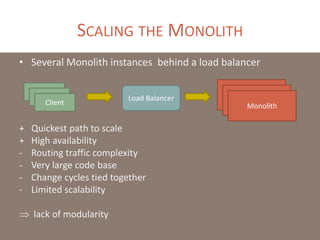
SCALING THE MONOLITH
• Several Monolith instances behind a load balancer
+ Quickest path to scale
+ High availability
- Routing traffic complexity
- Very large code base
- Change cycles tied together
- Limited scalability
 lack of modularity
Load Balancer
Monolith
Client
Client
Client
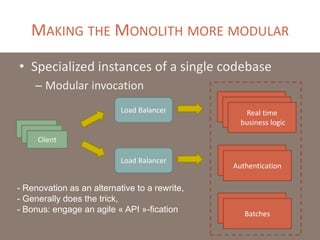
MAKING THE MONOLITH MORE MODULAR
• Specialized instances of a single codebase
– Modular invocation
Load Balancer Real time
business logic
Client
Client
Client
Monolith
MonolithAuthentication
Monolith
Batches
Load Balancer
- Renovation as an alternative to a rewrite,
- Generally does the trick,
- Bonus: engage an agile « API »-fication
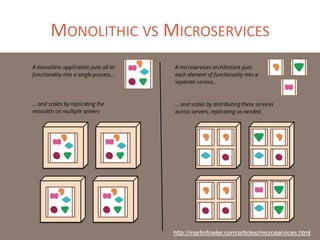
MONOLITHIC VS MICROSERVICES
http://martinfowler.com/articles/microservices.html
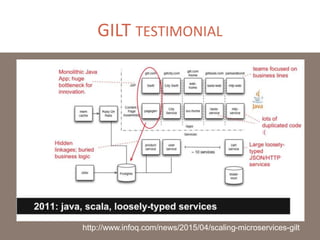
GILT TESTIMONIAL
http://www.infoq.com/news/2015/04/scaling-microservices-gilt
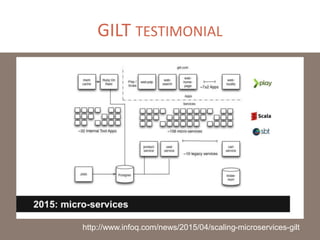
GILT TESTIMONIAL
http://www.infoq.com/news/2015/04/scaling-microservices-gilt
DESIGNING FOR MICROSERVICES
Common Characteristics
COMMON CHARACTERISTICS
• Componentization via Services
• Organized around Business Capabilities
• Products not Projects
• Smart endpoints and dumb pipes
• Decentralized governance
• Decentralized data management
• Infrastructure automation
• Design for failure
• Evolutionary design
http://martinfowler.com/articles/microservices.html
COMPONENTIZATION VIA SERVICES
• Services as components rather than libraries
• Services avoid tight coupling by using explicit
remote call mechanisms.
• Services are independently deployable and
scalable
COMPONENTIZATION VIA SERVICES
• Each service also provides a firm module
boundary
– business or technical,
– even allowing for different services to be written in
different programming languages,
– they can also be managed by different teams .
• A Microservice may consist of multiple processes
– that will always be developed and deployed together,
– Ex : an application process and a database that's only
used by that service.
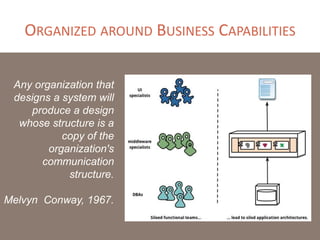
ORGANIZED AROUND BUSINESS CAPABILITIES
Any organization that
designs a system will
produce a design
whose structure is a
copy of the
organization's
communication
structure.
Melvyn Conway, 1967.
ORGANIZED AROUND BUSINESS CAPABILITIES
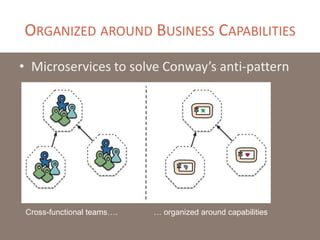
• Microservices to solve Conway’s anti-pattern
Cross-functional teams…. … organized around capabilities
PRODUCTS NOT PROJECTS
• Standard project model:
– deliver pieces of software which are then
considered to be completed,
– hand over to a maintenance organization and
disband the project team
• The Microservices style
– a team should own a product over its full lifetime
– Amazon : You build => You run it
SMART ENDPOINTS AND DUMB PIPES
• Be as decoupled and as cohesive as possible
– own domain logic,
– act more as filters in the classical Unix sense
– using simple RESTish protocols and lightweight messaging
• Smarts live in the services, not in-between the
endpoints
– No central tool / bus that includes sophisticated routing,
transformations, process, business rules
• Pre-requisite : turn the chatty in-process
communication of the monolith into coarser-grained
network messaging
DECENTRALIZED GOVERNANCE
• The common microservices practice is to choose the
best tool for each job
– Tools are shared inside and outside the organization
– Focus on common problems : data storage, IPC,
infrastructure automation
– Example : Netflix opensource libraries
• Favor independent evolution
– Consumer-driven Service contracts,
– Tolerant Reader Pattern
Minimal over-heads create an opportunity to have
teams responsible for all aspects
- Build their microservices and operate with 24/7 SLAs
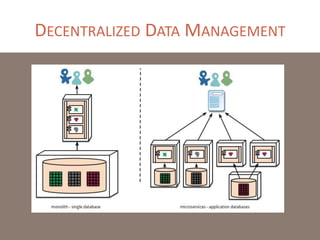
DECENTRALIZED DATA MANAGEMENT
• No unique data model approach
– the conceptual model differs between microservices
– Reinforce the separation of concerns
• Decentralized data storage
– Polyglot persistence is frequent in microservices architectures
• Manage inconsistencies via the business practices in
place throughout the organization
– Common design : reversal processes versus 2PC distributed
transactions
DECENTRALIZED DATA MANAGEMENT
INFRASTRUCTURE AUTOMATION
• CI/CD, Real-time monitoring, global system
and fine grained resources dashboards,
• Has become a standard practice
– thanks to public cloud providers,
– but also opensource tools
• a QA stake for monoliths
• a pre-requisite for microservices
DESIGN FOR FAILURE
• Any service call can fail
– Circuit Breaker pattern,
– async consumption
• Best practice : 1 to ZERO sync call
– Ex : Netflix Stack
• Hystrix / Eureka / Ribbon
– /! provide interop & implementations for various langages
• Infrastructure pre-requisites
– monitor and restore at scale
– dedicated tooling for simulation
– Ex : Netflix Simian Army (Chaos Monkey)
EVOLUTIONARY DESIGN
• More granular release planning
• Goal : change tolerance
– Identify change impacts quickly (via automation,
service contracts, automated dependency maps)
– Fix rather than revert
– In case of mandatory breaking change, use
versioning
• a last resort option in the microservices world
REAL WORLD MICROSERVICES
A bit of history, Best practices, Netflix Stack
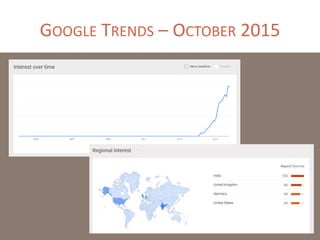
GOOGLE TRENDS – OCTOBER 2015
STATE OF THE ART
• Pioneers : Amazon, Netflix, Google
– Started Opensourcing their building blocks in 2010
– Democratized the Microservices architecture style
• Today
– Large corporation for complex systems that need
to evolve frequently (understand continuously)
– Digital startups to ensure their core business will
scale and embrace the long tail
AMAZON DNA
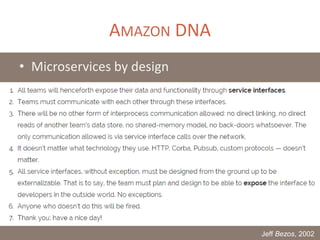
• Microservices by design
Jeff Bezos, 2002
NETFLIX ECOSYSTEM
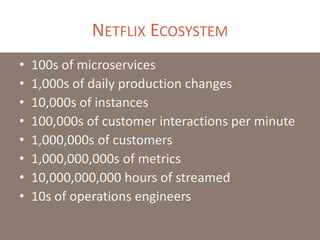
• 100s of microservices
• 1,000s of daily production changes
• 10,000s of instances
• 100,000s of customer interactions per minute
• 1,000,000s of customers
• 1,000,000,000s of metrics
• 10,000,000,000 hours of streamed
• 10s of operations engineers
RESILIENCE IN DISTRIBUTED SYSTEMS
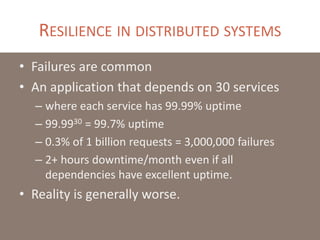
• Failures are common
• An application that depends on 30 services
– where each service has 99.99% uptime
– 99.9930 = 99.7% uptime
– 0.3% of 1 billion requests = 3,000,000 failures
– 2+ hours downtime/month even if all
dependencies have excellent uptime.
• Reality is generally worse.
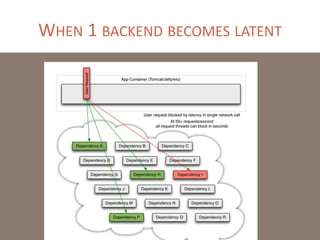
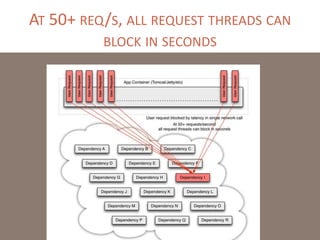
WHEN 1 BACKEND BECOMES LATENT
AT 50+ REQ/S, ALL REQUEST THREADS CAN
BLOCK IN SECONDS
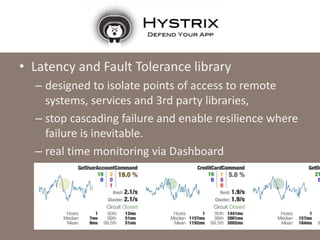
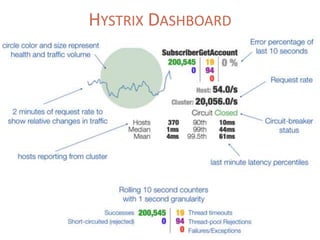
NETFLIX HYSTRIX
• Latency and Fault Tolerance library
– designed to isolate points of access to remote
systems, services and 3rd party libraries,
– stop cascading failure and enable resilience where
failure is inevitable.
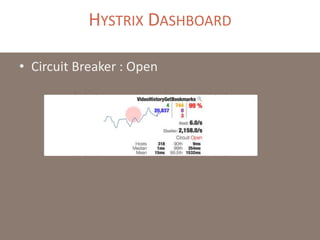
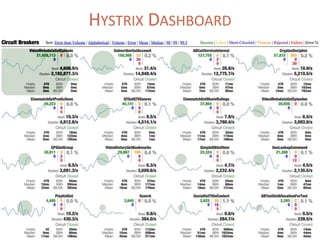
– real time monitoring via Dashboard
FAIL FAST, FAIL SILENT, FALLBACK
• Wrapping all calls to external systems (or “dependencies”) which
typically executes within a separate thread
• Timing-out calls that take longer than thresholds you define.
• Maintaining a small thread-pool for each dependency;
– if it becomes full, requests immediately rejected instead of queued up.
• Measuring successes, failures (exceptions thrown by client),
timeouts, and thread rejections.
• Tripping a circuit-breaker to stop all requests to a particular
service for a period of time,
– either manually or automatically (error percentage threshold)
• Performing fallback logic when a request fails, is rejected, times-
out, or short-circuits.
• Monitoring metrics and configuration changes in near real-time.
HYSTRIX DASHBOARD
HYSTRIX DASHBOARD
• Circuit Breaker : Open
HYSTRIX DASHBOARD
SERVICES DISCOVERY
• Typically, a Microservice gets created and
destroyed often
• It is reconfigured on the fly
• In near real-time, others should find it
• Examples
– Apache ZooKeeper
– HashiCorp Consul
– CoreOS Etcd
– Netflix Eureka
SERVICES CONSUMPTION
• Choose the best messaging infrastructure
– RPC / REST style,
– Request/Response, Streaming
– HTTP, HTTP2, TCP, UDP
• Support async consumption / aggregation
– Use parallel code structures of your clients
– GO, ES7 (BabelJS, Google Traceur)
• Ease consumption via clients SDKs
– Automated generated from API definitions
– Service providers tend to opensource their SDKs
• Facebook Parse, IBM Bluemix Mobile services
SERVICES CONSUMPTION
• Favor SDKs with large feature sets
– Basic REST is not an option for microservices
– integrate load balancing, fault tolerance, caching,
service discovery, multiple transport protocols (HTTP,
TCP, UDP)
• Netflix Ribbon
– Inter Process Communication with built in software
load balancers
– Integrates Hystrix and Eureka
– The primary usage model involves REST calls with
various serialization scheme support.
MICROSERVICES GATEWAY
• As an Edge service to access back-end microservices
– Authentication and Security
– Dynamic routing,
– Insights and Monitoring
– Stress testing : gradually increasing the traffic to a cluster in
order to gauge performance.
– Load Shedding : allocating capacity for each type of request
and dropping requests that go over the limit.
– Static Response handling : building some responses directly
at the edge instead of forwarding them to an internal cluster
– Multiregion Resiliency : routing requests across AWS regions
in order to diversify the ELB usage and move the edge closer
to users
MICROSERVICES GATEWAY
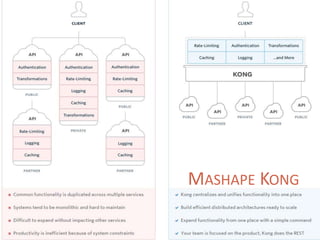
• Lots of building blocks
– Nginx
– Mashape Kong
• Needs integration with the other building
blocks of the Microservices communication
infrastructure
– Example : Netflix Zuul
MASHAPE KONG
COMMITTED TEAMS
• Ownership core to team organization
– built into the management of the organization
– make sure that teams have sufficient time to truly
own the applications that they are in charge
• “Products versus Projects” principle
• “Functional versus Divisional” organizations
– And give them 360 view on operations
SOUNDCLOUD TESTIMONIAL
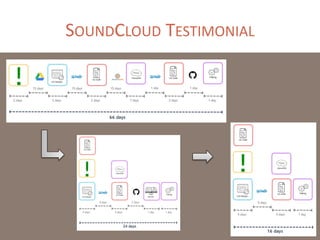
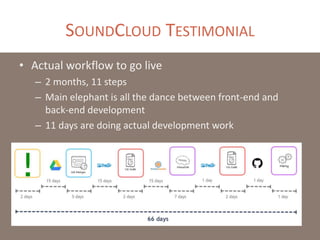
• Actual workflow to go live
– 2 months, 11 steps
– Main elephant is all the dance between front-end and
back-end development
– 11 days are doing actual development work
SOUNDCLOUD TESTIMONIAL
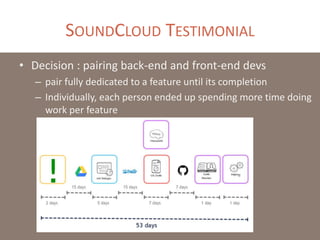
• Decision : pairing back-end and front-end devs
– pair fully dedicated to a feature until its completion
– Individually, each person ended up spending more time doing
work per feature
SOUNDCLOUD TESTIMONIAL
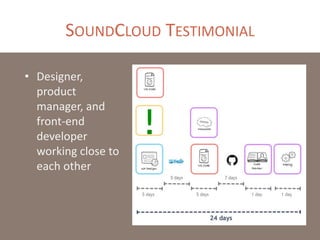
• Designer,
product
manager, and
front-end
developer
working close to
each other
SOUNDCLOUD TESTIMONIAL
• The irreducible complexity of the monolith
– Why do we need Pull Requests?
– Why do people make mistakes so often?
– Why is the code base so complex?
– Why do we need a single code base to implement
the many components?
– Why can’t we have economies of scale for
multiple, smaller, systems?
SOUNDCLOUD TESTIMONIAL
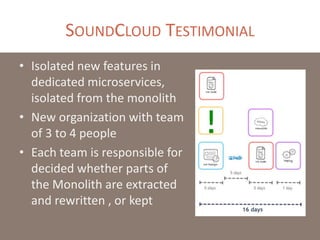
• Isolated new features in
dedicated microservices,
isolated from the monolith
• New organization with team
of 3 to 4 people
• Each team is responsible for
decided whether parts of
the Monolith are extracted
and rewritten , or kept
COMMITTED TEAMS
• Ownership core to team organization
– built into the management of the organization
– make sure that teams have sufficient time to truly
own the applications that they are in charge
• “Products versus Projects” principle
• “Functional versus Divisional” organizations
– And give them 360 view on operations
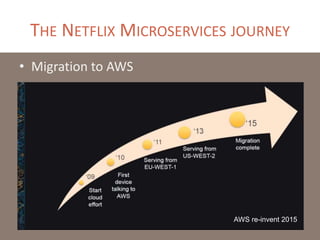
THE NETFLIX MICROSERVICES JOURNEY
• Migration to AWS
AWS re-invent 2015
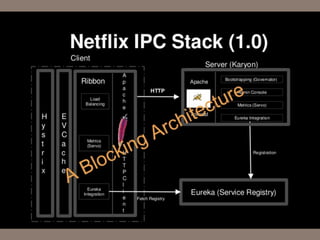
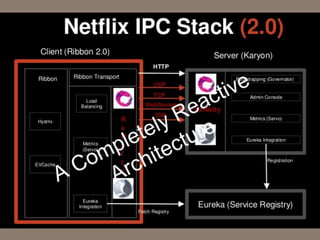
NETFLIX STACK
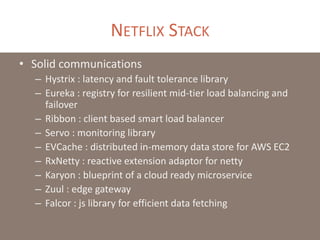
• Solid communications
– Hystrix : latency and fault tolerance library
– Eureka : registry for resilient mid-tier load balancing and
failover
– Ribbon : client based smart load balancer
– Servo : monitoring library
– EVCache : distributed in-memory data store for AWS EC2
– RxNetty : reactive extension adaptor for netty
– Karyon : blueprint of a cloud ready microservice
– Zuul : edge gateway
– Falcor : js library for efficient data fetching
NETFLIX STACK
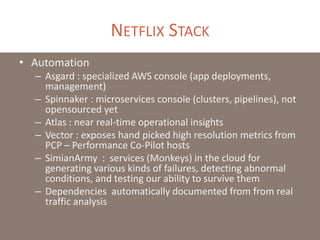
• Automation
– Asgard : specialized AWS console (app deployments,
management)
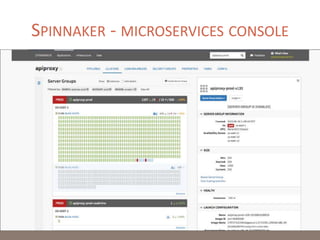
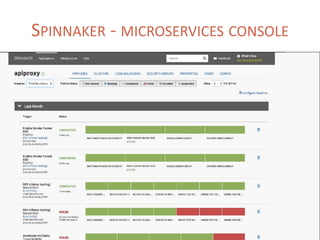
– Spinnaker : microservices console (clusters, pipelines), not
opensourced yet
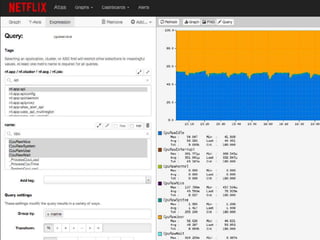
– Atlas : near real-time operational insights
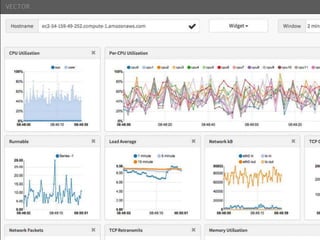
– Vector : exposes hand picked high resolution metrics from
PCP – Performance Co-Pilot hosts
– SimianArmy : services (Monkeys) in the cloud for
generating various kinds of failures, detecting abnormal
conditions, and testing our ability to survive them
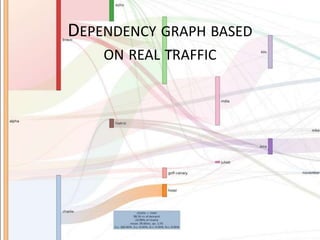
– Dependencies automatically documented from from real
traffic analysis
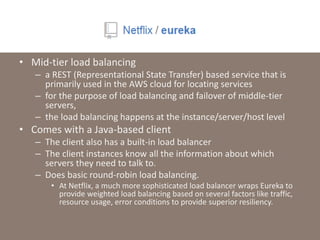
• Mid-tier load balancing
– a REST (Representational State Transfer) based service that is
primarily used in the AWS cloud for locating services
– for the purpose of load balancing and failover of middle-tier
servers,
– the load balancing happens at the instance/server/host level
• Comes with a Java-based client
– The client also has a built-in load balancer
– The client instances know all the information about which
servers they need to talk to.
– Does basic round-robin load balancing.
• At Netflix, a much more sophisticated load balancer wraps Eureka to
provide weighted load balancing based on several factors like traffic,
resource usage, error conditions to provide superior resiliency.
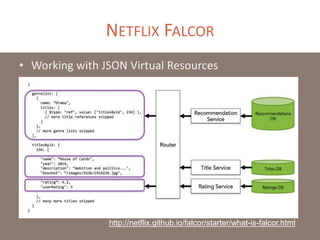
NETFLIX FALCOR
• Working with JSON Virtual Resources
http://netflix.github.io/falcor/starter/what-is-falcor.html
SPINNAKER - MICROSERVICES CONSOLE
DEPENDENCY GRAPH BASED
ON REAL TRAFFIC
VECTOR
FAQ
How big should be my microservices ?
RESTish microservices ?
Isn’t it SOA ?
The end of the monoliths ?
HOW BIG ?
• Microservices ownership implies that each team is
responsible for the entire lifecycle
– functional vs divisional organizations
– product management, development, QA, documentation,
support
• Sizing depends on the system you’re building
– Amazon 2PT principle - Two Pizza Teams
– 6 to 10 people to build/deploy/maintain a microservice
– an average microservice at Gilt consists of 2000 lines of
code, 5 source files, and is run on 3 instances in production
RESTISH MICROSERVICES ?
• REST
– Web lingua franca, 100% interoperable
– development cost is generally higher
– best practices : provide client sdks, (ex : generated from
Swagger/RAML or other API description languages)
– performance issues if not well-designed (chattiness)
– best practices : experience based and coarser grained APIs
• RPC
– optimized communication via binary formats
– automated generation from IDL, polyglot by default
– integrated support multiples scenarios : request/response,
streaming, bi-directional streaming
HOW RESTISH MICROSERVICES ?
• RPC vs REST style depends on the system you’re
building and teams existing skills set
• Whatever the style, your microservices architecture
MUST provide
– Services Discovery,
– Reliable Communications,
– Operational insights (logs, monitoring, alerts, real time
analysis)
GOT IT, BUT ISN’T IT SOA ?
• SOA so what ?
– Enterprise SOA
– Event-driven architecture (Pub/Sub)
– Streaming Services (real-time time series,
bidirectional)
– Container-Services (ala Docker)
– Nanoservices (ala AWS Lambda)
• Simply stated : Microservices are a SOA style for
systems whose first goal is to scale
 in details, let’s see how microservices differ from…
MICROSERVICES VS ENTERPRISE SOA
• Enterprise SOA is often seen as
– multi-year initiatives, costs millions
– complex protocols with productivity and interoperability
challenges
– central governance model that inhibits change
• Enterprise SOA is more about integrating siloed
monoliths
– generally via a smart and centralized service bus
• Microservices is scalable SOA
– an architectural style to design, develop and deploy a large
and complex system, so that it is easier to scale and evolve
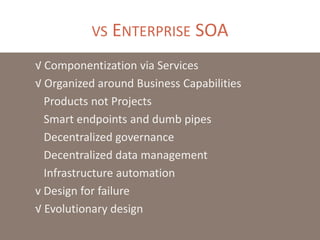
√ Componentization via Services
√ Organized around Business Capabilities
Products not Projects
Smart endpoints and dumb pipes
Decentralized governance
Decentralized data management
Infrastructure automation
v Design for failure
√ Evolutionary design
VS ENTERPRISE SOA
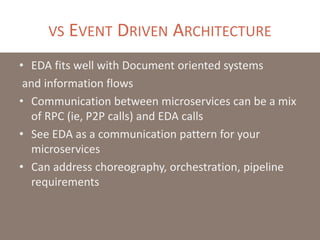
VS EVENT DRIVEN ARCHITECTURE
• EDA fits well with Document oriented systems
and information flows
• Communication between microservices can be a mix
of RPC (ie, P2P calls) and EDA calls
• See EDA as a communication pattern for your
microservices
• Can address choreography, orchestration, pipeline
requirements
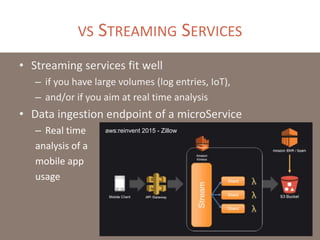
VS STREAMING SERVICES
• Streaming services fit well
– if you have large volumes (log entries, IoT),
– and/or if you aim at real time analysis
• Data ingestion endpoint of a microService
– Real time
analysis of a
mobile app
usage
aws:reinvent 2015 - Zillow
VS CONTAINER SERVICES
• Containers provide the infrastructure to
deploy your microservices independently one
from another
• See Container Services as a building block of
your global microservices architecture
VS NANOSERVICES
• Nanoservices are small pieces of code
(functions)
– Example : AWS Lambda, Auth0 Webtasks
• A microservice may leverage 1+ nanoservices
SUMP UP
MICROSERVICES PATTERNS
• Solid communications
– Fault tolerant librairies
– Service discovey
• Committed teams
– Devops culture
– Code/Test/Deploy/Support, 24/7
– Automation
• Ownership
– Organisation aligned with the strategy
– Insights via real time monitoring
MICROSERVICES IS A LONG JOURNEY
• Several years to implement
- Communications, infrastructure, automation, monitoring,
teams organization
- The price to pay for extreme agility in a complex system at
scale
- Prepare for iterative reworks
– Multiples languages => maintainability
– Numerous building blocks => updates & security
– EOL of microservices stacks : manage your technical debt
– Dependency Hell : keep control of your microservices
segmentation
– Ownership : is your organization ready ?
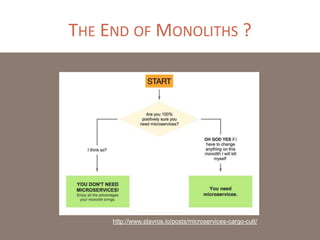
THE END OF MONOLITHS ?
http://www.stavros.io/posts/microservices-cargo-cult/
FROM MONOLITHS TO MICROSERVICES
• Velocity of innovation for complex systems
– Keep your monolith as is if you don’t need to
speed up features delivery
• To prepare for the journey
• switch from layered architecture to internal APIs,
• automate integration and deployment,
• reorganize from divisional to functional teams
committed to business and owning their code
REFERENCES
Microservices, Martin Fowler, James Lewis
– http://martinfowler.com/articles/microservices.html
A day in the life of a Netflix Engineer using 37% of the internet
– http://fr.slideshare.net/AmazonWebServices/dvo203-the-life-of-a-
netflix-engineer-using-37-of-the-internet
Dzone – Geting started with Microservices
– https://dzone.com/refcardz/getting-started-with-microservices
SoundCloud – How we ended up with microservices
– http://philcalcado.com/2015/09/08/how_we_ended_up_with_micros
ervices.html
gRPC - boilerplate to high-performance scalable APIs
– http://fr.slideshare.net/AboutYouGmbH/robert-kubis-grpc-boilerplate-
to-highperformance-scalable-apis-codetalks-2015
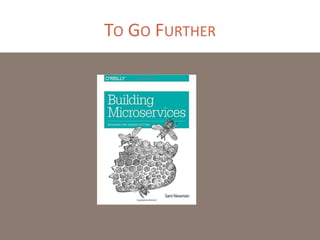
TO GO FURTHER
THANK YOU
Stève SFARTZ
• technical program manager
• enterprise architect, web API specialist,
• scalable & interoperable platforms builder
• dev & ops teams lead
Keeping in touch
• steve@sfartz.com
• twitter : @SteveSfartz

An introduction to Microservices

  • 1.
    INTRODUCTION TO MICROSERVICES Architectureprinciples, how to, patterns, examples October 2015, @SteveSfartz
  • 2.
    AGENDA • Why Microservices? • Designing Microservices • Microservices Patterns • Netflix stack • Comparing SOA styles • Sump up
  • 3.
    MICROSERVICES ARCHITECTURE Why, Monolithicstyle, Scaling the Monolith
  • 4.
    Microservices (2014) In short,the microservice architectural style is an approach to developing a single application as a suite of small services, each running in its own process and communicating with lightweight mechanisms, often an HTTP resource API. These services are built around business capabilities and independently deployable by fully automated deployment machinery. There is a bare minimum of centralized management of these services, which may be written in different programming languages and use different data storage technologies. Martin Fowler, James Lewis
  • 5.
    THE MONOLITHIC STYLE •An application built as a single unit, 3 main parts – a client-side user interface , – a database – and a server-side application that handles HTTP requests, execute domain logic, retrieve and update data from the database, and select and populate HTML views to be sent to the browser. • This server-side application is a monolith – a single logical executable – any change requires building and deploying a new version
  • 6.
    THE MONOLITHIC STYLE •Natural way to build a system – code specific to each layer (UI, Logic, DB) – generally a minimum of 3 languages – divided into classes, functions and namespaces • Locally built and tested on devs’ machines • CI/CD pipeline to secure production
  • 7.
    SCALING THE MONOLITH •Several Monolith instances behind a load balancer + Quickest path to scale + High availability - Routing traffic complexity - Very large code base - Change cycles tied together - Limited scalability  lack of modularity Load Balancer Monolith Client Client Client
  • 8.
    MAKING THE MONOLITHMORE MODULAR • Specialized instances of a single codebase – Modular invocation Load Balancer Real time business logic Client Client Client Monolith MonolithAuthentication Monolith Batches Load Balancer - Renovation as an alternative to a rewrite, - Generally does the trick, - Bonus: engage an agile « API »-fication
  • 9.
  • 10.
  • 11.
  • 12.
  • 13.
    COMMON CHARACTERISTICS • Componentizationvia Services • Organized around Business Capabilities • Products not Projects • Smart endpoints and dumb pipes • Decentralized governance • Decentralized data management • Infrastructure automation • Design for failure • Evolutionary design http://martinfowler.com/articles/microservices.html
  • 14.
    COMPONENTIZATION VIA SERVICES •Services as components rather than libraries • Services avoid tight coupling by using explicit remote call mechanisms. • Services are independently deployable and scalable
  • 15.
    COMPONENTIZATION VIA SERVICES •Each service also provides a firm module boundary – business or technical, – even allowing for different services to be written in different programming languages, – they can also be managed by different teams . • A Microservice may consist of multiple processes – that will always be developed and deployed together, – Ex : an application process and a database that's only used by that service.
  • 16.
    ORGANIZED AROUND BUSINESSCAPABILITIES Any organization that designs a system will produce a design whose structure is a copy of the organization's communication structure. Melvyn Conway, 1967.
  • 17.
    ORGANIZED AROUND BUSINESSCAPABILITIES • Microservices to solve Conway’s anti-pattern Cross-functional teams…. … organized around capabilities
  • 18.
    PRODUCTS NOT PROJECTS •Standard project model: – deliver pieces of software which are then considered to be completed, – hand over to a maintenance organization and disband the project team • The Microservices style – a team should own a product over its full lifetime – Amazon : You build => You run it
  • 19.
    SMART ENDPOINTS ANDDUMB PIPES • Be as decoupled and as cohesive as possible – own domain logic, – act more as filters in the classical Unix sense – using simple RESTish protocols and lightweight messaging • Smarts live in the services, not in-between the endpoints – No central tool / bus that includes sophisticated routing, transformations, process, business rules • Pre-requisite : turn the chatty in-process communication of the monolith into coarser-grained network messaging
  • 20.
    DECENTRALIZED GOVERNANCE • Thecommon microservices practice is to choose the best tool for each job – Tools are shared inside and outside the organization – Focus on common problems : data storage, IPC, infrastructure automation – Example : Netflix opensource libraries • Favor independent evolution – Consumer-driven Service contracts, – Tolerant Reader Pattern Minimal over-heads create an opportunity to have teams responsible for all aspects - Build their microservices and operate with 24/7 SLAs
  • 21.
    DECENTRALIZED DATA MANAGEMENT •No unique data model approach – the conceptual model differs between microservices – Reinforce the separation of concerns • Decentralized data storage – Polyglot persistence is frequent in microservices architectures • Manage inconsistencies via the business practices in place throughout the organization – Common design : reversal processes versus 2PC distributed transactions
  • 22.
  • 23.
    INFRASTRUCTURE AUTOMATION • CI/CD,Real-time monitoring, global system and fine grained resources dashboards, • Has become a standard practice – thanks to public cloud providers, – but also opensource tools • a QA stake for monoliths • a pre-requisite for microservices
  • 24.
    DESIGN FOR FAILURE •Any service call can fail – Circuit Breaker pattern, – async consumption • Best practice : 1 to ZERO sync call – Ex : Netflix Stack • Hystrix / Eureka / Ribbon – /! provide interop & implementations for various langages • Infrastructure pre-requisites – monitor and restore at scale – dedicated tooling for simulation – Ex : Netflix Simian Army (Chaos Monkey)
  • 25.
    EVOLUTIONARY DESIGN • Moregranular release planning • Goal : change tolerance – Identify change impacts quickly (via automation, service contracts, automated dependency maps) – Fix rather than revert – In case of mandatory breaking change, use versioning • a last resort option in the microservices world
  • 26.
    REAL WORLD MICROSERVICES Abit of history, Best practices, Netflix Stack
  • 27.
    GOOGLE TRENDS –OCTOBER 2015
  • 28.
    STATE OF THEART • Pioneers : Amazon, Netflix, Google – Started Opensourcing their building blocks in 2010 – Democratized the Microservices architecture style • Today – Large corporation for complex systems that need to evolve frequently (understand continuously) – Digital startups to ensure their core business will scale and embrace the long tail
  • 29.
    AMAZON DNA • Microservicesby design Jeff Bezos, 2002
  • 30.
    NETFLIX ECOSYSTEM • 100sof microservices • 1,000s of daily production changes • 10,000s of instances • 100,000s of customer interactions per minute • 1,000,000s of customers • 1,000,000,000s of metrics • 10,000,000,000 hours of streamed • 10s of operations engineers
  • 31.
    RESILIENCE IN DISTRIBUTEDSYSTEMS • Failures are common • An application that depends on 30 services – where each service has 99.99% uptime – 99.9930 = 99.7% uptime – 0.3% of 1 billion requests = 3,000,000 failures – 2+ hours downtime/month even if all dependencies have excellent uptime. • Reality is generally worse.
  • 32.
    WHEN 1 BACKENDBECOMES LATENT
  • 33.
    AT 50+ REQ/S,ALL REQUEST THREADS CAN BLOCK IN SECONDS
  • 34.
    NETFLIX HYSTRIX • Latencyand Fault Tolerance library – designed to isolate points of access to remote systems, services and 3rd party libraries, – stop cascading failure and enable resilience where failure is inevitable. – real time monitoring via Dashboard
  • 35.
    FAIL FAST, FAILSILENT, FALLBACK • Wrapping all calls to external systems (or “dependencies”) which typically executes within a separate thread • Timing-out calls that take longer than thresholds you define. • Maintaining a small thread-pool for each dependency; – if it becomes full, requests immediately rejected instead of queued up. • Measuring successes, failures (exceptions thrown by client), timeouts, and thread rejections. • Tripping a circuit-breaker to stop all requests to a particular service for a period of time, – either manually or automatically (error percentage threshold) • Performing fallback logic when a request fails, is rejected, times- out, or short-circuits. • Monitoring metrics and configuration changes in near real-time.
  • 36.
  • 37.
  • 38.
  • 39.
    SERVICES DISCOVERY • Typically,a Microservice gets created and destroyed often • It is reconfigured on the fly • In near real-time, others should find it • Examples – Apache ZooKeeper – HashiCorp Consul – CoreOS Etcd – Netflix Eureka
  • 40.
    SERVICES CONSUMPTION • Choosethe best messaging infrastructure – RPC / REST style, – Request/Response, Streaming – HTTP, HTTP2, TCP, UDP • Support async consumption / aggregation – Use parallel code structures of your clients – GO, ES7 (BabelJS, Google Traceur) • Ease consumption via clients SDKs – Automated generated from API definitions – Service providers tend to opensource their SDKs • Facebook Parse, IBM Bluemix Mobile services
  • 41.
    SERVICES CONSUMPTION • FavorSDKs with large feature sets – Basic REST is not an option for microservices – integrate load balancing, fault tolerance, caching, service discovery, multiple transport protocols (HTTP, TCP, UDP) • Netflix Ribbon – Inter Process Communication with built in software load balancers – Integrates Hystrix and Eureka – The primary usage model involves REST calls with various serialization scheme support.
  • 42.
    MICROSERVICES GATEWAY • Asan Edge service to access back-end microservices – Authentication and Security – Dynamic routing, – Insights and Monitoring – Stress testing : gradually increasing the traffic to a cluster in order to gauge performance. – Load Shedding : allocating capacity for each type of request and dropping requests that go over the limit. – Static Response handling : building some responses directly at the edge instead of forwarding them to an internal cluster – Multiregion Resiliency : routing requests across AWS regions in order to diversify the ELB usage and move the edge closer to users
  • 43.
    MICROSERVICES GATEWAY • Lotsof building blocks – Nginx – Mashape Kong • Needs integration with the other building blocks of the Microservices communication infrastructure – Example : Netflix Zuul
  • 44.
  • 45.
    COMMITTED TEAMS • Ownershipcore to team organization – built into the management of the organization – make sure that teams have sufficient time to truly own the applications that they are in charge • “Products versus Projects” principle • “Functional versus Divisional” organizations – And give them 360 view on operations
  • 46.
  • 47.
    SOUNDCLOUD TESTIMONIAL • Actualworkflow to go live – 2 months, 11 steps – Main elephant is all the dance between front-end and back-end development – 11 days are doing actual development work
  • 48.
    SOUNDCLOUD TESTIMONIAL • Decision: pairing back-end and front-end devs – pair fully dedicated to a feature until its completion – Individually, each person ended up spending more time doing work per feature
  • 49.
    SOUNDCLOUD TESTIMONIAL • Designer, product manager,and front-end developer working close to each other
  • 50.
    SOUNDCLOUD TESTIMONIAL • Theirreducible complexity of the monolith – Why do we need Pull Requests? – Why do people make mistakes so often? – Why is the code base so complex? – Why do we need a single code base to implement the many components? – Why can’t we have economies of scale for multiple, smaller, systems?
  • 51.
    SOUNDCLOUD TESTIMONIAL • Isolatednew features in dedicated microservices, isolated from the monolith • New organization with team of 3 to 4 people • Each team is responsible for decided whether parts of the Monolith are extracted and rewritten , or kept
  • 52.
    COMMITTED TEAMS • Ownershipcore to team organization – built into the management of the organization – make sure that teams have sufficient time to truly own the applications that they are in charge • “Products versus Projects” principle • “Functional versus Divisional” organizations – And give them 360 view on operations
  • 53.
    THE NETFLIX MICROSERVICESJOURNEY • Migration to AWS AWS re-invent 2015
  • 56.
    NETFLIX STACK • Solidcommunications – Hystrix : latency and fault tolerance library – Eureka : registry for resilient mid-tier load balancing and failover – Ribbon : client based smart load balancer – Servo : monitoring library – EVCache : distributed in-memory data store for AWS EC2 – RxNetty : reactive extension adaptor for netty – Karyon : blueprint of a cloud ready microservice – Zuul : edge gateway – Falcor : js library for efficient data fetching
  • 57.
    NETFLIX STACK • Automation –Asgard : specialized AWS console (app deployments, management) – Spinnaker : microservices console (clusters, pipelines), not opensourced yet – Atlas : near real-time operational insights – Vector : exposes hand picked high resolution metrics from PCP – Performance Co-Pilot hosts – SimianArmy : services (Monkeys) in the cloud for generating various kinds of failures, detecting abnormal conditions, and testing our ability to survive them – Dependencies automatically documented from from real traffic analysis
  • 58.
    • Mid-tier loadbalancing – a REST (Representational State Transfer) based service that is primarily used in the AWS cloud for locating services – for the purpose of load balancing and failover of middle-tier servers, – the load balancing happens at the instance/server/host level • Comes with a Java-based client – The client also has a built-in load balancer – The client instances know all the information about which servers they need to talk to. – Does basic round-robin load balancing. • At Netflix, a much more sophisticated load balancer wraps Eureka to provide weighted load balancing based on several factors like traffic, resource usage, error conditions to provide superior resiliency.
  • 59.
    NETFLIX FALCOR • Workingwith JSON Virtual Resources http://netflix.github.io/falcor/starter/what-is-falcor.html
  • 60.
  • 61.
  • 62.
  • 64.
  • 65.
    FAQ How big shouldbe my microservices ? RESTish microservices ? Isn’t it SOA ? The end of the monoliths ?
  • 66.
    HOW BIG ? •Microservices ownership implies that each team is responsible for the entire lifecycle – functional vs divisional organizations – product management, development, QA, documentation, support • Sizing depends on the system you’re building – Amazon 2PT principle - Two Pizza Teams – 6 to 10 people to build/deploy/maintain a microservice – an average microservice at Gilt consists of 2000 lines of code, 5 source files, and is run on 3 instances in production
  • 67.
    RESTISH MICROSERVICES ? •REST – Web lingua franca, 100% interoperable – development cost is generally higher – best practices : provide client sdks, (ex : generated from Swagger/RAML or other API description languages) – performance issues if not well-designed (chattiness) – best practices : experience based and coarser grained APIs • RPC – optimized communication via binary formats – automated generation from IDL, polyglot by default – integrated support multiples scenarios : request/response, streaming, bi-directional streaming
  • 68.
    HOW RESTISH MICROSERVICES? • RPC vs REST style depends on the system you’re building and teams existing skills set • Whatever the style, your microservices architecture MUST provide – Services Discovery, – Reliable Communications, – Operational insights (logs, monitoring, alerts, real time analysis)
  • 69.
    GOT IT, BUTISN’T IT SOA ? • SOA so what ? – Enterprise SOA – Event-driven architecture (Pub/Sub) – Streaming Services (real-time time series, bidirectional) – Container-Services (ala Docker) – Nanoservices (ala AWS Lambda) • Simply stated : Microservices are a SOA style for systems whose first goal is to scale  in details, let’s see how microservices differ from…
  • 70.
    MICROSERVICES VS ENTERPRISESOA • Enterprise SOA is often seen as – multi-year initiatives, costs millions – complex protocols with productivity and interoperability challenges – central governance model that inhibits change • Enterprise SOA is more about integrating siloed monoliths – generally via a smart and centralized service bus • Microservices is scalable SOA – an architectural style to design, develop and deploy a large and complex system, so that it is easier to scale and evolve
  • 71.
    √ Componentization viaServices √ Organized around Business Capabilities Products not Projects Smart endpoints and dumb pipes Decentralized governance Decentralized data management Infrastructure automation v Design for failure √ Evolutionary design VS ENTERPRISE SOA
  • 72.
    VS EVENT DRIVENARCHITECTURE • EDA fits well with Document oriented systems and information flows • Communication between microservices can be a mix of RPC (ie, P2P calls) and EDA calls • See EDA as a communication pattern for your microservices • Can address choreography, orchestration, pipeline requirements
  • 73.
    VS STREAMING SERVICES •Streaming services fit well – if you have large volumes (log entries, IoT), – and/or if you aim at real time analysis • Data ingestion endpoint of a microService – Real time analysis of a mobile app usage aws:reinvent 2015 - Zillow
  • 74.
    VS CONTAINER SERVICES •Containers provide the infrastructure to deploy your microservices independently one from another • See Container Services as a building block of your global microservices architecture
  • 75.
    VS NANOSERVICES • Nanoservicesare small pieces of code (functions) – Example : AWS Lambda, Auth0 Webtasks • A microservice may leverage 1+ nanoservices
  • 76.
  • 77.
    MICROSERVICES PATTERNS • Solidcommunications – Fault tolerant librairies – Service discovey • Committed teams – Devops culture – Code/Test/Deploy/Support, 24/7 – Automation • Ownership – Organisation aligned with the strategy – Insights via real time monitoring
  • 78.
    MICROSERVICES IS ALONG JOURNEY • Several years to implement - Communications, infrastructure, automation, monitoring, teams organization - The price to pay for extreme agility in a complex system at scale - Prepare for iterative reworks – Multiples languages => maintainability – Numerous building blocks => updates & security – EOL of microservices stacks : manage your technical debt – Dependency Hell : keep control of your microservices segmentation – Ownership : is your organization ready ?
  • 79.
    THE END OFMONOLITHS ? http://www.stavros.io/posts/microservices-cargo-cult/
  • 80.
    FROM MONOLITHS TOMICROSERVICES • Velocity of innovation for complex systems – Keep your monolith as is if you don’t need to speed up features delivery • To prepare for the journey • switch from layered architecture to internal APIs, • automate integration and deployment, • reorganize from divisional to functional teams committed to business and owning their code
  • 81.
    REFERENCES Microservices, Martin Fowler,James Lewis – http://martinfowler.com/articles/microservices.html A day in the life of a Netflix Engineer using 37% of the internet – http://fr.slideshare.net/AmazonWebServices/dvo203-the-life-of-a- netflix-engineer-using-37-of-the-internet Dzone – Geting started with Microservices – https://dzone.com/refcardz/getting-started-with-microservices SoundCloud – How we ended up with microservices – http://philcalcado.com/2015/09/08/how_we_ended_up_with_micros ervices.html gRPC - boilerplate to high-performance scalable APIs – http://fr.slideshare.net/AboutYouGmbH/robert-kubis-grpc-boilerplate- to-highperformance-scalable-apis-codetalks-2015
  • 82.
  • 83.
    THANK YOU Stève SFARTZ •technical program manager • enterprise architect, web API specialist, • scalable & interoperable platforms builder • dev & ops teams lead Keeping in touch • steve@sfartz.com • twitter : @SteveSfartz

Editor's Notes

  • #2 - tour d'horizon des différents types d'architectures : architecture orientées composants, services et hub de services, REST et microservices - 15' - comment créer un micro-service : fondamentaux, protocoles - 45' - état de l'art, exemple de microservices, références Amazon, Netflix - 45' - enjeux en entreprise (comment appliquer à l'échelle de son organisation) - 45'
  • #10 Couleur
  • #46 http://www.site-reliability-engineering.info/2014/04/what-is-site-reliability-engineering.html
  • #48 The actual flow was something like this: 1. Somebody comes up with an idea for a feature. They then write a fairly lightweight spec, with some screen mockups, and stores that in a Google Drive document. 2. The spec stays in this document until somebody has time to actually work on it. 3.The very small design team would get the spec and design the user experience for it. This would then become a card in the Trello board owned by the Web team. 4. The card would sit on the Trello board for a while, at least a 2-weeks iteration, until an engineer was free to pick it up. 5.The engineer would start working on it. After converting the design into a proper browser-based experience using fake/static data, the engineer would write down what changes in the Rails API they would need for this experience to work. This would go into Pivotal Tracker, the tool of choice for the App team. 6. The card would sit on Pivotal until somebody from the App team was free to look at it, often taking another two-week iteration. 7. The App team member would write the code, integration tests and everything required to get the API live. Then they would update the Trello issue, letting the Web team know their part was done. 8. The updated Trello card would sit in the backlog for a while more, waiting for the engineer in the Web team to finish whatever they started doing while waiting for the back-end work. 9. The Web team developer would make their client-side code match whatever kinks from the back-end implementation, and would give the green light for a deploy. 10. As deployments were risky, slow, and painful, the App team would wait for several features to land into the master branch before deploying it to production. This means the feature would be sitting in source control for a couple of days, and that very frequently your feature would be rolled back because of a problem in a completely unrelated part of the code. 11. At some point, the feature finally gets deployed to production.
  • #53 http://www.site-reliability-engineering.info/2014/04/what-is-site-reliability-engineering.html
  • #84 Entreprise / Web / Mobile Architectures Opensource Java & Microsoft .net Platforms