

Prepared by: Roqui M. Gonzaga
Hypermedia
Hypermedia is a computer-based information retrieval
system that enables a user to gain or provide access to texts,
audio, and video recordings, photographs, and computer
graphics related to a particular subject.
Hypermedia is anything that allows the user to gather
information in a nonlinear way.
Hypermedia is a database format similar to hypertext in
which text, sound, or display can be accessed directly from
the display.
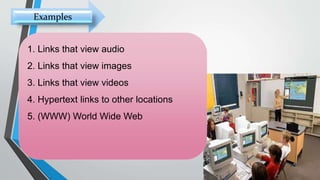
Examples
1. Links that view audio
2. Links that view images
3. Links that view videos
4. Hypertext links to other locations
5. (WWW) World Wide Web
CHARACTERISTICS OF
HYPERMEDIA APPLICATION
1. Learner control
The learner makes his own
decisions on the path, flow or
events of instruction.
CHARACTERISTICS OF
HYPERMEDIA APPLICATION
2.
LEARNER WIDE RANGE OF
NAVIGATION ROUTES
- For the most part, the learner
controls the sequence and pace of his
path depending on his ability and
motivation.
CHARACTERISTICS OF
HYPERMEDIA APPLICATION
3. VARIETY OF MEDIA
Hypermedia includes more than one media
(text, graphics, audio, animation and video
clip) but does not necessarily use all types of
media in one presentation.
 One of the major advantages of hypermedia is the ability to quickly follow
associations and look up related material.
 References can be traced both back-wards and forward in a way which can be
difficult and time consuming with printed media. In addition, the user can annotate
the material and create new references.
 Information can also be structured in a variety of ways. Multiple organizations of
the same material allow for specialized structures for different user categories.
(Conklin 1986, 1987).
 The student can browse the material and find new information as she explores a
subject area.
 hypermedia systems is usually considered as fun to use.
advantages
 Ease of browsing might increase the risk that the learner skips
through the material much to hasty, and thus get a shallow and
fragmented conception of the subject.
 The risk of getting disoriented can result in confusion rather than
understanding, especially if the user jumps around between different
nodes in a more or less random manner.
 Using a hypermedia system involves a certain cognitive overhead .
The problems is that the user has to interact with the system in order
to accomplish anything, which can be more or less complex.
disadvantages
Uses in education
 Hypermedia systems are used in educational environment. The
active participation of students is one of the major advantages of
hypermedia systems.
 Hypermedia enables students to explore and construct their own
learning.
 This method of learning breaks down the barriers of time and
place, allowing maximum flexibility for the learner. Students are
provided a means to learn individually and at their own speed.
Students can repeat difficult concepts, or skip already mastered
skill areas.
That’s
All!!!
Thank you
for listening!
reporters
Roqui m. gonzaga
John vernie r. gambito

Understanding Hypermedia (Educational Technology 2)

  • 1.
  • 2.
    Hypermedia Hypermedia is acomputer-based information retrieval system that enables a user to gain or provide access to texts, audio, and video recordings, photographs, and computer graphics related to a particular subject. Hypermedia is anything that allows the user to gather information in a nonlinear way. Hypermedia is a database format similar to hypertext in which text, sound, or display can be accessed directly from the display.
  • 3.
    Examples 1. Links thatview audio 2. Links that view images 3. Links that view videos 4. Hypertext links to other locations 5. (WWW) World Wide Web
  • 4.
    CHARACTERISTICS OF HYPERMEDIA APPLICATION 1.Learner control The learner makes his own decisions on the path, flow or events of instruction.
  • 5.
    CHARACTERISTICS OF HYPERMEDIA APPLICATION 2. LEARNERWIDE RANGE OF NAVIGATION ROUTES - For the most part, the learner controls the sequence and pace of his path depending on his ability and motivation.
  • 6.
    CHARACTERISTICS OF HYPERMEDIA APPLICATION 3.VARIETY OF MEDIA Hypermedia includes more than one media (text, graphics, audio, animation and video clip) but does not necessarily use all types of media in one presentation.
  • 7.
     One ofthe major advantages of hypermedia is the ability to quickly follow associations and look up related material.  References can be traced both back-wards and forward in a way which can be difficult and time consuming with printed media. In addition, the user can annotate the material and create new references.  Information can also be structured in a variety of ways. Multiple organizations of the same material allow for specialized structures for different user categories. (Conklin 1986, 1987).  The student can browse the material and find new information as she explores a subject area.  hypermedia systems is usually considered as fun to use. advantages
  • 8.
     Ease ofbrowsing might increase the risk that the learner skips through the material much to hasty, and thus get a shallow and fragmented conception of the subject.  The risk of getting disoriented can result in confusion rather than understanding, especially if the user jumps around between different nodes in a more or less random manner.  Using a hypermedia system involves a certain cognitive overhead . The problems is that the user has to interact with the system in order to accomplish anything, which can be more or less complex. disadvantages
  • 9.
    Uses in education Hypermedia systems are used in educational environment. The active participation of students is one of the major advantages of hypermedia systems.  Hypermedia enables students to explore and construct their own learning.  This method of learning breaks down the barriers of time and place, allowing maximum flexibility for the learner. Students are provided a means to learn individually and at their own speed. Students can repeat difficult concepts, or skip already mastered skill areas.
  • 10.
  • 11.
  • 12.