MMGD0101
INTRODUCTION TO MULTIMEDIA
Chapter 1
Introduction to Multimedia and
Hypermedia
What is Multimedia?
Multimedia means that computer
information can be represented through
audio, video, and animation in addition to
traditional media (i.e., text,
graphics/drawings, images).
What is Multimedia?
Multimedia is the field concerned with the
computer controlled integration of text,
graphics, drawings, still and moving
images (Video), animation, audio, and any
other media where every type of
information can be represented, stored,
transmitted and processed digitally.
What is Multimedia?
Multimedia is a media that uses multiple
form of information content and information
processing.
History of Multimedia
Multimedia is a media that uses multiple
form of information content and information
processing.
The Basic Elements of
Multimedia
Text
Graphic
Animation
Video
Audio
The Basic Elements of
Multimedia
 TEXT
 characters that are used to create words,
sentences, and paragraphs.
Titles
•Monitor
•Keyboard
•Mouse
•Speaker
Multimedia is a rich medium that
accommodates numerous instructional
strategies. Multimedia addresses many of the
challenges of instruction in both the academic
and corporate environments. It is accessible
over distance and time and provides a vehicle
for consistent delivery. Multimedia can provide
the best medium with which to communicate a
concept.
The Basic Elements of
Multimedia
 Graphics
 A digital representation of non-text
information, such as a drawing, chart, or
photograph.
The Basic Elements of
Multimedia
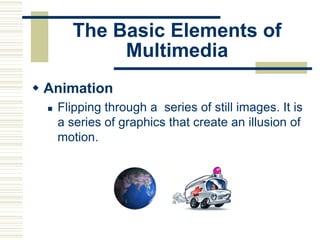
 Animation
 Flipping through a series of still images. It is
a series of graphics that create an illusion of
motion.
The Basic Elements of
Multimedia
 Video
 photographic images that are played back at
speeds of 15 to 30 frames a second and the
provide the appearance of full motion.
The Basic Elements of
Multimedia
 Audio
 music, speech, or any other sound.
Categorization
Linear
Presentation
Non-linear
Interactive
Two types of Multimedia presentation
Categorization
Linear active content progresses often without any
navigational control for the viewer such as a
cinema presentation.
Non-linear uses interactivity to control progress as
with a video game or self-paced computer based
training. Hypermedia is an example of non-linear
content.
Usage
Multimedia finds its application in various
areas including, but not limited to:
Advertisements
Art
Education
Entertainment
Engineering
Medicine
Mathematics
Business
Scientific research
Usage
In education, multimedia can be used as a source of
information. Students can search encyclopaedias such
as Encarta, which provide facts on a variety of different
topics using multimedia presentations.
Teachers can use multimedia presentations to make
lessons more interesting by using animations to highlight
or demonstrate key points.
Usage
A multimedia presentation can also make it easier for
pupils to read text rather than trying to read a teacher’s
writing on the board.
Programs which show pictures and text whilst children
are reading a story can help them learn to read; these too
are a form of multimedia presentation.
Usage
Multimedia is used for advertising and selling products on
the Internet.
Some businesses use multimedia for training where CD-
ROMs or on-line tutorials allow staff to learn at their own
speed, and at a suitable time to the staff and the
company.
Another benefit is that the company do not have to pay
the additional expenses of an employee attending a
course away from the workplace.
Usage
People use the Internet for a wide range of reasons,
including shopping and finding out about their hobbies.
The Internet has many multimedia elements embedded
in web pages and web browsers support a variety of
multimedia formats.
Many computer games use sound tracks, 3D graphics
and video clips.
Usage
Computer-Based Training Teaching Aid
Usage
References Entertainment
Usage
Simulation Virtual Reality
Usage
Virtual Surgery Information Kiosk
Advantages of using
Multimedia
 It is very user-friendly. It doesn’t take much energy out
of the user, in the sense that you can sit and watch the
presentation, you can read the text and hear the audio.
 It is multi sensorial. It uses a lot of the user’s senses
while making use of multimedia, for example hearing,
seeing and talking.
Advantages of using
Multimedia
 It is integrated and interactive. All the different
mediums are integrated through the digitisation
process. Interactivity is heightened by the possibility of
easy feedback.
 It is flexible. Being digital, this media can easily be
changed to fit different situations and audiences.
Advantages of using
Multimedia
 It can be used for a wide variety of audiences, ranging
from one person to a whole group.
Disadvantages of using
Multimedia
 Information overload. Because it is so easy to use, it
can contain too much information at once.
 It takes time to compile. Even though it is flexible, it
takes time to put the original draft together.
Disadvantages of using
Multimedia
 It can be expensive. As mentioned in one of my
previous posts, multimedia makes use of a wide range
of resources, which can cost you a large amount of
money.
 Too much makes it unpractical. Large files like video
and audio has an effect of the time it takes for your
presentation to load. Adding too much can mean that
you have to use a larger computer to store the files.
Hypertext and Hypermedia
Hypertext is a text which contains links to
other texts. The term was invented by
Ted Nelson around 1965.
Hypertext and Hypermedia
Information is linked and cross-referenced
in many different ways and is widely
available to end users.
Hypertext means a database in which
information (text) has been organized
nonlinearly. The database consists of
pages and links between pages.
Hypertext and Hypermedia
 A link is defined by source and
destination nodes, and by an anchor in
the source node.
 Two types of link:
 Internal link
 External link
Hypertext and Hypermedia
Hypermedia is not constrained to be text-
based. It can include other media, e.g.,
graphics, images, and especially the
continuous media – sound and video.
Hypertext and Hypermedia
Designing Hypermedia
 Important questions in designing the
hypermedia are:
 Converting linear text to hypertext
 Text format conversions
 Dividing the text into nodes
 Link structures, automatic generation of
links
 Are nodes in a database or are they
separate files on file system
 Client-server or standalone
Characteristics of
Hypermedia
 It must be possible to use hypermedia both for
writing and reading information.
 The information comprises non-sequential
structures, and may thus be followed along
alternative paths.
 The information must follow natural
associations from one information unit to
another.
 The information may be hierarchically
structured.
Characteristics of
Hypermedia
 Each information unit is presented in a
separate on-screen window.
 It must be possible to share the information or
parts of it among several users.
 It must be possible to have several people
working against the database at the same
time.
 The information resides in a database.
Delivering Multimedia
 Multimedia can be delivered using
 Optical disk (CD-based)
 Over a distributed network (Web-
based)
Delivering Multimedia
Optical Disks
 The most cost-effective
method of delivery for
multimedia materials.
 These devices are used to
store large amounts of some
combination of text, graphics,
sound, and moving video.
Delivering Multimedia
Optical Disks
Media Storage
Compact Disc (CD) 650MB
Digital Versatile Disc (DVD) 4.7GB
Bluray Disc (BD) 27GB
Delivering Multimedia
Distributed Network
 Suitable for web-based
content eg. website
 Files need to be compress
before transfer
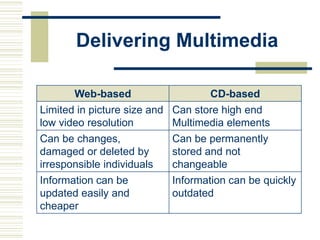
Delivering Multimedia
Web-based CD-based
Limited in picture size and
low video resolution
Can store high end
Multimedia elements
Can be changes,
damaged or deleted by
irresponsible individuals
Can be permanently
stored and not
changeable
Information can be
updated easily and
cheaper
Information can be quickly
outdated

Mmgd0101 chapter 1 (1)

  • 1.
    MMGD0101 INTRODUCTION TO MULTIMEDIA Chapter1 Introduction to Multimedia and Hypermedia
  • 2.
    What is Multimedia? Multimediameans that computer information can be represented through audio, video, and animation in addition to traditional media (i.e., text, graphics/drawings, images).
  • 3.
    What is Multimedia? Multimediais the field concerned with the computer controlled integration of text, graphics, drawings, still and moving images (Video), animation, audio, and any other media where every type of information can be represented, stored, transmitted and processed digitally.
  • 4.
    What is Multimedia? Multimediais a media that uses multiple form of information content and information processing.
  • 5.
    History of Multimedia Multimediais a media that uses multiple form of information content and information processing.
  • 6.
    The Basic Elementsof Multimedia Text Graphic Animation Video Audio
  • 7.
    The Basic Elementsof Multimedia  TEXT  characters that are used to create words, sentences, and paragraphs. Titles •Monitor •Keyboard •Mouse •Speaker Multimedia is a rich medium that accommodates numerous instructional strategies. Multimedia addresses many of the challenges of instruction in both the academic and corporate environments. It is accessible over distance and time and provides a vehicle for consistent delivery. Multimedia can provide the best medium with which to communicate a concept.
  • 8.
    The Basic Elementsof Multimedia  Graphics  A digital representation of non-text information, such as a drawing, chart, or photograph.
  • 9.
    The Basic Elementsof Multimedia  Animation  Flipping through a series of still images. It is a series of graphics that create an illusion of motion.
  • 10.
    The Basic Elementsof Multimedia  Video  photographic images that are played back at speeds of 15 to 30 frames a second and the provide the appearance of full motion.
  • 11.
    The Basic Elementsof Multimedia  Audio  music, speech, or any other sound.
  • 12.
  • 13.
    Categorization Linear active contentprogresses often without any navigational control for the viewer such as a cinema presentation. Non-linear uses interactivity to control progress as with a video game or self-paced computer based training. Hypermedia is an example of non-linear content.
  • 14.
    Usage Multimedia finds itsapplication in various areas including, but not limited to: Advertisements Art Education Entertainment Engineering Medicine Mathematics Business Scientific research
  • 15.
    Usage In education, multimediacan be used as a source of information. Students can search encyclopaedias such as Encarta, which provide facts on a variety of different topics using multimedia presentations. Teachers can use multimedia presentations to make lessons more interesting by using animations to highlight or demonstrate key points.
  • 16.
    Usage A multimedia presentationcan also make it easier for pupils to read text rather than trying to read a teacher’s writing on the board. Programs which show pictures and text whilst children are reading a story can help them learn to read; these too are a form of multimedia presentation.
  • 17.
    Usage Multimedia is usedfor advertising and selling products on the Internet. Some businesses use multimedia for training where CD- ROMs or on-line tutorials allow staff to learn at their own speed, and at a suitable time to the staff and the company. Another benefit is that the company do not have to pay the additional expenses of an employee attending a course away from the workplace.
  • 18.
    Usage People use theInternet for a wide range of reasons, including shopping and finding out about their hobbies. The Internet has many multimedia elements embedded in web pages and web browsers support a variety of multimedia formats. Many computer games use sound tracks, 3D graphics and video clips.
  • 19.
  • 20.
  • 21.
  • 22.
  • 23.
    Advantages of using Multimedia It is very user-friendly. It doesn’t take much energy out of the user, in the sense that you can sit and watch the presentation, you can read the text and hear the audio.  It is multi sensorial. It uses a lot of the user’s senses while making use of multimedia, for example hearing, seeing and talking.
  • 24.
    Advantages of using Multimedia It is integrated and interactive. All the different mediums are integrated through the digitisation process. Interactivity is heightened by the possibility of easy feedback.  It is flexible. Being digital, this media can easily be changed to fit different situations and audiences.
  • 25.
    Advantages of using Multimedia It can be used for a wide variety of audiences, ranging from one person to a whole group.
  • 26.
    Disadvantages of using Multimedia Information overload. Because it is so easy to use, it can contain too much information at once.  It takes time to compile. Even though it is flexible, it takes time to put the original draft together.
  • 27.
    Disadvantages of using Multimedia It can be expensive. As mentioned in one of my previous posts, multimedia makes use of a wide range of resources, which can cost you a large amount of money.  Too much makes it unpractical. Large files like video and audio has an effect of the time it takes for your presentation to load. Adding too much can mean that you have to use a larger computer to store the files.
  • 28.
    Hypertext and Hypermedia Hypertextis a text which contains links to other texts. The term was invented by Ted Nelson around 1965.
  • 29.
    Hypertext and Hypermedia Informationis linked and cross-referenced in many different ways and is widely available to end users. Hypertext means a database in which information (text) has been organized nonlinearly. The database consists of pages and links between pages.
  • 30.
    Hypertext and Hypermedia A link is defined by source and destination nodes, and by an anchor in the source node.  Two types of link:  Internal link  External link
  • 31.
  • 32.
    Hypertext and Hypermedia Hypermediais not constrained to be text- based. It can include other media, e.g., graphics, images, and especially the continuous media – sound and video.
  • 33.
  • 34.
    Designing Hypermedia  Importantquestions in designing the hypermedia are:  Converting linear text to hypertext  Text format conversions  Dividing the text into nodes  Link structures, automatic generation of links  Are nodes in a database or are they separate files on file system  Client-server or standalone
  • 35.
    Characteristics of Hypermedia  Itmust be possible to use hypermedia both for writing and reading information.  The information comprises non-sequential structures, and may thus be followed along alternative paths.  The information must follow natural associations from one information unit to another.  The information may be hierarchically structured.
  • 36.
    Characteristics of Hypermedia  Eachinformation unit is presented in a separate on-screen window.  It must be possible to share the information or parts of it among several users.  It must be possible to have several people working against the database at the same time.  The information resides in a database.
  • 37.
    Delivering Multimedia  Multimediacan be delivered using  Optical disk (CD-based)  Over a distributed network (Web- based)
  • 38.
    Delivering Multimedia Optical Disks The most cost-effective method of delivery for multimedia materials.  These devices are used to store large amounts of some combination of text, graphics, sound, and moving video.
  • 39.
    Delivering Multimedia Optical Disks MediaStorage Compact Disc (CD) 650MB Digital Versatile Disc (DVD) 4.7GB Bluray Disc (BD) 27GB
  • 40.
    Delivering Multimedia Distributed Network Suitable for web-based content eg. website  Files need to be compress before transfer
  • 41.
    Delivering Multimedia Web-based CD-based Limitedin picture size and low video resolution Can store high end Multimedia elements Can be changes, damaged or deleted by irresponsible individuals Can be permanently stored and not changeable Information can be updated easily and cheaper Information can be quickly outdated