PRICE, INCOME, AND CROSS ELASTICITY
WHAT IS ELASTICITY?
Measure of just how much the quality demanded
will be affected by a change in price or change in
price of related goods.
2 significant words:
1. Measure- refers to as numbers or coefficients
2. responsiveness- refers to the reaction to change
4 basic types of elasticity:
1. Price elasticity of demand
2. Price elasticity of supply
3. Income elasticity of demand
4. Cross elasticity
Types of Elasticity
- measures the responsiveness of quantity demanded of a good to a
change in the price.
1. Price elasticity of demand
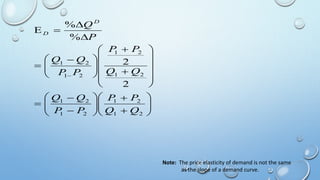
How price elasticity is measured
Note: The price elasticity of demand is not the same
as the slope of a demand curve.




































 





21
21
21
21
21
21
21
21
2
2
%
%
QQ
PP
PP
QQ
QQ
PP
PP
QQ
P
Q D
D
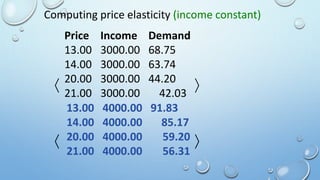
Price Income Demand
13.00 3000.00 68.75
14.00 3000.00 63.74
20.00 3000.00 44.20
21.00 3000.00 42.03
Computing price elasticity (income constant)
13.00 4000.00 91.83
14.00 4000.00 85.17
20.00 4000.00 59.20
21.00 4000.00 56.31
 
 
Price Income Demand
20.00 4000.00 59.20
21.00 4000.00 56.31
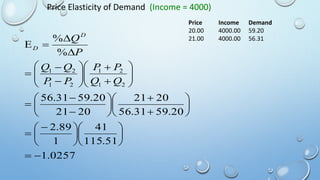
Price Elasticity of Demand (Income = 4000)
0257.1
51.115
41
1
89.2
20.5931.56
2021
2021
20.5931.56
%
%
21
21
21
21












 






































QQ
PP
PP
QQ
P
QD
D
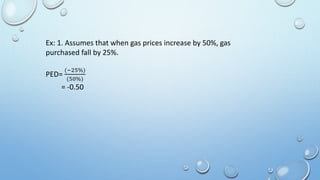
Ex: 1. Assumes that when gas prices increase by 50%, gas
purchased fall by 25%.
PED=
(−25%)
(50%)
= -0.50
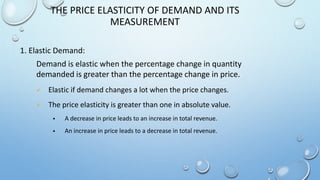
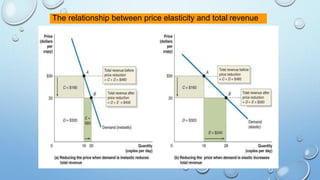
Demand is elastic when the percentage change in quantity
demanded is greater than the percentage change in price.
 Elastic if demand changes a lot when the price changes.
 The price elasticity is greater than one in absolute value.
 A decrease in price leads to an increase in total revenue.
 An increase in price leads to a decrease in total revenue.
THE PRICE ELASTICITY OF DEMAND AND ITS
MEASUREMENT
1. Elastic Demand:
ELASTICITY
Price (P)
Quantity Demanded
D
10
5 20
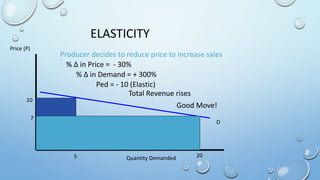
Producer decides to reduce price to increase sales
7
% Δ in Price = - 30%
% Δ in Demand = + 300%
Ped = - 10 (Elastic)
Total Revenue rises
Good Move!
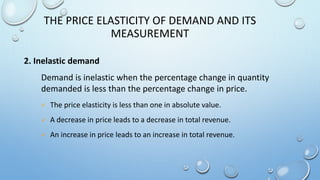
Demand is inelastic when the percentage change in quantity
demanded is less than the percentage change in price.
 The price elasticity is less than one in absolute value.
 A decrease in price leads to a decrease in total revenue.
 An increase in price leads to an increase in total revenue.
THE PRICE ELASTICITY OF DEMAND AND ITS
MEASUREMENT
2. Inelastic demand
ELASTICITY
Price (P)
Quantity Demanded
10
D
5
5
6
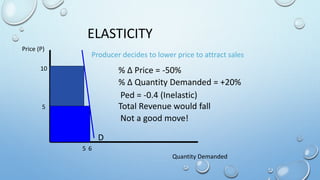
% Δ Price = -50%
% Δ Quantity Demanded = +20%
Ped = -0.4 (Inelastic)
Total Revenue would fall
Producer decides to lower price to attract sales
Not a good move!
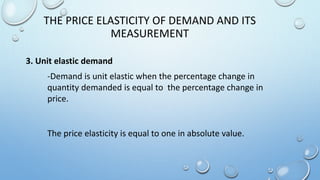
-Demand is unit elastic when the percentage change in
quantity demanded is equal to the percentage change in
price.
The price elasticity is equal to one in absolute value.
THE PRICE ELASTICITY OF DEMAND AND ITS
MEASUREMENT
3. Unit elastic demand
-the total amount of funds received by a seller of a good or service.
Total revenue is found by multiplying price per unit by the number of
units sold.
WHAT DETERMINES PRICE ELASTICITY OF
DEMAND?
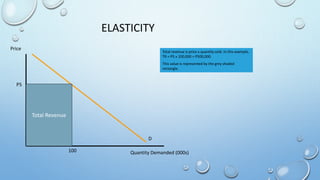
Total Revenue
ELASTICITY
Price
Quantity Demanded (000s)
D
The importance of elasticity is the
information it provides on the
effect on total revenue of changes
in price.
P5
100
Total revenue is price x quantity sold. In this example,
TR = P5 x 100,000 = P500,000.
This value is represented by the grey shaded
rectangle.
Total Revenue
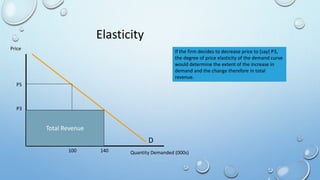
Elasticity
Price
Quantity Demanded (000s)
D
If the firm decides to decrease price to (say) P3,
the degree of price elasticity of the demand curve
would determine the extent of the increase in
demand and the change therefore in total
revenue.
P5
100
P3
140
Total Revenue
The relationship between price elasticity and total revenue
Types of Elasticity
2. Cross elasticity
- measures the responsiveness of quantity demanded by
changes in price of another good.
• CROSS PRICE ELASTICITY WILL BE POSITIVE WHEN THE TWO GOODS
ARE SUBSTITUTES IN CONSUMPTION.
• CROSS PRICE ELASTICITY WILL BE NEGATIVE WHEN THE TWO GOODS
ARE COMPLEMENTS IN CONSUMPTION.
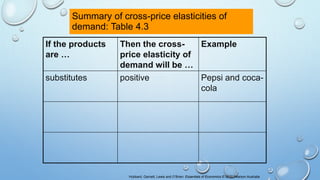
Summary of cross-price elasticities of
demand: Table 4.3
If the products
are …
Then the cross-
price elasticity of
demand will be …
Example
substitutes positive Pepsi and coca-
cola
Hubbard, Garnett, Lewis and O’Brien: Essentials of Economics © 2010 Pearson Australia
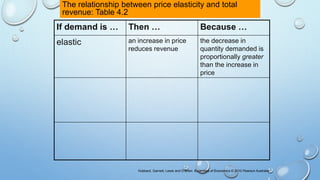
The relationship between price elasticity and total
revenue: Table 4.2
If demand is … Then … Because …
elastic an increase in price
reduces revenue
the decrease in
quantity demanded is
proportionally greater
than the increase in
price
Hubbard, Garnett, Lewis and O’Brien: Essentials of Economics © 2010 Pearson Australia
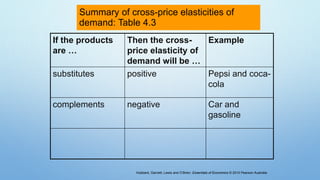
Summary of cross-price elasticities of
demand: Table 4.3
If the products
are …
Then the cross-
price elasticity of
demand will be …
Example
substitutes positive Pepsi and coca-
cola
complements negative Car and
gasoline
Hubbard, Garnett, Lewis and O’Brien: Essentials of Economics © 2010 Pearson Australia
Summary of cross-price elasticities of
demand: Table 4.3
If the products
are …
Then the cross-
price elasticity of
demand will be …
Example
substitutes positive Pepsi and coca-
cola
complements negative Car and
gasoline
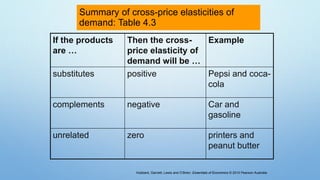
unrelated zero printers and
peanut butter
Hubbard, Garnett, Lewis and O’Brien: Essentials of Economics © 2010 Pearson Australia
CROSS PRICE ELASTICITIES
 Would you expect the cross price elasticity between the
following pairs of goods to be positive or negative? Explain your
answers.
a) Coke and Pepsi.
b) DVD players and DVDs.
c) Gucci sunglasses and vegemite
CROSS PRICE ELASTICITIES
Solving the problem:
 STEP 1: Review the material. The problem is about cross price
elasticities of demand, covered on 109 – 110 of the text.
 STEP 2: Solving (a). Coke and Pepsi are the classic example of
two goods which are substitutes in consumption. An increase in
the price of Coke would, therefore, lead to an increase in
demand for Pepsi, so the cross-price elasticity would be positive.
CROSS PRICE ELASTICITIES
Solving the problem:
 STEP 3: Solving (b). DVD players and DVDs are complements in
consumption. An increase in the price of DVD players would see
a decrease in demand for DVD players, and hence a decrease in
demand for the complement DVDs. The cross-price elasticity
between the two goods would, therefore, be negative.
Cross price elasticities
Solving the problem:
STEP 4: Solving (c). Gucci sunglasses and vegemite are completely
unrelated goods, therefore, we would expect the cross price
elasticity to equal zero.
THANK YOU FOR LISTENING!

Group 9 ppt

  • 1.
    PRICE, INCOME, ANDCROSS ELASTICITY
  • 2.
    WHAT IS ELASTICITY? Measureof just how much the quality demanded will be affected by a change in price or change in price of related goods. 2 significant words: 1. Measure- refers to as numbers or coefficients 2. responsiveness- refers to the reaction to change
  • 3.
    4 basic typesof elasticity: 1. Price elasticity of demand 2. Price elasticity of supply 3. Income elasticity of demand 4. Cross elasticity
  • 4.
    Types of Elasticity -measures the responsiveness of quantity demanded of a good to a change in the price. 1. Price elasticity of demand How price elasticity is measured
  • 5.
    Note: The priceelasticity of demand is not the same as the slope of a demand curve.                                            21 21 21 21 21 21 21 21 2 2 % % QQ PP PP QQ QQ PP PP QQ P Q D D
  • 6.
    Price Income Demand 13.003000.00 68.75 14.00 3000.00 63.74 20.00 3000.00 44.20 21.00 3000.00 42.03 Computing price elasticity (income constant) 13.00 4000.00 91.83 14.00 4000.00 85.17 20.00 4000.00 59.20 21.00 4000.00 56.31    
  • 7.
    Price Income Demand 20.004000.00 59.20 21.00 4000.00 56.31 Price Elasticity of Demand (Income = 4000) 0257.1 51.115 41 1 89.2 20.5931.56 2021 2021 20.5931.56 % % 21 21 21 21                                                     QQ PP PP QQ P QD D
  • 8.
    Ex: 1. Assumesthat when gas prices increase by 50%, gas purchased fall by 25%. PED= (−25%) (50%) = -0.50
  • 9.
    Demand is elasticwhen the percentage change in quantity demanded is greater than the percentage change in price.  Elastic if demand changes a lot when the price changes.  The price elasticity is greater than one in absolute value.  A decrease in price leads to an increase in total revenue.  An increase in price leads to a decrease in total revenue. THE PRICE ELASTICITY OF DEMAND AND ITS MEASUREMENT 1. Elastic Demand:
  • 10.
    ELASTICITY Price (P) Quantity Demanded D 10 520 Producer decides to reduce price to increase sales 7 % Δ in Price = - 30% % Δ in Demand = + 300% Ped = - 10 (Elastic) Total Revenue rises Good Move!
  • 11.
    Demand is inelasticwhen the percentage change in quantity demanded is less than the percentage change in price.  The price elasticity is less than one in absolute value.  A decrease in price leads to a decrease in total revenue.  An increase in price leads to an increase in total revenue. THE PRICE ELASTICITY OF DEMAND AND ITS MEASUREMENT 2. Inelastic demand
  • 12.
    ELASTICITY Price (P) Quantity Demanded 10 D 5 5 6 %Δ Price = -50% % Δ Quantity Demanded = +20% Ped = -0.4 (Inelastic) Total Revenue would fall Producer decides to lower price to attract sales Not a good move!
  • 13.
    -Demand is unitelastic when the percentage change in quantity demanded is equal to the percentage change in price. The price elasticity is equal to one in absolute value. THE PRICE ELASTICITY OF DEMAND AND ITS MEASUREMENT 3. Unit elastic demand
  • 14.
    -the total amountof funds received by a seller of a good or service. Total revenue is found by multiplying price per unit by the number of units sold. WHAT DETERMINES PRICE ELASTICITY OF DEMAND? Total Revenue
  • 15.
    ELASTICITY Price Quantity Demanded (000s) D Theimportance of elasticity is the information it provides on the effect on total revenue of changes in price. P5 100 Total revenue is price x quantity sold. In this example, TR = P5 x 100,000 = P500,000. This value is represented by the grey shaded rectangle. Total Revenue
  • 16.
    Elasticity Price Quantity Demanded (000s) D Ifthe firm decides to decrease price to (say) P3, the degree of price elasticity of the demand curve would determine the extent of the increase in demand and the change therefore in total revenue. P5 100 P3 140 Total Revenue
  • 17.
    The relationship betweenprice elasticity and total revenue
  • 18.
    Types of Elasticity 2.Cross elasticity - measures the responsiveness of quantity demanded by changes in price of another good.
  • 19.
    • CROSS PRICEELASTICITY WILL BE POSITIVE WHEN THE TWO GOODS ARE SUBSTITUTES IN CONSUMPTION. • CROSS PRICE ELASTICITY WILL BE NEGATIVE WHEN THE TWO GOODS ARE COMPLEMENTS IN CONSUMPTION.
  • 20.
    Summary of cross-priceelasticities of demand: Table 4.3 If the products are … Then the cross- price elasticity of demand will be … Example substitutes positive Pepsi and coca- cola Hubbard, Garnett, Lewis and O’Brien: Essentials of Economics © 2010 Pearson Australia
  • 21.
    The relationship betweenprice elasticity and total revenue: Table 4.2 If demand is … Then … Because … elastic an increase in price reduces revenue the decrease in quantity demanded is proportionally greater than the increase in price Hubbard, Garnett, Lewis and O’Brien: Essentials of Economics © 2010 Pearson Australia
  • 22.
    Summary of cross-priceelasticities of demand: Table 4.3 If the products are … Then the cross- price elasticity of demand will be … Example substitutes positive Pepsi and coca- cola complements negative Car and gasoline Hubbard, Garnett, Lewis and O’Brien: Essentials of Economics © 2010 Pearson Australia
  • 23.
    Summary of cross-priceelasticities of demand: Table 4.3 If the products are … Then the cross- price elasticity of demand will be … Example substitutes positive Pepsi and coca- cola complements negative Car and gasoline unrelated zero printers and peanut butter Hubbard, Garnett, Lewis and O’Brien: Essentials of Economics © 2010 Pearson Australia
  • 24.
    CROSS PRICE ELASTICITIES Would you expect the cross price elasticity between the following pairs of goods to be positive or negative? Explain your answers. a) Coke and Pepsi. b) DVD players and DVDs. c) Gucci sunglasses and vegemite
  • 25.
    CROSS PRICE ELASTICITIES Solvingthe problem:  STEP 1: Review the material. The problem is about cross price elasticities of demand, covered on 109 – 110 of the text.  STEP 2: Solving (a). Coke and Pepsi are the classic example of two goods which are substitutes in consumption. An increase in the price of Coke would, therefore, lead to an increase in demand for Pepsi, so the cross-price elasticity would be positive.
  • 26.
    CROSS PRICE ELASTICITIES Solvingthe problem:  STEP 3: Solving (b). DVD players and DVDs are complements in consumption. An increase in the price of DVD players would see a decrease in demand for DVD players, and hence a decrease in demand for the complement DVDs. The cross-price elasticity between the two goods would, therefore, be negative.
  • 27.
    Cross price elasticities Solvingthe problem: STEP 4: Solving (c). Gucci sunglasses and vegemite are completely unrelated goods, therefore, we would expect the cross price elasticity to equal zero.
  • 28.
    THANK YOU FORLISTENING!