

Understanding Each Other
…and building on each other’s ideas…
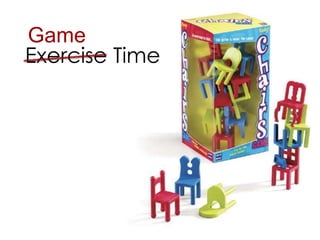
Exercise Time
Game
Instructions
• Separate into 3 teams
• Elect a leader
• Leader gets a goal & shares
w/team (visual sharing only)
• 1st team to arrange all chairs
to meet goal w/in 2 min wins!
NO TALKING!
Accredited
to Chris Sims
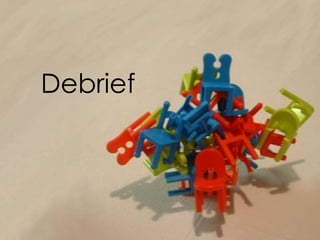
Debrief
Exercise
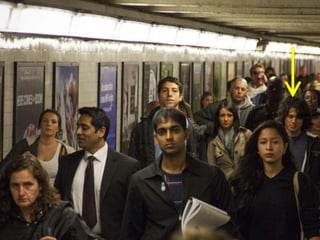
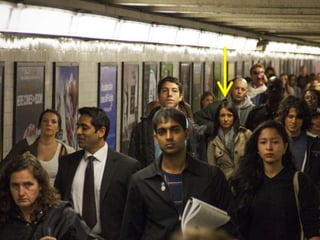
• I’m going to present an image of people in rush
hour in NYC; I’ll have an arrow pointing to one
person.
• I want you to write down the following:
– Is this morning or afternoon rush? What gave you the
clue?
– What type of work do you think that person does &
why you thought that?
– What do you think that person is thinking?
– If you were given $1000 to help that person in some
way other than giving it directly to them, how would
you go about doing it? Why did you select this choice?
Exercise (Again)
• I’m going to again present the same image of
people in rush hour in NYC; I’ll have an arrow
pointing to a different person.
• I want you to write down the following:
– What type of work do you think that person does &
why you thought that?
– What do you think that person is thinking?
– If you were given $1000 to help that person in some
way other than giving it directly to them, how would
you go about doing it? Why did you select this choice?
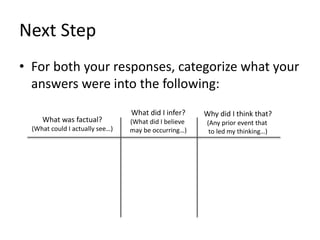
Next Step
• For both your responses, categorize what your
answers were into the following:
What was factual?
(What could I actually see…)
What did I infer?
(What did I believe
may be occurring…)
Why did I think that?
(Any prior event that
to led my thinking…)
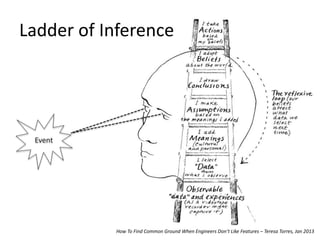
Ladder of Inference
Event
How To Find Common Ground When Engineers Don’t Like Features – Teresa Torres, Jan 2013
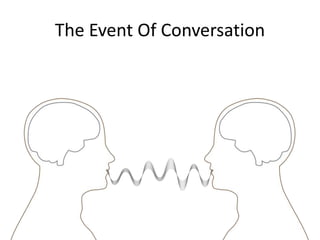
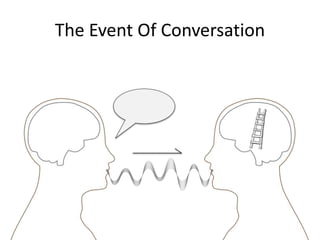
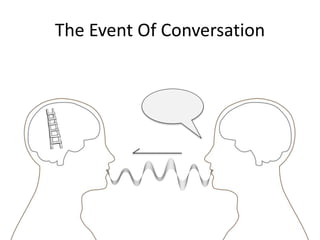
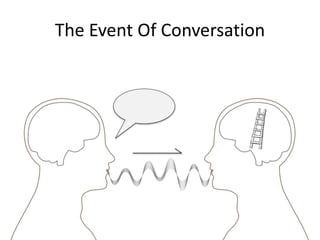
The Event Of Conversation
How do we
our
beliefsfrom getting
prevent
in the way?
a shared vision
Co-create
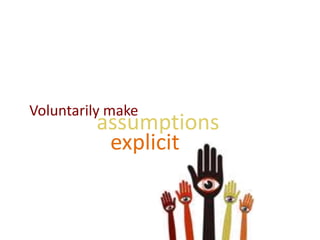
assumptions
Voluntarily make
explicit
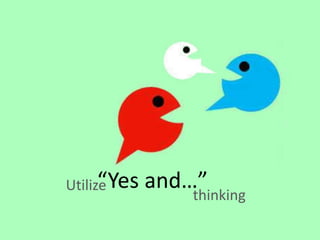
“Yes and…”Utilize
thinking
Let’s Learn the Basics of Improv
Yes BUT ---
• Split into pairs
• Pick a person to start…
• For the next 3 minutes -
• That person will say something they want to do
– The other person is to contradict them and propose
something else
– ALWAYS start the sentence with “Yes, but…”
– (even better if you say “we should do” in this counter-
proposal)
Thanks to Mike Sutton
for my learning of this
Let’s Learn the Basics of Improv
Yes AND ---
• Same pairs
• Other person to start…
• For the next 3 minutes -
• That person will say something they want to do
– The other person is to add to it and propose
something additional
– ALWAYS start the sentence with “Yes, and…”
– (even better if you say “we can do” in this addition)
Thanks to Mike Sutton
for my learning of this
Debrief
• So how did you feel with the “Yes, but…”?
• Any different with “Yes and…”?
• Did you see any change in your thinking when
moving to “Yes and…”?
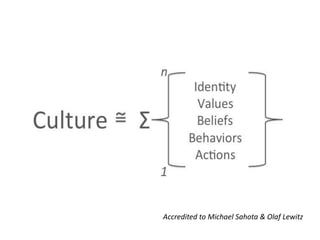
Core
Values
Accredited to Michael Sahota & Olaf Lewitz
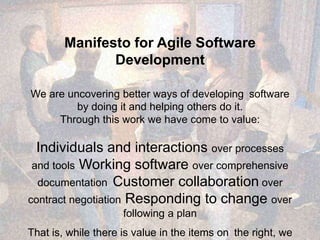
Manifesto for Agile Software
Development
We are uncovering better ways of developing software
by doing it and helping others do it.
Through this work we have come to value:
Individuals and interactions over processes
and tools Working software over comprehensive
documentation Customer collaboration over
contract negotiation Responding to change over
following a plan
That is, while there is value in the items on the right, we
Select Team Core Values
• Select Personal Core Values
– Use Page of Core Values (feel free to add additional ones)
– Select 5 that you feel you care about the most; that you
feel you exhibit; write each one on a sticky
– Rank these in order of importance to you
– Take the top 3 and post on the wall
• Since the Team’s Identity& Values are the Sum of the
Set of It’s People
– Affinity analysis to cluster the top 4-6 across everyone
– First of 5 for commitment to these
• Generate value statements from these (time
permitting)
Establish Working Agreements
• Write behaviors & actions that are important to
you for good working relationships, be specific
• Keep in mind the team’s core values and what
will help the team avoid problems
• Confirmation/refinement that these will work

Understanding Each Other - Ladder of Inference + Yes and... Thinking

  • 1.
    Understanding Each Other …andbuilding on each other’s ideas…
  • 2.
  • 3.
    Instructions • Separate into3 teams • Elect a leader • Leader gets a goal & shares w/team (visual sharing only) • 1st team to arrange all chairs to meet goal w/in 2 min wins! NO TALKING! Accredited to Chris Sims
  • 4.
  • 5.
    Exercise • I’m goingto present an image of people in rush hour in NYC; I’ll have an arrow pointing to one person. • I want you to write down the following: – Is this morning or afternoon rush? What gave you the clue? – What type of work do you think that person does & why you thought that? – What do you think that person is thinking? – If you were given $1000 to help that person in some way other than giving it directly to them, how would you go about doing it? Why did you select this choice?
  • 7.
    Exercise (Again) • I’mgoing to again present the same image of people in rush hour in NYC; I’ll have an arrow pointing to a different person. • I want you to write down the following: – What type of work do you think that person does & why you thought that? – What do you think that person is thinking? – If you were given $1000 to help that person in some way other than giving it directly to them, how would you go about doing it? Why did you select this choice?
  • 9.
    Next Step • Forboth your responses, categorize what your answers were into the following: What was factual? (What could I actually see…) What did I infer? (What did I believe may be occurring…) Why did I think that? (Any prior event that to led my thinking…)
  • 10.
    Ladder of Inference Event HowTo Find Common Ground When Engineers Don’t Like Features – Teresa Torres, Jan 2013
  • 11.
    The Event OfConversation
  • 12.
    The Event OfConversation
  • 13.
    The Event OfConversation
  • 14.
    The Event OfConversation
  • 15.
    How do we our beliefsfromgetting prevent in the way?
  • 16.
  • 17.
  • 18.
  • 19.
    Let’s Learn theBasics of Improv Yes BUT --- • Split into pairs • Pick a person to start… • For the next 3 minutes - • That person will say something they want to do – The other person is to contradict them and propose something else – ALWAYS start the sentence with “Yes, but…” – (even better if you say “we should do” in this counter- proposal) Thanks to Mike Sutton for my learning of this
  • 20.
    Let’s Learn theBasics of Improv Yes AND --- • Same pairs • Other person to start… • For the next 3 minutes - • That person will say something they want to do – The other person is to add to it and propose something additional – ALWAYS start the sentence with “Yes, and…” – (even better if you say “we can do” in this addition) Thanks to Mike Sutton for my learning of this
  • 21.
    Debrief • So howdid you feel with the “Yes, but…”? • Any different with “Yes and…”? • Did you see any change in your thinking when moving to “Yes and…”?
  • 22.
  • 23.
    Accredited to MichaelSahota & Olaf Lewitz
  • 24.
    Manifesto for AgileSoftware Development We are uncovering better ways of developing software by doing it and helping others do it. Through this work we have come to value: Individuals and interactions over processes and tools Working software over comprehensive documentation Customer collaboration over contract negotiation Responding to change over following a plan That is, while there is value in the items on the right, we
  • 25.
    Select Team CoreValues • Select Personal Core Values – Use Page of Core Values (feel free to add additional ones) – Select 5 that you feel you care about the most; that you feel you exhibit; write each one on a sticky – Rank these in order of importance to you – Take the top 3 and post on the wall • Since the Team’s Identity& Values are the Sum of the Set of It’s People – Affinity analysis to cluster the top 4-6 across everyone – First of 5 for commitment to these • Generate value statements from these (time permitting)
  • 26.
    Establish Working Agreements •Write behaviors & actions that are important to you for good working relationships, be specific • Keep in mind the team’s core values and what will help the team avoid problems • Confirmation/refinement that these will work