
User Story Splitting
Or how to be the Ninja on splitting
Stories, rather than fruit…
Your Sensei: Paul Boos
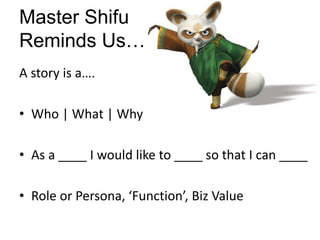
Master Shifu
Reminds Us…
A story is a….
• Who | What | Why
• As a ____ I would like to ____ so that I can ____
• Role or Persona, ‘Function’, Biz Value
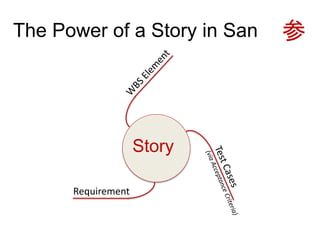
The Power of a Story in San 参
Story
Requirement
Dragon Stories (aka ‘Epics’)
• Stories that are horrendously large & scare us
• The amount of tasks feel like slaying a beast
• Larger than our iteration
• But even ‘Smaller than
Dragon’ Stories may need
to be split…
INVEST
I ndependent – minimize dependencies (to zero
preferably)
N egotiable – ability for Product Owner and
Delivery Team to make trade-offs
V aluable – fulfill end user needs/functionality
E stimable – understood well enough to be
estimated
S mall – fit within a Sprint easily
T estable – have an ability to be verified that they
work
Should I Split This Story?
• Does it meet the INVEST Criteria (with
exception of Small)?
No – refactor story first*
• Can it be completed in this Sprint?
No – time to split!
• Will this story consume most of the Team’s
capacity?
Yes – better to split than to be sorry…
* If a story isn’t small it may also be hard to be negotiable, so a story
being both small and negotiable could be exceptions.
Don’t
split a story on Waterfall
-like Phases
Unless you like riding very, very large
waves of failure…
Useful Considerations
• Story to– one role/persona (generally)
• Story to– one function/task of value
• Vertically slices most of the stack
Splitting Kata
• Workflow Steps Pattern
• Operations Pattern
• Business Rule Variations Pattern
• Simple  Complex Pattern
• Variations in Data Pattern
• Mock UI Pattern
• Data Entry Methods Pattern
• Hamburger Method
• Defer Performance Pattern
• Break Out a Spike Pattern 戻る
Workflow Steps Pattern
Look for steps in the workflow that chain different
roles/personas together or very distinctly different
functions that can be independently done.
Example: Content Authoring & Approval
• As an author, I want to be able to submit my article, so
that it can be published.
• As an editor, I would like to get notified when an article
has been submitted so that I can review it.
• As an editor, I need to approve an article, so that it can
become visible.
• As an editor, I would like to be able to request more
information, so that I can understand the author’s
intent.
Operations Pattern
Focus along Operations (think high level methods or CRUD
type operations).
Example: As a shop keeper I want to manage the products
being sold in my online store so that I can sell what people
want to buy. This could be become:
• As a shop keeper, I want to add and remove products
from my online store, so that I can sell what people want
to buy.
• As a shop keeper, I want to edit product details in my
online store, so that I can avoid recreating a product to
fix a typo … (and so on)
Look for generic verbs such as “manage” or “administer” which hints at multiple
more detailed operations. (Sort of use-case like…)
Business Rules Variation Pattern
Find ways to split stories based on business
rules deviations.
Example:
Set Payment Currency
As the buyer, I want to set my currency, so that I can
understand the value.
• Payment currency is set by purchase location
• Payment currency can be pulled from the user profile
• Payment currency defaults to US Dollars
Warning: variations could also be articulating various
acceptance criteria.
Simple  Complex Pattern
Look for general stories that hide complexity,
when the definition of the acceptance criteria
uncovers varied ways to approach this, then you
can split along this variance...
Example:
• As a loan applicant, I want to calculate my
mortgage payments
Might be made more specific in ways such as …
• … calculate payments manually
• … using an online spreadsheet template
• … using an online calculator
Variations in Data Pattern
Choose data objects that may have variations based
on roles and actions.
Example:
Suppose that there are data objects called Product,
Payment, and Receipt. In this instance, the idea would be
to focus on specific data types for each object type. So
for Product, there might be data types such as Book,
DVD, and Gift Card.
You can then work with the Product Owner to identify
the data type or types with the highest business value
and split the story accordingly.
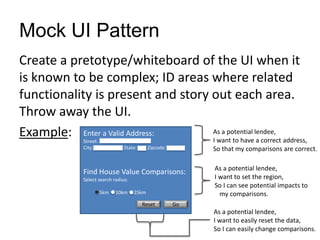
Mock UI Pattern
Create a pretotype/whiteboard of the UI when it
is known to be complex; ID areas where related
functionality is present and story out each area.
Throw away the UI.
Example: Enter a Valid Address:
Street:
City: State: Zipcode:
Find House Value Comparisons:
Select search radius:
5km 10km 25km
Go
Reset
As a potential lendee,
I want to have a correct address,
So that my comparisons are correct.
As a potential lendee,
I want to set the region,
So I can see potential impacts to
my comparisons.
As a potential lendee,
I want to easily reset the data,
So I can easily change comparisons.
Data Entry Methods Pattern
Examining various options for data entry at the
UI can be done. Each option is essentially the
same story and thus is a refactoring of a prior
story. Great for identifying MVF options…
Example:
As a user, I can search for flights
between two destinations.
…using simple date input.
…with a fancy calendar UI.
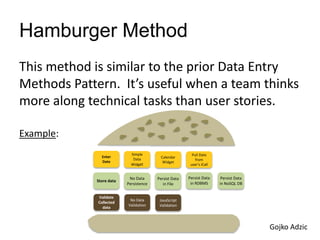
Hamburger Method
This method is similar to the prior Data Entry
Methods Pattern. It’s useful when a team thinks
more along technical tasks than user stories.
Example:
Simple
Data
Widget
No Data
Persistence
No Data
Validation
Calendar
Widget
Persist Data
in File
JavaScript
Validation
Pull Date
from
user’s iCall
Persist Data
in RDBMS
Persist Data
in NoSQL DB
Enter
Date
Store data
Validate
Collected
data
Gojko Adzic
Defer Performance Pattern
Look for Opportunities to Defer Work for later (and thus
refactor of the code).
“Simplicity--the art of maximizing the amount
of work not done--is essential.”
– Agile Manifesto Principle #10
Example:
Focus on user functionality 1st then various –’ilities’:
Scalability
Performance
Caution:
“Continuous attention to technical excellence
and good design enhances agility.”
– Agile Manifesto Principle #9
Break out a Spike Pattern
Often Stories are not necessarily complex, but just have
many unknowns. Turn possible acceptance criteria into
questions and investigate these.
Example: Suppose you didn’t understand how Paypal
worked…
Turn As a seller I want to collect payment with Paypal as it is
universally accepted and this will increase how I get paid.
into…
Spike: How does Paypal work?
How do I know I have a successful payment?
How do I know when a payment is unsuccessful and what options can I
present to the buyer?
Once I answer these I can create a valid story (or set of stories).
Helpful Tips for
Splitting Stories
Think in terms of what a user
(role/persona) wants as inputs & outputs.
• What does the user put in? What should or should not
come out?
• What processing should give the output?
• How can we test this?
Think in terms of vertical slices.
• What is the minimal version of this functionality?
• Can you touch all the needed tiers of the system.
Don’t worry about being 100% right…
IKIWISI!
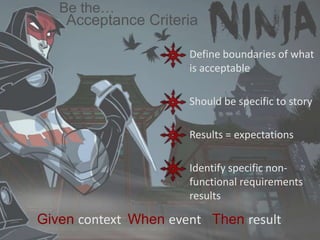
Acceptance Criteria
Given context When event Then result
Be the…
Define boundaries of what
is acceptable
Should be specific to story
Results = expectations
Identify specific non-
functional requirements
results
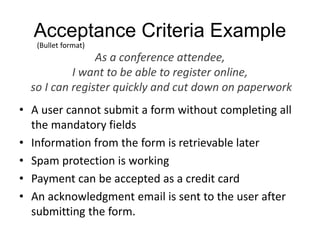
Acceptance Criteria Example
• A user cannot submit a form without completing all
the mandatory fields
• Information from the form is retrievable later
• Spam protection is working
• Payment can be accepted as a credit card
• An acknowledgment email is sent to the user after
submitting the form.
As a conference attendee,
I want to be able to register online,
so I can register quickly and cut down on paperwork
(Bullet format)
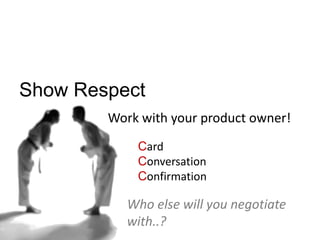
Show Respect
Work with your product owner!
Who else will you negotiate
with..?
Card
Conversation
Confirmation
EXERCISES
Establish Your Dojo
for exercises 1 - 4
• Gather in groups of 2-4
• Establish who will be the product owner
• Brainstorm stories based on the core
epics or features presented
• Ensure you have acceptance criteria
• Be ready to discuss how you split your
stories
• Feel free to go to a second level
Exercise 1
You are building an ecommerce site to sell your
products.
Your Epic:
Browse, Select, and Purchase Products from the
site.
10 Minutes to create stories based on this Epic.
Remember to ID some Acceptance Criteria!
We’ll discuss for 10 minutes
Exercise 2
You are building a system to manage content onto
your website.
Your Epic:
Manage Webpages, Images, and Video.
10 Minutes to create stories based on this Epic.
Remember to ID some Acceptance Criteria!
We’ll discuss for 10 minutes
Exercise 3
You are building an exercise and diet iPhone
application.
Your Epic:
Generate Anyone’s Exercise Routine and Diet.
10 Minutes to create stories based on this Epic.
Remember to ID some Acceptance Criteria!
We’ll discuss for 10 minutes
Exercise 4
Select your largest story for the next Sprint. Your REAL product owner
and SMEs are available to answer questions.
Take 15 minutes to do the following:
Meet INVEST? Except for small, No = refactor
Can we complete in this Sprint? No = split
Will it consume most of the Sprint in effort?
Yes = split
Take 5 minutes to decide on an approach.
Take another 15 minutes to brainstorm stories based on that
approach.
Can you establish some acceptance criteria?
20 minutes to discuss
Gather the Buke
for exercises 4 - 5
• Review the stories everyone just created in
the last exercise
• Select 2 stories you think are well constructed;
be able to defend this in terms of INVEST
• We’ll use these for our next 2 exercises as one
group to learn a bit about vertical slicing
Exercise 4: Walk the Code Dog
Take 15 minutes to…
Walk through the components of the system
one by one that will change. Draw these out (on
a flip chart or white board).
Did you touch all or most of the layers?
Exercise 5: Walk the Dog in the
Component Park
Take 15 minutes to…
Draw the architecture of your system
components on a flip chart or white board.
Using a story you have selected and using a
different color marker, redraw over the
architectural components of the application as
you need to touch them when you implement
the story.
For Further Study
Great post on how most teams evolve through their story
understanding by JB Rainsberger
http://www.jbrains.ca/permalink/how-youll-probably-learn-to-split-features
The Hamburger Method by Gojko Adzic
http://gojko.net/2012/01/23/splitting-user-stories-the-hamburger-method/
Walk the Dog Techniques for Vertical
Storieshttp://www.dhavalpanchal.com/walk-the-dog/
15 ways to split an an Epic (3rd exercise from
here)http://blogs.collab.net/agile/15-ways-to-split-an-epic-a-team-exercise
Beginner’s Guide to Acceptance Criteria (example)
http://www.boost.co.nz/blog/agile/acceptance-criteria/
Derived from Phil Rogers slide deck on Patterns for
Splitting User Stories.
You’re a Team
No need to be a solo ninja
Let’s go slay
some dragons!
Or better put, slice some stories!

User Story Splitting.pptx

  • 1.
    User Story Splitting Orhow to be the Ninja on splitting Stories, rather than fruit… Your Sensei: Paul Boos
  • 2.
    Master Shifu Reminds Us… Astory is a…. • Who | What | Why • As a ____ I would like to ____ so that I can ____ • Role or Persona, ‘Function’, Biz Value
  • 3.
    The Power ofa Story in San 参 Story Requirement
  • 4.
    Dragon Stories (aka‘Epics’) • Stories that are horrendously large & scare us • The amount of tasks feel like slaying a beast • Larger than our iteration • But even ‘Smaller than Dragon’ Stories may need to be split…
  • 5.
    INVEST I ndependent –minimize dependencies (to zero preferably) N egotiable – ability for Product Owner and Delivery Team to make trade-offs V aluable – fulfill end user needs/functionality E stimable – understood well enough to be estimated S mall – fit within a Sprint easily T estable – have an ability to be verified that they work
  • 6.
    Should I SplitThis Story? • Does it meet the INVEST Criteria (with exception of Small)? No – refactor story first* • Can it be completed in this Sprint? No – time to split! • Will this story consume most of the Team’s capacity? Yes – better to split than to be sorry… * If a story isn’t small it may also be hard to be negotiable, so a story being both small and negotiable could be exceptions.
  • 7.
    Don’t split a storyon Waterfall -like Phases Unless you like riding very, very large waves of failure…
  • 8.
    Useful Considerations • Storyto– one role/persona (generally) • Story to– one function/task of value • Vertically slices most of the stack
  • 9.
    Splitting Kata • WorkflowSteps Pattern • Operations Pattern • Business Rule Variations Pattern • Simple  Complex Pattern • Variations in Data Pattern • Mock UI Pattern • Data Entry Methods Pattern • Hamburger Method • Defer Performance Pattern • Break Out a Spike Pattern 戻る
  • 10.
    Workflow Steps Pattern Lookfor steps in the workflow that chain different roles/personas together or very distinctly different functions that can be independently done. Example: Content Authoring & Approval • As an author, I want to be able to submit my article, so that it can be published. • As an editor, I would like to get notified when an article has been submitted so that I can review it. • As an editor, I need to approve an article, so that it can become visible. • As an editor, I would like to be able to request more information, so that I can understand the author’s intent.
  • 11.
    Operations Pattern Focus alongOperations (think high level methods or CRUD type operations). Example: As a shop keeper I want to manage the products being sold in my online store so that I can sell what people want to buy. This could be become: • As a shop keeper, I want to add and remove products from my online store, so that I can sell what people want to buy. • As a shop keeper, I want to edit product details in my online store, so that I can avoid recreating a product to fix a typo … (and so on) Look for generic verbs such as “manage” or “administer” which hints at multiple more detailed operations. (Sort of use-case like…)
  • 12.
    Business Rules VariationPattern Find ways to split stories based on business rules deviations. Example: Set Payment Currency As the buyer, I want to set my currency, so that I can understand the value. • Payment currency is set by purchase location • Payment currency can be pulled from the user profile • Payment currency defaults to US Dollars Warning: variations could also be articulating various acceptance criteria.
  • 13.
    Simple  ComplexPattern Look for general stories that hide complexity, when the definition of the acceptance criteria uncovers varied ways to approach this, then you can split along this variance... Example: • As a loan applicant, I want to calculate my mortgage payments Might be made more specific in ways such as … • … calculate payments manually • … using an online spreadsheet template • … using an online calculator
  • 14.
    Variations in DataPattern Choose data objects that may have variations based on roles and actions. Example: Suppose that there are data objects called Product, Payment, and Receipt. In this instance, the idea would be to focus on specific data types for each object type. So for Product, there might be data types such as Book, DVD, and Gift Card. You can then work with the Product Owner to identify the data type or types with the highest business value and split the story accordingly.
  • 15.
    Mock UI Pattern Createa pretotype/whiteboard of the UI when it is known to be complex; ID areas where related functionality is present and story out each area. Throw away the UI. Example: Enter a Valid Address: Street: City: State: Zipcode: Find House Value Comparisons: Select search radius: 5km 10km 25km Go Reset As a potential lendee, I want to have a correct address, So that my comparisons are correct. As a potential lendee, I want to set the region, So I can see potential impacts to my comparisons. As a potential lendee, I want to easily reset the data, So I can easily change comparisons.
  • 16.
    Data Entry MethodsPattern Examining various options for data entry at the UI can be done. Each option is essentially the same story and thus is a refactoring of a prior story. Great for identifying MVF options… Example: As a user, I can search for flights between two destinations. …using simple date input. …with a fancy calendar UI.
  • 17.
    Hamburger Method This methodis similar to the prior Data Entry Methods Pattern. It’s useful when a team thinks more along technical tasks than user stories. Example: Simple Data Widget No Data Persistence No Data Validation Calendar Widget Persist Data in File JavaScript Validation Pull Date from user’s iCall Persist Data in RDBMS Persist Data in NoSQL DB Enter Date Store data Validate Collected data Gojko Adzic
  • 18.
    Defer Performance Pattern Lookfor Opportunities to Defer Work for later (and thus refactor of the code). “Simplicity--the art of maximizing the amount of work not done--is essential.” – Agile Manifesto Principle #10 Example: Focus on user functionality 1st then various –’ilities’: Scalability Performance Caution: “Continuous attention to technical excellence and good design enhances agility.” – Agile Manifesto Principle #9
  • 19.
    Break out aSpike Pattern Often Stories are not necessarily complex, but just have many unknowns. Turn possible acceptance criteria into questions and investigate these. Example: Suppose you didn’t understand how Paypal worked… Turn As a seller I want to collect payment with Paypal as it is universally accepted and this will increase how I get paid. into… Spike: How does Paypal work? How do I know I have a successful payment? How do I know when a payment is unsuccessful and what options can I present to the buyer? Once I answer these I can create a valid story (or set of stories).
  • 20.
    Helpful Tips for SplittingStories Think in terms of what a user (role/persona) wants as inputs & outputs. • What does the user put in? What should or should not come out? • What processing should give the output? • How can we test this? Think in terms of vertical slices. • What is the minimal version of this functionality? • Can you touch all the needed tiers of the system. Don’t worry about being 100% right… IKIWISI!
  • 21.
    Acceptance Criteria Given contextWhen event Then result Be the… Define boundaries of what is acceptable Should be specific to story Results = expectations Identify specific non- functional requirements results
  • 22.
    Acceptance Criteria Example •A user cannot submit a form without completing all the mandatory fields • Information from the form is retrievable later • Spam protection is working • Payment can be accepted as a credit card • An acknowledgment email is sent to the user after submitting the form. As a conference attendee, I want to be able to register online, so I can register quickly and cut down on paperwork (Bullet format)
  • 23.
    Show Respect Work withyour product owner! Who else will you negotiate with..? Card Conversation Confirmation
  • 24.
  • 25.
    Establish Your Dojo forexercises 1 - 4 • Gather in groups of 2-4 • Establish who will be the product owner • Brainstorm stories based on the core epics or features presented • Ensure you have acceptance criteria • Be ready to discuss how you split your stories • Feel free to go to a second level
  • 26.
    Exercise 1 You arebuilding an ecommerce site to sell your products. Your Epic: Browse, Select, and Purchase Products from the site. 10 Minutes to create stories based on this Epic. Remember to ID some Acceptance Criteria! We’ll discuss for 10 minutes
  • 27.
    Exercise 2 You arebuilding a system to manage content onto your website. Your Epic: Manage Webpages, Images, and Video. 10 Minutes to create stories based on this Epic. Remember to ID some Acceptance Criteria! We’ll discuss for 10 minutes
  • 28.
    Exercise 3 You arebuilding an exercise and diet iPhone application. Your Epic: Generate Anyone’s Exercise Routine and Diet. 10 Minutes to create stories based on this Epic. Remember to ID some Acceptance Criteria! We’ll discuss for 10 minutes
  • 29.
    Exercise 4 Select yourlargest story for the next Sprint. Your REAL product owner and SMEs are available to answer questions. Take 15 minutes to do the following: Meet INVEST? Except for small, No = refactor Can we complete in this Sprint? No = split Will it consume most of the Sprint in effort? Yes = split Take 5 minutes to decide on an approach. Take another 15 minutes to brainstorm stories based on that approach. Can you establish some acceptance criteria? 20 minutes to discuss
  • 30.
    Gather the Buke forexercises 4 - 5 • Review the stories everyone just created in the last exercise • Select 2 stories you think are well constructed; be able to defend this in terms of INVEST • We’ll use these for our next 2 exercises as one group to learn a bit about vertical slicing
  • 31.
    Exercise 4: Walkthe Code Dog Take 15 minutes to… Walk through the components of the system one by one that will change. Draw these out (on a flip chart or white board). Did you touch all or most of the layers?
  • 32.
    Exercise 5: Walkthe Dog in the Component Park Take 15 minutes to… Draw the architecture of your system components on a flip chart or white board. Using a story you have selected and using a different color marker, redraw over the architectural components of the application as you need to touch them when you implement the story.
  • 33.
    For Further Study Greatpost on how most teams evolve through their story understanding by JB Rainsberger http://www.jbrains.ca/permalink/how-youll-probably-learn-to-split-features The Hamburger Method by Gojko Adzic http://gojko.net/2012/01/23/splitting-user-stories-the-hamburger-method/ Walk the Dog Techniques for Vertical Storieshttp://www.dhavalpanchal.com/walk-the-dog/ 15 ways to split an an Epic (3rd exercise from here)http://blogs.collab.net/agile/15-ways-to-split-an-epic-a-team-exercise Beginner’s Guide to Acceptance Criteria (example) http://www.boost.co.nz/blog/agile/acceptance-criteria/ Derived from Phil Rogers slide deck on Patterns for Splitting User Stories.
  • 34.
    You’re a Team Noneed to be a solo ninja
  • 35.
    Let’s go slay somedragons! Or better put, slice some stories!