Konrad 'ktoso' Malawski
GeeCON 2014 @ Kraków, PL
Konrad `@ktosopl` Malawski
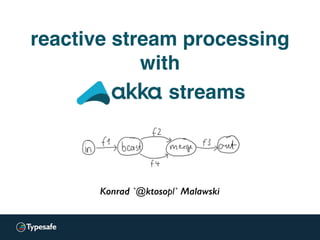
streams
reactive stream processing
with
Konrad `@ktosopl` Malawski
Akka Team
Reactive Streams TCK
sbt-jmh
…
hAkker @
Konrad `@ktosopl` Malawski
typesafe.com
geecon.org
Java.pl / KrakowScala.pl
sckrk.com / meetup.com/Paper-Cup @ London
GDGKrakow.pl
meetup.com/Lambda-Lounge-Krakow
hAkker @
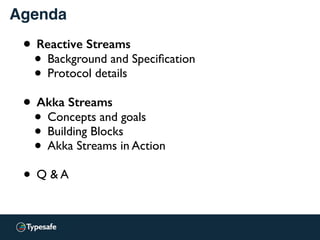
Agenda
Agenda
• Reactive Streams
• Background and Specification
• Protocol details
• Akka Streams
• Concepts and goals
• Building Blocks
• Akka Streams in Action
• Q & A
Streams
Streams
Streams
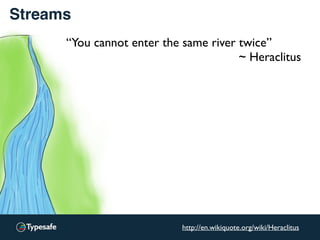
“You cannot enter the same river twice”
~ Heraclitus
http://en.wikiquote.org/wiki/Heraclitus
Streams
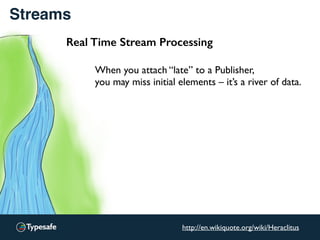
Real Time Stream Processing
When you attach “late” to a Publisher,
you may miss initial elements – it’s a river of data.
http://en.wikiquote.org/wiki/Heraclitus
Reactive Streams
Reactive Streams
Stream processing
Reactive Streams
Back-pressured
Stream processing
Reactive Streams
Back-pressured
Asynchronous
Stream processing
Reactive Streams
Back-pressured
Asynchronous
Stream processing
Standardised (!)
Reactive Streams: Goals
1. Back-pressured Asynchronous Stream processing
2. Standard implemented by many libraries
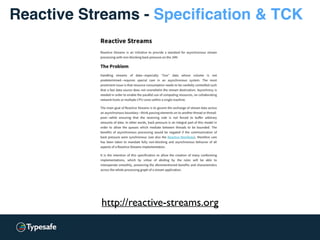
Reactive Streams - Specification & TCK
http://reactive-streams.org
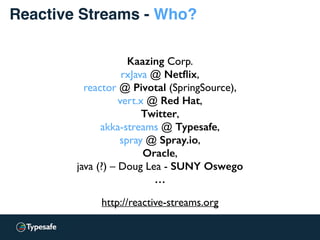
Reactive Streams - Who?
http://reactive-streams.org
Kaazing Corp.
rxJava @ Netflix,
reactor @ Pivotal (SpringSource),
vert.x @ Red Hat,
Twitter,
akka-streams @ Typesafe,
spray @ Spray.io,
Oracle,
java (?) – Doug Lea - SUNY Oswego
…
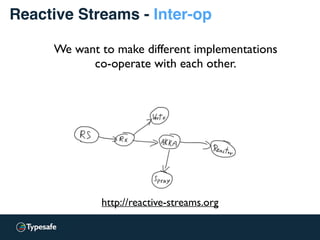
Reactive Streams - Inter-op
http://reactive-streams.org
We want to make different implementations
co-operate with each other.
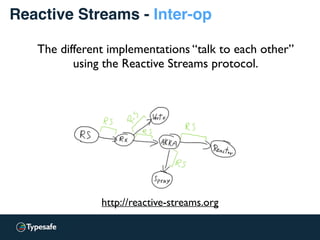
Reactive Streams - Inter-op
http://reactive-streams.org
The different implementations “talk to each other”
using the Reactive Streams protocol.
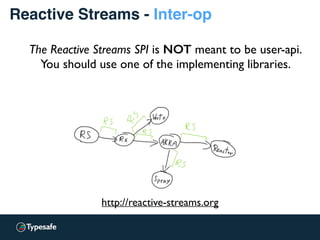
Reactive Streams - Inter-op
http://reactive-streams.org
The Reactive Streams SPI is NOT meant to be user-api.
You should use one of the implementing libraries.
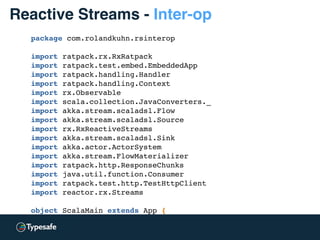
package com.rolandkuhn.rsinterop
import ratpack.rx.RxRatpack
import ratpack.test.embed.EmbeddedApp
import ratpack.handling.Handler
import ratpack.handling.Context
import rx.Observable
import scala.collection.JavaConverters._
import akka.stream.scaladsl.Flow
import akka.stream.scaladsl.Source
import rx.RxReactiveStreams
import akka.stream.scaladsl.Sink
import akka.actor.ActorSystem
import akka.stream.FlowMaterializer
import ratpack.http.ResponseChunks
import java.util.function.Consumer
import ratpack.test.http.TestHttpClient
import reactor.rx.Streams
object ScalaMain extends App {
val system = ActorSystem("InteropTest")
implicit val mat = FlowMaterializer()(system)
Reactive Streams - Inter-op
EmbeddedApp.fromHandler(new Handler {
override def handle(ctx: Context): Unit = {
// RxJava Observable
val intObs = Observable.from((1 to 10).asJava)
// Reactive Streams Publisher
val intPub = RxReactiveStreams.toPublisher(intObs)
// Akka Streams Source
val stringSource = Source(intPub).map(_.toString)
// Reactive Streams Publisher
val stringPub = stringSource.runWith(Sink.fanoutPublisher(1, 1))
// Reactor Stream
val linesStream = Streams.create(stringPub).map[String](new reactor.function.Function[String, String] {
override def apply(in: String) = in + "n"
})
// and now render the HTTP response (RatPack)
ctx.render(ResponseChunks.stringChunks(linesStream))
}
}).test(new Consumer[TestHttpClient] {
override def accept(client: TestHttpClient): Unit = {
val text = client.getText()
println(text)
system.shutdown()
}
})
}
Reactive Streams - Inter-op
What is back-pressure?
Back-pressure? Example Without
Publisher[T] Subscriber[T]
Back-pressure? Example Without
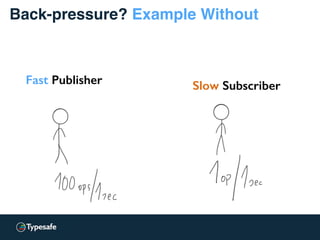
Fast Publisher Slow Subscriber
Back-pressure?
“Why would I need that!?”
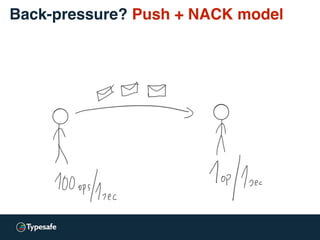
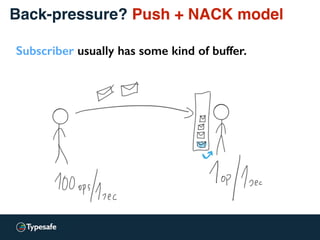
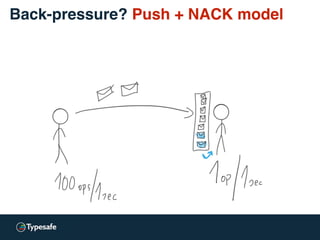
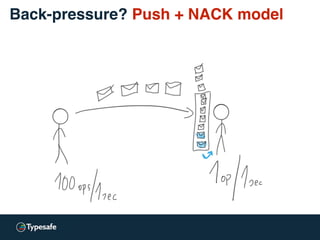
Back-pressure? Push + NACK model
Subscriber usually has some kind of buffer.
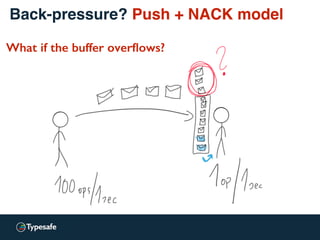
Back-pressure? Push + NACK model
What if the buffer overflows?
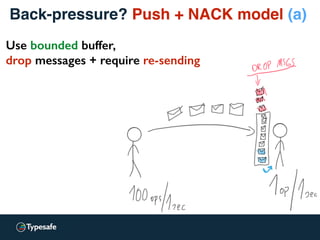
Back-pressure? Push + NACK model (a)
Use bounded buffer,
drop messages + require re-sending
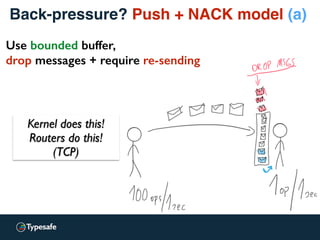
Back-pressure? Push + NACK model (a)
Kernel does this!
Routers do this!
(TCP)
Use bounded buffer,
drop messages + require re-sending
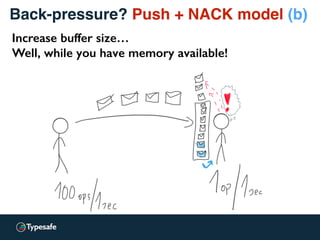
Back-pressure? Push + NACK model (b)
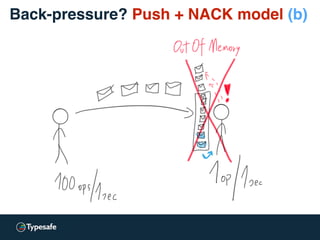
Increase buffer size…
Well, while you have memory available!
Back-pressure? Push + NACK model (b)
Back-pressure?
NACKing is NOT enough.
Negative ACKnowledgement
Back-pressure? Example NACKing
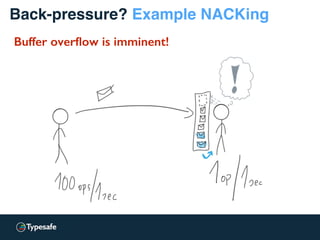
Buffer overflow is imminent!
Back-pressure? Example NACKing
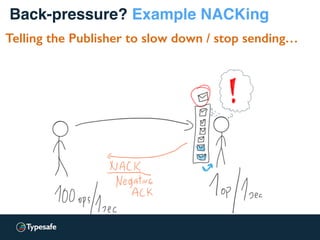
Telling the Publisher to slow down / stop sending…
Back-pressure? Example NACKing
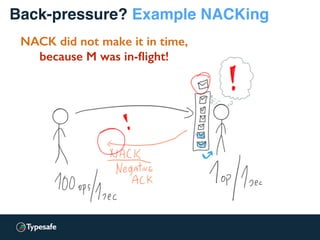
NACK did not make it in time,
because M was in-flight!
Back-pressure?
speed(publisher) < speed(subscriber)
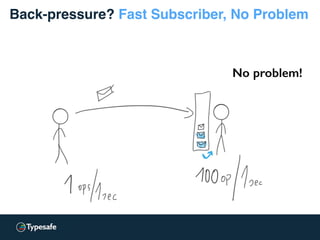
Back-pressure? Fast Subscriber, No Problem
No problem!
Back-pressure?
Reactive-Streams
=
“Dynamic Push/Pull”
Just push – not safe when Slow Subscriber
Just pull – too slow when Fast Subscriber
Back-pressure? RS: Dynamic Push/Pull
Solution:
Dynamic adjustment
Back-pressure? RS: Dynamic Push/Pull
Just push – not safe when Slow Subscriber
Just pull – too slow when Fast Subscriber
Back-pressure? RS: Dynamic Push/Pull
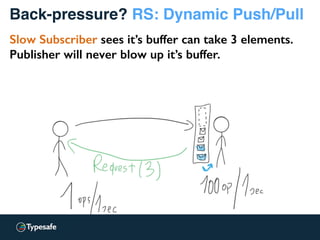
Slow Subscriber sees it’s buffer can take 3 elements.
Publisher will never blow up it’s buffer.
Back-pressure? RS: Dynamic Push/Pull
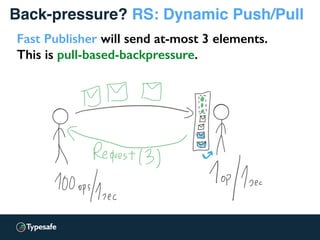
Fast Publisher will send at-most 3 elements.
This is pull-based-backpressure.
Back-pressure? RS: Dynamic Push/Pull
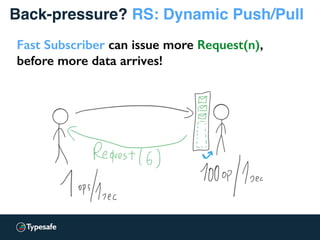
Fast Subscriber can issue more Request(n),
before more data arrives!
Back-pressure? RS: Dynamic Push/Pull
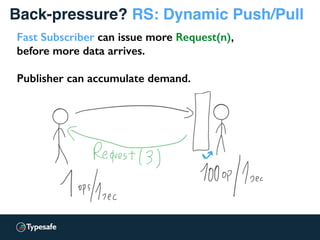
Fast Subscriber can issue more Request(n),
before more data arrives.
Publisher can accumulate demand.
Back-pressure? RS: Accumulate demand
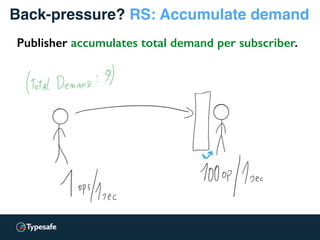
Publisher accumulates total demand per subscriber.
Back-pressure? RS: Accumulate demand
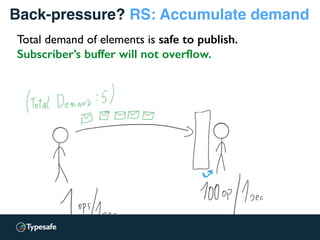
Total demand of elements is safe to publish.
Subscriber’s buffer will not overflow.
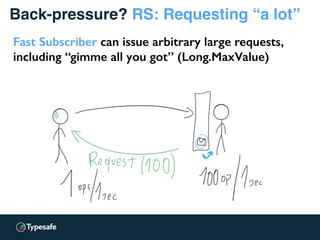
Back-pressure? RS: Requesting “a lot”
Fast Subscriber can issue arbitrary large requests,
including “gimme all you got” (Long.MaxValue)
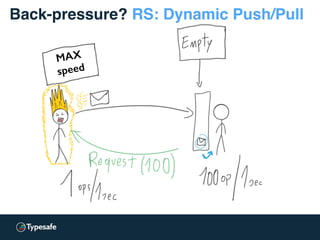
Back-pressure? RS: Dynamic Push/Pull
MAX
speed
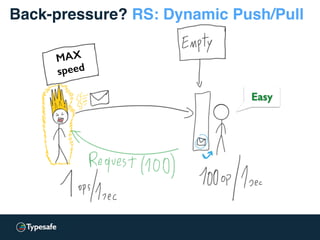
Back-pressure? RS: Dynamic Push/Pull
Easy
MAX
speed
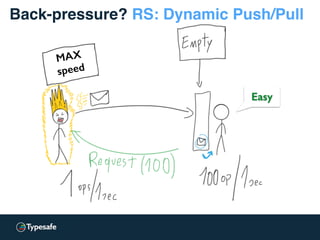
Back-pressure? RS: Dynamic Push/Pull
Easy
MAX
speed
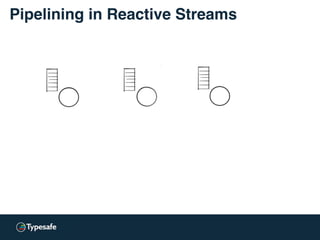
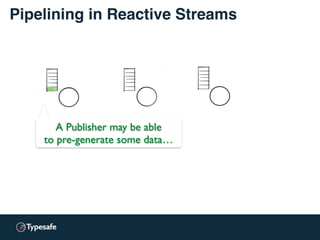
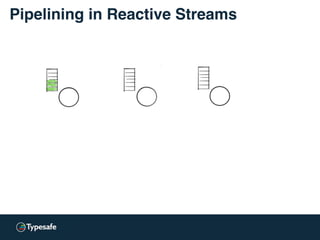
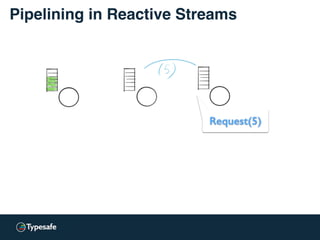
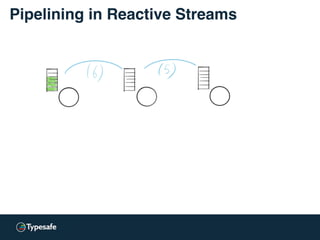
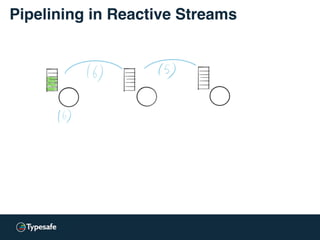
Pipelining in Reactive Streams
A Publisher may be able
to pre-generate some data…
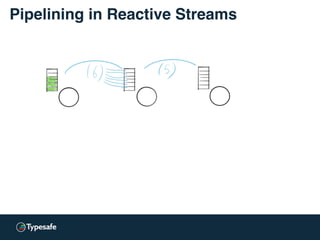
Pipelining in Reactive Streams
Request(5)
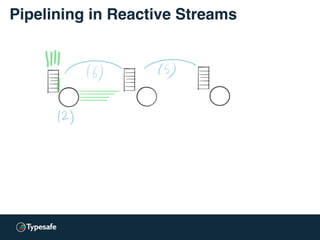
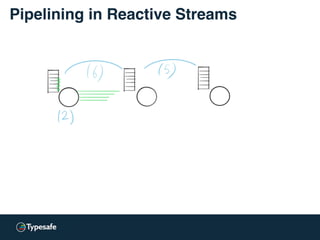
Pipelining in Reactive Streams
…and since signalling happens asynchronously…
Pipelining in Reactive Streams
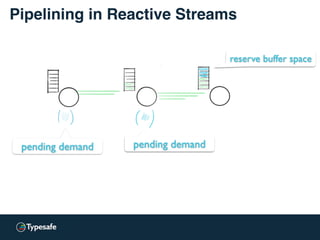
pending demand pending demand
reserve buffer space
Pipelining in Reactive Streams
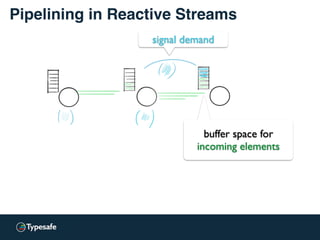
signal demand
buffer space for
incoming elements
Pipelining in Reactive Streams
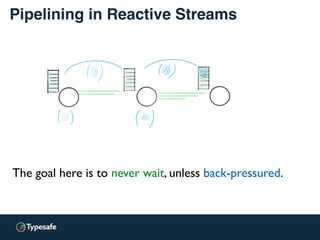
The goal here is to never wait, unless back-pressured.
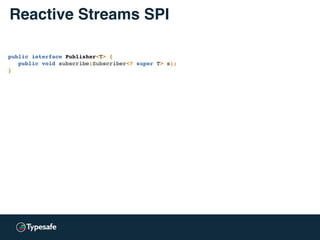
Reactive Streams SPI
public interface Publisher<T> {
public void subscribe(Subscriber<? super T> s);
}
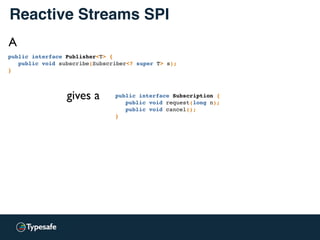
Reactive Streams SPI
public interface Publisher<T> {
public void subscribe(Subscriber<? super T> s);
}
gives a public interface Subscription {
public void request(long n);
public void cancel();
}
A
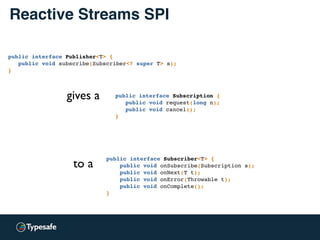
Reactive Streams SPI
public interface Subscriber<T> {
public void onSubscribe(Subscription s);
public void onNext(T t);
public void onError(Throwable t);
public void onComplete();
}
public interface Publisher<T> {
public void subscribe(Subscriber<? super T> s);
}
gives a
to a
public interface Subscription {
public void request(long n);
public void cancel();
}
How does fit in here?
Akka
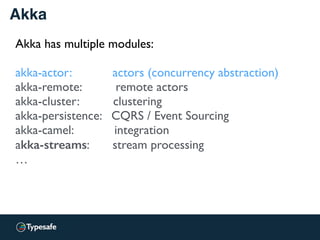
Akka has multiple modules:
akka-actor: actors (concurrency abstraction)
akka-remote: remote actors
akka-cluster: clustering
akka-persistence: CQRS / Event Sourcing
akka-camel: integration
akka-streams: stream processing
…
Akka
Akka is a high-performance concurrency
library for Scala and Java.
At it’s core it focuses on the Actor Model:
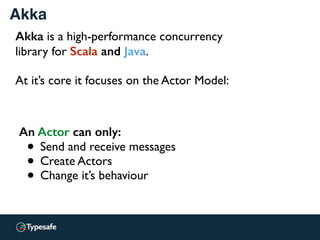
An Actor can only:
• Send and receive messages
• Create Actors
• Change it’s behaviour
Akka
Akka is a high-performance concurrency
library for Scala and Java.
At it’s core it focuses on the Actor Model:
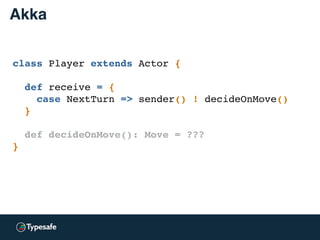
class Player extends Actor {
def receive = {
case NextTurn => sender() ! decideOnMove()
}
def decideOnMove(): Move = ???
}
Akka
Akka
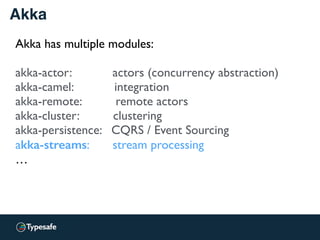
Akka has multiple modules:
akka-actor: actors (concurrency abstraction)
akka-camel: integration
akka-remote: remote actors
akka-cluster: clustering
akka-persistence: CQRS / Event Sourcing
akka-streams: stream processing
…
streams
Akka Streams – design decisions
Superior:
• reusability
• expansibility
• performance
• bound buffer space
• Java and Scala APIs
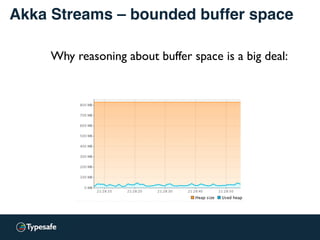
Akka Streams – bounded buffer space
Why reasoning about buffer space is a big deal:
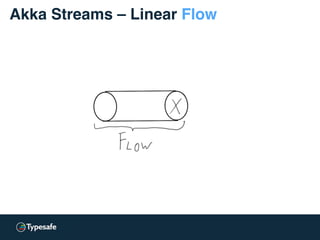
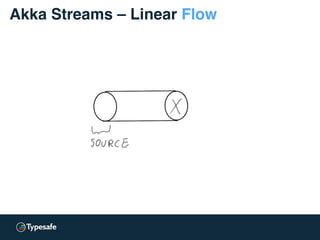
Akka Streams – Linear Flow
Flow[Double].map(_.toInt). [...]
No Source attached yet.
“Pipe ready to work with Doubles”.
Akka Streams – Linear Flow
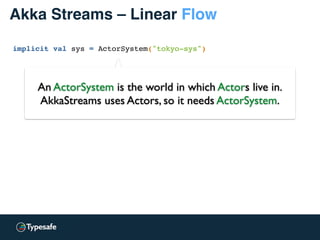
implicit val sys = ActorSystem("tokyo-sys")
An ActorSystem is the world in which Actors live in.
AkkaStreams uses Actors, so it needs ActorSystem.
Akka Streams – Linear Flow
implicit val sys = ActorSystem("tokyo-sys")
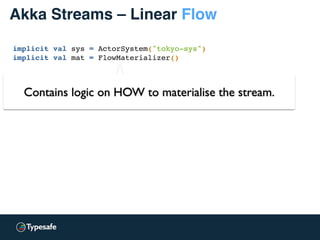
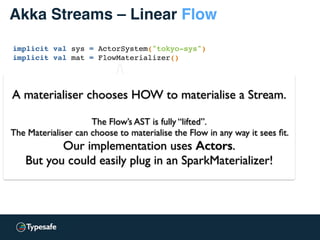
implicit val mat = FlowMaterializer()
Contains logic on HOW to materialise the stream.
Akka Streams – Linear Flow
implicit val sys = ActorSystem("tokyo-sys")
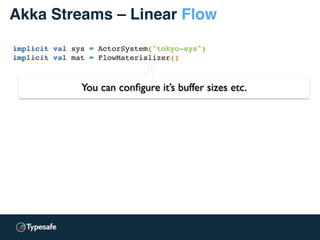
implicit val mat = FlowMaterializer()
A materialiser chooses HOW to materialise a Stream.
The Flow’s AST is fully “lifted”.
The Materialiser can choose to materialise the Flow in any way it sees fit.
Our implementation uses Actors.
But you could easily plug in an SparkMaterializer!
Akka Streams – Linear Flow
implicit val sys = ActorSystem("tokyo-sys")
implicit val mat = FlowMaterializer()
You can configure it’s buffer sizes etc.
Akka Streams – Linear Flow
implicit val sys = ActorSystem("tokyo-sys")
implicit val mat = FlowMaterializer()
val foreachSink = Sink.foreach[Int](println)
val mf = Source(1 to 3).runWith(foreachSink)
Akka Streams – Linear Flow
implicit val sys = ActorSystem("tokyo-sys")
implicit val mat = FlowMaterializer()
val foreachSink = Sink.foreach[Int](println)
val mf = Source(1 to 3).runWith(foreachSink)(mat)
Uses the implicit FlowMaterializer
Akka Streams – Linear Flow
implicit val sys = ActorSystem("tokyo-sys")
implicit val mat = FlowMaterializer()
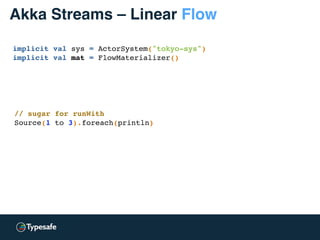
// sugar for runWith
Source(1 to 3).foreach(println)
Akka Streams – Linear Flow
val mf = Flow[Int].
map(_ * 2).
runWith(Sink.foreach(println))
// is missing a Source,
// can NOT run == won’t compile!
Akka Streams – Linear Flow
val f = Flow[Int].
map(_ * 2).
runWith(Sink.foreach(i => println(s"i = $i”))).
// needs Source to run!
Akka Streams – Linear Flow
val f = Flow[Int].
map(_ * 2).
runWith(Sink.foreach(i => println(s"i = $i”))).
// needs Source to run!
Akka Streams – Linear Flow
val f = Flow[Int].
map(_ * 2).
runWith(Sink.foreach(i => println(s"i = $i”))).
// needs Source to run!
Akka Streams – Linear Flow
val f = Flow[Int].
map(_ * 2).
runWith(Sink.foreach(i => println(s"i = $i”))).
// needs Source to run!
f.connect(Source(1 to 10)).run()
Akka Streams – Linear Flow
val f = Flow[Int].
map(_ * 2).
runWith(Sink.foreach(i => println(s"i = $i”))).
// needs Source to run!
f.connect(Source(1 to 10)).run()
With a Source attached… it can run()
Akka Streams – Linear Flow
Flow[Int].
map(_.toString).
runWith(Source(1 to 10), Sink.ignore)
Connects Source and Sink, then runs
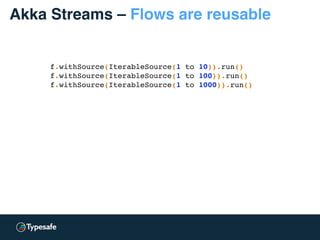
Akka Streams – Flows are reusable
f.withSource(IterableSource(1 to 10)).run()
f.withSource(IterableSource(1 to 100)).run()
f.withSource(IterableSource(1 to 1000)).run()
Akka Streams <-> Actors – Advanced
val subscriber = ActorSubscriber(
system.actorOf(Props[SubStreamParent], ”parent”))
Source(1 to 100).
map(_.toString).
filter(_.length == 2).
drop(2).
groupBy(_.last).
runWith(subscriber)
Akka Streams <-> Actors – Advanced
Each “group” is a stream too! It’s a “Stream of Streams”.
val subscriber = ActorSubscriber(
system.actorOf(Props[SubStreamParent], ”parent”))
Source(1 to 100).
map(_.toString).
filter(_.length == 2).
drop(2).
groupBy(_.last).
runWith(subscriber)
Akka Streams <-> Actors – Advanced
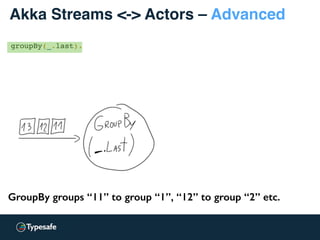
groupBy(_.last).
GroupBy groups “11” to group “1”, “12” to group “2” etc.
Akka Streams <-> Actors – Advanced
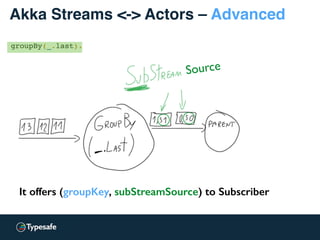
groupBy(_.last).
It offers (groupKey, subStreamSource) to Subscriber
Source
Akka Streams <-> Actors – Advanced
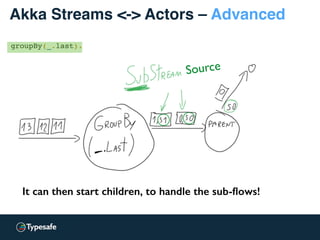
groupBy(_.last).
It can then start children, to handle the sub-flows!
Source
Akka Streams <-> Actors – Advanced
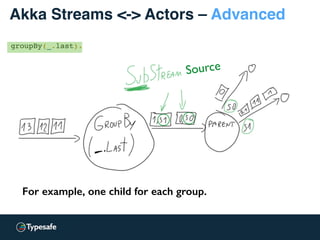
groupBy(_.last).
For example, one child for each group.
Source
Akka Streams <-> Actors – Advanced
val subscriber = ActorSubscriber(
system.actorOf(Props[SubStreamParent], ”parent”))
Source(1 to 100).
map(_.toString).
filter(_.length == 2).
drop(2).
groupBy(_.last).
runWith(subscriber)
The Actor, will consume SubStream offers.
Akka Streams – FlowGraph
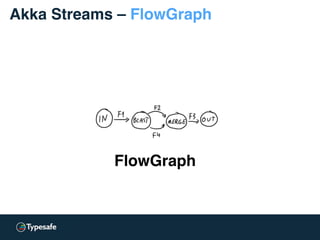
FlowGraph
Akka Streams – FlowGraph
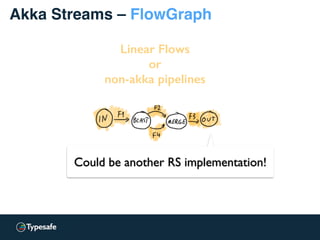
Linear Flows
or
non-akka pipelines
Could be another RS implementation!
Akka Streams – GraphFlow
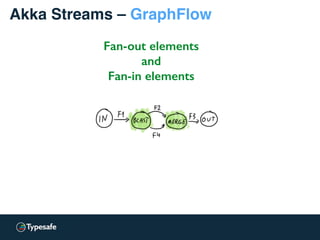
Fan-out elements
and
Fan-in elements
Akka Streams – GraphFlow
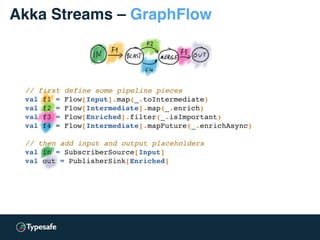
// first define some pipeline pieces
val f1 = Flow[Input].map(_.toIntermediate)
val f2 = Flow[Intermediate].map(_.enrich)
val f3 = Flow[Enriched].filter(_.isImportant)
val f4 = Flow[Intermediate].mapFuture(_.enrichAsync)
// then add input and output placeholders
val in = SubscriberSource[Input]
val out = PublisherSink[Enriched]
Akka Streams – GraphFlow
FlowGraph { implicit b =>
import FlowGraphImplicits._
val bcast = Broadcast[Intermediate]
val merge = Merge[Enriched]
in ~> f1 ~> bcast ~> f2 ~> merge
bcast ~> f4 ~> merge ~> f3 ~> out
}
Akka Streams – GraphFlow
FlowGraph { implicit b =>
import FlowGraphImplicits._
val bcast = Broadcast[Intermediate]
val merge = Merge[Enriched]
in ~> f1 ~> bcast ~> f2 ~> merge
bcast ~> f4 ~> merge ~> f3 ~> out
}
Akka Streams – GraphFlow
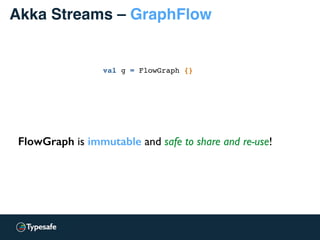
val g = FlowGraph {}
FlowGraph is immutable and safe to share and re-use!
streams
in action
There’s more to explore!
Topics we did explore today:
• asynchronous non-blocking back-pressure
• complex graph processing pipelines
• streams powered TCP server / client
• a sneak peek into custom elements
There’s more to explore!
Topics we didn’t explore today:
• explicit buffering, and overflow strategies
• integrating with Akka Actors
• time-based operators (takeWhile, dropWhile, timer transforms)
• plenty additional combinators and junctions
• implementing custom processing stages and junctions
There’s more to explore!
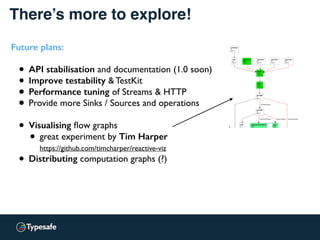
Future plans:
• API stabilisation and documentation (1.0 soon)
• Improve testability & TestKit
• Performance tuning of Streams & HTTP
• Provide more Sinks / Sources and operations
• Visualising flow graphs
• great experiment by Tim Harper

https://github.com/timcharper/reactive-viz
• Distributing computation graphs (?)
Links
• http://akka.io
• http://reactive-streams.org

• https://groups.google.com/group/akka-user

• Tim Harper’s awesome complex pipeline example + visualisation

https://github.com/timcharper/reactive-viz

• 1.0-M2 Documentation (not complete)

http://doc.akka.io/docs/akka-stream-and-http-experimental/1.0-M2/scala.html
• Complete JavaDSL for all operations

https://github.com/akka/akka/pulls?q=is%3Apr+javadsl
©Typesafe 2015 – All Rights Reserved
Reactive
Application
Development!
SBT in Action! Akka in Action!
Play for Scala! Play for Java! Atomic Scala!
Check out eBooks at Typesafe!!
Visit http://typesafe.com/resources/e-books to view all!!
Check out eBooks at Typesafe
Visit http://typesafe.com/resources/e-books to view all	
  
©Typesafe 2015 – All Rights Reserved

Reactive Stream Processing with Akka Streams

  • 1.
    Konrad 'ktoso' Malawski GeeCON2014 @ Kraków, PL Konrad `@ktosopl` Malawski streams reactive stream processing with
  • 2.
    Konrad `@ktosopl` Malawski AkkaTeam Reactive Streams TCK sbt-jmh … hAkker @
  • 3.
    Konrad `@ktosopl` Malawski typesafe.com geecon.org Java.pl/ KrakowScala.pl sckrk.com / meetup.com/Paper-Cup @ London GDGKrakow.pl meetup.com/Lambda-Lounge-Krakow hAkker @
  • 4.
  • 5.
    Agenda • Reactive Streams •Background and Specification • Protocol details • Akka Streams • Concepts and goals • Building Blocks • Akka Streams in Action • Q & A
  • 6.
  • 7.
  • 8.
    Streams “You cannot enterthe same river twice” ~ Heraclitus http://en.wikiquote.org/wiki/Heraclitus
  • 9.
    Streams Real Time StreamProcessing When you attach “late” to a Publisher, you may miss initial elements – it’s a river of data. http://en.wikiquote.org/wiki/Heraclitus
  • 10.
  • 11.
  • 12.
  • 13.
  • 14.
  • 15.
    Reactive Streams: Goals 1.Back-pressured Asynchronous Stream processing 2. Standard implemented by many libraries
  • 16.
    Reactive Streams -Specification & TCK http://reactive-streams.org
  • 17.
    Reactive Streams -Who? http://reactive-streams.org Kaazing Corp. rxJava @ Netflix, reactor @ Pivotal (SpringSource), vert.x @ Red Hat, Twitter, akka-streams @ Typesafe, spray @ Spray.io, Oracle, java (?) – Doug Lea - SUNY Oswego …
  • 18.
    Reactive Streams -Inter-op http://reactive-streams.org We want to make different implementations co-operate with each other.
  • 19.
    Reactive Streams -Inter-op http://reactive-streams.org The different implementations “talk to each other” using the Reactive Streams protocol.
  • 20.
    Reactive Streams -Inter-op http://reactive-streams.org The Reactive Streams SPI is NOT meant to be user-api. You should use one of the implementing libraries.
  • 21.
    package com.rolandkuhn.rsinterop import ratpack.rx.RxRatpack importratpack.test.embed.EmbeddedApp import ratpack.handling.Handler import ratpack.handling.Context import rx.Observable import scala.collection.JavaConverters._ import akka.stream.scaladsl.Flow import akka.stream.scaladsl.Source import rx.RxReactiveStreams import akka.stream.scaladsl.Sink import akka.actor.ActorSystem import akka.stream.FlowMaterializer import ratpack.http.ResponseChunks import java.util.function.Consumer import ratpack.test.http.TestHttpClient import reactor.rx.Streams object ScalaMain extends App { val system = ActorSystem("InteropTest") implicit val mat = FlowMaterializer()(system) Reactive Streams - Inter-op
  • 22.
    EmbeddedApp.fromHandler(new Handler { overridedef handle(ctx: Context): Unit = { // RxJava Observable val intObs = Observable.from((1 to 10).asJava) // Reactive Streams Publisher val intPub = RxReactiveStreams.toPublisher(intObs) // Akka Streams Source val stringSource = Source(intPub).map(_.toString) // Reactive Streams Publisher val stringPub = stringSource.runWith(Sink.fanoutPublisher(1, 1)) // Reactor Stream val linesStream = Streams.create(stringPub).map[String](new reactor.function.Function[String, String] { override def apply(in: String) = in + "n" }) // and now render the HTTP response (RatPack) ctx.render(ResponseChunks.stringChunks(linesStream)) } }).test(new Consumer[TestHttpClient] { override def accept(client: TestHttpClient): Unit = { val text = client.getText() println(text) system.shutdown() } }) } Reactive Streams - Inter-op
  • 23.
  • 24.
  • 25.
    Back-pressure? Example Without FastPublisher Slow Subscriber
  • 26.
  • 27.
  • 28.
    Back-pressure? Push +NACK model Subscriber usually has some kind of buffer.
  • 29.
  • 30.
  • 31.
    Back-pressure? Push +NACK model What if the buffer overflows?
  • 32.
    Back-pressure? Push +NACK model (a) Use bounded buffer, drop messages + require re-sending
  • 33.
    Back-pressure? Push +NACK model (a) Kernel does this! Routers do this! (TCP) Use bounded buffer, drop messages + require re-sending
  • 34.
    Back-pressure? Push +NACK model (b) Increase buffer size… Well, while you have memory available!
  • 35.
    Back-pressure? Push +NACK model (b)
  • 36.
  • 37.
  • 38.
  • 39.
    Back-pressure? Example NACKing Tellingthe Publisher to slow down / stop sending…
  • 40.
    Back-pressure? Example NACKing NACKdid not make it in time, because M was in-flight!
  • 41.
  • 42.
    Back-pressure? Fast Subscriber,No Problem No problem!
  • 43.
  • 44.
    Just push –not safe when Slow Subscriber Just pull – too slow when Fast Subscriber Back-pressure? RS: Dynamic Push/Pull
  • 45.
    Solution: Dynamic adjustment Back-pressure? RS:Dynamic Push/Pull Just push – not safe when Slow Subscriber Just pull – too slow when Fast Subscriber
  • 46.
    Back-pressure? RS: DynamicPush/Pull Slow Subscriber sees it’s buffer can take 3 elements. Publisher will never blow up it’s buffer.
  • 47.
    Back-pressure? RS: DynamicPush/Pull Fast Publisher will send at-most 3 elements. This is pull-based-backpressure.
  • 48.
    Back-pressure? RS: DynamicPush/Pull Fast Subscriber can issue more Request(n), before more data arrives!
  • 49.
    Back-pressure? RS: DynamicPush/Pull Fast Subscriber can issue more Request(n), before more data arrives. Publisher can accumulate demand.
  • 50.
    Back-pressure? RS: Accumulatedemand Publisher accumulates total demand per subscriber.
  • 51.
    Back-pressure? RS: Accumulatedemand Total demand of elements is safe to publish. Subscriber’s buffer will not overflow.
  • 52.
    Back-pressure? RS: Requesting“a lot” Fast Subscriber can issue arbitrary large requests, including “gimme all you got” (Long.MaxValue)
  • 53.
    Back-pressure? RS: DynamicPush/Pull MAX speed
  • 54.
    Back-pressure? RS: DynamicPush/Pull Easy MAX speed
  • 55.
    Back-pressure? RS: DynamicPush/Pull Easy MAX speed
  • 56.
  • 57.
    Pipelining in ReactiveStreams A Publisher may be able to pre-generate some data…
  • 58.
  • 59.
    Pipelining in ReactiveStreams Request(5)
  • 60.
  • 61.
  • 62.
  • 63.
  • 64.
  • 65.
    Pipelining in ReactiveStreams …and since signalling happens asynchronously…
  • 66.
    Pipelining in ReactiveStreams pending demand pending demand reserve buffer space
  • 67.
    Pipelining in ReactiveStreams signal demand buffer space for incoming elements
  • 68.
    Pipelining in ReactiveStreams The goal here is to never wait, unless back-pressured.
  • 69.
  • 70.
    Reactive Streams SPI publicinterface Publisher<T> { public void subscribe(Subscriber<? super T> s); }
  • 71.
    Reactive Streams SPI publicinterface Publisher<T> { public void subscribe(Subscriber<? super T> s); } gives a public interface Subscription { public void request(long n); public void cancel(); } A
  • 72.
    Reactive Streams SPI publicinterface Subscriber<T> { public void onSubscribe(Subscription s); public void onNext(T t); public void onError(Throwable t); public void onComplete(); } public interface Publisher<T> { public void subscribe(Subscriber<? super T> s); } gives a to a public interface Subscription { public void request(long n); public void cancel(); }
  • 73.
    How does fitin here?
  • 74.
    Akka Akka has multiplemodules: akka-actor: actors (concurrency abstraction) akka-remote: remote actors akka-cluster: clustering akka-persistence: CQRS / Event Sourcing akka-camel: integration akka-streams: stream processing …
  • 75.
    Akka Akka is ahigh-performance concurrency library for Scala and Java. At it’s core it focuses on the Actor Model:
  • 76.
    An Actor canonly: • Send and receive messages • Create Actors • Change it’s behaviour Akka Akka is a high-performance concurrency library for Scala and Java. At it’s core it focuses on the Actor Model:
  • 77.
    class Player extendsActor { def receive = { case NextTurn => sender() ! decideOnMove() } def decideOnMove(): Move = ??? } Akka
  • 78.
    Akka Akka has multiplemodules: akka-actor: actors (concurrency abstraction) akka-camel: integration akka-remote: remote actors akka-cluster: clustering akka-persistence: CQRS / Event Sourcing akka-streams: stream processing …
  • 79.
  • 80.
    Akka Streams –design decisions Superior: • reusability • expansibility • performance • bound buffer space • Java and Scala APIs
  • 81.
    Akka Streams –bounded buffer space Why reasoning about buffer space is a big deal:
  • 82.
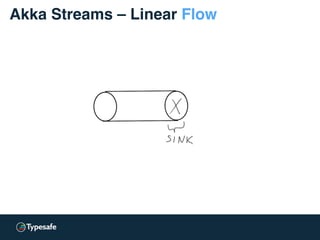
    Akka Streams –Linear Flow
  • 83.
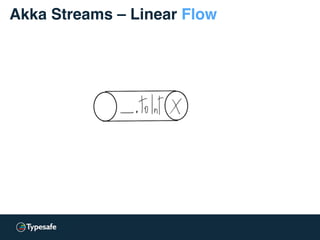
    Akka Streams –Linear Flow
  • 84.
    Akka Streams –Linear Flow
  • 85.
    Akka Streams –Linear Flow
  • 86.
    Akka Streams –Linear Flow Flow[Double].map(_.toInt). [...] No Source attached yet. “Pipe ready to work with Doubles”.
  • 87.
    Akka Streams –Linear Flow implicit val sys = ActorSystem("tokyo-sys") An ActorSystem is the world in which Actors live in. AkkaStreams uses Actors, so it needs ActorSystem.
  • 88.
    Akka Streams –Linear Flow implicit val sys = ActorSystem("tokyo-sys") implicit val mat = FlowMaterializer() Contains logic on HOW to materialise the stream.
  • 89.
    Akka Streams –Linear Flow implicit val sys = ActorSystem("tokyo-sys") implicit val mat = FlowMaterializer() A materialiser chooses HOW to materialise a Stream. The Flow’s AST is fully “lifted”. The Materialiser can choose to materialise the Flow in any way it sees fit. Our implementation uses Actors. But you could easily plug in an SparkMaterializer!
  • 90.
    Akka Streams –Linear Flow implicit val sys = ActorSystem("tokyo-sys") implicit val mat = FlowMaterializer() You can configure it’s buffer sizes etc.
  • 91.
    Akka Streams –Linear Flow implicit val sys = ActorSystem("tokyo-sys") implicit val mat = FlowMaterializer() val foreachSink = Sink.foreach[Int](println) val mf = Source(1 to 3).runWith(foreachSink)
  • 92.
    Akka Streams –Linear Flow implicit val sys = ActorSystem("tokyo-sys") implicit val mat = FlowMaterializer() val foreachSink = Sink.foreach[Int](println) val mf = Source(1 to 3).runWith(foreachSink)(mat) Uses the implicit FlowMaterializer
  • 93.
    Akka Streams –Linear Flow implicit val sys = ActorSystem("tokyo-sys") implicit val mat = FlowMaterializer() // sugar for runWith Source(1 to 3).foreach(println)
  • 94.
    Akka Streams –Linear Flow val mf = Flow[Int]. map(_ * 2). runWith(Sink.foreach(println)) // is missing a Source, // can NOT run == won’t compile!
  • 95.
    Akka Streams –Linear Flow val f = Flow[Int]. map(_ * 2). runWith(Sink.foreach(i => println(s"i = $i”))). // needs Source to run!
  • 96.
    Akka Streams –Linear Flow val f = Flow[Int]. map(_ * 2). runWith(Sink.foreach(i => println(s"i = $i”))). // needs Source to run!
  • 97.
    Akka Streams –Linear Flow val f = Flow[Int]. map(_ * 2). runWith(Sink.foreach(i => println(s"i = $i”))). // needs Source to run!
  • 98.
    Akka Streams –Linear Flow val f = Flow[Int]. map(_ * 2). runWith(Sink.foreach(i => println(s"i = $i”))). // needs Source to run! f.connect(Source(1 to 10)).run()
  • 99.
    Akka Streams –Linear Flow val f = Flow[Int]. map(_ * 2). runWith(Sink.foreach(i => println(s"i = $i”))). // needs Source to run! f.connect(Source(1 to 10)).run() With a Source attached… it can run()
  • 100.
    Akka Streams –Linear Flow Flow[Int]. map(_.toString). runWith(Source(1 to 10), Sink.ignore) Connects Source and Sink, then runs
  • 101.
    Akka Streams –Flows are reusable f.withSource(IterableSource(1 to 10)).run() f.withSource(IterableSource(1 to 100)).run() f.withSource(IterableSource(1 to 1000)).run()
  • 102.
    Akka Streams <->Actors – Advanced val subscriber = ActorSubscriber( system.actorOf(Props[SubStreamParent], ”parent”)) Source(1 to 100). map(_.toString). filter(_.length == 2). drop(2). groupBy(_.last). runWith(subscriber)
  • 103.
    Akka Streams <->Actors – Advanced Each “group” is a stream too! It’s a “Stream of Streams”. val subscriber = ActorSubscriber( system.actorOf(Props[SubStreamParent], ”parent”)) Source(1 to 100). map(_.toString). filter(_.length == 2). drop(2). groupBy(_.last). runWith(subscriber)
  • 104.
    Akka Streams <->Actors – Advanced groupBy(_.last). GroupBy groups “11” to group “1”, “12” to group “2” etc.
  • 105.
    Akka Streams <->Actors – Advanced groupBy(_.last). It offers (groupKey, subStreamSource) to Subscriber Source
  • 106.
    Akka Streams <->Actors – Advanced groupBy(_.last). It can then start children, to handle the sub-flows! Source
  • 107.
    Akka Streams <->Actors – Advanced groupBy(_.last). For example, one child for each group. Source
  • 108.
    Akka Streams <->Actors – Advanced val subscriber = ActorSubscriber( system.actorOf(Props[SubStreamParent], ”parent”)) Source(1 to 100). map(_.toString). filter(_.length == 2). drop(2). groupBy(_.last). runWith(subscriber) The Actor, will consume SubStream offers.
  • 109.
    Akka Streams –FlowGraph FlowGraph
  • 110.
    Akka Streams –FlowGraph Linear Flows or non-akka pipelines Could be another RS implementation!
  • 111.
    Akka Streams –GraphFlow Fan-out elements and Fan-in elements
  • 112.
    Akka Streams –GraphFlow // first define some pipeline pieces val f1 = Flow[Input].map(_.toIntermediate) val f2 = Flow[Intermediate].map(_.enrich) val f3 = Flow[Enriched].filter(_.isImportant) val f4 = Flow[Intermediate].mapFuture(_.enrichAsync) // then add input and output placeholders val in = SubscriberSource[Input] val out = PublisherSink[Enriched]
  • 113.
  • 114.
    Akka Streams –GraphFlow FlowGraph { implicit b => import FlowGraphImplicits._ val bcast = Broadcast[Intermediate] val merge = Merge[Enriched] in ~> f1 ~> bcast ~> f2 ~> merge bcast ~> f4 ~> merge ~> f3 ~> out }
  • 115.
    Akka Streams –GraphFlow FlowGraph { implicit b => import FlowGraphImplicits._ val bcast = Broadcast[Intermediate] val merge = Merge[Enriched] in ~> f1 ~> bcast ~> f2 ~> merge bcast ~> f4 ~> merge ~> f3 ~> out }
  • 116.
    Akka Streams –GraphFlow val g = FlowGraph {} FlowGraph is immutable and safe to share and re-use!
  • 117.
  • 118.
    There’s more toexplore! Topics we did explore today: • asynchronous non-blocking back-pressure • complex graph processing pipelines • streams powered TCP server / client • a sneak peek into custom elements
  • 119.
    There’s more toexplore! Topics we didn’t explore today: • explicit buffering, and overflow strategies • integrating with Akka Actors • time-based operators (takeWhile, dropWhile, timer transforms) • plenty additional combinators and junctions • implementing custom processing stages and junctions
  • 120.
    There’s more toexplore! Future plans: • API stabilisation and documentation (1.0 soon) • Improve testability & TestKit • Performance tuning of Streams & HTTP • Provide more Sinks / Sources and operations • Visualising flow graphs • great experiment by Tim Harper
 https://github.com/timcharper/reactive-viz • Distributing computation graphs (?)
  • 121.
    Links • http://akka.io • http://reactive-streams.org
 •https://groups.google.com/group/akka-user
 • Tim Harper’s awesome complex pipeline example + visualisation
 https://github.com/timcharper/reactive-viz
 • 1.0-M2 Documentation (not complete)
 http://doc.akka.io/docs/akka-stream-and-http-experimental/1.0-M2/scala.html • Complete JavaDSL for all operations
 https://github.com/akka/akka/pulls?q=is%3Apr+javadsl
  • 122.
    ©Typesafe 2015 –All Rights Reserved Reactive Application Development! SBT in Action! Akka in Action! Play for Scala! Play for Java! Atomic Scala! Check out eBooks at Typesafe!! Visit http://typesafe.com/resources/e-books to view all!! Check out eBooks at Typesafe Visit http://typesafe.com/resources/e-books to view all  
  • 123.
    ©Typesafe 2015 –All Rights Reserved