SPECIAL
SENSES
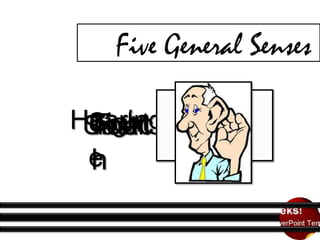
Five General Senses:
Hearing
Sight
Touc
Smell
Tast
e
h
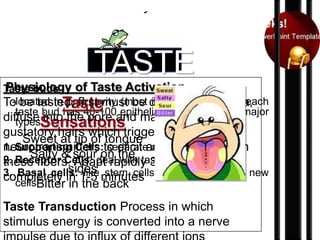
TASTE
Physiology of Taste Activation
Taste buds
-located inTaste
oral cavity (most in tongue in saliva,
To be tasted, first must be dissolvedpapillae) each
taste bud has 40-100 epithelial cells made of 3 major
diffuseSensations make contact with
types.into the pore and
gustatory hairs which trigger
Sweet at tip of tongue
1. Supporting Cells:to elicit action potentials in
neurotransmitters separate and insulate
Salty & sour on the
2. Receptor Cells: deal with taste seconds &
these fibers. Adapt rapidly 3-5
sides stem cells, they give rise to new
3. Basal cells: 1-5 minutes
completely in like
cellsBitter in the back
Taste Transduction Process in which
stimulus energy is converted into a nerve
SMEL
L
STRUCTURE
Pathway
PHYSIOLOGY
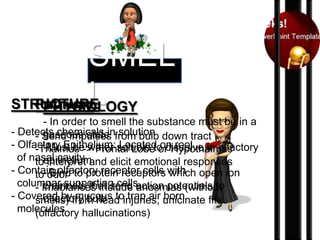
- In order to smell the substance must be in a
- Detects chemicals infrom bulb down tract
gaseous state
- Send impulses solution
- Olfactory Epithelium: soluble to dissolve in olfactory
-Must be water Located on roof
-Thalmus -> Frontal Lobe or Hypothalmus
of nasal cavity and elicit emotional responses
toepithelium
interpret
- Contain olfactory receptor cells with open ion
Bind
to-odor to protein receptors which
columnar supporting cellsanosmias (without
channels that send
- Imablances include action potentials to
- Covered byfrom head injuries; unicinate fits
olfactory bulb
smells) mucous to trap air born
molecules
(olfactory hallucinations)
SIGHT
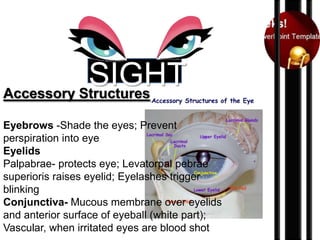
Accessory Structures
Eyebrows -Shade the eyes; Prevent
perspiration into eye
Eyelids
Palpabrae- protects eye; Levatorpal pebrae
superioris raises eyelid; Eyelashes trigger
blinking
Conjunctiva- Mucous membrane over eyelids
and anterior surface of eyeball (white part);
Vascular, when irritated eyes are blood shot
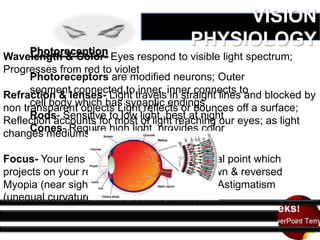
VISION
PHYSIOLOGY

Photoreception
Wavelength & Color- Eyes respond to visible light spectrum;
Progresses from red to violet
Photoreceptors are modified neurons; Outer
segment connected to inner, in straight lines and blocked by
Refraction & lenses- Light travelsinner connects to
cell body which has synaptic endings.
non transparent objects Light reflects or bounces off a surface;
Rods- Sensitive to low of light reaching our
Reflection accounts for most light, best at night eyes; as light
Cones- Require high light, provides color
changes mediums it can bend or refract.
Focus- Your lens refracts the light to your focal point which
projects on your retina Images are upside down & reversed
Myopia (near sighted) Hyperopia (farsighted) Astigmatism
(unequal curvature of lens leading to blur)
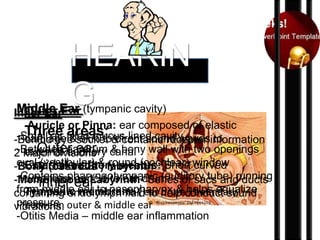
HEARIN
G

Middle Ear
Outer
Inner EarEar (tympanic cavity)
Auricle or Pinna: ear composed of elastic
Three areas: direct sound waves to
-Small air filled mucus lined cavity
cartilage & skin to
-Behind eye socket & contains receptor information
Outer ear
-Between eardrum & bony
external auditory
2 Major divisions canal wall with two openings
oval (vestibular) ) round (cochlear) curved
External auditory meatus:
middle ear
-Bony (osseous & labyrinth Short window
-Contains pharyngotympanic (auditory tube) running
tube from ear to ear Series
-Membranous Labyrinth-drum. of sacs and ducts
inner auricle nasopharynx & helps equalize
from middle ear to
Tympanic membrane ( to drum ) boundary
containing endolymph fluidear help conduct sound
pressure
between
vibrations. outer & middle ear
-Otitis Media – middle ear inflammation
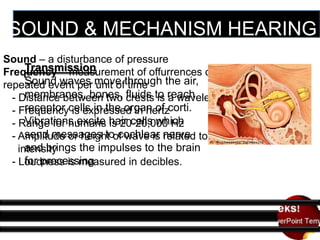
SOUND & MECHANISM HEARING
Sound – a disturbance of pressure
Transmission
Frequency – measurement of offurrences of a
Sound waves unit of time
repeated event per move through the air,
membranes, bones, fluids is a wavelength
- Distance between two crests to reach
receptor is expressed in hertz
- Frequencycells in the organ of corti.
Vibrations excite is 20-20,000 Hz
- Range for humans hair cells which
send messages to cochlear related
- Amplitude or height of wave is nerve to
and brings the impulses to the brain
intensity
for processing
- Loudness is measured in decibles.
IMBALANCES OF HEARING
Deafness – any hearing loss
Conduction deafness- When something hampers sound
conduction to fluids of inner ear
Sensorinerual- Damage to neural structures of cochlear hair
cells.
Tinnitus- Ringing of ear; Symptom of pathology and not
disease1st symptom of cochlear nerve degeneration.
Meniere’s Syndrome- Affects semicircular & cochlear canals.
Causes vertigo, nausea, vomiting.
EQUILIBRIUM
-Responds to head movement without awareness
-Receptors of inner ear are divided into two parts:
Static Sensory receptors for static are the maculae Found in saccules
and utricle Monitor position of head in space, control posture
Dynamic Receptor for dynamic are the crista ampullaris; Excited by
head movement but major stimuli are rotatory. These areas are at
work when twirling or feeling ill on a boat
TOUCH
In contrast, the other sense, touch, is a somatic
sense which
does not have a specialized organ but comes from all
over the body, most noticeably the skin but also the
internal organs.
Touch includes mechanoreception (pressure, vibration
and proprioception), pain (nociception) and heat
(thermoception), and such information is carried in
GSA and GVE.

Specialsenses

  • 1.
  • 2.
  • 3.
    TASTE Physiology of TasteActivation Taste buds -located inTaste oral cavity (most in tongue in saliva, To be tasted, first must be dissolvedpapillae) each taste bud has 40-100 epithelial cells made of 3 major diffuseSensations make contact with types.into the pore and gustatory hairs which trigger Sweet at tip of tongue 1. Supporting Cells:to elicit action potentials in neurotransmitters separate and insulate Salty & sour on the 2. Receptor Cells: deal with taste seconds & these fibers. Adapt rapidly 3-5 sides stem cells, they give rise to new 3. Basal cells: 1-5 minutes completely in like cellsBitter in the back Taste Transduction Process in which stimulus energy is converted into a nerve
  • 4.
    SMEL L STRUCTURE Pathway PHYSIOLOGY - In orderto smell the substance must be in a - Detects chemicals infrom bulb down tract gaseous state - Send impulses solution - Olfactory Epithelium: soluble to dissolve in olfactory -Must be water Located on roof -Thalmus -> Frontal Lobe or Hypothalmus of nasal cavity and elicit emotional responses toepithelium interpret - Contain olfactory receptor cells with open ion Bind to-odor to protein receptors which columnar supporting cellsanosmias (without channels that send - Imablances include action potentials to - Covered byfrom head injuries; unicinate fits olfactory bulb smells) mucous to trap air born molecules (olfactory hallucinations)
  • 5.
    SIGHT Accessory Structures Eyebrows -Shadethe eyes; Prevent perspiration into eye Eyelids Palpabrae- protects eye; Levatorpal pebrae superioris raises eyelid; Eyelashes trigger blinking Conjunctiva- Mucous membrane over eyelids and anterior surface of eyeball (white part); Vascular, when irritated eyes are blood shot
  • 6.
    VISION PHYSIOLOGY Photoreception Wavelength & Color-Eyes respond to visible light spectrum; Progresses from red to violet Photoreceptors are modified neurons; Outer segment connected to inner, in straight lines and blocked by Refraction & lenses- Light travelsinner connects to cell body which has synaptic endings. non transparent objects Light reflects or bounces off a surface; Rods- Sensitive to low of light reaching our Reflection accounts for most light, best at night eyes; as light Cones- Require high light, provides color changes mediums it can bend or refract. Focus- Your lens refracts the light to your focal point which projects on your retina Images are upside down & reversed Myopia (near sighted) Hyperopia (farsighted) Astigmatism (unequal curvature of lens leading to blur)
  • 7.
    HEARIN G Middle Ear Outer Inner EarEar(tympanic cavity) Auricle or Pinna: ear composed of elastic Three areas: direct sound waves to -Small air filled mucus lined cavity cartilage & skin to -Behind eye socket & contains receptor information Outer ear -Between eardrum & bony external auditory 2 Major divisions canal wall with two openings oval (vestibular) ) round (cochlear) curved External auditory meatus: middle ear -Bony (osseous & labyrinth Short window -Contains pharyngotympanic (auditory tube) running tube from ear to ear Series -Membranous Labyrinth-drum. of sacs and ducts inner auricle nasopharynx & helps equalize from middle ear to Tympanic membrane ( to drum ) boundary containing endolymph fluidear help conduct sound pressure between vibrations. outer & middle ear -Otitis Media – middle ear inflammation
  • 8.
    SOUND & MECHANISMHEARING Sound – a disturbance of pressure Transmission Frequency – measurement of offurrences of a Sound waves unit of time repeated event per move through the air, membranes, bones, fluids is a wavelength - Distance between two crests to reach receptor is expressed in hertz - Frequencycells in the organ of corti. Vibrations excite is 20-20,000 Hz - Range for humans hair cells which send messages to cochlear related - Amplitude or height of wave is nerve to and brings the impulses to the brain intensity for processing - Loudness is measured in decibles.
  • 9.
    IMBALANCES OF HEARING Deafness– any hearing loss Conduction deafness- When something hampers sound conduction to fluids of inner ear Sensorinerual- Damage to neural structures of cochlear hair cells. Tinnitus- Ringing of ear; Symptom of pathology and not disease1st symptom of cochlear nerve degeneration. Meniere’s Syndrome- Affects semicircular & cochlear canals. Causes vertigo, nausea, vomiting.
  • 10.
    EQUILIBRIUM -Responds to headmovement without awareness -Receptors of inner ear are divided into two parts: Static Sensory receptors for static are the maculae Found in saccules and utricle Monitor position of head in space, control posture Dynamic Receptor for dynamic are the crista ampullaris; Excited by head movement but major stimuli are rotatory. These areas are at work when twirling or feeling ill on a boat
  • 11.
    TOUCH In contrast, theother sense, touch, is a somatic sense which does not have a specialized organ but comes from all over the body, most noticeably the skin but also the internal organs. Touch includes mechanoreception (pressure, vibration and proprioception), pain (nociception) and heat (thermoception), and such information is carried in GSA and GVE.