Ulcer
By
Dr Prashant Patil
MS ( gen Surgery)
Reader & HOD
Dept. of surgery
Ulcer
Breach in the
continuity of surface
epithelium ( skin /
mucus membrane )
due to molecular death
of tissue cell by cell
Classification
-
-- Acute < 12 wks -- healing
-- Chronic > 12 wks -- Non healing
Infection TB Sq. cell carcinoma
physical/ chemical agents Syphilis Melanoma
local irritation /Trauma basal cell CA ( rodent)
interference with circulation
- arterial / venous
Cropathic, Bazin’s, Martorells
Diabetic, Cortisol, Tropical
aetiological Duration healing
Non
specific
specific Malignancy
Classification
 Wagner’s Classification (foot ulcers)
 The Wagner scale is used to classify the severity of foot ulcers in
diabetics:
 Grade 0 Pre- or post-ulcerative site
 Grade 1 Superficial ulcer
 Grade 2 Penetration into tendon or joint capsule
 Grade 3 Involvement of deeper tissues
 Grade 4 Gangrene of the forefoot
 Grade 5 Gangrene involving more than two-thirds of the foot
Classification
 Classification Based on Pain
 Painful Ulcers
 Tuberculous
 Arterial
 Advanced Malignancy
 Painless Ulcers-

Syphilitic
 Trophic
 Early Malignancy
Ulcer - few concepts
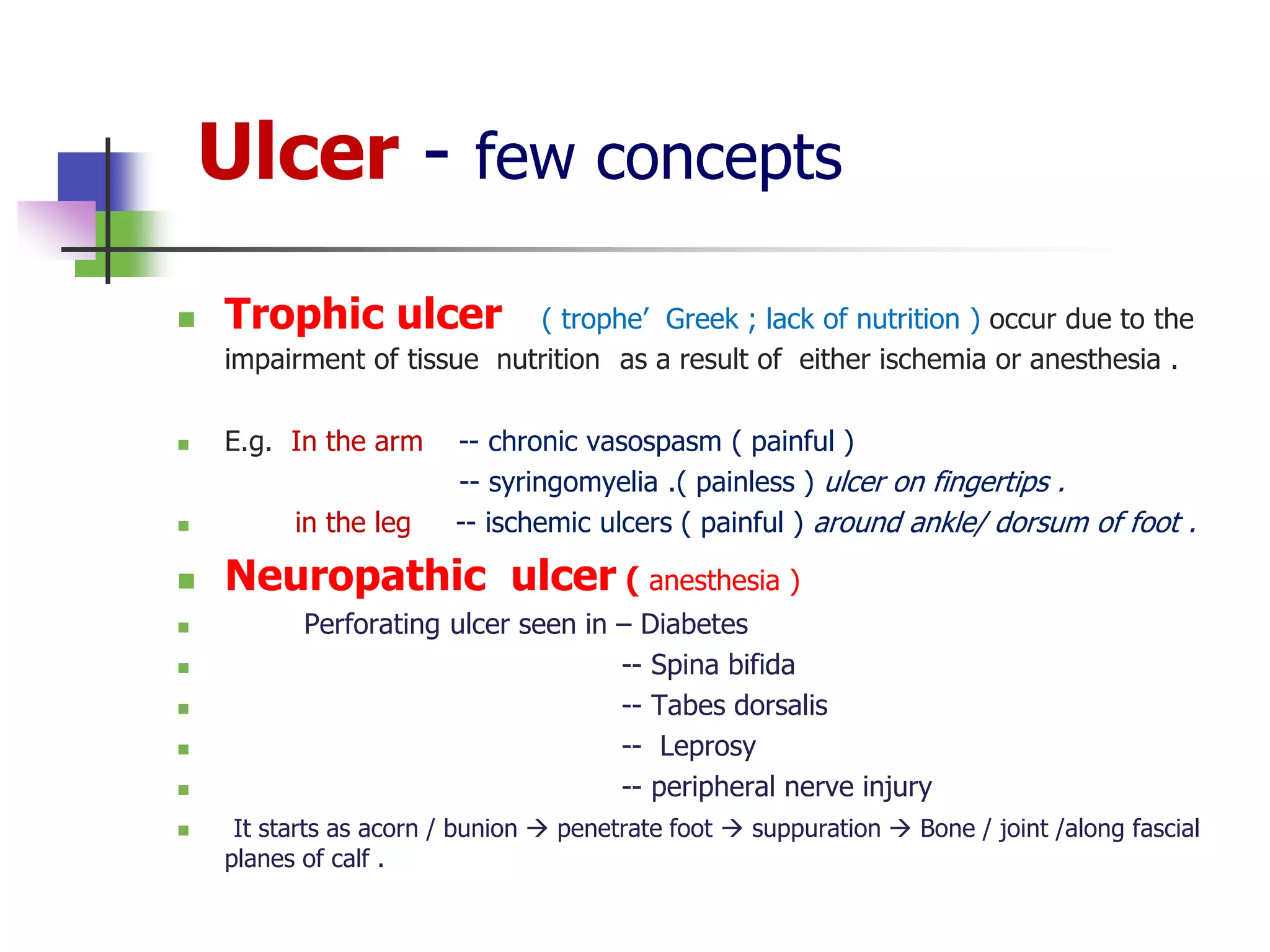
 Trophic ulcer ( trophe’ Greek ; lack of nutrition ) occur due to the
impairment of tissue nutrition as a result of either ischemia or anesthesia .
 E.g. In the arm -- chronic vasospasm ( painful )
-- syringomyelia .( painless ) ulcer on fingertips .
 in the leg -- ischemic ulcers ( painful ) around ankle/ dorsum of foot .
 Neuropathic ulcer ( anesthesia )
 Perforating ulcer seen in – Diabetes
 -- Spina bifida
 -- Tabes dorsalis
 -- Leprosy
 -- peripheral nerve injury
 It starts as acorn / bunion  penetrate foot  suppuration  Bone / joint /along fascial
planes of calf .
Ulcer - few concepts
 Modes of Onset of Ulcer
 • Traumatic
 • Spontaneous-
 • Secondary changes on a Swelling-Tuberculous lymphadenopathy
 • From a Previous Scar-Marjolin’s Ulcer
Life history of Ulcer
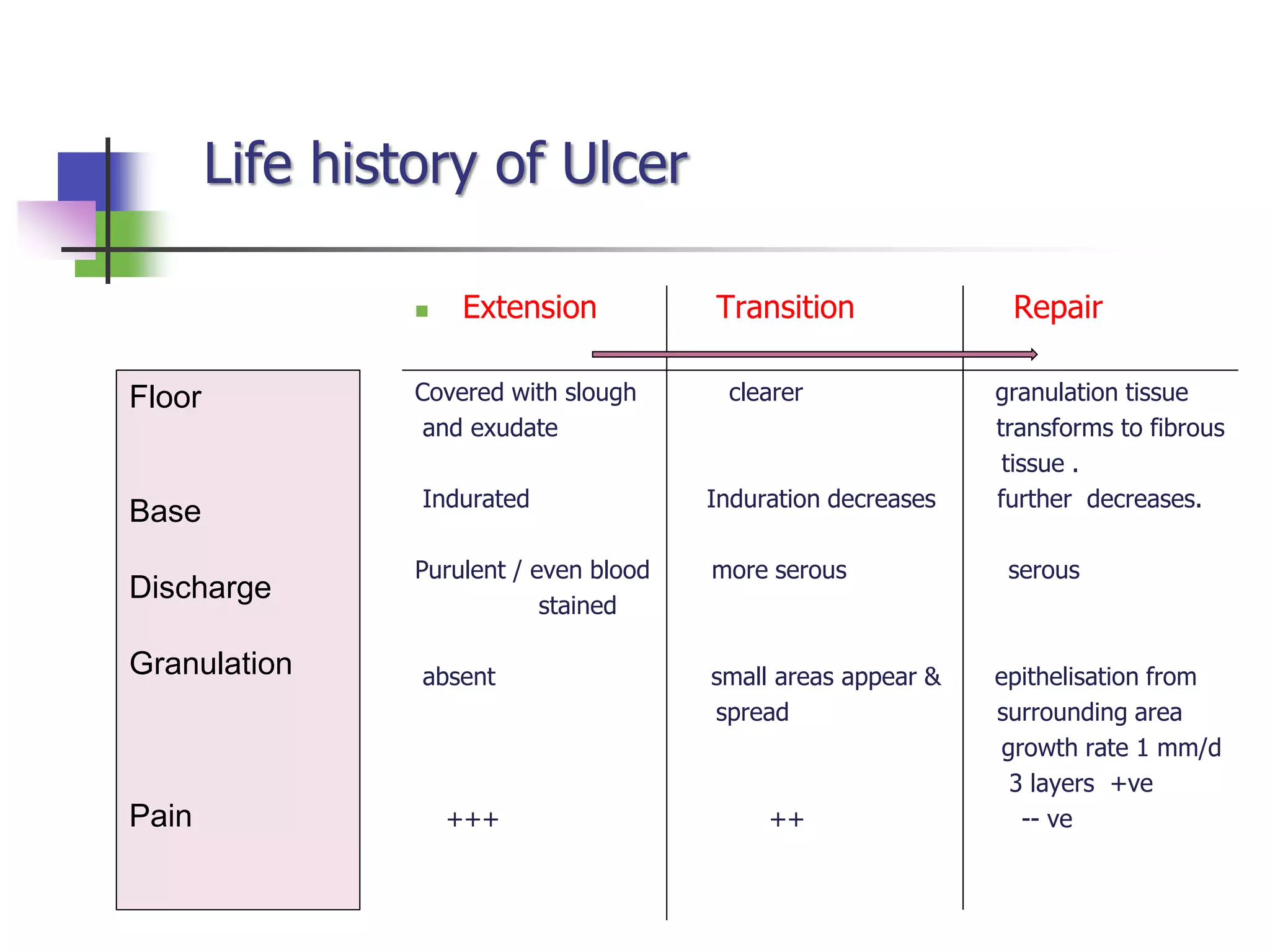
 Extension Transition Repair
Covered with slough clearer granulation tissue
and exudate transforms to fibrous
tissue .
Indurated Induration decreases further decreases.
Purulent / even blood more serous serous
stained
absent small areas appear & epithelisation from
spread surrounding area
growth rate 1 mm/d
3 layers +ve
+++ ++ -- ve
Floor
Base
Discharge
Granulation
Pain
Ulcer – clinical features
 Site : Rodent ulcer (95%) on upper part of face .
CA affects lower lip while primary ulcer of syphilis occur
on upper lip .
Arterial ulcers occur at finger tips / toe .
Venous ulcers occurs around ankle .
Size: Variable , depends on length of history .
inflammation > CA > Rodent .
Shape: Irregular -- Infective / CA .
Circular -- Rodent / Gummatous
Sq area / straight edge -- dermatitis artefacta .
Ulcer - parts
Edge
Floor
slough
Base
Ulcer – clinical features
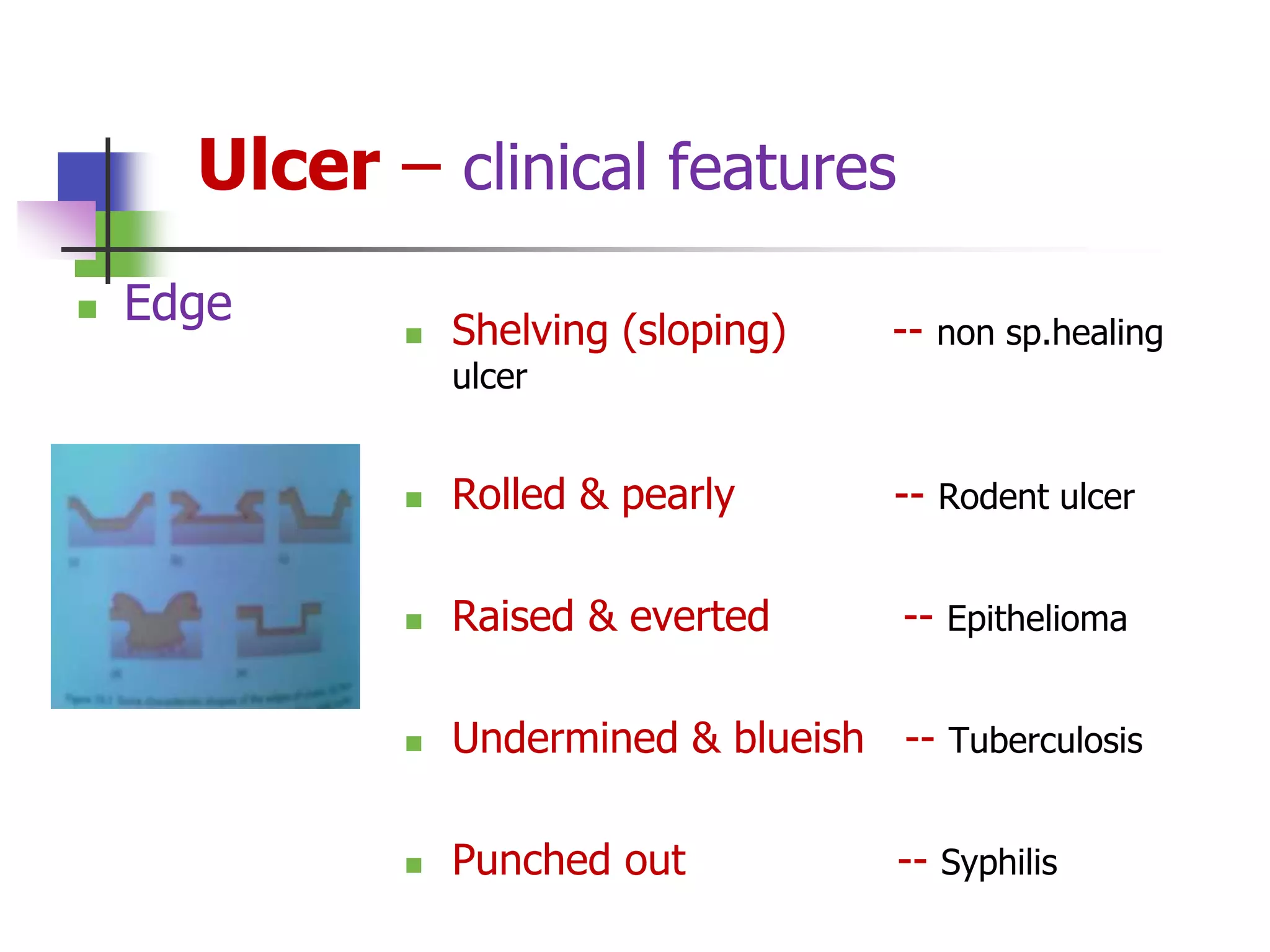
 Shelving (sloping) -- non sp.healing
ulcer
 Rolled & pearly -- Rodent ulcer
 Raised & everted -- Epithelioma
 Undermined & blueish -- Tuberculosis
 Punched out -- Syphilis
 Edge
Ulcer – clinical features ( cont. )
 Floor ( area seen by the observer )
Granulation -- non specific healing
Slough -- infected
Watery / Apple jelly Appearance -- tuberculus
Wash leather appearance -- gummatous
 Base ( part of an ulcer which is palpated )
Indurated -- malignancy
Attached to deep structures -- venous ulcer
Ulcer – clinical features ( con’t )
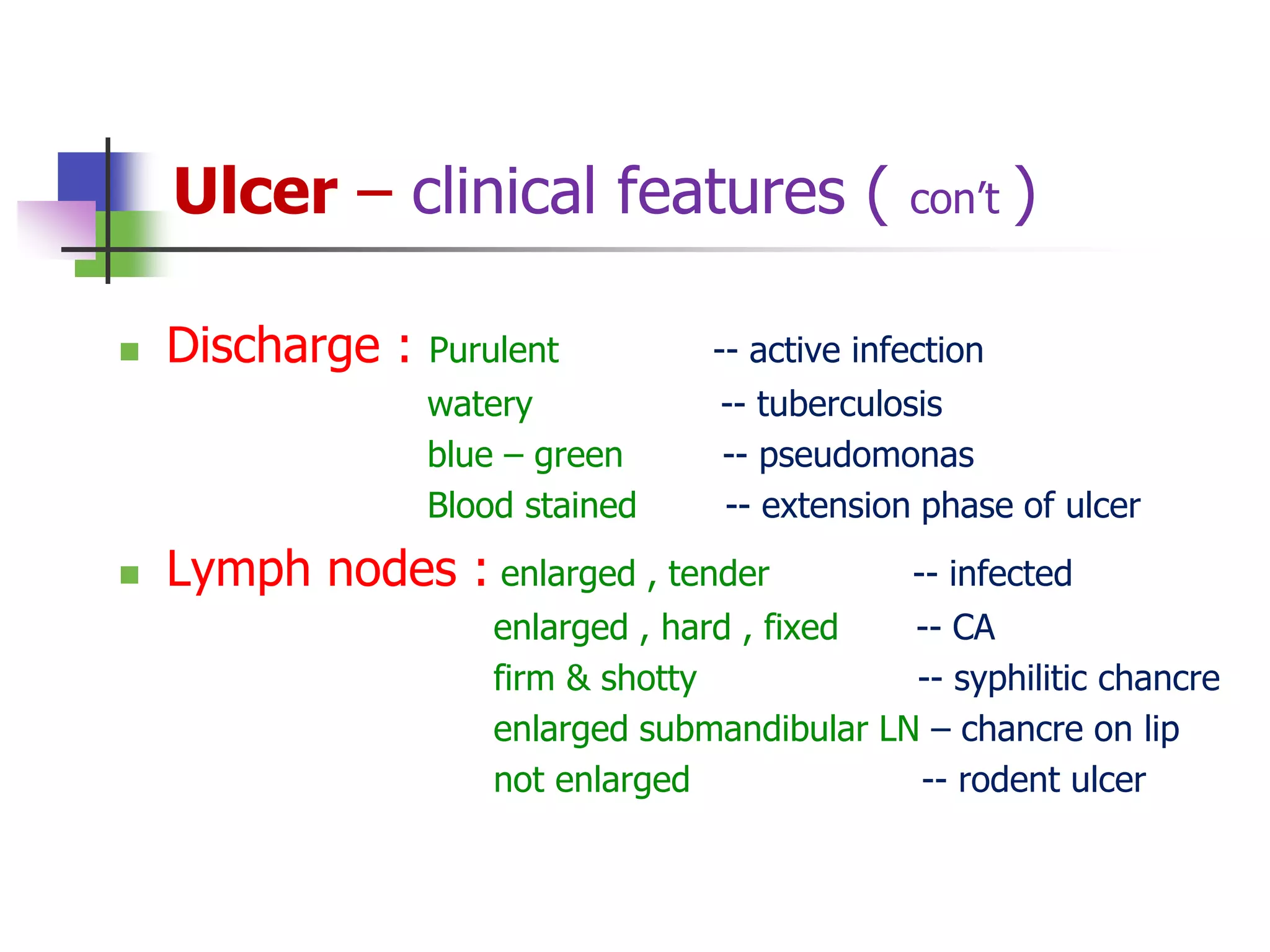
 Discharge : Purulent -- active infection
watery -- tuberculosis
blue – green -- pseudomonas
Blood stained -- extension phase of ulcer
 Lymph nodes : enlarged , tender -- infected
enlarged , hard , fixed -- CA
firm & shotty -- syphilitic chancre
enlarged submandibular LN – chancre on lip
not enlarged -- rodent ulcer
Ulcer – clinical features ( cont. )
 Pain
non sp ulcer in ext & ulcer in phase of repair
transition phase
Tuberculous ulcer on Tuberculous ulcer
tongue
Syphilitic Ulcer on anal Syphilitic ulcer
canal
Apthos ulcer
present absent
Ulcer – Regional examination
 Examination of draining LNs
Tender & enlarged – secondary infection
 Enlarged hard fixed – malignant ulcer
 Enlarged , firm , matted – tuberculous ulcer
 Enlarged and shotty – syphilis
 Examination for impaired circulation
 look for absent pulse/ weak pulse,
 trophic changes – thin limb, shiny skin, loss of hairs, brittle nails
 Look for varicose veins
 Neurological examination
 Sensation, motor power, reflexes
Ulcer – general examination
 Look for -- Aneamia , Malnutrition , Diabetes .
 Rule out -- Cardiac Failure .
Ulcer -- Investigations
 Haematological
 LFT / Protein
 Blood sugar -- fasting & post prandial
 Montoux test
 Serological tests for Syphilis
 Biopsy ( wedge/ Excision ) / scraping – histopath
 Swab -- culture / sensitivity
 Discharge – gm. staining, ZN staining for AFB, PCR for Koch.
 FNAC of enlarged LNs
 X-ray of affected part
Ulcer - principles of management
 Determine aetiology
 Accurate assessment of ulcer
 Identify and correct comorbid factors .
 Treat underlying cause
 Adequate drainage and desloughing .
 Avoid adherent dressings .
Ulcer -- treatment
local applications ( lotions / ointments ) -- treatment of cause
-- to separate slough -- correct Aneamia
-- hasten granulation -- treat metabolic
-- stimulate epithelisation disorders.
Na hypochlorite -- Antibiotics
0.5% AgNo3 early phase -- treatment of DM
Zinc Sulphate
Ointments ( mupirocin, soframycin , povidon iodine )
Vinegar ( 1: 6 ) for pseudomonas
Amnion ( fresh & cleaned with sodium hypochlorite
stored at 4*C
Silver Foil / SWD / Infra red
Hydrocolloids , Alginates ,Tegaderm
Recombinant epidermal growth factor
treatment
generallocal
Ulcer treatment - points to remember
 Determining exact aetiology is important - note the site & local characteristics
 - thorough history & physical assessment
 Detect & treat comorbid factors
 Biopsy of the lesion may be necessary sometimes for exact cause.
 Treat the underlying cause -- infection /DM / venous or arterial insufficiency .
 Adequate drainage & desloughing required – surgical excision is cost effective.
Antibiotic treatment is required for – infected ulcer / ulcer due to sp cause e.g. TB
 Clean ulcer should be dressed twice /day or more if copious discharge.
 Avoid adherent dressings .
 Wounds can be cleaned safely with normal saline solution.
Ulcer treatment – basic requirement of ideal dressing
 Maintain high humidity between wound & dressings.
 Absorbent , removes excess exudate.
 Non- adherent , allowing easy removal without trauma at changing
 Safe & acceptable to patients ( non allergic )
 Permit gaseous exchange but impermeable to micro- organisms .
 Cost - effective
Ulcer treatment ( Loco + Gen )
Healing
excision & curettage
AgN03 application
swab to r/o staph
coagulase + organism
pseudomonas
beta- hemo. Strepto .
clean with tetracycline treatment & confirm with swab
Loco + gen Treatment
Small ulcer Large ulcer
granulation Excessive granulation
(proud flesh )
Large area but granulation ++
+ ve- ve
SSG
Ulcer - factors causing delayed healing
 Aneamia
 Hypoproteinemia
 Absence of rest
 Malnutrition
 Diabetes
 Ureamia
 Irradiation
 Ischemia
 Neutropenia
 Active infection
Ulcer -- photo gallery
References
 Bailey & love’s Short Practice of surgery 22nd & 24th edition
 Short cases in surgery - Bhattacharya
 Text book of surgery for dental students- Dr. Sanjay Marwah
 Clinical surgery – Hamilton Bailey
 Text book of Clinical Surgery – S Das
Thank You

Ulcer by Dr.Prashant patil

  • 1.
    Ulcer By Dr Prashant Patil MS( gen Surgery) Reader & HOD Dept. of surgery
  • 2.
    Ulcer Breach in the continuityof surface epithelium ( skin / mucus membrane ) due to molecular death of tissue cell by cell
  • 3.
    Classification - -- Acute <12 wks -- healing -- Chronic > 12 wks -- Non healing Infection TB Sq. cell carcinoma physical/ chemical agents Syphilis Melanoma local irritation /Trauma basal cell CA ( rodent) interference with circulation - arterial / venous Cropathic, Bazin’s, Martorells Diabetic, Cortisol, Tropical aetiological Duration healing Non specific specific Malignancy
  • 4.
    Classification  Wagner’s Classification(foot ulcers)  The Wagner scale is used to classify the severity of foot ulcers in diabetics:  Grade 0 Pre- or post-ulcerative site  Grade 1 Superficial ulcer  Grade 2 Penetration into tendon or joint capsule  Grade 3 Involvement of deeper tissues  Grade 4 Gangrene of the forefoot  Grade 5 Gangrene involving more than two-thirds of the foot
  • 5.
    Classification  Classification Basedon Pain  Painful Ulcers  Tuberculous  Arterial  Advanced Malignancy  Painless Ulcers-  Syphilitic  Trophic  Early Malignancy
  • 6.
    Ulcer - fewconcepts  Trophic ulcer ( trophe’ Greek ; lack of nutrition ) occur due to the impairment of tissue nutrition as a result of either ischemia or anesthesia .  E.g. In the arm -- chronic vasospasm ( painful ) -- syringomyelia .( painless ) ulcer on fingertips .  in the leg -- ischemic ulcers ( painful ) around ankle/ dorsum of foot .  Neuropathic ulcer ( anesthesia )  Perforating ulcer seen in – Diabetes  -- Spina bifida  -- Tabes dorsalis  -- Leprosy  -- peripheral nerve injury  It starts as acorn / bunion  penetrate foot  suppuration  Bone / joint /along fascial planes of calf .
  • 7.
    Ulcer - fewconcepts  Modes of Onset of Ulcer  • Traumatic  • Spontaneous-  • Secondary changes on a Swelling-Tuberculous lymphadenopathy  • From a Previous Scar-Marjolin’s Ulcer
  • 8.
    Life history ofUlcer  Extension Transition Repair Covered with slough clearer granulation tissue and exudate transforms to fibrous tissue . Indurated Induration decreases further decreases. Purulent / even blood more serous serous stained absent small areas appear & epithelisation from spread surrounding area growth rate 1 mm/d 3 layers +ve +++ ++ -- ve Floor Base Discharge Granulation Pain
  • 9.
    Ulcer – clinicalfeatures  Site : Rodent ulcer (95%) on upper part of face . CA affects lower lip while primary ulcer of syphilis occur on upper lip . Arterial ulcers occur at finger tips / toe . Venous ulcers occurs around ankle . Size: Variable , depends on length of history . inflammation > CA > Rodent . Shape: Irregular -- Infective / CA . Circular -- Rodent / Gummatous Sq area / straight edge -- dermatitis artefacta .
  • 10.
  • 11.
    Ulcer – clinicalfeatures  Shelving (sloping) -- non sp.healing ulcer  Rolled & pearly -- Rodent ulcer  Raised & everted -- Epithelioma  Undermined & blueish -- Tuberculosis  Punched out -- Syphilis  Edge
  • 12.
    Ulcer – clinicalfeatures ( cont. )  Floor ( area seen by the observer ) Granulation -- non specific healing Slough -- infected Watery / Apple jelly Appearance -- tuberculus Wash leather appearance -- gummatous  Base ( part of an ulcer which is palpated ) Indurated -- malignancy Attached to deep structures -- venous ulcer
  • 13.
    Ulcer – clinicalfeatures ( con’t )  Discharge : Purulent -- active infection watery -- tuberculosis blue – green -- pseudomonas Blood stained -- extension phase of ulcer  Lymph nodes : enlarged , tender -- infected enlarged , hard , fixed -- CA firm & shotty -- syphilitic chancre enlarged submandibular LN – chancre on lip not enlarged -- rodent ulcer
  • 14.
    Ulcer – clinicalfeatures ( cont. )  Pain non sp ulcer in ext & ulcer in phase of repair transition phase Tuberculous ulcer on Tuberculous ulcer tongue Syphilitic Ulcer on anal Syphilitic ulcer canal Apthos ulcer present absent
  • 15.
    Ulcer – Regionalexamination  Examination of draining LNs Tender & enlarged – secondary infection  Enlarged hard fixed – malignant ulcer  Enlarged , firm , matted – tuberculous ulcer  Enlarged and shotty – syphilis  Examination for impaired circulation  look for absent pulse/ weak pulse,  trophic changes – thin limb, shiny skin, loss of hairs, brittle nails  Look for varicose veins  Neurological examination  Sensation, motor power, reflexes
  • 16.
    Ulcer – generalexamination  Look for -- Aneamia , Malnutrition , Diabetes .  Rule out -- Cardiac Failure .
  • 17.
    Ulcer -- Investigations Haematological  LFT / Protein  Blood sugar -- fasting & post prandial  Montoux test  Serological tests for Syphilis  Biopsy ( wedge/ Excision ) / scraping – histopath  Swab -- culture / sensitivity  Discharge – gm. staining, ZN staining for AFB, PCR for Koch.  FNAC of enlarged LNs  X-ray of affected part
  • 18.
    Ulcer - principlesof management  Determine aetiology  Accurate assessment of ulcer  Identify and correct comorbid factors .  Treat underlying cause  Adequate drainage and desloughing .  Avoid adherent dressings .
  • 19.
    Ulcer -- treatment localapplications ( lotions / ointments ) -- treatment of cause -- to separate slough -- correct Aneamia -- hasten granulation -- treat metabolic -- stimulate epithelisation disorders. Na hypochlorite -- Antibiotics 0.5% AgNo3 early phase -- treatment of DM Zinc Sulphate Ointments ( mupirocin, soframycin , povidon iodine ) Vinegar ( 1: 6 ) for pseudomonas Amnion ( fresh & cleaned with sodium hypochlorite stored at 4*C Silver Foil / SWD / Infra red Hydrocolloids , Alginates ,Tegaderm Recombinant epidermal growth factor treatment generallocal
  • 20.
    Ulcer treatment -points to remember  Determining exact aetiology is important - note the site & local characteristics  - thorough history & physical assessment  Detect & treat comorbid factors  Biopsy of the lesion may be necessary sometimes for exact cause.  Treat the underlying cause -- infection /DM / venous or arterial insufficiency .  Adequate drainage & desloughing required – surgical excision is cost effective. Antibiotic treatment is required for – infected ulcer / ulcer due to sp cause e.g. TB  Clean ulcer should be dressed twice /day or more if copious discharge.  Avoid adherent dressings .  Wounds can be cleaned safely with normal saline solution.
  • 21.
    Ulcer treatment –basic requirement of ideal dressing  Maintain high humidity between wound & dressings.  Absorbent , removes excess exudate.  Non- adherent , allowing easy removal without trauma at changing  Safe & acceptable to patients ( non allergic )  Permit gaseous exchange but impermeable to micro- organisms .  Cost - effective
  • 22.
    Ulcer treatment (Loco + Gen ) Healing excision & curettage AgN03 application swab to r/o staph coagulase + organism pseudomonas beta- hemo. Strepto . clean with tetracycline treatment & confirm with swab Loco + gen Treatment Small ulcer Large ulcer granulation Excessive granulation (proud flesh ) Large area but granulation ++ + ve- ve SSG
  • 23.
    Ulcer - factorscausing delayed healing  Aneamia  Hypoproteinemia  Absence of rest  Malnutrition  Diabetes  Ureamia  Irradiation  Ischemia  Neutropenia  Active infection
  • 24.
  • 25.
  • 26.
    References  Bailey &love’s Short Practice of surgery 22nd & 24th edition  Short cases in surgery - Bhattacharya  Text book of surgery for dental students- Dr. Sanjay Marwah  Clinical surgery – Hamilton Bailey  Text book of Clinical Surgery – S Das
  • 27.