The Millennium Development Goals (MDG) Unit 4 NSTP-CWTS2 February 2008
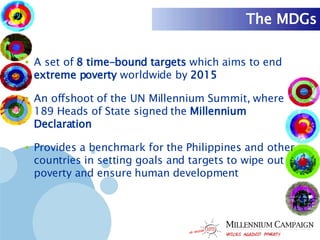
The MDGs A set of  8 time-bound targets  which aims to end  extreme poverty  worldwide by  2015 An offshoot of the UN Millennium Summit, where 189 Heads of State signed the  Millennium Declaration Provides a benchmark for the Philippines and other countries in setting goals and targets to wipe out poverty and ensure human development
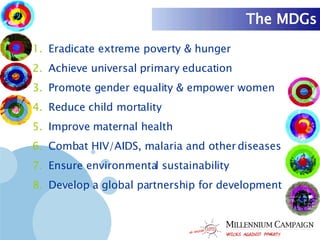
The MDGs Eradicate extreme poverty & hunger Achieve universal primary education Promote gender equality & empower women Reduce child mortality Improve maternal health Combat HIV/AIDS, malaria and other diseases Ensure environmental sustainability Develop a global partnership for development
MDGs are unique because.. Goals represent a  compact  between all the world's major economic players The world has never before seen so much  prosperity   Performance against the goals is being  monitored The Goals are clearly  achievable
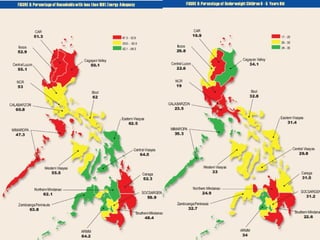
Health-Related MDG HEALTH GOAL (1) :  Eradicate extreme poverty and hunger TARGET:   Halve, between 1990 and 2015, the proportion of people who suffer from hunger INDICATOR : Prevalence of underweight children under five years of age Proportion of population below minimum level of dietary energy consumption
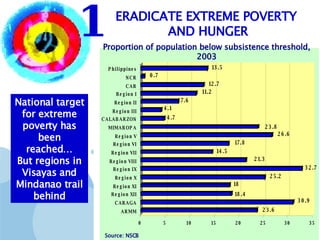
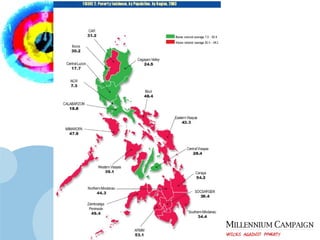
National target for extreme poverty has been reached… But regions in Visayas and Mindanao trail behind ERADICATE EXTREME POVERTY  AND HUNGER 1 Proportion of population below subsistence threshold, 2003 Source: NSCB
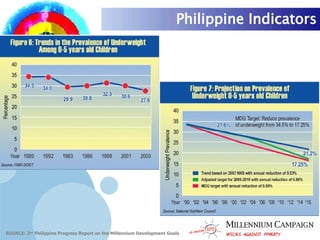
Philippine Indicators SOURCE: 2 nd  Philippine Progress Report on the Millennium Development Goals
 
 
Health-Related MDG HEALTH GOAL (4) : Reduce child mortality TARGET : Reduce by two-thirds, between 1990 and 2015, the under-five mortality rate INDICATOR : Under-five mortality rate Infant mortality rate Proportion of one-year-old children immunized against measles
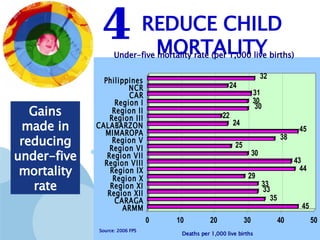
Gains made in reducing under-five mortality rate REDUCE CHILD MORTALITY 4 Under-five mortality rate (per 1,000 live births) Deaths per 1,000 live births Source: 2006 FPS
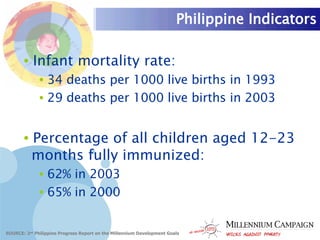
Philippine Indicators Infant mortality rate: 34 deaths per 1000 live births in 1993 29 deaths per 1000 live births in 2003 Percentage of all children aged 12-23 months fully immunized: 62% in 2003 65% in 2000 SOURCE: 2 nd  Philippine Progress Report on the Millennium Development Goals
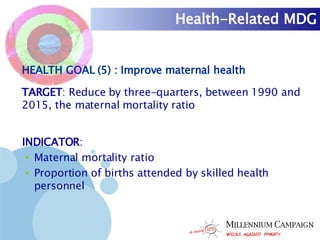
HEALTH GOAL (5) : Improve maternal health TARGET : Reduce by three-quarters, between 1990 and 2015, the maternal mortality ratio Health-Related MDG INDICATOR : Maternal mortality ratio Proportion of births attended by skilled health personnel
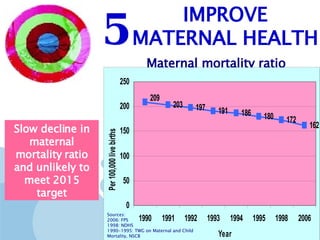
Slow decline in maternal mortality ratio and unlikely to meet 2015 target IMPROVE MATERNAL HEALTH 5 Maternal mortality ratio Sources: 2006: FPS 1998: NDHS 1990-1995: TWG on Maternal and Child Mortality, NSCB
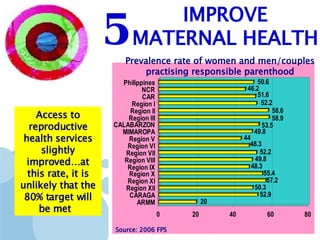
Access to reproductive health services slightly improved…at this rate, it is unlikely that the 80% target will be met  IMPROVE MATERNAL HEALTH 5 Prevalence rate of women and men/couples practising responsible parenthood Source: 2006 FPS
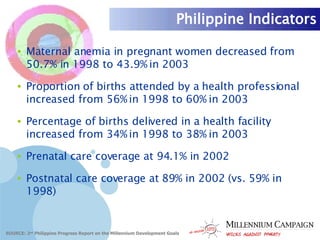
Philippine Indicators Maternal anemia in pregnant women decreased from 50.7% in 1998 to 43.9% in 2003 Proportion of births attended by a health professional increased from 56% in 1998 to 60% in 2003 Percentage of births delivered in a health facility increased from 34% in 1998 to 38% in 2003 Prenatal care coverage at 94.1% in 2002 Postnatal care coverage at 89% in 2002 (vs. 59% in 1998) SOURCE: 2 nd  Philippine Progress Report on the Millennium Development Goals
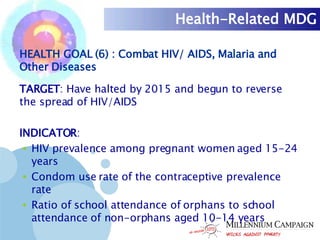
Health-Related MDG HEALTH GOAL (6) : Combat HIV/ AIDS, Malaria and Other Diseases TARGET : Have halted by 2015 and begun to reverse the spread of HIV/AIDS INDICATOR : HIV prevalence among pregnant women aged 15-24 years Condom use rate of the contraceptive prevalence rate Ratio of school attendance of orphans to school attendance of non-orphans aged 10-14 years
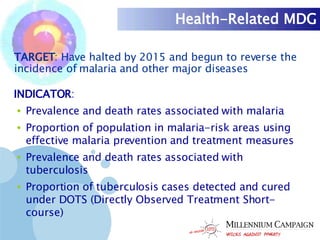
Health-Related MDG TARGET : Have halted by 2015 and begun to reverse the incidence of malaria and other major diseases  INDICATOR : Prevalence and death rates associated with malaria Proportion of population in malaria-risk areas using effective malaria prevention and treatment measures Prevalence and death rates associated with tuberculosis Proportion of tuberculosis cases detected and cured under DOTS (Directly Observed Treatment Short-course)
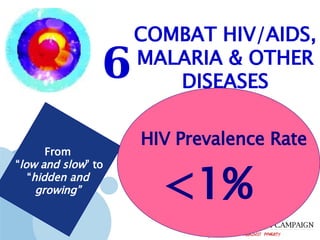
From “ low and slow ” to “ hidden and growing” COMBAT HIV/AIDS, MALARIA & OTHER DISEASES 6 <1% HIV Prevalence Rate
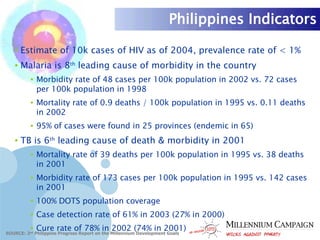
Philippines Indicators Estimate of 10k cases of HIV as of 2004, prevalence rate of < 1% Malaria is 8 th  leading cause of morbidity in the country Morbidity rate of 48 cases per 100k population in 2002 vs. 72 cases per 100k population in 1998 Mortality rate of 0.9 deaths / 100k population in 1995 vs. 0.11 deaths in 2002 95% of cases were found in 25 provinces (endemic in 65) TB is 6 th  leading cause of death & morbidity in 2001 Mortality rate of 39 deaths per 100k population in 1995 vs. 38 deaths in 2001 Morbidity rate of 173 cases per 100k population in 1995 vs. 142 cases in 2001 100% DOTS population coverage Case detection rate of 61% in 2003 (27% in 2000) Cure rate of 78% in 2002 (74% in 2001) SOURCE: 2 nd  Philippine Progress Report on the Millennium Development Goals
Health-Related MDG GOAL (7) : Ensure environmental sustainability TARGET : Halve by 2015 the proportion of people without sustainable access to safe drinking-water and sanitation INDICATOR :  Proportion of population with sustainable access to an improved water source, urban and rural
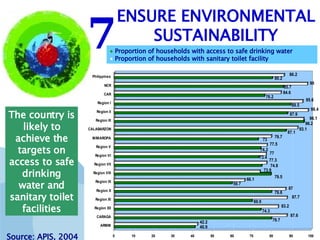
The country is likely to achieve the targets on access to safe drinking water and sanitary toilet facilities ENSURE ENVIRONMENTAL SUSTAINABILITY 7 ▪  Proportion of households with access to safe drinking water ▪   Proportion of households with sanitary toilet facility Source: APIS, 2004
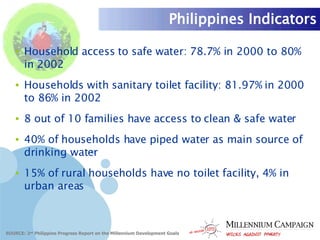
Philippines Indicators Household access to safe water: 78.7% in 2000 to 80% in 2002 Households with sanitary toilet facility: 81.97% in 2000 to 86% in 2002 8 out of 10 families have access to clean & safe water 40% of households have piped water as main source of drinking water 15% of rural households have no toilet facility, 4% in urban areas SOURCE: 2 nd  Philippine Progress Report on the Millennium Development Goals
Health-Related MDG TARGET : By 2020 to have achieved a significant improvement in the lives of at least 100 million slum dwellers INDICATOR : Proportion of population with access to improved sanitation, urban and rural
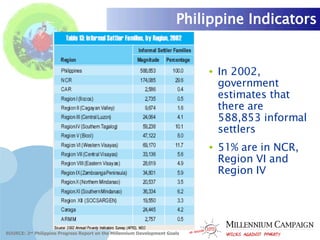
In 2002, government estimates that there are 588,853 informal settlers 51% are in NCR, Region VI and Region IV Philippine Indicators SOURCE: 2 nd  Philippine Progress Report on the Millennium Development Goals
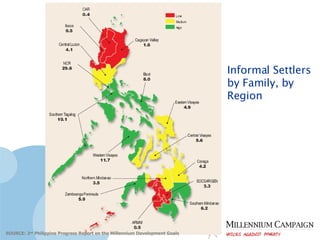
Informal Settlers by Family, by Region SOURCE: 2 nd  Philippine Progress Report on the Millennium Development Goals
Health-Related Goals GOAL (8) : Develop a global partnership for development TARGET : In cooperation with pharmaceutical companies, provide access to affordable, essential drugs in developing countries INDICATOR :  Proportion of population with access to affordable essential drugs on a sustainable basis
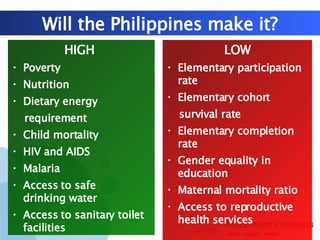
LOW Elementary participation  rate Elementary cohort  survival rate Elementary completion rate Gender equality in education Maternal mortality ratio Access to reproductive health services HIGH  Poverty  Nutrition Dietary energy  requirement Child mortality HIV and AIDS Malaria Access to safe  drinking water Access to sanitary toilet facilities Will the Philippines make it?
Thank You!

UERM NSTP-CWTS2 Unit 4: Millennium Development Goals

  • 1.
    The Millennium DevelopmentGoals (MDG) Unit 4 NSTP-CWTS2 February 2008
  • 2.
    The MDGs Aset of 8 time-bound targets which aims to end extreme poverty worldwide by 2015 An offshoot of the UN Millennium Summit, where 189 Heads of State signed the Millennium Declaration Provides a benchmark for the Philippines and other countries in setting goals and targets to wipe out poverty and ensure human development
  • 3.
    The MDGs Eradicateextreme poverty & hunger Achieve universal primary education Promote gender equality & empower women Reduce child mortality Improve maternal health Combat HIV/AIDS, malaria and other diseases Ensure environmental sustainability Develop a global partnership for development
  • 4.
    MDGs are uniquebecause.. Goals represent a compact between all the world's major economic players The world has never before seen so much prosperity Performance against the goals is being monitored The Goals are clearly achievable
  • 5.
    Health-Related MDG HEALTHGOAL (1) : Eradicate extreme poverty and hunger TARGET: Halve, between 1990 and 2015, the proportion of people who suffer from hunger INDICATOR : Prevalence of underweight children under five years of age Proportion of population below minimum level of dietary energy consumption
  • 6.
    National target forextreme poverty has been reached… But regions in Visayas and Mindanao trail behind ERADICATE EXTREME POVERTY AND HUNGER 1 Proportion of population below subsistence threshold, 2003 Source: NSCB
  • 7.
    Philippine Indicators SOURCE:2 nd Philippine Progress Report on the Millennium Development Goals
  • 8.
  • 9.
  • 10.
    Health-Related MDG HEALTHGOAL (4) : Reduce child mortality TARGET : Reduce by two-thirds, between 1990 and 2015, the under-five mortality rate INDICATOR : Under-five mortality rate Infant mortality rate Proportion of one-year-old children immunized against measles
  • 11.
    Gains made inreducing under-five mortality rate REDUCE CHILD MORTALITY 4 Under-five mortality rate (per 1,000 live births) Deaths per 1,000 live births Source: 2006 FPS
  • 12.
    Philippine Indicators Infantmortality rate: 34 deaths per 1000 live births in 1993 29 deaths per 1000 live births in 2003 Percentage of all children aged 12-23 months fully immunized: 62% in 2003 65% in 2000 SOURCE: 2 nd Philippine Progress Report on the Millennium Development Goals
  • 13.
    HEALTH GOAL (5): Improve maternal health TARGET : Reduce by three-quarters, between 1990 and 2015, the maternal mortality ratio Health-Related MDG INDICATOR : Maternal mortality ratio Proportion of births attended by skilled health personnel
  • 14.
    Slow decline inmaternal mortality ratio and unlikely to meet 2015 target IMPROVE MATERNAL HEALTH 5 Maternal mortality ratio Sources: 2006: FPS 1998: NDHS 1990-1995: TWG on Maternal and Child Mortality, NSCB
  • 15.
    Access to reproductivehealth services slightly improved…at this rate, it is unlikely that the 80% target will be met IMPROVE MATERNAL HEALTH 5 Prevalence rate of women and men/couples practising responsible parenthood Source: 2006 FPS
  • 16.
    Philippine Indicators Maternalanemia in pregnant women decreased from 50.7% in 1998 to 43.9% in 2003 Proportion of births attended by a health professional increased from 56% in 1998 to 60% in 2003 Percentage of births delivered in a health facility increased from 34% in 1998 to 38% in 2003 Prenatal care coverage at 94.1% in 2002 Postnatal care coverage at 89% in 2002 (vs. 59% in 1998) SOURCE: 2 nd Philippine Progress Report on the Millennium Development Goals
  • 17.
    Health-Related MDG HEALTHGOAL (6) : Combat HIV/ AIDS, Malaria and Other Diseases TARGET : Have halted by 2015 and begun to reverse the spread of HIV/AIDS INDICATOR : HIV prevalence among pregnant women aged 15-24 years Condom use rate of the contraceptive prevalence rate Ratio of school attendance of orphans to school attendance of non-orphans aged 10-14 years
  • 18.
    Health-Related MDG TARGET: Have halted by 2015 and begun to reverse the incidence of malaria and other major diseases INDICATOR : Prevalence and death rates associated with malaria Proportion of population in malaria-risk areas using effective malaria prevention and treatment measures Prevalence and death rates associated with tuberculosis Proportion of tuberculosis cases detected and cured under DOTS (Directly Observed Treatment Short-course)
  • 19.
    From “ lowand slow ” to “ hidden and growing” COMBAT HIV/AIDS, MALARIA & OTHER DISEASES 6 <1% HIV Prevalence Rate
  • 20.
    Philippines Indicators Estimateof 10k cases of HIV as of 2004, prevalence rate of < 1% Malaria is 8 th leading cause of morbidity in the country Morbidity rate of 48 cases per 100k population in 2002 vs. 72 cases per 100k population in 1998 Mortality rate of 0.9 deaths / 100k population in 1995 vs. 0.11 deaths in 2002 95% of cases were found in 25 provinces (endemic in 65) TB is 6 th leading cause of death & morbidity in 2001 Mortality rate of 39 deaths per 100k population in 1995 vs. 38 deaths in 2001 Morbidity rate of 173 cases per 100k population in 1995 vs. 142 cases in 2001 100% DOTS population coverage Case detection rate of 61% in 2003 (27% in 2000) Cure rate of 78% in 2002 (74% in 2001) SOURCE: 2 nd Philippine Progress Report on the Millennium Development Goals
  • 21.
    Health-Related MDG GOAL(7) : Ensure environmental sustainability TARGET : Halve by 2015 the proportion of people without sustainable access to safe drinking-water and sanitation INDICATOR : Proportion of population with sustainable access to an improved water source, urban and rural
  • 22.
    The country islikely to achieve the targets on access to safe drinking water and sanitary toilet facilities ENSURE ENVIRONMENTAL SUSTAINABILITY 7 ▪ Proportion of households with access to safe drinking water ▪ Proportion of households with sanitary toilet facility Source: APIS, 2004
  • 23.
    Philippines Indicators Householdaccess to safe water: 78.7% in 2000 to 80% in 2002 Households with sanitary toilet facility: 81.97% in 2000 to 86% in 2002 8 out of 10 families have access to clean & safe water 40% of households have piped water as main source of drinking water 15% of rural households have no toilet facility, 4% in urban areas SOURCE: 2 nd Philippine Progress Report on the Millennium Development Goals
  • 24.
    Health-Related MDG TARGET: By 2020 to have achieved a significant improvement in the lives of at least 100 million slum dwellers INDICATOR : Proportion of population with access to improved sanitation, urban and rural
  • 25.
    In 2002, governmentestimates that there are 588,853 informal settlers 51% are in NCR, Region VI and Region IV Philippine Indicators SOURCE: 2 nd Philippine Progress Report on the Millennium Development Goals
  • 26.
    Informal Settlers byFamily, by Region SOURCE: 2 nd Philippine Progress Report on the Millennium Development Goals
  • 27.
    Health-Related Goals GOAL(8) : Develop a global partnership for development TARGET : In cooperation with pharmaceutical companies, provide access to affordable, essential drugs in developing countries INDICATOR : Proportion of population with access to affordable essential drugs on a sustainable basis
  • 28.
    LOW Elementary participation rate Elementary cohort survival rate Elementary completion rate Gender equality in education Maternal mortality ratio Access to reproductive health services HIGH Poverty Nutrition Dietary energy requirement Child mortality HIV and AIDS Malaria Access to safe drinking water Access to sanitary toilet facilities Will the Philippines make it?
  • 29.