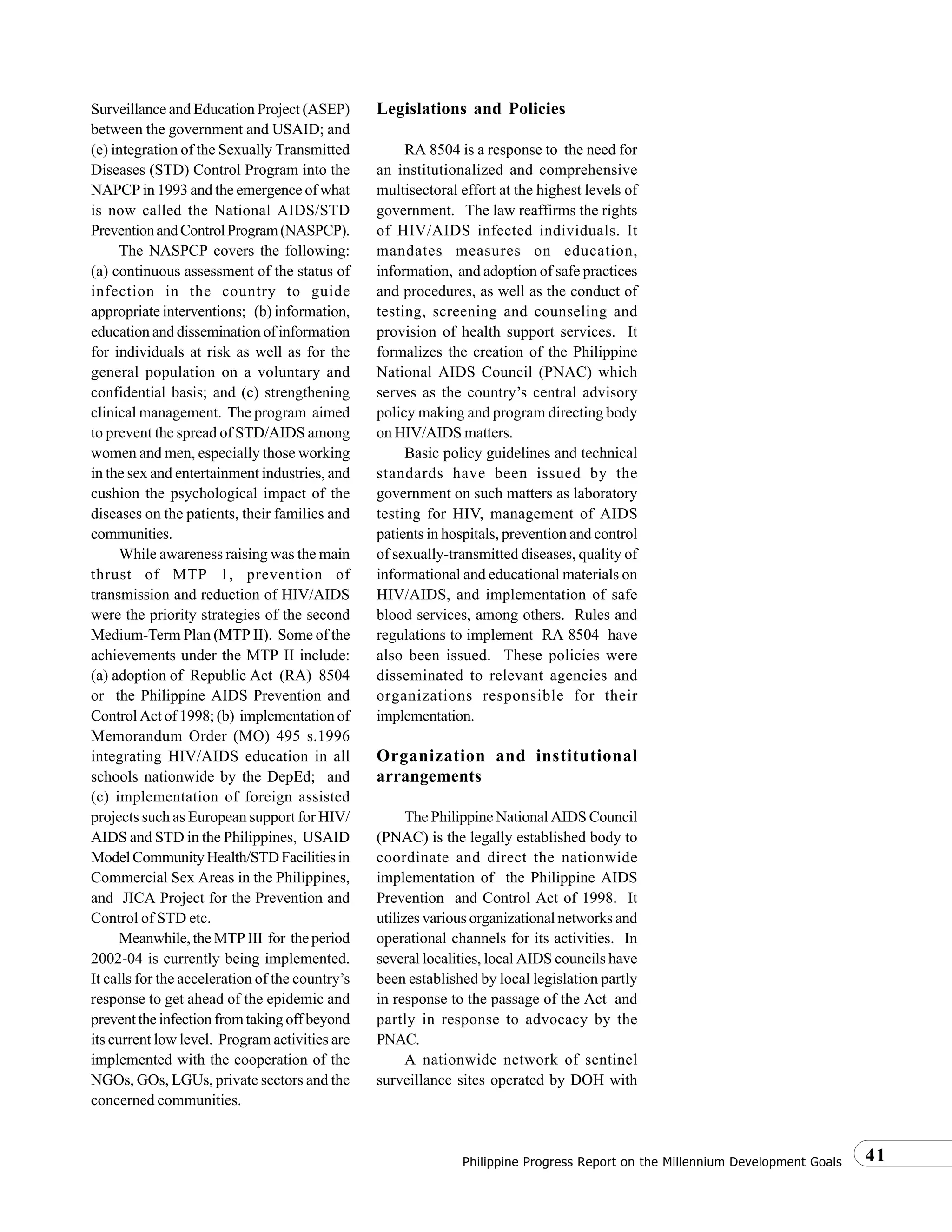
ExecutiveSummary
IIIII
n September 2000, member states
of the United Nations gathered at the
MillenniumSummittoaffirmcommitments
towards reducing poverty and the worst
forms of human deprivation. They adopted
the Millennium Declaration which
embodies specific targets and milestones
in eliminating extreme poverty worldwide.
The Millennium Development Goals
(MDGs), set within 2015, affirm and
reinforce the agreements on the goals and
targets reached at the global conferences
of the 1990s.
The MDGs include the following:
Goal1. Eradicate extreme poverty and
hunger
Target 1:
Halve the proportion of people living in
extreme poverty between 1990-2015
Target 2:
Halve the proportion of population below
the minimum level of dietary energy
consumption and halve the proportion of
underweight children (under five years old)
Target 3:
Halve the proportion of people with no
access to safe drinking water or those who
cannot afford it by 2015
Goal 2. Achieve universal primary
education
Target 4:
Achieve universal access to primary
education by 2015
Goal 3. Promote gender equality
Target 5:
Eliminate gender disparity in primary and
secondary education, preferably by 2005,
and all levels of education not later than
2015
Goal 4. Reduce child mortality
Target 6:
Reduce children under-five mortality rate
by two-thirds by 2015
Goal 5. Improvematernalhealth
Target 7:
Reduce maternal mortality rate by three-
quartersby2015(halfby2000,halfby2015)
Target 8:
Increase access to reproductive health
services to 60 percent by 2005, 80 percent
by 2010, and 100 percent by 2015
Goal 6. CombatHIV/AIDS,malaria,and
other diseases
Target 9:
Halt and reverse the spread of HIV/AIDS
by 2015
Target 10:
Have halted by 2015, and begun to reverse
the incidence of malaria and other major
diseases
Goal 7. Ensureenvironmental
sustainability
Target 11:
Implement national strategies for
sustainable development by 2005, to
reverse loss of environmental resources by
2015
Target 12:
By 2020, to have achieved a significant
improvement in the lives of at least 100
million slum dwellers
Goal 8. Develop a global partnership
fordevelopment
Target 13:
Develop further an open, rule-based,
predictable, nondiscriminatory trading and
Poverty eradication
has emerged as a
top priority of the
Philippine
government from
the late 1980s.
Philippine Progress Report on the Millennium Development Goals2
financial system; include a commitment
to good governance, development and
poverty reduction – both nationally and
internationally
Target 14:
Deal comprehensively with the debt
problems of developing countries through
national and international measures in order
to make debt sustainable in the long-term.
Eradicating extreme poverty
and hunger
The Philippine government has
consistently and explicitly committed itself
towards achieving the overarching goal of
poverty eradication and protecting the
vulnerable groups. Consequently, this has
paved the way for the formulation and
implementation of various policy reforms
and strategies for the improvement of the
quality of life of the Filipinos, especially
the poor. The administrations of Corazon
Aquino and Fidel Ramos have helped
reduce poverty incidence of the population
to 36.8 percent in 1997 from 49.3 percent in
1985.
Since 1990, the Philippines has made
significant improvements in reducing
extreme poverty and child and maternal
mortality rates; enhancing gender equality;
and increasing school participation rate
and access to safe water. However, the
effects of the 1997 Asian financial crisis
compounded by the El Niño and La Niña
weather phenomena temporarily crippled
the country’s improving situation.
Major improvements were observed in
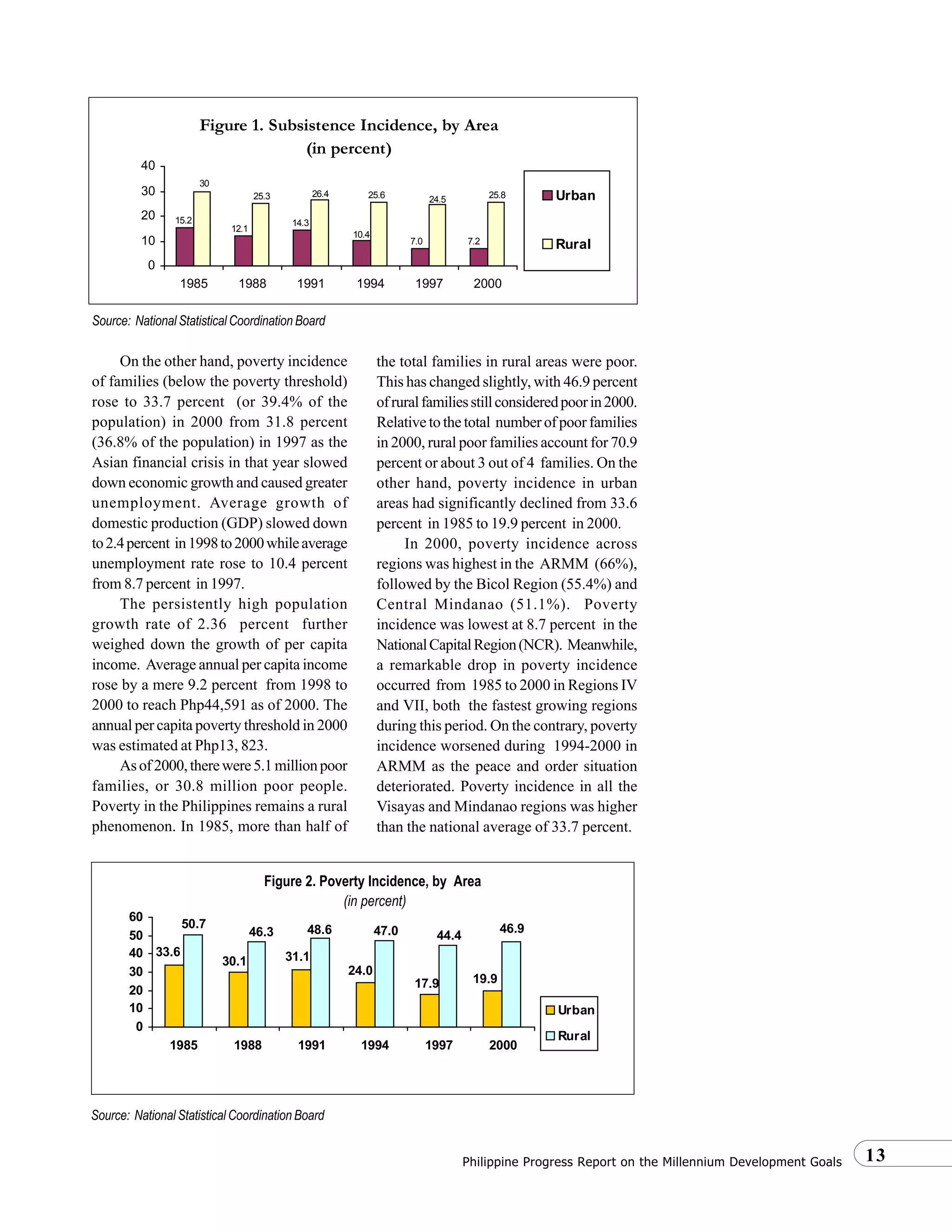
reducing extreme poverty. Subsistence
poverty declined from 20.4 percent in 1991
to 16.7 percent in 2000. But this issue
remains to be addressed as the magnitude
of food-poor families increased from 2.4
millionfamiliesin1991to2.5million families
in 2000. About 78.8 percent of these
families live in the rural areas.
Gaps across regions and sectors must
also be addressed, especially since rural
poverty remained high between 1991
(55.1%) and 2000 (54.5%). Urban poverty
has been reduced by almost one third as of
the year 2000, from 35.6 percent in 1991.
Achievements in reducing malnutrition
need to be sustained, in view of the mixed
results. The prevalence of moderately and
severely underweight preschoolers 0-5
years old decreased from 34.5 percent in
1989-90 to 28.9 percent in 1996, but rose
again to 32 percent in 1998 and decreased
to 30.6 percent in 2001. Figures for stunted
growthalsodippedfrom40percent in1989-
90 to 31.8 percent in 1996, but rose to 34
percent in 1998.
The percentage of people with
adequate and safe water supply steadily
rose since 1988 after the government
launched the Water Supply, Sewerage and
Sanitation Sector Master Plan, until the year
2000. By this year, about 78.5 percent of
Filipino households already had access to
safe drinking water compared to 73.7
percent in 1991.
Achieving universal
primary education
Universal access to primary education
by 2015 is attainable, assuming enough
resources are devoted to this end and
reforms are pursued with determination.
This can be shown by participation rate in
the elementary level in both private and
public schools, which improved from 85
percent in 1991 to 97 percent in 2000.
However, many of the children who enroll
do not complete the school year as
evidenced by the low cohort survival rate.
Further, the cohort survival rate has
declined from 68.4 percent to 67.1 percent
over the same period.
Eliminating gender disparity in schools
is one MDG target that can be attained.
Education is one area in Philippine society
where women and men have almost equal
status. In School Year (SY) 1999-2000,
girls had higher participation rates both in
the elementary (97.1%) and high school
(68.3%) levels than boys with 96.8 percent
and 62.6 percent, respectively. The
enrolment data for SY 2000-01 show that
there were almost an equal number of girls
and boys in the elementary level where the
ratio of girls to boys was around 96:100.
This ratio was higher in the secondary
level, with 105 girls to 100 boys.
3Philippine Progress Report on the Millennium Development Goals
Reducing child mortality
Government efforts have paid off in
reducing infant and under-five mortality
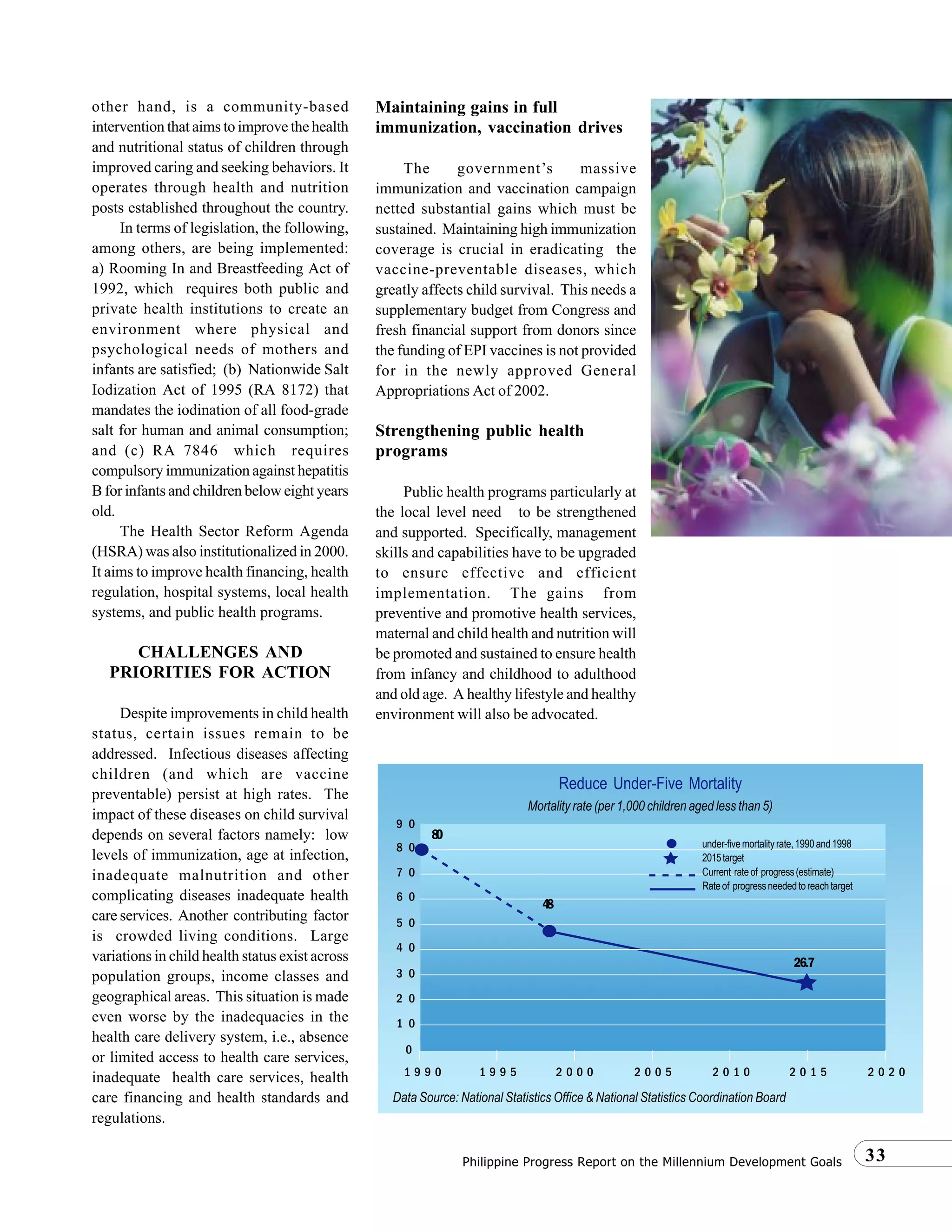
rates. Under-five mortality rate was
significantly reduced from 80 per 1,000 live
birthsin1990to48in1998. Infantmortality
rate was also reduced from 57 per 1,000 live
births in 1990 to 35 in 1998.
Improving maternal health
Immunization coverage goals were
largely attained. The Maternal and Child
Health Survey reported that in 2000,
65percent ofallchildrenaged12-23months
were fully immunized before turning 1 year
old. This shows an improvement from the
survey of 1997 where only 58 percent were
fullyimmunized. Therearemoreimmunized
children in the urban areas (68%) than in
the rural areas (63%).
The reduction in maternal mortality
rate was substantial. The maternal
mortality rate (MMR) in 1991-97 is 172 per
100,000 live births as estimated by the
1998 National Demographic and Health
Survey (NDHS). This is slightly lower than
the estimated MMR of 209 per 100,000 live
birthsin1987-93basedonthe1993National
Demographic Survey (NDS).
Care for mothers is a big challenge,
considering that a low percentage of
women get pre- and post-natal checkups,
iron and iodine supplements and tetanus
toxoid immunization.
Combatting HIV/AIDS,
malaria and other diseases
With regard to HIV/AIDS, the HIV/
AIDS Registry has recorded 1,441 HIV AB
seropositive cases (1984-2000), 486 of
whomhadAIDS; with218deaths. Majority
of the cases were in the 20-49 years age
group. Most cases were male. Of the 1,441
HIV cases, 371 or 26 percent are Overseas
FilipinoWorkers(OCWs). Thepredominant
mode of transmission is sexual intercourse.
Between 1984 and 1992, the reported
annual number of confirmed cases
remained below 100. However, in the last
seven years, 1993-99, the number of cases
per year had exceeded 100, but remained
below 200. The number of cases each year
has been increasing but there seems to be
no indication that such increse will be
significant.
While the number of confirmed cases
of HIV/AIDS is low and the rate of increase
in the number of cases is slow, the
potentials for a full-blown epidemic
continue to exist. Thus, the country cannot
be complacent on this.
The challenge with other major
diseases like malaria and tuberculosis is
daunting, though. TB incidence in the
country remains one of the highest in the
world, with 75 Filipinos dying daily from
the disease.
Ensuring environmental
sustainability
The country’s natural resource base
continues to be under threat. Total forest
cover has decreased from 6 million hectares
in 1990 to 5 million hectares in 1997,
consequently reducing its share to total
land area from 21 percent to 18 percent.
The state of the country’s forests requires
attention due to systemic degradation
attributed mainly to fire, logging, kaingin,
pests, diseases, mining activities and
population encroachment in critical areas.
An alarming rate of biodiversity loss
has also been reported. Being one of the 17
megadiversified countries in the world, the
Philippines is among those with the highest
concentration of endemic plants and
wildlife.Ironically,however,thecountryhas
also been identified by the Conservation
International as one of the “eight hottest
spots in the world” where exceptional
concentrations of endemic species are
undergoing continuous loss of habitat.
Priority species facing extinction increased
by 97 percent while threatened species, by
180 percent.
According to the Medium-Term
Philippine Development Plan (MTPDP)
2001-04, the Philippines arrested resource
depletion, but at the cost of slowing down
economic activities, i.e., in municipal
fishery, mining and forestry resources.
Philippine Progress Report on the Millennium Development Goals4
Improving thelivesof100millionslum
dwellers continue to be an uphill effort.
Housing requirements remain high: for
2000-04alone,anestimated3.4millionunits
are needed. The housing backlog stands
at 1 million units.
From 1990 to October 2001, the total
numberofinformalsettler-familiesprovided
with security of tenure through the
Community Mortgage Program (CMP) and
Resettlement Program in the country
totaled 250,231 households.
Developing a global partnership
for development
The continuing unilateral trade reforms
appear to have removed much of the
distortions of past protectionist policies.
Ithasstarted to make theeconomy become
more outward-oriented, open, and globally
competitive just in time for the international
trade changes created by the World Trade
Organization (WTO). The WTO, with
strengthened rules and discipline, brought
about greater transparency and restored
order in global trading.
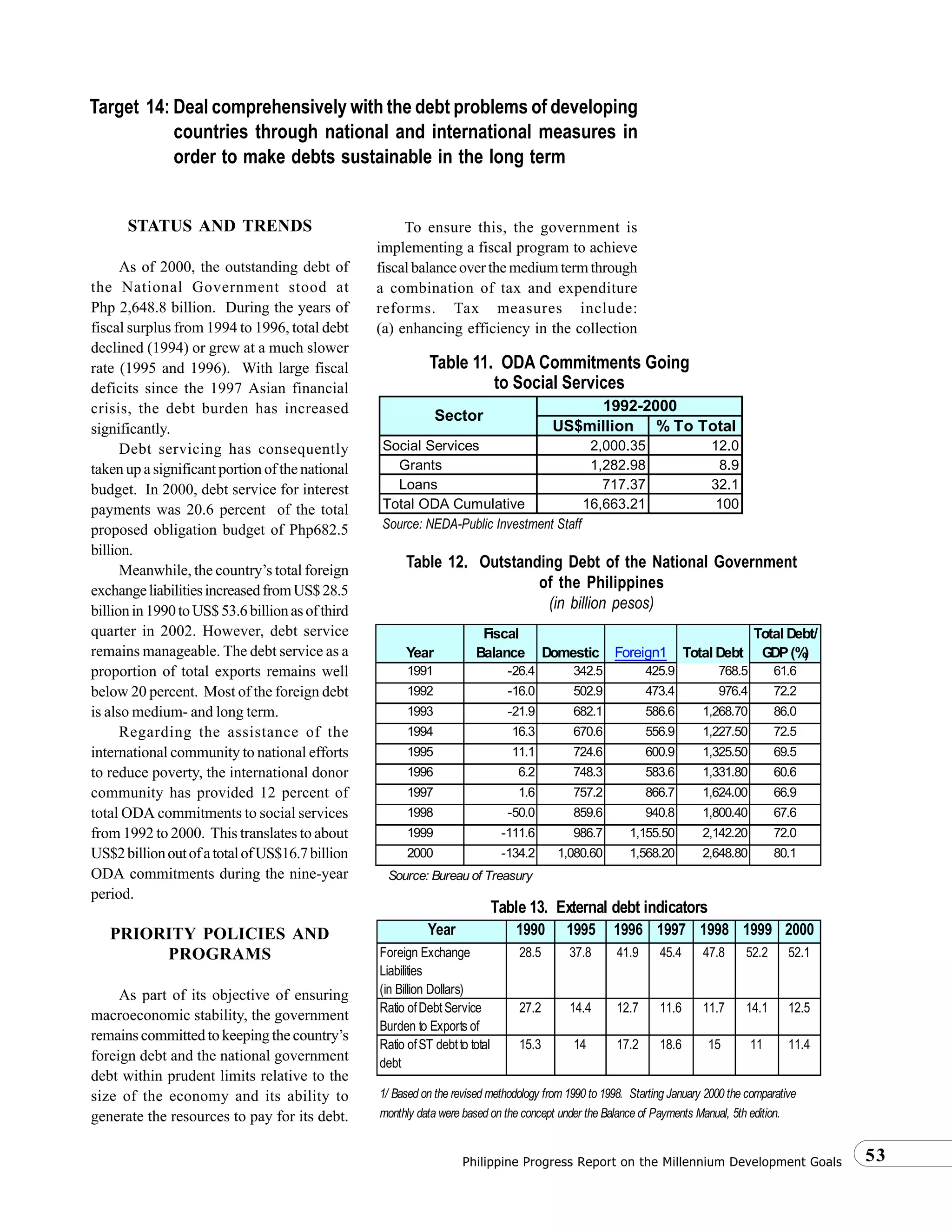
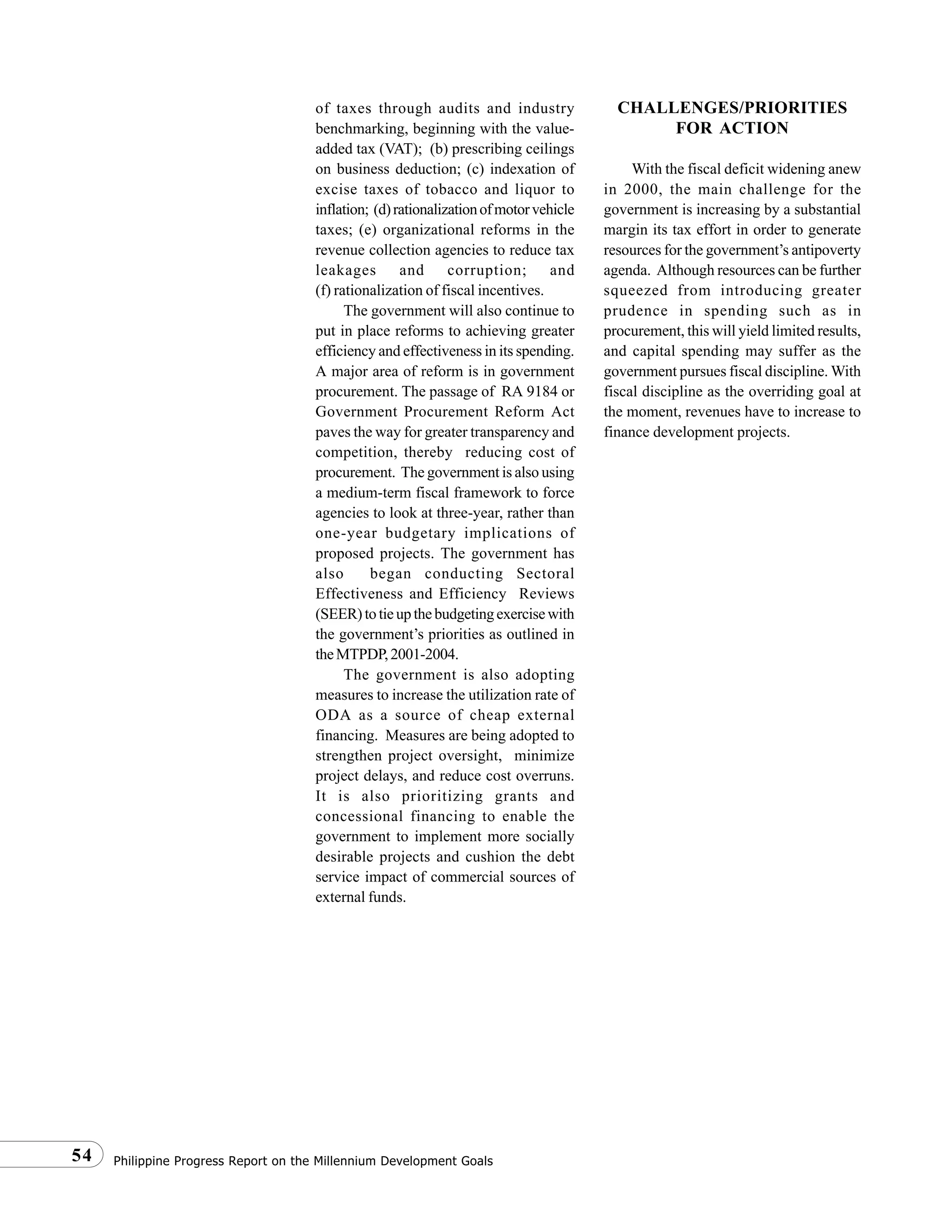
The outstanding debt of the National
Government has increased from Php768.5
billionin1991toPhp2,648.8billionin2000.
It was evident that during the years of fiscal
surplus from 1994 to 1996, total debt either
declined (1994) or grew at a much slower
rate (1995 and 1996). As fiscal deficits
became larger since the 1997 Asian
financial crisis, the debt burden has
increased significantly.
Since the start of President Gloria
Macapagal-Arroyo’s administration, the
government has committed itself to
achieving growth and poverty reduction.
The MTPDP and the government’s
antipoverty agenda envisions to “win the
war against poverty within the decade”
essentially through:
1) Macroeconomic stability with
equitable growth based on free
enterprise;
2) Agriculture and fisheries
modernization with social equity;
3) Comprehensive human development
and protecting the vulnerable; and
4) Good governance and the rule of law.
Other priority measures to fight
poverty include: enhancing competi-
tiveness in the industry and services
sectors; implementing regional
development programs and targeted social
development programs including
population management; and monitoring
poverty.
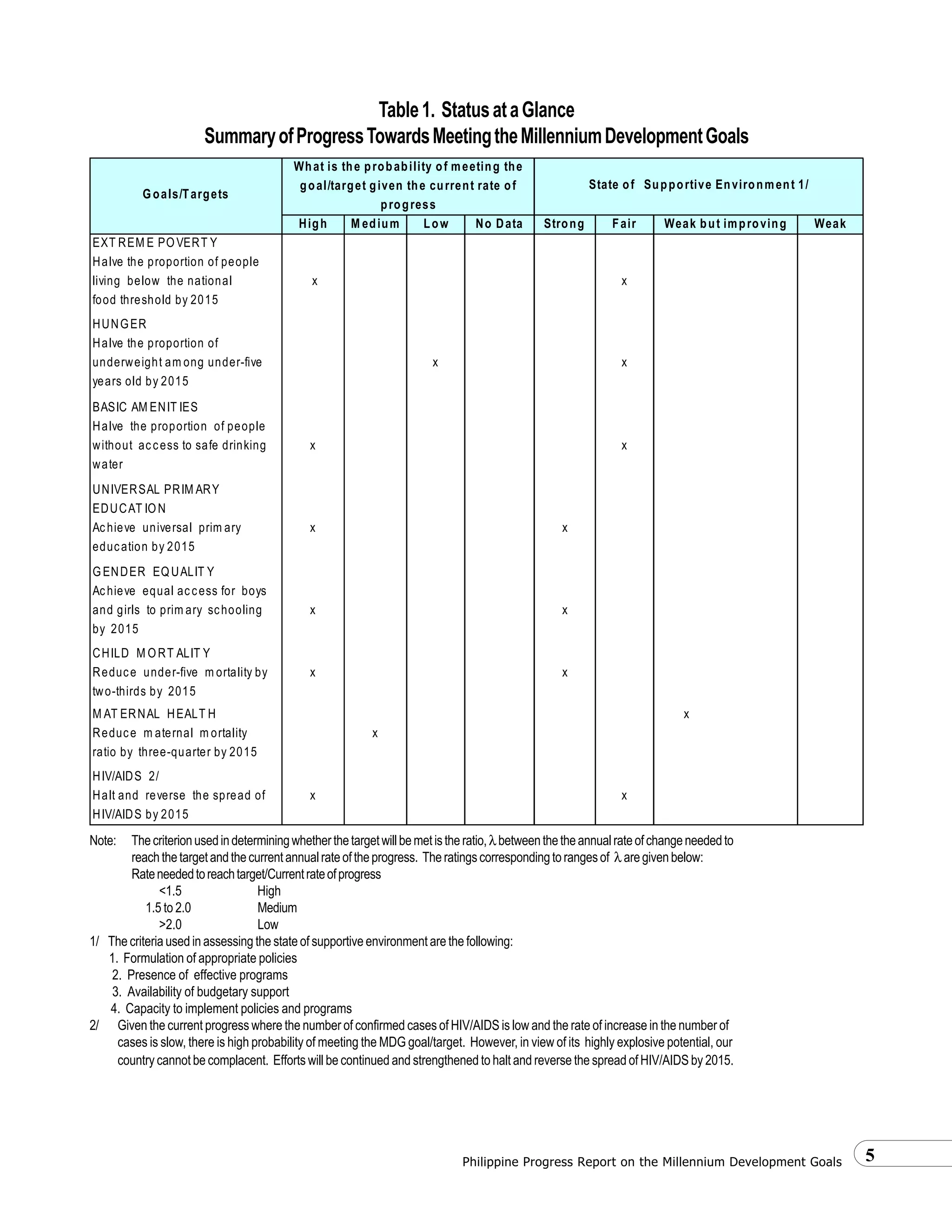
Given the country’s socioeconomic
performance, Table 1 shows the probability
of meeting the goals and targets. Table 2,
which provides the basis for the
assessment in Table 1, shows the current
rate as well as the required rate of progress
to meet the targets by 2015. Table 1 shows
a high probability of meeting the goals and
targets related to eradication of extreme
poverty; improving access to basic
amenities, universal primary education,
gender equality; and wiping out child
mortality, and HIV/AIDS.
There is medium probability in
attaining the goals and targets on maternal
health care. The target on hunger have
been accorded with low probability.
What it takes to meet MDGs
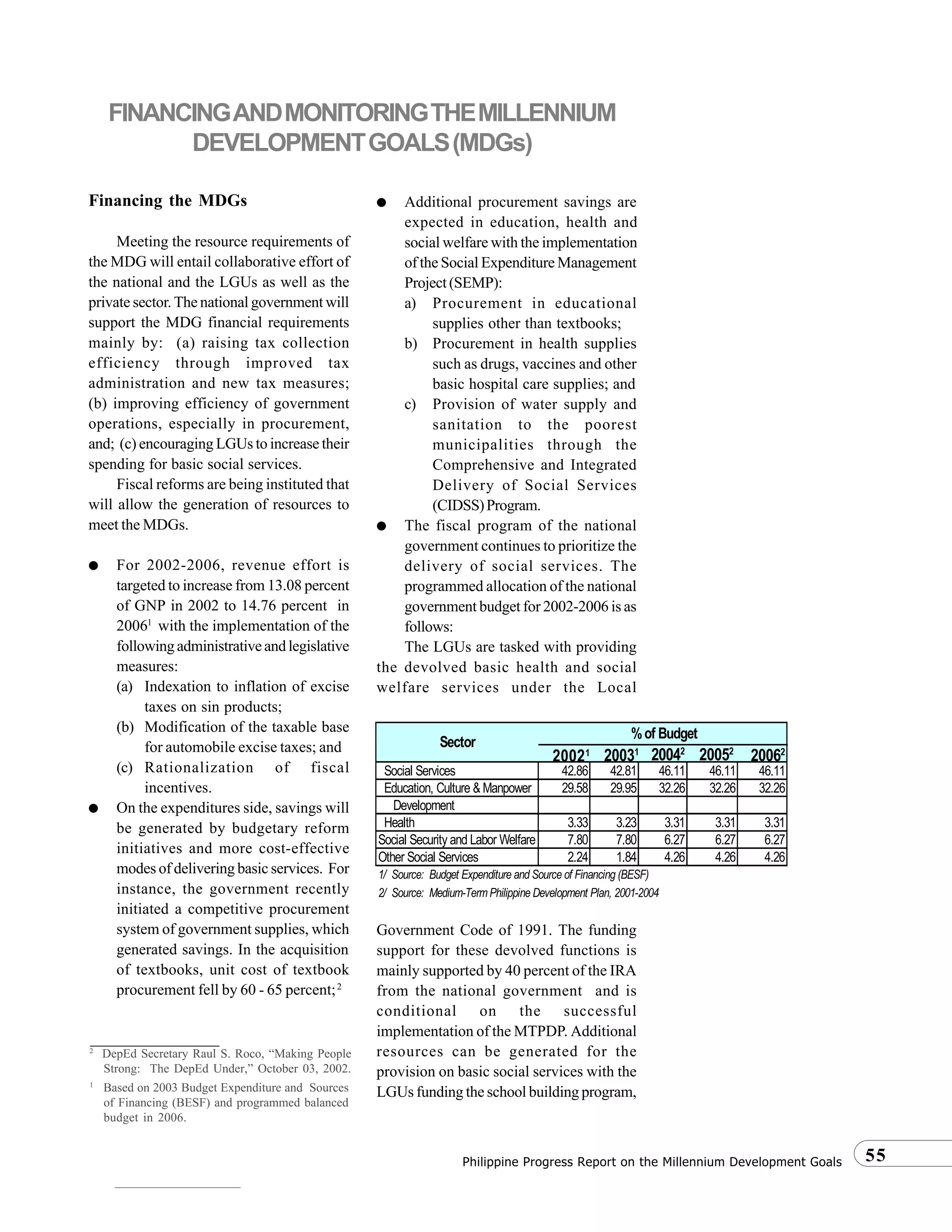
Meeting the resource requirements of
the MDGs will entail collaborative effort of
the national and the local government units
(LGUs) as well as the private sector. The
national government will support the MDG
financial requirements mainly by:
(a) raising tax collection efficiency through
improved tax administration and new tax
measures; (b) improving efficiency of
government operations, especially in
procurement; and (c) encouraging LGUs to
increase their spending for basic social
services.
These measures will continue and will
be broadened to help meet the country’s
MDG commitments by 2015.
Monitoring the MDGs can be
supported by expanding and regularly
updating the Social Development
ManagementInformationSystem(SOMIS),
a database of social development
indicators, housed at the National
Economic and Development Authority
(NEDA).
5Philippine Progress Report on the Millennium Development Goals
High M edium Low No Data Strong Fair Weak
EXT REM E POVERT Y
Halve the proportion of people
living below the national x x
food threshold by 2015
HUNGER
Halve the proportion of
underweight am ong under-five x x
years old by 2015
BASIC AM ENIT IES
Halve the proportion of people
without access to safe drinking x x
water
UNIVERSAL PRIM ARY
EDUCAT ION
Achieve universal prim ary x x
education by 2015
GENDER EQUALIT Y
Achieve equal access for boys
and girls to prim ary schooling x x
by 2015
CHILD M ORT ALIT Y
Reduce under-five m ortality by x x
two-thirds by 2015
M AT ERNAL HEALT H x
Reduce m aternal m ortality x
ratio by three-quarter by 2015
HIV/AIDS 2/
Halt and reverse the spread of x x
HIV/AIDS by 2015
Goals/Targets
goal/target given the current rate of
Weak but improving
State of Supportive Environment 1/
What is the probability of meeting the
progress
Table1. StatusataGlance
SummaryofProgressTowardsMeetingtheMillenniumDevelopmentGoals
Note: Thecriterionusedindeterminingwhetherthetargetwillbemetistheratio,λbetweenthetheannualrateofchangeneededto
reachthetargetandthecurrentannualrateoftheprogress. Theratingscorrespondingtorangesof λ aregivenbelow:
Rateneededtoreachtarget/Currentrateofprogress
<1.5 High
1.5 to 2.0 Medium
>2.0 Low
1/ The criteria used in assessing the state of supportive environment are the following:
1. Formulation of appropriate policies
2. Presence of effective programs
3. Availability of budgetary support
4. Capacity to implement policies and programs
2/ Given the current progress where the number of confirmed cases of HIV/AIDS is low and the rate of increase in the number of
cases is slow, there is high probability of meeting the MDG goal/target. However, in view of its highly explosive potential, our
country cannot be complacent. Efforts will be continued and strengthened to halt and reverse the spread of HIV/AIDS by 2015.
Philippine Progress Report on the Millennium Development Goals6
Table2.MILLENNIUMDEVELOPMENTGOALS(MDGs)
RateofProgress
7Philippine Progress Report on the Millennium Development Goals
n September 2000, the UN General
Assembly concluded the
Millennium Summit with the adoption of a
MillenniumDeclarationrenewingtheglobal
commitment to peace and human rights and
setting specific goals and targets to wipe
out poverty worldwide.
Included in the targets are:
(a) reducing by half the number of people
who live in extreme poverty, with little
access to food and safe drinking
water;
(b) reducing deaths in mothers and
children below five;
(c) making primary education accessible
to all;
(d) reducing gender disparities;
(e) providing access to reproductive
health services;
(f) pursuing national strategies for
sustainable development;
(g) reversing environmental resources
losses; and
(h) developing a global partnership for
development.
The Declaration, which sets year 2015
for fulfilling most of the targets, affirms the
International Development Targets (IDTs)
initially set in 1996.
The Philippine government through
the Multisectoral Committee on
International Human Development
Commitments and the Social Development
Committee of the NEDA Board, in close
collaboration with the UN country Team,
led the preparation of the first Country
Progress Report on the Millennium
Development Goals. The process benefited
from a series of multisectoral consultations.
ECONOMY AND POVERTY
The Philippines has 76 million people
as of year 2000. Its population is growing
at 2.36 percent annually. In 2000, the annual
per capita gross national product (GNP)
was about $700, using 1985 prices and
exchange rate.
From 1990 to 2000, the GNP increased
at an average rate of 3.4 percent annually.
The growth peaked in 1996 at 7.2 percent.
The Asian financial crisis in July 1997,
however, halted the growth momentum,
causingtheGNPgrowthtofallto5.3percent
that year. The after effects were mostly felt
in 1998 when the GNP growth fell to 0.4
percent. Contributing to the sharp decline
were the peso depreciation and the El Niño
weatherphenomenon.In1999,however,the
economy showed signs of recovery,
posting a growth rate of 3.7 percent. The
following year, it grew by 4.5 percent.
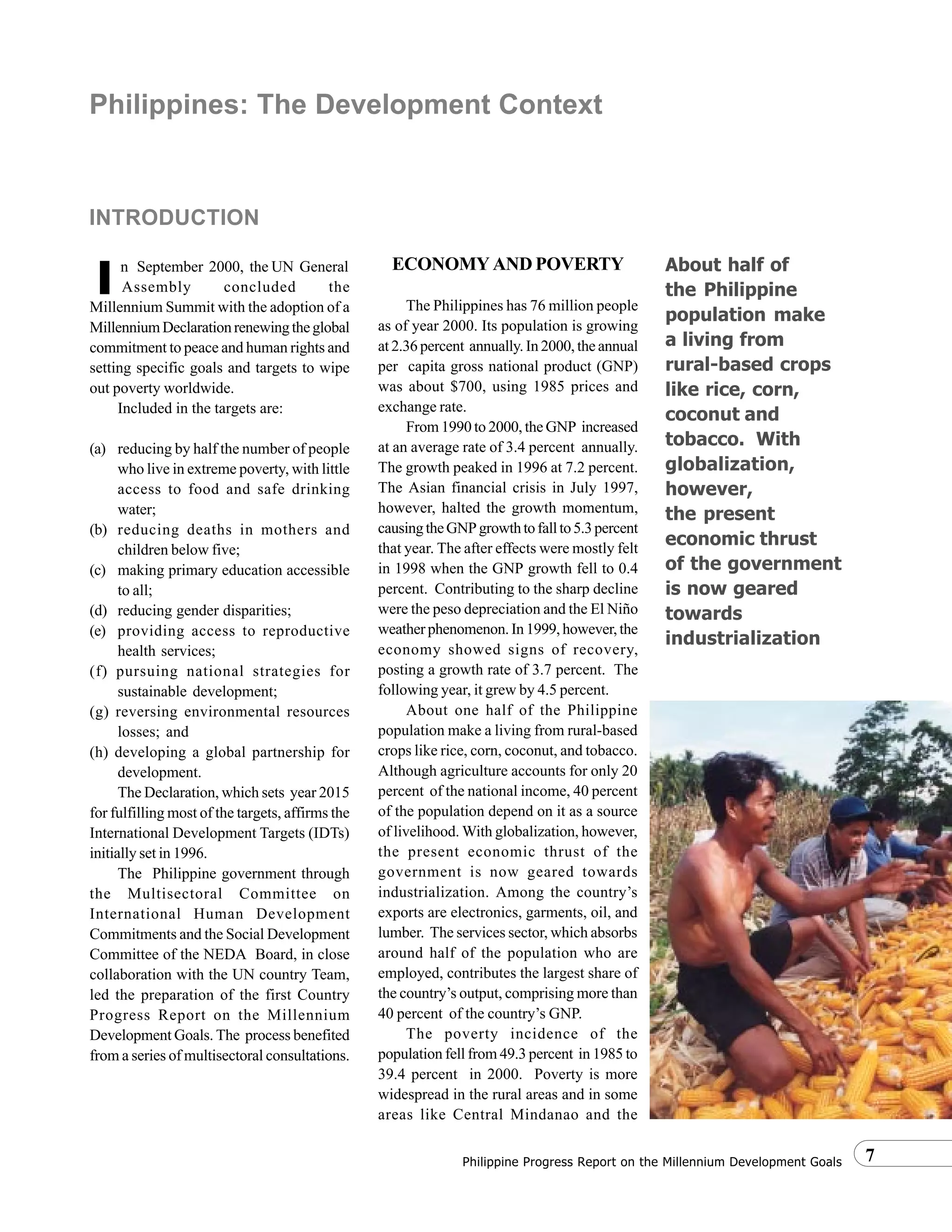
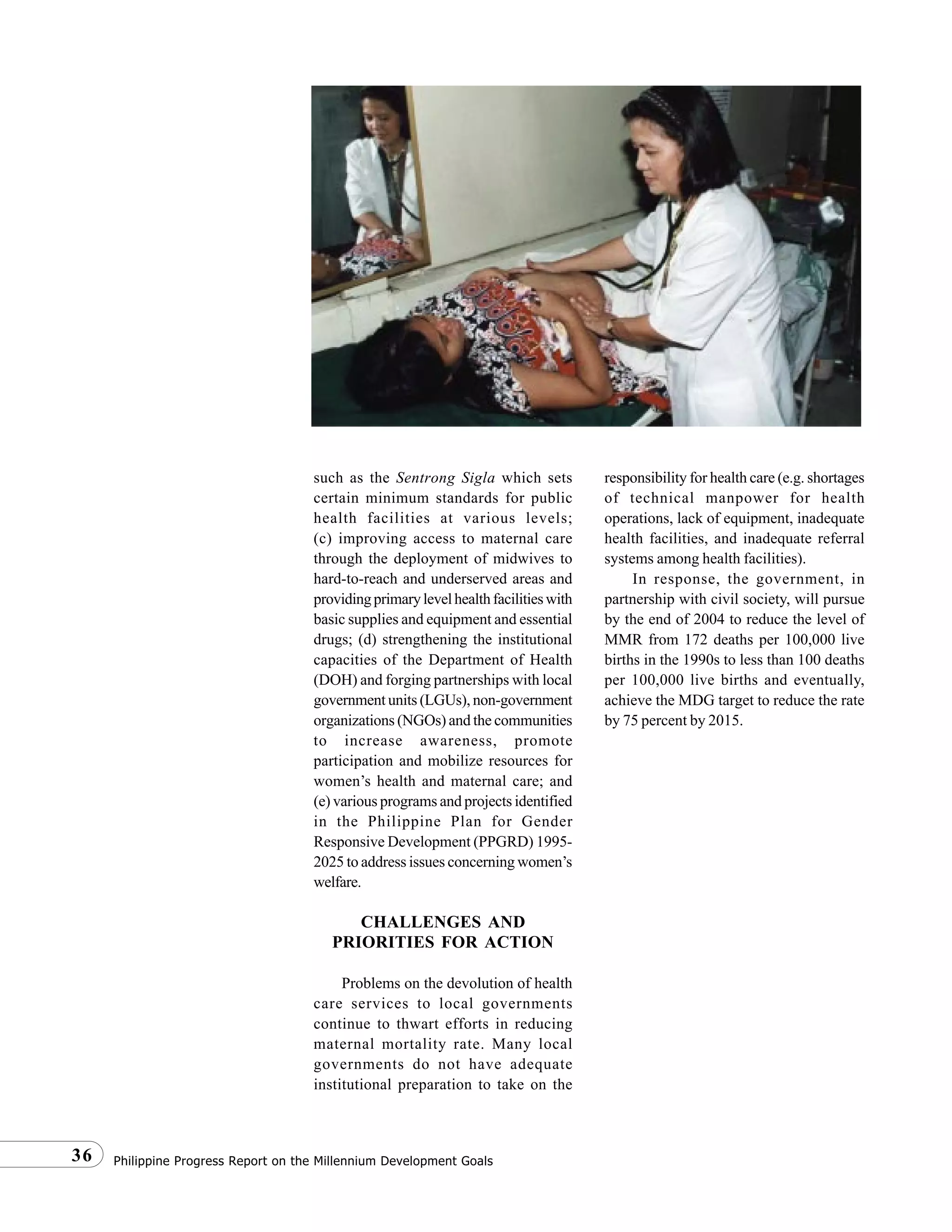
About one half of the Philippine
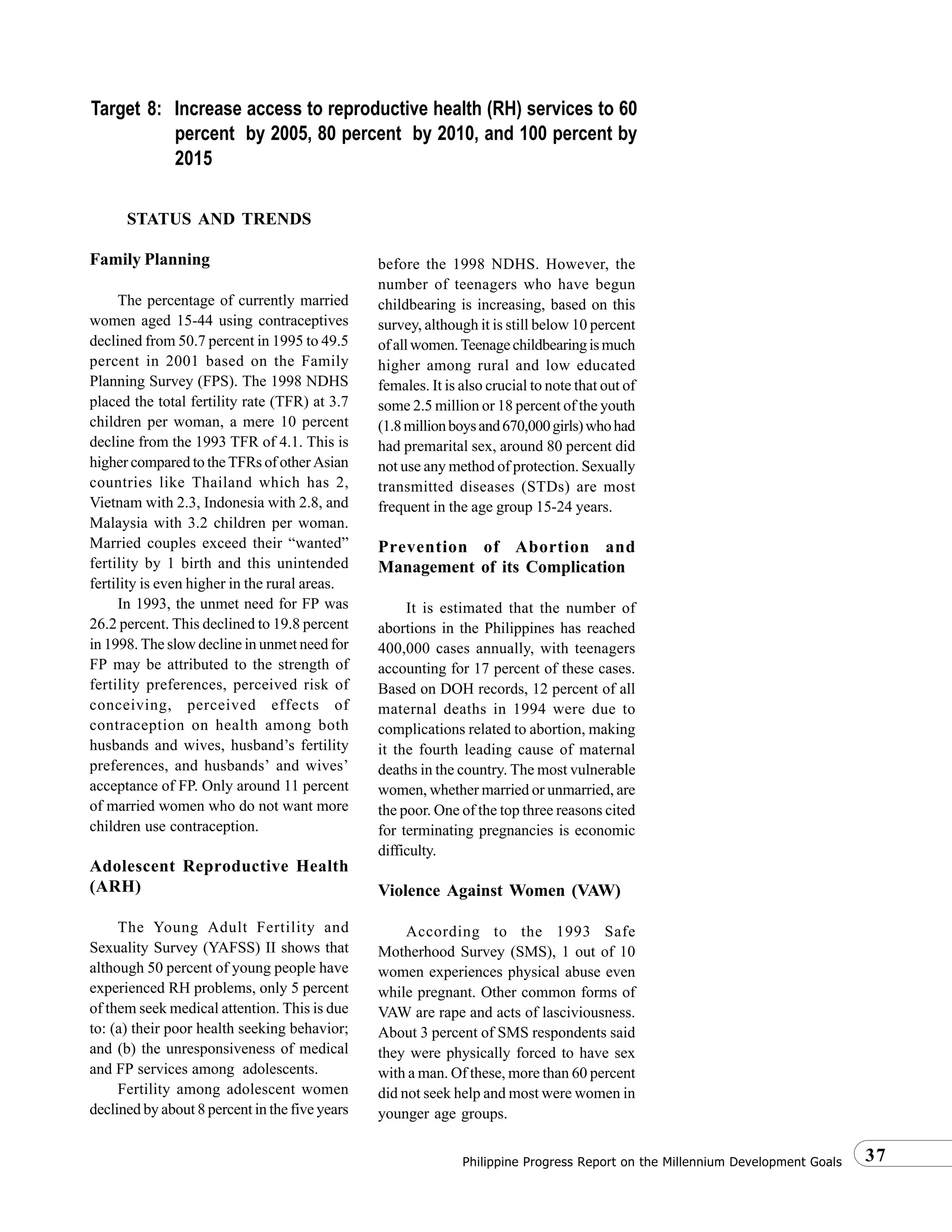
population make a living from rural-based
crops like rice, corn, coconut, and tobacco.
Although agriculture accounts for only 20
percent of the national income, 40 percent
of the population depend on it as a source
of livelihood. With globalization, however,
the present economic thrust of the
government is now geared towards
industrialization. Among the country’s
exports are electronics, garments, oil, and
lumber. The services sector, which absorbs
around half of the population who are
employed, contributes the largest share of
the country’s output, comprising more than
40 percent of the country’s GNP.
The poverty incidence of the
population fell from 49.3 percent in 1985 to
39.4 percent in 2000. Poverty is more
widespread in the rural areas and in some
areas like Central Mindanao and the
Philippines: The Development Context
INTRODUCTION
IIIII
About half of
the Philippine
population make
a living from
rural-based crops
like rice, corn,
coconut and
tobacco. With
globalization,
however,
the present
economic thrust
of the government
is now geared
towards
industrialization
Philippine Progress Report on the Millennium Development Goals8
Autonomous Region of Muslim Mindanao
(ARMM). Income inequality is also a
problem, as the Gini coefficient has
remained high at 0.48 in 2000.
In 2000, the Philippines ranked 77th
out of 162 countries with respect to the
Human Development Index (HDI).
Life expectancy has increased to 66.3
years for males and 71.6 years for females
in 2000. The maternal mortality rate has
gone down from 209 per 100,000 live births
in 1990 to 172 in 1998. The children under-
five mortality rate has also decreased
significantly from 79.6 per 1,000 live births
in 1990 to 48 in 1998.
The functional literacy rate of the
population 10 years and older in 1994 is 94
percent. Significantly, the net elementary
enrolment rate also rose from 85 percent
in 1991 to 96 percent in 2000.
GOVERNMENT EFFORTS
Although poverty has been a major
problem in the Philippines since the 1950s,
it was not until the late 1980s that poverty
alleviation became the top one priority in
government development plans.
Government administrators have been
tackling the problem of poverty since 1986.
The Aquino and Ramos governments
helped bring down its incidence from 49.3
percent of the population in 1985 to 37
percent in 1997. Although the Philippines
did not suffer as badly as its other
neighbors from the Asian financial crisis
in July 1997, there was a significant rise in
unemployment.
The Arroyo administration has
committed itself to pursue the war against
poverty and unemployment. A
comprehensive set of policies and programs
directly aimed at addressing the needs of the
poor has been outlined in the MTPDP for
2001-04. Its core strategies are:
1) Macroeconomic stability with
equitable growth based on free
enterprise;
2) Agricultural and fisheries
modernization with social equity;
3) Comprehensive human development
and protecting the vulnerable; and
4) Good governance and the rule of law.
The policies and strategies set forth
in the MTPDP are complemented by the
government’s Anti-Poverty Agenda
popularly known as KALAHI or “Kapit-
Bisig Laban sa Kahirapan” (Linking Arms
Against Poverty) Program. The KALAHI
is the current Administration’s centerpiece
antipoverty program which adopts the
Comprehensive and Integrated Delivery of
Social Services (CIDSS) approach that
provides holistic intervention at the
community level, specifically in the 5th and
6th class municipalities. It aims to improve
access to social services, empowerment
and management of resources. It responds
immediately to the most pressing needs of
the poorest communities and vulnerable
groups and ensures that all stakeholders
are important partners.
The antipoverty agenda has five major
strategies, namely:
1) asset reform by redistributing physical
and resource assets to the poor,
especially land and credit;
2) human development services by
strengthening the capacities of the
poor by increasing public spending on
basic social services and raising the
poor’s access to basic services;
3) employment and livelihood
opportunities by creating jobs through
agriculture and fisheries activities and
providing seed capital to micro and
small businesses for the poor;
4) participation of basic sectors in
governance by strengthening political
participation and cultural expression of
basic sectors and communities; and
5) social protection and security against
violence by reducing the risk and
vulnerability of the poor to immediate
effects of economic shocks and natural
and human-caused disasters.
9Philippine Progress Report on the Millennium Development Goals
Within the four-year time frame, the
government is committed to the
development and adoption of innovative
delivery and financing mechanisms for
health care, education, social welfare and
housing services. It will continue to
prioritize basic social services, like primary
health care, nutrition, basic education,
water and sanitation facilities.
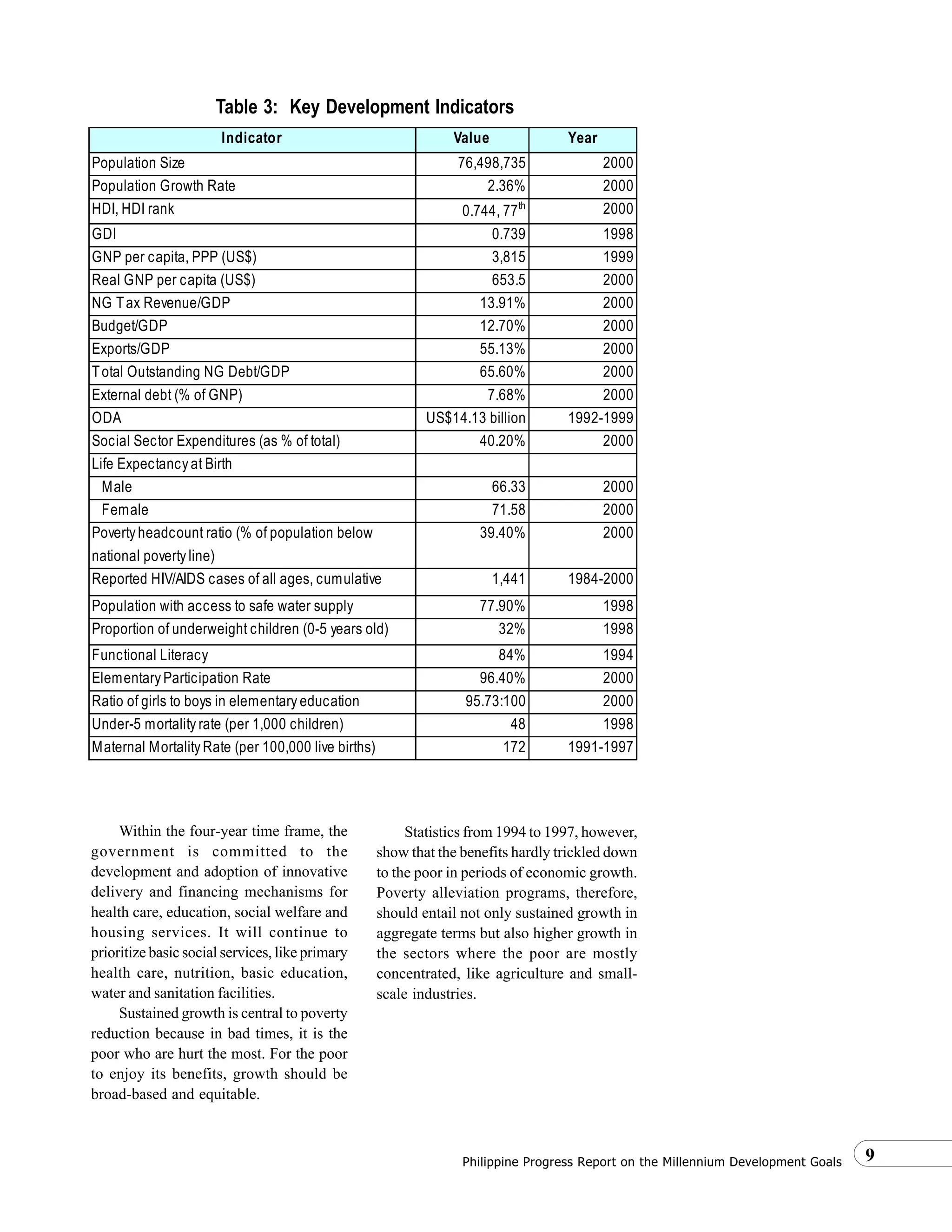
Sustained growth is central to poverty
reduction because in bad times, it is the
poor who are hurt the most. For the poor
to enjoy its benefits, growth should be
broad-based and equitable.
Indicator Value Year
Population Size 76,498,735 2000
Population Growth Rate 2.36% 2000
HDI, HDI rank 0.744, 77th 2000
GDI 0.739 1998
GNP per capita, PPP (US$) 3,815 1999
Real GNP per capita (US$) 653.5 2000
NG Tax Revenue/GDP 13.91% 2000
Budget/GDP 12.70% 2000
Exports/GDP 55.13% 2000
Total Outstanding NG Debt/GDP 65.60% 2000
External debt (% of GNP) 7.68% 2000
ODA US$14.13 billion 1992-1999
Social Sector Expenditures (as % of total) 40.20% 2000
Life Expectancyat Birth
Male 66.33 2000
Female 71.58 2000
Povertyheadcount ratio (% of population below
national povertyline)
39.40% 2000
Reported HIV/AIDS cases of all ages, cumulative 1,441 1984-2000
Population with access to safe water supply 77.90% 1998
Proportion of underweight children (0-5 years old) 32% 1998
Functional Literacy 84% 1994
ElementaryParticipation Rate 96.40% 2000
Ratio of girls to boys in elementary education 95.73:100 2000
Under-5 mortality rate (per 1,000 children) 48 1998
Maternal MortalityRate (per 100,000 live births) 172 1991-1997
Statistics from 1994 to 1997, however,
show that the benefits hardly trickled down
to the poor in periods of economic growth.
Poverty alleviation programs, therefore,
should entail not only sustained growth in
aggregate terms but also higher growth in
the sectors where the poor are mostly
concentrated, like agriculture and small-
scale industries.
Table 3: Key Development Indicators
Philippine Progress Report on the Millennium Development Goals10 10
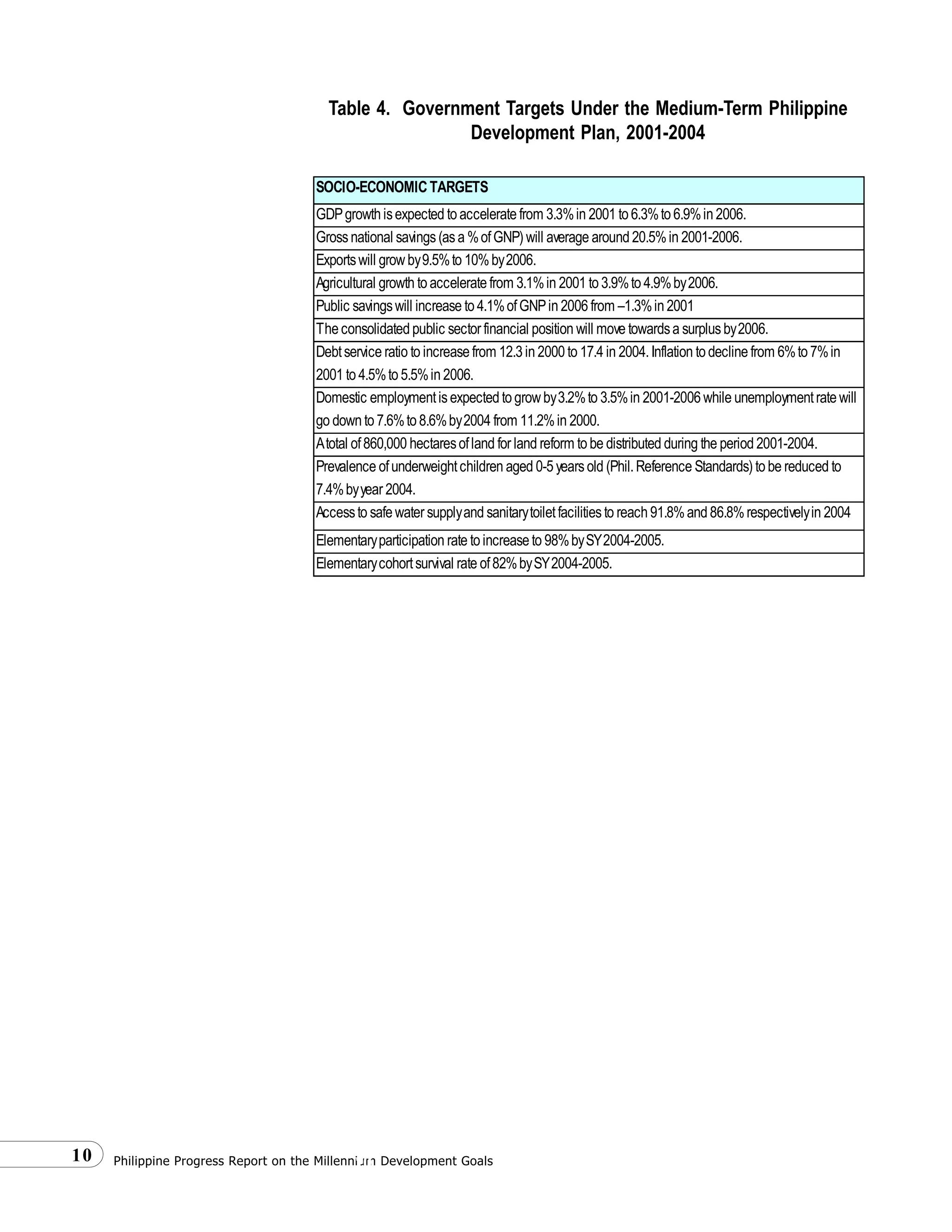
SOCIO-ECONOMICTARGETS
GDPgrowth isexpected to accelerate from 3.3%in 2001 to 6.3%to 6.9%in 2006.
Grossnational savings(asa %ofGNP) will average around 20.5%in 2001-2006.
Exportswill grow by9.5%to 10%by2006.
Agricultural growth to accelerate from 3.1%in 2001 to 3.9%to 4.9%by2006.
Public savingswill increase to 4.1%ofGNPin 2006 from –1.3%in 2001
The consolidated public sector financial position will move towardsa surplusby2006.
Debtservice ratio to increase from 12.3 in 2000 to 17.4 in 2004.Inflation to decline from 6%to 7%in
2001 to 4.5%to 5.5%in 2006.
Domestic employmentisexpected to grow by3.2%to 3.5%in 2001-2006 while unemploymentrate will
go down to 7.6%to 8.6%by2004 from 11.2%in 2000.
Atotal of860,000 hectaresofland for land reform to be distributed during the period 2001-2004.
Prevalence ofunderweightchildren aged 0-5 yearsold (Phil.Reference Standards) to be reduced to
7.4%byyear 2004.
Accessto safe water supplyand sanitarytoiletfacilitiesto reach 91.8%and 86.8%respectivelyin 2004
Elementaryparticipation rate to increase to 98%bySY2004-2005.
Elementarycohortsurvival rate of82%bySY2004-2005.
Table 4. Government Targets Under the Medium-Term Philippine
Development Plan, 2001-2004
11Philippine Progress Report on the Millennium Development Goals
Progress by Goal
This section presents the status and trends for the
indicators under the eight goals. The supportive
policies and programs characterize the policy
environment. It also presents the challenges and
the areas for priority action. Given past performance,
an assessment is made on whether or not the targets
are likely to be met.
Philippine Progress Report on the Millennium Development Goals12
s of 2000, 16.7 percent of total
families (or 20.9% of the popu-
lation) in the Philippines were core poor
(i.e., food poor or lived below subsistence).
The subsistence threshold or the family
income needed to satisfy the food
requirements of a family in 2000 was
estimated to be Php 45,9151
.
Although core poverty declined from
24.4 percent (28.5% of the population) in
GOAL 1
ERADICATE EXTREME POVERTY AND HUNGER
Target 1: Halve the proportion of people living in extreme
poverty between 1990 and 2015
1985, the magnitude of food-poor families
increased from 2.4 million families (15.4
million of the population) in 1985 to 2.5
million families (16.4 million of the
population) in 2000. About 78.8 percent of
these families reside in the rural areas. In
2000, the ARMM and the Bicol region had
the highest incidence of families who could
not meet basic food needs.
AAAAAPoverty in the
Philippines is still
largely a rural
phenomenon.
About 70 percent of
the poor live in
rural areas.
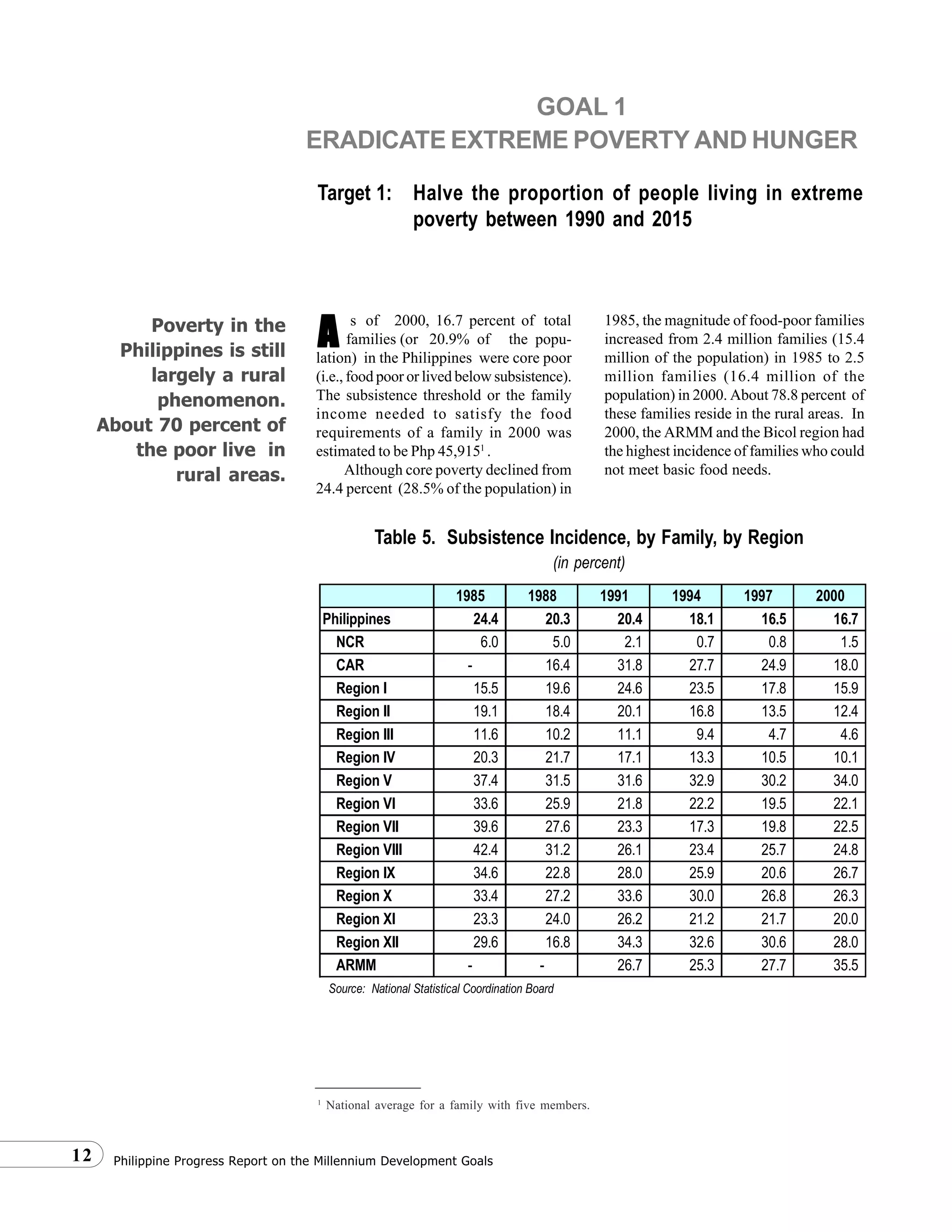
Table 5. Subsistence Incidence, by Family, by Region
(in percent)
1
National average for a family with five members.
1985 1988 1991 1994 1997 2000
Philippines 24.4 20.3 20.4 18.1 16.5 16.7
NCR 6.0 5.0 2.1 0.7 0.8 1.5
CAR - 16.4 31.8 27.7 24.9 18.0
Region I 15.5 19.6 24.6 23.5 17.8 15.9
Region II 19.1 18.4 20.1 16.8 13.5 12.4
Region III 11.6 10.2 11.1 9.4 4.7 4.6
Region IV 20.3 21.7 17.1 13.3 10.5 10.1
Region V 37.4 31.5 31.6 32.9 30.2 34.0
Region VI 33.6 25.9 21.8 22.2 19.5 22.1
Region VII 39.6 27.6 23.3 17.3 19.8 22.5
Region VIII 42.4 31.2 26.1 23.4 25.7 24.8
Region IX 34.6 22.8 28.0 25.9 20.6 26.7
Region X 33.4 27.2 33.6 30.0 26.8 26.3
Region XI 23.3 24.0 26.2 21.2 21.7 20.0
Region XII 29.6 16.8 34.3 32.6 30.6 28.0
ARMM - - 26.7 25.3 27.7 35.5
Source: National Statistical Coordination Board
13Philippine Progress Report on the Millennium Development Goals
Figure 1. Subsistence Incidence, by Area
(in percent)
7.27.0
10.4
14.3
12.1
15.2
25.824.525.626.425.3
30
0
10
20
30
40
1985 1988 1991 1994 1997 2000
Urban
Rural
Source: National Statistical Coordination Board
On the other hand, poverty incidence
of families (below the poverty threshold)
rose to 33.7 percent (or 39.4% of the
population) in 2000 from 31.8 percent
(36.8% of the population) in 1997 as the
Asian financial crisis in that year slowed
down economic growth and caused greater
unemployment. Average growth of
domestic production (GDP) slowed down
to2.4percent in1998to2000whileaverage
unemployment rate rose to 10.4 percent
from 8.7 percent in 1997.
The persistently high population
growth rate of 2.36 percent further
weighed down the growth of per capita
income. Average annual per capita income
rose by a mere 9.2 percent from 1998 to
2000 to reach Php44,591 as of 2000. The
annual per capita poverty threshold in 2000
was estimated at Php13, 823.
Asof2000,therewere5.1millionpoor
families, or 30.8 million poor people.
Poverty in the Philippines remains a rural
phenomenon. In 1985, more than half of
the total families in rural areas were poor.
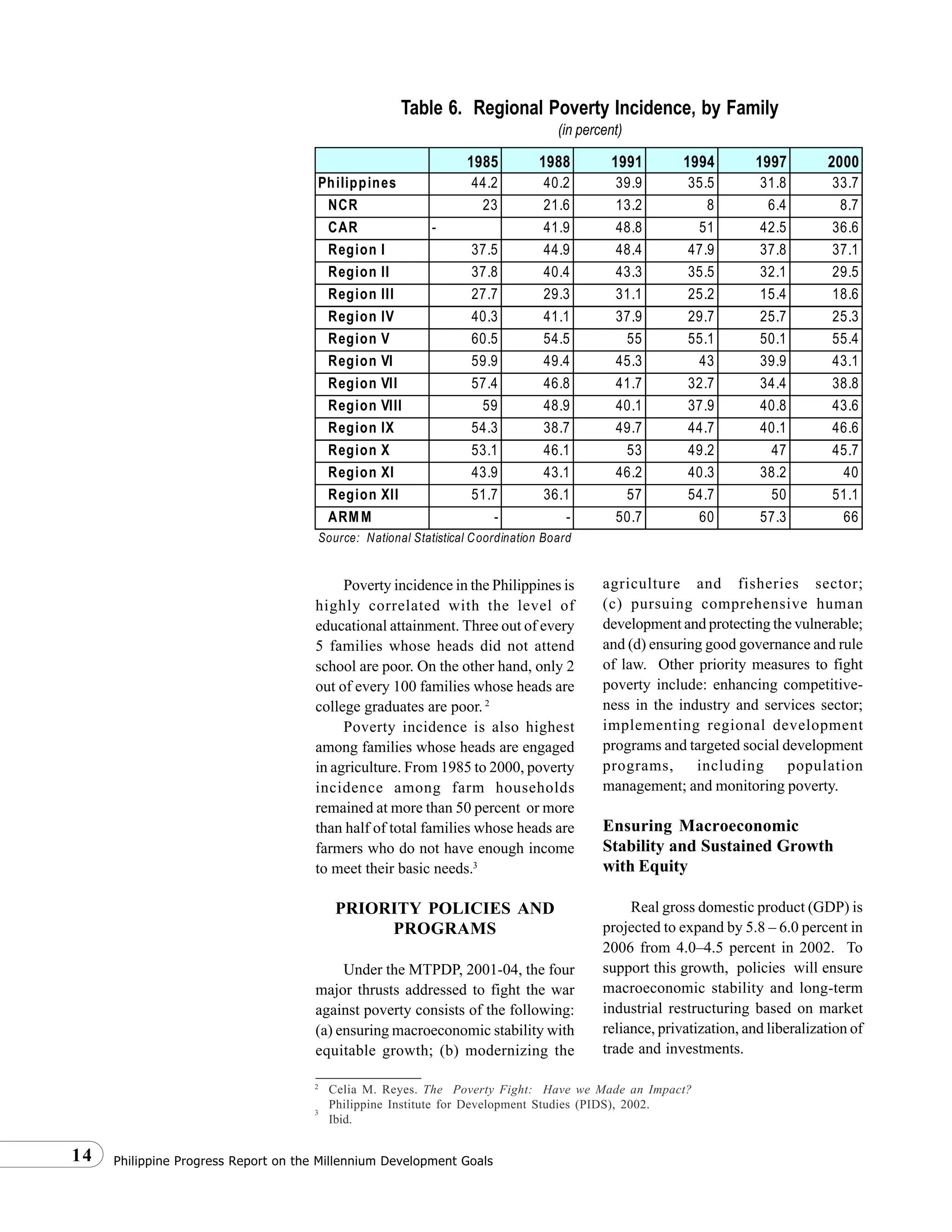
This has changed slightly, with 46.9 percent
ofruralfamiliesstillconsideredpoorin2000.
Relative to the total number of poor families
in 2000, rural poor families account for 70.9
percent or about 3 out of 4 families. On the
other hand, poverty incidence in urban
areas had significantly declined from 33.6
percent in 1985 to 19.9 percent in 2000.
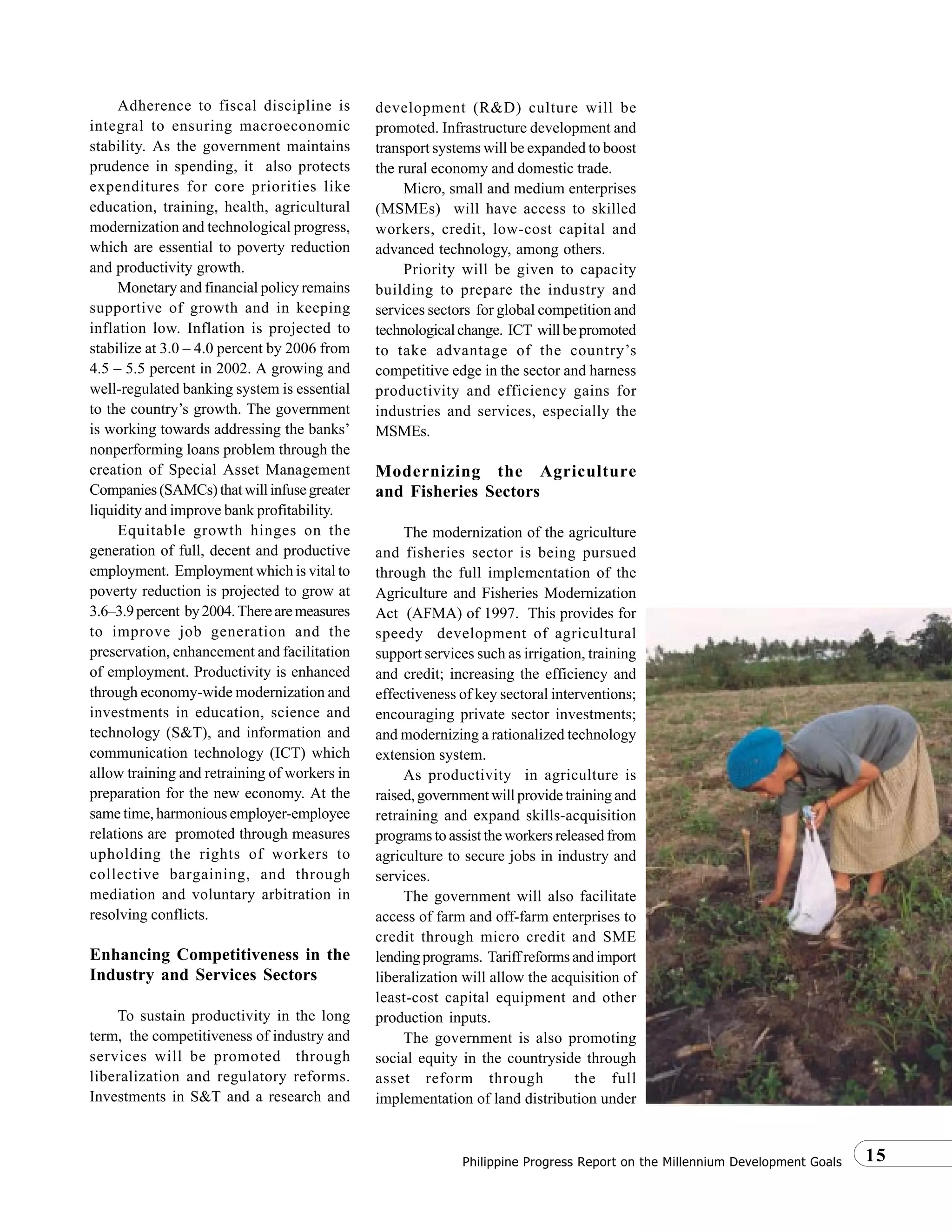
In 2000, poverty incidence across
regions was highest in the ARMM (66%),
followed by the Bicol Region (55.4%) and
Central Mindanao (51.1%). Poverty
incidence was lowest at 8.7 percent in the
NationalCapitalRegion(NCR). Meanwhile,
a remarkable drop in poverty incidence
occurred from 1985 to 2000 in Regions IV
and VII, both the fastest growing regions
during this period. On the contrary, poverty
incidence worsened during 1994-2000 in
ARMM as the peace and order situation
deteriorated. Poverty incidence in all the
Visayas and Mindanao regions was higher
than the national average of 33.7 percent.
Source: National Statistical Coordination Board
Figure 2. Poverty Incidence, by Area
(in percent)
33.6
30.1 31.1
24.0
17.9 19.9
50.7
46.3 48.6 47.0 44.4
46.9
0
10
20
30
40
50
60
1985 1988 1991 1994 1997 2000
Urban
Rural
Philippine Progress Report on the Millennium Development Goals14
Table 6. Regional Poverty Incidence, by Family
(in percent)
Source: National Statistical Coordination Board
Poverty incidence in the Philippines is
highly correlated with the level of
educational attainment. Three out of every
5 families whose heads did not attend
school are poor. On the other hand, only 2
out of every 100 families whose heads are
college graduates are poor. 2
Poverty incidence is also highest
among families whose heads are engaged
in agriculture. From 1985 to 2000, poverty
incidence among farm households
remained at more than 50 percent or more
than half of total families whose heads are
farmers who do not have enough income
to meet their basic needs.3
PRIORITY POLICIES AND
PROGRAMS
Under the MTPDP, 2001-04, the four
major thrusts addressed to fight the war
against poverty consists of the following:
(a) ensuring macroeconomic stability with
equitable growth; (b) modernizing the
agriculture and fisheries sector;
(c) pursuing comprehensive human
development and protecting the vulnerable;
and (d) ensuring good governance and rule
of law. Other priority measures to fight
poverty include: enhancing competitive-
ness in the industry and services sector;
implementing regional development
programs and targeted social development
programs, including population
management; and monitoring poverty.
Ensuring Macroeconomic
Stability and Sustained Growth
with Equity
Real gross domestic product (GDP) is
projected to expand by 5.8 – 6.0 percent in
2006 from 4.0–4.5 percent in 2002. To
support this growth, policies will ensure
macroeconomic stability and long-term
industrial restructuring based on market
reliance, privatization, and liberalization of
trade and investments.
1985 1988 1991 1994 1997 2000
Philippines 44.2 40.2 39.9 35.5 31.8 33.7
NCR 23 21.6 13.2 8 6.4 8.7
CAR - 41.9 48.8 51 42.5 36.6
Region I 37.5 44.9 48.4 47.9 37.8 37.1
Region II 37.8 40.4 43.3 35.5 32.1 29.5
Region III 27.7 29.3 31.1 25.2 15.4 18.6
Region IV 40.3 41.1 37.9 29.7 25.7 25.3
Region V 60.5 54.5 55 55.1 50.1 55.4
Region VI 59.9 49.4 45.3 43 39.9 43.1
Region VII 57.4 46.8 41.7 32.7 34.4 38.8
Region VIII 59 48.9 40.1 37.9 40.8 43.6
Region IX 54.3 38.7 49.7 44.7 40.1 46.6
Region X 53.1 46.1 53 49.2 47 45.7
Region XI 43.9 43.1 46.2 40.3 38.2 40
Region XII 51.7 36.1 57 54.7 50 51.1
ARMM - - 50.7 60 57.3 66
Source: National Statistical Coordination Board
2
Celia M. Reyes. The Poverty Fight: Have we Made an Impact?
Philippine Institute for Development Studies (PIDS), 2002.
3
Ibid.
15Philippine Progress Report on the Millennium Development Goals
Adherence to fiscal discipline is
integral to ensuring macroeconomic
stability. As the government maintains
prudence in spending, it also protects
expenditures for core priorities like
education, training, health, agricultural
modernization and technological progress,
which are essential to poverty reduction
and productivity growth.
Monetary and financial policy remains
supportive of growth and in keeping
inflation low. Inflation is projected to
stabilize at 3.0 – 4.0 percent by 2006 from
4.5 – 5.5 percent in 2002. A growing and
well-regulated banking system is essential
to the country’s growth. The government
is working towards addressing the banks’
nonperforming loans problem through the
creation of Special Asset Management
Companies(SAMCs)thatwillinfusegreater
liquidity and improve bank profitability.
Equitable growth hinges on the
generation of full, decent and productive
employment. Employment which is vital to
poverty reduction is projected to grow at
3.6–3.9percent by2004.Therearemeasures
to improve job generation and the
preservation, enhancement and facilitation
of employment. Productivity is enhanced
through economy-wide modernization and
investments in education, science and
technology (S&T), and information and
communication technology (ICT) which
allow training and retraining of workers in
preparation for the new economy. At the
same time, harmonious employer-employee
relations are promoted through measures
upholding the rights of workers to
collective bargaining, and through
mediation and voluntary arbitration in
resolving conflicts.
Enhancing Competitiveness in the
Industry and Services Sectors
To sustain productivity in the long
term, the competitiveness of industry and
services will be promoted through
liberalization and regulatory reforms.
Investments in S&T and a research and
development (R&D) culture will be
promoted. Infrastructure development and
transport systems will be expanded to boost
the rural economy and domestic trade.
Micro, small and medium enterprises
(MSMEs) will have access to skilled
workers, credit, low-cost capital and
advanced technology, among others.
Priority will be given to capacity
building to prepare the industry and
services sectors for global competition and
technologicalchange. ICT willbepromoted
to take advantage of the country’s
competitive edge in the sector and harness
productivity and efficiency gains for
industries and services, especially the
MSMEs.
Modernizing the Agriculture
and Fisheries Sectors
The modernization of the agriculture
and fisheries sector is being pursued
through the full implementation of the
Agriculture and Fisheries Modernization
Act (AFMA) of 1997. This provides for
speedy development of agricultural
support services such as irrigation, training
and credit; increasing the efficiency and
effectiveness of key sectoral interventions;
encouraging private sector investments;
and modernizing a rationalized technology
extension system.
As productivity in agriculture is
raised, government will provide training and
retraining and expand skills-acquisition
programs to assist the workers released from
agriculture to secure jobs in industry and
services.
The government will also facilitate
access of farm and off-farm enterprises to
credit through micro credit and SME
lendingprograms. Tariffreformsandimport
liberalization will allow the acquisition of
least-cost capital equipment and other
production inputs.
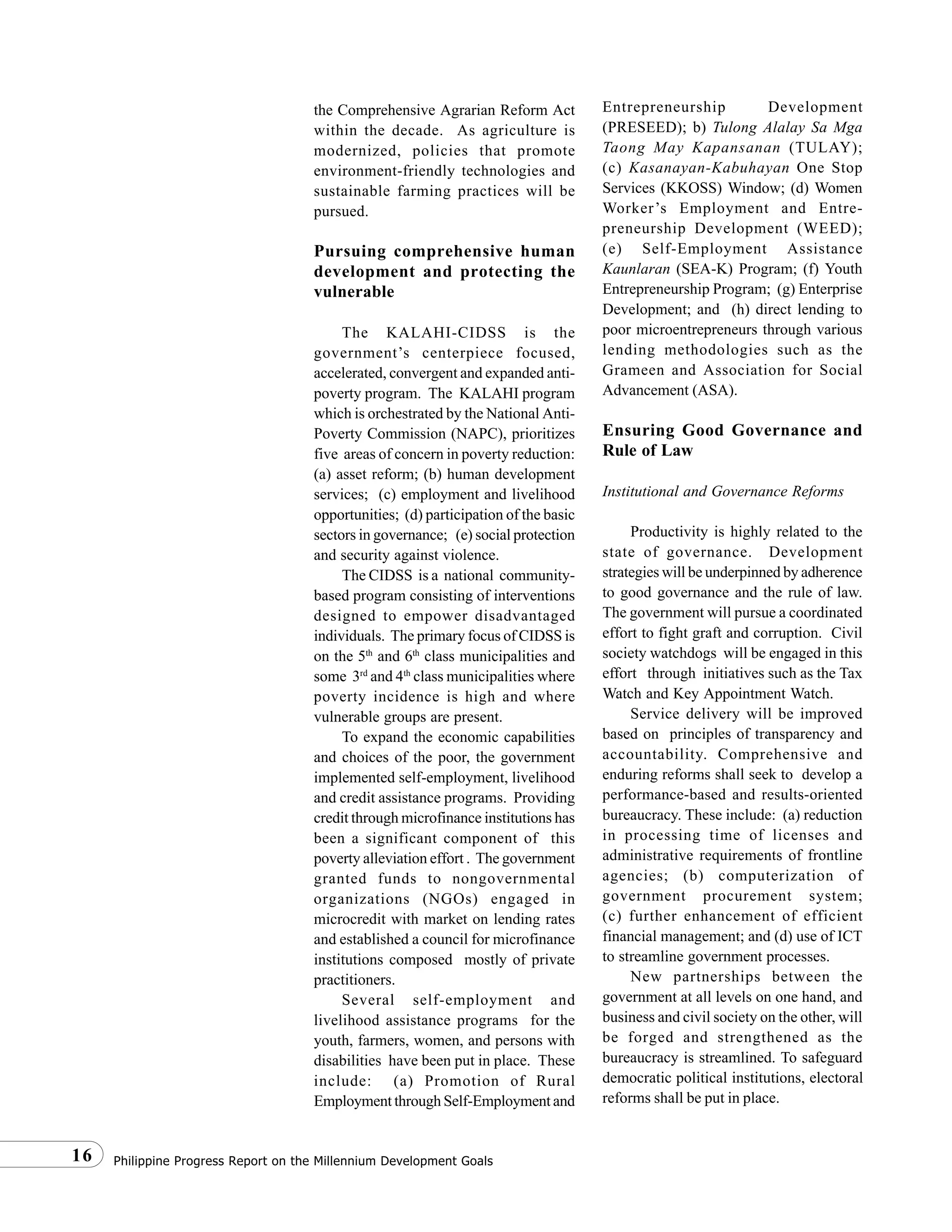
The government is also promoting
social equity in the countryside through
asset reform through the full
implementation of land distribution under
Philippine Progress Report on the Millennium Development Goals16
the Comprehensive Agrarian Reform Act
within the decade. As agriculture is
modernized, policies that promote
environment-friendly technologies and
sustainable farming practices will be
pursued.
Pursuing comprehensive human
development and protecting the
vulnerable
The KALAHI-CIDSS is the
government’s centerpiece focused,
accelerated, convergent and expanded anti-
poverty program. The KALAHI program
which is orchestrated by the National Anti-
Poverty Commission (NAPC), prioritizes
five areas of concern in poverty reduction:
(a) asset reform; (b) human development
services; (c) employment and livelihood
opportunities; (d) participation of the basic
sectors in governance; (e) social protection
and security against violence.
The CIDSS is a national community-
based program consisting of interventions
designed to empower disadvantaged
individuals. The primary focus of CIDSS is
on the 5th
and 6th
class municipalities and
some 3rd
and 4th
class municipalities where
poverty incidence is high and where
vulnerable groups are present.
To expand the economic capabilities
and choices of the poor, the government
implemented self-employment, livelihood
and credit assistance programs. Providing
credit through microfinance institutions has
been a significant component of this
poverty alleviation effort . The government
granted funds to nongovernmental
organizations (NGOs) engaged in
microcredit with market on lending rates
and established a council for microfinance
institutions composed mostly of private
practitioners.
Several self-employment and
livelihood assistance programs for the
youth, farmers, women, and persons with
disabilities have been put in place. These
include: (a) Promotion of Rural
Employment through Self-Employment and
Entrepreneurship Development
(PRESEED); b) Tulong Alalay Sa Mga
Taong May Kapansanan (TULAY);
(c) Kasanayan-Kabuhayan One Stop
Services (KKOSS) Window; (d) Women
Worker’s Employment and Entre-
preneurship Development (WEED);
(e) Self-Employment Assistance
Kaunlaran (SEA-K) Program; (f) Youth
Entrepreneurship Program; (g) Enterprise
Development; and (h) direct lending to
poor microentrepreneurs through various
lending methodologies such as the
Grameen and Association for Social
Advancement (ASA).
Ensuring Good Governance and
Rule of Law
Institutional and Governance Reforms
Productivity is highly related to the
state of governance. Development
strategies will be underpinned by adherence
to good governance and the rule of law.
The government will pursue a coordinated
effort to fight graft and corruption. Civil
society watchdogs will be engaged in this
effort through initiatives such as the Tax
Watch and Key Appointment Watch.
Service delivery will be improved
based on principles of transparency and
accountability. Comprehensive and
enduring reforms shall seek to develop a
performance-based and results-oriented
bureaucracy. These include: (a) reduction
in processing time of licenses and
administrative requirements of frontline
agencies; (b) computerization of
government procurement system;
(c) further enhancement of efficient
financial management; and (d) use of ICT
to streamline government processes.
New partnerships between the
government at all levels on one hand, and
business and civil society on the other, will
be forged and strengthened as the
bureaucracy is streamlined. To safeguard
democratic political institutions, electoral
reforms shall be put in place.
17Philippine Progress Report on the Millennium Development Goals
CHALLENGES/PRIORITIES
FOR ACTION
Spatial Disparities and
Deteriorating Peace and Order
Situation
Reducing poverty entails bridging the
disparities in development levels between
Metro Manila and the rest of the regions.
To do this, the government is working for
the development of urban centers outside
of Metro Manila. Enhancing capabilities of
LGUs to practice greater fiscal discipline
and improve collections is important. To
improve planning and instill discipline in
the use of scarce resources, a well-
coordinated statistical system at the local
level will be established.
To attain unity amid the diversity in
religion and culture of stakeholders, special
attention is focused on ensuring lasting
peace and development in Mindanao.
Rapid Population Growth
The Philippine Population and
Management Program (PPMP) Directional
Plan, together with the Population
Investment Plan, embodies the
government’s population policies. These
policies call on the government to assist
couples in achieving their fertility goals and
likewise prepare individuals to become
responsible parents. To support this, the
following efforts are encouraged:
(a) allocation of National Government (NG)
budget for responsible parenthood and
reproductive health (RH) programs;
(b) organizing government agencies and
NGOs for the preparation of the population
investment plan; and (c) mobilizing
resources from private commercial sector,
NGOs and LGUs for the PPMP programs.
The PPMP has three component
programs namely: responsible parenthood
and Family Planning, adolescent health and
youth development; and population and
development (POPDEV) integration.
Advocacy and information activities
will be conducted on POPDEV integration.
This means that population variables are
blended into development policies plans
andprograms. Thus,LGUsare,forexample,
expected to integrate POPDEV concerns in
their local development and investment
plans.
To assist couples on reaching their
desired family size, quality information and
reproductive health services will be made
available and accessible to them. Similarly,
programs such as Teen Centers,
Counseling on Air, and peer counseling will
be launched to provide adolescents with
age-appropriate information, knowledge,
education on reproductive health and
responsible sexual behavior.
Monitoring poverty through APIS
and FIES
The government will continue to
conduct the triennial Family Income and
Expenditures Survey (FIES) and Annual
Poverty Indicators Survey (APIS) on non-
FIES years to monitor the poverty situation
in the country and determine the status of
our MDG commitment of halving extreme
poverty (subsistence poverty) by 2015.
The FIES and APIS are both
household-based surveys. The FIES,
which generates family incomes and
expenditures data, is used in estimating
statistics such as the poverty and
subsistence incidences, poverty and
income gaps and income distribution. The
APIS, on the other hand, provides
information on correlates of poverty
relating to survival, security, enabling
indicators, and other minimum basic needs.
Strengthening safety nets
The government continues to pursue
policies to enhance access of the poor to
health financing. About 40 percent of the
urban poor beneficiaries have been
identified for enrollment under the National
Health Insurance Program (NHIP). As of
Philippine Progress Report on the Millennium Development Goals18
December 2001, some 156,039 urban poor
families were enrolled nationwide.
Awareness of the NHIP among the urban
poor also increased.
Improvements introduced in the NHIP
include the following: (a) increase in certain
in-patient benefit item ceilings that would
have impact on members, i.e., laboratory
services, drugs and medicines, by as much
as 43 percent; (b) approval of the
implementation of the Relative Value Scale
2001 and International Classification of
Diseases to improve payment schemes for
physicians; (c) roll-out of Outpatient
Diagnostic Package (general consultation,
laboratory fees, x-ray) in Health Sector
Reform Agenda (HSRA) convergence and
Plan 500 areas; (d) implementation of the
Plan500toensureenrolling500,000indigent
urban poor families each year; and
(e) aggressive marketing and enrollment of
the Individually-Paying Program.
As a safety net, social insurance
programs are important in minimizing the
income shocks that comes from work-
related injury, illness, old age, and disability,
especially of the poor and those dependent
on single sources of income. As such, the
implementation of social and health
insurance programs are being improved to
expand the coverage of these services.
The implementation of the Social
Security Act of 1997 will be intensified by
empowering the Social Security System
(SSS) to authorize duly registered
cooperatives to act as collecting agents
with respect to their members. The
development of a feasible set of guidelines
and measures to implement this new policy
on coverage and collection is underway.
Moreover, the SSS, through its SSS
Flexi-Fund Program, will provide better
social protection assistance for members
who are Overseas Filipino Workers
(OFWs). This program is a voluntary and
defined contribution scheme that enables
OFWs to save more of their relatively
higher incomes from overseas employment.
It also aims to provide financial assistance
for other needs of returning OFWs such as
housing, education and business capital.
This program is being implemented in 13
SSS Foreign Representative Offices and
has already enrolled 2,799 registrants with
a collection totaling to Php1.2 million.
On the other hand, social security to
an estimated 1.4 million public servants will
be enhanced by the Government Service
Insurance System (GSIS) through the
expansion of service delivery structures
such as conduit banks and other media.
Social security benefits will also be
increased specifically on disability, old age,
and survivorships pensions and housing
assistance.
19Philippine Progress Report on the Millennium Development Goals
STATUS AND TRENDS
The aggregate food supply available
in the country from domestic production
and imports more than satisfies
consumption levels of the population.
Based on the 1998-2000 Food Balance
Sheets of the Philippines, food supply over
consumption ratios for calories, protein,
and fats were estimated at 133.9 percent,
136.9 percent and 139.4 percent,
respectively. Although readily available,
many do not have enough money to buy
the food they need. Poverty is a major cause
of food inadequacy particularly in the rural
areas.
On the consumption side, the 4th
National Nutrition Survey in 1993
conducted by Food and Nutrition Research
Institute-Department of Science and
Technology (FNRI-DOST) as cited in the
2001 Philippine Nutrition Facts and Figures
shows that the average Filipino food and
nutrient intake of Filipinos is generally
inadequate. Trends in food consumption
indicate a general decrease in the intake of
various foods.
The mean one-day per capita food
consumption decreased from 869 grams in
1987 to 803 grams in 1993, and the mean
one-day per capita energy intake went
down from 1753 kilo calories to 1684 kilo
calories in the same period. Energy, iron,
calcium and ascorbic acid intakes
significantly decreased from 1987 to 1993,
and this can be traced to the general
downward trend in food consumption,
particularly of rice along with the decreases
in fish and meat consumption during the
period.
Most of the food groups except for
eggs and egg products and milk and milk
products show lower consumption levels
in 1993 as compared to the 1987 figures.
This means the vitamin and mineral intake
remains grossly inadequate except for
protein, which meets the corresponding
RDA (106.2%) standard.
Malnutrition is still a major threat to
the Filipino child’s survival. The prevalence
of underweight preschool children 0-5 years
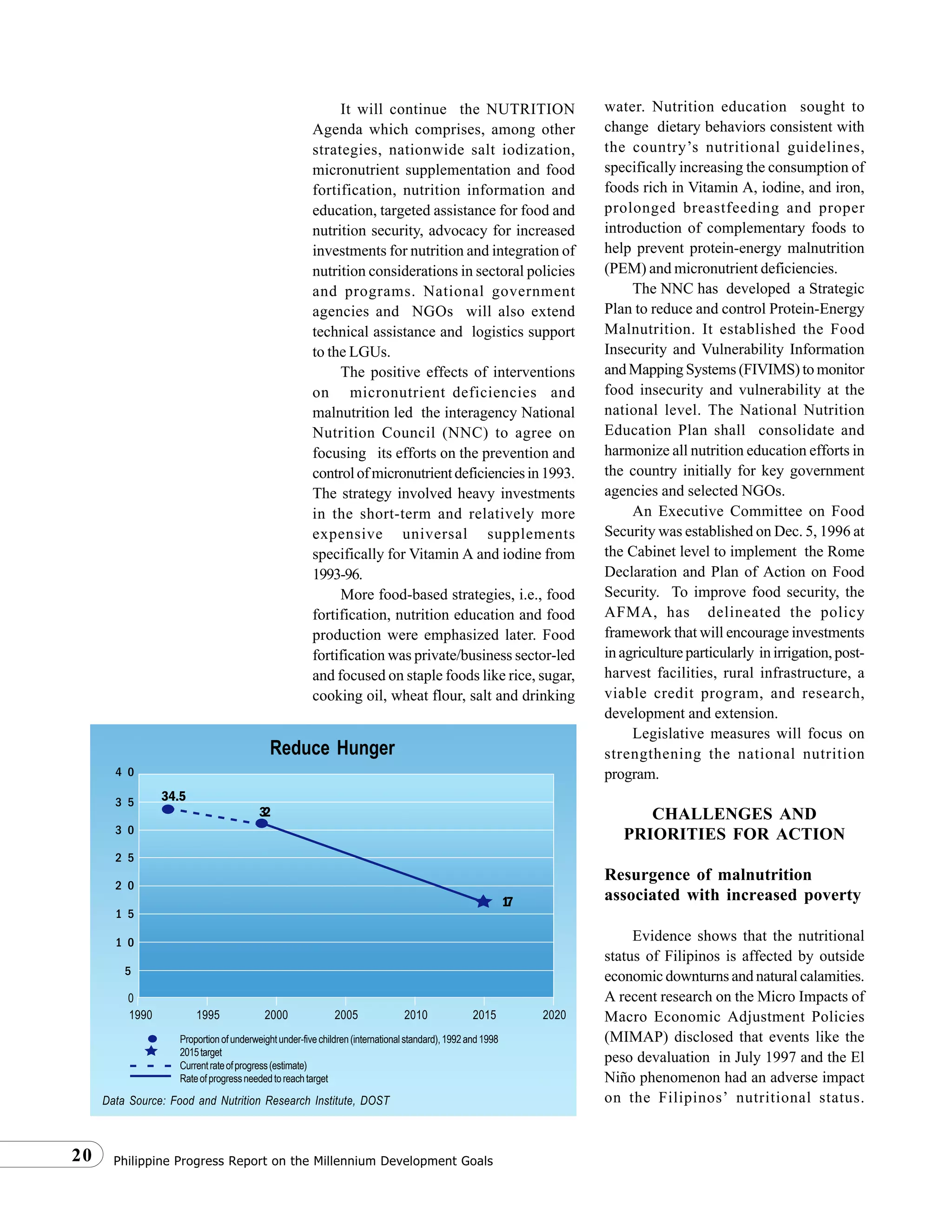
old decreased from 34.5 percent in 1989-90
to 30.8 percent in 1996, then increased to
32 percent in 1998 and decreased to 30.6
percent in 2001.
There is a wide disparity across regions
in terms of the nutritional status of children.
For instance, Bicol has almost twice as
much underweight preschoolers (37.8%)
than the NCR, which has only 20.3 percent.
The next two regions with the highest
underweight prevalence exceeded the
national average rate of 30.6 percent. These
are Western Visayas (35.2%) and Northern
Mindanao(34.1%).CARandCentralLuzon,
on the other hand, registered the lowest
prevalence rates at 23.4 percent and 25.9
percent respectively, following NCR.
Figures for stunted growth, indicative
of prolonged deprivation of food and
susceptibility to frequent infections,
decreased from 40 percent in 1989-90 to
34.5 percent in 1996, and almost stagnated
until 1998 at 34 percent.
PRIORITY POLICIES AND
PROGRAMS
The Philippines will ensure protection
of the rights of the children, particularly
their right to survival, protection,
development and participation. The
government will continue to implement the
Philippine Plan of Action for Nutrition
(PPAN), a companion plan of both the
Philippine Plan of Action for Children
(PPAC) and the Filipino Children 2000 and
Beyond, which embody the country’s
efforts towards achieving the nutrition
goals of the World Summit for Children.
Target 2: Halve the proportion of population below minimum level of
dietary energy consumption and halve the proportion of
underweight children (under five years old)
Philippine Progress Report on the Millennium Development Goals20
It will continue the NUTRITION
Agenda which comprises, among other
strategies, nationwide salt iodization,
micronutrient supplementation and food
fortification, nutrition information and
education, targeted assistance for food and
nutrition security, advocacy for increased
investments for nutrition and integration of
nutrition considerations in sectoral policies
and programs. National government
agencies and NGOs will also extend
technical assistance and logistics support
to the LGUs.
The positive effects of interventions
on micronutrient deficiencies and
malnutrition led the interagency National
Nutrition Council (NNC) to agree on
focusing its efforts on the prevention and
controlofmicronutrientdeficienciesin1993.
The strategy involved heavy investments
in the short-term and relatively more
expensive universal supplements
specifically for Vitamin A and iodine from
1993-96.
More food-based strategies, i.e., food
fortification, nutrition education and food
production were emphasized later. Food
fortification was private/business sector-led
and focused on staple foods like rice, sugar,
cooking oil, wheat flour, salt and drinking
water. Nutrition education sought to
change dietary behaviors consistent with
the country’s nutritional guidelines,
specifically increasing the consumption of
foods rich in Vitamin A, iodine, and iron,
prolonged breastfeeding and proper
introduction of complementary foods to
help prevent protein-energy malnutrition
(PEM) and micronutrient deficiencies.
The NNC has developed a Strategic
Plan to reduce and control Protein-Energy
Malnutrition. It established the Food
Insecurity and Vulnerability Information
and Mapping Systems (FIVIMS) to monitor
food insecurity and vulnerability at the
national level. The National Nutrition
Education Plan shall consolidate and
harmonize all nutrition education efforts in
the country initially for key government
agencies and selected NGOs.
An Executive Committee on Food
Security was established on Dec. 5, 1996 at
the Cabinet level to implement the Rome
Declaration and Plan of Action on Food
Security. To improve food security, the
AFMA, has delineated the policy
framework that will encourage investments
in agriculture particularly in irrigation, post-
harvest facilities, rural infrastructure, a
viable credit program, and research,
development and extension.
Legislative measures will focus on
strengthening the national nutrition
program.
CHALLENGES AND
PRIORITIES FOR ACTION
Resurgence of malnutrition
associated with increased poverty
Evidence shows that the nutritional
status of Filipinos is affected by outside
economic downturns and natural calamities.
A recent research on the Micro Impacts of
Macro Economic Adjustment Policies
(MIMAP) disclosed that events like the
peso devaluation in July 1997 and the El
Niño phenomenon had an adverse impact
on the Filipinos’ nutritional status.
Proportionofunderweightunder-fivechildren(internationalstandard),1992and1998
2015target
Currentrateofprogress(estimate)
Rateofprogressneededtoreachtarget
Data Source: Food and Nutrition Research Institute, DOST
Reduce Hunger
4 0
1990
3 5
2 5
2 0
1 5
1 0
5
0
1995 2000 2005 2010
34.5
32
17
2015 2020
3 0
21Philippine Progress Report on the Millennium Development Goals
However, the right amount of investments
in social services can counter their ill
effects both in the short and long term. A
more aggressive nutrition program will be
laid out by government to combat the
problem.
Wide spatial disparities
Focused targeting for programs is
needed to address the wide regional
disparities. Special target areas for uplifting
the nutritional status of children are the
Visayas (i.e., Antique, Southern Leyte,
Bacolod City) and Mindanao (i.e., Marawi
City, North and South Cotabato). Nutrition
advocacy for policy makers, especially in
the LGUs, will be intensified.
Targeting of strategic areas and
groups
Ways should be identified to actually
enforce focused targeting of nutrition
interventions. This will help ensure greater
economic returns of limited resources and
ensure that the most at-risk groups and
areas are the ones relieved by services.
Focusing on strategic areas or areas with
high malnutrition prevalence rates will also
help in substantially achieving the MDG
of halving the proportion of 0-5
underweight children.
Intensifying advocacy to LGUs to
address nutritional problem
The advocacy will involve dialogues
with local chief executives and their
functionaries and will emphasize the
magnitude and consequences of
malnutrition and the need to sufficiently
fund nutrition services to address the
identified nutritional problems in their
communities. Priorities for advocacy will
be the areas with the highest malnutrition
prevalence.
Low use of Iodized Salt
The country has not met the goal of
universal salt iodization set in 2000. From
1996 to 1998, only 2.6 percent of the annual
requirement of Filipinos for iodized salt was
met despite the passage of the salt
iodization law in 1995. The implementation
of the nationwide salt iodization program
will be pursued through the enforcement
of the ASIN Law. Partnerships with LGUs
and the private sector will also be forged to
sustain initiatives for nationwide salt
iodization.
Ineffective Nutrition Intervention
Mix
There is a need to assess which
nutrition interventions have the most
impact at the least possible cost. With the
declining trend of nutritional status, a cost
effective nutrition mix will be identified.
Other Challenges
The following challenges remain:
(a) increased occurrence of underweight
and wasting among children, particularly
among 1-2 year-old preschoolers and
among 9-10 year-old schoolchildren;
(b) vulnerability of 0-5 year-old children,
particularly boys, to stunted growth and
wasting; (c) high iron deficiency anemia
across all population groups, especially
among infants, and pregnant and lactating
women; (d) Vitamin A deficiency among
pregnant and lactating women; (e) iodine
deficiency; (f) high prevalence rates of
overweight and chronic energy deficiency
problems among adult females 20 years old
and over and older persons 60 years old
and above; and (g) protein energy
malnutrition.
Philippine Progress Report on the Millennium Development Goals22
STATUS AND TRENDS
According to the National Objectives
for Health, from 1960 to present, there has
been a significant increase in households
with access to safe drinking water at an
average rate of 2 percent increase yearly.
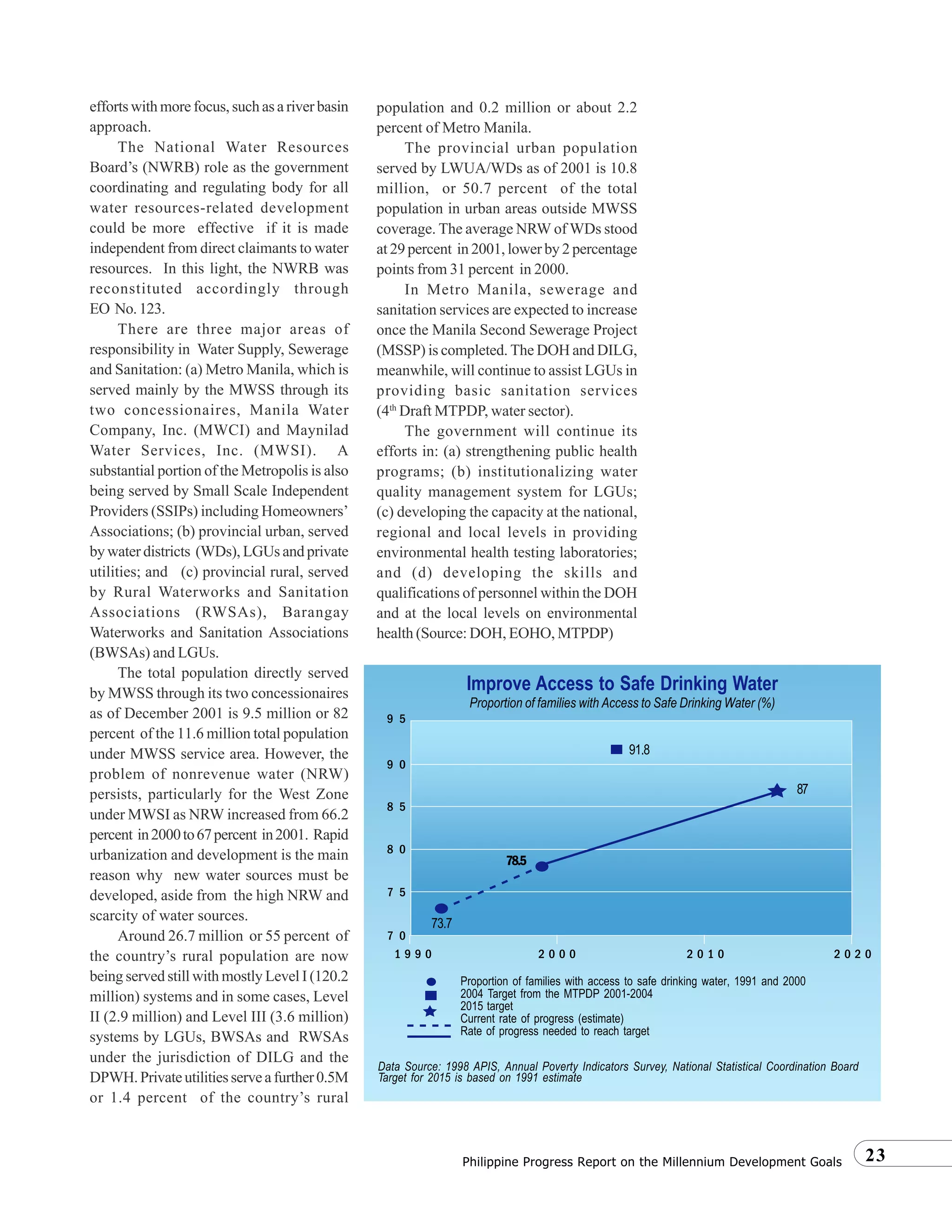
It is likely that the 87 percent access goal
can be met by 2015. The MTPDP target is
actually higher at 91.8 percent.
There has been a modest improvement
in water supply coverage since 1988, when
the government launched the Water
Supply, Sewerage and Sanitation Sector
Master Plan, covering the period up to the
year 2000. In 2000, about 78.5 percent of
Filipino households already had access to
safe drinking water. Although this was an
improvement from 73.7 percent figure of
1991, it was a 0.6 percent point decline from
the 79.1 percent figure of 1999. There was
also a minimal decline (0.4%) from
77.3 percent in 1994 to 76.9 percent in 1997.
However, the progress in the provision of
water supply facilities has been slower in
rural areas than in urban areas.
A baseline study under the Urban
HealthandNutritionProject(UHNP)in1995
showed that majority (72%) of households
among slum dwellers have access to piped
water or tube wells. However, 36 percent
of the water was contaminated at the point
of consumption than it had been at source
(17%). This was due to improper transport,
handling and storage of drinking water.
The National Demographic and Health
Survey conducted in 1998 indicated that
62 percent of households take between
1-15 minutes to draw water from the source
and bring it to the households which
implies a better access to water supply.
PRIORITY POLICIES AND
PROGRAMS
Through the nationwide campaign
under the International Decade of Water
and Sanitation, the government has set up
projects to address the concerns of water
resources agencies. The government will
pursue a water resources management
action plan which recommends a shift from
a purely sector approach to one which
integrates and coordinates all water-related
Target 3: Halve the proportion of people with no access to safe
drinking water or those who cannot afford it by 2015.
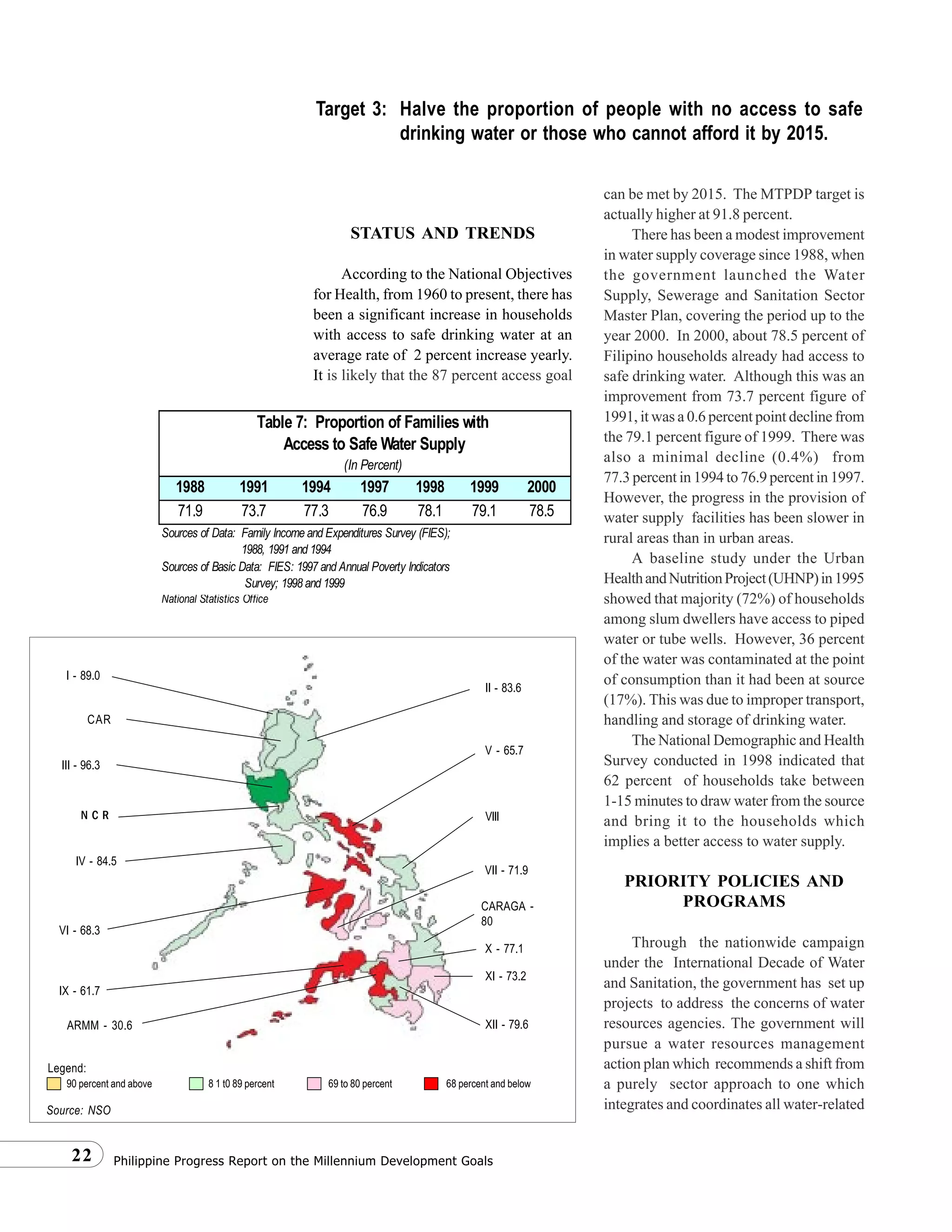
Table 7: Proportion of Families with
Access to Safe Water Supply
(In Percent)
1988 1991 1994 1997 1998 1999 2000
71.9 73.7 77.3 76.9 78.1 79.1 78.5
Survey; 1998 and 1999
National Statistics Office
Sources of Data: Family Income and Expenditures Survey (FIES);
1988, 1991 and 1994
Sources of Basic Data: FIES: 1997 and Annual Poverty Indicators
Source: NSO
90 percent and above 8 1 t0 89 percent 69 to 80 percent 68 percent and below
I - 89.0
CAR
III - 96.3
IV - 84.5
VI - 68.3
IX - 61.7
ARMM - 30.6
II - 83.6
V - 65.7
VIII
VII - 71.9
CARAGA -
80
X - 77.1
XI - 73.2
XII - 79.6
N C R
Legend:
23Philippine Progress Report on the Millennium Development Goals
efforts with more focus, such as a river basin
approach.
The National Water Resources
Board’s (NWRB) role as the government
coordinating and regulating body for all
water resources-related development
could be more effective if it is made
independent from direct claimants to water
resources. In this light, the NWRB was
reconstituted accordingly through
EO No.123.
There are three major areas of
responsibility in Water Supply, Sewerage
and Sanitation: (a) Metro Manila, which is
served mainly by the MWSS through its
two concessionaires, Manila Water
Company, Inc. (MWCI) and Maynilad
Water Services, Inc. (MWSI). A
substantial portion of the Metropolis is also
being served by Small Scale Independent
Providers (SSIPs) including Homeowners’
Associations; (b) provincial urban, served
by water districts (WDs), LGUs and private
utilities; and (c) provincial rural, served
by Rural Waterworks and Sanitation
Associations (RWSAs), Barangay
Waterworks and Sanitation Associations
(BWSAs) and LGUs.
The total population directly served
by MWSS through its two concessionaires
as of December 2001 is 9.5 million or 82
percent of the 11.6 million total population
under MWSS service area. However, the
problem of nonrevenue water (NRW)
persists, particularly for the West Zone
under MWSI as NRW increased from 66.2
percent in2000to67percent in2001. Rapid
urbanization and development is the main
reason why new water sources must be
developed, aside from the high NRW and
scarcity of water sources.
Around 26.7 million or 55 percent of
the country’s rural population are now
being served still with mostly Level I (120.2
million) systems and in some cases, Level
II (2.9 million) and Level III (3.6 million)
systems by LGUs, BWSAs and RWSAs
under the jurisdiction of DILG and the
DPWH.Privateutilitiesserveafurther0.5M
or 1.4 percent of the country’s rural
population and 0.2 million or about 2.2
percent of Metro Manila.
The provincial urban population
served by LWUA/WDs as of 2001 is 10.8
million, or 50.7 percent of the total
population in urban areas outside MWSS
coverage. The average NRW of WDs stood
at 29 percent in 2001, lower by 2 percentage
points from 31 percent in 2000.
In Metro Manila, sewerage and
sanitation services are expected to increase
once the Manila Second Sewerage Project
(MSSP) is completed. The DOH and DILG,
meanwhile, will continue to assist LGUs in
providing basic sanitation services
(4th
Draft MTPDP, water sector).
The government will continue its
efforts in: (a) strengthening public health
programs; (b) institutionalizing water
quality management system for LGUs;
(c) developing the capacity at the national,
regional and local levels in providing
environmental health testing laboratories;
and (d) developing the skills and
qualifications of personnel within the DOH
and at the local levels on environmental
health (Source: DOH, EOHO, MTPDP)
Proportion of families with access to safe drinking water, 1991 and 2000
2004 Target from the MTPDP 2001-2004
2015 target
Current rate of progress (estimate)
Rate of progress needed to reach target
Data Source: 1998 APIS, Annual Poverty Indicators Survey, National Statistical Coordination Board
Target for 2015 is based on 1991 estimate
Improve Access to Safe Drinking Water
1 9 9 0
7 0
2 0 0 0 2 0 1 0
73.7
91.8
87
2 0 2 0
9 5
9 0
8 5
8 0
7 5
78.5
Proportion of families with Access to Safe Drinking Water (%)
Philippine Progress Report on the Millennium Development Goals24
To sustain the gains in access to safe
water supply, the government will: (a) shift
emphasis from Build-Operate-Transfer
(BOT) scheme to concessions and similar
arrangements in terms of privatization of
water supply activities; (b) develop and
provide incentives for contiguous water
districts to blend into single business
entities to attain economy of scale in project
development cost; (c) encourage water
facilities to graduate into different
institutional types based on their level of
viability; and (d) ensure the financial and
technical performance of water utilities to
address the sustainability of water supply.
The government will also pursue the
Water Regulatory Commission Act to
establish a single agency for the rational
and effective economic regulation of all
piped-water supply and sewerage systems
and the Amendment of PD 198 (Provincial
Water Utilities Act of 1973) to increase
capitalization of Local Water Utilities
Associations.
CHALLENGES/PRIORITIES
FOR ACTION
Disparities across regions
There are wide disparities across the
regions. Some regions have already
exceeded their targets but there are areas
that are far behind. For instance, only 29
percent of all households in the
Autonomous Region of Muslim Mindanao
have access to safe drinking water,
compared with the 97 percent of Central
Luzon households which have safe water
facilities. The condition has not improved
significantly in the ARMM since 1994
when only 26 percent of its households
had safe drinking water. Thus, efforts will
be focused on areas that have not come
close to their targets.
Deterioration in quantity and quality
of water resources
Ground water has been the principal
source of municipal water, representing
about 46 percent. However, the recent
increase in ground water use in the country
led to problems like the intrusion of saline
water into aquifers and water pollution.
Low level of investment
Although the government encourages
private capital infusion in development
undertakings, investments from the sector
have not been as substantial as anticipated.
One cause of such apparent
unenthusiastic response from the private
sector, apart from tariffs, is the absence of
a strong and independent regulatory board
that, among others, sets and approves
tariffs as well as allocates finite water
resources among various competing users.
An effective and credible economic
regulatory environment weighs two
conflicting objectives – quality of service
and reasonableness of tariffs. The
regulatory body will also have to provide
incentives to suppliers to improve
efficiency without compromising the
welfare and interests of consumers.
The current practice for cost-recovery
varies for the different services of water
delivered. For urban water supply (Level
III), services are provided on the basis of
recovery of full-costs. In the case of rural
water supply (Levels I and II), cost recovery
through user charges is only for the
operation and maintenance (O&M) of the
systems (4th
Draft MTPDP, water sector).
25Philippine Progress Report on the Millennium Development Goals
GOAL 2
ACHIEVE UNIVERSAL PRIMARY EDUCATION
Target 4: Achieve universal access to primary education by 2015
STATUS AND TRENDS
ith more access to basic education,
the literacy rate has improved. The
89.8 percent simple literacy rate in 1989
rose to 93.9 percent in 1994 or by 4.1
percentage points, without a significant
difference between men and women. The
functional literacy rate of 75.4 percent in
1989 improved to 83.8 percent or by 8.4
percentage points in 1994 with no marked
gender bias.
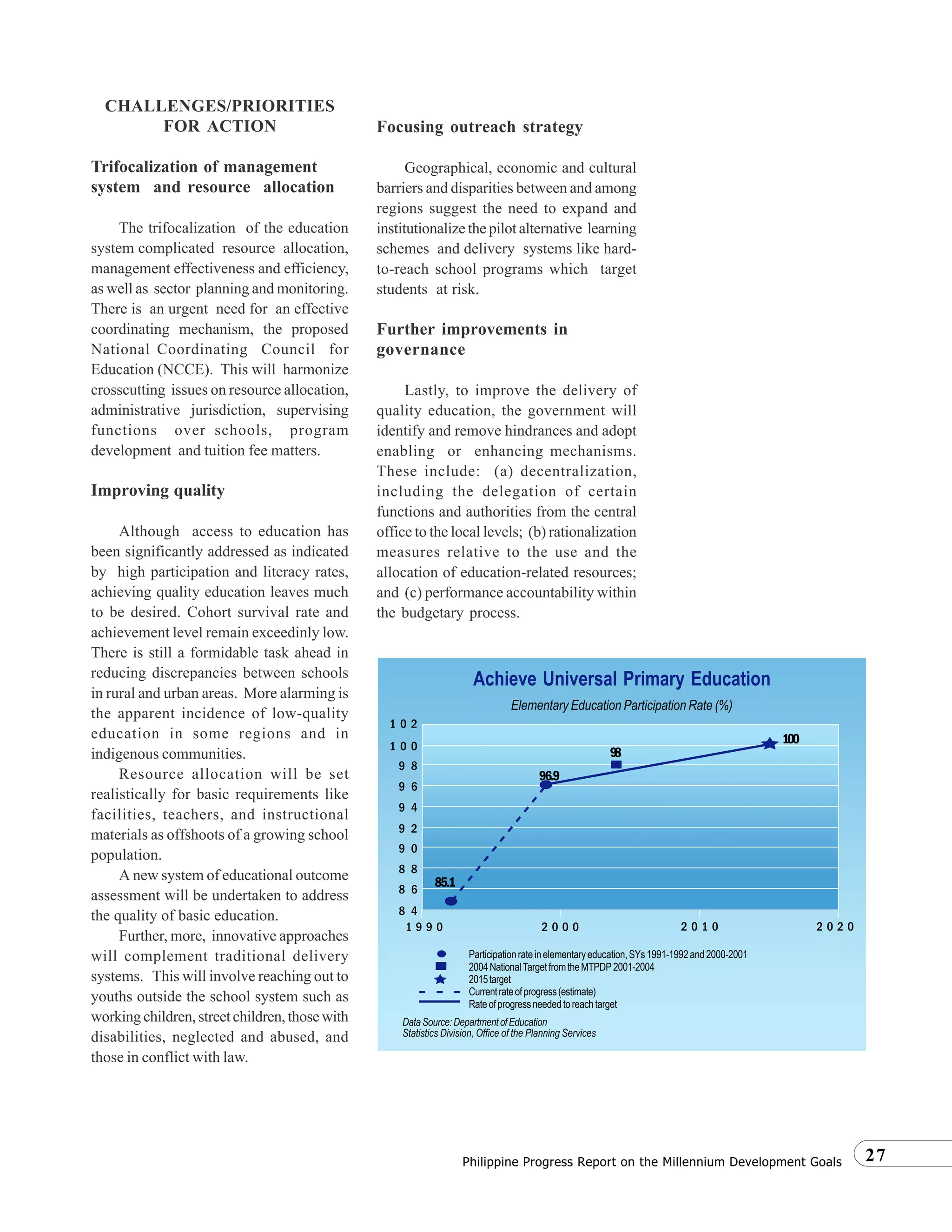
The participation rate in the
elementary education level in both public
and private schools improved from 85.1
percent in 1991 to 96.9 percent in 2000.
However, many of the children who enroll
do not complete the school year as
evidenced by the low cohort survival rate.
The cohort survival rate has declined from
68.4 percent to 67.1 percent over the same
period. Completion rate, however, slightly
increased from 65.5 percent in 1991 to 66.1
percent in 2000.
PRIORITY POLICIES AND
PROGRAMS
The Department of Education (DepEd)
continues to implement policies, programs
and projects to improve the quality of
education and make it accessible to all
Filipinos and more responsive to the
country’s twin goals of global
competitiveness and people
empowerment.
Access to Basic Education
Access to basic education has been
expanded through the twin strategies of
establishing elementary schools in villages
not being served by the system, and
completing “incomplete” schools through
multigradeclasses. Between1995 and2000,
the number of barangays without
elementary schools, was reduced from
5,119 to 4,569 out of 41,940 barangays. It
was further established that of these
remaining barangays, only 1,507 needed
schools. The number of “incomplete”
elementary schools decreased from 11,420
in 1993 to 8, 647 in 2000.
Several policy reforms were initiated
to enhance access to basic education.
Among these were: (a) prioritize
underserved or marginalized groups or
areas; (b) broaden and deepen stakeholder
involvement and participation through
WWWWW
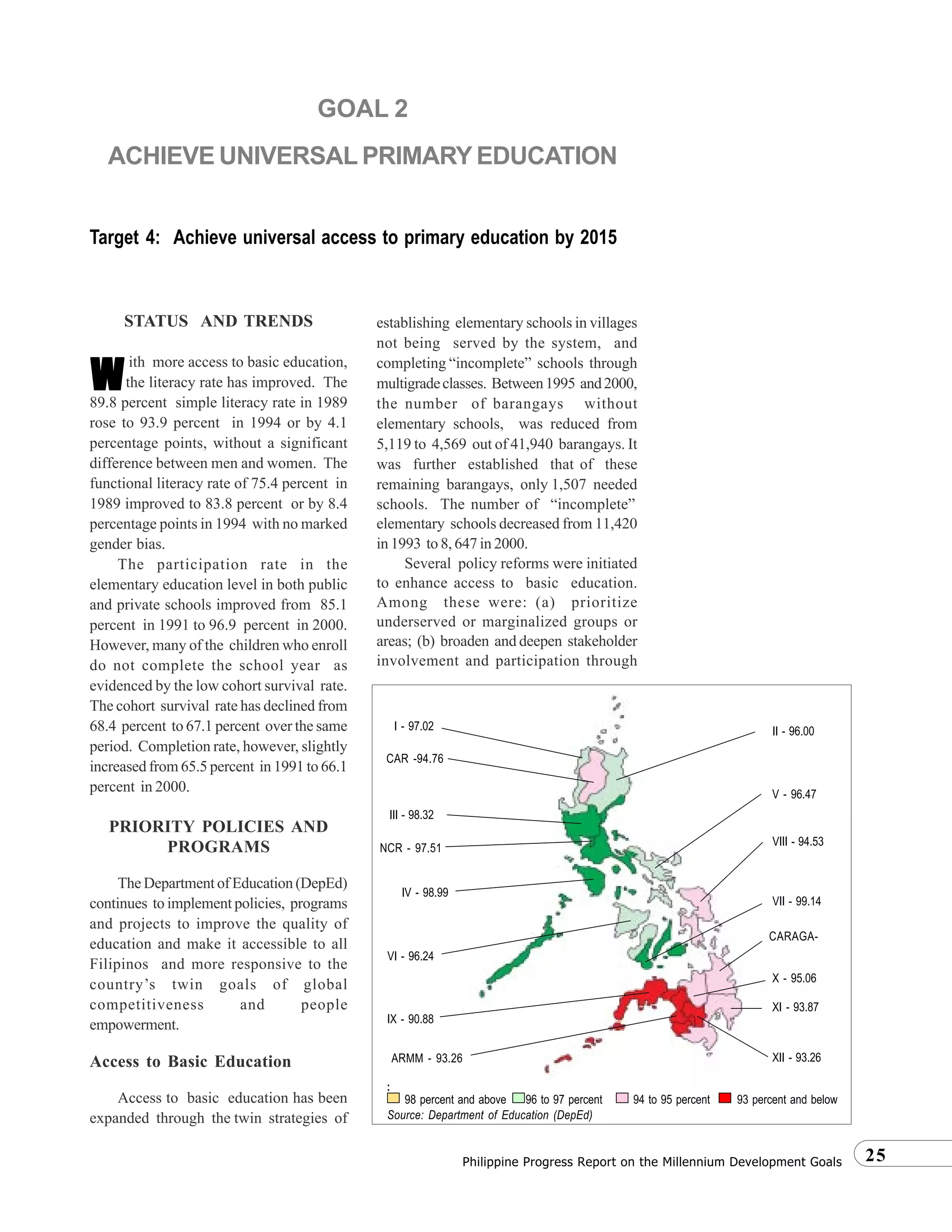
Source: Department of Education (DepEd)
98 percent and above 96 to 97 percent 94 to 95 percent 93 percent and below
I - 97.02
CAR -94.76
III - 98.32
IV - 98.99
VI - 96.24
IX - 90.88
ARMM - 93.26
II - 96.00
V - 96.47
VIII - 94.53
VII - 99.14
CARAGA-
X - 95.06
XI - 93.87
XII - 93.26
NCR - 97.51
:
Philippine Progress Report on the Millennium Development Goals26
school or community-based planning and
adapting effective fund mobilization
schemes; and (c) explore and maximize the
use of educational resources. Partnerships
have also been established among
government agencies, LGUs, NGOs,
business groups, parents and community
organizations.
Various programs were implemented,
including the Dropout Prevention
Program, Multi-Grade Program in
Philippine Education (MPPE), Adopt-a-
School-Program, Projects EASE (Effective
and Affordable Secondary Education),
Distance Learning Educational Program,
Balik-Paaralan for Out-of-School Adults
Program, Government Assistance to
Students and Teachers in Private
Education, Third Elementary Education
Program, Secondary Education
Development and Improvement Project,
and the School Feeding Program. The
NGOs and private institutions also
implemented the Children in Need of
Special Protection (CNSP) program and
gave out scholarship grants to poor but
deserving students.
Literacy levels of the marginalized
sectors are enhanced through the
Philippine Non-Formal Education Project
(PNFEP) with the NGOs as active
partners. The NFE Accreditation and
Equivalency System is a major program
for those 15 years old and above who are
unable to go to school or who have
dropped out from formal school.
The strict implementation of the
Ganzon Law (RA 5546) banning the
collection of compulsory contributions
and presentation of birth certificates for
enrolment resulted in a 5 percent increase
inenrolment inSY2001-2002.
Empowerment of Teachers
Recognizing the vital role of teachers,
several reforms were implemented to
empower them. These include increasing
their take-home pay, providing teacher
training, increase in election per diem, loan
structure, checkless payroll system and
freeing teachers from non-teaching duties
to allow them to concentrate on teaching.
Improved Quality of Education
The DepEd instituted measures to
improve the quality of education by
restructuring the curriculum, installing
computers in public high schools, teacher
training, improving basic education
facilities and testing programs and
providing preschool and early childhood
services.
The new curriculum aims to raise the
quality of the Filipino learners and
empowering them for lifelong learning. It
focuses on the basics of reading, writing,
arithmetic and values. Given this thrust,
functionality will be the touchstone of
quality and achievements. It stresses
integrative and interactive teaching
approaches.
One encouraging development is the
narrowing of the disparity between public
and private schools in terms of
achievement level in the elementary and
secondary level. Higher improvementrates
have been noted in test scores of public
school children compared to their private
school counterparts over the last five
years.
Good Governance
Several measures were set in place to
promote good governance. The DepEd
has formulated new bidding and
procurement procedures for more
transparency, resulting in cheaper
textbooks, school desks and armchairs.
Greater civil society participation in
educational policy formulation was also
encouraged.
27Philippine Progress Report on the Millennium Development Goals
CHALLENGES/PRIORITIES
FOR ACTION
Trifocalization of management
system and resource allocation
The trifocalization of the education
system complicated resource allocation,
management effectiveness and efficiency,
as well as sector planning and monitoring.
There is an urgent need for an effective
coordinating mechanism, the proposed
National Coordinating Council for
Education (NCCE). This will harmonize
crosscutting issues on resource allocation,
administrative jurisdiction, supervising
functions over schools, program
development and tuition fee matters.
Improving quality
Although access to education has
been significantly addressed as indicated
by high participation and literacy rates,
achieving quality education leaves much
to be desired. Cohort survival rate and
achievement level remain exceedinly low.
There is still a formidable task ahead in
reducing discrepancies between schools
in rural and urban areas. More alarming is
the apparent incidence of low-quality
education in some regions and in
indigenous communities.
Resource allocation will be set
realistically for basic requirements like
facilities, teachers, and instructional
materials as offshoots of a growing school
population.
A new system of educational outcome
assessment will be undertaken to address
the quality of basic education.
Further, more, innovative approaches
will complement traditional delivery
systems. This will involve reaching out to
youths outside the school system such as
working children, street children, those with
disabilities, neglected and abused, and
those in conflict with law.
Focusing outreach strategy
Geographical, economic and cultural
barriers and disparities between and among
regions suggest the need to expand and
institutionalize the pilot alternative learning
schemes and delivery systems like hard-
to-reach school programs which target
students at risk.
Further improvements in
governance
Lastly, to improve the delivery of
quality education, the government will
identify and remove hindrances and adopt
enabling or enhancing mechanisms.
These include: (a) decentralization,
including the delegation of certain
functions and authorities from the central
office to the local levels; (b) rationalization
measures relative to the use and the
allocation of education-related resources;
and (c) performance accountability within
the budgetary process.
Participationrateinelementaryeducation,SYs1991-1992and2000-2001
2004NationalTargetfromtheMTPDP2001-2004
2015target
Currentrateofprogress(estimate)
Rateofprogressneededtoreachtarget
DataSource:DepartmentofEducation
Statistics Division, Office of the Planning Services
Achieve Universal Primary Education
1 9 9 0
8 4
2 0 0 0 2 0 1 0 2 0 2 0
1 0 2
1 0 0
Elementary Education Participation Rate (%)
9 8
9 6
9 4
9 2
9 0
8 8
8 6
85.1
98
100
96.9
Philippine Progress Report on the Millennium Development Goals28
GOAL 3
PROMOTE GENDER EQUALITY
Target 5: Eliminate gender disparity in primary and secondary
education, preferably by 2005, and in all levels of education
no later than 2015
STATUS AND TRENDS
ducation is one area in Philippine
society where women and men have
almost equal status. In SY 1999-2000, girls
had higher participation rates both in the
elementary(97.1%)andhighschool(68.3%)
levels than boys (96.8 percent and 62.6
percent, respectively). The enrolment data
for SY 2000-2001 shows that there was
almost an equal number of girls and boys
in the elementary level where the ratio of
girls to boys was around 96:100. This ratio
was higher in the secondary level, with 105
girls to 100 boys.
Literacy rates, for both simple and
functional literacy are higher for women.
While simple literacy rates have increased
for both females and males, the latest
availableestimates(1994)indicateaslightly
higher rate (94%) for women than men
(93.7%). There, is, however, a gross
disparity in the functional literacy rates of
women between urban and rural areas. In
1994, 83.9 percent of urban women were
functionally literate compared to rural
women at 68.8 percent. This could be due
to the lack of educational opportunities, the
lack of access to schools, or the tendency
of some parents to discourage their
daughters from attending school.
Given the opportunity, girls have
higher survival rates in school. The
enrolment data for SY 1999-2000 show that
slightly more boys than girls start school
(51.5% vs. 48.9%) at the elementary level.
However, more girls move on to the next
level as they now slightly outnumber boys
in high school (51.4% vs. 48.6%). In SY
1996-1997, the females have higher cohort
survival rates for both elementary (73.02%)
and high school (78.11%) than the males
(63.41% and 68.84% respectively). With
regard to completion rates, available data
(SY 1999-2000) show better performance of
girls than boys at both elementary (73.27%
vs. 63.99%) and secondary levels (76.36%
vs. 63.59%).
Because they tend to stay longer in
school, women are greater in number than
men pursuing higher education. University
enrolmentisfemale-dominated. InSY1997-
1998, 53.2 percent of students were women.
Women are seen to increasingly invade
traditional male domains. In the case of
men, the reverse is not happening as they
continue to stick with their traditional
choices. Women have managed to
penetrate territories once traditionally
dominatedbymenlikemilitaryschools. The
fields of agriculture, forestry, fishery and
veterinary medicine, once regarded as
masculine enclaves, now admit female
student who constitute 50.2 percent of the
enrollees. Mathematics and computer
science (55.1%) as well as tradecrafts and
EEEEEWomen have
managed to
penetrate
territories once
traditionally
dominated by
men like military
schools.
1996 1999
Elementary 94.33 96.95
Male 95.27 96.80
Female 93.36 97.11
Secondary 63.36 65.44
Male 58.65 62.63
Female 68.22 68.33
Table 8. Participation Rates, by Sex
Source: Office of the Planning Service, DepEd
29Philippine Progress Report on the Millennium Development Goals
industrial courses (52.5%) are gradually
being dominated by women. Women entry
into the maritime profession, however,
remains a challenge.
On employment, the labor force
participation rate (LFPR) of women rose
from47.5percent in1990to52.9percent in
1999. In spite of this, men’s LFPR were still
much higher than women at 81.2 percent in
1990 and 86.3 percent in 1999.
More than half of all employed women
were in the informal sector doing home-
based work, vending and retailing, laundry
work, domestic service, and animal and
vegetable raising, among others. Work in
the informal sector is characterized as
hazardous, unprotected and mostly
unregulated where workers have no access
to protective and promotive services, e.g.,
maternity, health and other benefits.
In governance, women are increasingly
becoming visible as leaders and decision
makers in the various sectors in society.
However, their participation is still not
proportional to their numbers. While the
country has had two women Presidents,
there are only three women out of 24
senators and 33 out of 205 legislators in
the House of Representatives. Although
the bureaucracy is slightly dominated by
women employees, accounting for 53
percent of the total work force, more men
(65.2%) are appointed to the third level
positions of managers and executives. In
the judiciary, there are only two women
members out of the 15 Supreme Court
Justices. There are also more male justices
in the Court of Appeals and the
Sandiganbayan as well as in the regional
and local courts.
The Human Development Report
shows that the country’s gender
development index for 1998 is 0.739, which
places the Philippines in the 77th
position
among 174 countries and under the
category “medium human development”.
However, this is lower than the country’s
HDI at 0.744, which means that the average
achievements in HD have not been
equitably distributed between women and
men.
SUPPORTIVE POLICIES AND
PROGRAMS
One of the recent innovative
approaches to education is a gender-
sensitive approach to instruction.
Following the DepEd’s policy of providing
equal access to education, the elementary
education bureau integrated human rights
and sex education modules into the
curriculum. It evaluated new generation
textbooks for use in the public schools to
Philippine Progress Report on the Millennium Development Goals30
make them more gender-sensitive and
thereby help in improving the self-image,
lives and work opportunities of girls,
particularly in areas where women have
traditionally been under-represented, such
as mathematics, science and technology.
Gender reforms in the educational
system are continuously being pursued
through the revision of textbooks, curricula,
instructional materials and teaching
methods to eliminate gender biases and
stereotyping.
In 1997, the Science and Technology
Scholarship Act (RA 8248) gave women
and men equal opportunities to pursue
careers in science and technology. The
passage of RA 7192 in 1991 also gave
women “equal opportunity for
appointment, admission, training,
graduation, and commissioning in all
military or similar schools of the Armed
Forces of the Philippines and the Philippine
National Police”.
The Commission on Higher Education
(CHED) gave out more scholarships, study
grants and loan programs for
disadvantaged and hard-up students in
college or post-graduate courses,
particularly to women. They outnumbered
males by about two to one: 21,862 females
and 10,659 males, in SY 1997-98. The
following year’s distribution was even
more uneven: 19,426 females and 8,614
males. This could partially be attributed to
low achievement rate and low cohort
survival rate of males, giving rise to more
women finishing basic and secondary
education. Relatively, they are more
qualified to acquire higher levels of learning
than males.
The Bureau of Non-Formal Education
(BNFE) offers Functional Education and
Literacy Programs (FELP). Female
Functional Literacy classes with Maternal
and Child Care as core topics are made
available in all 16 regions.
The government also expanded
alternative nonformal education systems
for indigenous communities such as
Magbasa Kita (Let Us Read) that teaches
women and girls and parents of working
children to read. School-based child-
minding centers were also set up in the
cultural communities so older children,
mostly girls of school age who take care of
younger siblings, can attend classes
despite baby-sitting chores.
The government also instituted in 1996
an affirmative action policy so women can
enroll in industrial courses traditionally
dominated by men. In 1997, the country
launched a technology-based education
and training program for women through
the National Vocational Training and
Development Center for Women, which
adopts a holistic approach to women’s
economic empowerment.
The government has enacted laws and
directives to provide credit, training and
employment opportunities for women such
as RA 782 or the Provision of Assistance
to Women in Micro and Cottage Business
Enterprises; RA 8289 or Promotion and
Development of and Assistance to Small
and Medium Enterprises. The government
also adopted RA 6972 mandating the setting
up of day care centers for every village
nationwide, enabling women to engage in
economic activities, including part-time or
full-time employment outside the home.
In support of gender and development,
the government is behind two resource
mobilization strategies to promote women’s
advancement and gender concerns. These
strategies are the Gender and Development
(GAD) Budget provision in the annual
national government budget (General
Appropriations Act) and RA 7192 (Women
in Development and Nation-Building Act),
which allocates official development
assistance (ODA) to gender-related
programs, projects and activities.
The 1995 GAD Budget policy directs
all government departments, bureaus,
offices and agencies to set aside an amount
of their annual appropriations for projects
designed to address gender issues. The
cost of the gender-related activities should
be at least 5 percent of their total budget.
To implement this, the government issued
31Philippine Progress Report on the Millennium Development Goals
a memorandum outlining guidelines for
integrating gender concerns in agency
plans and budgets. A budget analysis
reveals that the government-wide
allocation stood at Php2.7 billion in 1998
to Php2.8 billion in 2001.
CHALLENGES/PRIORITIES
FOR ACTION
While significant progress has been
made in addressing gender concerns in the
past, there still remain issues and
challenges that need focus, especially in
the light of globalization, decentralization
and devolution of government functions,
and the effects of the financial crises.
Data in education tend to indicate that
gender inequality is not a problem insofar
as women and girls are concerned.
Attention should be given to the growing
phenomenon of boys being disadvantaged
in terms of quality outcome and retention
in the school system.
While females appear to be in step
with their male counterparts in education,
there is still a need to strengthen efforts to
remove the stereotype contents of
textbooks and other instructional materials
being used in the classroom. Serious
attention will also be drawn towards
enhancing the relevance of the school
curriculum, eliminating gender biases.
This effort will be complemented by
strengthening the gender perspective of
teachers and even parents, especially
regarding career counseling.
It is also necessary to overcome
obstacles to education such as multiple
burdens of the girl-child who, unlike her
male counterpart, carries more domestic
responsibilities.
The government will continue to
implement its policies and programs on
employment generation, preservation,
enhancement, and facilitation. This will
be undertaken through: effective
employment facilitation; more responsive
self-employment and livelihood
interventions, particularly for women in the
informal sector, and enhancement of
productivity and competitiveness of both
men and women.
The government will improve
generation of sex-disaggregated data in
order to determine the needs and situation
of women and men, particularly in the
informal sector, a growing sector in the
country.
To enhance women’s leadership roles
and participation in decision making, the
government will promote gender-
responsive management and leadership.
The role of women’s organizations in anti-
corruption program and peace building and
conflict resolution will be strengthened.
Philippine Progress Report on the Millennium Development Goals32
STATUS AND TRENDS
overnment efforts have paid off in
reducing infant and child mortality
rates. Under-five mortality rate among
children was significantly reduced from 80
per 1,000 live births in 1990 to 48 in 1998.
Infant mortality rate was also reduced from
57 in 1990 to 35 in 1998.
The Maternal and Child Health
Survey reported that in 2000, 65 percent
ofallchildrenaged12-23monthswerefully
immunized before turning a year old. This
shows an improvement from the survey
taken in 1997 where only 58 percent had
full immunization. Children in the urban
areas had a higher percentage (68%) than
those in the rural areas (63%).
PRIORITY POLICIES AND
PROGRAMS
The decline in the mortality rates was
the result of programs, services and
initiatives for children such as the
expanded program on immunization (EPI),
improvement in breastfeeding practices,
Vitamin A supplementation every six
months and the improvement of case
managementathomeandinhealthfacilities.
The EPI aims to reduce infant and
child mortality caused by the six
immunizable diseases (tuberculosis,
diphtheria, tetanus, pertussis, poliomyelitis
and measles). Because of its aggressive
campaign to eradicate polio, the country
had been classified polio-free within the
Western-Pacific Region at the Kyoto
Meeting on October 29, 2000. There was,
however, resurgence in 2001. Moreover,
sustaining high EPI coverage has been a
challenge in view of the devolution of health
services. The LGUs experienced problems
of irregular supply of vaccines (as well as
other essential drugs and micronutrients)
due to inadequate funds.
To address the problem of micro-
nutrient malnutrition, the government
embarked on supplementation, nutrition
education and food fortification initiatives.
These initiatives include the issuance of
Administrative Order (AO) No. 3 s. 2000,
or Guidelines on Vitamin A and Iron
Supplementation, by the DOH. It provides
that therapeutical supplementation will be
provided to all cases of Vitamin A
Deficiency. It also provides that preventive
supplementation will be given in three
categories: universal – children (6-9
months); regular routine - pregnant and
lactating women and high -risk children;
and supplemental – during emergencies.
On food fortification, a five-year food
fortification strategic plan was adopted.
The goal is to make Vitamin A, iron and
iodine fortified foods widely available in
order to increase the micronutrient intake
by at least 50 percent of RDA of the
vulnerable groups (preschool children and
women of reproductive age).
Otherinitiativestoimprovechildhealth
and nutrition include the Integrated
Management of Childhood Illness (IMCI)
strategy as well as the Enhanced Child
Growth (ECG) strategy. The IMCI is aimed
at reducing morbidity and deaths due to
common childhood illness. It has been
adopted nationwide and it is in the process
of integration into the medical, nursing and
midwifery curriculum. The ECG, on the
GOAL 4
REDUCE CHILD MORTALITY
Target 6: Reduce children under-five mortality rate by two-thirds by
2015
GGGGGThe decline in
the mortality rates
was the result of
programs, services
and initiatives for
children such as the
expanded program
on immunization
(EPI), improvement
in breastfeeding
practices, Vitamin A
supplementation
every six months
and the
improvement of case
management at
home and in health
facilities.
33Philippine Progress Report on the Millennium Development Goals
other hand, is a community-based
intervention that aims to improve the health
and nutritional status of children through
improved caring and seeking behaviors. It
operates through health and nutrition
posts established throughout the country.
In terms of legislation, the following,
among others, are being implemented:
a) Rooming In and Breastfeeding Act of
1992, which requires both public and
private health institutions to create an
environment where physical and
psychological needs of mothers and
infants are satisfied; (b) Nationwide Salt
Iodization Act of 1995 (RA 8172) that
mandates the iodination of all food-grade
salt for human and animal consumption;
and (c) RA 7846 which requires
compulsory immunization against hepatitis
B for infants and children below eight years
old.
The Health Sector Reform Agenda
(HSRA) was also institutionalized in 2000.
It aims to improve health financing, health
regulation, hospital systems, local health
systems, and public health programs.
CHALLENGES AND
PRIORITIES FOR ACTION
Despite improvements in child health
status, certain issues remain to be
addressed. Infectious diseases affecting
children (and which are vaccine
preventable) persist at high rates. The
impact of these diseases on child survival
depends on several factors namely: low
levels of immunization, age at infection,
inadequate malnutrition and other
complicating diseases inadequate health
care services. Another contributing factor
is crowded living conditions. Large
variations in child health status exist across
population groups, income classes and
geographical areas. This situation is made
even worse by the inadequacies in the
health care delivery system, i.e., absence
or limited access to health care services,
inadequate health care services, health
care financing and health standards and
regulations.
Maintaining gains in full
immunization, vaccination drives
The government’s massive
immunization and vaccination campaign
netted substantial gains which must be
sustained. Maintaining high immunization
coverage is crucial in eradicating the
vaccine-preventable diseases, which
greatly affects child survival. This needs a
supplementary budget from Congress and
fresh financial support from donors since
the funding of EPI vaccines is not provided
for in the newly approved General
Appropriations Act of 2002.
Strengthening public health
programs
Public health programs particularly at
the local level need to be strengthened
and supported. Specifically, management
skills and capabilities have to be upgraded
to ensure effective and efficient
implementation. The gains from
preventive and promotive health services,
maternal and child health and nutrition will
be promoted and sustained to ensure health
from infancy and childhood to adulthood
and old age. A healthy lifestyle and healthy
environment will also be advocated.
Data Source: National Statistics Office & National Statistics Coordination Board
Reduce Under-Five Mortality
Mortality rate (per 1,000 children aged less than 5)
1 9 9 0
7 0
6 0
5 0
3 0
2 0
0
1 9 9 5 2 0 0 0 2 0 0 5 2 0 1 0
48
26.7
2 0 1 5 2 0 2 0
8 0
9 0
4 0
1 0
80
under-fivemortalityrate,1990and1998
2015target
Current rateof progress(estimate)
Rateof progressneededtoreachtarget
Philippine Progress Report on the Millennium Development Goals34
Support for local health systems
development
A strong local health system supported
by well-trained and highly motivated health
workers is necessary to sustain the gains
in child health. It is thus imperative to
develop a functional local health system to
carry out public health programs and
deliver personal health care services.
Capacity building for LGUs and creating
better mechanisms for generating resources
needed to meet the health needs at the
local level will be undertaken. Moreover,
private sector participation will be
strengthened to address backlogs in the
local health delivery system.
Increasing investments for child
health
Further improvements in child health
require increased investments for
appropriate child health interventions at all
levels of the health care delivery system.
New mechanisms for grant funds and cost-
sharing schemes with other stakeholders,
e.g.,LGUs,NGOs,privatesectorgroups will
be looked into. Active social marketing for
more investments in child health
interventions will likewise be undertaken.
A challenge in financing health care
includes facing the problem of delayed
remittances of contributions, hampering the
implementation of health insurance
programs for the poor. Local governments
also continue to face difficulties, especially
in supporting the NHIP.
The benefits and the coverage of the
NHIP will be expanded through the LGUs
and through community participation.
Aggressive enrolment under the NHIP will
be pursued to meet the target of universal
coverage by 2010.
Ensuring quality of health care
The quality of health care remains
wanting in many areas. Some health
facilities have deteriorated and poor
quality services exist. Low quality drugs
and medicines are present in the market.
These have been attributed partly to the
weak enforcement of health regulations.
These concerns will be addressed to ensure
the best of care for the population most
especially the children.
In this regard, a quality improvement
program for all health facilities and services
at all levels of the health care system will
be pursued. Regulatory capabilities,
systems and procedures will be upgraded
and strengthened. The support of all
stakeholders in the initiatives to attain
quality care will also be strengthened and
sustained to keep pace with greater
35Philippine Progress Report on the Millennium Development Goals
Target 7: Reduce maternal mortality rate (MMR) by three-quarters
by 2015 (half by 2000, half by 2015)
GOAL 5
IMPROVE MATERNAL HEALTH
T The life time risk of
dying from maternal
causes from
maternal causes is
about 1 in every 100
Filipino women.
Major causes of
maternal deaths are
postpartum
hemorrhage,
eclampsia and
severe infection.
STATUS AND TRENDS
he 1998 National Demographic and
Health Survey (NDHS) estimates the
country’s MMR at 172 per 100,000 live
births for the period 1991-97. This figure is
lower than the estimated MMR for the
period1987-93whichis209per100,000live
births based on the 1993 National
DemographicSurvey (NDS). However,due
to large sampling errors associated with
these estimates, it is difficult to conclude
that the MMR has declined.
Disparities across provinces also
remain wide. MMR was highest in ARMM
at 320.28, which is almost three times the
rate of NCR which stood at 119.07 in 1995.
Thelifetimeriskofdyingfrommaternal
causes is about 1 in every 100 Filipino
women. Maternal deaths made up less
than 1 percent of the total deaths in the
country in 1988 but contributed about 14
percent of all deaths of women aged 15-49.
The major causes of maternal deaths are
postpartum hemorrhage, eclampsia and
severe infection. High incidence of high-
risk births, inadequate prenatal care and
lack of information and means to manage
complications in difficult pregnancies
account for much of the increased risks of
dying during pregnancy and childbirth.
Modest gains have been achieved on
factors related to risks of maternal mortality.
The 1998 NDHS revealed that while 77
percent of mothers received the minimum
three prenatal check-ups, only 59 percent
received postpartum care. Of women who
received prenatal care, few obtained
complete care. Most women receive only
6-11ofthe12requiredelementsofantenatal
care.Boththe1993NDSandthe1998NDHS
data revealed that urban women were more
likely to receive adequate prenatal care than
women in rural areas. Access to trained
prenatal care providers is much greater
among women with some college education
than among those with lower education.
The 1998 NDHS further showed that 56
percent of deliveries were attended by
skilled health professionals. As to the other
factors, a little over 57 percent received
iodine supplements and 75 percent got iron
supplements. The 2000 Maternal Care and
Health Survey (MCHS) showed that 70.9
percent of women have received tetanus
toxoid injections.
PRIORITY POLICIES AND
PROGRAMS
Women’s health programs like the Safe
Motherhood and Women’s Health Program
employ strategies such as skills upgrading
so that skilled and caring care providers
can attend to as many births as possible.
The other major components of the
program include family health for the urban
poor; sustainable community-based family
planning/maternal care (FP/MC) unit
projects with special focus on women; and
strengthening of maternal and child health
services projects.
Other government efforts include the
conduct of the following: (a) information,
education and communication (IEC)
activities to encourage informed decisions
and promote better health-seeking
behavior; (b) quality assurance schemes
Philippine Progress Report on the Millennium Development Goals36
such as the Sentrong Sigla which sets
certain minimum standards for public
health facilities at various levels;
(c) improving access to maternal care
through the deployment of midwives to
hard-to-reach and underserved areas and
providingprimarylevelhealthfacilitieswith
basic supplies and equipment and essential
drugs; (d) strengthening the institutional
capacities of the Department of Health
(DOH) and forging partnerships with local
government units (LGUs), non-government
organizations (NGOs) and the communities
to increase awareness, promote
participation and mobilize resources for
women’s health and maternal care; and
(e) various programs and projects identified
in the Philippine Plan for Gender
Responsive Development (PPGRD) 1995-
2025 to address issues concerning women’s
welfare.
CHALLENGES AND
PRIORITIES FOR ACTION
Problems on the devolution of health
care services to local governments
continue to thwart efforts in reducing
maternal mortality rate. Many local
governments do not have adequate
institutional preparation to take on the
responsibility for health care (e.g. shortages
of technical manpower for health
operations, lack of equipment, inadequate
health facilities, and inadequate referral
systems among health facilities).
In response, the government, in
partnership with civil society, will pursue
by the end of 2004 to reduce the level of
MMR from 172 deaths per 100,000 live
births in the 1990s to less than 100 deaths
per 100,000 live births and eventually,
achieve the MDG target to reduce the rate
by 75 percent by 2015.
37Philippine Progress Report on the Millennium Development Goals
STATUS AND TRENDS
Family Planning
The percentage of currently married
women aged 15-44 using contraceptives
declined from 50.7 percent in 1995 to 49.5
percent in 2001 based on the Family
Planning Survey (FPS). The 1998 NDHS
placed the total fertility rate (TFR) at 3.7
children per woman, a mere 10 percent
decline from the 1993 TFR of 4.1. This is
higher compared to the TFRs of other Asian
countries like Thailand which has 2,
Vietnam with 2.3, Indonesia with 2.8, and
Malaysia with 3.2 children per woman.
Married couples exceed their “wanted”
fertility by 1 birth and this unintended
fertility is even higher in the rural areas.
In 1993, the unmet need for FP was
26.2 percent. This declined to 19.8 percent
in 1998. The slow decline in unmet need for
FP may be attributed to the strength of
fertility preferences, perceived risk of
conceiving, perceived effects of
contraception on health among both
husbands and wives, husband’s fertility
preferences, and husbands’ and wives’
acceptance of FP. Only around 11 percent
of married women who do not want more
children use contraception.
Adolescent Reproductive Health
(ARH)
The Young Adult Fertility and
Sexuality Survey (YAFSS) II shows that
although 50 percent of young people have
experienced RH problems, only 5 percent
of them seek medical attention. This is due
to: (a) their poor health seeking behavior;
and (b) the unresponsiveness of medical
and FP services among adolescents.
Fertility among adolescent women
declined by about 8 percent in the five years
before the 1998 NDHS. However, the
number of teenagers who have begun
childbearing is increasing, based on this
survey, although it is still below 10 percent
ofallwomen.Teenagechildbearingismuch
higher among rural and low educated
females. It is also crucial to note that out of
some 2.5 million or 18 percent of the youth
(1.8millionboysand670,000girls)whohad
had premarital sex, around 80 percent did
not use any method of protection. Sexually
transmitted diseases (STDs) are most
frequent in the age group 15-24 years.
Prevention of Abortion and
Management of its Complication
It is estimated that the number of
abortions in the Philippines has reached
400,000 cases annually, with teenagers
accounting for 17 percent of these cases.
Based on DOH records, 12 percent of all
maternal deaths in 1994 were due to
complications related to abortion, making
it the fourth leading cause of maternal
deaths in the country. The most vulnerable
women, whether married or unmarried, are
the poor. One of the top three reasons cited
for terminating pregnancies is economic
difficulty.
Violence Against Women (VAW)
According to the 1993 Safe
Motherhood Survey (SMS), 1 out of 10
women experiences physical abuse even
while pregnant. Other common forms of
VAW are rape and acts of lasciviousness.
About 3 percent of SMS respondents said
they were physically forced to have sex
with a man. Of these, more than 60 percent
did not seek help and most were women in
younger age groups.
Target 8: Increase access to reproductive health (RH) services to 60
percent by 2005, 80 percent by 2010, and 100 percent by
2015
Philippine Progress Report on the Millennium Development Goals38
The 1994
International
Conference on
Population and
Development
(ICPD) emphasized
the link between
population and
sustainable
development and
recommended a
comprehensive
approach in
formulating and
implementing
reproductive health
policies and
programs
Men’s Reproductive Health
The leading cause of cancer deaths in
men 20-35 years old is testicular cancer. The
incidence is 35 times higher among men
with undescended testes. The second most
common cancer in men is cancer of the
prostate. Its incidence has been increasing
from 12.5 per 100,000 male population in
1980-82,to19.6per100,000malepopulation
in 1993-95. Other male RH concerns are
sexual dysfunctions such as impotence,
premature ejaculation and erection
dysfunctions.
RH programs for men also deal with
their participation in household
responsibilities and in women’s health
projects. In the review of 177 women’s
health projects in five cities, it was found
that 47 percent of the projects involved men
in the areas of RH, domestic violence and
STD/HIV/AIDS, although male
participation in RH was peripheral. Other
surveys show that men are beginning to
share somewhat household chores such as
caring for sick members of the family,
shopping for food and preparing household
budgets.
Prevention and Treatment of
Infertility and Sexual Disorders
Data on infertility reveals that 10
percent of couples are not able to conceive
after a year of unprotected, adequately
timed intercourse. There has been little or
no service available to infertile couples in
the country probably because only 2
percent of women are considered infecund.
There is no data at all for infertile men and
services for infertility. The latter is provided
only by a few training hospitals in the
country. Infertile couples, particularly in
rural areas, resort to traditional rituals and
use of herbal medicines.
PRIORITY POLICIES AND
PROGRAMS
The Philippines, as signatory to the
Programme of Action of the 1994
International Conference on Population and
Development (ICPD), subscribes to the
broadening of population policies and
programs beyond FP, and to a much closer
collaboration among development agencies
as the primary mechanism to attain the RH
approach objectives. Moreover, the 1995
International Conference on Women in
Beijing stressed women empowerment as
the key to healthy and productive lives,
and hence called for the promotion of the
RH approach.
In response, the Arroyo
Administration pursues a population policy
on responsible parenthood (RP),
highlighting on the health rationale of FP
and the exercise of RH. It emphasizes
shared responsibility between men and
women in deciding the number, spacing,
timing of their children within the context
of gender equity and sensitivity to their
cultural beliefs and traditions.
The above policy is spelled out in the
Commission on Population’s (POPCOM’s)
Philippine Population Management
Program (PPMP) as indicated in the
Directional Plan (DP) for the period
2000-04. The latter gives emphasis to
addressing the high unmet need for FP of
Filipino couples especially the poor and
disadvantaged. Specifically, the PPMP aims
to: (a) help couples and individuals achieve
their desired family size within the context
of RP and sustainable development;
(b) improve the RH of individuals and
contribute to further reduction of infant and
maternal mortality; (c) reduce the
incidences of teenage pregnancy, early
marriage and other RH problems; and
(d) contribute to policies that will assist
government achieve a favorable balance
between population distribution, economic
activities and the environment.
To reduce the incidence of teenage
pregnancy, early marriage and other
39Philippine Progress Report on the Millennium Development Goals
adolescent RH problems, the Adolescent
Health and Youth Development Program
(AHYDP) has been adopted to provide for
appropriate information, knowledge,
education and services on population and
RH for adolescents and the youth. T h e
1999-2004 Philippine Medium Term
National Youth Development Plan
(PMTNYDP) also provided a clear policy
for developing responsible RH behavior
among adolescents through an integrated
and comprehensive package of preventive
and curative health care services for the
youth at all levels of health care.
The DOH also issued administrative
orders (AOs) to provide the policy
framework for RH and FP. One of these is
AO 1-A which created the Philippine RH
Program. It identifies and adopts the 10
essential service elements of RH, namely:
(a) FP; (b) MCH care including nutrition;
(c) prevention of abortion and management
of its complications; (d) prevention and
treatment of reproductive tract infections
(RTIs) including HIV and AIDS;
(e) prevention and appropriate treatment
of infertility and sexual disorders;
(f) prevention and treatment of breast
cancers, cancers of the RH system and
adverse gynecological conditions;
(g) counseling and education on sexuality
and sexual health; (h) adolescent RH; (i)
male RH; and (j) prevention and
management of VAW. To establish a
National FP Policy, AO 50 was issued. It
shifts the focus of the FP Program from a
demographically driven approach to one
which upholds FP as a health intervention.
It prescribes essential policies for FP as an
element of RH, and aims to improve the
health status of Filipinos by helping
couples attain their desired fertility. AO 125
was also issued to adopt the National
Natural FP Strategic Plan for 2002-2006. It
focuses on the policies, standards,
strategies and activities needed to
mainstream NFP methods within the
country’s FP Program.
Another priority program on RH is the
Women’s Health and Development
Program, which aims to ensure women’s
health and development through
participatory strategies that enable women
to have control over their health and their
lives.
CHALLENGES AND
PRIORITIES FOR ACTION
Various challenges remain on the
implementation of the country’s RH
program. First, efforts will be geared
towards addressing the data gaps on RH
as this significantly affects the
responsiveness of policies to the real needs
of the public. Second, the concept of RH as
based on Filipino culture should be
concretized, clearly defining the scope of
universal rights of all men and women to
RH. An environment for more open
discussion about emerging issues such as
abortion and emergency contraception will
also be ensured. Likewise, clear and
sufficient policies and guidelines on the
provision of medical RH services for the
underserved groups such as adolescents,
men and even older persons will be made.
Efforts to mainstream RH will be continued
by putting in place culturally sensitive, high
quality, accessible and user-friendly
services which must respect the rights of
adolescents and youth to privacy and
informed choice.
With the phase-out of contraceptive
support by the United States Agency for
International Development (USAID),
sustainable funding for contraceptive
supplies and related RH/FP programs has
to be secured so that access, especially by
the poor, to quality RH and FP services can
continuously be improved. To do this, the
Philippine Government will turn to the
NGOs, private health service facilities,
businesses, people’s organizations (POs),
and grassroots groups to provide for
contraceptive supplies to married couples
of reproductive age particularly those with
unmet FP needs.
Philippine Progress Report on the Millennium Development Goals40
STATUS AND TRENDS
he first AIDS case in the country was
identified in 1984. Since then until
December 2000, the HIV/AIDS Registry
has recorded 1,441 HIV AB seropositive
cases, 486 of whom had AIDS. It also
recorded 218 deaths.
Majority of the cases belonged to the
20-49 years age group. Most cases were
male. Of the 1,441 HIV cases, 371 or 26
percent are Overseas Filipino Workers
(OCWs). The predominant mode of
transmission is sexual intercourse.
Between 1984 and 1992, the annual
number of confirmed HIV/AIDs cases
reported remained below 100. In the last
seven years (1993-99), however, the
number of cases per year exceeded 100,
but remained below 200. While the number
of cases each year has been increasing,
there seems to be no indication that the
numbers would significantly rise.
Philippine epidemiologists estimate
the actual number of HIV cases at between
a low of 5,000 to a high of 13,000. Even the
high estimate would place the current
nationalHIVprevalencerateat0.02percent
of the total population. There are, however,
some groups whose prevalence rates are
significantly higher than the rest of the
population. These include female sex
workers, men who have sex with men and
intravenous drug users.
Using the available evidence in the
country, international experts call the
Philippines’ HIV/AIDS situation as a
“nascent epidemic”. This is so since the
number of confirmed cases of HIV/AIDS
is low and the rate of increase in the number
of cases is slow. The potentials for a full-
blownepidemic,however,continuetoexist.
Thus, the country cannot be complacent
on this.
SUPPORTIVE POLICIES AND
PROGRAMS
The government has actively
responded to the HIV/AIDS concern since
the first AIDS case was diagnosed in 1984.
Sero surveys were undertaken on a regular
basis and in 1987, the DOH officially
declared the government’s initial official
response to the problem.
Plans and Programs
The first Medium-Term Plan (MTP 1)
on HIV/AIDS for the period 1988-93 was
formulated and adopted. The plan covered
five program components, namely:
surveillance; care and support for HIV-
infected persons; diagnostic and
laboratory facilities; information, education
training; and program management.
For MTP 1, the following major events
are worth noting: (a) creation of the
National AIDS Prevention and Control
Program (NAPCP) in 1988 leading to the
eventual creation of the Philippine National
AIDS Council (PNAC) through EO 39 in
1992;(b)draftingandapprovalof 12 policy
guidelines of HIV Infection/AIDS
Prevention and Control in 1989;
(c)formulationoftheNationalHIVSentinel
Surveillance in 1991; (d) signing of the
bilateral agreement for the AIDS
GOAL 6
COMBAT HIV/AIDS, MALARIA AND OTHER
DISEASES
Target 9: Halt and reverse the spread of HIV/AIDS by 2015
TTTTT
41Philippine Progress Report on the Millennium Development Goals
Surveillance and Education Project (ASEP)
between the government and USAID; and
(e) integration of the Sexually Transmitted
Diseases (STD) Control Program into the
NAPCP in 1993 and the emergence of what
is now called the National AIDS/STD
PreventionandControlProgram(NASPCP).
The NASPCP covers the following:
(a) continuous assessment of the status of
infection in the country to guide
appropriate interventions; (b) information,
education and dissemination of information
for individuals at risk as well as for the
general population on a voluntary and
confidential basis; and (c) strengthening
clinical management. The program aimed
to prevent the spread of STD/AIDS among
women and men, especially those working
in the sex and entertainment industries, and
cushion the psychological impact of the
diseases on the patients, their families and
communities.
While awareness raising was the main
thrust of MTP 1, prevention of
transmission and reduction of HIV/AIDS
were the priority strategies of the second
Medium-Term Plan (MTP II). Some of the
achievements under the MTP II include:
(a) adoption of Republic Act (RA) 8504
or the Philippine AIDS Prevention and
Control Act of 1998; (b) implementation of
Memorandum Order (MO) 495 s.1996
integrating HIV/AIDS education in all
schools nationwide by the DepEd; and
(c) implementation of foreign assisted
projects such as European support for HIV/
AIDS and STD in the Philippines, USAID
ModelCommunityHealth/STDFacilitiesin
Commercial Sex Areas in the Philippines,
and JICA Project for the Prevention and
Control of STD etc.
Meanwhile, the MTP III for the period
2002-04 is currently being implemented.
It calls for the acceleration of the country’s
response to get ahead of the epidemic and
preventtheinfectionfromtakingoffbeyond
its current low level. Program activities are
implemented with the cooperation of the
NGOs, GOs, LGUs, private sectors and the
concerned communities.
Legislations and Policies
RA 8504 is a response to the need for
an institutionalized and comprehensive
multisectoral effort at the highest levels of
government. The law reaffirms the rights
of HIV/AIDS infected individuals. It
mandates measures on education,
information, and adoption of safe practices
and procedures, as well as the conduct of
testing, screening and counseling and
provision of health support services. It
formalizes the creation of the Philippine
National AIDS Council (PNAC) which
serves as the country’s central advisory
policy making and program directing body
on HIV/AIDS matters.
Basic policy guidelines and technical
standards have been issued by the
government on such matters as laboratory
testing for HIV, management of AIDS
patients in hospitals, prevention and control
of sexually-transmitted diseases, quality of
informational and educational materials on
HIV/AIDS, and implementation of safe
blood services, among others. Rules and
regulations to implement RA 8504 have
also been issued. These policies were
disseminated to relevant agencies and
organizations responsible for their
implementation.
Organization and institutional
arrangements
The Philippine National AIDS Council
(PNAC) is the legally established body to
coordinate and direct the nationwide
implementation of the Philippine AIDS
Prevention and Control Act of 1998. It
utilizes various organizational networks and
operational channels for its activities. In
several localities, local AIDS councils have
been established by local legislation partly
in response to the passage of the Act and
partly in response to advocacy by the
PNAC.
A nationwide network of sentinel
surveillance sites operated by DOH with
Philippine Progress Report on the Millennium Development Goals42
LGUs is present in 10 cities. It has been
operating since 1993 and has been
regularly providing the most reliable set of
information on status of the HIV infection
and the level of risks.
The strengthening of the national
network of organizations participating in
the HIV/AIDS effort has been greatly
facilitated by RA 8504.
CHALLENGES AND
PRIORITIES FOR ACTION
Improved capabilities and on-going
activities contribute a lot in the prevention
efforts against HIV/AIDS. While the
country’s response is right in scope, it is
not adequate in terms of coverage and
outputs. This might lead to the country’s
inability to cope if the epidemic continues
to spread. It is thus imperative to scale up
and accelerate the response ahead of the
spread of infection. The challenge is how
to ensure that HIV prevalence does not
exceed 2 percent and does not deteriorate
from its current low level. To meet this
challenge, efforts will focus on the
following:
Sustaining Prevention Activities
Available data suggest that the
number of confirmed cases of HIV/AIDS
is low and the rate of increase in the number
of cases is slow. The country’s early start
with prevention activities may have made
the difference. There is, however, no
assurance that the “low and slow”
situation would be sustained in the future.
Learning from the accomplishments and
shortcomings of past efforts are important
to keep HIV/AIDS under control.
Strengthening Multisectoral
Involvement
Collaborative efforts among
stakeholders are needed to prevent the
spread and reduce the impact of HIV/AIDS.
The country’s approach in addressing this
concern is thus multisectoral. This will be
strengthened and sustained. The private
sector, NGOs, media, religious groups, etc
will also be mobilized to ensure full and
active participation in the planning,
implementation, monitoring and evaluation
of HIV/AIDS prevention and control
activities.
Mobilizing Local Responses
The task of mitigating the impact of
HIV/AIDS cannot be done by the
government alone. LGUs as well as the
communities are in the best position to
develop and implement plans, policies,
programs and projects that would best
respond to the needs of their localities.
They will thus be mobilized to ensure that
appropriate and effective responses are
available and accessible at the local levels.
43Philippine Progress Report on the Millennium Development Goals
STATUS AND TRENDS
Malaria
Malaria is still one of the 10 leading
causes of morbidity in the Philippines
although it is no longer a leading cause of
death. Itremainsamajorpublichealthissue
and is present to some extent in majority
of provinces. A reduction in the morbidity
rate has been observed for the past years.
Specifically, this declined from 123 cases
per 100,000 population in 1990 to 73 cases
per 100,000 population in 1998. The
mortality rate also fell from 1.5 deaths per
100,000 population in 1990 to 0.9 deaths
per 100,000 population in 1995. Deaths are
mainly due to delays in seeking treatment,
misdiagnosis and inappropriate case
management.
Tuberculosis
Tuberculosis is a major health problem
in the Philippines. It is the fifth leading
cause of death and the sixth leading cause
of morbidity in 1995. The mortality rate
from TB has declined in the past 20 years
from 69 deaths per 100,000 population in
1975 to 39 deaths per 100,000 population
in 1995. At this rate, around 75 Filipinos
die everyday from TB. Deaths were higher
among males (66%) and among the
productive age group 15-64 years old
(60%).
The TB morbidity rate shows a
variable trend although it has decreased
from 314 cases per 100,000 poulation in
1975 to 173 cases in 1995. Based on the
1998 population, it is estimated that around
100,000 new TB cases develop yearly. TB
cases are about two times more common
in urban areas than in rural areas. There
are also regional and provincial variations
in the magnitude of TB. As to the
prevalence of multidrug resistance cases,
it has been shown that this is less than 10
percent. The 1997 National Tuberculosis
Prevalence Survey showed that positive
action taking behavior among those with
TB is low, i.e., only 21.4 percent of TB
symptomatics and 28 percent of TB
patients consulted a health provider.
PRIORITY POLICIES AND
PROGRAMS
Malaria
The country’s Malaria Control
Program (MCP) involves several preventive
and control measures. It emphasizes a
large scale vector control coverage with
insecticide treated mosquito nets, residual
house spraying and improved case
detection and treatment. Case detection
or early diagnosis is by chemical or by blood
smear examination.
For treatment, chloroquine is the first
drug of choice, while primaquine is given
to prevent further transmission and relapse.
Control measures vary according to the
intensity of transmission. In general,
residual households spraying and the use
of insecticide treated nets (ITNs) are used
for control where incidence rates exceed 10
cases per 1000 population. Selective
applications of indoor house spraying is
undertaken to control the Anopheles
mosquito which is sensitive to currently
available insecticides.
Recent experiences in Mindanao
suggest that community mobilization with
targeted deployment of ITNs and rapid
diagnostic tests can significantly reduce
the problem. Plans are underway to expand
this approach to other highly endemic areas.
The population protected by ITNs
according to 1998 data is around 600,000.
The MCP is being carried out by the
DOH in partnership with LGUs, NGOs and
communities at risk. This multisectoral
collaboration has been successful in
controlling malaria in some cases.
Target 10: Have halted by 2015, and begun to reverse, the incidence
of malaria and other major diseases
Philippine Progress Report on the Millennium Development Goals44
Tuberculosis
A National Tuberculosis Control
Program has been implemented nationwide
since 1978. It has two major components:
case finding (identifying TB cases using
spectrum microscopy); and case holding
(ensuring that TB cases complete
prescribed treatment). At present, the main
strategy of the program is the Directly
Observed Treatment Short Course (DOTS).
This strategy was piloted in 1996 and later
expanded to 30 areas in 1997 and 1998. The
project areas successfully increased the
quality of case finding and case holding.
The cure rate for TB patients increased from
55 percent to about 80 percent. At the
start of 2001, 77 provinces (99%) and 82
cities (98%) were already implementing the
DOTS strategy.
CHALLENGES AND
PRIORITIES FOR ACTION
Reach vulnerable population
in far-flung areas
Malaria is endemic in areas that are
usually rural, hilly or mountainous. It is
estimated that the population at risk for
malariainendemicareasisaround11million
in year 2000. The high-risk groups are the
indigenous peoples, upland subsistence
farmers, forest workers and settlers in
frontier areas, migrant agriculture workers
and soldiers assigned in endemic areas.
Twenty-two of the country’s 79 provinces
have contributed more than 80 percent of
cases since 1993. These provinces are in
the CAR, Regions 2 and 4 in Luzon and the
ARMM, CARAGA, Regions 9, 10, and 11
in Mindanao.
Considering that most cases and
deaths occur in endemic and far flung
areas, these will be given priority attention.
Strengthening local capacities
The decentralization of health services
points to the need for capacity building in
carrying out public health programs such
as malaria and TB prevention and control.
Frontline health workers have to be
adequately trained to effectively carry out
program activities. For instance, in TB
prevention and control, health workers have
to be familiar with the DOTS as this is the
main strategy for the program. Their skills
in program supervision and monitoring
should also be enhanced. They should
also be prepared and be more active in
mobilizing and sustaining community
participation. Support for the health
workers should also ensure that the
necessary drugs and supplies are available.
Coordination/Partnership
with non-government service
providers
The government is not the sole
provider of TB care and services. These
are also offered by the private sector
(through private hospitals, practitioners,
pharmacists) and NGOs, etc. These groups
may have varying diagnoses, treatments,
protocol or guidelines, and may even
misdiagnose some cases or may even
dispense anti-TB drugs sans prescriptions.
This situation could undermine
government efforts to prevent and control
the spread of the disease and may also
lead to multidrug resistant strains of TB.
A stronger coordination and
partnership among the various service
providers initiated by the DOH is thus
necesssary. A stronger advocacy for the
adoption of DOTS in the private sector will
also be pursued. DOH will likewise ensure
strict compliance with the law prohibiting
dispensing of anti-TB drugs without
prescription.
Funding requirements
While infectious diseases persist at
high rates, these can be substantially
reduced if prevention and control efforts
are sustained. Available program resources
are, however, inadequate. Thus, alternative
forms of financing program activities must
be adopted.
45Philippine Progress Report on the Millennium Development Goals
STATUS AND TRENDS
he country’s natural resource base
continues to be under threat. Total
forest cover has decreased from 6.2 million
hectares in 1990 to 5.4 million hectares in
1997, consequently reducing its percentage
share to total land area from 20.5 percent
to 18 percent during the same period. The
country’s forests need attention due to
systemic degradation attributed mainly to
fire, logging, kaingin, pests, diseases,
mining activities and population
encroachment in critical areas.
Soil degradation and erosion are
worsened with the increased cultivation of
upland areas and massive conversion of
forestlands and grasslands into urban use.
These have largely contributed to siltation
of rivers and irrigation dams. Down the
line, siltation also affects the coastal and
marine ecosystems. To date, only 4.3
percent of corals remain in excellent
condition while the rest have been partially
or completely damaged. Mangrove forest
cover has decreased from 139,000 hectares
in 1988 to 115,000 hectares in 1996.
An alarming rate of biodiversity loss
has also been reported. Despite being one
of the 17 mega-diversified countries in the
world with its high concentration of
endemicplantsand wildlife, the Philippines
has been identified by the Conservation
International as one of the “eight hottest
spots in the world” where exceptional
concentrations of endemic species are
undergoing continuous loss of habitat. The
percentage of priority and threatened
species increased tremendously by 97
percent and 180 percent, respectively.
As of 2000, protected areas cover a
total area of 4 million hectares of which
2.7 million hectares are under the National
Integrated Protected Areas System
(NIPAS). The remaining areas cover the
new or additional sites.
Increasing carbon dioxide (CO2)
emissions particularly from fossil fuels has
likewise been observed. In 1998, the
national CO2 emissions from fossil fuel
burning, cement manufacture and gas
flaring in the country was estimated to be
21 million metric tons (MT) of carbon. Per
capita emission is at 0.28 MT and is
expected to increase due to the country’s
high dependency on fossil fuels. However,
the passage of the Clean Air Act of 1999
and the implementation of different
programs on improving air quality is
expected to help reverse this trend.
While economic growth is still within
the carrying capacity of the environment,
its sustainability is under threat.
According to the MTPDP, the country
posted gains in arresting resource
depletion but at the cost of slowing down
economic activities. Based on the
Philippine Economic-Environment and
Natural Resource Accounting (PEENRA)
System’s estimates, the growth rate of
Goal 7
Ensure Environmental Sustainability
Target 11: Implement national strategies for sustainable development
by 2005, to reverse loss of environmental resources by
2015
T
Percent to
Total Land Area
1990 6,158,800 20.53
1995 5,686,055 18.95
2000 5,391,717 17.97
Source: Economic Division, DENR
Table 9. Total Forest Cover (hectares)
Year Forest Cover
Despite being one of
the 17 mega-
diversified countries
in the world with its
high concentration of
endemic plants and
wildlife, the
Philippines has been
identified by the
Conservation
International as one
of the “eight hottest
spots in the world”
where exceptional
concentration of
endemic species are
undergoing
continuous loss of
habitat.
Philippine Progress Report on the Millennium Development Goals46
environmentally-adjusted net domestic
products (NDPs) has been higher than that
of the unadjusted NDP. This means that
gains made in arresting the depletion and
degradation of natural resources were
attained at the cost of a negative growth
on the fishery, mining and forestry sectors’
real output or gross value added (GVA).
PRIORITY POLICIES AND
PROGRAMS
The government created the Philippine
Council for Sustainable Development
(PCSD) in order to respond to global
sustainable development initiatives. It set
into motion the Philippine Agenda 21 in
compliance withitscommitmentsunder the
Rio Declaration. In accordance with the
Convention on Wetlands of International
Importance, the Philippine government
also formulated the Wetland Action Plan.
The Philippine Agenda 21 (PA 21) is
part of the country’s response to fulfill its
commitments in the historic Earth Summit
in 1992 where government and key sectors
of the society agreed to implement an
action agenda for sustainable
development. The impact and extent of
implementation of the PA 21 have been
assessed through the reports of key
informants from the concerned
Departments and institutions in the
government sector. From 1997 to 2001,
the extent of the implementation of its
agenda is as follows:
Action Agenda 1. Across Ecosystem 49%
ActionAgenda2.Forest/UplandEcosystem77%
Action Agenda 3. Lowland/Agriculture 65%
Ecosystem
Action Agenda 4. Urban Ecosystems 30%
Action Agenda 5. Coastal/Marine 53%
Ecosystem
Action Agenda 6. Freshwater Ecosystem 50%
Action Agenda 7. Minerals/Mines 97%
Ecosystems
Action Agenda 8. Biodiversity Ecosystem 90%
Factors that hinder the effective
implementation of PA 21 were limited
resources, inadequate capacities, policy
gaps, unclear and overlapping roles among
national government agencies and changes
in leadership both at national and local
levels.
The Agenda’s major impacts include
growing sustainable development
consciousness and the popular acceptance
of consensus building as a critical part of
47Philippine Progress Report on the Millennium Development Goals
decision making. The constituency of
sustainable development advocates must
be broadened among sectors and levels
of governance. There is also a need to
anchor activities along specific
institutional and agency mandates.
Consistent with the sustainable
development framework espoused in the
PA 21, the MTPDP embodies the priority
policies and strategies for the environment
and natural resource sector. The sector is
classified into: forest/upland ecosystem,
lowland/agriculture ecosystem, coastal/
marine ecosystem, biodiversity ecosystem,
minerals/mines ecosystem, urban
ecosystem.
For the forest/upland ecosystem, the
watershed approach is the primary
strategy adopted for forest management.
This ensures the sustainable use of the
forest as resource base of forest product
and as habitat for wildlife and source of
water, among others. To further protect
the country’s forest, the total log ban
policy covering old growth or virgin
forests and all other protection forests and
all other protection forests has been
continued.
Multistakeholder partnership is critical
to the conservation and protection of the
natural resources. Programs have thus
been pursued in partnership with NGOs
and LGUs. Investment in production
reforestation, private sector participation
and co-production sharing agreements,
were also encouraged.
Cloning technology was utilized and
clonal nurseries were established
nationwide where genetically improved
premium species were produced on a
massive scale.
To rehabilitate the watersheds,
structural adjustments and the restoration
of the vegetative cover were undertaken.
For the medium term, 108 priority
watersheds were identified nationwide
for rehabilitation and agricultural
development activities.
The community based forest
management program (CBFMP) was
implemented for areas not covered by
industrial forest plantations. With the
CBFMP,participationoflocalcommunities,
indigenous peoples and other stakeholders
are strengthened in the protection,
management, development and
conservation of forestlands and resources.
The CBFMP is expected to transform
upland dwellers into self-reliant
communities. It isnowbeingimplemented
in 4,950 sites covering 5.7 million hectares
and benefiting 496,160 households.
For the lowland/agriculture
ecosystem, government adopted the
National Framework for Physical Planning
(NFPP). This provides the framework for
the allocation, utilization, development
and management of the country’s natural
and physical resources. In particular, it
addresses the concern on environmental
degradation due to conflicts in land uses.
For the biodiversity ecosystem, the
National Integrated Protected Areas
System (NIPAS) was implemented to
preserve biologically diverse habitats. In
line with this, the government established
the Apo Reef Natural Park, Mt. Apo
Natural Park, Siargao Island Protected
Philippine Progress Report on the Millennium Development Goals48
Landscape and Seascape, Mt. Kitanglad
Range Natural Park, Agusan Marsh
Wildlife Sanctuary, and the Sarangani Bay
Protected Seascape. The government also
adopted the Mt.Makiling Reserve Area
and Laguna de Bay Region Master Plan,
which shall serve as the development
framework for those areas.
For the coastal/marine ecosystem, a
Presidential Task Force on Water Resource
Management was created through EO 374
to oversee and coordinate the policies
and programs of agencies involved in
water resource management.
For the mineral/mines ecosystem,
the government enacted RA 7942 (An Act
Instituting a New System of Mineral
Resource Exploration, Development,
Utilization and Conservation). It also
developed the National Mineral Policy to
address the environmental, economic,
health and social impacts and benefits of
mining and promote transparency and
accountability for sustainable mining and
minerals development. Moreover, a Mine
Rehabilitation Fund under the Mining Act
was established to foster sustainable
mining practices.
For the urban ecosystem, the
government passed the RA 8749 or
Philippine Clean Air Act (PCCA) of 1999.
This seeks to promote a healthy ecology
by internalizing the cost of pollution using
market-based instruments (MBIs). This
entails a participatory approach to air
quality planning and monitoring through
public information and education.
To address the growing problem on
garbage, the Ecological Solid Waste
Management Act (RA 9003) was passed.
The following are being instituted as a
result: (a) mechanisms for waste
minimization; (b)appropriatecollectionand
transport services; (c) adoption of
environmentally-sound technologies for
treatment and disposal of garbage; and
(d) the implementation of the provision
on the establishment of materials recovery
facilities nationwide.
For toxic/hazardous waste
management, the importation and use of
ozone depleting substances (ODS) was
reduced and efforts were undertaken to
eliminate the production, trade and use of
other toxic chemicals (e.g., DDT,
chlordane).
CHALLENGES AND
PRIORITIES FOR ACTION
The DENR under the present
administration has set its priorities in
attaining environmental stability. These
include sustainable management and
protection of forests; conservation of
biodiversity; cleaning the air; saving
inland, coastal and marine resources;
solving the garbage crisis; urban
greening; and development of sustainable
energy sources.
The following are areas for action:
1) Promote environmental sustainability
by integrating environmental concerns
in planning and decision-making at all
levels of the bureaucracy; and by
strengthening the monitoring and
enforcement of compliance to
environmental laws, rules and
regulations at the national and local
levels;
2) Promoting broader participation of
stakeholders in natural resources
management;
3) Ensuring equitable access to
productive resources and services;
and
4) Encouraging value-added and
technology-based forestry and
natural resources production.
Environmental pressure is expected
to be significantly reduced to help ensure
sustainability of Philippine ecology.
49Philippine Progress Report on the Millennium Development Goals
STATUS AND TRENDS
Slumdwellersliveinheavilypopulated
urban areas which are deteriorated,
hazardous, unsanitary or lacking in
standard conveniences. They are
concentrated in being self-employed in
highly marginal occupations (e.g., service
workers, manual workers, hawkers,
vendors). Services for slum dwellers vary
and may include basic education, health
services, vocational/skills training. Most
informal settlers, or those occupying private
or public spaces without the consent of
the owner, are slum dwellers.
In October 2000, about 1.3 million
informal settler families were identified in
key urban centers, with 57 percent in Metro
Manila. These settlers occupy spaces as
follows: government-owned lands
– 34 percent; private lands – 24 percent;
danger areas – 21 percent; national
government infrastructure – 20 percent;
local government infrastructure
– 1 percent. Given an average family size of
6, there were 7.5 million informal settlers in
October 2000.
Lands occupied by slum dwellers are
blighted areas, i. e., areas of declining
property values caused by the
deterioration and obsolescence of housing
facilities.Theirpoorlivingconditionsmirror
the condition of urban areas where
facilities for healthful living are wanting.
About 60 percent of Metro Manila
households have direct service water
connections, while only 47 percent in other
urban areas have direct connections and
access to public faucets. Only 20 percent
of the Metro Manila population has direct
connections to a centralized sewer
treatment facility. About 1,000 tons of solid
waste in Metro Manila are uncollected
everyday. Flood control and drainage
facilities likewise need to be improved
considering the damage caused by floods
and typhoons.
PRIORITY POLICIES AND
PROGRAMS
The National Shelter Program (NSP)
2001– 2004 will extend assistance for the
poor 880,000 households, about 61 percent
of whom are informal settlers. The
assistance will include resettlement, slum
upgrading, sites and services development,
core housing, and proclamation of
government-owned lands for housing the
poor.
The NSP, which is in consonance with
the 1987 Philippine Constitution,
implements policies for the welfare of slum
dwellers. The more recent ones include,
among others, the Urban Development and
Housing Act (UDHA), the Comprehensive
and Integrated Shelter Financing Act
(CISFA) and the National Urban
Development and Housing Framework
(NUDHF).
The UDHA provides for a
comprehensive and continuing urban
development and housing program, with
the cooperation of the private sector. It
seeks to uplift the conditions of the
underprivileged and homeless in urban
areas and in resettlement areas by making
available to them decent housing at
affordable cost, basic services, and
employment opportunities. On October 1,
2002, EO 131 was issued, declaring open
for socialized housing purposes
government-owned lands which have been
unused for the past 10 years upon the
effectivity of UDHA.
To comply with the UDHA
requirement that a National Urban
Development and Housing Framework be
prepared every five years along with the
Target 12: By 2020, to have achieved a significant improvement in the
lives of at least 100 million slum dwellers
Philippine Progress Report on the Millennium Development Goals50
MTPDP the NUDHF 1999-2004 was
formulated by the Housing and Urban
Development Coordinating Council
(HUDCC). The Framework primarily aims
to rationalize, manage, and harness
urbanization toward economic growth and
spatial integration. It also intends to utilize
cities and urban units to deliver shelter and
basic services, particularly to the poor
including the informal settlers.
The CISFA endeavors to increase and
regularize the yearly appropriation for the
major components of the NSP. This will
ensure continuous funding support for the
government’s programs for urban and rural
housing, resettlement, sites and services,
development, and the renewal of blighted
areas.
CHALLENGES AND
PRIORITIES FOR ACTION
Addressing the needs of the slum
dwellers involve the provision not only of
shelterbutauxiliaryfacilitiesandlivelihood.
The government will work with business
and civil society to meet the needs of the
urban poor and the informal sector. The
organization of the slum dwellers will
facilitate the process toward their full
integration as partners in development.
51Philippine Progress Report on the Millennium Development Goals
STATUS AND TRENDS
he continuing unilateral trade reforms
appear to have removed much of the
distortions of past protectionist policies.
It has started to gear up the economy
towards becoming more outward-oriented,
open, and globally competitive just in time
for the changes created by the World Trade
Organization (WTO). The WTO, with
strengthened rules and discipline, brought
about greater transparency and restored
order in global trading.
Since substantial unilateral trade
reforms were undertaken starting 1981, the
Philippines made limited offers in terms of
market opening under the Uruguay Round
of multilateral trade negotiations. The
country bound itself not to raise tariffs on
imports of some 3,544 items beyond a level
that is 10 percentage points higher than the
1995 rate. In terms of tariff reduction, only
66 tariff lines were committed.
The Philippines continued to review
tariffs periodically to attain the following:
(a) further rationalize the tariff structure to
remove tariff distortions; (b) promote
resource allocation by allowing easier
access to raw materials, equipment and new
technology; (c) simplify the tariff structure
for ease of customs administration and
minimize opportunities for smuggling and
graft and corruption; (d) provide time-
bound protection to existing local
industries that may be affected by the
removal of quantitative restrictions; and (e)
promote a level playing field by allowing
more competition.
The tariff reforms also aim to achieve a
more uniform level of protection across
sectors by 2004. The tariff liberalization for
some items, e.g., iron and steel,
petrochemicals, garments and textiles, and
motor vehicles, however, were slowed
down from 1998-2001 due to the Asian
financial crisis. To help local industries
reduce production costs, tariffs on about
1,000 items were reduced to 1 percent in
the first semester of 2002. The Agriculture
and Fisheries Modernization Act (AFMA)
likewise provided for zero duty on certain
agricultural inputs and machinery.
To complement trade reforms in order
to further sharpen competitiveness,
liberalization measures in areas such as
investments, finance, foreign exchange and
retail trade were put in place. Structural
reforms such as privatization and
deregulation efforts also implemented.
PRIORITY POLICIES AND
PROGRAMS
Faced with the challenges of
globalization and openness, the
government will undertake the following
efforts to enhance the competitiveness of
industry and services sectors: (a) provide
GOAL 8
DEVELOP A GLOBAL PARTNERSHIP FOR
DEVELOPMENT
Target 13: Develop further an open, rule-based, predictable, non-
discriminatory trading and financial system; include a
commitment to good governance, development and
poverty reduction – both nationally and internationally
Sector 1990 1995 2000
Agriculture 34.6 28 14.4
Mining 14.1 7.3 3.2
Manufacturing 27.1 14.0 7.0
Overall 27.8 15.9 8.0
Table 10: Average Nominal Tariffs by Sector (%)
Source: Tariff Commission
TTTTT
Philippine Progress Report on the Millennium Development Goals52
clear and simplified rules and regulations;
(b) encourage investments in science and
technology and research and development
(R&D); (c) continue infrastructure
development and industrial peace; and
(d) enhance stable macroeconomic
policies. Opportunities and benefits of
globalization will be balanced with stronger
regulatory capability, more transparency
and effective implementation of safety nets.
Liberalization and regulatory reform
policies will be sustained to facilitate the
flow of trade and investments. Capacity-
building mechanisms will be undertaken,
with special focus on small and medium
enterprises (SMEs), for industry and
services to compete in a highly competitive
global economy.
The Philippines will expand its
horizons through market and investment
opportunities offered by participation in
bilateral, regional, and multilateral trading
arrangements. Likewise,itwillforgegreater
partnerships and cooperation among
business, scientific and technological, and
public sectors to harness new technology.
With the growing financial integration,
the Philippine government will continue to
undertake fiscal, financial, monetary and
exchange rate policies to reduce
vulnerability of the economy against
volatile capital flows and exchange rates.
The country’s monetary policy will be
aimed towards price stability and efficient
financial intermediation amid a flexible
exchange-rate system.
To strengthen the banking system, the
country is committed to a regulatory
framework aligned with international
norms. Bank consolidation will be
encouraged in line with prudential banking
standards. Legislative measures will
likewise be pursued to eliminate money
laundering and rationalize taxation of
financial intermediation.
To win the battle against poverty and
achieve sustained growth and
development, the government is fully
committed to good governance. Through
collaborative efforts with the business
organizations and civil society, governance
shall be aimed at: (a) improving moral
standards in government and in society;
(b) implementing a philosophy of
transparency; and (c) strengthening the
ethic of effective implementation in the
bureaucracy.
CHALLENGES/PRIORITIES
FOR ACTION
The growing integration of the
Philippines in the arena of world trade still
poses both benefits and perils to the
country. The global economy offers a
bigger market for Philippine exports. On
the other hand, globalization presents a
challenge for local producers to compete
with their foreign counterparts in a regime
of low tariffs. In addition, the integration
of the Philippines in world capital markets
also creates greater volatility in the foreign
exchange market even as the Philippines
benefits from equity foreign capital flows.
Large and sudden shifts in capital
flows, whether caused by speculation,
contagion or changes in the underlying
macroeconomic fundamentals, require the
continuous pursuit of fiscal, financial,
monetary and exchange rate policies. These
policies will seek to increase the resiliency
or reduce the vulnerability of the economy
against volatile capital flows.
While the country reduced its reliance
on international trade taxes as a source of
government revenues, the failure to boost
other sources of revenue has compromised
trade reforms. The reduced collection of
international trade taxes has, at times, been
constrained by the weakness of domestic
taxmobilization.
The government also incurred
foregone revenues from fiscal incentives
extended to attract foreign investments.
The incentive system is now being
reviewed to correct market failures and
distortions and promote industries with
comparative advantage.
Finally, it is critical that the benefits
fromglobalizationbebalancedwithstronger
regulatory capability, more transparency
and effective implementation of safety nets.
53Philippine Progress Report on the Millennium Development Goals
STATUS AND TRENDS
As of 2000, the outstanding debt of
the National Government stood at
Php 2,648.8 billion. During the years of
fiscal surplus from 1994 to 1996, total debt
declined (1994) or grew at a much slower
rate (1995 and 1996). With large fiscal
deficits since the 1997 Asian financial
crisis, the debt burden has increased
significantly.
Debt servicing has consequently
taken up a significant portion of the national
budget. In 2000, debt service for interest
payments was 20.6 percent of the total
proposed obligation budget of Php682.5
billion.
Meanwhile, the country’s total foreign
exchangeliabilitiesincreasedfromUS$28.5
billionin1990toUS$53.6billionasofthird
quarter in 2002. However, debt service
remains manageable. The debt service as a
proportion of total exports remains well
below 20 percent. Most of the foreign debt
is also medium- and long term.
Regarding the assistance of the
international community to national efforts
to reduce poverty, the international donor
community has provided 12 percent of
total ODA commitments to social services
from 1992 to 2000. This translates to about
US$2billionoutofatotalofUS$16.7billion
ODA commitments during the nine-year
period.
PRIORITY POLICIES AND
PROGRAMS
As part of its objective of ensuring
macroeconomic stability, the government
remains committed to keeping the country’s
foreign debt and the national government
debt within prudent limits relative to the
size of the economy and its ability to
generate the resources to pay for its debt.
Target 14: Deal comprehensively with the debt problems of developing
countries through national and international measures in
order to make debts sustainable in the long term
Year 1990 1995 1996 1997 1998 1999 2000
Foreign Exchange
Liabilities
(in Billion Dollars)
Table 13. External debt indicators
1/ Based on the revised methodology from 1990 to 1998. Starting January 2000 the comparative
monthly data were based on the concept under the Balance of Payments Manual, 5th edition.
18.6 15 11 11.4Ratio ofST debtto total
debt
15.3 14 17.2
52.1
Ratio ofDebtService
Burden to Exports of
27.2 14.4 12.7 11.6 11.7 14.1 12.5
28.5 52.237.8 41.9 45.4 47.8
Table 11. ODA Commitments Going
to Social Services
US$million % To Total
Social Services 2,000.35 12.0
Grants 1,282.98 8.9
Loans 717.37 32.1
Total ODA Cumulative 16,663.21 100
Source: NEDA-Public Investment Staff
1992-2000
Sector
Year
Fiscal
Balance Domestic Foreign1 Total Debt
Total Debt/
GDP(%)
1991 -26.4 342.5 425.9 768.5 61.6
1992 -16.0 502.9 473.4 976.4 72.2
1993 -21.9 682.1 586.6 1,268.70 86.0
1994 16.3 670.6 556.9 1,227.50 72.5
1995 11.1 724.6 600.9 1,325.50 69.5
1996 6.2 748.3 583.6 1,331.80 60.6
1997 1.6 757.2 866.7 1,624.00 66.9
1998 -50.0 859.6 940.8 1,800.40 67.6
1999 -111.6 986.7 1,155.50 2,142.20 72.0
2000 -134.2 1,080.60 1,568.20 2,648.80 80.1
Source: Bureau of Treasury
Table 12. Outstanding Debt of the National Government
of the Philippines
(in billion pesos)
To ensure this, the government is
implementing a fiscal program to achieve
fiscalbalanceoverthemediumtermthrough
a combination of tax and expenditure
reforms. Tax measures include:
(a) enhancing efficiency in the collection
Philippine Progress Report on the Millennium Development Goals54
of taxes through audits and industry
benchmarking, beginning with the value-
added tax (VAT); (b) prescribing ceilings
on business deduction; (c) indexation of
excise taxes of tobacco and liquor to
inflation; (d)rationalizationofmotorvehicle
taxes; (e) organizational reforms in the
revenue collection agencies to reduce tax
leakages and corruption; and
(f) rationalization of fiscal incentives.
The government will also continue to
put in place reforms to achieving greater
efficiency and effectiveness in its spending.
A major area of reform is in government
procurement. The passage of RA 9184 or
Government Procurement Reform Act
paves the way for greater transparency and
competition, thereby reducing cost of
procurement. The government is also using
a medium-term fiscal framework to force
agencies to look at three-year, rather than
one-year budgetary implications of
proposed projects. The government has
also began conducting Sectoral
Effectiveness and Efficiency Reviews
(SEER)totieupthebudgetingexercisewith
the government’s priorities as outlined in
theMTPDP,2001-2004.
The government is also adopting
measures to increase the utilization rate of
ODA as a source of cheap external
financing. Measures are being adopted to
strengthen project oversight, minimize
project delays, and reduce cost overruns.
It is also prioritizing grants and
concessional financing to enable the
government to implement more socially
desirable projects and cushion the debt
service impact of commercial sources of
external funds.
CHALLENGES/PRIORITIES
FOR ACTION
With the fiscal deficit widening anew
in 2000, the main challenge for the
government is increasing by a substantial
margin its tax effort in order to generate
resources for the government’s antipoverty
agenda. Although resources can be further
squeezed from introducing greater
prudence in spending such as in
procurement, this will yield limited results,
and capital spending may suffer as the
government pursues fiscal discipline. With
fiscal discipline as the overriding goal at
the moment, revenues have to increase to
finance development projects.
55Philippine Progress Report on the Millennium Development Goals
Financing the MDGs
Meeting the resource requirements of
the MDG will entail collaborative effort of
the national and the LGUs as well as the
private sector. The national government will
support the MDG financial requirements
mainly by: (a) raising tax collection
efficiency through improved tax
administration and new tax measures;
(b) improving efficiency of government
operations, especially in procurement,
and; (c) encouraging LGUs to increase their
spending for basic social services.
Fiscal reforms are being instituted that
will allow the generation of resources to
meet the MDGs.
● For 2002-2006, revenue effort is
targeted to increase from 13.08 percent
of GNP in 2002 to 14.76 percent in
20061
with the implementation of the
followingadministrativeandlegislative
measures:
(a) Indexation to inflation of excise
taxes on sin products;
(b) Modification of the taxable base
for automobile excise taxes; and
(c) Rationalization of fiscal
incentives.
● On the expenditures side, savings will
be generated by budgetary reform
initiatives and more cost-effective
modes of delivering basic services. For
instance, the government recently
initiated a competitive procurement
system of government supplies, which
generated savings. In the acquisition
of textbooks, unit cost of textbook
procurement fell by 60 - 65 percent;2
● Additional procurement savings are
expected in education, health and
social welfare with the implementation
of the Social Expenditure Management
Project (SEMP):
a) Procurement in educational
supplies other than textbooks;
b) Procurement in health supplies
such as drugs, vaccines and other
basic hospital care supplies; and
c) Provision of water supply and
sanitation to the poorest
municipalities through the
Comprehensive and Integrated
Delivery of Social Services
(CIDSS)Program.
● The fiscal program of the national
government continues to prioritize the
delivery of social services. The
programmed allocation of the national
government budget for 2002-2006 is as
follows:
The LGUs are tasked with providing
the devolved basic health and social
welfare services under the Local
Government Code of 1991. The funding
support for these devolved functions is
mainly supported by 40 percent of the IRA
from the national government and is
conditional on the successful
implementation of the MTPDP. Additional
resources can be generated for the
provision on basic social services with the
LGUs funding the school building program,
2
DepEd Secretary Raul S. Roco, “Making People
Strong: The DepEd Under,” October 03, 2002.
FINANCINGANDMONITORINGTHEMILLENNIUM
DEVELOPMENTGOALS(MDGs)
1
Based on 2003 Budget Expenditure and Sources
of Financing (BESF) and programmed balanced
budget in 2006.
Social Services 42.86 42.81 46.11 46.11 46.11
Education, Culture & Manpower 29.58 29.95 32.26 32.26 32.26
Development
Health 3.33 3.23 3.31 3.31 3.31
Social Security and Labor Welfare 7.80 7.80 6.27 6.27 6.27
Other Social Services 2.24 1.84 4.26 4.26 4.26
1/ Source: Budget Expenditure and Source of Financing (BESF)
2/ Source: Medium-Term Philippine Development Plan, 2001-2004
Sector
%of Budget
20021
20031
20042
20052
20062
Philippine Progress Report on the Millennium Development Goals56
and other educational, health and water
and sanitation expenditures.
These measures will continue and will
be broadened to help meet the country’s
MDG commitments by 2015.
MONITORING THE MDGs
A monitoring system has been
developed so the government can track
down performance levels vis-à-vis
international commitments. The Social
Development Management Information
System (SOMIS) is a database of social
indicators available at the NEDA website.
It provides data for indicators of the
following: poverty, population, health,
education, employment, shelter,
environment, disaster, crime prevention,
social protection, and family. It also shows
the various global targets set in previous
conferences. However, it does not include
all of the MDGs.
Since the data for the different
indicators come from different agencies, the
SOMIS serves as a bank for accumulated
data. The SOMIS can be further
strengthened by providing the NEDA
Secretariat with the data as soon as these
are available for easy updating.
Disaggregations for some indicators are
needed to show problems that may be
obscured by national figures. For instance,
the national estimates of subsistence and
poverty incidence do not show existing
wide disparities across the regions.
GeographicInformationSystem(GIS)maps
are very useful in highlighting spatial
disparities. Disaggregation of data by sex
and the integration of gender in data
analysis are also important to determine
gender disparities.
This database is dependent on the data
collection activities of different statistical
bodies and other agencies. Since many of
the surveys are conducted every three or
five years, many of the indicators do not
have current data for more frequent
monitoring. For instance, the latest
available data on the functional literacy
ratewasreleasedin1994,while information
on per capita food consumption dates back
to1993.
Table 14 shows the level of capacity of
government to monitor and report the
MDGs. Among the goals, the monitoring
of the achievement of gender equality and
environmental sustainability need to be
strengthened.
The SOMIS can also be the repository
of progress reports. An annual progress
report of the country vis-à-vis the goals,
using the most recent data, would be an
effective tool in fine-tuning policies and
programs, and applying resources where
they are most needed.
57Philippine Progress Report on the Millennium Development Goals
Table14.CapacityformonitoringandreportingMDG-process2
Philippine Progress Report on the Millennium Development Goals58
REFERENCES
A Philippine Progress Report on WSSD +5:
Towards a Government-Civil Society
Agenda on Social Development, Manila,
June 2000
A Progress Report: Implementation of
Agenda for Action on Social Development,
National Economic and Development
Authority, Manila, November 1997.
An Overview and Assessment of the Extent
of Implementation and Impact of the
Philippine Agenda 21, 1997-2001, PCSD
Report during the Government Sector
Review Workshop on the Assessment of
the Philippine Agenda 21 Implementation,
August 2001, Clarkfield, Pampanga.
2001CEDAWReport,NCRFW
“Fulfilling the Cairo Commitments: The
Philippine Population Management
Program,” Paper Presented by POPCOM
Executive Director Tomas M. Osias at the
Asia Pacific Conference on Reproductive
Health held on February 15-19, 2001 at the
Philippine Trade Training Center, Manila,
Philippines.
Healing the Nation, The First 100 Days of
the Macapagal-Arroyo Administration,
April 30, 2001. Malacañang, Manila.
Institutional Arrangements Established for
the Follow-up of the Implementation of
World Food Summit Plan of Action
(WFSPOA), Department of Agriculture
Medium-TermPhilippineDevelopmentPlan
2001-2004 (draft), Manila Philippines, May
2001
Medium-TermPhilippineDevelopmentPlan
2001-2004, Manila, Philippines. November
2001
Philippine Statistical Yearbook 2001,
National Statistical Coordination Board
Report on Philippine Accomplishments
Relative to Habitat II (1996-2000), Prepared
by The Housing and Urban Development
Coordinating Council (Draft)
Seizing the Opportunity: The 2000-2004
Medium-Term Plan For Accelerating the
Philippine Response to HIV/AIDS,
Philippine National AIDS Council
Taguiwalo, Mario, Country Paper of the
Philippines For the ASEAN Summit
Discussions on HIV-AIDS
TheImplementationoftheBeijingPlatform
For Action: The Philippine Experience,
National Commission on the Role of
Filipino Women, Manila, Philippines
The Philippine National Report on Follow-
up to the World Summit for Children,
December2000
WHO Western Pacific Region Website.
h t t p : / / w w w . w p r o . w h o . i n t /
themes_focuses/theme1/focus2/
t1f2phil.asp
h t t p : / / m o s q u i t o . w h o . i n t / d o c s /
country_updates/philippines.htm
http://www.wpro.who.int/pdf/StopTB/
philippines.pdf
Tuberculosis Control in WHO Western
Pacific Region 1999, WHO Website
http://www.who.int/gtb/publications/
tbrep_97/countries/philippines.htm
http://www.who.int/gtb/dots/index.htm
Council for Health and Development, “The
Philippines is World Class…
For Tuberculosis”
http://www.compass.com.ph/~chd/bul/
bul0898.htm

Philippines mdg progress report

  • 1.
    ExecutiveSummary IIIII n September 2000,member states of the United Nations gathered at the MillenniumSummittoaffirmcommitments towards reducing poverty and the worst forms of human deprivation. They adopted the Millennium Declaration which embodies specific targets and milestones in eliminating extreme poverty worldwide. The Millennium Development Goals (MDGs), set within 2015, affirm and reinforce the agreements on the goals and targets reached at the global conferences of the 1990s. The MDGs include the following: Goal1. Eradicate extreme poverty and hunger Target 1: Halve the proportion of people living in extreme poverty between 1990-2015 Target 2: Halve the proportion of population below the minimum level of dietary energy consumption and halve the proportion of underweight children (under five years old) Target 3: Halve the proportion of people with no access to safe drinking water or those who cannot afford it by 2015 Goal 2. Achieve universal primary education Target 4: Achieve universal access to primary education by 2015 Goal 3. Promote gender equality Target 5: Eliminate gender disparity in primary and secondary education, preferably by 2005, and all levels of education not later than 2015 Goal 4. Reduce child mortality Target 6: Reduce children under-five mortality rate by two-thirds by 2015 Goal 5. Improvematernalhealth Target 7: Reduce maternal mortality rate by three- quartersby2015(halfby2000,halfby2015) Target 8: Increase access to reproductive health services to 60 percent by 2005, 80 percent by 2010, and 100 percent by 2015 Goal 6. CombatHIV/AIDS,malaria,and other diseases Target 9: Halt and reverse the spread of HIV/AIDS by 2015 Target 10: Have halted by 2015, and begun to reverse the incidence of malaria and other major diseases Goal 7. Ensureenvironmental sustainability Target 11: Implement national strategies for sustainable development by 2005, to reverse loss of environmental resources by 2015 Target 12: By 2020, to have achieved a significant improvement in the lives of at least 100 million slum dwellers Goal 8. Develop a global partnership fordevelopment Target 13: Develop further an open, rule-based, predictable, nondiscriminatory trading and Poverty eradication has emerged as a top priority of the Philippine government from the late 1980s.
  • 2.
    Philippine Progress Reporton the Millennium Development Goals2 financial system; include a commitment to good governance, development and poverty reduction – both nationally and internationally Target 14: Deal comprehensively with the debt problems of developing countries through national and international measures in order to make debt sustainable in the long-term. Eradicating extreme poverty and hunger The Philippine government has consistently and explicitly committed itself towards achieving the overarching goal of poverty eradication and protecting the vulnerable groups. Consequently, this has paved the way for the formulation and implementation of various policy reforms and strategies for the improvement of the quality of life of the Filipinos, especially the poor. The administrations of Corazon Aquino and Fidel Ramos have helped reduce poverty incidence of the population to 36.8 percent in 1997 from 49.3 percent in 1985. Since 1990, the Philippines has made significant improvements in reducing extreme poverty and child and maternal mortality rates; enhancing gender equality; and increasing school participation rate and access to safe water. However, the effects of the 1997 Asian financial crisis compounded by the El Niño and La Niña weather phenomena temporarily crippled the country’s improving situation. Major improvements were observed in reducing extreme poverty. Subsistence poverty declined from 20.4 percent in 1991 to 16.7 percent in 2000. But this issue remains to be addressed as the magnitude of food-poor families increased from 2.4 millionfamiliesin1991to2.5million families in 2000. About 78.8 percent of these families live in the rural areas. Gaps across regions and sectors must also be addressed, especially since rural poverty remained high between 1991 (55.1%) and 2000 (54.5%). Urban poverty has been reduced by almost one third as of the year 2000, from 35.6 percent in 1991. Achievements in reducing malnutrition need to be sustained, in view of the mixed results. The prevalence of moderately and severely underweight preschoolers 0-5 years old decreased from 34.5 percent in 1989-90 to 28.9 percent in 1996, but rose again to 32 percent in 1998 and decreased to 30.6 percent in 2001. Figures for stunted growthalsodippedfrom40percent in1989- 90 to 31.8 percent in 1996, but rose to 34 percent in 1998. The percentage of people with adequate and safe water supply steadily rose since 1988 after the government launched the Water Supply, Sewerage and Sanitation Sector Master Plan, until the year 2000. By this year, about 78.5 percent of Filipino households already had access to safe drinking water compared to 73.7 percent in 1991. Achieving universal primary education Universal access to primary education by 2015 is attainable, assuming enough resources are devoted to this end and reforms are pursued with determination. This can be shown by participation rate in the elementary level in both private and public schools, which improved from 85 percent in 1991 to 97 percent in 2000. However, many of the children who enroll do not complete the school year as evidenced by the low cohort survival rate. Further, the cohort survival rate has declined from 68.4 percent to 67.1 percent over the same period. Eliminating gender disparity in schools is one MDG target that can be attained. Education is one area in Philippine society where women and men have almost equal status. In School Year (SY) 1999-2000, girls had higher participation rates both in the elementary (97.1%) and high school (68.3%) levels than boys with 96.8 percent and 62.6 percent, respectively. The enrolment data for SY 2000-01 show that there were almost an equal number of girls and boys in the elementary level where the ratio of girls to boys was around 96:100. This ratio was higher in the secondary level, with 105 girls to 100 boys.
  • 3.
    3Philippine Progress Reporton the Millennium Development Goals Reducing child mortality Government efforts have paid off in reducing infant and under-five mortality rates. Under-five mortality rate was significantly reduced from 80 per 1,000 live birthsin1990to48in1998. Infantmortality rate was also reduced from 57 per 1,000 live births in 1990 to 35 in 1998. Improving maternal health Immunization coverage goals were largely attained. The Maternal and Child Health Survey reported that in 2000, 65percent ofallchildrenaged12-23months were fully immunized before turning 1 year old. This shows an improvement from the survey of 1997 where only 58 percent were fullyimmunized. Therearemoreimmunized children in the urban areas (68%) than in the rural areas (63%). The reduction in maternal mortality rate was substantial. The maternal mortality rate (MMR) in 1991-97 is 172 per 100,000 live births as estimated by the 1998 National Demographic and Health Survey (NDHS). This is slightly lower than the estimated MMR of 209 per 100,000 live birthsin1987-93basedonthe1993National Demographic Survey (NDS). Care for mothers is a big challenge, considering that a low percentage of women get pre- and post-natal checkups, iron and iodine supplements and tetanus toxoid immunization. Combatting HIV/AIDS, malaria and other diseases With regard to HIV/AIDS, the HIV/ AIDS Registry has recorded 1,441 HIV AB seropositive cases (1984-2000), 486 of whomhadAIDS; with218deaths. Majority of the cases were in the 20-49 years age group. Most cases were male. Of the 1,441 HIV cases, 371 or 26 percent are Overseas FilipinoWorkers(OCWs). Thepredominant mode of transmission is sexual intercourse. Between 1984 and 1992, the reported annual number of confirmed cases remained below 100. However, in the last seven years, 1993-99, the number of cases per year had exceeded 100, but remained below 200. The number of cases each year has been increasing but there seems to be no indication that such increse will be significant. While the number of confirmed cases of HIV/AIDS is low and the rate of increase in the number of cases is slow, the potentials for a full-blown epidemic continue to exist. Thus, the country cannot be complacent on this. The challenge with other major diseases like malaria and tuberculosis is daunting, though. TB incidence in the country remains one of the highest in the world, with 75 Filipinos dying daily from the disease. Ensuring environmental sustainability The country’s natural resource base continues to be under threat. Total forest cover has decreased from 6 million hectares in 1990 to 5 million hectares in 1997, consequently reducing its share to total land area from 21 percent to 18 percent. The state of the country’s forests requires attention due to systemic degradation attributed mainly to fire, logging, kaingin, pests, diseases, mining activities and population encroachment in critical areas. An alarming rate of biodiversity loss has also been reported. Being one of the 17 megadiversified countries in the world, the Philippines is among those with the highest concentration of endemic plants and wildlife.Ironically,however,thecountryhas also been identified by the Conservation International as one of the “eight hottest spots in the world” where exceptional concentrations of endemic species are undergoing continuous loss of habitat. Priority species facing extinction increased by 97 percent while threatened species, by 180 percent. According to the Medium-Term Philippine Development Plan (MTPDP) 2001-04, the Philippines arrested resource depletion, but at the cost of slowing down economic activities, i.e., in municipal fishery, mining and forestry resources.
  • 4.
    Philippine Progress Reporton the Millennium Development Goals4 Improving thelivesof100millionslum dwellers continue to be an uphill effort. Housing requirements remain high: for 2000-04alone,anestimated3.4millionunits are needed. The housing backlog stands at 1 million units. From 1990 to October 2001, the total numberofinformalsettler-familiesprovided with security of tenure through the Community Mortgage Program (CMP) and Resettlement Program in the country totaled 250,231 households. Developing a global partnership for development The continuing unilateral trade reforms appear to have removed much of the distortions of past protectionist policies. Ithasstarted to make theeconomy become more outward-oriented, open, and globally competitive just in time for the international trade changes created by the World Trade Organization (WTO). The WTO, with strengthened rules and discipline, brought about greater transparency and restored order in global trading. The outstanding debt of the National Government has increased from Php768.5 billionin1991toPhp2,648.8billionin2000. It was evident that during the years of fiscal surplus from 1994 to 1996, total debt either declined (1994) or grew at a much slower rate (1995 and 1996). As fiscal deficits became larger since the 1997 Asian financial crisis, the debt burden has increased significantly. Since the start of President Gloria Macapagal-Arroyo’s administration, the government has committed itself to achieving growth and poverty reduction. The MTPDP and the government’s antipoverty agenda envisions to “win the war against poverty within the decade” essentially through: 1) Macroeconomic stability with equitable growth based on free enterprise; 2) Agriculture and fisheries modernization with social equity; 3) Comprehensive human development and protecting the vulnerable; and 4) Good governance and the rule of law. Other priority measures to fight poverty include: enhancing competi- tiveness in the industry and services sectors; implementing regional development programs and targeted social development programs including population management; and monitoring poverty. Given the country’s socioeconomic performance, Table 1 shows the probability of meeting the goals and targets. Table 2, which provides the basis for the assessment in Table 1, shows the current rate as well as the required rate of progress to meet the targets by 2015. Table 1 shows a high probability of meeting the goals and targets related to eradication of extreme poverty; improving access to basic amenities, universal primary education, gender equality; and wiping out child mortality, and HIV/AIDS. There is medium probability in attaining the goals and targets on maternal health care. The target on hunger have been accorded with low probability. What it takes to meet MDGs Meeting the resource requirements of the MDGs will entail collaborative effort of the national and the local government units (LGUs) as well as the private sector. The national government will support the MDG financial requirements mainly by: (a) raising tax collection efficiency through improved tax administration and new tax measures; (b) improving efficiency of government operations, especially in procurement; and (c) encouraging LGUs to increase their spending for basic social services. These measures will continue and will be broadened to help meet the country’s MDG commitments by 2015. Monitoring the MDGs can be supported by expanding and regularly updating the Social Development ManagementInformationSystem(SOMIS), a database of social development indicators, housed at the National Economic and Development Authority (NEDA).
  • 5.
    5Philippine Progress Reporton the Millennium Development Goals High M edium Low No Data Strong Fair Weak EXT REM E POVERT Y Halve the proportion of people living below the national x x food threshold by 2015 HUNGER Halve the proportion of underweight am ong under-five x x years old by 2015 BASIC AM ENIT IES Halve the proportion of people without access to safe drinking x x water UNIVERSAL PRIM ARY EDUCAT ION Achieve universal prim ary x x education by 2015 GENDER EQUALIT Y Achieve equal access for boys and girls to prim ary schooling x x by 2015 CHILD M ORT ALIT Y Reduce under-five m ortality by x x two-thirds by 2015 M AT ERNAL HEALT H x Reduce m aternal m ortality x ratio by three-quarter by 2015 HIV/AIDS 2/ Halt and reverse the spread of x x HIV/AIDS by 2015 Goals/Targets goal/target given the current rate of Weak but improving State of Supportive Environment 1/ What is the probability of meeting the progress Table1. StatusataGlance SummaryofProgressTowardsMeetingtheMillenniumDevelopmentGoals Note: Thecriterionusedindeterminingwhetherthetargetwillbemetistheratio,λbetweenthetheannualrateofchangeneededto reachthetargetandthecurrentannualrateoftheprogress. Theratingscorrespondingtorangesof λ aregivenbelow: Rateneededtoreachtarget/Currentrateofprogress <1.5 High 1.5 to 2.0 Medium >2.0 Low 1/ The criteria used in assessing the state of supportive environment are the following: 1. Formulation of appropriate policies 2. Presence of effective programs 3. Availability of budgetary support 4. Capacity to implement policies and programs 2/ Given the current progress where the number of confirmed cases of HIV/AIDS is low and the rate of increase in the number of cases is slow, there is high probability of meeting the MDG goal/target. However, in view of its highly explosive potential, our country cannot be complacent. Efforts will be continued and strengthened to halt and reverse the spread of HIV/AIDS by 2015.
  • 6.
    Philippine Progress Reporton the Millennium Development Goals6 Table2.MILLENNIUMDEVELOPMENTGOALS(MDGs) RateofProgress
  • 7.
    7Philippine Progress Reporton the Millennium Development Goals n September 2000, the UN General Assembly concluded the Millennium Summit with the adoption of a MillenniumDeclarationrenewingtheglobal commitment to peace and human rights and setting specific goals and targets to wipe out poverty worldwide. Included in the targets are: (a) reducing by half the number of people who live in extreme poverty, with little access to food and safe drinking water; (b) reducing deaths in mothers and children below five; (c) making primary education accessible to all; (d) reducing gender disparities; (e) providing access to reproductive health services; (f) pursuing national strategies for sustainable development; (g) reversing environmental resources losses; and (h) developing a global partnership for development. The Declaration, which sets year 2015 for fulfilling most of the targets, affirms the International Development Targets (IDTs) initially set in 1996. The Philippine government through the Multisectoral Committee on International Human Development Commitments and the Social Development Committee of the NEDA Board, in close collaboration with the UN country Team, led the preparation of the first Country Progress Report on the Millennium Development Goals. The process benefited from a series of multisectoral consultations. ECONOMY AND POVERTY The Philippines has 76 million people as of year 2000. Its population is growing at 2.36 percent annually. In 2000, the annual per capita gross national product (GNP) was about $700, using 1985 prices and exchange rate. From 1990 to 2000, the GNP increased at an average rate of 3.4 percent annually. The growth peaked in 1996 at 7.2 percent. The Asian financial crisis in July 1997, however, halted the growth momentum, causingtheGNPgrowthtofallto5.3percent that year. The after effects were mostly felt in 1998 when the GNP growth fell to 0.4 percent. Contributing to the sharp decline were the peso depreciation and the El Niño weatherphenomenon.In1999,however,the economy showed signs of recovery, posting a growth rate of 3.7 percent. The following year, it grew by 4.5 percent. About one half of the Philippine population make a living from rural-based crops like rice, corn, coconut, and tobacco. Although agriculture accounts for only 20 percent of the national income, 40 percent of the population depend on it as a source of livelihood. With globalization, however, the present economic thrust of the government is now geared towards industrialization. Among the country’s exports are electronics, garments, oil, and lumber. The services sector, which absorbs around half of the population who are employed, contributes the largest share of the country’s output, comprising more than 40 percent of the country’s GNP. The poverty incidence of the population fell from 49.3 percent in 1985 to 39.4 percent in 2000. Poverty is more widespread in the rural areas and in some areas like Central Mindanao and the Philippines: The Development Context INTRODUCTION IIIII About half of the Philippine population make a living from rural-based crops like rice, corn, coconut and tobacco. With globalization, however, the present economic thrust of the government is now geared towards industrialization
  • 8.
    Philippine Progress Reporton the Millennium Development Goals8 Autonomous Region of Muslim Mindanao (ARMM). Income inequality is also a problem, as the Gini coefficient has remained high at 0.48 in 2000. In 2000, the Philippines ranked 77th out of 162 countries with respect to the Human Development Index (HDI). Life expectancy has increased to 66.3 years for males and 71.6 years for females in 2000. The maternal mortality rate has gone down from 209 per 100,000 live births in 1990 to 172 in 1998. The children under- five mortality rate has also decreased significantly from 79.6 per 1,000 live births in 1990 to 48 in 1998. The functional literacy rate of the population 10 years and older in 1994 is 94 percent. Significantly, the net elementary enrolment rate also rose from 85 percent in 1991 to 96 percent in 2000. GOVERNMENT EFFORTS Although poverty has been a major problem in the Philippines since the 1950s, it was not until the late 1980s that poverty alleviation became the top one priority in government development plans. Government administrators have been tackling the problem of poverty since 1986. The Aquino and Ramos governments helped bring down its incidence from 49.3 percent of the population in 1985 to 37 percent in 1997. Although the Philippines did not suffer as badly as its other neighbors from the Asian financial crisis in July 1997, there was a significant rise in unemployment. The Arroyo administration has committed itself to pursue the war against poverty and unemployment. A comprehensive set of policies and programs directly aimed at addressing the needs of the poor has been outlined in the MTPDP for 2001-04. Its core strategies are: 1) Macroeconomic stability with equitable growth based on free enterprise; 2) Agricultural and fisheries modernization with social equity; 3) Comprehensive human development and protecting the vulnerable; and 4) Good governance and the rule of law. The policies and strategies set forth in the MTPDP are complemented by the government’s Anti-Poverty Agenda popularly known as KALAHI or “Kapit- Bisig Laban sa Kahirapan” (Linking Arms Against Poverty) Program. The KALAHI is the current Administration’s centerpiece antipoverty program which adopts the Comprehensive and Integrated Delivery of Social Services (CIDSS) approach that provides holistic intervention at the community level, specifically in the 5th and 6th class municipalities. It aims to improve access to social services, empowerment and management of resources. It responds immediately to the most pressing needs of the poorest communities and vulnerable groups and ensures that all stakeholders are important partners. The antipoverty agenda has five major strategies, namely: 1) asset reform by redistributing physical and resource assets to the poor, especially land and credit; 2) human development services by strengthening the capacities of the poor by increasing public spending on basic social services and raising the poor’s access to basic services; 3) employment and livelihood opportunities by creating jobs through agriculture and fisheries activities and providing seed capital to micro and small businesses for the poor; 4) participation of basic sectors in governance by strengthening political participation and cultural expression of basic sectors and communities; and 5) social protection and security against violence by reducing the risk and vulnerability of the poor to immediate effects of economic shocks and natural and human-caused disasters.
  • 9.
    9Philippine Progress Reporton the Millennium Development Goals Within the four-year time frame, the government is committed to the development and adoption of innovative delivery and financing mechanisms for health care, education, social welfare and housing services. It will continue to prioritize basic social services, like primary health care, nutrition, basic education, water and sanitation facilities. Sustained growth is central to poverty reduction because in bad times, it is the poor who are hurt the most. For the poor to enjoy its benefits, growth should be broad-based and equitable. Indicator Value Year Population Size 76,498,735 2000 Population Growth Rate 2.36% 2000 HDI, HDI rank 0.744, 77th 2000 GDI 0.739 1998 GNP per capita, PPP (US$) 3,815 1999 Real GNP per capita (US$) 653.5 2000 NG Tax Revenue/GDP 13.91% 2000 Budget/GDP 12.70% 2000 Exports/GDP 55.13% 2000 Total Outstanding NG Debt/GDP 65.60% 2000 External debt (% of GNP) 7.68% 2000 ODA US$14.13 billion 1992-1999 Social Sector Expenditures (as % of total) 40.20% 2000 Life Expectancyat Birth Male 66.33 2000 Female 71.58 2000 Povertyheadcount ratio (% of population below national povertyline) 39.40% 2000 Reported HIV/AIDS cases of all ages, cumulative 1,441 1984-2000 Population with access to safe water supply 77.90% 1998 Proportion of underweight children (0-5 years old) 32% 1998 Functional Literacy 84% 1994 ElementaryParticipation Rate 96.40% 2000 Ratio of girls to boys in elementary education 95.73:100 2000 Under-5 mortality rate (per 1,000 children) 48 1998 Maternal MortalityRate (per 100,000 live births) 172 1991-1997 Statistics from 1994 to 1997, however, show that the benefits hardly trickled down to the poor in periods of economic growth. Poverty alleviation programs, therefore, should entail not only sustained growth in aggregate terms but also higher growth in the sectors where the poor are mostly concentrated, like agriculture and small- scale industries. Table 3: Key Development Indicators
  • 10.
    Philippine Progress Reporton the Millennium Development Goals10 10 SOCIO-ECONOMICTARGETS GDPgrowth isexpected to accelerate from 3.3%in 2001 to 6.3%to 6.9%in 2006. Grossnational savings(asa %ofGNP) will average around 20.5%in 2001-2006. Exportswill grow by9.5%to 10%by2006. Agricultural growth to accelerate from 3.1%in 2001 to 3.9%to 4.9%by2006. Public savingswill increase to 4.1%ofGNPin 2006 from –1.3%in 2001 The consolidated public sector financial position will move towardsa surplusby2006. Debtservice ratio to increase from 12.3 in 2000 to 17.4 in 2004.Inflation to decline from 6%to 7%in 2001 to 4.5%to 5.5%in 2006. Domestic employmentisexpected to grow by3.2%to 3.5%in 2001-2006 while unemploymentrate will go down to 7.6%to 8.6%by2004 from 11.2%in 2000. Atotal of860,000 hectaresofland for land reform to be distributed during the period 2001-2004. Prevalence ofunderweightchildren aged 0-5 yearsold (Phil.Reference Standards) to be reduced to 7.4%byyear 2004. Accessto safe water supplyand sanitarytoiletfacilitiesto reach 91.8%and 86.8%respectivelyin 2004 Elementaryparticipation rate to increase to 98%bySY2004-2005. Elementarycohortsurvival rate of82%bySY2004-2005. Table 4. Government Targets Under the Medium-Term Philippine Development Plan, 2001-2004
  • 11.
    11Philippine Progress Reporton the Millennium Development Goals Progress by Goal This section presents the status and trends for the indicators under the eight goals. The supportive policies and programs characterize the policy environment. It also presents the challenges and the areas for priority action. Given past performance, an assessment is made on whether or not the targets are likely to be met.
  • 12.
    Philippine Progress Reporton the Millennium Development Goals12 s of 2000, 16.7 percent of total families (or 20.9% of the popu- lation) in the Philippines were core poor (i.e., food poor or lived below subsistence). The subsistence threshold or the family income needed to satisfy the food requirements of a family in 2000 was estimated to be Php 45,9151 . Although core poverty declined from 24.4 percent (28.5% of the population) in GOAL 1 ERADICATE EXTREME POVERTY AND HUNGER Target 1: Halve the proportion of people living in extreme poverty between 1990 and 2015 1985, the magnitude of food-poor families increased from 2.4 million families (15.4 million of the population) in 1985 to 2.5 million families (16.4 million of the population) in 2000. About 78.8 percent of these families reside in the rural areas. In 2000, the ARMM and the Bicol region had the highest incidence of families who could not meet basic food needs. AAAAAPoverty in the Philippines is still largely a rural phenomenon. About 70 percent of the poor live in rural areas. Table 5. Subsistence Incidence, by Family, by Region (in percent) 1 National average for a family with five members. 1985 1988 1991 1994 1997 2000 Philippines 24.4 20.3 20.4 18.1 16.5 16.7 NCR 6.0 5.0 2.1 0.7 0.8 1.5 CAR - 16.4 31.8 27.7 24.9 18.0 Region I 15.5 19.6 24.6 23.5 17.8 15.9 Region II 19.1 18.4 20.1 16.8 13.5 12.4 Region III 11.6 10.2 11.1 9.4 4.7 4.6 Region IV 20.3 21.7 17.1 13.3 10.5 10.1 Region V 37.4 31.5 31.6 32.9 30.2 34.0 Region VI 33.6 25.9 21.8 22.2 19.5 22.1 Region VII 39.6 27.6 23.3 17.3 19.8 22.5 Region VIII 42.4 31.2 26.1 23.4 25.7 24.8 Region IX 34.6 22.8 28.0 25.9 20.6 26.7 Region X 33.4 27.2 33.6 30.0 26.8 26.3 Region XI 23.3 24.0 26.2 21.2 21.7 20.0 Region XII 29.6 16.8 34.3 32.6 30.6 28.0 ARMM - - 26.7 25.3 27.7 35.5 Source: National Statistical Coordination Board
  • 13.
    13Philippine Progress Reporton the Millennium Development Goals Figure 1. Subsistence Incidence, by Area (in percent) 7.27.0 10.4 14.3 12.1 15.2 25.824.525.626.425.3 30 0 10 20 30 40 1985 1988 1991 1994 1997 2000 Urban Rural Source: National Statistical Coordination Board On the other hand, poverty incidence of families (below the poverty threshold) rose to 33.7 percent (or 39.4% of the population) in 2000 from 31.8 percent (36.8% of the population) in 1997 as the Asian financial crisis in that year slowed down economic growth and caused greater unemployment. Average growth of domestic production (GDP) slowed down to2.4percent in1998to2000whileaverage unemployment rate rose to 10.4 percent from 8.7 percent in 1997. The persistently high population growth rate of 2.36 percent further weighed down the growth of per capita income. Average annual per capita income rose by a mere 9.2 percent from 1998 to 2000 to reach Php44,591 as of 2000. The annual per capita poverty threshold in 2000 was estimated at Php13, 823. Asof2000,therewere5.1millionpoor families, or 30.8 million poor people. Poverty in the Philippines remains a rural phenomenon. In 1985, more than half of the total families in rural areas were poor. This has changed slightly, with 46.9 percent ofruralfamiliesstillconsideredpoorin2000. Relative to the total number of poor families in 2000, rural poor families account for 70.9 percent or about 3 out of 4 families. On the other hand, poverty incidence in urban areas had significantly declined from 33.6 percent in 1985 to 19.9 percent in 2000. In 2000, poverty incidence across regions was highest in the ARMM (66%), followed by the Bicol Region (55.4%) and Central Mindanao (51.1%). Poverty incidence was lowest at 8.7 percent in the NationalCapitalRegion(NCR). Meanwhile, a remarkable drop in poverty incidence occurred from 1985 to 2000 in Regions IV and VII, both the fastest growing regions during this period. On the contrary, poverty incidence worsened during 1994-2000 in ARMM as the peace and order situation deteriorated. Poverty incidence in all the Visayas and Mindanao regions was higher than the national average of 33.7 percent. Source: National Statistical Coordination Board Figure 2. Poverty Incidence, by Area (in percent) 33.6 30.1 31.1 24.0 17.9 19.9 50.7 46.3 48.6 47.0 44.4 46.9 0 10 20 30 40 50 60 1985 1988 1991 1994 1997 2000 Urban Rural
  • 14.
    Philippine Progress Reporton the Millennium Development Goals14 Table 6. Regional Poverty Incidence, by Family (in percent) Source: National Statistical Coordination Board Poverty incidence in the Philippines is highly correlated with the level of educational attainment. Three out of every 5 families whose heads did not attend school are poor. On the other hand, only 2 out of every 100 families whose heads are college graduates are poor. 2 Poverty incidence is also highest among families whose heads are engaged in agriculture. From 1985 to 2000, poverty incidence among farm households remained at more than 50 percent or more than half of total families whose heads are farmers who do not have enough income to meet their basic needs.3 PRIORITY POLICIES AND PROGRAMS Under the MTPDP, 2001-04, the four major thrusts addressed to fight the war against poverty consists of the following: (a) ensuring macroeconomic stability with equitable growth; (b) modernizing the agriculture and fisheries sector; (c) pursuing comprehensive human development and protecting the vulnerable; and (d) ensuring good governance and rule of law. Other priority measures to fight poverty include: enhancing competitive- ness in the industry and services sector; implementing regional development programs and targeted social development programs, including population management; and monitoring poverty. Ensuring Macroeconomic Stability and Sustained Growth with Equity Real gross domestic product (GDP) is projected to expand by 5.8 – 6.0 percent in 2006 from 4.0–4.5 percent in 2002. To support this growth, policies will ensure macroeconomic stability and long-term industrial restructuring based on market reliance, privatization, and liberalization of trade and investments. 1985 1988 1991 1994 1997 2000 Philippines 44.2 40.2 39.9 35.5 31.8 33.7 NCR 23 21.6 13.2 8 6.4 8.7 CAR - 41.9 48.8 51 42.5 36.6 Region I 37.5 44.9 48.4 47.9 37.8 37.1 Region II 37.8 40.4 43.3 35.5 32.1 29.5 Region III 27.7 29.3 31.1 25.2 15.4 18.6 Region IV 40.3 41.1 37.9 29.7 25.7 25.3 Region V 60.5 54.5 55 55.1 50.1 55.4 Region VI 59.9 49.4 45.3 43 39.9 43.1 Region VII 57.4 46.8 41.7 32.7 34.4 38.8 Region VIII 59 48.9 40.1 37.9 40.8 43.6 Region IX 54.3 38.7 49.7 44.7 40.1 46.6 Region X 53.1 46.1 53 49.2 47 45.7 Region XI 43.9 43.1 46.2 40.3 38.2 40 Region XII 51.7 36.1 57 54.7 50 51.1 ARMM - - 50.7 60 57.3 66 Source: National Statistical Coordination Board 2 Celia M. Reyes. The Poverty Fight: Have we Made an Impact? Philippine Institute for Development Studies (PIDS), 2002. 3 Ibid.
  • 15.
    15Philippine Progress Reporton the Millennium Development Goals Adherence to fiscal discipline is integral to ensuring macroeconomic stability. As the government maintains prudence in spending, it also protects expenditures for core priorities like education, training, health, agricultural modernization and technological progress, which are essential to poverty reduction and productivity growth. Monetary and financial policy remains supportive of growth and in keeping inflation low. Inflation is projected to stabilize at 3.0 – 4.0 percent by 2006 from 4.5 – 5.5 percent in 2002. A growing and well-regulated banking system is essential to the country’s growth. The government is working towards addressing the banks’ nonperforming loans problem through the creation of Special Asset Management Companies(SAMCs)thatwillinfusegreater liquidity and improve bank profitability. Equitable growth hinges on the generation of full, decent and productive employment. Employment which is vital to poverty reduction is projected to grow at 3.6–3.9percent by2004.Therearemeasures to improve job generation and the preservation, enhancement and facilitation of employment. Productivity is enhanced through economy-wide modernization and investments in education, science and technology (S&T), and information and communication technology (ICT) which allow training and retraining of workers in preparation for the new economy. At the same time, harmonious employer-employee relations are promoted through measures upholding the rights of workers to collective bargaining, and through mediation and voluntary arbitration in resolving conflicts. Enhancing Competitiveness in the Industry and Services Sectors To sustain productivity in the long term, the competitiveness of industry and services will be promoted through liberalization and regulatory reforms. Investments in S&T and a research and development (R&D) culture will be promoted. Infrastructure development and transport systems will be expanded to boost the rural economy and domestic trade. Micro, small and medium enterprises (MSMEs) will have access to skilled workers, credit, low-cost capital and advanced technology, among others. Priority will be given to capacity building to prepare the industry and services sectors for global competition and technologicalchange. ICT willbepromoted to take advantage of the country’s competitive edge in the sector and harness productivity and efficiency gains for industries and services, especially the MSMEs. Modernizing the Agriculture and Fisheries Sectors The modernization of the agriculture and fisheries sector is being pursued through the full implementation of the Agriculture and Fisheries Modernization Act (AFMA) of 1997. This provides for speedy development of agricultural support services such as irrigation, training and credit; increasing the efficiency and effectiveness of key sectoral interventions; encouraging private sector investments; and modernizing a rationalized technology extension system. As productivity in agriculture is raised, government will provide training and retraining and expand skills-acquisition programs to assist the workers released from agriculture to secure jobs in industry and services. The government will also facilitate access of farm and off-farm enterprises to credit through micro credit and SME lendingprograms. Tariffreformsandimport liberalization will allow the acquisition of least-cost capital equipment and other production inputs. The government is also promoting social equity in the countryside through asset reform through the full implementation of land distribution under
  • 16.
    Philippine Progress Reporton the Millennium Development Goals16 the Comprehensive Agrarian Reform Act within the decade. As agriculture is modernized, policies that promote environment-friendly technologies and sustainable farming practices will be pursued. Pursuing comprehensive human development and protecting the vulnerable The KALAHI-CIDSS is the government’s centerpiece focused, accelerated, convergent and expanded anti- poverty program. The KALAHI program which is orchestrated by the National Anti- Poverty Commission (NAPC), prioritizes five areas of concern in poverty reduction: (a) asset reform; (b) human development services; (c) employment and livelihood opportunities; (d) participation of the basic sectors in governance; (e) social protection and security against violence. The CIDSS is a national community- based program consisting of interventions designed to empower disadvantaged individuals. The primary focus of CIDSS is on the 5th and 6th class municipalities and some 3rd and 4th class municipalities where poverty incidence is high and where vulnerable groups are present. To expand the economic capabilities and choices of the poor, the government implemented self-employment, livelihood and credit assistance programs. Providing credit through microfinance institutions has been a significant component of this poverty alleviation effort . The government granted funds to nongovernmental organizations (NGOs) engaged in microcredit with market on lending rates and established a council for microfinance institutions composed mostly of private practitioners. Several self-employment and livelihood assistance programs for the youth, farmers, women, and persons with disabilities have been put in place. These include: (a) Promotion of Rural Employment through Self-Employment and Entrepreneurship Development (PRESEED); b) Tulong Alalay Sa Mga Taong May Kapansanan (TULAY); (c) Kasanayan-Kabuhayan One Stop Services (KKOSS) Window; (d) Women Worker’s Employment and Entre- preneurship Development (WEED); (e) Self-Employment Assistance Kaunlaran (SEA-K) Program; (f) Youth Entrepreneurship Program; (g) Enterprise Development; and (h) direct lending to poor microentrepreneurs through various lending methodologies such as the Grameen and Association for Social Advancement (ASA). Ensuring Good Governance and Rule of Law Institutional and Governance Reforms Productivity is highly related to the state of governance. Development strategies will be underpinned by adherence to good governance and the rule of law. The government will pursue a coordinated effort to fight graft and corruption. Civil society watchdogs will be engaged in this effort through initiatives such as the Tax Watch and Key Appointment Watch. Service delivery will be improved based on principles of transparency and accountability. Comprehensive and enduring reforms shall seek to develop a performance-based and results-oriented bureaucracy. These include: (a) reduction in processing time of licenses and administrative requirements of frontline agencies; (b) computerization of government procurement system; (c) further enhancement of efficient financial management; and (d) use of ICT to streamline government processes. New partnerships between the government at all levels on one hand, and business and civil society on the other, will be forged and strengthened as the bureaucracy is streamlined. To safeguard democratic political institutions, electoral reforms shall be put in place.
  • 17.
    17Philippine Progress Reporton the Millennium Development Goals CHALLENGES/PRIORITIES FOR ACTION Spatial Disparities and Deteriorating Peace and Order Situation Reducing poverty entails bridging the disparities in development levels between Metro Manila and the rest of the regions. To do this, the government is working for the development of urban centers outside of Metro Manila. Enhancing capabilities of LGUs to practice greater fiscal discipline and improve collections is important. To improve planning and instill discipline in the use of scarce resources, a well- coordinated statistical system at the local level will be established. To attain unity amid the diversity in religion and culture of stakeholders, special attention is focused on ensuring lasting peace and development in Mindanao. Rapid Population Growth The Philippine Population and Management Program (PPMP) Directional Plan, together with the Population Investment Plan, embodies the government’s population policies. These policies call on the government to assist couples in achieving their fertility goals and likewise prepare individuals to become responsible parents. To support this, the following efforts are encouraged: (a) allocation of National Government (NG) budget for responsible parenthood and reproductive health (RH) programs; (b) organizing government agencies and NGOs for the preparation of the population investment plan; and (c) mobilizing resources from private commercial sector, NGOs and LGUs for the PPMP programs. The PPMP has three component programs namely: responsible parenthood and Family Planning, adolescent health and youth development; and population and development (POPDEV) integration. Advocacy and information activities will be conducted on POPDEV integration. This means that population variables are blended into development policies plans andprograms. Thus,LGUsare,forexample, expected to integrate POPDEV concerns in their local development and investment plans. To assist couples on reaching their desired family size, quality information and reproductive health services will be made available and accessible to them. Similarly, programs such as Teen Centers, Counseling on Air, and peer counseling will be launched to provide adolescents with age-appropriate information, knowledge, education on reproductive health and responsible sexual behavior. Monitoring poverty through APIS and FIES The government will continue to conduct the triennial Family Income and Expenditures Survey (FIES) and Annual Poverty Indicators Survey (APIS) on non- FIES years to monitor the poverty situation in the country and determine the status of our MDG commitment of halving extreme poverty (subsistence poverty) by 2015. The FIES and APIS are both household-based surveys. The FIES, which generates family incomes and expenditures data, is used in estimating statistics such as the poverty and subsistence incidences, poverty and income gaps and income distribution. The APIS, on the other hand, provides information on correlates of poverty relating to survival, security, enabling indicators, and other minimum basic needs. Strengthening safety nets The government continues to pursue policies to enhance access of the poor to health financing. About 40 percent of the urban poor beneficiaries have been identified for enrollment under the National Health Insurance Program (NHIP). As of
  • 18.
    Philippine Progress Reporton the Millennium Development Goals18 December 2001, some 156,039 urban poor families were enrolled nationwide. Awareness of the NHIP among the urban poor also increased. Improvements introduced in the NHIP include the following: (a) increase in certain in-patient benefit item ceilings that would have impact on members, i.e., laboratory services, drugs and medicines, by as much as 43 percent; (b) approval of the implementation of the Relative Value Scale 2001 and International Classification of Diseases to improve payment schemes for physicians; (c) roll-out of Outpatient Diagnostic Package (general consultation, laboratory fees, x-ray) in Health Sector Reform Agenda (HSRA) convergence and Plan 500 areas; (d) implementation of the Plan500toensureenrolling500,000indigent urban poor families each year; and (e) aggressive marketing and enrollment of the Individually-Paying Program. As a safety net, social insurance programs are important in minimizing the income shocks that comes from work- related injury, illness, old age, and disability, especially of the poor and those dependent on single sources of income. As such, the implementation of social and health insurance programs are being improved to expand the coverage of these services. The implementation of the Social Security Act of 1997 will be intensified by empowering the Social Security System (SSS) to authorize duly registered cooperatives to act as collecting agents with respect to their members. The development of a feasible set of guidelines and measures to implement this new policy on coverage and collection is underway. Moreover, the SSS, through its SSS Flexi-Fund Program, will provide better social protection assistance for members who are Overseas Filipino Workers (OFWs). This program is a voluntary and defined contribution scheme that enables OFWs to save more of their relatively higher incomes from overseas employment. It also aims to provide financial assistance for other needs of returning OFWs such as housing, education and business capital. This program is being implemented in 13 SSS Foreign Representative Offices and has already enrolled 2,799 registrants with a collection totaling to Php1.2 million. On the other hand, social security to an estimated 1.4 million public servants will be enhanced by the Government Service Insurance System (GSIS) through the expansion of service delivery structures such as conduit banks and other media. Social security benefits will also be increased specifically on disability, old age, and survivorships pensions and housing assistance.
  • 19.
    19Philippine Progress Reporton the Millennium Development Goals STATUS AND TRENDS The aggregate food supply available in the country from domestic production and imports more than satisfies consumption levels of the population. Based on the 1998-2000 Food Balance Sheets of the Philippines, food supply over consumption ratios for calories, protein, and fats were estimated at 133.9 percent, 136.9 percent and 139.4 percent, respectively. Although readily available, many do not have enough money to buy the food they need. Poverty is a major cause of food inadequacy particularly in the rural areas. On the consumption side, the 4th National Nutrition Survey in 1993 conducted by Food and Nutrition Research Institute-Department of Science and Technology (FNRI-DOST) as cited in the 2001 Philippine Nutrition Facts and Figures shows that the average Filipino food and nutrient intake of Filipinos is generally inadequate. Trends in food consumption indicate a general decrease in the intake of various foods. The mean one-day per capita food consumption decreased from 869 grams in 1987 to 803 grams in 1993, and the mean one-day per capita energy intake went down from 1753 kilo calories to 1684 kilo calories in the same period. Energy, iron, calcium and ascorbic acid intakes significantly decreased from 1987 to 1993, and this can be traced to the general downward trend in food consumption, particularly of rice along with the decreases in fish and meat consumption during the period. Most of the food groups except for eggs and egg products and milk and milk products show lower consumption levels in 1993 as compared to the 1987 figures. This means the vitamin and mineral intake remains grossly inadequate except for protein, which meets the corresponding RDA (106.2%) standard. Malnutrition is still a major threat to the Filipino child’s survival. The prevalence of underweight preschool children 0-5 years old decreased from 34.5 percent in 1989-90 to 30.8 percent in 1996, then increased to 32 percent in 1998 and decreased to 30.6 percent in 2001. There is a wide disparity across regions in terms of the nutritional status of children. For instance, Bicol has almost twice as much underweight preschoolers (37.8%) than the NCR, which has only 20.3 percent. The next two regions with the highest underweight prevalence exceeded the national average rate of 30.6 percent. These are Western Visayas (35.2%) and Northern Mindanao(34.1%).CARandCentralLuzon, on the other hand, registered the lowest prevalence rates at 23.4 percent and 25.9 percent respectively, following NCR. Figures for stunted growth, indicative of prolonged deprivation of food and susceptibility to frequent infections, decreased from 40 percent in 1989-90 to 34.5 percent in 1996, and almost stagnated until 1998 at 34 percent. PRIORITY POLICIES AND PROGRAMS The Philippines will ensure protection of the rights of the children, particularly their right to survival, protection, development and participation. The government will continue to implement the Philippine Plan of Action for Nutrition (PPAN), a companion plan of both the Philippine Plan of Action for Children (PPAC) and the Filipino Children 2000 and Beyond, which embody the country’s efforts towards achieving the nutrition goals of the World Summit for Children. Target 2: Halve the proportion of population below minimum level of dietary energy consumption and halve the proportion of underweight children (under five years old)
  • 20.
    Philippine Progress Reporton the Millennium Development Goals20 It will continue the NUTRITION Agenda which comprises, among other strategies, nationwide salt iodization, micronutrient supplementation and food fortification, nutrition information and education, targeted assistance for food and nutrition security, advocacy for increased investments for nutrition and integration of nutrition considerations in sectoral policies and programs. National government agencies and NGOs will also extend technical assistance and logistics support to the LGUs. The positive effects of interventions on micronutrient deficiencies and malnutrition led the interagency National Nutrition Council (NNC) to agree on focusing its efforts on the prevention and controlofmicronutrientdeficienciesin1993. The strategy involved heavy investments in the short-term and relatively more expensive universal supplements specifically for Vitamin A and iodine from 1993-96. More food-based strategies, i.e., food fortification, nutrition education and food production were emphasized later. Food fortification was private/business sector-led and focused on staple foods like rice, sugar, cooking oil, wheat flour, salt and drinking water. Nutrition education sought to change dietary behaviors consistent with the country’s nutritional guidelines, specifically increasing the consumption of foods rich in Vitamin A, iodine, and iron, prolonged breastfeeding and proper introduction of complementary foods to help prevent protein-energy malnutrition (PEM) and micronutrient deficiencies. The NNC has developed a Strategic Plan to reduce and control Protein-Energy Malnutrition. It established the Food Insecurity and Vulnerability Information and Mapping Systems (FIVIMS) to monitor food insecurity and vulnerability at the national level. The National Nutrition Education Plan shall consolidate and harmonize all nutrition education efforts in the country initially for key government agencies and selected NGOs. An Executive Committee on Food Security was established on Dec. 5, 1996 at the Cabinet level to implement the Rome Declaration and Plan of Action on Food Security. To improve food security, the AFMA, has delineated the policy framework that will encourage investments in agriculture particularly in irrigation, post- harvest facilities, rural infrastructure, a viable credit program, and research, development and extension. Legislative measures will focus on strengthening the national nutrition program. CHALLENGES AND PRIORITIES FOR ACTION Resurgence of malnutrition associated with increased poverty Evidence shows that the nutritional status of Filipinos is affected by outside economic downturns and natural calamities. A recent research on the Micro Impacts of Macro Economic Adjustment Policies (MIMAP) disclosed that events like the peso devaluation in July 1997 and the El Niño phenomenon had an adverse impact on the Filipinos’ nutritional status. Proportionofunderweightunder-fivechildren(internationalstandard),1992and1998 2015target Currentrateofprogress(estimate) Rateofprogressneededtoreachtarget Data Source: Food and Nutrition Research Institute, DOST Reduce Hunger 4 0 1990 3 5 2 5 2 0 1 5 1 0 5 0 1995 2000 2005 2010 34.5 32 17 2015 2020 3 0
  • 21.
    21Philippine Progress Reporton the Millennium Development Goals However, the right amount of investments in social services can counter their ill effects both in the short and long term. A more aggressive nutrition program will be laid out by government to combat the problem. Wide spatial disparities Focused targeting for programs is needed to address the wide regional disparities. Special target areas for uplifting the nutritional status of children are the Visayas (i.e., Antique, Southern Leyte, Bacolod City) and Mindanao (i.e., Marawi City, North and South Cotabato). Nutrition advocacy for policy makers, especially in the LGUs, will be intensified. Targeting of strategic areas and groups Ways should be identified to actually enforce focused targeting of nutrition interventions. This will help ensure greater economic returns of limited resources and ensure that the most at-risk groups and areas are the ones relieved by services. Focusing on strategic areas or areas with high malnutrition prevalence rates will also help in substantially achieving the MDG of halving the proportion of 0-5 underweight children. Intensifying advocacy to LGUs to address nutritional problem The advocacy will involve dialogues with local chief executives and their functionaries and will emphasize the magnitude and consequences of malnutrition and the need to sufficiently fund nutrition services to address the identified nutritional problems in their communities. Priorities for advocacy will be the areas with the highest malnutrition prevalence. Low use of Iodized Salt The country has not met the goal of universal salt iodization set in 2000. From 1996 to 1998, only 2.6 percent of the annual requirement of Filipinos for iodized salt was met despite the passage of the salt iodization law in 1995. The implementation of the nationwide salt iodization program will be pursued through the enforcement of the ASIN Law. Partnerships with LGUs and the private sector will also be forged to sustain initiatives for nationwide salt iodization. Ineffective Nutrition Intervention Mix There is a need to assess which nutrition interventions have the most impact at the least possible cost. With the declining trend of nutritional status, a cost effective nutrition mix will be identified. Other Challenges The following challenges remain: (a) increased occurrence of underweight and wasting among children, particularly among 1-2 year-old preschoolers and among 9-10 year-old schoolchildren; (b) vulnerability of 0-5 year-old children, particularly boys, to stunted growth and wasting; (c) high iron deficiency anemia across all population groups, especially among infants, and pregnant and lactating women; (d) Vitamin A deficiency among pregnant and lactating women; (e) iodine deficiency; (f) high prevalence rates of overweight and chronic energy deficiency problems among adult females 20 years old and over and older persons 60 years old and above; and (g) protein energy malnutrition.
  • 22.
    Philippine Progress Reporton the Millennium Development Goals22 STATUS AND TRENDS According to the National Objectives for Health, from 1960 to present, there has been a significant increase in households with access to safe drinking water at an average rate of 2 percent increase yearly. It is likely that the 87 percent access goal can be met by 2015. The MTPDP target is actually higher at 91.8 percent. There has been a modest improvement in water supply coverage since 1988, when the government launched the Water Supply, Sewerage and Sanitation Sector Master Plan, covering the period up to the year 2000. In 2000, about 78.5 percent of Filipino households already had access to safe drinking water. Although this was an improvement from 73.7 percent figure of 1991, it was a 0.6 percent point decline from the 79.1 percent figure of 1999. There was also a minimal decline (0.4%) from 77.3 percent in 1994 to 76.9 percent in 1997. However, the progress in the provision of water supply facilities has been slower in rural areas than in urban areas. A baseline study under the Urban HealthandNutritionProject(UHNP)in1995 showed that majority (72%) of households among slum dwellers have access to piped water or tube wells. However, 36 percent of the water was contaminated at the point of consumption than it had been at source (17%). This was due to improper transport, handling and storage of drinking water. The National Demographic and Health Survey conducted in 1998 indicated that 62 percent of households take between 1-15 minutes to draw water from the source and bring it to the households which implies a better access to water supply. PRIORITY POLICIES AND PROGRAMS Through the nationwide campaign under the International Decade of Water and Sanitation, the government has set up projects to address the concerns of water resources agencies. The government will pursue a water resources management action plan which recommends a shift from a purely sector approach to one which integrates and coordinates all water-related Target 3: Halve the proportion of people with no access to safe drinking water or those who cannot afford it by 2015. Table 7: Proportion of Families with Access to Safe Water Supply (In Percent) 1988 1991 1994 1997 1998 1999 2000 71.9 73.7 77.3 76.9 78.1 79.1 78.5 Survey; 1998 and 1999 National Statistics Office Sources of Data: Family Income and Expenditures Survey (FIES); 1988, 1991 and 1994 Sources of Basic Data: FIES: 1997 and Annual Poverty Indicators Source: NSO 90 percent and above 8 1 t0 89 percent 69 to 80 percent 68 percent and below I - 89.0 CAR III - 96.3 IV - 84.5 VI - 68.3 IX - 61.7 ARMM - 30.6 II - 83.6 V - 65.7 VIII VII - 71.9 CARAGA - 80 X - 77.1 XI - 73.2 XII - 79.6 N C R Legend:
  • 23.
    23Philippine Progress Reporton the Millennium Development Goals efforts with more focus, such as a river basin approach. The National Water Resources Board’s (NWRB) role as the government coordinating and regulating body for all water resources-related development could be more effective if it is made independent from direct claimants to water resources. In this light, the NWRB was reconstituted accordingly through EO No.123. There are three major areas of responsibility in Water Supply, Sewerage and Sanitation: (a) Metro Manila, which is served mainly by the MWSS through its two concessionaires, Manila Water Company, Inc. (MWCI) and Maynilad Water Services, Inc. (MWSI). A substantial portion of the Metropolis is also being served by Small Scale Independent Providers (SSIPs) including Homeowners’ Associations; (b) provincial urban, served by water districts (WDs), LGUs and private utilities; and (c) provincial rural, served by Rural Waterworks and Sanitation Associations (RWSAs), Barangay Waterworks and Sanitation Associations (BWSAs) and LGUs. The total population directly served by MWSS through its two concessionaires as of December 2001 is 9.5 million or 82 percent of the 11.6 million total population under MWSS service area. However, the problem of nonrevenue water (NRW) persists, particularly for the West Zone under MWSI as NRW increased from 66.2 percent in2000to67percent in2001. Rapid urbanization and development is the main reason why new water sources must be developed, aside from the high NRW and scarcity of water sources. Around 26.7 million or 55 percent of the country’s rural population are now being served still with mostly Level I (120.2 million) systems and in some cases, Level II (2.9 million) and Level III (3.6 million) systems by LGUs, BWSAs and RWSAs under the jurisdiction of DILG and the DPWH.Privateutilitiesserveafurther0.5M or 1.4 percent of the country’s rural population and 0.2 million or about 2.2 percent of Metro Manila. The provincial urban population served by LWUA/WDs as of 2001 is 10.8 million, or 50.7 percent of the total population in urban areas outside MWSS coverage. The average NRW of WDs stood at 29 percent in 2001, lower by 2 percentage points from 31 percent in 2000. In Metro Manila, sewerage and sanitation services are expected to increase once the Manila Second Sewerage Project (MSSP) is completed. The DOH and DILG, meanwhile, will continue to assist LGUs in providing basic sanitation services (4th Draft MTPDP, water sector). The government will continue its efforts in: (a) strengthening public health programs; (b) institutionalizing water quality management system for LGUs; (c) developing the capacity at the national, regional and local levels in providing environmental health testing laboratories; and (d) developing the skills and qualifications of personnel within the DOH and at the local levels on environmental health (Source: DOH, EOHO, MTPDP) Proportion of families with access to safe drinking water, 1991 and 2000 2004 Target from the MTPDP 2001-2004 2015 target Current rate of progress (estimate) Rate of progress needed to reach target Data Source: 1998 APIS, Annual Poverty Indicators Survey, National Statistical Coordination Board Target for 2015 is based on 1991 estimate Improve Access to Safe Drinking Water 1 9 9 0 7 0 2 0 0 0 2 0 1 0 73.7 91.8 87 2 0 2 0 9 5 9 0 8 5 8 0 7 5 78.5 Proportion of families with Access to Safe Drinking Water (%)
  • 24.
    Philippine Progress Reporton the Millennium Development Goals24 To sustain the gains in access to safe water supply, the government will: (a) shift emphasis from Build-Operate-Transfer (BOT) scheme to concessions and similar arrangements in terms of privatization of water supply activities; (b) develop and provide incentives for contiguous water districts to blend into single business entities to attain economy of scale in project development cost; (c) encourage water facilities to graduate into different institutional types based on their level of viability; and (d) ensure the financial and technical performance of water utilities to address the sustainability of water supply. The government will also pursue the Water Regulatory Commission Act to establish a single agency for the rational and effective economic regulation of all piped-water supply and sewerage systems and the Amendment of PD 198 (Provincial Water Utilities Act of 1973) to increase capitalization of Local Water Utilities Associations. CHALLENGES/PRIORITIES FOR ACTION Disparities across regions There are wide disparities across the regions. Some regions have already exceeded their targets but there are areas that are far behind. For instance, only 29 percent of all households in the Autonomous Region of Muslim Mindanao have access to safe drinking water, compared with the 97 percent of Central Luzon households which have safe water facilities. The condition has not improved significantly in the ARMM since 1994 when only 26 percent of its households had safe drinking water. Thus, efforts will be focused on areas that have not come close to their targets. Deterioration in quantity and quality of water resources Ground water has been the principal source of municipal water, representing about 46 percent. However, the recent increase in ground water use in the country led to problems like the intrusion of saline water into aquifers and water pollution. Low level of investment Although the government encourages private capital infusion in development undertakings, investments from the sector have not been as substantial as anticipated. One cause of such apparent unenthusiastic response from the private sector, apart from tariffs, is the absence of a strong and independent regulatory board that, among others, sets and approves tariffs as well as allocates finite water resources among various competing users. An effective and credible economic regulatory environment weighs two conflicting objectives – quality of service and reasonableness of tariffs. The regulatory body will also have to provide incentives to suppliers to improve efficiency without compromising the welfare and interests of consumers. The current practice for cost-recovery varies for the different services of water delivered. For urban water supply (Level III), services are provided on the basis of recovery of full-costs. In the case of rural water supply (Levels I and II), cost recovery through user charges is only for the operation and maintenance (O&M) of the systems (4th Draft MTPDP, water sector).
  • 25.
    25Philippine Progress Reporton the Millennium Development Goals GOAL 2 ACHIEVE UNIVERSAL PRIMARY EDUCATION Target 4: Achieve universal access to primary education by 2015 STATUS AND TRENDS ith more access to basic education, the literacy rate has improved. The 89.8 percent simple literacy rate in 1989 rose to 93.9 percent in 1994 or by 4.1 percentage points, without a significant difference between men and women. The functional literacy rate of 75.4 percent in 1989 improved to 83.8 percent or by 8.4 percentage points in 1994 with no marked gender bias. The participation rate in the elementary education level in both public and private schools improved from 85.1 percent in 1991 to 96.9 percent in 2000. However, many of the children who enroll do not complete the school year as evidenced by the low cohort survival rate. The cohort survival rate has declined from 68.4 percent to 67.1 percent over the same period. Completion rate, however, slightly increased from 65.5 percent in 1991 to 66.1 percent in 2000. PRIORITY POLICIES AND PROGRAMS The Department of Education (DepEd) continues to implement policies, programs and projects to improve the quality of education and make it accessible to all Filipinos and more responsive to the country’s twin goals of global competitiveness and people empowerment. Access to Basic Education Access to basic education has been expanded through the twin strategies of establishing elementary schools in villages not being served by the system, and completing “incomplete” schools through multigradeclasses. Between1995 and2000, the number of barangays without elementary schools, was reduced from 5,119 to 4,569 out of 41,940 barangays. It was further established that of these remaining barangays, only 1,507 needed schools. The number of “incomplete” elementary schools decreased from 11,420 in 1993 to 8, 647 in 2000. Several policy reforms were initiated to enhance access to basic education. Among these were: (a) prioritize underserved or marginalized groups or areas; (b) broaden and deepen stakeholder involvement and participation through WWWWW Source: Department of Education (DepEd) 98 percent and above 96 to 97 percent 94 to 95 percent 93 percent and below I - 97.02 CAR -94.76 III - 98.32 IV - 98.99 VI - 96.24 IX - 90.88 ARMM - 93.26 II - 96.00 V - 96.47 VIII - 94.53 VII - 99.14 CARAGA- X - 95.06 XI - 93.87 XII - 93.26 NCR - 97.51 :
  • 26.
    Philippine Progress Reporton the Millennium Development Goals26 school or community-based planning and adapting effective fund mobilization schemes; and (c) explore and maximize the use of educational resources. Partnerships have also been established among government agencies, LGUs, NGOs, business groups, parents and community organizations. Various programs were implemented, including the Dropout Prevention Program, Multi-Grade Program in Philippine Education (MPPE), Adopt-a- School-Program, Projects EASE (Effective and Affordable Secondary Education), Distance Learning Educational Program, Balik-Paaralan for Out-of-School Adults Program, Government Assistance to Students and Teachers in Private Education, Third Elementary Education Program, Secondary Education Development and Improvement Project, and the School Feeding Program. The NGOs and private institutions also implemented the Children in Need of Special Protection (CNSP) program and gave out scholarship grants to poor but deserving students. Literacy levels of the marginalized sectors are enhanced through the Philippine Non-Formal Education Project (PNFEP) with the NGOs as active partners. The NFE Accreditation and Equivalency System is a major program for those 15 years old and above who are unable to go to school or who have dropped out from formal school. The strict implementation of the Ganzon Law (RA 5546) banning the collection of compulsory contributions and presentation of birth certificates for enrolment resulted in a 5 percent increase inenrolment inSY2001-2002. Empowerment of Teachers Recognizing the vital role of teachers, several reforms were implemented to empower them. These include increasing their take-home pay, providing teacher training, increase in election per diem, loan structure, checkless payroll system and freeing teachers from non-teaching duties to allow them to concentrate on teaching. Improved Quality of Education The DepEd instituted measures to improve the quality of education by restructuring the curriculum, installing computers in public high schools, teacher training, improving basic education facilities and testing programs and providing preschool and early childhood services. The new curriculum aims to raise the quality of the Filipino learners and empowering them for lifelong learning. It focuses on the basics of reading, writing, arithmetic and values. Given this thrust, functionality will be the touchstone of quality and achievements. It stresses integrative and interactive teaching approaches. One encouraging development is the narrowing of the disparity between public and private schools in terms of achievement level in the elementary and secondary level. Higher improvementrates have been noted in test scores of public school children compared to their private school counterparts over the last five years. Good Governance Several measures were set in place to promote good governance. The DepEd has formulated new bidding and procurement procedures for more transparency, resulting in cheaper textbooks, school desks and armchairs. Greater civil society participation in educational policy formulation was also encouraged.
  • 27.
    27Philippine Progress Reporton the Millennium Development Goals CHALLENGES/PRIORITIES FOR ACTION Trifocalization of management system and resource allocation The trifocalization of the education system complicated resource allocation, management effectiveness and efficiency, as well as sector planning and monitoring. There is an urgent need for an effective coordinating mechanism, the proposed National Coordinating Council for Education (NCCE). This will harmonize crosscutting issues on resource allocation, administrative jurisdiction, supervising functions over schools, program development and tuition fee matters. Improving quality Although access to education has been significantly addressed as indicated by high participation and literacy rates, achieving quality education leaves much to be desired. Cohort survival rate and achievement level remain exceedinly low. There is still a formidable task ahead in reducing discrepancies between schools in rural and urban areas. More alarming is the apparent incidence of low-quality education in some regions and in indigenous communities. Resource allocation will be set realistically for basic requirements like facilities, teachers, and instructional materials as offshoots of a growing school population. A new system of educational outcome assessment will be undertaken to address the quality of basic education. Further, more, innovative approaches will complement traditional delivery systems. This will involve reaching out to youths outside the school system such as working children, street children, those with disabilities, neglected and abused, and those in conflict with law. Focusing outreach strategy Geographical, economic and cultural barriers and disparities between and among regions suggest the need to expand and institutionalize the pilot alternative learning schemes and delivery systems like hard- to-reach school programs which target students at risk. Further improvements in governance Lastly, to improve the delivery of quality education, the government will identify and remove hindrances and adopt enabling or enhancing mechanisms. These include: (a) decentralization, including the delegation of certain functions and authorities from the central office to the local levels; (b) rationalization measures relative to the use and the allocation of education-related resources; and (c) performance accountability within the budgetary process. Participationrateinelementaryeducation,SYs1991-1992and2000-2001 2004NationalTargetfromtheMTPDP2001-2004 2015target Currentrateofprogress(estimate) Rateofprogressneededtoreachtarget DataSource:DepartmentofEducation Statistics Division, Office of the Planning Services Achieve Universal Primary Education 1 9 9 0 8 4 2 0 0 0 2 0 1 0 2 0 2 0 1 0 2 1 0 0 Elementary Education Participation Rate (%) 9 8 9 6 9 4 9 2 9 0 8 8 8 6 85.1 98 100 96.9
  • 28.
    Philippine Progress Reporton the Millennium Development Goals28 GOAL 3 PROMOTE GENDER EQUALITY Target 5: Eliminate gender disparity in primary and secondary education, preferably by 2005, and in all levels of education no later than 2015 STATUS AND TRENDS ducation is one area in Philippine society where women and men have almost equal status. In SY 1999-2000, girls had higher participation rates both in the elementary(97.1%)andhighschool(68.3%) levels than boys (96.8 percent and 62.6 percent, respectively). The enrolment data for SY 2000-2001 shows that there was almost an equal number of girls and boys in the elementary level where the ratio of girls to boys was around 96:100. This ratio was higher in the secondary level, with 105 girls to 100 boys. Literacy rates, for both simple and functional literacy are higher for women. While simple literacy rates have increased for both females and males, the latest availableestimates(1994)indicateaslightly higher rate (94%) for women than men (93.7%). There, is, however, a gross disparity in the functional literacy rates of women between urban and rural areas. In 1994, 83.9 percent of urban women were functionally literate compared to rural women at 68.8 percent. This could be due to the lack of educational opportunities, the lack of access to schools, or the tendency of some parents to discourage their daughters from attending school. Given the opportunity, girls have higher survival rates in school. The enrolment data for SY 1999-2000 show that slightly more boys than girls start school (51.5% vs. 48.9%) at the elementary level. However, more girls move on to the next level as they now slightly outnumber boys in high school (51.4% vs. 48.6%). In SY 1996-1997, the females have higher cohort survival rates for both elementary (73.02%) and high school (78.11%) than the males (63.41% and 68.84% respectively). With regard to completion rates, available data (SY 1999-2000) show better performance of girls than boys at both elementary (73.27% vs. 63.99%) and secondary levels (76.36% vs. 63.59%). Because they tend to stay longer in school, women are greater in number than men pursuing higher education. University enrolmentisfemale-dominated. InSY1997- 1998, 53.2 percent of students were women. Women are seen to increasingly invade traditional male domains. In the case of men, the reverse is not happening as they continue to stick with their traditional choices. Women have managed to penetrate territories once traditionally dominatedbymenlikemilitaryschools. The fields of agriculture, forestry, fishery and veterinary medicine, once regarded as masculine enclaves, now admit female student who constitute 50.2 percent of the enrollees. Mathematics and computer science (55.1%) as well as tradecrafts and EEEEEWomen have managed to penetrate territories once traditionally dominated by men like military schools. 1996 1999 Elementary 94.33 96.95 Male 95.27 96.80 Female 93.36 97.11 Secondary 63.36 65.44 Male 58.65 62.63 Female 68.22 68.33 Table 8. Participation Rates, by Sex Source: Office of the Planning Service, DepEd
  • 29.
    29Philippine Progress Reporton the Millennium Development Goals industrial courses (52.5%) are gradually being dominated by women. Women entry into the maritime profession, however, remains a challenge. On employment, the labor force participation rate (LFPR) of women rose from47.5percent in1990to52.9percent in 1999. In spite of this, men’s LFPR were still much higher than women at 81.2 percent in 1990 and 86.3 percent in 1999. More than half of all employed women were in the informal sector doing home- based work, vending and retailing, laundry work, domestic service, and animal and vegetable raising, among others. Work in the informal sector is characterized as hazardous, unprotected and mostly unregulated where workers have no access to protective and promotive services, e.g., maternity, health and other benefits. In governance, women are increasingly becoming visible as leaders and decision makers in the various sectors in society. However, their participation is still not proportional to their numbers. While the country has had two women Presidents, there are only three women out of 24 senators and 33 out of 205 legislators in the House of Representatives. Although the bureaucracy is slightly dominated by women employees, accounting for 53 percent of the total work force, more men (65.2%) are appointed to the third level positions of managers and executives. In the judiciary, there are only two women members out of the 15 Supreme Court Justices. There are also more male justices in the Court of Appeals and the Sandiganbayan as well as in the regional and local courts. The Human Development Report shows that the country’s gender development index for 1998 is 0.739, which places the Philippines in the 77th position among 174 countries and under the category “medium human development”. However, this is lower than the country’s HDI at 0.744, which means that the average achievements in HD have not been equitably distributed between women and men. SUPPORTIVE POLICIES AND PROGRAMS One of the recent innovative approaches to education is a gender- sensitive approach to instruction. Following the DepEd’s policy of providing equal access to education, the elementary education bureau integrated human rights and sex education modules into the curriculum. It evaluated new generation textbooks for use in the public schools to
  • 30.
    Philippine Progress Reporton the Millennium Development Goals30 make them more gender-sensitive and thereby help in improving the self-image, lives and work opportunities of girls, particularly in areas where women have traditionally been under-represented, such as mathematics, science and technology. Gender reforms in the educational system are continuously being pursued through the revision of textbooks, curricula, instructional materials and teaching methods to eliminate gender biases and stereotyping. In 1997, the Science and Technology Scholarship Act (RA 8248) gave women and men equal opportunities to pursue careers in science and technology. The passage of RA 7192 in 1991 also gave women “equal opportunity for appointment, admission, training, graduation, and commissioning in all military or similar schools of the Armed Forces of the Philippines and the Philippine National Police”. The Commission on Higher Education (CHED) gave out more scholarships, study grants and loan programs for disadvantaged and hard-up students in college or post-graduate courses, particularly to women. They outnumbered males by about two to one: 21,862 females and 10,659 males, in SY 1997-98. The following year’s distribution was even more uneven: 19,426 females and 8,614 males. This could partially be attributed to low achievement rate and low cohort survival rate of males, giving rise to more women finishing basic and secondary education. Relatively, they are more qualified to acquire higher levels of learning than males. The Bureau of Non-Formal Education (BNFE) offers Functional Education and Literacy Programs (FELP). Female Functional Literacy classes with Maternal and Child Care as core topics are made available in all 16 regions. The government also expanded alternative nonformal education systems for indigenous communities such as Magbasa Kita (Let Us Read) that teaches women and girls and parents of working children to read. School-based child- minding centers were also set up in the cultural communities so older children, mostly girls of school age who take care of younger siblings, can attend classes despite baby-sitting chores. The government also instituted in 1996 an affirmative action policy so women can enroll in industrial courses traditionally dominated by men. In 1997, the country launched a technology-based education and training program for women through the National Vocational Training and Development Center for Women, which adopts a holistic approach to women’s economic empowerment. The government has enacted laws and directives to provide credit, training and employment opportunities for women such as RA 782 or the Provision of Assistance to Women in Micro and Cottage Business Enterprises; RA 8289 or Promotion and Development of and Assistance to Small and Medium Enterprises. The government also adopted RA 6972 mandating the setting up of day care centers for every village nationwide, enabling women to engage in economic activities, including part-time or full-time employment outside the home. In support of gender and development, the government is behind two resource mobilization strategies to promote women’s advancement and gender concerns. These strategies are the Gender and Development (GAD) Budget provision in the annual national government budget (General Appropriations Act) and RA 7192 (Women in Development and Nation-Building Act), which allocates official development assistance (ODA) to gender-related programs, projects and activities. The 1995 GAD Budget policy directs all government departments, bureaus, offices and agencies to set aside an amount of their annual appropriations for projects designed to address gender issues. The cost of the gender-related activities should be at least 5 percent of their total budget. To implement this, the government issued
  • 31.
    31Philippine Progress Reporton the Millennium Development Goals a memorandum outlining guidelines for integrating gender concerns in agency plans and budgets. A budget analysis reveals that the government-wide allocation stood at Php2.7 billion in 1998 to Php2.8 billion in 2001. CHALLENGES/PRIORITIES FOR ACTION While significant progress has been made in addressing gender concerns in the past, there still remain issues and challenges that need focus, especially in the light of globalization, decentralization and devolution of government functions, and the effects of the financial crises. Data in education tend to indicate that gender inequality is not a problem insofar as women and girls are concerned. Attention should be given to the growing phenomenon of boys being disadvantaged in terms of quality outcome and retention in the school system. While females appear to be in step with their male counterparts in education, there is still a need to strengthen efforts to remove the stereotype contents of textbooks and other instructional materials being used in the classroom. Serious attention will also be drawn towards enhancing the relevance of the school curriculum, eliminating gender biases. This effort will be complemented by strengthening the gender perspective of teachers and even parents, especially regarding career counseling. It is also necessary to overcome obstacles to education such as multiple burdens of the girl-child who, unlike her male counterpart, carries more domestic responsibilities. The government will continue to implement its policies and programs on employment generation, preservation, enhancement, and facilitation. This will be undertaken through: effective employment facilitation; more responsive self-employment and livelihood interventions, particularly for women in the informal sector, and enhancement of productivity and competitiveness of both men and women. The government will improve generation of sex-disaggregated data in order to determine the needs and situation of women and men, particularly in the informal sector, a growing sector in the country. To enhance women’s leadership roles and participation in decision making, the government will promote gender- responsive management and leadership. The role of women’s organizations in anti- corruption program and peace building and conflict resolution will be strengthened.
  • 32.
    Philippine Progress Reporton the Millennium Development Goals32 STATUS AND TRENDS overnment efforts have paid off in reducing infant and child mortality rates. Under-five mortality rate among children was significantly reduced from 80 per 1,000 live births in 1990 to 48 in 1998. Infant mortality rate was also reduced from 57 in 1990 to 35 in 1998. The Maternal and Child Health Survey reported that in 2000, 65 percent ofallchildrenaged12-23monthswerefully immunized before turning a year old. This shows an improvement from the survey taken in 1997 where only 58 percent had full immunization. Children in the urban areas had a higher percentage (68%) than those in the rural areas (63%). PRIORITY POLICIES AND PROGRAMS The decline in the mortality rates was the result of programs, services and initiatives for children such as the expanded program on immunization (EPI), improvement in breastfeeding practices, Vitamin A supplementation every six months and the improvement of case managementathomeandinhealthfacilities. The EPI aims to reduce infant and child mortality caused by the six immunizable diseases (tuberculosis, diphtheria, tetanus, pertussis, poliomyelitis and measles). Because of its aggressive campaign to eradicate polio, the country had been classified polio-free within the Western-Pacific Region at the Kyoto Meeting on October 29, 2000. There was, however, resurgence in 2001. Moreover, sustaining high EPI coverage has been a challenge in view of the devolution of health services. The LGUs experienced problems of irregular supply of vaccines (as well as other essential drugs and micronutrients) due to inadequate funds. To address the problem of micro- nutrient malnutrition, the government embarked on supplementation, nutrition education and food fortification initiatives. These initiatives include the issuance of Administrative Order (AO) No. 3 s. 2000, or Guidelines on Vitamin A and Iron Supplementation, by the DOH. It provides that therapeutical supplementation will be provided to all cases of Vitamin A Deficiency. It also provides that preventive supplementation will be given in three categories: universal – children (6-9 months); regular routine - pregnant and lactating women and high -risk children; and supplemental – during emergencies. On food fortification, a five-year food fortification strategic plan was adopted. The goal is to make Vitamin A, iron and iodine fortified foods widely available in order to increase the micronutrient intake by at least 50 percent of RDA of the vulnerable groups (preschool children and women of reproductive age). Otherinitiativestoimprovechildhealth and nutrition include the Integrated Management of Childhood Illness (IMCI) strategy as well as the Enhanced Child Growth (ECG) strategy. The IMCI is aimed at reducing morbidity and deaths due to common childhood illness. It has been adopted nationwide and it is in the process of integration into the medical, nursing and midwifery curriculum. The ECG, on the GOAL 4 REDUCE CHILD MORTALITY Target 6: Reduce children under-five mortality rate by two-thirds by 2015 GGGGGThe decline in the mortality rates was the result of programs, services and initiatives for children such as the expanded program on immunization (EPI), improvement in breastfeeding practices, Vitamin A supplementation every six months and the improvement of case management at home and in health facilities.
  • 33.
    33Philippine Progress Reporton the Millennium Development Goals other hand, is a community-based intervention that aims to improve the health and nutritional status of children through improved caring and seeking behaviors. It operates through health and nutrition posts established throughout the country. In terms of legislation, the following, among others, are being implemented: a) Rooming In and Breastfeeding Act of 1992, which requires both public and private health institutions to create an environment where physical and psychological needs of mothers and infants are satisfied; (b) Nationwide Salt Iodization Act of 1995 (RA 8172) that mandates the iodination of all food-grade salt for human and animal consumption; and (c) RA 7846 which requires compulsory immunization against hepatitis B for infants and children below eight years old. The Health Sector Reform Agenda (HSRA) was also institutionalized in 2000. It aims to improve health financing, health regulation, hospital systems, local health systems, and public health programs. CHALLENGES AND PRIORITIES FOR ACTION Despite improvements in child health status, certain issues remain to be addressed. Infectious diseases affecting children (and which are vaccine preventable) persist at high rates. The impact of these diseases on child survival depends on several factors namely: low levels of immunization, age at infection, inadequate malnutrition and other complicating diseases inadequate health care services. Another contributing factor is crowded living conditions. Large variations in child health status exist across population groups, income classes and geographical areas. This situation is made even worse by the inadequacies in the health care delivery system, i.e., absence or limited access to health care services, inadequate health care services, health care financing and health standards and regulations. Maintaining gains in full immunization, vaccination drives The government’s massive immunization and vaccination campaign netted substantial gains which must be sustained. Maintaining high immunization coverage is crucial in eradicating the vaccine-preventable diseases, which greatly affects child survival. This needs a supplementary budget from Congress and fresh financial support from donors since the funding of EPI vaccines is not provided for in the newly approved General Appropriations Act of 2002. Strengthening public health programs Public health programs particularly at the local level need to be strengthened and supported. Specifically, management skills and capabilities have to be upgraded to ensure effective and efficient implementation. The gains from preventive and promotive health services, maternal and child health and nutrition will be promoted and sustained to ensure health from infancy and childhood to adulthood and old age. A healthy lifestyle and healthy environment will also be advocated. Data Source: National Statistics Office & National Statistics Coordination Board Reduce Under-Five Mortality Mortality rate (per 1,000 children aged less than 5) 1 9 9 0 7 0 6 0 5 0 3 0 2 0 0 1 9 9 5 2 0 0 0 2 0 0 5 2 0 1 0 48 26.7 2 0 1 5 2 0 2 0 8 0 9 0 4 0 1 0 80 under-fivemortalityrate,1990and1998 2015target Current rateof progress(estimate) Rateof progressneededtoreachtarget
  • 34.
    Philippine Progress Reporton the Millennium Development Goals34 Support for local health systems development A strong local health system supported by well-trained and highly motivated health workers is necessary to sustain the gains in child health. It is thus imperative to develop a functional local health system to carry out public health programs and deliver personal health care services. Capacity building for LGUs and creating better mechanisms for generating resources needed to meet the health needs at the local level will be undertaken. Moreover, private sector participation will be strengthened to address backlogs in the local health delivery system. Increasing investments for child health Further improvements in child health require increased investments for appropriate child health interventions at all levels of the health care delivery system. New mechanisms for grant funds and cost- sharing schemes with other stakeholders, e.g.,LGUs,NGOs,privatesectorgroups will be looked into. Active social marketing for more investments in child health interventions will likewise be undertaken. A challenge in financing health care includes facing the problem of delayed remittances of contributions, hampering the implementation of health insurance programs for the poor. Local governments also continue to face difficulties, especially in supporting the NHIP. The benefits and the coverage of the NHIP will be expanded through the LGUs and through community participation. Aggressive enrolment under the NHIP will be pursued to meet the target of universal coverage by 2010. Ensuring quality of health care The quality of health care remains wanting in many areas. Some health facilities have deteriorated and poor quality services exist. Low quality drugs and medicines are present in the market. These have been attributed partly to the weak enforcement of health regulations. These concerns will be addressed to ensure the best of care for the population most especially the children. In this regard, a quality improvement program for all health facilities and services at all levels of the health care system will be pursued. Regulatory capabilities, systems and procedures will be upgraded and strengthened. The support of all stakeholders in the initiatives to attain quality care will also be strengthened and sustained to keep pace with greater
  • 35.
    35Philippine Progress Reporton the Millennium Development Goals Target 7: Reduce maternal mortality rate (MMR) by three-quarters by 2015 (half by 2000, half by 2015) GOAL 5 IMPROVE MATERNAL HEALTH T The life time risk of dying from maternal causes from maternal causes is about 1 in every 100 Filipino women. Major causes of maternal deaths are postpartum hemorrhage, eclampsia and severe infection. STATUS AND TRENDS he 1998 National Demographic and Health Survey (NDHS) estimates the country’s MMR at 172 per 100,000 live births for the period 1991-97. This figure is lower than the estimated MMR for the period1987-93whichis209per100,000live births based on the 1993 National DemographicSurvey (NDS). However,due to large sampling errors associated with these estimates, it is difficult to conclude that the MMR has declined. Disparities across provinces also remain wide. MMR was highest in ARMM at 320.28, which is almost three times the rate of NCR which stood at 119.07 in 1995. Thelifetimeriskofdyingfrommaternal causes is about 1 in every 100 Filipino women. Maternal deaths made up less than 1 percent of the total deaths in the country in 1988 but contributed about 14 percent of all deaths of women aged 15-49. The major causes of maternal deaths are postpartum hemorrhage, eclampsia and severe infection. High incidence of high- risk births, inadequate prenatal care and lack of information and means to manage complications in difficult pregnancies account for much of the increased risks of dying during pregnancy and childbirth. Modest gains have been achieved on factors related to risks of maternal mortality. The 1998 NDHS revealed that while 77 percent of mothers received the minimum three prenatal check-ups, only 59 percent received postpartum care. Of women who received prenatal care, few obtained complete care. Most women receive only 6-11ofthe12requiredelementsofantenatal care.Boththe1993NDSandthe1998NDHS data revealed that urban women were more likely to receive adequate prenatal care than women in rural areas. Access to trained prenatal care providers is much greater among women with some college education than among those with lower education. The 1998 NDHS further showed that 56 percent of deliveries were attended by skilled health professionals. As to the other factors, a little over 57 percent received iodine supplements and 75 percent got iron supplements. The 2000 Maternal Care and Health Survey (MCHS) showed that 70.9 percent of women have received tetanus toxoid injections. PRIORITY POLICIES AND PROGRAMS Women’s health programs like the Safe Motherhood and Women’s Health Program employ strategies such as skills upgrading so that skilled and caring care providers can attend to as many births as possible. The other major components of the program include family health for the urban poor; sustainable community-based family planning/maternal care (FP/MC) unit projects with special focus on women; and strengthening of maternal and child health services projects. Other government efforts include the conduct of the following: (a) information, education and communication (IEC) activities to encourage informed decisions and promote better health-seeking behavior; (b) quality assurance schemes
  • 36.
    Philippine Progress Reporton the Millennium Development Goals36 such as the Sentrong Sigla which sets certain minimum standards for public health facilities at various levels; (c) improving access to maternal care through the deployment of midwives to hard-to-reach and underserved areas and providingprimarylevelhealthfacilitieswith basic supplies and equipment and essential drugs; (d) strengthening the institutional capacities of the Department of Health (DOH) and forging partnerships with local government units (LGUs), non-government organizations (NGOs) and the communities to increase awareness, promote participation and mobilize resources for women’s health and maternal care; and (e) various programs and projects identified in the Philippine Plan for Gender Responsive Development (PPGRD) 1995- 2025 to address issues concerning women’s welfare. CHALLENGES AND PRIORITIES FOR ACTION Problems on the devolution of health care services to local governments continue to thwart efforts in reducing maternal mortality rate. Many local governments do not have adequate institutional preparation to take on the responsibility for health care (e.g. shortages of technical manpower for health operations, lack of equipment, inadequate health facilities, and inadequate referral systems among health facilities). In response, the government, in partnership with civil society, will pursue by the end of 2004 to reduce the level of MMR from 172 deaths per 100,000 live births in the 1990s to less than 100 deaths per 100,000 live births and eventually, achieve the MDG target to reduce the rate by 75 percent by 2015.
  • 37.
    37Philippine Progress Reporton the Millennium Development Goals STATUS AND TRENDS Family Planning The percentage of currently married women aged 15-44 using contraceptives declined from 50.7 percent in 1995 to 49.5 percent in 2001 based on the Family Planning Survey (FPS). The 1998 NDHS placed the total fertility rate (TFR) at 3.7 children per woman, a mere 10 percent decline from the 1993 TFR of 4.1. This is higher compared to the TFRs of other Asian countries like Thailand which has 2, Vietnam with 2.3, Indonesia with 2.8, and Malaysia with 3.2 children per woman. Married couples exceed their “wanted” fertility by 1 birth and this unintended fertility is even higher in the rural areas. In 1993, the unmet need for FP was 26.2 percent. This declined to 19.8 percent in 1998. The slow decline in unmet need for FP may be attributed to the strength of fertility preferences, perceived risk of conceiving, perceived effects of contraception on health among both husbands and wives, husband’s fertility preferences, and husbands’ and wives’ acceptance of FP. Only around 11 percent of married women who do not want more children use contraception. Adolescent Reproductive Health (ARH) The Young Adult Fertility and Sexuality Survey (YAFSS) II shows that although 50 percent of young people have experienced RH problems, only 5 percent of them seek medical attention. This is due to: (a) their poor health seeking behavior; and (b) the unresponsiveness of medical and FP services among adolescents. Fertility among adolescent women declined by about 8 percent in the five years before the 1998 NDHS. However, the number of teenagers who have begun childbearing is increasing, based on this survey, although it is still below 10 percent ofallwomen.Teenagechildbearingismuch higher among rural and low educated females. It is also crucial to note that out of some 2.5 million or 18 percent of the youth (1.8millionboysand670,000girls)whohad had premarital sex, around 80 percent did not use any method of protection. Sexually transmitted diseases (STDs) are most frequent in the age group 15-24 years. Prevention of Abortion and Management of its Complication It is estimated that the number of abortions in the Philippines has reached 400,000 cases annually, with teenagers accounting for 17 percent of these cases. Based on DOH records, 12 percent of all maternal deaths in 1994 were due to complications related to abortion, making it the fourth leading cause of maternal deaths in the country. The most vulnerable women, whether married or unmarried, are the poor. One of the top three reasons cited for terminating pregnancies is economic difficulty. Violence Against Women (VAW) According to the 1993 Safe Motherhood Survey (SMS), 1 out of 10 women experiences physical abuse even while pregnant. Other common forms of VAW are rape and acts of lasciviousness. About 3 percent of SMS respondents said they were physically forced to have sex with a man. Of these, more than 60 percent did not seek help and most were women in younger age groups. Target 8: Increase access to reproductive health (RH) services to 60 percent by 2005, 80 percent by 2010, and 100 percent by 2015
  • 38.
    Philippine Progress Reporton the Millennium Development Goals38 The 1994 International Conference on Population and Development (ICPD) emphasized the link between population and sustainable development and recommended a comprehensive approach in formulating and implementing reproductive health policies and programs Men’s Reproductive Health The leading cause of cancer deaths in men 20-35 years old is testicular cancer. The incidence is 35 times higher among men with undescended testes. The second most common cancer in men is cancer of the prostate. Its incidence has been increasing from 12.5 per 100,000 male population in 1980-82,to19.6per100,000malepopulation in 1993-95. Other male RH concerns are sexual dysfunctions such as impotence, premature ejaculation and erection dysfunctions. RH programs for men also deal with their participation in household responsibilities and in women’s health projects. In the review of 177 women’s health projects in five cities, it was found that 47 percent of the projects involved men in the areas of RH, domestic violence and STD/HIV/AIDS, although male participation in RH was peripheral. Other surveys show that men are beginning to share somewhat household chores such as caring for sick members of the family, shopping for food and preparing household budgets. Prevention and Treatment of Infertility and Sexual Disorders Data on infertility reveals that 10 percent of couples are not able to conceive after a year of unprotected, adequately timed intercourse. There has been little or no service available to infertile couples in the country probably because only 2 percent of women are considered infecund. There is no data at all for infertile men and services for infertility. The latter is provided only by a few training hospitals in the country. Infertile couples, particularly in rural areas, resort to traditional rituals and use of herbal medicines. PRIORITY POLICIES AND PROGRAMS The Philippines, as signatory to the Programme of Action of the 1994 International Conference on Population and Development (ICPD), subscribes to the broadening of population policies and programs beyond FP, and to a much closer collaboration among development agencies as the primary mechanism to attain the RH approach objectives. Moreover, the 1995 International Conference on Women in Beijing stressed women empowerment as the key to healthy and productive lives, and hence called for the promotion of the RH approach. In response, the Arroyo Administration pursues a population policy on responsible parenthood (RP), highlighting on the health rationale of FP and the exercise of RH. It emphasizes shared responsibility between men and women in deciding the number, spacing, timing of their children within the context of gender equity and sensitivity to their cultural beliefs and traditions. The above policy is spelled out in the Commission on Population’s (POPCOM’s) Philippine Population Management Program (PPMP) as indicated in the Directional Plan (DP) for the period 2000-04. The latter gives emphasis to addressing the high unmet need for FP of Filipino couples especially the poor and disadvantaged. Specifically, the PPMP aims to: (a) help couples and individuals achieve their desired family size within the context of RP and sustainable development; (b) improve the RH of individuals and contribute to further reduction of infant and maternal mortality; (c) reduce the incidences of teenage pregnancy, early marriage and other RH problems; and (d) contribute to policies that will assist government achieve a favorable balance between population distribution, economic activities and the environment. To reduce the incidence of teenage pregnancy, early marriage and other
  • 39.
    39Philippine Progress Reporton the Millennium Development Goals adolescent RH problems, the Adolescent Health and Youth Development Program (AHYDP) has been adopted to provide for appropriate information, knowledge, education and services on population and RH for adolescents and the youth. T h e 1999-2004 Philippine Medium Term National Youth Development Plan (PMTNYDP) also provided a clear policy for developing responsible RH behavior among adolescents through an integrated and comprehensive package of preventive and curative health care services for the youth at all levels of health care. The DOH also issued administrative orders (AOs) to provide the policy framework for RH and FP. One of these is AO 1-A which created the Philippine RH Program. It identifies and adopts the 10 essential service elements of RH, namely: (a) FP; (b) MCH care including nutrition; (c) prevention of abortion and management of its complications; (d) prevention and treatment of reproductive tract infections (RTIs) including HIV and AIDS; (e) prevention and appropriate treatment of infertility and sexual disorders; (f) prevention and treatment of breast cancers, cancers of the RH system and adverse gynecological conditions; (g) counseling and education on sexuality and sexual health; (h) adolescent RH; (i) male RH; and (j) prevention and management of VAW. To establish a National FP Policy, AO 50 was issued. It shifts the focus of the FP Program from a demographically driven approach to one which upholds FP as a health intervention. It prescribes essential policies for FP as an element of RH, and aims to improve the health status of Filipinos by helping couples attain their desired fertility. AO 125 was also issued to adopt the National Natural FP Strategic Plan for 2002-2006. It focuses on the policies, standards, strategies and activities needed to mainstream NFP methods within the country’s FP Program. Another priority program on RH is the Women’s Health and Development Program, which aims to ensure women’s health and development through participatory strategies that enable women to have control over their health and their lives. CHALLENGES AND PRIORITIES FOR ACTION Various challenges remain on the implementation of the country’s RH program. First, efforts will be geared towards addressing the data gaps on RH as this significantly affects the responsiveness of policies to the real needs of the public. Second, the concept of RH as based on Filipino culture should be concretized, clearly defining the scope of universal rights of all men and women to RH. An environment for more open discussion about emerging issues such as abortion and emergency contraception will also be ensured. Likewise, clear and sufficient policies and guidelines on the provision of medical RH services for the underserved groups such as adolescents, men and even older persons will be made. Efforts to mainstream RH will be continued by putting in place culturally sensitive, high quality, accessible and user-friendly services which must respect the rights of adolescents and youth to privacy and informed choice. With the phase-out of contraceptive support by the United States Agency for International Development (USAID), sustainable funding for contraceptive supplies and related RH/FP programs has to be secured so that access, especially by the poor, to quality RH and FP services can continuously be improved. To do this, the Philippine Government will turn to the NGOs, private health service facilities, businesses, people’s organizations (POs), and grassroots groups to provide for contraceptive supplies to married couples of reproductive age particularly those with unmet FP needs.
  • 40.
    Philippine Progress Reporton the Millennium Development Goals40 STATUS AND TRENDS he first AIDS case in the country was identified in 1984. Since then until December 2000, the HIV/AIDS Registry has recorded 1,441 HIV AB seropositive cases, 486 of whom had AIDS. It also recorded 218 deaths. Majority of the cases belonged to the 20-49 years age group. Most cases were male. Of the 1,441 HIV cases, 371 or 26 percent are Overseas Filipino Workers (OCWs). The predominant mode of transmission is sexual intercourse. Between 1984 and 1992, the annual number of confirmed HIV/AIDs cases reported remained below 100. In the last seven years (1993-99), however, the number of cases per year exceeded 100, but remained below 200. While the number of cases each year has been increasing, there seems to be no indication that the numbers would significantly rise. Philippine epidemiologists estimate the actual number of HIV cases at between a low of 5,000 to a high of 13,000. Even the high estimate would place the current nationalHIVprevalencerateat0.02percent of the total population. There are, however, some groups whose prevalence rates are significantly higher than the rest of the population. These include female sex workers, men who have sex with men and intravenous drug users. Using the available evidence in the country, international experts call the Philippines’ HIV/AIDS situation as a “nascent epidemic”. This is so since the number of confirmed cases of HIV/AIDS is low and the rate of increase in the number of cases is slow. The potentials for a full- blownepidemic,however,continuetoexist. Thus, the country cannot be complacent on this. SUPPORTIVE POLICIES AND PROGRAMS The government has actively responded to the HIV/AIDS concern since the first AIDS case was diagnosed in 1984. Sero surveys were undertaken on a regular basis and in 1987, the DOH officially declared the government’s initial official response to the problem. Plans and Programs The first Medium-Term Plan (MTP 1) on HIV/AIDS for the period 1988-93 was formulated and adopted. The plan covered five program components, namely: surveillance; care and support for HIV- infected persons; diagnostic and laboratory facilities; information, education training; and program management. For MTP 1, the following major events are worth noting: (a) creation of the National AIDS Prevention and Control Program (NAPCP) in 1988 leading to the eventual creation of the Philippine National AIDS Council (PNAC) through EO 39 in 1992;(b)draftingandapprovalof 12 policy guidelines of HIV Infection/AIDS Prevention and Control in 1989; (c)formulationoftheNationalHIVSentinel Surveillance in 1991; (d) signing of the bilateral agreement for the AIDS GOAL 6 COMBAT HIV/AIDS, MALARIA AND OTHER DISEASES Target 9: Halt and reverse the spread of HIV/AIDS by 2015 TTTTT
  • 41.
    41Philippine Progress Reporton the Millennium Development Goals Surveillance and Education Project (ASEP) between the government and USAID; and (e) integration of the Sexually Transmitted Diseases (STD) Control Program into the NAPCP in 1993 and the emergence of what is now called the National AIDS/STD PreventionandControlProgram(NASPCP). The NASPCP covers the following: (a) continuous assessment of the status of infection in the country to guide appropriate interventions; (b) information, education and dissemination of information for individuals at risk as well as for the general population on a voluntary and confidential basis; and (c) strengthening clinical management. The program aimed to prevent the spread of STD/AIDS among women and men, especially those working in the sex and entertainment industries, and cushion the psychological impact of the diseases on the patients, their families and communities. While awareness raising was the main thrust of MTP 1, prevention of transmission and reduction of HIV/AIDS were the priority strategies of the second Medium-Term Plan (MTP II). Some of the achievements under the MTP II include: (a) adoption of Republic Act (RA) 8504 or the Philippine AIDS Prevention and Control Act of 1998; (b) implementation of Memorandum Order (MO) 495 s.1996 integrating HIV/AIDS education in all schools nationwide by the DepEd; and (c) implementation of foreign assisted projects such as European support for HIV/ AIDS and STD in the Philippines, USAID ModelCommunityHealth/STDFacilitiesin Commercial Sex Areas in the Philippines, and JICA Project for the Prevention and Control of STD etc. Meanwhile, the MTP III for the period 2002-04 is currently being implemented. It calls for the acceleration of the country’s response to get ahead of the epidemic and preventtheinfectionfromtakingoffbeyond its current low level. Program activities are implemented with the cooperation of the NGOs, GOs, LGUs, private sectors and the concerned communities. Legislations and Policies RA 8504 is a response to the need for an institutionalized and comprehensive multisectoral effort at the highest levels of government. The law reaffirms the rights of HIV/AIDS infected individuals. It mandates measures on education, information, and adoption of safe practices and procedures, as well as the conduct of testing, screening and counseling and provision of health support services. It formalizes the creation of the Philippine National AIDS Council (PNAC) which serves as the country’s central advisory policy making and program directing body on HIV/AIDS matters. Basic policy guidelines and technical standards have been issued by the government on such matters as laboratory testing for HIV, management of AIDS patients in hospitals, prevention and control of sexually-transmitted diseases, quality of informational and educational materials on HIV/AIDS, and implementation of safe blood services, among others. Rules and regulations to implement RA 8504 have also been issued. These policies were disseminated to relevant agencies and organizations responsible for their implementation. Organization and institutional arrangements The Philippine National AIDS Council (PNAC) is the legally established body to coordinate and direct the nationwide implementation of the Philippine AIDS Prevention and Control Act of 1998. It utilizes various organizational networks and operational channels for its activities. In several localities, local AIDS councils have been established by local legislation partly in response to the passage of the Act and partly in response to advocacy by the PNAC. A nationwide network of sentinel surveillance sites operated by DOH with
  • 42.
    Philippine Progress Reporton the Millennium Development Goals42 LGUs is present in 10 cities. It has been operating since 1993 and has been regularly providing the most reliable set of information on status of the HIV infection and the level of risks. The strengthening of the national network of organizations participating in the HIV/AIDS effort has been greatly facilitated by RA 8504. CHALLENGES AND PRIORITIES FOR ACTION Improved capabilities and on-going activities contribute a lot in the prevention efforts against HIV/AIDS. While the country’s response is right in scope, it is not adequate in terms of coverage and outputs. This might lead to the country’s inability to cope if the epidemic continues to spread. It is thus imperative to scale up and accelerate the response ahead of the spread of infection. The challenge is how to ensure that HIV prevalence does not exceed 2 percent and does not deteriorate from its current low level. To meet this challenge, efforts will focus on the following: Sustaining Prevention Activities Available data suggest that the number of confirmed cases of HIV/AIDS is low and the rate of increase in the number of cases is slow. The country’s early start with prevention activities may have made the difference. There is, however, no assurance that the “low and slow” situation would be sustained in the future. Learning from the accomplishments and shortcomings of past efforts are important to keep HIV/AIDS under control. Strengthening Multisectoral Involvement Collaborative efforts among stakeholders are needed to prevent the spread and reduce the impact of HIV/AIDS. The country’s approach in addressing this concern is thus multisectoral. This will be strengthened and sustained. The private sector, NGOs, media, religious groups, etc will also be mobilized to ensure full and active participation in the planning, implementation, monitoring and evaluation of HIV/AIDS prevention and control activities. Mobilizing Local Responses The task of mitigating the impact of HIV/AIDS cannot be done by the government alone. LGUs as well as the communities are in the best position to develop and implement plans, policies, programs and projects that would best respond to the needs of their localities. They will thus be mobilized to ensure that appropriate and effective responses are available and accessible at the local levels.
  • 43.
    43Philippine Progress Reporton the Millennium Development Goals STATUS AND TRENDS Malaria Malaria is still one of the 10 leading causes of morbidity in the Philippines although it is no longer a leading cause of death. Itremainsamajorpublichealthissue and is present to some extent in majority of provinces. A reduction in the morbidity rate has been observed for the past years. Specifically, this declined from 123 cases per 100,000 population in 1990 to 73 cases per 100,000 population in 1998. The mortality rate also fell from 1.5 deaths per 100,000 population in 1990 to 0.9 deaths per 100,000 population in 1995. Deaths are mainly due to delays in seeking treatment, misdiagnosis and inappropriate case management. Tuberculosis Tuberculosis is a major health problem in the Philippines. It is the fifth leading cause of death and the sixth leading cause of morbidity in 1995. The mortality rate from TB has declined in the past 20 years from 69 deaths per 100,000 population in 1975 to 39 deaths per 100,000 population in 1995. At this rate, around 75 Filipinos die everyday from TB. Deaths were higher among males (66%) and among the productive age group 15-64 years old (60%). The TB morbidity rate shows a variable trend although it has decreased from 314 cases per 100,000 poulation in 1975 to 173 cases in 1995. Based on the 1998 population, it is estimated that around 100,000 new TB cases develop yearly. TB cases are about two times more common in urban areas than in rural areas. There are also regional and provincial variations in the magnitude of TB. As to the prevalence of multidrug resistance cases, it has been shown that this is less than 10 percent. The 1997 National Tuberculosis Prevalence Survey showed that positive action taking behavior among those with TB is low, i.e., only 21.4 percent of TB symptomatics and 28 percent of TB patients consulted a health provider. PRIORITY POLICIES AND PROGRAMS Malaria The country’s Malaria Control Program (MCP) involves several preventive and control measures. It emphasizes a large scale vector control coverage with insecticide treated mosquito nets, residual house spraying and improved case detection and treatment. Case detection or early diagnosis is by chemical or by blood smear examination. For treatment, chloroquine is the first drug of choice, while primaquine is given to prevent further transmission and relapse. Control measures vary according to the intensity of transmission. In general, residual households spraying and the use of insecticide treated nets (ITNs) are used for control where incidence rates exceed 10 cases per 1000 population. Selective applications of indoor house spraying is undertaken to control the Anopheles mosquito which is sensitive to currently available insecticides. Recent experiences in Mindanao suggest that community mobilization with targeted deployment of ITNs and rapid diagnostic tests can significantly reduce the problem. Plans are underway to expand this approach to other highly endemic areas. The population protected by ITNs according to 1998 data is around 600,000. The MCP is being carried out by the DOH in partnership with LGUs, NGOs and communities at risk. This multisectoral collaboration has been successful in controlling malaria in some cases. Target 10: Have halted by 2015, and begun to reverse, the incidence of malaria and other major diseases
  • 44.
    Philippine Progress Reporton the Millennium Development Goals44 Tuberculosis A National Tuberculosis Control Program has been implemented nationwide since 1978. It has two major components: case finding (identifying TB cases using spectrum microscopy); and case holding (ensuring that TB cases complete prescribed treatment). At present, the main strategy of the program is the Directly Observed Treatment Short Course (DOTS). This strategy was piloted in 1996 and later expanded to 30 areas in 1997 and 1998. The project areas successfully increased the quality of case finding and case holding. The cure rate for TB patients increased from 55 percent to about 80 percent. At the start of 2001, 77 provinces (99%) and 82 cities (98%) were already implementing the DOTS strategy. CHALLENGES AND PRIORITIES FOR ACTION Reach vulnerable population in far-flung areas Malaria is endemic in areas that are usually rural, hilly or mountainous. It is estimated that the population at risk for malariainendemicareasisaround11million in year 2000. The high-risk groups are the indigenous peoples, upland subsistence farmers, forest workers and settlers in frontier areas, migrant agriculture workers and soldiers assigned in endemic areas. Twenty-two of the country’s 79 provinces have contributed more than 80 percent of cases since 1993. These provinces are in the CAR, Regions 2 and 4 in Luzon and the ARMM, CARAGA, Regions 9, 10, and 11 in Mindanao. Considering that most cases and deaths occur in endemic and far flung areas, these will be given priority attention. Strengthening local capacities The decentralization of health services points to the need for capacity building in carrying out public health programs such as malaria and TB prevention and control. Frontline health workers have to be adequately trained to effectively carry out program activities. For instance, in TB prevention and control, health workers have to be familiar with the DOTS as this is the main strategy for the program. Their skills in program supervision and monitoring should also be enhanced. They should also be prepared and be more active in mobilizing and sustaining community participation. Support for the health workers should also ensure that the necessary drugs and supplies are available. Coordination/Partnership with non-government service providers The government is not the sole provider of TB care and services. These are also offered by the private sector (through private hospitals, practitioners, pharmacists) and NGOs, etc. These groups may have varying diagnoses, treatments, protocol or guidelines, and may even misdiagnose some cases or may even dispense anti-TB drugs sans prescriptions. This situation could undermine government efforts to prevent and control the spread of the disease and may also lead to multidrug resistant strains of TB. A stronger coordination and partnership among the various service providers initiated by the DOH is thus necesssary. A stronger advocacy for the adoption of DOTS in the private sector will also be pursued. DOH will likewise ensure strict compliance with the law prohibiting dispensing of anti-TB drugs without prescription. Funding requirements While infectious diseases persist at high rates, these can be substantially reduced if prevention and control efforts are sustained. Available program resources are, however, inadequate. Thus, alternative forms of financing program activities must be adopted.
  • 45.
    45Philippine Progress Reporton the Millennium Development Goals STATUS AND TRENDS he country’s natural resource base continues to be under threat. Total forest cover has decreased from 6.2 million hectares in 1990 to 5.4 million hectares in 1997, consequently reducing its percentage share to total land area from 20.5 percent to 18 percent during the same period. The country’s forests need attention due to systemic degradation attributed mainly to fire, logging, kaingin, pests, diseases, mining activities and population encroachment in critical areas. Soil degradation and erosion are worsened with the increased cultivation of upland areas and massive conversion of forestlands and grasslands into urban use. These have largely contributed to siltation of rivers and irrigation dams. Down the line, siltation also affects the coastal and marine ecosystems. To date, only 4.3 percent of corals remain in excellent condition while the rest have been partially or completely damaged. Mangrove forest cover has decreased from 139,000 hectares in 1988 to 115,000 hectares in 1996. An alarming rate of biodiversity loss has also been reported. Despite being one of the 17 mega-diversified countries in the world with its high concentration of endemicplantsand wildlife, the Philippines has been identified by the Conservation International as one of the “eight hottest spots in the world” where exceptional concentrations of endemic species are undergoing continuous loss of habitat. The percentage of priority and threatened species increased tremendously by 97 percent and 180 percent, respectively. As of 2000, protected areas cover a total area of 4 million hectares of which 2.7 million hectares are under the National Integrated Protected Areas System (NIPAS). The remaining areas cover the new or additional sites. Increasing carbon dioxide (CO2) emissions particularly from fossil fuels has likewise been observed. In 1998, the national CO2 emissions from fossil fuel burning, cement manufacture and gas flaring in the country was estimated to be 21 million metric tons (MT) of carbon. Per capita emission is at 0.28 MT and is expected to increase due to the country’s high dependency on fossil fuels. However, the passage of the Clean Air Act of 1999 and the implementation of different programs on improving air quality is expected to help reverse this trend. While economic growth is still within the carrying capacity of the environment, its sustainability is under threat. According to the MTPDP, the country posted gains in arresting resource depletion but at the cost of slowing down economic activities. Based on the Philippine Economic-Environment and Natural Resource Accounting (PEENRA) System’s estimates, the growth rate of Goal 7 Ensure Environmental Sustainability Target 11: Implement national strategies for sustainable development by 2005, to reverse loss of environmental resources by 2015 T Percent to Total Land Area 1990 6,158,800 20.53 1995 5,686,055 18.95 2000 5,391,717 17.97 Source: Economic Division, DENR Table 9. Total Forest Cover (hectares) Year Forest Cover Despite being one of the 17 mega- diversified countries in the world with its high concentration of endemic plants and wildlife, the Philippines has been identified by the Conservation International as one of the “eight hottest spots in the world” where exceptional concentration of endemic species are undergoing continuous loss of habitat.
  • 46.
    Philippine Progress Reporton the Millennium Development Goals46 environmentally-adjusted net domestic products (NDPs) has been higher than that of the unadjusted NDP. This means that gains made in arresting the depletion and degradation of natural resources were attained at the cost of a negative growth on the fishery, mining and forestry sectors’ real output or gross value added (GVA). PRIORITY POLICIES AND PROGRAMS The government created the Philippine Council for Sustainable Development (PCSD) in order to respond to global sustainable development initiatives. It set into motion the Philippine Agenda 21 in compliance withitscommitmentsunder the Rio Declaration. In accordance with the Convention on Wetlands of International Importance, the Philippine government also formulated the Wetland Action Plan. The Philippine Agenda 21 (PA 21) is part of the country’s response to fulfill its commitments in the historic Earth Summit in 1992 where government and key sectors of the society agreed to implement an action agenda for sustainable development. The impact and extent of implementation of the PA 21 have been assessed through the reports of key informants from the concerned Departments and institutions in the government sector. From 1997 to 2001, the extent of the implementation of its agenda is as follows: Action Agenda 1. Across Ecosystem 49% ActionAgenda2.Forest/UplandEcosystem77% Action Agenda 3. Lowland/Agriculture 65% Ecosystem Action Agenda 4. Urban Ecosystems 30% Action Agenda 5. Coastal/Marine 53% Ecosystem Action Agenda 6. Freshwater Ecosystem 50% Action Agenda 7. Minerals/Mines 97% Ecosystems Action Agenda 8. Biodiversity Ecosystem 90% Factors that hinder the effective implementation of PA 21 were limited resources, inadequate capacities, policy gaps, unclear and overlapping roles among national government agencies and changes in leadership both at national and local levels. The Agenda’s major impacts include growing sustainable development consciousness and the popular acceptance of consensus building as a critical part of
  • 47.
    47Philippine Progress Reporton the Millennium Development Goals decision making. The constituency of sustainable development advocates must be broadened among sectors and levels of governance. There is also a need to anchor activities along specific institutional and agency mandates. Consistent with the sustainable development framework espoused in the PA 21, the MTPDP embodies the priority policies and strategies for the environment and natural resource sector. The sector is classified into: forest/upland ecosystem, lowland/agriculture ecosystem, coastal/ marine ecosystem, biodiversity ecosystem, minerals/mines ecosystem, urban ecosystem. For the forest/upland ecosystem, the watershed approach is the primary strategy adopted for forest management. This ensures the sustainable use of the forest as resource base of forest product and as habitat for wildlife and source of water, among others. To further protect the country’s forest, the total log ban policy covering old growth or virgin forests and all other protection forests and all other protection forests has been continued. Multistakeholder partnership is critical to the conservation and protection of the natural resources. Programs have thus been pursued in partnership with NGOs and LGUs. Investment in production reforestation, private sector participation and co-production sharing agreements, were also encouraged. Cloning technology was utilized and clonal nurseries were established nationwide where genetically improved premium species were produced on a massive scale. To rehabilitate the watersheds, structural adjustments and the restoration of the vegetative cover were undertaken. For the medium term, 108 priority watersheds were identified nationwide for rehabilitation and agricultural development activities. The community based forest management program (CBFMP) was implemented for areas not covered by industrial forest plantations. With the CBFMP,participationoflocalcommunities, indigenous peoples and other stakeholders are strengthened in the protection, management, development and conservation of forestlands and resources. The CBFMP is expected to transform upland dwellers into self-reliant communities. It isnowbeingimplemented in 4,950 sites covering 5.7 million hectares and benefiting 496,160 households. For the lowland/agriculture ecosystem, government adopted the National Framework for Physical Planning (NFPP). This provides the framework for the allocation, utilization, development and management of the country’s natural and physical resources. In particular, it addresses the concern on environmental degradation due to conflicts in land uses. For the biodiversity ecosystem, the National Integrated Protected Areas System (NIPAS) was implemented to preserve biologically diverse habitats. In line with this, the government established the Apo Reef Natural Park, Mt. Apo Natural Park, Siargao Island Protected
  • 48.
    Philippine Progress Reporton the Millennium Development Goals48 Landscape and Seascape, Mt. Kitanglad Range Natural Park, Agusan Marsh Wildlife Sanctuary, and the Sarangani Bay Protected Seascape. The government also adopted the Mt.Makiling Reserve Area and Laguna de Bay Region Master Plan, which shall serve as the development framework for those areas. For the coastal/marine ecosystem, a Presidential Task Force on Water Resource Management was created through EO 374 to oversee and coordinate the policies and programs of agencies involved in water resource management. For the mineral/mines ecosystem, the government enacted RA 7942 (An Act Instituting a New System of Mineral Resource Exploration, Development, Utilization and Conservation). It also developed the National Mineral Policy to address the environmental, economic, health and social impacts and benefits of mining and promote transparency and accountability for sustainable mining and minerals development. Moreover, a Mine Rehabilitation Fund under the Mining Act was established to foster sustainable mining practices. For the urban ecosystem, the government passed the RA 8749 or Philippine Clean Air Act (PCCA) of 1999. This seeks to promote a healthy ecology by internalizing the cost of pollution using market-based instruments (MBIs). This entails a participatory approach to air quality planning and monitoring through public information and education. To address the growing problem on garbage, the Ecological Solid Waste Management Act (RA 9003) was passed. The following are being instituted as a result: (a) mechanisms for waste minimization; (b)appropriatecollectionand transport services; (c) adoption of environmentally-sound technologies for treatment and disposal of garbage; and (d) the implementation of the provision on the establishment of materials recovery facilities nationwide. For toxic/hazardous waste management, the importation and use of ozone depleting substances (ODS) was reduced and efforts were undertaken to eliminate the production, trade and use of other toxic chemicals (e.g., DDT, chlordane). CHALLENGES AND PRIORITIES FOR ACTION The DENR under the present administration has set its priorities in attaining environmental stability. These include sustainable management and protection of forests; conservation of biodiversity; cleaning the air; saving inland, coastal and marine resources; solving the garbage crisis; urban greening; and development of sustainable energy sources. The following are areas for action: 1) Promote environmental sustainability by integrating environmental concerns in planning and decision-making at all levels of the bureaucracy; and by strengthening the monitoring and enforcement of compliance to environmental laws, rules and regulations at the national and local levels; 2) Promoting broader participation of stakeholders in natural resources management; 3) Ensuring equitable access to productive resources and services; and 4) Encouraging value-added and technology-based forestry and natural resources production. Environmental pressure is expected to be significantly reduced to help ensure sustainability of Philippine ecology.
  • 49.
    49Philippine Progress Reporton the Millennium Development Goals STATUS AND TRENDS Slumdwellersliveinheavilypopulated urban areas which are deteriorated, hazardous, unsanitary or lacking in standard conveniences. They are concentrated in being self-employed in highly marginal occupations (e.g., service workers, manual workers, hawkers, vendors). Services for slum dwellers vary and may include basic education, health services, vocational/skills training. Most informal settlers, or those occupying private or public spaces without the consent of the owner, are slum dwellers. In October 2000, about 1.3 million informal settler families were identified in key urban centers, with 57 percent in Metro Manila. These settlers occupy spaces as follows: government-owned lands – 34 percent; private lands – 24 percent; danger areas – 21 percent; national government infrastructure – 20 percent; local government infrastructure – 1 percent. Given an average family size of 6, there were 7.5 million informal settlers in October 2000. Lands occupied by slum dwellers are blighted areas, i. e., areas of declining property values caused by the deterioration and obsolescence of housing facilities.Theirpoorlivingconditionsmirror the condition of urban areas where facilities for healthful living are wanting. About 60 percent of Metro Manila households have direct service water connections, while only 47 percent in other urban areas have direct connections and access to public faucets. Only 20 percent of the Metro Manila population has direct connections to a centralized sewer treatment facility. About 1,000 tons of solid waste in Metro Manila are uncollected everyday. Flood control and drainage facilities likewise need to be improved considering the damage caused by floods and typhoons. PRIORITY POLICIES AND PROGRAMS The National Shelter Program (NSP) 2001– 2004 will extend assistance for the poor 880,000 households, about 61 percent of whom are informal settlers. The assistance will include resettlement, slum upgrading, sites and services development, core housing, and proclamation of government-owned lands for housing the poor. The NSP, which is in consonance with the 1987 Philippine Constitution, implements policies for the welfare of slum dwellers. The more recent ones include, among others, the Urban Development and Housing Act (UDHA), the Comprehensive and Integrated Shelter Financing Act (CISFA) and the National Urban Development and Housing Framework (NUDHF). The UDHA provides for a comprehensive and continuing urban development and housing program, with the cooperation of the private sector. It seeks to uplift the conditions of the underprivileged and homeless in urban areas and in resettlement areas by making available to them decent housing at affordable cost, basic services, and employment opportunities. On October 1, 2002, EO 131 was issued, declaring open for socialized housing purposes government-owned lands which have been unused for the past 10 years upon the effectivity of UDHA. To comply with the UDHA requirement that a National Urban Development and Housing Framework be prepared every five years along with the Target 12: By 2020, to have achieved a significant improvement in the lives of at least 100 million slum dwellers
  • 50.
    Philippine Progress Reporton the Millennium Development Goals50 MTPDP the NUDHF 1999-2004 was formulated by the Housing and Urban Development Coordinating Council (HUDCC). The Framework primarily aims to rationalize, manage, and harness urbanization toward economic growth and spatial integration. It also intends to utilize cities and urban units to deliver shelter and basic services, particularly to the poor including the informal settlers. The CISFA endeavors to increase and regularize the yearly appropriation for the major components of the NSP. This will ensure continuous funding support for the government’s programs for urban and rural housing, resettlement, sites and services, development, and the renewal of blighted areas. CHALLENGES AND PRIORITIES FOR ACTION Addressing the needs of the slum dwellers involve the provision not only of shelterbutauxiliaryfacilitiesandlivelihood. The government will work with business and civil society to meet the needs of the urban poor and the informal sector. The organization of the slum dwellers will facilitate the process toward their full integration as partners in development.
  • 51.
    51Philippine Progress Reporton the Millennium Development Goals STATUS AND TRENDS he continuing unilateral trade reforms appear to have removed much of the distortions of past protectionist policies. It has started to gear up the economy towards becoming more outward-oriented, open, and globally competitive just in time for the changes created by the World Trade Organization (WTO). The WTO, with strengthened rules and discipline, brought about greater transparency and restored order in global trading. Since substantial unilateral trade reforms were undertaken starting 1981, the Philippines made limited offers in terms of market opening under the Uruguay Round of multilateral trade negotiations. The country bound itself not to raise tariffs on imports of some 3,544 items beyond a level that is 10 percentage points higher than the 1995 rate. In terms of tariff reduction, only 66 tariff lines were committed. The Philippines continued to review tariffs periodically to attain the following: (a) further rationalize the tariff structure to remove tariff distortions; (b) promote resource allocation by allowing easier access to raw materials, equipment and new technology; (c) simplify the tariff structure for ease of customs administration and minimize opportunities for smuggling and graft and corruption; (d) provide time- bound protection to existing local industries that may be affected by the removal of quantitative restrictions; and (e) promote a level playing field by allowing more competition. The tariff reforms also aim to achieve a more uniform level of protection across sectors by 2004. The tariff liberalization for some items, e.g., iron and steel, petrochemicals, garments and textiles, and motor vehicles, however, were slowed down from 1998-2001 due to the Asian financial crisis. To help local industries reduce production costs, tariffs on about 1,000 items were reduced to 1 percent in the first semester of 2002. The Agriculture and Fisheries Modernization Act (AFMA) likewise provided for zero duty on certain agricultural inputs and machinery. To complement trade reforms in order to further sharpen competitiveness, liberalization measures in areas such as investments, finance, foreign exchange and retail trade were put in place. Structural reforms such as privatization and deregulation efforts also implemented. PRIORITY POLICIES AND PROGRAMS Faced with the challenges of globalization and openness, the government will undertake the following efforts to enhance the competitiveness of industry and services sectors: (a) provide GOAL 8 DEVELOP A GLOBAL PARTNERSHIP FOR DEVELOPMENT Target 13: Develop further an open, rule-based, predictable, non- discriminatory trading and financial system; include a commitment to good governance, development and poverty reduction – both nationally and internationally Sector 1990 1995 2000 Agriculture 34.6 28 14.4 Mining 14.1 7.3 3.2 Manufacturing 27.1 14.0 7.0 Overall 27.8 15.9 8.0 Table 10: Average Nominal Tariffs by Sector (%) Source: Tariff Commission TTTTT
  • 52.
    Philippine Progress Reporton the Millennium Development Goals52 clear and simplified rules and regulations; (b) encourage investments in science and technology and research and development (R&D); (c) continue infrastructure development and industrial peace; and (d) enhance stable macroeconomic policies. Opportunities and benefits of globalization will be balanced with stronger regulatory capability, more transparency and effective implementation of safety nets. Liberalization and regulatory reform policies will be sustained to facilitate the flow of trade and investments. Capacity- building mechanisms will be undertaken, with special focus on small and medium enterprises (SMEs), for industry and services to compete in a highly competitive global economy. The Philippines will expand its horizons through market and investment opportunities offered by participation in bilateral, regional, and multilateral trading arrangements. Likewise,itwillforgegreater partnerships and cooperation among business, scientific and technological, and public sectors to harness new technology. With the growing financial integration, the Philippine government will continue to undertake fiscal, financial, monetary and exchange rate policies to reduce vulnerability of the economy against volatile capital flows and exchange rates. The country’s monetary policy will be aimed towards price stability and efficient financial intermediation amid a flexible exchange-rate system. To strengthen the banking system, the country is committed to a regulatory framework aligned with international norms. Bank consolidation will be encouraged in line with prudential banking standards. Legislative measures will likewise be pursued to eliminate money laundering and rationalize taxation of financial intermediation. To win the battle against poverty and achieve sustained growth and development, the government is fully committed to good governance. Through collaborative efforts with the business organizations and civil society, governance shall be aimed at: (a) improving moral standards in government and in society; (b) implementing a philosophy of transparency; and (c) strengthening the ethic of effective implementation in the bureaucracy. CHALLENGES/PRIORITIES FOR ACTION The growing integration of the Philippines in the arena of world trade still poses both benefits and perils to the country. The global economy offers a bigger market for Philippine exports. On the other hand, globalization presents a challenge for local producers to compete with their foreign counterparts in a regime of low tariffs. In addition, the integration of the Philippines in world capital markets also creates greater volatility in the foreign exchange market even as the Philippines benefits from equity foreign capital flows. Large and sudden shifts in capital flows, whether caused by speculation, contagion or changes in the underlying macroeconomic fundamentals, require the continuous pursuit of fiscal, financial, monetary and exchange rate policies. These policies will seek to increase the resiliency or reduce the vulnerability of the economy against volatile capital flows. While the country reduced its reliance on international trade taxes as a source of government revenues, the failure to boost other sources of revenue has compromised trade reforms. The reduced collection of international trade taxes has, at times, been constrained by the weakness of domestic taxmobilization. The government also incurred foregone revenues from fiscal incentives extended to attract foreign investments. The incentive system is now being reviewed to correct market failures and distortions and promote industries with comparative advantage. Finally, it is critical that the benefits fromglobalizationbebalancedwithstronger regulatory capability, more transparency and effective implementation of safety nets.
  • 53.
    53Philippine Progress Reporton the Millennium Development Goals STATUS AND TRENDS As of 2000, the outstanding debt of the National Government stood at Php 2,648.8 billion. During the years of fiscal surplus from 1994 to 1996, total debt declined (1994) or grew at a much slower rate (1995 and 1996). With large fiscal deficits since the 1997 Asian financial crisis, the debt burden has increased significantly. Debt servicing has consequently taken up a significant portion of the national budget. In 2000, debt service for interest payments was 20.6 percent of the total proposed obligation budget of Php682.5 billion. Meanwhile, the country’s total foreign exchangeliabilitiesincreasedfromUS$28.5 billionin1990toUS$53.6billionasofthird quarter in 2002. However, debt service remains manageable. The debt service as a proportion of total exports remains well below 20 percent. Most of the foreign debt is also medium- and long term. Regarding the assistance of the international community to national efforts to reduce poverty, the international donor community has provided 12 percent of total ODA commitments to social services from 1992 to 2000. This translates to about US$2billionoutofatotalofUS$16.7billion ODA commitments during the nine-year period. PRIORITY POLICIES AND PROGRAMS As part of its objective of ensuring macroeconomic stability, the government remains committed to keeping the country’s foreign debt and the national government debt within prudent limits relative to the size of the economy and its ability to generate the resources to pay for its debt. Target 14: Deal comprehensively with the debt problems of developing countries through national and international measures in order to make debts sustainable in the long term Year 1990 1995 1996 1997 1998 1999 2000 Foreign Exchange Liabilities (in Billion Dollars) Table 13. External debt indicators 1/ Based on the revised methodology from 1990 to 1998. Starting January 2000 the comparative monthly data were based on the concept under the Balance of Payments Manual, 5th edition. 18.6 15 11 11.4Ratio ofST debtto total debt 15.3 14 17.2 52.1 Ratio ofDebtService Burden to Exports of 27.2 14.4 12.7 11.6 11.7 14.1 12.5 28.5 52.237.8 41.9 45.4 47.8 Table 11. ODA Commitments Going to Social Services US$million % To Total Social Services 2,000.35 12.0 Grants 1,282.98 8.9 Loans 717.37 32.1 Total ODA Cumulative 16,663.21 100 Source: NEDA-Public Investment Staff 1992-2000 Sector Year Fiscal Balance Domestic Foreign1 Total Debt Total Debt/ GDP(%) 1991 -26.4 342.5 425.9 768.5 61.6 1992 -16.0 502.9 473.4 976.4 72.2 1993 -21.9 682.1 586.6 1,268.70 86.0 1994 16.3 670.6 556.9 1,227.50 72.5 1995 11.1 724.6 600.9 1,325.50 69.5 1996 6.2 748.3 583.6 1,331.80 60.6 1997 1.6 757.2 866.7 1,624.00 66.9 1998 -50.0 859.6 940.8 1,800.40 67.6 1999 -111.6 986.7 1,155.50 2,142.20 72.0 2000 -134.2 1,080.60 1,568.20 2,648.80 80.1 Source: Bureau of Treasury Table 12. Outstanding Debt of the National Government of the Philippines (in billion pesos) To ensure this, the government is implementing a fiscal program to achieve fiscalbalanceoverthemediumtermthrough a combination of tax and expenditure reforms. Tax measures include: (a) enhancing efficiency in the collection
  • 54.
    Philippine Progress Reporton the Millennium Development Goals54 of taxes through audits and industry benchmarking, beginning with the value- added tax (VAT); (b) prescribing ceilings on business deduction; (c) indexation of excise taxes of tobacco and liquor to inflation; (d)rationalizationofmotorvehicle taxes; (e) organizational reforms in the revenue collection agencies to reduce tax leakages and corruption; and (f) rationalization of fiscal incentives. The government will also continue to put in place reforms to achieving greater efficiency and effectiveness in its spending. A major area of reform is in government procurement. The passage of RA 9184 or Government Procurement Reform Act paves the way for greater transparency and competition, thereby reducing cost of procurement. The government is also using a medium-term fiscal framework to force agencies to look at three-year, rather than one-year budgetary implications of proposed projects. The government has also began conducting Sectoral Effectiveness and Efficiency Reviews (SEER)totieupthebudgetingexercisewith the government’s priorities as outlined in theMTPDP,2001-2004. The government is also adopting measures to increase the utilization rate of ODA as a source of cheap external financing. Measures are being adopted to strengthen project oversight, minimize project delays, and reduce cost overruns. It is also prioritizing grants and concessional financing to enable the government to implement more socially desirable projects and cushion the debt service impact of commercial sources of external funds. CHALLENGES/PRIORITIES FOR ACTION With the fiscal deficit widening anew in 2000, the main challenge for the government is increasing by a substantial margin its tax effort in order to generate resources for the government’s antipoverty agenda. Although resources can be further squeezed from introducing greater prudence in spending such as in procurement, this will yield limited results, and capital spending may suffer as the government pursues fiscal discipline. With fiscal discipline as the overriding goal at the moment, revenues have to increase to finance development projects.
  • 55.
    55Philippine Progress Reporton the Millennium Development Goals Financing the MDGs Meeting the resource requirements of the MDG will entail collaborative effort of the national and the LGUs as well as the private sector. The national government will support the MDG financial requirements mainly by: (a) raising tax collection efficiency through improved tax administration and new tax measures; (b) improving efficiency of government operations, especially in procurement, and; (c) encouraging LGUs to increase their spending for basic social services. Fiscal reforms are being instituted that will allow the generation of resources to meet the MDGs. ● For 2002-2006, revenue effort is targeted to increase from 13.08 percent of GNP in 2002 to 14.76 percent in 20061 with the implementation of the followingadministrativeandlegislative measures: (a) Indexation to inflation of excise taxes on sin products; (b) Modification of the taxable base for automobile excise taxes; and (c) Rationalization of fiscal incentives. ● On the expenditures side, savings will be generated by budgetary reform initiatives and more cost-effective modes of delivering basic services. For instance, the government recently initiated a competitive procurement system of government supplies, which generated savings. In the acquisition of textbooks, unit cost of textbook procurement fell by 60 - 65 percent;2 ● Additional procurement savings are expected in education, health and social welfare with the implementation of the Social Expenditure Management Project (SEMP): a) Procurement in educational supplies other than textbooks; b) Procurement in health supplies such as drugs, vaccines and other basic hospital care supplies; and c) Provision of water supply and sanitation to the poorest municipalities through the Comprehensive and Integrated Delivery of Social Services (CIDSS)Program. ● The fiscal program of the national government continues to prioritize the delivery of social services. The programmed allocation of the national government budget for 2002-2006 is as follows: The LGUs are tasked with providing the devolved basic health and social welfare services under the Local Government Code of 1991. The funding support for these devolved functions is mainly supported by 40 percent of the IRA from the national government and is conditional on the successful implementation of the MTPDP. Additional resources can be generated for the provision on basic social services with the LGUs funding the school building program, 2 DepEd Secretary Raul S. Roco, “Making People Strong: The DepEd Under,” October 03, 2002. FINANCINGANDMONITORINGTHEMILLENNIUM DEVELOPMENTGOALS(MDGs) 1 Based on 2003 Budget Expenditure and Sources of Financing (BESF) and programmed balanced budget in 2006. Social Services 42.86 42.81 46.11 46.11 46.11 Education, Culture & Manpower 29.58 29.95 32.26 32.26 32.26 Development Health 3.33 3.23 3.31 3.31 3.31 Social Security and Labor Welfare 7.80 7.80 6.27 6.27 6.27 Other Social Services 2.24 1.84 4.26 4.26 4.26 1/ Source: Budget Expenditure and Source of Financing (BESF) 2/ Source: Medium-Term Philippine Development Plan, 2001-2004 Sector %of Budget 20021 20031 20042 20052 20062
  • 56.
    Philippine Progress Reporton the Millennium Development Goals56 and other educational, health and water and sanitation expenditures. These measures will continue and will be broadened to help meet the country’s MDG commitments by 2015. MONITORING THE MDGs A monitoring system has been developed so the government can track down performance levels vis-à-vis international commitments. The Social Development Management Information System (SOMIS) is a database of social indicators available at the NEDA website. It provides data for indicators of the following: poverty, population, health, education, employment, shelter, environment, disaster, crime prevention, social protection, and family. It also shows the various global targets set in previous conferences. However, it does not include all of the MDGs. Since the data for the different indicators come from different agencies, the SOMIS serves as a bank for accumulated data. The SOMIS can be further strengthened by providing the NEDA Secretariat with the data as soon as these are available for easy updating. Disaggregations for some indicators are needed to show problems that may be obscured by national figures. For instance, the national estimates of subsistence and poverty incidence do not show existing wide disparities across the regions. GeographicInformationSystem(GIS)maps are very useful in highlighting spatial disparities. Disaggregation of data by sex and the integration of gender in data analysis are also important to determine gender disparities. This database is dependent on the data collection activities of different statistical bodies and other agencies. Since many of the surveys are conducted every three or five years, many of the indicators do not have current data for more frequent monitoring. For instance, the latest available data on the functional literacy ratewasreleasedin1994,while information on per capita food consumption dates back to1993. Table 14 shows the level of capacity of government to monitor and report the MDGs. Among the goals, the monitoring of the achievement of gender equality and environmental sustainability need to be strengthened. The SOMIS can also be the repository of progress reports. An annual progress report of the country vis-à-vis the goals, using the most recent data, would be an effective tool in fine-tuning policies and programs, and applying resources where they are most needed.
  • 57.
    57Philippine Progress Reporton the Millennium Development Goals Table14.CapacityformonitoringandreportingMDG-process2
  • 58.
    Philippine Progress Reporton the Millennium Development Goals58 REFERENCES A Philippine Progress Report on WSSD +5: Towards a Government-Civil Society Agenda on Social Development, Manila, June 2000 A Progress Report: Implementation of Agenda for Action on Social Development, National Economic and Development Authority, Manila, November 1997. An Overview and Assessment of the Extent of Implementation and Impact of the Philippine Agenda 21, 1997-2001, PCSD Report during the Government Sector Review Workshop on the Assessment of the Philippine Agenda 21 Implementation, August 2001, Clarkfield, Pampanga. 2001CEDAWReport,NCRFW “Fulfilling the Cairo Commitments: The Philippine Population Management Program,” Paper Presented by POPCOM Executive Director Tomas M. Osias at the Asia Pacific Conference on Reproductive Health held on February 15-19, 2001 at the Philippine Trade Training Center, Manila, Philippines. Healing the Nation, The First 100 Days of the Macapagal-Arroyo Administration, April 30, 2001. Malacañang, Manila. Institutional Arrangements Established for the Follow-up of the Implementation of World Food Summit Plan of Action (WFSPOA), Department of Agriculture Medium-TermPhilippineDevelopmentPlan 2001-2004 (draft), Manila Philippines, May 2001 Medium-TermPhilippineDevelopmentPlan 2001-2004, Manila, Philippines. November 2001 Philippine Statistical Yearbook 2001, National Statistical Coordination Board Report on Philippine Accomplishments Relative to Habitat II (1996-2000), Prepared by The Housing and Urban Development Coordinating Council (Draft) Seizing the Opportunity: The 2000-2004 Medium-Term Plan For Accelerating the Philippine Response to HIV/AIDS, Philippine National AIDS Council Taguiwalo, Mario, Country Paper of the Philippines For the ASEAN Summit Discussions on HIV-AIDS TheImplementationoftheBeijingPlatform For Action: The Philippine Experience, National Commission on the Role of Filipino Women, Manila, Philippines The Philippine National Report on Follow- up to the World Summit for Children, December2000 WHO Western Pacific Region Website. h t t p : / / w w w . w p r o . w h o . i n t / themes_focuses/theme1/focus2/ t1f2phil.asp h t t p : / / m o s q u i t o . w h o . i n t / d o c s / country_updates/philippines.htm http://www.wpro.who.int/pdf/StopTB/ philippines.pdf Tuberculosis Control in WHO Western Pacific Region 1999, WHO Website http://www.who.int/gtb/publications/ tbrep_97/countries/philippines.htm http://www.who.int/gtb/dots/index.htm Council for Health and Development, “The Philippines is World Class… For Tuberculosis” http://www.compass.com.ph/~chd/bul/ bul0898.htm