

TRANSITION FROM MDG TO SDG:
CHALLENGES AND IMPLICATIONS
FOR THE NIGERIAN ECONOMY
AND ITS IMPACT ON
CHILD HEALTH
OSAHON OTAIGBE
DEPARTMENT OF COMMUNITY MEDICINE
IRRUA SPECIALIST TEACHING HOSPITAL
2nd February 2018
• Introduction
• List of Abbreviations
• Overview of MDG
• The Global Picture
• The Nigerian Picture
• Limitations of MDG
• Transition to SDG
• Challenges
• Implications for the Nigerian Economy
• Impact on Child Health
• Way Forward
• Conclusion
2
OUTLINE
02.02.2018
• ANC – Antenatal Care
• DOTS – Directly Observed Therapy Short-Course
• GDP – Gross Domestic Product
• HIV/AIDS – Human Immunodeficiency Virus/Acquired
Immunodeficiency Syndrome
• IMR – Infant Mortality Rate
3
LIST OF ABBREVIATIONS…1
02.02.2018
• MDG – Millennium Development Goal
• MMR – Maternal Mortality Ratio
• OSSAP-MDG – Office of the Senior Special Assistant to
the President on Millennium Development Goals
• PPP – Purchasing Power Parity
• SDG – Sustainable Development Goal
4
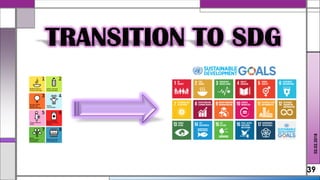
LIST OF ABBREVIATIONS…2
02.02.2018
• U5MR – Under Five Mortality Rate
• UHC – Universal Health Coverage
• UNICEF – United Nations Children’s Fund
• WCED – World Commission on Environment and
Development
• WHO – World Health Organization
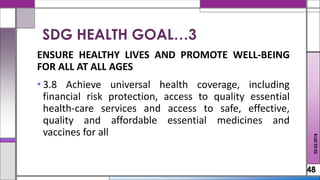
5
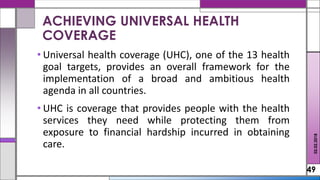
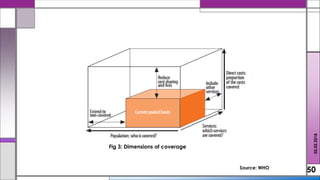
LIST OF ABBREVIATIONS…3
02.02.2018
• At the turn of the new millennium, world leaders held
a Millennium Summit in New York and agreed on a set
of goals for development worldwide.
• These goals came to be known as the Millennium
Development Goals (MDG).
• The MDGs were a set of 8 goals, each with its specific
targets as well as indicators for evaluating the progress
of the goals.
6
INTRODUCTION…1
02.02.2018
• The goals set the global development agenda for the
next 15 years with an endpoint of 2015.
• A post-2015 agenda eventually replaced the MDGs
after a series of extensive global consultations, debates
and deliberations.
7
02.02.2018
INTRODUCTION…2
• From the post-2015 agenda emerged the Sustainable
Development Goals.
• It is also referred to as “Global Goals” or “Agenda
2030”.
• In both the MDGs and the SDGs, health plays a very
pivotal role as there can be no true development
without health.
8
02.02.2018
INTRODUCTION…3
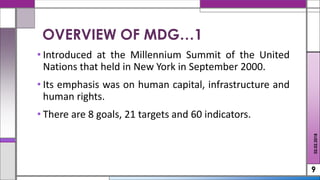
• Introduced at the Millennium Summit of the United
Nations that held in New York in September 2000.
• Its emphasis was on human capital, infrastructure and
human rights.
• There are 8 goals, 21 targets and 60 indicators.
9
OVERVIEW OF MDG…1
02.02.2018
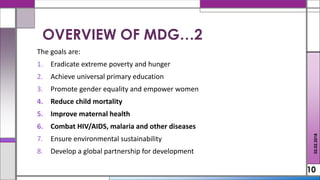
The goals are:
1. Eradicate extreme poverty and hunger
2. Achieve universal primary education
3. Promote gender equality and empower women
4. Reduce child mortality
5. Improve maternal health
6. Combat HIV/AIDS, malaria and other diseases
7. Ensure environmental sustainability
8. Develop a global partnership for development
10
02.02.2018
OVERVIEW OF MDG…2
• The aim of the MDGs was to create conditions
enabling all people to live in dignity and safety, free of
hunger, fear or oppression.
11
02.02.2018
OVERVIEW OF MDG…3
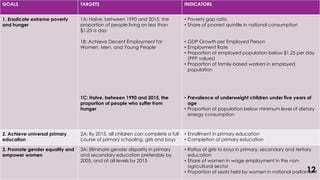
GOALS TARGETS INDICATORS
1. Eradicate extreme poverty
and hunger
1A: Halve, between 1990 and 2015, the
proportion of people living on less than
$1.25 a day
1B: Achieve Decent Employment for
Women, Men, and Young People
1C: Halve, between 1990 and 2015, the
proportion of people who suffer from
hunger
• Poverty gap ratio
• Share of poorest quintile in national consumption
• GDP Growth per Employed Person
• Employment Rate
• Proportion of employed population below $1.25 per day
(PPP values)
• Proportion of family-based workers in employed
population
• Prevalence of underweight children under five years of
age
• Proportion of population below minimum level of dietary
energy consumption
2. Achieve universal primary
education
2A: By 2015, all children can complete a full
course of primary schooling, girls and boys
• Enrollment in primary education
• Completion of primary education
3. Promote gender equality and
empower women
3A: Eliminate gender disparity in primary
and secondary education preferably by
2005, and at all levels by 2015
• Ratios of girls to boys in primary, secondary and tertiary
education
• Share of women in wage employment in the non-
agricultural sector
• Proportion of seats held by women in national parliament
12
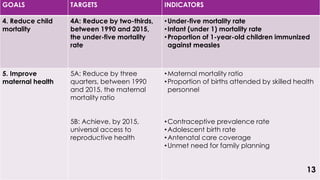
GOALS TARGETS INDICATORS
4. Reduce child
mortality
4A: Reduce by two-thirds,
between 1990 and 2015,
the under-five mortality
rate
•Under-five mortality rate
•Infant (under 1) mortality rate
•Proportion of 1-year-old children immunized
against measles
5. Improve
maternal health
5A: Reduce by three
quarters, between 1990
and 2015, the maternal
mortality ratio
5B: Achieve, by 2015,
universal access to
reproductive health
•Maternal mortality ratio
•Proportion of births attended by skilled health
personnel
•Contraceptive prevalence rate
•Adolescent birth rate
•Antenatal care coverage
•Unmet need for family planning
13
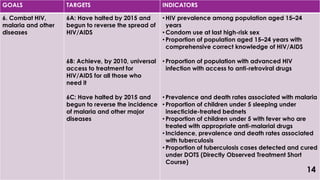
GOALS TARGETS INDICATORS
6. Combat HIV,
malaria and other
diseases
6A: Have halted by 2015 and
begun to reverse the spread of
HIV/AIDS
6B: Achieve, by 2010, universal
access to treatment for
HIV/AIDS for all those who
need it
6C: Have halted by 2015 and
begun to reverse the incidence
of malaria and other major
diseases
• HIV prevalence among population aged 15–24
years
• Condom use at last high-risk sex
• Proportion of population aged 15–24 years with
comprehensive correct knowledge of HIV/AIDS
• Proportion of population with advanced HIV
infection with access to anti-retroviral drugs
• Prevalence and death rates associated with malaria
• Proportion of children under 5 sleeping under
insecticide-treated bednets
• Proportion of children under 5 with fever who are
treated with appropriate anti-malarial drugs
• Incidence, prevalence and death rates associated
with tuberculosis
• Proportion of tuberculosis cases detected and cured
under DOTS (Directly Observed Treatment Short
Course)
14
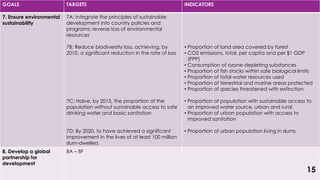
GOALS TARGETS INDICATORS
7. Ensure environmental
sustainability
7A: Integrate the principles of sustainable
development into country policies and
programs; reverse loss of environmental
resources
7B: Reduce biodiversity loss, achieving, by
2010, a significant reduction in the rate of loss
7C: Halve, by 2015, the proportion of the
population without sustainable access to safe
drinking water and basic sanitation
7D: By 2020, to have achieved a significant
improvement in the lives of at least 100 million
slum-dwellers
• Proportion of land area covered by forest
• CO2 emissions, total, per capita and per $1 GDP
(PPP)
• Consumption of ozone-depleting substances
• Proportion of fish stocks within safe biological limits
• Proportion of total water resources used
• Proportion of terrestrial and marine areas protected
• Proportion of species threatened with extinction
• Proportion of population with sustainable access to
an improved water source, urban and rural
• Proportion of urban population with access to
improved sanitation
• Proportion of urban population living in slums
8. Develop a global
partnership for
development
8A – 8F
15
16
02.02.2018
17
02.02.2018
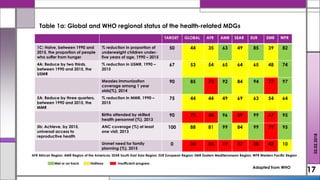
TARGET GLOBAL AFR AMR SEAR EUR EMR WPR
1C: Halve, between 1990 and
2015, the proportion of people
who suffer from hunger
% reduction in proportion of
underweight children under-
five years of age, 1990 – 2015
50 44 35 63 49 85 39 82
4A: Reduce by two thirds,
between 1990 and 2015, the
U5MR
% reduction in U5MR, 1990 –
2015
67 53 54 65 64 65 48 74
Measles immunization
coverage among 1 year
olds(%), 2014
90 85 73 92 84 94 77 97
5A: Reduce by three quarters,
between 1990 and 2015, the
MMR
% reduction in MMR, 1990 –
2015
75 44 44 49 69 63 54 64
Births attended by skilled
health personnel (%), 2013
90 73 54 96 59 99 67 95
5b: Achieve, by 2015,
universal access to
reproductive health
ANC coverage (%) at least
one visit, 2013
100 88 81 99 84 99 79 95
Unmet need for family
planning (%), 2015
0 24 55 19 27 28 42 10
Table 1a: Global and WHO regional status of the health-related MDGs
AFR African Region; AMR Region of the Americas; SEAR South East Asia Region; EUR European Region; EMR Esatern Mediterranean Region; WPR Western Pacific Region
Met or on track Halfway Insufficient progress
Adapted from WHO
18
02.02.2018
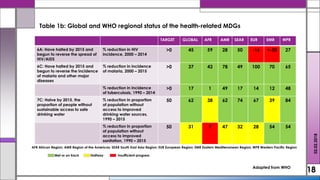
TARGET GLOBAL AFR AMR SEAR EUR EMR WPR
6A: Have halted by 2015 and
begun to reverse the spread of
HIV/AIDS
% reduction in HIV
incidence, 2000 – 2014
>0 45 59 28 50 -16 <-50 27
6C: Have halted by 2015 and
begun to reverse the incidence
of malaria and other major
diseases
% reduction in incidence
of malaria, 2000 – 2015
>0 37 42 78 49 100 70 65
% reduction in incidence
of tuberculosis, 1990 – 2014
>0 17 1 49 17 14 12 48
7C: Halve by 2015, the
proportion of people without
sustainable access to safe
drinking water
% reduction in proportion
of population without
access to improved
drinking water sources,
1990 – 2015
50 62 38 62 74 67 39 84
% reduction in proportion
of population without
access to improved
sanitation, 1990 – 2015
50 31 7 47 32 28 54 54
Table 1b: Global and WHO regional status of the health-related MDGs
AFR African Region; AMR Region of the Americas; SEAR South East Asia Region; EUR European Region; EMR Esatern Mediterranean Region; WPR Western Pacific Region
Met or on track Halfway Insufficient progress
Adapted from WHO
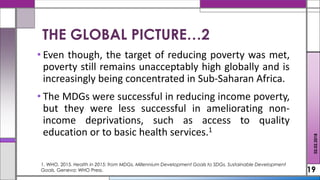
• Even though, the target of reducing poverty was met,
poverty still remains unacceptably high globally and is
increasingly being concentrated in Sub-Saharan Africa.
• The MDGs were successful in reducing income poverty,
but they were less successful in ameliorating non-
income deprivations, such as access to quality
education or to basic health services.1
19
THE GLOBAL PICTURE…2
02.02.2018
1. WHO, 2015. Health in 2015: from MDGs, Millennium Development Goals to SDGs, Sustainable Development
Goals. Geneva: WHO Press.
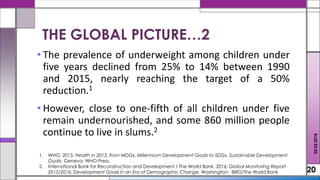
• The prevalence of underweight among children under
five years declined from 25% to 14% between 1990
and 2015, nearly reaching the target of a 50%
reduction.1
• However, close to one-fifth of all children under five
remain undernourished, and some 860 million people
continue to live in slums.2
20
THE GLOBAL PICTURE…2
02.02.2018
1. WHO, 2015. Health in 2015: from MDGs, Millennium Development Goals to SDGs, Sustainable Development
Goals. Geneva: WHO Press.
2. International Bank for Reconstruction and Development / The World Bank, 2016. Global Monitoring Report
2015/2016: Development Goals in an Era of Demographic Change. Washington: IBRD/The World Bank
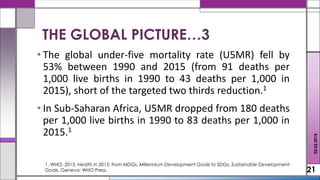
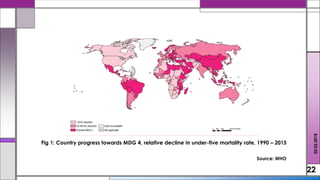
• The global under-five mortality rate (U5MR) fell by
53% between 1990 and 2015 (from 91 deaths per
1,000 live births in 1990 to 43 deaths per 1,000 in
2015), short of the targeted two thirds reduction.1
• In Sub-Saharan Africa, U5MR dropped from 180 deaths
per 1,000 live births in 1990 to 83 deaths per 1,000 in
2015.1
21
02.02.2018
THE GLOBAL PICTURE…3
1. WHO, 2015. Health in 2015: from MDGs, Millennium Development Goals to SDGs, Sustainable Development
Goals. Geneva: WHO Press.
22
02.02.2018
Fig 1: Country progress towards MDG 4, relative decline in under-five mortality rate, 1990 – 2015
Source: WHO
23
02.02.2018
Fig 2: Number of deaths of children under age five in 2015
Source: World Bank, 2015. Global Monitoring Report 2015/2016: Development Goals in an Era of Demographic Change
• From 1990 to 2013, the MMR declined substantially in
developing countries as a whole, from 430 maternal
deaths per 100,000 live births in 1990 to 230 in 2013.1
• As at 2015, 91% of the global population was using an
improved drinking-water source, compared to 76% in
1990.2
24
THE GLOBAL PICTURE…4
02.02.2018
1. International Bank for Reconstruction and Development / The World Bank, 2016. Global Monitoring Report
2015/2016: Development Goals in an Era of Demographic Change. Washington: IBRD/The World Bank
2. WHO, 2015. Health in 2015: from MDGs, Millennium Development Goals to SDGs, Sustainable Development
Goals. Geneva: WHO Press.
• MDG Target 6 for the major infectious diseases was
met.
• Incidence (new HIV infections and new cases of
malaria and TB) has declined: compared to 2000, the
number of people newly infected with HIV was 35%
lower; the malaria incidence rate among the
population at risk was 37% lower and the TB incidence
rate was 18% lower.1
25
THE GLOBAL PICTURE…5
02.02.2018
1. WHO, 2015. Health in 2015: from MDGs, Millennium Development Goals to SDGs, Sustainable Development
Goals. Geneva: WHO Press.
• Even though MDG 6 was met turning the tide on the
incidence of major deadly diseases, a high number of
preventable deaths persist.
• With the development of new medicines, HIV patients
receiving treatment have nearly the same life expectancy
as those without HIV.
• However, three-fifths of those people living with HIV,
mostly in developing countries still lack access to
antiretroviral drugs.1
26
02.02.2018
1. International Bank for Reconstruction and Development / The World Bank, 2016. Global Monitoring Report
2015/2016: Development Goals in an Era of Demographic Change. Washington: IBRD/The World Bank
THE GLOBAL PICTURE…6
• Tuberculosis killed 1.5 million people in 2013.1
• An estimated 198 million cases of malaria were
registered in 2013, claiming the lives of about 453,000
children.1
27
02.02.2018
1. International Bank for Reconstruction and Development / The World Bank, 2016. Global Monitoring Report
2015/2016: Development Goals in an Era of Demographic Change. Washington: IBRD/The World Bank
THE GLOBAL PICTURE…7
• Concerning MDG 7, little progress has been made in
improving the long-term environmental sustainability
of development.
• In 2013, over 5 billion people in developing countries
were breathing polluted air with concentrations of
PM2.5 in excess of the guideline levels recommended
by the World Health Organization, up 42% since 1990.1
28
02.02.2018
1. Brauer M., G. Freedman, J. Frostad, A. van Donkelaar, et al. 2015. “Ambient Air Pollution Exposure Estimation for
the Global Burden of Disease 2013.” Paper submitted for publication, Institute for Health Metrics and Evaluation,
University of Washington, Seattle
THE GLOBAL PICTURE…8
• In 2010, between 11 and 21 percent of all deaths in
developing countries were the result of pollution and
other environmental risk factors.1
• Only about 25 percent of the countries in the world,
primarily high-income countries, have managed to
grow economically while simultaneously decreasing
their environmental externalities.1
29
02.02.2018
1. International Bank for Reconstruction and Development / The World Bank, 2016. Global Monitoring Report
2015/2016: Development Goals in an Era of Demographic Change. Washington: IBRD/The World Bank
THE GLOBAL PICTURE…9
30
02.02.2018
31
02.02.2018
32
02.02.2018
• Nigeria’s efforts at meeting the various targets saw
some progress but ultimately fell short of most of all
the health-related targets.
• The under-five mortality rate (U5MR) improved from
191 deaths per 1000 live births in 2000 to 89 deaths
per 1000 live births in 2014 (short of the 2015 target of
64 deaths per 1000 live births by 28 %).1
33
THE NIGERIAN PICTURE…2
02.02.2018
1. OSSAP-MDGs, 2015. Nigeria 2015 Millennium Development Goals End-Point Report. Abuja.
• According to UNICEF, Nigeria’s U5MR estimate of 2015
was 109 deaths per 1,000 live births, making Nigeria
the 7th worst country with under 5 mortalities coming
behind Mali (115), Sierra Leone (120), Central African
Republic (130), Somalia (137), Chad (139) and Angola
(157). 1
34
02.02.2018
THE NIGERIAN PICTURE…3
1. UNICEF, 2016. The State of the World's Children 2016: A Fair Chance for Every Child. New York: UNICEF
• Infant mortality rate (IMR) decreased from 91 deaths
per 1000 live births in 1990 to 58 deaths per 1000 live
births in 2014 (but short of the 2015 target of 30
deaths per 1000 live births).
• The proportion of one-year-old children immunized
against measles increased from 46% in 1990 to 63.0%
in 2014 (short of the 90% target).
35
02.02.2018
THE NIGERIAN PICTURE…4
1. OSSAP-MDGs, 2015. Nigeria 2015 Millennium Development Goals End-Point Report. Abuja.
• Health indices in Nigeria have remained poor despite
MDG-related programmes and initiatives that have
been adopted.
• A similar dismal situation also affected Sub-Saharan
Africa in general.
• In countries that made significant progress, the
successes were grossly inequitably distributed.
36
02.02.2018
THE NIGERIAN PICTURE…5
37
02.02.2018
• Lack of integration and tendency to promote
verticalization of programmes
• Emphasis on measurement of aggregate performances
• Lack of emphasis on broad objectives e.g strong health
system, quality education etc.
• Lack of reliable data in the most affected countries
• Limited focus
38
LIMITATIONS OF MDG
02.02.2018
39
02.02.2018
• The unmet targets as well as the limitations of the
MDGs necessitated the transition to a new global
agenda with goals that are broader, more ambitious
and relevant to all people in all countries.
• Sustainable development has been defined as
development that meets the needs of the present
generation without compromising the ability of
future generations to meet their own needs.1
40
TRANSITION TO SDG…1
02.02.2018
1. WCED, 1987. Our Common Future. Oxford: Oxford University Press.
• At the United Nations Sustainable Development
Summit that held in New York on 25 September 2015,
world leaders adopted the new 2030 Agenda for
Sustainable Development.
• The 17 new Sustainable Development Goals, also
known as the Global Goals, aim to end poverty, hunger
and inequality, take action on climate change and the
environment, improve access to health and education,
build strong institutions and partnerships, and more.
41
02.02.2018
TRANSITION TO SDG…2
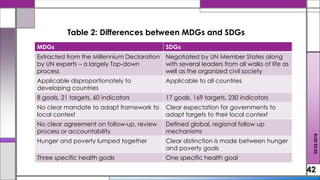
MDGs SDGs
Extracted from the Millennium Declaration
by UN experts – a largely Top-down
process
Negotiated by UN Member States along
with several leaders from all walks of life as
well as the organized civil society
Applicable disproportionately to
developing countries
Applicable to all countries
8 goals, 21 targets, 60 indicators 17 goals, 169 targets, 230 indicators
No clear mandate to adapt framework to
local context
Clear expectation for governments to
adapt targets to their local context
No clear agreement on follow-up, review
process or accountability
Defined global, regional follow up
mechanisms
Hunger and poverty lumped together Clear distinction is made between hunger
and poverty goals
Three specific health goals One specific health goal
42
02.02.2018
Table 2: Differences between MDGs and SDGs
• Goal 1 End poverty in all its forms everywhere
• Goal 2 End hunger, achieve food security and improved
nutrition and promote sustainable agriculture
•Goal 3 Ensure healthy lives and promote well
being for all at all ages
43
02.02.2018
TRANSITION TO SDG…3
44
02.02.2018
45
02.02.2018
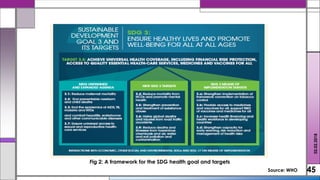
Fig 2: A framework for the SDG health goal and targets
Source: WHO
ENSURE HEALTHY LIVES AND PROMOTE WELL-BEING
FOR ALL AT ALL AGES
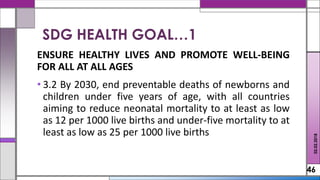
• 3.2 By 2030, end preventable deaths of newborns and
children under five years of age, with all countries
aiming to reduce neonatal mortality to at least as low
as 12 per 1000 live births and under-five mortality to at
least as low as 25 per 1000 live births
46
SDG HEALTH GOAL…1
02.02.2018
ENSURE HEALTHY LIVES AND PROMOTE WELL-BEING
FOR ALL AT ALL AGES
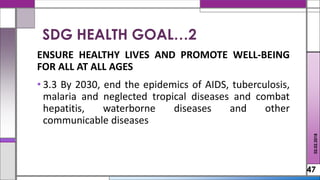
• 3.3 By 2030, end the epidemics of AIDS, tuberculosis,
malaria and neglected tropical diseases and combat
hepatitis, waterborne diseases and other
communicable diseases
47
02.02.2018
SDG HEALTH GOAL…2
ENSURE HEALTHY LIVES AND PROMOTE WELL-BEING
FOR ALL AT ALL AGES
• 3.8 Achieve universal health coverage, including
financial risk protection, access to quality essential
health-care services and access to safe, effective,
quality and affordable essential medicines and
vaccines for all
48
02.02.2018
SDG HEALTH GOAL…3
• Universal health coverage (UHC), one of the 13 health
goal targets, provides an overall framework for the
implementation of a broad and ambitious health
agenda in all countries.
• UHC is coverage that provides people with the health
services they need while protecting them from
exposure to financial hardship incurred in obtaining
care.
49
ACHIEVING UNIVERSAL HEALTH
COVERAGE
02.02.2018
50
02.02.2018
Fig 3: Dimensions of coverage
Source: WHO
• Goal 4 Ensure inclusive and equitable quality education
and promote lifelong learning opportunities for all
• Goal 5 Achieve gender equality and empower all
women and girls
• Goal 6 Ensure availability and sustainable management
of water and sanitation for all
51
02.02.2018
OTHER SDGs…1
• Goal 7 Ensure access to affordable, reliable,
sustainable and modern energy for all
• Goal 8 Promote sustained, inclusive and sustainable
economic growth, full and productive employment and
decent work for all
• Goal 9 Build resilient infrastructure, promote inclusive
and sustainable industrialization and foster innovation
52
02.02.2018
OTHER SDGs…2
• Goal 10 Reduce inequality within and among countries
• Goal 11 Make cities and human settlements inclusive,
safe, resilient and sustainable
• Goal 12 Ensure sustainable consumption and
production patterns
53
02.02.2018
OTHER SDGs…3
• Goal 13 Take urgent action to combat climate change
and its impacts
• Goal 14 Conserve and sustainably use the oceans, seas
and marine resources for sustainable development
• Goal 15 Protect, restore and promote sustainable use
of terrestrial ecosystems, sustainably manage forests,
combat desertification, and halt and reverse land
degradation and halt biodiversity loss
54
02.02.2018
OTHER SDGs…4
• Goal 16 Promote peaceful and inclusive societies for
sustainable development, provide access to justice for
all and build effective, accountable and inclusive
institutions at all levels
• Goal 17 Strengthen the means of implementation and
revitalize the Global Partnership for Sustainable
Development
55
02.02.2018
OTHER SDGs…5
56
WHERE ARE WE NOW
02.02.2018
• Establishment of institutional frameworks for enhanced
coordination
–Appointment of Senior Special Assistant to the President
on SDGs (Princess Adejoke Orelope Adefulire)
–Establishment of Inter-Ministerial Committee on the
SDGs
–Inauguration of Private Sector Advisory Group
–Establisment of committee on SDG in both the Senate
and the House of Representatives
57
WHERE WE ARE NOW…1
02.02.2018
• Establishment of a National Social Register for poor
and vulnerable households, and conditional cash
transfer of N5,000 to such households
• SDGs Indicators Baseline Report 2016
58
02.02.2018
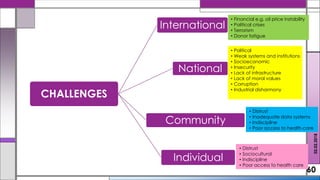
WHERE WE ARE NOW…2
CHALLENGES
59
02.02.2018
CHALLENGES
International
National
Community
Individual
60
• Financial e.g. oil price instability
• Political crises
• Terrorism
• Donor fatigue
• Political
• Weak systems and institutions
• Socioeconomic
• Insecurity
• Lack of infrastructure
• Lack of moral values
• Corruption
• Industrial disharmony
• Distrust
• Inadequate data systems
• Indiscipline
• Poor access to health care
• Distrust
• Sociocultural
• Indiscipline
• Poor access to health care
02.02.2018
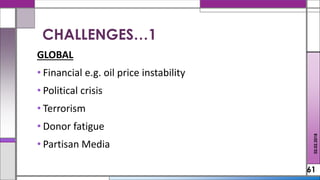
GLOBAL
• Financial e.g. oil price instability
• Political crisis
• Terrorism
• Donor fatigue
• Partisan Media
61
CHALLENGES…1
02.02.2018
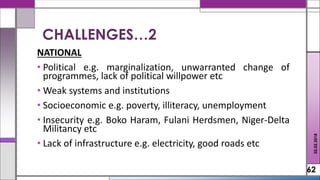
NATIONAL
• Political e.g. marginalization, unwarranted change of
programmes, lack of political willpower etc
• Weak systems and institutions
• Socioeconomic e.g. poverty, illiteracy, unemployment
• Insecurity e.g. Boko Haram, Fulani Herdsmen, Niger-Delta
Militancy etc
• Lack of infrastructure e.g. electricity, good roads etc
62
CHALLENGES…2
02.02.2018
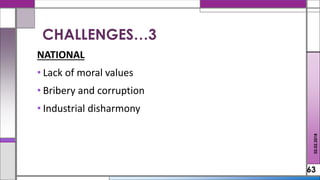
NATIONAL
• Lack of moral values
• Bribery and corruption
• Industrial disharmony
63
CHALLENGES…3
02.02.2018
COMMUNITY AND INDIVIDUAL LEVEL
• Distrust
• Corruption
• Poor access to health care
• Poverty
• Illiteracy etc
64
02.02.2018
CHALLENGES…4
• Health care financing
–Inadequate budgetary allocation on health
–Low health insurance coverage
–Predominance of out-of-pocket payment
–Reduction in donor aids
65
SPECIFIC HEALTH-RELATED
CHALLENGES…1
02.02.2018
• Health workforce
–Lack of cohesion among health workforce
–Skewed distribution of workforce
–Poor remuneration
–Mass exodus of health workforce
66
SPECIFIC HEALTH-RELATED
CHALLENGES…2
02.02.2018
• Health Information System
–Lack of modern technologies
• Leadership and Governance
–Incompetent leadership
–Corruption
–Poor enforcement of policies
67
SPECIFIC HEALTH-RELATED
CHALLENGES…3
02.02.2018
• Medical products and commodities
–High cost of importation
–Fake drugs
• Insufficient research
68
SPECIFIC HEALTH-RELATED
CHALLENGES…4
02.02.2018
• Failure to overcome the highlighted challenges would
lead to further downturn in the Nigerian economy
which in turn would create more challenges thus
perpetuating a vicious cycle.
• Some of the implications for the economy include:
69
IMPLICATIONS FOR THE ECONOMY…1
02.02.2018
• Low GDP
• Increased cost of governance
• Decreased spending on health
• Monopolistic market
• Rising unemployment
• Increased borrowing and debt servicing
70
02.02.2018
IMPLICATIONS FOR THE ECONOMY…2
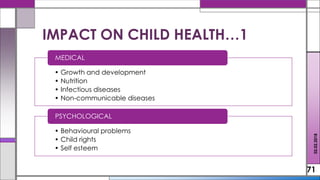
• Growth and development
• Nutrition
• Infectious diseases
• Non-communicable diseases
MEDICAL
• Behavioural problems
• Child rights
• Self esteem
PSYCHOLOGICAL
71
IMPACT ON CHILD HEALTH…1
02.02.2018
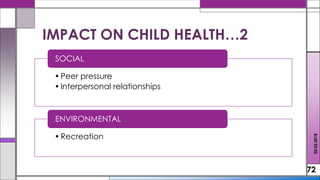
•Peer pressure
•Interpersonal relationships
SOCIAL
•Recreation
ENVIRONMENTAL
72
IMPACT ON CHILD HEALTH…2
02.02.2018
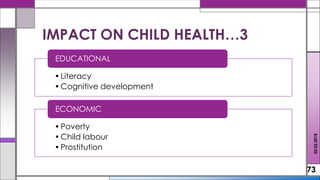
•Literacy
•Cognitive development
EDUCATIONAL
•Poverty
•Child labour
•Prostitution
ECONOMIC
73
IMPACT ON CHILD HEALTH…3
02.02.2018
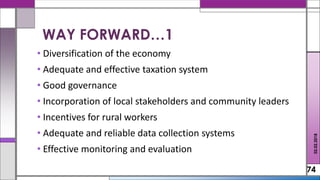
• Diversification of the economy
• Adequate and effective taxation system
• Good governance
• Incorporation of local stakeholders and community leaders
• Incentives for rural workers
• Adequate and reliable data collection systems
• Effective monitoring and evaluation
74
WAY FORWARD…1
02.02.2018
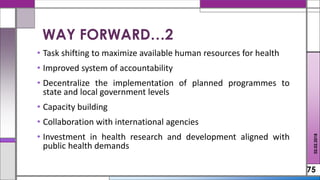
• Task shifting to maximize available human resources for health
• Improved system of accountability
• Decentralize the implementation of planned programmes to
state and local government levels
• Capacity building
• Collaboration with international agencies
• Investment in health research and development aligned with
public health demands
75
02.02.2018
WAY FORWARD…2
76
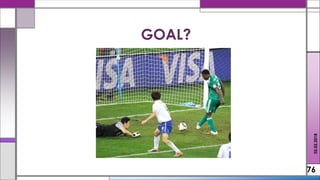
GOAL?
02.02.2018
• Sustainable development is a holistic agenda for
positively transforming the health of present and
future generations.
• With genuine commitment from all levels of leadership
to the least follower, these lofty ideals can be
achieved.
• This is our chance to score the goals that matter. Our
children deserve the very best!
77
CONCLUSION
02.02.2018
78
thanks for listening
02.02.2018

TRANSITION FROM MDG TO SDG.pdf

  • 1.
    TRANSITION FROM MDGTO SDG: CHALLENGES AND IMPLICATIONS FOR THE NIGERIAN ECONOMY AND ITS IMPACT ON CHILD HEALTH OSAHON OTAIGBE DEPARTMENT OF COMMUNITY MEDICINE IRRUA SPECIALIST TEACHING HOSPITAL 2nd February 2018
  • 2.
    • Introduction • Listof Abbreviations • Overview of MDG • The Global Picture • The Nigerian Picture • Limitations of MDG • Transition to SDG • Challenges • Implications for the Nigerian Economy • Impact on Child Health • Way Forward • Conclusion 2 OUTLINE 02.02.2018
  • 3.
    • ANC –Antenatal Care • DOTS – Directly Observed Therapy Short-Course • GDP – Gross Domestic Product • HIV/AIDS – Human Immunodeficiency Virus/Acquired Immunodeficiency Syndrome • IMR – Infant Mortality Rate 3 LIST OF ABBREVIATIONS…1 02.02.2018
  • 4.
    • MDG –Millennium Development Goal • MMR – Maternal Mortality Ratio • OSSAP-MDG – Office of the Senior Special Assistant to the President on Millennium Development Goals • PPP – Purchasing Power Parity • SDG – Sustainable Development Goal 4 LIST OF ABBREVIATIONS…2 02.02.2018
  • 5.
    • U5MR –Under Five Mortality Rate • UHC – Universal Health Coverage • UNICEF – United Nations Children’s Fund • WCED – World Commission on Environment and Development • WHO – World Health Organization 5 LIST OF ABBREVIATIONS…3 02.02.2018
  • 6.
    • At theturn of the new millennium, world leaders held a Millennium Summit in New York and agreed on a set of goals for development worldwide. • These goals came to be known as the Millennium Development Goals (MDG). • The MDGs were a set of 8 goals, each with its specific targets as well as indicators for evaluating the progress of the goals. 6 INTRODUCTION…1 02.02.2018
  • 7.
    • The goalsset the global development agenda for the next 15 years with an endpoint of 2015. • A post-2015 agenda eventually replaced the MDGs after a series of extensive global consultations, debates and deliberations. 7 02.02.2018 INTRODUCTION…2
  • 8.
    • From thepost-2015 agenda emerged the Sustainable Development Goals. • It is also referred to as “Global Goals” or “Agenda 2030”. • In both the MDGs and the SDGs, health plays a very pivotal role as there can be no true development without health. 8 02.02.2018 INTRODUCTION…3
  • 9.
    • Introduced atthe Millennium Summit of the United Nations that held in New York in September 2000. • Its emphasis was on human capital, infrastructure and human rights. • There are 8 goals, 21 targets and 60 indicators. 9 OVERVIEW OF MDG…1 02.02.2018
  • 10.
    The goals are: 1.Eradicate extreme poverty and hunger 2. Achieve universal primary education 3. Promote gender equality and empower women 4. Reduce child mortality 5. Improve maternal health 6. Combat HIV/AIDS, malaria and other diseases 7. Ensure environmental sustainability 8. Develop a global partnership for development 10 02.02.2018 OVERVIEW OF MDG…2
  • 11.
    • The aimof the MDGs was to create conditions enabling all people to live in dignity and safety, free of hunger, fear or oppression. 11 02.02.2018 OVERVIEW OF MDG…3
  • 12.
    GOALS TARGETS INDICATORS 1.Eradicate extreme poverty and hunger 1A: Halve, between 1990 and 2015, the proportion of people living on less than $1.25 a day 1B: Achieve Decent Employment for Women, Men, and Young People 1C: Halve, between 1990 and 2015, the proportion of people who suffer from hunger • Poverty gap ratio • Share of poorest quintile in national consumption • GDP Growth per Employed Person • Employment Rate • Proportion of employed population below $1.25 per day (PPP values) • Proportion of family-based workers in employed population • Prevalence of underweight children under five years of age • Proportion of population below minimum level of dietary energy consumption 2. Achieve universal primary education 2A: By 2015, all children can complete a full course of primary schooling, girls and boys • Enrollment in primary education • Completion of primary education 3. Promote gender equality and empower women 3A: Eliminate gender disparity in primary and secondary education preferably by 2005, and at all levels by 2015 • Ratios of girls to boys in primary, secondary and tertiary education • Share of women in wage employment in the non- agricultural sector • Proportion of seats held by women in national parliament 12
  • 13.
    GOALS TARGETS INDICATORS 4.Reduce child mortality 4A: Reduce by two-thirds, between 1990 and 2015, the under-five mortality rate •Under-five mortality rate •Infant (under 1) mortality rate •Proportion of 1-year-old children immunized against measles 5. Improve maternal health 5A: Reduce by three quarters, between 1990 and 2015, the maternal mortality ratio 5B: Achieve, by 2015, universal access to reproductive health •Maternal mortality ratio •Proportion of births attended by skilled health personnel •Contraceptive prevalence rate •Adolescent birth rate •Antenatal care coverage •Unmet need for family planning 13
  • 14.
    GOALS TARGETS INDICATORS 6.Combat HIV, malaria and other diseases 6A: Have halted by 2015 and begun to reverse the spread of HIV/AIDS 6B: Achieve, by 2010, universal access to treatment for HIV/AIDS for all those who need it 6C: Have halted by 2015 and begun to reverse the incidence of malaria and other major diseases • HIV prevalence among population aged 15–24 years • Condom use at last high-risk sex • Proportion of population aged 15–24 years with comprehensive correct knowledge of HIV/AIDS • Proportion of population with advanced HIV infection with access to anti-retroviral drugs • Prevalence and death rates associated with malaria • Proportion of children under 5 sleeping under insecticide-treated bednets • Proportion of children under 5 with fever who are treated with appropriate anti-malarial drugs • Incidence, prevalence and death rates associated with tuberculosis • Proportion of tuberculosis cases detected and cured under DOTS (Directly Observed Treatment Short Course) 14
  • 15.
    GOALS TARGETS INDICATORS 7.Ensure environmental sustainability 7A: Integrate the principles of sustainable development into country policies and programs; reverse loss of environmental resources 7B: Reduce biodiversity loss, achieving, by 2010, a significant reduction in the rate of loss 7C: Halve, by 2015, the proportion of the population without sustainable access to safe drinking water and basic sanitation 7D: By 2020, to have achieved a significant improvement in the lives of at least 100 million slum-dwellers • Proportion of land area covered by forest • CO2 emissions, total, per capita and per $1 GDP (PPP) • Consumption of ozone-depleting substances • Proportion of fish stocks within safe biological limits • Proportion of total water resources used • Proportion of terrestrial and marine areas protected • Proportion of species threatened with extinction • Proportion of population with sustainable access to an improved water source, urban and rural • Proportion of urban population with access to improved sanitation • Proportion of urban population living in slums 8. Develop a global partnership for development 8A – 8F 15
  • 16.
  • 17.
    17 02.02.2018 TARGET GLOBAL AFRAMR SEAR EUR EMR WPR 1C: Halve, between 1990 and 2015, the proportion of people who suffer from hunger % reduction in proportion of underweight children under- five years of age, 1990 – 2015 50 44 35 63 49 85 39 82 4A: Reduce by two thirds, between 1990 and 2015, the U5MR % reduction in U5MR, 1990 – 2015 67 53 54 65 64 65 48 74 Measles immunization coverage among 1 year olds(%), 2014 90 85 73 92 84 94 77 97 5A: Reduce by three quarters, between 1990 and 2015, the MMR % reduction in MMR, 1990 – 2015 75 44 44 49 69 63 54 64 Births attended by skilled health personnel (%), 2013 90 73 54 96 59 99 67 95 5b: Achieve, by 2015, universal access to reproductive health ANC coverage (%) at least one visit, 2013 100 88 81 99 84 99 79 95 Unmet need for family planning (%), 2015 0 24 55 19 27 28 42 10 Table 1a: Global and WHO regional status of the health-related MDGs AFR African Region; AMR Region of the Americas; SEAR South East Asia Region; EUR European Region; EMR Esatern Mediterranean Region; WPR Western Pacific Region Met or on track Halfway Insufficient progress Adapted from WHO
  • 18.
    18 02.02.2018 TARGET GLOBAL AFRAMR SEAR EUR EMR WPR 6A: Have halted by 2015 and begun to reverse the spread of HIV/AIDS % reduction in HIV incidence, 2000 – 2014 >0 45 59 28 50 -16 <-50 27 6C: Have halted by 2015 and begun to reverse the incidence of malaria and other major diseases % reduction in incidence of malaria, 2000 – 2015 >0 37 42 78 49 100 70 65 % reduction in incidence of tuberculosis, 1990 – 2014 >0 17 1 49 17 14 12 48 7C: Halve by 2015, the proportion of people without sustainable access to safe drinking water % reduction in proportion of population without access to improved drinking water sources, 1990 – 2015 50 62 38 62 74 67 39 84 % reduction in proportion of population without access to improved sanitation, 1990 – 2015 50 31 7 47 32 28 54 54 Table 1b: Global and WHO regional status of the health-related MDGs AFR African Region; AMR Region of the Americas; SEAR South East Asia Region; EUR European Region; EMR Esatern Mediterranean Region; WPR Western Pacific Region Met or on track Halfway Insufficient progress Adapted from WHO
  • 19.
    • Even though,the target of reducing poverty was met, poverty still remains unacceptably high globally and is increasingly being concentrated in Sub-Saharan Africa. • The MDGs were successful in reducing income poverty, but they were less successful in ameliorating non- income deprivations, such as access to quality education or to basic health services.1 19 THE GLOBAL PICTURE…2 02.02.2018 1. WHO, 2015. Health in 2015: from MDGs, Millennium Development Goals to SDGs, Sustainable Development Goals. Geneva: WHO Press.
  • 20.
    • The prevalenceof underweight among children under five years declined from 25% to 14% between 1990 and 2015, nearly reaching the target of a 50% reduction.1 • However, close to one-fifth of all children under five remain undernourished, and some 860 million people continue to live in slums.2 20 THE GLOBAL PICTURE…2 02.02.2018 1. WHO, 2015. Health in 2015: from MDGs, Millennium Development Goals to SDGs, Sustainable Development Goals. Geneva: WHO Press. 2. International Bank for Reconstruction and Development / The World Bank, 2016. Global Monitoring Report 2015/2016: Development Goals in an Era of Demographic Change. Washington: IBRD/The World Bank
  • 21.
    • The globalunder-five mortality rate (U5MR) fell by 53% between 1990 and 2015 (from 91 deaths per 1,000 live births in 1990 to 43 deaths per 1,000 in 2015), short of the targeted two thirds reduction.1 • In Sub-Saharan Africa, U5MR dropped from 180 deaths per 1,000 live births in 1990 to 83 deaths per 1,000 in 2015.1 21 02.02.2018 THE GLOBAL PICTURE…3 1. WHO, 2015. Health in 2015: from MDGs, Millennium Development Goals to SDGs, Sustainable Development Goals. Geneva: WHO Press.
  • 22.
    22 02.02.2018 Fig 1: Countryprogress towards MDG 4, relative decline in under-five mortality rate, 1990 – 2015 Source: WHO
  • 23.
    23 02.02.2018 Fig 2: Numberof deaths of children under age five in 2015 Source: World Bank, 2015. Global Monitoring Report 2015/2016: Development Goals in an Era of Demographic Change
  • 24.
    • From 1990to 2013, the MMR declined substantially in developing countries as a whole, from 430 maternal deaths per 100,000 live births in 1990 to 230 in 2013.1 • As at 2015, 91% of the global population was using an improved drinking-water source, compared to 76% in 1990.2 24 THE GLOBAL PICTURE…4 02.02.2018 1. International Bank for Reconstruction and Development / The World Bank, 2016. Global Monitoring Report 2015/2016: Development Goals in an Era of Demographic Change. Washington: IBRD/The World Bank 2. WHO, 2015. Health in 2015: from MDGs, Millennium Development Goals to SDGs, Sustainable Development Goals. Geneva: WHO Press.
  • 25.
    • MDG Target6 for the major infectious diseases was met. • Incidence (new HIV infections and new cases of malaria and TB) has declined: compared to 2000, the number of people newly infected with HIV was 35% lower; the malaria incidence rate among the population at risk was 37% lower and the TB incidence rate was 18% lower.1 25 THE GLOBAL PICTURE…5 02.02.2018 1. WHO, 2015. Health in 2015: from MDGs, Millennium Development Goals to SDGs, Sustainable Development Goals. Geneva: WHO Press.
  • 26.
    • Even thoughMDG 6 was met turning the tide on the incidence of major deadly diseases, a high number of preventable deaths persist. • With the development of new medicines, HIV patients receiving treatment have nearly the same life expectancy as those without HIV. • However, three-fifths of those people living with HIV, mostly in developing countries still lack access to antiretroviral drugs.1 26 02.02.2018 1. International Bank for Reconstruction and Development / The World Bank, 2016. Global Monitoring Report 2015/2016: Development Goals in an Era of Demographic Change. Washington: IBRD/The World Bank THE GLOBAL PICTURE…6
  • 27.
    • Tuberculosis killed1.5 million people in 2013.1 • An estimated 198 million cases of malaria were registered in 2013, claiming the lives of about 453,000 children.1 27 02.02.2018 1. International Bank for Reconstruction and Development / The World Bank, 2016. Global Monitoring Report 2015/2016: Development Goals in an Era of Demographic Change. Washington: IBRD/The World Bank THE GLOBAL PICTURE…7
  • 28.
    • Concerning MDG7, little progress has been made in improving the long-term environmental sustainability of development. • In 2013, over 5 billion people in developing countries were breathing polluted air with concentrations of PM2.5 in excess of the guideline levels recommended by the World Health Organization, up 42% since 1990.1 28 02.02.2018 1. Brauer M., G. Freedman, J. Frostad, A. van Donkelaar, et al. 2015. “Ambient Air Pollution Exposure Estimation for the Global Burden of Disease 2013.” Paper submitted for publication, Institute for Health Metrics and Evaluation, University of Washington, Seattle THE GLOBAL PICTURE…8
  • 29.
    • In 2010,between 11 and 21 percent of all deaths in developing countries were the result of pollution and other environmental risk factors.1 • Only about 25 percent of the countries in the world, primarily high-income countries, have managed to grow economically while simultaneously decreasing their environmental externalities.1 29 02.02.2018 1. International Bank for Reconstruction and Development / The World Bank, 2016. Global Monitoring Report 2015/2016: Development Goals in an Era of Demographic Change. Washington: IBRD/The World Bank THE GLOBAL PICTURE…9
  • 30.
  • 31.
  • 32.
  • 33.
    • Nigeria’s effortsat meeting the various targets saw some progress but ultimately fell short of most of all the health-related targets. • The under-five mortality rate (U5MR) improved from 191 deaths per 1000 live births in 2000 to 89 deaths per 1000 live births in 2014 (short of the 2015 target of 64 deaths per 1000 live births by 28 %).1 33 THE NIGERIAN PICTURE…2 02.02.2018 1. OSSAP-MDGs, 2015. Nigeria 2015 Millennium Development Goals End-Point Report. Abuja.
  • 34.
    • According toUNICEF, Nigeria’s U5MR estimate of 2015 was 109 deaths per 1,000 live births, making Nigeria the 7th worst country with under 5 mortalities coming behind Mali (115), Sierra Leone (120), Central African Republic (130), Somalia (137), Chad (139) and Angola (157). 1 34 02.02.2018 THE NIGERIAN PICTURE…3 1. UNICEF, 2016. The State of the World's Children 2016: A Fair Chance for Every Child. New York: UNICEF
  • 35.
    • Infant mortalityrate (IMR) decreased from 91 deaths per 1000 live births in 1990 to 58 deaths per 1000 live births in 2014 (but short of the 2015 target of 30 deaths per 1000 live births). • The proportion of one-year-old children immunized against measles increased from 46% in 1990 to 63.0% in 2014 (short of the 90% target). 35 02.02.2018 THE NIGERIAN PICTURE…4 1. OSSAP-MDGs, 2015. Nigeria 2015 Millennium Development Goals End-Point Report. Abuja.
  • 36.
    • Health indicesin Nigeria have remained poor despite MDG-related programmes and initiatives that have been adopted. • A similar dismal situation also affected Sub-Saharan Africa in general. • In countries that made significant progress, the successes were grossly inequitably distributed. 36 02.02.2018 THE NIGERIAN PICTURE…5
  • 37.
  • 38.
    • Lack ofintegration and tendency to promote verticalization of programmes • Emphasis on measurement of aggregate performances • Lack of emphasis on broad objectives e.g strong health system, quality education etc. • Lack of reliable data in the most affected countries • Limited focus 38 LIMITATIONS OF MDG 02.02.2018
  • 39.
  • 40.
    • The unmettargets as well as the limitations of the MDGs necessitated the transition to a new global agenda with goals that are broader, more ambitious and relevant to all people in all countries. • Sustainable development has been defined as development that meets the needs of the present generation without compromising the ability of future generations to meet their own needs.1 40 TRANSITION TO SDG…1 02.02.2018 1. WCED, 1987. Our Common Future. Oxford: Oxford University Press.
  • 41.
    • At theUnited Nations Sustainable Development Summit that held in New York on 25 September 2015, world leaders adopted the new 2030 Agenda for Sustainable Development. • The 17 new Sustainable Development Goals, also known as the Global Goals, aim to end poverty, hunger and inequality, take action on climate change and the environment, improve access to health and education, build strong institutions and partnerships, and more. 41 02.02.2018 TRANSITION TO SDG…2
  • 42.
    MDGs SDGs Extracted fromthe Millennium Declaration by UN experts – a largely Top-down process Negotiated by UN Member States along with several leaders from all walks of life as well as the organized civil society Applicable disproportionately to developing countries Applicable to all countries 8 goals, 21 targets, 60 indicators 17 goals, 169 targets, 230 indicators No clear mandate to adapt framework to local context Clear expectation for governments to adapt targets to their local context No clear agreement on follow-up, review process or accountability Defined global, regional follow up mechanisms Hunger and poverty lumped together Clear distinction is made between hunger and poverty goals Three specific health goals One specific health goal 42 02.02.2018 Table 2: Differences between MDGs and SDGs
  • 43.
    • Goal 1End poverty in all its forms everywhere • Goal 2 End hunger, achieve food security and improved nutrition and promote sustainable agriculture •Goal 3 Ensure healthy lives and promote well being for all at all ages 43 02.02.2018 TRANSITION TO SDG…3
  • 44.
  • 45.
    45 02.02.2018 Fig 2: Aframework for the SDG health goal and targets Source: WHO
  • 46.
    ENSURE HEALTHY LIVESAND PROMOTE WELL-BEING FOR ALL AT ALL AGES • 3.2 By 2030, end preventable deaths of newborns and children under five years of age, with all countries aiming to reduce neonatal mortality to at least as low as 12 per 1000 live births and under-five mortality to at least as low as 25 per 1000 live births 46 SDG HEALTH GOAL…1 02.02.2018
  • 47.
    ENSURE HEALTHY LIVESAND PROMOTE WELL-BEING FOR ALL AT ALL AGES • 3.3 By 2030, end the epidemics of AIDS, tuberculosis, malaria and neglected tropical diseases and combat hepatitis, waterborne diseases and other communicable diseases 47 02.02.2018 SDG HEALTH GOAL…2
  • 48.
    ENSURE HEALTHY LIVESAND PROMOTE WELL-BEING FOR ALL AT ALL AGES • 3.8 Achieve universal health coverage, including financial risk protection, access to quality essential health-care services and access to safe, effective, quality and affordable essential medicines and vaccines for all 48 02.02.2018 SDG HEALTH GOAL…3
  • 49.
    • Universal healthcoverage (UHC), one of the 13 health goal targets, provides an overall framework for the implementation of a broad and ambitious health agenda in all countries. • UHC is coverage that provides people with the health services they need while protecting them from exposure to financial hardship incurred in obtaining care. 49 ACHIEVING UNIVERSAL HEALTH COVERAGE 02.02.2018
  • 50.
    50 02.02.2018 Fig 3: Dimensionsof coverage Source: WHO
  • 51.
    • Goal 4Ensure inclusive and equitable quality education and promote lifelong learning opportunities for all • Goal 5 Achieve gender equality and empower all women and girls • Goal 6 Ensure availability and sustainable management of water and sanitation for all 51 02.02.2018 OTHER SDGs…1
  • 52.
    • Goal 7Ensure access to affordable, reliable, sustainable and modern energy for all • Goal 8 Promote sustained, inclusive and sustainable economic growth, full and productive employment and decent work for all • Goal 9 Build resilient infrastructure, promote inclusive and sustainable industrialization and foster innovation 52 02.02.2018 OTHER SDGs…2
  • 53.
    • Goal 10Reduce inequality within and among countries • Goal 11 Make cities and human settlements inclusive, safe, resilient and sustainable • Goal 12 Ensure sustainable consumption and production patterns 53 02.02.2018 OTHER SDGs…3
  • 54.
    • Goal 13Take urgent action to combat climate change and its impacts • Goal 14 Conserve and sustainably use the oceans, seas and marine resources for sustainable development • Goal 15 Protect, restore and promote sustainable use of terrestrial ecosystems, sustainably manage forests, combat desertification, and halt and reverse land degradation and halt biodiversity loss 54 02.02.2018 OTHER SDGs…4
  • 55.
    • Goal 16Promote peaceful and inclusive societies for sustainable development, provide access to justice for all and build effective, accountable and inclusive institutions at all levels • Goal 17 Strengthen the means of implementation and revitalize the Global Partnership for Sustainable Development 55 02.02.2018 OTHER SDGs…5
  • 56.
    56 WHERE ARE WENOW 02.02.2018
  • 57.
    • Establishment ofinstitutional frameworks for enhanced coordination –Appointment of Senior Special Assistant to the President on SDGs (Princess Adejoke Orelope Adefulire) –Establishment of Inter-Ministerial Committee on the SDGs –Inauguration of Private Sector Advisory Group –Establisment of committee on SDG in both the Senate and the House of Representatives 57 WHERE WE ARE NOW…1 02.02.2018
  • 58.
    • Establishment ofa National Social Register for poor and vulnerable households, and conditional cash transfer of N5,000 to such households • SDGs Indicators Baseline Report 2016 58 02.02.2018 WHERE WE ARE NOW…2
  • 59.
  • 60.
    CHALLENGES International National Community Individual 60 • Financial e.g.oil price instability • Political crises • Terrorism • Donor fatigue • Political • Weak systems and institutions • Socioeconomic • Insecurity • Lack of infrastructure • Lack of moral values • Corruption • Industrial disharmony • Distrust • Inadequate data systems • Indiscipline • Poor access to health care • Distrust • Sociocultural • Indiscipline • Poor access to health care 02.02.2018
  • 61.
    GLOBAL • Financial e.g.oil price instability • Political crisis • Terrorism • Donor fatigue • Partisan Media 61 CHALLENGES…1 02.02.2018
  • 62.
    NATIONAL • Political e.g.marginalization, unwarranted change of programmes, lack of political willpower etc • Weak systems and institutions • Socioeconomic e.g. poverty, illiteracy, unemployment • Insecurity e.g. Boko Haram, Fulani Herdsmen, Niger-Delta Militancy etc • Lack of infrastructure e.g. electricity, good roads etc 62 CHALLENGES…2 02.02.2018
  • 63.
    NATIONAL • Lack ofmoral values • Bribery and corruption • Industrial disharmony 63 CHALLENGES…3 02.02.2018
  • 64.
    COMMUNITY AND INDIVIDUALLEVEL • Distrust • Corruption • Poor access to health care • Poverty • Illiteracy etc 64 02.02.2018 CHALLENGES…4
  • 65.
    • Health carefinancing –Inadequate budgetary allocation on health –Low health insurance coverage –Predominance of out-of-pocket payment –Reduction in donor aids 65 SPECIFIC HEALTH-RELATED CHALLENGES…1 02.02.2018
  • 66.
    • Health workforce –Lackof cohesion among health workforce –Skewed distribution of workforce –Poor remuneration –Mass exodus of health workforce 66 SPECIFIC HEALTH-RELATED CHALLENGES…2 02.02.2018
  • 67.
    • Health InformationSystem –Lack of modern technologies • Leadership and Governance –Incompetent leadership –Corruption –Poor enforcement of policies 67 SPECIFIC HEALTH-RELATED CHALLENGES…3 02.02.2018
  • 68.
    • Medical productsand commodities –High cost of importation –Fake drugs • Insufficient research 68 SPECIFIC HEALTH-RELATED CHALLENGES…4 02.02.2018
  • 69.
    • Failure toovercome the highlighted challenges would lead to further downturn in the Nigerian economy which in turn would create more challenges thus perpetuating a vicious cycle. • Some of the implications for the economy include: 69 IMPLICATIONS FOR THE ECONOMY…1 02.02.2018
  • 70.
    • Low GDP •Increased cost of governance • Decreased spending on health • Monopolistic market • Rising unemployment • Increased borrowing and debt servicing 70 02.02.2018 IMPLICATIONS FOR THE ECONOMY…2
  • 71.
    • Growth anddevelopment • Nutrition • Infectious diseases • Non-communicable diseases MEDICAL • Behavioural problems • Child rights • Self esteem PSYCHOLOGICAL 71 IMPACT ON CHILD HEALTH…1 02.02.2018
  • 72.
  • 73.
  • 74.
    • Diversification ofthe economy • Adequate and effective taxation system • Good governance • Incorporation of local stakeholders and community leaders • Incentives for rural workers • Adequate and reliable data collection systems • Effective monitoring and evaluation 74 WAY FORWARD…1 02.02.2018
  • 75.
    • Task shiftingto maximize available human resources for health • Improved system of accountability • Decentralize the implementation of planned programmes to state and local government levels • Capacity building • Collaboration with international agencies • Investment in health research and development aligned with public health demands 75 02.02.2018 WAY FORWARD…2
  • 76.
  • 77.
    • Sustainable developmentis a holistic agenda for positively transforming the health of present and future generations. • With genuine commitment from all levels of leadership to the least follower, these lofty ideals can be achieved. • This is our chance to score the goals that matter. Our children deserve the very best! 77 CONCLUSION 02.02.2018
  • 78.