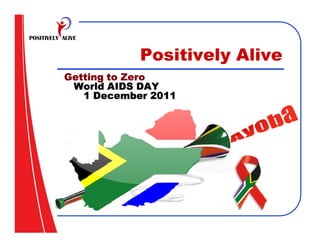
Positively Alive
Getting to Zero
 World AIDS DAY
   1 December 2011
Responsibility for Employee
          Wellness

Who is responsible for employee
 wellness?
 HR practitioners respond?
 Wellness Champion?
 Wellness Manage?
Human Rights Violations in the
   Workplace are an Obstacle to
        Universal Access


CREATE – AN ENVIRONMENT WITH ZERO INCIDENCE
Provide the Means to Getting
     to Zero Tollerance
THE FOUNDATION:
  Wellness Policy
  HIV/AIDS Policy
  Health and Safety Policy
  Leave Policy, Sick leave and other HR Policies
THE TOOLS:
  Wellness Manager
  Champions of Wellness Programme
  Treatment - HIV/AIDS Management Programme
  (Medical Aid)
  Employee Assistance Programme
  Medical Care / Medical Assessments
State of the HIV/AIDS Epidemic
At the end of 2010, an estimated 34 million people
[31.6 million–35.2 million] were living with HIV
worldwide, up 17% from 2001.
New HIV Infections and AIDS
     Related Deaths
SOUTH AFRICA – IS AYOBA
Supporting pregnant women
 SA Now provides an estimated 95%
 of eligible women with antiretrovirals
 to prevent new HIV infections among
 children, up from 57% coverage in
 2007.
The Theme for World AIDS Day
     2011 is 'Getting to Zero'

After 30 years of the global fight
against HIV/AIDS, this year the
global community has committed to
focusing on achieving 3 targets:
• Zero new HIV infections.
• Zero discrimination.
• Zero AIDS-related deaths.
       AIDS-
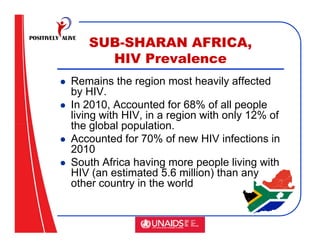
SUB-SHARAN AFRICA,
     HIV Prevalence
Remains the region most heavily affected
by HIV.
In 2010, Accounted for 68% of all people
living with HIV, in a region with only 12% of
the global population.
Accounted for 70% of new HIV infections in
2010
South Africa having more people living with
HIV (an estimated 5.6 million) than any
other country in the world
SUB-SHARAN AFRICA,
          AIDS Deaths
Almost half of the deaths from AIDS-
related illnesses in 2010 occurred in
Southern Africa.
AIDS has claimed at least one million lives
annually in sub-Saharan Africa since 1998.
Since then, however, AIDS-related deaths
have steadily decreased, as free
antiretroviral therapy has become more
widely available in the region.
SUB-SAHARAN AFRICA.
        New Infections

The total number of new HIV
infections in Sub-Saharan Africa has
dropped by more than 26%, down to
1.9 million [1.7 million–2.1 million]
from the estimated 2.6 million [2.4
million–2.8 million] at the height of the
epidemic in 1997.
SOUTH AFRICA – IS AYOBA
Refentse Model for Post-Rape Care a multisectoral
  approach to post-rape care.
  Integrating services in SA reduce delays in
  accessing PEP and collecting medical evidence for
  legal purposes, improves access to care, the
  quality of clinical history and examinations,
  provides pregnancy testing and emergency
  contraception; STI treatment; HIV counselling and
  testing; trauma counselling, and referrals.
SOUTH AFRICA – IS AYOBA
South Africa boosts collaborative TB/HIV care -2010
  210 000 people with tuberculosis were tested for HIV in
  + 60% were identified as HIV-positive.
  60% of 3.9 million people in HIV care, screened for TB,
  with 12% given TB preventive therapy.
  The HIV counselling and testing campaign (included
  tuberculosis screening), 760 000 people with HIV being
  screened for TB, of which120 000 were provided with
  preventive therapy
SA Statistics Released on 29 Dec
 2011 for 2010 for SA by Health
             Minister
 HIV antenatal prevalence 30.2% which is
 the same as was in 2005 but is slightly up
 from the 29.4% in 2009
 HIV prevalence steady at:
 •   21.8% for 15 – 24 yr olds
 •   37.3% for 25 – 29 yr olds
                                 AYOBA
 ARV’s are the biggest contributing factor to
 the stability.
 SA has reached a period of stability
SA Statistics Released on 29
   Dec 2011 for 2010 for SA by
         Health Minister
Highest regions Umgungungluvu and
Llembe with 42.3%
Lowest region central Karoo 8.5%
1 out of every 3 women visiting antenatal
clinks HIV positive.
Only age group showing increase is
women between 45 -49 yrs of age.
Husband are biggest contributing factor to
the increase in prevalence in the above
category says health minister.
Creating an Environment
             that is AYOBA
Reducing the burden of HIV/AIDS by providing:
  Consistent application of workplace policies with resources
  aimed at…
  Eliminating stigma and discrimination.
  Through an integrated and holistic employee wellness and
  assistance programme ... Is
  Providing access to TREATMENT / CARE which…
  Is reducing the incidence of new infections and achieving
  the international goals of …
                  GETTING TO ZERO
   Zero new HIV infections.
   Zero discrimination.
   Zero AIDS-related deaths
        AIDS-
Thank you - Questions

BECAUSE GETTING TO ZERO


       IS AYOBA

Positively alive wad_presentation

  • 1.
    Positively Alive Getting toZero World AIDS DAY 1 December 2011
  • 2.
    Responsibility for Employee Wellness Who is responsible for employee wellness? HR practitioners respond? Wellness Champion? Wellness Manage?
  • 3.
    Human Rights Violationsin the Workplace are an Obstacle to Universal Access CREATE – AN ENVIRONMENT WITH ZERO INCIDENCE
  • 4.
    Provide the Meansto Getting to Zero Tollerance THE FOUNDATION: Wellness Policy HIV/AIDS Policy Health and Safety Policy Leave Policy, Sick leave and other HR Policies THE TOOLS: Wellness Manager Champions of Wellness Programme Treatment - HIV/AIDS Management Programme (Medical Aid) Employee Assistance Programme Medical Care / Medical Assessments
  • 5.
    State of theHIV/AIDS Epidemic At the end of 2010, an estimated 34 million people [31.6 million–35.2 million] were living with HIV worldwide, up 17% from 2001.
  • 6.
    New HIV Infectionsand AIDS Related Deaths
  • 7.
    SOUTH AFRICA –IS AYOBA Supporting pregnant women SA Now provides an estimated 95% of eligible women with antiretrovirals to prevent new HIV infections among children, up from 57% coverage in 2007.
  • 8.
    The Theme forWorld AIDS Day 2011 is 'Getting to Zero' After 30 years of the global fight against HIV/AIDS, this year the global community has committed to focusing on achieving 3 targets: • Zero new HIV infections. • Zero discrimination. • Zero AIDS-related deaths. AIDS-
  • 9.
    SUB-SHARAN AFRICA, HIV Prevalence Remains the region most heavily affected by HIV. In 2010, Accounted for 68% of all people living with HIV, in a region with only 12% of the global population. Accounted for 70% of new HIV infections in 2010 South Africa having more people living with HIV (an estimated 5.6 million) than any other country in the world
  • 10.
    SUB-SHARAN AFRICA, AIDS Deaths Almost half of the deaths from AIDS- related illnesses in 2010 occurred in Southern Africa. AIDS has claimed at least one million lives annually in sub-Saharan Africa since 1998. Since then, however, AIDS-related deaths have steadily decreased, as free antiretroviral therapy has become more widely available in the region.
  • 11.
    SUB-SAHARAN AFRICA. New Infections The total number of new HIV infections in Sub-Saharan Africa has dropped by more than 26%, down to 1.9 million [1.7 million–2.1 million] from the estimated 2.6 million [2.4 million–2.8 million] at the height of the epidemic in 1997.
  • 12.
    SOUTH AFRICA –IS AYOBA Refentse Model for Post-Rape Care a multisectoral approach to post-rape care. Integrating services in SA reduce delays in accessing PEP and collecting medical evidence for legal purposes, improves access to care, the quality of clinical history and examinations, provides pregnancy testing and emergency contraception; STI treatment; HIV counselling and testing; trauma counselling, and referrals.
  • 13.
    SOUTH AFRICA –IS AYOBA South Africa boosts collaborative TB/HIV care -2010 210 000 people with tuberculosis were tested for HIV in + 60% were identified as HIV-positive. 60% of 3.9 million people in HIV care, screened for TB, with 12% given TB preventive therapy. The HIV counselling and testing campaign (included tuberculosis screening), 760 000 people with HIV being screened for TB, of which120 000 were provided with preventive therapy
  • 14.
    SA Statistics Releasedon 29 Dec 2011 for 2010 for SA by Health Minister HIV antenatal prevalence 30.2% which is the same as was in 2005 but is slightly up from the 29.4% in 2009 HIV prevalence steady at: • 21.8% for 15 – 24 yr olds • 37.3% for 25 – 29 yr olds AYOBA ARV’s are the biggest contributing factor to the stability. SA has reached a period of stability
  • 15.
    SA Statistics Releasedon 29 Dec 2011 for 2010 for SA by Health Minister Highest regions Umgungungluvu and Llembe with 42.3% Lowest region central Karoo 8.5% 1 out of every 3 women visiting antenatal clinks HIV positive. Only age group showing increase is women between 45 -49 yrs of age. Husband are biggest contributing factor to the increase in prevalence in the above category says health minister.
  • 16.
    Creating an Environment that is AYOBA Reducing the burden of HIV/AIDS by providing: Consistent application of workplace policies with resources aimed at… Eliminating stigma and discrimination. Through an integrated and holistic employee wellness and assistance programme ... Is Providing access to TREATMENT / CARE which… Is reducing the incidence of new infections and achieving the international goals of … GETTING TO ZERO Zero new HIV infections. Zero discrimination. Zero AIDS-related deaths AIDS-
  • 17.
    Thank you -Questions BECAUSE GETTING TO ZERO IS AYOBA