AP Biology
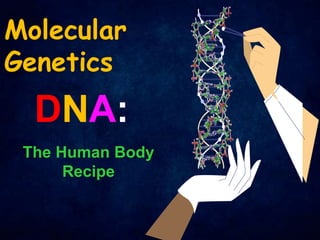
The Human Body
Recipe
DNA:
Molecular
Genetics
AP Biology
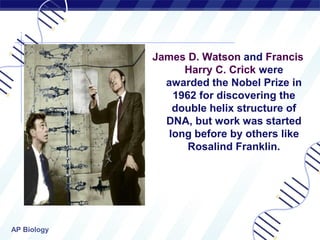
James D. Watson and Francis
Harry C. Crick were
awarded the Nobel Prize in
1962 for discovering the
double helix structure of
DNA, but work was started
long before by others like
Rosalind Franklin.
AP Biology
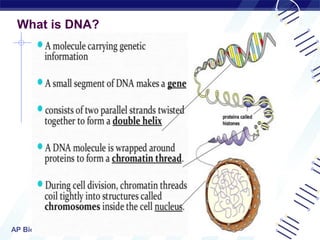
What is DNA?
AP Biology
AP Biology
AP Biology
The Human Body
Recipe
DNA:
Molecular
Genetics
AP Biology
AP Biology
DNA Replication
DNA must be replicated before a cell divides, so that each daughter
cell inherits a copy of each gene.
 Cell missing a critical gene will die
 Essential that the process of DNA replication produces an
absolutely accurate copy of the original genetic information
 Mistake made in critical genes can result in lethal mutations.
AP Biology
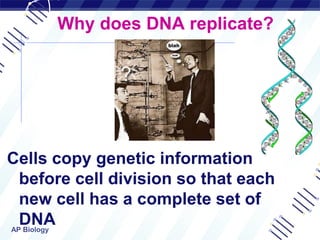
Why does DNA replicate?
Cells copy genetic information
before cell division so that each
new cell has a complete set of
DNA
AP Biology
 Structure of the DNA molecule suggest the
mechanism for accurate replication
 An enzyme could “read” the nitrogenous bases
on one strand of a DNA molecule adding
complementary bases to a newly synthesized
strand.
 Product of this strategy would be a new DNA
molecule in which one strand is the original or
parent strand, and the other is newly
synthesized, a daughter strand.
 This strategy is called semiconservative
replication.
Structure to Function in DNA Replication
AP Biology
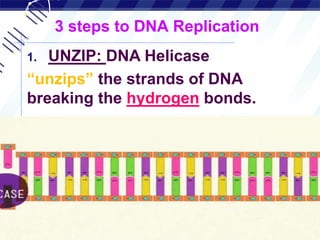
3 steps to DNA Replication
1. UNZIP: DNA Helicase
“unzips” the strands of DNA
breaking the hydrogen bonds.
AP Biology
2) BASE PAIRING: DNA
Polymerase bonds free
nucleotides with nucleotides
from parent strand
AP Biology
3. Joining Nucleotides:
Ligase bonds nucleotides
together.
This result in 2 identical
DNA molecules.
AP Biology
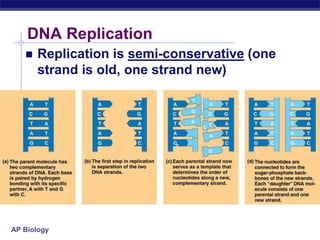
DNA Replication
 Replication is semi-conservative (one
strand is old, one strand new)
AP Biology
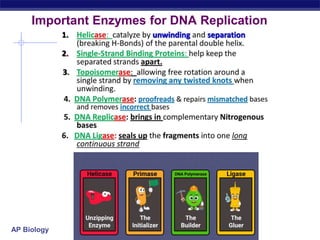
Important Enzymes for DNA Replication
AP Biology
AP Biology
From Gene
to Protein
How Genes
Work
AP Biology
Protein Synthesis (Gene Expression) Notes
Proteins (Review)
•Proteins make up all living materials
AP Biology
AP Biology
AP Biology
• Proteins are manufactured (made) by the ribosomes
AP Biology
From Gene
to Protein
How Genes
Work
AP Biology
The “Central Dogma”
 Flow of genetic information in a cell
 How do we move information from DNA to proteins?
replication
protein
RNA
DNA trait
DNA gets
all the glory,
but proteins do
all the work!
AP Biology
Protein Synthesis occurs in two steps:
1) Transcription: DNA RNA
2) Translation: RNA Protein
AP Biology
If the processof proteinsynthesiswere a play,these wouldbe
the rolesof all of the people involved
The director who has the master plan
Three assistant directors
The cast
The stage
The stage crew
DNA (genes)
mRNA, tRNA, rRNA
Amino acids
Ribosome
Enzymes
AP Biology
Transcription
from
DNA nucleic acid language
to
RNA nucleic acid language
AP Biology
RNA
 ribose sugar
 N-bases
 uracil instead of thymine
 U : A
 C : G
 single stranded
 lots of RNAs
 mRNA, tRNA, rRNA, siRNA…
RNA
DNA
transcription
3 KINDS OF RNA HELP WITH INFO TRANSFER FOR
PROTEIN SYNTHESIS
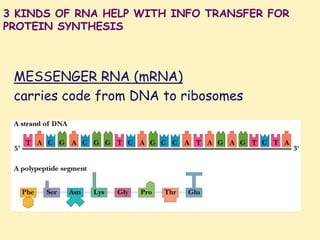
MESSENGER RNA (mRNA)
carries code from DNA to ribosomes
3 KINDS OF RNA HELP WITH INFO TRANSFER FOR
PROTEIN SYNTHESIS
TRANSFER RNA (tRNA)
ANTICODON sequence
matches CODON on mRNA
to add correct
amino acids during
protein synthesis
AMINOACYL-tRNA SYNTHETASE
Enzyme attaches a specific
amino acid using energy from ATP
3 KINDS OF RNA HELP WITH INFO TRANSFER FOR
PROTEIN SYNTHESIS
RIBOSOMAL RNA (rRNA)
Made in nucleolus
2 subunits (large & small)
Combine with proteins to
form ribosomes
Bacterial ribosomes different
size than eukaryotic ribosomes
 Evidence for ENDOSYMBIOTIC THEORY
 Medically significant-some antibiotics target
bacterial ribosomes w/o harming host
AP Biology
AP Biology
Transcription
 Making mRNA
 transcribed DNA strand = template strand
 untranscribed DNA strand = coding strand
 same sequence as RNA
 synthesis of complementary RNA strand
 transcription bubble
 enzyme
 RNA polymerase
template strand
rewinding
mRNA RNA polymerase
unwinding
coding strand
DNA
C C
C
C
C
C
C
C
C C
C
G
G
G
G
G G
G G
G
G
G
A
A
A
A A
A
A
A
A
A A
A
A
T
T T
T
T
T
T
T
T T
T
T
U U
5
3
5
3
3
5
build RNA 53
AP Biology
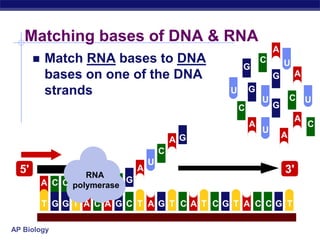
Matching bases of DNA & RNA
 Match RNA bases to DNA
bases on one of the DNA
strands
U
A G G
G
G
G
G
T T A C A C T T T T T
C C C C
A A
U
U
U
U
U
G
G
A
A
A C C
RNA
polymerase
C
C
C
C
C
G
G
G
G
A
A
A
A
A
5' 3'
AP Biology
Splicing must be accurate
 No room for mistakes!
 a single base added or lost throws off the
reading frame
AUG|CGG|UCC|GAU|AAG|GGC|CAU
AUGCGGCTATGGGUCCGAUAAGGGCCAU
AUGCGGUCCGAUAAGGGCCAU
AUG|CGG|GUC|CGA|UAA|GGG|CCA|U
AUGCGGCTATGGGUCCGAUAAGGGCCAU
AUGCGGGUCCGAUAAGGGCCAU
Met|Arg|Ser|Asp|Lys|Gly|His
Met|Arg|Val|Arg|STOP|
AP Biology 2007-2008
Translation
from
nucleic acid language
to
amino acid language
AP Biology
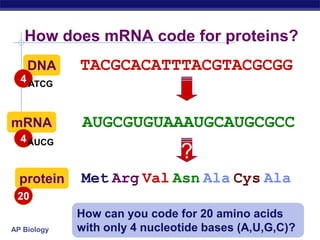
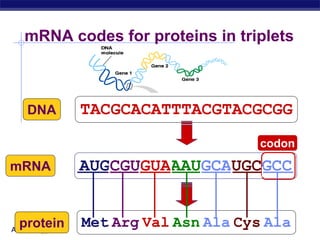
How does mRNA code for proteins?
TACGCACATTTACGTACGCGG
DNA
AUGCGUGUAAAUGCAUGCGCC
mRNA
Met Arg Val Asn Ala Cys Ala
protein
?
How can you code for 20 amino acids
with only 4 nucleotide bases (A,U,G,C)?
4
4
20
ATCG
AUCG
AP Biology
AUGCGUGUAAAUGCAUGCGCC
mRNA
mRNA codes for proteins in triplets
TACGCACATTTACGTACGCGG
DNA
AUGCGUGUAAAUGCAUGCGCC
mRNA
Met Arg Val Asn Ala Cys Ala
protein
?
codon
AP Biology
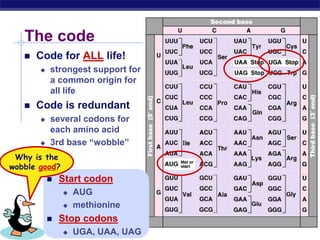
The code
 Code for ALL life!
 strongest support for
a common origin for
all life
 Code is redundant
 several codons for
each amino acid
 3rd base “wobble”
 Start codon
 AUG
 methionine
 Stop codons
 UGA, UAA, UAG
Why is the
wobble good?
AP Biology
A BAD NIGHT AT THE THEATRE
Question: What if something goes wrong during translation?
Answer: MUTATION
• A change in the
nucleotide
sequence of DNA
• When the bases (‘letters’)
change, the wrong amino
acids are used to make
the protein.
• The protein will NOT be
able to do its job.
AP Biology
What are mutations?
 MUTATIONS are
any changes in the
sequence of bases
of DNA
Mutations DO NOT
lead to this
Mutations COULD
lead to this
Colon cancer cells
AP Biology
How do mutations occur?
 Sometimes during
replication, the cell makes a
mistake and adds the wrong
base
 When the cell replicates its
DNA again, the two strands
that are produced are no
longer exactly the same
 This usually will cause the
new cell to die, but
sometimes it can cause the
cell to divide when it is not
supposed to  cancer
AP Biology
Are Mutations Helpful or Harmful?
 Mutations happen
regularly
 Almost all mutations are
neutral
 Chemicals & UV
radiation cause
mutations
 Many mutations are
repaired by enzymes
AP Biology
Are Mutations Helpful or Harmful?
 Some type of skin
cancers and
leukemia result from
somatic mutations
 Some mutations may
improve an
organism’s survival
(beneficial)
AP Biology
Types of Mutations
 Now and then cells make mistakes in
copying their own DNA, inserting the wrong
base or even skipping a base as a strand is
put together.
 These variations are called mutations, from
the Latin word mutare, meaning “to change.”
 Mutations are heritable changes in genetic
information.
AP Biology
Types of Mutations
 All mutations fall into two basic categories:
 Those that produce changes in a single
gene are known as gene mutations.
 Those that produce changes in whole
chromosomes are known as chromosomal
mutations.
AP Biology
There are 2 types of MUTATION:
1. Chromosomal mutations: a mutation of all or part of a
chromosome.
This usually involves MANY GENES, and therefore, MANY
PROTEINS.
Example: Down’s syndrome.
2. Gene mutations: a mutation that occurs within a gene at
some point along a chromosome. This mutation is only a
change of 1 or a few ‘letters’ (nitrogenous bases).
It usually only affects ONE GENE, and therefore, ONE
PROTEIN.
Example: Sickle cell anemia.
AP Biology
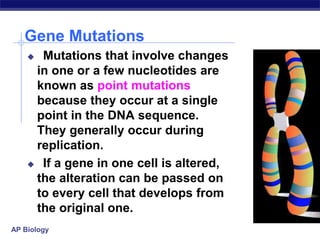
Gene Mutations
 Mutations that involve changes
in one or a few nucleotides are
known as point mutations
because they occur at a single
point in the DNA sequence.
They generally occur during
replication.
 If a gene in one cell is altered,
the alteration can be passed on
to every cell that develops from
the original one.
AP Biology
Mutations
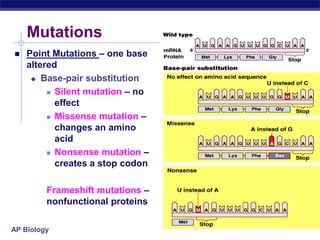
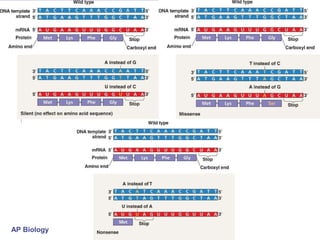
 Point Mutations – one base
altered
 Base-pair substitution
 Silent mutation – no
effect
 Missense mutation –
changes an amino
acid
 Nonsense mutation –
creates a stop codon
Frameshift mutations –
nonfunctional proteins
AP Biology
Point mutation leads to Sickle cell anemia
What kind of mutation?
Sickle cell anemia
AP Biology
Gene Mutations
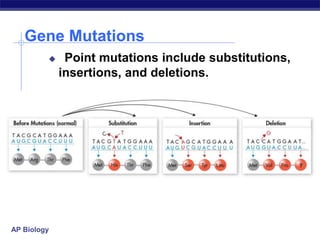
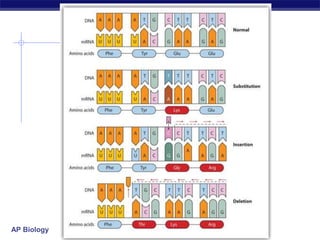
 Point mutations include substitutions,
insertions, and deletions.
AP Biology
Substitutions
 In a substitution, one base is changed to a
different base.
 Substitutions usually affect no more than a
single amino acid, and sometimes they have
no effect at all.
AP Biology
Substitutions
AP Biology
Insertions and Deletions
 Insertions and deletions are point mutations in
which one base is inserted or removed from the DNA
sequence.
 If a nucleotide is added or deleted, the bases are still
read in groups of three, but now those groupings
shift in every codon that follows the mutation.
AP Biology
Insertions and Deletions
 Insertions and deletions are also called “frameshift
mutations” because they shift the “reading frame” of
the genetic message.
 Frameshift mutations can change every amino acid
that follows the point of the mutation and can alter a
protein so much that it is unable to perform its normal
functions.
AP Biology
Insertion
AP Biology
Deletion
AP Biology
AP Biology
Chromosomal Mutations
 Chromosomal mutations involve changes in the
number or structure of chromosomes.
 These mutations can change the location of genes on
chromosomes and can even change the number of
copies of some genes.
 There are four types of chromosomal mutations:
deletion, duplication, inversion, and translocation.
AP Biology
Chromosomal Mutations
 Deletion involves the loss of all or part
of a chromosome.
AP Biology
Chromosomal Mutations
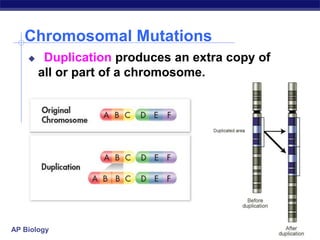
 Duplication produces an extra copy of
all or part of a chromosome.
AP Biology
Chromosomal Mutations
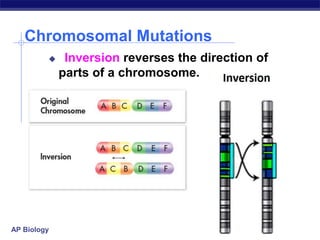
 Inversion reverses the direction of
parts of a chromosome.
AP Biology
Chromosomal Mutations
 Translocation occurs when part of one
chromosome breaks off and attaches to
another.
AP Biology
Effects of Mutations
 Genetic material can be altered by natural
events or by artificial means.
 The resulting mutations may or may not
affect an organism.
 Some mutations that affect individual
organisms can also affect a species or even
an entire ecosystem.
AP Biology
Effects of Mutations
 Many mutations are produced by errors in
genetic processes.
 For example, some point mutations are caused
by errors during DNA replication.
 The cellular machinery that replicates DNA
inserts an incorrect base roughly once in every 10
million bases.
 Small changes in genes can gradually
accumulate over time.
AP Biology
Effects of Mutations
 Stressful environmental conditions may
cause some bacteria to increase mutation
rates.
 This can actually be helpful to the
organism, since mutations may sometimes
give such bacteria new traits, such as the
ability to consume a new food source or to
resist a poison in the environment.
AP Biology
Mutagens
 Some mutations arise from mutagens,
chemical or physical agents in the
environment.
 Chemical mutagens include certain
pesticides, a few natural plant alkaloids,
tobacco smoke, and environmental pollutants.
 Physical mutagens include some forms of
electromagnetic radiation, such as X-rays and
ultraviolet light.
AP Biology
Harmful and Helpful Mutations
 The effects of mutations on genes vary widely. Some
have little or no effect; and some produce beneficial
variations. Some negatively disrupt gene function.
 Whether a mutation is negative or beneficial depends on
how its DNA changes relative to the organism’s situation.
 Mutations are often thought of as negative because they
disrupt the normal function of genes.
 However, without mutations, organisms cannot evolve,
because mutations are the source of genetic variability in
a species.
AP Biology
Harmful Effects
 Some of the most harmful mutations are
those that dramatically change protein
structure or gene activity.
 The defective proteins produced by these
mutations can disrupt normal biological
activities, and result in genetic disorders.
 Some cancers, for example, are the product
of mutations that cause the uncontrolled
growth of cells.
AP Biology
Harmful Effects
 Sickle cell disease is a disorder associated with
changes in the shape of red blood cells. Normal
red blood cells are round. Sickle cells appear
long and pointed.
 Sickle cell disease is caused by a point mutation
in one of the polypeptides found in hemoglobin,
the blood’s principal oxygen-carrying protein.
 Among the symptoms of the disease are anemia,
severe pain, frequent infections, and stunted
growth.
AP Biology
Beneficial Effects
 Some of the variation produced by mutations can be
highly advantageous to an organism or species.
 Mutations often produce proteins with new or
altered functions that can be useful to organisms in
different or changing environments.
 For example, mutations have helped many insects
resist chemical pesticides.
 Some mutations have enabled microorganisms to
adapt to new chemicals in the environment.
AP Biology
Beneficial Effects
 Plant and animal breeders often make use of “good” mutations.
 For example, when a complete set of chromosomes fails to
separate during meiosis, the gametes that result may produce
triploid (3N) or tetraploid (4N) organisms.
 The condition in which an organism has extra sets of
chromosomes is called polyploidy.
 Polyploid plants are often larger and stronger than diploid
plants.
 Important crop plants—including bananas and limes—have been
produced this way.
AP Biology
Down Syndrome
 Down syndrome (DS or
DNS), also known as
trisomy 21, is a genetic
disorder caused by the
presence of all or part of a
third copy of chromosome
21. It is typically associated
with physical growth
delays, characteristic facial
features and mild to
moderate intellectual
disability.
AP Biology
Turner Syndrome
 A condition that affects
only females, results when
one of the X
chromosomes (sex
chromosomes) is missing
or partially missing.
Turner syndrome can
cause a variety of medical
and developmental
problems, including short
height, failure of the
ovaries to develop and
heart defects.
AP Biology
Klinefelter’s Syndrome
 A genetic disorder that
affects males.
 Klinefelter’s syndrome
occurs when a boy is born
with one or more extra X
chromosomes. Most males
have one Y and one X
chromosome. Having extra X
chromosomes can cause a
male to have some physical
traits unusual for males such
as weaker muscles, greater
height, poor coordination,
less body hair, and sterility
AP Biology
AP Biology
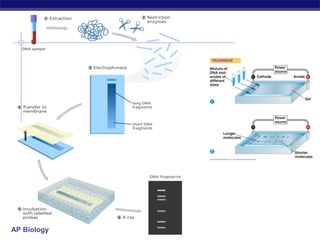
DNA Fingerprinting
 It is a way to identify a certain
individual, rather than simply
identifying a species or a
particular trait.
 A technique used by scientists
to distinguish between
individuals of the same species
using only samples of their DNA.
 The process of DNA
fingerprinting was invested by
Alec John Jeffreys in 1985.
AP Biology
Biological Samples used for
DNA Fingerprinting
 Blood
 Hair
 Saliva
 Semen
 Body Tissue cells
 DNA samples have been obtained from
vaginal cells transferred to the outside
of a condom during sexual intercourse.
AP Biology
AP Biology
AP Biology
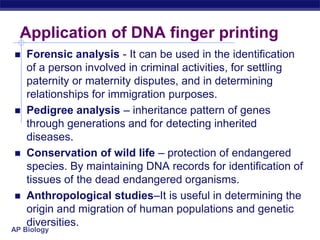
Application of DNA finger printing
 Forensic analysis - It can be used in the identification
of a person involved in criminal activities, for settling
paternity or maternity disputes, and in determining
relationships for immigration purposes.
 Pedigree analysis – inheritance pattern of genes
through generations and for detecting inherited
diseases.
 Conservation of wild life – protection of endangered
species. By maintaining DNA records for identification of
tissues of the dead endangered organisms.
 Anthropological studies–It is useful in determining the
origin and migration of human populations and genetic
diversities.
AP Biology
Advantages and Disadvantages
 It is an easy and painless method
for the subject being tested. It is
less invasive then taking a blood
sample.
 It is an affordable and reliable
technique
 It can be conducted in a relatively
short amount of time
 Anyone at any age can be tested
with this method without any
major concerns
 There is a large variety of uses
such as in legal claims, missing
persons cases, identification for
the military, and paternity and
prenatal testing
 The technique has used since
1984, making it highly developed
and improved
 The sample of DNA can easily be ruined
during the process of DNA fingerprinting,
causing the sample to become
completely useless for testing
 The process itself is complex and
tedious, and can give results that may be
hard to interpret
 The test needs to be run on multiple
samples, a numerous amount of
times for ideal accuracy. Commonly, labs
run each test twice with four samples.
 Privacy issues could occur if the
information isn't kept secure at the lab.
Personal information legally can only be
released with a written order. This
personal information if leaked, could
potentially complicate insurance
processes, health care and job prospects
for an individual
AP Biology
Techniques of Inserting
Genes into Cells
AP Biology
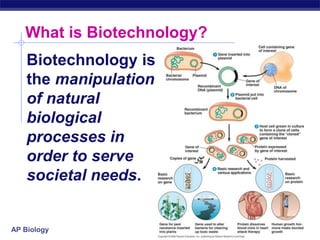
What is Biotechnology?
Biotechnology is
the manipulation
of natural
biological
processes in
order to serve
societal needs.
AP Biology
Types of Biotechnology
4 MAIN AREAS OF BIOTECHNOLOGY
Transgenic
Biotechnology
Mixing genetic material from multiple
sources (species)
Reproductive
cloning
Techniques used to clone certain species
(mammals)
Reprogramming
of Cells
Reprogramming differentiated cells or
using stem cells to become needed tissues
in patients with diseases or physical harm
Forensic
Biotechnology
Use of restriction enzymes and
electrophoresis to distinguish one person
from another
AP Biology
TRANSGENIC
BIOTECHNOLOGY
AP Biology
HGH Deficiencies
The pituitary gland produces a
crucial hormone called the
human growth hormone.
 This peptide hormone (protein)
provides for normal growth
and development.
 If the pituitary gland is
defective then growth is
severely stunted.
 For many years HGH had to be
extracted from the pituitary
glands of deceased humans
which meant that there was a
shortage of available HGH.
AP Biology
Starting in the mid-1980’s…
Now, we have all we need! How?
 The HGH gene was cut out of
the human genome and
inserted into a plasmid, which
is now now called
recombinant DNA because it
contains DNA from multiple
sources.
 The plasmid is then taken up
via transformation by a
bacterium.
 The bacterium reproduces
many times and when the the
bacterium undergoes
transcription and translation
(protein synthesis), it makes
all of the HGH that we could
possibly need!
AP Biology
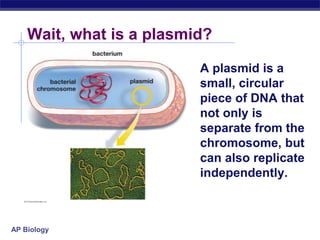
Wait, what is a plasmid?
A plasmid is a
small, circular
piece of DNA that
not only is
separate from the
chromosome, but
can also replicate
independently.
AP Biology
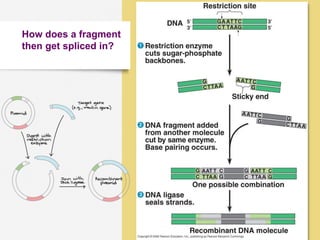
How do they cut
out a gene?
 How do they
cut the gene
of interest
out of the
genome?
• Restriction Enzymes!!
AP Biology
How does a fragment
then get spliced in?
92
AP Biology
Insulin
The pancreas, among other functions,
produces a crucial hormone called insulin.
 This peptide hormone (protein) ensures
that glucose is taken up by the cells for
cellular respiration.
 If the pancreas is defective then the
blood sugar levels get dangerously high
causing many physiological effects
(Diabetes mellitus).
 Using very similar technique as HGH
production previously mentioned,
scientists were able to use E. coli to
bioengineer synthetic insulin in 1977.
 Other transgenic organisms used to
produce insulin today are yeast
(Saccharomyces cerevisiae) and a plant
called safflower (Carthamus tinctorius).
AP Biology
AP Biology
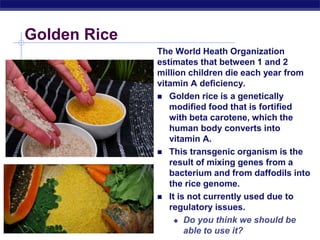
Golden Rice
The World Heath Organization
estimates that between 1 and 2
million children die each year from
vitamin A deficiency.
 Golden rice is a genetically
modified food that is fortified
with beta carotene, which the
human body converts into
vitamin A.
 This transgenic organism is the
result of mixing genes from a
bacterium and from daffodils into
the rice genome.
 It is not currently used due to
regulatory issues.
 Do you think we should be
able to use it?
AP Biology
REPRODUCTIVE
CLONING
AP Biology
Reproductive Cloning
 What is a clone?
 It is an exact genetic
replica of another
cell or organism.
 What have we cloned
so far?
 DNA (Polymerase
Chain Reaction)
 Cells (creating
tissue cultures or
stem cell lines)
 Whole organisms
AP Biology
Organismal Cloning
 What has been cloned thus
far?
 Plants have been cloned for
thousands of years!
 Bananas, potatoes, grape
vines (grafting), etc.
 Many trees, shrubs, and vines
are just clonal colonies.
 Animals
 Parthenogenesis – asexual
reproduction that occurs
naturally where offspring is
born with sexual reproduction
(sharks, anteaters, some
insects, etc.)
 Some animals have
undergone somatic cell
nuclear transfer such as:
sheep, rats, cats, goats, dogs,
camels, and many others.
AP Biology
Somatic Cell Nuclear
Transfer (SCNT)
99
 a laboratory
strategy for
creating a
viable embryo
from a body
cell and an egg
cell.
AP Biology
So, what if we…
• What if we manipulate
animal embryos and use
recombinant technology
to give these animals
some beneficial
characteristics…to us?
That is what some
scientists have been
able to do. Some
animals, like this goat,
have been bred to
produce certain peptide
hormones needed by
humans when they
express milk. These
proteins can easily be
separated from the milk
for human use!
100
AP Biology
REPROGRAMMING
CELLS
AP Biology
What can stem cell research do for us?
Stem cells could help us in many medical
applications such as:
 Organ and tissue regeneration
 Fighting the following diseases:
 Cardiovascular disease
 Brain diseases like Parkinson’s and Alzheimer's
 Blood diseases like leukemia and sickle-cell
anemia
So…what’s all the fuss about?
The stems cells that work the best come
from embryos.
AP Biology
Plant cells are totipotent!
AP Biology
Stem Cells
 What are they?
 Stem cells are
undifferentiated, meaning
that they haven’t become
a “type” of cell yet.
 When a sperm meets an
egg, the resulting zygote
is totipotent. The inner
cell mass, the source of
“embryonic stem” cells,
are pluripotent.
 Totipotent cells have
the ability to create a
whole organism, or at
least all different
types of tissues.
 Pluripotent cells can
only give rise to most
types of tissues, and
definitely NOT a
whole organism. 104
AP Biology
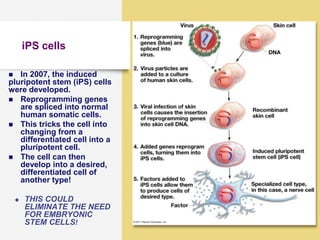
iPS cells
 In 2007, the induced
pluripotent stem (iPS) cells
were developed.
 Reprogramming genes
are spliced into normal
human somatic cells.
 This tricks the cell into
changing from a
differentiated cell into a
pluripotent cell.
 The cell can then
develop into a desired,
differentiated cell of
another type!
 THIS COULD
ELIMINATE THE NEED
FOR EMBRYONIC
STEM CELLS!
AP Biology
John Gurdon
Shinya Yamanaka
They received the
2012 Nobel Prize
(Physiology and
Medicine) for their
work with the
development of iPS
cells.
The 2012 Nobel Prize in
Physiology and Medicine
AP Biology
FORENSIC BIOTECHNOLOGY
AP Biology
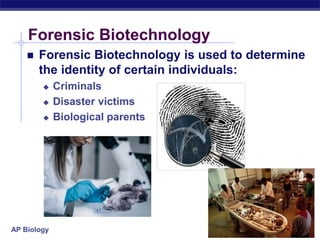
Forensic Biotechnology
 Forensic Biotechnology is used to determine
the identity of certain individuals:
 Criminals
 Disaster victims
 Biological parents
AP Biology
Electrophoresis
AP Biology
Electrophoresis
AP Biology
111
PCR: Polymerase
Chain Reaction
 Usually there is
only a small
amount of DNA to
work with at a
crime scene.
 Investigators and
forensic scientists
use the polymerase
chain reaction to
make thousands of
copies of key
regions of the
original DNA
strand.
AP Biology
Electrophoresis
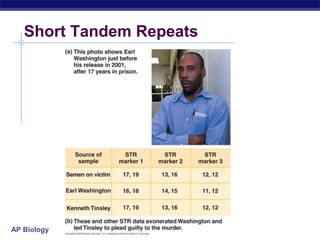
 The PCR products (DNA strands) are analyzed via
electrophoresis for STR’s (short tandem repeats).
 Every person has their own individual pattern of these
STRs.
 For a single set of primers, a person will have 2 PCR
products if they inherited different numbers of STRs from
each parent. This results in 2 bands on their gel.
AP Biology
Short Tandem Repeats
AP Biology
DNA Analysis
We have the ability to “sequence
DNA.” This means that if we know
the gene we are looking for we can
analyze someone’s DNA for a
specific sequence, i.e. allele.
 Therefore, we could tell you
definitively if you have a
disorder like Huntington’s, an
autosomal dominant disorder, or
not.
 Huntington’s Disorder is a
degenerative brain disorder that
“usually” starts causing telltale
symptoms around age 35. There
is no cure for Huntington’s and
it is eventually fatal.
Would you want to know?
AP Biology
Other than the ones already mentioned, here are some other “real-
life” examples of biotechnology.
 Injecting human brain cells into monkey brains
 for brain disease research
 Xenotransplantation
 using animal “parts” for our parts (for instance using a pig
valve to replace a defective heart valve in a human)
 Adding human stem cells to sheep fetuses
 to produce sheep with livers made of mostly human tissue
 Bt crops
 these crops contain genes from the bacterium Bacillus
thuringiensis which produces proteins toxic to pest insects
 Roundup Ready crops
 contain genes that protect them from Roundup (herbicide)
AP Biology
Genetics
and
Heredity
AP Biology
KEY CONCEPT
Human inheritance patterns are more complex.
AP Biology
Genetics terms you need to know:
 Gene – a unit of heredity;
a section of DNA sequence
encoding a single protein
 Genome – the entire set
of genes in an organism
 Alleles – two genes that occupy the same
position on homologous chromosomes and
that cover the same trait (like ‘flavors’ of a
trait).
 Locus – a fixed location on a strand of DNA
where a gene or one of its alleles is located.
AP Biology
 Homozygous – having identical genes (one
from each parent) for a particular characteristic.
 Heterozygous – having two different genes for
a particular characteristic.
 Dominant – the allele of a gene that masks or
suppresses the expression of an alternate
allele; the trait appears in the heterozygous
condition.
 Recessive – an allele that is masked by a
dominant allele; does not appear in the
heterozygous condition, only in homozygous.
AP Biology
 Genotype – the genetic makeup of an organisms
 Phenotype – the physical appearance
of an organism (Genotype + environment)
 Monohybrid cross: a genetic cross involving a
single pair of genes (one trait); parents differ by
a single trait.
 P = Parental generation
 F1 = First filial generation; offspring from a
genetic cross.
 F2 = Second filial generation of a genetic cross
AP Biology
INTRODUCTION
 Many theories of
inheritance have been
proposed to explain
transmission of
hereditary traits
 Blending Theory of
Inheritance
 Gregor Mendel’s
pioneering experiments
with garden peas solved
it once and for all!
AP Biology
 Gregor Johann Mendel (1822-1884) is considered
the father of genetics
 His success can be attributed, in part, to
 His boyhood experience in grafting trees
 This taught him the importance of precision and
attention to detail
 His university experience in physics and natural
history
 This taught him to view the world as an orderly
place governed by natural laws
These laws can be stated mathematically
Mendel, Gregor
AP Biology
 His work, entitled “Experiments on Plant Hybrids” was
published in 1866
 It was ignored for 34 years
 Probably because
 It was published in an obscure journal
 Lack of understanding of chromosome
transmission
‘THE FOOL’
Rediscovery
 In 1900, Mendel’s work
was rediscovered by
three botanists
working independently
AP Biology
Mendel Chose Pea Plants as
His Experimental Organism
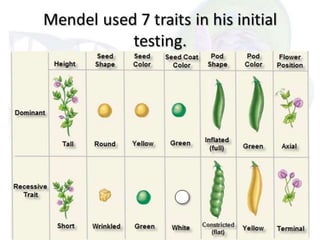
 Mendel chose the garden pea to study the
natural laws governing plants hybrids
 The garden pea was advantageous
because
 1. It existed in several varieties with
distinct characteristics
 2. Its structure allowed for easy crosses
AP Biology
Contain the pollen grains, where
the male gametes are produced
AP Biology
Mendel Chose Pea Plants as
His Experimental Organism
 Mendel carried out two types of crosses
 1. Self-fertilization
 Pollen and egg are derived from the same plant
 2. Cross-fertilization
 Pollen and egg are derived from different plants
AP Biology
Self-Pollination
 Involves having
the pollen (male
sperm) be directly
deposited on the
female section of
the flower
AP Biology
Cross- Pollination
 Requires the
removal of the male
stamen (makes
pollen) on 1st flower
and transferring the
pollen from a
different flower
to the first one
AP Biology
AP Biology
Mendel’s Experiments
 Mendel crossed two variants that differ in
only one trait
 This is termed a monohybrid cross -
differences in just one character between
the parents.
AP Biology
Monohybrid cross
 Parents differ by a single trait.
 Crossing two pea plants that differ in stem
size, one tall one short
T = allele for Tall
t = allele for dwarf
TT = homozygous tall plant
t t = homozygous dwarf plant
T T  t t
AP Biology
Monohybrid cross for stem length:
T T  t t
(tall) (dwarf)
P = parentals
true breeding,
homozygous plants:
F1 generation
is heterozygous:
T t
(all tall plants)
AP Biology
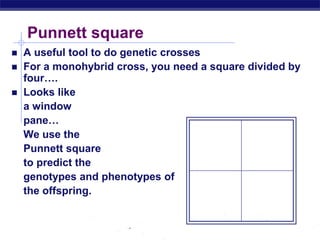
Punnett square
 A useful tool to do genetic crosses
 For a monohybrid cross, you need a square divided by
four….
 Looks like
a window
pane…
We use the
Punnett square
to predict the
genotypes and phenotypes of
the offspring.
AP Biology
Using a Punnett Square
STEPS:
1. determine the genotypes of the parent organisms
2. write down your "cross" (mating)
3. draw a p-square
Parent genotypes:
TT and t t
Cross
T T  t t
AP Biology
Punnett square
4. "split" the letters of the genotype for each parent & put
them "outside" the p-square
5. determine the possible genotypes of the offspring by filling
in the p-square
6. summarize results (genotypes & phenotypes of offspring)
T t T t
T t T t
T T
t
t
Genotypes:
100% T t
Phenotypes:
100% Tall plants
T T  t t
AP Biology
Monohybrid cross: F2 generation
 If you let the F1 generation self-fertilize, the next
monohybrid cross would be:
T t  T t
(tall) (tall)
T T T t
T t t t
T t
T
t
Genotypes:
1 TT= Tall
2 Tt = Tall
1 tt = dwarf
Genotypic ratio= 1:2:1
Phenotype:
3 Tall
1 dwarf
Phenotypic ratio= 3:1
AP Biology
Secret of the Punnett Square
 Key to the Punnett Square:
 Determine the gametes of each parent…
 How? By “splitting” the genotypes of each
parent:
If this is your cross T T  t t
T T t t
The gametes are:
AP Biology
Once you have the gametes…
T T t t
T t T t
T t T t

T
T
t t
AP Biology
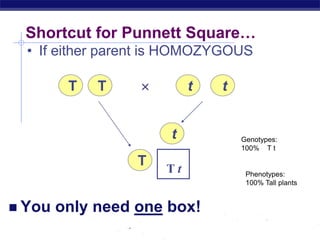
Shortcut for Punnett Square…
 You only need one box!
T T t t

T
t Genotypes:
100% T t
Phenotypes:
100% Tall plants
• If either parent is HOMOZYGOUS
T t
AP Biology
Understanding the shortcut…
T
t
T t T t
T t T t
T
T
t t
=
Genotypes:
100% T t
Phenotypes:
100% Tall plants
T t
AP Biology
If you have another cross…
 A heterozygous with a homozygous
T t t t

T
t
t
T t
t t
Genotypes:
50% T t
50 % t t
Phenotypes:
50% Tall plants
50% Dwarf plants
You can
still use the
shortcut!
AP Biology
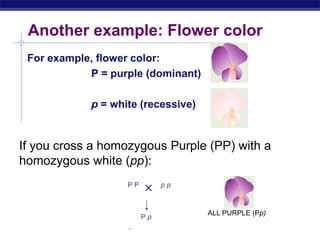
Another example: Flower color
For example, flower color:
P = purple (dominant)
p = white (recessive)
If you cross a homozygous Purple (PP) with a
homozygous white (pp):

P P p p
P p
ALL PURPLE (Pp)
AP Biology
Cross the F1 generation:
P p P p

P P P p
P p p p
P
p
P p
Genotypes:
1 PP
2 Pp
1 Pp
Genotypic Ratio: 1:2:1
Phenotypes:
3 Purple
1 White
Phenotypic Ratio: 3:1
AP Biology
Mendel’s Principles
 1. Principle of Dominance:
One allele masked another, one allele was
dominant over the other in the F1 generation.
 2. Principle of Segregation:
When gametes are formed, the pairs of
hereditary factors (genes) become separated,
so that each sex cell (egg/sperm) receives
only one kind of gene.
AP Biology
Human case: CF
 Mendel’s Principles of Heredity apply
universally to all organisms.
 Cystic Fibrosis: a lethal genetic disease
affecting Caucasians.
 Caused by mutant recessive gene carried by 1
in 20 people of European descent (12M)
 One in 400 Caucasian couples will be both
carriers of CF – 1 in 4 children will have it.
 CF disease affects transport
in tissues – mucus is accumulated
in lungs, causing infections.
AP Biology
Inheritance pattern of CF
IF two parents carry the recessive gene of
Cystic Fibrosis (c), that is, they are
heterozygous (C c), one in four of their
children is expected to be homozygous for
cf and have the disease:
C C C c
C c c c
C c
C
c
C C = normal
C c = carrier, no symptoms
c c = has cystic fibrosis
AP Biology
Probabilities…
 Of course, the 1 in 4 probability of getting the
disease is just an expectation, and in reality, any
two carriers may have normal children.
 However, the greatest probability is for 1 in 4
children to be affected.
 Important factor when prospective parents are
concerned about their chances of having
affected children.
 Now, 1 in 29 Americans is a symptom-less
carrier (Cf cf) of the gene.
AP Biology
Gaucher Disease
 Gaucher Disease is a rare, genetic disease. It
causes lipid-storage disorder (lipids accumulate
in spleen, liver, bone marrow)
 It is the most common genetic disease affecting
Jewish people of Eastern European ancestry
(1 in 500 incidence; rest of pop. 1 in 100,000)
AP Biology
Dihybrid crosses
 Matings that involve parents that differ in two
genes (two independent traits)
For example, flower color:
P = purple (dominant)
p = white (recessive)
and stem length:
T = tall t = short
AP Biology
Dihybrid cross: flower color and
stem length
TT PP  tt pp
(tall, purple) (short, white)
Possible Gametes for parents
T P and t p
F1 Generation: All tall, purple flowers (Tt Pp)
TtPp TtPp TtPp TtPp
TtPp TtPp TtPp TtPp
TtPp TtPp TtPp TtPp
TtPp TtPp TtPp TtPp
tp tp tp tp
TP
TP
TP
TP
AP Biology
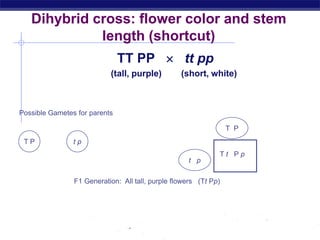
Dihybrid cross: flower color and stem
length (shortcut)
TT PP  tt pp
(tall, purple) (short, white)
Possible Gametes for parents
F1 Generation: All tall, purple flowers (Tt Pp)
T t P p
T P t p
T P
t p
AP Biology
Dihybrid cross F2
If F1 generation is allowed to self pollinate,
Mendel observed 4 phenotypes:
Tt Pp  Tt Pp
(tall, purple) (tall, purple)
Possible gametes:
TP Tp tP tp
Four phenotypes observed
Tall, purple (9); Tall, white (3); Short, purple (3); Short white (1)
TTPP TTPp TtPP TtPp
TTPp TTpp TtPp Ttpp
TtPP TtPp ttPP ttPp
TtPp Ttpp ttPp ttpp
TP Tp tP tp
TP
Tp
tP
tp
AP Biology
Dihybrid cross
9 Tall purple
3 Tall white
3 Short purple
1 Short white
TTPP TTPp TtPP TtPp
TTPp TTpp TtPp Ttpp
TtPP TtPp ttPP ttPp
TtPp Ttpp ttPp ttpp
TP Tp tP tp
TP
Tp
tP
tp
Phenotype Ratio = 9:3:3:1
AP Biology
Genotype ratios (9): Four Phenotypes:
1 TTPP
2 TTPp
2 TtPP
4 TtPp
1 TTpp
2 Ttpp
1 ttPP
2 ttPp
1 ttpp
Dihybrid cross: 9 genotypes
Tall, purple (9)
Tall, white (3)
Short, purple (3)
Short, white (1)
AP Biology
Principle of Independent Assortment
 Based on these results, Mendel postulated the
3. Principle of Independent Assortment:
“Members of one gene pair segregate
independently from other gene pairs during
gamete formation”
Genes get shuffled – these many combinations
are one of the advantages of sexual
reproduction
AP Biology
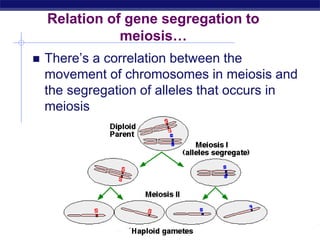
Relation of gene segregation to
meiosis…
 There’s a correlation between the
movement of chromosomes in meiosis and
the segregation of alleles that occurs in
meiosis
AP Biology
Test cross
When you have an individual with an unknown
genotype, you do a test cross.
Test cross: Cross with a homozygous
recessive individual.
For example, a plant with purple flowers can
either be PP or Pp… therefore, you cross the
plant with a pp (white flowers, homozygous
recessive)
P ?  pp
AP Biology
Test cross
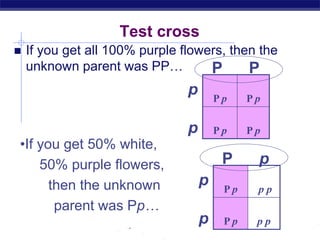
 If you get all 100% purple flowers, then the
unknown parent was PP…
P p P p
P p P p
P P
p
p
P p p p
P p p p
P p
p
p
•If you get 50% white,
50% purple flowers,
then the unknown
parent was Pp…
AP Biology
Dihybrid test cross??
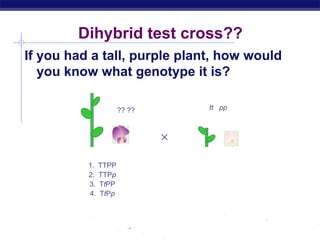
If you had a tall, purple plant, how would
you know what genotype it is?

tt pp
?? ??
1. TTPP
2. TTPp
3. TtPP
4. TtPp
AP Biology
Beyond Mendelian Genetics:
Incomplete Dominance
Mendel was lucky!
Traits he chose in the
pea plant showed up
very clearly…
One allele was dominant over another, so
phenotypes were easy to recognize.
But sometimes phenotypes are not very
obvious…
AP Biology
Incomplete Dominance
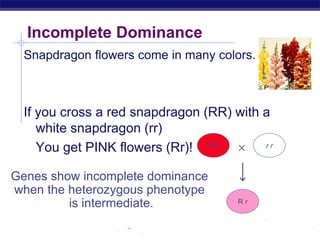
Snapdragon flowers come in many colors.
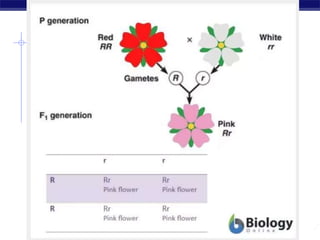
If you cross a red snapdragon (RR) with a
white snapdragon (rr)
You get PINK flowers (Rr)! R R
R r
r r

Genes show incomplete dominance
when the heterozygous phenotype
is intermediate.
AP Biology
AP Biology
AP Biology
Incomplete dominance
Incomplete Dominance
When F1 generation (all pink flowers) is self
pollinated, the F2 generation is 1:2:1
red, pink, white
R R R r
R r r r
R r
R
r
AP Biology
• Chromosomes come in homologous pairs, thus genes
come in pairs.
Homologous pairs – matching genes – one from female
parent and one from male parent
• Example: Humans have 46 chromosomes or 23 pairs.
One set from dad – 23 in sperm
One set from mom – 23 in egg
AP Biology
Gene for eye color
(blue eyes)
Gene for eye color
(brown eyes)
Homologous pair
of chromosomes
• One pair of Homologous Chromosomes:
Alleles – different genes (possibilities) for the same trait –
ex: blue eyes or brown eyes
AP Biology
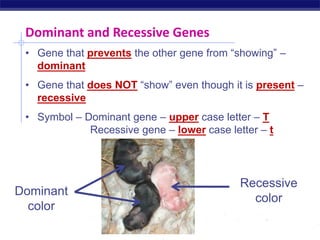
Dominant and Recessive Genes
• Gene that prevents the other gene from “showing” –
dominant
• Gene that does NOT “show” even though it is present –
recessive
• Symbol – Dominant gene – upper case letter – T
Recessive gene – lower case letter – t
Dominant
color
Recessive
color
AP Biology
• Both genes of a pair are the same –
homozygous or purebred
TT – homozygous dominant
tt – homozygous recessive
• One dominant and one recessive gene –
heterozygous or hybrid
Tt – heterozygous
BB – Black
Bb – Black w/
white
gene
bb – White
AP Biology
Example: Straight thumb is dominant to hitchhiker thumb
T = straight thumb t = hitchhikers thumb
(Always use the same letter for the same alleles—
No S = straight, h = hitchhiker’s)
Straight thumb = TT
Straight thumb = Tt
Hitchhikers thumb = tt * Must have 2 recessive alleles
for a recessive trait to “show”
AP Biology
Genotype and Phenotype
• Combination of genes an organism has (actual gene
makeup) – genotype
Ex: TT, Tt, tt
• Physical appearance resulting from gene make-up –
phenotype
Ex: hitchhiker’s thumb or straight thumb
AP Biology
Genotype vs. Phenotype
AP Biology
White fur (b)
Punnett Square and Probability
• Used to predict the possible gene makeup of offspring –
Punnett Square
• Example: Black fur (B) is dominant to white fur (b) in mice
1. Cross a heterozygous male with a homozygous recessive
female.
Black fur (B)
White fur (b)
Heterozygous
male
White fur (b)
Homozygous
recessive female
AP Biology
Bb Bb
bb bb
Write the ratios in the following orders:
Genotypic ratio
homozygous : heterozygous : homozygous
dominant recessive
Phenotypic ratio
dominant : recessive
b
b
b
B Possible offspring – 2N
Male gametes - N
(One gene in
sperm)
Female gametes – N
(One gene in egg)
Male = Bb X Female = bb
Genotypic ratio = 2 Bb : 2 bb
50% Bb : 50% bb
Phenotypic ratio = 2 black : 2 white
50% black : 50% white
AP Biology
BB Bb
Bb bb
B b
B
Genotypic ratio = 1 BB : 2 Bb : 1 bb
25% BB : 50% Bb : 25% bb
Phenotypic ratio = 3 black : 1 white
75% black : 25% white
Cross 2 hybrid mice and give the genotypic ratio and
phenotypic ratio.
Bb X Bb
b
AP Biology
BB Bb
Bb bb
B
b
B
b
Example: A man and woman, both with brown eyes (B)
marry and have a blue eyed (b) child. What are the
genotypes of the man, woman and child?
Bb X Bb
Man = Bb
Woman = Bb
AP Biology
1 brown and curly
BBHH BBHh BbHH BbHh
BBHh BBhh BbHh Bbhh
BbHH BbHh bbHH bbHh
BbHh Bbhh bbHh bbhh
BH
BH
Bh
Bh
bH
bH
bh
bh
9 black and straight
3 black and curly
3 brown and straight
Gametes
Crossing involving 2 traits – Dihybrid crosses
• Example: In rabbits black coat (B) is dominant over brown (b) and
straight hair (H) is dominant to curly (h). Cross 2 hybrid rabbits
and give the phenotypic ratio for the first generation of offspring.
Possible gametes:
BbHh X BbHh
BH BH
Bh Bh
bH bH
bh bh
Phenotypes - 9:3:3:1
AP Biology
BBHH BBHh
Gametes
Gametes
BH
BH Bh
100% black and straight
• Example: In rabbits black coat (B) is dominant over brown (b) and
straight hair (H) is dominant to curly (h). Cross a rabbit that is
homozygous dominant for both traits with a rabbit that is
homozygous dominant for black coat and heterozygous for straight
hair. Then give the phenotypic ratio for the first generation of
offspring.
BBHH X BBHh
Possible gametes: BH BH
Bh
(Hint: Only design Punnett squares to suit the number of possible gametes.)
Phenotypes:
AP Biology
Incomplete dominance and Codominance
• When one allele is NOT completely dominant over
another (they blend) – incomplete dominance
Example: In carnations the color red (R) is incompletely
dominant over white (W). The hybrid color is
pink. Give the genotypic and phenotypic ratio from a
cross between 2 pink flowers.
RW X RW
RR RW
RW WW
R
W
R
W
Genotypic = 1 RR : 2 RW : 1 WW
Phenotypic = 1 red : 2 pink : 1 white
AP Biology
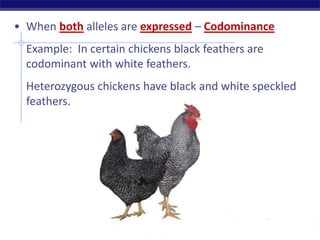
• When both alleles are expressed – Codominance
Example: In certain chickens black feathers are
codominant with white feathers.
Heterozygous chickens have black and white speckled
feathers.
AP Biology
Sex Determination
• People – 46 chromosomes or 23 pairs
• 22 pairs are homologous (look alike) – called autosomes –
determine body traits
1 pair is the sex chromosomes – determines sex (male or female)
• Females – sex chromosomes are homologous (look alike) – label XX
Males – sex chromosomes are different – label XY
AP Biology
XX XX
XY XY
X
Y
• What is the probability of a couple having a boy? Or a girl?
Chance of having female baby? 50%
male baby? 50%
Who determines the sex of the child? father
X
X
AP Biology
Sex – linked Traits
• Genes for these traits are
located only on the X
chromosome (NOT on the
Y chromosome)
• X linked alleles always
show up in males whether
dominant or recessive
because males have only
one X chromosome
AP Biology
• Examples of recessive sex-linked disorders:
1. colorblindness – inability to distinguish between
certain colors
Color blindness is the inability to distinguish the differences between certain colors. The most
common type is red-green color blindness, where red and green are seen as the same color.
You should see
58 (upper left),
18 (upper right),
E (lower left) and
17 (lower right).
AP Biology
XNXN XNXn
XNY XnY
XN Xn
XN
Y
Phenotype: 2 normal vision females
1 normal vision male
1 colorblind male
• Example: A female that has normal vision but is a carrier
for colorblindness marries a male with normal vision.
Give the expected phenotypes of their children.
N = normal vision
n = colorblindness XN Xn X XN Y
AP Biology
AP Biology
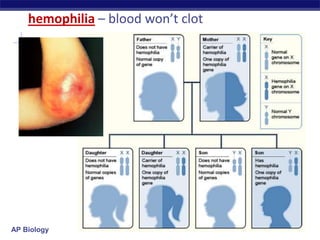
hemophilia – blood won’t clot
AP Biology
AP Biology
Pedigrees
• Graphic representation of how a trait is
passed from parents to offspring
• Tips for making a pedigree
1. Circles are for females
2. Squares are for males
3. Horizontal lines connecting a male and a
female represent a marriage
4. Vertical line and brackets connect parent
to offspring
5. A shaded circle or square indicates a
person has the trait
6. A circle or square NOT shaded represents
an individual who does NOT have the trait
7. Partial shade indicates a carrier –
someone who is heterozygous for the
trait
AP Biology
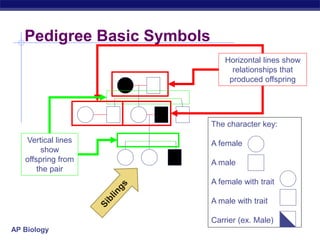
Pedigree Basic Symbols
Horizontal lines show
relationships that
produced offspring
Vertical lines
show
offspring from
the pair
The character key:
A female
A male
A female with trait
A male with trait
Carrier (ex. Male)
AP Biology
• Example: Make a pedigree chart for the following
couple. Dana is color blind; her husband Jeff is not.
They have two boys and two girls.
HINT: Colorblindness is a recessive sex-linked trait.
XNY
Has trait Can pass trait to
offspring
XnXn
AP Biology
Multiple Alleles
 There Are Always Multiple Alleles!
 Genetic inheritance is often presented with
straightforward examples involving only two
alleles with clear-cut dominance. This makes
inheritance patterns easy to see.
 But very few traits actually only have two alleles
with clear-cut dominance. As we learn more
about genetics, we have found that there are
often hundreds of alleles for any particular
gene.
 We probably know this already - as we look around
at other people, we see infinite variation.
AP Biology
Multiple Alleles
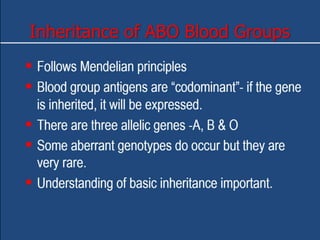
• 3 or more alleles of the same gene that code for a single trait
• In humans, blood type is determined by 3 alleles – A, B, and O
BUT each human can only inherit 2 alleles
1. Dominant – A and B (codominance)
Recessive – O
2. Blood type – A = AA or AO
B = BB or BO
AB = AB
O = OO
AP Biology
A B
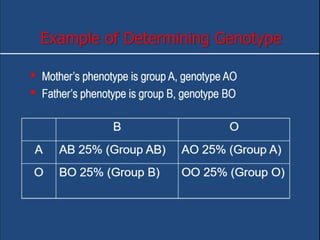
Example: What would be the possible blood types of
children born to a female with type AB blood and
a male with type O blood?
AB X OO
AO BO
AO BO
O
O
Children would be type A or B only
AP Biology
Multiple Alleles
 Multiple Alleles- Three or more alleles
of the same gene.
 Even though three or more alleles exist
for a particular trait, an individual can
only have two alleles - one from the
mother and one from the father.
AP Biology
Examples of Multiple Alleles
1. Coat color in rabbits is determined
by a single gene that has at least four
different alleles. Different
combinations of alleles result in the
four colors you see here.
AP Biology
Examples of Multiple Alleles
2. Blood Type – 3 alleles
exist (IA, IB, and i),
which results in four
different possible
blood
types
3. Hair Color – Too many
alleles exist to count
 There are over 20
different shades of
hair color.
AP Biology
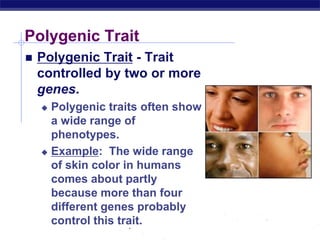
Polygenic Trait
 Polygenic Trait - Trait
controlled by two or more
genes.
 Polygenic traits often show
a wide range of
phenotypes.
 Example: The wide range
of skin color in humans
comes about partly
because more than four
different genes probably
control this trait.
AP Biology
AP Biology
The Genetics of ABO
and Rh Blood Group
AP Biology
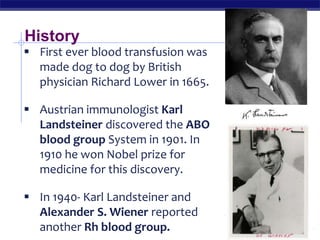
 First ever blood transfusion was
made dog to dog by British
physician Richard Lower in 1665.
 Austrian immunologist Karl
Landsteiner discovered the ABO
blood group System in 1901. In
1910 he won Nobel prize for
medicine for this discovery.
 In 1940- Karl Landsteiner and
Alexander S. Wiener reported
another Rh blood group.
History
AP Biology
ABO Blood Group System
AP Biology
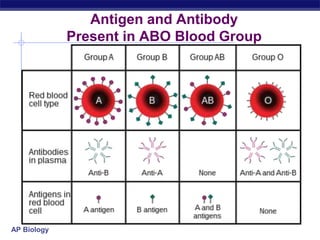
ABO Basics
 Based on the presence or absence of Antigen A and
B, blood is divided into four groups: A, B, AB, and O
group.
 Blood having antigen A belongs to ‘A’ group. This
blood has β-antibody in the serum.
 Blood with antigen B and α-antibody belongs to ‘B’
group.
 If both the antigens are present, blood group is
called ‘AB’ group and serum of this group does not
contain any antibody.
 If both antigens are absent, the blood group is called
‘O’ group and both α and β antibodies are present in
the serum.
AP Biology
The ABO blood group antigens are complex
oligosaccharide chains that differ in their terminal sugar
and project above the RBC surface.
following types of abs may develop-
type A: anti-B abs, type B: anti-A abs, type O :
both & type AB: neither.
ABO Blood Group System
AP Biology
Antigen and Antibody
Present in ABO Blood Group
AP Biology
AP Biology
AP Biology
▪The ABO locus has three main allele forms: A, B, & O.
The A and B genes found on chromosome 9 and are
inherited one gene (allele) from father and one from
mother.
1.Homozygous A 2. Heterozygous A
Genotype A/A Genotype A/0
Phenotype A Phenotype A
Inheritance of ABO Blood Group System
AP Biology
1. If a certain agglutinogen is present on the surface
of RBCs, the corresponding agglutinin must be absent
in the plasma .
2. If a certain agglutinogen is absent on the surface of
RBCs, then corresponding agglutinin must be present
in the plasma.
Landsteiner’s Law
AP Biology
Principle of Blood Grouping
 Blood grouping is done on the basis of
agglutination.
 Agglutination means the collection of
separate particles like RBCs into clumps
or masses.
 Agglutination occurs if an antigen is
mixed with its corresponding antibody
which is called isoagglutinin, i.e. occurs
when A antigen is mixed with anti-A or
when B antigen is mixed with anti-B.
AP Biology
AP Biology
AP Biology
AP Biology
AP Biology
AP Biology
AP Biology
1. Safe blood
transfusion that may be
life saving.
2. To prevent hemolytic
disease of new born
(Rh compatibility in
newborn)
3. To solve the legal
disputes related to
parenting claimant.
4. To study the
Mendelian laws of
Importance of knowing about
blood group system
AP Biology
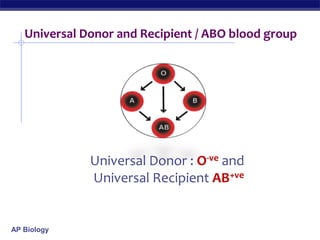
Universal Donor : O-ve and
Universal Recipient AB+ve
Universal Donor and Recipient / ABO blood group
AP Biology
AP Biology
AP Biology
Transfusion Reactions Due to
ABO Incompatibility
 Transfusion reactions are the
adverse reactions in the
body, which occur due to
transfusion error that
involves transfusion of
incompatible or mismatched
blood.
 The reactions may be mild
causing only fever and hives
(skin disorder characterized
by itching) or may be severe
leading to renal failure, shock
and death.
AP Biology
Rh Blood Group System
AP Biology
Rh Blood Group System
 The Rh blood group system is one of thirty-
five current human blood group systems.
 It is the most important blood group system
after ABO.
 Rh gene located on short arm of
chromosome 1.
 Rh blood group system consists of 50
defined blood-group antigens, among them
there are six common type of Rh antigens.
 Each of which is called an Rh factor.
These types are designated C, D, E, c, d and e.
AP Biology
Rhesus Factor (Rh)
 If a person has a positive Rh factor, this
means that their blood contains a protein
that is also found in Rhesus monkeys.
 Most people (about 85%) have a positive
Rh factor
 Rh is expressed as either positive or
negative.
 The Rh factor, like other antigens, is
found on the surface of the red blood
cells.
AP Biology
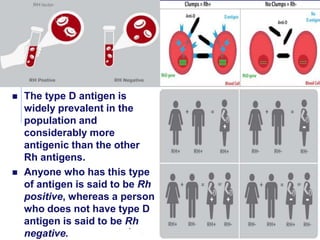
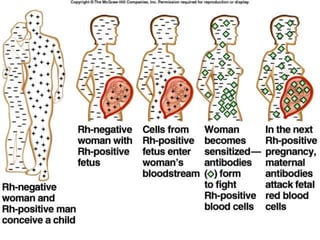
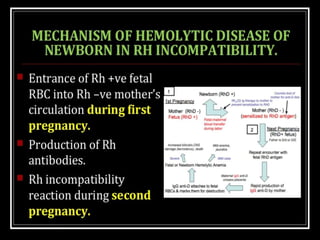
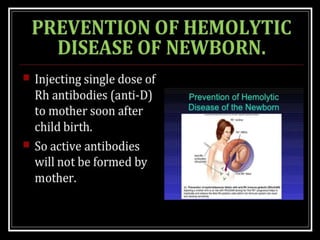
 The type D antigen is
widely prevalent in the
population and
considerably more
antigenic than the other
Rh antigens.
 Anyone who has this type
of antigen is said to be Rh
positive, whereas a person
who does not have type D
antigen is said to be Rh
negative.
AP Biology
AP Biology
AP Biology
AP Biology
AP Biology
AP Biology
AP Biology
AP Biology
AP Biology
AP Biology
AP Biology
AP Biology
AP Biology
AP Biology
AP Biology
AP Biology
AP Biology
AP Biology
AP Biology
AP Biology
AP Biology
AP Biology
Interesting Facts
 Men generally have more red blood
cells than women.
 Rare blood types exist in addition to the
basic ABO system.
AP Biology
AP Biology
The parents in this cross
are _____________
Homozygous Heterozygous
Heterozygous
If G is dominant for green pods and g is
recessive for yellow pods, what percentage of the
offspring will have green pods? _______%
75
GG Gg
Gg gg
G g
G
g
AP Biology
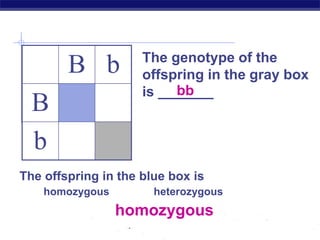
B b
B
b
The genotype of the
offspring in the gray box
is _______
bb
The offspring in the blue box is
homozygous heterozygous
homozygous
AP Biology
If you cross a homozygous RED flowered four o’clock
plant with a homozygous WHITE flowered plant, ALL
of the offspring produced have PINK flowers.
This type of inheritance in which the heterozygote (Rr)
shows a blending of traits is called __________.
A. Dominant/recessive inheritance
B. Co-dominance
C. Incomplete dominance
Incomplete dominance
AP Biology
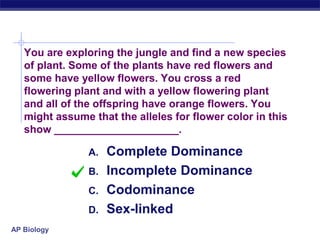
You are exploring the jungle and find a new species
of plant. Some of the plants have red flowers and
some have yellow flowers. You cross a red
flowering plant and with a yellow flowering plant
and all of the offspring have orange flowers. You
might assume that the alleles for flower color in this
show _____________________.
A. Complete Dominance
B. Incomplete Dominance
C. Codominance
D. Sex-linked
AP Biology
If the red and yellow alleles in the mystery
jungle plant above showed CODOMINANCE
instead, what might you expect a plant with one
red allele and one yellow allele to look like?
A. It would have all red flowers.
B. It would have all blue flowers.
C. It would have red and yellow flowers
together on one plant.
D. It wouldn’t make any flowers because it is
a mutant.
AP Biology
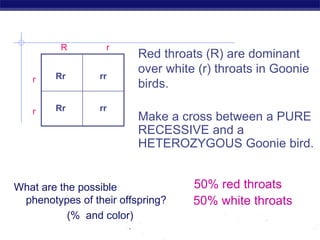
What are the possible
phenotypes of their offspring?
(% and color)
Red throats (R) are dominant
over white (r) throats in Goonie
birds.
Make a cross between a PURE
RECESSIVE and a
HETEROZYGOUS Goonie bird.
50% red throats
50% white throats
Rr rr
Rr rr
R r
r
r
AP Biology
What are the possible
phenotypes of their offspring?
(% and color)
Black eyes (B) are dominant
over red eyes (b) in rats.
Make a cross between two
HETEROZYGOUS rats.
75 % black eyes
25% red eyes
B b
B
b
BB Bb
Bb bb
AP Biology
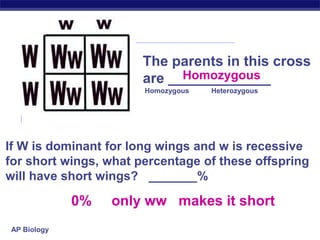
The parents in this cross
are _____________
Homozygous Heterozygous
Homozygous
If W is dominant for long wings and w is recessive
for short wings, what percentage of these offspring
will have short wings? _______%
0% only ww makes it short
AP Biology
What is the probability the offspring
will have straight tails?
In Reebops curly tails (T) are
dominant over straight tails (t).
Make a cross between a
HOMOZYGOUS DOMINANT
and a HOMOZYGOUS
RECESSIVE Reebop.
0%
All will be Curly tailed
(Tt)
Tt Tt
Tt Tt
T T
t
t
AP Biology
Which of the following is NOT TRUE?
Genotype determines phenotype
Alleles are different forms of the same gene.
Genotype is the way the genes
make you look.
Organisms with different genotypes
can have the same phenotype.
T
T
F
T
Tt and TT both look tall
AP Biology
Alternate forms of a gene are
called
A. Chromosomes
B. Alleles
C. Gametes
D. Heterozygotes
C
h
r
o
m
o
s
o
m
e
s
A
l
l
e
l
e
s
G
a
m
e
t
e
s
H
e
t
e
r
o
z
y
g
o
t
e
s
5% 5%
0%
91%
AP Biology
Only one ________ allele is needed in
order for that trait to be expressed in
the phenotype.
A. Recessive
B. Dominant
C. Heterozygous
D. Homozygous
R
e
c
e
s
s
i
v
e
D
o
m
i
n
a
n
t
H
e
t
e
r
o
z
y
g
o
u
s
H
o
m
o
z
y
g
o
u
s
5%
0%
0%
95%
AP Biology
Which of the following genotypes
is homozygous recessive?
1 2 3
4%
96%
0%
1. RR
2. Rr
3. rr
AP Biology
The genotype TT is
1 2 3
0% 0%
100%
1. Homozygous
recessive
2. Homozygous
dominant
3. Heterozygous
AP Biology
Which of the following genotypes
is heterozygous?
1 2 3
0% 0%
100%
1. BB
2. Bb
3. bb
AP Biology
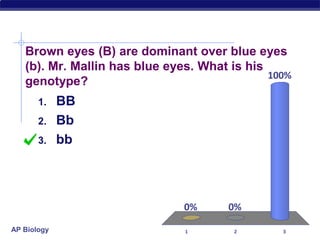
Brown eyes (B) are dominant over blue eyes
(b). Mr. Mallin has blue eyes. What is his
genotype?
1 2 3
0%
100%
0%
1. BB
2. Bb
3. bb
AP Biology
Brown eyes (B) are dominant over blue
eyes (b). Channing Tatum has brown
eyes. What is his genotype?
1 2 3 4
9%
91%
0%
0%
1. BB
2. Bb
3. bb
4. BB or Bb
AP Biology
Brown eyes (B) are dominant over blue eyes
(b). Assume Mr. Ward is homozygous dominant
for brown eyes. What is his son’s phenotype?
1 2 3 4
83%
17%
0%
0%
1. Brown eyes
2. Blue eyes
3. Bb
4. BB
AP Biology
Free earlobes (E) are dominant over attached
earlobes (e). Ms. Palmeri’s phenotype is free
earlobes and her genotype is heterozygous (Ee).
Which of these statements is true?
1 2 3
9%
0%
91%
1. Both of her parents
have attached ear
lobes
2. At least one of her
parents has free
earlobes
3. Both of her parents
are homozygous
recessive
AP Biology
If a persons genotype is EE, what percentage
of their gametes (produced by meiosis)
would contain the recessive allele?
A. 100%
B. 50%
C. 25%
D. 0%
1
0
0
%
5
0
%
2
5
%
0
%
8%
92%
0%
0%
AP Biology
The previous question is a direct
application of which of Mendel’s laws?
A. Law of
independent
assortment
B. Law of
Homozygous
Dominance
C. Law of
Segregation
D. Principle of
Dominance
L
a
w
o
f
i
n
d
e
p
e
n
d
e
n
t
a
s
s
.
.
.
L
a
w
o
f
H
o
m
o
z
y
g
o
u
s
D
o
.
.
.
L
a
w
o
f
S
e
g
r
e
g
a
t
i
o
n
P
r
i
n
c
i
p
l
e
o
f
D
o
m
i
n
a
n
c
e
9%
32%
36%
23%
AP Biology
A mutation arises in a gene that
causes a very minor change in the
protein produced. The changes
are so minor that the protein
functions in practically the same
way. So, although a new allele was
produced, it is not that much
different from the wild-type, or
most common allele. Will this
allele persist in the population?
A. Yes
B. No
C. Maybe
AP Biology
In some genes with multiple alleles, when the
alleles are together in a genotype they express
their influence equally in the phenotype. This is
known as incomplete dominance. However, other
alleles in the population may not express
themselves equally, and are considered recessive.
If an organism with two dominant alleles and an
incompletely dominant phenotype breeds with an
organism with two recessive alleles, what will the
offspring look like?
A. They will look like one or the other dominant alleles.
B. They will be something in between the two parents.
C. They will also show incomplete dominance.

Molecular Genetics final.pptx

  • 1.
    AP Biology The HumanBody Recipe DNA: Molecular Genetics
  • 2.
    AP Biology James D.Watson and Francis Harry C. Crick were awarded the Nobel Prize in 1962 for discovering the double helix structure of DNA, but work was started long before by others like Rosalind Franklin.
  • 3.
  • 4.
  • 5.
  • 6.
    AP Biology The HumanBody Recipe DNA: Molecular Genetics
  • 7.
  • 8.
    AP Biology DNA Replication DNAmust be replicated before a cell divides, so that each daughter cell inherits a copy of each gene.  Cell missing a critical gene will die  Essential that the process of DNA replication produces an absolutely accurate copy of the original genetic information  Mistake made in critical genes can result in lethal mutations.
  • 9.
    AP Biology Why doesDNA replicate? Cells copy genetic information before cell division so that each new cell has a complete set of DNA
  • 10.
    AP Biology  Structureof the DNA molecule suggest the mechanism for accurate replication  An enzyme could “read” the nitrogenous bases on one strand of a DNA molecule adding complementary bases to a newly synthesized strand.  Product of this strategy would be a new DNA molecule in which one strand is the original or parent strand, and the other is newly synthesized, a daughter strand.  This strategy is called semiconservative replication. Structure to Function in DNA Replication
  • 11.
    AP Biology 3 stepsto DNA Replication 1. UNZIP: DNA Helicase “unzips” the strands of DNA breaking the hydrogen bonds.
  • 12.
    AP Biology 2) BASEPAIRING: DNA Polymerase bonds free nucleotides with nucleotides from parent strand
  • 13.
    AP Biology 3. JoiningNucleotides: Ligase bonds nucleotides together. This result in 2 identical DNA molecules.
  • 14.
    AP Biology DNA Replication Replication is semi-conservative (one strand is old, one strand new)
  • 15.
    AP Biology Important Enzymesfor DNA Replication
  • 16.
  • 17.
    AP Biology From Gene toProtein How Genes Work
  • 18.
    AP Biology Protein Synthesis(Gene Expression) Notes Proteins (Review) •Proteins make up all living materials
  • 19.
  • 20.
  • 21.
    AP Biology • Proteinsare manufactured (made) by the ribosomes
  • 22.
    AP Biology From Gene toProtein How Genes Work
  • 23.
    AP Biology The “CentralDogma”  Flow of genetic information in a cell  How do we move information from DNA to proteins? replication protein RNA DNA trait DNA gets all the glory, but proteins do all the work!
  • 24.
    AP Biology Protein Synthesisoccurs in two steps: 1) Transcription: DNA RNA 2) Translation: RNA Protein
  • 25.
    AP Biology If theprocessof proteinsynthesiswere a play,these wouldbe the rolesof all of the people involved The director who has the master plan Three assistant directors The cast The stage The stage crew DNA (genes) mRNA, tRNA, rRNA Amino acids Ribosome Enzymes
  • 26.
    AP Biology Transcription from DNA nucleicacid language to RNA nucleic acid language
  • 27.
    AP Biology RNA  ribosesugar  N-bases  uracil instead of thymine  U : A  C : G  single stranded  lots of RNAs  mRNA, tRNA, rRNA, siRNA… RNA DNA transcription
  • 28.
    3 KINDS OFRNA HELP WITH INFO TRANSFER FOR PROTEIN SYNTHESIS MESSENGER RNA (mRNA) carries code from DNA to ribosomes
  • 29.
    3 KINDS OFRNA HELP WITH INFO TRANSFER FOR PROTEIN SYNTHESIS TRANSFER RNA (tRNA) ANTICODON sequence matches CODON on mRNA to add correct amino acids during protein synthesis AMINOACYL-tRNA SYNTHETASE Enzyme attaches a specific amino acid using energy from ATP
  • 30.
    3 KINDS OFRNA HELP WITH INFO TRANSFER FOR PROTEIN SYNTHESIS RIBOSOMAL RNA (rRNA) Made in nucleolus 2 subunits (large & small) Combine with proteins to form ribosomes Bacterial ribosomes different size than eukaryotic ribosomes  Evidence for ENDOSYMBIOTIC THEORY  Medically significant-some antibiotics target bacterial ribosomes w/o harming host
  • 31.
  • 32.
    AP Biology Transcription  MakingmRNA  transcribed DNA strand = template strand  untranscribed DNA strand = coding strand  same sequence as RNA  synthesis of complementary RNA strand  transcription bubble  enzyme  RNA polymerase template strand rewinding mRNA RNA polymerase unwinding coding strand DNA C C C C C C C C C C C G G G G G G G G G G G A A A A A A A A A A A A A T T T T T T T T T T T T U U 5 3 5 3 3 5 build RNA 53
  • 33.
    AP Biology Matching basesof DNA & RNA  Match RNA bases to DNA bases on one of the DNA strands U A G G G G G G T T A C A C T T T T T C C C C A A U U U U U G G A A A C C RNA polymerase C C C C C G G G G A A A A A 5' 3'
  • 34.
    AP Biology Splicing mustbe accurate  No room for mistakes!  a single base added or lost throws off the reading frame AUG|CGG|UCC|GAU|AAG|GGC|CAU AUGCGGCTATGGGUCCGAUAAGGGCCAU AUGCGGUCCGAUAAGGGCCAU AUG|CGG|GUC|CGA|UAA|GGG|CCA|U AUGCGGCTATGGGUCCGAUAAGGGCCAU AUGCGGGUCCGAUAAGGGCCAU Met|Arg|Ser|Asp|Lys|Gly|His Met|Arg|Val|Arg|STOP|
  • 35.
    AP Biology 2007-2008 Translation from nucleicacid language to amino acid language
  • 36.
    AP Biology How doesmRNA code for proteins? TACGCACATTTACGTACGCGG DNA AUGCGUGUAAAUGCAUGCGCC mRNA Met Arg Val Asn Ala Cys Ala protein ? How can you code for 20 amino acids with only 4 nucleotide bases (A,U,G,C)? 4 4 20 ATCG AUCG
  • 37.
    AP Biology AUGCGUGUAAAUGCAUGCGCC mRNA mRNA codesfor proteins in triplets TACGCACATTTACGTACGCGG DNA AUGCGUGUAAAUGCAUGCGCC mRNA Met Arg Val Asn Ala Cys Ala protein ? codon
  • 38.
    AP Biology The code Code for ALL life!  strongest support for a common origin for all life  Code is redundant  several codons for each amino acid  3rd base “wobble”  Start codon  AUG  methionine  Stop codons  UGA, UAA, UAG Why is the wobble good?
  • 39.
    AP Biology A BADNIGHT AT THE THEATRE Question: What if something goes wrong during translation? Answer: MUTATION • A change in the nucleotide sequence of DNA • When the bases (‘letters’) change, the wrong amino acids are used to make the protein. • The protein will NOT be able to do its job.
  • 40.
    AP Biology What aremutations?  MUTATIONS are any changes in the sequence of bases of DNA Mutations DO NOT lead to this Mutations COULD lead to this Colon cancer cells
  • 41.
    AP Biology How domutations occur?  Sometimes during replication, the cell makes a mistake and adds the wrong base  When the cell replicates its DNA again, the two strands that are produced are no longer exactly the same  This usually will cause the new cell to die, but sometimes it can cause the cell to divide when it is not supposed to  cancer
  • 42.
    AP Biology Are MutationsHelpful or Harmful?  Mutations happen regularly  Almost all mutations are neutral  Chemicals & UV radiation cause mutations  Many mutations are repaired by enzymes
  • 43.
    AP Biology Are MutationsHelpful or Harmful?  Some type of skin cancers and leukemia result from somatic mutations  Some mutations may improve an organism’s survival (beneficial)
  • 44.
    AP Biology Types ofMutations  Now and then cells make mistakes in copying their own DNA, inserting the wrong base or even skipping a base as a strand is put together.  These variations are called mutations, from the Latin word mutare, meaning “to change.”  Mutations are heritable changes in genetic information.
  • 45.
    AP Biology Types ofMutations  All mutations fall into two basic categories:  Those that produce changes in a single gene are known as gene mutations.  Those that produce changes in whole chromosomes are known as chromosomal mutations.
  • 46.
    AP Biology There are2 types of MUTATION: 1. Chromosomal mutations: a mutation of all or part of a chromosome. This usually involves MANY GENES, and therefore, MANY PROTEINS. Example: Down’s syndrome. 2. Gene mutations: a mutation that occurs within a gene at some point along a chromosome. This mutation is only a change of 1 or a few ‘letters’ (nitrogenous bases). It usually only affects ONE GENE, and therefore, ONE PROTEIN. Example: Sickle cell anemia.
  • 47.
    AP Biology Gene Mutations Mutations that involve changes in one or a few nucleotides are known as point mutations because they occur at a single point in the DNA sequence. They generally occur during replication.  If a gene in one cell is altered, the alteration can be passed on to every cell that develops from the original one.
  • 48.
    AP Biology Mutations  PointMutations – one base altered  Base-pair substitution  Silent mutation – no effect  Missense mutation – changes an amino acid  Nonsense mutation – creates a stop codon Frameshift mutations – nonfunctional proteins
  • 49.
  • 50.
    Point mutation leadsto Sickle cell anemia What kind of mutation?
  • 51.
  • 52.
    AP Biology Gene Mutations Point mutations include substitutions, insertions, and deletions.
  • 53.
    AP Biology Substitutions  Ina substitution, one base is changed to a different base.  Substitutions usually affect no more than a single amino acid, and sometimes they have no effect at all.
  • 54.
  • 55.
    AP Biology Insertions andDeletions  Insertions and deletions are point mutations in which one base is inserted or removed from the DNA sequence.  If a nucleotide is added or deleted, the bases are still read in groups of three, but now those groupings shift in every codon that follows the mutation.
  • 56.
    AP Biology Insertions andDeletions  Insertions and deletions are also called “frameshift mutations” because they shift the “reading frame” of the genetic message.  Frameshift mutations can change every amino acid that follows the point of the mutation and can alter a protein so much that it is unable to perform its normal functions.
  • 57.
  • 58.
  • 59.
  • 60.
    AP Biology Chromosomal Mutations Chromosomal mutations involve changes in the number or structure of chromosomes.  These mutations can change the location of genes on chromosomes and can even change the number of copies of some genes.  There are four types of chromosomal mutations: deletion, duplication, inversion, and translocation.
  • 61.
    AP Biology Chromosomal Mutations Deletion involves the loss of all or part of a chromosome.
  • 62.
    AP Biology Chromosomal Mutations Duplication produces an extra copy of all or part of a chromosome.
  • 63.
    AP Biology Chromosomal Mutations Inversion reverses the direction of parts of a chromosome.
  • 64.
    AP Biology Chromosomal Mutations Translocation occurs when part of one chromosome breaks off and attaches to another.
  • 65.
    AP Biology Effects ofMutations  Genetic material can be altered by natural events or by artificial means.  The resulting mutations may or may not affect an organism.  Some mutations that affect individual organisms can also affect a species or even an entire ecosystem.
  • 66.
    AP Biology Effects ofMutations  Many mutations are produced by errors in genetic processes.  For example, some point mutations are caused by errors during DNA replication.  The cellular machinery that replicates DNA inserts an incorrect base roughly once in every 10 million bases.  Small changes in genes can gradually accumulate over time.
  • 67.
    AP Biology Effects ofMutations  Stressful environmental conditions may cause some bacteria to increase mutation rates.  This can actually be helpful to the organism, since mutations may sometimes give such bacteria new traits, such as the ability to consume a new food source or to resist a poison in the environment.
  • 68.
    AP Biology Mutagens  Somemutations arise from mutagens, chemical or physical agents in the environment.  Chemical mutagens include certain pesticides, a few natural plant alkaloids, tobacco smoke, and environmental pollutants.  Physical mutagens include some forms of electromagnetic radiation, such as X-rays and ultraviolet light.
  • 69.
    AP Biology Harmful andHelpful Mutations  The effects of mutations on genes vary widely. Some have little or no effect; and some produce beneficial variations. Some negatively disrupt gene function.  Whether a mutation is negative or beneficial depends on how its DNA changes relative to the organism’s situation.  Mutations are often thought of as negative because they disrupt the normal function of genes.  However, without mutations, organisms cannot evolve, because mutations are the source of genetic variability in a species.
  • 70.
    AP Biology Harmful Effects Some of the most harmful mutations are those that dramatically change protein structure or gene activity.  The defective proteins produced by these mutations can disrupt normal biological activities, and result in genetic disorders.  Some cancers, for example, are the product of mutations that cause the uncontrolled growth of cells.
  • 71.
    AP Biology Harmful Effects Sickle cell disease is a disorder associated with changes in the shape of red blood cells. Normal red blood cells are round. Sickle cells appear long and pointed.  Sickle cell disease is caused by a point mutation in one of the polypeptides found in hemoglobin, the blood’s principal oxygen-carrying protein.  Among the symptoms of the disease are anemia, severe pain, frequent infections, and stunted growth.
  • 72.
    AP Biology Beneficial Effects Some of the variation produced by mutations can be highly advantageous to an organism or species.  Mutations often produce proteins with new or altered functions that can be useful to organisms in different or changing environments.  For example, mutations have helped many insects resist chemical pesticides.  Some mutations have enabled microorganisms to adapt to new chemicals in the environment.
  • 73.
    AP Biology Beneficial Effects Plant and animal breeders often make use of “good” mutations.  For example, when a complete set of chromosomes fails to separate during meiosis, the gametes that result may produce triploid (3N) or tetraploid (4N) organisms.  The condition in which an organism has extra sets of chromosomes is called polyploidy.  Polyploid plants are often larger and stronger than diploid plants.  Important crop plants—including bananas and limes—have been produced this way.
  • 74.
    AP Biology Down Syndrome Down syndrome (DS or DNS), also known as trisomy 21, is a genetic disorder caused by the presence of all or part of a third copy of chromosome 21. It is typically associated with physical growth delays, characteristic facial features and mild to moderate intellectual disability.
  • 75.
    AP Biology Turner Syndrome A condition that affects only females, results when one of the X chromosomes (sex chromosomes) is missing or partially missing. Turner syndrome can cause a variety of medical and developmental problems, including short height, failure of the ovaries to develop and heart defects.
  • 76.
    AP Biology Klinefelter’s Syndrome A genetic disorder that affects males.  Klinefelter’s syndrome occurs when a boy is born with one or more extra X chromosomes. Most males have one Y and one X chromosome. Having extra X chromosomes can cause a male to have some physical traits unusual for males such as weaker muscles, greater height, poor coordination, less body hair, and sterility
  • 77.
  • 78.
    AP Biology DNA Fingerprinting It is a way to identify a certain individual, rather than simply identifying a species or a particular trait.  A technique used by scientists to distinguish between individuals of the same species using only samples of their DNA.  The process of DNA fingerprinting was invested by Alec John Jeffreys in 1985.
  • 79.
    AP Biology Biological Samplesused for DNA Fingerprinting  Blood  Hair  Saliva  Semen  Body Tissue cells  DNA samples have been obtained from vaginal cells transferred to the outside of a condom during sexual intercourse.
  • 80.
  • 81.
  • 82.
    AP Biology Application ofDNA finger printing  Forensic analysis - It can be used in the identification of a person involved in criminal activities, for settling paternity or maternity disputes, and in determining relationships for immigration purposes.  Pedigree analysis – inheritance pattern of genes through generations and for detecting inherited diseases.  Conservation of wild life – protection of endangered species. By maintaining DNA records for identification of tissues of the dead endangered organisms.  Anthropological studies–It is useful in determining the origin and migration of human populations and genetic diversities.
  • 83.
    AP Biology Advantages andDisadvantages  It is an easy and painless method for the subject being tested. It is less invasive then taking a blood sample.  It is an affordable and reliable technique  It can be conducted in a relatively short amount of time  Anyone at any age can be tested with this method without any major concerns  There is a large variety of uses such as in legal claims, missing persons cases, identification for the military, and paternity and prenatal testing  The technique has used since 1984, making it highly developed and improved  The sample of DNA can easily be ruined during the process of DNA fingerprinting, causing the sample to become completely useless for testing  The process itself is complex and tedious, and can give results that may be hard to interpret  The test needs to be run on multiple samples, a numerous amount of times for ideal accuracy. Commonly, labs run each test twice with four samples.  Privacy issues could occur if the information isn't kept secure at the lab. Personal information legally can only be released with a written order. This personal information if leaked, could potentially complicate insurance processes, health care and job prospects for an individual
  • 84.
    AP Biology Techniques ofInserting Genes into Cells
  • 85.
    AP Biology What isBiotechnology? Biotechnology is the manipulation of natural biological processes in order to serve societal needs.
  • 86.
    AP Biology Types ofBiotechnology 4 MAIN AREAS OF BIOTECHNOLOGY Transgenic Biotechnology Mixing genetic material from multiple sources (species) Reproductive cloning Techniques used to clone certain species (mammals) Reprogramming of Cells Reprogramming differentiated cells or using stem cells to become needed tissues in patients with diseases or physical harm Forensic Biotechnology Use of restriction enzymes and electrophoresis to distinguish one person from another
  • 87.
  • 88.
    AP Biology HGH Deficiencies Thepituitary gland produces a crucial hormone called the human growth hormone.  This peptide hormone (protein) provides for normal growth and development.  If the pituitary gland is defective then growth is severely stunted.  For many years HGH had to be extracted from the pituitary glands of deceased humans which meant that there was a shortage of available HGH.
  • 89.
    AP Biology Starting inthe mid-1980’s… Now, we have all we need! How?  The HGH gene was cut out of the human genome and inserted into a plasmid, which is now now called recombinant DNA because it contains DNA from multiple sources.  The plasmid is then taken up via transformation by a bacterium.  The bacterium reproduces many times and when the the bacterium undergoes transcription and translation (protein synthesis), it makes all of the HGH that we could possibly need!
  • 90.
    AP Biology Wait, whatis a plasmid? A plasmid is a small, circular piece of DNA that not only is separate from the chromosome, but can also replicate independently.
  • 91.
    AP Biology How dothey cut out a gene?  How do they cut the gene of interest out of the genome? • Restriction Enzymes!!
  • 92.
    AP Biology How doesa fragment then get spliced in? 92
  • 93.
    AP Biology Insulin The pancreas,among other functions, produces a crucial hormone called insulin.  This peptide hormone (protein) ensures that glucose is taken up by the cells for cellular respiration.  If the pancreas is defective then the blood sugar levels get dangerously high causing many physiological effects (Diabetes mellitus).  Using very similar technique as HGH production previously mentioned, scientists were able to use E. coli to bioengineer synthetic insulin in 1977.  Other transgenic organisms used to produce insulin today are yeast (Saccharomyces cerevisiae) and a plant called safflower (Carthamus tinctorius).
  • 94.
  • 95.
    AP Biology Golden Rice TheWorld Heath Organization estimates that between 1 and 2 million children die each year from vitamin A deficiency.  Golden rice is a genetically modified food that is fortified with beta carotene, which the human body converts into vitamin A.  This transgenic organism is the result of mixing genes from a bacterium and from daffodils into the rice genome.  It is not currently used due to regulatory issues.  Do you think we should be able to use it?
  • 96.
  • 97.
    AP Biology Reproductive Cloning What is a clone?  It is an exact genetic replica of another cell or organism.  What have we cloned so far?  DNA (Polymerase Chain Reaction)  Cells (creating tissue cultures or stem cell lines)  Whole organisms
  • 98.
    AP Biology Organismal Cloning What has been cloned thus far?  Plants have been cloned for thousands of years!  Bananas, potatoes, grape vines (grafting), etc.  Many trees, shrubs, and vines are just clonal colonies.  Animals  Parthenogenesis – asexual reproduction that occurs naturally where offspring is born with sexual reproduction (sharks, anteaters, some insects, etc.)  Some animals have undergone somatic cell nuclear transfer such as: sheep, rats, cats, goats, dogs, camels, and many others.
  • 99.
    AP Biology Somatic CellNuclear Transfer (SCNT) 99  a laboratory strategy for creating a viable embryo from a body cell and an egg cell.
  • 100.
    AP Biology So, whatif we… • What if we manipulate animal embryos and use recombinant technology to give these animals some beneficial characteristics…to us? That is what some scientists have been able to do. Some animals, like this goat, have been bred to produce certain peptide hormones needed by humans when they express milk. These proteins can easily be separated from the milk for human use! 100
  • 101.
  • 102.
    AP Biology What canstem cell research do for us? Stem cells could help us in many medical applications such as:  Organ and tissue regeneration  Fighting the following diseases:  Cardiovascular disease  Brain diseases like Parkinson’s and Alzheimer's  Blood diseases like leukemia and sickle-cell anemia So…what’s all the fuss about? The stems cells that work the best come from embryos.
  • 103.
    AP Biology Plant cellsare totipotent!
  • 104.
    AP Biology Stem Cells What are they?  Stem cells are undifferentiated, meaning that they haven’t become a “type” of cell yet.  When a sperm meets an egg, the resulting zygote is totipotent. The inner cell mass, the source of “embryonic stem” cells, are pluripotent.  Totipotent cells have the ability to create a whole organism, or at least all different types of tissues.  Pluripotent cells can only give rise to most types of tissues, and definitely NOT a whole organism. 104
  • 105.
    AP Biology iPS cells In 2007, the induced pluripotent stem (iPS) cells were developed.  Reprogramming genes are spliced into normal human somatic cells.  This tricks the cell into changing from a differentiated cell into a pluripotent cell.  The cell can then develop into a desired, differentiated cell of another type!  THIS COULD ELIMINATE THE NEED FOR EMBRYONIC STEM CELLS!
  • 106.
    AP Biology John Gurdon ShinyaYamanaka They received the 2012 Nobel Prize (Physiology and Medicine) for their work with the development of iPS cells. The 2012 Nobel Prize in Physiology and Medicine
  • 107.
  • 108.
    AP Biology Forensic Biotechnology Forensic Biotechnology is used to determine the identity of certain individuals:  Criminals  Disaster victims  Biological parents
  • 109.
  • 110.
  • 111.
    AP Biology 111 PCR: Polymerase ChainReaction  Usually there is only a small amount of DNA to work with at a crime scene.  Investigators and forensic scientists use the polymerase chain reaction to make thousands of copies of key regions of the original DNA strand.
  • 112.
    AP Biology Electrophoresis  ThePCR products (DNA strands) are analyzed via electrophoresis for STR’s (short tandem repeats).  Every person has their own individual pattern of these STRs.  For a single set of primers, a person will have 2 PCR products if they inherited different numbers of STRs from each parent. This results in 2 bands on their gel.
  • 113.
  • 114.
    AP Biology DNA Analysis Wehave the ability to “sequence DNA.” This means that if we know the gene we are looking for we can analyze someone’s DNA for a specific sequence, i.e. allele.  Therefore, we could tell you definitively if you have a disorder like Huntington’s, an autosomal dominant disorder, or not.  Huntington’s Disorder is a degenerative brain disorder that “usually” starts causing telltale symptoms around age 35. There is no cure for Huntington’s and it is eventually fatal. Would you want to know?
  • 115.
    AP Biology Other thanthe ones already mentioned, here are some other “real- life” examples of biotechnology.  Injecting human brain cells into monkey brains  for brain disease research  Xenotransplantation  using animal “parts” for our parts (for instance using a pig valve to replace a defective heart valve in a human)  Adding human stem cells to sheep fetuses  to produce sheep with livers made of mostly human tissue  Bt crops  these crops contain genes from the bacterium Bacillus thuringiensis which produces proteins toxic to pest insects  Roundup Ready crops  contain genes that protect them from Roundup (herbicide)
  • 116.
  • 117.
    AP Biology KEY CONCEPT Humaninheritance patterns are more complex.
  • 118.
    AP Biology Genetics termsyou need to know:  Gene – a unit of heredity; a section of DNA sequence encoding a single protein  Genome – the entire set of genes in an organism  Alleles – two genes that occupy the same position on homologous chromosomes and that cover the same trait (like ‘flavors’ of a trait).  Locus – a fixed location on a strand of DNA where a gene or one of its alleles is located.
  • 119.
    AP Biology  Homozygous– having identical genes (one from each parent) for a particular characteristic.  Heterozygous – having two different genes for a particular characteristic.  Dominant – the allele of a gene that masks or suppresses the expression of an alternate allele; the trait appears in the heterozygous condition.  Recessive – an allele that is masked by a dominant allele; does not appear in the heterozygous condition, only in homozygous.
  • 120.
    AP Biology  Genotype– the genetic makeup of an organisms  Phenotype – the physical appearance of an organism (Genotype + environment)  Monohybrid cross: a genetic cross involving a single pair of genes (one trait); parents differ by a single trait.  P = Parental generation  F1 = First filial generation; offspring from a genetic cross.  F2 = Second filial generation of a genetic cross
  • 121.
    AP Biology INTRODUCTION  Manytheories of inheritance have been proposed to explain transmission of hereditary traits  Blending Theory of Inheritance  Gregor Mendel’s pioneering experiments with garden peas solved it once and for all!
  • 122.
    AP Biology  GregorJohann Mendel (1822-1884) is considered the father of genetics  His success can be attributed, in part, to  His boyhood experience in grafting trees  This taught him the importance of precision and attention to detail  His university experience in physics and natural history  This taught him to view the world as an orderly place governed by natural laws These laws can be stated mathematically Mendel, Gregor
  • 123.
    AP Biology  Hiswork, entitled “Experiments on Plant Hybrids” was published in 1866  It was ignored for 34 years  Probably because  It was published in an obscure journal  Lack of understanding of chromosome transmission ‘THE FOOL’ Rediscovery  In 1900, Mendel’s work was rediscovered by three botanists working independently
  • 124.
    AP Biology Mendel ChosePea Plants as His Experimental Organism  Mendel chose the garden pea to study the natural laws governing plants hybrids  The garden pea was advantageous because  1. It existed in several varieties with distinct characteristics  2. Its structure allowed for easy crosses
  • 125.
    AP Biology Contain thepollen grains, where the male gametes are produced
  • 126.
    AP Biology Mendel ChosePea Plants as His Experimental Organism  Mendel carried out two types of crosses  1. Self-fertilization  Pollen and egg are derived from the same plant  2. Cross-fertilization  Pollen and egg are derived from different plants
  • 127.
    AP Biology Self-Pollination  Involveshaving the pollen (male sperm) be directly deposited on the female section of the flower
  • 128.
    AP Biology Cross- Pollination Requires the removal of the male stamen (makes pollen) on 1st flower and transferring the pollen from a different flower to the first one
  • 129.
  • 130.
    AP Biology Mendel’s Experiments Mendel crossed two variants that differ in only one trait  This is termed a monohybrid cross - differences in just one character between the parents.
  • 131.
    AP Biology Monohybrid cross Parents differ by a single trait.  Crossing two pea plants that differ in stem size, one tall one short T = allele for Tall t = allele for dwarf TT = homozygous tall plant t t = homozygous dwarf plant T T  t t
  • 132.
    AP Biology Monohybrid crossfor stem length: T T  t t (tall) (dwarf) P = parentals true breeding, homozygous plants: F1 generation is heterozygous: T t (all tall plants)
  • 133.
    AP Biology Punnett square A useful tool to do genetic crosses  For a monohybrid cross, you need a square divided by four….  Looks like a window pane… We use the Punnett square to predict the genotypes and phenotypes of the offspring.
  • 134.
    AP Biology Using aPunnett Square STEPS: 1. determine the genotypes of the parent organisms 2. write down your "cross" (mating) 3. draw a p-square Parent genotypes: TT and t t Cross T T  t t
  • 135.
    AP Biology Punnett square 4."split" the letters of the genotype for each parent & put them "outside" the p-square 5. determine the possible genotypes of the offspring by filling in the p-square 6. summarize results (genotypes & phenotypes of offspring) T t T t T t T t T T t t Genotypes: 100% T t Phenotypes: 100% Tall plants T T  t t
  • 136.
    AP Biology Monohybrid cross:F2 generation  If you let the F1 generation self-fertilize, the next monohybrid cross would be: T t  T t (tall) (tall) T T T t T t t t T t T t Genotypes: 1 TT= Tall 2 Tt = Tall 1 tt = dwarf Genotypic ratio= 1:2:1 Phenotype: 3 Tall 1 dwarf Phenotypic ratio= 3:1
  • 137.
    AP Biology Secret ofthe Punnett Square  Key to the Punnett Square:  Determine the gametes of each parent…  How? By “splitting” the genotypes of each parent: If this is your cross T T  t t T T t t The gametes are:
  • 138.
    AP Biology Once youhave the gametes… T T t t T t T t T t T t  T T t t
  • 139.
    AP Biology Shortcut forPunnett Square…  You only need one box! T T t t  T t Genotypes: 100% T t Phenotypes: 100% Tall plants • If either parent is HOMOZYGOUS T t
  • 140.
    AP Biology Understanding theshortcut… T t T t T t T t T t T T t t = Genotypes: 100% T t Phenotypes: 100% Tall plants T t
  • 141.
    AP Biology If youhave another cross…  A heterozygous with a homozygous T t t t  T t t T t t t Genotypes: 50% T t 50 % t t Phenotypes: 50% Tall plants 50% Dwarf plants You can still use the shortcut!
  • 142.
    AP Biology Another example:Flower color For example, flower color: P = purple (dominant) p = white (recessive) If you cross a homozygous Purple (PP) with a homozygous white (pp):  P P p p P p ALL PURPLE (Pp)
  • 143.
    AP Biology Cross theF1 generation: P p P p  P P P p P p p p P p P p Genotypes: 1 PP 2 Pp 1 Pp Genotypic Ratio: 1:2:1 Phenotypes: 3 Purple 1 White Phenotypic Ratio: 3:1
  • 144.
    AP Biology Mendel’s Principles 1. Principle of Dominance: One allele masked another, one allele was dominant over the other in the F1 generation.  2. Principle of Segregation: When gametes are formed, the pairs of hereditary factors (genes) become separated, so that each sex cell (egg/sperm) receives only one kind of gene.
  • 145.
    AP Biology Human case:CF  Mendel’s Principles of Heredity apply universally to all organisms.  Cystic Fibrosis: a lethal genetic disease affecting Caucasians.  Caused by mutant recessive gene carried by 1 in 20 people of European descent (12M)  One in 400 Caucasian couples will be both carriers of CF – 1 in 4 children will have it.  CF disease affects transport in tissues – mucus is accumulated in lungs, causing infections.
  • 146.
    AP Biology Inheritance patternof CF IF two parents carry the recessive gene of Cystic Fibrosis (c), that is, they are heterozygous (C c), one in four of their children is expected to be homozygous for cf and have the disease: C C C c C c c c C c C c C C = normal C c = carrier, no symptoms c c = has cystic fibrosis
  • 147.
    AP Biology Probabilities…  Ofcourse, the 1 in 4 probability of getting the disease is just an expectation, and in reality, any two carriers may have normal children.  However, the greatest probability is for 1 in 4 children to be affected.  Important factor when prospective parents are concerned about their chances of having affected children.  Now, 1 in 29 Americans is a symptom-less carrier (Cf cf) of the gene.
  • 148.
    AP Biology Gaucher Disease Gaucher Disease is a rare, genetic disease. It causes lipid-storage disorder (lipids accumulate in spleen, liver, bone marrow)  It is the most common genetic disease affecting Jewish people of Eastern European ancestry (1 in 500 incidence; rest of pop. 1 in 100,000)
  • 149.
    AP Biology Dihybrid crosses Matings that involve parents that differ in two genes (two independent traits) For example, flower color: P = purple (dominant) p = white (recessive) and stem length: T = tall t = short
  • 150.
    AP Biology Dihybrid cross:flower color and stem length TT PP  tt pp (tall, purple) (short, white) Possible Gametes for parents T P and t p F1 Generation: All tall, purple flowers (Tt Pp) TtPp TtPp TtPp TtPp TtPp TtPp TtPp TtPp TtPp TtPp TtPp TtPp TtPp TtPp TtPp TtPp tp tp tp tp TP TP TP TP
  • 151.
    AP Biology Dihybrid cross:flower color and stem length (shortcut) TT PP  tt pp (tall, purple) (short, white) Possible Gametes for parents F1 Generation: All tall, purple flowers (Tt Pp) T t P p T P t p T P t p
  • 152.
    AP Biology Dihybrid crossF2 If F1 generation is allowed to self pollinate, Mendel observed 4 phenotypes: Tt Pp  Tt Pp (tall, purple) (tall, purple) Possible gametes: TP Tp tP tp Four phenotypes observed Tall, purple (9); Tall, white (3); Short, purple (3); Short white (1) TTPP TTPp TtPP TtPp TTPp TTpp TtPp Ttpp TtPP TtPp ttPP ttPp TtPp Ttpp ttPp ttpp TP Tp tP tp TP Tp tP tp
  • 153.
    AP Biology Dihybrid cross 9Tall purple 3 Tall white 3 Short purple 1 Short white TTPP TTPp TtPP TtPp TTPp TTpp TtPp Ttpp TtPP TtPp ttPP ttPp TtPp Ttpp ttPp ttpp TP Tp tP tp TP Tp tP tp Phenotype Ratio = 9:3:3:1
  • 154.
    AP Biology Genotype ratios(9): Four Phenotypes: 1 TTPP 2 TTPp 2 TtPP 4 TtPp 1 TTpp 2 Ttpp 1 ttPP 2 ttPp 1 ttpp Dihybrid cross: 9 genotypes Tall, purple (9) Tall, white (3) Short, purple (3) Short, white (1)
  • 155.
    AP Biology Principle ofIndependent Assortment  Based on these results, Mendel postulated the 3. Principle of Independent Assortment: “Members of one gene pair segregate independently from other gene pairs during gamete formation” Genes get shuffled – these many combinations are one of the advantages of sexual reproduction
  • 156.
    AP Biology Relation ofgene segregation to meiosis…  There’s a correlation between the movement of chromosomes in meiosis and the segregation of alleles that occurs in meiosis
  • 157.
    AP Biology Test cross Whenyou have an individual with an unknown genotype, you do a test cross. Test cross: Cross with a homozygous recessive individual. For example, a plant with purple flowers can either be PP or Pp… therefore, you cross the plant with a pp (white flowers, homozygous recessive) P ?  pp
  • 158.
    AP Biology Test cross If you get all 100% purple flowers, then the unknown parent was PP… P p P p P p P p P P p p P p p p P p p p P p p p •If you get 50% white, 50% purple flowers, then the unknown parent was Pp…
  • 159.
    AP Biology Dihybrid testcross?? If you had a tall, purple plant, how would you know what genotype it is?  tt pp ?? ?? 1. TTPP 2. TTPp 3. TtPP 4. TtPp
  • 160.
    AP Biology Beyond MendelianGenetics: Incomplete Dominance Mendel was lucky! Traits he chose in the pea plant showed up very clearly… One allele was dominant over another, so phenotypes were easy to recognize. But sometimes phenotypes are not very obvious…
  • 161.
    AP Biology Incomplete Dominance Snapdragonflowers come in many colors. If you cross a red snapdragon (RR) with a white snapdragon (rr) You get PINK flowers (Rr)! R R R r r r  Genes show incomplete dominance when the heterozygous phenotype is intermediate.
  • 162.
  • 163.
  • 164.
    AP Biology Incomplete dominance IncompleteDominance When F1 generation (all pink flowers) is self pollinated, the F2 generation is 1:2:1 red, pink, white R R R r R r r r R r R r
  • 165.
    AP Biology • Chromosomescome in homologous pairs, thus genes come in pairs. Homologous pairs – matching genes – one from female parent and one from male parent • Example: Humans have 46 chromosomes or 23 pairs. One set from dad – 23 in sperm One set from mom – 23 in egg
  • 166.
    AP Biology Gene foreye color (blue eyes) Gene for eye color (brown eyes) Homologous pair of chromosomes • One pair of Homologous Chromosomes: Alleles – different genes (possibilities) for the same trait – ex: blue eyes or brown eyes
  • 167.
    AP Biology Dominant andRecessive Genes • Gene that prevents the other gene from “showing” – dominant • Gene that does NOT “show” even though it is present – recessive • Symbol – Dominant gene – upper case letter – T Recessive gene – lower case letter – t Dominant color Recessive color
  • 168.
    AP Biology • Bothgenes of a pair are the same – homozygous or purebred TT – homozygous dominant tt – homozygous recessive • One dominant and one recessive gene – heterozygous or hybrid Tt – heterozygous BB – Black Bb – Black w/ white gene bb – White
  • 169.
    AP Biology Example: Straightthumb is dominant to hitchhiker thumb T = straight thumb t = hitchhikers thumb (Always use the same letter for the same alleles— No S = straight, h = hitchhiker’s) Straight thumb = TT Straight thumb = Tt Hitchhikers thumb = tt * Must have 2 recessive alleles for a recessive trait to “show”
  • 170.
    AP Biology Genotype andPhenotype • Combination of genes an organism has (actual gene makeup) – genotype Ex: TT, Tt, tt • Physical appearance resulting from gene make-up – phenotype Ex: hitchhiker’s thumb or straight thumb
  • 171.
  • 172.
    AP Biology White fur(b) Punnett Square and Probability • Used to predict the possible gene makeup of offspring – Punnett Square • Example: Black fur (B) is dominant to white fur (b) in mice 1. Cross a heterozygous male with a homozygous recessive female. Black fur (B) White fur (b) Heterozygous male White fur (b) Homozygous recessive female
  • 173.
    AP Biology Bb Bb bbbb Write the ratios in the following orders: Genotypic ratio homozygous : heterozygous : homozygous dominant recessive Phenotypic ratio dominant : recessive b b b B Possible offspring – 2N Male gametes - N (One gene in sperm) Female gametes – N (One gene in egg) Male = Bb X Female = bb Genotypic ratio = 2 Bb : 2 bb 50% Bb : 50% bb Phenotypic ratio = 2 black : 2 white 50% black : 50% white
  • 174.
    AP Biology BB Bb Bbbb B b B Genotypic ratio = 1 BB : 2 Bb : 1 bb 25% BB : 50% Bb : 25% bb Phenotypic ratio = 3 black : 1 white 75% black : 25% white Cross 2 hybrid mice and give the genotypic ratio and phenotypic ratio. Bb X Bb b
  • 175.
    AP Biology BB Bb Bbbb B b B b Example: A man and woman, both with brown eyes (B) marry and have a blue eyed (b) child. What are the genotypes of the man, woman and child? Bb X Bb Man = Bb Woman = Bb
  • 176.
    AP Biology 1 brownand curly BBHH BBHh BbHH BbHh BBHh BBhh BbHh Bbhh BbHH BbHh bbHH bbHh BbHh Bbhh bbHh bbhh BH BH Bh Bh bH bH bh bh 9 black and straight 3 black and curly 3 brown and straight Gametes Crossing involving 2 traits – Dihybrid crosses • Example: In rabbits black coat (B) is dominant over brown (b) and straight hair (H) is dominant to curly (h). Cross 2 hybrid rabbits and give the phenotypic ratio for the first generation of offspring. Possible gametes: BbHh X BbHh BH BH Bh Bh bH bH bh bh Phenotypes - 9:3:3:1
  • 177.
    AP Biology BBHH BBHh Gametes Gametes BH BHBh 100% black and straight • Example: In rabbits black coat (B) is dominant over brown (b) and straight hair (H) is dominant to curly (h). Cross a rabbit that is homozygous dominant for both traits with a rabbit that is homozygous dominant for black coat and heterozygous for straight hair. Then give the phenotypic ratio for the first generation of offspring. BBHH X BBHh Possible gametes: BH BH Bh (Hint: Only design Punnett squares to suit the number of possible gametes.) Phenotypes:
  • 178.
    AP Biology Incomplete dominanceand Codominance • When one allele is NOT completely dominant over another (they blend) – incomplete dominance Example: In carnations the color red (R) is incompletely dominant over white (W). The hybrid color is pink. Give the genotypic and phenotypic ratio from a cross between 2 pink flowers. RW X RW RR RW RW WW R W R W Genotypic = 1 RR : 2 RW : 1 WW Phenotypic = 1 red : 2 pink : 1 white
  • 179.
    AP Biology • Whenboth alleles are expressed – Codominance Example: In certain chickens black feathers are codominant with white feathers. Heterozygous chickens have black and white speckled feathers.
  • 180.
    AP Biology Sex Determination •People – 46 chromosomes or 23 pairs • 22 pairs are homologous (look alike) – called autosomes – determine body traits 1 pair is the sex chromosomes – determines sex (male or female) • Females – sex chromosomes are homologous (look alike) – label XX Males – sex chromosomes are different – label XY
  • 181.
    AP Biology XX XX XYXY X Y • What is the probability of a couple having a boy? Or a girl? Chance of having female baby? 50% male baby? 50% Who determines the sex of the child? father X X
  • 182.
    AP Biology Sex –linked Traits • Genes for these traits are located only on the X chromosome (NOT on the Y chromosome) • X linked alleles always show up in males whether dominant or recessive because males have only one X chromosome
  • 183.
    AP Biology • Examplesof recessive sex-linked disorders: 1. colorblindness – inability to distinguish between certain colors Color blindness is the inability to distinguish the differences between certain colors. The most common type is red-green color blindness, where red and green are seen as the same color. You should see 58 (upper left), 18 (upper right), E (lower left) and 17 (lower right).
  • 184.
    AP Biology XNXN XNXn XNYXnY XN Xn XN Y Phenotype: 2 normal vision females 1 normal vision male 1 colorblind male • Example: A female that has normal vision but is a carrier for colorblindness marries a male with normal vision. Give the expected phenotypes of their children. N = normal vision n = colorblindness XN Xn X XN Y
  • 185.
  • 186.
    AP Biology hemophilia –blood won’t clot
  • 187.
  • 188.
    AP Biology Pedigrees • Graphicrepresentation of how a trait is passed from parents to offspring • Tips for making a pedigree 1. Circles are for females 2. Squares are for males 3. Horizontal lines connecting a male and a female represent a marriage 4. Vertical line and brackets connect parent to offspring 5. A shaded circle or square indicates a person has the trait 6. A circle or square NOT shaded represents an individual who does NOT have the trait 7. Partial shade indicates a carrier – someone who is heterozygous for the trait
  • 189.
    AP Biology Pedigree BasicSymbols Horizontal lines show relationships that produced offspring Vertical lines show offspring from the pair The character key: A female A male A female with trait A male with trait Carrier (ex. Male)
  • 190.
    AP Biology • Example:Make a pedigree chart for the following couple. Dana is color blind; her husband Jeff is not. They have two boys and two girls. HINT: Colorblindness is a recessive sex-linked trait. XNY Has trait Can pass trait to offspring XnXn
  • 191.
    AP Biology Multiple Alleles There Are Always Multiple Alleles!  Genetic inheritance is often presented with straightforward examples involving only two alleles with clear-cut dominance. This makes inheritance patterns easy to see.  But very few traits actually only have two alleles with clear-cut dominance. As we learn more about genetics, we have found that there are often hundreds of alleles for any particular gene.  We probably know this already - as we look around at other people, we see infinite variation.
  • 192.
    AP Biology Multiple Alleles •3 or more alleles of the same gene that code for a single trait • In humans, blood type is determined by 3 alleles – A, B, and O BUT each human can only inherit 2 alleles 1. Dominant – A and B (codominance) Recessive – O 2. Blood type – A = AA or AO B = BB or BO AB = AB O = OO
  • 193.
    AP Biology A B Example:What would be the possible blood types of children born to a female with type AB blood and a male with type O blood? AB X OO AO BO AO BO O O Children would be type A or B only
  • 194.
    AP Biology Multiple Alleles Multiple Alleles- Three or more alleles of the same gene.  Even though three or more alleles exist for a particular trait, an individual can only have two alleles - one from the mother and one from the father.
  • 195.
    AP Biology Examples ofMultiple Alleles 1. Coat color in rabbits is determined by a single gene that has at least four different alleles. Different combinations of alleles result in the four colors you see here.
  • 196.
    AP Biology Examples ofMultiple Alleles 2. Blood Type – 3 alleles exist (IA, IB, and i), which results in four different possible blood types 3. Hair Color – Too many alleles exist to count  There are over 20 different shades of hair color.
  • 197.
    AP Biology Polygenic Trait Polygenic Trait - Trait controlled by two or more genes.  Polygenic traits often show a wide range of phenotypes.  Example: The wide range of skin color in humans comes about partly because more than four different genes probably control this trait.
  • 198.
  • 199.
    AP Biology The Geneticsof ABO and Rh Blood Group
  • 200.
    AP Biology  Firstever blood transfusion was made dog to dog by British physician Richard Lower in 1665.  Austrian immunologist Karl Landsteiner discovered the ABO blood group System in 1901. In 1910 he won Nobel prize for medicine for this discovery.  In 1940- Karl Landsteiner and Alexander S. Wiener reported another Rh blood group. History
  • 201.
  • 202.
    AP Biology ABO Basics Based on the presence or absence of Antigen A and B, blood is divided into four groups: A, B, AB, and O group.  Blood having antigen A belongs to ‘A’ group. This blood has β-antibody in the serum.  Blood with antigen B and α-antibody belongs to ‘B’ group.  If both the antigens are present, blood group is called ‘AB’ group and serum of this group does not contain any antibody.  If both antigens are absent, the blood group is called ‘O’ group and both α and β antibodies are present in the serum.
  • 203.
    AP Biology The ABOblood group antigens are complex oligosaccharide chains that differ in their terminal sugar and project above the RBC surface. following types of abs may develop- type A: anti-B abs, type B: anti-A abs, type O : both & type AB: neither. ABO Blood Group System
  • 204.
    AP Biology Antigen andAntibody Present in ABO Blood Group
  • 205.
  • 206.
  • 207.
    AP Biology ▪The ABOlocus has three main allele forms: A, B, & O. The A and B genes found on chromosome 9 and are inherited one gene (allele) from father and one from mother. 1.Homozygous A 2. Heterozygous A Genotype A/A Genotype A/0 Phenotype A Phenotype A Inheritance of ABO Blood Group System
  • 208.
    AP Biology 1. Ifa certain agglutinogen is present on the surface of RBCs, the corresponding agglutinin must be absent in the plasma . 2. If a certain agglutinogen is absent on the surface of RBCs, then corresponding agglutinin must be present in the plasma. Landsteiner’s Law
  • 209.
    AP Biology Principle ofBlood Grouping  Blood grouping is done on the basis of agglutination.  Agglutination means the collection of separate particles like RBCs into clumps or masses.  Agglutination occurs if an antigen is mixed with its corresponding antibody which is called isoagglutinin, i.e. occurs when A antigen is mixed with anti-A or when B antigen is mixed with anti-B.
  • 210.
  • 211.
  • 212.
  • 213.
  • 214.
  • 215.
  • 216.
    AP Biology 1. Safeblood transfusion that may be life saving. 2. To prevent hemolytic disease of new born (Rh compatibility in newborn) 3. To solve the legal disputes related to parenting claimant. 4. To study the Mendelian laws of Importance of knowing about blood group system
  • 217.
    AP Biology Universal Donor: O-ve and Universal Recipient AB+ve Universal Donor and Recipient / ABO blood group
  • 218.
  • 219.
  • 220.
    AP Biology Transfusion ReactionsDue to ABO Incompatibility  Transfusion reactions are the adverse reactions in the body, which occur due to transfusion error that involves transfusion of incompatible or mismatched blood.  The reactions may be mild causing only fever and hives (skin disorder characterized by itching) or may be severe leading to renal failure, shock and death.
  • 221.
    AP Biology Rh BloodGroup System
  • 222.
    AP Biology Rh BloodGroup System  The Rh blood group system is one of thirty- five current human blood group systems.  It is the most important blood group system after ABO.  Rh gene located on short arm of chromosome 1.  Rh blood group system consists of 50 defined blood-group antigens, among them there are six common type of Rh antigens.  Each of which is called an Rh factor. These types are designated C, D, E, c, d and e.
  • 223.
    AP Biology Rhesus Factor(Rh)  If a person has a positive Rh factor, this means that their blood contains a protein that is also found in Rhesus monkeys.  Most people (about 85%) have a positive Rh factor  Rh is expressed as either positive or negative.  The Rh factor, like other antigens, is found on the surface of the red blood cells.
  • 224.
    AP Biology  Thetype D antigen is widely prevalent in the population and considerably more antigenic than the other Rh antigens.  Anyone who has this type of antigen is said to be Rh positive, whereas a person who does not have type D antigen is said to be Rh negative.
  • 225.
  • 226.
  • 227.
  • 228.
  • 229.
  • 230.
  • 231.
  • 232.
  • 233.
  • 234.
  • 235.
  • 236.
  • 237.
  • 238.
  • 239.
  • 240.
  • 241.
  • 242.
  • 243.
  • 244.
  • 245.
  • 246.
    AP Biology Interesting Facts Men generally have more red blood cells than women.  Rare blood types exist in addition to the basic ABO system.
  • 247.
  • 248.
    AP Biology The parentsin this cross are _____________ Homozygous Heterozygous Heterozygous If G is dominant for green pods and g is recessive for yellow pods, what percentage of the offspring will have green pods? _______% 75 GG Gg Gg gg G g G g
  • 249.
    AP Biology B b B b Thegenotype of the offspring in the gray box is _______ bb The offspring in the blue box is homozygous heterozygous homozygous
  • 250.
    AP Biology If youcross a homozygous RED flowered four o’clock plant with a homozygous WHITE flowered plant, ALL of the offspring produced have PINK flowers. This type of inheritance in which the heterozygote (Rr) shows a blending of traits is called __________. A. Dominant/recessive inheritance B. Co-dominance C. Incomplete dominance Incomplete dominance
  • 251.
    AP Biology You areexploring the jungle and find a new species of plant. Some of the plants have red flowers and some have yellow flowers. You cross a red flowering plant and with a yellow flowering plant and all of the offspring have orange flowers. You might assume that the alleles for flower color in this show _____________________. A. Complete Dominance B. Incomplete Dominance C. Codominance D. Sex-linked
  • 252.
    AP Biology If thered and yellow alleles in the mystery jungle plant above showed CODOMINANCE instead, what might you expect a plant with one red allele and one yellow allele to look like? A. It would have all red flowers. B. It would have all blue flowers. C. It would have red and yellow flowers together on one plant. D. It wouldn’t make any flowers because it is a mutant.
  • 253.
    AP Biology What arethe possible phenotypes of their offspring? (% and color) Red throats (R) are dominant over white (r) throats in Goonie birds. Make a cross between a PURE RECESSIVE and a HETEROZYGOUS Goonie bird. 50% red throats 50% white throats Rr rr Rr rr R r r r
  • 254.
    AP Biology What arethe possible phenotypes of their offspring? (% and color) Black eyes (B) are dominant over red eyes (b) in rats. Make a cross between two HETEROZYGOUS rats. 75 % black eyes 25% red eyes B b B b BB Bb Bb bb
  • 255.
    AP Biology The parentsin this cross are _____________ Homozygous Heterozygous Homozygous If W is dominant for long wings and w is recessive for short wings, what percentage of these offspring will have short wings? _______% 0% only ww makes it short
  • 256.
    AP Biology What isthe probability the offspring will have straight tails? In Reebops curly tails (T) are dominant over straight tails (t). Make a cross between a HOMOZYGOUS DOMINANT and a HOMOZYGOUS RECESSIVE Reebop. 0% All will be Curly tailed (Tt) Tt Tt Tt Tt T T t t
  • 257.
    AP Biology Which ofthe following is NOT TRUE? Genotype determines phenotype Alleles are different forms of the same gene. Genotype is the way the genes make you look. Organisms with different genotypes can have the same phenotype. T T F T Tt and TT both look tall
  • 258.
    AP Biology Alternate formsof a gene are called A. Chromosomes B. Alleles C. Gametes D. Heterozygotes C h r o m o s o m e s A l l e l e s G a m e t e s H e t e r o z y g o t e s 5% 5% 0% 91%
  • 259.
    AP Biology Only one________ allele is needed in order for that trait to be expressed in the phenotype. A. Recessive B. Dominant C. Heterozygous D. Homozygous R e c e s s i v e D o m i n a n t H e t e r o z y g o u s H o m o z y g o u s 5% 0% 0% 95%
  • 260.
    AP Biology Which ofthe following genotypes is homozygous recessive? 1 2 3 4% 96% 0% 1. RR 2. Rr 3. rr
  • 261.
    AP Biology The genotypeTT is 1 2 3 0% 0% 100% 1. Homozygous recessive 2. Homozygous dominant 3. Heterozygous
  • 262.
    AP Biology Which ofthe following genotypes is heterozygous? 1 2 3 0% 0% 100% 1. BB 2. Bb 3. bb
  • 263.
    AP Biology Brown eyes(B) are dominant over blue eyes (b). Mr. Mallin has blue eyes. What is his genotype? 1 2 3 0% 100% 0% 1. BB 2. Bb 3. bb
  • 264.
    AP Biology Brown eyes(B) are dominant over blue eyes (b). Channing Tatum has brown eyes. What is his genotype? 1 2 3 4 9% 91% 0% 0% 1. BB 2. Bb 3. bb 4. BB or Bb
  • 265.
    AP Biology Brown eyes(B) are dominant over blue eyes (b). Assume Mr. Ward is homozygous dominant for brown eyes. What is his son’s phenotype? 1 2 3 4 83% 17% 0% 0% 1. Brown eyes 2. Blue eyes 3. Bb 4. BB
  • 266.
    AP Biology Free earlobes(E) are dominant over attached earlobes (e). Ms. Palmeri’s phenotype is free earlobes and her genotype is heterozygous (Ee). Which of these statements is true? 1 2 3 9% 0% 91% 1. Both of her parents have attached ear lobes 2. At least one of her parents has free earlobes 3. Both of her parents are homozygous recessive
  • 267.
    AP Biology If apersons genotype is EE, what percentage of their gametes (produced by meiosis) would contain the recessive allele? A. 100% B. 50% C. 25% D. 0% 1 0 0 % 5 0 % 2 5 % 0 % 8% 92% 0% 0%
  • 268.
    AP Biology The previousquestion is a direct application of which of Mendel’s laws? A. Law of independent assortment B. Law of Homozygous Dominance C. Law of Segregation D. Principle of Dominance L a w o f i n d e p e n d e n t a s s . . . L a w o f H o m o z y g o u s D o . . . L a w o f S e g r e g a t i o n P r i n c i p l e o f D o m i n a n c e 9% 32% 36% 23%
  • 269.
    AP Biology A mutationarises in a gene that causes a very minor change in the protein produced. The changes are so minor that the protein functions in practically the same way. So, although a new allele was produced, it is not that much different from the wild-type, or most common allele. Will this allele persist in the population? A. Yes B. No C. Maybe
  • 270.
    AP Biology In somegenes with multiple alleles, when the alleles are together in a genotype they express their influence equally in the phenotype. This is known as incomplete dominance. However, other alleles in the population may not express themselves equally, and are considered recessive. If an organism with two dominant alleles and an incompletely dominant phenotype breeds with an organism with two recessive alleles, what will the offspring look like? A. They will look like one or the other dominant alleles. B. They will be something in between the two parents. C. They will also show incomplete dominance.