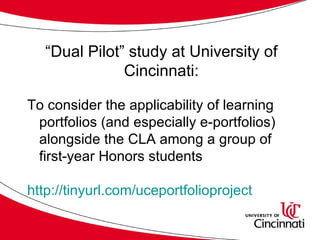
“ Dual Pilot” study at University of Cincinnati: To consider the applicability of learning portfolios (and especially e-portfolios) alongside the CLA among a group of first-year Honors students http://tinyurl.com/uceportfolioproject
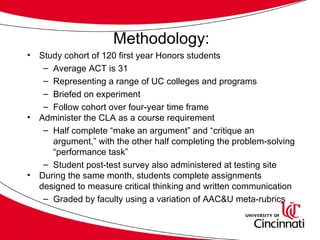
Methodology: Study cohort of 120 first year Honors students Average ACT is 31 Representing a range of UC colleges and programs  Briefed on experiment  Follow cohort over four-year time frame Administer the CLA as a course requirement Half complete “make an argument” and “critique an argument,” with the other half completing the problem-solving “performance task” Student post-test survey also administered at testing site During the same month, students complete assignments designed to measure critical thinking and written communication Graded by faculty using a variation of AAC&U meta-rubrics ,
Assessment of essays  in the e-portfolios Variation on AAC&U (VALUE) meta-rubrics Critical Thinking Written Communication
Preliminary results –  CLA/VALUE score correlations  CLA  report delayed 8 months, returning data to students problematic R-square between the Performance Task Score and Scaled SAT/ACT score:  0.053 (correlation= 0.23) R-square between the Analytical Writing Score and Scaled SAT/ACT score: 0.059 (correlation = 0.24) Ceiling effects are a  concern: honors student unadjusted percentile score was 98 th  percentile, adjusted for SAT 95 th;  VALUE rubrics may be calibrated to avoid ceiling effects.
Some Findings from the Student Survey Usefulness of the test (waste of time or only mildly useful=50%,useful= 40%, very useful=10%)  Describe the test experience (unpleasant=37%, indifferent 48%, pleasant= 15%) Effort exerted (little or none 8%, some 40%, a great deal 52%) Incentives to take the test seriously (would do it for free 8%, self-improvement 39%, financial incentive required- 43%) Experiences that prepared students to do well on the test: prep courses for ACT and SAT
UC’s concerns about the CLA: Questionable reliability and validity of results Lack of integration into the curriculum Disconnect between the CLA and UC’s mission and students Absence of ownership by the faculty Question motivation of students taking the test if it is not embedded in a course; embedding is difficult as CLA is designed with the institution, not the individual, as the “unit” of analysis
Future Plans Continue to pilot embedding CLA in FYE courses for freshmen; capstone courses for seniors  Working with IR to create reasonably representative samples Include faculty in conversation and find ways to use the data to provide feedback to students and programs Explore other measures of general education outcomes: Capstone rubric assessment Expanded use of e-portfolios Data from experiential learning supervisors through UC’s  I-LEAP project

UC Dual Pilot Study

  • 1.
    “ Dual Pilot”study at University of Cincinnati: To consider the applicability of learning portfolios (and especially e-portfolios) alongside the CLA among a group of first-year Honors students http://tinyurl.com/uceportfolioproject
  • 2.
    Methodology: Study cohortof 120 first year Honors students Average ACT is 31 Representing a range of UC colleges and programs Briefed on experiment Follow cohort over four-year time frame Administer the CLA as a course requirement Half complete “make an argument” and “critique an argument,” with the other half completing the problem-solving “performance task” Student post-test survey also administered at testing site During the same month, students complete assignments designed to measure critical thinking and written communication Graded by faculty using a variation of AAC&U meta-rubrics ,
  • 3.
    Assessment of essays in the e-portfolios Variation on AAC&U (VALUE) meta-rubrics Critical Thinking Written Communication
  • 4.
    Preliminary results – CLA/VALUE score correlations CLA report delayed 8 months, returning data to students problematic R-square between the Performance Task Score and Scaled SAT/ACT score:  0.053 (correlation= 0.23) R-square between the Analytical Writing Score and Scaled SAT/ACT score: 0.059 (correlation = 0.24) Ceiling effects are a concern: honors student unadjusted percentile score was 98 th percentile, adjusted for SAT 95 th; VALUE rubrics may be calibrated to avoid ceiling effects.
  • 5.
    Some Findings fromthe Student Survey Usefulness of the test (waste of time or only mildly useful=50%,useful= 40%, very useful=10%) Describe the test experience (unpleasant=37%, indifferent 48%, pleasant= 15%) Effort exerted (little or none 8%, some 40%, a great deal 52%) Incentives to take the test seriously (would do it for free 8%, self-improvement 39%, financial incentive required- 43%) Experiences that prepared students to do well on the test: prep courses for ACT and SAT
  • 6.
    UC’s concerns aboutthe CLA: Questionable reliability and validity of results Lack of integration into the curriculum Disconnect between the CLA and UC’s mission and students Absence of ownership by the faculty Question motivation of students taking the test if it is not embedded in a course; embedding is difficult as CLA is designed with the institution, not the individual, as the “unit” of analysis
  • 7.
    Future Plans Continueto pilot embedding CLA in FYE courses for freshmen; capstone courses for seniors Working with IR to create reasonably representative samples Include faculty in conversation and find ways to use the data to provide feedback to students and programs Explore other measures of general education outcomes: Capstone rubric assessment Expanded use of e-portfolios Data from experiential learning supervisors through UC’s I-LEAP project

Editor's Notes

  • #2 Short identification of our study
  • #3 Highlights of the methodology of our study
  • #4 Note here the modifications that we’ve already made in the AAC&U metarubrics, trying to stay close to them but adapting them to this particular set of assignments
  • #5 SurveyMonkey survey: 1. Please rate your overall impression of the validity of the Collegiate Learning Assessment(CLA)in providing feedback about students’ abilities in such areas as critical thinking, problem solving, and effective communication:
  • #7 Review concerns that we’ve probably already mentioned; pull together main remaining concerns