Medaille College I nternship Orientation November 11, 2009
Presenters Carol Cullinan, Director of Career Services Norm Muir, Dean of the Undergraduate College Lou Pozantides, Associate Clinical Professor
Modest Orientation Objectives Connect students with internship resources Review the internship process  Introduce a theory of experiential learning
A Few Key Messages Opportunity to design own learning Ownership of learning Responsibility  Accountability Active engagement (initiative, curiosity, questioning)
Internships Defined Internships are structured, supervised opportunities for extended, in-depth, out-of-class, field-based discovery learning.  Internships involve the direct, hands-on application of classroom learning (concepts, theories, knowledge, skills) to situations in real-world contexts. Internships are one form of experiential learning (others include service-learning, cooperative education, and study abroad)
Internship Benefits  Apply classroom learning to practical real-life problems in order to evaluate its validity Foster capacity to integrate knowledge with experience to deepen learning Enhance thinking, communication, problem-solving, and interpersonal skills Gain knowledge of developing trends in one’s field Explore and confirm (or not) career choices Develop self understanding, confidence, and maturity Develop network of professional relationships/contacts
Medaille College Internship Resources Medaille College Undergraduate Internship Guidelines and Resource Manual http://www.medaille.edu/academics/internships/ This manual is your definitive information resource for internships.  It describes all the policies and procedures you need to know to prepare for and enjoy a successful internship. Contact your program’s faculty internship coordinator if you have any questions or need help understanding the manual.
Medaille College  Internship Outcome Statement  Students will: Demonstrate effective written and oral communication and critical thinking skills Demonstrate common professional workplace behaviors (listed on assessment forms in your packet) Enhance professional networking skills Demonstrate active engagement and intellectual initiative throughout the internship process  Demonstrate the ability to integrate theory
Student Roles and Responsibilities See pages 15-18 in the internship manual for complete information. Stage 1 – Pre-Internship Planning Attend Internship Orientation  Meet with Internship Coordinator to Declare Intent Research and Site Selection (be thorough and selective; choose a site that meets your educational goals, needs, and interests)  Apply for Internship and Develop a Learning Plan Secure Approval and Register
Student Roles and Responsibilities Stage 2 – The Internship Contact site supervisor a few days before you begin Notify your internship coordinator when you start your hours Attend host site orientation (as required)  Maintain analytical field learning journal Maintain regular contact with internship coordinator Attend campus seminars (if required) Arrange for internship coordinator to visit site  Have an exit strategy: bring your internship to a smooth conclusion: say goodbyes, give thanks; contact faculty coordinator about next steps
Student Roles and Responsibilities Stage 3 – Post-Internship Submit site supervisor’s evaluation of your performance Complete self evaluation form Continue to reflect on your field experience and integrate it with prior learning Submit field learning journal Submit summary and analysis essay to internship coordinator
Academic Preparation Complete  Internship Concept Form  (see Appendix A) Imagine the kind of internship experience you seek Compose some preliminary learning goals and objectives Consider the kinds of knowledge and skills you want to acquire or deepen as a result of your internship  Think about how you can connect your field experience with your academics
Academic Preparation Complete a  Student Internship Learning Plan  (see Appendix A) The SILP represents your own self-designed, customized course syllabus It represents a blueprint or compass to on-site learning It establishes a learning contract between you, your site supervisor, and your faculty coordinator Consult with both your site supervisor and faculty evaluator in its creation  Be sure your learning objectives are clear, specific, and meaningful Be sure they are aligned with internship activities
Learning Objectives are measurable, observable statements that describe what a learner will know, be able to do, or feel as a result of a learning activity, course, or internship objectives may be about knowledge, skills, behaviors, values, or attitudes they guide the learner, helping her/him focus and set priorities they serve as a basis for evaluating actual performance they should be Specific, Measurable, Attainable, Realistic, and Timely (SMART)
Writing Learning Objectives—Resources “ Writing Learning Objectives” by Dr. Raoul Arreola http://www.utmem.edu/grad/CourseInfo/CurrManagement/Learning_Objectives.pdf “ Helpful Resources for Writing Measurable Learning Outcomes” by Dr. Kristine Webb http://www.unf.edu/groups/unffa/OnlineForms/CurrentAPCforms/APC%202005%20Folder/Writing_Measureable_Learning_Objectives.html
Learning from Experience  “ Learning is the process whereby knowledge is created through the transformation of experience”  (David Kolb 1984)
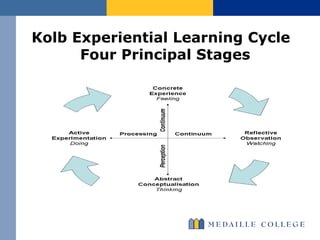
David Kolb’s Theory of Experiential Learning:  A Lifelong Tool for Learning from Experience In 1984, cognitive psychologist  and educational theorist David Kolb published a cyclical model of learning consisting of four stages. Kolb’s theory explain how human beings translate the raw data of experience into new learning or deeper understanding  through reflection and analysis . Kolb’s descriptive model remains a useful and commonly cited tool in higher education for explaining the learning process  The model can serve as a lifelong learning tool that helps us to  construct meaning from our daily experiences .
Characteristics of Experiential Learning Result from an individual’s direct  participation  in events Rooted in one’s own experience and  reflection  about it Learning-centered  approach based on the premise that people learn best from doing Holistic —address cognitive, emotional, and physical aspects of the learner  Best thought of as a  continuous process of adaptation  to the world grounded in experience rather than a definite outcome
Characteristics of Experiential Learning Involves  transactions  between the learner and the environment Involves  transactions  between personal and social knowledge Process of creating knowledge  from these interactions of self (your knowledge, values, attitudes, skills) with received academic knowledge (classroom concepts and theories) and  the contexts  with which you engage (residence hall, internship site, student club, family, work, community)
Kolb Experiential Learning Cycle   Four Principal Stages
Kolb Simplified What? So what? Now what?
Stage I Concrete Experience (CE) Knowledge by acquaintance Direct practical experience Individual engages in a particular action Immerse self in “doing” tasks  Experience serves as raw material for learning
Stage II  Reflective Observation (RO)  Reflection involves stepping back from immersion in experiences to review what has been done. Involves the temporary suspension of judgments and decisions.  Reflection starts the  meaning-making process  of translating raw experience into the insight and understanding of true learning  In this stage, you begin to  probe, interrogate, and process  experiences through the  filter  of your personal beliefs, attitudes, and values
Reflective Observation (continued) Begin to apply your cognitive abilities to connect and integrate your new experiences into the framework of your prior experiences and understanding of the yourself, your context, and the world.  Ask questions Examine your feelings
Stage III Abstract Conceptualization (AC) Apply your academic learning and prior personal knowledge and experiences to review, explain, and  analyze new experiences in order to construct meaning Bridge theory and practice (applied learning) Test feasibility/usefulness of theories/concepts/models Integrate ideas and concepts to interpret events, understand relationships among them, guide future decisions and courses of action, and to generate new ideas or perspectives
Bloom’s Revised Taxonomy  Using your higher-order thinking abilities Creating  (generating new ideas, products, or ways of viewing things: designing, inventing, planning, constructing) Evaluating  (justifying a decision or course of action: hypothesizing, critiquing, judging) Analyzing  (breaking information into parts to explore understandings and relationships: comparing, organizing, interrogating) Applying  (using information in another situation) (explaining ideas or concepts: summarizing) Understanding  (explaining, interpreting) Remembering  (recalling information: listening, describing)
Stage IV Active Experimentation  Involves the application of new insights and understanding to anticipate future occurrences of the event or similar ones Test out new or modified/adapted understanding and perspective in future experiences to continue the reflective learning cycle
Example #1  Enhancing Nursing Techniques An internship nurse trainee participates in a supervised teaching simulation on how to lift a patient. (CE) The student might raise some probing questions about the process and her performance: “How did that feel?”or “What might I have done differently?” or “Was the patient comfortable?”(RO) The student might review her lecture notes, textbook instructions or search the Internet for helpful ideas and tips. (AC) At the next simulation, the nursing student might draw on yesterday’s lessons from experience and her research to modify her techniques and improve her effectiveness. (AE)
Example #2  Learning Coaching Style/Skills Participate in a week-long clinic on coaching styles and skills. (CE) Observe how other people coach and reflect on your coaching beliefs, values, and strategies in the context of what you learned at the clinic.  (RO) Read articles or books on coaching philosophies and techniques. Draw on knowledge from videos or ESPN analysis of coaches. (AC) Apply your clinic experience, observations, and reading to test out components of your coaching style. (AE)
Example #3  Exploring Leadership  Tour Buffalo neighborhood experiencing a housing and economic renewal and meet with recognized community leaders. (CE) Interview a citizen leader about his/her role in the neighborhood’s renaissance; use questions from leadership readings and films to create a portrait of the individual’s leadership traits, behaviors, and style. (RO)  Apply leadership theories from course textbook or other research sources to construct a case study of the person’s leadership approach (style, traits, behaviors). (AC) Test out your new understanding of citizen leadership in your neighborhood or campus community. (AE)
Reflective Thinking and Meaning-Making  Some Final Quotes Experience is not what happens to you, it’s what you do  with what happens to you.  --Aldous Huxley We don’t learn from experience. We learn from reflecting on experience.  --John Dewey  The only kind of learning which significantly influences behavior is self-discovered or self-appropriated learning—truth that has been assimilated in experience.  --Carl Rogers
Critical Reflection: The Key to Learning  Experience becomes educative when critical reflective thought creates new meaning and leads to growth and the ability to take informed actions.  --Robert Bringle and Julie Hatcher
Reflective Thinking  Reflective thinking is not only an organic component in the[Kolb] learning cycle, it is simultaneously the very ground from which knowledge and belief spring. [It] is both process and product.   --David Cooper [P]ersonal experiences . . . allow theory to take on meaning when reflection supports an analysis and critical examination of the experience.  –Robert Bringle and Julie Hatcher Reflection as an “active, persistent, and careful consideration of any belief or supported form of knowledge in light of the grounds that support it”   --John Dewey
Analytical Field Journal: Reflective Tool A weekly (or daily) field journal represents an opportunity to create meaning from internship experiences through systematic reflection and critical analysis (see journal resources in your orientation packet) Four Cs of Reflection  Continuous Connected to academic learning  Challenging to assumptions, knowledge, perspectives Contextual (dependent on setting and learning design)
Assessing Student Learning In addition to the reflective analytical field journal, students are required to demonstrate internship learning through a formal 5-7 page summary and analysis paper  a tangible form of special documentation appropriate to the nature of the field experience
Summary and Analysis Paper The specific requirements may vary slightly depending on the degree program and the directions of the faculty internship coordinator. However, the paper’s fundamental purpose remains the same no matter the student or program: to demonstrate to yourself and to others that learning did occur as a direct result of your engagement in a field setting The paper analysis should explicitly connect to the learning outcomes designated by the program and those self-created by you in the Student Internship Learning Plan.
Summary and Analysis Paper The paper should present specific claims about what you learned from your experience—whether about yourself, your academic studies, the host organization, human nature, or the world at large. These general claims (assertions) should be supported by specific examples from your experience. Ideally the paper will show evidence of analytical reflection and gained insight, not merely summarize and describe weeks of activity.
Summary and Analysis Paper Ideally you will connect theory and concepts from your academic studies to explore, examine, and deepen your understanding of your field experiences.  Draw on your analytical field journal for raw material to re-visit, investigate, and shape into a formal paper Use the opportunity to create meaning and deepen your learning; don’t approach it as just another rote assignment to complete.  Remember this is a paper over which you have maximum control.  You determine  the topics to explore.
Special Documentation  You should determine your type of special documentation of internship learning, performance, and achievement in consultation with your faculty internship coordinator BEFORE you begin the internship. The idea here is to produce at least one tangible, observable product that documents what you learned during your internship.  The forms of demonstration are many and limited only by your imagination.  The documentation should be customized to fit with the specific circumstances of your internship.
Special Documentation Marketing brochure or other organizational publication to which you contributed an written copy or design elements Video or audio tape of one’s performance/work Business plan  Case study Scrapbook Interview transcript (site leaders/managers, employees, clients) An original song or poem or play Visual representation (painting, sculpture) Power point presentation Poster presentation
Special Documentation Lesson plans Proposal for improving services, products or processes at your site Website A montage Organizational chart An additional paper analyzing the organization’s culture or management/leadership style Meeting agendas (of meeting you led or participated in)
Internship outcomes Internships can help with: Self discovery Career exploration Professional preparation Its all about competencies….do you know what you know?  “ a written description of measurable work habits and personal skills used to achieve a work objective” or the skills, knowledge, and abilities to do the job.  SKA’a
Common competencies employers seek Communication skills Strong work ethic Team work skills Initiative Analytical skills Interpersonal skills Problem solving skills Organization skills Leadership skills
Journaling and Reflection can help Identify SKA’s Develop competency based resumes Prepare competency based cover letters Prepare for the job interview – behavioral based Prepare you for job success
Ten Commandments for the Intern Office politics and office gossip can complicate the simplest tasks Walk lightly and think twice before making waves Deadline are reality, and time is money You can make one mistake – learn from it Organizations no longer close their eyes to after hours activities Do as you are told; do not allow the ego to get in the way Determine a proper time balance between work and play You must work well with associates you did not choose yourself Patience is a workplace pre-requisite Bosses are right; even when they are wrong
Off to a good start…. Be positive Ask for help Don’t be a know-it-all Have a good sense of humor Find a buddy Follow instructions Read company policies Wear the right clothes Be punctual

Internship Orientation November 11, 2009

  • 1.
    Medaille College Internship Orientation November 11, 2009
  • 2.
    Presenters Carol Cullinan,Director of Career Services Norm Muir, Dean of the Undergraduate College Lou Pozantides, Associate Clinical Professor
  • 3.
    Modest Orientation ObjectivesConnect students with internship resources Review the internship process Introduce a theory of experiential learning
  • 4.
    A Few KeyMessages Opportunity to design own learning Ownership of learning Responsibility Accountability Active engagement (initiative, curiosity, questioning)
  • 5.
    Internships Defined Internshipsare structured, supervised opportunities for extended, in-depth, out-of-class, field-based discovery learning. Internships involve the direct, hands-on application of classroom learning (concepts, theories, knowledge, skills) to situations in real-world contexts. Internships are one form of experiential learning (others include service-learning, cooperative education, and study abroad)
  • 6.
    Internship Benefits Apply classroom learning to practical real-life problems in order to evaluate its validity Foster capacity to integrate knowledge with experience to deepen learning Enhance thinking, communication, problem-solving, and interpersonal skills Gain knowledge of developing trends in one’s field Explore and confirm (or not) career choices Develop self understanding, confidence, and maturity Develop network of professional relationships/contacts
  • 7.
    Medaille College InternshipResources Medaille College Undergraduate Internship Guidelines and Resource Manual http://www.medaille.edu/academics/internships/ This manual is your definitive information resource for internships. It describes all the policies and procedures you need to know to prepare for and enjoy a successful internship. Contact your program’s faculty internship coordinator if you have any questions or need help understanding the manual.
  • 8.
    Medaille College Internship Outcome Statement Students will: Demonstrate effective written and oral communication and critical thinking skills Demonstrate common professional workplace behaviors (listed on assessment forms in your packet) Enhance professional networking skills Demonstrate active engagement and intellectual initiative throughout the internship process Demonstrate the ability to integrate theory
  • 9.
    Student Roles andResponsibilities See pages 15-18 in the internship manual for complete information. Stage 1 – Pre-Internship Planning Attend Internship Orientation Meet with Internship Coordinator to Declare Intent Research and Site Selection (be thorough and selective; choose a site that meets your educational goals, needs, and interests) Apply for Internship and Develop a Learning Plan Secure Approval and Register
  • 10.
    Student Roles andResponsibilities Stage 2 – The Internship Contact site supervisor a few days before you begin Notify your internship coordinator when you start your hours Attend host site orientation (as required) Maintain analytical field learning journal Maintain regular contact with internship coordinator Attend campus seminars (if required) Arrange for internship coordinator to visit site Have an exit strategy: bring your internship to a smooth conclusion: say goodbyes, give thanks; contact faculty coordinator about next steps
  • 11.
    Student Roles andResponsibilities Stage 3 – Post-Internship Submit site supervisor’s evaluation of your performance Complete self evaluation form Continue to reflect on your field experience and integrate it with prior learning Submit field learning journal Submit summary and analysis essay to internship coordinator
  • 12.
    Academic Preparation Complete Internship Concept Form (see Appendix A) Imagine the kind of internship experience you seek Compose some preliminary learning goals and objectives Consider the kinds of knowledge and skills you want to acquire or deepen as a result of your internship Think about how you can connect your field experience with your academics
  • 13.
    Academic Preparation Completea Student Internship Learning Plan (see Appendix A) The SILP represents your own self-designed, customized course syllabus It represents a blueprint or compass to on-site learning It establishes a learning contract between you, your site supervisor, and your faculty coordinator Consult with both your site supervisor and faculty evaluator in its creation Be sure your learning objectives are clear, specific, and meaningful Be sure they are aligned with internship activities
  • 14.
    Learning Objectives aremeasurable, observable statements that describe what a learner will know, be able to do, or feel as a result of a learning activity, course, or internship objectives may be about knowledge, skills, behaviors, values, or attitudes they guide the learner, helping her/him focus and set priorities they serve as a basis for evaluating actual performance they should be Specific, Measurable, Attainable, Realistic, and Timely (SMART)
  • 15.
    Writing Learning Objectives—Resources“ Writing Learning Objectives” by Dr. Raoul Arreola http://www.utmem.edu/grad/CourseInfo/CurrManagement/Learning_Objectives.pdf “ Helpful Resources for Writing Measurable Learning Outcomes” by Dr. Kristine Webb http://www.unf.edu/groups/unffa/OnlineForms/CurrentAPCforms/APC%202005%20Folder/Writing_Measureable_Learning_Objectives.html
  • 16.
    Learning from Experience “ Learning is the process whereby knowledge is created through the transformation of experience” (David Kolb 1984)
  • 17.
    David Kolb’s Theoryof Experiential Learning: A Lifelong Tool for Learning from Experience In 1984, cognitive psychologist and educational theorist David Kolb published a cyclical model of learning consisting of four stages. Kolb’s theory explain how human beings translate the raw data of experience into new learning or deeper understanding through reflection and analysis . Kolb’s descriptive model remains a useful and commonly cited tool in higher education for explaining the learning process The model can serve as a lifelong learning tool that helps us to construct meaning from our daily experiences .
  • 18.
    Characteristics of ExperientialLearning Result from an individual’s direct participation in events Rooted in one’s own experience and reflection about it Learning-centered approach based on the premise that people learn best from doing Holistic —address cognitive, emotional, and physical aspects of the learner Best thought of as a continuous process of adaptation to the world grounded in experience rather than a definite outcome
  • 19.
    Characteristics of ExperientialLearning Involves transactions between the learner and the environment Involves transactions between personal and social knowledge Process of creating knowledge from these interactions of self (your knowledge, values, attitudes, skills) with received academic knowledge (classroom concepts and theories) and the contexts with which you engage (residence hall, internship site, student club, family, work, community)
  • 20.
    Kolb Experiential LearningCycle Four Principal Stages
  • 21.
    Kolb Simplified What?So what? Now what?
  • 22.
    Stage I ConcreteExperience (CE) Knowledge by acquaintance Direct practical experience Individual engages in a particular action Immerse self in “doing” tasks Experience serves as raw material for learning
  • 23.
    Stage II Reflective Observation (RO) Reflection involves stepping back from immersion in experiences to review what has been done. Involves the temporary suspension of judgments and decisions. Reflection starts the meaning-making process of translating raw experience into the insight and understanding of true learning In this stage, you begin to probe, interrogate, and process experiences through the filter of your personal beliefs, attitudes, and values
  • 24.
    Reflective Observation (continued)Begin to apply your cognitive abilities to connect and integrate your new experiences into the framework of your prior experiences and understanding of the yourself, your context, and the world. Ask questions Examine your feelings
  • 25.
    Stage III AbstractConceptualization (AC) Apply your academic learning and prior personal knowledge and experiences to review, explain, and analyze new experiences in order to construct meaning Bridge theory and practice (applied learning) Test feasibility/usefulness of theories/concepts/models Integrate ideas and concepts to interpret events, understand relationships among them, guide future decisions and courses of action, and to generate new ideas or perspectives
  • 26.
    Bloom’s Revised Taxonomy Using your higher-order thinking abilities Creating (generating new ideas, products, or ways of viewing things: designing, inventing, planning, constructing) Evaluating (justifying a decision or course of action: hypothesizing, critiquing, judging) Analyzing (breaking information into parts to explore understandings and relationships: comparing, organizing, interrogating) Applying (using information in another situation) (explaining ideas or concepts: summarizing) Understanding (explaining, interpreting) Remembering (recalling information: listening, describing)
  • 27.
    Stage IV ActiveExperimentation Involves the application of new insights and understanding to anticipate future occurrences of the event or similar ones Test out new or modified/adapted understanding and perspective in future experiences to continue the reflective learning cycle
  • 28.
    Example #1 Enhancing Nursing Techniques An internship nurse trainee participates in a supervised teaching simulation on how to lift a patient. (CE) The student might raise some probing questions about the process and her performance: “How did that feel?”or “What might I have done differently?” or “Was the patient comfortable?”(RO) The student might review her lecture notes, textbook instructions or search the Internet for helpful ideas and tips. (AC) At the next simulation, the nursing student might draw on yesterday’s lessons from experience and her research to modify her techniques and improve her effectiveness. (AE)
  • 29.
    Example #2 Learning Coaching Style/Skills Participate in a week-long clinic on coaching styles and skills. (CE) Observe how other people coach and reflect on your coaching beliefs, values, and strategies in the context of what you learned at the clinic. (RO) Read articles or books on coaching philosophies and techniques. Draw on knowledge from videos or ESPN analysis of coaches. (AC) Apply your clinic experience, observations, and reading to test out components of your coaching style. (AE)
  • 30.
    Example #3 Exploring Leadership Tour Buffalo neighborhood experiencing a housing and economic renewal and meet with recognized community leaders. (CE) Interview a citizen leader about his/her role in the neighborhood’s renaissance; use questions from leadership readings and films to create a portrait of the individual’s leadership traits, behaviors, and style. (RO) Apply leadership theories from course textbook or other research sources to construct a case study of the person’s leadership approach (style, traits, behaviors). (AC) Test out your new understanding of citizen leadership in your neighborhood or campus community. (AE)
  • 31.
    Reflective Thinking andMeaning-Making Some Final Quotes Experience is not what happens to you, it’s what you do with what happens to you. --Aldous Huxley We don’t learn from experience. We learn from reflecting on experience. --John Dewey The only kind of learning which significantly influences behavior is self-discovered or self-appropriated learning—truth that has been assimilated in experience. --Carl Rogers
  • 32.
    Critical Reflection: TheKey to Learning Experience becomes educative when critical reflective thought creates new meaning and leads to growth and the ability to take informed actions. --Robert Bringle and Julie Hatcher
  • 33.
    Reflective Thinking Reflective thinking is not only an organic component in the[Kolb] learning cycle, it is simultaneously the very ground from which knowledge and belief spring. [It] is both process and product. --David Cooper [P]ersonal experiences . . . allow theory to take on meaning when reflection supports an analysis and critical examination of the experience. –Robert Bringle and Julie Hatcher Reflection as an “active, persistent, and careful consideration of any belief or supported form of knowledge in light of the grounds that support it” --John Dewey
  • 34.
    Analytical Field Journal:Reflective Tool A weekly (or daily) field journal represents an opportunity to create meaning from internship experiences through systematic reflection and critical analysis (see journal resources in your orientation packet) Four Cs of Reflection Continuous Connected to academic learning Challenging to assumptions, knowledge, perspectives Contextual (dependent on setting and learning design)
  • 35.
    Assessing Student LearningIn addition to the reflective analytical field journal, students are required to demonstrate internship learning through a formal 5-7 page summary and analysis paper a tangible form of special documentation appropriate to the nature of the field experience
  • 36.
    Summary and AnalysisPaper The specific requirements may vary slightly depending on the degree program and the directions of the faculty internship coordinator. However, the paper’s fundamental purpose remains the same no matter the student or program: to demonstrate to yourself and to others that learning did occur as a direct result of your engagement in a field setting The paper analysis should explicitly connect to the learning outcomes designated by the program and those self-created by you in the Student Internship Learning Plan.
  • 37.
    Summary and AnalysisPaper The paper should present specific claims about what you learned from your experience—whether about yourself, your academic studies, the host organization, human nature, or the world at large. These general claims (assertions) should be supported by specific examples from your experience. Ideally the paper will show evidence of analytical reflection and gained insight, not merely summarize and describe weeks of activity.
  • 38.
    Summary and AnalysisPaper Ideally you will connect theory and concepts from your academic studies to explore, examine, and deepen your understanding of your field experiences. Draw on your analytical field journal for raw material to re-visit, investigate, and shape into a formal paper Use the opportunity to create meaning and deepen your learning; don’t approach it as just another rote assignment to complete. Remember this is a paper over which you have maximum control. You determine the topics to explore.
  • 39.
    Special Documentation You should determine your type of special documentation of internship learning, performance, and achievement in consultation with your faculty internship coordinator BEFORE you begin the internship. The idea here is to produce at least one tangible, observable product that documents what you learned during your internship. The forms of demonstration are many and limited only by your imagination. The documentation should be customized to fit with the specific circumstances of your internship.
  • 40.
    Special Documentation Marketingbrochure or other organizational publication to which you contributed an written copy or design elements Video or audio tape of one’s performance/work Business plan Case study Scrapbook Interview transcript (site leaders/managers, employees, clients) An original song or poem or play Visual representation (painting, sculpture) Power point presentation Poster presentation
  • 41.
    Special Documentation Lessonplans Proposal for improving services, products or processes at your site Website A montage Organizational chart An additional paper analyzing the organization’s culture or management/leadership style Meeting agendas (of meeting you led or participated in)
  • 42.
    Internship outcomes Internshipscan help with: Self discovery Career exploration Professional preparation Its all about competencies….do you know what you know? “ a written description of measurable work habits and personal skills used to achieve a work objective” or the skills, knowledge, and abilities to do the job. SKA’a
  • 43.
    Common competencies employersseek Communication skills Strong work ethic Team work skills Initiative Analytical skills Interpersonal skills Problem solving skills Organization skills Leadership skills
  • 44.
    Journaling and Reflectioncan help Identify SKA’s Develop competency based resumes Prepare competency based cover letters Prepare for the job interview – behavioral based Prepare you for job success
  • 45.
    Ten Commandments forthe Intern Office politics and office gossip can complicate the simplest tasks Walk lightly and think twice before making waves Deadline are reality, and time is money You can make one mistake – learn from it Organizations no longer close their eyes to after hours activities Do as you are told; do not allow the ego to get in the way Determine a proper time balance between work and play You must work well with associates you did not choose yourself Patience is a workplace pre-requisite Bosses are right; even when they are wrong
  • 46.
    Off to agood start…. Be positive Ask for help Don’t be a know-it-all Have a good sense of humor Find a buddy Follow instructions Read company policies Wear the right clothes Be punctual