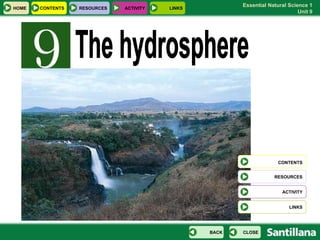
The hydrosphere  CONTENTS RESOURCES LINKS HOME RESOURCES CONTENTS CLOSE BACK ACTIVITY LINKS ACTIVITY
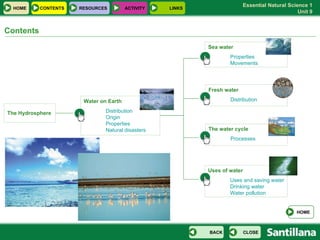
Contents The Hydrosphere Water on Earth Distribution Origin Properties Natural disasters Sea water Properties Movements Fresh water Distribution Uses of water Uses and saving water Drinking water Water pollution The water cycle Processes HOME HOME RESOURCES CONTENTS CLOSE BACK ACTIVITY LINKS
Resources   Links HOME Distribution of water on Earth Origin of the hydrosphere What are some properties of water? What is sea water like? Natural disasters produced by water Movements produced in the  oceans Where is fresh water found? What is the water cycle? What is water used for? Drinking water What causes water pollution? HOME RESOURCES CONTENTS CLOSE BACK ACTIVITY LINKS Activity: water  cycle Water cycle activity
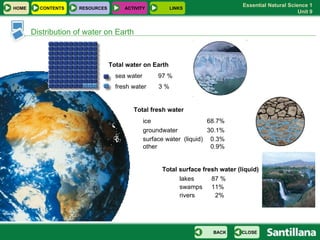
Distribution of water on Earth Total water on Earth sea water  97 % fresh water  3 % Total fresh water ice  68.7% surface water  (liquid)    0.3% other    0.9% groundwater  30.1%  lakes  87 % swamps  11% Total surface fresh water (liquid) rivers    2% HOME CLOSE BACK ACTIVITY LINKS RESOURCES CONTENTS
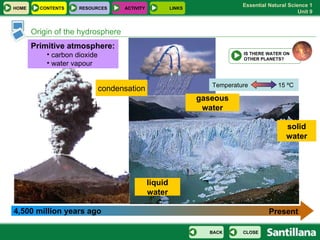
Primitive atmosphere: carbon dioxide water vapour Origin of the hydrosphere  condensation gaseous water liquid water solid water IS THERE WATER ON OTHER PLANETS? 4,500 million years ago Present HOME RESOURCES CONTENTS CLOSE BACK Temperature  15 ºC ACTIVITY LINKS
Water on other rocky planets HOME RESOURCES CONTENTS CLOSE BACK Mercury Venus Mars GO BACK ACTIVITY LINKS
Water on other rocky planets Ice may exist in craters at the poles according to radar.   HOME RESOURCES CONTENTS CLOSE BACK Mercury Venus Mars GO BACK ACTIVITY LINKS
Water on other rocky planets Frozen water under the polar caps Liquid water in the past HOME RESOURCES CONTENTS CLOSE BACK Mercury Venus Mars GO BACK ACTIVITY LINKS
Water on other rocky planets No surface water Traces of water vapour in the atmosphere   HOME RESOURCES CONTENTS CLOSE BACK Mercury Venus Mars GO BACK ACTIVITY LINKS
What are some properties of water?  It absorbs a lot of heat. It is highly cohesive and adhesive. It expands on freezing. It is an excellent solvent. HOME RESOURCES CONTENTS CLOSE BACK ACTIVITY LINKS
Natural disasters produced by water Flash flooding Torrential rain   River flooding  Tsunamis   HOME RESOURCES CONTENTS CLOSE BACK ACTIVITY LINKS
87 % It is salty. It contains dissolved gases from: - wave action - the activity of aquatic plants and animals Temperature varies with depth. What is sea water like? Proportions of dissolved salts   chlorides 2 % others 11 % sulphates  HOME RESOURCES CONTENTS CLOSE BACK ACTIVITY LINKS
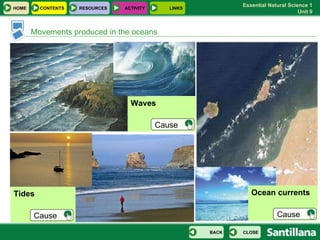
Movements produced in the oceans Ocean currents Waves Tides HOME RESOURCES CONTENTS CLOSE BACK Cause Cause Cause ACTIVITY LINKS
Movements produced in the oceans The wind Tides Ocean currents HOME RESOURCES CONTENTS CLOSE BACK Waves Cause Cause Cause ACTIVITY LINKS
Movements produced in the oceans Gravitational attraction of the Moon and Sun on the water Waves Ocean currents HOME RESOURCES CONTENTS CLOSE BACK Cause Tides Cause Cause ACTIVITY LINKS
Movements produced in the oceans Winds Differences in temperature Differences in salinity   Waves Tides HOME RESOURCES CONTENTS CLOSE BACK Cause Cause Ocean currents Cause ACTIVITY LINKS
Where is fresh water found? Lakes Groundwater Rivers Streams or torrents Wetlands Glaciers HOME RESOURCES CONTENTS CLOSE BACK ACTIVITY LINKS
What is the water cycle? water storage in ice and snow precipitation evaporation condensation in  the form of clouds surface runoff evapotranspiration infiltration ENLARGE IMAGE HOME RESOURCES CONTENTS CLOSE BACK ACTIVITY LINKS
What is the water cycle? permeable rock groundwater water storage in ice and snow precipitation evaporation condensation in  the form of clouds surface runoff evapotranspiration infiltration HOME RESOURCES CONTENTS CLOSE BACK ACTIVITY LINKS
What is the water cycle? water storage in ice and snow precipitation evaporation condensation in  the form of clouds surface runoff evapotranspiration infiltration HOME RESOURCES CONTENTS CLOSE BACK ACTIVITY LINKS
What is the water cycle? water storage in ice and snow precipitation evaporation condensation in  the form of clouds surface runoff evapotranspiration infiltration Hailstone formation HOME RESOURCES CONTENTS CLOSE BACK ACTIVITY LINKS
What is water used for? Agriculture Furrow irrigation Sprinkler irrigation Drip irrigation Industry Domestic use HOME RESOURCES CONTENTS CLOSE BACK What can I do  to save water? ACTIVITY LINKS
What is water used for? Fix leaks and use water saving devices. Wash full loads of clothes and dishes.  Take showers. Turn off taps. What can I do  to save water? HOME RESOURCES CONTENTS CLOSE BACK GO BACK ACTIVITY LINKS
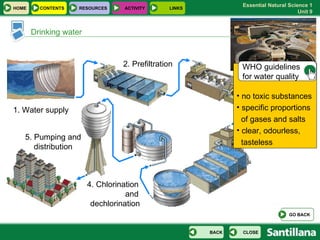
Drinking water 1. Water supply  2. Prefiltration 3. Decantation and filtration 4. Chlorination  and dechlorination 5. Pumping and distribution HOME RESOURCES CONTENTS CLOSE BACK WHO guidelines for water quality ACTIVITY LINKS
3. Decantation and filtration Drinking water 1. Water supply  2. Prefiltration 4. Chlorination  and dechlorination no toxic substances specific proportions  of gases and salts clear, odourless,  tasteless WHO Guidelines 5. Pumping and distribution HOME RESOURCES CONTENTS CLOSE BACK GO BACK WHO guidelines for water quality ACTIVITY LINKS
What causes water pollution? What can you do? Waste water from industry, agriculture and domestic use Water pollution Fertilizers and pesticides Oil spills Deposit rubbish in bins Recycle batteries Do not throw paint, oil or solvents down  the drain or toilet HOME RESOURCES CONTENTS CLOSE BACK ACTIVITY LINKS
What causes water pollution? Water pollution Waste water from industry, agriculture and domestic use Fertilizers and pesticides Oil spills What can you do? Deposit rubbish in bins. Do not throw paint, oil or solvents  down the drain or toilet. Recycle batteries. HOME RESOURCES CONTENTS CLOSE BACK ACTIVITY LINKS
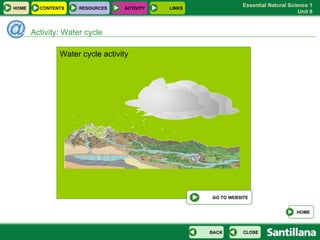
Activity: Water cycle  HOME HOME RESOURCES CONTENTS CLOSE BACK GO TO WEBSITE Water cycle activity ACTIVITY LINKS
Links HOME HOME RESOURCES CONTENTS CLOSE BACK GO TO WEBSITE Investigating groundwater GO TO WEBSITE Hydrosphere basics ACTIVITY LINKS

U09 Hydrosphere

  • 1.
    The hydrosphere CONTENTS RESOURCES LINKS HOME RESOURCES CONTENTS CLOSE BACK ACTIVITY LINKS ACTIVITY
  • 2.
    Contents The HydrosphereWater on Earth Distribution Origin Properties Natural disasters Sea water Properties Movements Fresh water Distribution Uses of water Uses and saving water Drinking water Water pollution The water cycle Processes HOME HOME RESOURCES CONTENTS CLOSE BACK ACTIVITY LINKS
  • 3.
    Resources Links HOME Distribution of water on Earth Origin of the hydrosphere What are some properties of water? What is sea water like? Natural disasters produced by water Movements produced in the oceans Where is fresh water found? What is the water cycle? What is water used for? Drinking water What causes water pollution? HOME RESOURCES CONTENTS CLOSE BACK ACTIVITY LINKS Activity: water cycle Water cycle activity
  • 4.
    Distribution of wateron Earth Total water on Earth sea water 97 % fresh water 3 % Total fresh water ice 68.7% surface water (liquid) 0.3% other 0.9% groundwater 30.1% lakes 87 % swamps 11% Total surface fresh water (liquid) rivers 2% HOME CLOSE BACK ACTIVITY LINKS RESOURCES CONTENTS
  • 5.
    Primitive atmosphere: carbondioxide water vapour Origin of the hydrosphere condensation gaseous water liquid water solid water IS THERE WATER ON OTHER PLANETS? 4,500 million years ago Present HOME RESOURCES CONTENTS CLOSE BACK Temperature 15 ºC ACTIVITY LINKS
  • 6.
    Water on otherrocky planets HOME RESOURCES CONTENTS CLOSE BACK Mercury Venus Mars GO BACK ACTIVITY LINKS
  • 7.
    Water on otherrocky planets Ice may exist in craters at the poles according to radar. HOME RESOURCES CONTENTS CLOSE BACK Mercury Venus Mars GO BACK ACTIVITY LINKS
  • 8.
    Water on otherrocky planets Frozen water under the polar caps Liquid water in the past HOME RESOURCES CONTENTS CLOSE BACK Mercury Venus Mars GO BACK ACTIVITY LINKS
  • 9.
    Water on otherrocky planets No surface water Traces of water vapour in the atmosphere HOME RESOURCES CONTENTS CLOSE BACK Mercury Venus Mars GO BACK ACTIVITY LINKS
  • 10.
    What are someproperties of water? It absorbs a lot of heat. It is highly cohesive and adhesive. It expands on freezing. It is an excellent solvent. HOME RESOURCES CONTENTS CLOSE BACK ACTIVITY LINKS
  • 11.
    Natural disasters producedby water Flash flooding Torrential rain River flooding Tsunamis HOME RESOURCES CONTENTS CLOSE BACK ACTIVITY LINKS
  • 12.
    87 % Itis salty. It contains dissolved gases from: - wave action - the activity of aquatic plants and animals Temperature varies with depth. What is sea water like? Proportions of dissolved salts chlorides 2 % others 11 % sulphates HOME RESOURCES CONTENTS CLOSE BACK ACTIVITY LINKS
  • 13.
    Movements produced inthe oceans Ocean currents Waves Tides HOME RESOURCES CONTENTS CLOSE BACK Cause Cause Cause ACTIVITY LINKS
  • 14.
    Movements produced inthe oceans The wind Tides Ocean currents HOME RESOURCES CONTENTS CLOSE BACK Waves Cause Cause Cause ACTIVITY LINKS
  • 15.
    Movements produced inthe oceans Gravitational attraction of the Moon and Sun on the water Waves Ocean currents HOME RESOURCES CONTENTS CLOSE BACK Cause Tides Cause Cause ACTIVITY LINKS
  • 16.
    Movements produced inthe oceans Winds Differences in temperature Differences in salinity Waves Tides HOME RESOURCES CONTENTS CLOSE BACK Cause Cause Ocean currents Cause ACTIVITY LINKS
  • 17.
    Where is freshwater found? Lakes Groundwater Rivers Streams or torrents Wetlands Glaciers HOME RESOURCES CONTENTS CLOSE BACK ACTIVITY LINKS
  • 18.
    What is thewater cycle? water storage in ice and snow precipitation evaporation condensation in the form of clouds surface runoff evapotranspiration infiltration ENLARGE IMAGE HOME RESOURCES CONTENTS CLOSE BACK ACTIVITY LINKS
  • 19.
    What is thewater cycle? permeable rock groundwater water storage in ice and snow precipitation evaporation condensation in the form of clouds surface runoff evapotranspiration infiltration HOME RESOURCES CONTENTS CLOSE BACK ACTIVITY LINKS
  • 20.
    What is thewater cycle? water storage in ice and snow precipitation evaporation condensation in the form of clouds surface runoff evapotranspiration infiltration HOME RESOURCES CONTENTS CLOSE BACK ACTIVITY LINKS
  • 21.
    What is thewater cycle? water storage in ice and snow precipitation evaporation condensation in the form of clouds surface runoff evapotranspiration infiltration Hailstone formation HOME RESOURCES CONTENTS CLOSE BACK ACTIVITY LINKS
  • 22.
    What is waterused for? Agriculture Furrow irrigation Sprinkler irrigation Drip irrigation Industry Domestic use HOME RESOURCES CONTENTS CLOSE BACK What can I do to save water? ACTIVITY LINKS
  • 23.
    What is waterused for? Fix leaks and use water saving devices. Wash full loads of clothes and dishes. Take showers. Turn off taps. What can I do to save water? HOME RESOURCES CONTENTS CLOSE BACK GO BACK ACTIVITY LINKS
  • 24.
    Drinking water 1.Water supply 2. Prefiltration 3. Decantation and filtration 4. Chlorination and dechlorination 5. Pumping and distribution HOME RESOURCES CONTENTS CLOSE BACK WHO guidelines for water quality ACTIVITY LINKS
  • 25.
    3. Decantation andfiltration Drinking water 1. Water supply 2. Prefiltration 4. Chlorination and dechlorination no toxic substances specific proportions of gases and salts clear, odourless, tasteless WHO Guidelines 5. Pumping and distribution HOME RESOURCES CONTENTS CLOSE BACK GO BACK WHO guidelines for water quality ACTIVITY LINKS
  • 26.
    What causes waterpollution? What can you do? Waste water from industry, agriculture and domestic use Water pollution Fertilizers and pesticides Oil spills Deposit rubbish in bins Recycle batteries Do not throw paint, oil or solvents down the drain or toilet HOME RESOURCES CONTENTS CLOSE BACK ACTIVITY LINKS
  • 27.
    What causes waterpollution? Water pollution Waste water from industry, agriculture and domestic use Fertilizers and pesticides Oil spills What can you do? Deposit rubbish in bins. Do not throw paint, oil or solvents down the drain or toilet. Recycle batteries. HOME RESOURCES CONTENTS CLOSE BACK ACTIVITY LINKS
  • 28.
    Activity: Water cycle HOME HOME RESOURCES CONTENTS CLOSE BACK GO TO WEBSITE Water cycle activity ACTIVITY LINKS
  • 29.
    Links HOME HOMERESOURCES CONTENTS CLOSE BACK GO TO WEBSITE Investigating groundwater GO TO WEBSITE Hydrosphere basics ACTIVITY LINKS