



Transverse Waves 
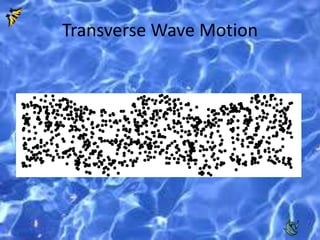
• In a transverse wave the particle 
displacement is perpendicular to the 
direction of wave propagation. The 
animation below shows a one-dimensional 
transverse plane wave propagating from 
left to right. The particles do not move 
along with the wave; they simply oscillate 
up and down about their individual 
equilibrium positions as the wave passes 
by.
Transverse Wave Motion
Longitudinal Waves 
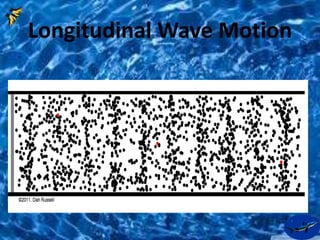
• In a longitudinal wave the particle 
displacement is parallel to the direction 
of wave propagation. The animation at 
right shows a one-dimensional 
longitudinal plane wave propagating 
down a tube. The particles do not move 
down the tube with the wave; they 
simply oscillate back and forth about 
their individual equilibrium positions.
Longitudinal Wave Motion
•It is the combination 
of Transverse and 
Longitudinal Waves.
Water Waves 
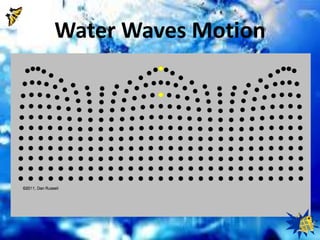
• Water waves are an example of waves that 
involve a combination of both longitudinal 
and transverse motions. As a wave travels 
through the waver, the particles travel 
in clockwise circles. The radius of the circles 
decreases as the depth into the water 
increases. The movie below shows a water 
wave travelling from left to right in a region 
where the depth of the water is greater than 
the wavelength of the waves.
Water Waves Motion
Rayleigh surface waves 
• Another example of waves with both 
longitudinal and transverse motion may be 
found in solids as Rayleigh surface 
waves (named after John W. Strutt, 3rd Baron 
Rayleigh). The particles in a solid, through 
which a Rayleigh surface wave passes, move 
in elliptical paths, with the major axis of the 
ellipse perpendicular to the surface of the 
solid. As the depth into the solid increases 
the "width" of the elliptical path decreases.
• Rayleigh waves are different from water 
waves in one important way. In a water wave 
all particles travel in clockwise circles. 
However, in a Rayleigh surface wave, 
particles at the surface trace out a counter-clockwise 
ellipse, while particles at a depth of 
more than 1/5th of a wavelength trace 
out clockwiseellispes. The movie below 
shows a Rayleigh wave travelling from left to 
right along the surface of a solid. I have 
identified two particles in yellow to illustrate 
the counterclockwise-clockwise motion as a 
function of depth.
• The Rayleigh surface waves are the 
waves that cause the most damage 
during an earthquake. They travel 
with velocities slower than S waves, 
and arrive later, but with much 
greater amplitudes. These are also 
the waves that are most easily felt 
during an earthquake and involve 
both up-down and side-to-side 
motion.
Sound Waves 
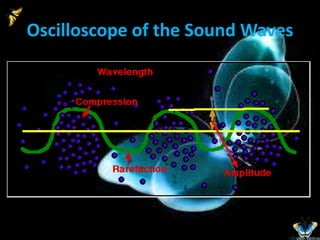
• Three characteristics are used to describe a 
sound wave. These are wavelength, 
frequency, and amplitude. 
• Wavelength; this is the distance from the 
crest of one wave to the crest of the next. 
• Frequency; this is the number of waves that 
pass a point in each second. 
• Amplitude; this is the measure of the amount 
of energy in a sound wave.
Oscilloscope of the Sound Waves
Pitch 
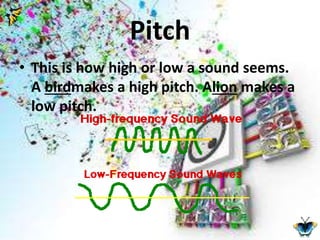
• This is how high or low a sound seems. 
A birdmakes a high pitch. Alion makes a 
low pitch.
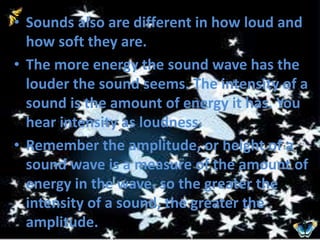
• Sounds also are different in how loud and 
how soft they are. 
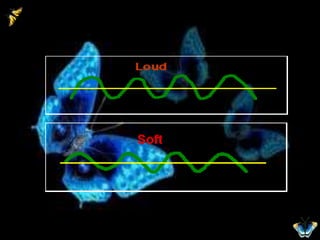
• The more energy the sound wave has the 
louder the sound seems. The intensity of a 
sound is the amount of energy it has. You 
hear intensity as loudness. 
• Remember the amplitude, or height of a 
sound wave is a measure of the amount of 
energy in the wave. so the greater the 
intensity of a sound, the greater the 
amplitude.
• Pitch and loudness are two ways that 
sounds are different. Another way is in 
quality.Some sounds are pleasant and 
some are a noise. 
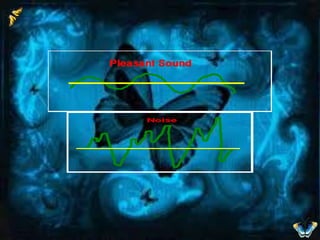
• Compare the two waves on the right. 
• A pleasant sound has a regular wave 
pattern. The pattern is repeated over 
and over. But the waves of noise are 
irregular. They do not have a repeated 
pattern.

Types of waves

  • 5.
    Transverse Waves •In a transverse wave the particle displacement is perpendicular to the direction of wave propagation. The animation below shows a one-dimensional transverse plane wave propagating from left to right. The particles do not move along with the wave; they simply oscillate up and down about their individual equilibrium positions as the wave passes by.
  • 6.
  • 7.
    Longitudinal Waves •In a longitudinal wave the particle displacement is parallel to the direction of wave propagation. The animation at right shows a one-dimensional longitudinal plane wave propagating down a tube. The particles do not move down the tube with the wave; they simply oscillate back and forth about their individual equilibrium positions.
  • 8.
  • 9.
    •It is thecombination of Transverse and Longitudinal Waves.
  • 10.
    Water Waves •Water waves are an example of waves that involve a combination of both longitudinal and transverse motions. As a wave travels through the waver, the particles travel in clockwise circles. The radius of the circles decreases as the depth into the water increases. The movie below shows a water wave travelling from left to right in a region where the depth of the water is greater than the wavelength of the waves.
  • 11.
  • 12.
    Rayleigh surface waves • Another example of waves with both longitudinal and transverse motion may be found in solids as Rayleigh surface waves (named after John W. Strutt, 3rd Baron Rayleigh). The particles in a solid, through which a Rayleigh surface wave passes, move in elliptical paths, with the major axis of the ellipse perpendicular to the surface of the solid. As the depth into the solid increases the "width" of the elliptical path decreases.
  • 13.
    • Rayleigh wavesare different from water waves in one important way. In a water wave all particles travel in clockwise circles. However, in a Rayleigh surface wave, particles at the surface trace out a counter-clockwise ellipse, while particles at a depth of more than 1/5th of a wavelength trace out clockwiseellispes. The movie below shows a Rayleigh wave travelling from left to right along the surface of a solid. I have identified two particles in yellow to illustrate the counterclockwise-clockwise motion as a function of depth.
  • 14.
    • The Rayleighsurface waves are the waves that cause the most damage during an earthquake. They travel with velocities slower than S waves, and arrive later, but with much greater amplitudes. These are also the waves that are most easily felt during an earthquake and involve both up-down and side-to-side motion.
  • 15.
    Sound Waves •Three characteristics are used to describe a sound wave. These are wavelength, frequency, and amplitude. • Wavelength; this is the distance from the crest of one wave to the crest of the next. • Frequency; this is the number of waves that pass a point in each second. • Amplitude; this is the measure of the amount of energy in a sound wave.
  • 16.
  • 17.
    Pitch • Thisis how high or low a sound seems. A birdmakes a high pitch. Alion makes a low pitch.
  • 18.
    • Sounds alsoare different in how loud and how soft they are. • The more energy the sound wave has the louder the sound seems. The intensity of a sound is the amount of energy it has. You hear intensity as loudness. • Remember the amplitude, or height of a sound wave is a measure of the amount of energy in the wave. so the greater the intensity of a sound, the greater the amplitude.
  • 21.
    • Pitch andloudness are two ways that sounds are different. Another way is in quality.Some sounds are pleasant and some are a noise. • Compare the two waves on the right. • A pleasant sound has a regular wave pattern. The pattern is repeated over and over. But the waves of noise are irregular. They do not have a repeated pattern.