

ezek_rodriguez@yahoo.com
At the end of the lesson, the
students should be able to:
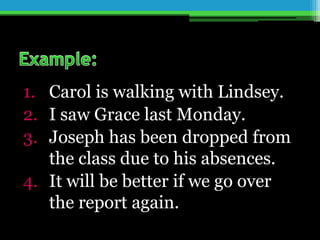
1. Carol is walking with Lindsey.
2. I saw Grace last Monday.
3. Joseph has been dropped from
the class due to his absences.
4. It will be better if we go over
the report again.
1. Please tell your mom that I will
be visiting her on Tuesday.
2. Kindly turn off the lights.
3. Close the window.
4. Please get me a glass of water.
1. Who is that person?
2. Can you carry this for me?
3. Do you want to have a new
phone?
4. Will you teach me how to do
that?
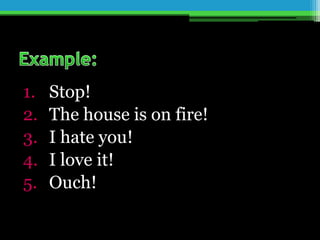
1. Stop!
2. The house is on fire!
3. I hate you!
4. I love it!
5. Ouch!
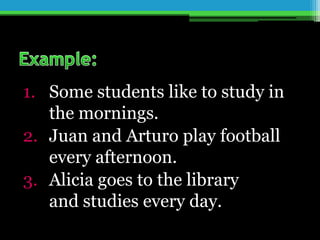
1. Some students like to study in
the mornings.
2. Juan and Arturo play football
every afternoon.
3. Alicia goes to the library
and studies every day.
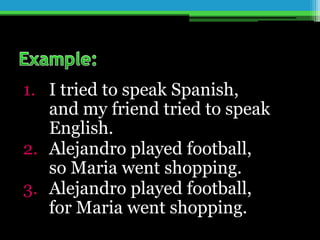
1. I tried to speak Spanish,
and my friend tried to speak
English.
2. Alejandro played football,
so Maria went shopping.
3. Alejandro played football,
for Maria went shopping.
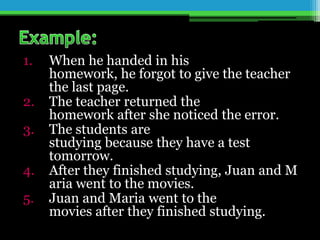
1. When he handed in his
homework, he forgot to give the teacher
the last page.
2. The teacher returned the
homework after she noticed the error.
3. The students are
studying because they have a test
tomorrow.
4. After they finished studying, Juan and M
aria went to the movies.
5. Juan and Maria went to the
movies after they finished studying.
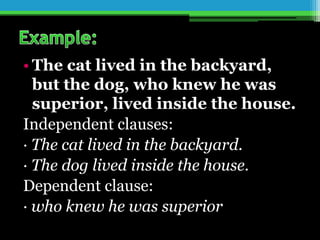
• The cat lived in the backyard,
but the dog, who knew he was
superior, lived inside the house.
Independent clauses:
· The cat lived in the backyard.
· The dog lived inside the house.
Dependent clause:
· who knew he was superior
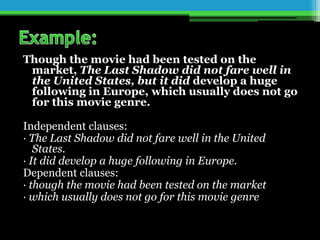
Though the movie had been tested on the
market, The Last Shadow did not fare well in
the United States, but it did develop a huge
following in Europe, which usually does not go
for this movie genre.
Independent clauses:
· The Last Shadow did not fare well in the United
States.
· It did develop a huge following in Europe.
Dependent clauses:
· though the movie had been tested on the market
· which usually does not go for this movie genre
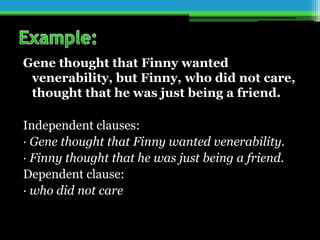
Gene thought that Finny wanted
venerability, but Finny, who did not care,
thought that he was just being a friend.
Independent clauses:
· Gene thought that Finny wanted venerability.
· Finny thought that he was just being a friend.
Dependent clause:
· who did not care
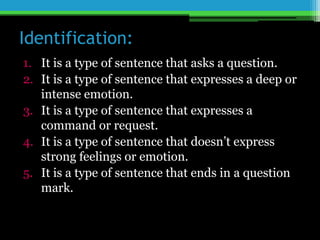
Identification:
1. It is a type of sentence that asks a question.
2. It is a type of sentence that expresses a deep or
intense emotion.
3. It is a type of sentence that expresses a
command or request.
4. It is a type of sentence that doesn’t express
strong feelings or emotion.
5. It is a type of sentence that ends in a question
mark.
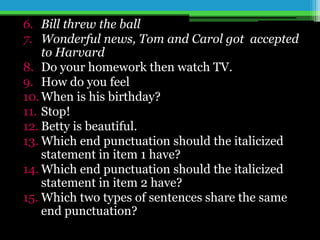
6. Bill threw the ball
7. Wonderful news, Tom and Carol got accepted
to Harvard
8. Do your homework then watch TV.
9. How do you feel
10.When is his birthday?
11. Stop!
12. Betty is beautiful.
13. Which end punctuation should the italicized
statement in item 1 have?
14. Which end punctuation should the italicized
statement in item 2 have?
15. Which two types of sentences share the same
end punctuation?
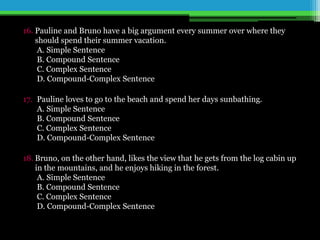
16. Pauline and Bruno have a big argument every summer over where they
should spend their summer vacation.
A. Simple Sentence
B. Compound Sentence
C. Complex Sentence
D. Compound-Complex Sentence
17. Pauline loves to go to the beach and spend her days sunbathing.
A. Simple Sentence
B. Compound Sentence
C. Complex Sentence
D. Compound-Complex Sentence
18. Bruno, on the other hand, likes the view that he gets from the log cabin up
in the mountains, and he enjoys hiking in the forest.
A. Simple Sentence
B. Compound Sentence
C. Complex Sentence
D. Compound-Complex Sentence
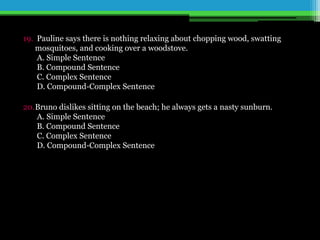
19. Pauline says there is nothing relaxing about chopping wood, swatting
mosquitoes, and cooking over a woodstove.
A. Simple Sentence
B. Compound Sentence
C. Complex Sentence
D. Compound-Complex Sentence
20.Bruno dislikes sitting on the beach; he always gets a nasty sunburn.
A. Simple Sentence
B. Compound Sentence
C. Complex Sentence
D. Compound-Complex Sentence
Pauline and Bruno have a big argument every summer over where they should spend their
summer vacation.
A. Simple Sentence
B. Compound Sentence
C. Complex Sentence
D. Compound-Complex Sentence
The independent clause is "Pauline and Bruno have a big argument every
summer; the dependent clause is "where they should spend their summer
vacation." (The dependent clause is a noun clause, the object of the
preposition "over.")
Pauline loves to go to the beach and spend her days sunbathing.
A. Simple Sentence
B. Compound Sentence
C. Complex Sentence
D. Compound-Complex Sentence
There is only one independent clause here, and no dependent clause. The
"and" is connecting two infinitive phrases ("to go" and "[to] spend").
Bruno, on the other hand, likes the view that he gets from the log cabin up in the mountains,
and he enjoys hiking in the forest.
A. Simple Sentence
B. Compound Sentence
C. Complex Sentence
D. Compound-Complex Sentence
There are two independent clauses here -- "Bruno likes the view" and "he
enjoys hiking. . ." -- and one dependent clause -- "that he gets . . . ."
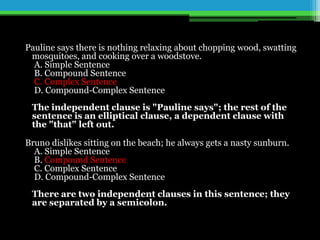
Pauline says there is nothing relaxing about chopping wood, swatting
mosquitoes, and cooking over a woodstove.
A. Simple Sentence
B. Compound Sentence
C. Complex Sentence
D. Compound-Complex Sentence
The independent clause is "Pauline says"; the rest of the
sentence is an elliptical clause, a dependent clause with
the "that" left out.
Bruno dislikes sitting on the beach; he always gets a nasty sunburn.
A. Simple Sentence
B. Compound Sentence
C. Complex Sentence
D. Compound-Complex Sentence
There are two independent clauses in this sentence; they
are separated by a semicolon.

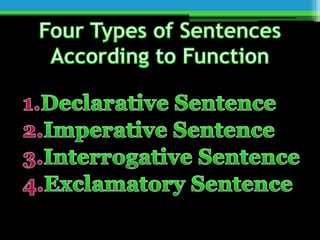
Types of Sentence According to Function

  • 1.
  • 2.
    At the endof the lesson, the students should be able to:
  • 7.
    1. Carol iswalking with Lindsey. 2. I saw Grace last Monday. 3. Joseph has been dropped from the class due to his absences. 4. It will be better if we go over the report again.
  • 9.
    1. Please tellyour mom that I will be visiting her on Tuesday. 2. Kindly turn off the lights. 3. Close the window. 4. Please get me a glass of water.
  • 11.
    1. Who isthat person? 2. Can you carry this for me? 3. Do you want to have a new phone? 4. Will you teach me how to do that?
  • 13.
    1. Stop! 2. Thehouse is on fire! 3. I hate you! 4. I love it! 5. Ouch!
  • 17.
    1. Some studentslike to study in the mornings. 2. Juan and Arturo play football every afternoon. 3. Alicia goes to the library and studies every day.
  • 19.
    1. I triedto speak Spanish, and my friend tried to speak English. 2. Alejandro played football, so Maria went shopping. 3. Alejandro played football, for Maria went shopping.
  • 21.
    1. When hehanded in his homework, he forgot to give the teacher the last page. 2. The teacher returned the homework after she noticed the error. 3. The students are studying because they have a test tomorrow. 4. After they finished studying, Juan and M aria went to the movies. 5. Juan and Maria went to the movies after they finished studying.
  • 23.
    • The catlived in the backyard, but the dog, who knew he was superior, lived inside the house. Independent clauses: · The cat lived in the backyard. · The dog lived inside the house. Dependent clause: · who knew he was superior
  • 24.
    Though the moviehad been tested on the market, The Last Shadow did not fare well in the United States, but it did develop a huge following in Europe, which usually does not go for this movie genre. Independent clauses: · The Last Shadow did not fare well in the United States. · It did develop a huge following in Europe. Dependent clauses: · though the movie had been tested on the market · which usually does not go for this movie genre
  • 25.
    Gene thought thatFinny wanted venerability, but Finny, who did not care, thought that he was just being a friend. Independent clauses: · Gene thought that Finny wanted venerability. · Finny thought that he was just being a friend. Dependent clause: · who did not care
  • 28.
    Identification: 1. It isa type of sentence that asks a question. 2. It is a type of sentence that expresses a deep or intense emotion. 3. It is a type of sentence that expresses a command or request. 4. It is a type of sentence that doesn’t express strong feelings or emotion. 5. It is a type of sentence that ends in a question mark.
  • 29.
    6. Bill threwthe ball 7. Wonderful news, Tom and Carol got accepted to Harvard 8. Do your homework then watch TV. 9. How do you feel 10.When is his birthday? 11. Stop! 12. Betty is beautiful. 13. Which end punctuation should the italicized statement in item 1 have? 14. Which end punctuation should the italicized statement in item 2 have? 15. Which two types of sentences share the same end punctuation?
  • 30.
    16. Pauline andBruno have a big argument every summer over where they should spend their summer vacation. A. Simple Sentence B. Compound Sentence C. Complex Sentence D. Compound-Complex Sentence 17. Pauline loves to go to the beach and spend her days sunbathing. A. Simple Sentence B. Compound Sentence C. Complex Sentence D. Compound-Complex Sentence 18. Bruno, on the other hand, likes the view that he gets from the log cabin up in the mountains, and he enjoys hiking in the forest. A. Simple Sentence B. Compound Sentence C. Complex Sentence D. Compound-Complex Sentence
  • 31.
    19. Pauline saysthere is nothing relaxing about chopping wood, swatting mosquitoes, and cooking over a woodstove. A. Simple Sentence B. Compound Sentence C. Complex Sentence D. Compound-Complex Sentence 20.Bruno dislikes sitting on the beach; he always gets a nasty sunburn. A. Simple Sentence B. Compound Sentence C. Complex Sentence D. Compound-Complex Sentence
  • 33.
    Pauline and Brunohave a big argument every summer over where they should spend their summer vacation. A. Simple Sentence B. Compound Sentence C. Complex Sentence D. Compound-Complex Sentence The independent clause is "Pauline and Bruno have a big argument every summer; the dependent clause is "where they should spend their summer vacation." (The dependent clause is a noun clause, the object of the preposition "over.") Pauline loves to go to the beach and spend her days sunbathing. A. Simple Sentence B. Compound Sentence C. Complex Sentence D. Compound-Complex Sentence There is only one independent clause here, and no dependent clause. The "and" is connecting two infinitive phrases ("to go" and "[to] spend"). Bruno, on the other hand, likes the view that he gets from the log cabin up in the mountains, and he enjoys hiking in the forest. A. Simple Sentence B. Compound Sentence C. Complex Sentence D. Compound-Complex Sentence There are two independent clauses here -- "Bruno likes the view" and "he enjoys hiking. . ." -- and one dependent clause -- "that he gets . . . ."
  • 34.
    Pauline says thereis nothing relaxing about chopping wood, swatting mosquitoes, and cooking over a woodstove. A. Simple Sentence B. Compound Sentence C. Complex Sentence D. Compound-Complex Sentence The independent clause is "Pauline says"; the rest of the sentence is an elliptical clause, a dependent clause with the "that" left out. Bruno dislikes sitting on the beach; he always gets a nasty sunburn. A. Simple Sentence B. Compound Sentence C. Complex Sentence D. Compound-Complex Sentence There are two independent clauses in this sentence; they are separated by a semicolon.