At the end of the lesson, the students should be
able to:
a) identify the use of content words in the
discourse;
b) talk about social issues based on preliminary
readings and contextual discourses;
c) formulate sentences and identify the nouns that
has been used; and
d) answer the given exercises.
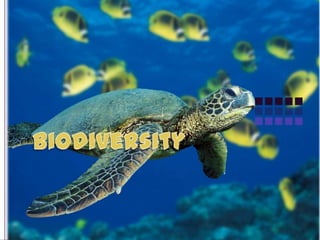
Biodiversity refers to the sum of all the different
species of animals, fungi, and microbial
organisms living on Earth and the variety of
habitats in which they live. It allowed
ecosystems to function properly. It is essential
to the well being of humans and plants.
However the biodiversity is in serious danger, it
is shrinking at an alarming rate. It is estimated
that the Earth is losing approximately 27,000
species per year.The cause of biodiversity loss
is largely due to the explosion in human
population.
The shrinking of the biodiversity would have a huge
impact on lives of human. Biodiversity provides
the necessity that makes life possible. It provides
fresh water, clean air and nutrients.Without all of
these things, it is impossible for human to survive,
The human destruction of the natural habitats,
the raising temperature and introduced species
has jeopardized our biodiversity.The human
destruction of natural habitats is one of the
greatest threats to biodiversity. Human has
physically transformed the earth's face. Human
destroyed wetlands, forests and jungles and
replaced it with railways and factories.This has
caused large amounts of animals to lose their
homes and become extinct.
The greenhouse effect has affected
our biodiversity tremendously.The burning of fossil
fuels produce large amounts of greenhouse gases
which trap the heat in the air.The greenhouse
effect has caused the temperature to rise unnaturally
and dramatically. Scientists blame it for an increase in
the Earth's surface temperature of about 0.6 Celsius
degrees (about 1 Fahrenheit degree) over the last
nearly 100 years.Without remedial measures, many
scientists fear global temperature will rise 1.4 to 5.8
Celsius degrees (2.5 to 10.4 Fahrenheit degrees) by
2100.The warmer temperature could melt polar icecaps
which would cause the sea level to rise and lands to
sink. Lots of animal would be unable to survive in
warmer temperature. Scientists have warned that
extinction is to be expected if the temperature keeps
rising in current rate.
The introduced species have damaging effect
to biodiversity. It unbalances the environment.
The introduced animals may prefer other wild
animals to the pests they supposed to destroy.
We can protect biodiversity in the following
methods: conservation and preservation.
Conservation is to set resources aside from use.
National park is one form of conservation.
Preservation means to set resources aside so we
can use later. Other strategies include reducing
impact of feral animals and plants by controlling
them; set species breeding program; introduce
laws and rules to reduce pollution.
 The word comes from
the Latin nomen meaning "name".
 A noun is a word used to refer to people,
animals, objects, substances, states, events
and feelings. Nouns can be a subject or an
object of a verb, can be modified by an
adjective and can take an article or
determiner.
 Table
 A pencil is needed for the entrance
examination.
 The dog is barking.
 A white house is burning.
For example:
 birth
 happiness
 evolution
 technology
1. We went to town and bought a lamp.
2. The joy she felt was clear for all to see.
3. The thunder could be heard from a distance
of three miles.
4. The cow with the curly horn was the most
spectacular of the herd.
5. Misha lovesYel very much.
Now, it’s your turn to
construct your own
sentences…
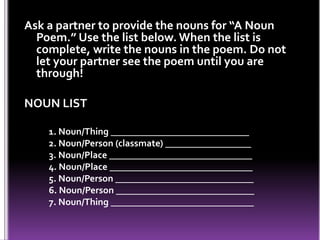
Ask a partner to provide the nouns for “A Noun
Poem.” Use the list below. When the list is
complete, write the nouns in the poem. Do not
let your partner see the poem until you are
through!
NOUN LIST
1. Noun/Thing _____________________________
2. Noun/Person (classmate) __________________
3. Noun/Place ______________________________
4. Noun/Place ______________________________
5. Noun/Person _____________________________
6. Noun/Person _____________________________
7. Noun/Thing ______________________________
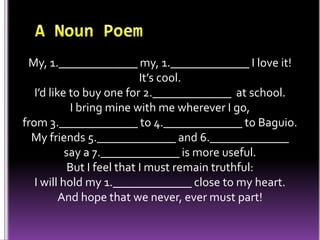
My, 1._____________ my, 1._____________ I love it!
It’s cool.
I’d like to buy one for 2._____________ at school.
I bring mine with me wherever I go,
from 3._____________ to 4._____________ to Baguio.
My friends 5._____________ and 6._____________
say a 7._____________ is more useful.
But I feel that I must remain truthful:
I will hold my 1._____________ close to my heart.
And hope that we never, ever must part!
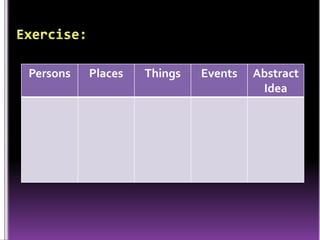
Persons Places Things Events Abstract
Idea
An unusually strong earthquake occurred
in China in 1976.Tremors from the
quake were felt hundreds of miles away.
In the severely damaged city ofTientsin,
thousands of Chinese evacuated
collapsing buildings.The industrial city
of Tangshan was devastated, and its
nearby mines were also damaged. An
estimated 655,000 people lost their
lives.
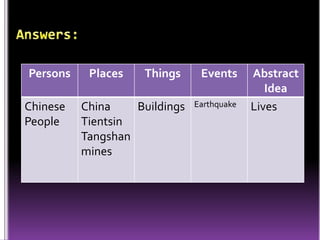
Persons Places Things Events Abstract
Idea
Chinese
People
China
Tientsin
Tangshan
mines
Buildings Earthquake Lives

Nouns

  • 1.
    At the endof the lesson, the students should be able to: a) identify the use of content words in the discourse; b) talk about social issues based on preliminary readings and contextual discourses; c) formulate sentences and identify the nouns that has been used; and d) answer the given exercises.
  • 3.
    Biodiversity refers tothe sum of all the different species of animals, fungi, and microbial organisms living on Earth and the variety of habitats in which they live. It allowed ecosystems to function properly. It is essential to the well being of humans and plants. However the biodiversity is in serious danger, it is shrinking at an alarming rate. It is estimated that the Earth is losing approximately 27,000 species per year.The cause of biodiversity loss is largely due to the explosion in human population.
  • 4.
    The shrinking ofthe biodiversity would have a huge impact on lives of human. Biodiversity provides the necessity that makes life possible. It provides fresh water, clean air and nutrients.Without all of these things, it is impossible for human to survive, The human destruction of the natural habitats, the raising temperature and introduced species has jeopardized our biodiversity.The human destruction of natural habitats is one of the greatest threats to biodiversity. Human has physically transformed the earth's face. Human destroyed wetlands, forests and jungles and replaced it with railways and factories.This has caused large amounts of animals to lose their homes and become extinct.
  • 5.
    The greenhouse effecthas affected our biodiversity tremendously.The burning of fossil fuels produce large amounts of greenhouse gases which trap the heat in the air.The greenhouse effect has caused the temperature to rise unnaturally and dramatically. Scientists blame it for an increase in the Earth's surface temperature of about 0.6 Celsius degrees (about 1 Fahrenheit degree) over the last nearly 100 years.Without remedial measures, many scientists fear global temperature will rise 1.4 to 5.8 Celsius degrees (2.5 to 10.4 Fahrenheit degrees) by 2100.The warmer temperature could melt polar icecaps which would cause the sea level to rise and lands to sink. Lots of animal would be unable to survive in warmer temperature. Scientists have warned that extinction is to be expected if the temperature keeps rising in current rate.
  • 6.
    The introduced specieshave damaging effect to biodiversity. It unbalances the environment. The introduced animals may prefer other wild animals to the pests they supposed to destroy. We can protect biodiversity in the following methods: conservation and preservation. Conservation is to set resources aside from use. National park is one form of conservation. Preservation means to set resources aside so we can use later. Other strategies include reducing impact of feral animals and plants by controlling them; set species breeding program; introduce laws and rules to reduce pollution.
  • 7.
     The wordcomes from the Latin nomen meaning "name".  A noun is a word used to refer to people, animals, objects, substances, states, events and feelings. Nouns can be a subject or an object of a verb, can be modified by an adjective and can take an article or determiner.
  • 8.
     Table  Apencil is needed for the entrance examination.  The dog is barking.  A white house is burning.
  • 9.
    For example:  birth happiness  evolution  technology
  • 10.
    1. We wentto town and bought a lamp. 2. The joy she felt was clear for all to see. 3. The thunder could be heard from a distance of three miles. 4. The cow with the curly horn was the most spectacular of the herd. 5. Misha lovesYel very much.
  • 11.
    Now, it’s yourturn to construct your own sentences…
  • 12.
    Ask a partnerto provide the nouns for “A Noun Poem.” Use the list below. When the list is complete, write the nouns in the poem. Do not let your partner see the poem until you are through! NOUN LIST 1. Noun/Thing _____________________________ 2. Noun/Person (classmate) __________________ 3. Noun/Place ______________________________ 4. Noun/Place ______________________________ 5. Noun/Person _____________________________ 6. Noun/Person _____________________________ 7. Noun/Thing ______________________________
  • 13.
    My, 1._____________ my,1._____________ I love it! It’s cool. I’d like to buy one for 2._____________ at school. I bring mine with me wherever I go, from 3._____________ to 4._____________ to Baguio. My friends 5._____________ and 6._____________ say a 7._____________ is more useful. But I feel that I must remain truthful: I will hold my 1._____________ close to my heart. And hope that we never, ever must part!
  • 15.
    Persons Places ThingsEvents Abstract Idea
  • 16.
    An unusually strongearthquake occurred in China in 1976.Tremors from the quake were felt hundreds of miles away. In the severely damaged city ofTientsin, thousands of Chinese evacuated collapsing buildings.The industrial city of Tangshan was devastated, and its nearby mines were also damaged. An estimated 655,000 people lost their lives.
  • 17.
    Persons Places ThingsEvents Abstract Idea Chinese People China Tientsin Tangshan mines Buildings Earthquake Lives