Types of Programs and Program Development
Types of Programs Televised Sports Usually Captured and Broadcast Live Usually Shot with Multiple Cameras Usually Have a Location Production Truck Usually Feature an Announcer (Play by Play) and a Color Commentator (Often a “Jock”) Usually Employ Local Camera Ops and Crew Usually Shot on Beta-SP or HD Occasionally Shot on 16mm Film
Types of Programs Televised News Packages Usually Compiled over a Few Hours Always Shot with a Single Camera Usually Broadcast the Same Day Usually Feature a Stand-Up Announcer Usually Employ Station Personnel Always Edited at the Station or Affiliate Running Time Usually 2-3 Minutes Usually Shot on Video or HD
Types of Programs Televised Live News Always Shot Live on Location Usually Shot with a Single Camera Always Broadcast Live Usually Feature a Stand-Up Announcer Usually Feature Communication w/ Hosts Always Employ Station Personnel Running Time Usually 2-3 Minutes Usually Shot on Video or HD
Types of Programs Broadcast Feature Stories Usually Compiled over Weeks or Months Usually Shot with a Single Camera Usually Provide Their Own Equipment Often Feature a V.O. (Voice-Over) Track Usually Employ Minimal Local Crew Usually Edited in NY or LA Running Time Usually 5-20 Minutes Usually Shot on Video or HD
Types of Programs Documentary Film Usually Compiled over Months or Years Usually Shot with a Single or Two Cameras Usually Provide Their Own Equipment Often Feature a V.O. (Voice-Over) Track Usually Employ Minimal Local Crew Usually Edited Over a Long Period of Time Running Time Usually 30-60-90 Minutes Often Shot on Video or HD
Types of Programs Talk Shows and Game Shows Several Usually Shot in One Day Usually Shot with Three Cameras Usually Shot in a Studio with an Audience Usually Feature a Well-Known Host Usually Shot in Hollywood or New York Usually Edited by the Network or Producer Running Time Usually 30 or 60 Minutes Usually Shot on HD, Beta-SP or Digi-Beta
Types of Programs Music Videos Usually Shot in a Few Days Often Shot with up to Three Cameras Equipment Usually from a Rental House Always Shot with a Playback Track Usually Employ Some Local Crew Usually Edited Over a Few Weeks Often Shot Secretly to Avoid Crowds Usually Shot on Film or HD
Types of Programs Local Commercials Usually Shot and Edited in 1 Day Usually Shot with One Camera Equipment Usually Locally Owned Often Shot by a Local Production House Often Employ Some Local Crew Often Written and Produced by an Agency Length Usually :30 sec (Rarely :15 or :60) Usually Shot on Beta-SP or HDV
Types of Programs National Commercials Usually Shot in 1-3 Days Usually Shot with One Camera Equipment Usually Rented for Project Sometimes Shot by a Local Production House Often Employ Some Local Crew Always Written and Produced by an Agency Length Usually :30 sec (Rarely :15 or :60) Usually Shot on HD or 35mm Film
Types of Programs Infomercials Usually Shot in 1-3 Days Usually Shot with 3 Cameras Equipment Usually Rented for Project Sometimes Shot by a Local Production House Often Employ Some Local Crew Always Written and Produced by an Agency Length is 30 or 60 Minutes Including Ads Usually Shot on HD or Beta-SP
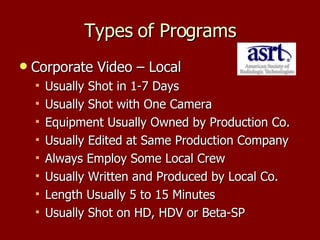
Types of Programs Corporate Video – Local Usually Shot in 1-7 Days Usually Shot with One Camera Equipment Usually Owned by Production Co. Usually Edited at Same Production Company Always Employ Some Local Crew Usually Written and Produced by Local Co. Length Usually 5 to 15 Minutes Usually Shot on HD, HDV or Beta-SP
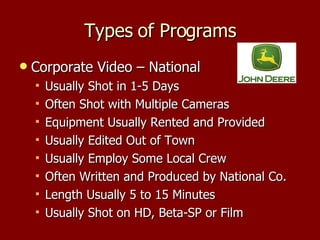
Types of Programs Corporate Video – National Usually Shot in 1-5 Days Often Shot with Multiple Cameras Equipment Usually Rented and Provided Usually Edited Out of Town Usually Employ Some Local Crew Often Written and Produced by National Co. Length Usually 5 to 15 Minutes Usually Shot on HD, Beta-SP or Film
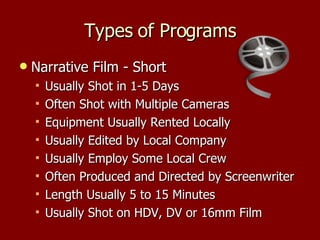
Types of Programs Narrative Film - Short Usually Shot in 1-5 Days Often Shot with Multiple Cameras Equipment Usually Rented Locally Usually Edited by Local Company Usually Employ Some Local Crew Often Produced and Directed by Screenwriter Length Usually 5 to 15 Minutes Usually Shot on HDV, DV or 16mm Film
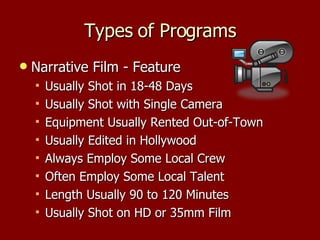
Types of Programs Narrative Film - Feature Usually Shot in 18-48 Days Usually Shot with Single Camera Equipment Usually Rented Out-of-Town Usually Edited in Hollywood Always Employ Some Local Crew Often Employ Some Local Talent Length Usually 90 to 120 Minutes Usually Shot on HD or 35mm Film
Types of Programs Narrative Film - TV Series Pilot Shot in 12-20 Days Series Shot in 45-120 Days Often Shot with Multiple Cameras Equipment and Editing from Out-of-Town Always Employ Some Local Crew Often Employ Some Local Talent Length Usually 60 or 120 Minutes Usually Shot on HD or 16mm Film
Types of Programs Reality Television Program Usually Shot Over Several Weeks Usually Shot with Multiple Cameras Equipment Usually Rented Out-of-Town Usually Edited in Hollywood Usually Employ Some Local Crew Usually Employ Some Local Talent Length Usually 30 or 60 Minutes per Show Usually Shot on HD, Beta-SP or Digi-Beta
Program Development The First Steps in Program Development are to determine your: Subject Matter Objectives Target Audience Delivery System Program Length Budget
Program Development The first step in pre-production is to identify the  Subject Matter The easiest way to do that is to give the project a Working Title that states the topic in a few words. For example: Warehouse Operations at Sysco Foods Zangara Dodge :30 Second TV Spot Man vs. Cartoon How to Make Rice Krispy Treats
Program Development The next step is to deter- mine your   or your client’s Objectives . What do you want your outcome to be? If it is a training video, maybe you want the viewer to be able to take and pass a test. If it is a marketing video, you might want the viewer to purchase a product or invest money If it is a television program, you might want to attract the largest number of teens during a particular time slot
Program Development Demographics  are selected population characteristics used in government, marketing or opinion research, or the profiles used in such research  Commonly-used  Demographics  include race, age, income, disabilities, mobility, educational attainment, home ownership, employment status, and location. Wikipedia
Program Development The next step is to deter- mine the  Target Audience .   This is the demographic group most likely to watch your specific program In any type of programming, it is essential to know your  Target Audience Once you know your  Target Audience  the writing style and choice of talent can be adjusted to appeal to that demographic
Program Development Ratings Services Arbitron (Radio) and Neilsen (TV) chart the listening and viewing habits of demographic groups – These stats are called Ratings Marketers use the Ratings to target their ideal customer base (demographic) Ratings are the tools media outlets use to justify their advertising rates Ratings are the way media creators can be assured that their programs will be renewed
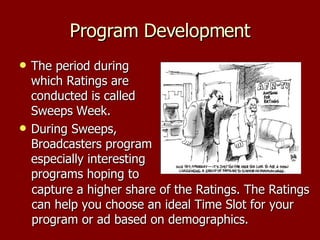
Program Development The period during which Ratings are conducted is called Sweeps   Week. During Sweeps, Broadcasters program especially interesting programs hoping to capture a higher share of the Ratings. The Ratings can help you choose an ideal Time Slot for your program or ad based on demographics.
Program Development The  Delivery System  is  the next element Is the  Delivery System : Broadcast Television Cable or Satellite Theatrical Distribution Festivals or Limited Screening Online Streaming Radio Broadcast Tape or DVD Sales and Rentals
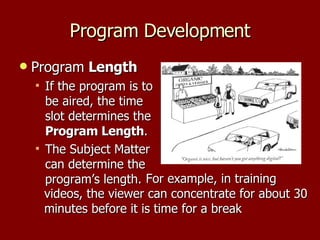
Program Development Program  Length If the program is to be aired, the time slot determines the  Program Length . The Subject Matter can determine the program’s length.   For example, in training videos, the viewer can concentrate for about 30 minutes before it is time for a break
Program Development Program  Budget The  Budget  is often the key factor in determining the length of the program The client often asks for a presentation to be a certain length only to find his budget can’t support that length. The old “Rule of Thumb” was that a production would cost $1500. to $2000. per finished minute. This varies greatly depending on a number of variables

Film and Video Projects and Program Development

  • 1.
    Types of Programsand Program Development
  • 2.
    Types of ProgramsTelevised Sports Usually Captured and Broadcast Live Usually Shot with Multiple Cameras Usually Have a Location Production Truck Usually Feature an Announcer (Play by Play) and a Color Commentator (Often a “Jock”) Usually Employ Local Camera Ops and Crew Usually Shot on Beta-SP or HD Occasionally Shot on 16mm Film
  • 3.
    Types of ProgramsTelevised News Packages Usually Compiled over a Few Hours Always Shot with a Single Camera Usually Broadcast the Same Day Usually Feature a Stand-Up Announcer Usually Employ Station Personnel Always Edited at the Station or Affiliate Running Time Usually 2-3 Minutes Usually Shot on Video or HD
  • 4.
    Types of ProgramsTelevised Live News Always Shot Live on Location Usually Shot with a Single Camera Always Broadcast Live Usually Feature a Stand-Up Announcer Usually Feature Communication w/ Hosts Always Employ Station Personnel Running Time Usually 2-3 Minutes Usually Shot on Video or HD
  • 5.
    Types of ProgramsBroadcast Feature Stories Usually Compiled over Weeks or Months Usually Shot with a Single Camera Usually Provide Their Own Equipment Often Feature a V.O. (Voice-Over) Track Usually Employ Minimal Local Crew Usually Edited in NY or LA Running Time Usually 5-20 Minutes Usually Shot on Video or HD
  • 6.
    Types of ProgramsDocumentary Film Usually Compiled over Months or Years Usually Shot with a Single or Two Cameras Usually Provide Their Own Equipment Often Feature a V.O. (Voice-Over) Track Usually Employ Minimal Local Crew Usually Edited Over a Long Period of Time Running Time Usually 30-60-90 Minutes Often Shot on Video or HD
  • 7.
    Types of ProgramsTalk Shows and Game Shows Several Usually Shot in One Day Usually Shot with Three Cameras Usually Shot in a Studio with an Audience Usually Feature a Well-Known Host Usually Shot in Hollywood or New York Usually Edited by the Network or Producer Running Time Usually 30 or 60 Minutes Usually Shot on HD, Beta-SP or Digi-Beta
  • 8.
    Types of ProgramsMusic Videos Usually Shot in a Few Days Often Shot with up to Three Cameras Equipment Usually from a Rental House Always Shot with a Playback Track Usually Employ Some Local Crew Usually Edited Over a Few Weeks Often Shot Secretly to Avoid Crowds Usually Shot on Film or HD
  • 9.
    Types of ProgramsLocal Commercials Usually Shot and Edited in 1 Day Usually Shot with One Camera Equipment Usually Locally Owned Often Shot by a Local Production House Often Employ Some Local Crew Often Written and Produced by an Agency Length Usually :30 sec (Rarely :15 or :60) Usually Shot on Beta-SP or HDV
  • 10.
    Types of ProgramsNational Commercials Usually Shot in 1-3 Days Usually Shot with One Camera Equipment Usually Rented for Project Sometimes Shot by a Local Production House Often Employ Some Local Crew Always Written and Produced by an Agency Length Usually :30 sec (Rarely :15 or :60) Usually Shot on HD or 35mm Film
  • 11.
    Types of ProgramsInfomercials Usually Shot in 1-3 Days Usually Shot with 3 Cameras Equipment Usually Rented for Project Sometimes Shot by a Local Production House Often Employ Some Local Crew Always Written and Produced by an Agency Length is 30 or 60 Minutes Including Ads Usually Shot on HD or Beta-SP
  • 12.
    Types of ProgramsCorporate Video – Local Usually Shot in 1-7 Days Usually Shot with One Camera Equipment Usually Owned by Production Co. Usually Edited at Same Production Company Always Employ Some Local Crew Usually Written and Produced by Local Co. Length Usually 5 to 15 Minutes Usually Shot on HD, HDV or Beta-SP
  • 13.
    Types of ProgramsCorporate Video – National Usually Shot in 1-5 Days Often Shot with Multiple Cameras Equipment Usually Rented and Provided Usually Edited Out of Town Usually Employ Some Local Crew Often Written and Produced by National Co. Length Usually 5 to 15 Minutes Usually Shot on HD, Beta-SP or Film
  • 14.
    Types of ProgramsNarrative Film - Short Usually Shot in 1-5 Days Often Shot with Multiple Cameras Equipment Usually Rented Locally Usually Edited by Local Company Usually Employ Some Local Crew Often Produced and Directed by Screenwriter Length Usually 5 to 15 Minutes Usually Shot on HDV, DV or 16mm Film
  • 15.
    Types of ProgramsNarrative Film - Feature Usually Shot in 18-48 Days Usually Shot with Single Camera Equipment Usually Rented Out-of-Town Usually Edited in Hollywood Always Employ Some Local Crew Often Employ Some Local Talent Length Usually 90 to 120 Minutes Usually Shot on HD or 35mm Film
  • 16.
    Types of ProgramsNarrative Film - TV Series Pilot Shot in 12-20 Days Series Shot in 45-120 Days Often Shot with Multiple Cameras Equipment and Editing from Out-of-Town Always Employ Some Local Crew Often Employ Some Local Talent Length Usually 60 or 120 Minutes Usually Shot on HD or 16mm Film
  • 17.
    Types of ProgramsReality Television Program Usually Shot Over Several Weeks Usually Shot with Multiple Cameras Equipment Usually Rented Out-of-Town Usually Edited in Hollywood Usually Employ Some Local Crew Usually Employ Some Local Talent Length Usually 30 or 60 Minutes per Show Usually Shot on HD, Beta-SP or Digi-Beta
  • 18.
    Program Development TheFirst Steps in Program Development are to determine your: Subject Matter Objectives Target Audience Delivery System Program Length Budget
  • 19.
    Program Development Thefirst step in pre-production is to identify the Subject Matter The easiest way to do that is to give the project a Working Title that states the topic in a few words. For example: Warehouse Operations at Sysco Foods Zangara Dodge :30 Second TV Spot Man vs. Cartoon How to Make Rice Krispy Treats
  • 20.
    Program Development Thenext step is to deter- mine your or your client’s Objectives . What do you want your outcome to be? If it is a training video, maybe you want the viewer to be able to take and pass a test. If it is a marketing video, you might want the viewer to purchase a product or invest money If it is a television program, you might want to attract the largest number of teens during a particular time slot
  • 21.
    Program Development Demographics are selected population characteristics used in government, marketing or opinion research, or the profiles used in such research Commonly-used Demographics include race, age, income, disabilities, mobility, educational attainment, home ownership, employment status, and location. Wikipedia
  • 22.
    Program Development Thenext step is to deter- mine the Target Audience . This is the demographic group most likely to watch your specific program In any type of programming, it is essential to know your Target Audience Once you know your Target Audience the writing style and choice of talent can be adjusted to appeal to that demographic
  • 23.
    Program Development RatingsServices Arbitron (Radio) and Neilsen (TV) chart the listening and viewing habits of demographic groups – These stats are called Ratings Marketers use the Ratings to target their ideal customer base (demographic) Ratings are the tools media outlets use to justify their advertising rates Ratings are the way media creators can be assured that their programs will be renewed
  • 24.
    Program Development Theperiod during which Ratings are conducted is called Sweeps Week. During Sweeps, Broadcasters program especially interesting programs hoping to capture a higher share of the Ratings. The Ratings can help you choose an ideal Time Slot for your program or ad based on demographics.
  • 25.
    Program Development The Delivery System is the next element Is the Delivery System : Broadcast Television Cable or Satellite Theatrical Distribution Festivals or Limited Screening Online Streaming Radio Broadcast Tape or DVD Sales and Rentals
  • 26.
    Program Development Program Length If the program is to be aired, the time slot determines the Program Length . The Subject Matter can determine the program’s length. For example, in training videos, the viewer can concentrate for about 30 minutes before it is time for a break
  • 27.
    Program Development Program Budget The Budget is often the key factor in determining the length of the program The client often asks for a presentation to be a certain length only to find his budget can’t support that length. The old “Rule of Thumb” was that a production would cost $1500. to $2000. per finished minute. This varies greatly depending on a number of variables