



Technical Definitions
Print
What is a digital cromalin and what is it used for? Cromalin provides the best colour matching for printers as it is calibrated to show CMYK colours, (exactly as they should appear when printing with inks) It is an industry standard proof which the printer actually uses while printing the job on press to ensure the printed job is consistent and 100% accurate to the proof colour wise.  
  What is a press proof and what is it used for? Colours for printing on newsprint need a lot more tweaking than those used on standard paper as the newsprint soaks more ink and naturally prints much darker. We run press proofs of every campaign to ensure ; 1. The image is visible - 80% of images need to be colour amended after a newsprint proof is run  2. that all the copy is legible as the ink will spread when printed on newsprint. Each newspaper has individual profiles (some print darker and some print lighter  eg The Irish Times prints using much less ink than most newspapers so all the ads that appear in this  publication are printed much lighter than say in the Sunday World.) Newsprint proofs are vital to ensure we achieve the best colour balance across all publications.
Film
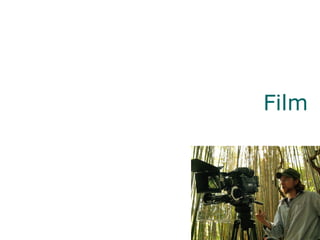
DOP A Director of Photography (cinematographer)-After the locations have been chosen, the DOP decides on how the scenes should be shot. Views, scenery etc . They are responsible for achieving artistic and technical decisions relating to the image.
A Focus puller They are part of the film crew, they prepare the camera, accessories, lens etc for the day’s shoot. They also change the distance setting on the lens during the take.
Pre production Pre production is the process before a film is made. This involves the organization of the whole production. For example: budget, cast, crew, locations, food, accommodation, scripts.  Pre Production meeting  is a key decision making time
Post production The post production process involves everything that happens  after  the production has been shot. For example, sound, music, re touching, editing and this happens in a post production house/studio.
Off-line edit  Is a pre-graded, pre-visual effects, pre-sound effects, pre-VO version of the film. Normally what is first shown to the client to get approval before final cut is agreed.
Director  The director develop their vision of what the script will look like by creating a sequence of clearly defined shots (‘ Directors Treatment ’ )  They cast the actors Then they direct the actors and crew during the film making process.
Producer  A producer is responsible for overseeing and developing the project. The producer manages the budget and pulls together the crew. A role not disimilar to an account director in a agency
A movement order A document outlining exactly one gets to a shoot location or from one location to the next location.
A Critical Path  - CPA This is a detailed schedule/timeline of every aspect of a production that happens on a daily bases from start to finish.
A Call Sheet Is a document that details the names and numbers of everyone involved on a shoot, from Agency to Client to Cast, to Crew to Suppliers.  So on a shoot everyone you need to get hold of is listed on this document.
A VO Is a Voice Over.
Digital
SEO   - Search Engine Optimization. This is an action taken on a web site to improve your contents visibility within the results. PPC  – Pay-Per-Click A method of advertising on a search engine where you pay an agreed amount everytime someone clicks on your ad.
UCG  – user generated content. Same thing as  CGM  (Consumer Generated Media) or  UCC  (User Created Content), just a different way of saying it. Any content on a website, social media platform etc that has been generated by a user/consumer rather than the site owner.  CTR  – Click Through Rate. The percentage of clicks out of the total number views of a particular link
An  MPEG  is an movie or audio file type  An  MP3  is an audio file type
Banners can be created using three types of   content  Video (Rich media) Bitmap images  Vector images Banners a usually made in Adobe Flash and exported as a .swf file. Pronounced (swif)
VIDEO Video banners are a rich media format.
BITMAP IMAGES (photos..) Most images you see on your computer screen are raster graphics. They are made up of grid of pixels, commonly referred to as a bitmap. The larger the image, the more disk space the image file will take up. Raster/Bitmap graphics can typically be scaled down with no loss of quality, but enlarging a bitmap image causes it to look blocky and pixelated.
VECTOR (cartoons..) Unlike JPEGs, GIFs, and BMP images, vector graphics are not made up of a grid of pixels. They are lines of code containing mathematical equations. Because vector-based images are not made up of a specific number of dots, they can be scaled to a larger size and not lose any image quality. Also they are a much smaller file size.
CLIENT SERVICE
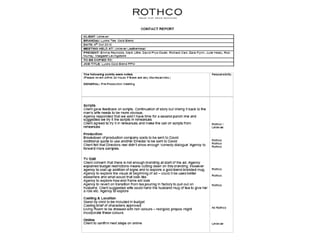
CONTACT REPORT/NOTE Date Location All attendees  Client/name of project Actions  What has been agreed Dates that actions need to be completed by NOTHING ELSE
THE CONTACT REPORT/NOTE Contact notes are legally binding  They have regularly used in disputes between client, agencies and suppliers  In Ireland they have ended up in High Court legal challenges It is your responsibly to write them correctly  It is great training if any of you plan to run your own agency/business
 
GENERAL CLIENT ENGAGEMENT RULES
Every  client meeting needs a rehearsal Always know your opening cold  Everyone you bring along should have a speaking role  Everyone should know when they and  ‘ on ’  and what we are saying All props checked and ready (estimates, creative work etc) Always a have written agenda (pre-sell)  Preparation
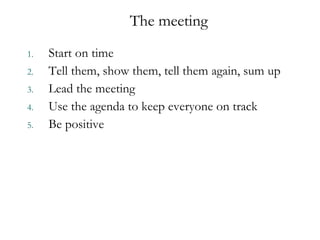
Start on time Tell them, show them, tell them again, sum up Lead the meeting Use the agenda to keep everyone on track Be positive The meeting
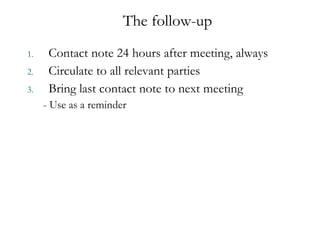
Contact note 24 hours after meeting, always Circulate to all relevant parties Bring last contact note to next meeting - Use as a reminder  The follow-up
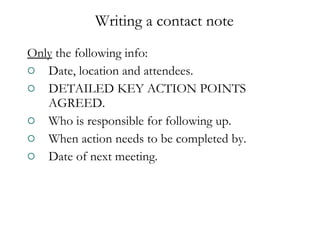
Only  the following info: Date, location and attendees. DETAILED KEY ACTION POINTS AGREED. Who is responsible for following up. When action needs to be completed by. Date of next meeting. Writing a contact note
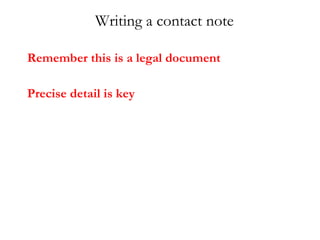
Remember this is a legal document   Precise detail is key Writing a contact note
Tips Remember contact notes can be used very effectively to manage (displine!) clients.  Contact notes manage expectations Finally always get an approval/input from your next-in-command

Lecture9 finalfinal2011

  • 1.
  • 2.
  • 3.
  • 4.
  • 5.
    What is adigital cromalin and what is it used for? Cromalin provides the best colour matching for printers as it is calibrated to show CMYK colours, (exactly as they should appear when printing with inks) It is an industry standard proof which the printer actually uses while printing the job on press to ensure the printed job is consistent and 100% accurate to the proof colour wise.  
  • 6.
      What isa press proof and what is it used for? Colours for printing on newsprint need a lot more tweaking than those used on standard paper as the newsprint soaks more ink and naturally prints much darker. We run press proofs of every campaign to ensure ; 1. The image is visible - 80% of images need to be colour amended after a newsprint proof is run 2. that all the copy is legible as the ink will spread when printed on newsprint. Each newspaper has individual profiles (some print darker and some print lighter  eg The Irish Times prints using much less ink than most newspapers so all the ads that appear in this  publication are printed much lighter than say in the Sunday World.) Newsprint proofs are vital to ensure we achieve the best colour balance across all publications.
  • 7.
  • 8.
    DOP A Directorof Photography (cinematographer)-After the locations have been chosen, the DOP decides on how the scenes should be shot. Views, scenery etc . They are responsible for achieving artistic and technical decisions relating to the image.
  • 9.
    A Focus pullerThey are part of the film crew, they prepare the camera, accessories, lens etc for the day’s shoot. They also change the distance setting on the lens during the take.
  • 10.
    Pre production Preproduction is the process before a film is made. This involves the organization of the whole production. For example: budget, cast, crew, locations, food, accommodation, scripts. Pre Production meeting is a key decision making time
  • 11.
    Post production Thepost production process involves everything that happens after the production has been shot. For example, sound, music, re touching, editing and this happens in a post production house/studio.
  • 12.
    Off-line edit Is a pre-graded, pre-visual effects, pre-sound effects, pre-VO version of the film. Normally what is first shown to the client to get approval before final cut is agreed.
  • 13.
    Director Thedirector develop their vision of what the script will look like by creating a sequence of clearly defined shots (‘ Directors Treatment ’ ) They cast the actors Then they direct the actors and crew during the film making process.
  • 14.
    Producer Aproducer is responsible for overseeing and developing the project. The producer manages the budget and pulls together the crew. A role not disimilar to an account director in a agency
  • 15.
    A movement orderA document outlining exactly one gets to a shoot location or from one location to the next location.
  • 16.
    A Critical Path - CPA This is a detailed schedule/timeline of every aspect of a production that happens on a daily bases from start to finish.
  • 17.
    A Call SheetIs a document that details the names and numbers of everyone involved on a shoot, from Agency to Client to Cast, to Crew to Suppliers.  So on a shoot everyone you need to get hold of is listed on this document.
  • 18.
    A VO Isa Voice Over.
  • 19.
  • 20.
    SEO - Search Engine Optimization. This is an action taken on a web site to improve your contents visibility within the results. PPC – Pay-Per-Click A method of advertising on a search engine where you pay an agreed amount everytime someone clicks on your ad.
  • 21.
    UCG –user generated content. Same thing as  CGM  (Consumer Generated Media) or  UCC  (User Created Content), just a different way of saying it. Any content on a website, social media platform etc that has been generated by a user/consumer rather than the site owner. CTR – Click Through Rate. The percentage of clicks out of the total number views of a particular link
  • 22.
    An MPEG is an movie or audio file type An MP3 is an audio file type
  • 23.
    Banners can becreated using three types of content Video (Rich media) Bitmap images Vector images Banners a usually made in Adobe Flash and exported as a .swf file. Pronounced (swif)
  • 24.
    VIDEO Video bannersare a rich media format.
  • 25.
    BITMAP IMAGES (photos..)Most images you see on your computer screen are raster graphics. They are made up of grid of pixels, commonly referred to as a bitmap. The larger the image, the more disk space the image file will take up. Raster/Bitmap graphics can typically be scaled down with no loss of quality, but enlarging a bitmap image causes it to look blocky and pixelated.
  • 26.
    VECTOR (cartoons..) UnlikeJPEGs, GIFs, and BMP images, vector graphics are not made up of a grid of pixels. They are lines of code containing mathematical equations. Because vector-based images are not made up of a specific number of dots, they can be scaled to a larger size and not lose any image quality. Also they are a much smaller file size.
  • 27.
  • 28.
    CONTACT REPORT/NOTE DateLocation All attendees Client/name of project Actions What has been agreed Dates that actions need to be completed by NOTHING ELSE
  • 29.
    THE CONTACT REPORT/NOTEContact notes are legally binding They have regularly used in disputes between client, agencies and suppliers In Ireland they have ended up in High Court legal challenges It is your responsibly to write them correctly It is great training if any of you plan to run your own agency/business
  • 30.
  • 31.
  • 32.
    Every clientmeeting needs a rehearsal Always know your opening cold Everyone you bring along should have a speaking role Everyone should know when they and ‘ on ’ and what we are saying All props checked and ready (estimates, creative work etc) Always a have written agenda (pre-sell) Preparation
  • 33.
    Start on timeTell them, show them, tell them again, sum up Lead the meeting Use the agenda to keep everyone on track Be positive The meeting
  • 34.
    Contact note 24hours after meeting, always Circulate to all relevant parties Bring last contact note to next meeting - Use as a reminder The follow-up
  • 35.
    Only thefollowing info: Date, location and attendees. DETAILED KEY ACTION POINTS AGREED. Who is responsible for following up. When action needs to be completed by. Date of next meeting. Writing a contact note
  • 36.
    Remember this isa legal document Precise detail is key Writing a contact note
  • 37.
    Tips Remember contactnotes can be used very effectively to manage (displine!) clients. Contact notes manage expectations Finally always get an approval/input from your next-in-command