Unit 4: Pre-Production Portfolio
The Requirements of a Moving Image Production
Finance in pre-production is the money which films cost to make and is very crucial. Money is
important in pre-production because cast and crew need to be paid, facilities may need hiring,
equipment must be purchased or hired, props and costume must be provided, transport
between locations must be considered and clearances may need to be budgeted for such as the
use of soundtracks. There are two types of funding, public funding and private funding. Public
funding refers to funding that is provided by a publically funded agency, from monies allocated
via tax relief, the National Lottery, or funded via grants provided to support the arts from the
Department of Culture. One example of public funding is the ‘BFI Film Fund’. The BFI is the lead
agency for film in the UK. the BFI Film Fund has a number of funding strands, investing over
£26m of Lottery funds per year to support film development, production, including the majority
and minority of co-productions and distribution activity in the UK. The other type of funding is
private funding. Private funding refers to funding accrued from investors- therefore the film
production often has to be seen as financially attractive such as the ability to make a profit.
Examples include equity financing which is having investors contribute money to the production
in exchange for a percentage ownership interest in the film and the profits derived from the
exploitation of the film. A more recent way of private funding is crowd-funding (i.e. kickstarter).
Crowd-funding collects multiple small investments via private donations.
Time scales is the effective management of time which is essential to pre-production. Cast and
crew will often have other commitments in their schedules therefore the planning must carefully
consider when all the required components are available at any given time. Realistic schedules
for production and post production must be accurately thought through, for example if shooting
over runs this can impact not only the cast and crew but also availability and budgets. Deadlines
are extremely important factor because without them, many more problems could be created
because of the lack of planning and sticking to a specific timeline. Deadlines or when shooting
has to be finished, editing etc. helps to structure the timescale and plan and help with a more
successful outcome. Some problems that could be caused by lack of deadlines set, could be
running over budget and the availability of things like locations and cast and crew may be
compromised. An example of why deadlines need to be created otherwise problems are
created, is Francis Ford Coppola’s Heart of Darkness- Apocalypse Now which caused many
problems because of the lack of planning.
When filming a movie, the facilities is a big thing to think about. A key element of pre-production
is the consideration of what materials and equipment will be required in order to successfully
produce the film. When planning the making of the film, you will need to think about what film is
required, where it will be sourced, does it need to be purchased or hired and are there any
specialist pieces of equipment required for certain days of the shooting. Furthermore you will
need to consider costumes, props and set designs hilst planning your movie and what post-
production equipment is needed such as editing software, access to foley tracks and the use of
specialist effects software.
A successful pre-production requires all locations to be thoroughly researched and considered
prior to shooting. This involves identification and recces which is actual location shooting, a
consideration of any limitations of the site, for example distance, access, hiring, cost and
weather issues. You will also need to research and consider health and safety, are there any
risks associated with the location or the requirements of the scene in relation to this? If any part
of a film need to be shot outside the studio, sites are selected by a location manager, whose
research is often aided by a location scout. The location manager obtains permission to film
from authorities or private owners and negotiates any fees that must be paid. Throughout the
shoot the location manager is responsible for liaison with area film councils or other relevant
authorities.
Any film must clearly identify the personnel required. This doesn’t just include cast and crew, but
also any extras needed or the advice of experts or specialists who may be working to ensure
accuracy and smoot shooting. Sourcing the right personnel for a media production is another
important aspect of the pre-production process and you will need to ensure that your production
team is the right size for the job and that each member has the right balance of knowledge,
skills and experience to undertake the specific role that is needed.
In pre-production you will need additional materials such as:
-Scripts and storyboards
A storyboard is a graphic representation of how your video will unfold, shot by shot.It’s made up
of a number of squares with illustrations or pictures representing each shot, with notes about
what’s going on in the scene and what’s going on in the scene and what’s being said in the shot
in that scene.
-Original filmed materials
In filmmaking and video production, footage is raw, unedited material as originally filmed by a
movie camera or recorded by a video camera, which typically must be edited to create a motion
picture, video clip, television show or similar completed work.
-Archive or library materials
Archives can both hold published and unpublished materials, and those materials can be in any
format. Some examples are manuscripts, letters, photographs, moving image and sound
materials, artwork, books, diaries, artifacts and the digital equivalents of all these things.
-Sound or sound library materials
A sound library is a collection of sounds stored on file, for example: CDs, DVDs, or as digital
audio files.
-Props and costumes
-Assets (anything purchased or produced for production that carries value)
A code of practice can be a document that complements health and safety laws and regulations
to provide detailed practical guidance on how to comply with legal obligations and should be
followed unless another solution with the same or better health and safety standards are in
place, or may be a document for the same purpose published by a self regulating body to be
followed by the member organisations. All filming projects must make sure that they adhere
closely to accepted codes of practice and follow any regulatory requirements. Examples of
regulatory companies is Trade Union and professional Body membership and Pact which is The
Producers Alliance for Cinema and Television, which campaigns for producers rights.
The Formats For Pre-Production Process
When completing pre-production it is vital to follow industry accepted formats. The first process
in film production is generally the writing of a proposal. The proposal sums up the premise of
your film, it provides a brief synopsis, key character information, sums up the structure of the
narrative and considers a target audience. Proposals are used as a basis with which to
formulate ideas over a project and then ultimately to ‘pitch’ the concept to prospective investors.
Once this is complete, a script can be written.
The accepted formatting for film scripting is done in what is known as master screen script.
Prospective studios will not even read scripts that are not produced in this format. A master
screen script is the standard and accepted format for film production. It is designed to offer a
straightforward and accessible format for producers to show to investors. It offers a mix of
description and dialogue to allow the reader to easily follow the story; the story is the most
important thing and as such technical information is very limited within MSS format. MSS is split
into scene headings, narrative description and dialogue blocks. A scene heading is known as a
slugline and is composed of three parts:
-Interior vs exterior
-Location
-Time of day
These parts are written on one line and capitalised, for example interior and exterior are always
abbreviated as INT. and EXT. Time of day is limited to DAY and NIGHT, with the occasional use
of DAWN and DUSK. Narrative description is the telling of the story as it unfolds on screen. It
begins directly below the scene heading. The writing should be lean and visual, focusing on
action that moves the story forward. It should have enough flair to engage readers. Unlike a
novel, everything in a screenplay must be recorded in terms of picture and sound. Therefore,
narrative description should never include anything that cannot be seen or heard, only write
about what can be seen and heard. For example, you cannot describe a character’s feelings,
since this cannot be recorded. To convey a character’s feelings, thoughts, and memories they
must be externalised in some way, this can be through action, dialogue or flashback scenes.
Timing is a customary assumption in the movie industry that one page of screenplay equals one
minute of time on screen. This is convenient for planning purposes. Since the average feature is
120 minutes, the average script should be about 20 pages in length. Due to this convention,
description passages should cover as many pages as the scene is expected to run in real time.
If you sense that an action scene will take a minute of screen time, it should be written to cover
one page rather than one line.
Dialogue blocks is also called “speeches” and are composed of three parts: character name,
wryly and dialogue. Character names are written in uppercase, wrylies are written in lowercase
inside parenthesis, and the dialogue is written in normal sentence case. A wryly indicates how a
line should be said. It was named after all the novice screenwriters whose characters say things
in a “wry” way. Wrylies should only be used if the subtext of the dialogue is not clear but also
keep them very minimum.
When writing master screen scripts, you need to consider:
-Font always courier and size 12
-Sluglines and character names in dialogue in capital letters.
-Voiceover and off-screen used as (V.O and O.S)
-Footers at the bottom right of a page say (CONTINUED) only where a scene moves from one
page to the next, the next pages has (CONT.) top left.
When writing a spec script don’t use:
-Scene numbers
-Camera angles
-Page footers are not always required on special scripts.
-Caps for sound effects in narrative description.
-Caps for character names in narrative descriptions (except from when they are first appearing)
-Third person use of “we” for example: “We see John storm out”
Shooting scripts are scripts used during production to shoot the movie. They are written with
much more detail than spec scripts and may include among other things, scene numbers,
editing transitions and camera angles. Since shooting scripts are used in production, they are
formatted to include any helpful information that the director may request. They are not used for
selling purposes. Shooting scripts can be difficult to read and will turn off prospective investors,
this approach is used when the script is going directly into production. In broad terms, the main
difference between the screenplay and the shooting script is that the screenplay is a selling tool,
whereas the shooting script is a production tool. Screen numbers are added which remain
constant through any revisions that are printed on coloured paper. Techniques are included to
help the crew shoot on set and these include camera compositions, movement and editing.
Once a script is finished, it is converted into a storyboard. Storyboards evaluate a screenplay
and pictures it in terms of separate shots that can be visually translated into individual
storyboard panels. The graphic layout that sequences image and illustrations with the purpose
of telling a visual story. Film-makers and video creators use storyboards to transfer ideas from
their imagination to the screen. By doing this, it helps film directors and cinematographers
visualise the scenes and find potential problems before they occur. In addition to this,
storyboards also help estimate the cost of the overall production and saves time in shooting.
Some directors such as Alfred Hitchcock were famous for storyboarding in great depth,
visualising the film extensively prior to shooting on set. A good use of storyboards is to limit the
post-production work and effects.To be able to lock a scene in camera, finding a smart solution
so that you won’t have to fix it in post, which can be quite costly. A good storyboard can help all
departments.For example, a storyboard can give you an overview of the locations and what
designs have to be made, what props are needed. It also helps the production assistant prepare
the call sheets. It helps the director of photography (DoP) to know which lenses to use. It helps
the editor to put together the material for the rough cut. It can also help the producer to find
investors and financers for the film and is a perfect way of showing where products can be
placed.
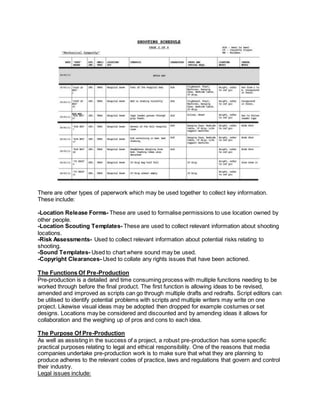
By utilising the storyboards and the shooting script, a shooting schedule is created. A shooting
schedule is a breakdown of everything planned to shoot for each day of the shoot which is
organised into the most logical and efficient order to shoot. As opposed to a schedule for the
entire shoot, focusing on scenes and days, this schedule focuses on shots and hours. Having a
shooting schedule is essential for a smooth and efficient shoot which cuts down on time, hence
the budget and it allows plenty of coverage to be shot.
An example of a shooting schedule looks like this:
There are other types of paperwork which may be used together to collect key information.
These include:
-Location Release Forms- These are used to formalise permissions to use location owned by
other people.
-Location Scouting Templates- These are used to collect relevant information about shooting
locations.
-Risk Assessments- Used to collect relevant information about potential risks relating to
shooting.
-Sound Templates- Used to chart where sound may be used.
-Copyright Clearances- Used to collate any rights issues that have been actioned.
The Functions Of Pre-Production
Pre-production is a detailed and time consuming process with multiple functions needing to be
worked through before the final product. The first function is allowing ideas to be revised,
amended and improved as scripts can go through multiple drafts and redrafts. Script editors can
be utilised to identify potential problems with scripts and multiple writers may write on one
project. Likewise visual ideas may be adopted then dropped for example costumes or set
designs. Locations may be considered and discounted and by amending ideas it allows for
collaboration and the weighing up of pros and cons to each idea.
The Purpose Of Pre-Production
As well as assisting in the success of a project, a robust pre-production has some specific
practical purposes relating to legal and ethical responsibility. One of the reasons that media
companies undertake pre-production work is to make sure that what they are planning to
produce adheres to the relevant codes of practice, laws and regulations that govern and control
their industry.
Legal issues include:
1. Health and safety procedures and paperwork in place.
2. Permission in place for the use of copyrighted material.
3. Permissions in place for the use of privately owned locations.
4. Permissions in place in the form of contracts for those appearing in work.
Public liability is another legal requirement for companies and organisations who are involved in
creative media production, particularly when they are recording on location where members of
the public may be at risk from the production activities. One example of public liability is a
college having public liability insurance as young students are learners and the insurance can
be used for their production work. When filming on the streets, permission must be sought and
approved for filming in any public location and filming licenses obtained as some locations may
be restricted, trespassing issues which can lead to prosecution and people not wanting to be
filmed as they don’t feel uncomfortable or happy with what is taking place.
A compliance audit is a comprehensive review of an organisations adherence to regulatory
guidelines. Independent consultants evaluate the strength and thoroughness of compliance
preparations. Auditors review security policies, user access controls and risk management
procedures over the course of a compliance audit. It is essential therefore to maintain a
thorough pre-production to adhere to any legal responsibilities in the event of such an audit
When planning your pre-production, consideration of wider guidelines/regulatory bodies must be
taken place. The BBFC is the UK’s regulator of film and video, providing age ratings to film
materials. They are a designated body and as such have legal powers to rate and sometimes
cut or even reject work ideas. All decisions are based on public consultation and guidelines
which form a contract between the public, the film industry and the BBFC. They are updated
every four years following a major public consultation. Film productions will have target
audiences and distribution platforms in mind, therefore careful pre-production decisions may be
influenced by target demographics and envisaged certificate requirements.
Film productions often include a large list of cast and crew involvement. Effective pre-production
and thorough and organised records allow information sharing across relevant parties
effectively, to ensure all involved are working together efficiently.

Unit 4 pre production

  • 1.
    Unit 4: Pre-ProductionPortfolio The Requirements of a Moving Image Production Finance in pre-production is the money which films cost to make and is very crucial. Money is important in pre-production because cast and crew need to be paid, facilities may need hiring, equipment must be purchased or hired, props and costume must be provided, transport between locations must be considered and clearances may need to be budgeted for such as the use of soundtracks. There are two types of funding, public funding and private funding. Public funding refers to funding that is provided by a publically funded agency, from monies allocated via tax relief, the National Lottery, or funded via grants provided to support the arts from the Department of Culture. One example of public funding is the ‘BFI Film Fund’. The BFI is the lead agency for film in the UK. the BFI Film Fund has a number of funding strands, investing over £26m of Lottery funds per year to support film development, production, including the majority and minority of co-productions and distribution activity in the UK. The other type of funding is private funding. Private funding refers to funding accrued from investors- therefore the film production often has to be seen as financially attractive such as the ability to make a profit. Examples include equity financing which is having investors contribute money to the production in exchange for a percentage ownership interest in the film and the profits derived from the exploitation of the film. A more recent way of private funding is crowd-funding (i.e. kickstarter). Crowd-funding collects multiple small investments via private donations. Time scales is the effective management of time which is essential to pre-production. Cast and crew will often have other commitments in their schedules therefore the planning must carefully consider when all the required components are available at any given time. Realistic schedules for production and post production must be accurately thought through, for example if shooting over runs this can impact not only the cast and crew but also availability and budgets. Deadlines are extremely important factor because without them, many more problems could be created because of the lack of planning and sticking to a specific timeline. Deadlines or when shooting has to be finished, editing etc. helps to structure the timescale and plan and help with a more successful outcome. Some problems that could be caused by lack of deadlines set, could be running over budget and the availability of things like locations and cast and crew may be compromised. An example of why deadlines need to be created otherwise problems are created, is Francis Ford Coppola’s Heart of Darkness- Apocalypse Now which caused many problems because of the lack of planning. When filming a movie, the facilities is a big thing to think about. A key element of pre-production is the consideration of what materials and equipment will be required in order to successfully produce the film. When planning the making of the film, you will need to think about what film is required, where it will be sourced, does it need to be purchased or hired and are there any specialist pieces of equipment required for certain days of the shooting. Furthermore you will need to consider costumes, props and set designs hilst planning your movie and what post- production equipment is needed such as editing software, access to foley tracks and the use of specialist effects software. A successful pre-production requires all locations to be thoroughly researched and considered prior to shooting. This involves identification and recces which is actual location shooting, a consideration of any limitations of the site, for example distance, access, hiring, cost and weather issues. You will also need to research and consider health and safety, are there any risks associated with the location or the requirements of the scene in relation to this? If any part
  • 2.
    of a filmneed to be shot outside the studio, sites are selected by a location manager, whose research is often aided by a location scout. The location manager obtains permission to film from authorities or private owners and negotiates any fees that must be paid. Throughout the shoot the location manager is responsible for liaison with area film councils or other relevant authorities. Any film must clearly identify the personnel required. This doesn’t just include cast and crew, but also any extras needed or the advice of experts or specialists who may be working to ensure accuracy and smoot shooting. Sourcing the right personnel for a media production is another important aspect of the pre-production process and you will need to ensure that your production team is the right size for the job and that each member has the right balance of knowledge, skills and experience to undertake the specific role that is needed. In pre-production you will need additional materials such as: -Scripts and storyboards A storyboard is a graphic representation of how your video will unfold, shot by shot.It’s made up of a number of squares with illustrations or pictures representing each shot, with notes about what’s going on in the scene and what’s going on in the scene and what’s being said in the shot in that scene. -Original filmed materials In filmmaking and video production, footage is raw, unedited material as originally filmed by a movie camera or recorded by a video camera, which typically must be edited to create a motion picture, video clip, television show or similar completed work. -Archive or library materials Archives can both hold published and unpublished materials, and those materials can be in any format. Some examples are manuscripts, letters, photographs, moving image and sound materials, artwork, books, diaries, artifacts and the digital equivalents of all these things. -Sound or sound library materials A sound library is a collection of sounds stored on file, for example: CDs, DVDs, or as digital audio files. -Props and costumes -Assets (anything purchased or produced for production that carries value) A code of practice can be a document that complements health and safety laws and regulations to provide detailed practical guidance on how to comply with legal obligations and should be followed unless another solution with the same or better health and safety standards are in place, or may be a document for the same purpose published by a self regulating body to be followed by the member organisations. All filming projects must make sure that they adhere closely to accepted codes of practice and follow any regulatory requirements. Examples of regulatory companies is Trade Union and professional Body membership and Pact which is The Producers Alliance for Cinema and Television, which campaigns for producers rights. The Formats For Pre-Production Process When completing pre-production it is vital to follow industry accepted formats. The first process in film production is generally the writing of a proposal. The proposal sums up the premise of your film, it provides a brief synopsis, key character information, sums up the structure of the narrative and considers a target audience. Proposals are used as a basis with which to formulate ideas over a project and then ultimately to ‘pitch’ the concept to prospective investors. Once this is complete, a script can be written.
  • 3.
    The accepted formattingfor film scripting is done in what is known as master screen script. Prospective studios will not even read scripts that are not produced in this format. A master screen script is the standard and accepted format for film production. It is designed to offer a straightforward and accessible format for producers to show to investors. It offers a mix of description and dialogue to allow the reader to easily follow the story; the story is the most important thing and as such technical information is very limited within MSS format. MSS is split into scene headings, narrative description and dialogue blocks. A scene heading is known as a slugline and is composed of three parts: -Interior vs exterior -Location -Time of day These parts are written on one line and capitalised, for example interior and exterior are always abbreviated as INT. and EXT. Time of day is limited to DAY and NIGHT, with the occasional use of DAWN and DUSK. Narrative description is the telling of the story as it unfolds on screen. It begins directly below the scene heading. The writing should be lean and visual, focusing on action that moves the story forward. It should have enough flair to engage readers. Unlike a novel, everything in a screenplay must be recorded in terms of picture and sound. Therefore, narrative description should never include anything that cannot be seen or heard, only write about what can be seen and heard. For example, you cannot describe a character’s feelings, since this cannot be recorded. To convey a character’s feelings, thoughts, and memories they must be externalised in some way, this can be through action, dialogue or flashback scenes. Timing is a customary assumption in the movie industry that one page of screenplay equals one minute of time on screen. This is convenient for planning purposes. Since the average feature is 120 minutes, the average script should be about 20 pages in length. Due to this convention, description passages should cover as many pages as the scene is expected to run in real time. If you sense that an action scene will take a minute of screen time, it should be written to cover one page rather than one line. Dialogue blocks is also called “speeches” and are composed of three parts: character name, wryly and dialogue. Character names are written in uppercase, wrylies are written in lowercase inside parenthesis, and the dialogue is written in normal sentence case. A wryly indicates how a line should be said. It was named after all the novice screenwriters whose characters say things in a “wry” way. Wrylies should only be used if the subtext of the dialogue is not clear but also keep them very minimum. When writing master screen scripts, you need to consider: -Font always courier and size 12 -Sluglines and character names in dialogue in capital letters. -Voiceover and off-screen used as (V.O and O.S) -Footers at the bottom right of a page say (CONTINUED) only where a scene moves from one page to the next, the next pages has (CONT.) top left. When writing a spec script don’t use: -Scene numbers -Camera angles -Page footers are not always required on special scripts. -Caps for sound effects in narrative description. -Caps for character names in narrative descriptions (except from when they are first appearing) -Third person use of “we” for example: “We see John storm out”
  • 4.
    Shooting scripts arescripts used during production to shoot the movie. They are written with much more detail than spec scripts and may include among other things, scene numbers, editing transitions and camera angles. Since shooting scripts are used in production, they are formatted to include any helpful information that the director may request. They are not used for selling purposes. Shooting scripts can be difficult to read and will turn off prospective investors, this approach is used when the script is going directly into production. In broad terms, the main difference between the screenplay and the shooting script is that the screenplay is a selling tool, whereas the shooting script is a production tool. Screen numbers are added which remain constant through any revisions that are printed on coloured paper. Techniques are included to help the crew shoot on set and these include camera compositions, movement and editing. Once a script is finished, it is converted into a storyboard. Storyboards evaluate a screenplay and pictures it in terms of separate shots that can be visually translated into individual storyboard panels. The graphic layout that sequences image and illustrations with the purpose of telling a visual story. Film-makers and video creators use storyboards to transfer ideas from their imagination to the screen. By doing this, it helps film directors and cinematographers visualise the scenes and find potential problems before they occur. In addition to this, storyboards also help estimate the cost of the overall production and saves time in shooting. Some directors such as Alfred Hitchcock were famous for storyboarding in great depth, visualising the film extensively prior to shooting on set. A good use of storyboards is to limit the post-production work and effects.To be able to lock a scene in camera, finding a smart solution so that you won’t have to fix it in post, which can be quite costly. A good storyboard can help all departments.For example, a storyboard can give you an overview of the locations and what designs have to be made, what props are needed. It also helps the production assistant prepare the call sheets. It helps the director of photography (DoP) to know which lenses to use. It helps the editor to put together the material for the rough cut. It can also help the producer to find investors and financers for the film and is a perfect way of showing where products can be placed. By utilising the storyboards and the shooting script, a shooting schedule is created. A shooting schedule is a breakdown of everything planned to shoot for each day of the shoot which is organised into the most logical and efficient order to shoot. As opposed to a schedule for the entire shoot, focusing on scenes and days, this schedule focuses on shots and hours. Having a shooting schedule is essential for a smooth and efficient shoot which cuts down on time, hence the budget and it allows plenty of coverage to be shot. An example of a shooting schedule looks like this:
  • 5.
    There are othertypes of paperwork which may be used together to collect key information. These include: -Location Release Forms- These are used to formalise permissions to use location owned by other people. -Location Scouting Templates- These are used to collect relevant information about shooting locations. -Risk Assessments- Used to collect relevant information about potential risks relating to shooting. -Sound Templates- Used to chart where sound may be used. -Copyright Clearances- Used to collate any rights issues that have been actioned. The Functions Of Pre-Production Pre-production is a detailed and time consuming process with multiple functions needing to be worked through before the final product. The first function is allowing ideas to be revised, amended and improved as scripts can go through multiple drafts and redrafts. Script editors can be utilised to identify potential problems with scripts and multiple writers may write on one project. Likewise visual ideas may be adopted then dropped for example costumes or set designs. Locations may be considered and discounted and by amending ideas it allows for collaboration and the weighing up of pros and cons to each idea. The Purpose Of Pre-Production As well as assisting in the success of a project, a robust pre-production has some specific practical purposes relating to legal and ethical responsibility. One of the reasons that media companies undertake pre-production work is to make sure that what they are planning to produce adheres to the relevant codes of practice, laws and regulations that govern and control their industry. Legal issues include:
  • 6.
    1. Health andsafety procedures and paperwork in place. 2. Permission in place for the use of copyrighted material. 3. Permissions in place for the use of privately owned locations. 4. Permissions in place in the form of contracts for those appearing in work. Public liability is another legal requirement for companies and organisations who are involved in creative media production, particularly when they are recording on location where members of the public may be at risk from the production activities. One example of public liability is a college having public liability insurance as young students are learners and the insurance can be used for their production work. When filming on the streets, permission must be sought and approved for filming in any public location and filming licenses obtained as some locations may be restricted, trespassing issues which can lead to prosecution and people not wanting to be filmed as they don’t feel uncomfortable or happy with what is taking place. A compliance audit is a comprehensive review of an organisations adherence to regulatory guidelines. Independent consultants evaluate the strength and thoroughness of compliance preparations. Auditors review security policies, user access controls and risk management procedures over the course of a compliance audit. It is essential therefore to maintain a thorough pre-production to adhere to any legal responsibilities in the event of such an audit When planning your pre-production, consideration of wider guidelines/regulatory bodies must be taken place. The BBFC is the UK’s regulator of film and video, providing age ratings to film materials. They are a designated body and as such have legal powers to rate and sometimes cut or even reject work ideas. All decisions are based on public consultation and guidelines which form a contract between the public, the film industry and the BBFC. They are updated every four years following a major public consultation. Film productions will have target audiences and distribution platforms in mind, therefore careful pre-production decisions may be influenced by target demographics and envisaged certificate requirements. Film productions often include a large list of cast and crew involvement. Effective pre-production and thorough and organised records allow information sharing across relevant parties effectively, to ensure all involved are working together efficiently.