SOUMADITYA BANERJEE, 5TH SEMESTER STUDENT
Moderator: Dr Santosh Kumar Mondal
Assoc.Professor, Pathology
CASE STUDY:
 A four years old male child suffering
from growth retardation, irritability
,anorexia till infancy.
 O/E :1. pallor marked, huge
enlargement of liver & spleen
 2.no marked lymphadenopathy,
 3. depressed nasal bridge
Classification of beta thalassemia:
Clinical Nomenclature Genotype Disease Molecular Genetics
β- Thalassemias
Thalassemia major
Homozygous β0-
thalassemia (β0/β0)
Severe; requires blood
transfusions
Rare gene deletions in
β0/β0
Defects in transcription,
processing, or translatio
of β-globin mRNA
Homozygous β+-
thalassemia (β+/β+)
Thalassemia intermedia β0/β
Severe, but does not
require regular blood
transfusions
β+/β+
Thalassemia minor β0/β
Asymptomatic with mild
or absent anemia; red
cell abnormalities seen
β+/β
BETA THALASSEMIA
MAJOR:
 Highest incidence in south east asia ,
Mediterranean countries & parts of
africa..
 types of genetic mutations seen:
Homozygous β0-thalassemia (β0/β0)
Homozygous β+-thalassemia (β+/β+)
Clinical features:
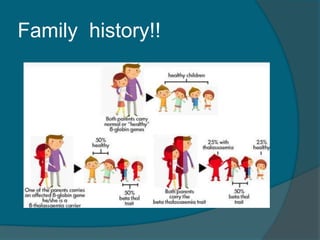
 family history
 anemia appear during 6-8 months of
age
 mild icterus
 history of repeated blood transfusion
 hepatosplenomegaly
 dilatation of heart with feature of
heart failure
 facial & other bony anomalies.
Family history!!
CLINICAL FINDINGS AT
DIAGNOSIS:
 Clinical manifestation emerge during
second sixth month of life.
 Diagnosis always evident by 2nd yr.
 Pallor , irritability , abdominal swelling
,jaundice are usual symptoms.
.
Thalassemic facies:
Radiograph shows:
 Additional skeletal
changes are
observed in the
metacarpals,
metatarsals, and
phalanges, where
expanded medullary
cavities produce a
rectangular and then
a convex shape .
 Irregular fusion of the
epiphyses of the
proximal humerus
results in
characteristic
shortening of the
upper arms.
Figure
Hypercoaguable state:
 A chronic hypercoagulable state has been
observed even in childhood . It has been
demonstrated that procoagulant
phospholipids are exposed on the surface
of the red cells and that platelets and the
hemostatic system are activated in
thalassemia major.
 In addition, vascular endothelial cell injury
and the peroxidative status due to iron
overload have been proposed as possible
mechanism.
Hepato spleenomegaly:
 Causes:
 1.prior to transfusion d/t
extramedullary hematopoeisis .
 2. with transfusion iron overload
add a new reason to this.
 3.this also increase chance of
hepatocellular carcinoma.
Heart:
 Cardiac abnormalities are
important causes of morbidity
and mortality .
 Cardiac enlargement secondary
to anemia is almost always
present.
 myocardial hemosiderosis and
serious iron-induced cardiac
diseases were inevitable .
Lungs:
 Patients exhibit primarily
restrictive defects ; others
experience mild to moderate small-
airway obstruction and
hyperinflation.
 Most patients have a decreased
maximal oxygen uptake and
anaerobic threshold; these do not
normalize after transfusion.
Beta thalassemia minor:
 CLINICAL FEATURES:
 Asymptomatic
 spleen may be palpable
 mostly detected in adults as a
case of chronic anaemia
:
important feature:
This occurs mainly in endemic areas of
malaria.
Thalassemia intermedia:
 Clinical features:
 symptomatic with moderate anemia
 may have splenomegaly, bone
deformity
 recurrent leg ulcers ,gall stones
,infections
 pt. may be iron overloaded.
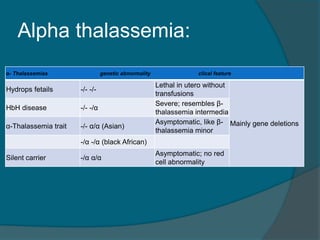
Alpha thalassemia:
α- Thalassemias genetic abnormality clical feature
Hydrops fetails -/- -/-
Lethal in utero without
transfusions
Mainly gene deletions
HbH disease -/- -/α
Severe; resembles β-
thalassemia intermedia
α-Thalassemia trait -/- α/α (Asian)
Asymptomatic, like β-
thalassemia minor
-/α -/α (black African)
Silent carrier -/α α/α
Asymptomatic; no red
cell abnormality
Clinical manifestations:
Silent carrier:
 α+-Thalassemia trait has no consistent
hematologic manifestations.
 The red blood cells are not microcytic, and
Hb A2 and Hb F are normal.
 During the newborn period, small amounts
(≤3%) of Hb Bart (γ4) can be seen by
electrophoresis or other techniques.
 This condition is most often recognized
when an apparently normal individual
becomes the parent of a child with Hb H
disease after mating with a person with α°-
thalassemia trait.
α-Thalassemia Trait (α°-
Thalassemia Trait)
 Levels of Hb A2 in the low to low
normal range (1.5%–2.5%)
 β/α synthetic ratios averaging 1.4 : 1
characterize α°-thalassemia trait.
 During the perinatal period, elevated
amounts of Hb Bart are noted (3%–
8%).
 Microcytosis is present in cord blood
erythrocytes.
HbH disease:
 HbH disease is common in Southeast Asia
and relatively frequent in Mediterranean
countries and parts of the Middle East,
 Subjects with HbH disease may develop
complications including hypersplenism,
leg ulcers, and gallstones.
 Hypersplenism has been reported in
10% of Thai patients with HbH disease,
but seems to be rare elsewhere .
 Iron overload is not common and has
been reported only in some older
patients and as a result of repeated
blood transfusions
Hydrops fetalis:
 Hb Bart hydrops fetalis syndrome is the
most severe α-thalassemia clinical
condition, often associated with the absent
function of all four α-globin genes
 A fetus homozygous for α0-thalassemia
produces mainly Hb Bart (γ4), which is
functionally useless for oxygen transport,
and his or her survival to late pregnancy is
due to the presence of small amounts of
embryonic hemoglobins Portland 1 (ζ2γ2)
and Portland 2 (ζ2β2
 severe anemia (Hb level range, 3 to 8 g/dl)
marked
 hepatosplenomegaly,
 generalized edema,
 signs of cardiac failure,
 extensive extramedullary erythropoiesis in
many organs .
 Other congenital abnormalities: particularly
of the skeletal, cardiovascular, and
urogenital system
Complication during
pregnanacy:
 Complications during pregnancy are common
 mild pre-eclampsia (hypertension, fluid
retention with or without proteinuria),
 polyhydramnios or oligohydramnios
 antepartum hemorrhage.
 Postpartum complications include :placenta
retention, eclampsia (fits and coma),
hemorrhage, anemia, and sepsis.
Th thank you

thalassemia subtypes

  • 1.
    SOUMADITYA BANERJEE, 5THSEMESTER STUDENT Moderator: Dr Santosh Kumar Mondal Assoc.Professor, Pathology
  • 3.
    CASE STUDY:  Afour years old male child suffering from growth retardation, irritability ,anorexia till infancy.  O/E :1. pallor marked, huge enlargement of liver & spleen  2.no marked lymphadenopathy,  3. depressed nasal bridge
  • 5.
    Classification of betathalassemia: Clinical Nomenclature Genotype Disease Molecular Genetics β- Thalassemias Thalassemia major Homozygous β0- thalassemia (β0/β0) Severe; requires blood transfusions Rare gene deletions in β0/β0 Defects in transcription, processing, or translatio of β-globin mRNA Homozygous β+- thalassemia (β+/β+) Thalassemia intermedia β0/β Severe, but does not require regular blood transfusions β+/β+ Thalassemia minor β0/β Asymptomatic with mild or absent anemia; red cell abnormalities seen β+/β
  • 6.
    BETA THALASSEMIA MAJOR:  Highestincidence in south east asia , Mediterranean countries & parts of africa..  types of genetic mutations seen: Homozygous β0-thalassemia (β0/β0) Homozygous β+-thalassemia (β+/β+)
  • 7.
    Clinical features:  familyhistory  anemia appear during 6-8 months of age  mild icterus  history of repeated blood transfusion  hepatosplenomegaly  dilatation of heart with feature of heart failure  facial & other bony anomalies.
  • 8.
  • 9.
    CLINICAL FINDINGS AT DIAGNOSIS: Clinical manifestation emerge during second sixth month of life.  Diagnosis always evident by 2nd yr.  Pallor , irritability , abdominal swelling ,jaundice are usual symptoms. .
  • 10.
  • 11.
  • 12.
     Additional skeletal changesare observed in the metacarpals, metatarsals, and phalanges, where expanded medullary cavities produce a rectangular and then a convex shape .  Irregular fusion of the epiphyses of the proximal humerus results in characteristic shortening of the upper arms. Figure
  • 13.
    Hypercoaguable state:  Achronic hypercoagulable state has been observed even in childhood . It has been demonstrated that procoagulant phospholipids are exposed on the surface of the red cells and that platelets and the hemostatic system are activated in thalassemia major.  In addition, vascular endothelial cell injury and the peroxidative status due to iron overload have been proposed as possible mechanism.
  • 14.
    Hepato spleenomegaly:  Causes: 1.prior to transfusion d/t extramedullary hematopoeisis .  2. with transfusion iron overload add a new reason to this.  3.this also increase chance of hepatocellular carcinoma.
  • 15.
    Heart:  Cardiac abnormalitiesare important causes of morbidity and mortality .  Cardiac enlargement secondary to anemia is almost always present.  myocardial hemosiderosis and serious iron-induced cardiac diseases were inevitable .
  • 16.
    Lungs:  Patients exhibitprimarily restrictive defects ; others experience mild to moderate small- airway obstruction and hyperinflation.  Most patients have a decreased maximal oxygen uptake and anaerobic threshold; these do not normalize after transfusion.
  • 17.
    Beta thalassemia minor: CLINICAL FEATURES:  Asymptomatic  spleen may be palpable  mostly detected in adults as a case of chronic anaemia
  • 18.
    : important feature: This occursmainly in endemic areas of malaria.
  • 19.
    Thalassemia intermedia:  Clinicalfeatures:  symptomatic with moderate anemia  may have splenomegaly, bone deformity  recurrent leg ulcers ,gall stones ,infections  pt. may be iron overloaded.
  • 20.
    Alpha thalassemia: α- Thalassemiasgenetic abnormality clical feature Hydrops fetails -/- -/- Lethal in utero without transfusions Mainly gene deletions HbH disease -/- -/α Severe; resembles β- thalassemia intermedia α-Thalassemia trait -/- α/α (Asian) Asymptomatic, like β- thalassemia minor -/α -/α (black African) Silent carrier -/α α/α Asymptomatic; no red cell abnormality
  • 21.
  • 22.
    Silent carrier:  α+-Thalassemiatrait has no consistent hematologic manifestations.  The red blood cells are not microcytic, and Hb A2 and Hb F are normal.  During the newborn period, small amounts (≤3%) of Hb Bart (γ4) can be seen by electrophoresis or other techniques.  This condition is most often recognized when an apparently normal individual becomes the parent of a child with Hb H disease after mating with a person with α°- thalassemia trait.
  • 23.
    α-Thalassemia Trait (α°- ThalassemiaTrait)  Levels of Hb A2 in the low to low normal range (1.5%–2.5%)  β/α synthetic ratios averaging 1.4 : 1 characterize α°-thalassemia trait.  During the perinatal period, elevated amounts of Hb Bart are noted (3%– 8%).  Microcytosis is present in cord blood erythrocytes.
  • 24.
    HbH disease:  HbHdisease is common in Southeast Asia and relatively frequent in Mediterranean countries and parts of the Middle East,
  • 25.
     Subjects withHbH disease may develop complications including hypersplenism, leg ulcers, and gallstones.  Hypersplenism has been reported in 10% of Thai patients with HbH disease, but seems to be rare elsewhere .  Iron overload is not common and has been reported only in some older patients and as a result of repeated blood transfusions
  • 26.
    Hydrops fetalis:  HbBart hydrops fetalis syndrome is the most severe α-thalassemia clinical condition, often associated with the absent function of all four α-globin genes  A fetus homozygous for α0-thalassemia produces mainly Hb Bart (γ4), which is functionally useless for oxygen transport, and his or her survival to late pregnancy is due to the presence of small amounts of embryonic hemoglobins Portland 1 (ζ2γ2) and Portland 2 (ζ2β2
  • 27.
     severe anemia(Hb level range, 3 to 8 g/dl) marked  hepatosplenomegaly,  generalized edema,  signs of cardiac failure,  extensive extramedullary erythropoiesis in many organs .  Other congenital abnormalities: particularly of the skeletal, cardiovascular, and urogenital system
  • 28.
    Complication during pregnanacy:  Complicationsduring pregnancy are common  mild pre-eclampsia (hypertension, fluid retention with or without proteinuria),  polyhydramnios or oligohydramnios  antepartum hemorrhage.  Postpartum complications include :placenta retention, eclampsia (fits and coma), hemorrhage, anemia, and sepsis.
  • 29.