1.1
1.2
Chapter 1
Introduction
1.3
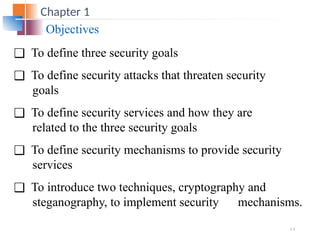
❑ To define three security goals
❑ To define security attacks that threaten security
goals
❑ To define security services and how they are
related to the three security goals
❑ To define security mechanisms to provide security
services
❑ To introduce two techniques, cryptography and
steganography, to implement security mechanisms.
Objectives
Chapter 1
1.4
1.5
1.6
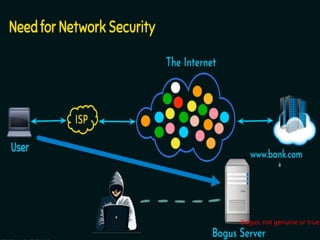
Bogus: not genuine or true
Some Basic Terminology
• plaintext - original message
• ciphertext - coded message
• cipher - algorithm for transforming plaintext to ciphertext
• key - info used in cipher known only to sender/receiver
• encipher (encrypt) - converting plaintext to ciphertext
• decipher (decrypt) - recovering plaintext from ciphertext
• cryptography - study of encryption principles/methods.
• Etymololy: from Greek kryptós, meaning "hidden" or "secret," and graphein, meaning "to
write."
• cryptanalysis (codebreaking) - study of principles/ methods of deciphering
ciphertext without knowing key
• cryptology - field of both cryptography and cryptanalysis
1.8
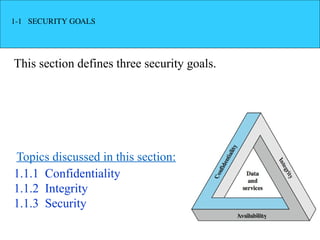
1-1 SECURITY GOALS
This section defines three security goals.
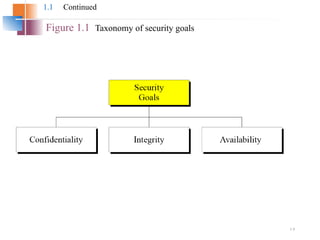
1.1.1 Confidentiality
1.1.2 Integrity
1.1.3 Security
Topics discussed in this section:
1.9
Figure 1.1 Taxonomy of security goals
1.1 Continued
1.10
1.1.1 Confidentiality
Confidentiality is probably the most common aspect of
information security. We need to protect our confidential
information. An organization needs to guard against those
malicious actions that endanger the confidentiality of its
information.
1.11
1.1.2 Integrity
Information needs to be changed constantly. Integrity means
that changes need to be done only by authorized entities and
through authorized mechanisms.
1.12
1.1.3 Availability
The information created and stored by an organization needs
to be available to authorized entities. Information needs to
be constantly changed, which means it must be accessible to
authorized entities.
1.13
1-2 ATTACKS
The three goals of security⎯confidentiality, integrity,
and availability⎯can be threatened by security attacks.
1.2.1 Attacks Threatening Confidentiality
1.2.2 Attacks Threatening Integrity
1.2.3 Attacks Threatening Availability
1.2.4 Passive versus Active Attacks
Topics discussed in this section:
1.14
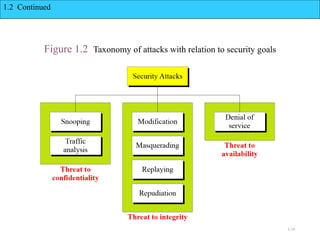
Figure 1.2 Taxonomy of attacks with relation to security goals
1.2 Continued
1.15
1.2.1 Attacks Threatening Confidentiality
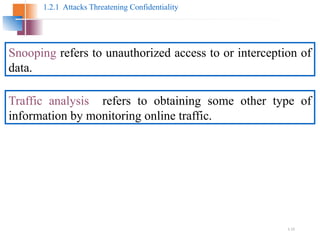
Snooping refers to unauthorized access to or interception of
data.
Traffic analysis refers to obtaining some other type of
information by monitoring online traffic.
1.16
1.2.2 Attacks Threatening Integrity
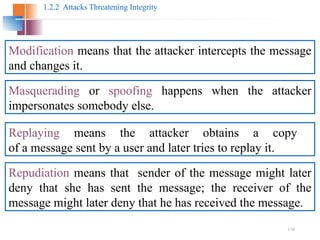
Modification means that the attacker intercepts the message
and changes it.
Masquerading or spoofing happens when the attacker
impersonates somebody else.
Replaying means the attacker obtains a copy
of a message sent by a user and later tries to replay it.
Repudiation means that sender of the message might later
deny that she has sent the message; the receiver of the
message might later deny that he has received the message.
1.17
1.2.3 Attacks Threatening Availability
Denial of service (DoS) is a very common attack. It may
slow down or totally interrupt the service of a system.
1.18
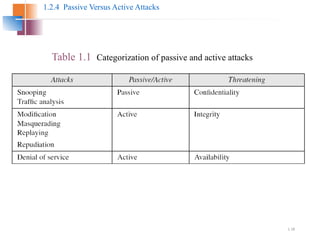
1.2.4 Passive Versus Active Attacks
Table 1.1 Categorization of passive and active attacks
1.19
1-3 SERVICES AND MECHANISMS
ITU-T provides some security services and some
mechanisms to implement those services. Security
services and mechanisms are closely related because a
mechanism or combination of mechanisms are used to
provide a service..
1.3.1 Security Services
1.3.2 Security Mechanism
1.3.3 Relation between Services and Mechanisms
Topics discussed in this section:
1.20
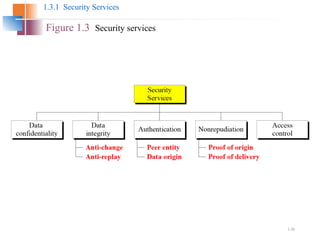
1.3.1 Security Services
Figure 1.3 Security services
1.21
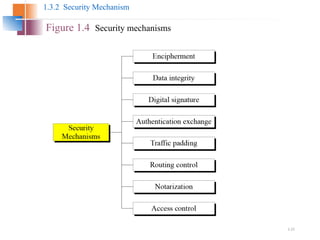
1.3.2 Security Mechanism
Figure 1.4 Security mechanisms
1.22
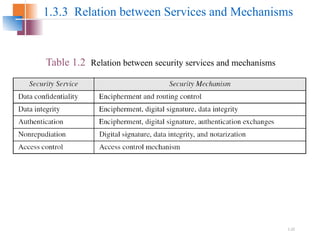
1.3.3 Relation between Services and Mechanisms
Table 1.2 Relation between security services and mechanisms
1.23
1-4 TECHNIQUES
Mechanisms discussed in the previous sections are only
theoretical recipes to implement security. The actual
implementation of security goals needs some
techniques. Two techniques are prevalent today:
cryptography and steganography.
1.4.1 Cryptography
1.4.2 Steganography
Topics discussed in this section:
1.24
1.4.1 Cryptography
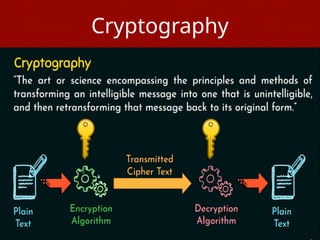
Cryptography, a word with Greek origins, means “secret
writing.” However, we use the term to refer to the science
and art of transforming messages to make them secure and
immune to attacks.
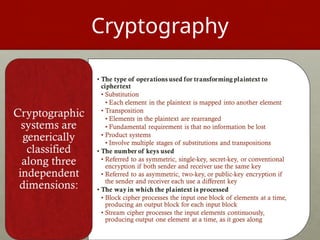
Cryptography
Model for Network
Security
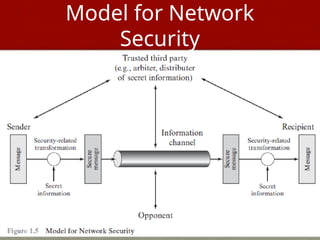
Model for Network
Security
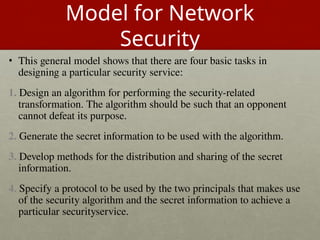
• This general model shows that there are four basic tasks in
designing a particular security service:
1. Design an algorithm for performing the security-related
transformation. The algorithm should be such that an opponent
cannot defeat its purpose.
2. Generate the secret information to be used with the algorithm.
3. Develop methods for the distribution and sharing of the secret
information.
4. Specify a protocol to be used by the two principals that makes use
of the security algorithm and the secret information to achieve a
particular securityservice.
Cryptography
Classical encryption
techniques
• As opposed to modern cryptography
• Goals:
• to introduce basic concepts & terminology of
encryption
• to prepare us for studying modern cryptography
29
Classical encryption techniques
• As opposed to modern cryptography
• Goals:
– to introduce basic concepts & terminology of
encryption
– to prepare us for studying modern
cryptography
30
Basic terminology
• Plaintext: original message to be
encrypted
• Ciphertext: the encrypted message
• Enciphering or encryption: the process of
converting plaintext into ciphertext
• Encryption algorithm: performs encryption
– Two inputs: a plaintext and a secret key
31
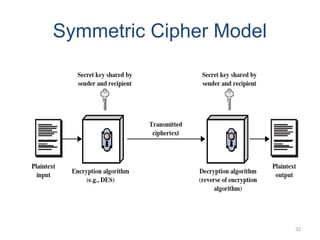
Symmetric Cipher Model
32
• Deciphering or decryption: recovering
plaintext from ciphertext
• Decryption algorithm: performs decryption
– Two inputs: ciphertext and secret key
• Secret key: same key used for encryption
and decryption
– Also referred to as a symmetric key
33
• Cipher or cryptographic system : a scheme
for encryption and decryption
• Cryptography: science of studying ciphers
• Cryptanalysis: science of studying attacks
against cryptographic systems
• Cryptology: cryptography + cryptanalysis
34
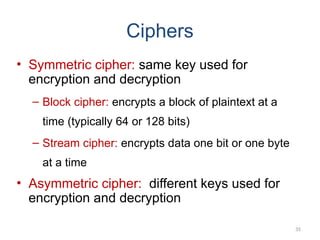
Ciphers
• Symmetric cipher: same key used for
encryption and decryption
– Block cipher: encrypts a block of plaintext at a
time (typically 64 or 128 bits)
– Stream cipher: encrypts data one bit or one byte
at a time
• Asymmetric cipher: different keys used for
encryption and decryption
35
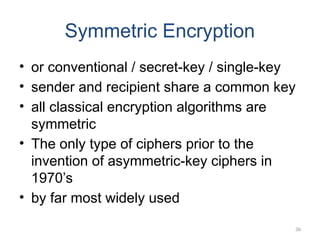
Symmetric Encryption
• or conventional / secret-key / single-key
• sender and recipient share a common key
• all classical encryption algorithms are
symmetric
• The only type of ciphers prior to the
invention of asymmetric-key ciphers in
1970’s
• by far most widely used
36
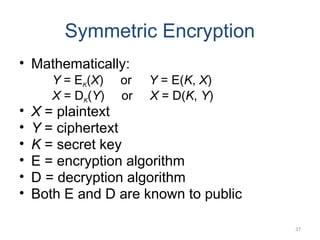
Symmetric Encryption
• Mathematically:
Y = EK(X) or Y = E(K, X)
X = DK(Y) or X = D(K, Y)
• X = plaintext
• Y = ciphertext
• K = secret key
• E = encryption algorithm
• D = decryption algorithm
• Both E and D are known to public
37
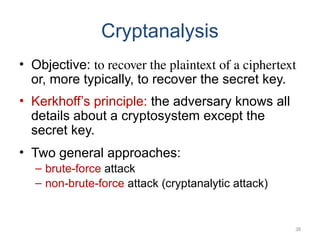
Cryptanalysis
• Objective: to recover the plaintext of a ciphertext
or, more typically, to recover the secret key.
• Kerkhoff’s principle: the adversary knows all
details about a cryptosystem except the
secret key.
• Two general approaches:
– brute-force attack
– non-brute-force attack (cryptanalytic attack)
38
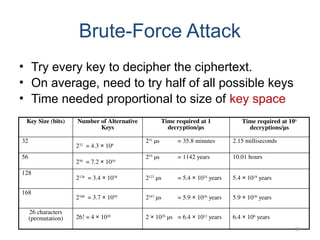
Brute-Force Attack
• Try every key to decipher the ciphertext.
• On average, need to try half of all possible keys
• Time needed proportional to size of key space
Key Size (bits) Number of Alternative
Keys
Time required at 1
decryption/µs
Time required at 106
decryptions/µs
32
232
= 4.3 × 10⁹
231
µs = 35.8 minutes 2.15 milliseconds
56
256
= 7.2 × 10¹⁶
255
µs = 1142 years 10.01 hours
128
2128
= 3.4 × 1038
2127
µs = 5.4 × 1024
years 5.4 × 10¹⁸
years
168
2168
= 3.7 × 1050
2167
µs = 5.9 × 1036
years 5.9 × 1030
years
26 characters
(permutation) 26! = 4 × 1026
2 × 1026
µs = 6.4 × 10¹²
years 6.4 × 10⁶
years
39
40
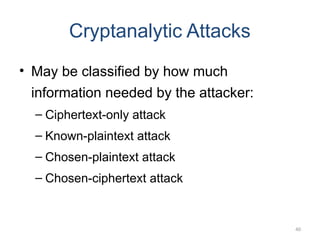
Cryptanalytic Attacks
• May be classified by how much
information needed by the attacker:
– Ciphertext-only attack
– Known-plaintext attack
– Chosen-plaintext attack
– Chosen-ciphertext attack
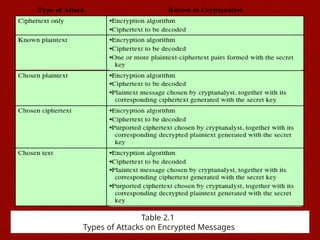
Table 2.1
Types of Attacks on Encrypted Messages
42
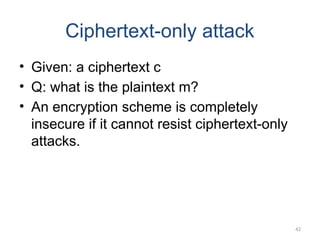
Ciphertext-only attack
• Given: a ciphertext c
• Q: what is the plaintext m?
• An encryption scheme is completely
insecure if it cannot resist ciphertext-only
attacks.
43
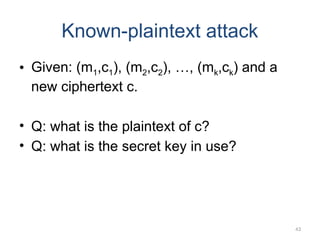
Known-plaintext attack
• Given: (m1,c1), (m2,c2), …, (mk,ck) and a
new ciphertext c.
• Q: what is the plaintext of c?
• Q: what is the secret key in use?
44
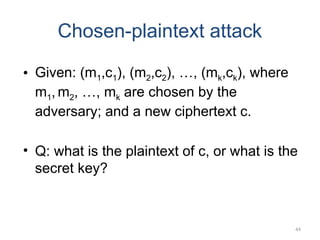
Chosen-plaintext attack
• Given: (m1,c1), (m2,c2), …, (mk,ck), where
m1, m2, …, mk are chosen by the
adversary; and a new ciphertext c.
• Q: what is the plaintext of c, or what is the
secret key?
45
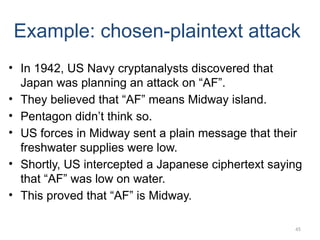
Example: chosen-plaintext attack
• In 1942, US Navy cryptanalysts discovered that
Japan was planning an attack on “AF”.
• They believed that “AF” means Midway island.
• Pentagon didn’t think so.
• US forces in Midway sent a plain message that their
freshwater supplies were low.
• Shortly, US intercepted a Japanese ciphertext saying
that “AF” was low on water.
• This proved that “AF” is Midway.
46
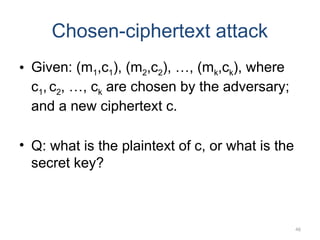
Chosen-ciphertext attack
• Given: (m1,c1), (m2,c2), …, (mk,ck), where
c1, c2, …, ck are chosen by the adversary;
and a new ciphertext c.
• Q: what is the plaintext of c, or what is the
secret key?
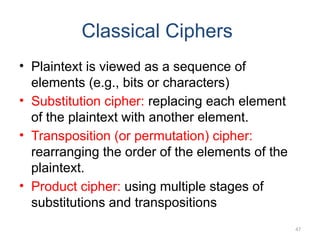
Classical Ciphers
• Plaintext is viewed as a sequence of
elements (e.g., bits or characters)
• Substitution cipher: replacing each element
of the plaintext with another element.
• Transposition (or permutation) cipher:
rearranging the order of the elements of the
plaintext.
• Product cipher: using multiple stages of
substitutions and transpositions
47
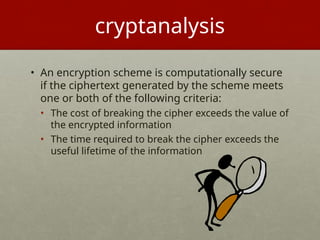
cryptanalysis
• An encryption scheme is computationally secure
if the ciphertext generated by the scheme meets
one or both of the following criteria:
• The cost of breaking the cipher exceeds the value of
the encrypted information
• The time required to break the cipher exceeds the
useful lifetime of the information
1.49
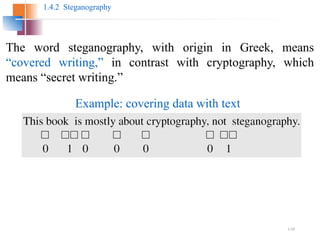
1.4.2 Steganography
The word steganography, with origin in Greek, means
“covered writing,” in contrast with cryptography, which
means “secret writing.”
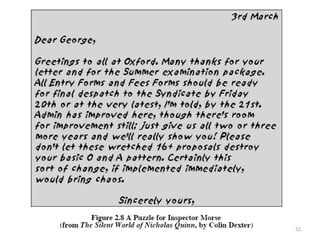
Example: covering data with text
Steganography
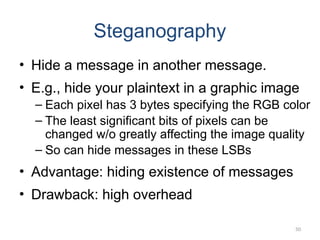
• Hide a message in another message.
• E.g., hide your plaintext in a graphic image
– Each pixel has 3 bytes specifying the RGB color
– The least significant bits of pixels can be
changed w/o greatly affecting the image quality
– So can hide messages in these LSBs
• Advantage: hiding existence of messages
• Drawback: high overhead
50
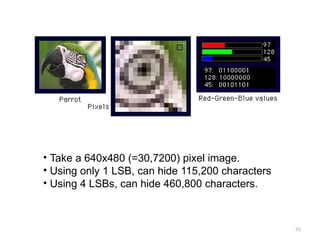
51
• Take a 640x480 (=30,7200) pixel image.
• Using only 1 LSB, can hide 115,200 characters
• Using 4 LSBs, can hide 460,800 characters.
52
1.53
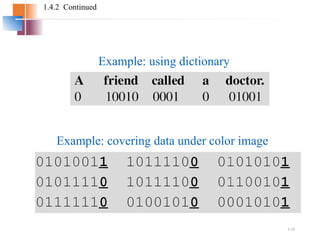
1.4.2 Continued
Example: using dictionary
Example: covering data under color image
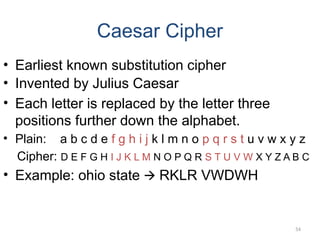
Caesar Cipher
• Earliest known substitution cipher
• Invented by Julius Caesar
• Each letter is replaced by the letter three
positions further down the alphabet.
• Plain: a b c d e f g h i j k l m n o p q r s t u v w x y z
Cipher: D E F G H I J K L M N O P Q R S T U V W X Y Z A B C
• Example: ohio state RKLR VWDWH
🡪
54
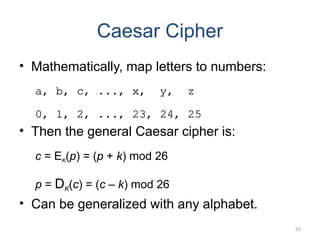
Caesar Cipher
• Mathematically, map letters to numbers:
a, b, c, ..., x, y, z
0, 1, 2, ..., 23, 24, 25
• Then the general Caesar cipher is:
c = EK(p) = (p + k) mod 26
p = DK(c) = (c – k) mod 26
• Can be generalized with any alphabet.
55
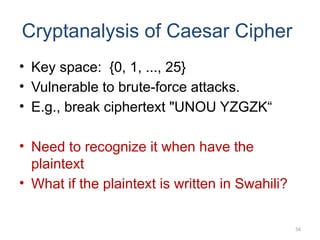
Cryptanalysis of Caesar Cipher
• Key space: {0, 1, ..., 25}
• Vulnerable to brute-force attacks.
• E.g., break ciphertext "UNOU YZGZK“
• Need to recognize it when have the
plaintext
• What if the plaintext is written in Swahili?
56
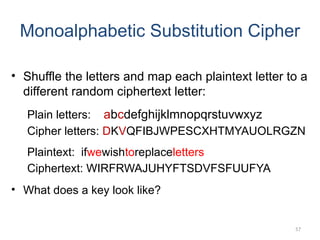
Monoalphabetic Substitution Cipher
• Shuffle the letters and map each plaintext letter to a
different random ciphertext letter:
Plain letters: abcdefghijklmnopqrstuvwxyz
Cipher letters: DKVQFIBJWPESCXHTMYAUOLRGZN
Plaintext: ifwewishtoreplaceletters
Ciphertext: WIRFRWAJUHYFTSDVFSFUUFYA
• What does a key look like?
57
Monoalphabetic Cipher Security
• Now we have a total of 26! = 4 x 1026
keys.
• With so many keys, it is secure against
brute-force attacks.
• But not secure against some cryptanalytic
attacks.
• Problem is language characteristics.
58
Language Statistics and Cryptanalysis
• Human languages are not random.
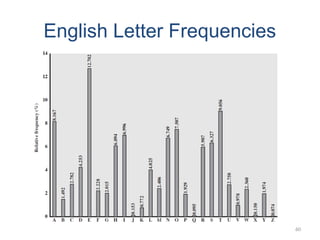
• Letters are not equally frequently used.
• In English, E is by far the most common letter,
followed by T, R, N, I, O, A, S.
• Other letters like Z, J, K, Q, X are fairly rare.
• There are tables of single, double & triple letter
frequencies for various languages
59
English Letter Frequencies
60
Statistics for double & triple letters
• In decreasing order of frequency
• Double letters:
th he an in er re es on, …
• Triple letters:
the and ent ion tio for nde, …
61
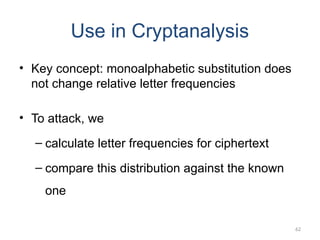
Use in Cryptanalysis
• Key concept: monoalphabetic substitution does
not change relative letter frequencies
• To attack, we
– calculate letter frequencies for ciphertext
– compare this distribution against the known
one
62
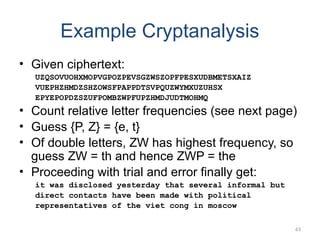
Example Cryptanalysis
• Given ciphertext:
UZQSOVUOHXMOPVGPOZPEVSGZWSZOPFPESXUDBMETSXAIZ
VUEPHZHMDZSHZOWSFPAPPDTSVPQUZWYMXUZUHSX
EPYEPOPDZSZUFPOMBZWPFUPZHMDJUDTMOHMQ
• Count relative letter frequencies (see next page)
• Guess {P, Z} = {e, t}
• Of double letters, ZW has highest frequency, so
guess ZW = th and hence ZWP = the
• Proceeding with trial and error finally get:
it was disclosed yesterday that several informal but
direct contacts have been made with political
representatives of the viet cong in moscow
63
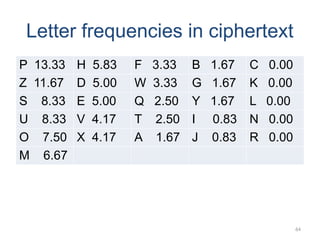
Letter frequencies in ciphertext
P 13.33 H 5.83 F 3.33 B 1.67 C 0.00
Z 11.67 D 5.00 W 3.33 G 1.67 K 0.00
S 8.33 E 5.00 Q 2.50 Y 1.67 L 0.00
U 8.33 V 4.17 T 2.50 I 0.83 N 0.00
O 7.50 X 4.17 A 1.67 J 0.83 R 0.00
M 6.67
64
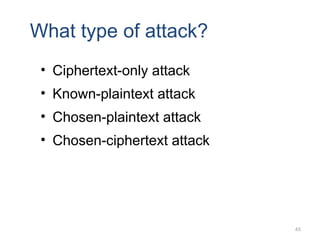
What type of attack?
• Ciphertext-only attack
• Known-plaintext attack
• Chosen-plaintext attack
• Chosen-ciphertext attack
65

cryptography_and_Network_Security_fuck_scribd_scribd_will_go_to_hell.pptx

  • 1.
  • 2.
  • 3.
    1.3 ❑ To definethree security goals ❑ To define security attacks that threaten security goals ❑ To define security services and how they are related to the three security goals ❑ To define security mechanisms to provide security services ❑ To introduce two techniques, cryptography and steganography, to implement security mechanisms. Objectives Chapter 1
  • 4.
  • 5.
  • 6.
  • 7.
    Some Basic Terminology •plaintext - original message • ciphertext - coded message • cipher - algorithm for transforming plaintext to ciphertext • key - info used in cipher known only to sender/receiver • encipher (encrypt) - converting plaintext to ciphertext • decipher (decrypt) - recovering plaintext from ciphertext • cryptography - study of encryption principles/methods. • Etymololy: from Greek kryptós, meaning "hidden" or "secret," and graphein, meaning "to write." • cryptanalysis (codebreaking) - study of principles/ methods of deciphering ciphertext without knowing key • cryptology - field of both cryptography and cryptanalysis
  • 8.
    1.8 1-1 SECURITY GOALS Thissection defines three security goals. 1.1.1 Confidentiality 1.1.2 Integrity 1.1.3 Security Topics discussed in this section:
  • 9.
    1.9 Figure 1.1 Taxonomyof security goals 1.1 Continued
  • 10.
    1.10 1.1.1 Confidentiality Confidentiality isprobably the most common aspect of information security. We need to protect our confidential information. An organization needs to guard against those malicious actions that endanger the confidentiality of its information.
  • 11.
    1.11 1.1.2 Integrity Information needsto be changed constantly. Integrity means that changes need to be done only by authorized entities and through authorized mechanisms.
  • 12.
    1.12 1.1.3 Availability The informationcreated and stored by an organization needs to be available to authorized entities. Information needs to be constantly changed, which means it must be accessible to authorized entities.
  • 13.
    1.13 1-2 ATTACKS The threegoals of security⎯confidentiality, integrity, and availability⎯can be threatened by security attacks. 1.2.1 Attacks Threatening Confidentiality 1.2.2 Attacks Threatening Integrity 1.2.3 Attacks Threatening Availability 1.2.4 Passive versus Active Attacks Topics discussed in this section:
  • 14.
    1.14 Figure 1.2 Taxonomyof attacks with relation to security goals 1.2 Continued
  • 15.
    1.15 1.2.1 Attacks ThreateningConfidentiality Snooping refers to unauthorized access to or interception of data. Traffic analysis refers to obtaining some other type of information by monitoring online traffic.
  • 16.
    1.16 1.2.2 Attacks ThreateningIntegrity Modification means that the attacker intercepts the message and changes it. Masquerading or spoofing happens when the attacker impersonates somebody else. Replaying means the attacker obtains a copy of a message sent by a user and later tries to replay it. Repudiation means that sender of the message might later deny that she has sent the message; the receiver of the message might later deny that he has received the message.
  • 17.
    1.17 1.2.3 Attacks ThreateningAvailability Denial of service (DoS) is a very common attack. It may slow down or totally interrupt the service of a system.
  • 18.
    1.18 1.2.4 Passive VersusActive Attacks Table 1.1 Categorization of passive and active attacks
  • 19.
    1.19 1-3 SERVICES ANDMECHANISMS ITU-T provides some security services and some mechanisms to implement those services. Security services and mechanisms are closely related because a mechanism or combination of mechanisms are used to provide a service.. 1.3.1 Security Services 1.3.2 Security Mechanism 1.3.3 Relation between Services and Mechanisms Topics discussed in this section:
  • 20.
  • 21.
    1.21 1.3.2 Security Mechanism Figure1.4 Security mechanisms
  • 22.
    1.22 1.3.3 Relation betweenServices and Mechanisms Table 1.2 Relation between security services and mechanisms
  • 23.
    1.23 1-4 TECHNIQUES Mechanisms discussedin the previous sections are only theoretical recipes to implement security. The actual implementation of security goals needs some techniques. Two techniques are prevalent today: cryptography and steganography. 1.4.1 Cryptography 1.4.2 Steganography Topics discussed in this section:
  • 24.
    1.24 1.4.1 Cryptography Cryptography, aword with Greek origins, means “secret writing.” However, we use the term to refer to the science and art of transforming messages to make them secure and immune to attacks.
  • 25.
  • 26.
  • 27.
    Model for Network Security •This general model shows that there are four basic tasks in designing a particular security service: 1. Design an algorithm for performing the security-related transformation. The algorithm should be such that an opponent cannot defeat its purpose. 2. Generate the secret information to be used with the algorithm. 3. Develop methods for the distribution and sharing of the secret information. 4. Specify a protocol to be used by the two principals that makes use of the security algorithm and the secret information to achieve a particular securityservice.
  • 28.
  • 29.
    Classical encryption techniques • Asopposed to modern cryptography • Goals: • to introduce basic concepts & terminology of encryption • to prepare us for studying modern cryptography 29
  • 30.
    Classical encryption techniques •As opposed to modern cryptography • Goals: – to introduce basic concepts & terminology of encryption – to prepare us for studying modern cryptography 30
  • 31.
    Basic terminology • Plaintext:original message to be encrypted • Ciphertext: the encrypted message • Enciphering or encryption: the process of converting plaintext into ciphertext • Encryption algorithm: performs encryption – Two inputs: a plaintext and a secret key 31
  • 32.
  • 33.
    • Deciphering ordecryption: recovering plaintext from ciphertext • Decryption algorithm: performs decryption – Two inputs: ciphertext and secret key • Secret key: same key used for encryption and decryption – Also referred to as a symmetric key 33
  • 34.
    • Cipher orcryptographic system : a scheme for encryption and decryption • Cryptography: science of studying ciphers • Cryptanalysis: science of studying attacks against cryptographic systems • Cryptology: cryptography + cryptanalysis 34
  • 35.
    Ciphers • Symmetric cipher:same key used for encryption and decryption – Block cipher: encrypts a block of plaintext at a time (typically 64 or 128 bits) – Stream cipher: encrypts data one bit or one byte at a time • Asymmetric cipher: different keys used for encryption and decryption 35
  • 36.
    Symmetric Encryption • orconventional / secret-key / single-key • sender and recipient share a common key • all classical encryption algorithms are symmetric • The only type of ciphers prior to the invention of asymmetric-key ciphers in 1970’s • by far most widely used 36
  • 37.
    Symmetric Encryption • Mathematically: Y= EK(X) or Y = E(K, X) X = DK(Y) or X = D(K, Y) • X = plaintext • Y = ciphertext • K = secret key • E = encryption algorithm • D = decryption algorithm • Both E and D are known to public 37
  • 38.
    Cryptanalysis • Objective: torecover the plaintext of a ciphertext or, more typically, to recover the secret key. • Kerkhoff’s principle: the adversary knows all details about a cryptosystem except the secret key. • Two general approaches: – brute-force attack – non-brute-force attack (cryptanalytic attack) 38
  • 39.
    Brute-Force Attack • Tryevery key to decipher the ciphertext. • On average, need to try half of all possible keys • Time needed proportional to size of key space Key Size (bits) Number of Alternative Keys Time required at 1 decryption/µs Time required at 106 decryptions/µs 32 232 = 4.3 × 10⁹ 231 µs = 35.8 minutes 2.15 milliseconds 56 256 = 7.2 × 10¹⁶ 255 µs = 1142 years 10.01 hours 128 2128 = 3.4 × 1038 2127 µs = 5.4 × 1024 years 5.4 × 10¹⁸ years 168 2168 = 3.7 × 1050 2167 µs = 5.9 × 1036 years 5.9 × 1030 years 26 characters (permutation) 26! = 4 × 1026 2 × 1026 µs = 6.4 × 10¹² years 6.4 × 10⁶ years 39
  • 40.
    40 Cryptanalytic Attacks • Maybe classified by how much information needed by the attacker: – Ciphertext-only attack – Known-plaintext attack – Chosen-plaintext attack – Chosen-ciphertext attack
  • 41.
    Table 2.1 Types ofAttacks on Encrypted Messages
  • 42.
    42 Ciphertext-only attack • Given:a ciphertext c • Q: what is the plaintext m? • An encryption scheme is completely insecure if it cannot resist ciphertext-only attacks.
  • 43.
    43 Known-plaintext attack • Given:(m1,c1), (m2,c2), …, (mk,ck) and a new ciphertext c. • Q: what is the plaintext of c? • Q: what is the secret key in use?
  • 44.
    44 Chosen-plaintext attack • Given:(m1,c1), (m2,c2), …, (mk,ck), where m1, m2, …, mk are chosen by the adversary; and a new ciphertext c. • Q: what is the plaintext of c, or what is the secret key?
  • 45.
    45 Example: chosen-plaintext attack •In 1942, US Navy cryptanalysts discovered that Japan was planning an attack on “AF”. • They believed that “AF” means Midway island. • Pentagon didn’t think so. • US forces in Midway sent a plain message that their freshwater supplies were low. • Shortly, US intercepted a Japanese ciphertext saying that “AF” was low on water. • This proved that “AF” is Midway.
  • 46.
    46 Chosen-ciphertext attack • Given:(m1,c1), (m2,c2), …, (mk,ck), where c1, c2, …, ck are chosen by the adversary; and a new ciphertext c. • Q: what is the plaintext of c, or what is the secret key?
  • 47.
    Classical Ciphers • Plaintextis viewed as a sequence of elements (e.g., bits or characters) • Substitution cipher: replacing each element of the plaintext with another element. • Transposition (or permutation) cipher: rearranging the order of the elements of the plaintext. • Product cipher: using multiple stages of substitutions and transpositions 47
  • 48.
    cryptanalysis • An encryptionscheme is computationally secure if the ciphertext generated by the scheme meets one or both of the following criteria: • The cost of breaking the cipher exceeds the value of the encrypted information • The time required to break the cipher exceeds the useful lifetime of the information
  • 49.
    1.49 1.4.2 Steganography The wordsteganography, with origin in Greek, means “covered writing,” in contrast with cryptography, which means “secret writing.” Example: covering data with text
  • 50.
    Steganography • Hide amessage in another message. • E.g., hide your plaintext in a graphic image – Each pixel has 3 bytes specifying the RGB color – The least significant bits of pixels can be changed w/o greatly affecting the image quality – So can hide messages in these LSBs • Advantage: hiding existence of messages • Drawback: high overhead 50
  • 51.
    51 • Take a640x480 (=30,7200) pixel image. • Using only 1 LSB, can hide 115,200 characters • Using 4 LSBs, can hide 460,800 characters.
  • 52.
  • 53.
    1.53 1.4.2 Continued Example: usingdictionary Example: covering data under color image
  • 54.
    Caesar Cipher • Earliestknown substitution cipher • Invented by Julius Caesar • Each letter is replaced by the letter three positions further down the alphabet. • Plain: a b c d e f g h i j k l m n o p q r s t u v w x y z Cipher: D E F G H I J K L M N O P Q R S T U V W X Y Z A B C • Example: ohio state RKLR VWDWH 🡪 54
  • 55.
    Caesar Cipher • Mathematically,map letters to numbers: a, b, c, ..., x, y, z 0, 1, 2, ..., 23, 24, 25 • Then the general Caesar cipher is: c = EK(p) = (p + k) mod 26 p = DK(c) = (c – k) mod 26 • Can be generalized with any alphabet. 55
  • 56.
    Cryptanalysis of CaesarCipher • Key space: {0, 1, ..., 25} • Vulnerable to brute-force attacks. • E.g., break ciphertext "UNOU YZGZK“ • Need to recognize it when have the plaintext • What if the plaintext is written in Swahili? 56
  • 57.
    Monoalphabetic Substitution Cipher •Shuffle the letters and map each plaintext letter to a different random ciphertext letter: Plain letters: abcdefghijklmnopqrstuvwxyz Cipher letters: DKVQFIBJWPESCXHTMYAUOLRGZN Plaintext: ifwewishtoreplaceletters Ciphertext: WIRFRWAJUHYFTSDVFSFUUFYA • What does a key look like? 57
  • 58.
    Monoalphabetic Cipher Security •Now we have a total of 26! = 4 x 1026 keys. • With so many keys, it is secure against brute-force attacks. • But not secure against some cryptanalytic attacks. • Problem is language characteristics. 58
  • 59.
    Language Statistics andCryptanalysis • Human languages are not random. • Letters are not equally frequently used. • In English, E is by far the most common letter, followed by T, R, N, I, O, A, S. • Other letters like Z, J, K, Q, X are fairly rare. • There are tables of single, double & triple letter frequencies for various languages 59
  • 60.
  • 61.
    Statistics for double& triple letters • In decreasing order of frequency • Double letters: th he an in er re es on, … • Triple letters: the and ent ion tio for nde, … 61
  • 62.
    Use in Cryptanalysis •Key concept: monoalphabetic substitution does not change relative letter frequencies • To attack, we – calculate letter frequencies for ciphertext – compare this distribution against the known one 62
  • 63.
    Example Cryptanalysis • Givenciphertext: UZQSOVUOHXMOPVGPOZPEVSGZWSZOPFPESXUDBMETSXAIZ VUEPHZHMDZSHZOWSFPAPPDTSVPQUZWYMXUZUHSX EPYEPOPDZSZUFPOMBZWPFUPZHMDJUDTMOHMQ • Count relative letter frequencies (see next page) • Guess {P, Z} = {e, t} • Of double letters, ZW has highest frequency, so guess ZW = th and hence ZWP = the • Proceeding with trial and error finally get: it was disclosed yesterday that several informal but direct contacts have been made with political representatives of the viet cong in moscow 63
  • 64.
    Letter frequencies inciphertext P 13.33 H 5.83 F 3.33 B 1.67 C 0.00 Z 11.67 D 5.00 W 3.33 G 1.67 K 0.00 S 8.33 E 5.00 Q 2.50 Y 1.67 L 0.00 U 8.33 V 4.17 T 2.50 I 0.83 N 0.00 O 7.50 X 4.17 A 1.67 J 0.83 R 0.00 M 6.67 64
  • 65.
    What type ofattack? • Ciphertext-only attack • Known-plaintext attack • Chosen-plaintext attack • Chosen-ciphertext attack 65

Editor's Notes

  • #7 Briefly review some terminology used throughout the course.
  • #41  The process of attempting to discover the plaintext or key is known as cryptanalysis . The strategy used by the cryptanalyst depends on the nature of the encryption scheme and the information available to the cryptanalyst. Table 2.1 summarizes the various types of cryptanalytic attacks based on the amount of information known to the cryptanalyst. The most difficult problem is presented when all that is available is the ciphertext only . In some cases, not even the encryption algorithm is known, but in general, we can assume that the opponent does know the algorithm used for encryption. One possible attack under these circumstances is the brute-force approach of trying all possible keys. If the key space is very large, this becomes impractical. Thus, the opponent must rely on an analysis of the ciphertext itself, generally applying various statistical tests to it. To use this approach, the opponent must have some general idea of the type of plaintext that is concealed, such as English or French text, an EXE file, a Java source listing, an accounting file, and so on. The ciphertext-only attack is the easiest to defend against because the opponent has the least amount of information to work with. In many cases, however, the analyst has more information. The analyst may be able to capture one or more plaintext messages as well as their encryptions. Or the analyst may know that certain plaintext patterns will appear in a message. For example, a file that is encoded in the Postscript format always begins with the same pattern, or there may be a standardized header or banner to an electronic funds transfer message, and so on. All of these are examples of known plaintext . With this knowledge, the analyst may be able to deduce the key on the basis of the way in which the known plaintext is transformed. Closely related to the known-plaintext attack is what might be referred to as a probable-word attack. If the opponent is working with the encryption of some general prose message, he or she may have little knowledge of what is in the message. However, if the opponent is after some very specific information, then parts of the message may be known. For example, if an entire accounting file is being transmitted, the opponent may know the placement of certain key words in the header of the file. As another example, the source code for a program developed by a corporation might include a copyright statement in some standardized position. If the analyst is able somehow to get the source system to insert into the system a message chosen by the analyst, then a chosen-plaintext attack is possible. In general, if the analyst is able to choose the messages to encrypt, the analyst may deliberately pick patterns that can be expected to reveal the structure of the key. Table 2.1 lists two other types of attack: chosen ciphertext and chosen text. These are less commonly employed as cryptanalytic techniques but are nevertheless possible avenues of attack.
  • #48 Only relatively weak algorithms fail to withstand a ciphertext-only attack. Generally, an encryption algorithm is designed to withstand a known-plaintext attack. An encryption scheme is computationally secure if the ciphertext generated by the scheme meets one or both of the following criteria: • The cost of breaking the cipher exceeds the value of the encrypted information. • The time required to break the cipher exceeds the useful lifetime of the information.