INTRODUCTION TO ACCOUNTING
(VOUCHER TYPES)
CLASS 11
UNIT - II
BY
ABHISHIKTH SANDEEP .A.
TRANSACTION – Defined& Vouchers
Define: A transaction may be defined as an exchange
between two or more parties. (generally buyer & seller
OR service provider & service receiver)
Eg: Sale of groceries , Deposit of cash into bank , salary
paid, Purchase of furniture for use in business etc.
When one of the parties mentioned above, involves a
business organization, it leads to the initiation of the
accounting process.
The documentary proof that a transaction has taken place
is referred to as a VOUCHER.
Based on these vouchers, the accounting process of
recording the transaction in the books of accounts
commences. They are arranged in a chronological order,
serially numbered and put in a file. Thereafter they are
taken up for entry into the books of accounts.
VOUCHER - Defined
 Define: A voucher is a documentary proof that a
business transaction has taken place and it records the
transaactional value in monetary terms
 Examples: Some examples of vouchers are
1. Cash Memo
2. Sales Bill
3. Invoice
4. Salary slip
5. Cheque
6. Bank pay in slip
7. Purchase returns memo
8. Sales returns memo etc.
Categories of Transactions
Transactions ,for the purpose of categorization of vouchers
(from the point of view of accounts ) can be categorized as
follows:
1. SIMPLE TRANSACTION VOUCHER:
If there is only one debit item and one credit item in a
transaction, then it is known as a SIMPLE TRANSACTION
These are evidenced by a SIMPLE TRANSACTION VOUCHER
2. COMPOUND TRANSACTION VOUCHER:
If there are multiple debit items & multiple credit items in a
single transaction, then it is known as a COMPOUND
TRANSACTION
These are evidenced by a COMPOUND TRANSACTION VOUCHER or
JOURNAL VOUCHER
TYPES OF VOUCHERS IN ACCOUNTS
 1. SALES VOUCHER:- To record sales made by the business (cash
sales & credit sales)
 2. PURCHASE VOUCHER: To record purchases made by the
business (cash purchases & credit purchases)
 3. BANK VOUCHER: To record bank transactions
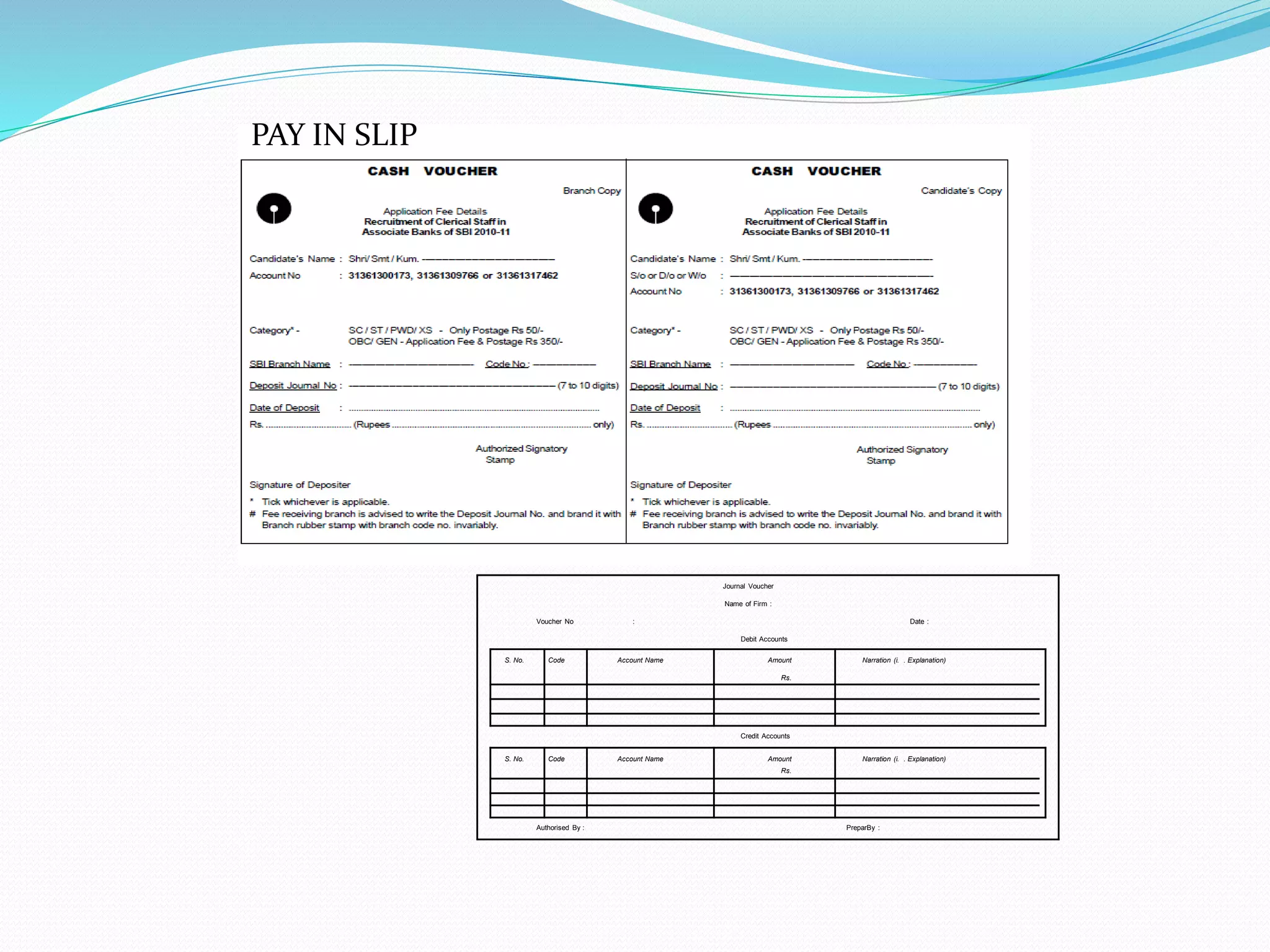
 A) PAY IN SLIP: To record cash deposits made into bank account
 4. PAYMENT VOUCHER: To record all the transactions related to
cash payments made by the business.
 5. CREDIT NOTE: To record sales returns & when trade discount to
debtors/ amount is refunded or they may return goods on account of
damage.
 6. DEBIT NOTE: To record Purchase Returns/Trade Discount offered
by creditors /suppliers/When the original bill has been over drawn
and now in order to reduce it/creditor returns goods
 7. JOURNAL VOUCHER: Mostly used to record non cash
transactions/ inter book adjustment entries.(NOTE: can also record
cash transactions if needed)
TYPES OF VOUCHERS IN ACCOUNTS….contd
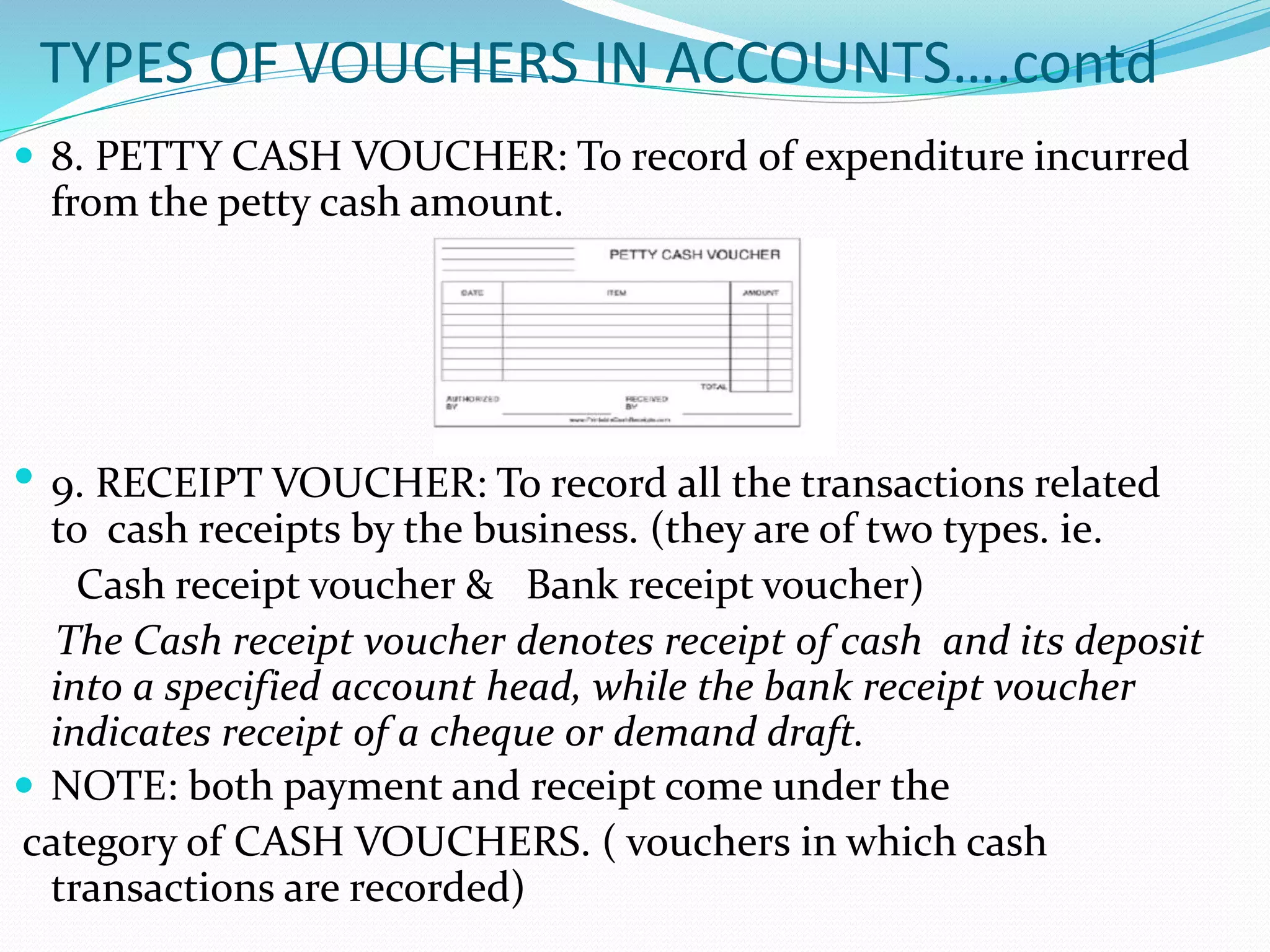
 8. PETTY CASH VOUCHER: To record of expenditure incurred
from the petty cash amount.
 9. RECEIPT VOUCHER: To record all the transactions related
to cash receipts by the business. (they are of two types. ie.
Cash receipt voucher & Bank receipt voucher)
The Cash receipt voucher denotes receipt of cash and its deposit
into a specified account head, while the bank receipt voucher
indicates receipt of a cheque or demand draft.
 NOTE: both payment and receipt come under the
category of CASH VOUCHERS. ( vouchers in which cash
transactions are recorded)
PAY IN SLIP
Journal Voucher
Name of Firm :
Voucher No : Date :
Debit Accounts
S. No. Code Account Name Amount Narration (i. . Explanation)
Rs.
Credit Accounts
S. No. Code Account Name Amount Narration (i. . Explanation)
Rs.
Authorised By : PreparBy :
PROBLEM
 Identify the vouchers used to record following
transactions.
 Cash sales Rs. 40000
 Credit sales to Y Rs. 20000
 Cash purchases Rs. 10000
 Credit purchases to Deepu Rs. 15000
 Salaries paid Rs.5000
 Deposited cash into SBI Rs.1000
Types of computerized accounting vouchers

  • 1.
    INTRODUCTION TO ACCOUNTING (VOUCHERTYPES) CLASS 11 UNIT - II BY ABHISHIKTH SANDEEP .A.
  • 2.
    TRANSACTION – Defined&Vouchers Define: A transaction may be defined as an exchange between two or more parties. (generally buyer & seller OR service provider & service receiver) Eg: Sale of groceries , Deposit of cash into bank , salary paid, Purchase of furniture for use in business etc. When one of the parties mentioned above, involves a business organization, it leads to the initiation of the accounting process. The documentary proof that a transaction has taken place is referred to as a VOUCHER. Based on these vouchers, the accounting process of recording the transaction in the books of accounts commences. They are arranged in a chronological order, serially numbered and put in a file. Thereafter they are taken up for entry into the books of accounts.
  • 3.
    VOUCHER - Defined Define: A voucher is a documentary proof that a business transaction has taken place and it records the transaactional value in monetary terms  Examples: Some examples of vouchers are 1. Cash Memo 2. Sales Bill 3. Invoice 4. Salary slip 5. Cheque 6. Bank pay in slip 7. Purchase returns memo 8. Sales returns memo etc.
  • 4.
    Categories of Transactions Transactions,for the purpose of categorization of vouchers (from the point of view of accounts ) can be categorized as follows: 1. SIMPLE TRANSACTION VOUCHER: If there is only one debit item and one credit item in a transaction, then it is known as a SIMPLE TRANSACTION These are evidenced by a SIMPLE TRANSACTION VOUCHER 2. COMPOUND TRANSACTION VOUCHER: If there are multiple debit items & multiple credit items in a single transaction, then it is known as a COMPOUND TRANSACTION These are evidenced by a COMPOUND TRANSACTION VOUCHER or JOURNAL VOUCHER
  • 5.
    TYPES OF VOUCHERSIN ACCOUNTS  1. SALES VOUCHER:- To record sales made by the business (cash sales & credit sales)  2. PURCHASE VOUCHER: To record purchases made by the business (cash purchases & credit purchases)  3. BANK VOUCHER: To record bank transactions  A) PAY IN SLIP: To record cash deposits made into bank account  4. PAYMENT VOUCHER: To record all the transactions related to cash payments made by the business.  5. CREDIT NOTE: To record sales returns & when trade discount to debtors/ amount is refunded or they may return goods on account of damage.  6. DEBIT NOTE: To record Purchase Returns/Trade Discount offered by creditors /suppliers/When the original bill has been over drawn and now in order to reduce it/creditor returns goods  7. JOURNAL VOUCHER: Mostly used to record non cash transactions/ inter book adjustment entries.(NOTE: can also record cash transactions if needed)
  • 6.
    TYPES OF VOUCHERSIN ACCOUNTS….contd  8. PETTY CASH VOUCHER: To record of expenditure incurred from the petty cash amount.  9. RECEIPT VOUCHER: To record all the transactions related to cash receipts by the business. (they are of two types. ie. Cash receipt voucher & Bank receipt voucher) The Cash receipt voucher denotes receipt of cash and its deposit into a specified account head, while the bank receipt voucher indicates receipt of a cheque or demand draft.  NOTE: both payment and receipt come under the category of CASH VOUCHERS. ( vouchers in which cash transactions are recorded)
  • 7.
    PAY IN SLIP JournalVoucher Name of Firm : Voucher No : Date : Debit Accounts S. No. Code Account Name Amount Narration (i. . Explanation) Rs. Credit Accounts S. No. Code Account Name Amount Narration (i. . Explanation) Rs. Authorised By : PreparBy :
  • 8.
    PROBLEM  Identify thevouchers used to record following transactions.  Cash sales Rs. 40000  Credit sales to Y Rs. 20000  Cash purchases Rs. 10000  Credit purchases to Deepu Rs. 15000  Salaries paid Rs.5000  Deposited cash into SBI Rs.1000