By
ABHISHIKTH SANDEEP ABRAHAM
M.Phil, M.Com, MA(Pub.Rel & Journl), MBA (HR),B.Ed, BCJ,
ICWAI(I), PGDT, PGDCMP, Dip.Tax, CDT, UGC-NET,APSLET,
(PhD),UGC-MAN Research Fellow Awardee in Devp. Studies
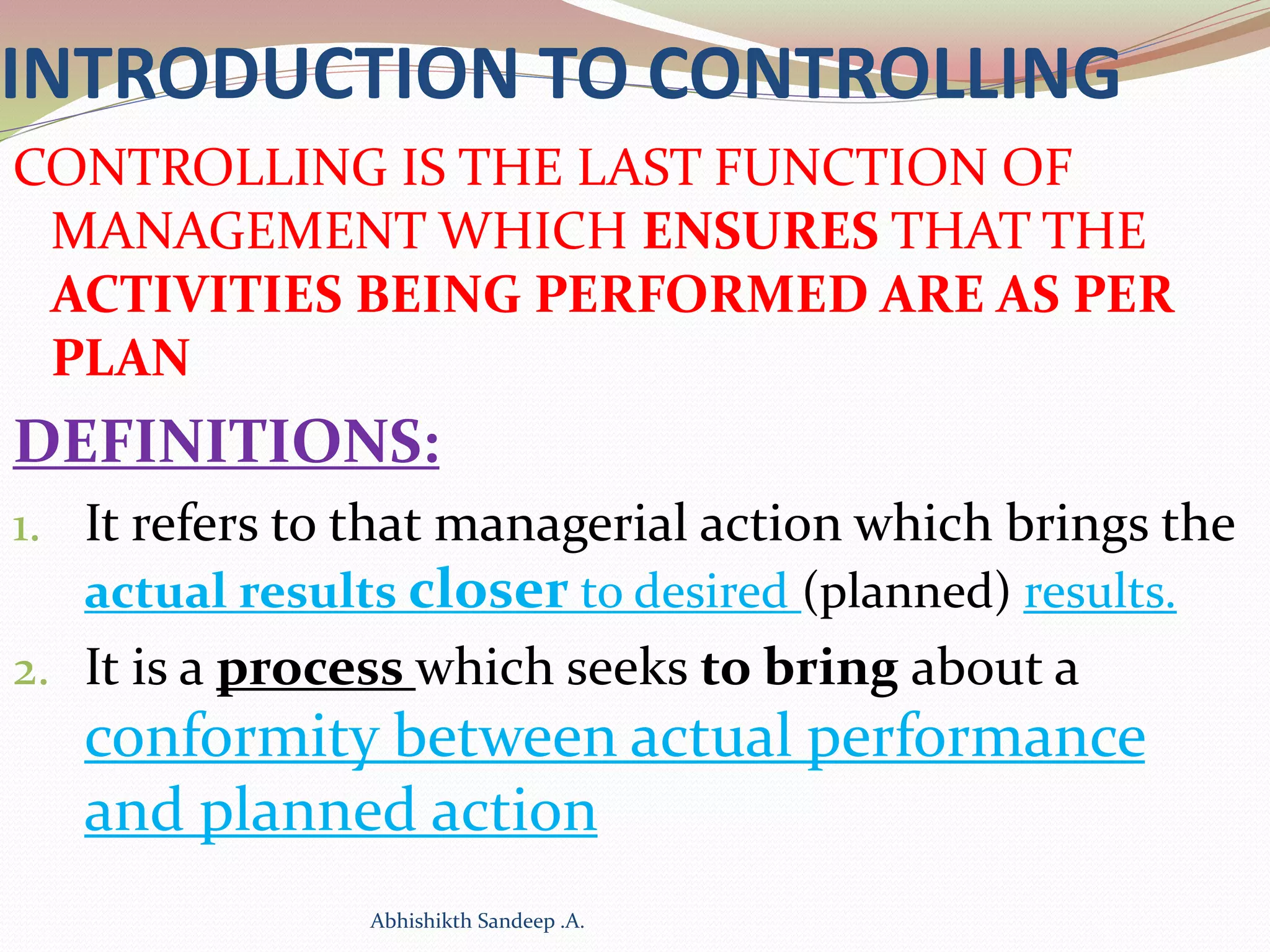
INTRODUCTION TO CONTROLLING
CONTROLLING IS THE LAST FUNCTION OF
MANAGEMENT WHICH ENSURES THAT THE
ACTIVITIES BEING PERFORMED ARE AS PER
PLAN
DEFINITIONS:
1. It refers to that managerial action which brings the
actual results closer to desired (planned) results.
2. It is a process which seeks to bring about a
conformity between actual performance
and planned action
Abhishikth Sandeep .A.
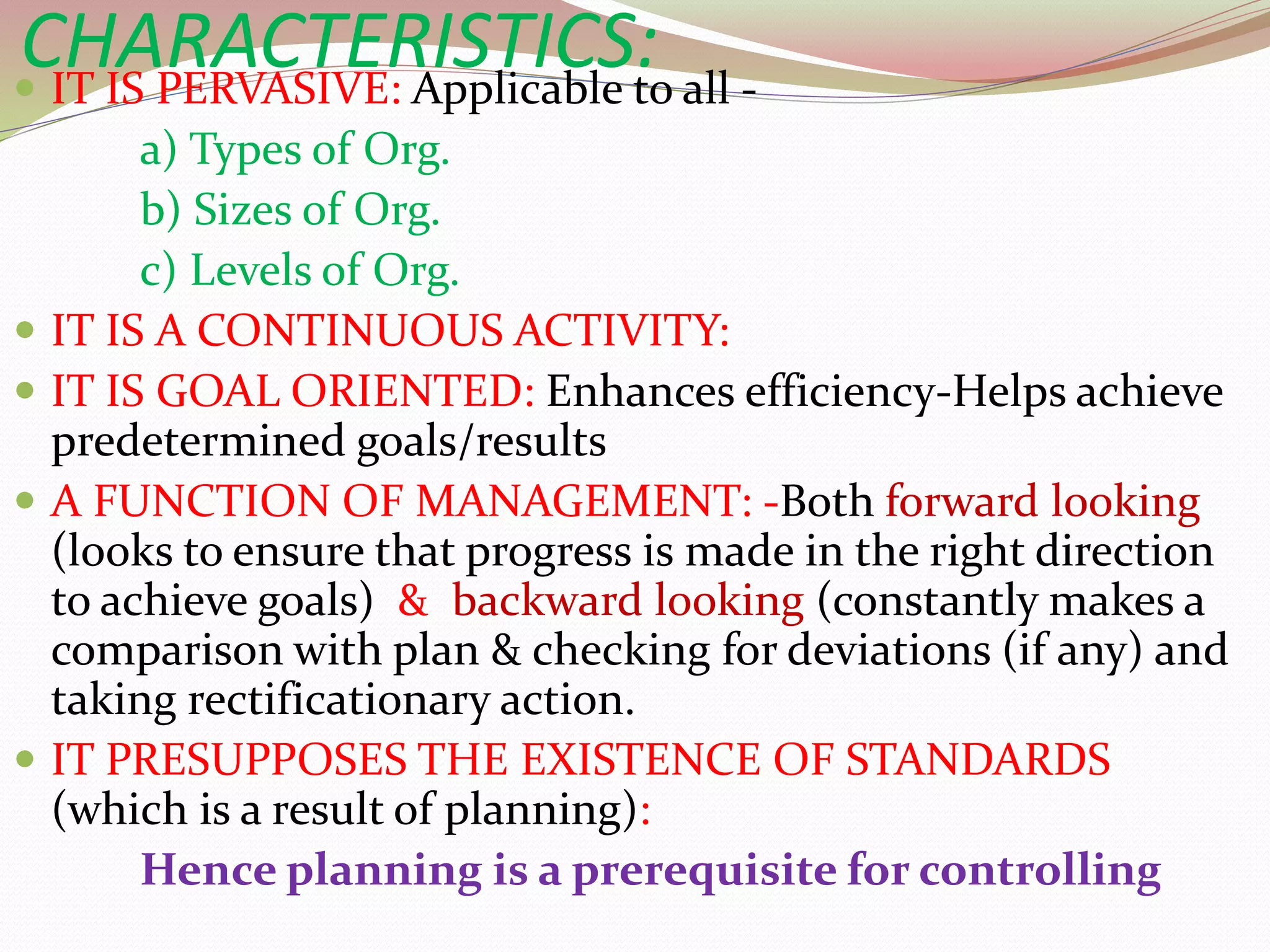
CHARACTERISTICS:
 IT IS PERVASIVE: Applicable to all -
a) Types of Org.
b) Sizes of Org.
c) Levels of Org.
 IT IS A CONTINUOUS ACTIVITY:
 IT IS GOAL ORIENTED: Enhances efficiency-Helps achieve
predetermined goals/results
 A FUNCTION OF MANAGEMENT: -Both forward looking
(looks to ensure that progress is made in the right direction
to achieve goals) & backward looking (constantly makes a
comparison with plan & checking for deviations (if any) and
taking rectificationary action.
 IT PRESUPPOSES THE EXISTENCE OF STANDARDS
(which is a result of planning):
Hence planning is a prerequisite for controlling
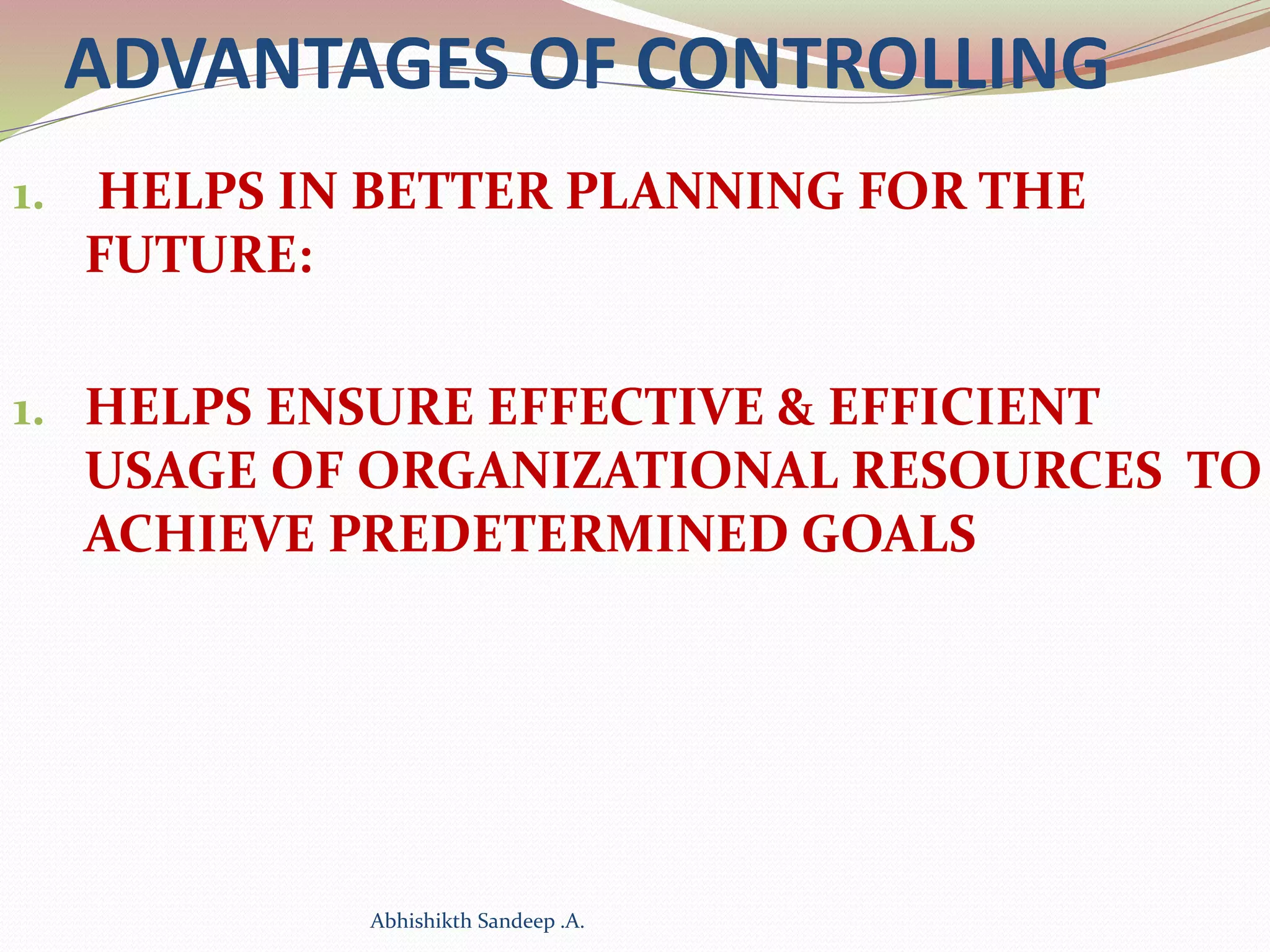
ADVANTAGES OF CONTROLLING
1. HELPS IN BETTER PLANNING FOR THE
FUTURE:
1. HELPS ENSURE EFFECTIVE & EFFICIENT
USAGE OF ORGANIZATIONAL RESOURCES TO
ACHIEVE PREDETERMINED GOALS
Abhishikth Sandeep .A.
IMPORTANCE OF CONTROLLING
 HELPS ACHIEVE ORGANIZATIONAL GOALS - by synchronizing
performance with planned effort & keeping the progress on track
 ENSURES EFFICIENT USE OF RESOURCES- Minimises wastages
 MOTIVATES EMPLOYEE- Helps enhance dedication of employee
to the job through a system of performance linked incentive
recognition
 PROMOTES ORDER & DISCIPLINE :- Checks unwanted activities
 FACILITATES BETTER COORDINATION: between various
departments
Abhishikth Sandeep .A.
LIMITATIONS OF CONTROLLING.....
1. IN MOST CASES “STANDARDS” CANNOT BE ACCURATELY
DEFINED IN QUANTITATIVE TERMS: Ex: In the case of attributes –
Customer satisfaction, honesty of employee etc. – Hence the
measurement of performance & comparison with standard is difficult.
2. NO CONTROL OVER EXTERNAL FACTORS : As they are beyond the
control of the organization.
3. RESISTANCE FROM EMPLOYEES: As it seeks to constantly monitor
on the job employee performance & make comparison with standards,
employees feel inconvenienced and tend to offer resistance
4. COSTLY: Involves spending a lot of time, money & effort. It proves to
be costly for small & medium enterprises
Abhishikth Sandeep .A.
Source: Business Studies-Class 12, CBSE.
R.K.Singla.
VK Publications
Abhishikth Sandeep. A.
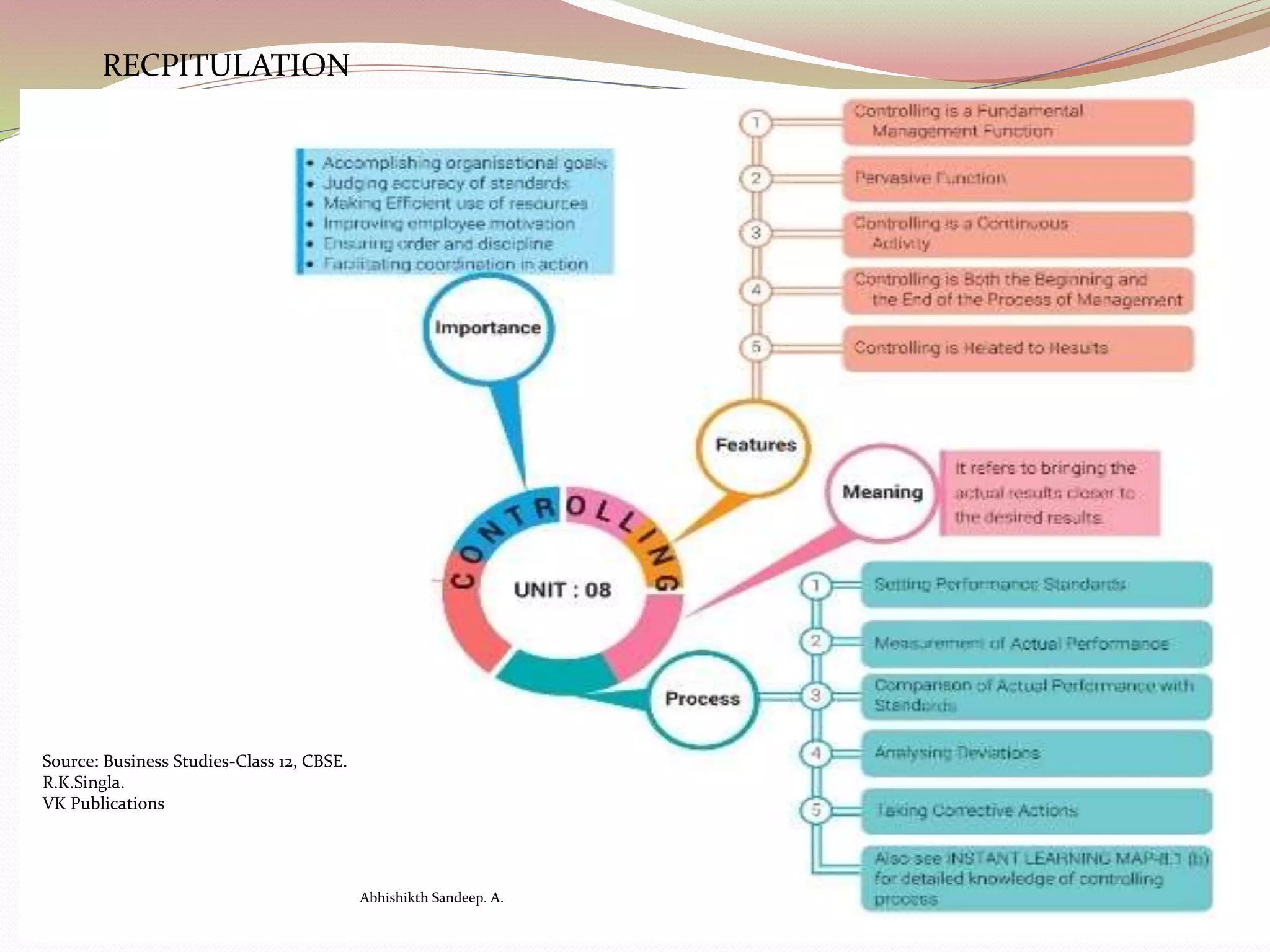
RECPITULATION
1. Why is controlling said to be a continous activity? ( 1 mark)
2. Why is it said that controlling is looking back? ( 1 mark)
3. “Controlling is all pervasive”- Explain. ( 3 mark)
4. “Controlling is an indispensible function of management”- Do you agree? Give reasons.
( 5 mark)
5. Name the function of management which reviews the business operations ( 1 mark)
6. Expalain how controlling helps in achieving the organizational goals ( 3 mark)
7. How does controlling ensure efficient usage of resources? ( 3 mark)
8. “ Controlling is forward looking “ – Explain ( 3 mark)
9. How does controlling improve employee morale? ( 3 mark)
10. Explain the importance of controlling. ( 5/6 mark)
Abhishikth Sandeep .A.

controlling intro.pptx

  • 1.
    By ABHISHIKTH SANDEEP ABRAHAM M.Phil,M.Com, MA(Pub.Rel & Journl), MBA (HR),B.Ed, BCJ, ICWAI(I), PGDT, PGDCMP, Dip.Tax, CDT, UGC-NET,APSLET, (PhD),UGC-MAN Research Fellow Awardee in Devp. Studies
  • 2.
    INTRODUCTION TO CONTROLLING CONTROLLINGIS THE LAST FUNCTION OF MANAGEMENT WHICH ENSURES THAT THE ACTIVITIES BEING PERFORMED ARE AS PER PLAN DEFINITIONS: 1. It refers to that managerial action which brings the actual results closer to desired (planned) results. 2. It is a process which seeks to bring about a conformity between actual performance and planned action Abhishikth Sandeep .A.
  • 3.
    CHARACTERISTICS:  IT ISPERVASIVE: Applicable to all - a) Types of Org. b) Sizes of Org. c) Levels of Org.  IT IS A CONTINUOUS ACTIVITY:  IT IS GOAL ORIENTED: Enhances efficiency-Helps achieve predetermined goals/results  A FUNCTION OF MANAGEMENT: -Both forward looking (looks to ensure that progress is made in the right direction to achieve goals) & backward looking (constantly makes a comparison with plan & checking for deviations (if any) and taking rectificationary action.  IT PRESUPPOSES THE EXISTENCE OF STANDARDS (which is a result of planning): Hence planning is a prerequisite for controlling
  • 4.
    ADVANTAGES OF CONTROLLING 1.HELPS IN BETTER PLANNING FOR THE FUTURE: 1. HELPS ENSURE EFFECTIVE & EFFICIENT USAGE OF ORGANIZATIONAL RESOURCES TO ACHIEVE PREDETERMINED GOALS Abhishikth Sandeep .A.
  • 5.
    IMPORTANCE OF CONTROLLING HELPS ACHIEVE ORGANIZATIONAL GOALS - by synchronizing performance with planned effort & keeping the progress on track  ENSURES EFFICIENT USE OF RESOURCES- Minimises wastages  MOTIVATES EMPLOYEE- Helps enhance dedication of employee to the job through a system of performance linked incentive recognition  PROMOTES ORDER & DISCIPLINE :- Checks unwanted activities  FACILITATES BETTER COORDINATION: between various departments Abhishikth Sandeep .A.
  • 6.
    LIMITATIONS OF CONTROLLING..... 1.IN MOST CASES “STANDARDS” CANNOT BE ACCURATELY DEFINED IN QUANTITATIVE TERMS: Ex: In the case of attributes – Customer satisfaction, honesty of employee etc. – Hence the measurement of performance & comparison with standard is difficult. 2. NO CONTROL OVER EXTERNAL FACTORS : As they are beyond the control of the organization. 3. RESISTANCE FROM EMPLOYEES: As it seeks to constantly monitor on the job employee performance & make comparison with standards, employees feel inconvenienced and tend to offer resistance 4. COSTLY: Involves spending a lot of time, money & effort. It proves to be costly for small & medium enterprises Abhishikth Sandeep .A.
  • 7.
    Source: Business Studies-Class12, CBSE. R.K.Singla. VK Publications Abhishikth Sandeep. A. RECPITULATION
  • 8.
    1. Why iscontrolling said to be a continous activity? ( 1 mark) 2. Why is it said that controlling is looking back? ( 1 mark) 3. “Controlling is all pervasive”- Explain. ( 3 mark) 4. “Controlling is an indispensible function of management”- Do you agree? Give reasons. ( 5 mark) 5. Name the function of management which reviews the business operations ( 1 mark) 6. Expalain how controlling helps in achieving the organizational goals ( 3 mark) 7. How does controlling ensure efficient usage of resources? ( 3 mark) 8. “ Controlling is forward looking “ – Explain ( 3 mark) 9. How does controlling improve employee morale? ( 3 mark) 10. Explain the importance of controlling. ( 5/6 mark) Abhishikth Sandeep .A.