History :
 1st clinical practise was demonstrated by
Carl koller in 1884
 Effective local anesthetic “ Procaine “
Founded in 1905
 Lidocaine was founded By LOFGREN In
1948 and used by T. GORDH in 1949
Not irritant
 Low systemic toxicity
 Short onset of action
 Effective
 No allergic effects / reactions
 Local anesthesia is defined as a loss
of sensation in a circumscribe area of
the body caused by inhibition of
conduction process in peripheral
nerves
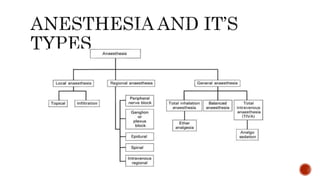
Types :
 Topical
 Infiltration
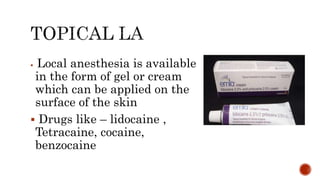
 Local anesthesia is available
in the form of gel or cream
which can be applied on the
surface of the skin
 Drugs like – lidocaine ,
Tetracaine, cocaine,
benzocaine
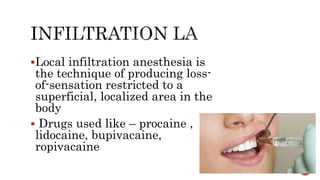
Local infiltration anesthesia is
the technique of producing loss-
of-sensation restricted to a
superficial, localized area in the
body
 Drugs used like – procaine ,
lidocaine, bupivacaine,
ropivacaine
Excision ( I&D)
 Dermatology procedure ( removal of moles)
 Dentistry
 Ansthetic adjuvant
 Biopsy
 Catract procedures
Ocular complications – due to inj at wrong site
during dental procedures
 Paresthesia – trauma to nerve
 Facial nerve paralysis – occur when over dose of
anesthesia inj into deep lobe of parotid gland
 Soft tissue injury over lips and mouth
 Hematoma
Pain on injection
 Infection – contaminated drugs / needles
 Edema
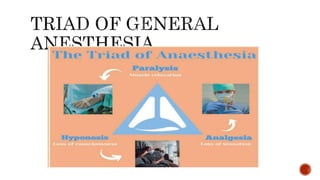
 General anesthesia is defined as reversible loss of
consciousness / sensation in patient using
anesthetic drug.
Types :
 Balanced anesthesia
 Total inhalational anesthesia
 Total intravenous anesthesia
Steps involved :
 Premedication
Preoxygenation
 Induction
Intubation
 Maintanance
 Reversal
Extubation
1. Premedication :
administration of drugs before induction. It is given 40 – 30mins prior
to the surgery
Goals
 Analgesic
 To reduce anxiety
 Decreses secretion
 Facilitate induction
 Prevent post op nausea & vomiting
 Facilitate post op analgesia
Drugs used :
 Benzodiazepines
 Barbiturates
 Glyco ; atropine, ranitidine, metaclopramide
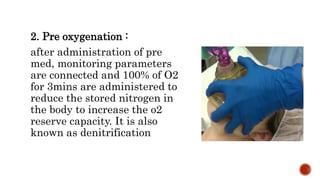
2. Pre oxygenation :
after administration of pre
med, monitoring parameters
are connected and 100% of O2
for 3mins are administered to
reduce the stored nitrogen in
the body to increase the o2
reserve capacity. It is also
known as denitrification
3 . Induction : it refers to transition from an
awake to an anesthetized stage
Routes : IV route and inhalational route
Inhalational :
Agents used – Sevoflurane, desflurane, N20,
halothene
Indications :
Young children’s
 URT and LRT obstruction
 No accessible veins
Intravenous :
Drugs used : induction agents + opioids + MR
Properties :
Rapid onset
 Rapid recovery
 Minimal cvs & Rs depression
 No toxic reactions
No excitatory actions ( cough, hiccup)
Technique :
 Access for good iv line
 Preoxy is must and connect monitors
 Doses varies with age and weight
 Slow injection is recommended
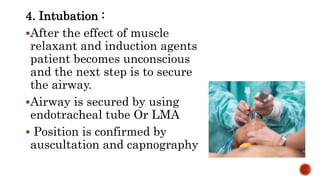
4. Intubation :
After the effect of muscle
relaxant and induction agents
patient becomes unconscious
and the next step is to secure
the airway.
Airway is secured by using
endotracheal tube Or LMA
 Position is confirmed by
auscultation and capnography
5. Maintanance :
The phase of anesthesia Is maintained with
33% of O2 + 66% of N20 + inhalational agent
6. Reversal and extubation :
At the end Of surgery, the effect of MR is
reversed by Neo + glyco
Once the pt able to breathe by own check for
vitals, remove the tube and suction the oral
cavity
Definition : It is a technique of GA which uses a
combination of agents given oly through IV route
without the Use of inhalational agent except O2 and
air
Indications :
 Malignant hyperthermia
 Long QT syndrome
 H/0 severe PONV
 Tubeless ENT / thoracic surgery.
 Difficult intubation
Drugs : propofol, ketamine, etomidate, fentanyl
Adv:
 No mask over face
 No risk of hyperthermia
 No incidence of PO delirium
 Less PONV
 Less OR pollution
Disadv :
 Pain
 Difficult finding vein.
 Diff in obese pt
 Risk of bac contamination
It refers to the delivery of gases / vapours to
respiratory system to produce anesthesia
Indications :
 For IV cannulation in pediatric
 Control of status epilepticus
 Pt with difficult IV line
Advantages :
 Easy to administer
 Rapid induction
 Easy and cheap
 no cvs and rs depression
 No toxic effects
 No post op pain
Disadvantage :
 Adverse drug effects
 Nephrotoxicity, hepatotoxicity
 PONV
 Post op hyperthermia
Intra op :
 Chances of aspirations,
 Trauma to lips , teeth and tongue
 Hypoxia and hemodynamics changes due to drug
 Less / over fluid administration
 Anemia
 Air embolism
Post op :
 Inadequate reversal
 Laryngospasm
 Bronchospasm
Bradycardia
 Urine retention
Delayed :
 Sore throat
Cough
 Tracheitis
 Hoarseness of voice
It is the use of LA to block the sensation of pain
from a Larger region / particular region of the body,
such as arm / leg or abdomen.
Types :
 Neuraxial block
 Peripheral nerve block
 Iv regional
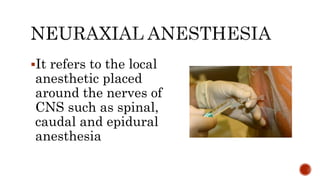
It refers to the local
anesthetic placed
around the nerves of
CNS such as spinal,
caudal and epidural
anesthesia
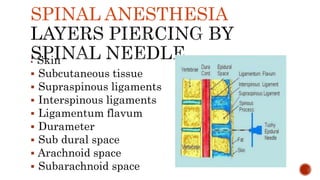
SPINAL ANESTHESIA
 Skin
 Subcutaneous tissue
 Supraspinous ligaments
 Interspinous ligaments
 Ligamentum flavum
 Durameter
 Sub dural space
 Arachnoid space
 Subarachnoid space
Technique involves 4 P’s
Preparation
Position
Projection
puncture
 Spinal tray
 Sterile gloves
 I v lines
 LA with 2 ml syringe
 Spinal drug ( bupi heavy 0.5% )
 5ml syringe
 Spinal needles
betadine solution
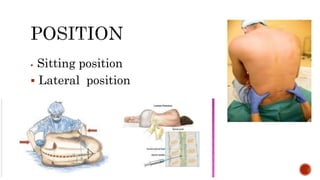
 Sitting position
 Lateral position
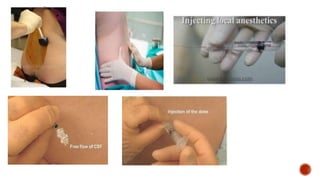
Assess for the correct site
 Clean the area
 Feel lumbar
 Inject LA
 After 2 – 3 mins introduce spinal needle
 Remove stylet wait for CSF flow
 Inject bupi and ask pt to lie immediately
 Check for dermatome level
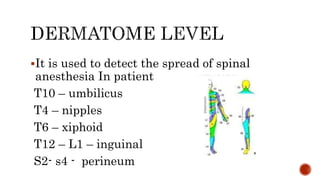
It is used to detect the spread of spinal
anesthesia In patient
T10 – umbilicus
T4 – nipples
T6 – xiphoid
T12 – L1 – inguinal
S2- s4 - perineum
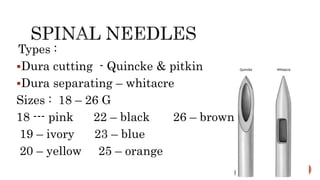
Types :
Dura cutting - Quincke & pitkin
Dura separating – whitacre
Sizes : 18 – 26 G
18 --- pink 22 – black 26 – brown
19 – ivory 23 – blue
20 – yellow 25 – orange
Advantages :
 Cheap
 High patient satisfaction
 Maintain pt airway
 Decresed blood loss
Disadvantage :
 Difficult in elder
 Hypotension
Pt can talk
 Pt increase toxicity
Contraindications :
 Hypovolemia
 Patient refusal
 Sepsis
 Increased Intracranial pressure
 Neuro disorder
 Spine deformities
Complications :
 Bleeding
 PDPH
 Total spinal
EPIDURAL ANESTHESIA..
An anesthetic drug is injected into the epidural space
surrounding the fluid filled sac around the spine to
numb the larger region eg. Abdomen and legs
Layers piercing :
Skin
Subcutaneous tissue
Supraspinous ligaments
Interspinous ligaments
Ligamentum flavum
Duramater
 Inform consent
 Sterile epidural tray & gloves
 NS 100ml
Betadine solution
Plaster
 10,2ml syringe
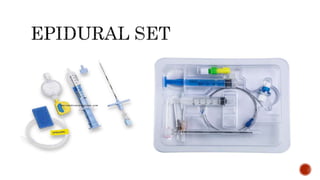
 Epidural set
 Iv line and set
 Needles, syringes
Drugs – bupivacaine 0.5, lignocaine 2.0, LA with
adrenaline, opioid
 Sitting
Lateral
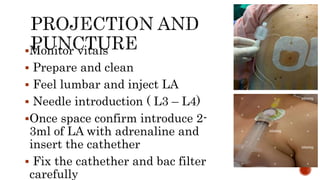
Monitor vitals
 Prepare and clean
 Feel lumbar and inject LA
 Needle introduction ( L3 – L4)
Once space confirm introduce 2-
3ml of LA with adrenaline and
insert the cathether
 Fix the cathether and bac filter
carefully
 Hanging drop method
 Loss of resistance
All operation below diaphragm
 Poor risk patient
 Cardiac and pulmo disease
 GA contraindicated
 Long duration surgery
 Post operative pain relief ( drug infusion)
 Risk in Ceaserean
Patient refusal
 Coagulopathy
 Infection at needle site
 Hypovolemia
 Neurological disease
Aortic stenosis
 Increased ICP
Anaphylaxis
 Pain
Hypotension
Bradycardia
 Hypothermia
 Nerve damage
 Respiratory failure
Infection
Urinary retention
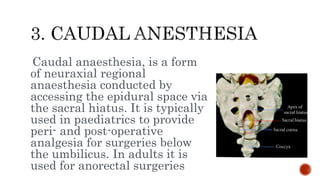
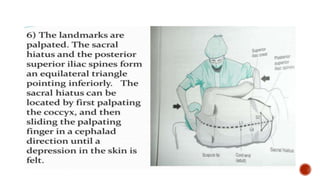
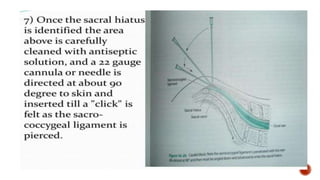
Caudal anaesthesia, is a form
of neuraxial regional
anaesthesia conducted by
accessing the epidural space via
the sacral hiatus. It is typically
used in paediatrics to provide
peri- and post-operative
analgesia for surgeries below
the umbilicus. In adults it is
used for anorectal surgeries
 Anesthesia and analgesia below
umblicus
To treat chronic pain in adults
 Ano rectal surgeries in adult
 Pediatric and neonatal
 Inguinal herniorraphy
 Infection at needle site
 Coagulopathy
 Pilonidal cyst
 Congenital abnormalities of lower spine
 Meninges
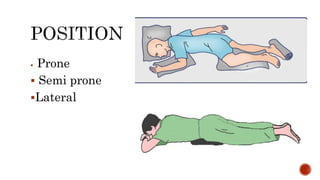
 Prone
 Semi prone
Lateral
 Intraosseous Injection
 Sepsis
Hematoma
 Urinary retention
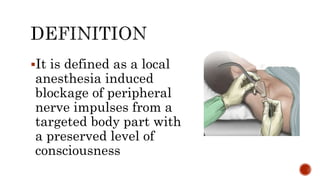
It is defined as a local
anesthesia induced
blockage of peripheral
nerve impulses from a
targeted body part with
a preserved level of
consciousness
 Truncal --- paravertebral
--- Transabdominal plane block
 Plexuses --- brachial
---- lumbar
 Distal
 Topical
 No GA complications
 Patient remains awake
 Post op analgesia is maintained with
cathether
 Less PONV – less opioids
 Hemodynamic stability is maintained
 Growing technique
 Time delay
 Discomfort during procedure
 Block failure can occur
 Nerve damage
 LA toxicity
 Seizures – in case of any arterial blockage
 Pt refusal
 Hemophilia
 Anticoagulant drug
 Infection at site
 LA allergy
 Pediatric patients
 Blood stream infection
 Peripheral neuropathy
 Uncooperative patient
 This technique was first
introduced in 1908 by a
surgeon August bier
 Bier block is a technique of
injecting Local anesthesia
solution through intravenous
route
 Surgical procedures ( arm below
elbow)
 Surgical procedure ( leg below knee)
 Minor surgical procedures
 Burn patient
 Pt refusal
 Compound fracture
 Inability to locate IV line
 Local skin infection
 H/0 local anesthesia
allergy
 Patient with vascular
injury
 Sickle cell disease
 Easy
 Low incidence of block failure
 Safe technique
 Rapid onset and recovery
Contraindication
 Chances of compartment syndrome

types of anesthesia 2.pptx

  • 4.
    History :  1stclinical practise was demonstrated by Carl koller in 1884  Effective local anesthetic “ Procaine “ Founded in 1905  Lidocaine was founded By LOFGREN In 1948 and used by T. GORDH in 1949
  • 5.
    Not irritant  Lowsystemic toxicity  Short onset of action  Effective  No allergic effects / reactions
  • 6.
     Local anesthesiais defined as a loss of sensation in a circumscribe area of the body caused by inhibition of conduction process in peripheral nerves Types :  Topical  Infiltration
  • 7.
     Local anesthesiais available in the form of gel or cream which can be applied on the surface of the skin  Drugs like – lidocaine , Tetracaine, cocaine, benzocaine
  • 8.
    Local infiltration anesthesiais the technique of producing loss- of-sensation restricted to a superficial, localized area in the body  Drugs used like – procaine , lidocaine, bupivacaine, ropivacaine
  • 9.
    Excision ( I&D) Dermatology procedure ( removal of moles)  Dentistry  Ansthetic adjuvant  Biopsy  Catract procedures
  • 10.
    Ocular complications –due to inj at wrong site during dental procedures  Paresthesia – trauma to nerve  Facial nerve paralysis – occur when over dose of anesthesia inj into deep lobe of parotid gland  Soft tissue injury over lips and mouth  Hematoma Pain on injection  Infection – contaminated drugs / needles  Edema
  • 12.
     General anesthesiais defined as reversible loss of consciousness / sensation in patient using anesthetic drug. Types :  Balanced anesthesia  Total inhalational anesthesia  Total intravenous anesthesia
  • 14.
    Steps involved : Premedication Preoxygenation  Induction Intubation  Maintanance  Reversal Extubation
  • 15.
    1. Premedication : administrationof drugs before induction. It is given 40 – 30mins prior to the surgery Goals  Analgesic  To reduce anxiety  Decreses secretion  Facilitate induction  Prevent post op nausea & vomiting  Facilitate post op analgesia Drugs used :  Benzodiazepines  Barbiturates  Glyco ; atropine, ranitidine, metaclopramide
  • 16.
    2. Pre oxygenation: after administration of pre med, monitoring parameters are connected and 100% of O2 for 3mins are administered to reduce the stored nitrogen in the body to increase the o2 reserve capacity. It is also known as denitrification
  • 17.
    3 . Induction: it refers to transition from an awake to an anesthetized stage Routes : IV route and inhalational route Inhalational : Agents used – Sevoflurane, desflurane, N20, halothene Indications : Young children’s  URT and LRT obstruction  No accessible veins
  • 18.
    Intravenous : Drugs used: induction agents + opioids + MR Properties : Rapid onset  Rapid recovery  Minimal cvs & Rs depression  No toxic reactions No excitatory actions ( cough, hiccup) Technique :  Access for good iv line  Preoxy is must and connect monitors  Doses varies with age and weight  Slow injection is recommended
  • 19.
    4. Intubation : Afterthe effect of muscle relaxant and induction agents patient becomes unconscious and the next step is to secure the airway. Airway is secured by using endotracheal tube Or LMA  Position is confirmed by auscultation and capnography
  • 20.
    5. Maintanance : Thephase of anesthesia Is maintained with 33% of O2 + 66% of N20 + inhalational agent 6. Reversal and extubation : At the end Of surgery, the effect of MR is reversed by Neo + glyco Once the pt able to breathe by own check for vitals, remove the tube and suction the oral cavity
  • 21.
    Definition : Itis a technique of GA which uses a combination of agents given oly through IV route without the Use of inhalational agent except O2 and air Indications :  Malignant hyperthermia  Long QT syndrome  H/0 severe PONV  Tubeless ENT / thoracic surgery.  Difficult intubation
  • 22.
    Drugs : propofol,ketamine, etomidate, fentanyl Adv:  No mask over face  No risk of hyperthermia  No incidence of PO delirium  Less PONV  Less OR pollution Disadv :  Pain  Difficult finding vein.  Diff in obese pt  Risk of bac contamination
  • 23.
    It refers tothe delivery of gases / vapours to respiratory system to produce anesthesia Indications :  For IV cannulation in pediatric  Control of status epilepticus  Pt with difficult IV line
  • 24.
    Advantages :  Easyto administer  Rapid induction  Easy and cheap  no cvs and rs depression  No toxic effects  No post op pain Disadvantage :  Adverse drug effects  Nephrotoxicity, hepatotoxicity  PONV  Post op hyperthermia
  • 25.
    Intra op : Chances of aspirations,  Trauma to lips , teeth and tongue  Hypoxia and hemodynamics changes due to drug  Less / over fluid administration  Anemia  Air embolism
  • 26.
    Post op : Inadequate reversal  Laryngospasm  Bronchospasm Bradycardia  Urine retention Delayed :  Sore throat Cough  Tracheitis  Hoarseness of voice
  • 28.
    It is theuse of LA to block the sensation of pain from a Larger region / particular region of the body, such as arm / leg or abdomen. Types :  Neuraxial block  Peripheral nerve block  Iv regional
  • 30.
    It refers tothe local anesthetic placed around the nerves of CNS such as spinal, caudal and epidural anesthesia
  • 31.
    SPINAL ANESTHESIA  Skin Subcutaneous tissue  Supraspinous ligaments  Interspinous ligaments  Ligamentum flavum  Durameter  Sub dural space  Arachnoid space  Subarachnoid space
  • 32.
    Technique involves 4P’s Preparation Position Projection puncture
  • 33.
     Spinal tray Sterile gloves  I v lines  LA with 2 ml syringe  Spinal drug ( bupi heavy 0.5% )  5ml syringe  Spinal needles betadine solution
  • 34.
     Sitting position Lateral position
  • 35.
    Assess for thecorrect site  Clean the area  Feel lumbar  Inject LA  After 2 – 3 mins introduce spinal needle  Remove stylet wait for CSF flow  Inject bupi and ask pt to lie immediately  Check for dermatome level
  • 37.
    It is usedto detect the spread of spinal anesthesia In patient T10 – umbilicus T4 – nipples T6 – xiphoid T12 – L1 – inguinal S2- s4 - perineum
  • 38.
    Types : Dura cutting- Quincke & pitkin Dura separating – whitacre Sizes : 18 – 26 G 18 --- pink 22 – black 26 – brown 19 – ivory 23 – blue 20 – yellow 25 – orange
  • 39.
    Advantages :  Cheap High patient satisfaction  Maintain pt airway  Decresed blood loss Disadvantage :  Difficult in elder  Hypotension Pt can talk  Pt increase toxicity
  • 40.
    Contraindications :  Hypovolemia Patient refusal  Sepsis  Increased Intracranial pressure  Neuro disorder  Spine deformities Complications :  Bleeding  PDPH  Total spinal
  • 41.
    EPIDURAL ANESTHESIA.. An anestheticdrug is injected into the epidural space surrounding the fluid filled sac around the spine to numb the larger region eg. Abdomen and legs Layers piercing : Skin Subcutaneous tissue Supraspinous ligaments Interspinous ligaments Ligamentum flavum Duramater
  • 42.
     Inform consent Sterile epidural tray & gloves  NS 100ml Betadine solution Plaster  10,2ml syringe  Epidural set  Iv line and set  Needles, syringes Drugs – bupivacaine 0.5, lignocaine 2.0, LA with adrenaline, opioid
  • 43.
  • 44.
    Monitor vitals  Prepareand clean  Feel lumbar and inject LA  Needle introduction ( L3 – L4) Once space confirm introduce 2- 3ml of LA with adrenaline and insert the cathether  Fix the cathether and bac filter carefully
  • 45.
     Hanging dropmethod  Loss of resistance
  • 46.
    All operation belowdiaphragm  Poor risk patient  Cardiac and pulmo disease  GA contraindicated  Long duration surgery  Post operative pain relief ( drug infusion)  Risk in Ceaserean
  • 47.
    Patient refusal  Coagulopathy Infection at needle site  Hypovolemia  Neurological disease Aortic stenosis  Increased ICP
  • 48.
    Anaphylaxis  Pain Hypotension Bradycardia  Hypothermia Nerve damage  Respiratory failure Infection Urinary retention
  • 50.
    Caudal anaesthesia, isa form of neuraxial regional anaesthesia conducted by accessing the epidural space via the sacral hiatus. It is typically used in paediatrics to provide peri- and post-operative analgesia for surgeries below the umbilicus. In adults it is used for anorectal surgeries
  • 51.
     Anesthesia andanalgesia below umblicus To treat chronic pain in adults  Ano rectal surgeries in adult  Pediatric and neonatal  Inguinal herniorraphy
  • 52.
     Infection atneedle site  Coagulopathy  Pilonidal cyst  Congenital abnormalities of lower spine  Meninges
  • 53.
     Prone  Semiprone Lateral
  • 59.
     Intraosseous Injection Sepsis Hematoma  Urinary retention
  • 61.
    It is definedas a local anesthesia induced blockage of peripheral nerve impulses from a targeted body part with a preserved level of consciousness
  • 62.
     Truncal ---paravertebral --- Transabdominal plane block  Plexuses --- brachial ---- lumbar  Distal  Topical
  • 63.
     No GAcomplications  Patient remains awake  Post op analgesia is maintained with cathether  Less PONV – less opioids  Hemodynamic stability is maintained  Growing technique
  • 64.
     Time delay Discomfort during procedure  Block failure can occur  Nerve damage  LA toxicity  Seizures – in case of any arterial blockage
  • 65.
     Pt refusal Hemophilia  Anticoagulant drug  Infection at site  LA allergy  Pediatric patients  Blood stream infection  Peripheral neuropathy  Uncooperative patient
  • 67.
     This techniquewas first introduced in 1908 by a surgeon August bier  Bier block is a technique of injecting Local anesthesia solution through intravenous route
  • 68.
     Surgical procedures( arm below elbow)  Surgical procedure ( leg below knee)  Minor surgical procedures  Burn patient
  • 69.
     Pt refusal Compound fracture  Inability to locate IV line  Local skin infection  H/0 local anesthesia allergy  Patient with vascular injury  Sickle cell disease
  • 70.
     Easy  Lowincidence of block failure  Safe technique  Rapid onset and recovery Contraindication  Chances of compartment syndrome