Copyright © 2010 Delmar, Cengage Learning. ALL RIGHTS RESERVED.
Chapter 15
Introduction to IV Therapy
Copyright © 2010 Delmar, Cengage Learning. ALL RIGHTS RESERVED.
Primary Line
• Typically connected to maintenance IV
fluids
• Includes spike, drip chamber, and roller
clamps for adjusting drip rate and ports for
IV medications
Copyright © 2010 Delmar, Cengage Learning. ALL RIGHTS RESERVED.
Primary Line Set-Up: Step 1
• Assumes IV fluid bag is ready
• Open package containing tubing
• Close all roller clamps on IV tubing to
prevent air bubbles
Copyright © 2010 Delmar, Cengage Learning. ALL RIGHTS RESERVED.
Primary Line Set-Up: Step 2
• Use sterile technique
• Pull cover off port on bag
• Pull cover off IV tubing spike
• Spike IV bag
Copyright © 2010 Delmar, Cengage Learning. ALL RIGHTS RESERVED.
Primary Line Set-Up: Step 3
• Squeeze drip chamber
• Fill approximately half full with IV fluids
– Or to mark provided by tubing manufacturer
Copyright © 2010 Delmar, Cengage Learning. ALL RIGHTS RESERVED.
Primary Line Set-Up: Step 4
• Prime tubing with IV fluids to remove air
• Open roller clamp closest to drip chamber
• Air must be displaced to prevent client from
experiencing air embolism
Copyright © 2010 Delmar, Cengage Learning. ALL RIGHTS RESERVED.
Primary Line Set-Up: Step 5
• Close roller clamp
Copyright © 2010 Delmar, Cengage Learning. ALL RIGHTS RESERVED.
Primary Line Set-Up: Step 6
• Label tubing with the following
information:
– Date
– Time
– Initials
Copyright © 2010 Delmar, Cengage Learning. ALL RIGHTS RESERVED.
Remember
• With gravity drip IV lines, pressure in line
is created when fluid drop falls in drip
chamber
• With electronic volumetric IV pump, pump
maintains constant pressure in line to
maintain patency of IV access
Copyright © 2010 Delmar, Cengage Learning. ALL RIGHTS RESERVED.
Secondary Line
• Shorter tubing used to infuse small-volume
medications
• Also referred to as IV piggybacks (IVPB) or
minibags (IVMB)
Copyright © 2010 Delmar, Cengage Learning. ALL RIGHTS RESERVED.
ADD-Vantage® Bags
• Have powdered medication in vial in top of
small-volume bag with IV fluid in it
• Vial opened within IV bag
• Medication mixes with fluid for infusion
• Used to package medications with short
shelf life in solution
Copyright © 2010 Delmar, Cengage Learning. ALL RIGHTS RESERVED.
Volume-Controlled Burettes
• For greater accuracy in measurement of
small-volume IV medications or fluids, use
calibrated burette chamber
• Used most often in intensive care unit (ICU)
for frequent small-volume fluid replacement
Copyright © 2010 Delmar, Cengage Learning. ALL RIGHTS RESERVED.
Indwelling Infusion Ports
• Used for intermittent IV medication
administration, either IVMB or IV bolus
• Most often referred to as:
– Saline locks
– Heparin locks
– Medlocks
Copyright © 2010 Delmar, Cengage Learning. ALL RIGHTS RESERVED.
IV Bolus/IV Push
• Medications administered directly through
lock or into IV tubing port if IV fluids
infusing
Copyright © 2010 Delmar, Cengage Learning. ALL RIGHTS RESERVED.
Flush with IV Bolus
• When administering IV bolus medications,
must flush before and after medication with
5 to 10 mL of compatible flush fluid
Copyright © 2010 Delmar, Cengage Learning. ALL RIGHTS RESERVED.
Volumetric Pumps
• Electronic devices
• Force fluids into vein under pressure
• Maintain patency of IV
• Control infusion rates
Copyright © 2010 Delmar, Cengage Learning. ALL RIGHTS RESERVED.
Volumetric Pumps
• Hospital or clinical in-service education
required for use of all infusion pumps
• Programming of pumps must be double-
checked
• IVs still should be checked every hour
Copyright © 2010 Delmar, Cengage Learning. ALL RIGHTS RESERVED.
Syringe Pump
• Variations on electronic volumetric pumps
• Used to infuse drugs that cannot be mixed
with other solutions or medications
• Used with very small volumes
– e.g., infants, ICU clients
Copyright © 2010 Delmar, Cengage Learning. ALL RIGHTS RESERVED.
Patient-Controlled Analgesia
(PCA) Devices
• Allow client to self-administer medication
to control pain
• Pre-filled syringe or medication bag
containing analgesics (opioids) inserted into
device
Copyright © 2010 Delmar, Cengage Learning. ALL RIGHTS RESERVED.
PCA Pumps
• Items programmed into device include the
following:
– Dosage
– Frequency
– Lock-out time
– Amount
Copyright © 2010 Delmar, Cengage Learning. ALL RIGHTS RESERVED.
Introduction to IV Fluids
• Manufactured and packaged under sterile
conditions
• Most prepared in plastic bags
• Volumes range from 25 to 1000 mL
Copyright © 2010 Delmar, Cengage Learning. ALL RIGHTS RESERVED.
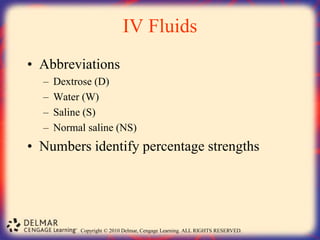
IV Fluids
• Abbreviations
– Dextrose (D)
– Water (W)
– Saline (S)
– Normal saline (NS)
• Numbers identify percentage strengths
Copyright © 2010 Delmar, Cengage Learning. ALL RIGHTS RESERVED.
Fluid Strengths
• Percentages mean grams of drug per 100
mL of fluid
– e.g., 5% dextrose, 0.9% normal saline, 0.45% normal
saline, 3% saline
Copyright © 2010 Delmar, Cengage Learning. ALL RIGHTS RESERVED.
Parenteral Nutrition
• Administer nutrition solution via central
vein through central venous access device
(CVAD)
• Usually infused slowly
• Solutions usually changed every 24 hours to
prevent spoilage and bacterial growth
Copyright © 2010 Delmar, Cengage Learning. ALL RIGHTS RESERVED.
Types of Parenteral Nutrition
• Total parenteral nutrition (TPN)
• Partial parenteral nutrition (PPN)
• Hyperalimentation

Chapter 15.ppt

  • 1.
    Copyright © 2010Delmar, Cengage Learning. ALL RIGHTS RESERVED. Chapter 15 Introduction to IV Therapy
  • 2.
    Copyright © 2010Delmar, Cengage Learning. ALL RIGHTS RESERVED. Primary Line • Typically connected to maintenance IV fluids • Includes spike, drip chamber, and roller clamps for adjusting drip rate and ports for IV medications
  • 3.
    Copyright © 2010Delmar, Cengage Learning. ALL RIGHTS RESERVED. Primary Line Set-Up: Step 1 • Assumes IV fluid bag is ready • Open package containing tubing • Close all roller clamps on IV tubing to prevent air bubbles
  • 4.
    Copyright © 2010Delmar, Cengage Learning. ALL RIGHTS RESERVED. Primary Line Set-Up: Step 2 • Use sterile technique • Pull cover off port on bag • Pull cover off IV tubing spike • Spike IV bag
  • 5.
    Copyright © 2010Delmar, Cengage Learning. ALL RIGHTS RESERVED. Primary Line Set-Up: Step 3 • Squeeze drip chamber • Fill approximately half full with IV fluids – Or to mark provided by tubing manufacturer
  • 6.
    Copyright © 2010Delmar, Cengage Learning. ALL RIGHTS RESERVED. Primary Line Set-Up: Step 4 • Prime tubing with IV fluids to remove air • Open roller clamp closest to drip chamber • Air must be displaced to prevent client from experiencing air embolism
  • 7.
    Copyright © 2010Delmar, Cengage Learning. ALL RIGHTS RESERVED. Primary Line Set-Up: Step 5 • Close roller clamp
  • 8.
    Copyright © 2010Delmar, Cengage Learning. ALL RIGHTS RESERVED. Primary Line Set-Up: Step 6 • Label tubing with the following information: – Date – Time – Initials
  • 9.
    Copyright © 2010Delmar, Cengage Learning. ALL RIGHTS RESERVED. Remember • With gravity drip IV lines, pressure in line is created when fluid drop falls in drip chamber • With electronic volumetric IV pump, pump maintains constant pressure in line to maintain patency of IV access
  • 10.
    Copyright © 2010Delmar, Cengage Learning. ALL RIGHTS RESERVED. Secondary Line • Shorter tubing used to infuse small-volume medications • Also referred to as IV piggybacks (IVPB) or minibags (IVMB)
  • 11.
    Copyright © 2010Delmar, Cengage Learning. ALL RIGHTS RESERVED. ADD-Vantage® Bags • Have powdered medication in vial in top of small-volume bag with IV fluid in it • Vial opened within IV bag • Medication mixes with fluid for infusion • Used to package medications with short shelf life in solution
  • 12.
    Copyright © 2010Delmar, Cengage Learning. ALL RIGHTS RESERVED. Volume-Controlled Burettes • For greater accuracy in measurement of small-volume IV medications or fluids, use calibrated burette chamber • Used most often in intensive care unit (ICU) for frequent small-volume fluid replacement
  • 13.
    Copyright © 2010Delmar, Cengage Learning. ALL RIGHTS RESERVED. Indwelling Infusion Ports • Used for intermittent IV medication administration, either IVMB or IV bolus • Most often referred to as: – Saline locks – Heparin locks – Medlocks
  • 14.
    Copyright © 2010Delmar, Cengage Learning. ALL RIGHTS RESERVED. IV Bolus/IV Push • Medications administered directly through lock or into IV tubing port if IV fluids infusing
  • 15.
    Copyright © 2010Delmar, Cengage Learning. ALL RIGHTS RESERVED. Flush with IV Bolus • When administering IV bolus medications, must flush before and after medication with 5 to 10 mL of compatible flush fluid
  • 16.
    Copyright © 2010Delmar, Cengage Learning. ALL RIGHTS RESERVED. Volumetric Pumps • Electronic devices • Force fluids into vein under pressure • Maintain patency of IV • Control infusion rates
  • 17.
    Copyright © 2010Delmar, Cengage Learning. ALL RIGHTS RESERVED. Volumetric Pumps • Hospital or clinical in-service education required for use of all infusion pumps • Programming of pumps must be double- checked • IVs still should be checked every hour
  • 18.
    Copyright © 2010Delmar, Cengage Learning. ALL RIGHTS RESERVED. Syringe Pump • Variations on electronic volumetric pumps • Used to infuse drugs that cannot be mixed with other solutions or medications • Used with very small volumes – e.g., infants, ICU clients
  • 19.
    Copyright © 2010Delmar, Cengage Learning. ALL RIGHTS RESERVED. Patient-Controlled Analgesia (PCA) Devices • Allow client to self-administer medication to control pain • Pre-filled syringe or medication bag containing analgesics (opioids) inserted into device
  • 20.
    Copyright © 2010Delmar, Cengage Learning. ALL RIGHTS RESERVED. PCA Pumps • Items programmed into device include the following: – Dosage – Frequency – Lock-out time – Amount
  • 21.
    Copyright © 2010Delmar, Cengage Learning. ALL RIGHTS RESERVED. Introduction to IV Fluids • Manufactured and packaged under sterile conditions • Most prepared in plastic bags • Volumes range from 25 to 1000 mL
  • 22.
    Copyright © 2010Delmar, Cengage Learning. ALL RIGHTS RESERVED. IV Fluids • Abbreviations – Dextrose (D) – Water (W) – Saline (S) – Normal saline (NS) • Numbers identify percentage strengths
  • 23.
    Copyright © 2010Delmar, Cengage Learning. ALL RIGHTS RESERVED. Fluid Strengths • Percentages mean grams of drug per 100 mL of fluid – e.g., 5% dextrose, 0.9% normal saline, 0.45% normal saline, 3% saline
  • 24.
    Copyright © 2010Delmar, Cengage Learning. ALL RIGHTS RESERVED. Parenteral Nutrition • Administer nutrition solution via central vein through central venous access device (CVAD) • Usually infused slowly • Solutions usually changed every 24 hours to prevent spoilage and bacterial growth
  • 25.
    Copyright © 2010Delmar, Cengage Learning. ALL RIGHTS RESERVED. Types of Parenteral Nutrition • Total parenteral nutrition (TPN) • Partial parenteral nutrition (PPN) • Hyperalimentation