Download to read offline
![Types in Scala
({type λ[-α]= T[α] <~< T[A2]})#λ](https://image.slidesharecdn.com/types1-saulius-150226141934-conversion-gate02/85/Types-by-Adform-Research-Saulius-Valatka-1-320.jpg)
![Types in Scala
({type λ[-α]= T[α] <~< T[A2]})#λ](https://image.slidesharecdn.com/types1-saulius-150226141934-conversion-gate02/75/Types-by-Adform-Research-Saulius-Valatka-1-2048.jpg)
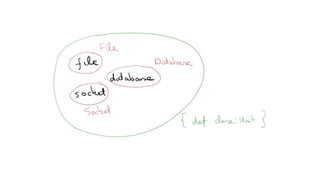
![In a nutshell
OOP/modular
• named BitSet
• compound Channel with Logged
• refined Channel {def close(): Unit }
Functional
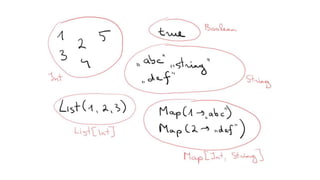
• parametrized List[Int]
• existential List[T] forSome {type T}
• higher-kinded List[_]](https://image.slidesharecdn.com/types1-saulius-150226141934-conversion-gate02/85/Types-by-Adform-Research-Saulius-Valatka-4-320.jpg)
![Type Parameters
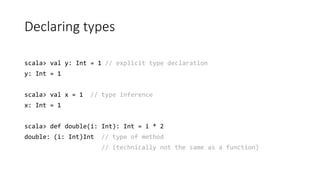
scala> class MyList[T]
defined class MyList
scala> val x = new MyList[Int]
scala> val y = new MyList[String]](https://image.slidesharecdn.com/types1-saulius-150226141934-conversion-gate02/85/Types-by-Adform-Research-Saulius-Valatka-20-320.jpg)
![Tuples and Unit
scala> val x: Tuple2[Int, String] = (1, "abc")
x: (Int, String) = (1,abc)
scala> val x: (Int, String) = (1, "abc") // syntactic sugar
x: (Int, String) = (1,abc)
scala> val u: Unit = () // Like a tuple with 0 arguments !
u: Unit = ()](https://image.slidesharecdn.com/types1-saulius-150226141934-conversion-gate02/85/Types-by-Adform-Research-Saulius-Valatka-21-320.jpg)
![Types of functions
scala> val doubler: Function[Int, Int] = x => x * 2
doubler: Function[Int,Int] = <function1>
scala> val doubler: Int => Int = x => x * 2 // Alternative syntax
doubler: Int => Int = <function1>](https://image.slidesharecdn.com/types1-saulius-150226141934-conversion-gate02/85/Types-by-Adform-Research-Saulius-Valatka-22-320.jpg)
![Syntactic Sugar
scala> class @@[A, B]
scala> val test = new (Int @@ String)
test: @@[Int,String] = $at$at@6bddea9
scala> trait MyIntFn extends (Int => Int)](https://image.slidesharecdn.com/types1-saulius-150226141934-conversion-gate02/85/Types-by-Adform-Research-Saulius-Valatka-23-320.jpg)
![Variance
• Is List[Dog] a subtype of List[Animal] ? You decide!
class Covariant[+T]
class Contravariant[-T]
class Invariant[T]](https://image.slidesharecdn.com/types1-saulius-150226141934-conversion-gate02/85/Types-by-Adform-Research-Saulius-Valatka-24-320.jpg)
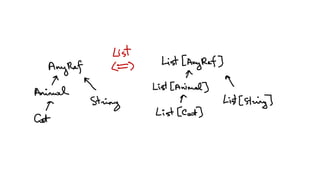
![Variance
List[+T] // List[Dog] is a List[Animal]
Comparator[-B] // Comparator[Animal] can work as Comparator[Dog]
Function[-A, +R] // Think about it!
mutable.Set[A] // Can you say why ?
Covariant types can only appear in return positions
Contravariant types can only appear in argument positions
e.g. def apply(arg: A): R](https://image.slidesharecdn.com/types1-saulius-150226141934-conversion-gate02/85/Types-by-Adform-Research-Saulius-Valatka-26-320.jpg)
![Type Bounds
class CosmicList[A <: Cosmic]
class CosmicAnimalList[A <: Animal with Cosmic]
class ClosableList[A <: { def close: Unit }]
class ComparatorList[T >: Comparable]](https://image.slidesharecdn.com/types1-saulius-150226141934-conversion-gate02/85/Types-by-Adform-Research-Saulius-Valatka-27-320.jpg)
: Int = list.length
length: [T](list: List[T])Int
scala> def length(list: List[T] forSome { type T }): Int = list.length
length: (list: List[_])Int
scala> def length(list: List[_]): Int = list.length // equivalent
length: (list: List[_])Int](https://image.slidesharecdn.com/types1-saulius-150226141934-conversion-gate02/85/Types-by-Adform-Research-Saulius-Valatka-28-320.jpg)
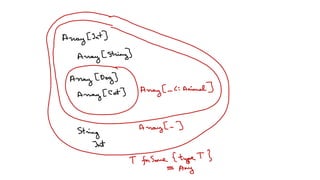
![Existential types
Array[T] forSome { type T } // Array[_]
Array[T forSome { type T }] // Array[Any]
Map[Class[T forSome { type T }], String]
Map[Class[T] forSome { type T }, String] // Map[Class[_], String]
Map[Class[T], String] forSome { type T }](https://image.slidesharecdn.com/types1-saulius-150226141934-conversion-gate02/85/Types-by-Adform-Research-Saulius-Valatka-29-320.jpg)
![Type constructors
• List is a type constructor, i.e. given a type, it produces a type
• List is not a type! List[Int] is a type!](https://image.slidesharecdn.com/types1-saulius-150226141934-conversion-gate02/85/Types-by-Adform-Research-Saulius-Valatka-31-320.jpg)
![Higher Kinded Types
scala> class ContainerFactory[T, C[_]]
defined class ContainerFactory
scala> class ListFactory[T] extends ContainerFactory[T, List]
defined class ListFactory](https://image.slidesharecdn.com/types1-saulius-150226141934-conversion-gate02/85/Types-by-Adform-Research-Saulius-Valatka-32-320.jpg)
![Kinds of types
Int has kind * // analogous to value 1
List[Int] has kind * // analogous to value “abc”
List[_] has kind * // analogous to value ‘a’
List has kind * -> * // analogous to function x => x * x
ContainerFactory has kind (*, * -> *) -> * // analogous to (x, f) => f(x)](https://image.slidesharecdn.com/types1-saulius-150226141934-conversion-gate02/85/Types-by-Adform-Research-Saulius-Valatka-33-320.jpg)
![1000000$ question
• What is a type equivalent to plus(2, _) ? i.e. x => plus(2, x)
• E.g. given Either[A, B] get a type constructor that produces types
Either[Int, T] given a type T](https://image.slidesharecdn.com/types1-saulius-150226141934-conversion-gate02/85/Types-by-Adform-Research-Saulius-Valatka-34-320.jpg)
![Naïve answer
• Either[Int, _] ?
scala> class EitherFactory[T] extends ContainerFactory[T, Either[Int, _]]
<console>:8: error: Either[Int, _] takes no type parameters, expected: one
class EitherFactory[T] extends ContainerFactory[T, Either[Int, _]]](https://image.slidesharecdn.com/types1-saulius-150226141934-conversion-gate02/85/Types-by-Adform-Research-Saulius-Valatka-35-320.jpg)
![Answer
class EitherFactory[T] extends ContainerFactory[T, ({ type λ[α] = Either[Int, α]})#λ]
defined class EitherFactory
Type lambdas !!
Future syntax: [α]=Either[Int, α]
Type members will be discussed next time](https://image.slidesharecdn.com/types1-saulius-150226141934-conversion-gate02/85/Types-by-Adform-Research-Saulius-Valatka-36-320.jpg)
![({type λ[-α]= T[α] <~< T[A2]})#λ](https://image.slidesharecdn.com/types1-saulius-150226141934-conversion-gate02/85/Types-by-Adform-Research-Saulius-Valatka-37-320.jpg)

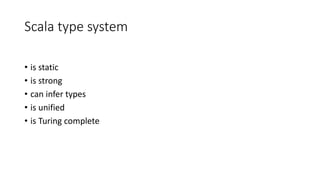
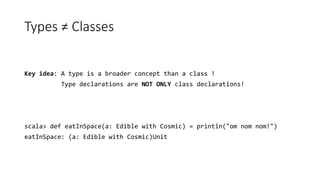
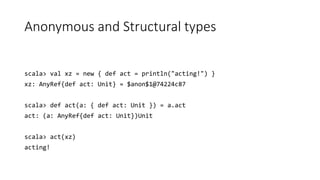
Scala has a static, strong, and Turing complete type system that can infer types. It supports object-oriented programming with named types like Dog and functional programming with parameterized types like List[Int]. New types can be defined through classes, traits, case classes, and type members. Types are more general than classes and include structural types. Variance controls subtype relationships for parameterized types. Type bounds and existential types provide additional type safety. Higher kinded types allow types to be parameterized over other types.


