SPARQL
Departamento de Informática
Universidad de Oviedo
Jose Emilio Labra Gayo
Jose Emilio Labra Gayo – Universidad de Oviedo
SPARQL
SPARQL (April 2006) query language for RDF data
Similar to SQL, but for RDF
Based on graph patterns
It also describes a REST protocol
SPARQL = SPARQL Protocol And RDF Query Language
SPARQL 1.1 (2013, recommendation)
Updates, federated queries, etc.
Jose Emilio Labra Gayo – Universidad de Oviedo
SPARQL Syntax
Similar to Turtle
URIs between <...>
<http://www.example.org/alice>
Namespace prefixes as in Turtle
prefix dc: <http://purl.org/dc/terms/>
dc:creator
Blank nodes
_:node or between square brackets [ ]
Literals between " "
"Alice" "234"^^xsd:integer
Comments start by #
# this is a comment
Variables start by?
?name
Jose Emilio Labra Gayo – Universidad de Oviedo
RDF
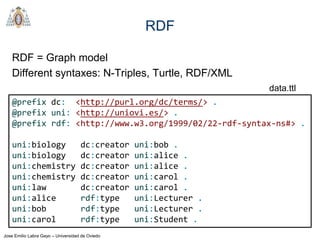
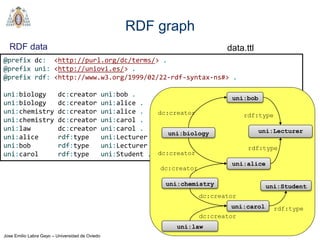
RDF = Graph model
Different syntaxes: N-Triples, Turtle, RDF/XML
@prefix dc: <http://purl.org/dc/terms/> .
@prefix uni: <http://uniovi.es/> .
@prefix rdf: <http://www.w3.org/1999/02/22-rdf-syntax-ns#> .
uni:biology dc:creator uni:bob .
uni:biology dc:creator uni:alice .
uni:chemistry dc:creator uni:alice .
uni:chemistry dc:creator uni:carol .
uni:law dc:creator uni:carol .
uni:alice rdf:type uni:Lecturer .
uni:bob rdf:type uni:Lecturer .
uni:carol rdf:type uni:Student .
data.ttl
Jose Emilio Labra Gayo – Universidad de Oviedo
@prefix dc: <http://purl.org/dc/terms/> .
@prefix uni: <http://uniovi.es/> .
@prefix rdf: <http://www.w3.org/1999/02/22-rdf-syntax-ns#> .
uni:biology dc:creator uni:bob .
uni:biology dc:creator uni:alice .
uni:chemistry dc:creator uni:alice .
uni:chemistry dc:creator uni:carol .
uni:law dc:creator uni:carol .
uni:alice rdf:type uni:Lecturer .
uni:bob rdf:type uni:Lecturer .
uni:carol rdf:type uni:Student .
RDF data
RDF graph
uni:chemistry
uni:alice
dc:creator
uni:carol
dc:creator
uni:Student
rdf:type
uni:biology
uni:bob
dc:creator
dc:creator
uni:Lecturer
rdf:type
rdf:type
uni:law
dc:creator
data.ttl
Jose Emilio Labra Gayo – Universidad de Oviedo
Simple SPARQL query
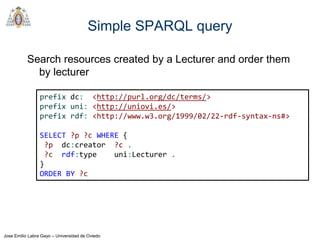
Search resources created by a Lecturer and order them
by lecturer
prefix dc: <http://purl.org/dc/terms/>
prefix uni: <http://uniovi.es/>
prefix rdf: <http://www.w3.org/1999/02/22-rdf-syntax-ns#>
SELECT ?p ?c WHERE {
?p dc:creator ?c .
?c rdf:type uni:Lecturer .
}
ORDER BY ?c
Jose Emilio Labra Gayo – Universidad de Oviedo
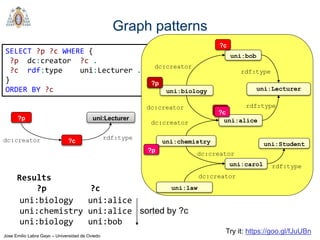
SELECT ?p ?c WHERE {
?p dc:creator ?c .
?c rdf:type uni:Lecturer .
}
ORDER BY ?c
uni:chemistry
uni:alicedc:creator
uni:carol
dc:creator
uni:Student
rdf:type
uni:biology
uni:bob
dc:creator
dc:creator
uni:Lecturer
rdf:type
rdf:type
uni:law
dc:creator
Graph patterns
?p
dc:creator ?c
uni:Lecturer
rdf:type
?p
?c
Results
?p ?c
uni:biology uni:bob
uni:chemistry uni:alice
uni:biology uni:alice
?p
?c
?p
?c
uni:biology uni:alice
uni:chemistry uni:alice
uni:biology uni:bob
sorted by ?c
Try it: https://goo.gl/fJuUBn
Jose Emilio Labra Gayo – Universidad de Oviedo
Playing with SPARQL
Command line tools:
Apache Jena. https://jena.apache.org/
Online:
SHACLex: can be used without endpoint
http://shaclex.herokuapp.com/
YASGUI: can be used to query existing SPARQL endpoints
http://yasgui.org/
Creating SPARQL endpoints
Apache Jena Fuseki: https://jena.apache.org/
Blazegraph: https://www.blazegraph.com/
Jose Emilio Labra Gayo – Universidad de Oviedo
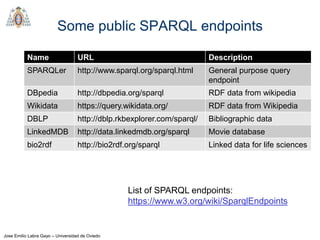
Some public SPARQL endpoints
Name URL Description
SPARQLer http://www.sparql.org/sparql.html General purpose query
endpoint
DBpedia http://dbpedia.org/sparql RDF data from wikipedia
Wikidata https://query.wikidata.org/ RDF data from Wikipedia
DBLP http://dblp.rkbexplorer.com/sparql/ Bibliographic data
LinkedMDB http://data.linkedmdb.org/sparql Movie database
bio2rdf http://bio2rdf.org/sparql Linked data for life sciences
List of SPARQL endpoints:
https://www.w3.org/wiki/SparqlEndpoints
Jose Emilio Labra Gayo – Universidad de Oviedo
SPARQL query language
Jose Emilio Labra Gayo – Universidad de Oviedo
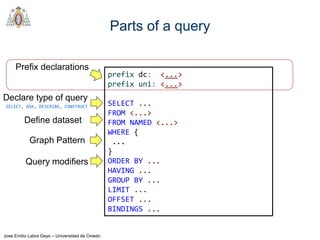
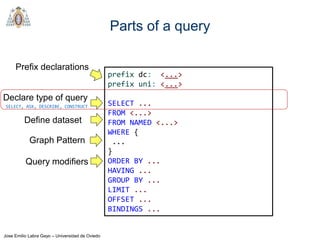
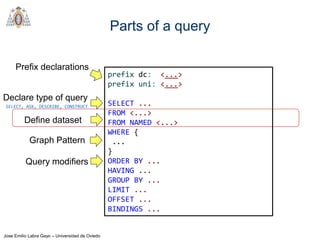
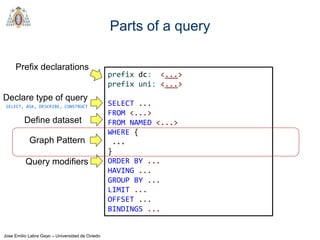
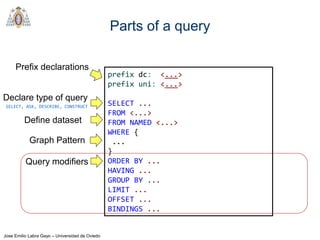
Parts of a query
prefix dc: <...>
prefix uni: <...>
SELECT ...
FROM <...>
FROM NAMED <...>
WHERE {
...
}
ORDER BY ...
HAVING ...
GROUP BY ...
LIMIT ...
OFFSET ...
BINDINGS ...
Graph Pattern
Query modifiers
Prefix declarations
Define dataset
Declare type of query
SELECT, ASK, DESCRIBE, CONSTRUCT
Jose Emilio Labra Gayo – Universidad de Oviedo
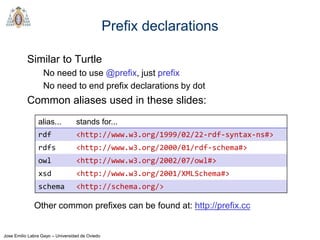
Prefix declarations
Similar to Turtle
No need to use @prefix, just prefix
No need to end prefix declarations by dot
Common aliases used in these slides:
alias... stands for...
rdf <http://www.w3.org/1999/02/22-rdf-syntax-ns#>
rdfs <http://www.w3.org/2000/01/rdf-schema#>
owl <http://www.w3.org/2002/07/owl#>
xsd <http://www.w3.org/2001/XMLSchema#>
schema <http://schema.org/>
Other common prefixes can be found at: http://prefix.cc
Jose Emilio Labra Gayo – Universidad de Oviedo
Parts of a query
prefix dc: <...>
prefix uni: <...>
SELECT ...
FROM <...>
FROM NAMED <...>
WHERE {
...
}
ORDER BY ...
HAVING ...
GROUP BY ...
LIMIT ...
OFFSET ...
BINDINGS ...
Declare type of query
SELECT, ASK, DESCRIBE, CONSTRUCT
Graph Pattern
Query modifiers
Prefix declarations
Define dataset
Jose Emilio Labra Gayo – Universidad de Oviedo
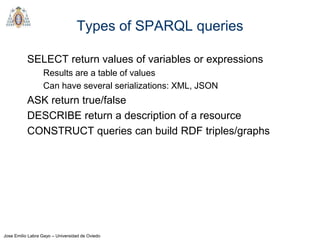
Types of SPARQL queries
SELECT return values of variables or expressions
Results are a table of values
Can have several serializations: XML, JSON
ASK return true/false
DESCRIBE return a description of a resource
CONSTRUCT queries can build RDF triples/graphs
Jose Emilio Labra Gayo – Universidad de Oviedo
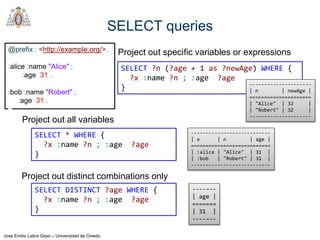
SELECT queries
@prefix : <http://example.org/>.
:alice :name "Alice" ;
:age 31 .
:bob :name "Robert" ;
:age 31 .
SELECT ?n (?age + 1 as ?newAge) WHERE {
?x :name ?n ; :age ?age
}
Project out specific variables or expressions
---------------------
| n | newAge |
=====================
| "Alice" | 32 |
| "Robert" | 32 |
---------------------
SELECT * WHERE {
?x :name ?n ; :age ?age
}
Project out all variables
---------------------------
| x | n | age |
===========================
| :alice | "Alice" | 31 |
| :bob | "Robert" | 31 |
---------------------------
Project out distinct combinations only
SELECT DISTINCT ?age WHERE {
?x :name ?n ; :age ?age
}
-------
| age |
=======
| 31 |
-------
Jose Emilio Labra Gayo – Universidad de Oviedo
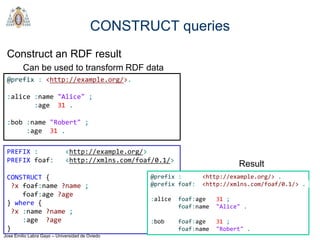
CONSTRUCT queries
Construct an RDF result
Can be used to transform RDF data
@prefix : <http://example.org/>.
:alice :name "Alice" ;
:age 31 .
:bob :name "Robert" ;
:age 31 .
PREFIX : <http://example.org/>
PREFIX foaf: <http://xmlns.com/foaf/0.1/>
CONSTRUCT {
?x foaf:name ?name ;
foaf:age ?age
} where {
?x :name ?name ;
:age ?age
}
@prefix : <http://example.org/> .
@prefix foaf: <http://xmlns.com/foaf/0.1/> .
:alice foaf:age 31 ;
foaf:name "Alice" .
:bob foaf:age 31 ;
foaf:name "Robert" .
Result
Jose Emilio Labra Gayo – Universidad de Oviedo
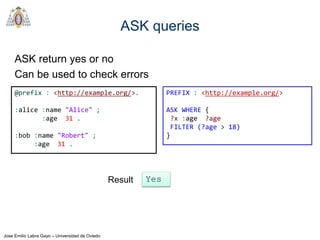
ASK queries
ASK return yes or no
Can be used to check errors
Yes
@prefix : <http://example.org/>.
:alice :name "Alice" ;
:age 31 .
:bob :name "Robert" ;
:age 31 .
PREFIX : <http://example.org/>
ASK WHERE {
?x :age ?age
FILTER (?age > 18)
}
Result
Jose Emilio Labra Gayo – Universidad de Oviedo
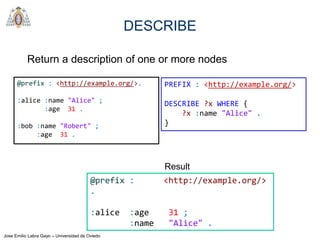
DESCRIBE
Return a description of one or more nodes
@prefix : <http://example.org/>
.
:alice :age 31 ;
:name "Alice" .
PREFIX : <http://example.org/>
DESCRIBE ?x WHERE {
?x :name "Alice" .
}
@prefix : <http://example.org/>.
:alice :name "Alice" ;
:age 31 .
:bob :name "Robert" ;
:age 31 .
Result
Jose Emilio Labra Gayo – Universidad de Oviedo
Parts of a query
prefix dc: <...>
prefix uni: <...>
SELECT ...
FROM <...>
FROM NAMED <...>
WHERE {
...
}
ORDER BY ...
HAVING ...
GROUP BY ...
LIMIT ...
OFFSET ...
BINDINGS ...
Graph Pattern
Query modifiers
Prefix declarations
Define dataset
Declare type of query
SELECT, ASK, DESCRIBE, CONSTRUCT
Jose Emilio Labra Gayo – Universidad de Oviedo
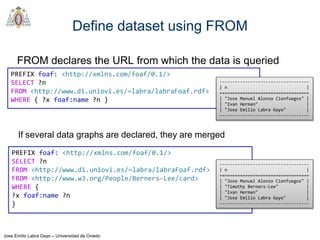
Define dataset using FROM
FROM declares the URL from which the data is queried
PREFIX foaf: <http://xmlns.com/foaf/0.1/>
SELECT ?n
FROM <http://www.di.uniovi.es/~labra/labraFoaf.rdf>
WHERE { ?x foaf:name ?n }
If several data graphs are declared, they are merged
PREFIX foaf: <http://xmlns.com/foaf/0.1/>
SELECT ?n
FROM <http://www.di.uniovi.es/~labra/labraFoaf.rdf>
FROM <http://www.w3.org/People/Berners-Lee/card>
WHERE {
?x foaf:name ?n
}
-----------------------------------
| n |
===================================
| "Jose Manuel Alonso Cienfuegos" |
| "Timothy Berners-Lee" |
| "Ivan Herman" |
| "Jose Emilio Labra Gayo" |
-----------------------------------
-----------------------------------
| n |
===================================
| "Jose Manuel Alonso Cienfuegos" |
| "Ivan Herman" |
| "Jose Emilio Labra Gayo" |
-----------------------------------
Jose Emilio Labra Gayo – Universidad de Oviedo
Named graphs
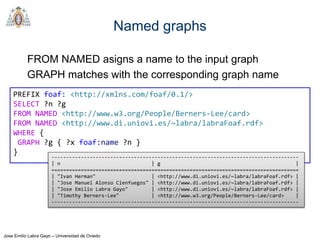
FROM NAMED asigns a name to the input graph
GRAPH matches with the corresponding graph name
PREFIX foaf: <http://xmlns.com/foaf/0.1/>
SELECT ?n ?g
FROM NAMED <http://www.w3.org/People/Berners-Lee/card>
FROM NAMED <http://www.di.uniovi.es/~labra/labraFoaf.rdf>
WHERE {
GRAPH ?g { ?x foaf:name ?n }
}
------------------------------------------------------------------------------------
| n | g |
====================================================================================
| "Ivan Herman" | <http://www.di.uniovi.es/~labra/labraFoaf.rdf> |
| "Jose Manuel Alonso Cienfuegos" | <http://www.di.uniovi.es/~labra/labraFoaf.rdf> |
| "Jose Emilio Labra Gayo" | <http://www.di.uniovi.es/~labra/labraFoaf.rdf> |
| "Timothy Berners-Lee" | <http://www.w3.org/People/Berners-Lee/card> |
------------------------------------------------------------------------------------
Jose Emilio Labra Gayo – Universidad de Oviedo
Parts of a query
prefix dc: <...>
prefix uni: <...>
SELECT ...
FROM <...>
FROM NAMED <...>
WHERE {
...
}
ORDER BY ...
HAVING ...
GROUP BY ...
LIMIT ...
OFFSET ...
BINDINGS ...
Graph Pattern
Query modifiers
Prefix declarations
Define dataset
Declare type of query
SELECT, ASK, DESCRIBE, CONSTRUCT
Jose Emilio Labra Gayo – Universidad de Oviedo
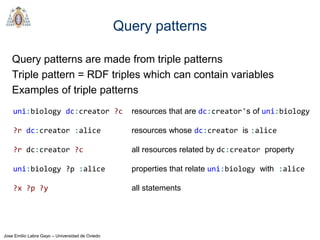
Query patterns
Query patterns are made from triple patterns
Triple pattern = RDF triples which can contain variables
Examples of triple patterns
uni:biology dc:creator ?c resources that are dc:creator's of uni:biology
?r dc:creator :alice resources whose dc:creator is :alice
?r dc:creator ?c all resources related by dc:creator property
uni:biology ?p :alice properties that relate uni:biology with :alice
?x ?p ?y all statements
Jose Emilio Labra Gayo – Universidad de Oviedo
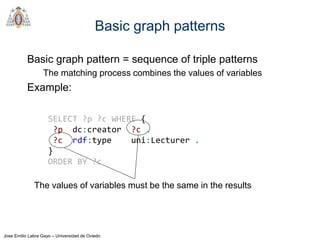
Basic graph patterns
Basic graph pattern = sequence of triple patterns
The matching process combines the values of variables
Example:
The values of variables must be the same in the results
SELECT ?p ?c WHERE {
?p dc:creator ?c .
?c rdf:type uni:Lecturer .
}
ORDER BY ?c
Jose Emilio Labra Gayo – Universidad de Oviedo
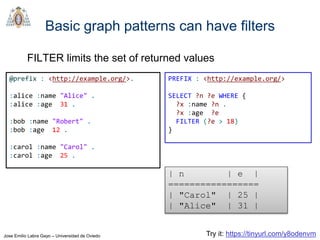
Basic graph patterns can have filters
FILTER limits the set of returned values
PREFIX : <http://example.org/>
SELECT ?n ?e WHERE {
?x :name ?n .
?x :age ?e
FILTER (?e > 18)
}
@prefix : <http://example.org/>.
:alice :name "Alice" .
:alice :age 31 .
:bob :name "Robert" .
:bob :age 12 .
:carol :name "Carol" .
:carol :age 25 .
| n | e |
=================
| "Carol" | 25 |
| "Alice" | 31 |
Try it: https://tinyurl.com/y8odenvm
Jose Emilio Labra Gayo – Universidad de Oviedo
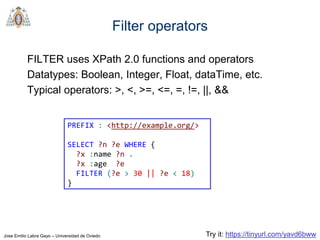
Filter operators
FILTER uses XPath 2.0 functions and operators
Datatypes: Boolean, Integer, Float, dataTime, etc.
Typical operators: >, <, >=, <=, =, !=, ||, &&
PREFIX : <http://example.org/>
SELECT ?n ?e WHERE {
?x :name ?n .
?x :age ?e
FILTER (?e > 30 || ?e < 18)
}
Try it: https://tinyurl.com/yavd6bww
Jose Emilio Labra Gayo – Universidad de Oviedo
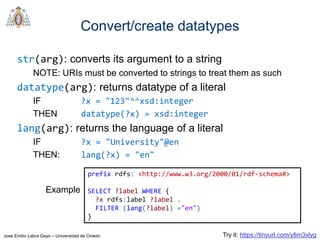
Convert/create datatypes
str(arg): converts its argument to a string
NOTE: URIs must be converted to strings to treat them as such
datatype(arg): returns datatype of a literal
IF ?x = "123"^^xsd:integer
THEN datatype(?x) = xsd:integer
lang(arg): returns the language of a literal
IF ?x = "University"@en
THEN: lang(?x) = "en"
prefix rdfs: <http://www.w3.org/2000/01/rdf-schema#>
SELECT ?label WHERE {
?x rdfs:label ?label .
FILTER (lang(?label) ="en")
}
Example
Try it: https://tinyurl.com/y8m3xlyg
Jose Emilio Labra Gayo – Universidad de Oviedo
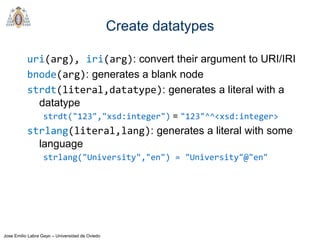
Create datatypes
uri(arg), iri(arg): convert their argument to URI/IRI
bnode(arg): generates a blank node
strdt(literal,datatype): generates a literal with a
datatype
strdt("123","xsd:integer") = "123"^^<xsd:integer>
strlang(literal,lang): generates a literal with some
language
strlang("University","en") = "University"@"en"
Jose Emilio Labra Gayo – Universidad de Oviedo
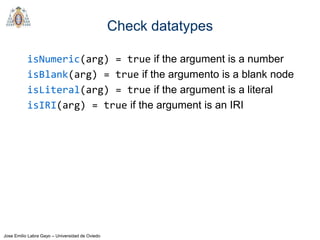
Check datatypes
isNumeric(arg) = true if the argument is a number
isBlank(arg) = true if the argumento is a blank node
isLiteral(arg) = true if the argument is a literal
isIRI(arg) = true if the argument is an IRI
Jose Emilio Labra Gayo – Universidad de Oviedo
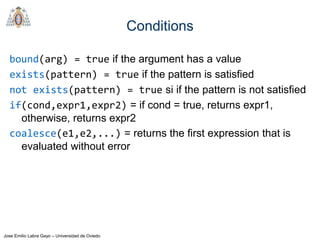
Conditions
bound(arg) = true if the argument has a value
exists(pattern) = true if the pattern is satisfied
not exists(pattern) = true si if the pattern is not satisfied
if(cond,expr1,expr2) = if cond = true, returns expr1,
otherwise, returns expr2
coalesce(e1,e2,...) = returns the first expression that is
evaluated without error
Jose Emilio Labra Gayo – Universidad de Oviedo
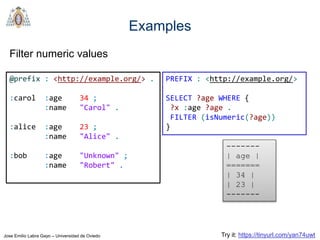
Examples
Filter numeric values
PREFIX : <http://example.org/>
SELECT ?age WHERE {
?x :age ?age .
FILTER (isNumeric(?age))
}
@prefix : <http://example.org/> .
:carol :age 34 ;
:name "Carol" .
:alice :age 23 ;
:name "Alice" .
:bob :age "Unknown" ;
:name "Robert" .
-------
| age |
=======
| 34 |
| 23 |
-------
Try it: https://tinyurl.com/yan74uwt
Jose Emilio Labra Gayo – Universidad de Oviedo
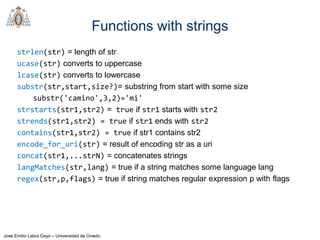
Functions with strings
strlen(str) = length of str
ucase(str) converts to uppercase
lcase(str) converts to lowercase
substr(str,start,size?)= substring from start with some size
substr('camino',3,2)='mi'
strstarts(str1,str2) = true if str1 starts with str2
strends(str1,str2) = true if str1 ends with str2
contains(str1,str2) = true if str1 contains str2
encode_for_uri(str) = result of encoding str as a uri
concat(str1,...strN) = concatenates strings
langMatches(str,lang) = true if a string matches some language lang
regex(str,p,flags) = true if string matches regular expression p with flags
Jose Emilio Labra Gayo – Universidad de Oviedo
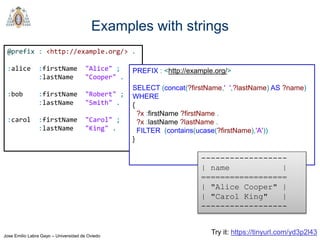
Examples with strings
@prefix : <http://example.org/> .
:alice :firstName "Alice" ;
:lastName "Cooper" .
:bob :firstName "Robert" ;
:lastName "Smith" .
:carol :firstName "Carol" ;
:lastName "King" .
Try it: https://tinyurl.com/yd3p2l43
PREFIX : <http://example.org/>
SELECT (concat(?firstName,' ',?lastName) AS ?name)
WHERE
{
?x :firstName ?firstName .
?x :lastName ?lastName .
FILTER (contains(ucase(?firstName),'A'))
}
------------------
| name |
==================
| "Alice Cooper" |
| "Carol King" |
------------------
Jose Emilio Labra Gayo – Universidad de Oviedo
Regex
REGEX invokes regular expression matching
It is based on XPath 2.0 functions
regex(?Expr, ?Pattern [, ?Flags])
?Expr = expression to match
?Pattern = regular expression pattern
?Flags = matching options
Try it: https://tinyurl.com/yd29xsyz
@prefix : <http://example.org/>.
:alice :firstName "Alice" ;
:lastName "Cooper" .
:bob :firstName "Robert" ;
:lastName "Smith" .
:carol :firstName "Carol" ;
:lastName "King" .
PREFIX : <http://example.org/>
SELECT ?firstName WHERE {
?x :firstName ?firstName .
FILTER (regex(?firstName,"^[ABC](.*)"))
} -------------
| firstName |
=============
| "Alice" |
| "Carol" |
-------------
Jose Emilio Labra Gayo – Universidad de Oviedo
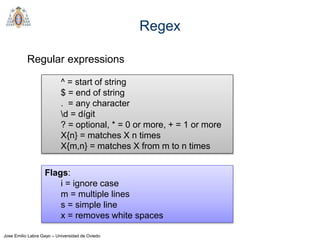
Regex
Regular expressions
^ = start of string
$ = end of string
. = any character
d = dígit
? = optional, * = 0 or more, + = 1 or more
X{n} = matches X n times
X{m,n} = matches X from m to n times
Flags:
i = ignore case
m = multiple lines
s = simple line
x = removes white spaces
Jose Emilio Labra Gayo – Universidad de Oviedo
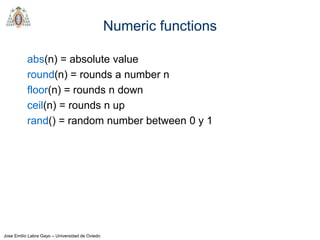
Numeric functions
abs(n) = absolute value
round(n) = rounds a number n
floor(n) = rounds n down
ceil(n) = rounds n up
rand() = random number between 0 y 1
Jose Emilio Labra Gayo – Universidad de Oviedo
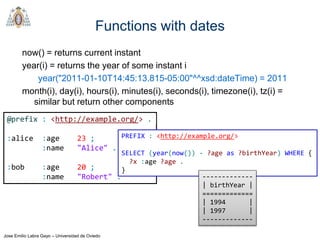
Functions with dates
now() = returns current instant
year(i) = returns the year of some instant i
year("2011-01-10T14:45:13.815-05:00"^^xsd:dateTime) = 2011
month(i), day(i), hours(i), minutes(i), seconds(i), timezone(i), tz(i) =
similar but return other components
@prefix : <http://example.org/> .
:alice :age 23 ;
:name "Alice" .
:bob :age 20 ;
:name "Robert" .
PREFIX : <http://example.org/>
SELECT (year(now()) - ?age as ?birthYear) WHERE {
?x :age ?age .
}
-------------
| birthYear |
=============
| 1994 |
| 1997 |
-------------
Jose Emilio Labra Gayo – Universidad de Oviedo
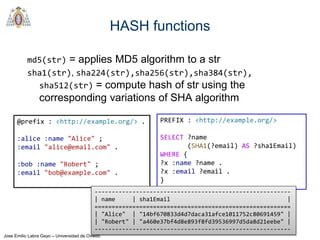
HASH functions
md5(str) = applies MD5 algorithm to a str
sha1(str), sha224(str),sha256(str),sha384(str),
sha512(str) = compute hash of str using the
corresponding variations of SHA algorithm
PREFIX : <http://example.org/>
SELECT ?name
(SHA1(?email) AS ?sha1Email)
WHERE {
?x :name ?name .
?x :email ?email .
}
@prefix : <http://example.org/> .
:alice :name "Alice" ;
:email "alice@email.com" .
:bob :name "Robert" ;
:email "bob@example.com" .
---------------------------------------------------------
| name | sha1Email |
=========================================================
| "Alice" | "14bf670833d4d7daca31afce1011752c80691459" |
| "Robert" | "a460e37bf4d8e893f8fd39536997d5da8d21eebe" |
---------------------------------------------------------
Jose Emilio Labra Gayo – Universidad de Oviedo
@prefix : <http://example.org/>.
:alice :name "Alice" ;
:age 23 .
:bob :firstName "Robert" ;
:age 20 .
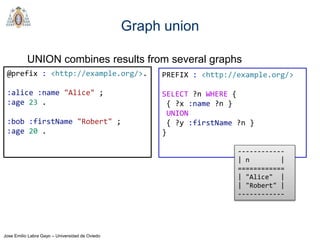
Graph union
UNION combines results from several graphs
PREFIX : <http://example.org/>
SELECT ?n WHERE {
{ ?x :name ?n }
UNION
{ ?y :firstName ?n }
}
------------
| n |
============
| "Alice" |
| "Robert" |
------------
Jose Emilio Labra Gayo – Universidad de Oviedo
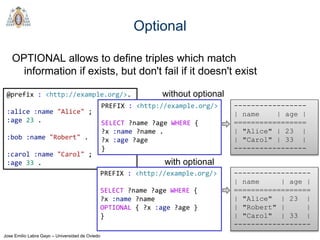
Optional
OPTIONAL allows to define triples which match
information if exists, but don't fail if it doesn't exist
@prefix : <http://example.org/>.
:alice :name "Alice" ;
:age 23 .
:bob :name "Robert" .
:carol :name "Carol" ;
:age 33 .
PREFIX : <http://example.org/>
SELECT ?name ?age WHERE {
?x :name ?name .
?x :age ?age
}
PREFIX : <http://example.org/>
SELECT ?name ?age WHERE {
?x :name ?name
OPTIONAL { ?x :age ?age }
}
-----------------
| name | age |
=================
| "Alice" | 23 |
| "Carol" | 33 |
-----------------
------------------
| name | age |
==================
| "Alice" | 23 |
| "Robert" | |
| "Carol" | 33 |
------------------
without optional
with optional
Jose Emilio Labra Gayo – Universidad de Oviedo
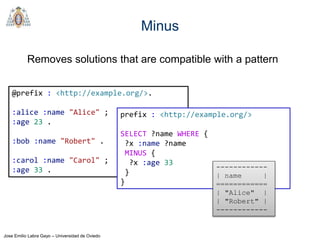
Minus
Removes solutions that are compatible with a pattern
@prefix : <http://example.org/>.
:alice :name "Alice" ;
:age 23 .
:bob :name "Robert" .
:carol :name "Carol" ;
:age 33 .
prefix : <http://example.org/>
SELECT ?name WHERE {
?x :name ?name
MINUS {
?x :age 33
}
}
------------
| name |
============
| "Alice" |
| "Robert" |
------------
Jose Emilio Labra Gayo – Universidad de Oviedo
Parts of a query
prefix dc: <...>
prefix uni: <...>
SELECT ...
FROM <...>
FROM NAMED <...>
WHERE {
...
}
ORDER BY ...
HAVING ...
GROUP BY ...
LIMIT ...
OFFSET ...
BINDINGS ...
Graph Pattern
Query modifiers
Prefix declarations
Define dataset
Declare type of query
SELECT, ASK, DESCRIBE, CONSTRUCT
Jose Emilio Labra Gayo – Universidad de Oviedo
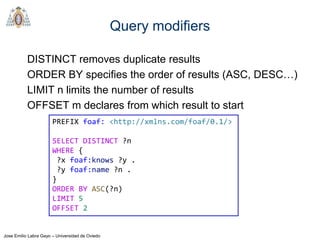
Query modifiers
DISTINCT removes duplicate results
ORDER BY specifies the order of results (ASC, DESC…)
LIMIT n limits the number of results
OFFSET m declares from which result to start
PREFIX foaf: <http://xmlns.com/foaf/0.1/>
SELECT DISTINCT ?n
WHERE {
?x foaf:knows ?y .
?y foaf:name ?n .
}
ORDER BY ASC(?n)
LIMIT 5
OFFSET 2
Jose Emilio Labra Gayo – Universidad de Oviedo
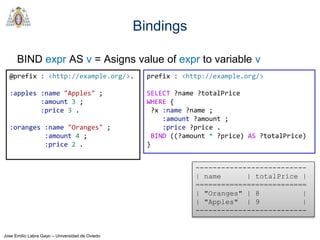
Bindings
BIND expr AS v = Asigns value of expr to variable v
@prefix : <http://example.org/>.
:apples :name "Apples" ;
:amount 3 ;
:price 3 .
:oranges :name "Oranges" ;
:amount 4 ;
:price 2 .
prefix : <http://example.org/>
SELECT ?name ?totalPrice
WHERE {
?x :name ?name ;
:amount ?amount ;
:price ?price .
BIND ((?amount * ?price) AS ?totalPrice)
}
--------------------------
| name | totalPrice |
==========================
| "Oranges" | 8 |
| "Apples" | 9 |
--------------------------
Jose Emilio Labra Gayo – Universidad de Oviedo
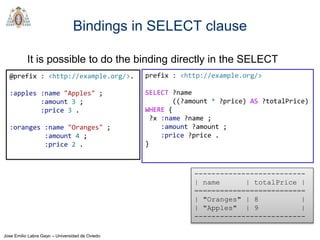
Bindings in SELECT clause
It is possible to do the binding directly in the SELECT
@prefix : <http://example.org/>.
:apples :name "Apples" ;
:amount 3 ;
:price 3 .
:oranges :name "Oranges" ;
:amount 4 ;
:price 2 .
prefix : <http://example.org/>
SELECT ?name
((?amount * ?price) AS ?totalPrice)
WHERE {
?x :name ?name ;
:amount ?amount ;
:price ?price .
}
--------------------------
| name | totalPrice |
==========================
| "Oranges" | 8 |
| "Apples" | 9 |
--------------------------
Jose Emilio Labra Gayo – Universidad de Oviedo
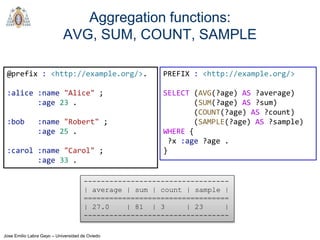
Aggregation functions:
AVG, SUM, COUNT, SAMPLE
@prefix : <http://example.org/>.
:alice :name "Alice" ;
:age 23 .
:bob :name "Robert" ;
:age 25 .
:carol :name "Carol" ;
:age 33 .
PREFIX : <http://example.org/>
SELECT (AVG(?age) AS ?average)
(SUM(?age) AS ?sum)
(COUNT(?age) AS ?count)
(SAMPLE(?age) AS ?sample)
WHERE {
?x :age ?age .
}
----------------------------------
| average | sum | count | sample |
==================================
| 27.0 | 81 | 3 | 23 |
----------------------------------
Jose Emilio Labra Gayo – Universidad de Oviedo
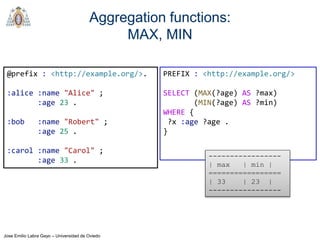
Aggregation functions:
MAX, MIN
@prefix : <http://example.org/>.
:alice :name "Alice" ;
:age 23 .
:bob :name "Robert" ;
:age 25 .
:carol :name "Carol" ;
:age 33 .
PREFIX : <http://example.org/>
SELECT (MAX(?age) AS ?max)
(MIN(?age) AS ?min)
WHERE {
?x :age ?age .
}
-----------------
| max | min |
=================
| 33 | 23 |
-----------------
Jose Emilio Labra Gayo – Universidad de Oviedo
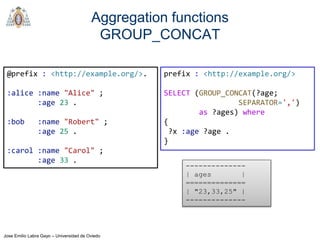
Aggregation functions
GROUP_CONCAT
prefix : <http://example.org/>
SELECT (GROUP_CONCAT(?age;
SEPARATOR=',')
as ?ages) where
{
?x :age ?age .
}
--------------
| ages |
==============
| "23,33,25" |
--------------
@prefix : <http://example.org/>.
:alice :name "Alice" ;
:age 23 .
:bob :name "Robert" ;
:age 25 .
:carol :name "Carol" ;
:age 33 .
Jose Emilio Labra Gayo – Universidad de Oviedo
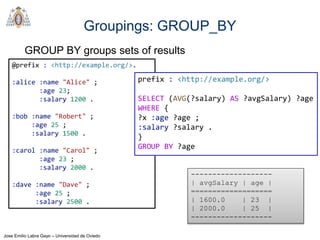
Groupings: GROUP_BY
GROUP BY groups sets of results
@prefix : <http://example.org/>.
:alice :name "Alice" ;
:age 23;
:salary 1200 .
:bob :name "Robert" ;
:age 25 ;
:salary 1500 .
:carol :name "Carol" ;
:age 23 ;
:salary 2000 .
:dave :name "Dave" ;
:age 25 ;
:salary 2500 .
prefix : <http://example.org/>
SELECT (AVG(?salary) AS ?avgSalary) ?age
WHERE {
?x :age ?age ;
:salary ?salary .
}
GROUP BY ?age
-------------------
| avgSalary | age |
===================
| 1600.0 | 23 |
| 2000.0 | 25 |
-------------------
Jose Emilio Labra Gayo – Universidad de Oviedo
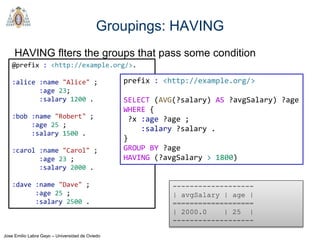
Groupings: HAVING
HAVING flters the groups that pass some condition
-------------------
| avgSalary | age |
===================
| 2000.0 | 25 |
-------------------
@prefix : <http://example.org/>.
:alice :name "Alice" ;
:age 23;
:salary 1200 .
:bob :name "Robert" ;
:age 25 ;
:salary 1500 .
:carol :name "Carol" ;
:age 23 ;
:salary 2000 .
:dave :name "Dave" ;
:age 25 ;
:salary 2500 .
prefix : <http://example.org/>
SELECT (AVG(?salary) AS ?avgSalary) ?age
WHERE {
?x :age ?age ;
:salary ?salary .
}
GROUP BY ?age
HAVING (?avgSalary > 1800)
Jose Emilio Labra Gayo – Universidad de Oviedo
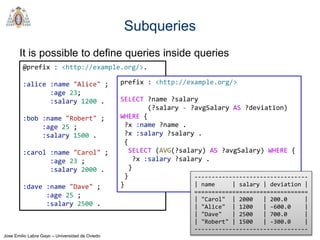
Subqueries
It is possible to define queries inside queries
@prefix : <http://example.org/>.
:alice :name "Alice" ;
:age 23;
:salary 1200 .
:bob :name "Robert" ;
:age 25 ;
:salary 1500 .
:carol :name "Carol" ;
:age 23 ;
:salary 2000 .
:dave :name "Dave" ;
:age 25 ;
:salary 2500 .
prefix : <http://example.org/>
SELECT ?name ?salary
(?salary - ?avgSalary AS ?deviation)
WHERE {
?x :name ?name .
?x :salary ?salary .
{
SELECT (AVG(?salary) AS ?avgSalary) WHERE {
?x :salary ?salary .
}
}
}
---------------------------------
| name | salary | deviation |
=================================
| "Carol" | 2000 | 200.0 |
| "Alice" | 1200 | -600.0 |
| "Dave" | 2500 | 700.0 |
| "Robert" | 1500 | -300.0 |
---------------------------------
Jose Emilio Labra Gayo – Universidad de Oviedo
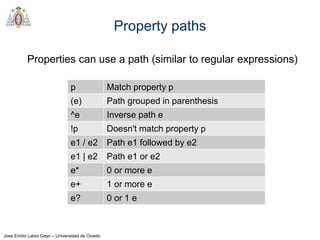
Property paths
Properties can use a path (similar to regular expressions)
p Match property p
(e) Path grouped in parenthesis
^e Inverse path e
!p Doesn't match property p
e1 / e2 Path e1 followed by e2
e1 | e2 Path e1 or e2
e* 0 or more e
e+ 1 or more e
e? 0 or 1 e
Jose Emilio Labra Gayo – Universidad de Oviedo
@prefix : <http://example.org/>.
@prefix foaf: <http://xmlns.com/foaf/0.1/>.
:alice :name "Alice" ;
foaf:knows :bob, :carol .
:bob foaf:name "Robert";
foaf:knows :carol .
:carol foaf:name "Carol" ;
foaf:knows :alice .
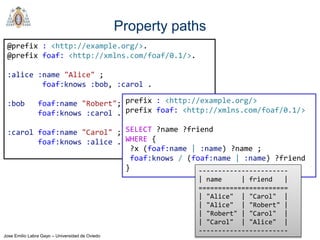
Property paths
prefix : <http://example.org/>
prefix foaf: <http://xmlns.com/foaf/0.1/>
SELECT ?name ?friend
WHERE {
?x (foaf:name | :name) ?name ;
foaf:knows / (foaf:name | :name) ?friend
} -----------------------
| name | friend |
=======================
| "Alice" | "Carol" |
| "Alice" | "Robert" |
| "Robert" | "Carol" |
| "Carol" | "Alice" |
-----------------------
Jose Emilio Labra Gayo – Universidad de Oviedo
Property paths
@prefix : <http://example.org/>.
@prefix foaf: <http://xmlns.com/foaf/0.1/>.
:isabelle foaf:knows :frank, :grace .
:frank foaf:knows :carol, :emily .
:grace foaf:knows :carol, :emily .
:carol foaf:knows :alice .
:emily foaf:knows :alice .
:heidi foaf:knows :dave .
:dave foaf:knows :bob .
:bob foaf:knows :alice .
prefix : <http://example.org/>
prefix foaf: <http://xmlns.com/foaf/0.1/>
SELECT ?p {
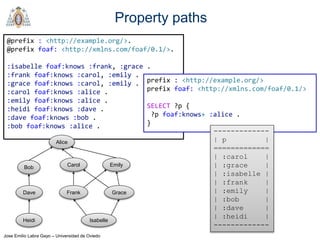
?p foaf:knows+ :alice .
}
-------------
| p |
=============
| :carol |
| :grace |
| :isabelle |
| :frank |
| :emily |
| :bob |
| :dave |
| :heidi |
-------------
Alice
Bob Carol Emily
Dave Frank Grace
Heidi Isabelle
Jose Emilio Labra Gayo – Universidad de Oviedo
Property paths
@prefix : <http://example.org/>.
@prefix foaf: <http://xmlns.com/foaf/0.1/>.
:isabelle foaf:knows :frank, :grace .
:frank foaf:knows :carol, :emily .
:grace foaf:knows :carol, :emily .
:carol foaf:knows :alice .
:emily foaf:knows :alice .
:heidi foaf:knows :dave .
:dave foaf:knows :bob .
:bob foaf:knows :alice .
Alice
Bob Carol Emily
Dave Frank Grace
Heidi Isabelle
prefix : <http://example.org/>
prefix foaf: <http://xmlns.com/foaf/0.1/>
SELECT ?p {
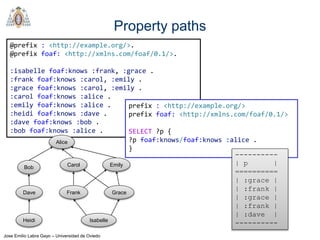
?p foaf:knows/foaf:knows :alice .
}
----------
| p |
==========
| :grace |
| :frank |
| :grace |
| :frank |
| :dave |
----------
Jose Emilio Labra Gayo – Universidad de Oviedo
Property paths
@prefix : <http://example.org/>.
@prefix foaf: <http://xmlns.com/foaf/0.1/>.
:isabelle foaf:knows :frank, :grace .
:frank foaf:knows :carol, :emily .
:grace foaf:knows :carol, :emily .
:carol foaf:knows :alice .
:emily foaf:knows :alice .
:heidi foaf:knows :dave .
:dave foaf:knows :bob .
:bob foaf:knows :alice .
Alice
Bob Carol Emily
Dave Frank Grace
Heidi Isabelle
prefix : <http://example.org/>
prefix foaf: <http://xmlns.com/foaf/0.1/>
SELECT ?p {
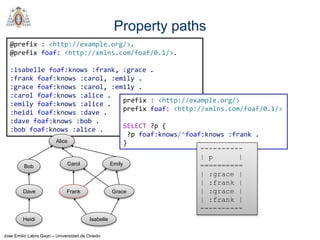
?p foaf:knows/^foaf:knows :frank .
}
----------
| p |
==========
| :grace |
| :frank |
| :grace |
| :frank |
----------
Jose Emilio Labra Gayo – Universidad de Oviedo
SPARQL Update
Jose Emilio Labra Gayo – Universidad de Oviedo
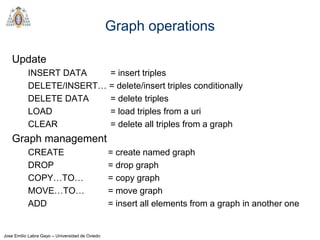
Graph operations
Update
INSERT DATA = insert triples
DELETE/INSERT… = delete/insert triples conditionally
DELETE DATA = delete triples
LOAD = load triples from a uri
CLEAR = delete all triples from a graph
Graph management
CREATE = create named graph
DROP = drop graph
COPY…TO… = copy graph
MOVE…TO… = move graph
ADD = insert all elements from a graph in another one
Jose Emilio Labra Gayo – Universidad de Oviedo
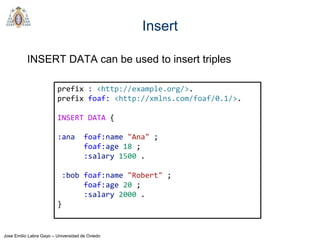
Insert
INSERT DATA can be used to insert triples
prefix : <http://example.org/>.
prefix foaf: <http://xmlns.com/foaf/0.1/>.
INSERT DATA {
:ana foaf:name "Ana" ;
foaf:age 18 ;
:salary 1500 .
:bob foaf:name "Robert" ;
foaf:age 20 ;
:salary 2000 .
}
Jose Emilio Labra Gayo – Universidad de Oviedo
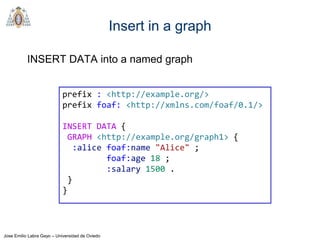
Insert in a graph
INSERT DATA into a named graph
prefix : <http://example.org/>
prefix foaf: <http://xmlns.com/foaf/0.1/>
INSERT DATA {
GRAPH <http://example.org/graph1> {
:alice foaf:name "Alice" ;
foaf:age 18 ;
:salary 1500 .
}
}
Jose Emilio Labra Gayo – Universidad de Oviedo
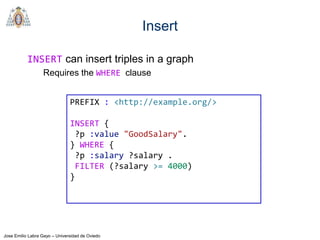
Insert
INSERT can insert triples in a graph
Requires the WHERE clause
PREFIX : <http://example.org/>
INSERT {
?p :value "GoodSalary".
} WHERE {
?p :salary ?salary .
FILTER (?salary >= 4000)
}
Jose Emilio Labra Gayo – Universidad de Oviedo
Graph load
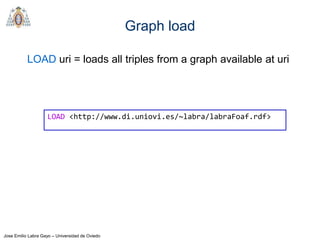
LOAD uri = loads all triples from a graph available at uri
LOAD <http://www.di.uniovi.es/~labra/labraFoaf.rdf>
Jose Emilio Labra Gayo – Universidad de Oviedo
Delete data
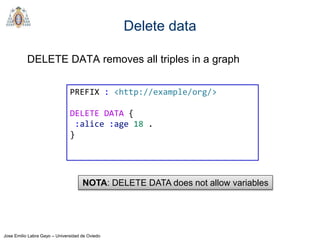
DELETE DATA removes all triples in a graph
PREFIX : <http://example/org/>
DELETE DATA {
:alice :age 18 .
}
NOTA: DELETE DATA does not allow variables
Jose Emilio Labra Gayo – Universidad de Oviedo
Delete...where
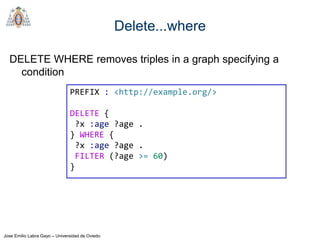
DELETE WHERE removes triples in a graph specifying a
condition
PREFIX : <http://example.org/>
DELETE {
?x :age ?age .
} WHERE {
?x :age ?age .
FILTER (?age >= 60)
}
Jose Emilio Labra Gayo – Universidad de Oviedo
Updating information
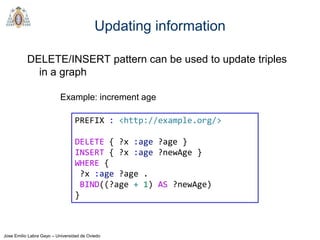
DELETE/INSERT pattern can be used to update triples
in a graph
PREFIX : <http://example.org/>
DELETE { ?x :age ?age }
INSERT { ?x :age ?newAge }
WHERE {
?x :age ?age .
BIND((?age + 1) AS ?newAge)
}
Example: increment age
Jose Emilio Labra Gayo – Universidad de Oviedo
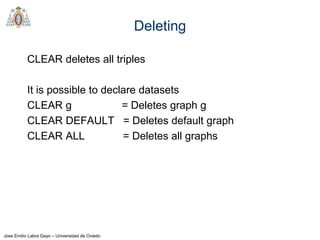
Deleting
CLEAR deletes all triples
It is possible to declare datasets
CLEAR g = Deletes graph g
CLEAR DEFAULT = Deletes default graph
CLEAR ALL = Deletes all graphs
Jose Emilio Labra Gayo – Universidad de Oviedo
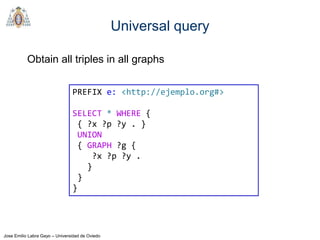
Universal query
Obtain all triples in all graphs
PREFIX e: <http://ejemplo.org#>
SELECT * WHERE {
{ ?x ?p ?y . }
UNION
{ GRAPH ?g {
?x ?p ?y .
}
}
}
Jose Emilio Labra Gayo – Universidad de Oviedo
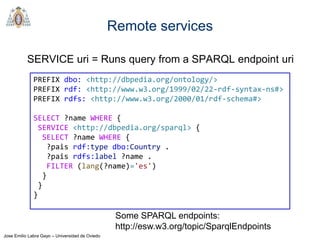
Remote services
SERVICE uri = Runs query from a SPARQL endpoint uri
PREFIX dbo: <http://dbpedia.org/ontology/>
PREFIX rdf: <http://www.w3.org/1999/02/22-rdf-syntax-ns#>
PREFIX rdfs: <http://www.w3.org/2000/01/rdf-schema#>
SELECT ?name WHERE {
SERVICE <http://dbpedia.org/sparql> {
SELECT ?name WHERE {
?pais rdf:type dbo:Country .
?pais rdfs:label ?name .
FILTER (lang(?name)='es')
}
}
}
Some SPARQL endpoints:
http://esw.w3.org/topic/SparqlEndpoints
Jose Emilio Labra Gayo – Universidad de Oviedo
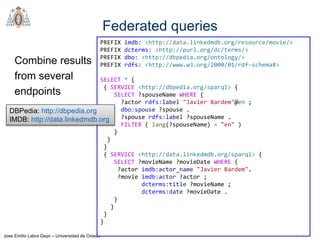
Federated queries
Combine results
from several
endpoints
PREFIX imdb: <http://data.linkedmdb.org/resource/movie/>
PREFIX dcterms: <http://purl.org/dc/terms/>
PREFIX dbo: <http://dbpedia.org/ontology/>
PREFIX rdfs: <http://www.w3.org/2000/01/rdf-schema#>
SELECT * {
{ SERVICE <http://dbpedia.org/sparql> {
SELECT ?spouseName WHERE {
?actor rdfs:label "Javier Bardem"@en ;
dbo:spouse ?spouse .
?spouse rdfs:label ?spouseName .
FILTER ( lang(?spouseName) = "en" )
}
}
}
{ SERVICE <http://data.linkedmdb.org/sparql> {
SELECT ?movieName ?movieDate WHERE {
?actor imdb:actor_name "Javier Bardem".
?movie imdb:actor ?actor ;
dcterms:title ?movieName ;
dcterms:date ?movieDate .
}
}
}
}
DBPedia: http://dbpedia.org
IMDB: http://data.linkedmdb.org
Jose Emilio Labra Gayo – Universidad de Oviedo
SPARQL Protocol
Jose Emilio Labra Gayo – Universidad de Oviedo
SPARQL Protocol
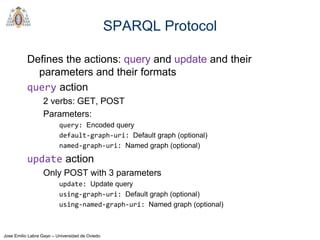
Defines the actions: query and update and their
parameters and their formats
query action
2 verbs: GET, POST
Parameters:
query: Encoded query
default-graph-uri: Default graph (optional)
named-graph-uri: Named graph (optional)
update action
Only POST with 3 parameters
update: Update query
using-graph-uri: Default graph (optional)
using-named-graph-uri: Named graph (optional)
Jose Emilio Labra Gayo – Universidad de Oviedo
Validating RDF using SPARQL?
Jose Emilio Labra Gayo – Universidad de Oviedo
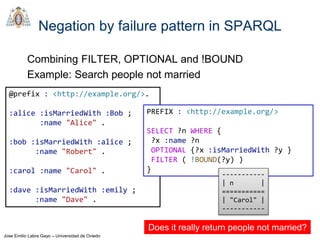
Negation by failure pattern in SPARQL
Combining FILTER, OPTIONAL and !BOUND
Example: Search people not married
@prefix : <http://example.org/>.
:alice :isMarriedWith :Bob ;
:name "Alice" .
:bob :isMarriedWith :alice ;
:name "Robert" .
:carol :name "Carol" .
:dave :isMarriedWith :emily ;
:name "Dave" .
PREFIX : <http://example.org/>
SELECT ?n WHERE {
?x :name ?n
OPTIONAL {?x :isMarriedWith ?y }
FILTER ( !BOUND(?y) )
}
Does it really return people not married?
-----------
| n |
===========
| "Carol" |
-----------
Jose Emilio Labra Gayo – Universidad de Oviedo
Validating RDF with SPARQL
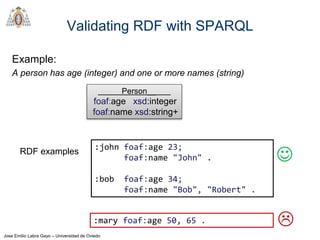
Example:
A person has age (integer) and one or more names (string)
Person__
foaf:age xsd:integer
foaf:name xsd:string+
:john foaf:age 23;
foaf:name "John" .
:bob foaf:age 34;
foaf:name "Bob", "Robert" .

RDF examples
:mary foaf:age 50, 65 .
Jose Emilio Labra Gayo – Universidad de Oviedo
Example of SPARQL query
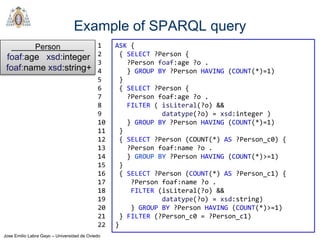
ASK {
{ SELECT ?Person {
?Person foaf:age ?o .
} GROUP BY ?Person HAVING (COUNT(*)=1)
}
{ SELECT ?Person {
?Person foaf:age ?o .
FILTER ( isLiteral(?o) &&
datatype(?o) = xsd:integer )
} GROUP BY ?Person HAVING (COUNT(*)=1)
}
{ SELECT ?Person (COUNT(*) AS ?Person_c0) {
?Person foaf:name ?o .
} GROUP BY ?Person HAVING (COUNT(*)>=1)
}
{ SELECT ?Person (COUNT(*) AS ?Person_c1) {
?Person foaf:name ?o .
FILTER (isLiteral(?o) &&
datatype(?o) = xsd:string)
} GROUP BY ?Person HAVING (COUNT(*)>=1)
} FILTER (?Person_c0 = ?Person_c1)
}
1
2
3
4
5
6
7
8
9
10
11
12
13
14
15
16
17
18
19
20
21
22
Person__
foaf:age xsd:integer
foaf:name xsd:string+
Jose Emilio Labra Gayo – Universidad de Oviedo
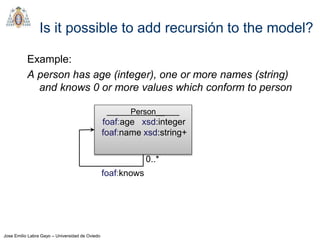
Is it possible to add recursión to the model?
Example:
A person has age (integer), one or more names (string)
and knows 0 or more values which conform to person
Person__
foaf:age xsd:integer
foaf:name xsd:string+
0..*
foaf:knows
Jose Emilio Labra Gayo – Universidad de Oviedo
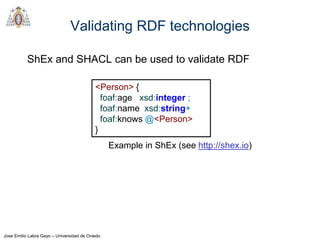
Validating RDF technologies
ShEx and SHACL can be used to validate RDF
<Person> {
foaf:age xsd:integer ;
foaf:name xsd:string+
foaf:knows @<Person>
}
Example in ShEx (see http://shex.io)
Jose Emilio Labra Gayo – Universidad de Oviedo
References
SPARQL by example
SPARQL by example cheatsheet
Learning SPARQL, book by Bob Ducharme
SPARQL 1.1 spec

Introduction to SPARQL

  • 1.
    SPARQL Departamento de Informática Universidadde Oviedo Jose Emilio Labra Gayo
  • 2.
    Jose Emilio LabraGayo – Universidad de Oviedo SPARQL SPARQL (April 2006) query language for RDF data Similar to SQL, but for RDF Based on graph patterns It also describes a REST protocol SPARQL = SPARQL Protocol And RDF Query Language SPARQL 1.1 (2013, recommendation) Updates, federated queries, etc.
  • 3.
    Jose Emilio LabraGayo – Universidad de Oviedo SPARQL Syntax Similar to Turtle URIs between <...> <http://www.example.org/alice> Namespace prefixes as in Turtle prefix dc: <http://purl.org/dc/terms/> dc:creator Blank nodes _:node or between square brackets [ ] Literals between " " "Alice" "234"^^xsd:integer Comments start by # # this is a comment Variables start by? ?name
  • 4.
    Jose Emilio LabraGayo – Universidad de Oviedo RDF RDF = Graph model Different syntaxes: N-Triples, Turtle, RDF/XML @prefix dc: <http://purl.org/dc/terms/> . @prefix uni: <http://uniovi.es/> . @prefix rdf: <http://www.w3.org/1999/02/22-rdf-syntax-ns#> . uni:biology dc:creator uni:bob . uni:biology dc:creator uni:alice . uni:chemistry dc:creator uni:alice . uni:chemistry dc:creator uni:carol . uni:law dc:creator uni:carol . uni:alice rdf:type uni:Lecturer . uni:bob rdf:type uni:Lecturer . uni:carol rdf:type uni:Student . data.ttl
  • 5.
    Jose Emilio LabraGayo – Universidad de Oviedo @prefix dc: <http://purl.org/dc/terms/> . @prefix uni: <http://uniovi.es/> . @prefix rdf: <http://www.w3.org/1999/02/22-rdf-syntax-ns#> . uni:biology dc:creator uni:bob . uni:biology dc:creator uni:alice . uni:chemistry dc:creator uni:alice . uni:chemistry dc:creator uni:carol . uni:law dc:creator uni:carol . uni:alice rdf:type uni:Lecturer . uni:bob rdf:type uni:Lecturer . uni:carol rdf:type uni:Student . RDF data RDF graph uni:chemistry uni:alice dc:creator uni:carol dc:creator uni:Student rdf:type uni:biology uni:bob dc:creator dc:creator uni:Lecturer rdf:type rdf:type uni:law dc:creator data.ttl
  • 6.
    Jose Emilio LabraGayo – Universidad de Oviedo Simple SPARQL query Search resources created by a Lecturer and order them by lecturer prefix dc: <http://purl.org/dc/terms/> prefix uni: <http://uniovi.es/> prefix rdf: <http://www.w3.org/1999/02/22-rdf-syntax-ns#> SELECT ?p ?c WHERE { ?p dc:creator ?c . ?c rdf:type uni:Lecturer . } ORDER BY ?c
  • 7.
    Jose Emilio LabraGayo – Universidad de Oviedo SELECT ?p ?c WHERE { ?p dc:creator ?c . ?c rdf:type uni:Lecturer . } ORDER BY ?c uni:chemistry uni:alicedc:creator uni:carol dc:creator uni:Student rdf:type uni:biology uni:bob dc:creator dc:creator uni:Lecturer rdf:type rdf:type uni:law dc:creator Graph patterns ?p dc:creator ?c uni:Lecturer rdf:type ?p ?c Results ?p ?c uni:biology uni:bob uni:chemistry uni:alice uni:biology uni:alice ?p ?c ?p ?c uni:biology uni:alice uni:chemistry uni:alice uni:biology uni:bob sorted by ?c Try it: https://goo.gl/fJuUBn
  • 8.
    Jose Emilio LabraGayo – Universidad de Oviedo Playing with SPARQL Command line tools: Apache Jena. https://jena.apache.org/ Online: SHACLex: can be used without endpoint http://shaclex.herokuapp.com/ YASGUI: can be used to query existing SPARQL endpoints http://yasgui.org/ Creating SPARQL endpoints Apache Jena Fuseki: https://jena.apache.org/ Blazegraph: https://www.blazegraph.com/
  • 9.
    Jose Emilio LabraGayo – Universidad de Oviedo Some public SPARQL endpoints Name URL Description SPARQLer http://www.sparql.org/sparql.html General purpose query endpoint DBpedia http://dbpedia.org/sparql RDF data from wikipedia Wikidata https://query.wikidata.org/ RDF data from Wikipedia DBLP http://dblp.rkbexplorer.com/sparql/ Bibliographic data LinkedMDB http://data.linkedmdb.org/sparql Movie database bio2rdf http://bio2rdf.org/sparql Linked data for life sciences List of SPARQL endpoints: https://www.w3.org/wiki/SparqlEndpoints
  • 10.
    Jose Emilio LabraGayo – Universidad de Oviedo SPARQL query language
  • 11.
    Jose Emilio LabraGayo – Universidad de Oviedo Parts of a query prefix dc: <...> prefix uni: <...> SELECT ... FROM <...> FROM NAMED <...> WHERE { ... } ORDER BY ... HAVING ... GROUP BY ... LIMIT ... OFFSET ... BINDINGS ... Graph Pattern Query modifiers Prefix declarations Define dataset Declare type of query SELECT, ASK, DESCRIBE, CONSTRUCT
  • 12.
    Jose Emilio LabraGayo – Universidad de Oviedo Prefix declarations Similar to Turtle No need to use @prefix, just prefix No need to end prefix declarations by dot Common aliases used in these slides: alias... stands for... rdf <http://www.w3.org/1999/02/22-rdf-syntax-ns#> rdfs <http://www.w3.org/2000/01/rdf-schema#> owl <http://www.w3.org/2002/07/owl#> xsd <http://www.w3.org/2001/XMLSchema#> schema <http://schema.org/> Other common prefixes can be found at: http://prefix.cc
  • 13.
    Jose Emilio LabraGayo – Universidad de Oviedo Parts of a query prefix dc: <...> prefix uni: <...> SELECT ... FROM <...> FROM NAMED <...> WHERE { ... } ORDER BY ... HAVING ... GROUP BY ... LIMIT ... OFFSET ... BINDINGS ... Declare type of query SELECT, ASK, DESCRIBE, CONSTRUCT Graph Pattern Query modifiers Prefix declarations Define dataset
  • 14.
    Jose Emilio LabraGayo – Universidad de Oviedo Types of SPARQL queries SELECT return values of variables or expressions Results are a table of values Can have several serializations: XML, JSON ASK return true/false DESCRIBE return a description of a resource CONSTRUCT queries can build RDF triples/graphs
  • 15.
    Jose Emilio LabraGayo – Universidad de Oviedo SELECT queries @prefix : <http://example.org/>. :alice :name "Alice" ; :age 31 . :bob :name "Robert" ; :age 31 . SELECT ?n (?age + 1 as ?newAge) WHERE { ?x :name ?n ; :age ?age } Project out specific variables or expressions --------------------- | n | newAge | ===================== | "Alice" | 32 | | "Robert" | 32 | --------------------- SELECT * WHERE { ?x :name ?n ; :age ?age } Project out all variables --------------------------- | x | n | age | =========================== | :alice | "Alice" | 31 | | :bob | "Robert" | 31 | --------------------------- Project out distinct combinations only SELECT DISTINCT ?age WHERE { ?x :name ?n ; :age ?age } ------- | age | ======= | 31 | -------
  • 16.
    Jose Emilio LabraGayo – Universidad de Oviedo CONSTRUCT queries Construct an RDF result Can be used to transform RDF data @prefix : <http://example.org/>. :alice :name "Alice" ; :age 31 . :bob :name "Robert" ; :age 31 . PREFIX : <http://example.org/> PREFIX foaf: <http://xmlns.com/foaf/0.1/> CONSTRUCT { ?x foaf:name ?name ; foaf:age ?age } where { ?x :name ?name ; :age ?age } @prefix : <http://example.org/> . @prefix foaf: <http://xmlns.com/foaf/0.1/> . :alice foaf:age 31 ; foaf:name "Alice" . :bob foaf:age 31 ; foaf:name "Robert" . Result
  • 17.
    Jose Emilio LabraGayo – Universidad de Oviedo ASK queries ASK return yes or no Can be used to check errors Yes @prefix : <http://example.org/>. :alice :name "Alice" ; :age 31 . :bob :name "Robert" ; :age 31 . PREFIX : <http://example.org/> ASK WHERE { ?x :age ?age FILTER (?age > 18) } Result
  • 18.
    Jose Emilio LabraGayo – Universidad de Oviedo DESCRIBE Return a description of one or more nodes @prefix : <http://example.org/> . :alice :age 31 ; :name "Alice" . PREFIX : <http://example.org/> DESCRIBE ?x WHERE { ?x :name "Alice" . } @prefix : <http://example.org/>. :alice :name "Alice" ; :age 31 . :bob :name "Robert" ; :age 31 . Result
  • 19.
    Jose Emilio LabraGayo – Universidad de Oviedo Parts of a query prefix dc: <...> prefix uni: <...> SELECT ... FROM <...> FROM NAMED <...> WHERE { ... } ORDER BY ... HAVING ... GROUP BY ... LIMIT ... OFFSET ... BINDINGS ... Graph Pattern Query modifiers Prefix declarations Define dataset Declare type of query SELECT, ASK, DESCRIBE, CONSTRUCT
  • 20.
    Jose Emilio LabraGayo – Universidad de Oviedo Define dataset using FROM FROM declares the URL from which the data is queried PREFIX foaf: <http://xmlns.com/foaf/0.1/> SELECT ?n FROM <http://www.di.uniovi.es/~labra/labraFoaf.rdf> WHERE { ?x foaf:name ?n } If several data graphs are declared, they are merged PREFIX foaf: <http://xmlns.com/foaf/0.1/> SELECT ?n FROM <http://www.di.uniovi.es/~labra/labraFoaf.rdf> FROM <http://www.w3.org/People/Berners-Lee/card> WHERE { ?x foaf:name ?n } ----------------------------------- | n | =================================== | "Jose Manuel Alonso Cienfuegos" | | "Timothy Berners-Lee" | | "Ivan Herman" | | "Jose Emilio Labra Gayo" | ----------------------------------- ----------------------------------- | n | =================================== | "Jose Manuel Alonso Cienfuegos" | | "Ivan Herman" | | "Jose Emilio Labra Gayo" | -----------------------------------
  • 21.
    Jose Emilio LabraGayo – Universidad de Oviedo Named graphs FROM NAMED asigns a name to the input graph GRAPH matches with the corresponding graph name PREFIX foaf: <http://xmlns.com/foaf/0.1/> SELECT ?n ?g FROM NAMED <http://www.w3.org/People/Berners-Lee/card> FROM NAMED <http://www.di.uniovi.es/~labra/labraFoaf.rdf> WHERE { GRAPH ?g { ?x foaf:name ?n } } ------------------------------------------------------------------------------------ | n | g | ==================================================================================== | "Ivan Herman" | <http://www.di.uniovi.es/~labra/labraFoaf.rdf> | | "Jose Manuel Alonso Cienfuegos" | <http://www.di.uniovi.es/~labra/labraFoaf.rdf> | | "Jose Emilio Labra Gayo" | <http://www.di.uniovi.es/~labra/labraFoaf.rdf> | | "Timothy Berners-Lee" | <http://www.w3.org/People/Berners-Lee/card> | ------------------------------------------------------------------------------------
  • 22.
    Jose Emilio LabraGayo – Universidad de Oviedo Parts of a query prefix dc: <...> prefix uni: <...> SELECT ... FROM <...> FROM NAMED <...> WHERE { ... } ORDER BY ... HAVING ... GROUP BY ... LIMIT ... OFFSET ... BINDINGS ... Graph Pattern Query modifiers Prefix declarations Define dataset Declare type of query SELECT, ASK, DESCRIBE, CONSTRUCT
  • 23.
    Jose Emilio LabraGayo – Universidad de Oviedo Query patterns Query patterns are made from triple patterns Triple pattern = RDF triples which can contain variables Examples of triple patterns uni:biology dc:creator ?c resources that are dc:creator's of uni:biology ?r dc:creator :alice resources whose dc:creator is :alice ?r dc:creator ?c all resources related by dc:creator property uni:biology ?p :alice properties that relate uni:biology with :alice ?x ?p ?y all statements
  • 24.
    Jose Emilio LabraGayo – Universidad de Oviedo Basic graph patterns Basic graph pattern = sequence of triple patterns The matching process combines the values of variables Example: The values of variables must be the same in the results SELECT ?p ?c WHERE { ?p dc:creator ?c . ?c rdf:type uni:Lecturer . } ORDER BY ?c
  • 25.
    Jose Emilio LabraGayo – Universidad de Oviedo Basic graph patterns can have filters FILTER limits the set of returned values PREFIX : <http://example.org/> SELECT ?n ?e WHERE { ?x :name ?n . ?x :age ?e FILTER (?e > 18) } @prefix : <http://example.org/>. :alice :name "Alice" . :alice :age 31 . :bob :name "Robert" . :bob :age 12 . :carol :name "Carol" . :carol :age 25 . | n | e | ================= | "Carol" | 25 | | "Alice" | 31 | Try it: https://tinyurl.com/y8odenvm
  • 26.
    Jose Emilio LabraGayo – Universidad de Oviedo Filter operators FILTER uses XPath 2.0 functions and operators Datatypes: Boolean, Integer, Float, dataTime, etc. Typical operators: >, <, >=, <=, =, !=, ||, && PREFIX : <http://example.org/> SELECT ?n ?e WHERE { ?x :name ?n . ?x :age ?e FILTER (?e > 30 || ?e < 18) } Try it: https://tinyurl.com/yavd6bww
  • 27.
    Jose Emilio LabraGayo – Universidad de Oviedo Convert/create datatypes str(arg): converts its argument to a string NOTE: URIs must be converted to strings to treat them as such datatype(arg): returns datatype of a literal IF ?x = "123"^^xsd:integer THEN datatype(?x) = xsd:integer lang(arg): returns the language of a literal IF ?x = "University"@en THEN: lang(?x) = "en" prefix rdfs: <http://www.w3.org/2000/01/rdf-schema#> SELECT ?label WHERE { ?x rdfs:label ?label . FILTER (lang(?label) ="en") } Example Try it: https://tinyurl.com/y8m3xlyg
  • 28.
    Jose Emilio LabraGayo – Universidad de Oviedo Create datatypes uri(arg), iri(arg): convert their argument to URI/IRI bnode(arg): generates a blank node strdt(literal,datatype): generates a literal with a datatype strdt("123","xsd:integer") = "123"^^<xsd:integer> strlang(literal,lang): generates a literal with some language strlang("University","en") = "University"@"en"
  • 29.
    Jose Emilio LabraGayo – Universidad de Oviedo Check datatypes isNumeric(arg) = true if the argument is a number isBlank(arg) = true if the argumento is a blank node isLiteral(arg) = true if the argument is a literal isIRI(arg) = true if the argument is an IRI
  • 30.
    Jose Emilio LabraGayo – Universidad de Oviedo Conditions bound(arg) = true if the argument has a value exists(pattern) = true if the pattern is satisfied not exists(pattern) = true si if the pattern is not satisfied if(cond,expr1,expr2) = if cond = true, returns expr1, otherwise, returns expr2 coalesce(e1,e2,...) = returns the first expression that is evaluated without error
  • 31.
    Jose Emilio LabraGayo – Universidad de Oviedo Examples Filter numeric values PREFIX : <http://example.org/> SELECT ?age WHERE { ?x :age ?age . FILTER (isNumeric(?age)) } @prefix : <http://example.org/> . :carol :age 34 ; :name "Carol" . :alice :age 23 ; :name "Alice" . :bob :age "Unknown" ; :name "Robert" . ------- | age | ======= | 34 | | 23 | ------- Try it: https://tinyurl.com/yan74uwt
  • 32.
    Jose Emilio LabraGayo – Universidad de Oviedo Functions with strings strlen(str) = length of str ucase(str) converts to uppercase lcase(str) converts to lowercase substr(str,start,size?)= substring from start with some size substr('camino',3,2)='mi' strstarts(str1,str2) = true if str1 starts with str2 strends(str1,str2) = true if str1 ends with str2 contains(str1,str2) = true if str1 contains str2 encode_for_uri(str) = result of encoding str as a uri concat(str1,...strN) = concatenates strings langMatches(str,lang) = true if a string matches some language lang regex(str,p,flags) = true if string matches regular expression p with flags
  • 33.
    Jose Emilio LabraGayo – Universidad de Oviedo Examples with strings @prefix : <http://example.org/> . :alice :firstName "Alice" ; :lastName "Cooper" . :bob :firstName "Robert" ; :lastName "Smith" . :carol :firstName "Carol" ; :lastName "King" . Try it: https://tinyurl.com/yd3p2l43 PREFIX : <http://example.org/> SELECT (concat(?firstName,' ',?lastName) AS ?name) WHERE { ?x :firstName ?firstName . ?x :lastName ?lastName . FILTER (contains(ucase(?firstName),'A')) } ------------------ | name | ================== | "Alice Cooper" | | "Carol King" | ------------------
  • 34.
    Jose Emilio LabraGayo – Universidad de Oviedo Regex REGEX invokes regular expression matching It is based on XPath 2.0 functions regex(?Expr, ?Pattern [, ?Flags]) ?Expr = expression to match ?Pattern = regular expression pattern ?Flags = matching options Try it: https://tinyurl.com/yd29xsyz @prefix : <http://example.org/>. :alice :firstName "Alice" ; :lastName "Cooper" . :bob :firstName "Robert" ; :lastName "Smith" . :carol :firstName "Carol" ; :lastName "King" . PREFIX : <http://example.org/> SELECT ?firstName WHERE { ?x :firstName ?firstName . FILTER (regex(?firstName,"^[ABC](.*)")) } ------------- | firstName | ============= | "Alice" | | "Carol" | -------------
  • 35.
    Jose Emilio LabraGayo – Universidad de Oviedo Regex Regular expressions ^ = start of string $ = end of string . = any character d = dígit ? = optional, * = 0 or more, + = 1 or more X{n} = matches X n times X{m,n} = matches X from m to n times Flags: i = ignore case m = multiple lines s = simple line x = removes white spaces
  • 36.
    Jose Emilio LabraGayo – Universidad de Oviedo Numeric functions abs(n) = absolute value round(n) = rounds a number n floor(n) = rounds n down ceil(n) = rounds n up rand() = random number between 0 y 1
  • 37.
    Jose Emilio LabraGayo – Universidad de Oviedo Functions with dates now() = returns current instant year(i) = returns the year of some instant i year("2011-01-10T14:45:13.815-05:00"^^xsd:dateTime) = 2011 month(i), day(i), hours(i), minutes(i), seconds(i), timezone(i), tz(i) = similar but return other components @prefix : <http://example.org/> . :alice :age 23 ; :name "Alice" . :bob :age 20 ; :name "Robert" . PREFIX : <http://example.org/> SELECT (year(now()) - ?age as ?birthYear) WHERE { ?x :age ?age . } ------------- | birthYear | ============= | 1994 | | 1997 | -------------
  • 38.
    Jose Emilio LabraGayo – Universidad de Oviedo HASH functions md5(str) = applies MD5 algorithm to a str sha1(str), sha224(str),sha256(str),sha384(str), sha512(str) = compute hash of str using the corresponding variations of SHA algorithm PREFIX : <http://example.org/> SELECT ?name (SHA1(?email) AS ?sha1Email) WHERE { ?x :name ?name . ?x :email ?email . } @prefix : <http://example.org/> . :alice :name "Alice" ; :email "alice@email.com" . :bob :name "Robert" ; :email "bob@example.com" . --------------------------------------------------------- | name | sha1Email | ========================================================= | "Alice" | "14bf670833d4d7daca31afce1011752c80691459" | | "Robert" | "a460e37bf4d8e893f8fd39536997d5da8d21eebe" | ---------------------------------------------------------
  • 39.
    Jose Emilio LabraGayo – Universidad de Oviedo @prefix : <http://example.org/>. :alice :name "Alice" ; :age 23 . :bob :firstName "Robert" ; :age 20 . Graph union UNION combines results from several graphs PREFIX : <http://example.org/> SELECT ?n WHERE { { ?x :name ?n } UNION { ?y :firstName ?n } } ------------ | n | ============ | "Alice" | | "Robert" | ------------
  • 40.
    Jose Emilio LabraGayo – Universidad de Oviedo Optional OPTIONAL allows to define triples which match information if exists, but don't fail if it doesn't exist @prefix : <http://example.org/>. :alice :name "Alice" ; :age 23 . :bob :name "Robert" . :carol :name "Carol" ; :age 33 . PREFIX : <http://example.org/> SELECT ?name ?age WHERE { ?x :name ?name . ?x :age ?age } PREFIX : <http://example.org/> SELECT ?name ?age WHERE { ?x :name ?name OPTIONAL { ?x :age ?age } } ----------------- | name | age | ================= | "Alice" | 23 | | "Carol" | 33 | ----------------- ------------------ | name | age | ================== | "Alice" | 23 | | "Robert" | | | "Carol" | 33 | ------------------ without optional with optional
  • 41.
    Jose Emilio LabraGayo – Universidad de Oviedo Minus Removes solutions that are compatible with a pattern @prefix : <http://example.org/>. :alice :name "Alice" ; :age 23 . :bob :name "Robert" . :carol :name "Carol" ; :age 33 . prefix : <http://example.org/> SELECT ?name WHERE { ?x :name ?name MINUS { ?x :age 33 } } ------------ | name | ============ | "Alice" | | "Robert" | ------------
  • 42.
    Jose Emilio LabraGayo – Universidad de Oviedo Parts of a query prefix dc: <...> prefix uni: <...> SELECT ... FROM <...> FROM NAMED <...> WHERE { ... } ORDER BY ... HAVING ... GROUP BY ... LIMIT ... OFFSET ... BINDINGS ... Graph Pattern Query modifiers Prefix declarations Define dataset Declare type of query SELECT, ASK, DESCRIBE, CONSTRUCT
  • 43.
    Jose Emilio LabraGayo – Universidad de Oviedo Query modifiers DISTINCT removes duplicate results ORDER BY specifies the order of results (ASC, DESC…) LIMIT n limits the number of results OFFSET m declares from which result to start PREFIX foaf: <http://xmlns.com/foaf/0.1/> SELECT DISTINCT ?n WHERE { ?x foaf:knows ?y . ?y foaf:name ?n . } ORDER BY ASC(?n) LIMIT 5 OFFSET 2
  • 44.
    Jose Emilio LabraGayo – Universidad de Oviedo Bindings BIND expr AS v = Asigns value of expr to variable v @prefix : <http://example.org/>. :apples :name "Apples" ; :amount 3 ; :price 3 . :oranges :name "Oranges" ; :amount 4 ; :price 2 . prefix : <http://example.org/> SELECT ?name ?totalPrice WHERE { ?x :name ?name ; :amount ?amount ; :price ?price . BIND ((?amount * ?price) AS ?totalPrice) } -------------------------- | name | totalPrice | ========================== | "Oranges" | 8 | | "Apples" | 9 | --------------------------
  • 45.
    Jose Emilio LabraGayo – Universidad de Oviedo Bindings in SELECT clause It is possible to do the binding directly in the SELECT @prefix : <http://example.org/>. :apples :name "Apples" ; :amount 3 ; :price 3 . :oranges :name "Oranges" ; :amount 4 ; :price 2 . prefix : <http://example.org/> SELECT ?name ((?amount * ?price) AS ?totalPrice) WHERE { ?x :name ?name ; :amount ?amount ; :price ?price . } -------------------------- | name | totalPrice | ========================== | "Oranges" | 8 | | "Apples" | 9 | --------------------------
  • 46.
    Jose Emilio LabraGayo – Universidad de Oviedo Aggregation functions: AVG, SUM, COUNT, SAMPLE @prefix : <http://example.org/>. :alice :name "Alice" ; :age 23 . :bob :name "Robert" ; :age 25 . :carol :name "Carol" ; :age 33 . PREFIX : <http://example.org/> SELECT (AVG(?age) AS ?average) (SUM(?age) AS ?sum) (COUNT(?age) AS ?count) (SAMPLE(?age) AS ?sample) WHERE { ?x :age ?age . } ---------------------------------- | average | sum | count | sample | ================================== | 27.0 | 81 | 3 | 23 | ----------------------------------
  • 47.
    Jose Emilio LabraGayo – Universidad de Oviedo Aggregation functions: MAX, MIN @prefix : <http://example.org/>. :alice :name "Alice" ; :age 23 . :bob :name "Robert" ; :age 25 . :carol :name "Carol" ; :age 33 . PREFIX : <http://example.org/> SELECT (MAX(?age) AS ?max) (MIN(?age) AS ?min) WHERE { ?x :age ?age . } ----------------- | max | min | ================= | 33 | 23 | -----------------
  • 48.
    Jose Emilio LabraGayo – Universidad de Oviedo Aggregation functions GROUP_CONCAT prefix : <http://example.org/> SELECT (GROUP_CONCAT(?age; SEPARATOR=',') as ?ages) where { ?x :age ?age . } -------------- | ages | ============== | "23,33,25" | -------------- @prefix : <http://example.org/>. :alice :name "Alice" ; :age 23 . :bob :name "Robert" ; :age 25 . :carol :name "Carol" ; :age 33 .
  • 49.
    Jose Emilio LabraGayo – Universidad de Oviedo Groupings: GROUP_BY GROUP BY groups sets of results @prefix : <http://example.org/>. :alice :name "Alice" ; :age 23; :salary 1200 . :bob :name "Robert" ; :age 25 ; :salary 1500 . :carol :name "Carol" ; :age 23 ; :salary 2000 . :dave :name "Dave" ; :age 25 ; :salary 2500 . prefix : <http://example.org/> SELECT (AVG(?salary) AS ?avgSalary) ?age WHERE { ?x :age ?age ; :salary ?salary . } GROUP BY ?age ------------------- | avgSalary | age | =================== | 1600.0 | 23 | | 2000.0 | 25 | -------------------
  • 50.
    Jose Emilio LabraGayo – Universidad de Oviedo Groupings: HAVING HAVING flters the groups that pass some condition ------------------- | avgSalary | age | =================== | 2000.0 | 25 | ------------------- @prefix : <http://example.org/>. :alice :name "Alice" ; :age 23; :salary 1200 . :bob :name "Robert" ; :age 25 ; :salary 1500 . :carol :name "Carol" ; :age 23 ; :salary 2000 . :dave :name "Dave" ; :age 25 ; :salary 2500 . prefix : <http://example.org/> SELECT (AVG(?salary) AS ?avgSalary) ?age WHERE { ?x :age ?age ; :salary ?salary . } GROUP BY ?age HAVING (?avgSalary > 1800)
  • 51.
    Jose Emilio LabraGayo – Universidad de Oviedo Subqueries It is possible to define queries inside queries @prefix : <http://example.org/>. :alice :name "Alice" ; :age 23; :salary 1200 . :bob :name "Robert" ; :age 25 ; :salary 1500 . :carol :name "Carol" ; :age 23 ; :salary 2000 . :dave :name "Dave" ; :age 25 ; :salary 2500 . prefix : <http://example.org/> SELECT ?name ?salary (?salary - ?avgSalary AS ?deviation) WHERE { ?x :name ?name . ?x :salary ?salary . { SELECT (AVG(?salary) AS ?avgSalary) WHERE { ?x :salary ?salary . } } } --------------------------------- | name | salary | deviation | ================================= | "Carol" | 2000 | 200.0 | | "Alice" | 1200 | -600.0 | | "Dave" | 2500 | 700.0 | | "Robert" | 1500 | -300.0 | ---------------------------------
  • 52.
    Jose Emilio LabraGayo – Universidad de Oviedo Property paths Properties can use a path (similar to regular expressions) p Match property p (e) Path grouped in parenthesis ^e Inverse path e !p Doesn't match property p e1 / e2 Path e1 followed by e2 e1 | e2 Path e1 or e2 e* 0 or more e e+ 1 or more e e? 0 or 1 e
  • 53.
    Jose Emilio LabraGayo – Universidad de Oviedo @prefix : <http://example.org/>. @prefix foaf: <http://xmlns.com/foaf/0.1/>. :alice :name "Alice" ; foaf:knows :bob, :carol . :bob foaf:name "Robert"; foaf:knows :carol . :carol foaf:name "Carol" ; foaf:knows :alice . Property paths prefix : <http://example.org/> prefix foaf: <http://xmlns.com/foaf/0.1/> SELECT ?name ?friend WHERE { ?x (foaf:name | :name) ?name ; foaf:knows / (foaf:name | :name) ?friend } ----------------------- | name | friend | ======================= | "Alice" | "Carol" | | "Alice" | "Robert" | | "Robert" | "Carol" | | "Carol" | "Alice" | -----------------------
  • 54.
    Jose Emilio LabraGayo – Universidad de Oviedo Property paths @prefix : <http://example.org/>. @prefix foaf: <http://xmlns.com/foaf/0.1/>. :isabelle foaf:knows :frank, :grace . :frank foaf:knows :carol, :emily . :grace foaf:knows :carol, :emily . :carol foaf:knows :alice . :emily foaf:knows :alice . :heidi foaf:knows :dave . :dave foaf:knows :bob . :bob foaf:knows :alice . prefix : <http://example.org/> prefix foaf: <http://xmlns.com/foaf/0.1/> SELECT ?p { ?p foaf:knows+ :alice . } ------------- | p | ============= | :carol | | :grace | | :isabelle | | :frank | | :emily | | :bob | | :dave | | :heidi | ------------- Alice Bob Carol Emily Dave Frank Grace Heidi Isabelle
  • 55.
    Jose Emilio LabraGayo – Universidad de Oviedo Property paths @prefix : <http://example.org/>. @prefix foaf: <http://xmlns.com/foaf/0.1/>. :isabelle foaf:knows :frank, :grace . :frank foaf:knows :carol, :emily . :grace foaf:knows :carol, :emily . :carol foaf:knows :alice . :emily foaf:knows :alice . :heidi foaf:knows :dave . :dave foaf:knows :bob . :bob foaf:knows :alice . Alice Bob Carol Emily Dave Frank Grace Heidi Isabelle prefix : <http://example.org/> prefix foaf: <http://xmlns.com/foaf/0.1/> SELECT ?p { ?p foaf:knows/foaf:knows :alice . } ---------- | p | ========== | :grace | | :frank | | :grace | | :frank | | :dave | ----------
  • 56.
    Jose Emilio LabraGayo – Universidad de Oviedo Property paths @prefix : <http://example.org/>. @prefix foaf: <http://xmlns.com/foaf/0.1/>. :isabelle foaf:knows :frank, :grace . :frank foaf:knows :carol, :emily . :grace foaf:knows :carol, :emily . :carol foaf:knows :alice . :emily foaf:knows :alice . :heidi foaf:knows :dave . :dave foaf:knows :bob . :bob foaf:knows :alice . Alice Bob Carol Emily Dave Frank Grace Heidi Isabelle prefix : <http://example.org/> prefix foaf: <http://xmlns.com/foaf/0.1/> SELECT ?p { ?p foaf:knows/^foaf:knows :frank . } ---------- | p | ========== | :grace | | :frank | | :grace | | :frank | ----------
  • 57.
    Jose Emilio LabraGayo – Universidad de Oviedo SPARQL Update
  • 58.
    Jose Emilio LabraGayo – Universidad de Oviedo Graph operations Update INSERT DATA = insert triples DELETE/INSERT… = delete/insert triples conditionally DELETE DATA = delete triples LOAD = load triples from a uri CLEAR = delete all triples from a graph Graph management CREATE = create named graph DROP = drop graph COPY…TO… = copy graph MOVE…TO… = move graph ADD = insert all elements from a graph in another one
  • 59.
    Jose Emilio LabraGayo – Universidad de Oviedo Insert INSERT DATA can be used to insert triples prefix : <http://example.org/>. prefix foaf: <http://xmlns.com/foaf/0.1/>. INSERT DATA { :ana foaf:name "Ana" ; foaf:age 18 ; :salary 1500 . :bob foaf:name "Robert" ; foaf:age 20 ; :salary 2000 . }
  • 60.
    Jose Emilio LabraGayo – Universidad de Oviedo Insert in a graph INSERT DATA into a named graph prefix : <http://example.org/> prefix foaf: <http://xmlns.com/foaf/0.1/> INSERT DATA { GRAPH <http://example.org/graph1> { :alice foaf:name "Alice" ; foaf:age 18 ; :salary 1500 . } }
  • 61.
    Jose Emilio LabraGayo – Universidad de Oviedo Insert INSERT can insert triples in a graph Requires the WHERE clause PREFIX : <http://example.org/> INSERT { ?p :value "GoodSalary". } WHERE { ?p :salary ?salary . FILTER (?salary >= 4000) }
  • 62.
    Jose Emilio LabraGayo – Universidad de Oviedo Graph load LOAD uri = loads all triples from a graph available at uri LOAD <http://www.di.uniovi.es/~labra/labraFoaf.rdf>
  • 63.
    Jose Emilio LabraGayo – Universidad de Oviedo Delete data DELETE DATA removes all triples in a graph PREFIX : <http://example/org/> DELETE DATA { :alice :age 18 . } NOTA: DELETE DATA does not allow variables
  • 64.
    Jose Emilio LabraGayo – Universidad de Oviedo Delete...where DELETE WHERE removes triples in a graph specifying a condition PREFIX : <http://example.org/> DELETE { ?x :age ?age . } WHERE { ?x :age ?age . FILTER (?age >= 60) }
  • 65.
    Jose Emilio LabraGayo – Universidad de Oviedo Updating information DELETE/INSERT pattern can be used to update triples in a graph PREFIX : <http://example.org/> DELETE { ?x :age ?age } INSERT { ?x :age ?newAge } WHERE { ?x :age ?age . BIND((?age + 1) AS ?newAge) } Example: increment age
  • 66.
    Jose Emilio LabraGayo – Universidad de Oviedo Deleting CLEAR deletes all triples It is possible to declare datasets CLEAR g = Deletes graph g CLEAR DEFAULT = Deletes default graph CLEAR ALL = Deletes all graphs
  • 67.
    Jose Emilio LabraGayo – Universidad de Oviedo Universal query Obtain all triples in all graphs PREFIX e: <http://ejemplo.org#> SELECT * WHERE { { ?x ?p ?y . } UNION { GRAPH ?g { ?x ?p ?y . } } }
  • 68.
    Jose Emilio LabraGayo – Universidad de Oviedo Remote services SERVICE uri = Runs query from a SPARQL endpoint uri PREFIX dbo: <http://dbpedia.org/ontology/> PREFIX rdf: <http://www.w3.org/1999/02/22-rdf-syntax-ns#> PREFIX rdfs: <http://www.w3.org/2000/01/rdf-schema#> SELECT ?name WHERE { SERVICE <http://dbpedia.org/sparql> { SELECT ?name WHERE { ?pais rdf:type dbo:Country . ?pais rdfs:label ?name . FILTER (lang(?name)='es') } } } Some SPARQL endpoints: http://esw.w3.org/topic/SparqlEndpoints
  • 69.
    Jose Emilio LabraGayo – Universidad de Oviedo Federated queries Combine results from several endpoints PREFIX imdb: <http://data.linkedmdb.org/resource/movie/> PREFIX dcterms: <http://purl.org/dc/terms/> PREFIX dbo: <http://dbpedia.org/ontology/> PREFIX rdfs: <http://www.w3.org/2000/01/rdf-schema#> SELECT * { { SERVICE <http://dbpedia.org/sparql> { SELECT ?spouseName WHERE { ?actor rdfs:label "Javier Bardem"@en ; dbo:spouse ?spouse . ?spouse rdfs:label ?spouseName . FILTER ( lang(?spouseName) = "en" ) } } } { SERVICE <http://data.linkedmdb.org/sparql> { SELECT ?movieName ?movieDate WHERE { ?actor imdb:actor_name "Javier Bardem". ?movie imdb:actor ?actor ; dcterms:title ?movieName ; dcterms:date ?movieDate . } } } } DBPedia: http://dbpedia.org IMDB: http://data.linkedmdb.org
  • 70.
    Jose Emilio LabraGayo – Universidad de Oviedo SPARQL Protocol
  • 71.
    Jose Emilio LabraGayo – Universidad de Oviedo SPARQL Protocol Defines the actions: query and update and their parameters and their formats query action 2 verbs: GET, POST Parameters: query: Encoded query default-graph-uri: Default graph (optional) named-graph-uri: Named graph (optional) update action Only POST with 3 parameters update: Update query using-graph-uri: Default graph (optional) using-named-graph-uri: Named graph (optional)
  • 72.
    Jose Emilio LabraGayo – Universidad de Oviedo Validating RDF using SPARQL?
  • 73.
    Jose Emilio LabraGayo – Universidad de Oviedo Negation by failure pattern in SPARQL Combining FILTER, OPTIONAL and !BOUND Example: Search people not married @prefix : <http://example.org/>. :alice :isMarriedWith :Bob ; :name "Alice" . :bob :isMarriedWith :alice ; :name "Robert" . :carol :name "Carol" . :dave :isMarriedWith :emily ; :name "Dave" . PREFIX : <http://example.org/> SELECT ?n WHERE { ?x :name ?n OPTIONAL {?x :isMarriedWith ?y } FILTER ( !BOUND(?y) ) } Does it really return people not married? ----------- | n | =========== | "Carol" | -----------
  • 74.
    Jose Emilio LabraGayo – Universidad de Oviedo Validating RDF with SPARQL Example: A person has age (integer) and one or more names (string) Person__ foaf:age xsd:integer foaf:name xsd:string+ :john foaf:age 23; foaf:name "John" . :bob foaf:age 34; foaf:name "Bob", "Robert" .  RDF examples :mary foaf:age 50, 65 .
  • 75.
    Jose Emilio LabraGayo – Universidad de Oviedo Example of SPARQL query ASK { { SELECT ?Person { ?Person foaf:age ?o . } GROUP BY ?Person HAVING (COUNT(*)=1) } { SELECT ?Person { ?Person foaf:age ?o . FILTER ( isLiteral(?o) && datatype(?o) = xsd:integer ) } GROUP BY ?Person HAVING (COUNT(*)=1) } { SELECT ?Person (COUNT(*) AS ?Person_c0) { ?Person foaf:name ?o . } GROUP BY ?Person HAVING (COUNT(*)>=1) } { SELECT ?Person (COUNT(*) AS ?Person_c1) { ?Person foaf:name ?o . FILTER (isLiteral(?o) && datatype(?o) = xsd:string) } GROUP BY ?Person HAVING (COUNT(*)>=1) } FILTER (?Person_c0 = ?Person_c1) } 1 2 3 4 5 6 7 8 9 10 11 12 13 14 15 16 17 18 19 20 21 22 Person__ foaf:age xsd:integer foaf:name xsd:string+
  • 76.
    Jose Emilio LabraGayo – Universidad de Oviedo Is it possible to add recursión to the model? Example: A person has age (integer), one or more names (string) and knows 0 or more values which conform to person Person__ foaf:age xsd:integer foaf:name xsd:string+ 0..* foaf:knows
  • 77.
    Jose Emilio LabraGayo – Universidad de Oviedo Validating RDF technologies ShEx and SHACL can be used to validate RDF <Person> { foaf:age xsd:integer ; foaf:name xsd:string+ foaf:knows @<Person> } Example in ShEx (see http://shex.io)
  • 78.
    Jose Emilio LabraGayo – Universidad de Oviedo References SPARQL by example SPARQL by example cheatsheet Learning SPARQL, book by Bob Ducharme SPARQL 1.1 spec