
TVWS: Connecting unconnected
Gururaj Padaki | Jayaram Shanbhag
Saankhya Labs Pvt Ltd.
Agenda
Need for Rural connectivity
Rural Broadband: Available solutions and
Issues
Requirement for Rural Broadband
TVWS for Rural Broadband
Brief overview to 802.22 standard
Q&A
Need for connectivity
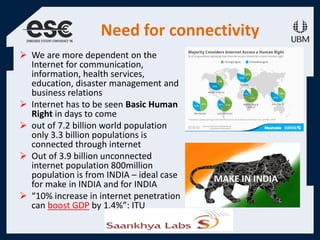
 We are more dependent on the
Internet for communication,
information, health services,
education, disaster management and
business relations
 Internet has to be seen Basic Human
Right in days to come
 out of 7.2 billion world population
only 3.3 billion populations is
connected through internet
 Out of 3.9 billion unconnected
internet population 800million
population is from INDIA – ideal case
for make in INDIA and for INDIA
 “10% increase in internet penetration
can boost GDP by 1.4%”: ITU
Need for Rural connectivity
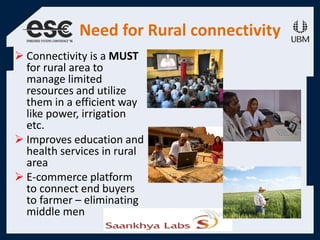
 Connectivity is a MUST
for rural area to
manage limited
resources and utilize
them in a efficient way
like power, irrigation
etc.
 Improves education and
health services in rural
area
 E-commerce platform
to connect end buyers
to farmer – eliminating
middle men
Rural Broadband :
Available solutions and Issues
ADSL/Cable/Fiber
Mobile telephony(2G/3G and 4G)
Wi-Fi (IEEE 802.11a/b/g/n)
Wi-Max (IEEE 802.16)
Satellite
ADSL/Fiber/Cable
The most common type of broadband connection
worldwide.
QoS you achieve relies heavily on how close your
telephone exchange.
As rural areas are sparsely populated, service
providers are unlikely to be interested as it
wouldn’t be commercially viable.
Big challenge in Operation and Maintenance of
cabling.
With cabling, need another 20years to cover
remaining 3.9billion population.
Mobile telephony
(3G and 4G)
This is one of the fast and scalable ways to
connect rural area.
Involves costly wave spectrum
Unfortunately 3G/4G coverage in countries
like INDIA is patchy, particularly in the rural
areas.
High entry costs and poor ROIs currently
doesn’t suit the growing countries like INDIA.
Wi-Fi
(IEEE 802.11a/b/g/n)
Works with un- licensed band and cost
effective CPE(Customer Premises Equipment)
and AP(Access Point) for deployments.
Well suited for coverage up to 100-200meters.
Not suitable for sparsely populated rural area
of 15-20kms.
Wi-Max (IEEE 802.16)
Mobile Wi-MAX was a replacement candidate
for GSM and 3G technologies.
Wi-Max operates from 2 to 11 GHz licensed
band and based on WRAN topology.
This is good candidate for last mile rural
connectivity which is limited up to 2-3Kms due
to its short multipath handling capability.
Satellite
Better alternative to cover bigger geography
wirelessly.
Building, launching and operating satellites is very
expensive which makes service to be costly.
High latency as signal have to travel 46000 miles
from customer end to back haul gateway.
Needs line of site link and depends on weather
conditions.
Comparison of different
options
Standard Range
(KMs)
Entry
Cost
Frequen
cy Band
Deploy
ment
time
Mainten
ance
cost
Network
latency
ADSL/Cabl
e/Fiber
1-2 High NA High High Low
Mobile
telephony
5(typical) High Licensed Medium Medium Low
Wi-Fi 0.1 Low Un-
licensed
Low Low Low
Wi-Max 2-3 Medium Licensed Low Low Low
Satellite >100 High Licensed High Low High
Requirement for
Rural Broadband
Entry Cost – Low like Wi-Fi
Range – at least 15-20Kms
Deployment time and Scalability – like Wi-Fi
Network Latency - <50msec
Speed per user – At least 1Mbps to have video
call
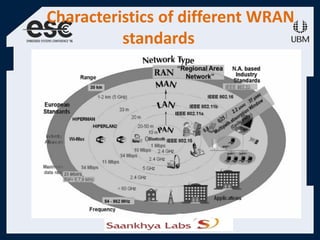
Network Topology – WRAN
Characteristics of different WRAN
standards
Rural Broadband –
Who Fits the Bill
802.22b - Cognitive Wireless Regional Area
Network(WRAN)
Range – 30Kms
Network Topology – WRAN(Fixed installation),no
mobility
Entry Cost – Less, uses un-licensed TVWS Band
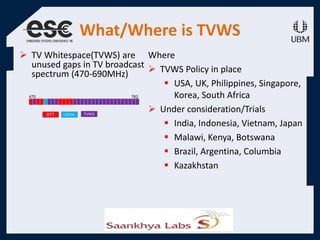
What/Where is TVWS
 TV Whitespace(TVWS) are
unused gaps in TV broadcast
spectrum (470-690MHz)
Where
 TVWS Policy in place
 USA, UK, Philippines, Singapore,
Korea, South Africa
 Under consideration/Trials
 India, Indonesia, Vietnam, Japan
 Malawi, Kenya, Botswana
 Brazil, Argentina, Columbia
 Kazakhstan
Why TVWS
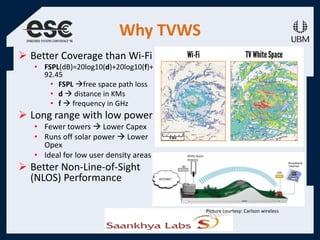
 Better Coverage than Wi-Fi
• FSPL(dB)=20log10(d)+20log10(f)+
92.45
• FSPL free space path loss
• d  distance in KMs
• f  frequency in GHz
 Long range with low power
• Fewer towers  Lower Capex
• Runs off solar power  Lower
Opex
• Ideal for low user density areas
 Better Non-Line-of-Sight
(NLOS) Performance
Picture courtesy: Carlson wireless
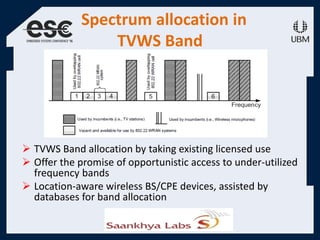
Spectrum allocation in
TVWS Band
 TVWS Band allocation by taking existing licensed use
 Offer the promise of opportunistic access to under-utilized
frequency bands
 Location-aware wireless BS/CPE devices, assisted by
databases for band allocation
Overview – 802.22
Focus Area
Rural Wireless broadband service
Core Technology
Cognitive radio technology based un-licensed TVWS
Band without affecting incumbents
Spectrum sensing, spectrum management, intra-
system co-existence, geo-location
Mobility and Portability
Limited mobility support with NO hand-off
Network Topology –Point to Multi Point
Max EIRP – 4W
Cell Radius – up to 100KMs (with MAC support)
Incumbent Protection – Sensing and Data base access
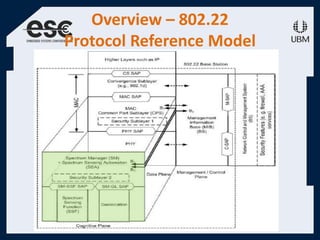
Overview – 802.22
Protocol Reference Model
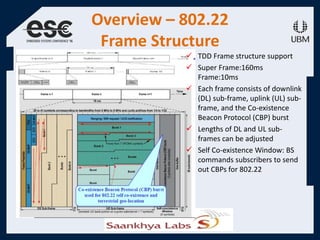
Overview – 802.22
Frame Structure
 TDD Frame structure support
 Super Frame:160ms
Frame:10ms
 Each frame consists of downlink
(DL) sub-frame, uplink (UL) sub-
frame, and the Co-existence
Beacon Protocol (CBP) burst
 Lengths of DL and UL sub-
frames can be adjusted
 Self Co-existence Window: BS
commands subscribers to send
out CBPs for 802.22
Overview – 802.22
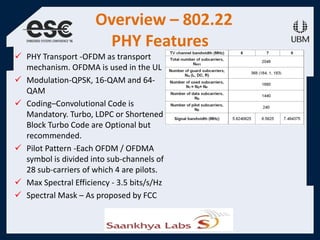
PHY Features
 PHY Transport -OFDM as transport
mechanism. OFDMA is used in the UL
 Modulation-QPSK, 16-QAM and 64-
QAM
 Coding–Convolutional Code is
Mandatory. Turbo, LDPC or Shortened
Block Turbo Code are Optional but
recommended.
 Pilot Pattern -Each OFDM / OFDMA
symbol is divided into sub-channels of
28 sub-carriers of which 4 are pilots.
 Max Spectral Efficiency - 3.5 bits/s/Hz
 Spectral Mask – As proposed by FCC
Overview – 802.22
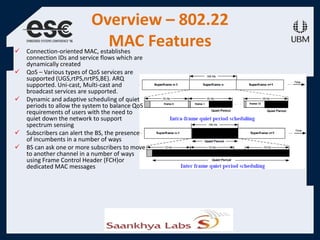
MAC Features Connection-oriented MAC, establishes
connection IDs and service flows which are
dynamically created
 QoS – Various types of QoS services are
supported (UGS,rtPS,nrtPS,BE). ARQ
supported. Uni-cast, Multi-cast and
broadcast services are supported.
 Dynamic and adaptive scheduling of quiet
periods to allow the system to balance QoS
requirements of users with the need to
quiet down the network to support
spectrum sensing
 Subscribers can alert the BS, the presence
of incumbents in a number of ways
 BS can ask one or more subscribers to move
to another channel in a number of ways
using Frame Control Header (FCH)or
dedicated MAC messages
Overview – 802.22
Cognitive Features
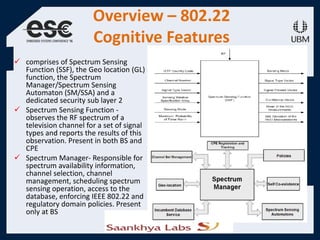
 comprises of Spectrum Sensing
Function (SSF), the Geo location (GL)
function, the Spectrum
Manager/Spectrum Sensing
Automaton (SM/SSA) and a
dedicated security sub layer 2
 Spectrum Sensing Function -
observes the RF spectrum of a
television channel for a set of signal
types and reports the results of this
observation. Present in both BS and
CPE
 Spectrum Manager- Responsible for
spectrum availability information,
channel selection, channel
management, scheduling spectrum
sensing operation, access to the
database, enforcing IEEE 802.22 and
regulatory domain policies. Present
only at BS
Overview – 802.22
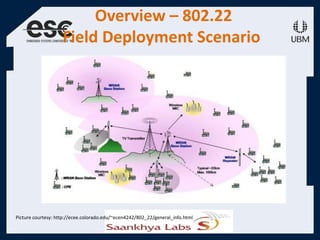
Field Deployment Scenario
Picture courtesy: http://ecee.colorado.edu/~ecen4242/802_22/general_info.html
Overview – 802.22
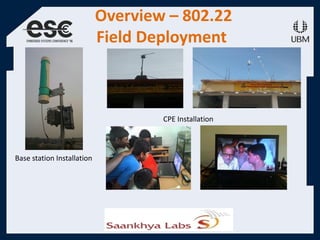
Field Deployment
Base station Installation
CPE Installation
gururaj@saankhyalabs.com
jayaram@saankhyalabs.com

TVWS:Connecting Unconnected

  • 1.
    TVWS: Connecting unconnected GururajPadaki | Jayaram Shanbhag Saankhya Labs Pvt Ltd.
  • 2.
    Agenda Need for Ruralconnectivity Rural Broadband: Available solutions and Issues Requirement for Rural Broadband TVWS for Rural Broadband Brief overview to 802.22 standard Q&A
  • 3.
    Need for connectivity We are more dependent on the Internet for communication, information, health services, education, disaster management and business relations  Internet has to be seen Basic Human Right in days to come  out of 7.2 billion world population only 3.3 billion populations is connected through internet  Out of 3.9 billion unconnected internet population 800million population is from INDIA – ideal case for make in INDIA and for INDIA  “10% increase in internet penetration can boost GDP by 1.4%”: ITU
  • 4.
    Need for Ruralconnectivity  Connectivity is a MUST for rural area to manage limited resources and utilize them in a efficient way like power, irrigation etc.  Improves education and health services in rural area  E-commerce platform to connect end buyers to farmer – eliminating middle men
  • 5.
    Rural Broadband : Availablesolutions and Issues ADSL/Cable/Fiber Mobile telephony(2G/3G and 4G) Wi-Fi (IEEE 802.11a/b/g/n) Wi-Max (IEEE 802.16) Satellite
  • 6.
    ADSL/Fiber/Cable The most commontype of broadband connection worldwide. QoS you achieve relies heavily on how close your telephone exchange. As rural areas are sparsely populated, service providers are unlikely to be interested as it wouldn’t be commercially viable. Big challenge in Operation and Maintenance of cabling. With cabling, need another 20years to cover remaining 3.9billion population.
  • 7.
    Mobile telephony (3G and4G) This is one of the fast and scalable ways to connect rural area. Involves costly wave spectrum Unfortunately 3G/4G coverage in countries like INDIA is patchy, particularly in the rural areas. High entry costs and poor ROIs currently doesn’t suit the growing countries like INDIA.
  • 8.
    Wi-Fi (IEEE 802.11a/b/g/n) Works withun- licensed band and cost effective CPE(Customer Premises Equipment) and AP(Access Point) for deployments. Well suited for coverage up to 100-200meters. Not suitable for sparsely populated rural area of 15-20kms.
  • 9.
    Wi-Max (IEEE 802.16) MobileWi-MAX was a replacement candidate for GSM and 3G technologies. Wi-Max operates from 2 to 11 GHz licensed band and based on WRAN topology. This is good candidate for last mile rural connectivity which is limited up to 2-3Kms due to its short multipath handling capability.
  • 10.
    Satellite Better alternative tocover bigger geography wirelessly. Building, launching and operating satellites is very expensive which makes service to be costly. High latency as signal have to travel 46000 miles from customer end to back haul gateway. Needs line of site link and depends on weather conditions.
  • 11.
    Comparison of different options StandardRange (KMs) Entry Cost Frequen cy Band Deploy ment time Mainten ance cost Network latency ADSL/Cabl e/Fiber 1-2 High NA High High Low Mobile telephony 5(typical) High Licensed Medium Medium Low Wi-Fi 0.1 Low Un- licensed Low Low Low Wi-Max 2-3 Medium Licensed Low Low Low Satellite >100 High Licensed High Low High
  • 12.
    Requirement for Rural Broadband EntryCost – Low like Wi-Fi Range – at least 15-20Kms Deployment time and Scalability – like Wi-Fi Network Latency - <50msec Speed per user – At least 1Mbps to have video call Network Topology – WRAN
  • 13.
  • 14.
    Rural Broadband – WhoFits the Bill 802.22b - Cognitive Wireless Regional Area Network(WRAN) Range – 30Kms Network Topology – WRAN(Fixed installation),no mobility Entry Cost – Less, uses un-licensed TVWS Band
  • 15.
    What/Where is TVWS TV Whitespace(TVWS) are unused gaps in TV broadcast spectrum (470-690MHz) Where  TVWS Policy in place  USA, UK, Philippines, Singapore, Korea, South Africa  Under consideration/Trials  India, Indonesia, Vietnam, Japan  Malawi, Kenya, Botswana  Brazil, Argentina, Columbia  Kazakhstan
  • 16.
    Why TVWS  BetterCoverage than Wi-Fi • FSPL(dB)=20log10(d)+20log10(f)+ 92.45 • FSPL free space path loss • d  distance in KMs • f  frequency in GHz  Long range with low power • Fewer towers  Lower Capex • Runs off solar power  Lower Opex • Ideal for low user density areas  Better Non-Line-of-Sight (NLOS) Performance Picture courtesy: Carlson wireless
  • 17.
    Spectrum allocation in TVWSBand  TVWS Band allocation by taking existing licensed use  Offer the promise of opportunistic access to under-utilized frequency bands  Location-aware wireless BS/CPE devices, assisted by databases for band allocation
  • 18.
    Overview – 802.22 FocusArea Rural Wireless broadband service Core Technology Cognitive radio technology based un-licensed TVWS Band without affecting incumbents Spectrum sensing, spectrum management, intra- system co-existence, geo-location Mobility and Portability Limited mobility support with NO hand-off Network Topology –Point to Multi Point Max EIRP – 4W Cell Radius – up to 100KMs (with MAC support) Incumbent Protection – Sensing and Data base access
  • 19.
  • 20.
    Overview – 802.22 FrameStructure  TDD Frame structure support  Super Frame:160ms Frame:10ms  Each frame consists of downlink (DL) sub-frame, uplink (UL) sub- frame, and the Co-existence Beacon Protocol (CBP) burst  Lengths of DL and UL sub- frames can be adjusted  Self Co-existence Window: BS commands subscribers to send out CBPs for 802.22
  • 21.
    Overview – 802.22 PHYFeatures  PHY Transport -OFDM as transport mechanism. OFDMA is used in the UL  Modulation-QPSK, 16-QAM and 64- QAM  Coding–Convolutional Code is Mandatory. Turbo, LDPC or Shortened Block Turbo Code are Optional but recommended.  Pilot Pattern -Each OFDM / OFDMA symbol is divided into sub-channels of 28 sub-carriers of which 4 are pilots.  Max Spectral Efficiency - 3.5 bits/s/Hz  Spectral Mask – As proposed by FCC
  • 22.
    Overview – 802.22 MACFeatures Connection-oriented MAC, establishes connection IDs and service flows which are dynamically created  QoS – Various types of QoS services are supported (UGS,rtPS,nrtPS,BE). ARQ supported. Uni-cast, Multi-cast and broadcast services are supported.  Dynamic and adaptive scheduling of quiet periods to allow the system to balance QoS requirements of users with the need to quiet down the network to support spectrum sensing  Subscribers can alert the BS, the presence of incumbents in a number of ways  BS can ask one or more subscribers to move to another channel in a number of ways using Frame Control Header (FCH)or dedicated MAC messages
  • 23.
    Overview – 802.22 CognitiveFeatures  comprises of Spectrum Sensing Function (SSF), the Geo location (GL) function, the Spectrum Manager/Spectrum Sensing Automaton (SM/SSA) and a dedicated security sub layer 2  Spectrum Sensing Function - observes the RF spectrum of a television channel for a set of signal types and reports the results of this observation. Present in both BS and CPE  Spectrum Manager- Responsible for spectrum availability information, channel selection, channel management, scheduling spectrum sensing operation, access to the database, enforcing IEEE 802.22 and regulatory domain policies. Present only at BS
  • 24.
    Overview – 802.22 FieldDeployment Scenario Picture courtesy: http://ecee.colorado.edu/~ecen4242/802_22/general_info.html
  • 25.
    Overview – 802.22 FieldDeployment Base station Installation CPE Installation
  • 27.