© 2012 Fluor Corporation. All Rights Reserved.
Enhancing Highways Communications using
Wireless Roadside Access Technology
Gabriel Ozique – MBA, M.Sc., FIET.
Senior Fellow Telecommunication Engineering
Fluor – Executive Overview
 One of the world’s leading publicly traded
engineering, procurement, construction,
maintenance, and project management
companies
 #109 in the FORTUNE 500 in 2014
 Over 1,000 projects annually, serving more
than 600 clients in 79 different countries
 40,000 employees executing projects globally
 Offices in 31 countries on 6 continents
 Celebrated 100 years in 2012
2
©2015
Introduction
Our Mission :
 “To provide high quality telecommunication services that support future
operational needs.”
 This delivering voice, data and video services all across England.
 On a dedicated fibre and copper network.
All purpose Trunk Roads
“Over the next five years, we will
start to improve the way we
manage traffic on some of our
busiest A roads by transforming
them into Expressways, mirroring
the journey experience normally
associated with our most advanced
motorways.”
Highways England Strategic Business Plan 2015-2020
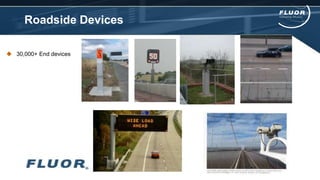
Roadside Devices
 30,000+ End devices
Why not Wireless?
6
Well, why not!
NRTS are undergoing studies to see
the feasibility of wireless networks
deployed on roadside infrastructure.
Frequency Bands and channel plan
7
VLF LF MF HF VHF UHF SHF EHF
navigational aids
(e.g. loran-C)
Maritime
navigational
signals
Am radio,
maritime radio
VHF television,
FMradio,
navigational aids
satellite
communications,
microwave
systems, WiFi
Shortwave radio,
radiotelephone
UHF television,
celluar phone,
GPS, WiFi
Radio astronomy,
microwave
systems
100 km 10 km 1 km 100 m 10 m 1 m 10 cm 1 cm 1 mm
increasing wavelength increasing frequency
3 KHz 30 KHz 300 KHz 3 MHz 30 MHz 300 MHz 3 GHz 30 GHz 300 GHz
BAND C BAND E
Identifying Useful Frequencies
 5.4 GHz (Band B)
– Licence free
– Improved output Power compared with 2.4GHz Wifi
 5.8 GHz (Band C)
– Improved Interference Protection due to licensing Process
– Less Channels than 5.4 GHz
– Underling technology the same (i.e lower Dev. cost) but Four times the power of Band B
 70 / 80 GHz (Band E)
– Interference Protection due to licensing
– High Capacity Communications (Ideal for backhaul)
8
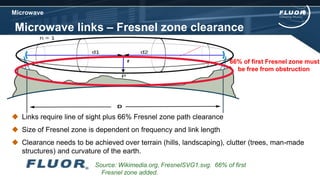
Microwave links – Fresnel zone clearance
 Links require line of sight plus 66% Fresnel zone path clearance
 Size of Fresnel zone is dependent on frequency and link length
 Clearance needs to be achieved over terrain (hills, landscaping), clutter (trees, man-made
structures) and curvature of the earth.
9
Source: Wikimedia.org, FresnelSVG1.svg. 66% of first
Fresnel zone added.
Microwave
66% of first Fresnel zone must
be free from obstruction
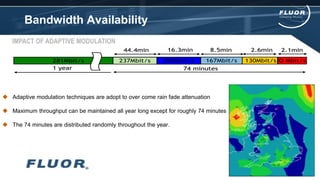
Bandwidth Availability
281Mbit/s O Mbit/s
2.1min
74 minutes
130Mbit/s167Mbit/s
2.6min
200Mbit/s237Mbit/s
8.5min16.3min44.4min
1 year
281Mbit/s O Mbit/s
2.1min
74 minutes
130Mbit/s167Mbit/s
2.6min
200Mbit/s237Mbit/s
8.5min16.3min44.4min
1 year
 Adaptive modulation techniques are adopt to over come rain fade attenuation
 Maximum throughput can be maintained all year long except for roughly 74 minutes
 The 74 minutes are distributed randomly throughout the year.
IMPACT OF ADAPTIVE MODULATION
Conceptual design 4 – CCTV 8Mbit/s variant
 Partial LOS Band C cells dimensioned to accommodate data capacity requirement
 Microwave is lightly licensed, providing additional power and higher availability
 Two backhaul points on larger schemes to increase reliability
11Design concepts
Desktop design
IP / MPLS CORE
SPC-A TS
RCC
KEY
CCTV
Message Sign
7705 SAR-8
MSR 2000
Ethernet
Microwave Backhaul Node
SPC-A TS
Microwave Repeater Node
CCTV
Message Sign
Message Sign
7750SR IP / MPLS Core Router
9500MSR Packet microwave
Wireless Link
5.8GHz Band C5.8GHz Band C
Highways Agency End Device
23GHz / 38GHz Microwave
Backbone Links
Message Sign MIDAS
Access Node with multiple STIs
7210SAS-D
CCTV Codec
CCTV
CCTVERT
ERT
ERT
ERT
 Up to 50% savings when using wireless technology rather than wire-line implementation
Deployment Considerations
 Rigid LOS structure needed for MW
 Existing infrastructure can be utilised to
reduce costs
 Space can be leased on commercial
radio towers as required
Motorways Infill Technology
 Deployed in isolation
 Alternative to cross carriage way ducting
 Provides higher channel capacity than copper
 Alternative to installing new cable when all
copper have been exhausted.
 Solution to copper theft
Longitudinal Cabling
Band C PtP Link
New
service
Intelligent Infrastructure
Daily mail UK, 2014
Flash flooding in Surrey & Wireless Sensors
 Economical
 Requires minimum maintenance
 Can be rapidly deployed
Conclusion
 Economical wireless solution that could enhance existing infrastructure
 Rapidly deployed even with no existing infrastructure
 Increase our scope of observation and monitoring with the addition of sensors
 Modulation methods are present to combat the element
 Costs can be reduced further by selecting the appropriate operating frequencies and
making use of exiting infrastructure.
 Air Interface Encrypted for Security (AES 256)
17
Any Questions?

Nation Road Telecommunication Service - wireless Solution Trial.

  • 1.
    © 2012 FluorCorporation. All Rights Reserved. Enhancing Highways Communications using Wireless Roadside Access Technology Gabriel Ozique – MBA, M.Sc., FIET. Senior Fellow Telecommunication Engineering
  • 2.
    Fluor – ExecutiveOverview  One of the world’s leading publicly traded engineering, procurement, construction, maintenance, and project management companies  #109 in the FORTUNE 500 in 2014  Over 1,000 projects annually, serving more than 600 clients in 79 different countries  40,000 employees executing projects globally  Offices in 31 countries on 6 continents  Celebrated 100 years in 2012 2 ©2015
  • 3.
    Introduction Our Mission : “To provide high quality telecommunication services that support future operational needs.”  This delivering voice, data and video services all across England.  On a dedicated fibre and copper network.
  • 4.
    All purpose TrunkRoads “Over the next five years, we will start to improve the way we manage traffic on some of our busiest A roads by transforming them into Expressways, mirroring the journey experience normally associated with our most advanced motorways.” Highways England Strategic Business Plan 2015-2020
  • 5.
  • 6.
    Why not Wireless? 6 Well,why not! NRTS are undergoing studies to see the feasibility of wireless networks deployed on roadside infrastructure.
  • 7.
    Frequency Bands andchannel plan 7 VLF LF MF HF VHF UHF SHF EHF navigational aids (e.g. loran-C) Maritime navigational signals Am radio, maritime radio VHF television, FMradio, navigational aids satellite communications, microwave systems, WiFi Shortwave radio, radiotelephone UHF television, celluar phone, GPS, WiFi Radio astronomy, microwave systems 100 km 10 km 1 km 100 m 10 m 1 m 10 cm 1 cm 1 mm increasing wavelength increasing frequency 3 KHz 30 KHz 300 KHz 3 MHz 30 MHz 300 MHz 3 GHz 30 GHz 300 GHz BAND C BAND E
  • 8.
    Identifying Useful Frequencies 5.4 GHz (Band B) – Licence free – Improved output Power compared with 2.4GHz Wifi  5.8 GHz (Band C) – Improved Interference Protection due to licensing Process – Less Channels than 5.4 GHz – Underling technology the same (i.e lower Dev. cost) but Four times the power of Band B  70 / 80 GHz (Band E) – Interference Protection due to licensing – High Capacity Communications (Ideal for backhaul) 8
  • 9.
    Microwave links –Fresnel zone clearance  Links require line of sight plus 66% Fresnel zone path clearance  Size of Fresnel zone is dependent on frequency and link length  Clearance needs to be achieved over terrain (hills, landscaping), clutter (trees, man-made structures) and curvature of the earth. 9 Source: Wikimedia.org, FresnelSVG1.svg. 66% of first Fresnel zone added. Microwave 66% of first Fresnel zone must be free from obstruction
  • 10.
    Bandwidth Availability 281Mbit/s OMbit/s 2.1min 74 minutes 130Mbit/s167Mbit/s 2.6min 200Mbit/s237Mbit/s 8.5min16.3min44.4min 1 year 281Mbit/s O Mbit/s 2.1min 74 minutes 130Mbit/s167Mbit/s 2.6min 200Mbit/s237Mbit/s 8.5min16.3min44.4min 1 year  Adaptive modulation techniques are adopt to over come rain fade attenuation  Maximum throughput can be maintained all year long except for roughly 74 minutes  The 74 minutes are distributed randomly throughout the year. IMPACT OF ADAPTIVE MODULATION
  • 11.
    Conceptual design 4– CCTV 8Mbit/s variant  Partial LOS Band C cells dimensioned to accommodate data capacity requirement  Microwave is lightly licensed, providing additional power and higher availability  Two backhaul points on larger schemes to increase reliability 11Design concepts
  • 12.
    Desktop design IP /MPLS CORE SPC-A TS RCC KEY CCTV Message Sign 7705 SAR-8 MSR 2000 Ethernet Microwave Backhaul Node SPC-A TS Microwave Repeater Node CCTV Message Sign Message Sign 7750SR IP / MPLS Core Router 9500MSR Packet microwave Wireless Link 5.8GHz Band C5.8GHz Band C Highways Agency End Device 23GHz / 38GHz Microwave Backbone Links Message Sign MIDAS Access Node with multiple STIs 7210SAS-D CCTV Codec CCTV CCTVERT ERT ERT ERT  Up to 50% savings when using wireless technology rather than wire-line implementation
  • 13.
    Deployment Considerations  RigidLOS structure needed for MW  Existing infrastructure can be utilised to reduce costs  Space can be leased on commercial radio towers as required
  • 14.
    Motorways Infill Technology Deployed in isolation  Alternative to cross carriage way ducting  Provides higher channel capacity than copper  Alternative to installing new cable when all copper have been exhausted.  Solution to copper theft Longitudinal Cabling Band C PtP Link New service
  • 15.
    Intelligent Infrastructure Daily mailUK, 2014 Flash flooding in Surrey & Wireless Sensors  Economical  Requires minimum maintenance  Can be rapidly deployed
  • 16.
    Conclusion  Economical wirelesssolution that could enhance existing infrastructure  Rapidly deployed even with no existing infrastructure  Increase our scope of observation and monitoring with the addition of sensors  Modulation methods are present to combat the element  Costs can be reduced further by selecting the appropriate operating frequencies and making use of exiting infrastructure.  Air Interface Encrypted for Security (AES 256)
  • 17.