TV WHITE SPACES
(TVWS) DEPLOYMENT
IN GHANA
By. Derek Barnabas Laryea
derek.laryea@gmail.com
Outline
 Background
 Country Profile
 Broadband Initiatives In Ghana
 TVWS Trials in Ghana
 Trial Reports – One Case in Question
 SWOT
 Critiquing the thirst for TVWS
 Recommendation
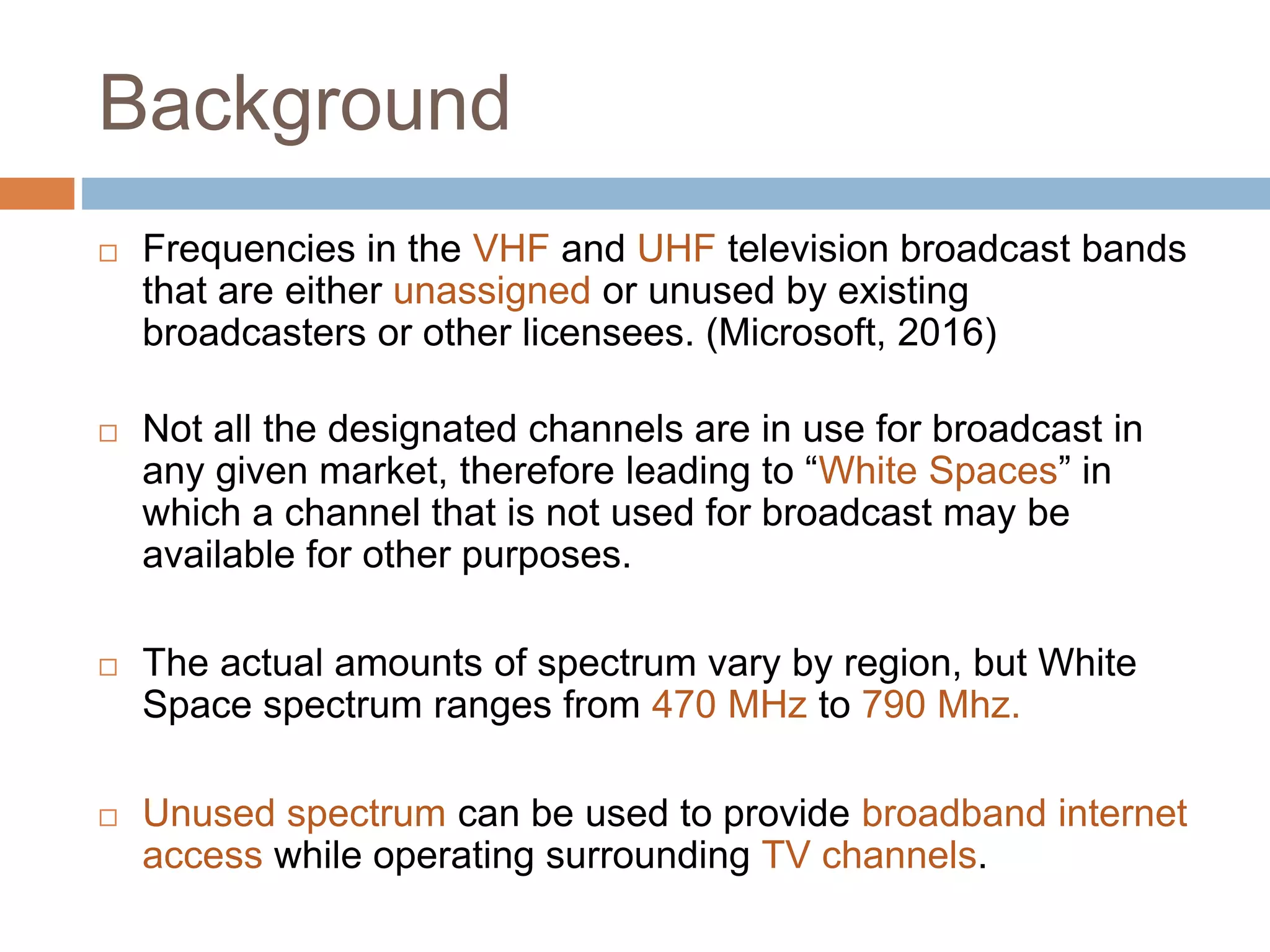
Background
 Frequencies in the VHF and UHF television broadcast bands
that are either unassigned or unused by existing
broadcasters or other licensees. (Microsoft, 2016)
 Not all the designated channels are in use for broadcast in
any given market, therefore leading to “White Spaces” in
which a channel that is not used for broadcast may be
available for other purposes.
 The actual amounts of spectrum vary by region, but White
Space spectrum ranges from 470 MHz to 790 Mhz.
 Unused spectrum can be used to provide broadband internet
access while operating surrounding TV channels.
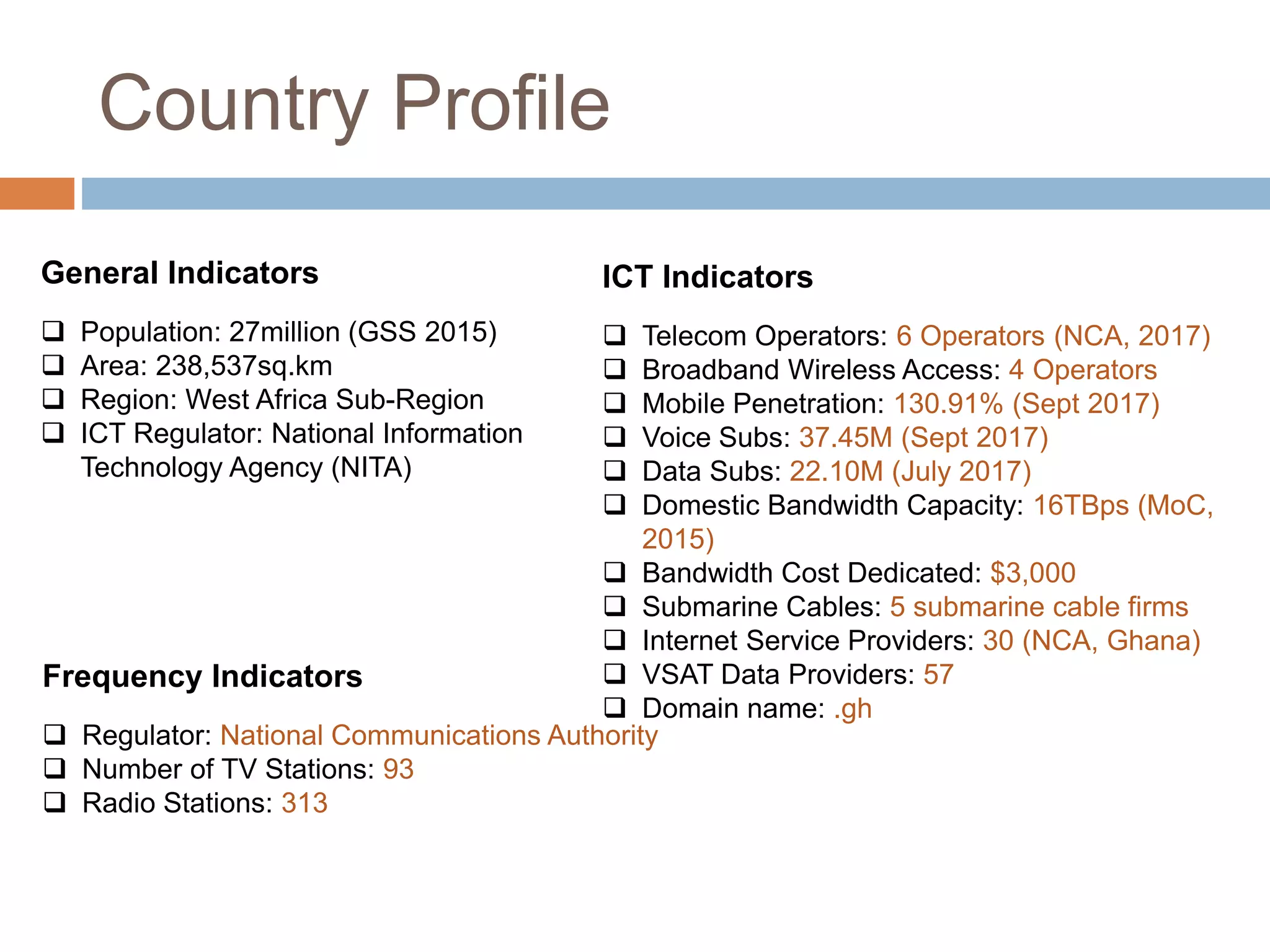
Country Profile
General Indicators
 Population: 27million (GSS 2015)
 Area: 238,537sq.km
 Region: West Africa Sub-Region
 ICT Regulator: National Information
Technology Agency (NITA)
Frequency Indicators
 Regulator: National Communications Authority
 Number of TV Stations: 93
 Radio Stations: 313
ICT Indicators
 Telecom Operators: 6 Operators (NCA, 2017)
 Broadband Wireless Access: 4 Operators
 Mobile Penetration: 130.91% (Sept 2017)
 Voice Subs: 37.45M (Sept 2017)
 Data Subs: 22.10M (July 2017)
 Domestic Bandwidth Capacity: 16TBps (MoC,
2015)
 Bandwidth Cost Dedicated: $3,000
 Submarine Cables: 5 submarine cable firms
 Internet Service Providers: 30 (NCA, Ghana)
 VSAT Data Providers: 57
 Domain name: .gh
Urbanization & Geography
Urban Geography is about 46%
Rural Geography is about 54%
Ghana has a lot of Mountains,
Rivers and Forests with extremely
large vegetation cover.
The TVWS deployment objectives fits
such territories and geography like
Ghana
Industry Broadband Initiatives
 Liberalization of Telecommunications in 1994- 2000
(ADP2000)
 Establishment of the NCA in 1996
 Privatization of Ghana Telecom in 1996
 Award of 2G licenses in 2004
 Award of 3G licenses in 2008-2009
 Award of 6th Mobile license in 2008
 Award of Broadband Wireless Access (4G licenses) in
2010
 Award of 4G license in 2016
 TVWS Regulations in 2016
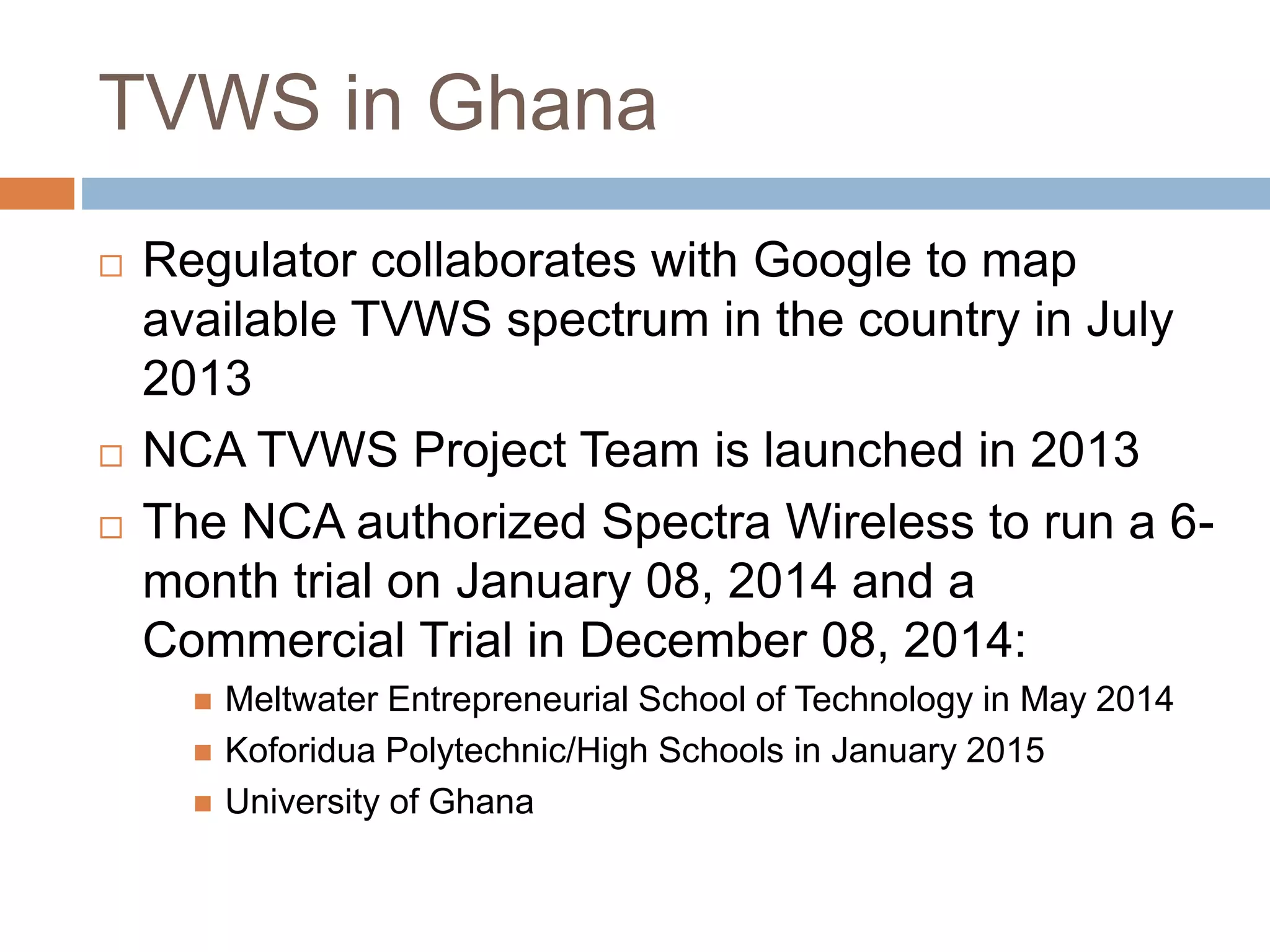
TVWS in Ghana
 Regulator collaborates with Google to map
available TVWS spectrum in the country in July
2013
 NCA TVWS Project Team is launched in 2013
 The NCA authorized Spectra Wireless to run a 6-
month trial on January 08, 2014 and a
Commercial Trial in December 08, 2014:
 Meltwater Entrepreneurial School of Technology in May 2014
 Koforidua Polytechnic/High Schools in January 2015
 University of Ghana
TVWS Use Case – University of
Ghana (UG)
UG NoC – Network Operating Centre
(NOC)
Little Legon – University staff residence
School of Engineering
Channel 29; Link between Base Station and
5 Little Legon and 35 Little Legon
TVWS Use Case – University of
Ghana (UG)
TVWS Yagi Antennae
TVWS Radio & PoE used for Trials
The team findings shared
with me on this particular
Trial within the premier
University of Ghana’s
campus concluded that per
its findings the inspection
was satisfactory.
However, recommendations
were made to increasing
antenna height at the base
station site and vary its
modulation schemes
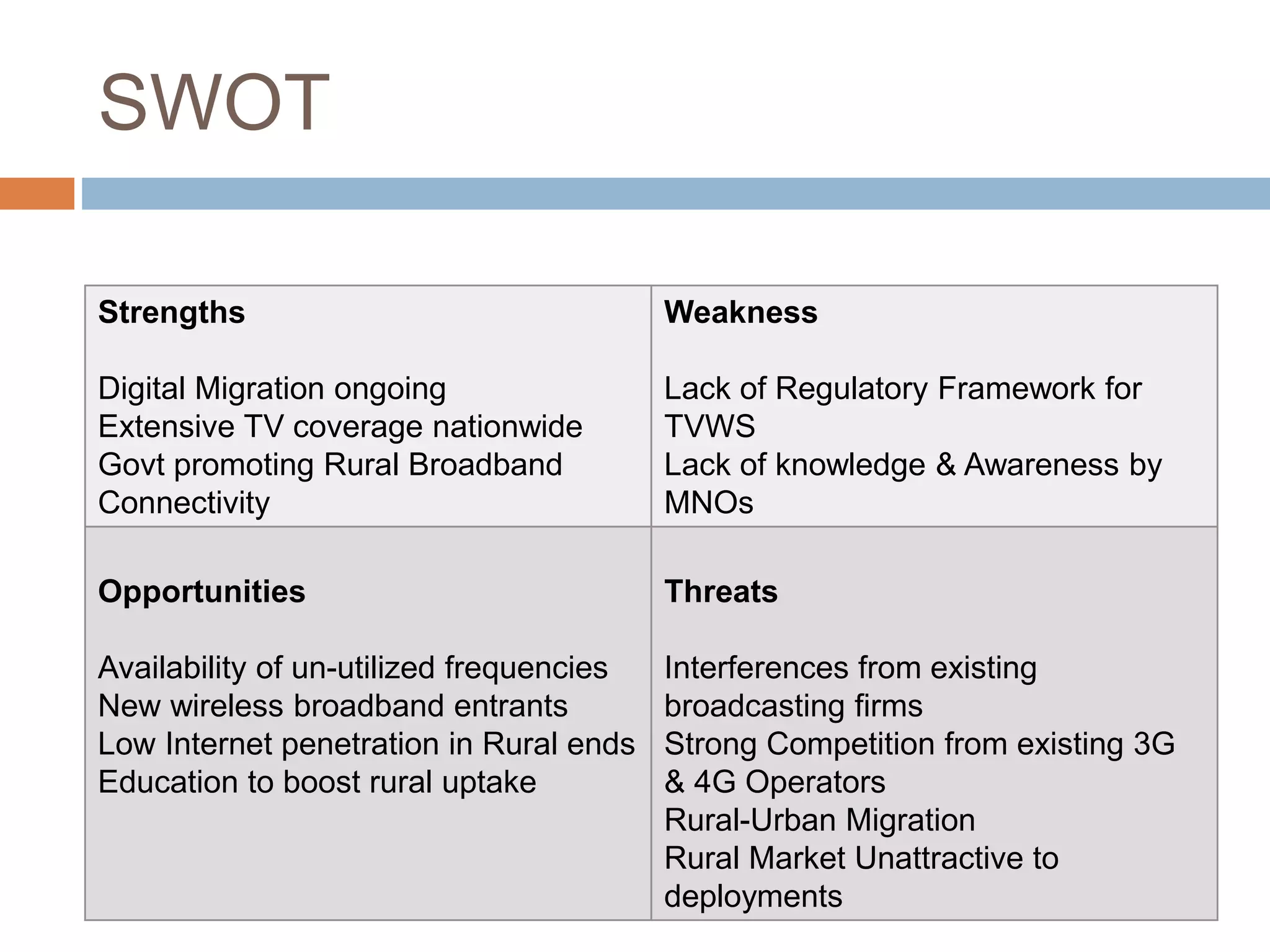
SWOT
Strengths
Digital Migration ongoing
Extensive TV coverage nationwide
Govt promoting Rural Broadband
Connectivity
Weakness
Lack of Regulatory Framework for
TVWS
Lack of knowledge & Awareness by
MNOs
Opportunities
Availability of un-utilized frequencies
New wireless broadband entrants
Low Internet penetration in Rural ends
Education to boost rural uptake
Threats
Interferences from existing
broadcasting firms
Strong Competition from existing 3G
& 4G Operators
Rural-Urban Migration
Rural Market Unattractive to
deployments
Current Status
 The National Communications Authority (NCA)
intends to introduce the Television White
Space (TVWS) Spectrum Usage Regulatory
Framework in order to streamline the provision
of data services in the Television Ultra-High
Frequency (UHF) Bands
 Current Regulatory Plans to further deepen the TVWS
program with the support of a regulatory framework
although trials have not proven any “eureka” gains till
date.
Critiquing the TVWS thirst (1)
 TV White Space is unlike any technology on
the market because it uses the same
frequencies that broadcasters use to get
programming to our TV sets
 Till date and from my review of Ghana’s trials,
TVWS has not
 Closed the Digital Divide
 Cheapened Internet Access
 Enhanced Spectrum Utilization
 Driven Economic Growth
Critiquing the TVWS thirst (2)
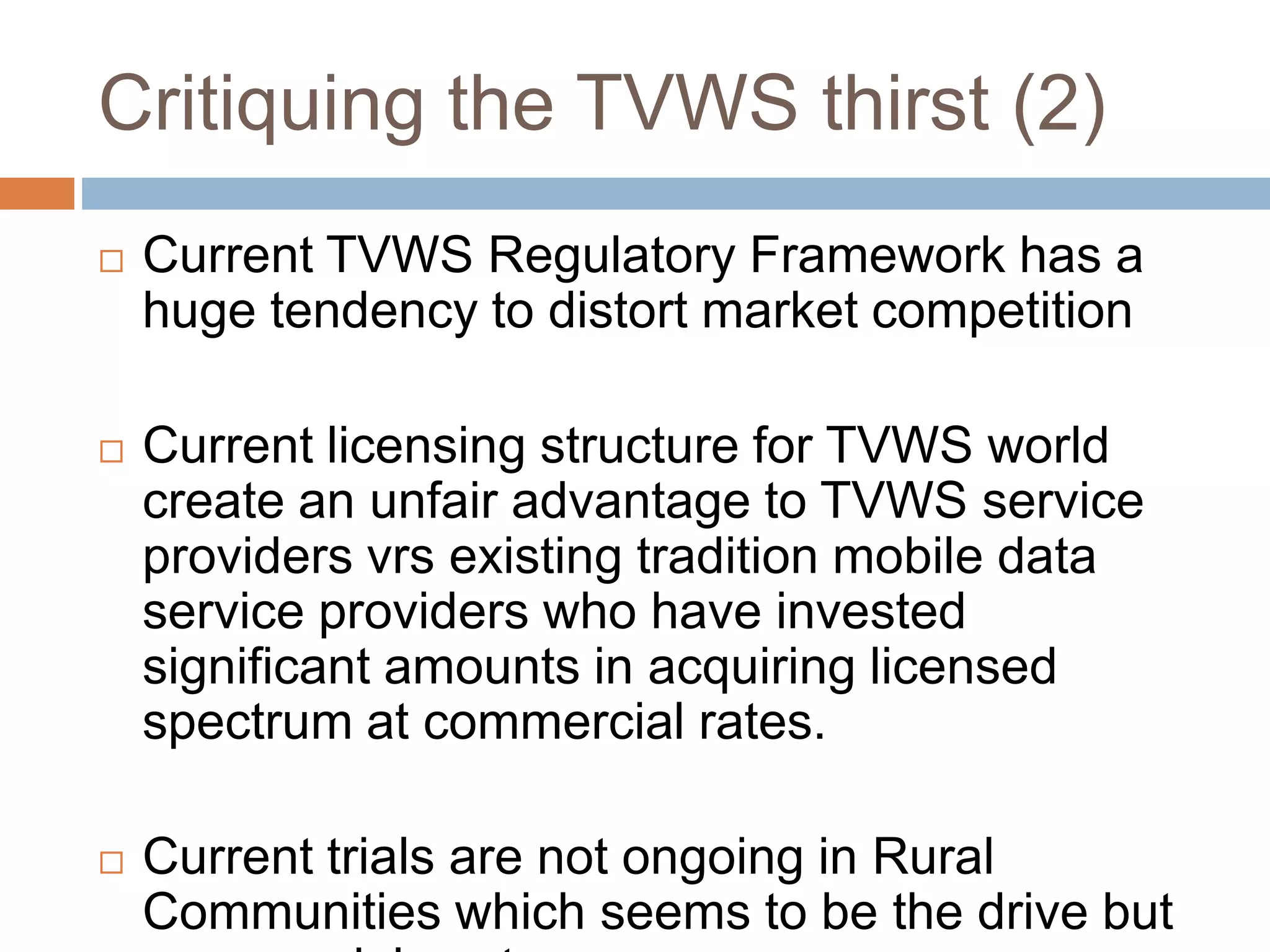
 Current TVWS Regulatory Framework has a
huge tendency to distort market competition
 Current licensing structure for TVWS world
create an unfair advantage to TVWS service
providers vrs existing tradition mobile data
service providers who have invested
significant amounts in acquiring licensed
spectrum at commercial rates.
 Current trials are not ongoing in Rural
Communities which seems to be the drive but
Critiquing the TVWS thirst (3)
 Allowing TVWS service providers to deliver
Internet/Public Data services in urban or highly
developed metropolitan areas or within
locaties served by the MNOs in Ghana will
create further revenue cannibalization.
 Broadband provides significant economic
advantage but its important the thirst for more
Broadband should not jeopardize the
commercial operations of already licensed
mobile operators and the future of the UHF
Critiquing the TVWS thirst (4)
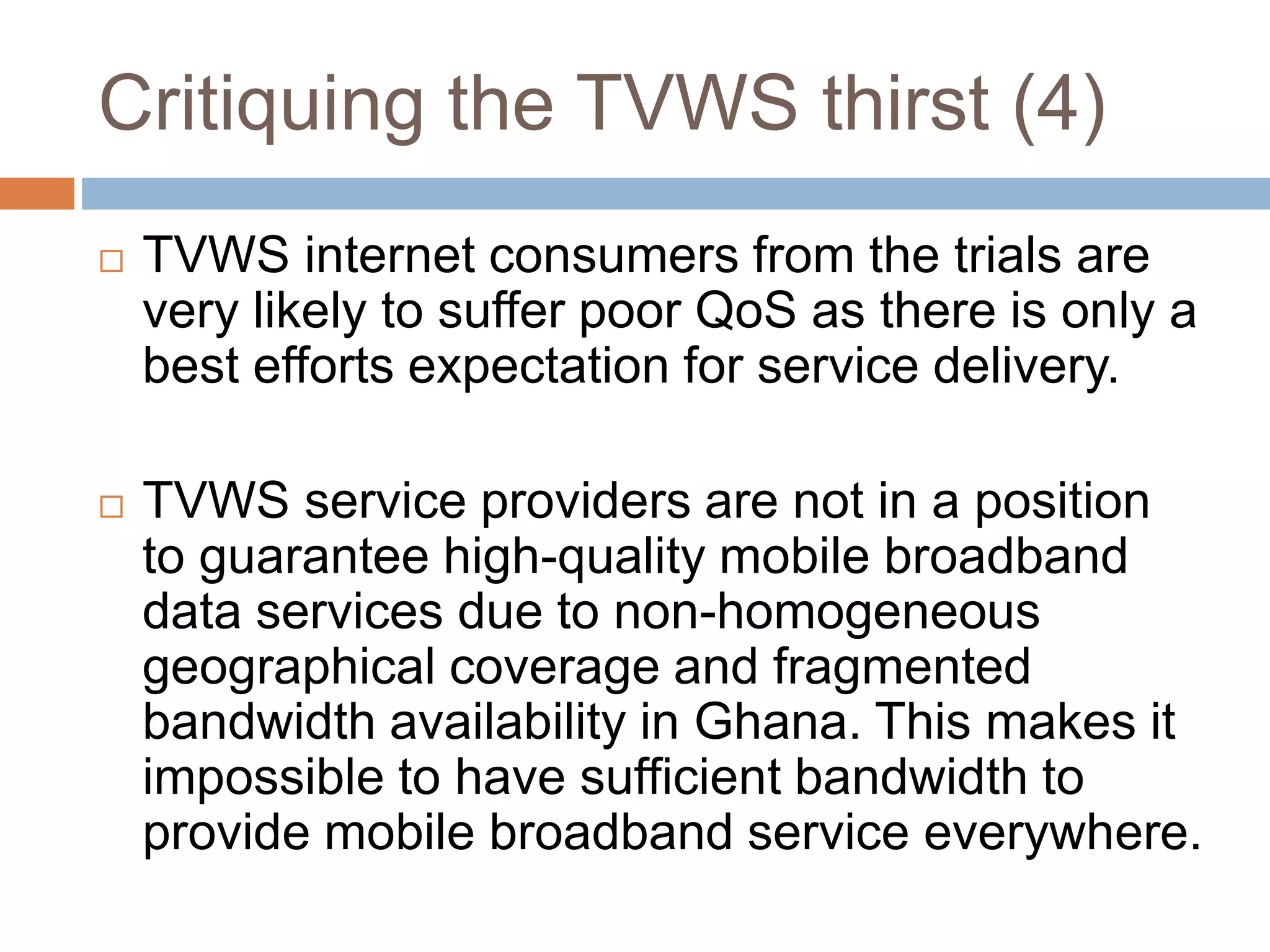
 TVWS internet consumers from the trials are
very likely to suffer poor QoS as there is only a
best efforts expectation for service delivery.
 TVWS service providers are not in a position
to guarantee high-quality mobile broadband
data services due to non-homogeneous
geographical coverage and fragmented
bandwidth availability in Ghana. This makes it
impossible to have sufficient bandwidth to
provide mobile broadband service everywhere.
Recommendation
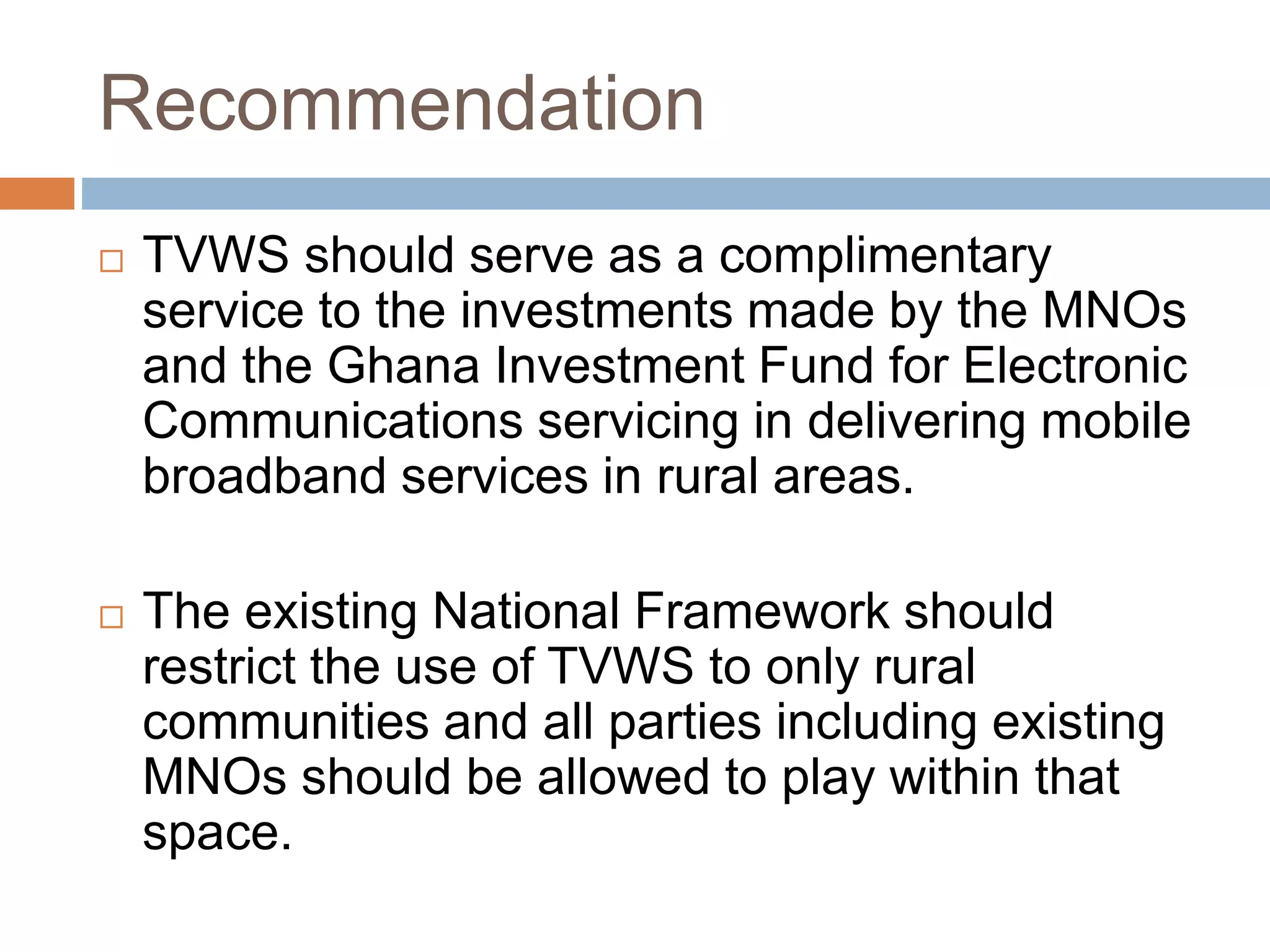
 TVWS should serve as a complimentary
service to the investments made by the MNOs
and the Ghana Investment Fund for Electronic
Communications servicing in delivering mobile
broadband services in rural areas.
 The existing National Framework should
restrict the use of TVWS to only rural
communities and all parties including existing
MNOs should be allowed to play within that
space.
Conclusion
Materials Sourced
 www.nca.org.gh
 http://www.nca.org.gh/downloads/TVWS_Technology_Public_Consultation_Rev_20_06_2
016.pdf
 www.gsma.com
 http://www.statsghana.gov.gh/
 http://dynamicspectrumalliance.org/assets/submissions/2014-12-
17%20Dynamic%20Spectrum%20Alliance%20Comment%20on%20Philippine%20Memor
andum%20Circular.pdf
 World Economic Report
 World Bank Report
THANK YOU!!!

TV White Spaces Deployment in Ghana - ASM Presentation

  • 1.
    TV WHITE SPACES (TVWS)DEPLOYMENT IN GHANA By. Derek Barnabas Laryea derek.laryea@gmail.com
  • 2.
    Outline  Background  CountryProfile  Broadband Initiatives In Ghana  TVWS Trials in Ghana  Trial Reports – One Case in Question  SWOT  Critiquing the thirst for TVWS  Recommendation
  • 3.
    Background  Frequencies inthe VHF and UHF television broadcast bands that are either unassigned or unused by existing broadcasters or other licensees. (Microsoft, 2016)  Not all the designated channels are in use for broadcast in any given market, therefore leading to “White Spaces” in which a channel that is not used for broadcast may be available for other purposes.  The actual amounts of spectrum vary by region, but White Space spectrum ranges from 470 MHz to 790 Mhz.  Unused spectrum can be used to provide broadband internet access while operating surrounding TV channels.
  • 4.
    Country Profile General Indicators Population: 27million (GSS 2015)  Area: 238,537sq.km  Region: West Africa Sub-Region  ICT Regulator: National Information Technology Agency (NITA) Frequency Indicators  Regulator: National Communications Authority  Number of TV Stations: 93  Radio Stations: 313 ICT Indicators  Telecom Operators: 6 Operators (NCA, 2017)  Broadband Wireless Access: 4 Operators  Mobile Penetration: 130.91% (Sept 2017)  Voice Subs: 37.45M (Sept 2017)  Data Subs: 22.10M (July 2017)  Domestic Bandwidth Capacity: 16TBps (MoC, 2015)  Bandwidth Cost Dedicated: $3,000  Submarine Cables: 5 submarine cable firms  Internet Service Providers: 30 (NCA, Ghana)  VSAT Data Providers: 57  Domain name: .gh
  • 5.
    Urbanization & Geography UrbanGeography is about 46% Rural Geography is about 54% Ghana has a lot of Mountains, Rivers and Forests with extremely large vegetation cover. The TVWS deployment objectives fits such territories and geography like Ghana
  • 6.
    Industry Broadband Initiatives Liberalization of Telecommunications in 1994- 2000 (ADP2000)  Establishment of the NCA in 1996  Privatization of Ghana Telecom in 1996  Award of 2G licenses in 2004  Award of 3G licenses in 2008-2009  Award of 6th Mobile license in 2008  Award of Broadband Wireless Access (4G licenses) in 2010  Award of 4G license in 2016  TVWS Regulations in 2016
  • 7.
    TVWS in Ghana Regulator collaborates with Google to map available TVWS spectrum in the country in July 2013  NCA TVWS Project Team is launched in 2013  The NCA authorized Spectra Wireless to run a 6- month trial on January 08, 2014 and a Commercial Trial in December 08, 2014:  Meltwater Entrepreneurial School of Technology in May 2014  Koforidua Polytechnic/High Schools in January 2015  University of Ghana
  • 8.
    TVWS Use Case– University of Ghana (UG) UG NoC – Network Operating Centre (NOC) Little Legon – University staff residence School of Engineering Channel 29; Link between Base Station and 5 Little Legon and 35 Little Legon
  • 9.
    TVWS Use Case– University of Ghana (UG) TVWS Yagi Antennae TVWS Radio & PoE used for Trials The team findings shared with me on this particular Trial within the premier University of Ghana’s campus concluded that per its findings the inspection was satisfactory. However, recommendations were made to increasing antenna height at the base station site and vary its modulation schemes
  • 10.
    SWOT Strengths Digital Migration ongoing ExtensiveTV coverage nationwide Govt promoting Rural Broadband Connectivity Weakness Lack of Regulatory Framework for TVWS Lack of knowledge & Awareness by MNOs Opportunities Availability of un-utilized frequencies New wireless broadband entrants Low Internet penetration in Rural ends Education to boost rural uptake Threats Interferences from existing broadcasting firms Strong Competition from existing 3G & 4G Operators Rural-Urban Migration Rural Market Unattractive to deployments
  • 11.
    Current Status  TheNational Communications Authority (NCA) intends to introduce the Television White Space (TVWS) Spectrum Usage Regulatory Framework in order to streamline the provision of data services in the Television Ultra-High Frequency (UHF) Bands  Current Regulatory Plans to further deepen the TVWS program with the support of a regulatory framework although trials have not proven any “eureka” gains till date.
  • 12.
    Critiquing the TVWSthirst (1)  TV White Space is unlike any technology on the market because it uses the same frequencies that broadcasters use to get programming to our TV sets  Till date and from my review of Ghana’s trials, TVWS has not  Closed the Digital Divide  Cheapened Internet Access  Enhanced Spectrum Utilization  Driven Economic Growth
  • 13.
    Critiquing the TVWSthirst (2)  Current TVWS Regulatory Framework has a huge tendency to distort market competition  Current licensing structure for TVWS world create an unfair advantage to TVWS service providers vrs existing tradition mobile data service providers who have invested significant amounts in acquiring licensed spectrum at commercial rates.  Current trials are not ongoing in Rural Communities which seems to be the drive but
  • 14.
    Critiquing the TVWSthirst (3)  Allowing TVWS service providers to deliver Internet/Public Data services in urban or highly developed metropolitan areas or within locaties served by the MNOs in Ghana will create further revenue cannibalization.  Broadband provides significant economic advantage but its important the thirst for more Broadband should not jeopardize the commercial operations of already licensed mobile operators and the future of the UHF
  • 15.
    Critiquing the TVWSthirst (4)  TVWS internet consumers from the trials are very likely to suffer poor QoS as there is only a best efforts expectation for service delivery.  TVWS service providers are not in a position to guarantee high-quality mobile broadband data services due to non-homogeneous geographical coverage and fragmented bandwidth availability in Ghana. This makes it impossible to have sufficient bandwidth to provide mobile broadband service everywhere.
  • 16.
    Recommendation  TVWS shouldserve as a complimentary service to the investments made by the MNOs and the Ghana Investment Fund for Electronic Communications servicing in delivering mobile broadband services in rural areas.  The existing National Framework should restrict the use of TVWS to only rural communities and all parties including existing MNOs should be allowed to play within that space.
  • 17.
    Conclusion Materials Sourced  www.nca.org.gh http://www.nca.org.gh/downloads/TVWS_Technology_Public_Consultation_Rev_20_06_2 016.pdf  www.gsma.com  http://www.statsghana.gov.gh/  http://dynamicspectrumalliance.org/assets/submissions/2014-12- 17%20Dynamic%20Spectrum%20Alliance%20Comment%20on%20Philippine%20Memor andum%20Circular.pdf  World Economic Report  World Bank Report THANK YOU!!!

Editor's Notes

  • #9 BRIEF DESCRIPTION OF NETWORK The network layout is outlined in the diagram to the left above. UG has partnered Vodafone Ghana as its internet capacity provider, in which the UG is provided with 670Megabytes capacity. The network operating centre (NOC) is connected to the Vodafone Ghana’s Fibre network. The main base station is located at the residence of the Vice Chancellor. This base station is connected to the NOC through a single mode fibre optic.   From this base station, there are TVWS links to two residential areas for the UG staff (5 Little Legon and 35 Little Legon) and the School of Engineering. Channel 29 (534-542MHz) was assigned to each link are shown in Fig.1 above. At each site, there is a Carlson equipment which comprises of the radio and power-over-ethernet (PoE) units, and this is connected to an Access Point (AP) for WIFI access. The School of Engineering site is temporarily down due to faults in the TVWS equipment.
  • #10 OBSERVATIONS At the end of the inspection, the team observed that: The emission from the TVWS devices occupied 7MHz out of the 8MHz channel, thus leaving a guard band of 0.5MHz at each edge. This will minimize interference to adjacent television or other TVWS services in the band. UG was using channel 29 for its transmissions. The TV spectrum was scanned before channels were assigned manually to the TVWS devices. There were TV services adjacent to the TVWS channels used by UG at the time of the inspection. They had not yet experienced any interference. Regardless of the high foliage presence, internet access was satisfactory at the receiving end.