DECLINE AND TURNAROUND
MANAGEMENT
Turnaround is of considerable
importance to strategic management.
However the process by which firms
move away from deterioration in
performance to enduring success has
not received sufficient attention in
management literature.
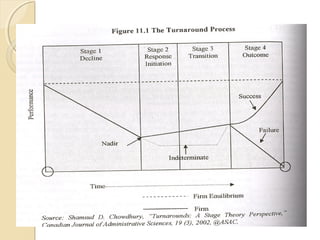
The frame work of the Turnaround
Process:
Turnaround Process model of
Shamsud Chowdhury
( Turnarounds: A stage theory perspective)
The turnaround occurs when “ a firm
perseveres through an existence
threatening performance decline;
ends the threat with a combination of
strategies, systems, skills & capabilities; and
achieves sustainable performance
recovery. The reverse is failure and
eventual death.
The definition identifies four key
attributes of a turnaround:
1.Declining performance is the trigger for
turnaround.
2.Turnaround involves a series of activities.
3. A turnaround is undertaken with a
definite purpose.
4.Turn around activities continue for a
number of years.
Shamsud Chowdhury suggested the
use of a stage theory to study the
turnaround process.
The four stages mentioned are:
Decline stage
Response initiation stage
Transition stage
Outcome stage
Stage-1- Decline:

1. Decline starts from firm equilibrium and reaches
a nadir.
This is based on :
K- extinction perspective : Macro or external
factors related to the industry in general is
responsible for the decline.
R- extinction theory: The decline is due to
reduction in resources within the firm ,
independent of the external environment.
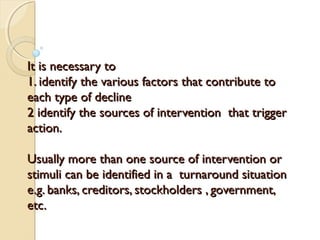
It is necessary to
1. identify the various factors that contribute to
each type of decline
2 identify the sources of intervention that trigger
action.
Usually more than one source of intervention or
stimuli can be identified in a turnaround situation
e.g. banks, creditors, stockholders , government,
etc.
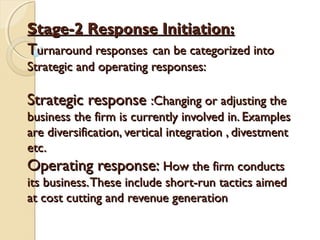
Stage-2 Response Initiation:
Turnaround responses can be categorized into
Strategic and operating responses:

Strategic response :Changing or adjusting the

business the firm is currently involved in. Examples
are diversification, vertical integration , divestment
etc.
Operating response: How the firm conducts
its business. These include short-run tactics aimed
at cost cutting and revenue generation
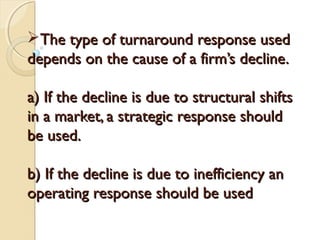
The type of turnaround response used
depends on the cause of a firm’s decline.
a) If the decline is due to structural shifts
in a market, a strategic response should
be used.
b) If the decline is due to inefficiency an
operating response should be used
Stage-3 Transition :

A substantial amount of time has to
pass before the results of turnaround
strategies show.
Stage-4 Outcome :
To determine whether a turnaround has
been accomplishedA cut-off point of measure of performance
can be used to measure this.
The measures used to determine outcome
should be same as was used to determine
the decline
e.g. the same ratios in ratio analysis should be
used before and after the turnaround to
measure the accomplishment

Turnaround management

  • 1.
  • 2.
    Turnaround is ofconsiderable importance to strategic management. However the process by which firms move away from deterioration in performance to enduring success has not received sufficient attention in management literature.
  • 3.
    The frame workof the Turnaround Process: Turnaround Process model of Shamsud Chowdhury ( Turnarounds: A stage theory perspective)
  • 4.
    The turnaround occurswhen “ a firm perseveres through an existence threatening performance decline; ends the threat with a combination of strategies, systems, skills & capabilities; and achieves sustainable performance recovery. The reverse is failure and eventual death.
  • 5.
    The definition identifiesfour key attributes of a turnaround: 1.Declining performance is the trigger for turnaround. 2.Turnaround involves a series of activities. 3. A turnaround is undertaken with a definite purpose. 4.Turn around activities continue for a number of years.
  • 6.
    Shamsud Chowdhury suggestedthe use of a stage theory to study the turnaround process. The four stages mentioned are: Decline stage Response initiation stage Transition stage Outcome stage
  • 8.
    Stage-1- Decline: 1. Declinestarts from firm equilibrium and reaches a nadir. This is based on : K- extinction perspective : Macro or external factors related to the industry in general is responsible for the decline. R- extinction theory: The decline is due to reduction in resources within the firm , independent of the external environment.
  • 9.
    It is necessaryto 1. identify the various factors that contribute to each type of decline 2 identify the sources of intervention that trigger action. Usually more than one source of intervention or stimuli can be identified in a turnaround situation e.g. banks, creditors, stockholders , government, etc.
  • 10.
    Stage-2 Response Initiation: Turnaroundresponses can be categorized into Strategic and operating responses: Strategic response :Changing or adjusting the business the firm is currently involved in. Examples are diversification, vertical integration , divestment etc. Operating response: How the firm conducts its business. These include short-run tactics aimed at cost cutting and revenue generation
  • 11.
    The type ofturnaround response used depends on the cause of a firm’s decline. a) If the decline is due to structural shifts in a market, a strategic response should be used. b) If the decline is due to inefficiency an operating response should be used
  • 12.
    Stage-3 Transition : Asubstantial amount of time has to pass before the results of turnaround strategies show.
  • 13.
    Stage-4 Outcome : Todetermine whether a turnaround has been accomplishedA cut-off point of measure of performance can be used to measure this. The measures used to determine outcome should be same as was used to determine the decline e.g. the same ratios in ratio analysis should be used before and after the turnaround to measure the accomplishment