© 2020 Wael Badawy
11
RANSAC
— Computer Vision —
DISCLAIMER:
This video is optimized for HD large display using
patented and patent-pending “Nile Codec”, the first
Egyptian Video Codec for more information,
PLEASE check https://NileCodec.com
RAndom SAmple Consensus
Also available as a PodCast
http://www.wired.com/gadgetlab/2010/07/camera-software-lets-you-see-into-the-past/
© 2020 Wael Badawy
Copyright © 2020 Wael Badawy. All rights reserved
 This video is subject to copyright owned by Wael Badawy “WB”. Any
reproduction or republication of all or part of this video is expressly prohibited
unless WB has explicitly granted its prior written consent. All other rights
reserved.
 This video is intended for education and information only and is offered AS IS,
without any warranty of the accuracy or the quality of the content. Any other
use is strictly prohibited. The viewer is fully responsible to verify the accuracy
of the contents received without any claims of costs or liability arising .
 The names, trademarks service marked as logos of WB or the sponsors
appearing in this video may not be used in any any product or service,
without prior express written permission from WB and the video sponsors
 Neither WB nor any party involved in creating, producing or delivering
information and material via this video shall be liable for any direction,
incidental, consequential, indirect of punitive damages arising out of access
to, use or inability to use this content or any errors or omissions in the
content thereof.
 If you will continue to watch this video, you agree to the terms above and
other terms that may be available on http://nu.edu.eg & https://caiwave.net
2
© 2020 Wael Badawy
© 2020 Wael Badawy
Reading
 Szeliski: Chapter 6.1
© 2020 Wael Badawy
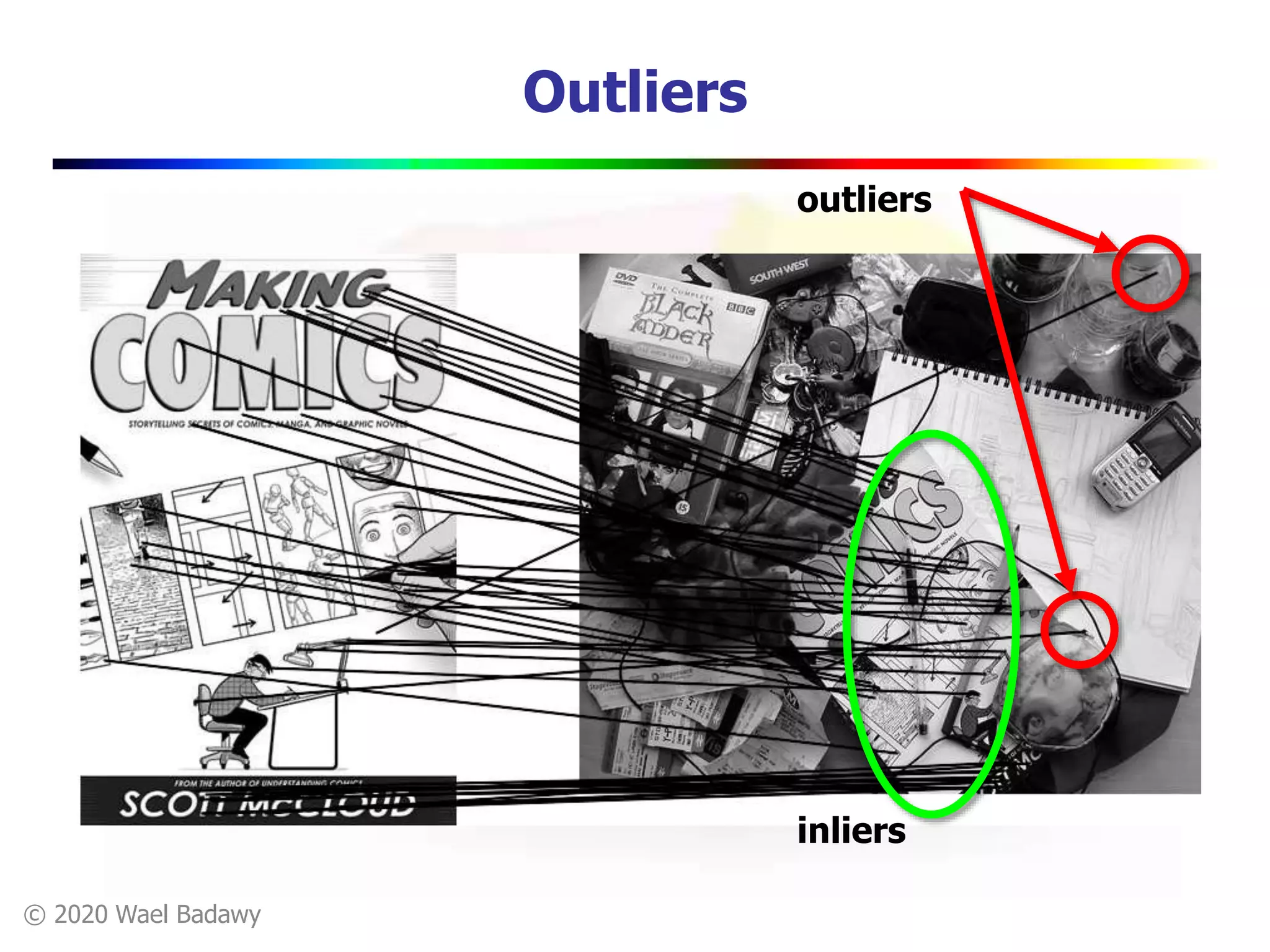
Outliers
outliers
inliers
© 2020 Wael Badawy
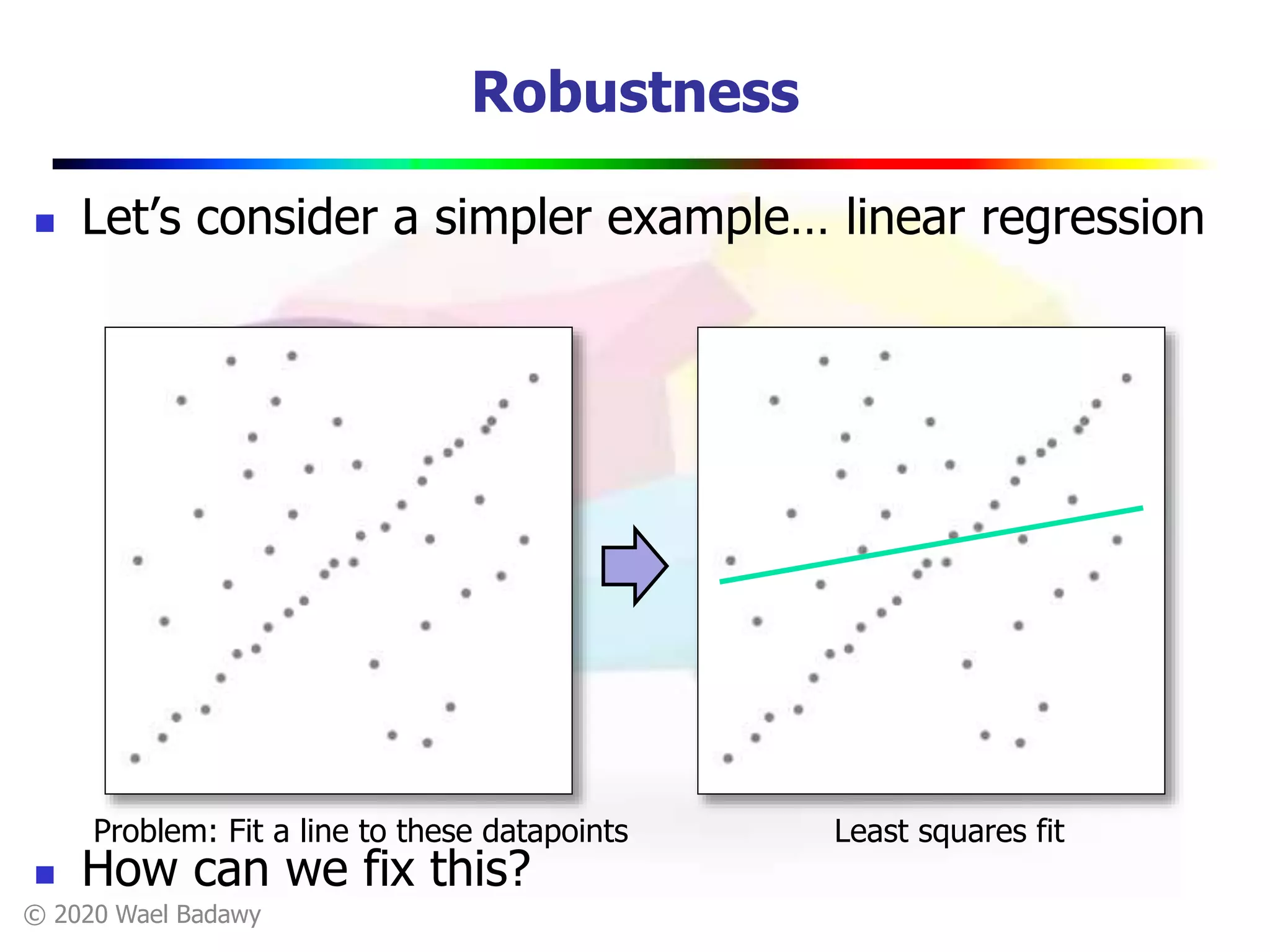
Robustness
 Let’s consider a simpler example… linear regression
 How can we fix this?
Problem: Fit a line to these datapoints Least squares fit
© 2020 Wael Badawy
We need a better cost function…
 Suggestions?
© 2020 Wael Badawy
Idea
 Given a hypothesized line
 Count the number of points that “agree” with the
line
 “Agree” = within a small distance of the line
 I.e., the inliers to that line
 For all possible lines, select the one with the
largest number of inliers
© 2020 Wael Badawy
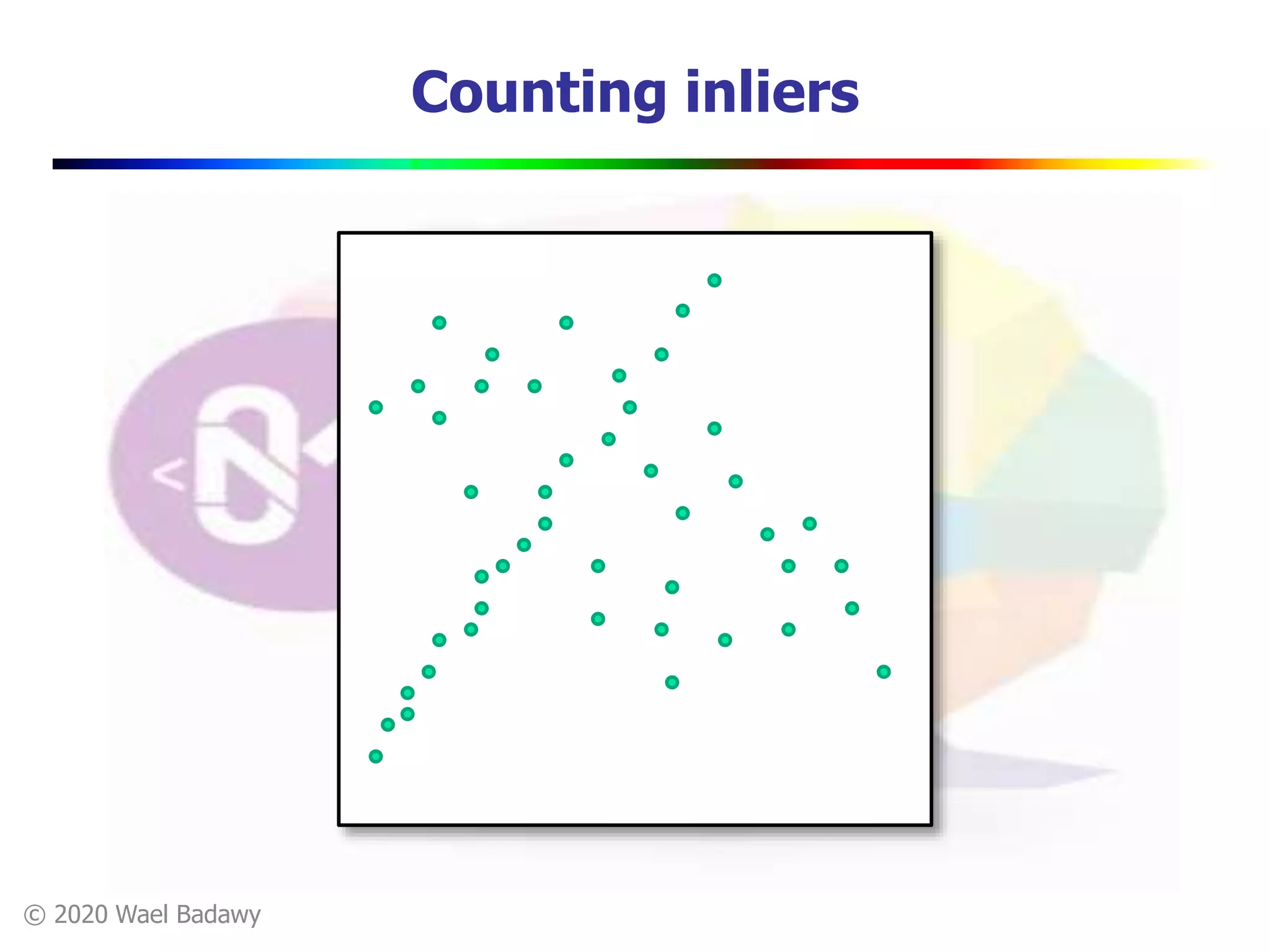
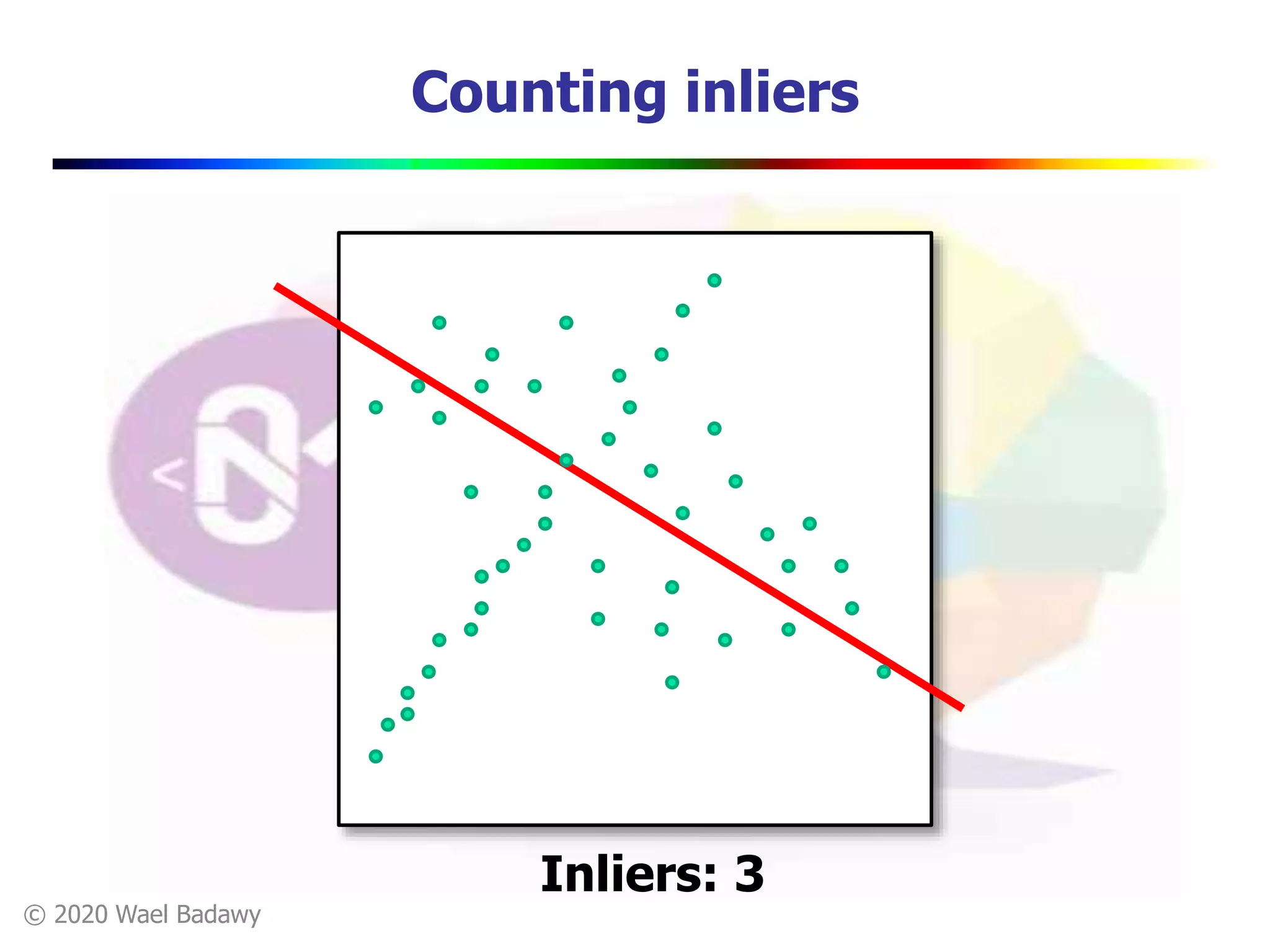
Counting inliers
© 2020 Wael Badawy
Counting inliers
Inliers: 3
© 2020 Wael Badawy
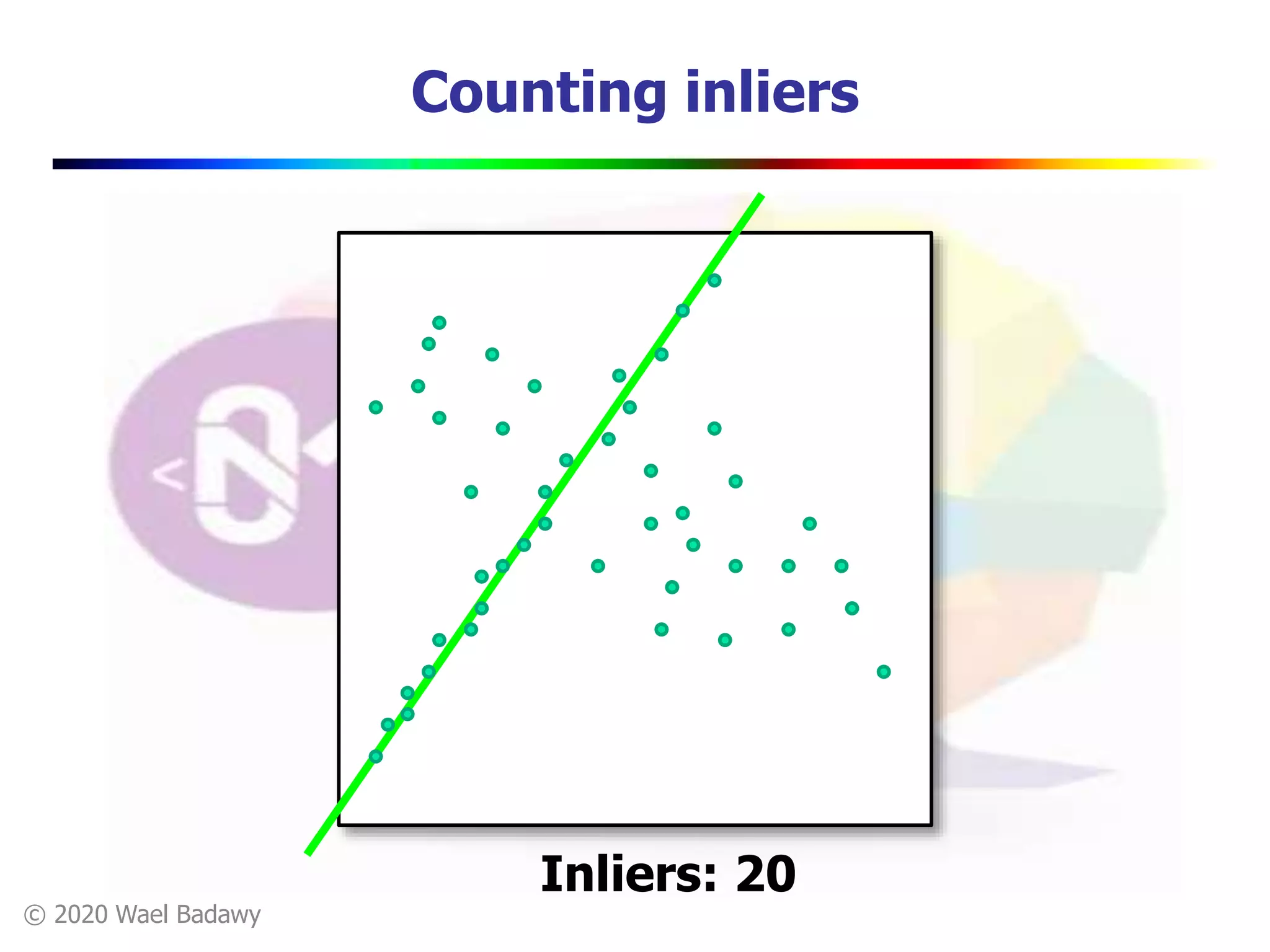
Counting inliers
Inliers: 20
© 2020 Wael Badawy
How do we find the best line?
 Unlike least-squares, no simple closed-form
solution
 Hypothesize-and-test
 Try out many lines, keep the best one
 Which lines?
© 2020 Wael Badawy
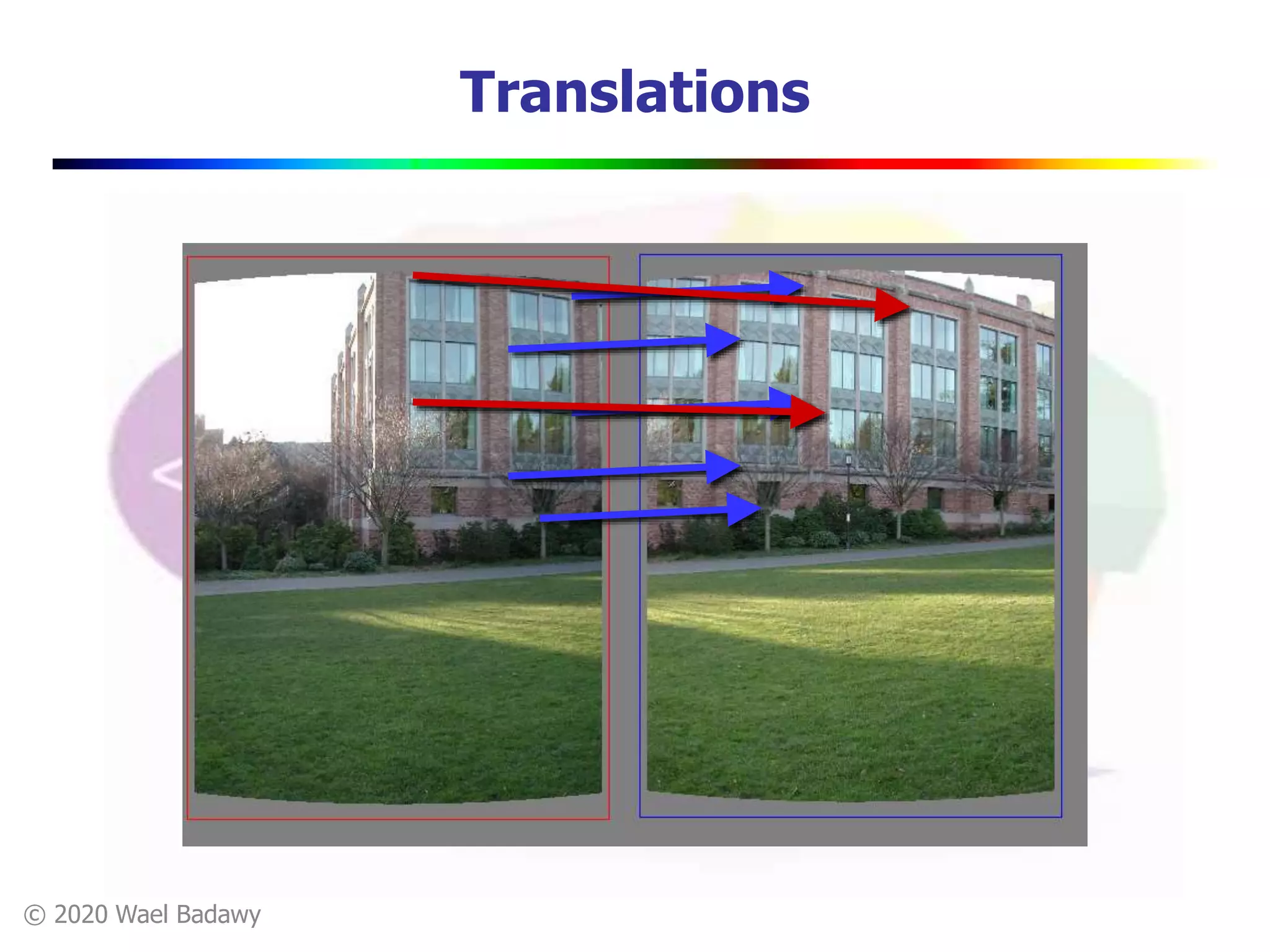
Translations
© 2020 Wael Badawy
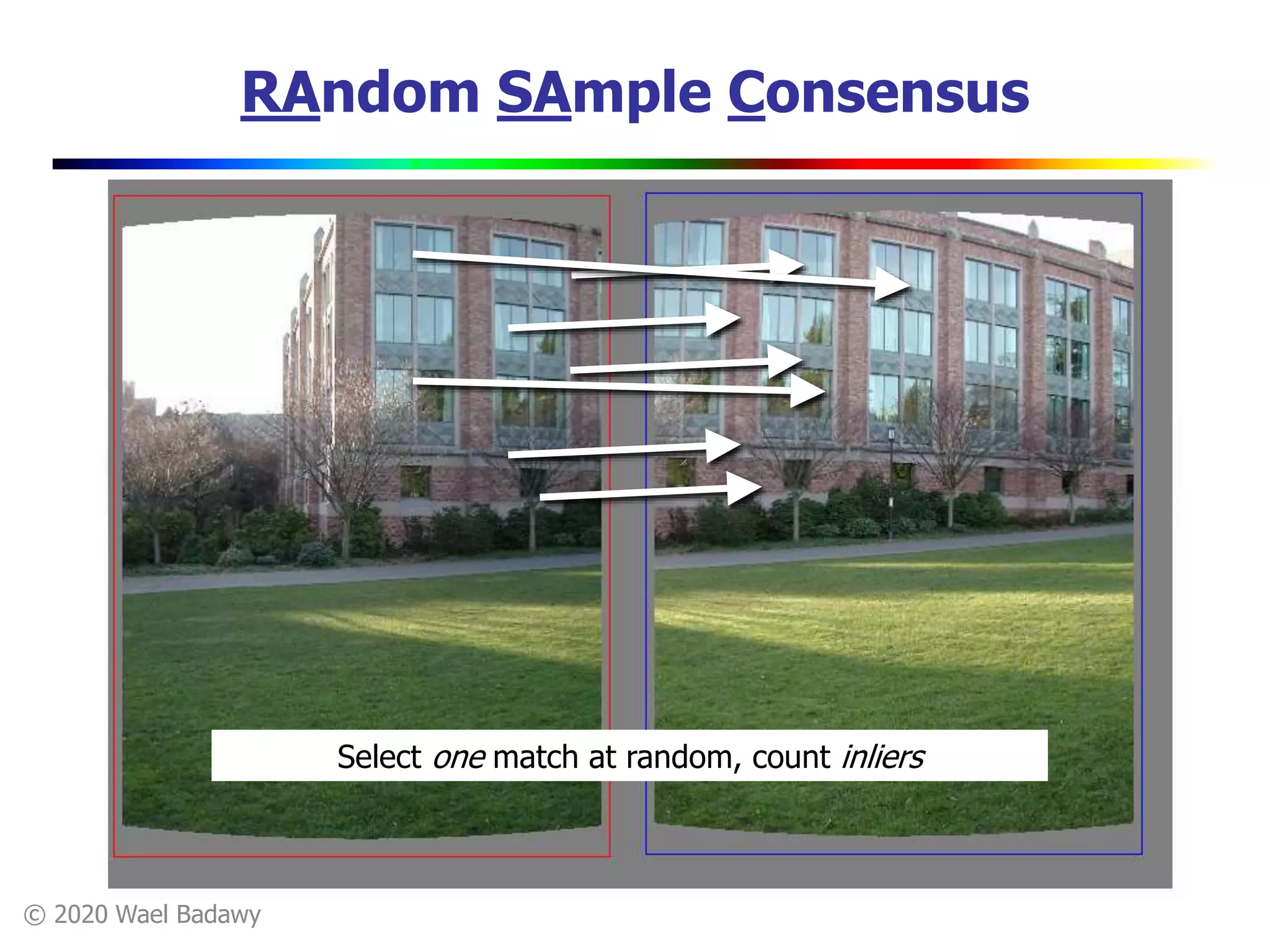
RAndom SAmple Consensus
Select one match at random, count inliers
© 2020 Wael Badawy
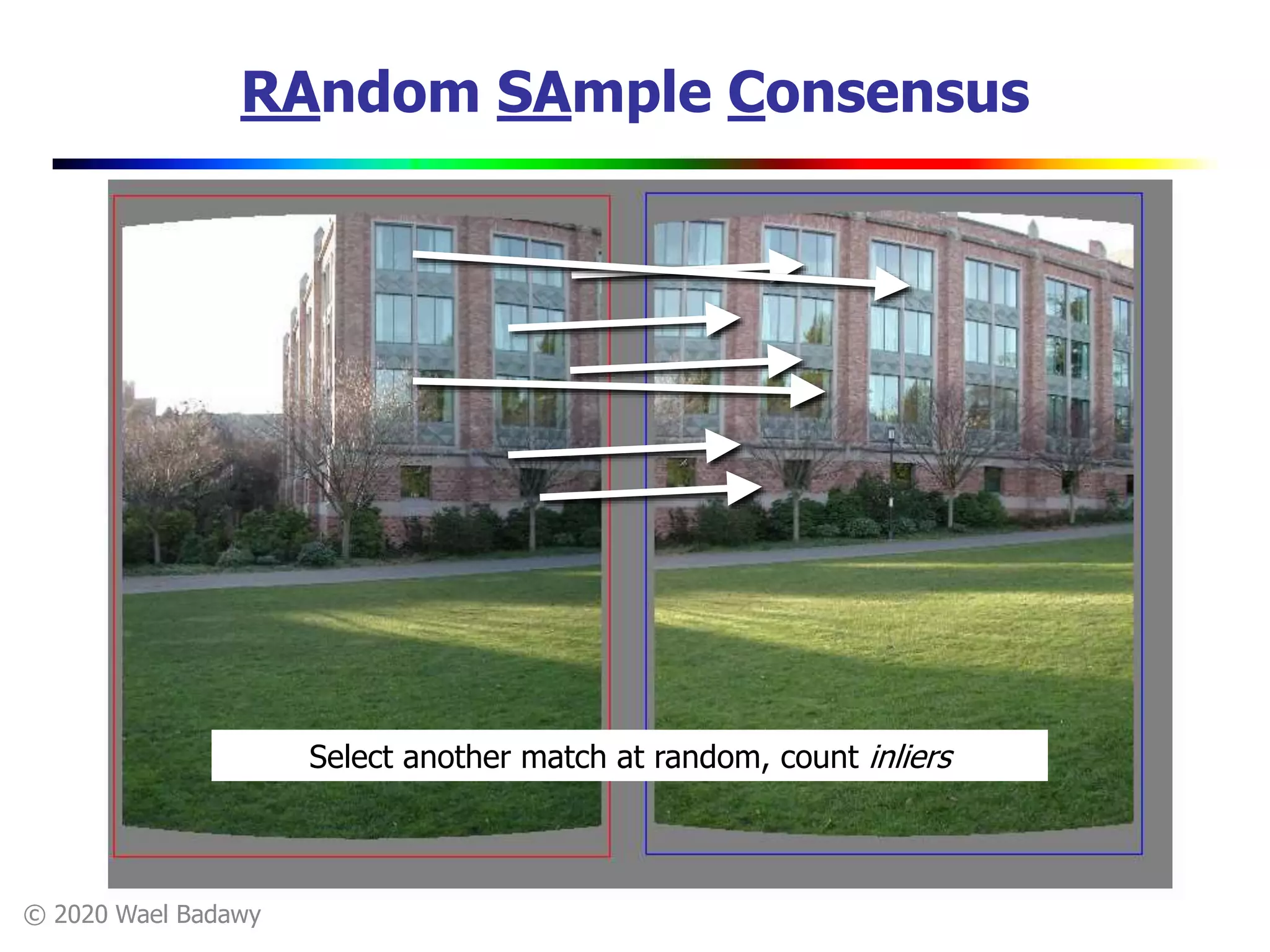
RAndom SAmple Consensus
Select another match at random, count inliers
© 2020 Wael Badawy
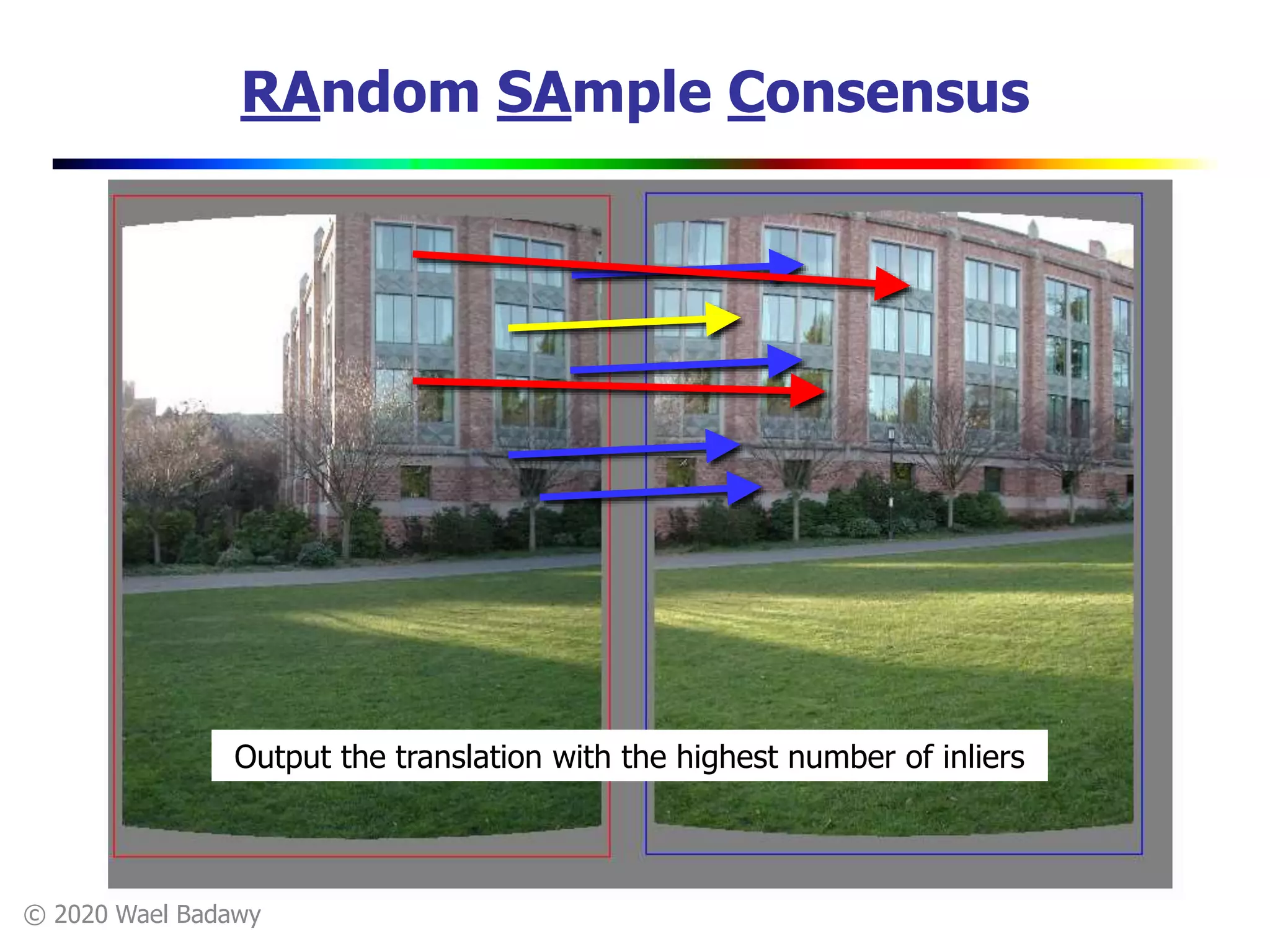
RAndom SAmple Consensus
Output the translation with the highest number of inliers
© 2020 Wael Badawy
RANSAC
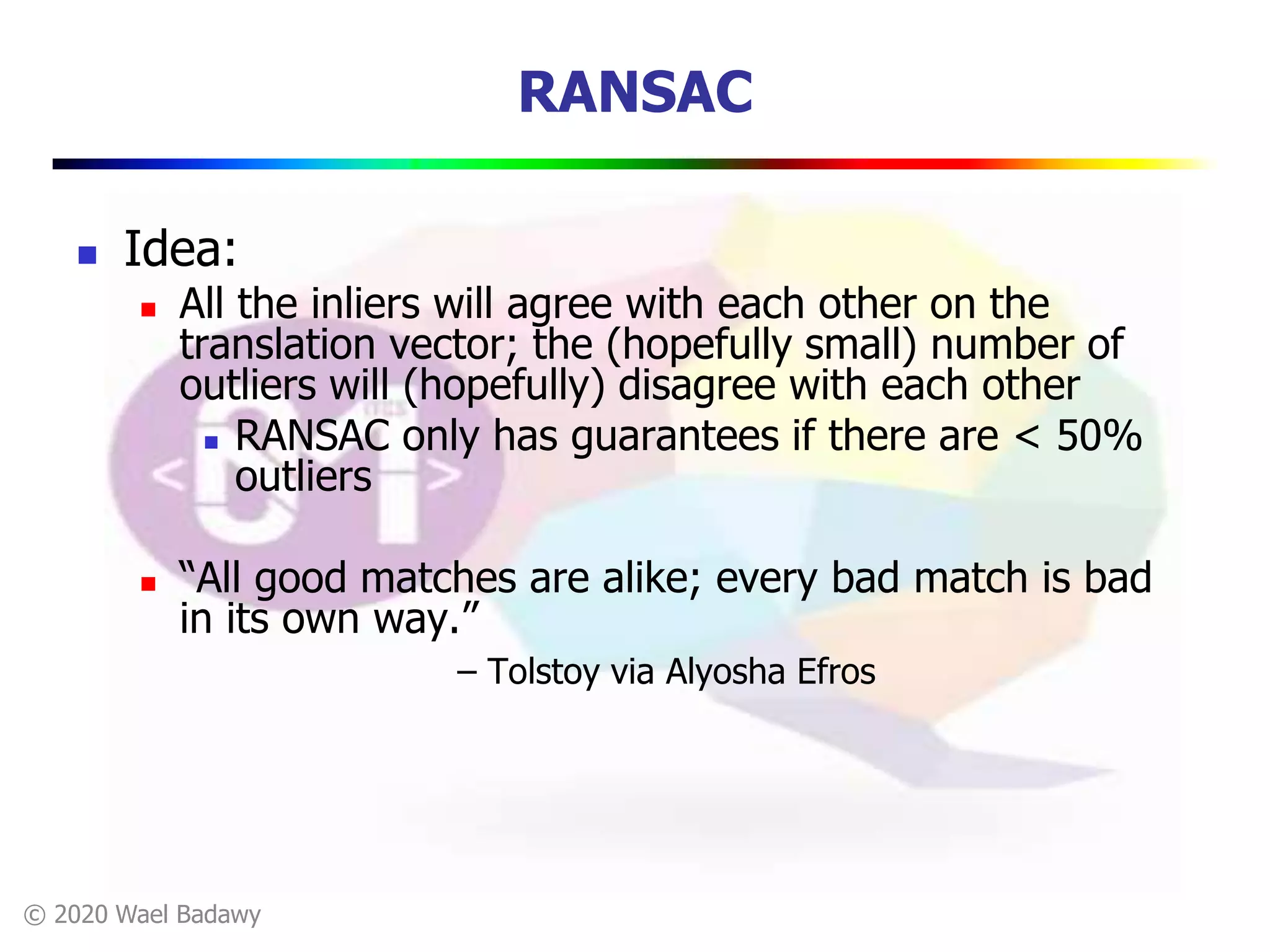
 Idea:
 All the inliers will agree with each other on the
translation vector; the (hopefully small) number of
outliers will (hopefully) disagree with each other
 RANSAC only has guarantees if there are < 50%
outliers
 “All good matches are alike; every bad match is bad
in its own way.”
– Tolstoy via Alyosha Efros
© 2020 Wael Badawy
RANSAC
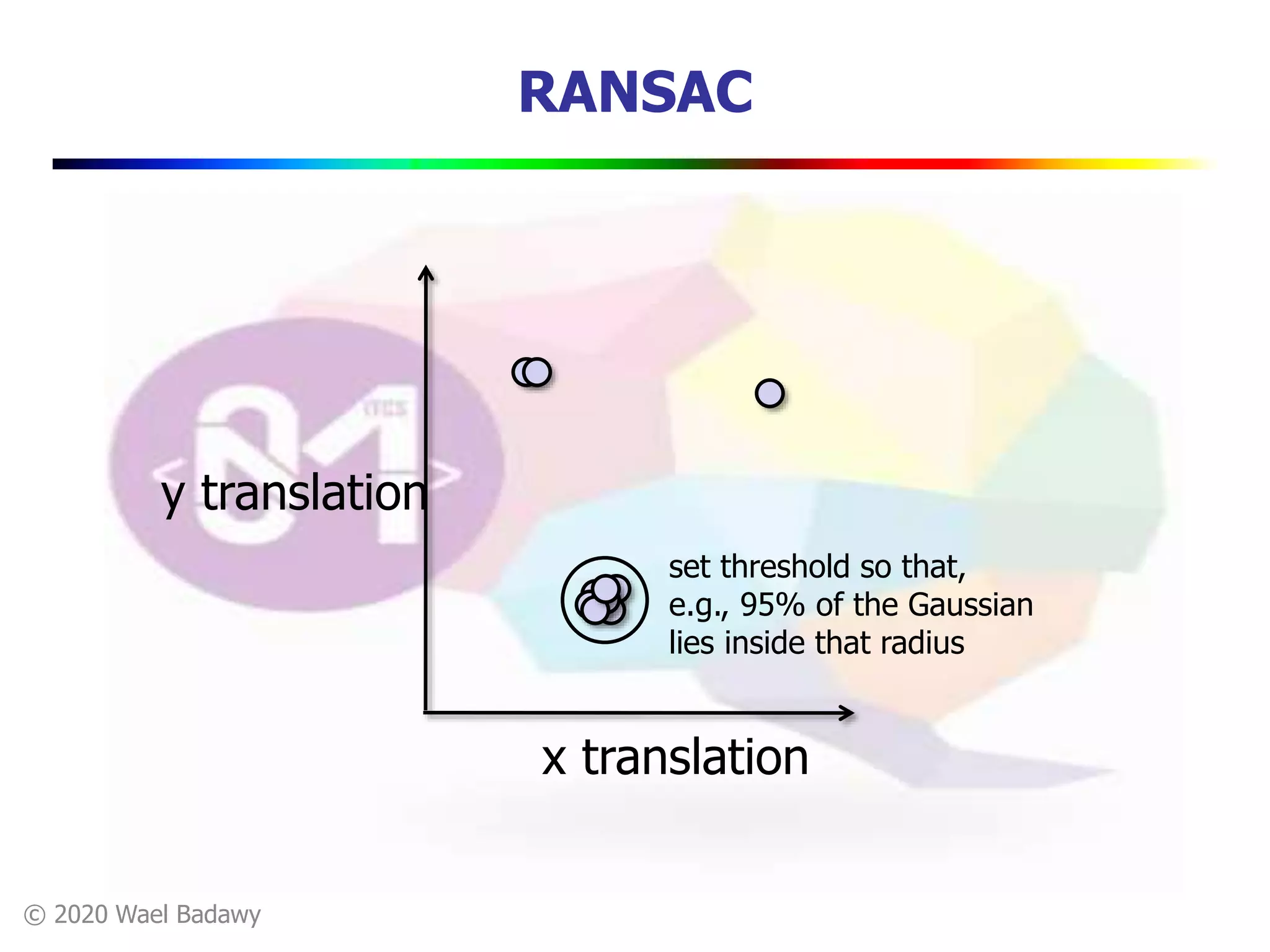
 Inlier threshold related to the amount of noise
we expect in inliers
 Often model noise as Gaussian with some standard
deviation (e.g., 3 pixels)
 Number of rounds related to the percentage
of outliers we expect, and the probability of
success we’d like to guarantee
 Suppose there are 20% outliers, and we want to find
the correct answer with 99% probability
 How many rounds do we need?
© 2020 Wael Badawy
RANSAC
x translation
y translation
set threshold so that,
e.g., 95% of the Gaussian
lies inside that radius
© 2020 Wael Badawy
RANSAC
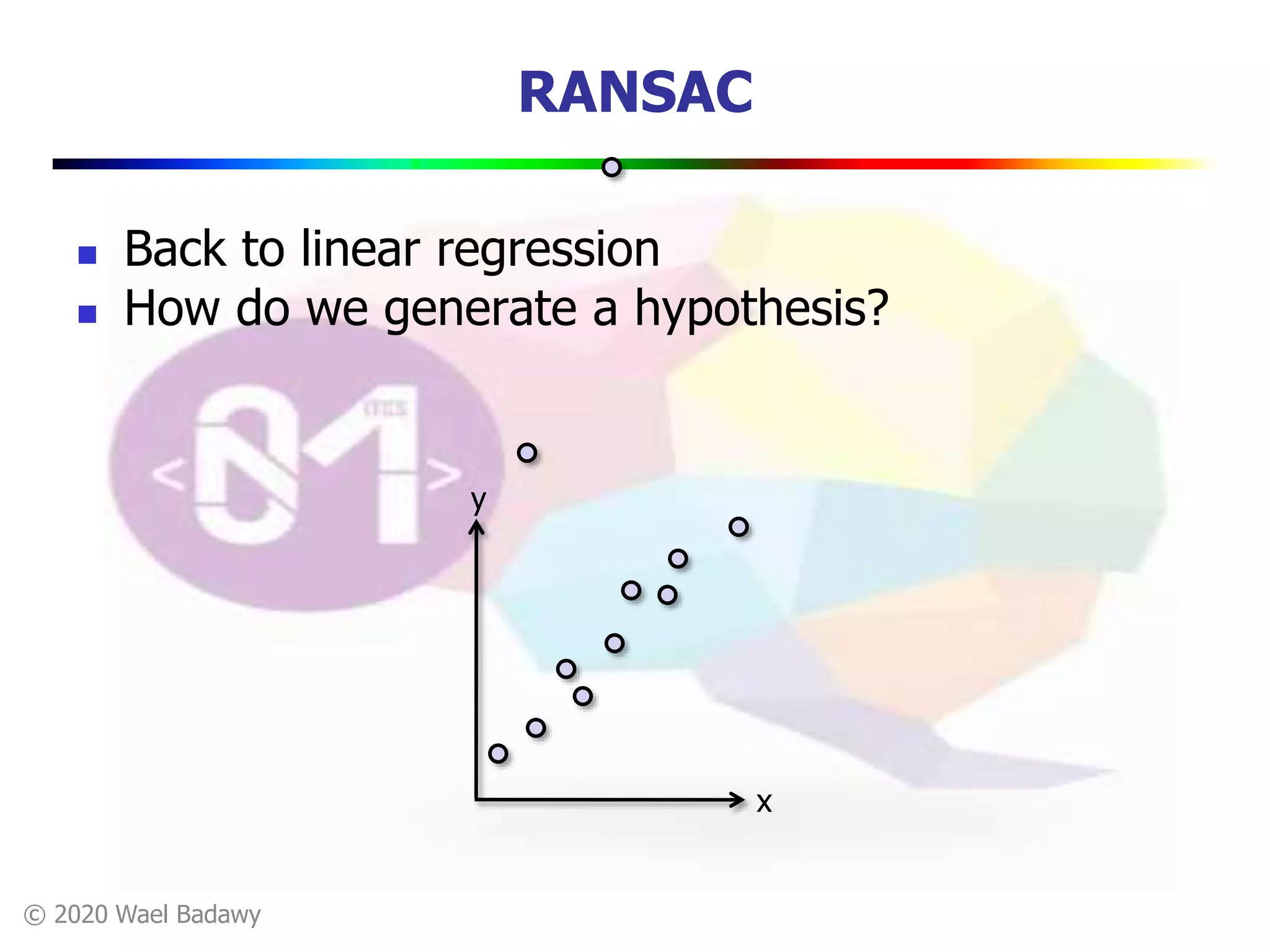
 Back to linear regression
 How do we generate a hypothesis?
x
y
© 2020 Wael Badawy
RANSAC
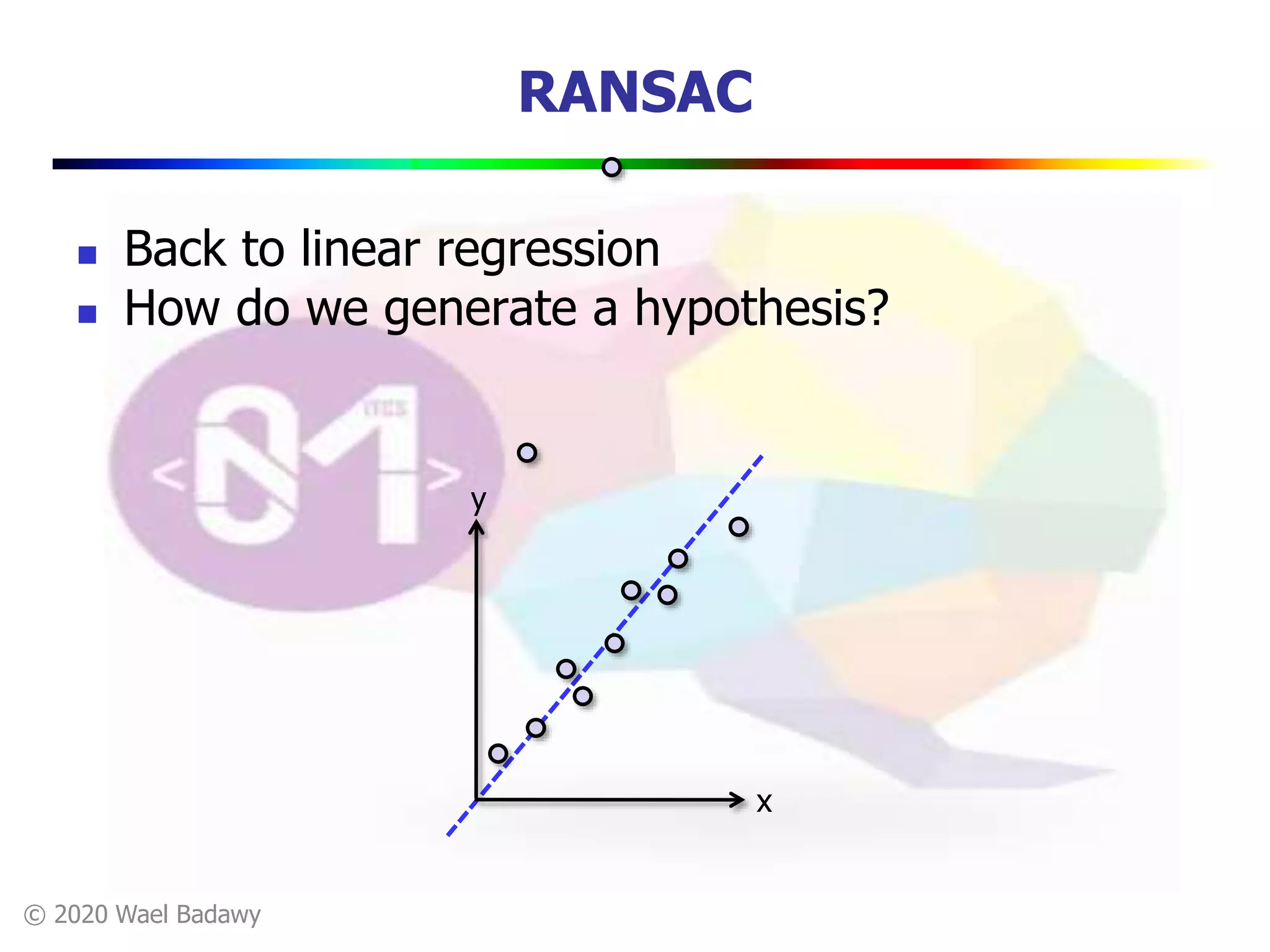
 Back to linear regression
 How do we generate a hypothesis?
x
y
© 2020 Wael Badawy
RANSAC
 General version:
1. Randomly choose s samples
 Typically s = minimum sample size that lets you
fit a model
2. Fit a model (e.g., line) to those samples
3. Count the number of inliers that approximately fit
the model
4. Repeat N times
5. Choose the model that has the largest set of inliers
© 2020 Wael Badawy
How many rounds?
 If we have to choose s samples each time
 with an outlier ratio e
 and we want the right answer with probability p
proportion of outliers e
s 5% 10% 20% 25% 30% 40% 50%
2 2 3 5 6 7 11 17
3 3 4 7 9 11 19 35
4 3 5 9 13 17 34 72
5 4 6 12 17 26 57 146
6 4 7 16 24 37 97 293
7 4 8 20 33 54 163 588
8 5 9 26 44 78 272 1177
Source: M. Pollefeysp = 0.99
© 2020 Wael Badawy
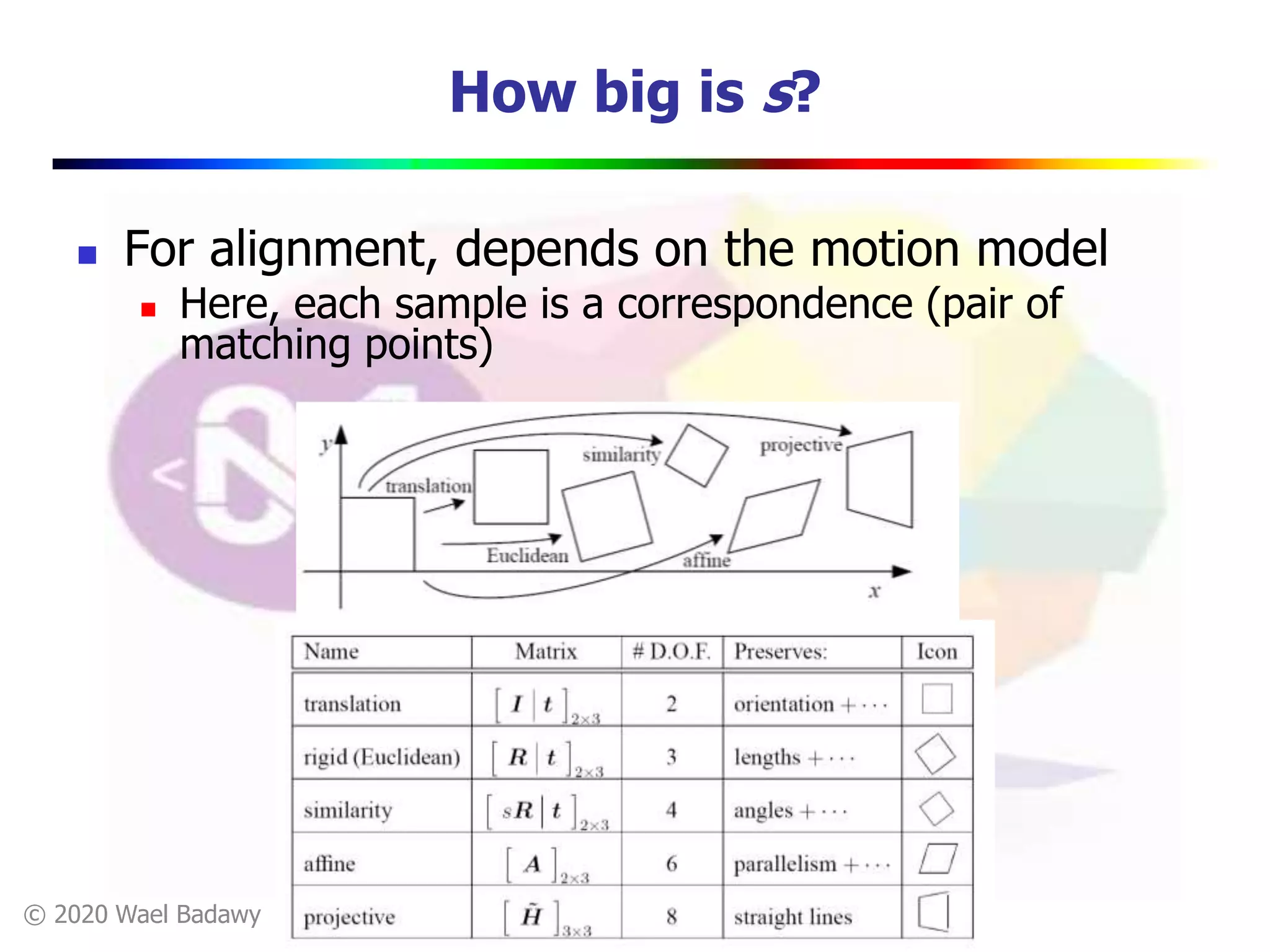
How big is s?
 For alignment, depends on the motion model
 Here, each sample is a correspondence (pair of
matching points)
© 2020 Wael Badawy
RANSAC pros and cons
• Pros
 Simple and general
 Applicable to many different problems
 Often works well in practice
• Cons
 Parameters to tune
 Sometimes too many iterations are required
 Can fail for extremely low inlier ratios
 We can often do better than brute-force sampling
© 2020 Wael Badawy
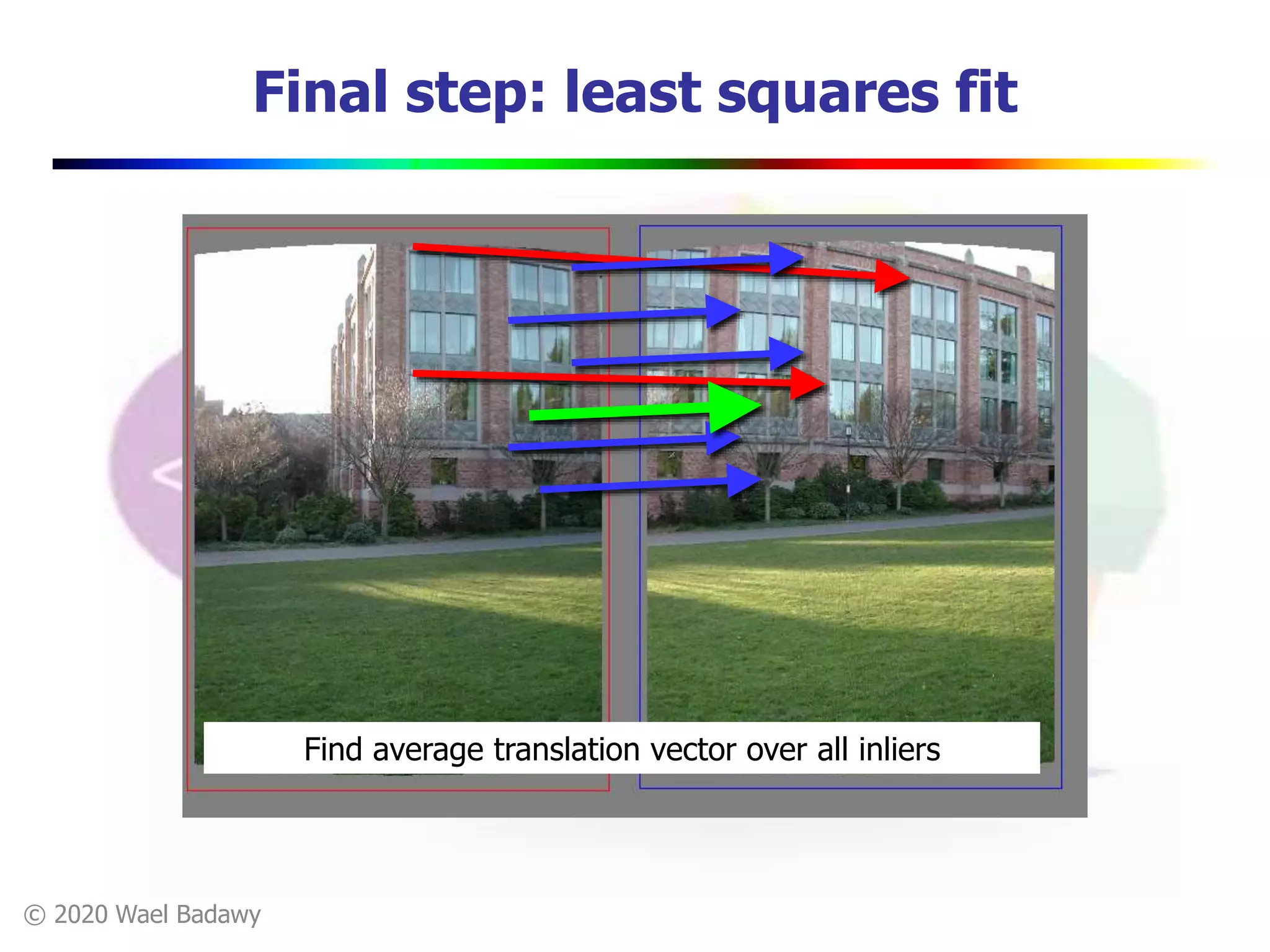
Final step: least squares fit
Find average translation vector over all inliers
© 2020 Wael Badawy
RANSAC
 An example of a “voting”-based fitting scheme
 Each hypothesis gets voted on by each data
point, best hypothesis wins
 There are many other types of voting schemes
 E.g., Hough transforms…
© 2020 Wael Badawy
Panoramas
 Now we know how to create panoramas!
 Given two images:
 Step 1: Detect features
 Step 2: Match features
 Step 3: Compute a homography using RANSAC
 Step 4: Combine the images together (somehow)
 What if we have more than two images?
© 2020 Wael Badawy
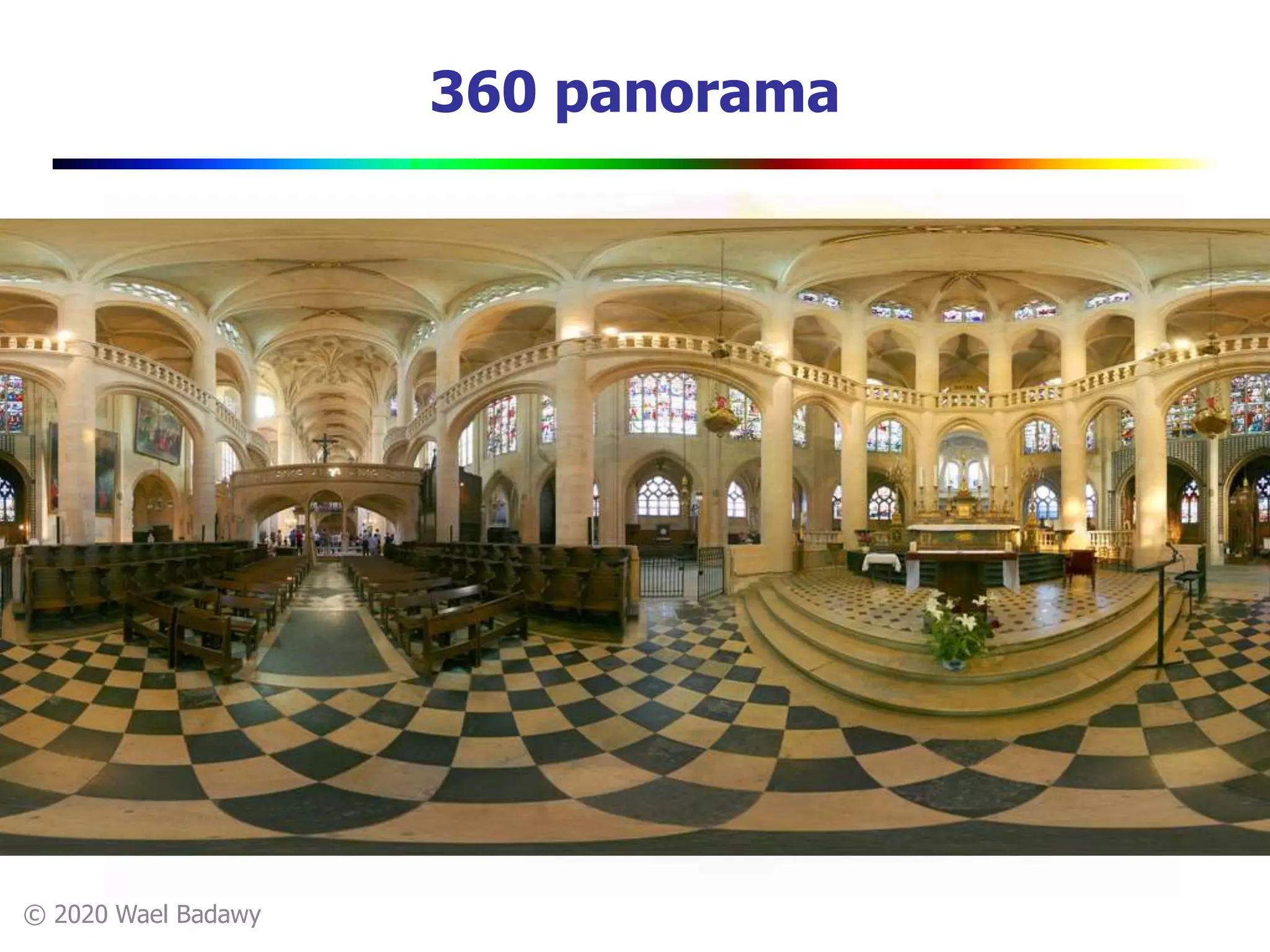
Can we use homographies to create a 360
panorama?
 In order to figure this out, we need to learn
what a camera is
© 2020 Wael Badawy
360 panorama
© 2020 Wael Badawy
Questions?

Computer Vision RANSAC

  • 1.
    © 2020 WaelBadawy 11 RANSAC — Computer Vision — DISCLAIMER: This video is optimized for HD large display using patented and patent-pending “Nile Codec”, the first Egyptian Video Codec for more information, PLEASE check https://NileCodec.com RAndom SAmple Consensus Also available as a PodCast http://www.wired.com/gadgetlab/2010/07/camera-software-lets-you-see-into-the-past/
  • 2.
    © 2020 WaelBadawy Copyright © 2020 Wael Badawy. All rights reserved  This video is subject to copyright owned by Wael Badawy “WB”. Any reproduction or republication of all or part of this video is expressly prohibited unless WB has explicitly granted its prior written consent. All other rights reserved.  This video is intended for education and information only and is offered AS IS, without any warranty of the accuracy or the quality of the content. Any other use is strictly prohibited. The viewer is fully responsible to verify the accuracy of the contents received without any claims of costs or liability arising .  The names, trademarks service marked as logos of WB or the sponsors appearing in this video may not be used in any any product or service, without prior express written permission from WB and the video sponsors  Neither WB nor any party involved in creating, producing or delivering information and material via this video shall be liable for any direction, incidental, consequential, indirect of punitive damages arising out of access to, use or inability to use this content or any errors or omissions in the content thereof.  If you will continue to watch this video, you agree to the terms above and other terms that may be available on http://nu.edu.eg & https://caiwave.net 2
  • 3.
  • 4.
    © 2020 WaelBadawy Reading  Szeliski: Chapter 6.1
  • 5.
    © 2020 WaelBadawy Outliers outliers inliers
  • 6.
    © 2020 WaelBadawy Robustness  Let’s consider a simpler example… linear regression  How can we fix this? Problem: Fit a line to these datapoints Least squares fit
  • 7.
    © 2020 WaelBadawy We need a better cost function…  Suggestions?
  • 8.
    © 2020 WaelBadawy Idea  Given a hypothesized line  Count the number of points that “agree” with the line  “Agree” = within a small distance of the line  I.e., the inliers to that line  For all possible lines, select the one with the largest number of inliers
  • 9.
    © 2020 WaelBadawy Counting inliers
  • 10.
    © 2020 WaelBadawy Counting inliers Inliers: 3
  • 11.
    © 2020 WaelBadawy Counting inliers Inliers: 20
  • 12.
    © 2020 WaelBadawy How do we find the best line?  Unlike least-squares, no simple closed-form solution  Hypothesize-and-test  Try out many lines, keep the best one  Which lines?
  • 13.
    © 2020 WaelBadawy Translations
  • 14.
    © 2020 WaelBadawy RAndom SAmple Consensus Select one match at random, count inliers
  • 15.
    © 2020 WaelBadawy RAndom SAmple Consensus Select another match at random, count inliers
  • 16.
    © 2020 WaelBadawy RAndom SAmple Consensus Output the translation with the highest number of inliers
  • 17.
    © 2020 WaelBadawy RANSAC  Idea:  All the inliers will agree with each other on the translation vector; the (hopefully small) number of outliers will (hopefully) disagree with each other  RANSAC only has guarantees if there are < 50% outliers  “All good matches are alike; every bad match is bad in its own way.” – Tolstoy via Alyosha Efros
  • 18.
    © 2020 WaelBadawy RANSAC  Inlier threshold related to the amount of noise we expect in inliers  Often model noise as Gaussian with some standard deviation (e.g., 3 pixels)  Number of rounds related to the percentage of outliers we expect, and the probability of success we’d like to guarantee  Suppose there are 20% outliers, and we want to find the correct answer with 99% probability  How many rounds do we need?
  • 19.
    © 2020 WaelBadawy RANSAC x translation y translation set threshold so that, e.g., 95% of the Gaussian lies inside that radius
  • 20.
    © 2020 WaelBadawy RANSAC  Back to linear regression  How do we generate a hypothesis? x y
  • 21.
    © 2020 WaelBadawy RANSAC  Back to linear regression  How do we generate a hypothesis? x y
  • 22.
    © 2020 WaelBadawy RANSAC  General version: 1. Randomly choose s samples  Typically s = minimum sample size that lets you fit a model 2. Fit a model (e.g., line) to those samples 3. Count the number of inliers that approximately fit the model 4. Repeat N times 5. Choose the model that has the largest set of inliers
  • 23.
    © 2020 WaelBadawy How many rounds?  If we have to choose s samples each time  with an outlier ratio e  and we want the right answer with probability p proportion of outliers e s 5% 10% 20% 25% 30% 40% 50% 2 2 3 5 6 7 11 17 3 3 4 7 9 11 19 35 4 3 5 9 13 17 34 72 5 4 6 12 17 26 57 146 6 4 7 16 24 37 97 293 7 4 8 20 33 54 163 588 8 5 9 26 44 78 272 1177 Source: M. Pollefeysp = 0.99
  • 24.
    © 2020 WaelBadawy How big is s?  For alignment, depends on the motion model  Here, each sample is a correspondence (pair of matching points)
  • 25.
    © 2020 WaelBadawy RANSAC pros and cons • Pros  Simple and general  Applicable to many different problems  Often works well in practice • Cons  Parameters to tune  Sometimes too many iterations are required  Can fail for extremely low inlier ratios  We can often do better than brute-force sampling
  • 26.
    © 2020 WaelBadawy Final step: least squares fit Find average translation vector over all inliers
  • 27.
    © 2020 WaelBadawy RANSAC  An example of a “voting”-based fitting scheme  Each hypothesis gets voted on by each data point, best hypothesis wins  There are many other types of voting schemes  E.g., Hough transforms…
  • 28.
    © 2020 WaelBadawy Panoramas  Now we know how to create panoramas!  Given two images:  Step 1: Detect features  Step 2: Match features  Step 3: Compute a homography using RANSAC  Step 4: Combine the images together (somehow)  What if we have more than two images?
  • 29.
    © 2020 WaelBadawy Can we use homographies to create a 360 panorama?  In order to figure this out, we need to learn what a camera is
  • 30.
    © 2020 WaelBadawy 360 panorama
  • 31.
    © 2020 WaelBadawy Questions?