THE
HALLMARKS
OF CANCER
A project submitted in fulfillment of the
requirements for Value Added Course :
Cancer Awareness and Therapy.
Introduction
The hallmarks of cancer comprise six
biological capabilities acquired during
the multistep development of human
tumors. The hallmarks constitute an
organizing principle for rationalizing
the complexities of neoplastic disease.
1. Self-Sufficiency in Growth Signals
2. Insensitivity to Anti-Growth Signals
3. Tissue Invasion and Metastasis
4. Limitless Replicative Potential
5. Sustained Angiogenesis (Blood
Vessel Growth)
6. Evasion of Apoptosis (Cell Death)
Hallmark
Capabilitie
s —
Conceptual
Progress
The six hallmarks of cancer—distinctive
and complementary capabilities that
enable tumor growth and metastatic
dissemination—continue to provide a solid
foundation for understanding the biology
of cancerIn the first section of this Review,
we summarize the essence of each
hallmark as described in the original
presentation in 2000, followed by selected
illustrations (demarcated by subheadings
in italics) of the conceptual progress made
over the past decade in understanding
their mechanistic underpinnings.
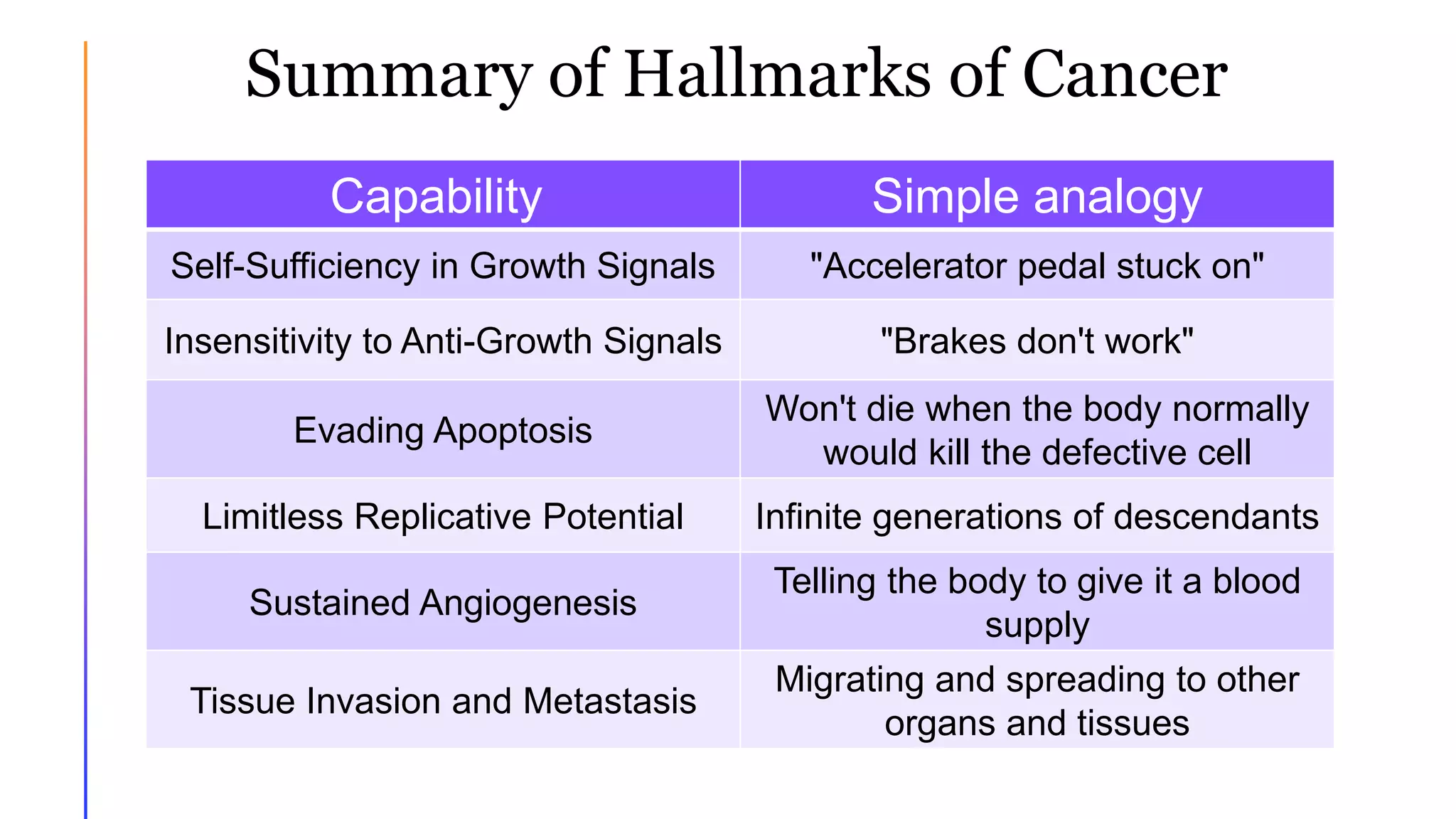
Summary of Hallmarks of Cancer
Click to add text
Capability Simple analogy
Self-Sufficiency in Growth Signals "Accelerator pedal stuck on"
Insensitivity to Anti-Growth Signals "Brakes don't work"
Evading Apoptosis
Won't die when the body normally
would kill the defective cell
Limitless Replicative Potential Infinite generations of descendants
Sustained Angiogenesis
Telling the body to give it a blood
supply
Tissue Invasion and Metastasis
Migrating and spreading to other
organs and tissues
The Cell Cycle
Clock
Cells do not divide in G0 and are quiescent. After
receiving growth factor signals, they prepare for division
by entering G1, where everything within the cell except
DNA is doubled. This doubling includes the size of the
cell. The next phase of the cell cycle is S (synthesis)
phase. It is the cell cycle phase where the chromosomes
(DNA) are duplicated in preparation for cellular division.
Self-Sufficiency in Growth
Signals
Cancer cells do not need stimulation from external signals (in the form
of growth factors) to multiply. Typically, cells of the body require hormones
and other molecules that act as signals for them to grow and divide. Cancer
cells, however, have the ability to grow without these external signals.
There are multiple ways in which cancer cells can do this: by producing
these signals themselves, known as autocrine signalling; by permanently
activating the signalling pathways that respond to these signals; or by
destroying 'off switches' that prevents excessive growth from these signals
(negative feedback). In addition, cell division in normal, non-cancerous cells
is tightly controlled.
Insensitivity to Anti-Growth Signals
Cancer cells are generally resistant to growth-preventing signals
from their neighbours. To tightly control cell division, cells have
processes within them that prevent cell growth and division. These
processes are orchestrated by proteins known as tumor suppressor
genes. These genes take information from the cell to ensure that it is
ready to divide, and will halt division if not (when the DNA is
damaged, for example). In cancer, these tumour suppressor proteins
are altered so that they don't effectively prevent cell division, even
when the cell has severe abnormalities.
Evading Programmed Cell Death
Apoptosis is a form of programmed cell death (cell suicide), the
mechanism by which cells are programmed to die in the event they
become damaged. Cancer cells are characteristically able to bypass this
mechanism. Cells have the ability to 'self-destruct'; a process known
as apoptosis. This is required for organisms to grow and develop
properly, for maintaining tissues of the body, and is also initiated when a
cell is damaged or infected. Cancer cells, however, lose this ability; even
though cells may become grossly abnormal, they do not undergo
apoptosis.
Limitless Replicative Potential
Non-cancer cells die after a certain number of divisions. Cancer cells
escape this limit and are apparently capable of indefinite growth and
division (immortality). But those immortal cells have damaged
chromosomes, which can become cancerous. Cells of the body don't
normally have the ability to divide indefinitely. They have a limited number
of divisions before the cells become unable to divide (senescence), or die
(crisis). The cause of these barriers is primarily due to the DNA at the end
of chromosomes, known as telomeres. Telomeric DNA shortens with every
cell division, until it becomes so short it activates senescence, so the cell
stops dividing.
Sustained Angiogenesis
Angiogenesis is the process by which new blood vessels are
formed. Cancer cells appear to be able to kickstart this process,
ensuring that such cells receive a continual supply of oxygen and
other nutrients. Normal tissues of the body have blood vessels
running through them that deliver oxygen from the lungs. Cells must
be close to the blood vessels to get enough oxygen for them to
survive. New blood vessels are formed during the development of
embryos, during wound repair and during the female reproductive
cycle.
Tissue Invasion and Metastasis
Cancer cells can break away from their site or organ of origin to
invade surrounding tissue and spread (metastasize) to distant
body parts. One of the most well known properties of cancer
cells is their ability to invade neighboring tissues. It is what
dictates whether the tumor is benign or malignant, and is the
property which enables their dissemination around the
body. They then have to invade blood vessels, survive in the
harsh environment of the circulatory system, exit this system
Emerging Hallmarks
Deregulated Metabolism: Most cancer cells use alternative metabolic
pathways to generate energy, a fact appreciated since the early
twentieth century with the postulation of the Warburg hypothesis, but
only now gaining renewed research interest.
Evading the Immune System: Despite cancer cells causing increased
inflammation and angiogenesis, they also appear to be able to avoid
interaction with the body's immune system via a loss of interleukin-33.
THANK
YOU
A Presentation by
MOHD AZHAN
Department of Computer
Application (BCA)
Enrollment No.

The Hallmarks of Cancer.pptx

  • 1.
    THE HALLMARKS OF CANCER A projectsubmitted in fulfillment of the requirements for Value Added Course : Cancer Awareness and Therapy.
  • 2.
    Introduction The hallmarks ofcancer comprise six biological capabilities acquired during the multistep development of human tumors. The hallmarks constitute an organizing principle for rationalizing the complexities of neoplastic disease. 1. Self-Sufficiency in Growth Signals 2. Insensitivity to Anti-Growth Signals 3. Tissue Invasion and Metastasis 4. Limitless Replicative Potential 5. Sustained Angiogenesis (Blood Vessel Growth) 6. Evasion of Apoptosis (Cell Death)
  • 3.
    Hallmark Capabilitie s — Conceptual Progress The sixhallmarks of cancer—distinctive and complementary capabilities that enable tumor growth and metastatic dissemination—continue to provide a solid foundation for understanding the biology of cancerIn the first section of this Review, we summarize the essence of each hallmark as described in the original presentation in 2000, followed by selected illustrations (demarcated by subheadings in italics) of the conceptual progress made over the past decade in understanding their mechanistic underpinnings.
  • 5.
    Summary of Hallmarksof Cancer Click to add text Capability Simple analogy Self-Sufficiency in Growth Signals "Accelerator pedal stuck on" Insensitivity to Anti-Growth Signals "Brakes don't work" Evading Apoptosis Won't die when the body normally would kill the defective cell Limitless Replicative Potential Infinite generations of descendants Sustained Angiogenesis Telling the body to give it a blood supply Tissue Invasion and Metastasis Migrating and spreading to other organs and tissues
  • 6.
    The Cell Cycle Clock Cellsdo not divide in G0 and are quiescent. After receiving growth factor signals, they prepare for division by entering G1, where everything within the cell except DNA is doubled. This doubling includes the size of the cell. The next phase of the cell cycle is S (synthesis) phase. It is the cell cycle phase where the chromosomes (DNA) are duplicated in preparation for cellular division.
  • 8.
    Self-Sufficiency in Growth Signals Cancercells do not need stimulation from external signals (in the form of growth factors) to multiply. Typically, cells of the body require hormones and other molecules that act as signals for them to grow and divide. Cancer cells, however, have the ability to grow without these external signals. There are multiple ways in which cancer cells can do this: by producing these signals themselves, known as autocrine signalling; by permanently activating the signalling pathways that respond to these signals; or by destroying 'off switches' that prevents excessive growth from these signals (negative feedback). In addition, cell division in normal, non-cancerous cells is tightly controlled.
  • 10.
    Insensitivity to Anti-GrowthSignals Cancer cells are generally resistant to growth-preventing signals from their neighbours. To tightly control cell division, cells have processes within them that prevent cell growth and division. These processes are orchestrated by proteins known as tumor suppressor genes. These genes take information from the cell to ensure that it is ready to divide, and will halt division if not (when the DNA is damaged, for example). In cancer, these tumour suppressor proteins are altered so that they don't effectively prevent cell division, even when the cell has severe abnormalities.
  • 12.
    Evading Programmed CellDeath Apoptosis is a form of programmed cell death (cell suicide), the mechanism by which cells are programmed to die in the event they become damaged. Cancer cells are characteristically able to bypass this mechanism. Cells have the ability to 'self-destruct'; a process known as apoptosis. This is required for organisms to grow and develop properly, for maintaining tissues of the body, and is also initiated when a cell is damaged or infected. Cancer cells, however, lose this ability; even though cells may become grossly abnormal, they do not undergo apoptosis.
  • 14.
    Limitless Replicative Potential Non-cancercells die after a certain number of divisions. Cancer cells escape this limit and are apparently capable of indefinite growth and division (immortality). But those immortal cells have damaged chromosomes, which can become cancerous. Cells of the body don't normally have the ability to divide indefinitely. They have a limited number of divisions before the cells become unable to divide (senescence), or die (crisis). The cause of these barriers is primarily due to the DNA at the end of chromosomes, known as telomeres. Telomeric DNA shortens with every cell division, until it becomes so short it activates senescence, so the cell stops dividing.
  • 16.
    Sustained Angiogenesis Angiogenesis isthe process by which new blood vessels are formed. Cancer cells appear to be able to kickstart this process, ensuring that such cells receive a continual supply of oxygen and other nutrients. Normal tissues of the body have blood vessels running through them that deliver oxygen from the lungs. Cells must be close to the blood vessels to get enough oxygen for them to survive. New blood vessels are formed during the development of embryos, during wound repair and during the female reproductive cycle.
  • 18.
    Tissue Invasion andMetastasis Cancer cells can break away from their site or organ of origin to invade surrounding tissue and spread (metastasize) to distant body parts. One of the most well known properties of cancer cells is their ability to invade neighboring tissues. It is what dictates whether the tumor is benign or malignant, and is the property which enables their dissemination around the body. They then have to invade blood vessels, survive in the harsh environment of the circulatory system, exit this system
  • 20.
    Emerging Hallmarks Deregulated Metabolism:Most cancer cells use alternative metabolic pathways to generate energy, a fact appreciated since the early twentieth century with the postulation of the Warburg hypothesis, but only now gaining renewed research interest. Evading the Immune System: Despite cancer cells causing increased inflammation and angiogenesis, they also appear to be able to avoid interaction with the body's immune system via a loss of interleukin-33.
  • 21.
    THANK YOU A Presentation by MOHDAZHAN Department of Computer Application (BCA) Enrollment No.