


Trinity Consultants Inc. 2018
PROGNOSTIC METEOROLOGICAL MODELS
AND THEIR USE IN DISPERSION MODELLING
DMUG 2018
LONDON, UNITED KINGDOM
ARUN KANCHAN
TRINITY CONSULTANTS, INC.
APRIL 19, 2018
Trinity Consultants Inc. 2018
Prognostic Meteorological Models and their
Use in Dispersion Modelling
AGENDA
1. INTRODUCTION
2. PROGNOSTIC MODEL OF FOCUS:
WEATHER RESEARCH AND FORECASTING
(WRF) MODEL
3. CASE STUDY: APPLICATION OF WRF FOR
AQM IN THE MIDDLE-EAST
4. FINDINGS AND CONCLUSIONS
Trinity Consultants Inc. 2018
INTRODUCTION
Trinity Consultants Inc. 2018
Meteorological Input Types Used in
Dispersion Modeling
 Site-Specific
Installed meteorological observation tower
Most accurate meteorological data at the source location
Installation/maintenance costs and data handling/quality control
procedures
 National Weather Service / Met Office
Routinely available
Generally not at the source location
May not be the most adequately representative data (e.g. complex
terrain, distance, etc.)
 Prognostic Meteorological Data
Three-dimensional mesoscale computer models: MM5 and WRF
Trinity Consultants Inc. 2018
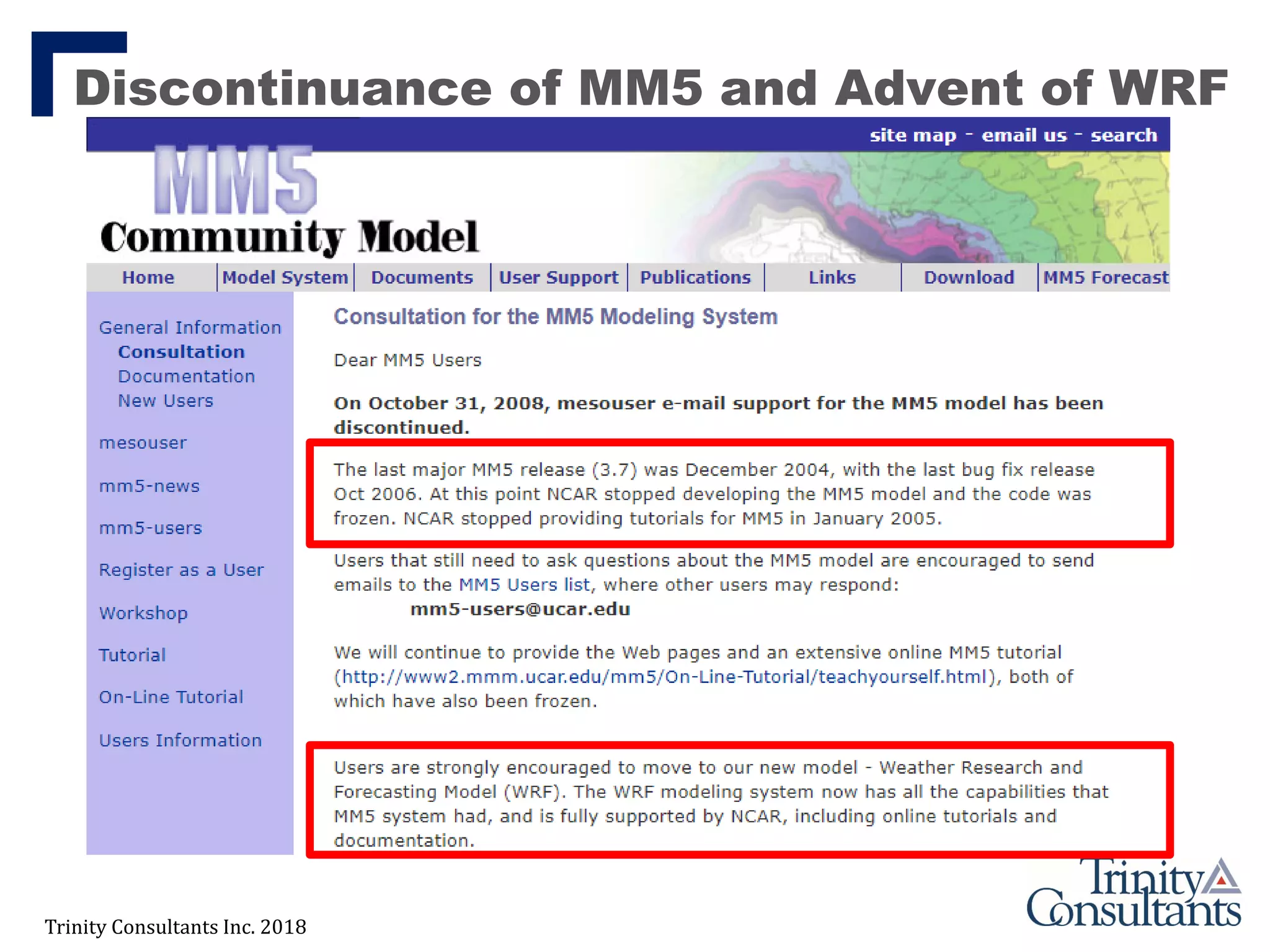
Discontinuance of MM5 and Advent of WRF
Trinity Consultants Inc. 2018
PROGNOSTIC MODEL
OF FOCUS:
WEATHER RESEARCH
AND FORECASTING
(WRF) MODEL
Trinity Consultants Inc. 2018
WRF
 Developed in the U.S. by National Center for
Atmospheric Research (NCAR)
Primary meteorological tool used by U.S. EPA
Continuous updates
Supported across a broad community
 Modeling across multiple scales
Trinity Consultants Inc. 2018
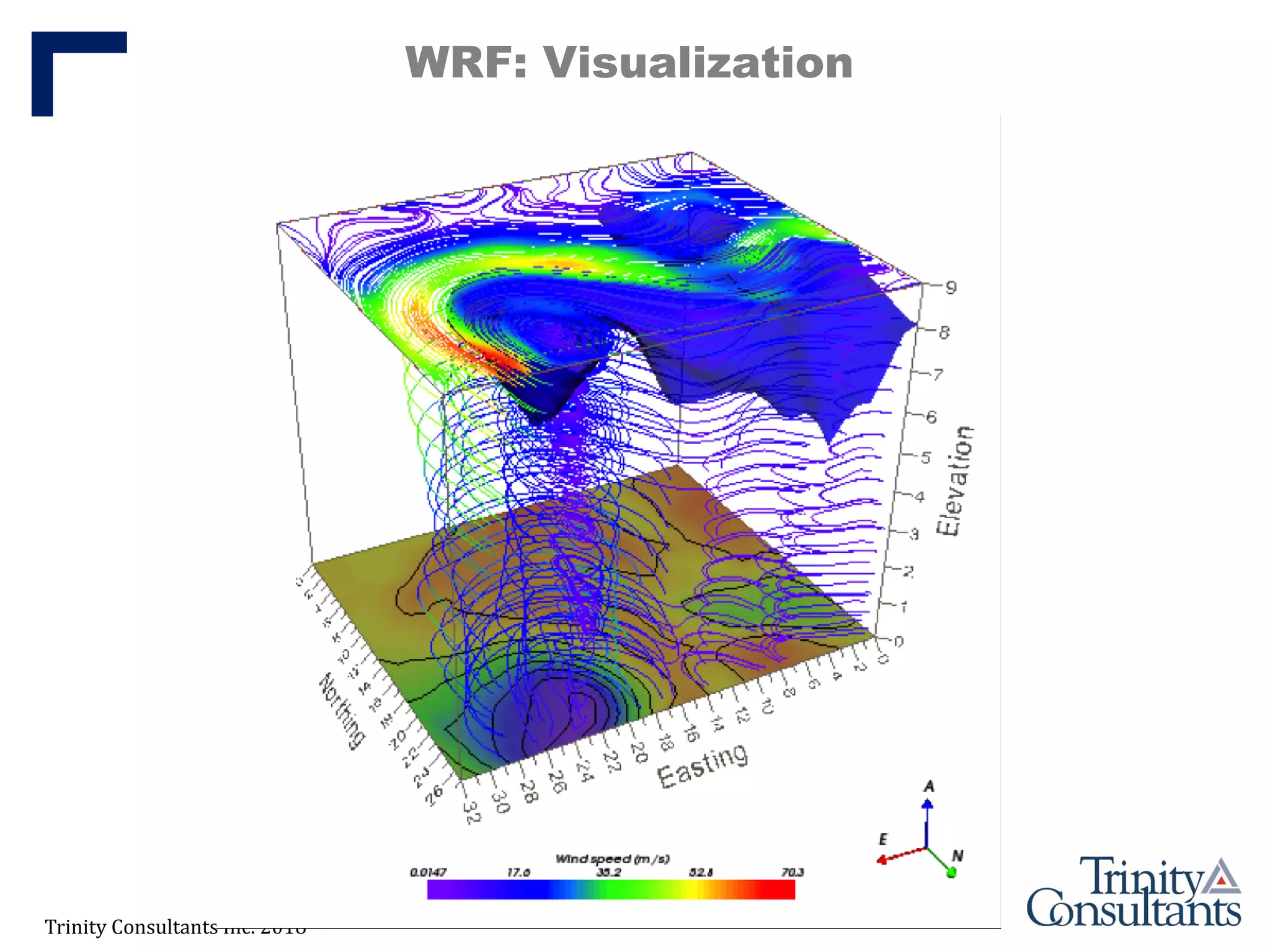
WRF: Visualization
Trinity Consultants Inc. 2018
Mesoscale Met Data
 “Mesoscale” is that domain of atmospheric
physics that takes place on the order of
approximately 100 km and about 1 hour
 Weather forecast models operate by computing
mesoscale physical parameters at hourly time
steps over the entire depth of the atmosphere
 Parameters are computed over a three-
dimensional grid that covers the globe and
multiple (approximately 30) levels of the
atmosphere
Trinity Consultants Inc. 2018
Mesoscale Met Data
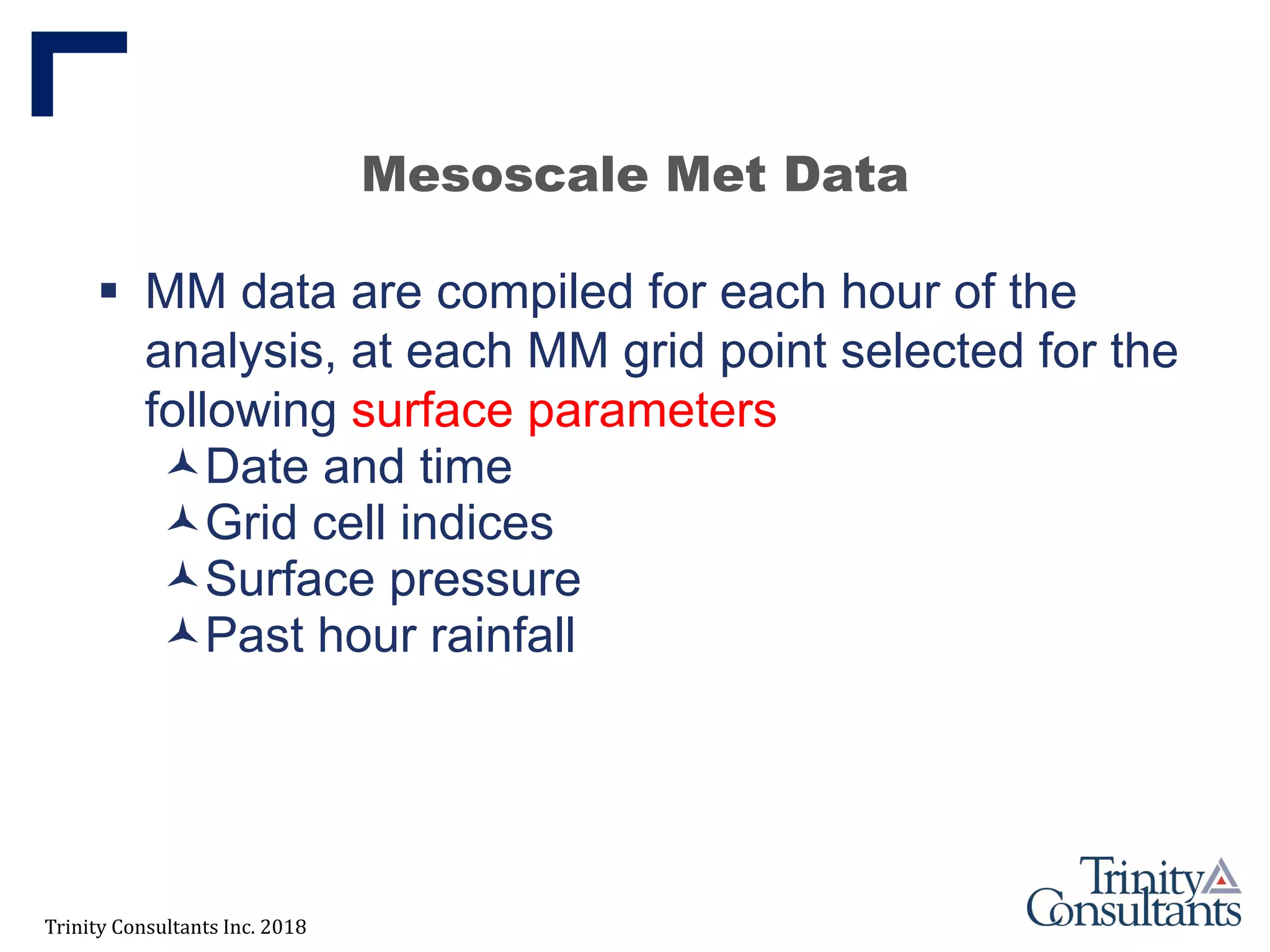
 MM data are used as an “initial guess” wind field
input to CALMET
 From this wind field, terrain effects and slope
flow are computed
 This wind field is then supplemented with
interpolated observations from surface and
upper air stations and smoothed to create the
final wind field
Trinity Consultants Inc. 2018
Mesoscale Met Data
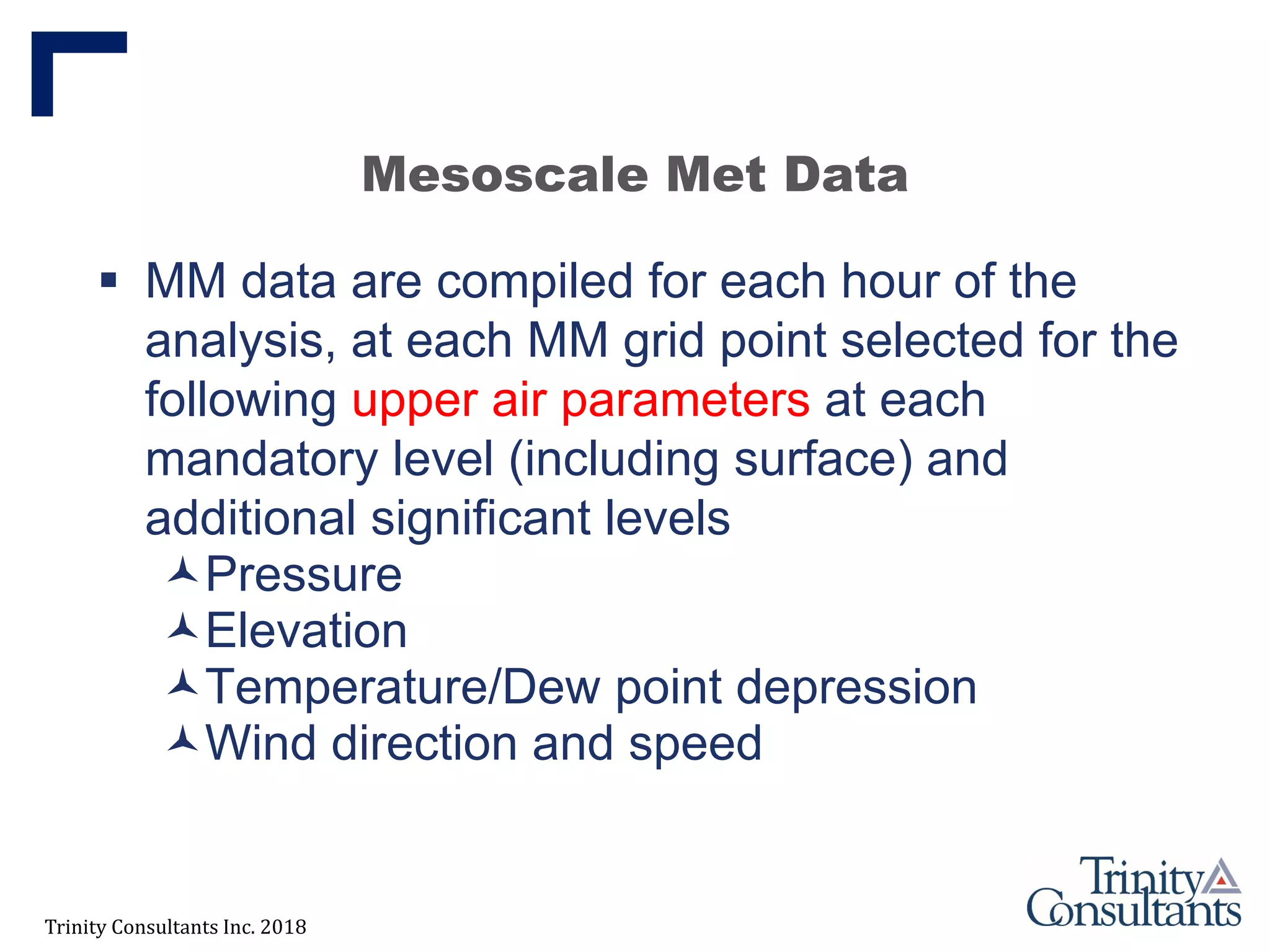
 MM data are compiled for each hour of the
analysis, at each MM grid point selected for the
following surface parameters
Date and time
Grid cell indices
Surface pressure
Past hour rainfall
Trinity Consultants Inc. 2018
Mesoscale Met Data
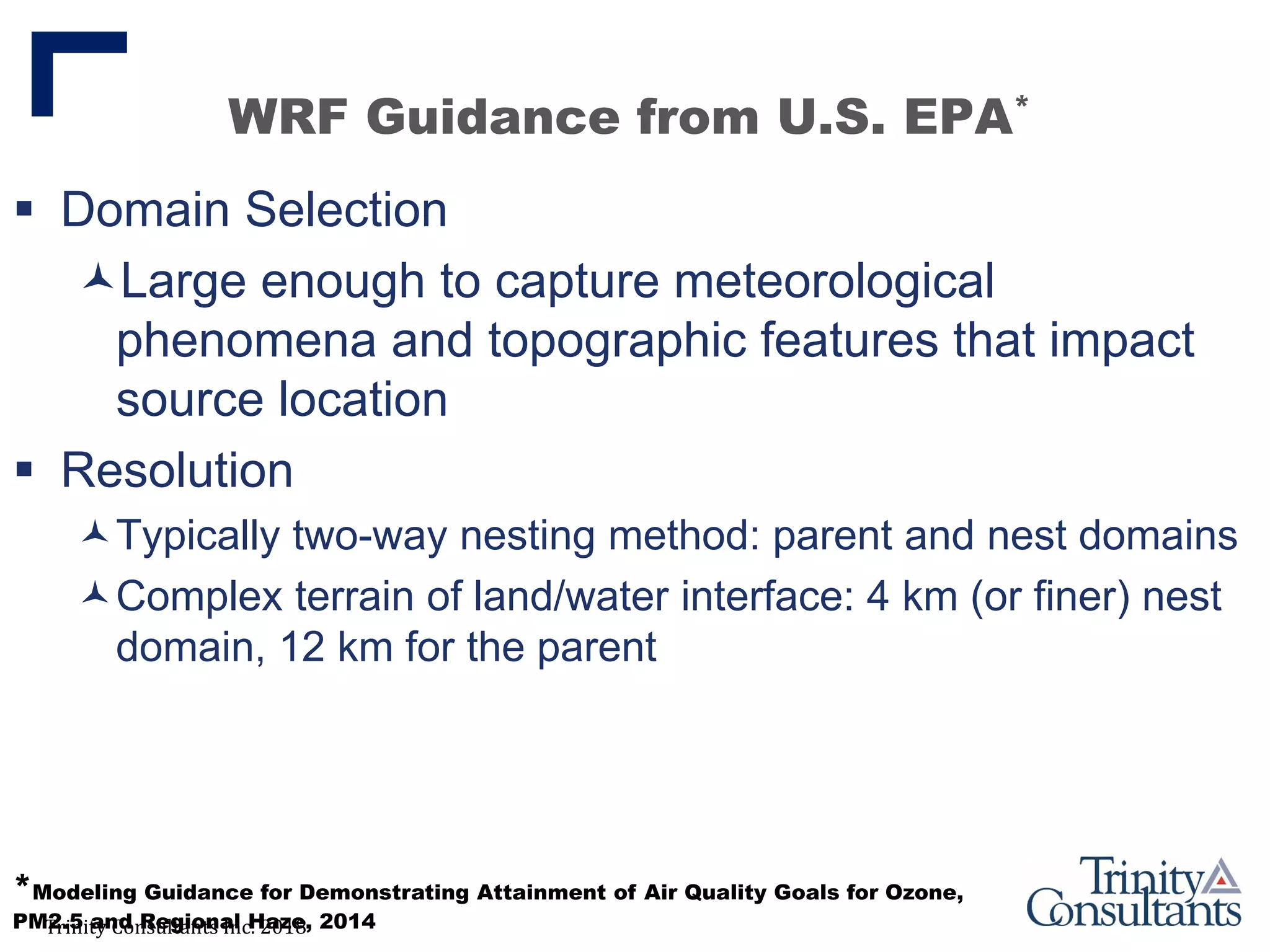
 MM data are compiled for each hour of the
analysis, at each MM grid point selected for the
following upper air parameters at each
mandatory level (including surface) and
additional significant levels
Pressure
Elevation
Temperature/Dew point depression
Wind direction and speed
Trinity Consultants Inc. 2018
WRF Guidance from U.S. EPA*
 Domain Selection
Large enough to capture meteorological
phenomena and topographic features that impact
source location
 Resolution
Typically two-way nesting method: parent and nest domains
Complex terrain of land/water interface: 4 km (or finer) nest
domain, 12 km for the parent
*Modeling Guidance for Demonstrating Attainment of Air Quality Goals for Ozone,
PM2.5 and Regional Haze, 2014
Trinity Consultants Inc. 2018
Data Set Prepared for WRF
Processing
 Surface weather reports operationally collected by the
National Centers for Environmental Prediction (NCEP)
 NCEP FNL (Final) Operational Global Analysis data
which are on 1-degree by 1-degree grids prepared
operationally every six hours
 Global Upper Air Observational Weather Data which
are collected by the NCEP
 A daily, high-resolution, real-time, global, sea surface
temperature (RTG_SST) analysis developed by the
NCEP and Modeling and Analysis Branch (MMAB).
Trinity Consultants Inc. 2018
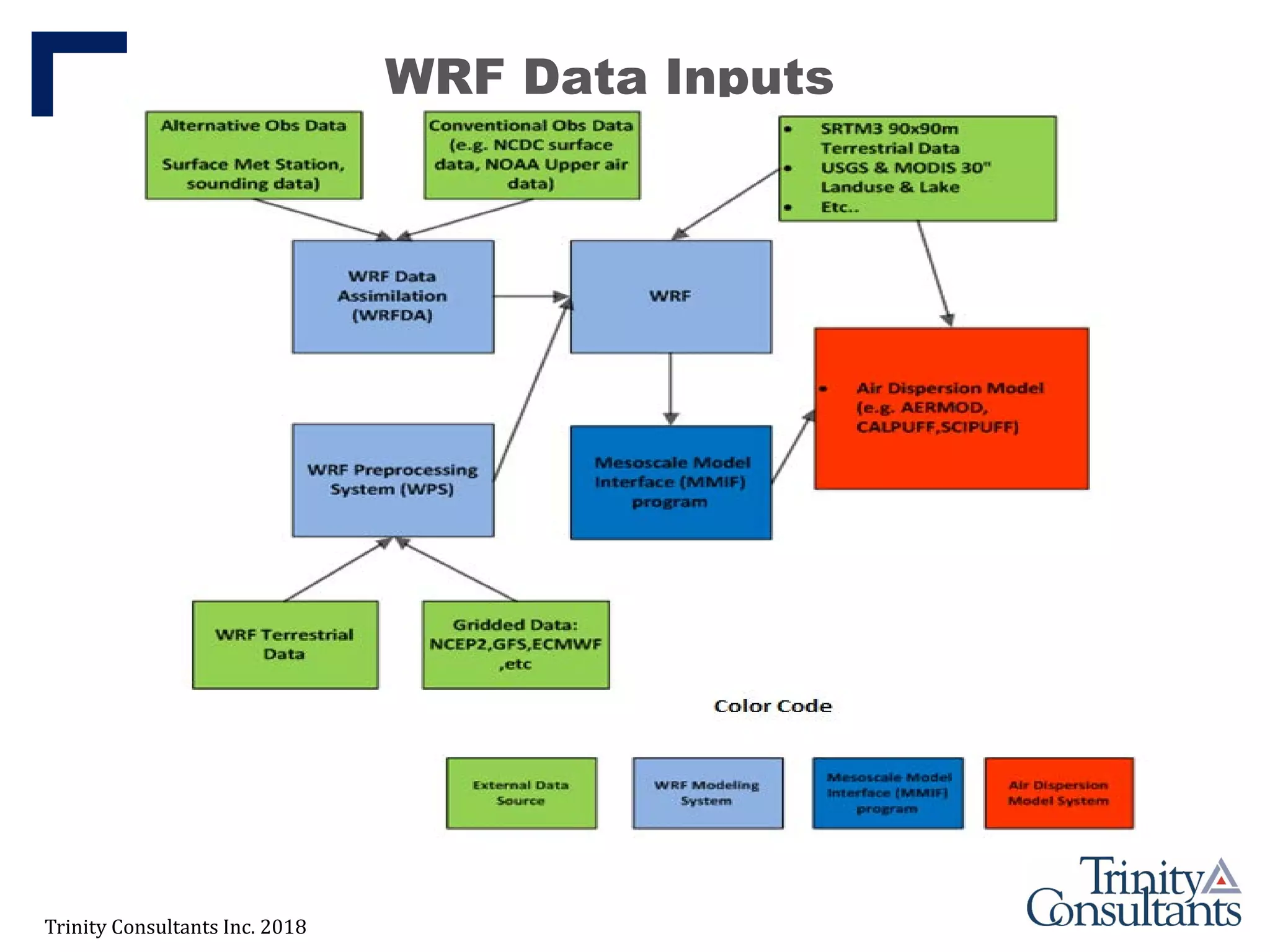
WRF Data Inputs
Trinity Consultants Inc. 2018
CASE STUDY:
APPLICATION OF WRF
FOR AQM IN THE
MIDDLE-EAST
Trinity Consultants Inc. 2018
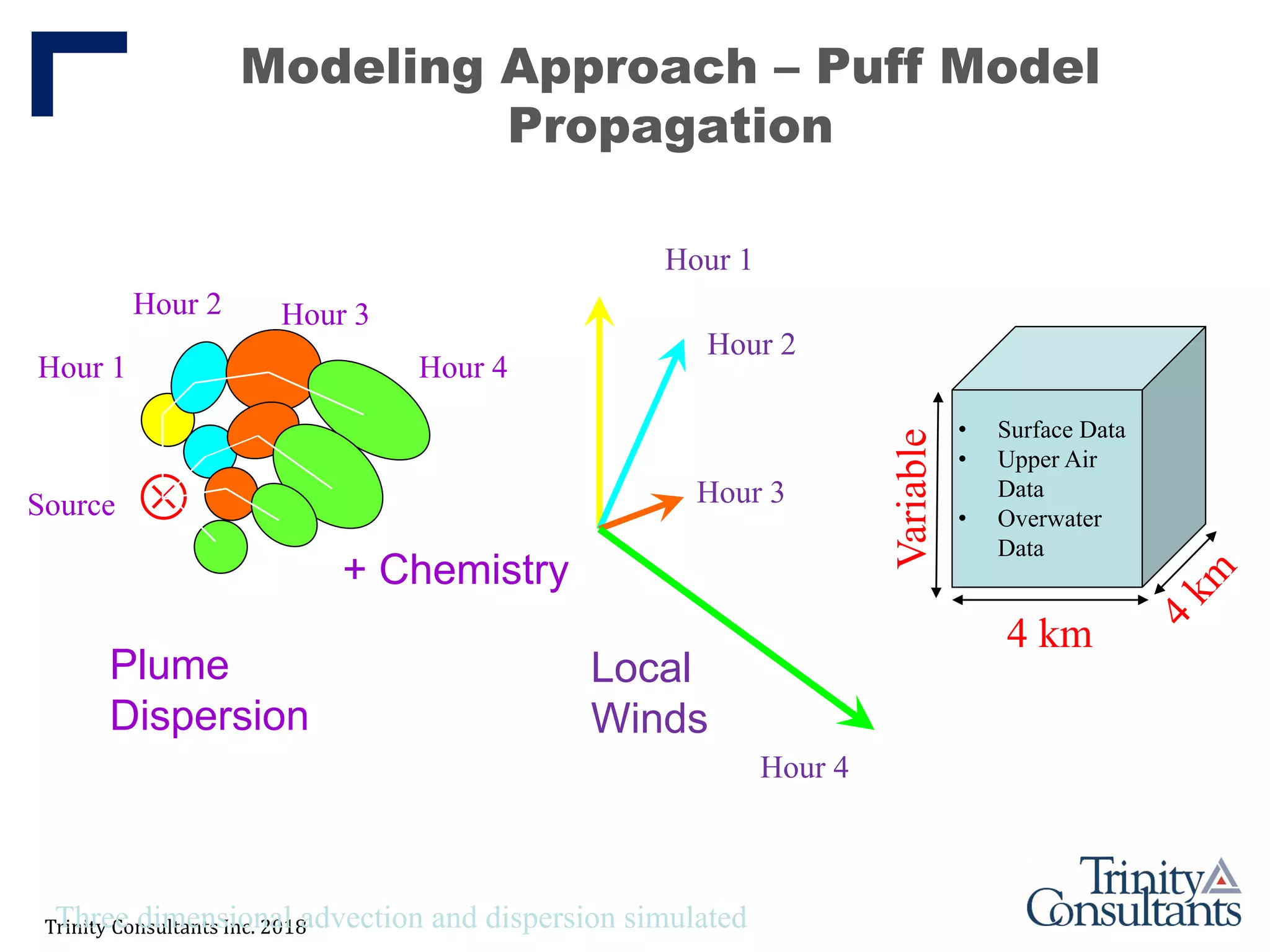
Modeling Approach – Puff Model
Propagation

Hour 1
Hour 2
Hour 3
Hour 4
Hour 1
Hour 2 Hour 3
Hour 4
Plume
Dispersion
Local
Winds
Source
Three dimensional advection and dispersion simulated
+ Chemistry
• Surface Data
• Upper Air
Data
• Overwater
Data
4 km
Variable
Trinity Consultants Inc. 2018
FINDINGS AND
CONCLUSIONS
Trinity Consultants Inc. 2018
CONCLUSION
 Prognostic Models simulate the source location with relative
accuracy
 Retrospective application grounded by actual observations through four-
dimensional data assimilation
 Improved representativeness relative to NWS data
 Provides upper-air data at source location
 Studies validate modeled data to be well correlated to balloon
observations
 Alternative source of met information for locations where
observation systems are not available
 Higher density of data for models such as CALPUFF
Trinity Consultants Inc. 2018
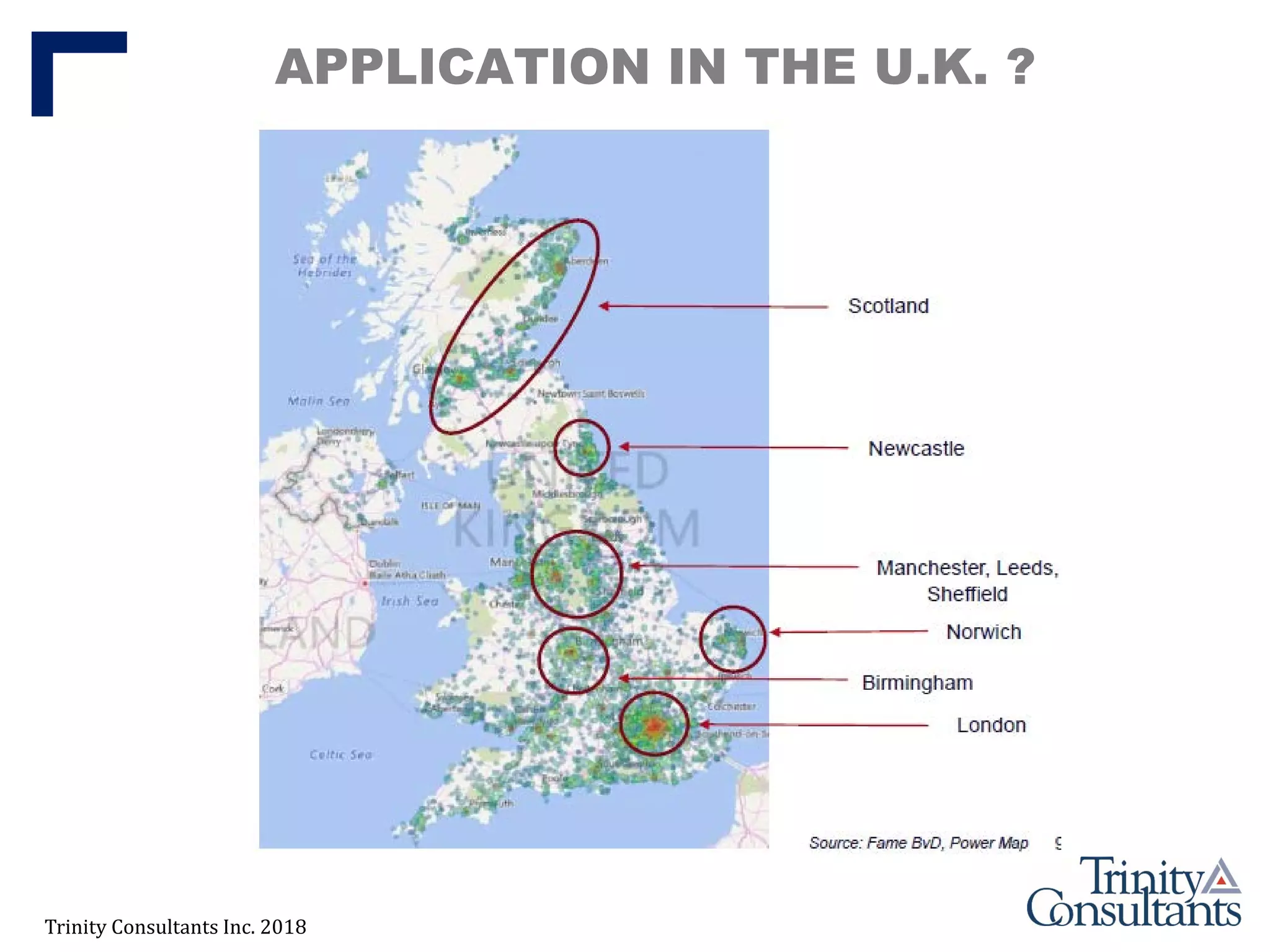
APPLICATION IN THE U.K. ?
Trinity Consultants Inc. 2018
Thank you!

Prognostic Meteorological Models and Their Use in Dispersion Modelling

  • 1.
    Trinity Consultants Inc.2018 PROGNOSTIC METEOROLOGICAL MODELS AND THEIR USE IN DISPERSION MODELLING DMUG 2018 LONDON, UNITED KINGDOM ARUN KANCHAN TRINITY CONSULTANTS, INC. APRIL 19, 2018
  • 2.
    Trinity Consultants Inc.2018 Prognostic Meteorological Models and their Use in Dispersion Modelling AGENDA 1. INTRODUCTION 2. PROGNOSTIC MODEL OF FOCUS: WEATHER RESEARCH AND FORECASTING (WRF) MODEL 3. CASE STUDY: APPLICATION OF WRF FOR AQM IN THE MIDDLE-EAST 4. FINDINGS AND CONCLUSIONS
  • 3.
    Trinity Consultants Inc.2018 INTRODUCTION
  • 4.
    Trinity Consultants Inc.2018 Meteorological Input Types Used in Dispersion Modeling  Site-Specific Installed meteorological observation tower Most accurate meteorological data at the source location Installation/maintenance costs and data handling/quality control procedures  National Weather Service / Met Office Routinely available Generally not at the source location May not be the most adequately representative data (e.g. complex terrain, distance, etc.)  Prognostic Meteorological Data Three-dimensional mesoscale computer models: MM5 and WRF
  • 5.
    Trinity Consultants Inc.2018 Discontinuance of MM5 and Advent of WRF
  • 6.
    Trinity Consultants Inc.2018 PROGNOSTIC MODEL OF FOCUS: WEATHER RESEARCH AND FORECASTING (WRF) MODEL
  • 7.
    Trinity Consultants Inc.2018 WRF  Developed in the U.S. by National Center for Atmospheric Research (NCAR) Primary meteorological tool used by U.S. EPA Continuous updates Supported across a broad community  Modeling across multiple scales
  • 8.
    Trinity Consultants Inc.2018 WRF: Visualization
  • 9.
    Trinity Consultants Inc.2018 Mesoscale Met Data  “Mesoscale” is that domain of atmospheric physics that takes place on the order of approximately 100 km and about 1 hour  Weather forecast models operate by computing mesoscale physical parameters at hourly time steps over the entire depth of the atmosphere  Parameters are computed over a three- dimensional grid that covers the globe and multiple (approximately 30) levels of the atmosphere
  • 10.
    Trinity Consultants Inc.2018 Mesoscale Met Data  MM data are used as an “initial guess” wind field input to CALMET  From this wind field, terrain effects and slope flow are computed  This wind field is then supplemented with interpolated observations from surface and upper air stations and smoothed to create the final wind field
  • 11.
    Trinity Consultants Inc.2018 Mesoscale Met Data  MM data are compiled for each hour of the analysis, at each MM grid point selected for the following surface parameters Date and time Grid cell indices Surface pressure Past hour rainfall
  • 12.
    Trinity Consultants Inc.2018 Mesoscale Met Data  MM data are compiled for each hour of the analysis, at each MM grid point selected for the following upper air parameters at each mandatory level (including surface) and additional significant levels Pressure Elevation Temperature/Dew point depression Wind direction and speed
  • 13.
    Trinity Consultants Inc.2018 WRF Guidance from U.S. EPA*  Domain Selection Large enough to capture meteorological phenomena and topographic features that impact source location  Resolution Typically two-way nesting method: parent and nest domains Complex terrain of land/water interface: 4 km (or finer) nest domain, 12 km for the parent *Modeling Guidance for Demonstrating Attainment of Air Quality Goals for Ozone, PM2.5 and Regional Haze, 2014
  • 14.
    Trinity Consultants Inc.2018 Data Set Prepared for WRF Processing  Surface weather reports operationally collected by the National Centers for Environmental Prediction (NCEP)  NCEP FNL (Final) Operational Global Analysis data which are on 1-degree by 1-degree grids prepared operationally every six hours  Global Upper Air Observational Weather Data which are collected by the NCEP  A daily, high-resolution, real-time, global, sea surface temperature (RTG_SST) analysis developed by the NCEP and Modeling and Analysis Branch (MMAB).
  • 15.
    Trinity Consultants Inc.2018 WRF Data Inputs
  • 16.
  • 17.
    Trinity Consultants Inc.2018 CASE STUDY: APPLICATION OF WRF FOR AQM IN THE MIDDLE-EAST
  • 18.
    Trinity Consultants Inc.2018 Modeling Approach – Puff Model Propagation  Hour 1 Hour 2 Hour 3 Hour 4 Hour 1 Hour 2 Hour 3 Hour 4 Plume Dispersion Local Winds Source Three dimensional advection and dispersion simulated + Chemistry • Surface Data • Upper Air Data • Overwater Data 4 km Variable
  • 19.
    Trinity Consultants Inc.2018 FINDINGS AND CONCLUSIONS
  • 20.
    Trinity Consultants Inc.2018 CONCLUSION  Prognostic Models simulate the source location with relative accuracy  Retrospective application grounded by actual observations through four- dimensional data assimilation  Improved representativeness relative to NWS data  Provides upper-air data at source location  Studies validate modeled data to be well correlated to balloon observations  Alternative source of met information for locations where observation systems are not available  Higher density of data for models such as CALPUFF
  • 21.
    Trinity Consultants Inc.2018 APPLICATION IN THE U.K. ?
  • 22.
    Trinity Consultants Inc.2018 Thank you!