Coastway – UAV data Acquisition and Processing

Industry using UAV’s and Laser Scanning
Mine and Quarry Mapping using UAV’s and Laser Scanners

Kick-off Meeting
8-9/jan/2014
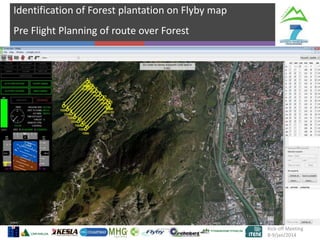
Identification of Forest plantation on Flyby map
Pre Flight Planning of route over Forest

Kick-off Meeting
8-9/jan/2014
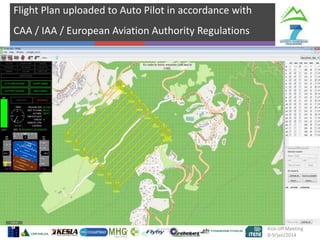
Flight Plan uploaded to Auto Pilot in accordance with
CAA / IAA / European Aviation Authority Regulations

Kick-off Meeting
8-9/jan/2014
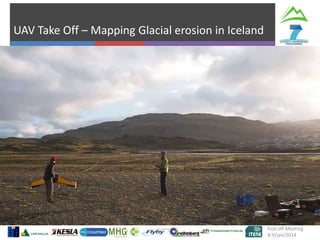
UAV Take Off – Mapping Glacial erosion in Iceland

Kick-off Meeting
8-9/jan/2014
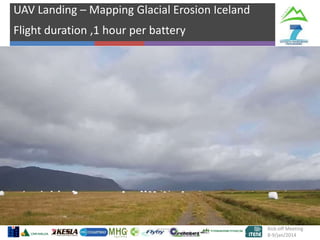
UAV Landing – Mapping Glacial Erosion Iceland
Flight duration ,1 hour per battery

Kick-off Meeting
8-9/jan/2014
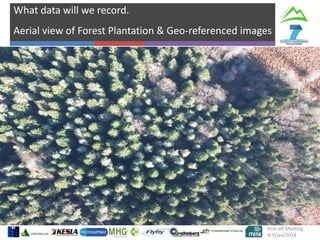
What data will we record.
Aerial view of Forest Plantation & Geo-referenced images

Kick-off Meeting
8-9/jan/2014
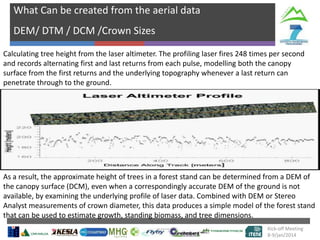
What Can be created from the aerial data
DEM/ DTM / DCM /Crown Sizes
Calculating tree height from the laser altimeter. The profiling laser fires 248 times per second
and records alternating first and last returns from each pulse, modelling both the canopy
surface from the first returns and the underlying topography whenever a last return can
penetrate through to the ground.

As a result, the approximate height of trees in a forest stand can be determined from a DEM of
the canopy surface (DCM), even when a correspondingly accurate DEM of the ground is not
available, by examining the underlying profile of laser data. Combined with DEM or Stereo
Analyst measurements of crown diameter, this data produces a simple model of the forest stand
that can be used to estimate growth, standing biomass, and tree dimensions.
Kick-off Meeting
8-9/jan/2014
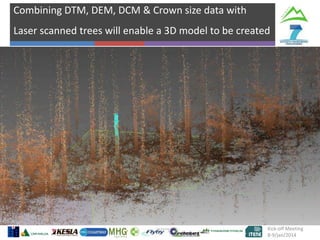
Combining DTM, DEM, DCM & Crown size data with
Laser scanned trees will enable a 3D model to be created

Kick-off Meeting
8-9/jan/2014
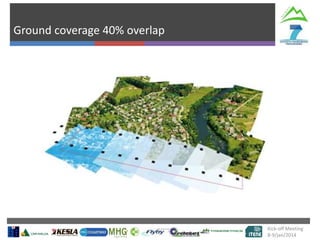
Ground coverage 40% overlap

Kick-off Meeting
8-9/jan/2014
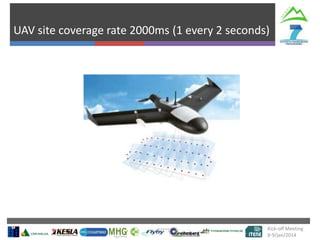
UAV site coverage rate 2000ms (1 every 2 seconds)

Kick-off Meeting
8-9/jan/2014
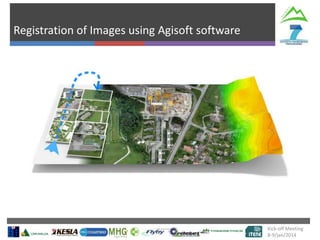
Registration of Images using Agisoft software

Kick-off Meeting
8-9/jan/2014
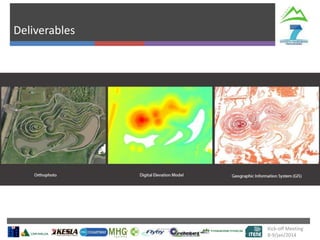
Deliverables

Kick-off Meeting
8-9/jan/2014
Delivering Geohazard/Geomorphological Models
Mountain Forestry
• A number of European programmes have assessed at a large scale geohazards (mostly
landslides), for example Terrafirma, LSI, SAFER LIM and
RLM, SLAM, PREVIEW, SAR.net, SAR.net2, DORIS and SafeLand
• Use of UAV and other data sets gathered as part of this programme will allow more
detailed mapping and practical assessment of geohazard with respect to local mountain
forestry activity
•

•

number of
Geohazard/geomorphological constraints include for example: landslide, rockfall, soft
ground, steep/rocky terrain, general groundtargets hydrological features, glacial
conditions,
features
visible, gradie
By quantifying the geohazard the appropriate forestry management technique can be
nt of
applied to optimise mountain forestry opportunitiessurface

• The use of particular DEM and aerial imagery in combination with localised groundproofing would allow a rapid interpretation of geomorphology and identification of
geohazard and terrain evaluation
• Several approaches to geohazard mapping are available, as follows:
Kick-off Meeting
8-9/jan/2014
Developing Geohazard/Geomorphological Models
Mountain Forestry
• A number of European programmes have assessed at a large scale geohazards (mostly
landslides), for example Terrafirma, LSI, SAFER LIM and RLM, SLAM, PREVIEW, SAR.net,
SAR.net2, DORIS and SafeLand
• Use of UAV and other data sets gathered as part of this programme will allow more
detailed mapping and practical assessment of geohazard with respect to local mountain
forestry activity
•

•

number of
Geohazard/geomorphological constraints include for example: landslide, rockfall, soft
ground, steep/rocky terrain, general groundtargets hydrological features, glacial
conditions,
features
visible, gradie
By quantifying the geohazard the appropriate forestry management technique can be
nt of
applied to optimise mountain forestry opportunitiessurface

• The use of particular DTM and aerial imagery in combination with localised groundproofing would allow a rapid interpretation of geomorphology and identification of
geohazard and terrain evaluation
• Several approaches to geohazard mapping are available, as follows:
Kick-off Meeting
8-9/jan/2014
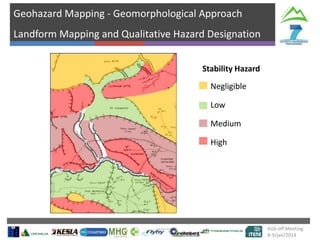
Geohazard Mapping - Geomorphological Approach

Landform Mapping and Qualitative Hazard Designation
Stability Hazard
Negligible
Low
Medium
High

Kick-off Meeting
8-9/jan/2014
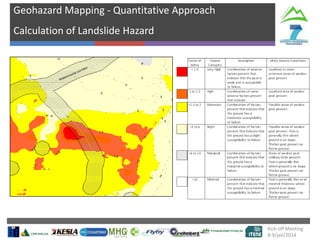
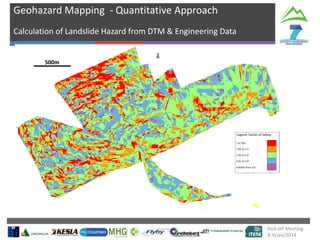
Geohazard Mapping - Quantitative Approach
Calculation of Landslide Hazard

Kick-off Meeting
8-9/jan/2014
Geohazard Mapping - Quantitative Approach
Calculation of Landslide Hazard from DTM & Engineering Data

500m
500m

Landslide failure scar (2003)

Kick-off Meeting
8-9/jan/2014
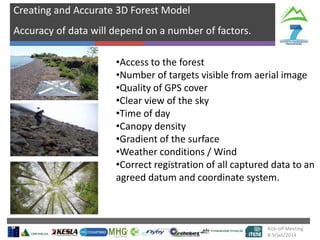
Creating and Accurate 3D Forest Model
Accuracy of data will depend on a number of factors.
•Access to the forest
•Number of targets visible from aerial image
•Quality of GPS cover
•Clear view of the sky
number of
•Time of day
•Canopy density
targets
•Gradient ofvisible, gradie
the surface
•Weather conditions / Wind
nt of surface
•Correct registration of all captured data to an
agreed datum and coordinate system.

Kick-off Meeting
8-9/jan/2014
Risk
Safety and Planning are key to success

Kick-off Meeting
8-9/jan/2014

Coastway technical presentation5

  • 1.
    Coastway – UAVdata Acquisition and Processing Industry using UAV’s and Laser Scanning Mine and Quarry Mapping using UAV’s and Laser Scanners Kick-off Meeting 8-9/jan/2014
  • 2.
    Identification of Forestplantation on Flyby map Pre Flight Planning of route over Forest Kick-off Meeting 8-9/jan/2014
  • 3.
    Flight Plan uploadedto Auto Pilot in accordance with CAA / IAA / European Aviation Authority Regulations Kick-off Meeting 8-9/jan/2014
  • 4.
    UAV Take Off– Mapping Glacial erosion in Iceland Kick-off Meeting 8-9/jan/2014
  • 5.
    UAV Landing –Mapping Glacial Erosion Iceland Flight duration ,1 hour per battery Kick-off Meeting 8-9/jan/2014
  • 6.
    What data willwe record. Aerial view of Forest Plantation & Geo-referenced images Kick-off Meeting 8-9/jan/2014
  • 7.
    What Can becreated from the aerial data DEM/ DTM / DCM /Crown Sizes Calculating tree height from the laser altimeter. The profiling laser fires 248 times per second and records alternating first and last returns from each pulse, modelling both the canopy surface from the first returns and the underlying topography whenever a last return can penetrate through to the ground. As a result, the approximate height of trees in a forest stand can be determined from a DEM of the canopy surface (DCM), even when a correspondingly accurate DEM of the ground is not available, by examining the underlying profile of laser data. Combined with DEM or Stereo Analyst measurements of crown diameter, this data produces a simple model of the forest stand that can be used to estimate growth, standing biomass, and tree dimensions. Kick-off Meeting 8-9/jan/2014
  • 8.
    Combining DTM, DEM,DCM & Crown size data with Laser scanned trees will enable a 3D model to be created Kick-off Meeting 8-9/jan/2014
  • 9.
    Ground coverage 40%overlap Kick-off Meeting 8-9/jan/2014
  • 10.
    UAV site coveragerate 2000ms (1 every 2 seconds) Kick-off Meeting 8-9/jan/2014
  • 11.
    Registration of Imagesusing Agisoft software Kick-off Meeting 8-9/jan/2014
  • 12.
  • 13.
    Delivering Geohazard/Geomorphological Models MountainForestry • A number of European programmes have assessed at a large scale geohazards (mostly landslides), for example Terrafirma, LSI, SAFER LIM and RLM, SLAM, PREVIEW, SAR.net, SAR.net2, DORIS and SafeLand • Use of UAV and other data sets gathered as part of this programme will allow more detailed mapping and practical assessment of geohazard with respect to local mountain forestry activity • • number of Geohazard/geomorphological constraints include for example: landslide, rockfall, soft ground, steep/rocky terrain, general groundtargets hydrological features, glacial conditions, features visible, gradie By quantifying the geohazard the appropriate forestry management technique can be nt of applied to optimise mountain forestry opportunitiessurface • The use of particular DEM and aerial imagery in combination with localised groundproofing would allow a rapid interpretation of geomorphology and identification of geohazard and terrain evaluation • Several approaches to geohazard mapping are available, as follows: Kick-off Meeting 8-9/jan/2014
  • 14.
    Developing Geohazard/Geomorphological Models MountainForestry • A number of European programmes have assessed at a large scale geohazards (mostly landslides), for example Terrafirma, LSI, SAFER LIM and RLM, SLAM, PREVIEW, SAR.net, SAR.net2, DORIS and SafeLand • Use of UAV and other data sets gathered as part of this programme will allow more detailed mapping and practical assessment of geohazard with respect to local mountain forestry activity • • number of Geohazard/geomorphological constraints include for example: landslide, rockfall, soft ground, steep/rocky terrain, general groundtargets hydrological features, glacial conditions, features visible, gradie By quantifying the geohazard the appropriate forestry management technique can be nt of applied to optimise mountain forestry opportunitiessurface • The use of particular DTM and aerial imagery in combination with localised groundproofing would allow a rapid interpretation of geomorphology and identification of geohazard and terrain evaluation • Several approaches to geohazard mapping are available, as follows: Kick-off Meeting 8-9/jan/2014
  • 15.
    Geohazard Mapping -Geomorphological Approach Landform Mapping and Qualitative Hazard Designation Stability Hazard Negligible Low Medium High Kick-off Meeting 8-9/jan/2014
  • 16.
    Geohazard Mapping -Quantitative Approach Calculation of Landslide Hazard Kick-off Meeting 8-9/jan/2014
  • 17.
    Geohazard Mapping -Quantitative Approach Calculation of Landslide Hazard from DTM & Engineering Data 500m 500m Landslide failure scar (2003) Kick-off Meeting 8-9/jan/2014
  • 18.
    Creating and Accurate3D Forest Model Accuracy of data will depend on a number of factors. •Access to the forest •Number of targets visible from aerial image •Quality of GPS cover •Clear view of the sky number of •Time of day •Canopy density targets •Gradient ofvisible, gradie the surface •Weather conditions / Wind nt of surface •Correct registration of all captured data to an agreed datum and coordinate system. Kick-off Meeting 8-9/jan/2014
  • 19.
    Risk Safety and Planningare key to success Kick-off Meeting 8-9/jan/2014