Innovative web-based modeling solutions
for wildfires
H2020 Webinar Series / October 2019
Céline Déandreis, Marc Chiappero
Overview
RiskFP is a geospatial web-based modeling platform developed to support both forest managers,
investors and insurance actors in managing the vulnerability of their assets/portfolios to fire risk.
RiskFP includes four main modules:
1. Realistic disaster scenarios and CO2 release
2. Risk mapping
3. Seasonal and climate forecast for critical days
4. Wildland Urban Interface
RiskFP has been tested by several users (mainly forest managers, insurers and fire-fighters) in
several regions worldwide: Brazil, Chile, South Europe, and Australia.
Partners and context of development
The context:
Two R&D projects
1. H2020 OASIS Insurance, initiated in 2017 and due to finish in 2020
2. BOOSTER FIRE WUI initiated in 2018 and due to finish late 2019
The partners:
H2020 project leader
Project leader insurance
module – Modeling -
Meteorology
Fire propagation – Risk
maps – Veg maps
Insurance specialist
Forest management
specialist, CO2 module
Building vulnerability
Research on fire
modeling
Prevention of
natural risks
Competitive
cluster on risk
Competition
WEB Service:
RMS
Studies: ARIA uses the platform to perform specific studies for the client
One-off consulting
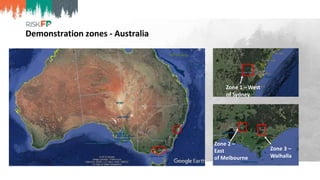
Demonstration zones - Australia
Zone 2 –
East
of Melbourne
Zone 3 –
Walhalla
Zone 1 – West
of Sydney
Demonstration zones – Victoria / Australia
Central Gippsland north of the
Morwell-Traralgon basin
Critical Landscape Weather Patterns
This concept lies at the heart of the platform.
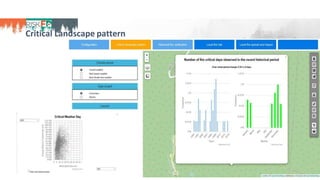
“Critical landscape fire weather pattern” is an empirical fire weather index that identifies severe-extreme fire
weather days. It is defined based on:
• Fire risk factors related to critical fuel and fire weather conditions for a severe-extreme bushfire. Three fire
risk factors are used. Specific thresholds used as triggering criteria have been calibrated to the zone.
• Criteria of exposure duration in hours on a given day.
The indicator is derived from hourly or half-hourly records at a representative weather station of the given zone.
It is used for:
• pre-selecting days for the RDS generator and for the risk mapping service
• the forecasting and projection service as a basis indicator
Critical Landscape pattern
Realistic disaster scenarios and impact assessment
1) “Critical landscape fire weather patterns”
2) A propagation model that allows estimating the progression and behaviour
of the fire in space and time. Realistic disaster scenarios are simulated with
the Wildfire Analyst® simulation software from Tecnosylva.
• The propagation model of Wildfire Analyst is based on the standardized
and validated semi-empirical Rothermel propagation model (1972).
• Improvement of the model capabilities thanks to the participation to
many R&D project since 2005
3) Impact module:
• Calculation of the GHGs emissions released by the fire scenario
modelled.
• Calculation of other impacts and losses possible depending on data
availability.
Input data
 Hourly weather data
 Fire ignition line / point
 Digital Elevation model
 Vegetation fuels at high resolution (30m)
Realistic disaster scenarios and CO2 release
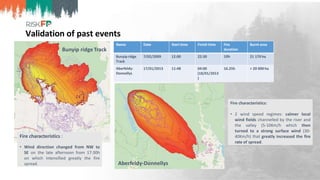
Validation of past events
Fire characteristics :
• Wind direction changed from NW to
SE on the late afternoon from 17:30h
on which intensified greatly the fire
spread.
Bunyip ridge Track
Name Date Start time Finish time Burnt area
7/02/2009 12:00 22:30
Fire
duration
10h 21 170 haBunyip ridge
Track
Aberfeldy-
Donnellys
17/01/2013 11:48 04:00
(18/01/2013
)
16.25h > 20 000 ha
Fire characteristics:
• 2 wind speed regimes: calmer local
wind fields channelled by the river and
the valley (5-10Km/h which then
turned to a strong surface wind (30-
40Km/h) that greatly increased the fire
rate of spread.
Aberfeldy-Donnellys
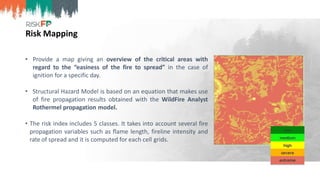
Risk Mapping
• Provide a map giving an overview of the critical areas with
regard to the “easiness of the fire to spread” in the case of
ignition for a specific day.
• Structural Hazard Model is based on an equation that makes use
of fire propagation results obtained with the WildFire Analyst
Rothermel propagation model.
• The risk index includes 5 classes. It takes into account several fire
propagation variables such as flame length, fireline intensity and
rate of spread and it is computed for each cell grids.
Seasonal and climate forecast for critical days
Operational forecast to predict their potential exposure to fire risk
at both a seasonal and long-term horizons. It provides information
on the frequency of large fires.
It consists in assessing the frequency of critical days during which
weather conditions could lead to large fires in the future period
and to compare it to “normal” conditions.
- Seasonal forecasts provided by the Copernicus Program that
are updated each month by ECMWF and the main European
Met Offices.
- Climate change scenarios provided by the International
Community (IPCC, CORDEX) and that allow to take into account
the evolution of weather conditions due to climate change over
a long-term horizon
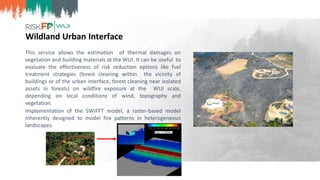
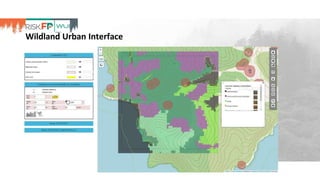
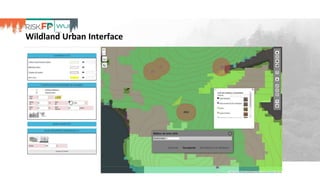
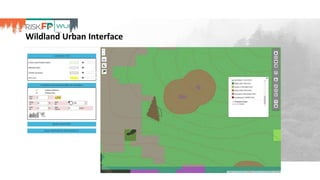
Wildland Urban Interface
This service allows the estimation of thermal damages on
vegetation and building materials at the WUI. It can be useful to
evaluate the effectiveness of risk reduction options like fuel
treatment strategies (forest cleaning within the vicinity of
buildings or of the urban interface, forest cleaning near isolated
assets in forests) on wildfire exposure at the WUI scale,
depending on local conditions of wind, topography and
vegetation.
Implementation of the SWIFFT model, a raster-based model
inherently designed to model fire patterns in heterogeneous
landscapes.
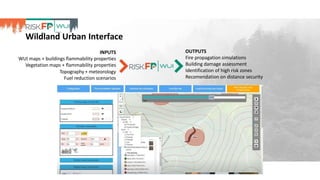
Wildland Urban Interface
INPUTS
WUI maps + buildings flammability properties
Vegetation maps + flammability properties
Topography + meteorology
Fuel reduction scenarios
OUTPUTS
Fire propagation simulations
Building damage assessment
Identification of high risk zones
Recomendation on distance security
Wildland Urban Interface
Thank you for your attention!
cdeandreis@aria.fr
mchiappero@aria.fr
ARIA Technologies
ARIA Technologies
8-10 rue de la Ferme
92100 Boulogne-Billancourt
Tél : +33 (0)1 46 08 68 60
www.aria.fr

Innovation web-based modeling solutions for wildfires

  • 1.
    Innovative web-based modelingsolutions for wildfires H2020 Webinar Series / October 2019 Céline Déandreis, Marc Chiappero
  • 2.
    Overview RiskFP is ageospatial web-based modeling platform developed to support both forest managers, investors and insurance actors in managing the vulnerability of their assets/portfolios to fire risk. RiskFP includes four main modules: 1. Realistic disaster scenarios and CO2 release 2. Risk mapping 3. Seasonal and climate forecast for critical days 4. Wildland Urban Interface RiskFP has been tested by several users (mainly forest managers, insurers and fire-fighters) in several regions worldwide: Brazil, Chile, South Europe, and Australia.
  • 3.
    Partners and contextof development The context: Two R&D projects 1. H2020 OASIS Insurance, initiated in 2017 and due to finish in 2020 2. BOOSTER FIRE WUI initiated in 2018 and due to finish late 2019 The partners: H2020 project leader Project leader insurance module – Modeling - Meteorology Fire propagation – Risk maps – Veg maps Insurance specialist Forest management specialist, CO2 module Building vulnerability Research on fire modeling Prevention of natural risks Competitive cluster on risk
  • 4.
    Competition WEB Service: RMS Studies: ARIAuses the platform to perform specific studies for the client One-off consulting
  • 5.
    Demonstration zones -Australia Zone 2 – East of Melbourne Zone 3 – Walhalla Zone 1 – West of Sydney
  • 6.
    Demonstration zones –Victoria / Australia Central Gippsland north of the Morwell-Traralgon basin
  • 7.
    Critical Landscape WeatherPatterns This concept lies at the heart of the platform. “Critical landscape fire weather pattern” is an empirical fire weather index that identifies severe-extreme fire weather days. It is defined based on: • Fire risk factors related to critical fuel and fire weather conditions for a severe-extreme bushfire. Three fire risk factors are used. Specific thresholds used as triggering criteria have been calibrated to the zone. • Criteria of exposure duration in hours on a given day. The indicator is derived from hourly or half-hourly records at a representative weather station of the given zone. It is used for: • pre-selecting days for the RDS generator and for the risk mapping service • the forecasting and projection service as a basis indicator
  • 8.
  • 9.
    Realistic disaster scenariosand impact assessment 1) “Critical landscape fire weather patterns” 2) A propagation model that allows estimating the progression and behaviour of the fire in space and time. Realistic disaster scenarios are simulated with the Wildfire Analyst® simulation software from Tecnosylva. • The propagation model of Wildfire Analyst is based on the standardized and validated semi-empirical Rothermel propagation model (1972). • Improvement of the model capabilities thanks to the participation to many R&D project since 2005 3) Impact module: • Calculation of the GHGs emissions released by the fire scenario modelled. • Calculation of other impacts and losses possible depending on data availability. Input data  Hourly weather data  Fire ignition line / point  Digital Elevation model  Vegetation fuels at high resolution (30m)
  • 10.
  • 11.
    Validation of pastevents Fire characteristics : • Wind direction changed from NW to SE on the late afternoon from 17:30h on which intensified greatly the fire spread. Bunyip ridge Track Name Date Start time Finish time Burnt area 7/02/2009 12:00 22:30 Fire duration 10h 21 170 haBunyip ridge Track Aberfeldy- Donnellys 17/01/2013 11:48 04:00 (18/01/2013 ) 16.25h > 20 000 ha Fire characteristics: • 2 wind speed regimes: calmer local wind fields channelled by the river and the valley (5-10Km/h which then turned to a strong surface wind (30- 40Km/h) that greatly increased the fire rate of spread. Aberfeldy-Donnellys
  • 12.
    Risk Mapping • Providea map giving an overview of the critical areas with regard to the “easiness of the fire to spread” in the case of ignition for a specific day. • Structural Hazard Model is based on an equation that makes use of fire propagation results obtained with the WildFire Analyst Rothermel propagation model. • The risk index includes 5 classes. It takes into account several fire propagation variables such as flame length, fireline intensity and rate of spread and it is computed for each cell grids.
  • 13.
    Seasonal and climateforecast for critical days Operational forecast to predict their potential exposure to fire risk at both a seasonal and long-term horizons. It provides information on the frequency of large fires. It consists in assessing the frequency of critical days during which weather conditions could lead to large fires in the future period and to compare it to “normal” conditions. - Seasonal forecasts provided by the Copernicus Program that are updated each month by ECMWF and the main European Met Offices. - Climate change scenarios provided by the International Community (IPCC, CORDEX) and that allow to take into account the evolution of weather conditions due to climate change over a long-term horizon
  • 14.
    Wildland Urban Interface Thisservice allows the estimation of thermal damages on vegetation and building materials at the WUI. It can be useful to evaluate the effectiveness of risk reduction options like fuel treatment strategies (forest cleaning within the vicinity of buildings or of the urban interface, forest cleaning near isolated assets in forests) on wildfire exposure at the WUI scale, depending on local conditions of wind, topography and vegetation. Implementation of the SWIFFT model, a raster-based model inherently designed to model fire patterns in heterogeneous landscapes.
  • 15.
    Wildland Urban Interface INPUTS WUImaps + buildings flammability properties Vegetation maps + flammability properties Topography + meteorology Fuel reduction scenarios OUTPUTS Fire propagation simulations Building damage assessment Identification of high risk zones Recomendation on distance security
  • 16.
  • 17.
  • 18.
  • 19.
  • 20.
  • 21.
  • 22.
  • 23.
  • 24.
  • 25.
  • 26.
    Thank you foryour attention! cdeandreis@aria.fr mchiappero@aria.fr ARIA Technologies ARIA Technologies 8-10 rue de la Ferme 92100 Boulogne-Billancourt Tél : +33 (0)1 46 08 68 60 www.aria.fr