Solar Resource Measurements
and Satellite Data
4th Sfera Summer School 2013
Hornberg Castle, Germany
Dr. Norbert Geuder
CSP Services – Almería – Cologne
Outline
1) Introduction
2) Fundamentals on Solar Irradiation
3) Variability of Irradiation
4) Irradiation Sensors
5) Sensor calibration and measurement accuracy enhancement
6) Satellite Based Assessment
7) Outlook / Summary

4th Sfera Summer School, Hornberg Castle, 2013

-2
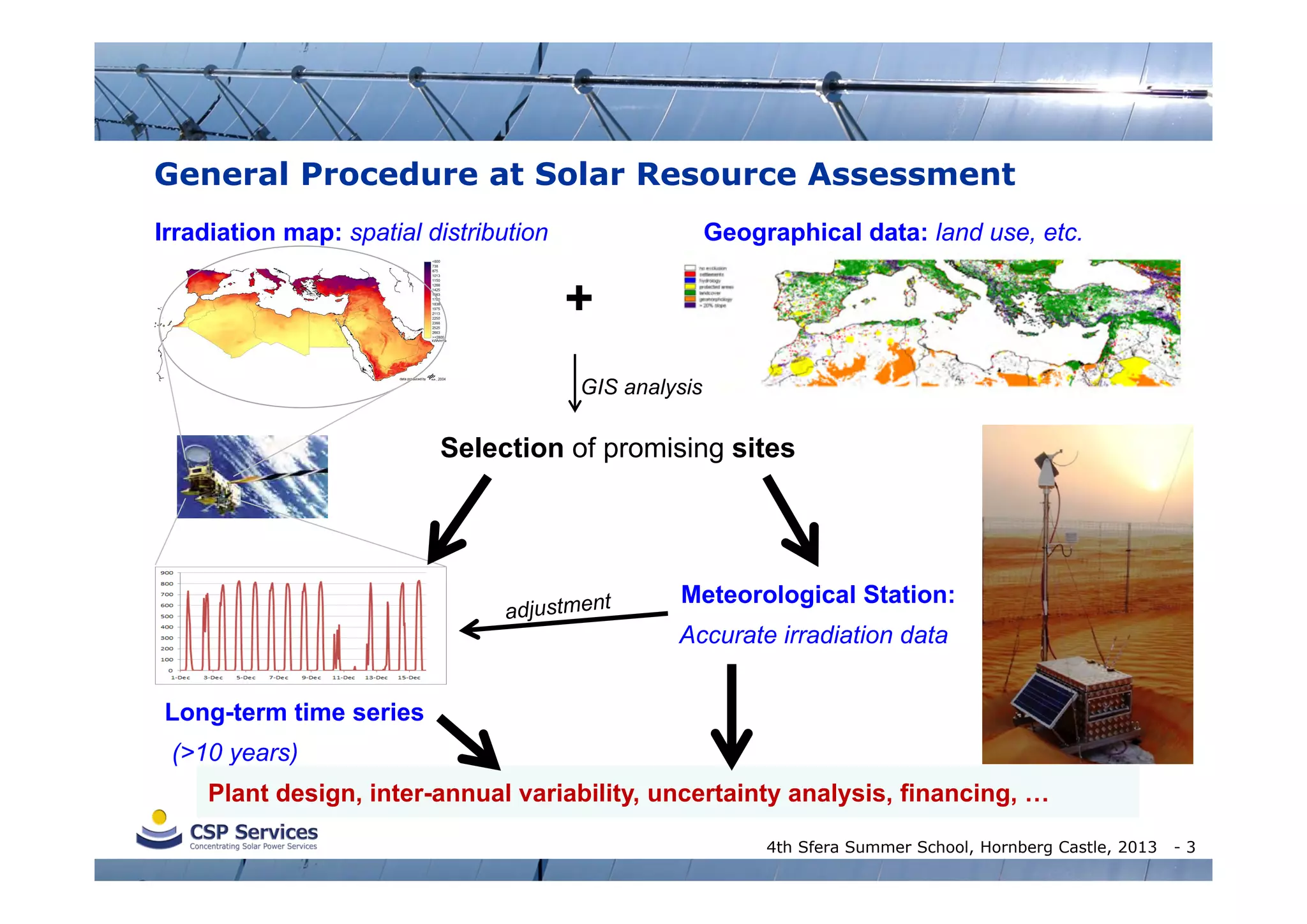
General Procedure at Solar Resource Assessment
Irradiation map: spatial distribution

Geographical data: land use, etc.

+
GIS analysis

Selection of promising sites

Meteorological Station:
Accurate irradiation data
Long-term time series
(>10 years)
Plant design, inter-annual variability, uncertainty analysis, financing, …
4th Sfera Summer School, Hornberg Castle, 2013

-3
Solar Resource Assessment for CSP Plants
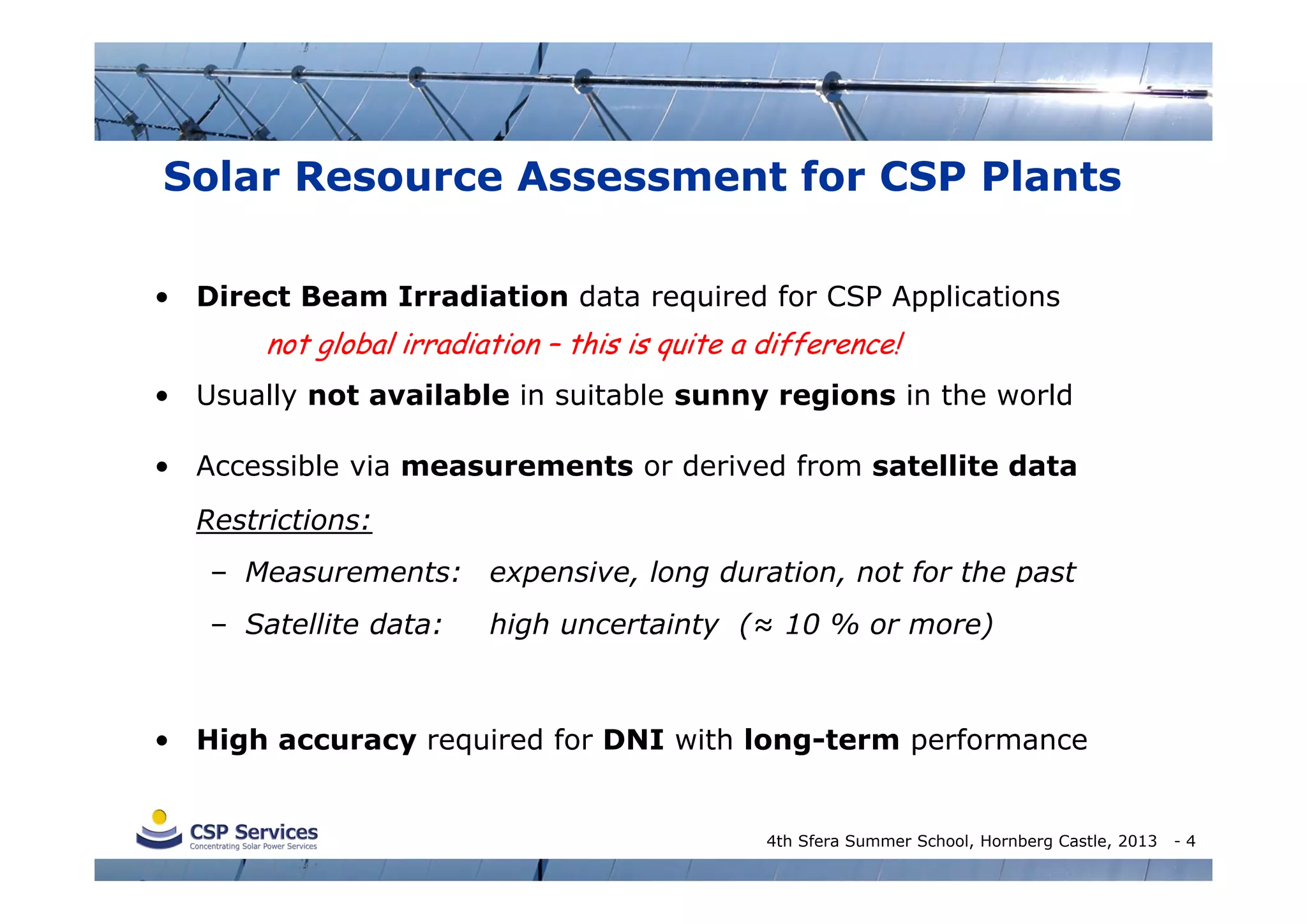
• Direct Beam Irradiation data required for CSP Applications

not global irradiation – this is quite a difference!
• Usually not available in suitable sunny regions in the world
• Accessible via measurements or derived from satellite data
Restrictions:
– Measurements: expensive, long duration, not for the past
– Satellite data:

high uncertainty (≈ 10 % or more)

• High accuracy required for DNI with long-term performance

4th Sfera Summer School, Hornberg Castle, 2013

-4
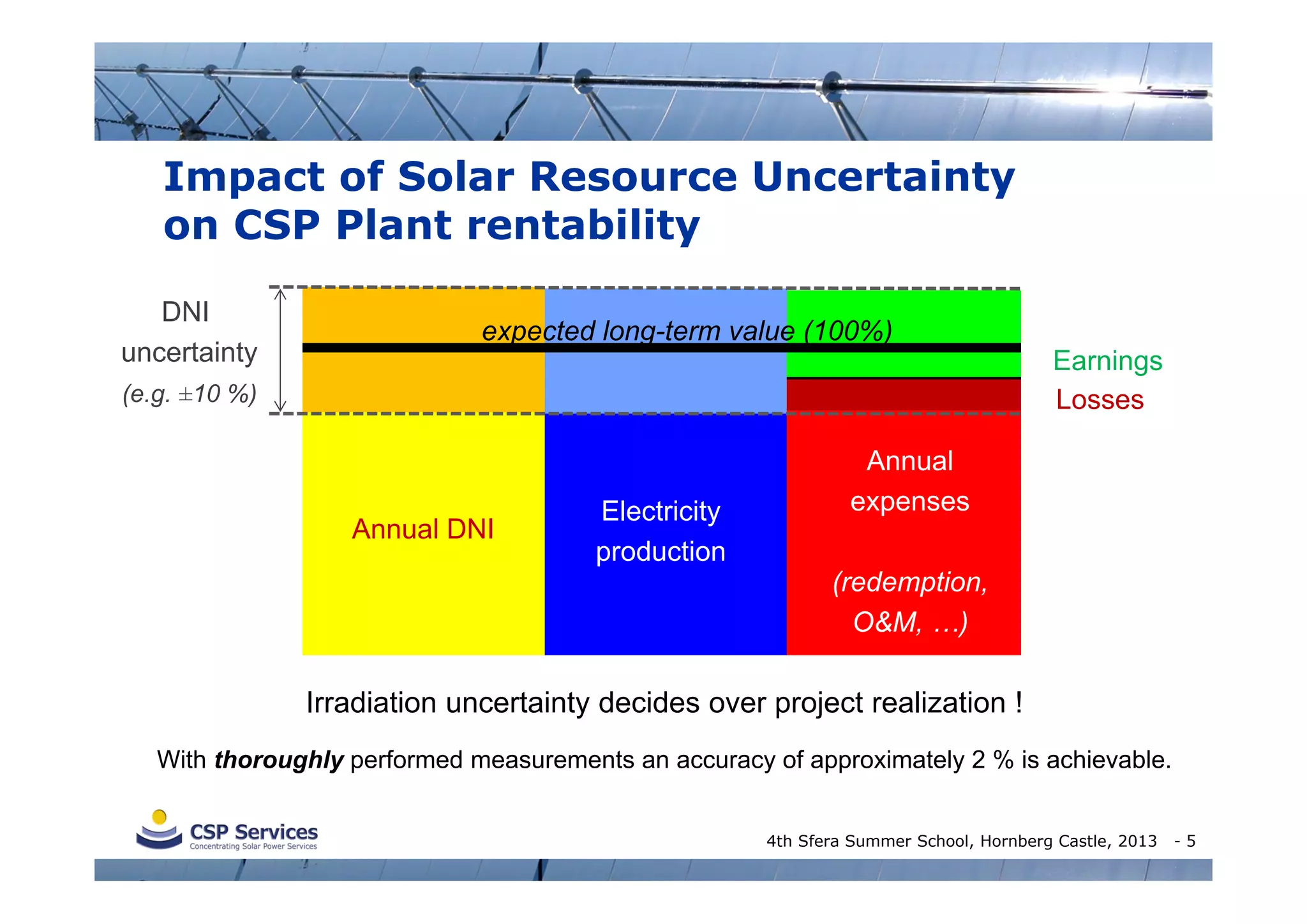
Impact of Solar Resource Uncertainty
on CSP Plant rentability
DNI
uncertainty

expected long-term value (100%)

(e.g. ±10 %)

Annual DNI

Electricity
production

Earnings
Losses

Annual
expenses
(redemption,
O&M, …)

Irradiation uncertainty decides over project realization !
With thoroughly performed measurements an accuracy of approximately 2 % is achievable.
4th Sfera Summer School, Hornberg Castle, 2013

-5
Fundamentals on Solar Irradiation

4th Sfera Summer School, Hornberg Castle, 2013

-6
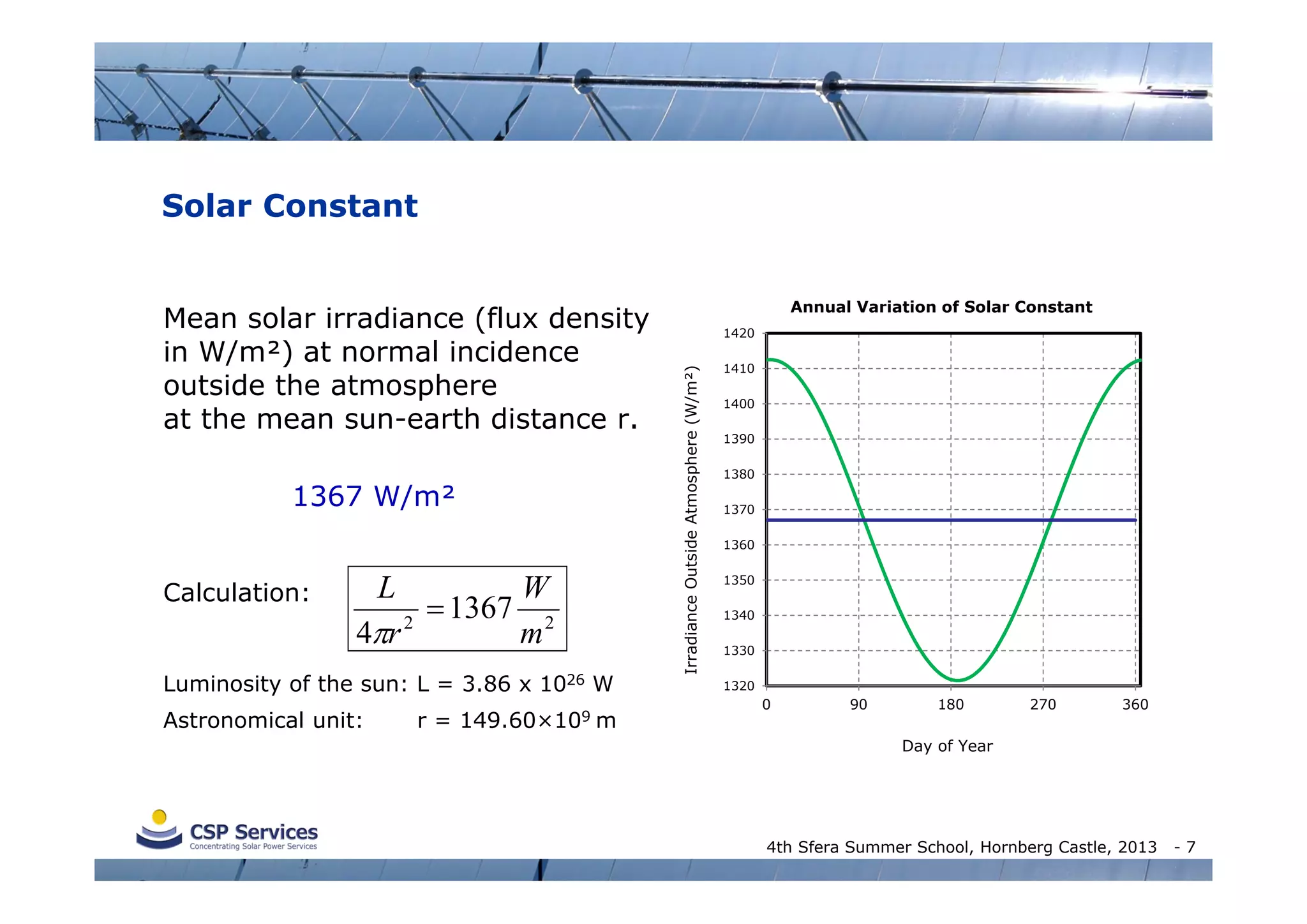
Solar Constant

1367 W/m²
Calculation:

L
W
 1367 2
4r 2
m

Luminosity of the sun: L = 3.86 x 1026 W
Astronomical unit:

r = 149.60×10⁹ m

Annual Variation of Solar Constant
1420

Irradiance Outside Atmosphere (W/m²)

Mean solar irradiance (flux density
in W/m²) at normal incidence
outside the atmosphere
at the mean sun-earth distance r.

1410
1400
1390
1380
1370
1360
1350
1340
1330
1320

0

90

180

270

360

Day of Year

4th Sfera Summer School, Hornberg Castle, 2013

-7
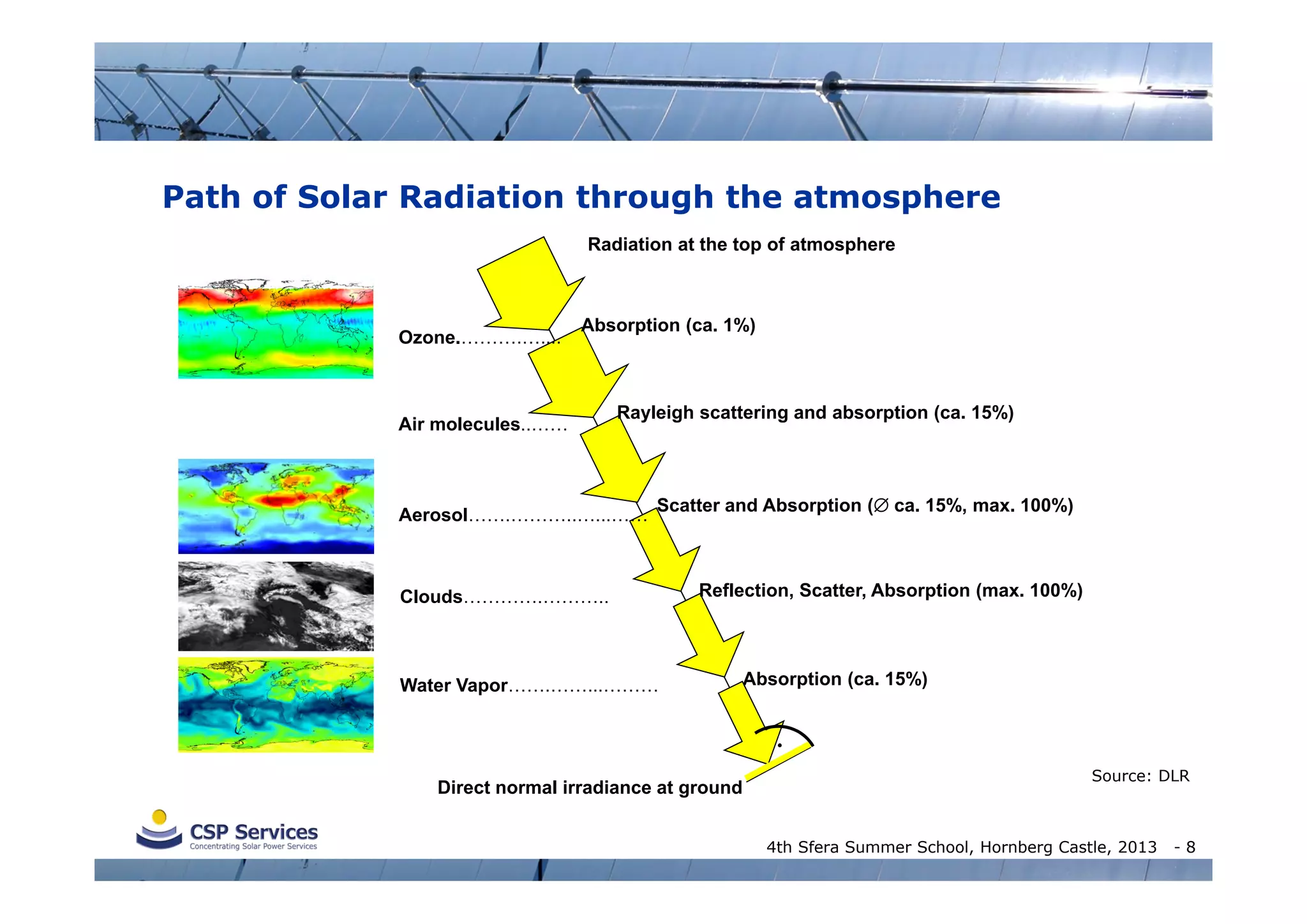
Path of Solar Radiation through the atmosphere
Radiation at the top of atmosphere

Ozone.……….…....

Absorption (ca. 1%)

Air molecules..……

Rayleigh scattering and absorption (ca. 15%)

Aerosol…….………..…...……

Scatter and Absorption ( ca. 15%, max. 100%)

Clouds………….………..

Reflection, Scatter, Absorption (max. 100%)

Water Vapor…….……...………

Direct normal irradiance at ground

Absorption (ca. 15%)

Source: DLR

4th Sfera Summer School, Hornberg Castle, 2013

-8
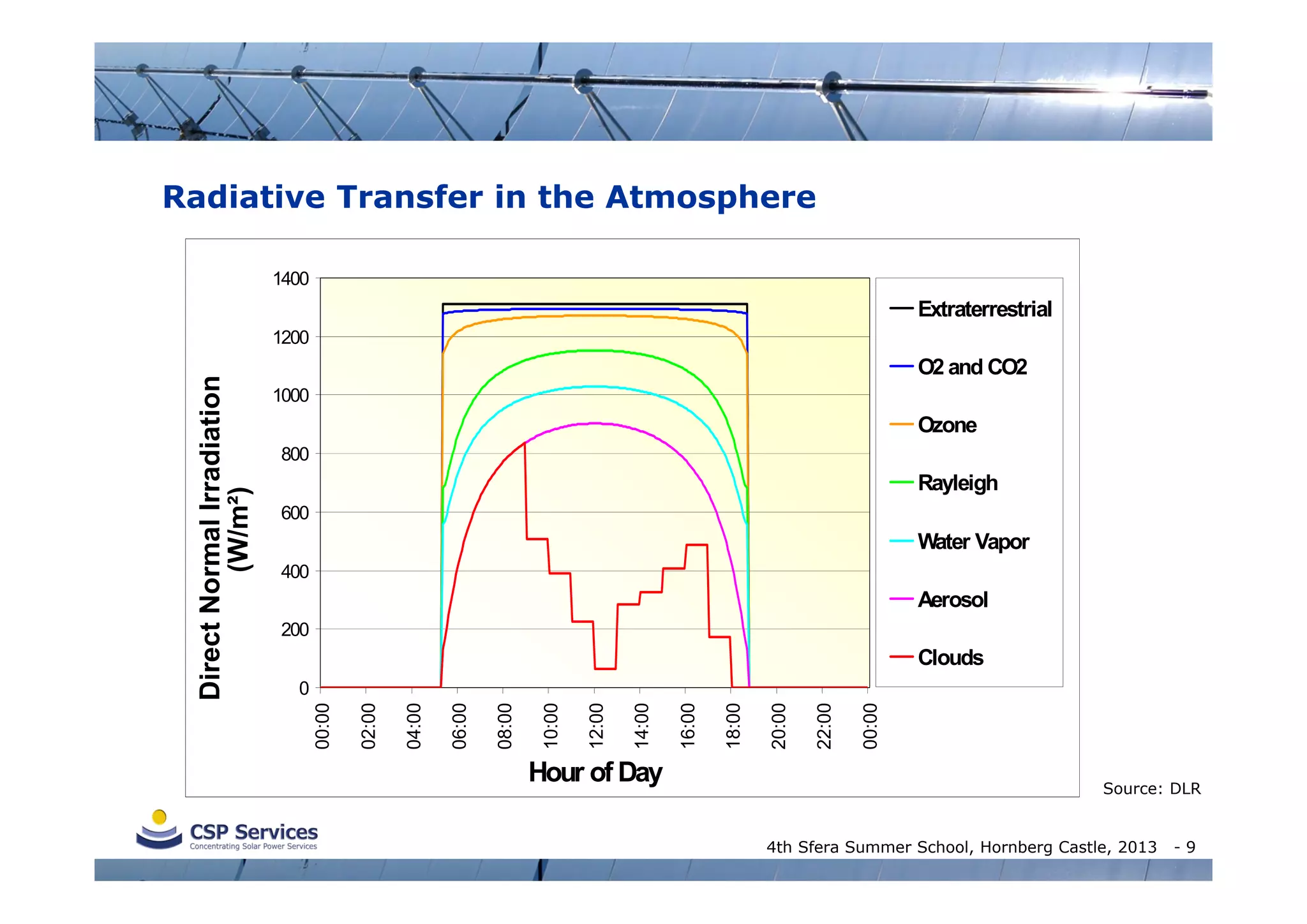
Radiative Transfer in the Atmosphere
1400

Extraterrestrial
O2 and CO2
1000

Ozone
800

Rayleigh
600

Water Vapor
400

Aerosol
200

Clouds

Hour of Day

00:00

22:00

20:00

18:00

16:00

14:00

12:00

10:00

08:00

06:00

04:00

02:00

0
00:00

Direct Normal Irradiation
(W/m²)

1200

Source: DLR

4th Sfera Summer School, Hornberg Castle, 2013

-9
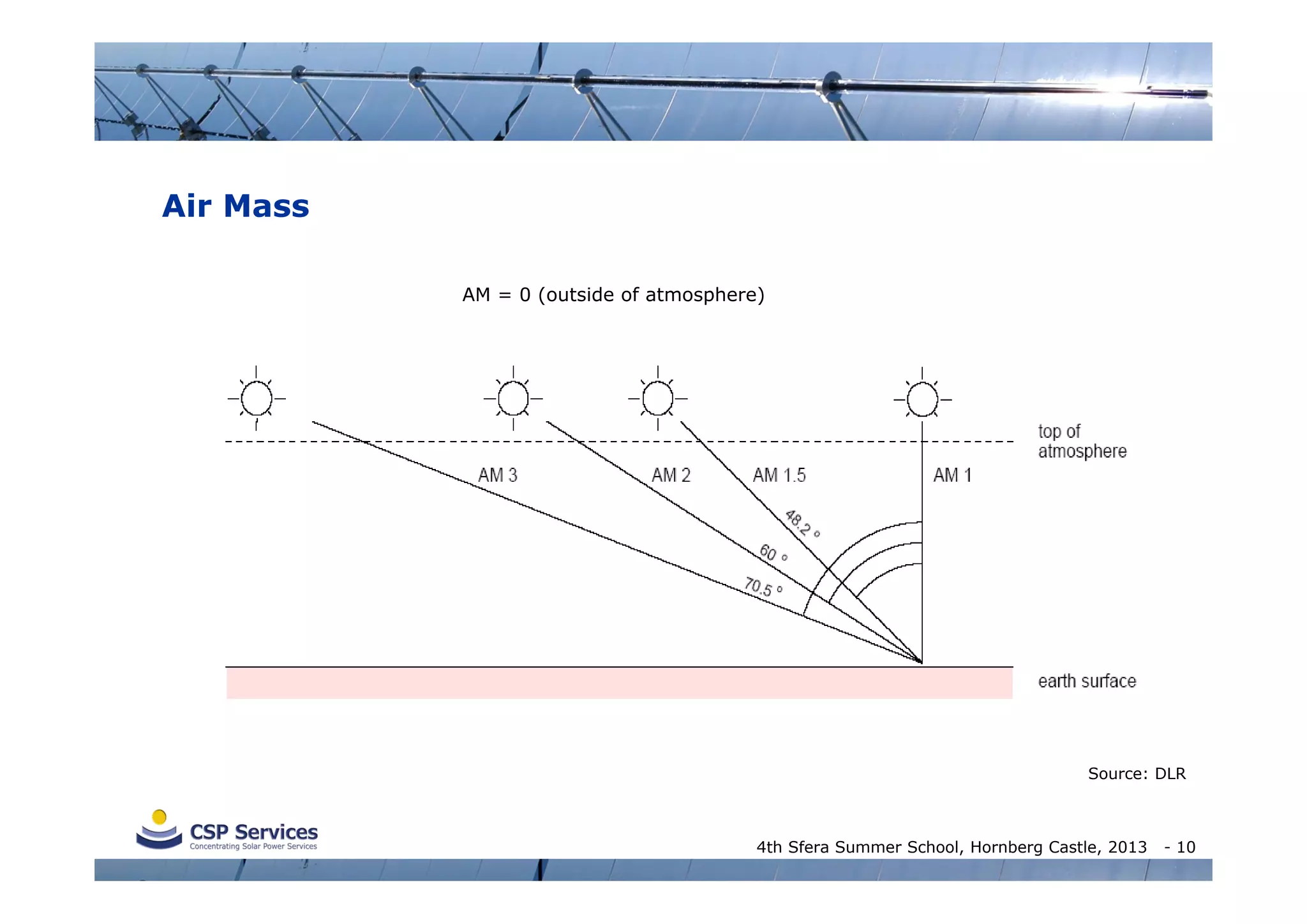
Air Mass
AM = 0 (outside of atmosphere)

Source: DLR

4th Sfera Summer School, Hornberg Castle, 2013

- 10
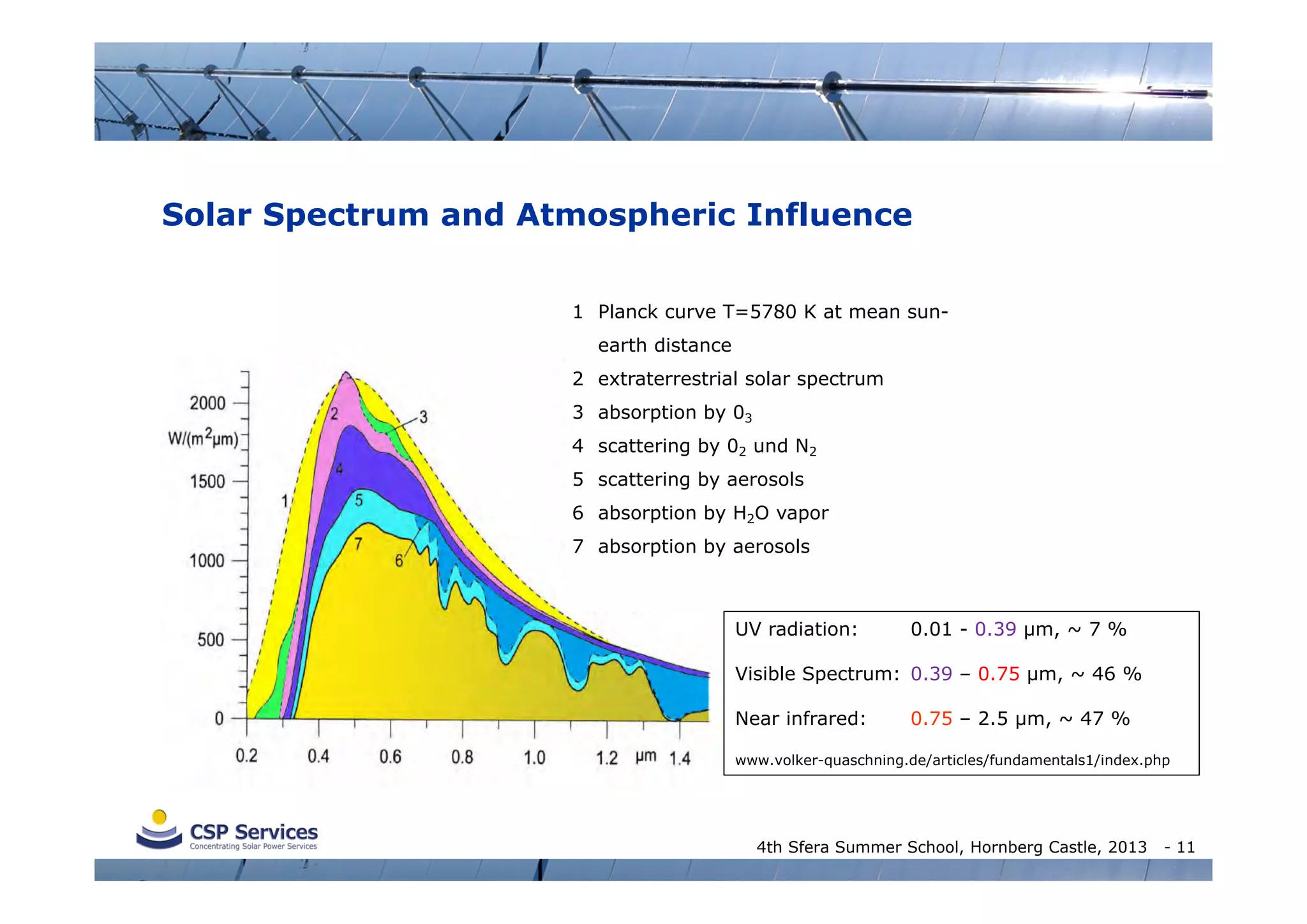
Solar Spectrum and Atmospheric Influence
1 Planck curve T=5780 K at mean sunearth distance
2 extraterrestrial solar spectrum
3 absorption by 03
4 scattering by 02 und N2
5 scattering by aerosols
6 absorption by H2O vapor
7 absorption by aerosols

UV radiation:

0.01 - 0.39 µm, ~ 7 %

Visible Spectrum: 0.39 – 0.75 µm, ~ 46 %
Near infrared:

0.75 – 2.5 µm, ~ 47 %

www.volker-quaschning.de/articles/fundamentals1/index.php

4th Sfera Summer School, Hornberg Castle, 2013

- 11
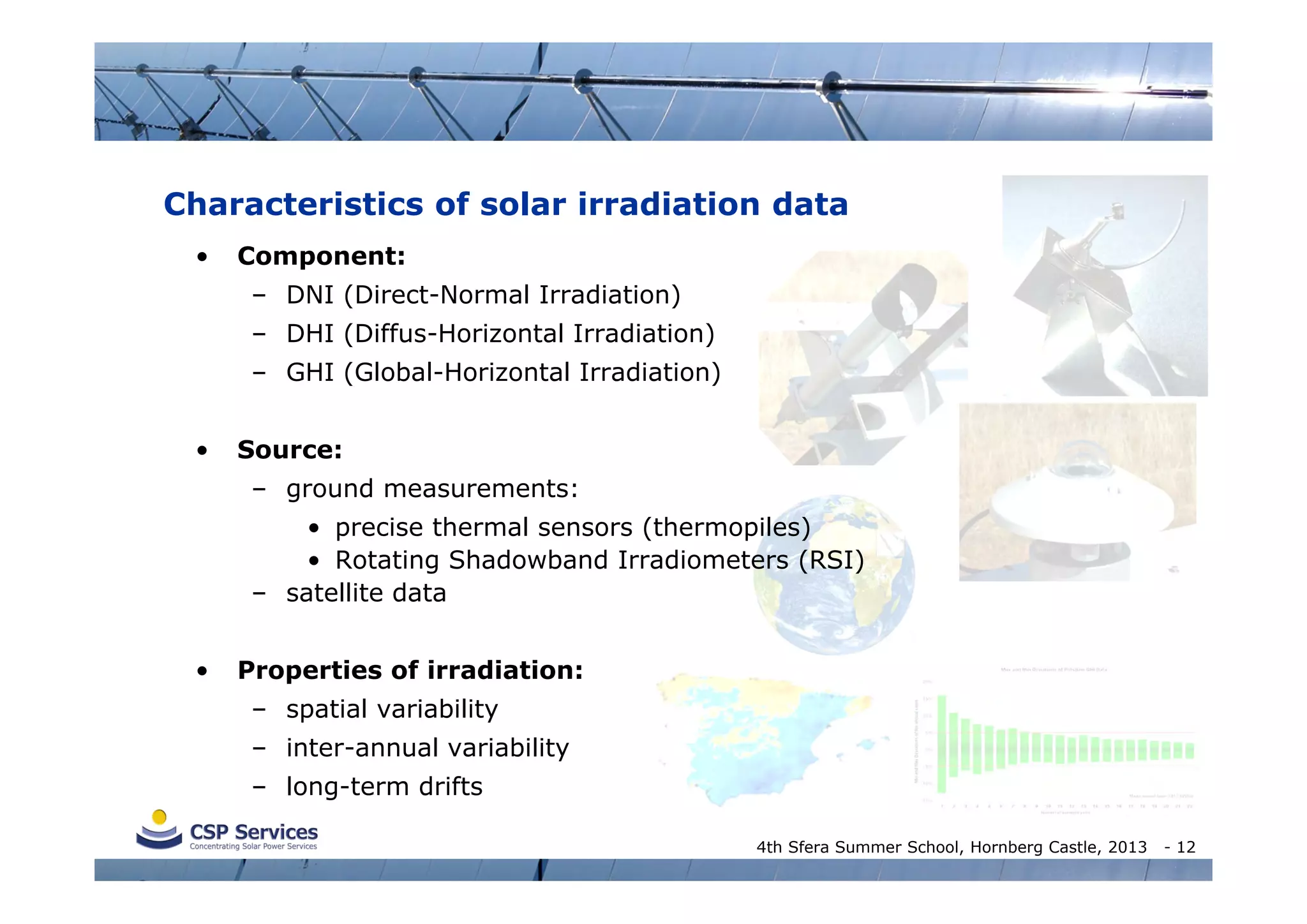
Characteristics of solar irradiation data
•

Component:
– DNI (Direct-Normal Irradiation)
– DHI (Diffus-Horizontal Irradiation)
– GHI (Global-Horizontal Irradiation)

•

Source:
– ground measurements:
• precise thermal sensors (thermopiles)
• Rotating Shadowband Irradiometers (RSI)
– satellite data

•

Properties of irradiation:
– spatial variability
– inter-annual variability
– long-term drifts
4th Sfera Summer School, Hornberg Castle, 2013

- 12
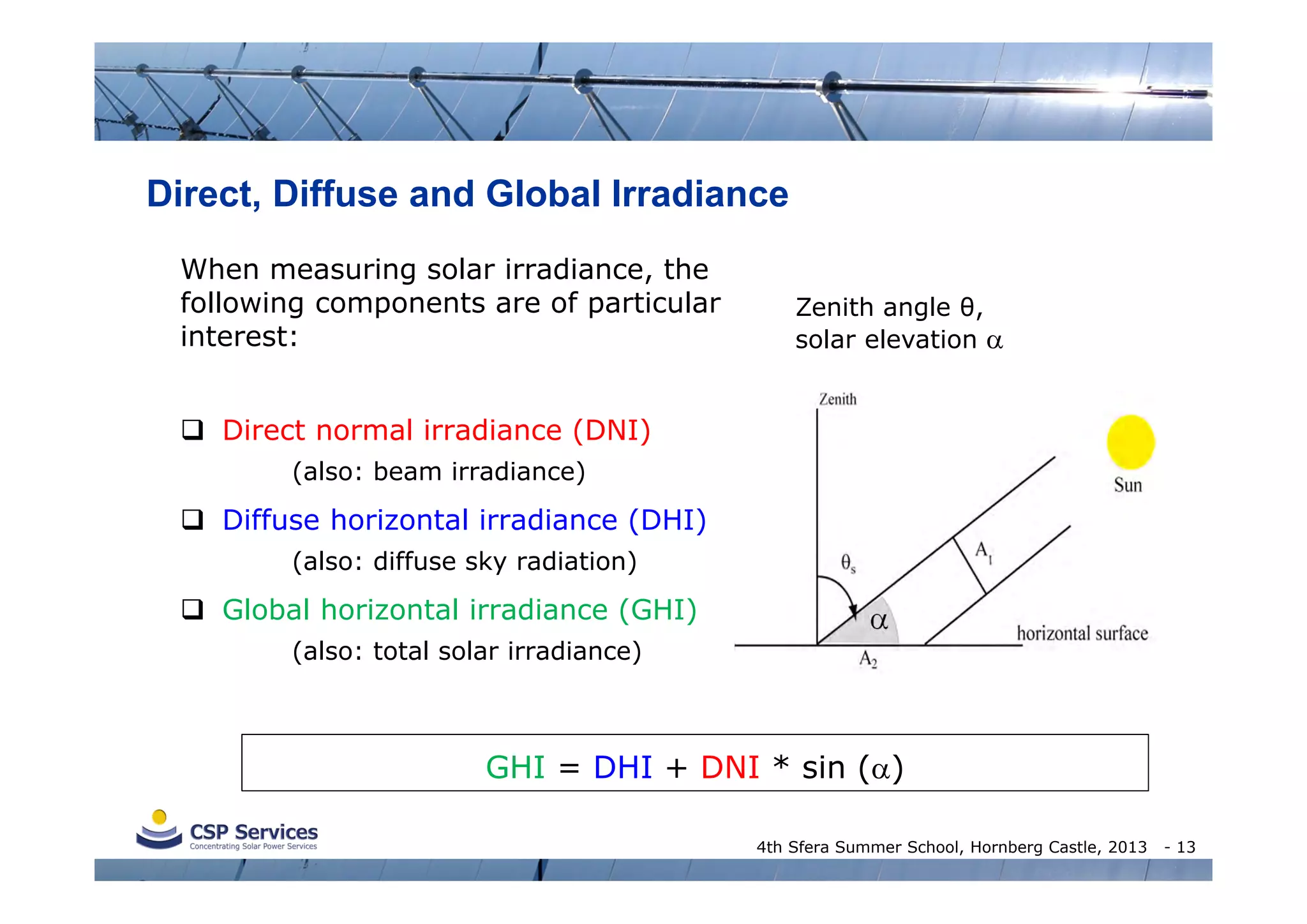
Direct, Diffuse and Global Irradiance
When measuring solar irradiance, the
following components are of particular
interest:

Zenith angle θ,
solar elevation 

 Direct normal irradiance (DNI)
(also: beam irradiance)

 Diffuse horizontal irradiance (DHI)
(also: diffuse sky radiation)

 Global horizontal irradiance (GHI)
(also: total solar irradiance)



GHI = DHI + DNI * sin ()
4th Sfera Summer School, Hornberg Castle, 2013

- 13
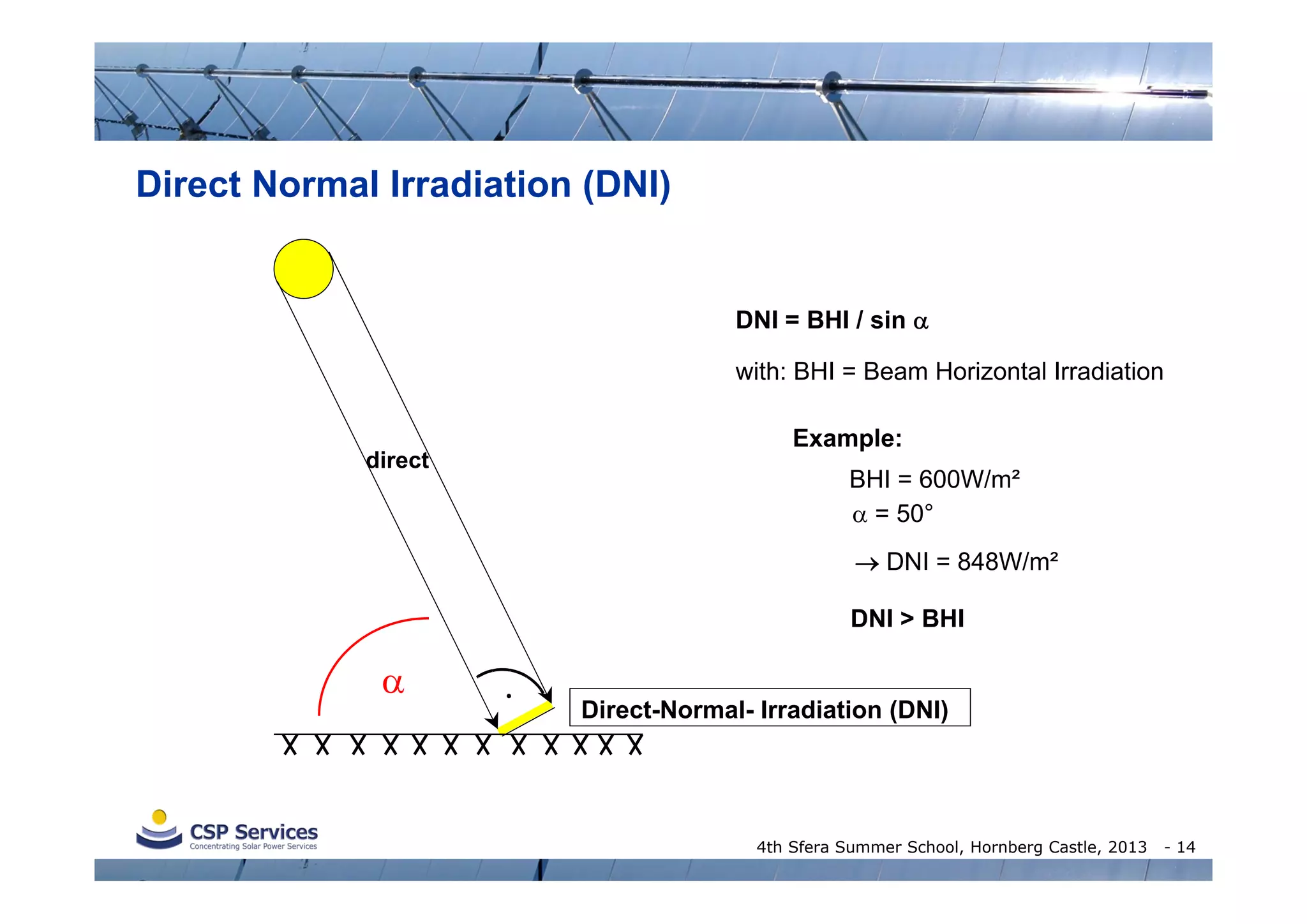
Direct Normal Irradiation (DNI)

DNI = BHI / sin 
with: BHI = Beam Horizontal Irradiation
direct

Example:
BHI = 600W/m²
 = 50°
 DNI = 848W/m²
DNI > BHI



Direct-Normal- Irradiation (DNI)

4th Sfera Summer School, Hornberg Castle, 2013

- 14
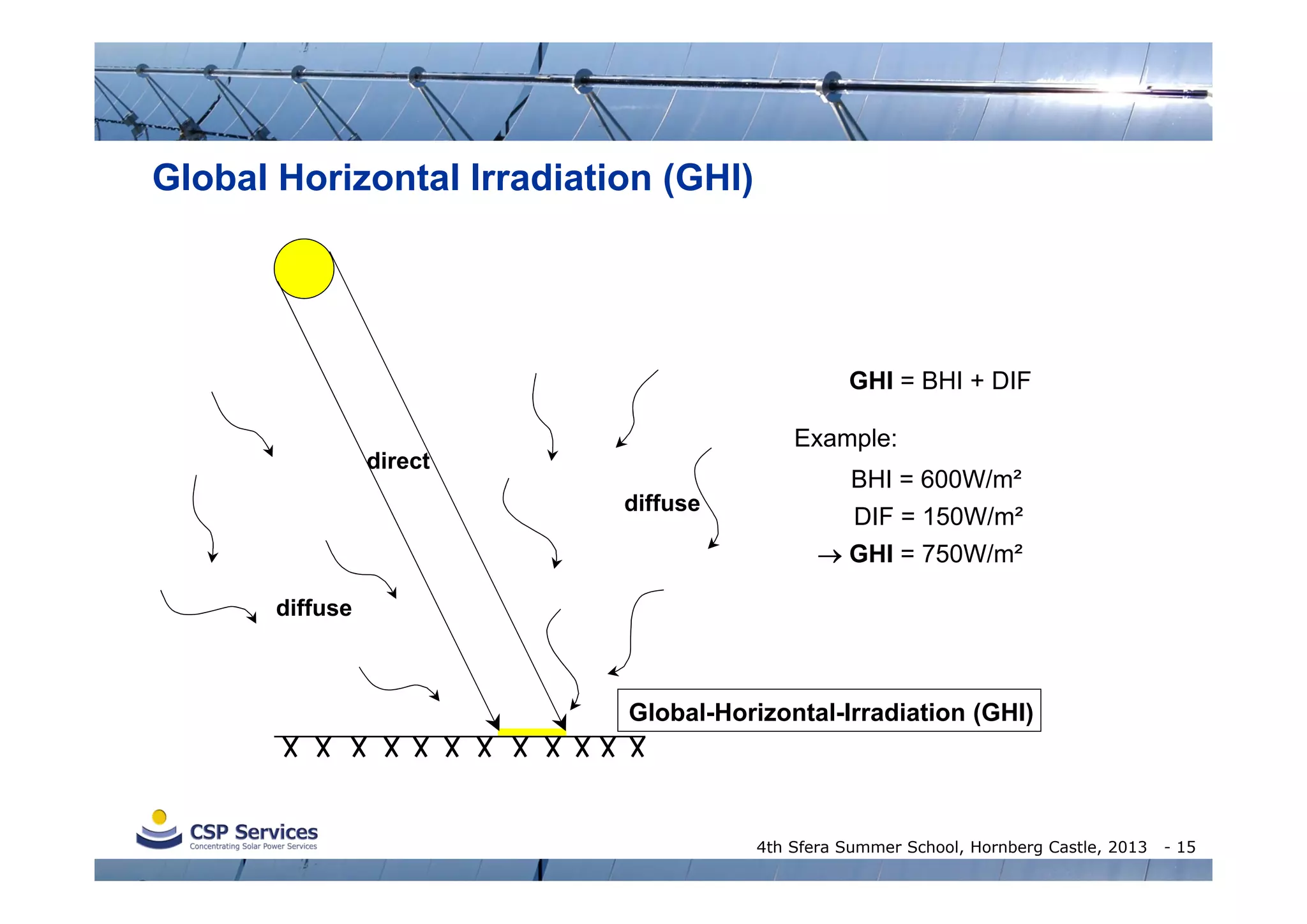
Global Horizontal Irradiation (GHI)

GHI = BHI + DIF
Example:

direct
diffuse

BHI = 600W/m²
DIF = 150W/m²
 GHI = 750W/m²

diffuse

Global-Horizontal-Irradiation (GHI)

4th Sfera Summer School, Hornberg Castle, 2013

- 15
Variability of irradiation
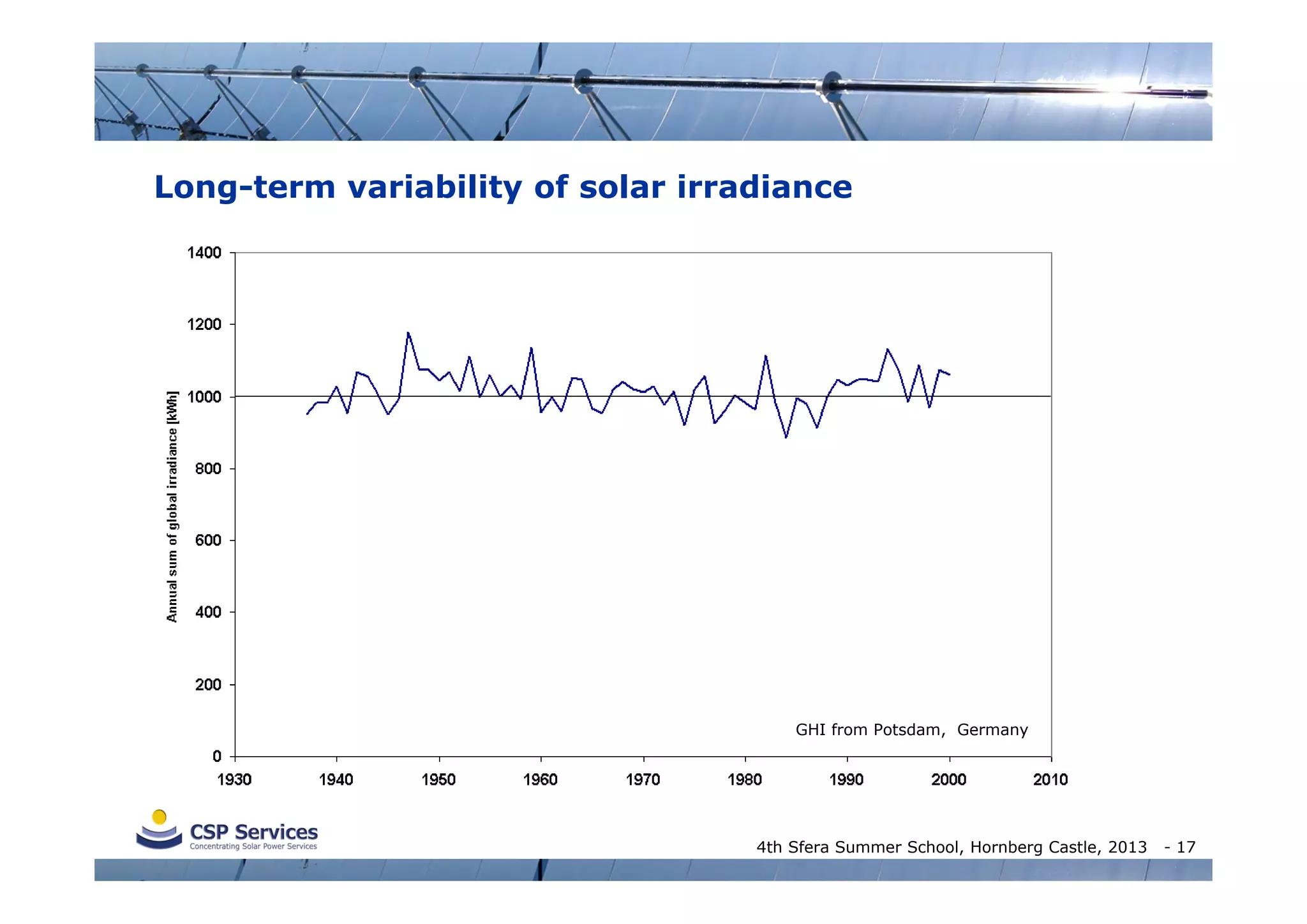
Long-term variability of solar irradiance

GHI from Potsdam, Germany

4th Sfera Summer School, Hornberg Castle, 2013

- 17
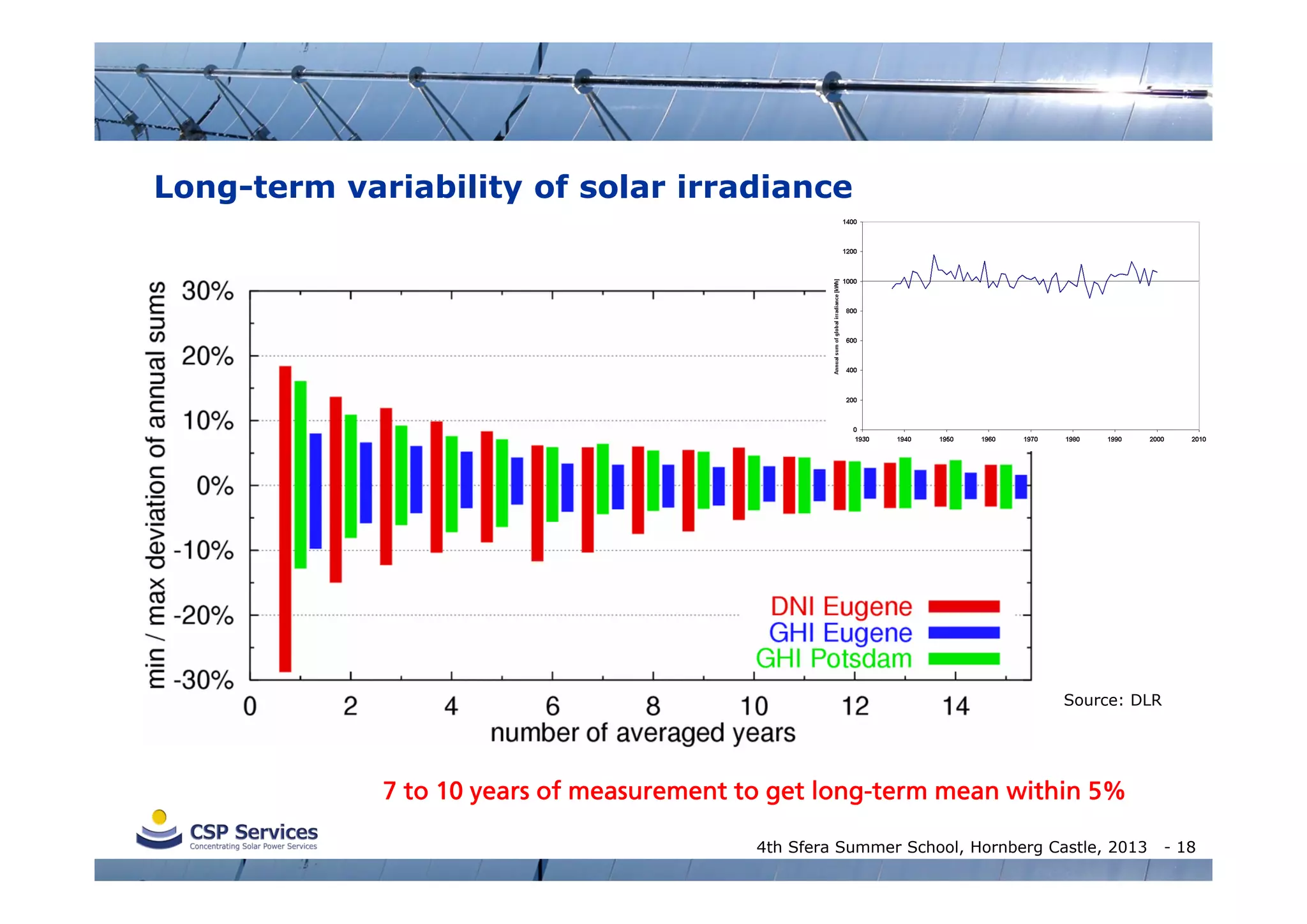
Long-term variability of solar irradiance

Source: DLR

7 to 10 years of measurement to get long-term mean within 5%
4th Sfera Summer School, Hornberg Castle, 2013

- 18
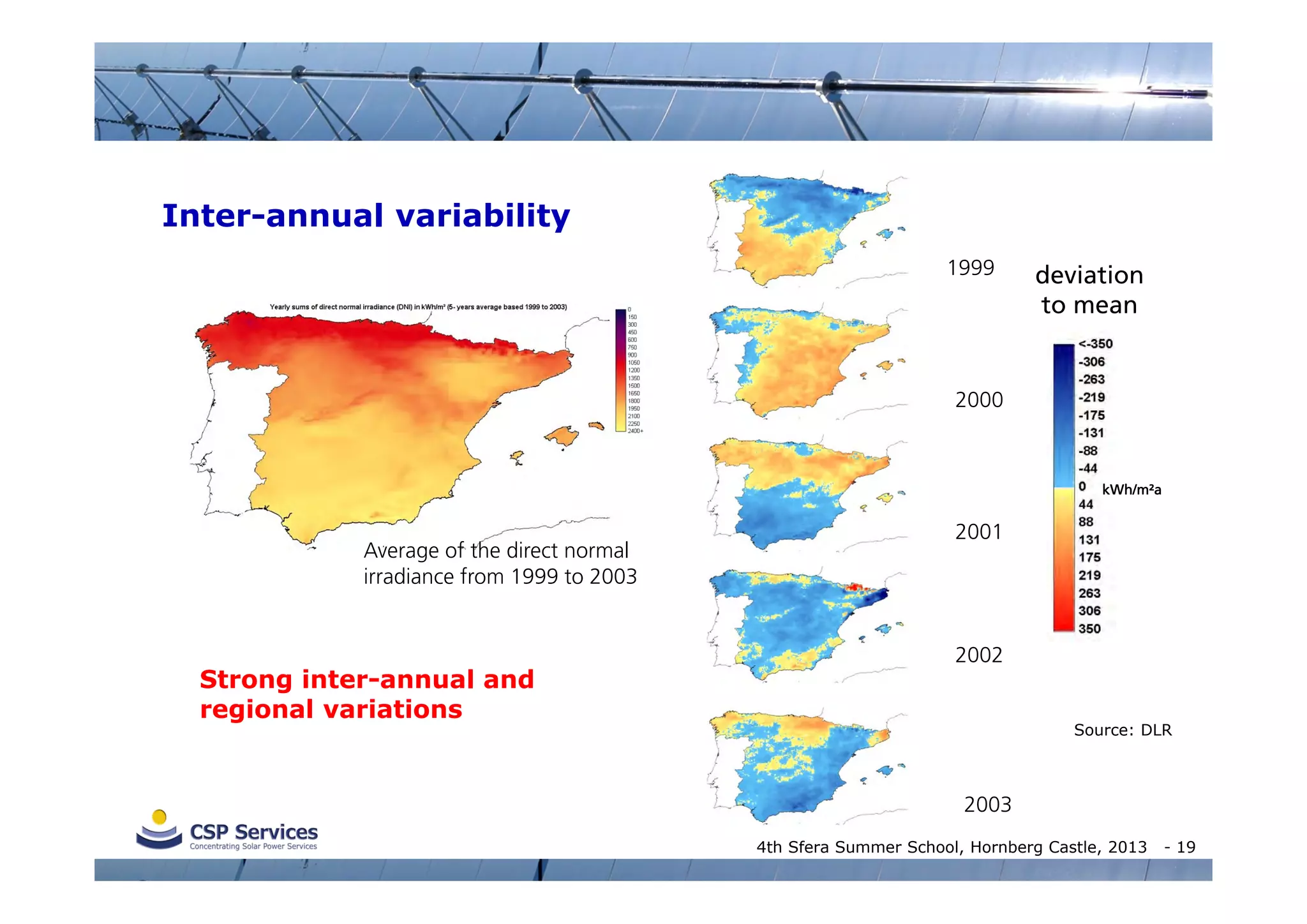
Inter-annual variability
1999

deviation
to mean

2000

kWh/m²a

Average of the direct normal
irradiance from 1999 to 2003

Strong inter-annual and
regional variations

2001

2002
Source: DLR

2003
4th Sfera Summer School, Hornberg Castle, 2013

- 19
Irradiation sensors

4th Sfera Summer School, Hornberg Castle, 2013

- 20
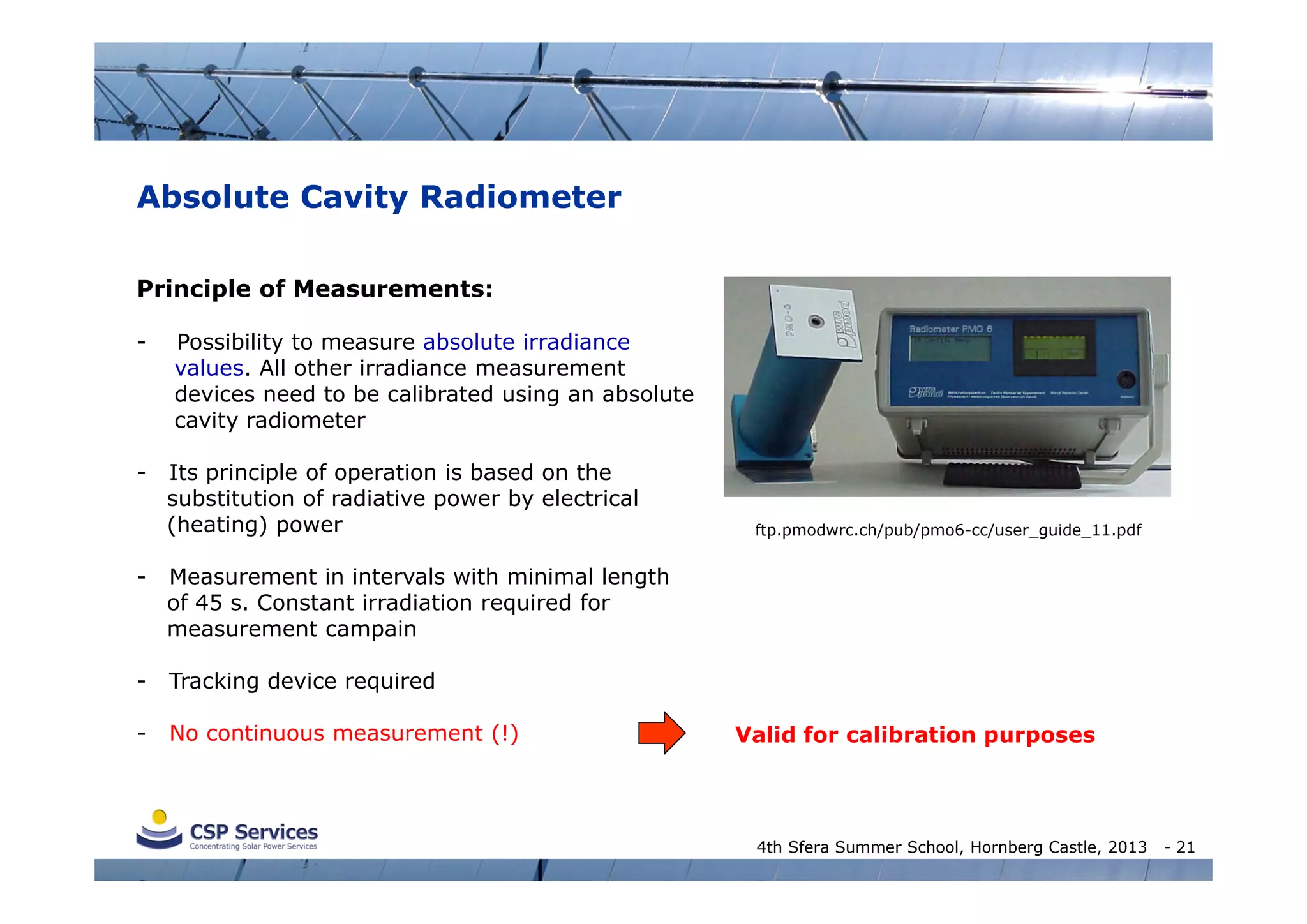
Absolute Cavity Radiometer
Principle of Measurements:
-

-

Possibility to measure absolute irradiance
values. All other irradiance measurement
devices need to be calibrated using an absolute
cavity radiometer
Its principle of operation is based on the
substitution of radiative power by electrical
(heating) power

-

Measurement in intervals with minimal length
of 45 s. Constant irradiation required for
measurement campain

-

Tracking device required

-

No continuous measurement (!)

ftp.pmodwrc.ch/pub/pmo6-cc/user_guide_11.pdf

Valid for calibration purposes

4th Sfera Summer School, Hornberg Castle, 2013

- 21
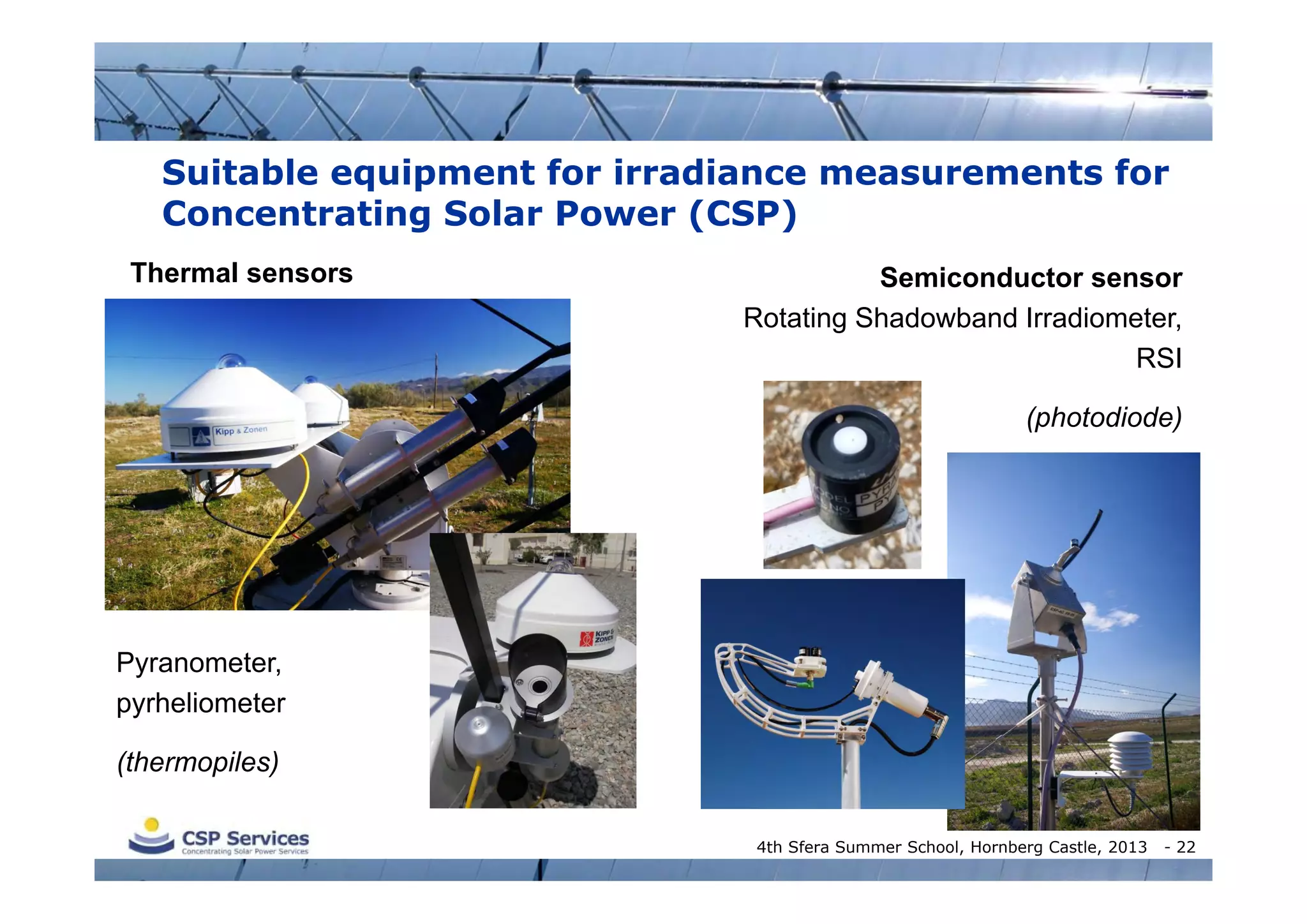
Suitable equipment for irradiance measurements for
Concentrating Solar Power (CSP)
Thermal sensors

Semiconductor sensor
Rotating Shadowband Irradiometer,
RSI
(photodiode)

Pyranometer,
pyrheliometer
(thermopiles)
4th Sfera Summer School, Hornberg Castle, 2013

- 22
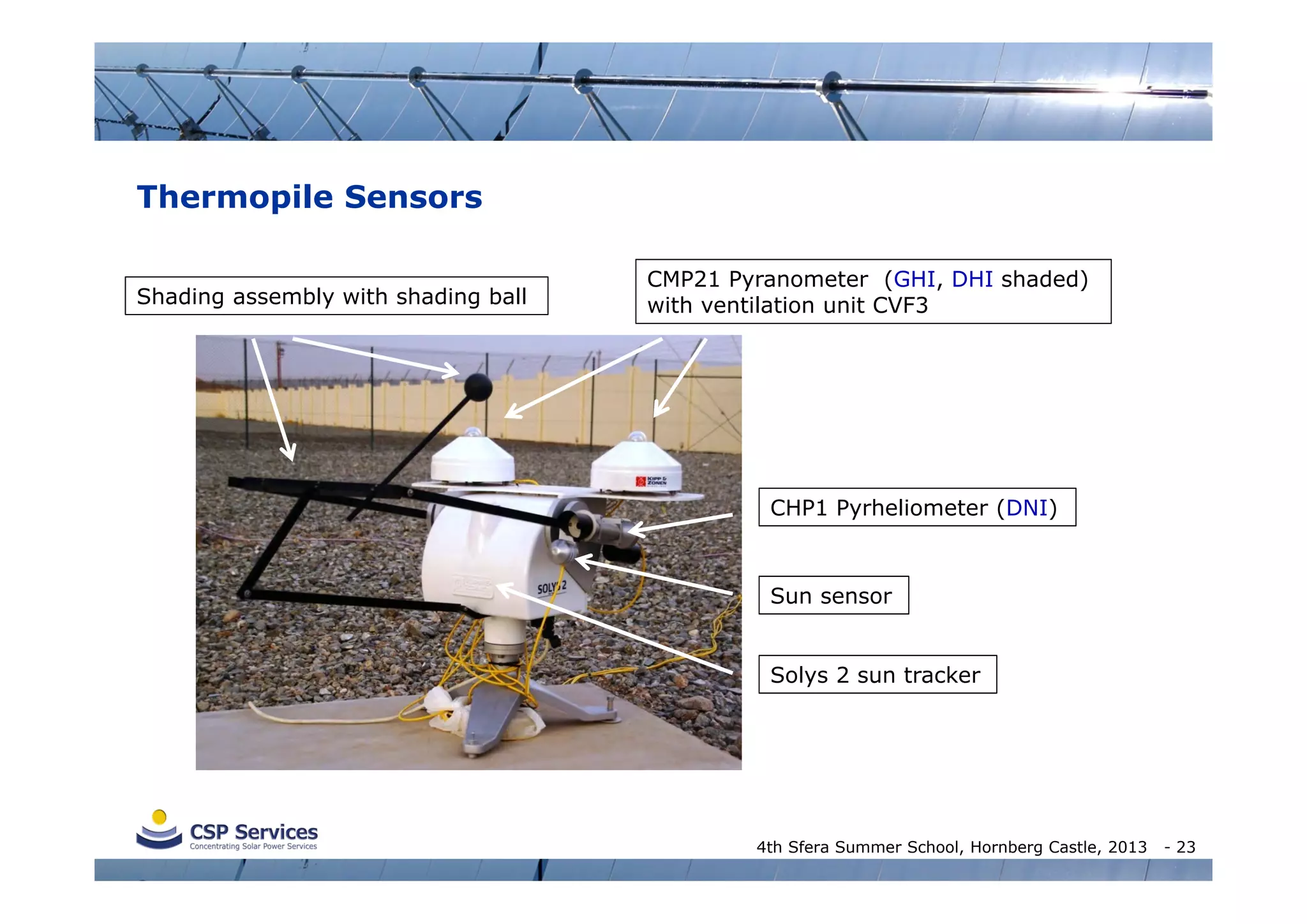
Thermopile Sensors
Shading assembly with shading ball

CMP21 Pyranometer (GHI, DHI shaded)
with ventilation unit CVF3

CHP1 Pyrheliometer (DNI)

Sun sensor
Solys 2 sun tracker

4th Sfera Summer School, Hornberg Castle, 2013

- 23
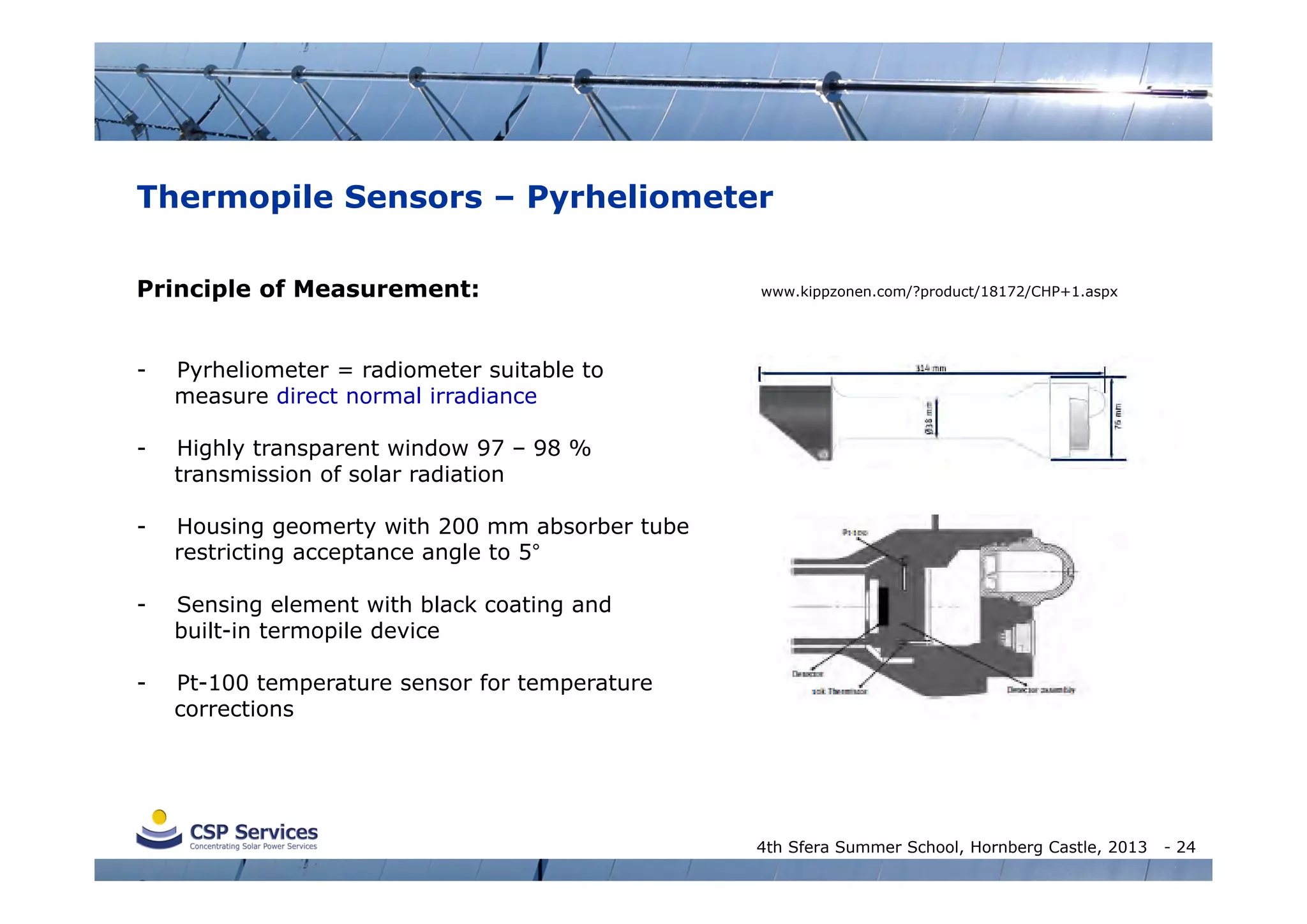
Thermopile Sensors – Pyrheliometer
Principle of Measurement:
-

Pyrheliometer = radiometer suitable to
measure direct normal irradiance

-

Highly transparent window 97 – 98 %
transmission of solar radiation

-

Housing geomerty with 200 mm absorber tube
restricting acceptance angle to 5°

-

Sensing element with black coating and
built-in termopile device

-

www.kippzonen.com/?product/18172/CHP+1.aspx

Pt-100 temperature sensor for temperature
corrections

4th Sfera Summer School, Hornberg Castle, 2013

- 24
Pyrheliometer Specifications

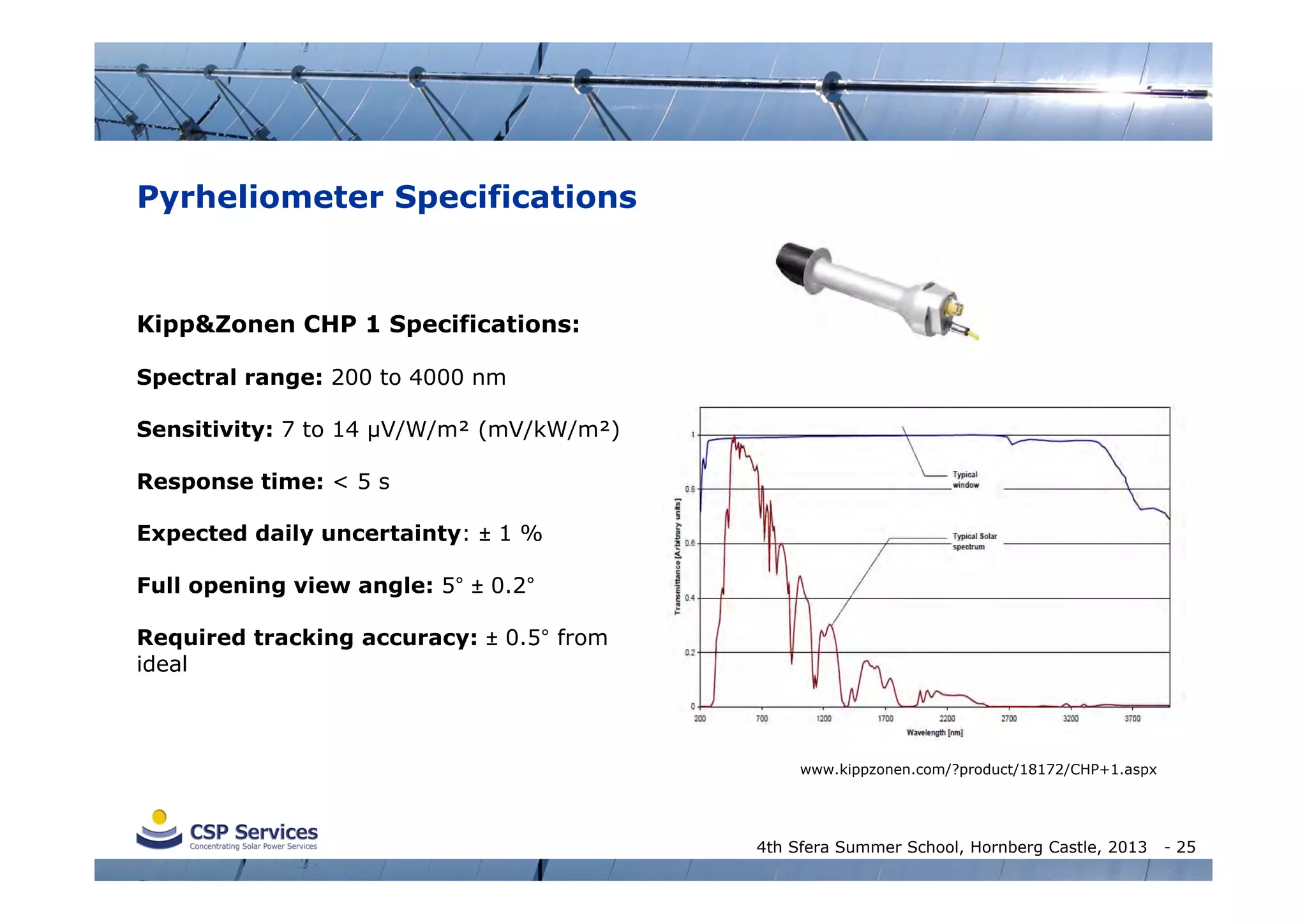
Kipp&Zonen CHP 1 Specifications:
Spectral range: 200 to 4000 nm
Sensitivity: 7 to 14 µV/W/m² (mV/kW/m²)
Response time: < 5 s
Expected daily uncertainty: ± 1 %
Full opening view angle: 5° ± 0.2°
Required tracking accuracy: ± 0.5° from
ideal

www.kippzonen.com/?product/18172/CHP+1.aspx

4th Sfera Summer School, Hornberg Castle, 2013

- 25
Thermopile Sensors – Pyranometer
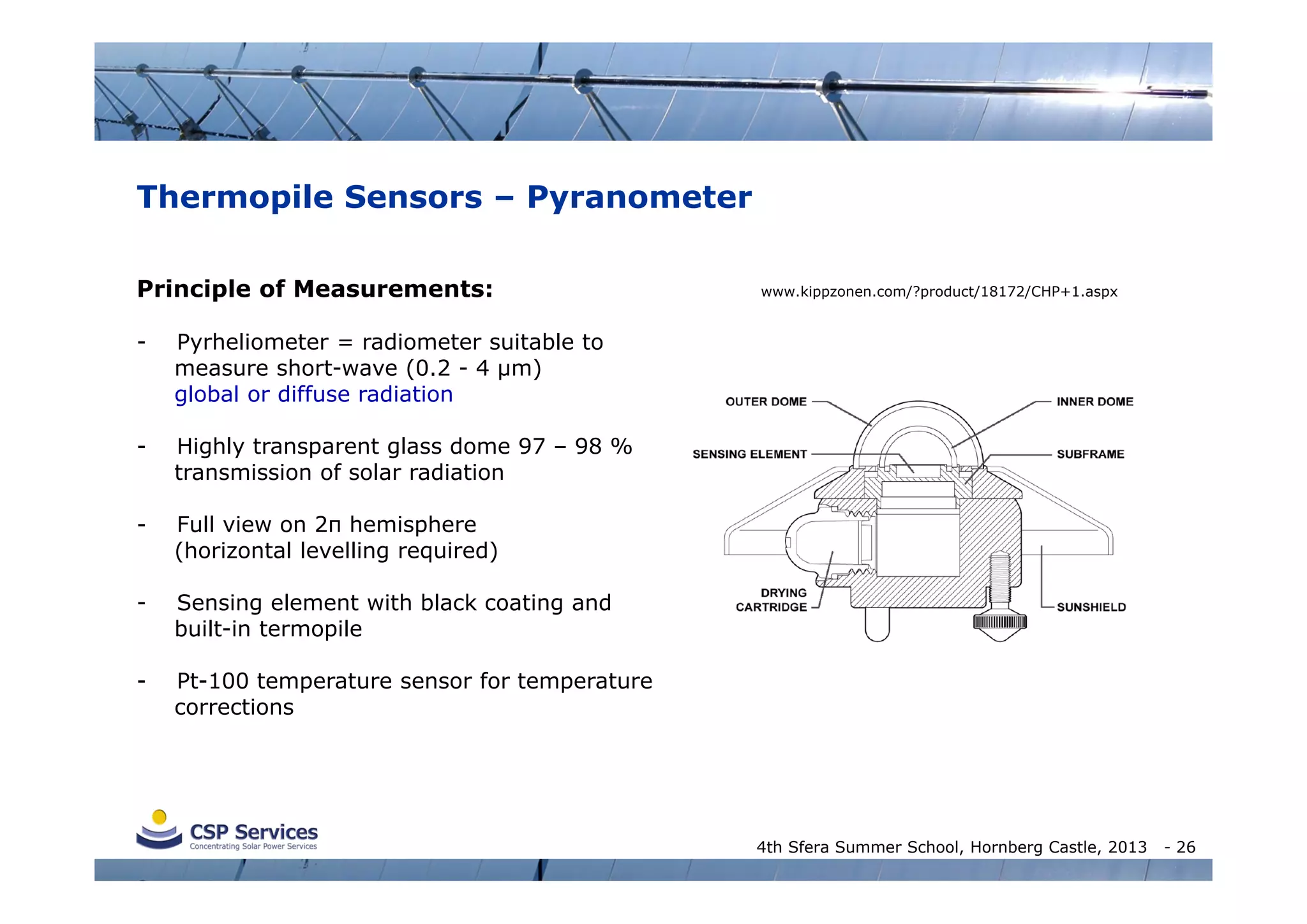
Principle of Measurements:
-

Pyrheliometer = radiometer suitable to
measure short-wave (0.2 - 4 µm)
global or diffuse radiation

-

Highly transparent glass dome 97 – 98 %
transmission of solar radiation

-

Full view on 2π hemisphere
(horizontal levelling required)

-

Sensing element with black coating and
built-in termopile

-

www.kippzonen.com/?product/18172/CHP+1.aspx

Pt-100 temperature sensor for temperature
corrections

4th Sfera Summer School, Hornberg Castle, 2013

- 26
Thermopile Sensors – Pyranometer
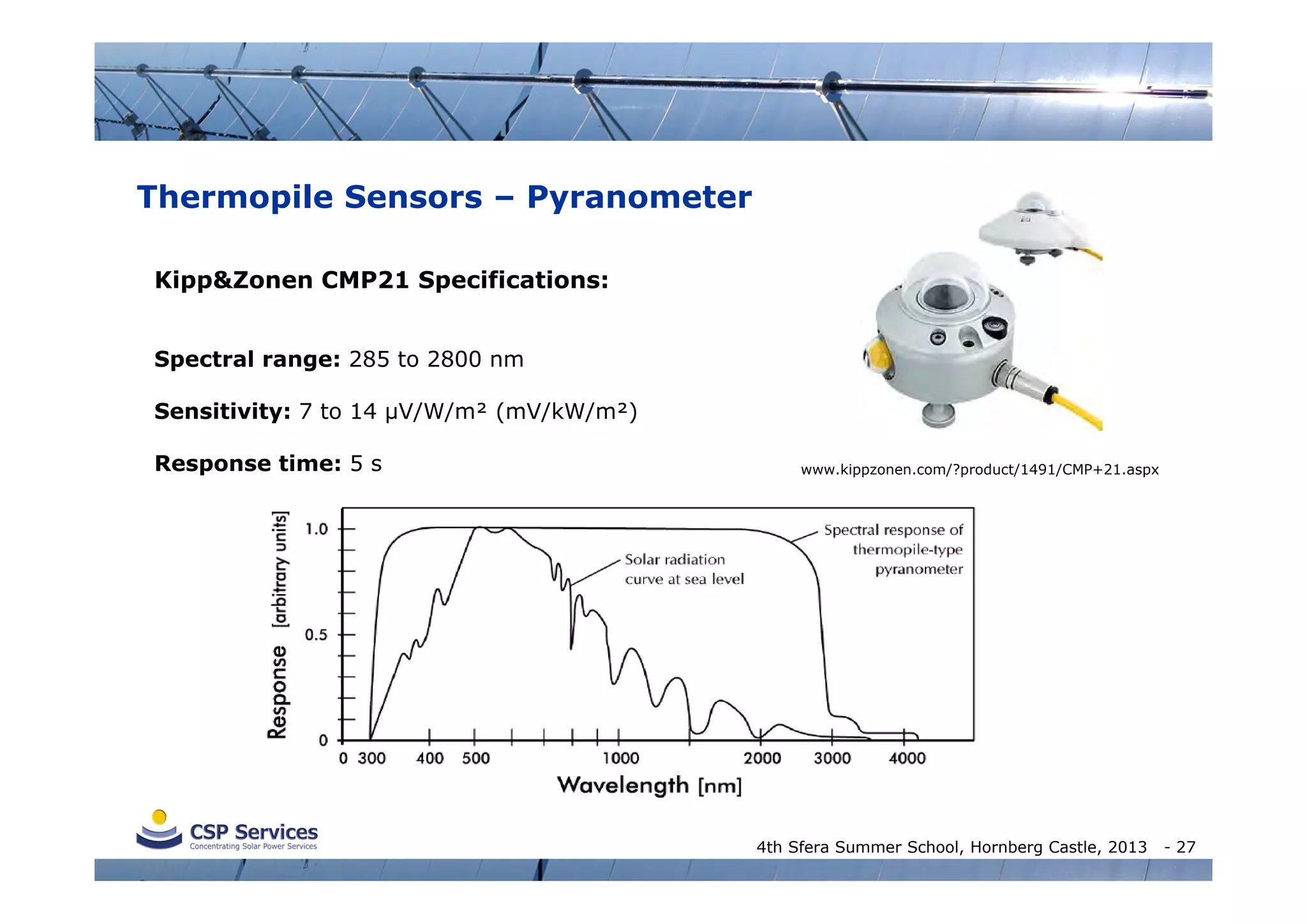
Kipp&Zonen CMP21 Specifications:
Spectral range: 285 to 2800 nm
Sensitivity: 7 to 14 µV/W/m² (mV/kW/m²)
Response time: 5 s

www.kippzonen.com/?product/1491/CMP+21.aspx

4th Sfera Summer School, Hornberg Castle, 2013

- 27
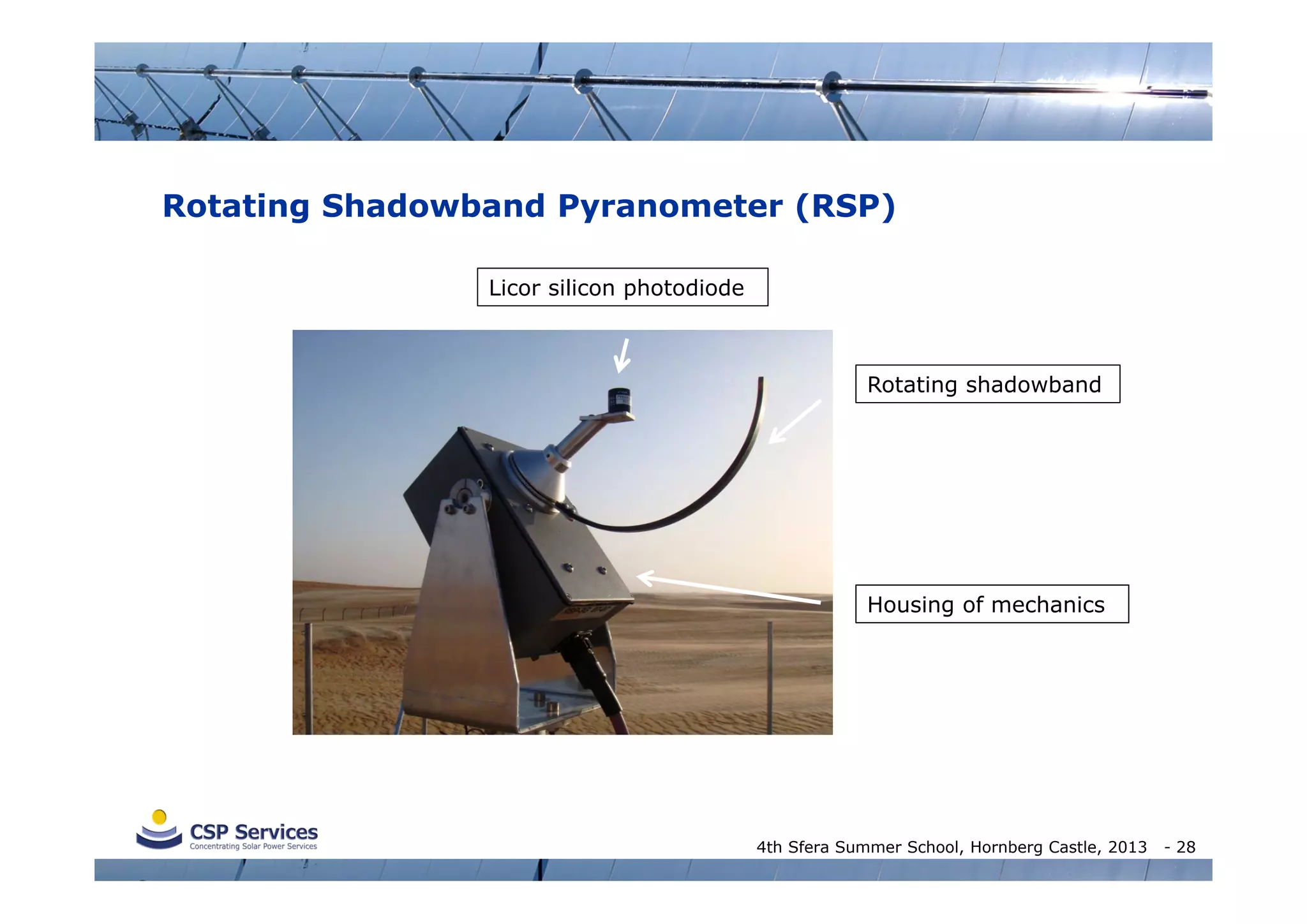
Rotating Shadowband Pyranometer (RSP)
Licor silicon photodiode

Rotating shadowband

Housing of mechanics

4th Sfera Summer School, Hornberg Castle, 2013

- 28
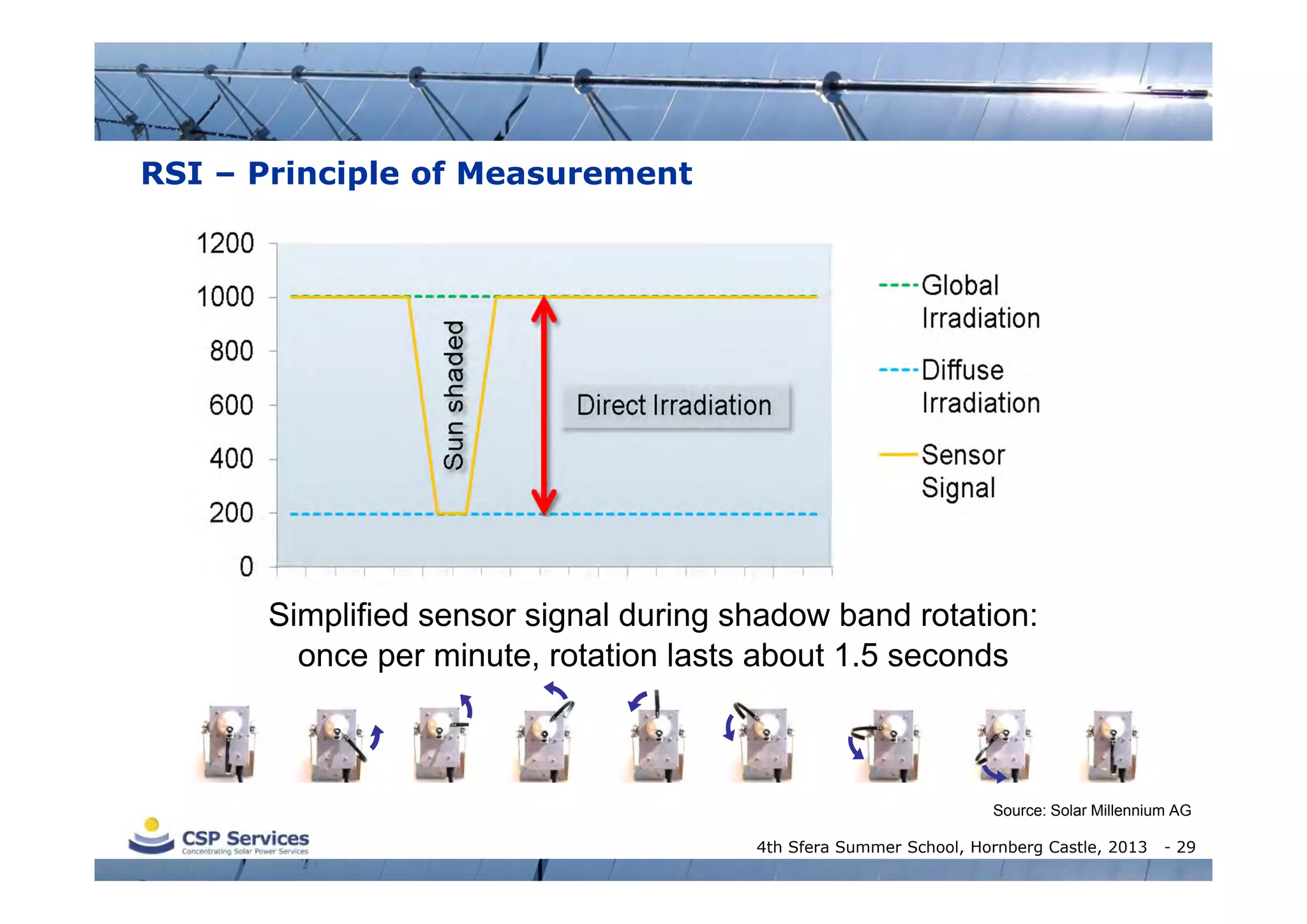
RSI – Principle of Measurement

Simplified sensor signal during shadow band rotation:
once per minute, rotation lasts about 1.5 seconds

Source: Solar Millennium AG
4th Sfera Summer School, Hornberg Castle, 2013

- 29
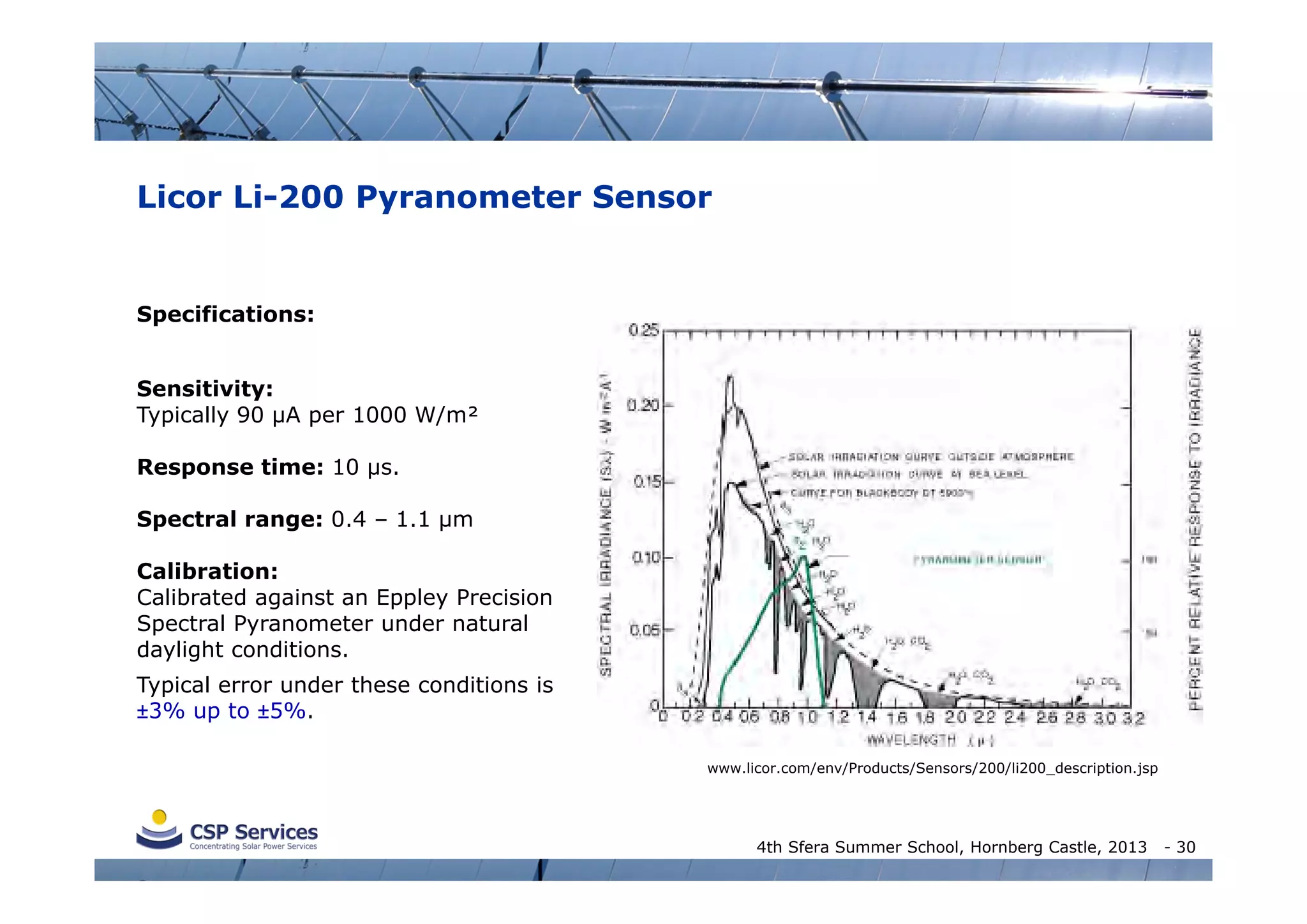
Licor Li-200 Pyranometer Sensor

Specifications:
Sensitivity:
Typically 90 µA per 1000 W/m²
Response time: 10 µs.
Spectral range: 0.4 – 1.1 µm
Calibration:
Calibrated against an Eppley Precision
Spectral Pyranometer under natural
daylight conditions.
Typical error under these conditions is
±3% up to ±5%.
www.licor.com/env/Products/Sensors/200/li200_description.jsp

4th Sfera Summer School, Hornberg Castle, 2013

- 30
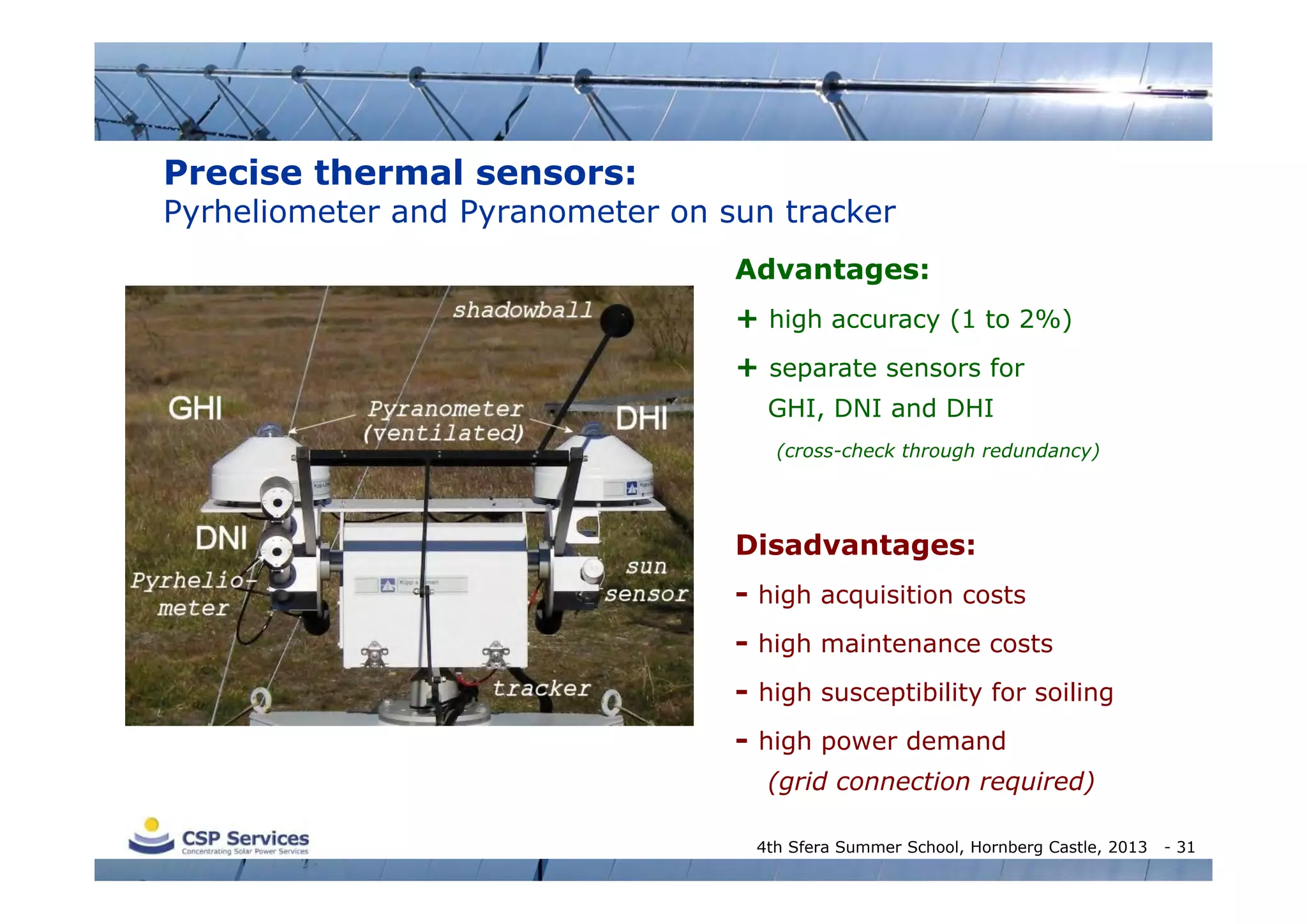
Precise thermal sensors:

Pyrheliometer and Pyranometer on sun tracker
Advantages:
+ high accuracy (1 to 2%)
-GHI

-DNI

-DHI

+ separate sensors for
GHI, DNI and DHI
(cross-check through redundancy)

Disadvantages:
- high acquisition costs
- high maintenance costs
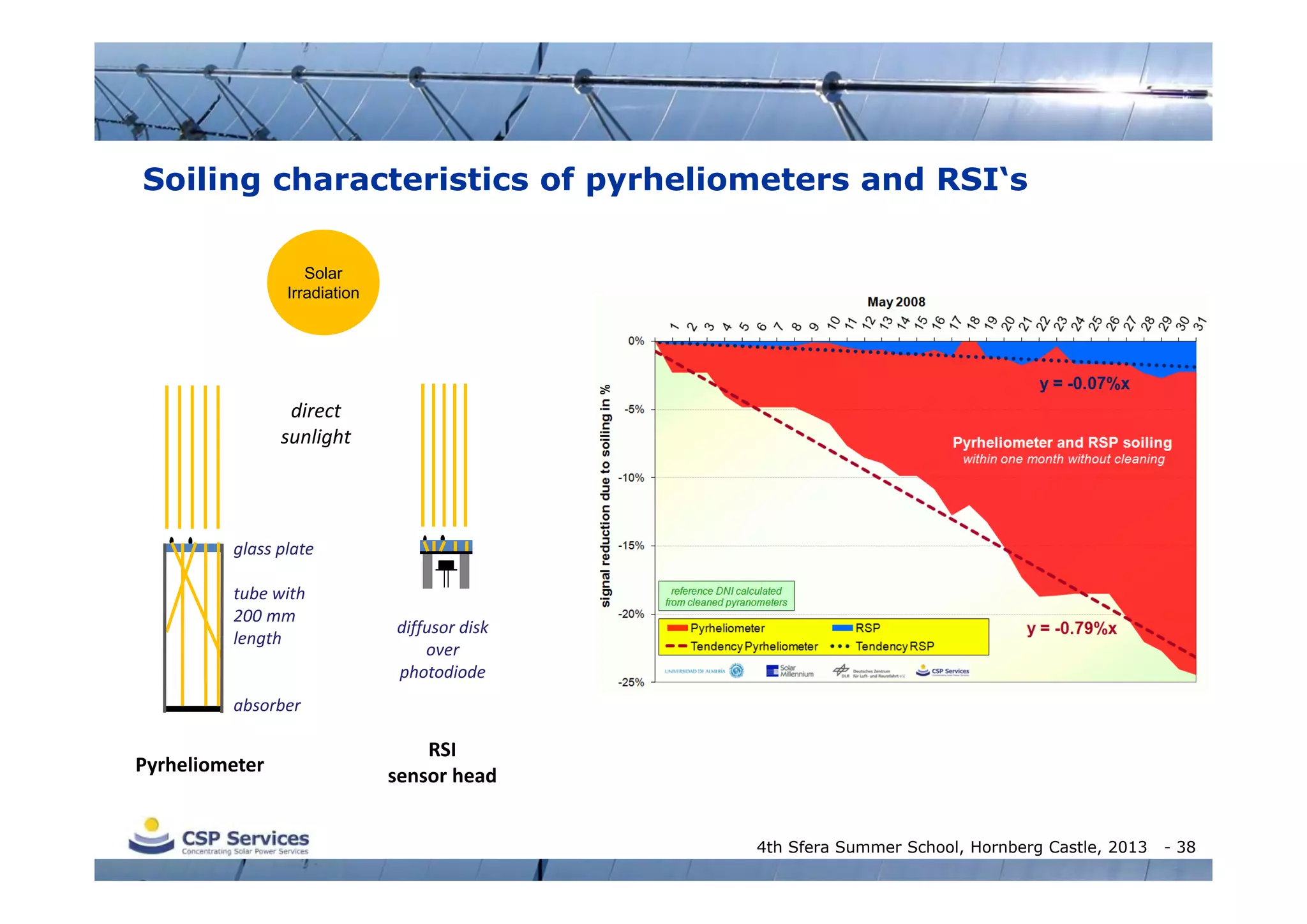
- high susceptibility for soiling
- high power demand
(grid connection required)
4th Sfera Summer School, Hornberg Castle, 2013

- 31
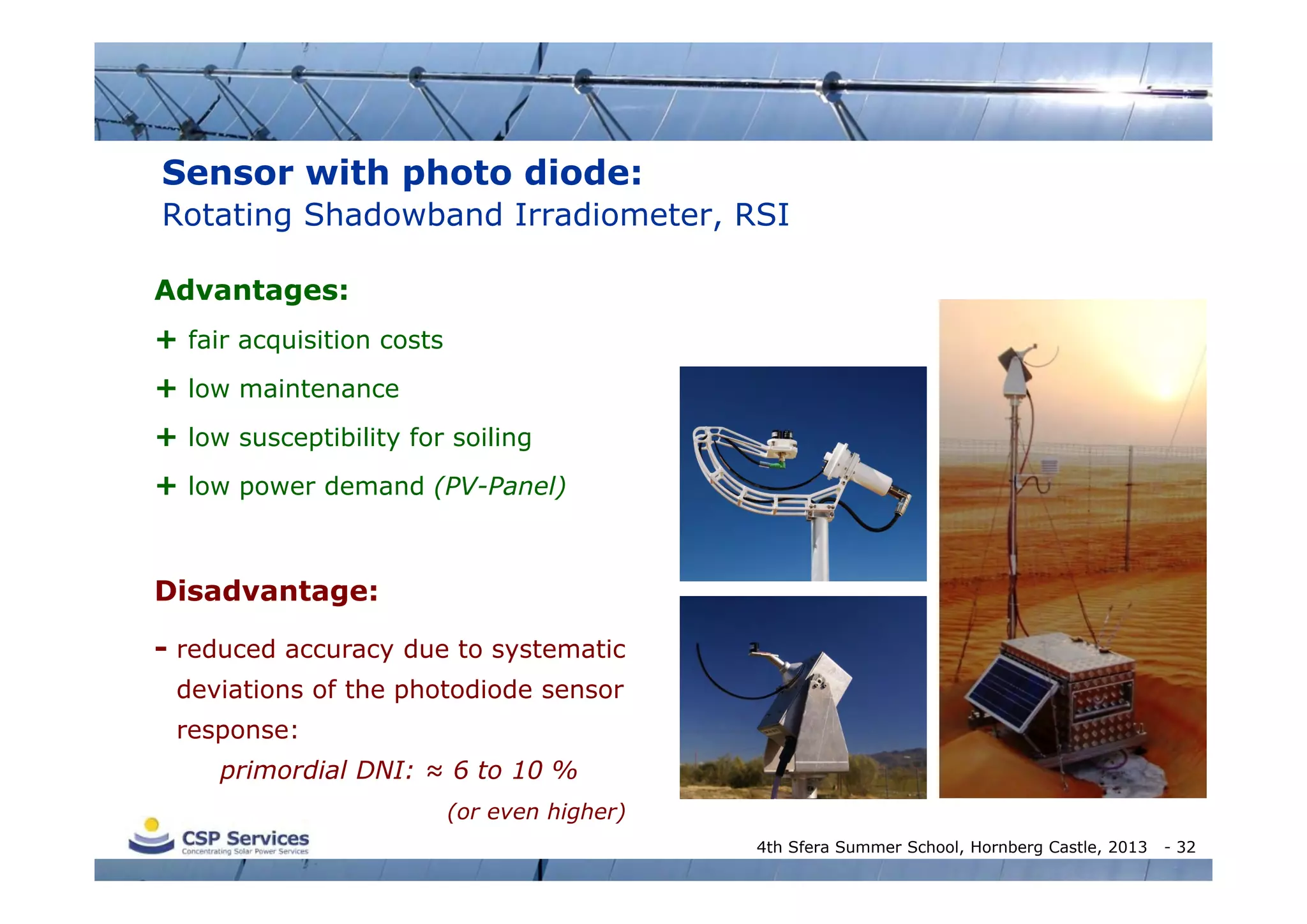
Sensor with photo diode:
Rotating Shadowband Irradiometer, RSI
Advantages:
+ fair acquisition costs
+ low maintenance
+ low susceptibility for soiling
+ low power demand (PV-Panel)

Disadvantage:
- reduced accuracy due to systematic
deviations of the photodiode sensor
response:
primordial DNI: ≈ 6 to 10 %
(or even higher)
4th Sfera Summer School, Hornberg Castle, 2013

- 32
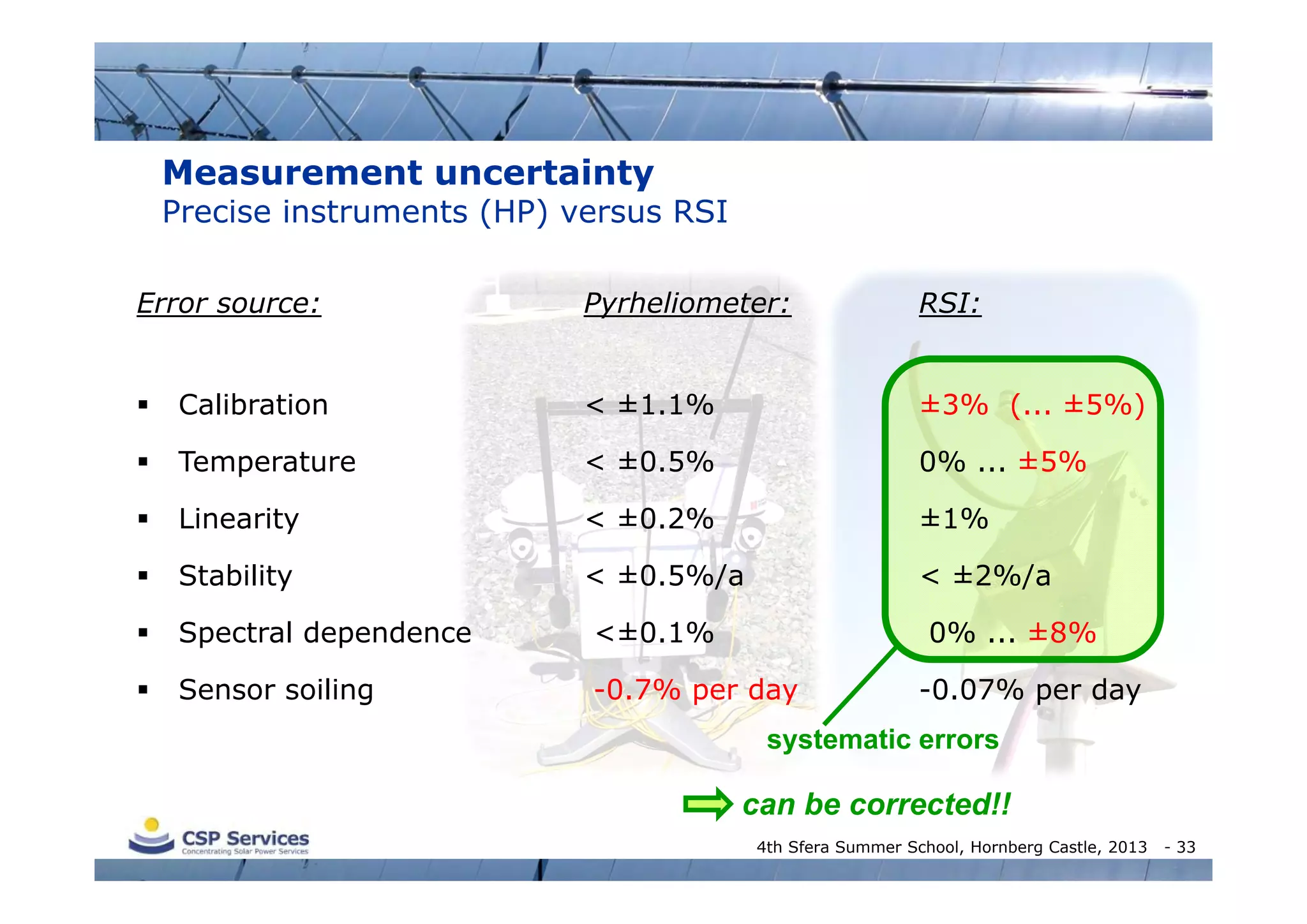
Measurement uncertainty

Precise instruments (HP) versus RSI
Error source:

Pyrheliometer:

RSI:



Calibration

< ±1.1%

±3% (... ±5%)



Temperature

< ±0.5%

0% ... ±5%



Linearity

< ±0.2%

±1%



Stability

< ±0.5%/a

< ±2%/a



Spectral dependence

<±0.1%



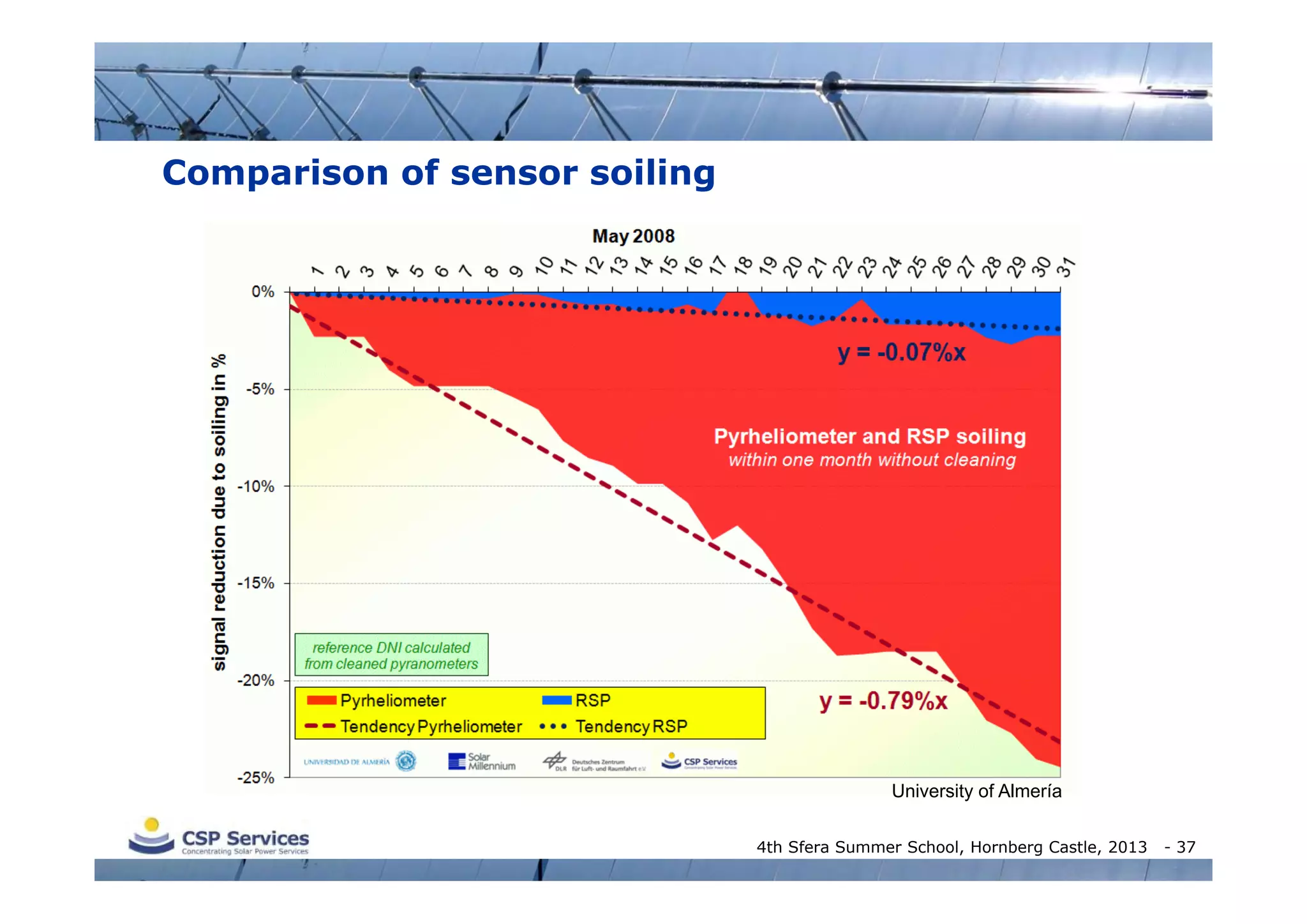
Sensor soiling

-0.7% per day

0% ... ±8%
-0.07% per day

systematic errors

can be corrected!!
4th Sfera Summer School, Hornberg Castle, 2013

- 33
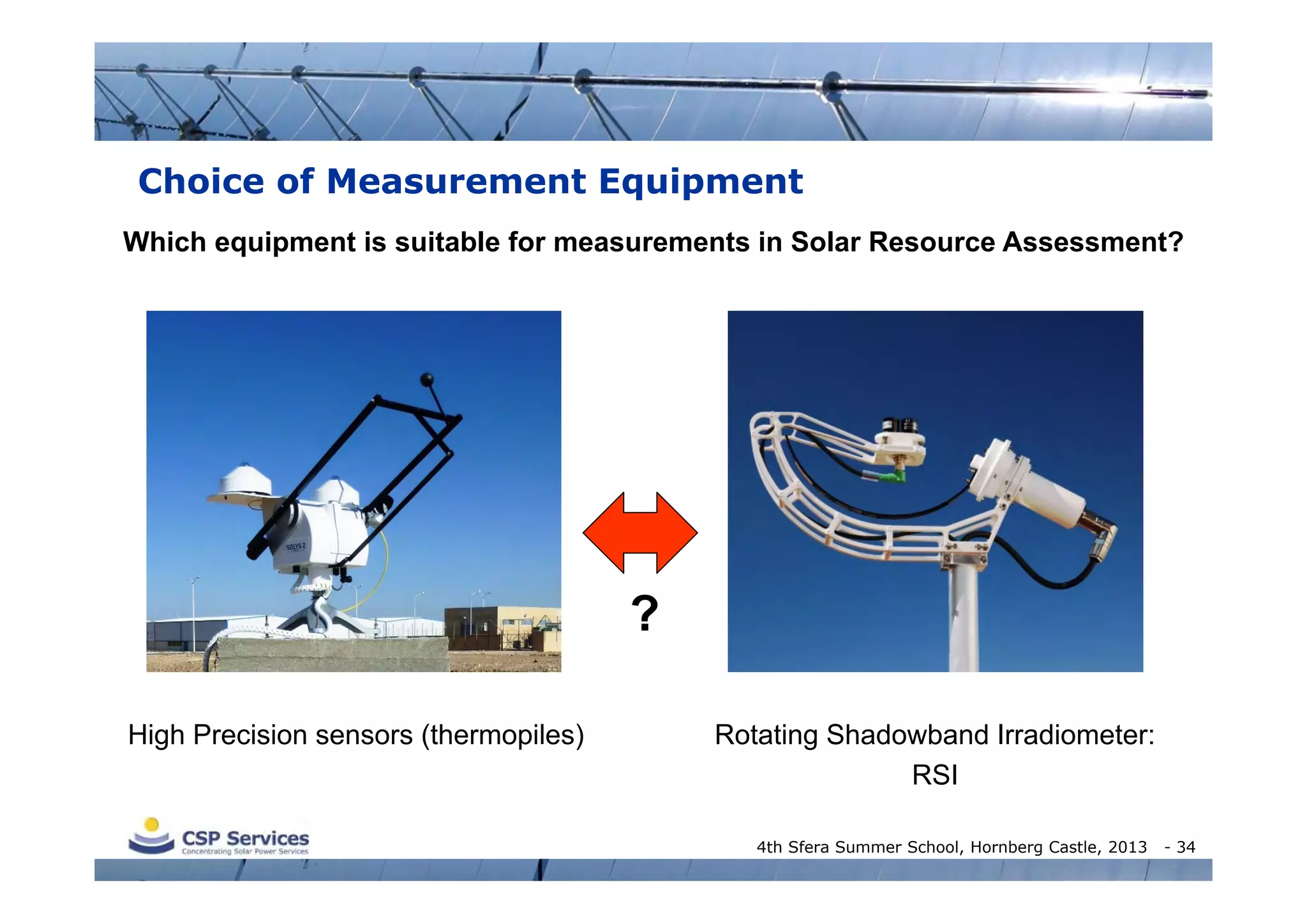
Choice of Measurement Equipment
Which equipment is suitable for measurements in Solar Resource Assessment?

?
High Precision sensors (thermopiles)

Rotating Shadowband Irradiometer:
RSI
4th Sfera Summer School, Hornberg Castle, 2013

- 34
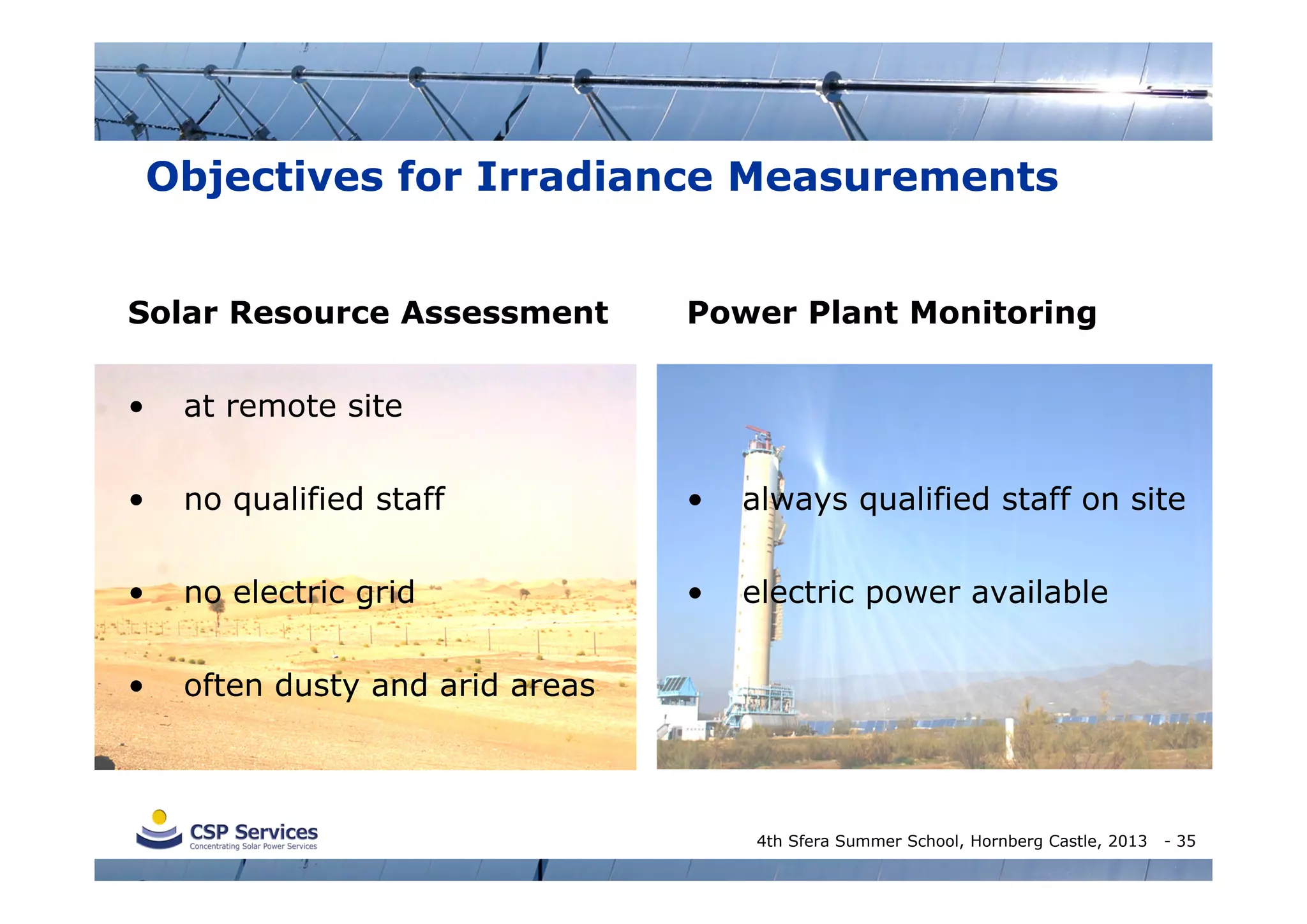
Objectives for Irradiance Measurements
Solar Resource Assessment

Power Plant Monitoring

•

at remote site

•

no qualified staff

•

always qualified staff on site

•

no electric grid

•

electric power available

•

often dusty and arid areas

4th Sfera Summer School, Hornberg Castle, 2013

- 35
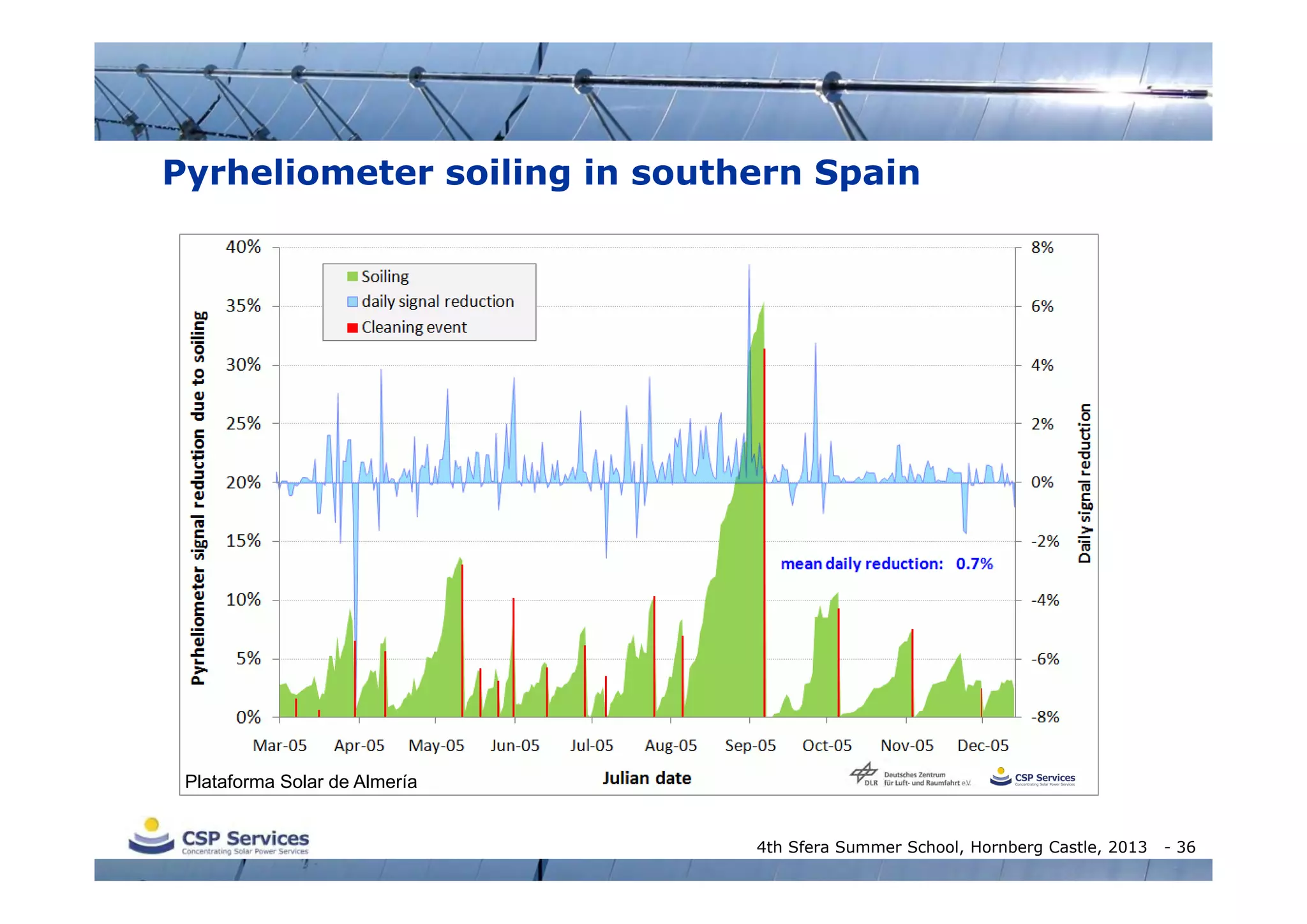
Pyrheliometer soiling in southern Spain

Plataforma Solar de Almería
4th Sfera Summer School, Hornberg Castle, 2013

- 36
Comparison of sensor soiling

University of Almería
4th Sfera Summer School, Hornberg Castle, 2013

- 37
Soiling characteristics of pyrheliometers and RSI‘s
Solar
Irradiation

direct 
sunlight

glass plate
tube with 
200 mm 
length

diffusor disk 
over 
photodiode

absorber

Pyrheliometer

RSI 
sensor head
4th Sfera Summer School, Hornberg Castle, 2013

- 38
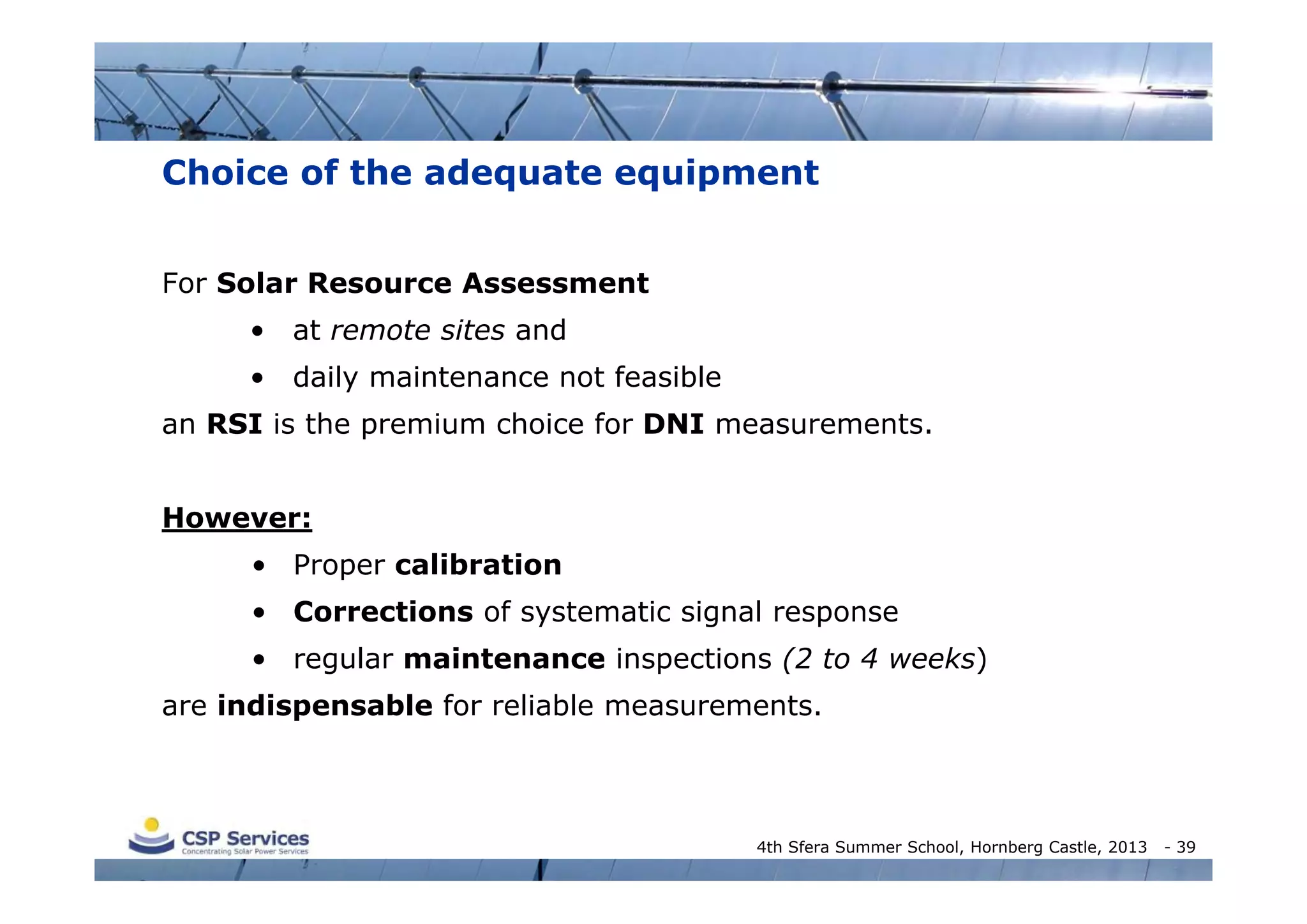
Choice of the adequate equipment
For Solar Resource Assessment
• at remote sites and
• daily maintenance not feasible
an RSI is the premium choice for DNI measurements.
However:
• Proper calibration
• Corrections of systematic signal response
• regular maintenance inspections (2 to 4 weeks)
are indispensable for reliable measurements.

4th Sfera Summer School, Hornberg Castle, 2013

- 39
Sensor calibration
and measurement accuracy enhancement

4th Sfera Summer School, Hornberg Castle, 2013

- 40
Sensor Calibration – Fundamentals I
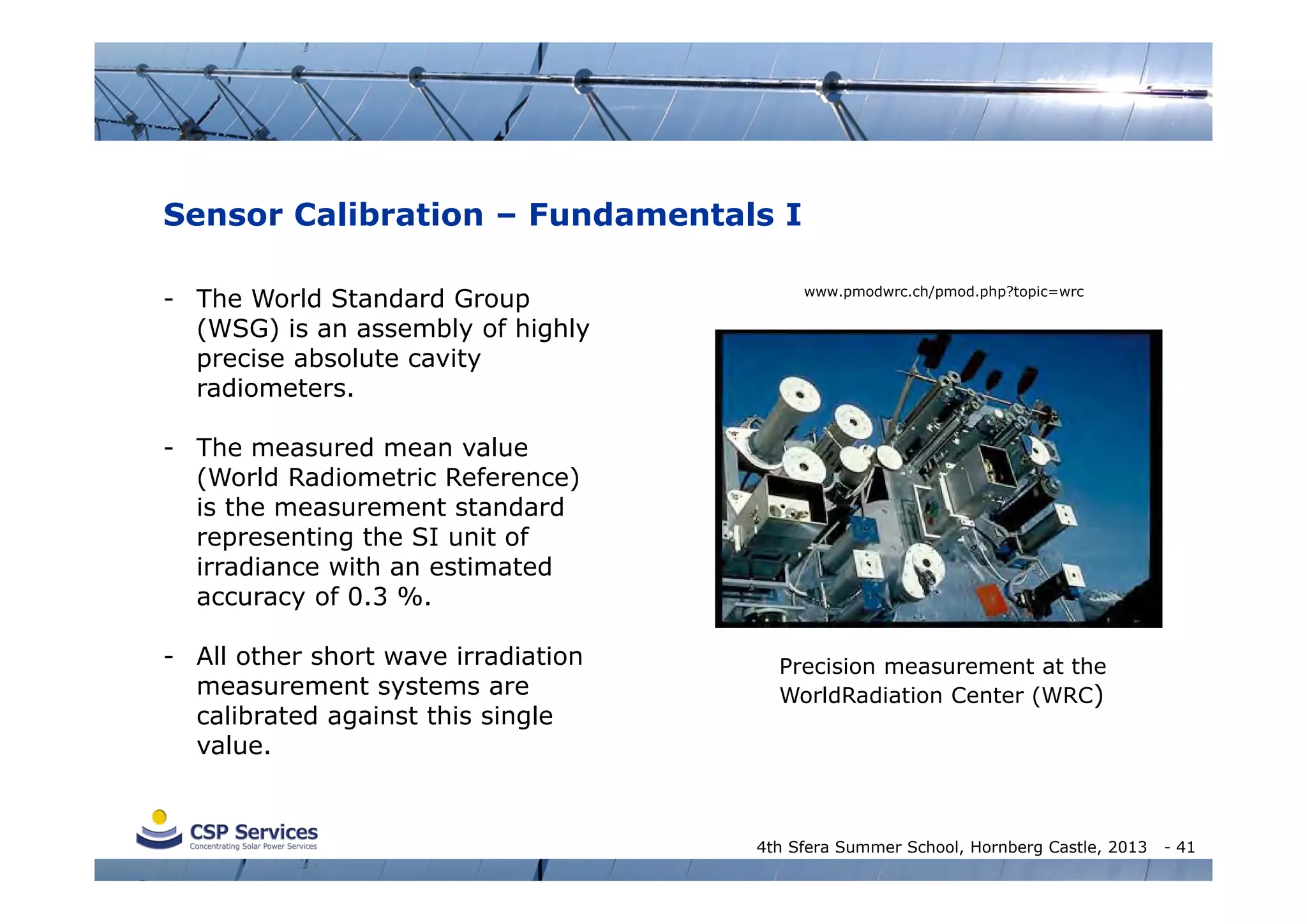
- The World Standard Group
(WSG) is an assembly of highly
precise absolute cavity
radiometers.

www.pmodwrc.ch/pmod.php?topic=wrc

- The measured mean value
(World Radiometric Reference)
is the measurement standard
representing the SI unit of
irradiance with an estimated
accuracy of 0.3 %.
- All other short wave irradiation
measurement systems are
calibrated against this single
value.

Precision measurement at the
WorldRadiation Center (WRC)

4th Sfera Summer School, Hornberg Castle, 2013

- 41
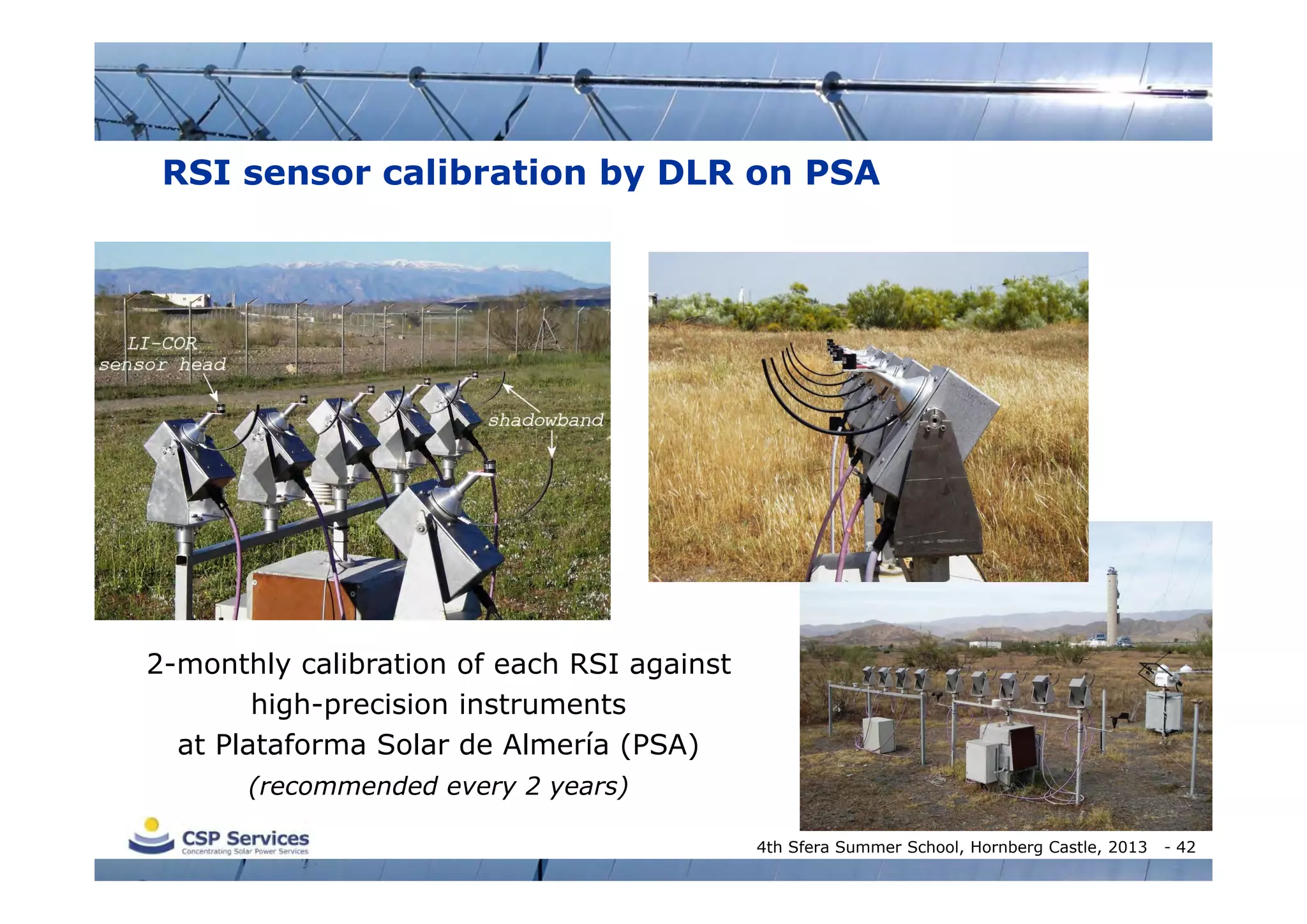
RSI sensor calibration by DLR on PSA

2-monthly calibration of each RSI against
high-precision instruments
at Plataforma Solar de Almería (PSA)
(recommended every 2 years)
4th Sfera Summer School, Hornberg Castle, 2013

- 42
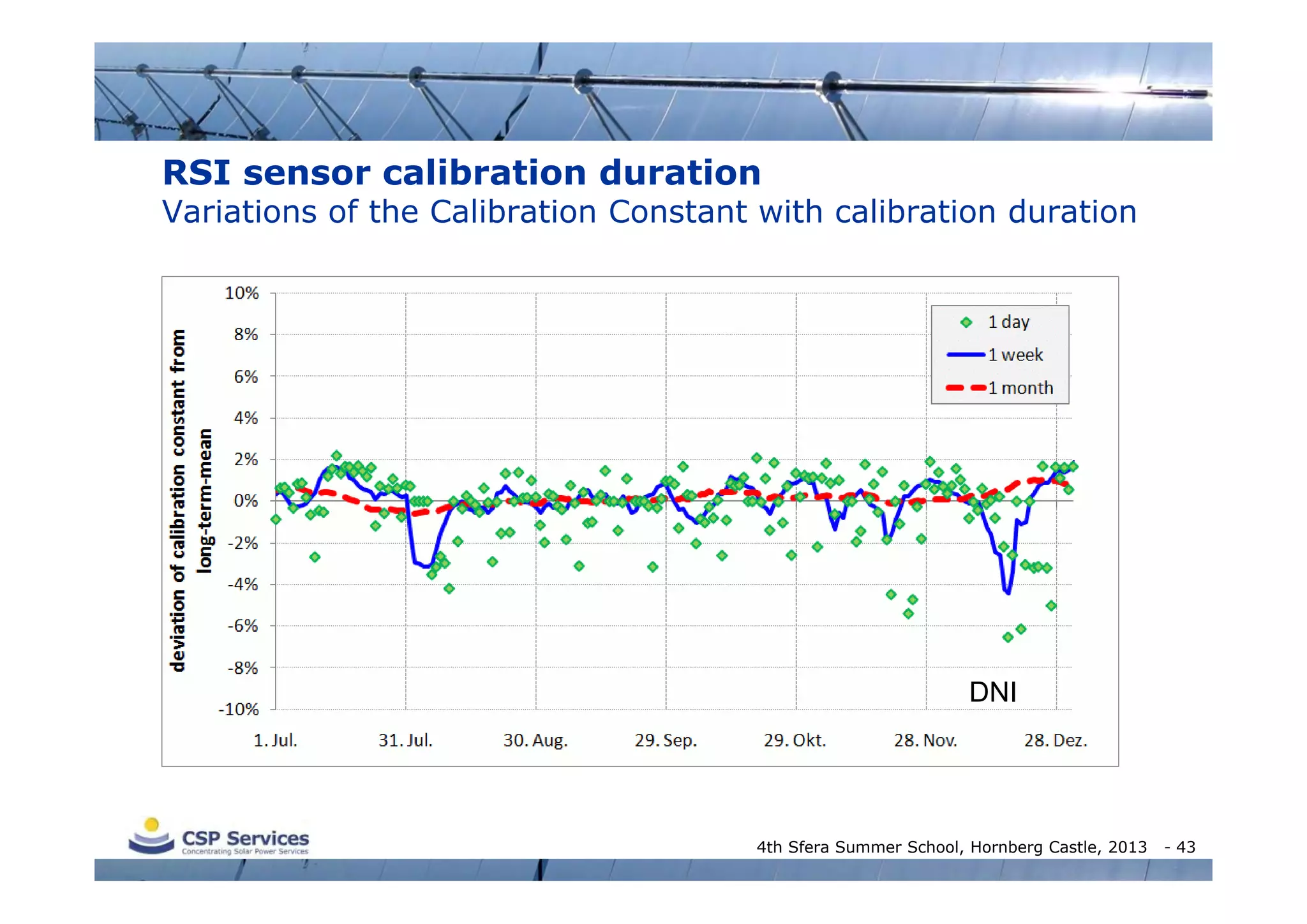
RSI sensor calibration duration

Variations of the Calibration Constant with calibration duration

DNI

4th Sfera Summer School, Hornberg Castle, 2013

- 43
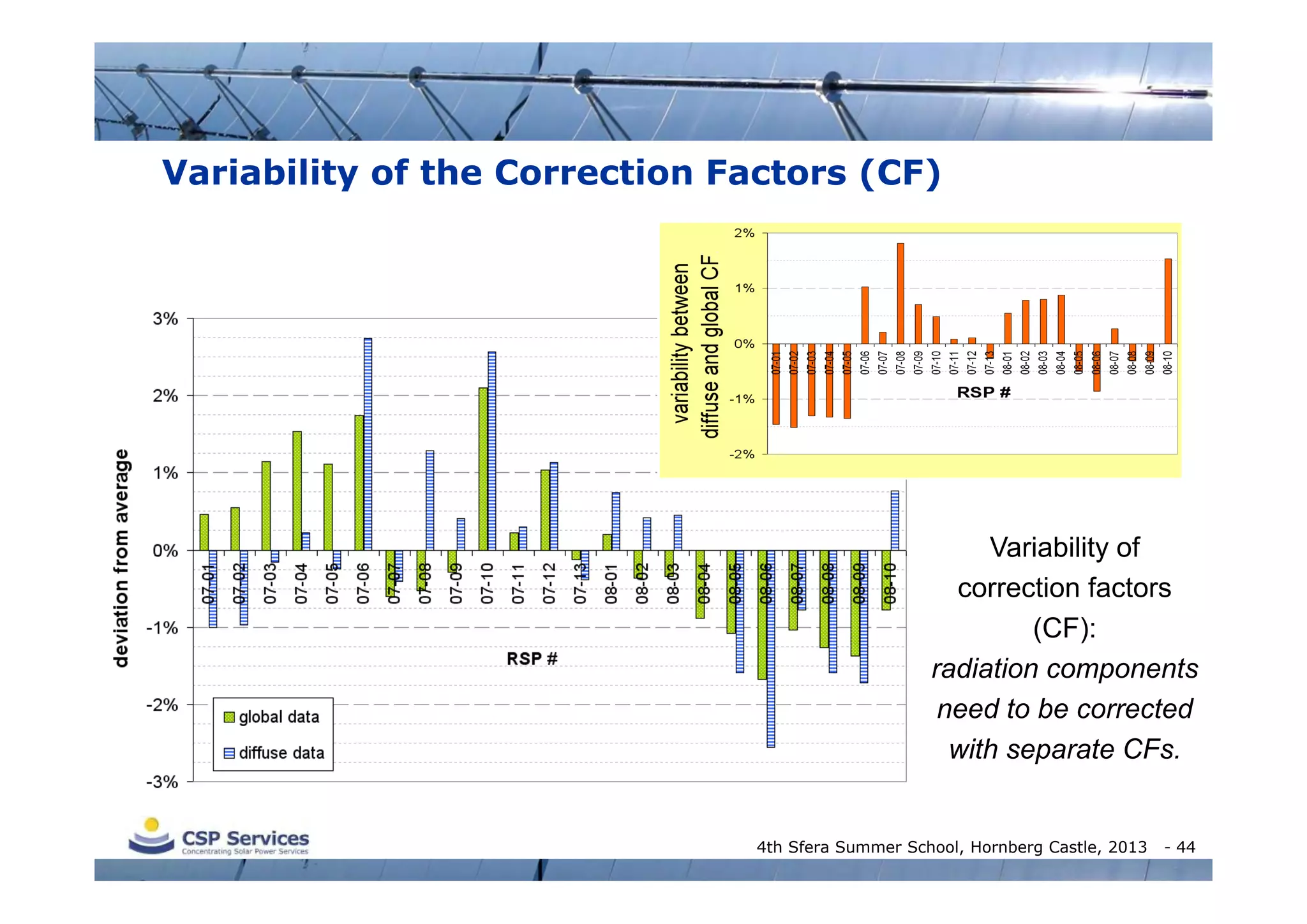
Variability of the Correction Factors (CF)

Variability of
correction factors
(CF):
radiation components
need to be corrected
with separate CFs.

4th Sfera Summer School, Hornberg Castle, 2013

- 44
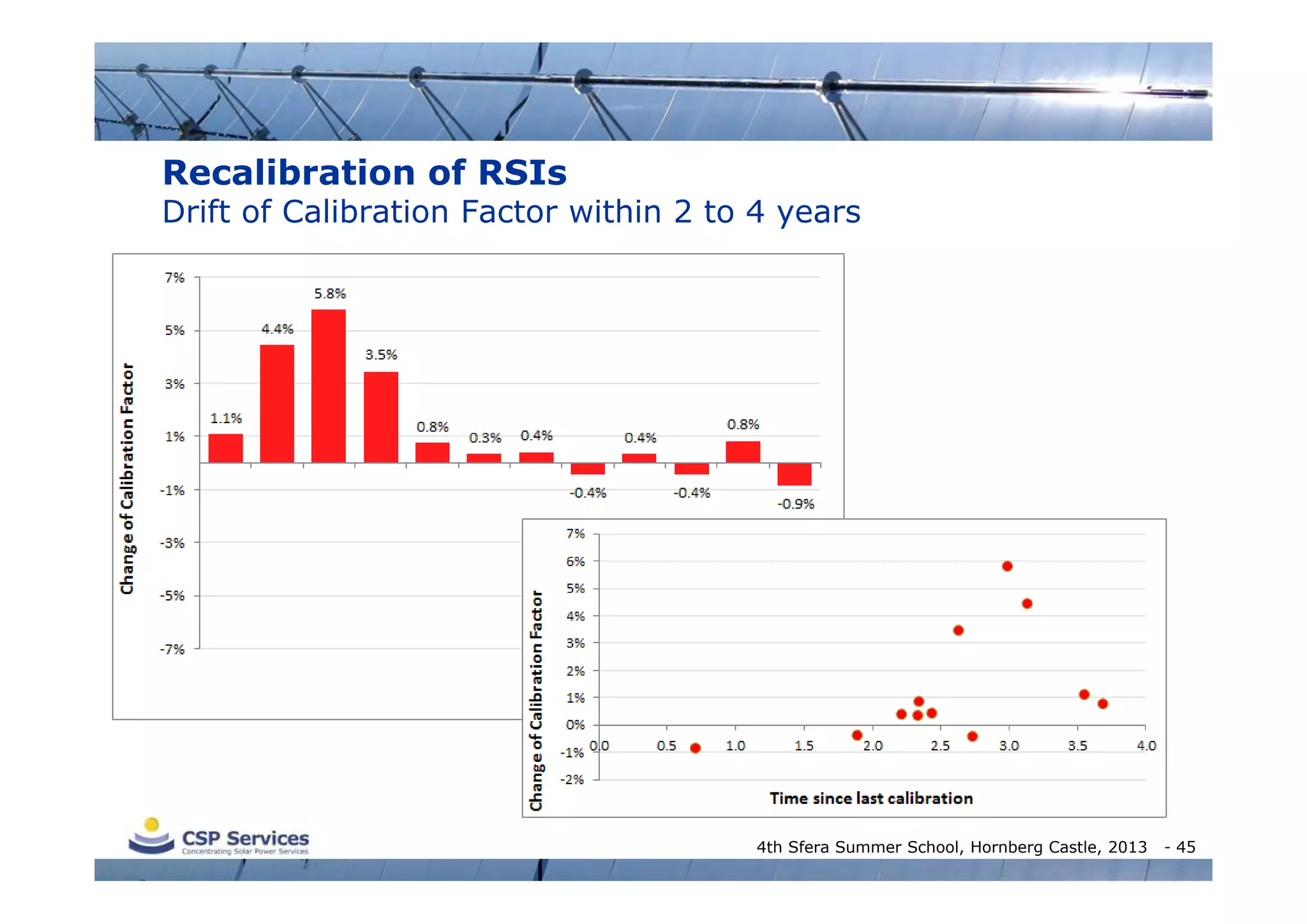
Recalibration of RSIs

Drift of Calibration Factor within 2 to 4 years

4th Sfera Summer School, Hornberg Castle, 2013

- 45
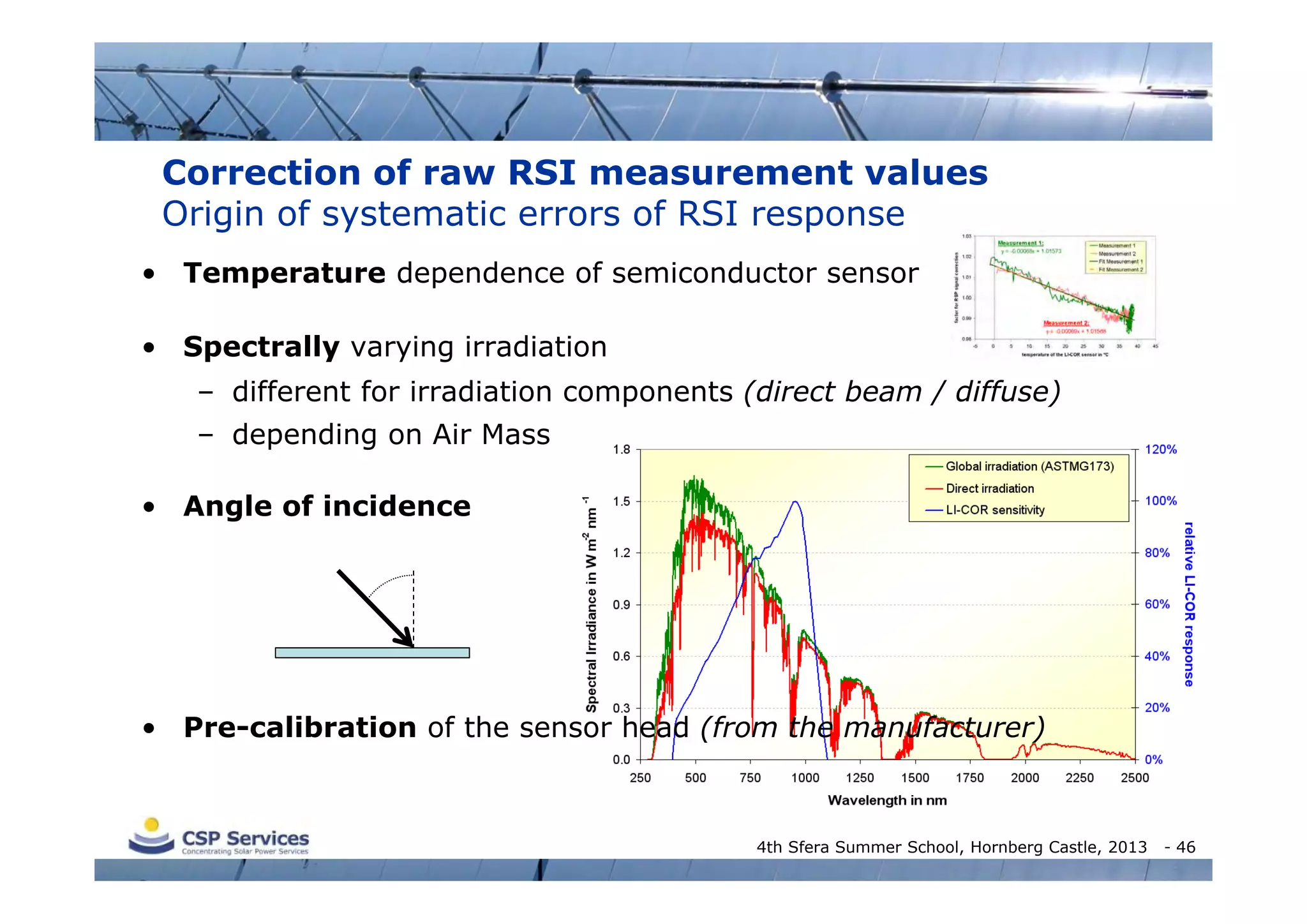
Correction of raw RSI measurement values
Origin of systematic errors of RSI response
• Temperature dependence of semiconductor sensor
• Spectrally varying irradiation
– different for irradiation components (direct beam / diffuse)
– depending on Air Mass
• Angle of incidence

• Pre-calibration of the sensor head (from the manufacturer)

4th Sfera Summer School, Hornberg Castle, 2013

- 46
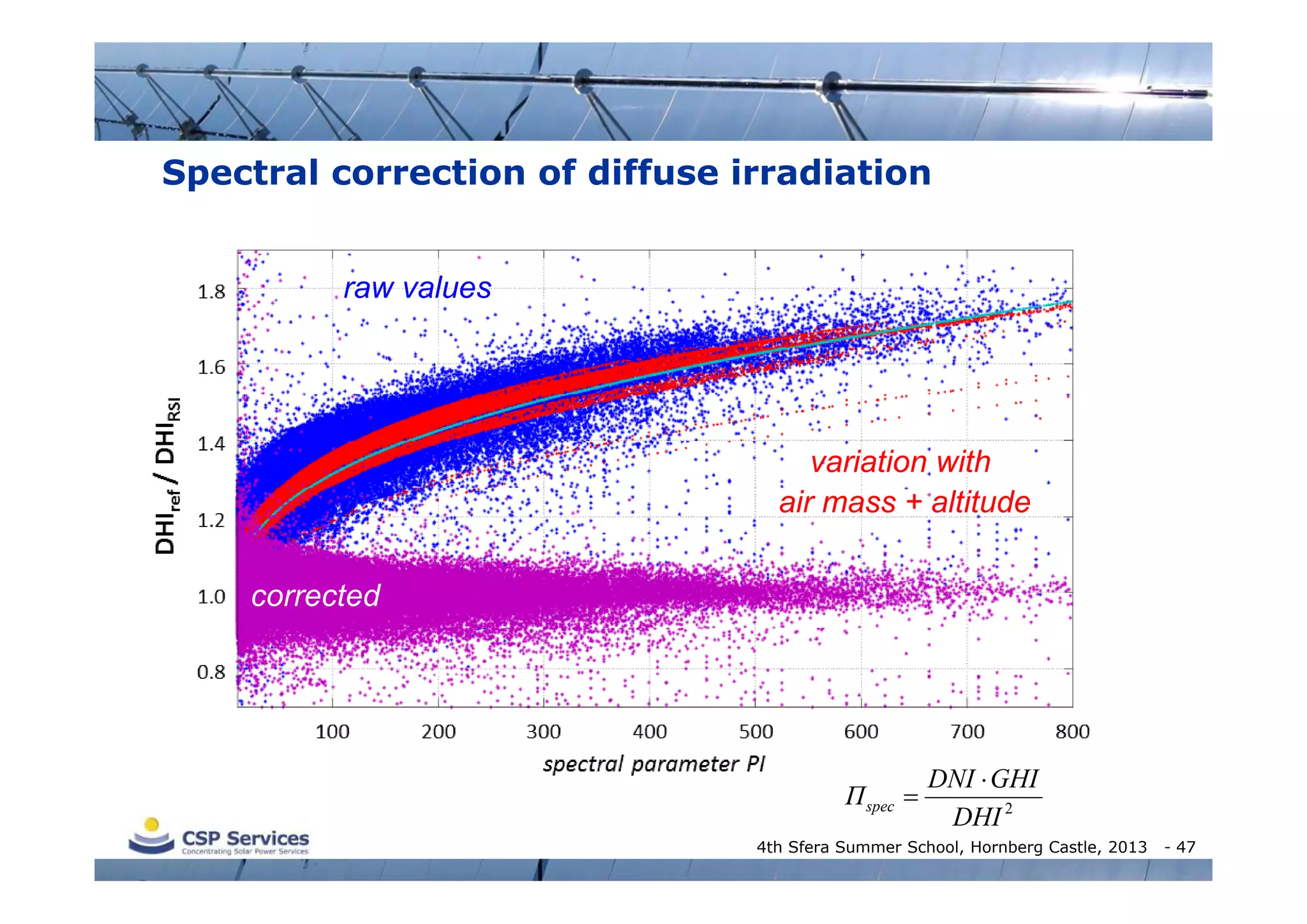
Spectral correction of diffuse irradiation
raw values

variation with
air mass + altitude
corrected

Π spec 

DNI  GHI
DHI 2

4th Sfera Summer School, Hornberg Castle, 2013

- 47
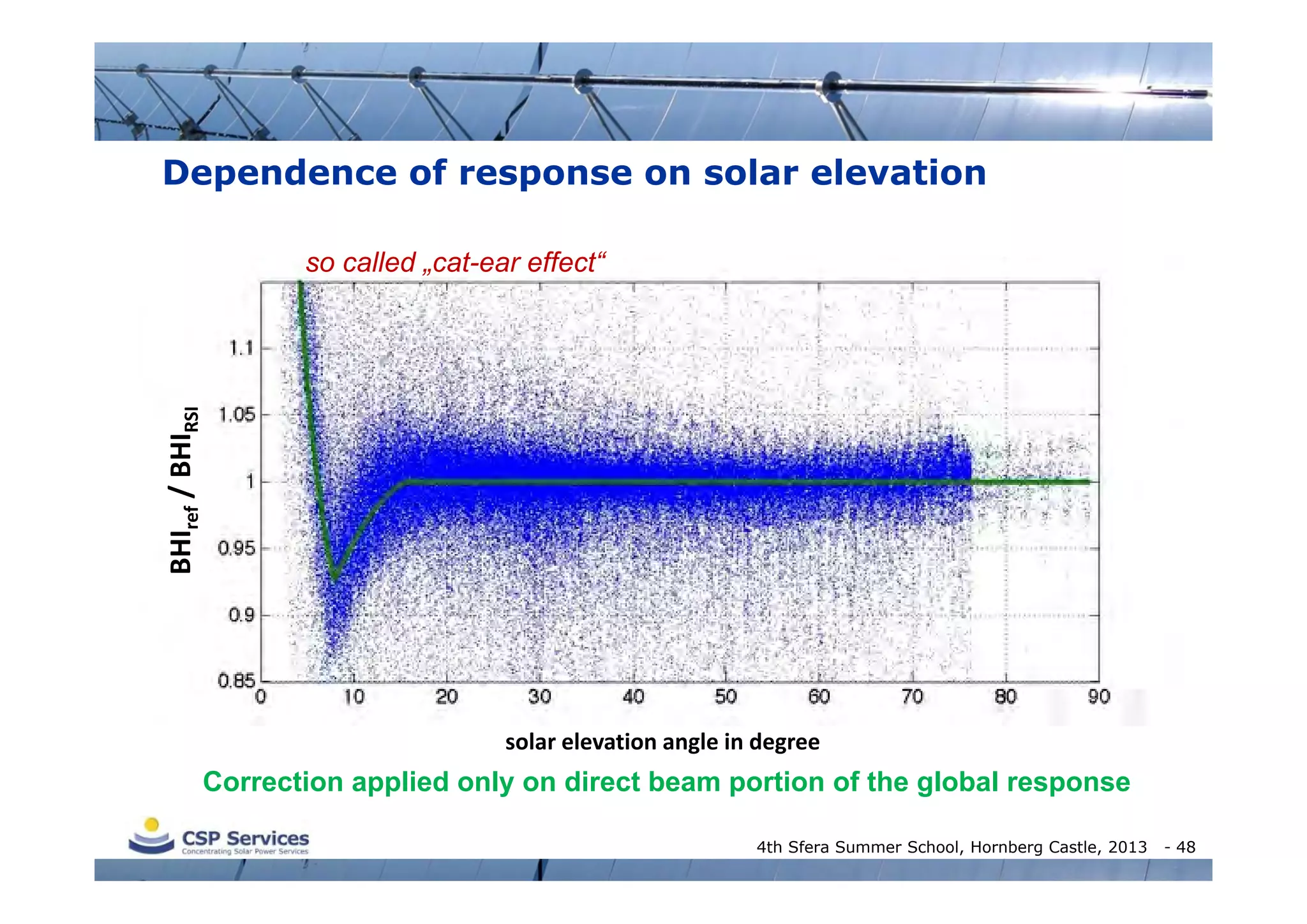
Dependence of response on solar elevation

BHIref / BHIRSI

so called „cat-ear effect“

solar elevation angle in degree

Correction applied only on direct beam portion of the global response
4th Sfera Summer School, Hornberg Castle, 2013

- 48
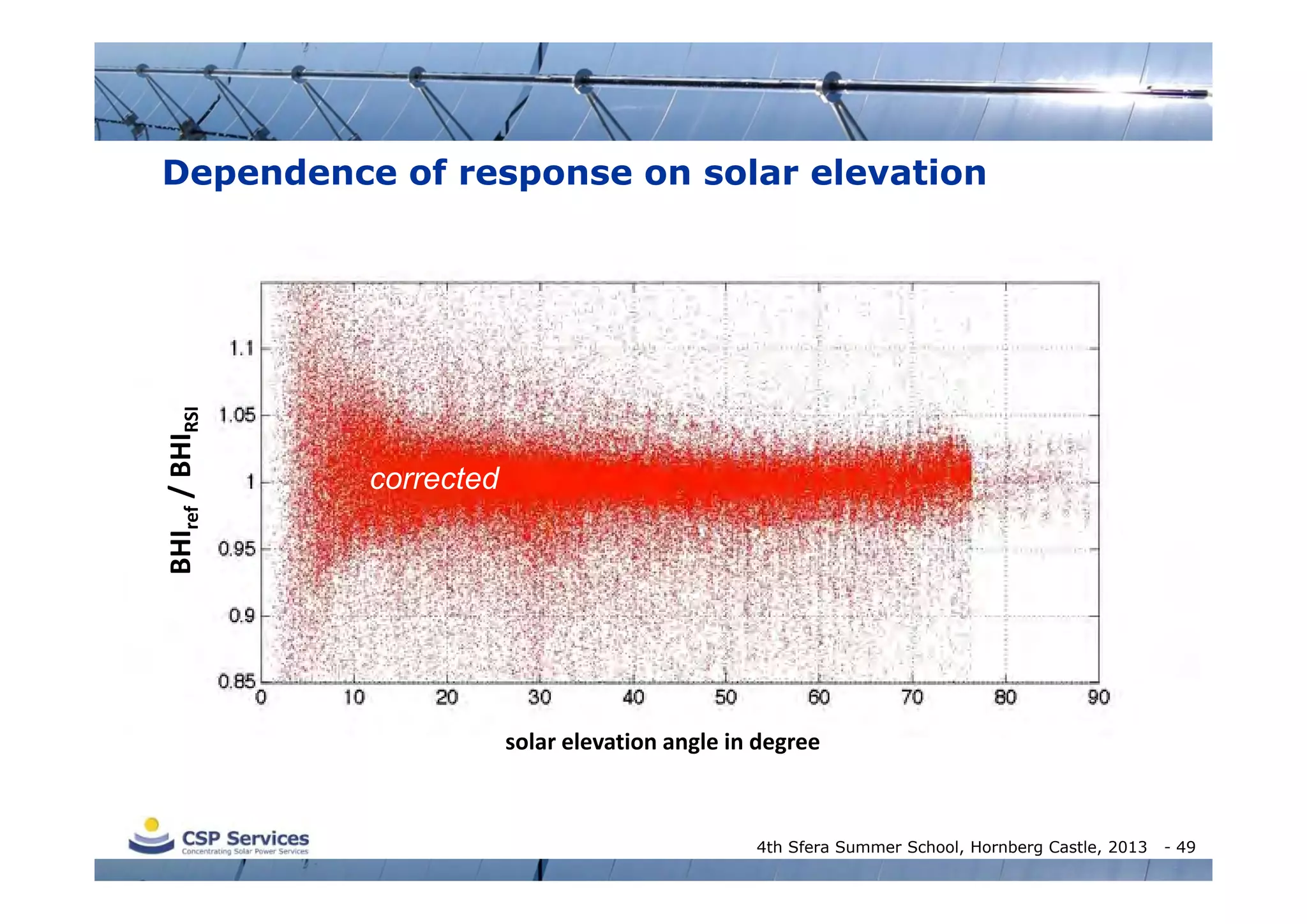
BHIref / BHIRSI

Dependence of response on solar elevation

corrected

solar elevation angle in degree

4th Sfera Summer School, Hornberg Castle, 2013

- 49
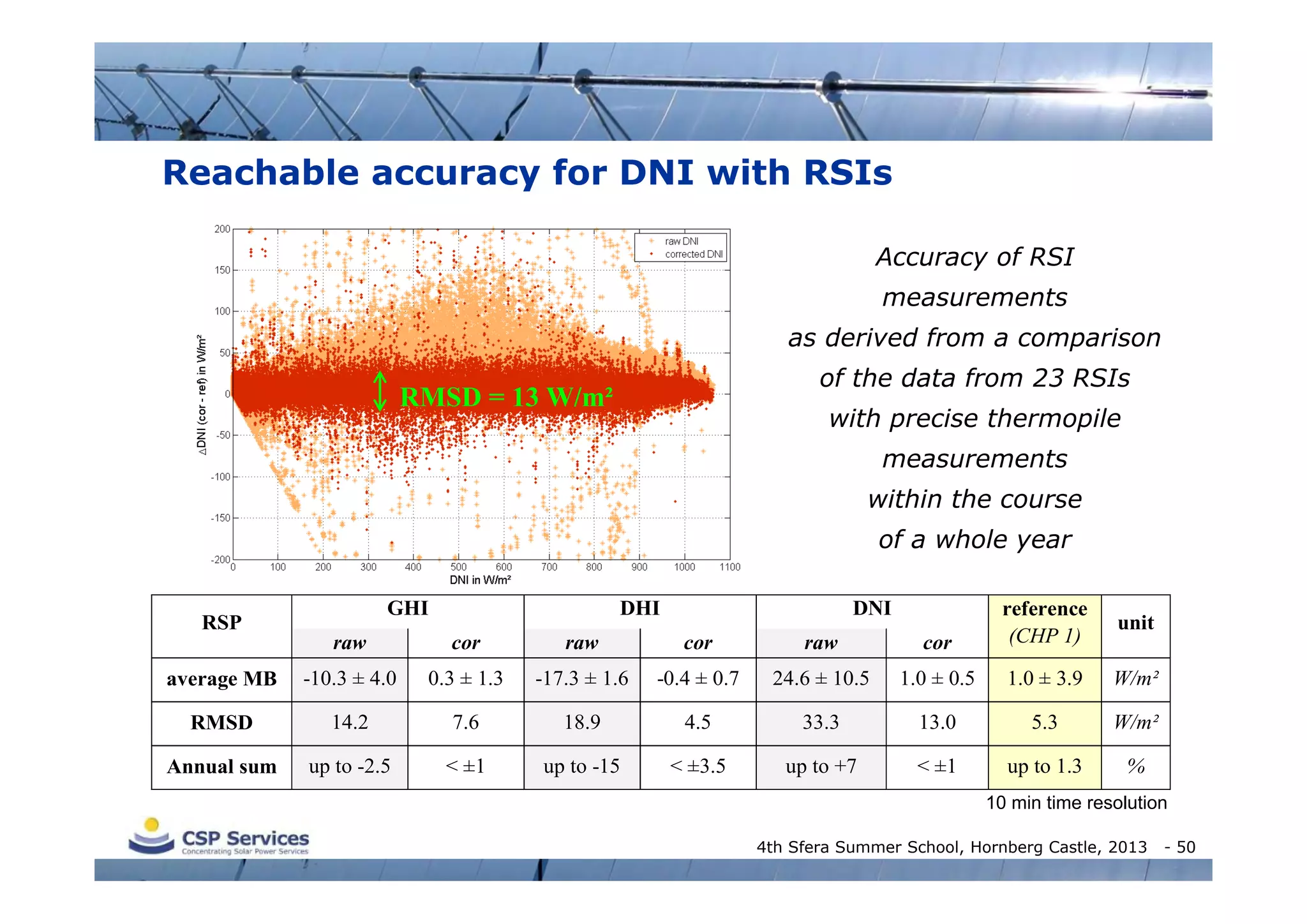
Reachable accuracy for DNI with RSIs
Accuracy of RSI
measurements
as derived from a comparison
of the data from 23 RSIs

RMSD = 13 W/m²

with precise thermopile
measurements
within the course
of a whole year

GHI

DHI

DNI

raw

cor

raw

cor

raw

cor

reference
(CHP 1)

average MB

-10.3 ± 4.0

0.3 ± 1.3

-17.3 ± 1.6

-0.4 ± 0.7

24.6 ± 10.5

1.0 ± 0.5

1.0 ± 3.9

W/m²

RMSD

14.2

7.6

18.9

4.5

33.3

13.0

5.3

W/m²

Annual sum

up to -2.5

< ±1

up to -15

< ±3.5

up to +7

< ±1

up to 1.3

%

RSP

unit

10 min time resolution
4th Sfera Summer School, Hornberg Castle, 2013

- 50
Transferability of the results?
The reachable accuracy of the measured beam irradiance data
for the client at his prospected sites depends on 2 crucial points:
• Stability of the sensor sensitivity
• Transferability of the results to other sites
• Regular inspections and data controlling

4th Sfera Summer School, Hornberg Castle, 2013

- 51
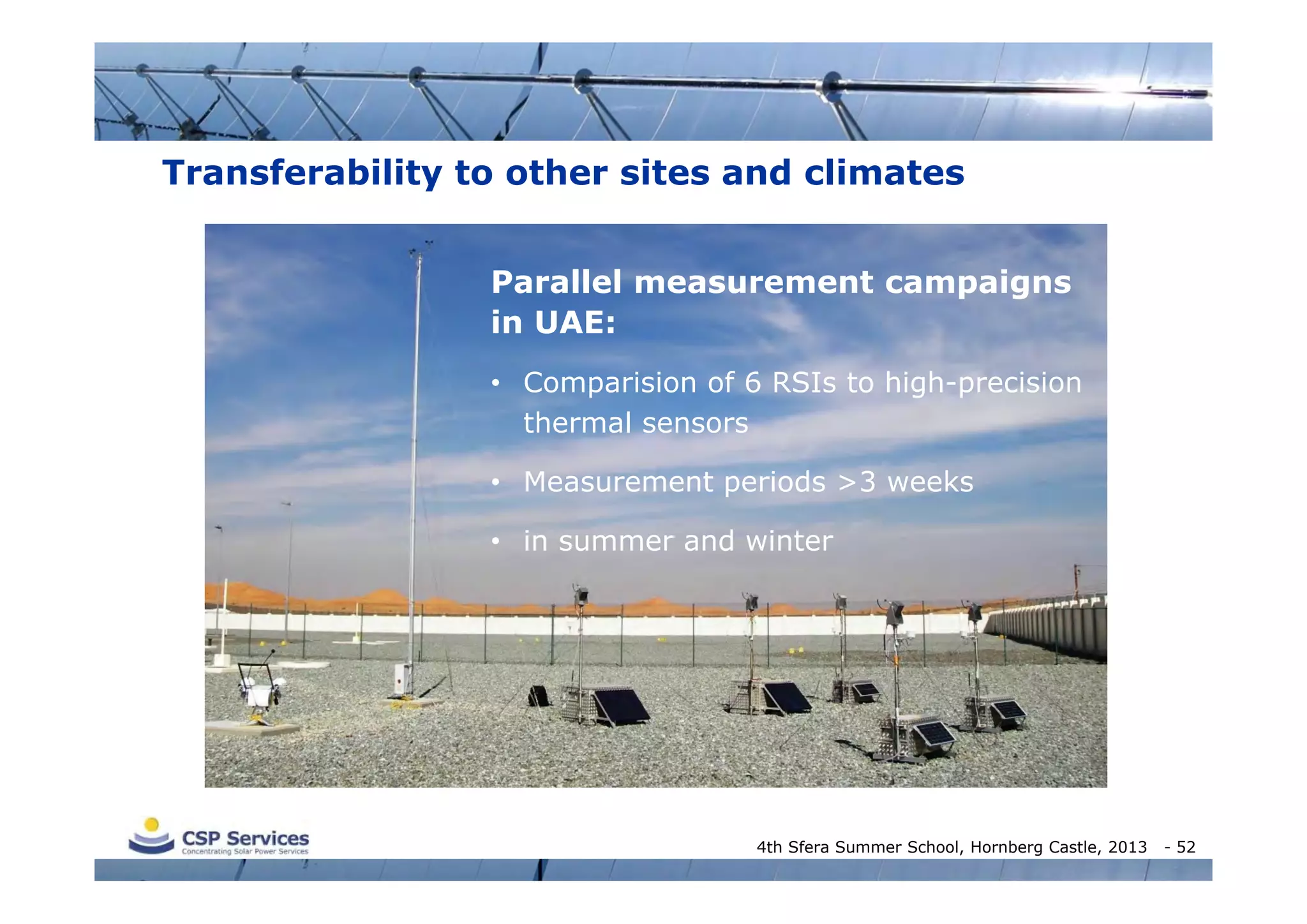
Transferability to other sites and climates
Parallel measurement campaigns
in UAE:
• Comparision of 6 RSIs to high-precision
thermal sensors
• Measurement periods >3 weeks
• in summer and winter

4th Sfera Summer School, Hornberg Castle, 2013

- 52
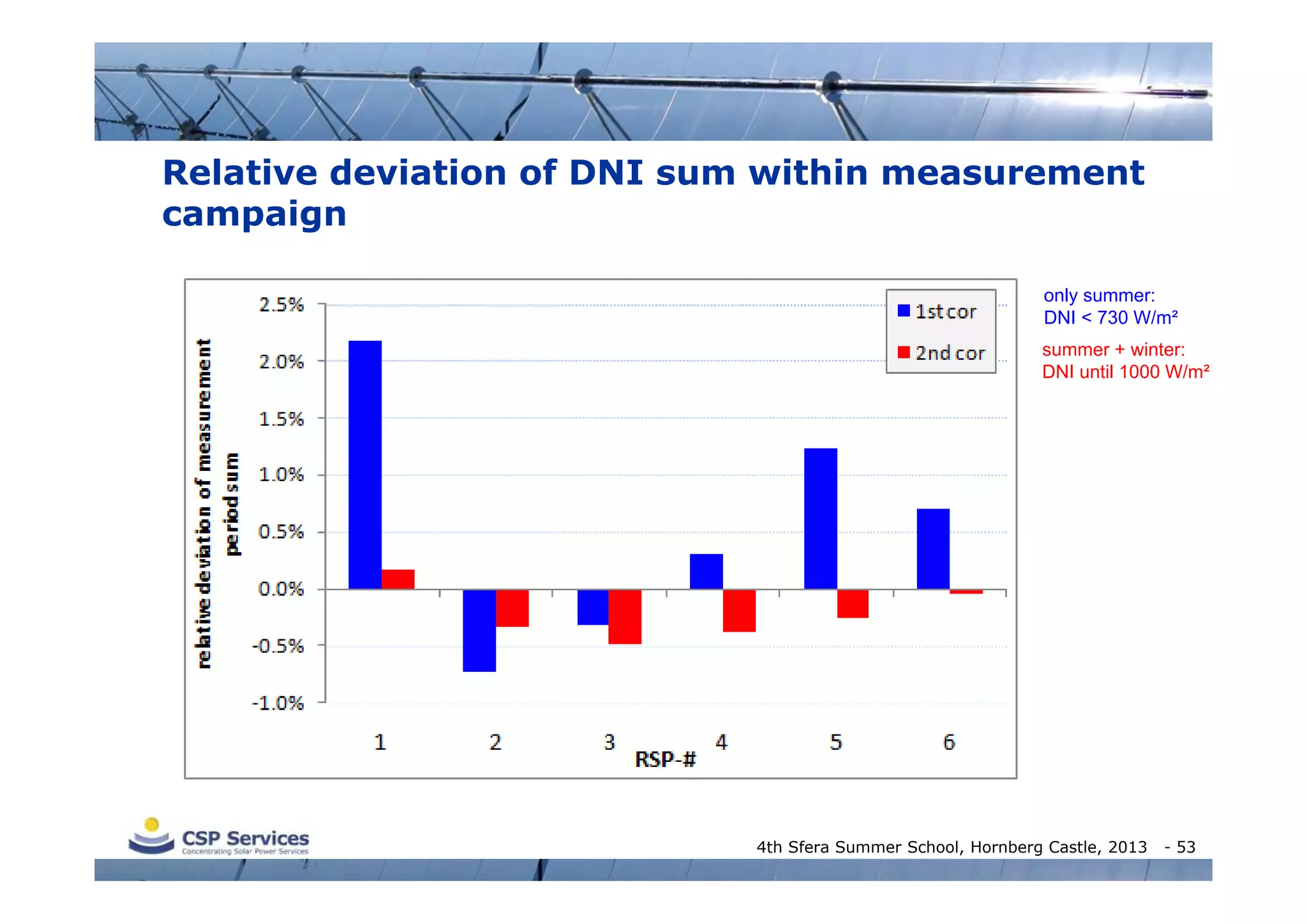
Relative deviation of DNI sum within measurement
campaign
only summer:
DNI < 730 W/m²
summer + winter:
DNI until 1000 W/m²

4th Sfera Summer School, Hornberg Castle, 2013

- 53
Satellite Based Assessment

4th Sfera Summer School, Hornberg Castle, 2013

- 54
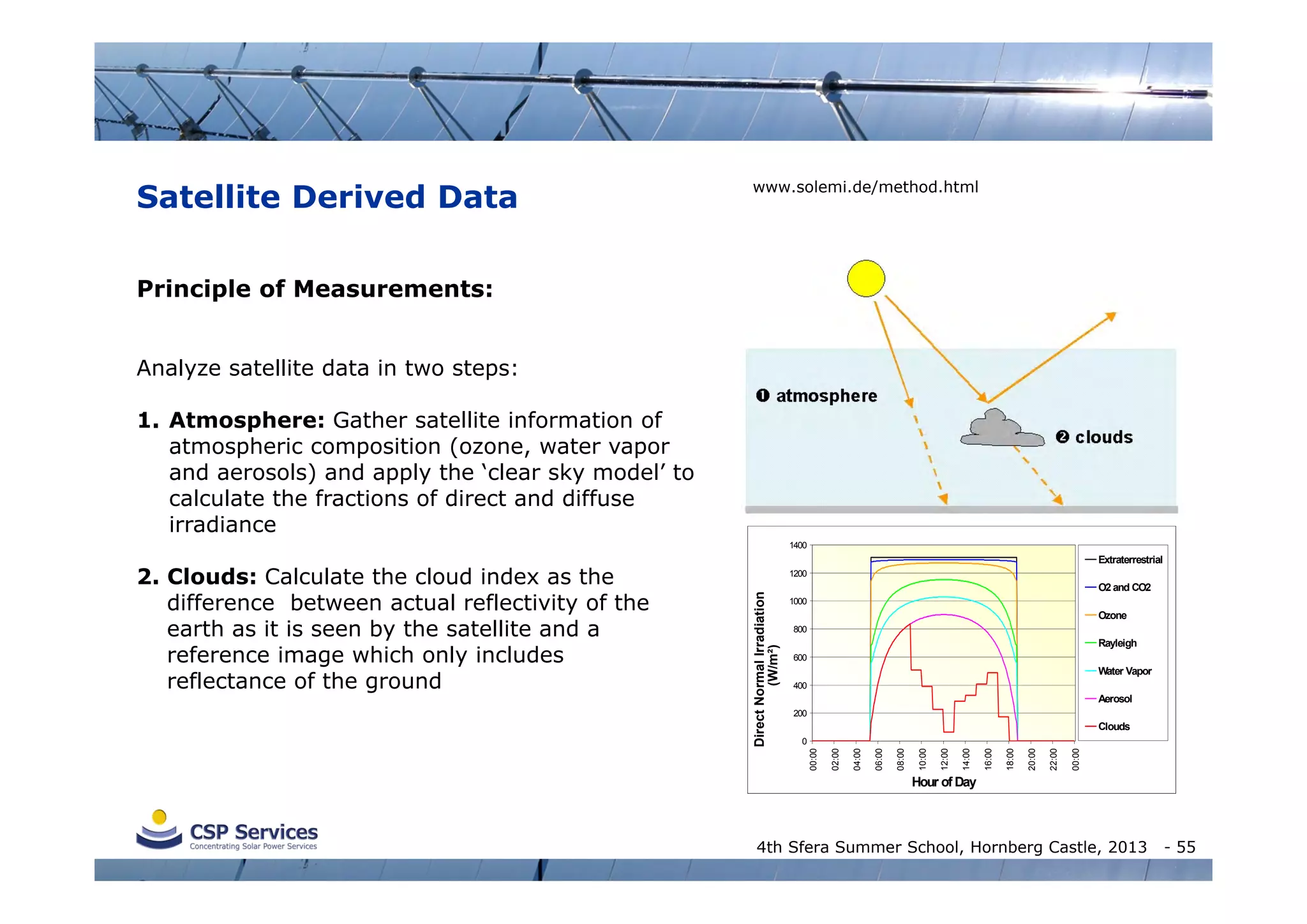
Satellite Derived Data

www.solemi.de/method.html

Principle of Measurements:
Analyze satellite data in two steps:
1. Atmosphere: Gather satellite information of
atmospheric composition (ozone, water vapor
and aerosols) and apply the ‘clear sky model’ to
calculate the fractions of direct and diffuse
irradiance
1400

O2 and CO2
1000

Ozone
800

Rayleigh
600

Water Vapor
400

Aerosol
200

Clouds
00:00

22:00

20:00

18:00

16:00

14:00

12:00

10:00

08:00

06:00

04:00

02:00

0
00:00

Direct Normal Irradiation
(W/m²)

2. Clouds: Calculate the cloud index as the
difference between actual reflectivity of the
earth as it is seen by the satellite and a
reference image which only includes
reflectance of the ground

Extraterrestrial
1200

Hour of Day

4th Sfera Summer School, Hornberg Castle, 2013

- 55
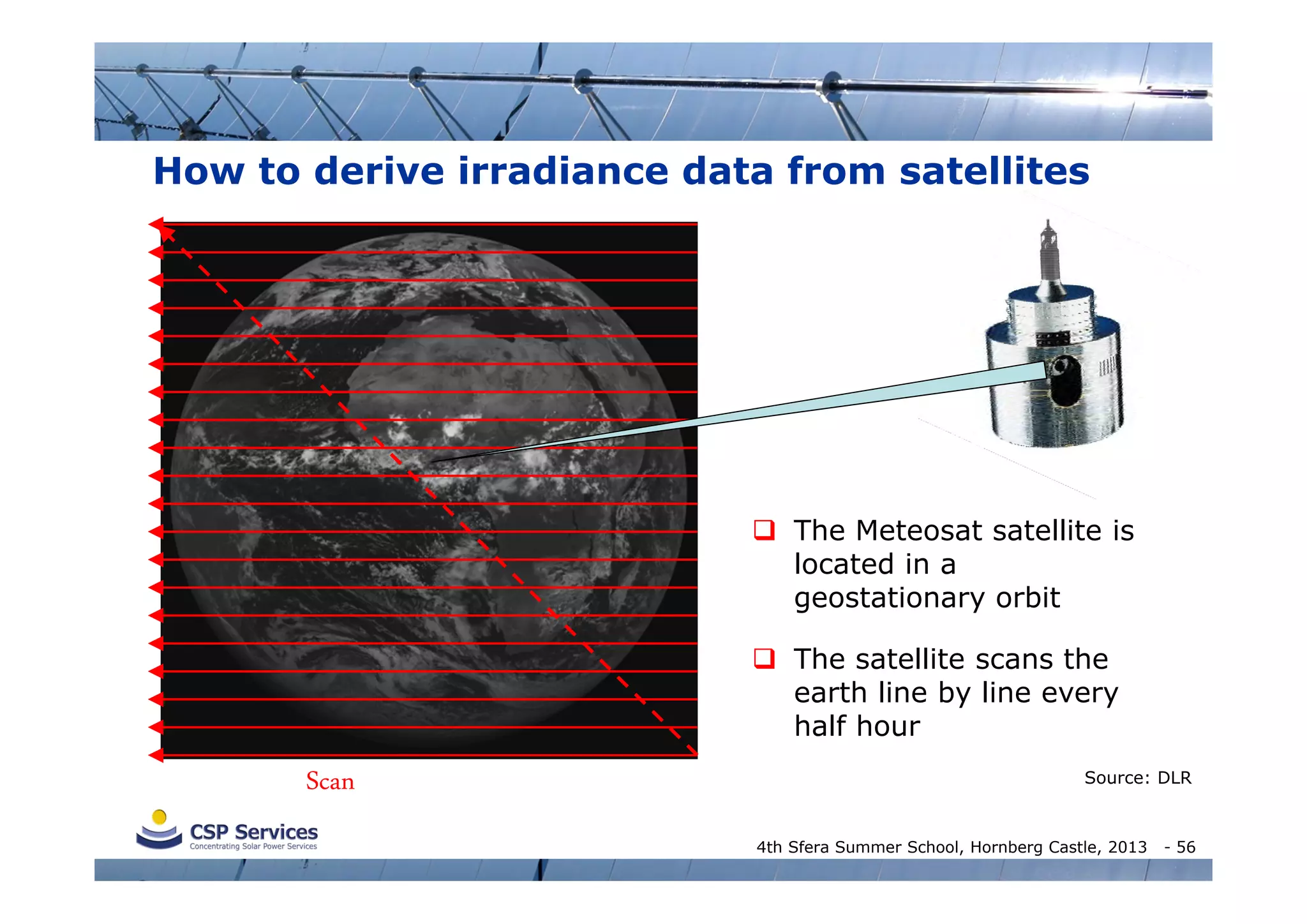
How to derive irradiance data from satellites

 The Meteosat satellite is
located in a
geostationary orbit
 The satellite scans the
earth line by line every
half hour

Scan

Source: DLR

4th Sfera Summer School, Hornberg Castle, 2013

- 56
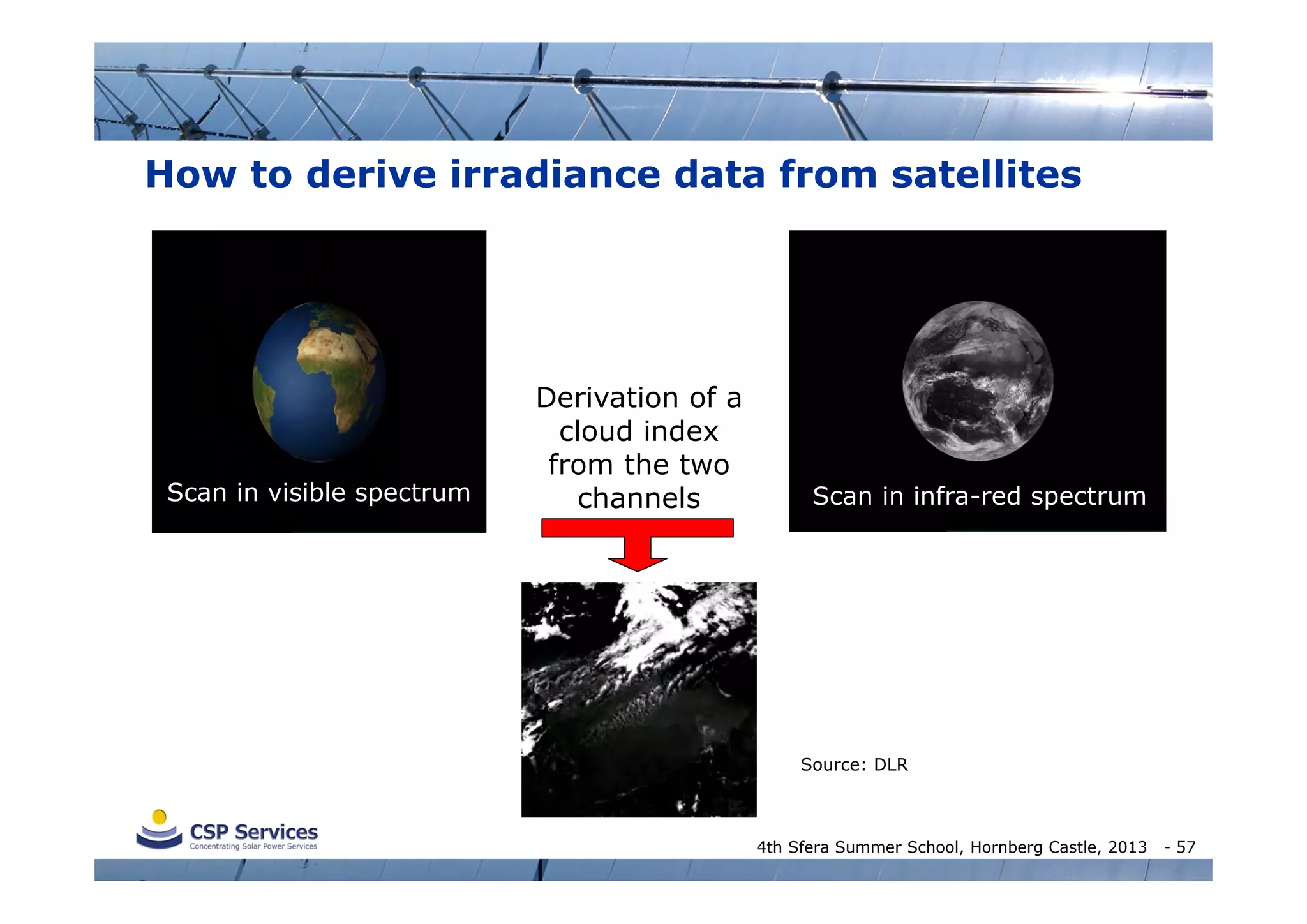
How to derive irradiance data from satellites

Scan in visible spectrum

Derivation of a
cloud index
from the two
channels

Scan in infra-red spectrum

Source: DLR

4th Sfera Summer School, Hornberg Castle, 2013

- 57
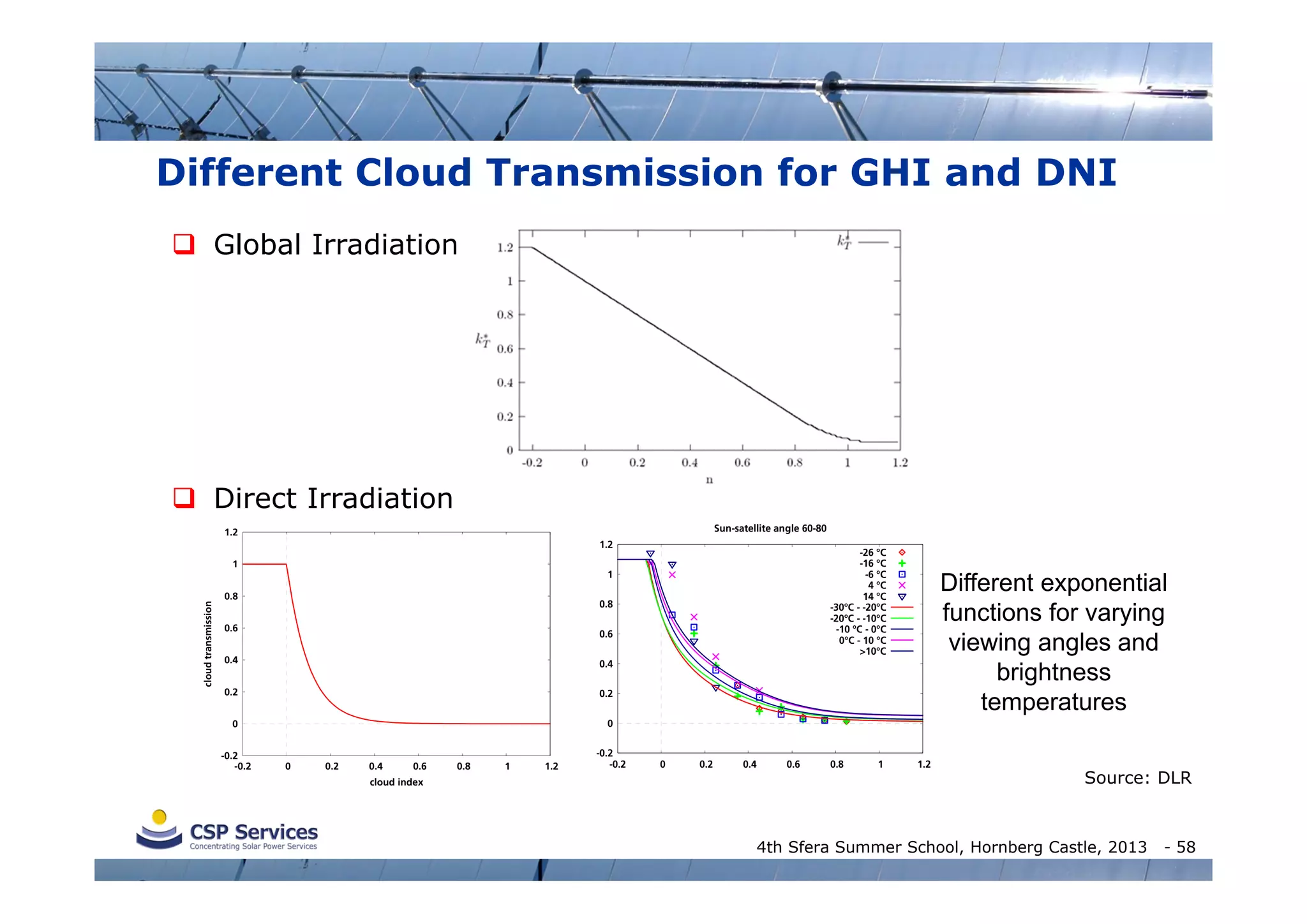
Different Cloud Transmission for GHI and DNI
 Global Irradiation

 Direct Irradiation
Sun-satellite angle 60-80

1.2

1.2

-26 °C
-16 °C
-6 °C
4 °C
14 °C
-30°C - -20°C
-20°C - -10°C
-10 °C - 0°C
0°C - 10 °C
>10°C

1

cloud transmission

1
0.8

0.8

0.6

0.6

0.4

0.4

0.2

0.2

0

Different exponential
functions for varying
viewing angles and
brightness
temperatures

0

-0.2
-0.2

0

0.2

0.4

0.6

cloud index

0.8

1

1.2

-0.2
-0.2

0

0.2

0.4

0.6

0.8

1

1.2

Source: DLR

4th Sfera Summer School, Hornberg Castle, 2013

- 58
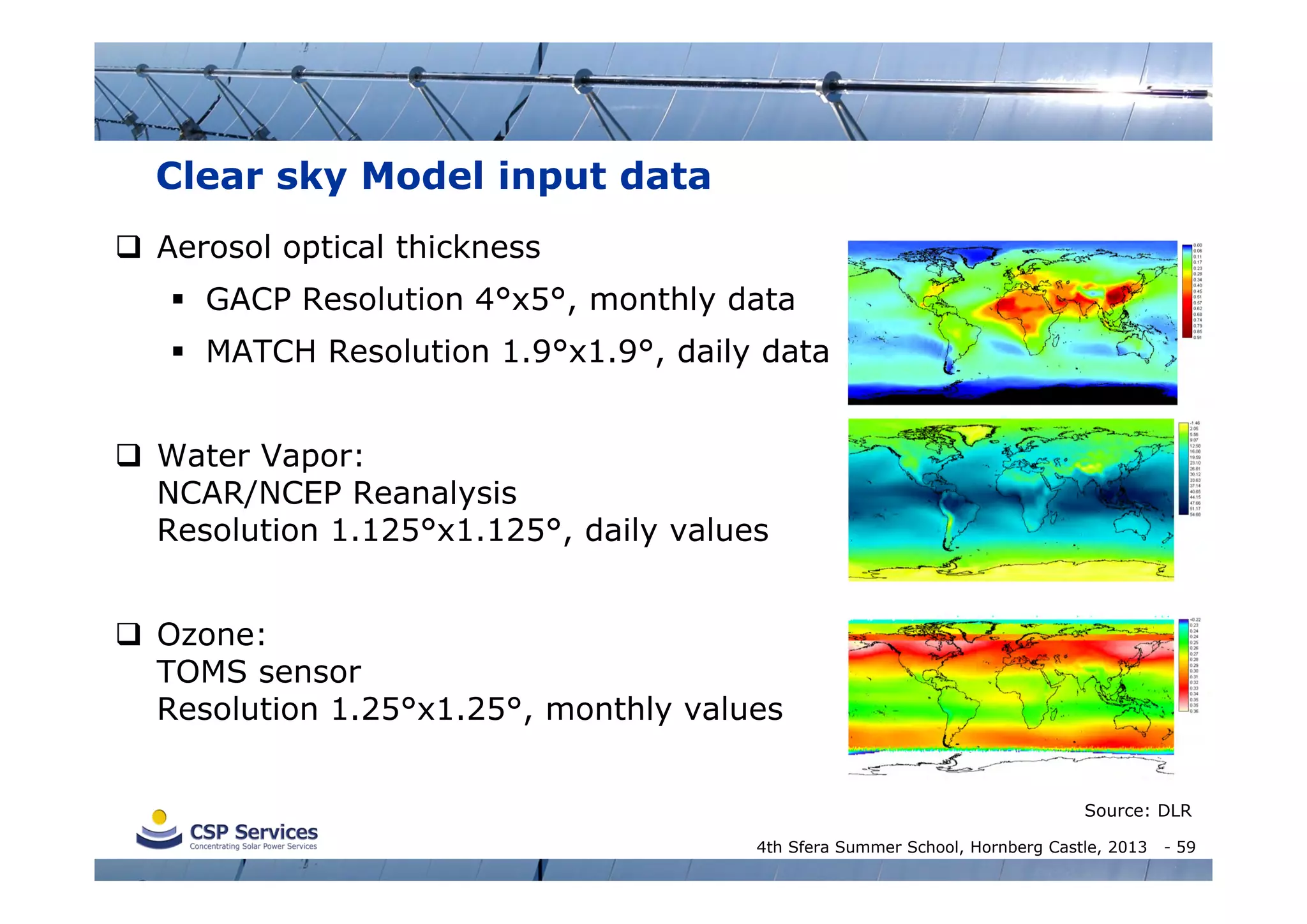
Clear sky Model input data
 Aerosol optical thickness
 GACP Resolution 4°x5°, monthly data
 MATCH Resolution 1.9°x1.9°, daily data
 Water Vapor:
NCAR/NCEP Reanalysis
Resolution 1.125°x1.125°, daily values
 Ozone:
TOMS sensor
Resolution 1.25°x1.25°, monthly values
Source: DLR
4th Sfera Summer School, Hornberg Castle, 2013

- 59
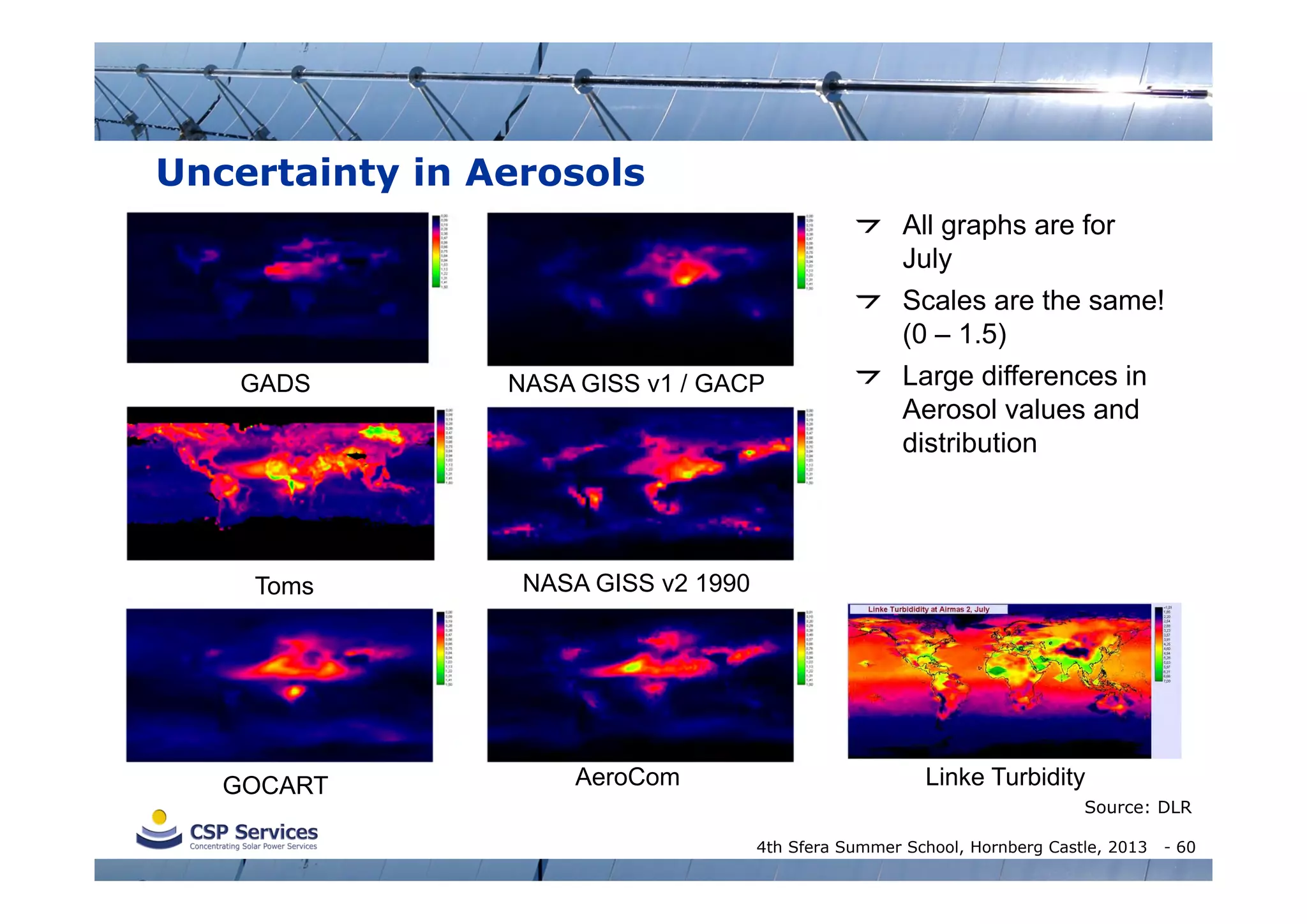
Uncertainty in Aerosols

GADS

Toms

GOCART

NASA GISS v1 / GACP

All graphs are for
July
Scales are the same!
(0 – 1.5)
Large differences in
Aerosol values and
distribution

NASA GISS v2 1990

AeroCom

Linke Turbidity
Source: DLR
4th Sfera Summer School, Hornberg Castle, 2013

- 60
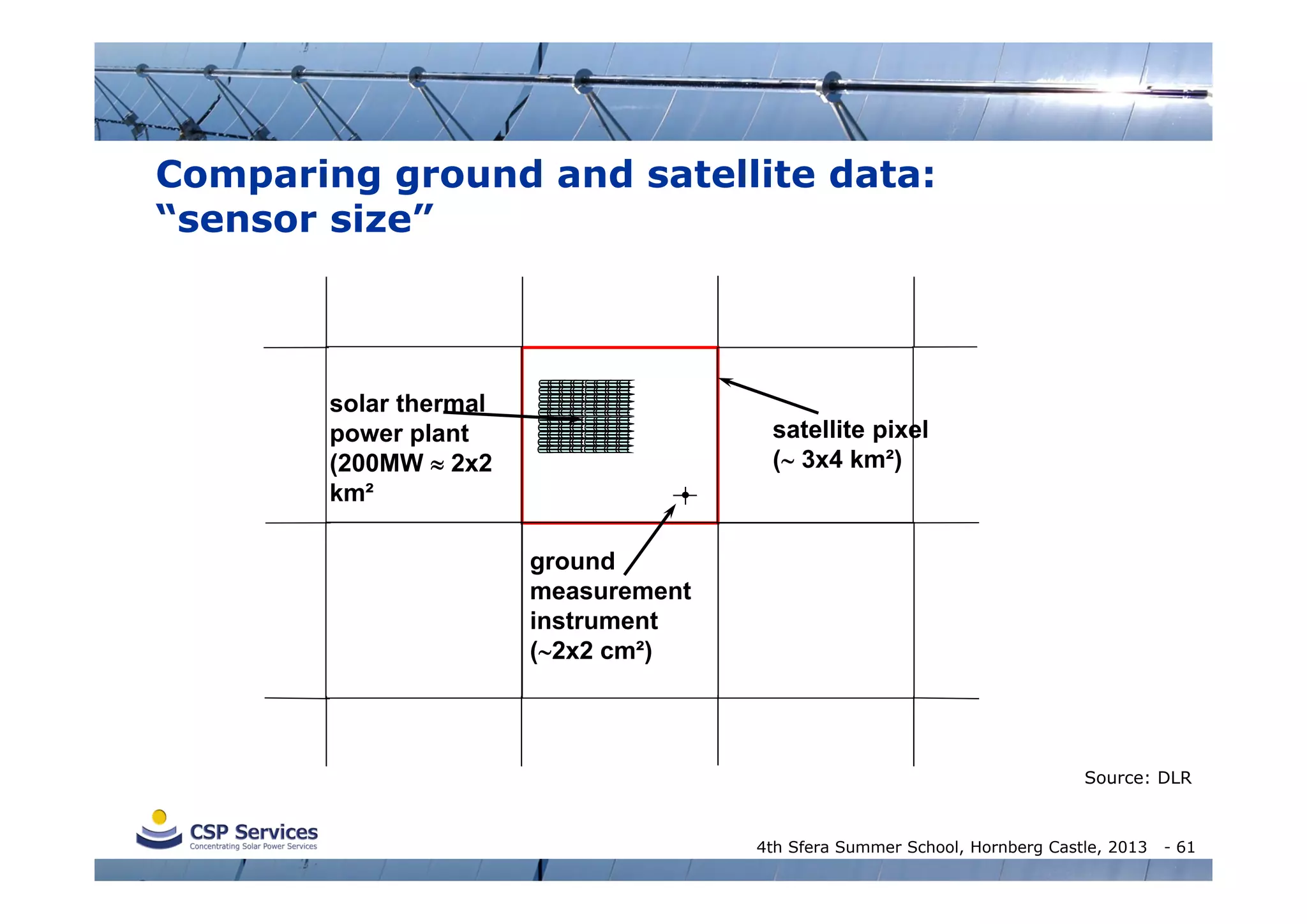
Comparing ground and satellite data:
“sensor size”

solar thermal
power plant
(200MW  2x2
km²

satellite pixel
( 3x4 km²)

ground
measurement
instrument
(2x2 cm²)

Source: DLR

4th Sfera Summer School, Hornberg Castle, 2013

- 61
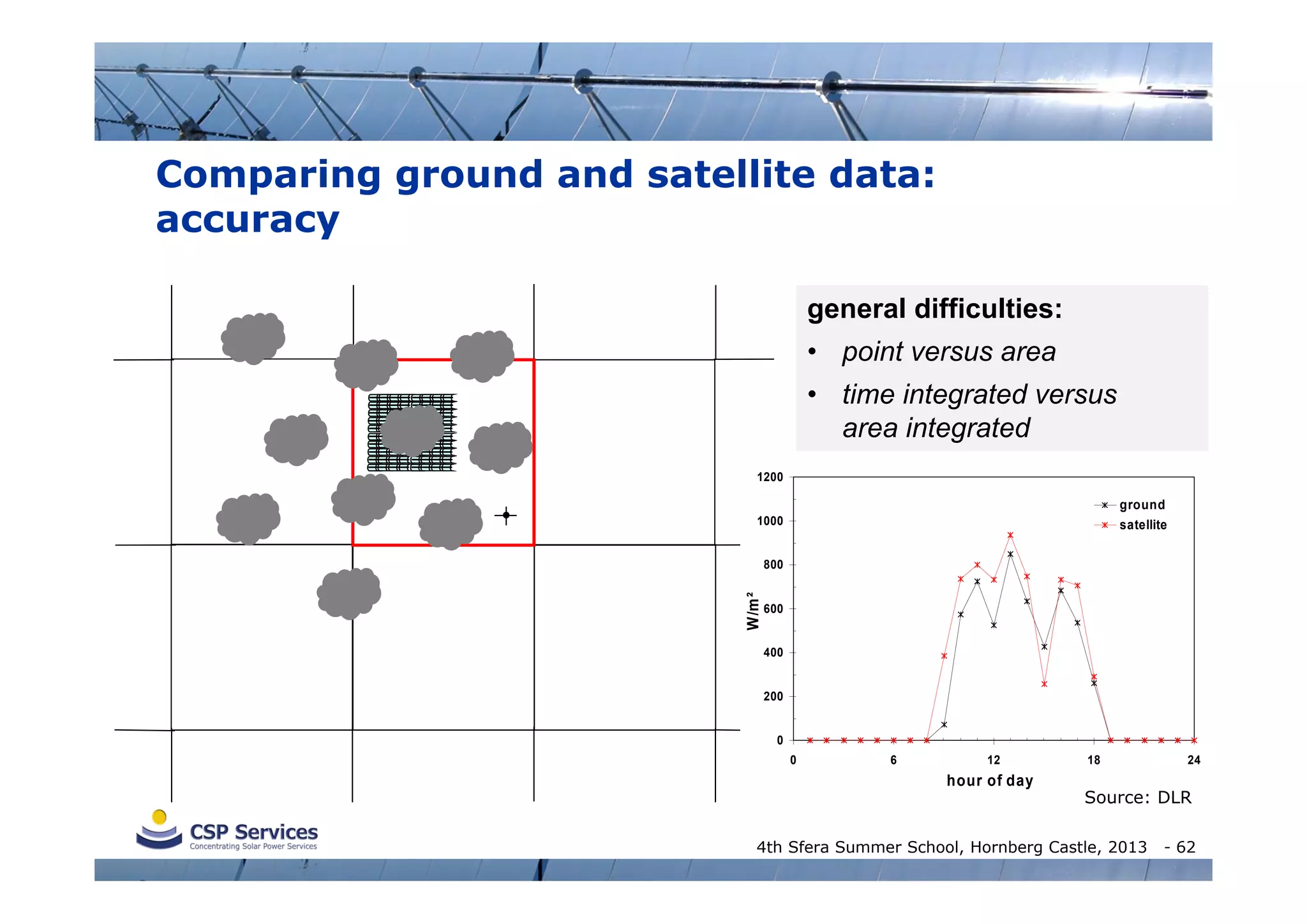
Comparing ground and satellite data:
accuracy
general difficulties:
• point versus area
• time integrated versus
area integrated
1200

ground
1000

satellite

W/m²

800
600
400
200
0
0

6

12

hour of day

18

24

Source: DLR

4th Sfera Summer School, Hornberg Castle, 2013

- 62
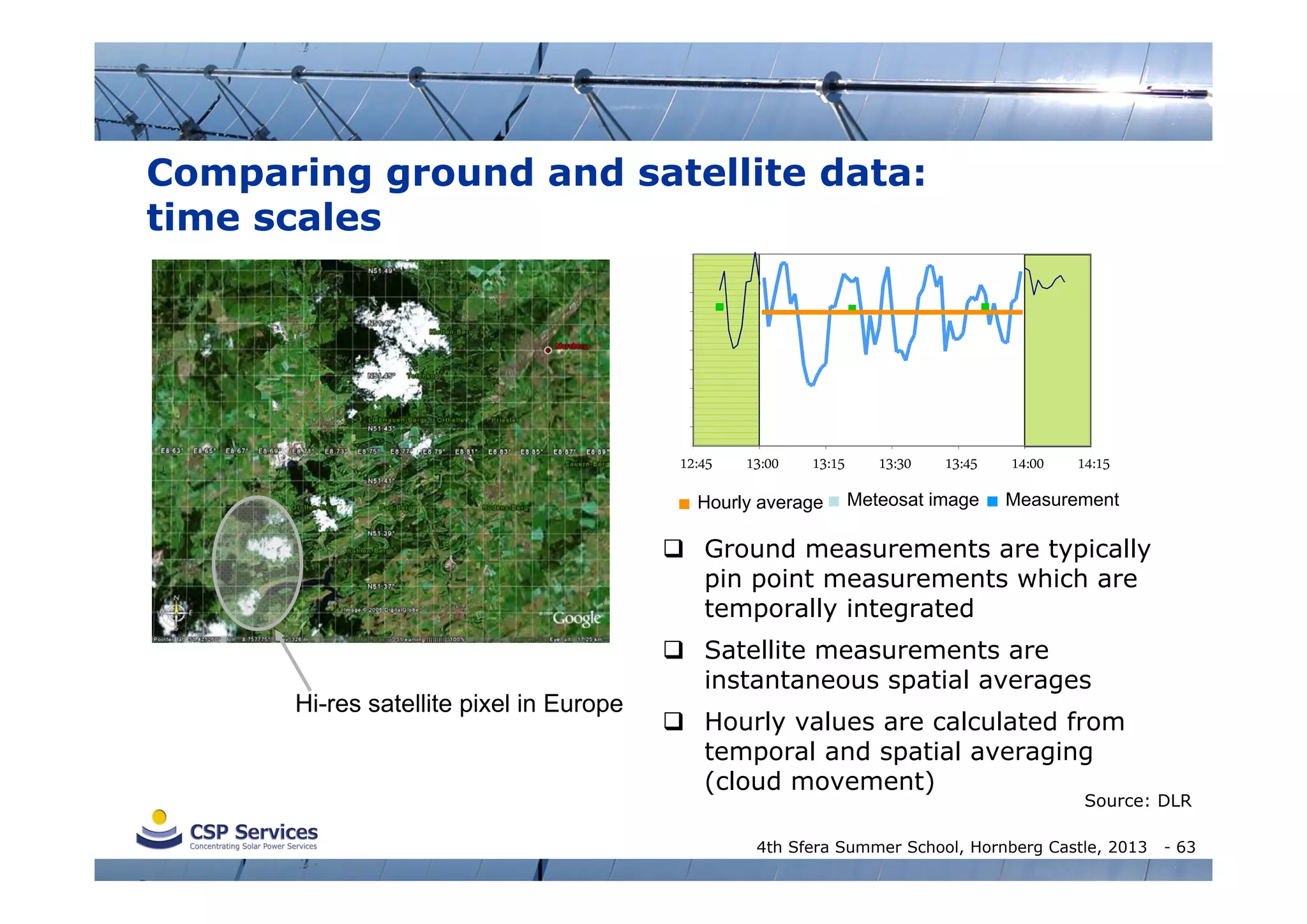
Comparing ground and satellite data:
time scales

12:45

13:00

13:15

Hourly average

13:30

13:45

Meteosat image

14:00

14:15

Measurement

 Ground measurements are typically
pin point measurements which are
temporally integrated

Hi-res satellite pixel in Europe

 Satellite measurements are
instantaneous spatial averages
 Hourly values are calculated from
temporal and spatial averaging
(cloud movement)

Source: DLR

4th Sfera Summer School, Hornberg Castle, 2013

- 63
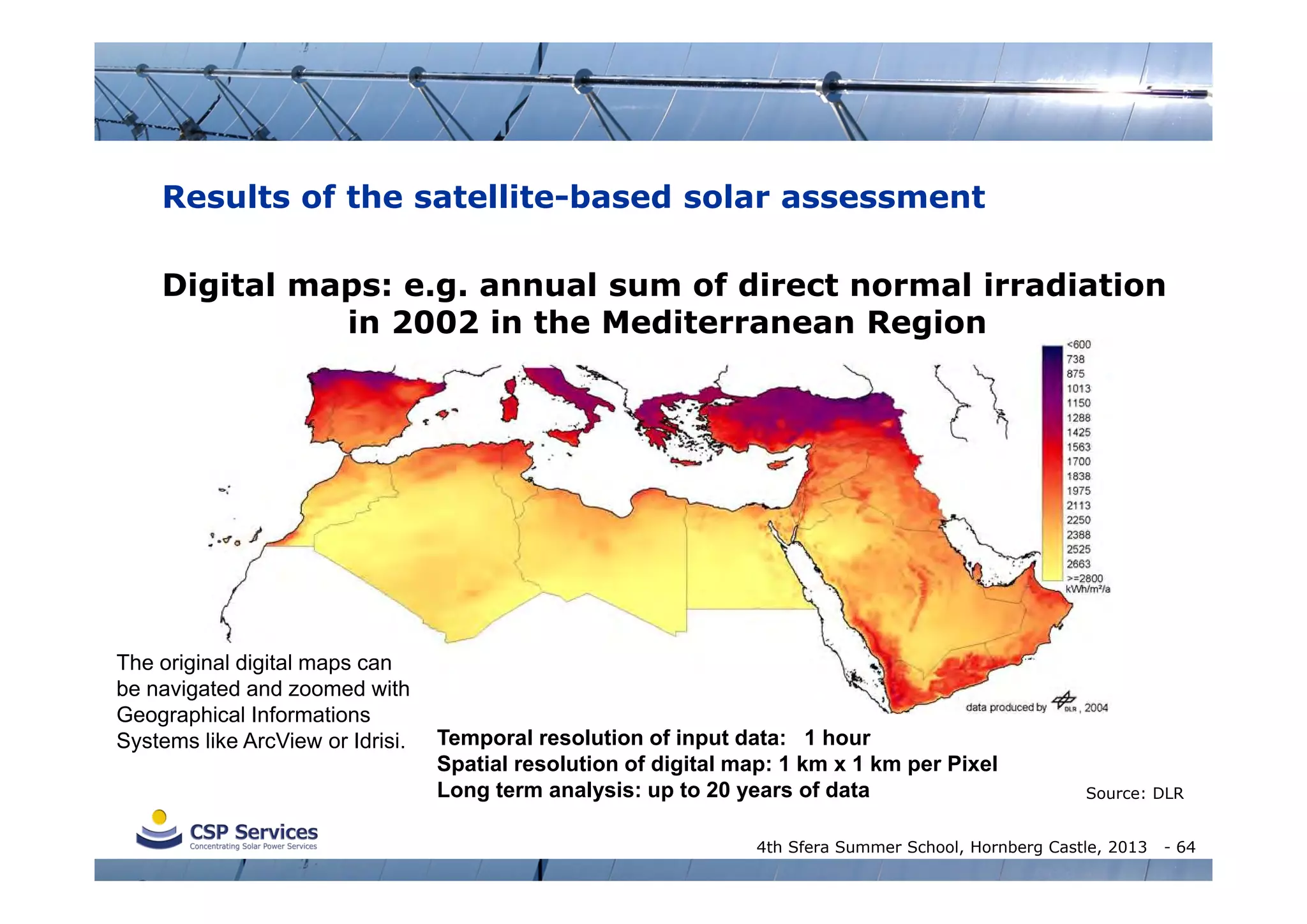
Results of the satellite-based solar assessment
Digital maps: e.g. annual sum of direct normal irradiation
in 2002 in the Mediterranean Region

The original digital maps can
be navigated and zoomed with
Geographical Informations
Systems like ArcView or Idrisi.

data produced by

(DLR, 2004) for MED-CSP

Temporal resolution of input data: 1 hour
Spatial resolution of digital map: 1 km x 1 km per Pixel
Long term analysis: up to 20 years of data

Source: DLR

4th Sfera Summer School, Hornberg Castle, 2013

- 64
Results of the satellite-based solar assessment
Time series: for single sites, e.g. hourly, monthly or annual
Hourly DNI [Wh/m²] for one site in Spain

Annual sums of DNI [kWh/m²] for one site in Spain

Monthly sums of DNI [kWh/m²] for one site in Spain

Hourly monthly mean of DNI in Wh/m², Solar Village 2000

hour

Source: DLR

4th Sfera Summer School, Hornberg Castle, 2013

- 65
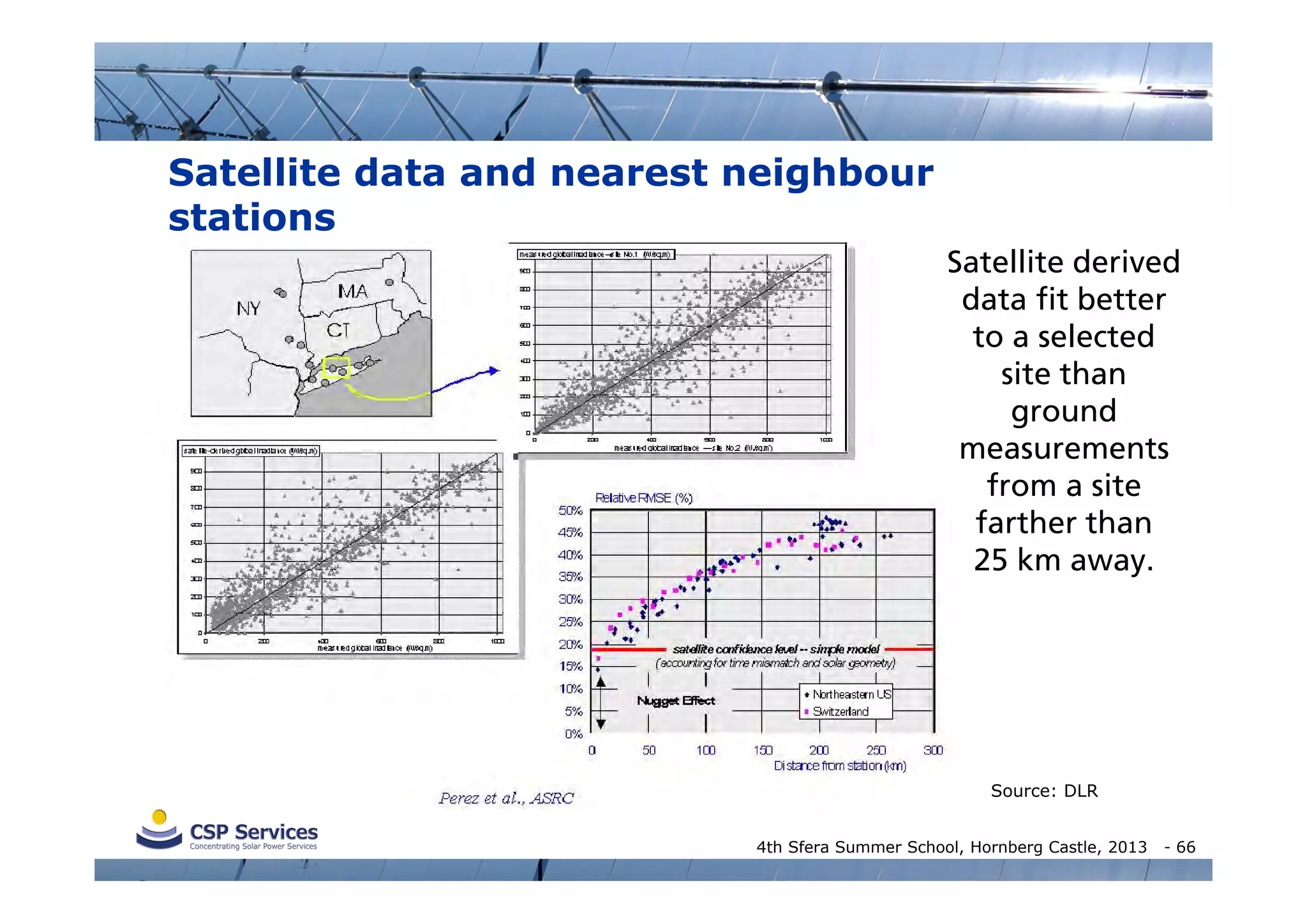
Satellite data and nearest neighbour
stations
Satellite derived
data fit better
to a selected
site than
ground
measurements
from a site
farther than
25 km away.

Source: DLR
4th Sfera Summer School, Hornberg Castle, 2013

- 66
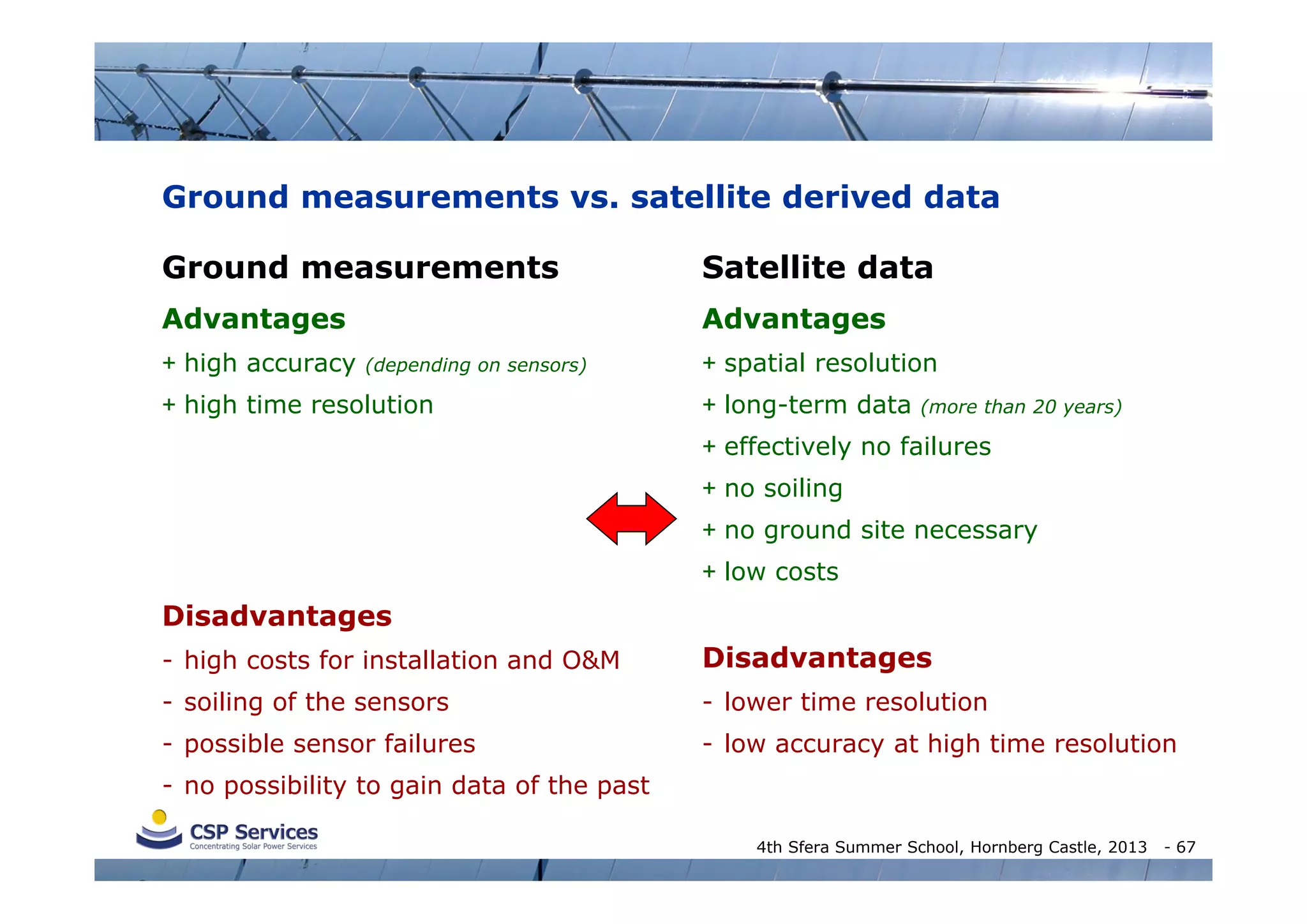
Ground measurements vs. satellite derived data
Ground measurements

Satellite data

Advantages

Advantages

+ high accuracy

(depending on sensors)

+ high time resolution

+ spatial resolution
+ long-term data

(more than 20 years)

+ effectively no failures
+ no soiling
+ no ground site necessary
+ low costs

Disadvantages
- high costs for installation and O&M

Disadvantages

- soiling of the sensors

- lower time resolution

- possible sensor failures

- low accuracy at high time resolution

- no possibility to gain data of the past
4th Sfera Summer School, Hornberg Castle, 2013

- 67
Combining Ground and Satellite Assessments
• Satellite data
– Long-term average
– Year to year variability
– Regional assessment
• Ground data
– High Precision (if measurements taken thoroughly)
– High temporal resolution possible
(up to 1 min to model transient effects)
– Good distribution function
– Site specific

4th Sfera Summer School, Hornberg Castle, 2013

- 68
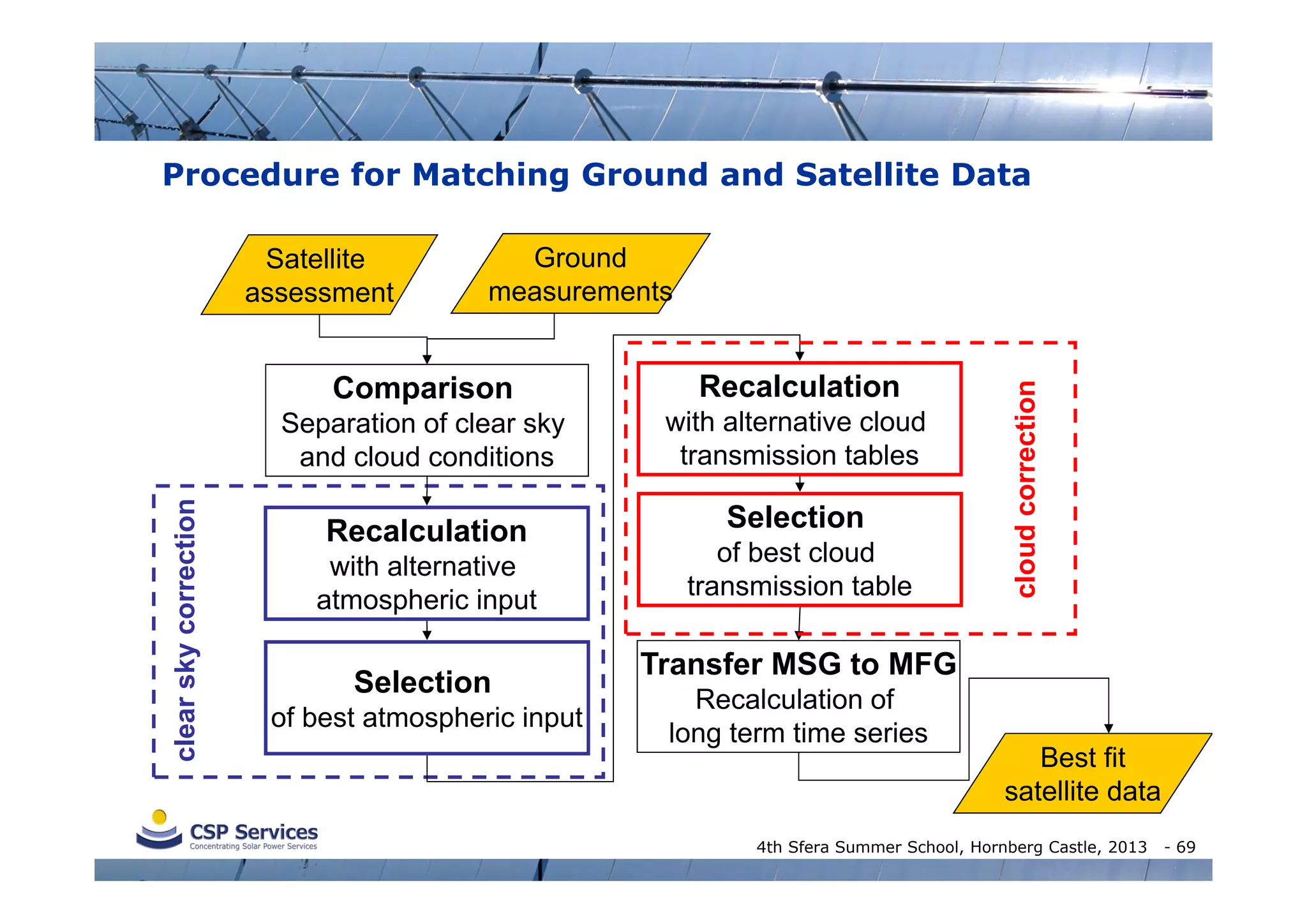
Procedure for Matching Ground and Satellite Data
Ground
measurements

Recalculation

Separation of clear sky
and cloud conditions
clear sky correction

Comparison

with alternative cloud
transmission tables

Recalculation

Selection

with alternative
atmospheric input

Selection
of best atmospheric input

of best cloud
transmission table

cloud correction

Satellite
assessment

Transfer MSG to MFG
Recalculation of
long term time series

Best fit
satellite data

4th Sfera Summer School, Hornberg Castle, 2013

- 69
What you should care for in good
Solar Resource Assessment

4th Sfera Summer School, Hornberg Castle, 2013

- 70
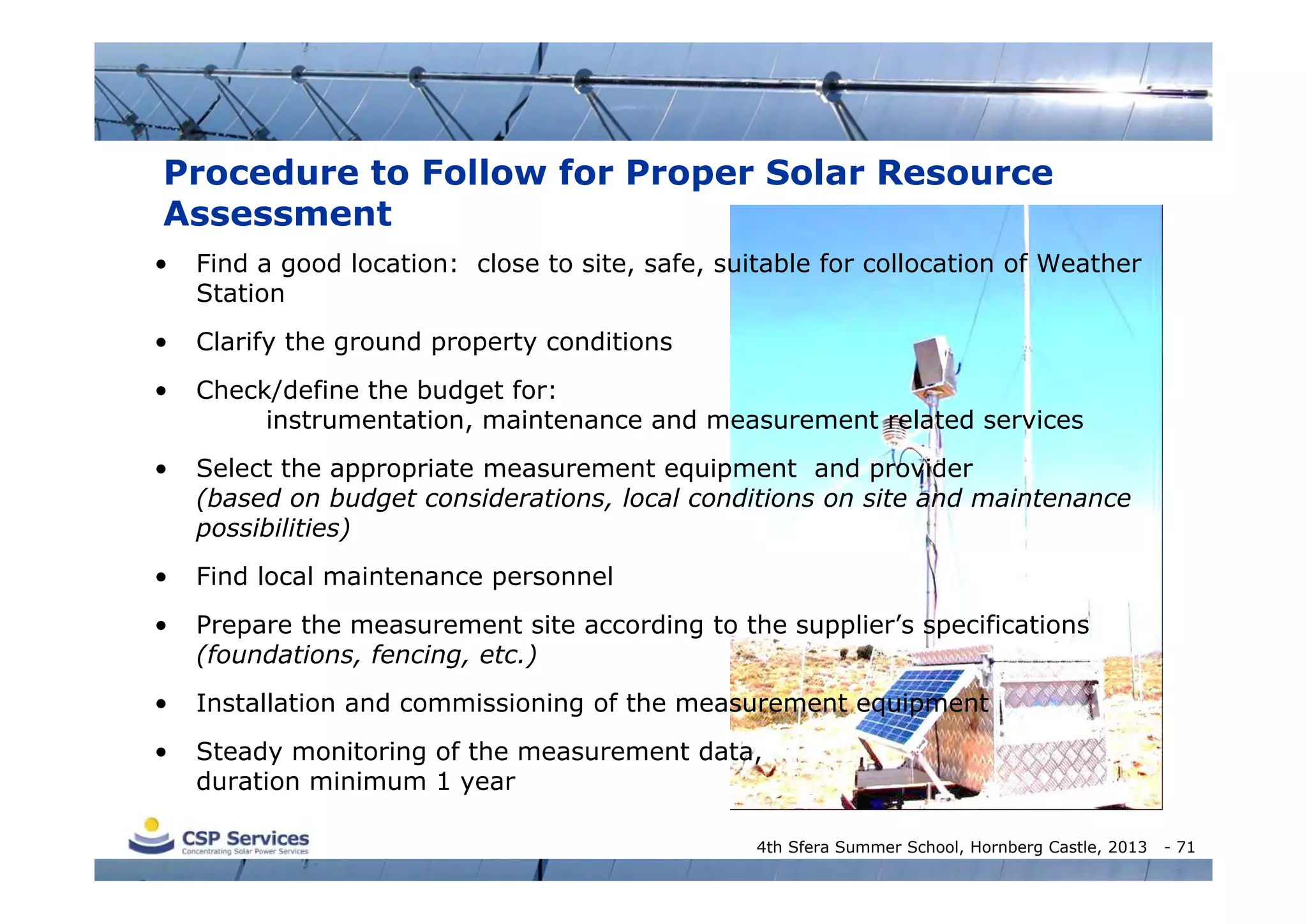
Procedure to Follow for Proper Solar Resource
Assessment
•

Find a good location: close to site, safe, suitable for collocation of Weather
Station

•

Clarify the ground property conditions

•

Check/define the budget for:
instrumentation, maintenance and measurement related services

•

Select the appropriate measurement equipment and provider
(based on budget considerations, local conditions on site and maintenance
possibilities)

•

Find local maintenance personnel

•

Prepare the measurement site according to the supplier’s specifications
(foundations, fencing, etc.)

•

Installation and commissioning of the measurement equipment

•

Steady monitoring of the measurement data,
duration minimum 1 year
4th Sfera Summer School, Hornberg Castle, 2013

- 71
Procedure to Follow for Proper Solar Resource
Assessment
•

Documenting the selection of instruments

•

Choosing a renowned company or institution to conduct or assist the
measurement campaign

•

Documenting sensor calibration with proper calibration certificates

•

Meticolously documenting the instrument installation and alignment

•

Performing and documenting regular sensor cleaning, maintenance and
verification of alignment

•

Cautiously and continuously checking data for errors and outliers

•

Flagging suspect data, and applying corrections if possible, during and after
the measurement campaign

•

Stating and justifying the uncertainty estimate in a detailed report after the
measurement campaign.
4th Sfera Summer School, Hornberg Castle, 2013

- 72
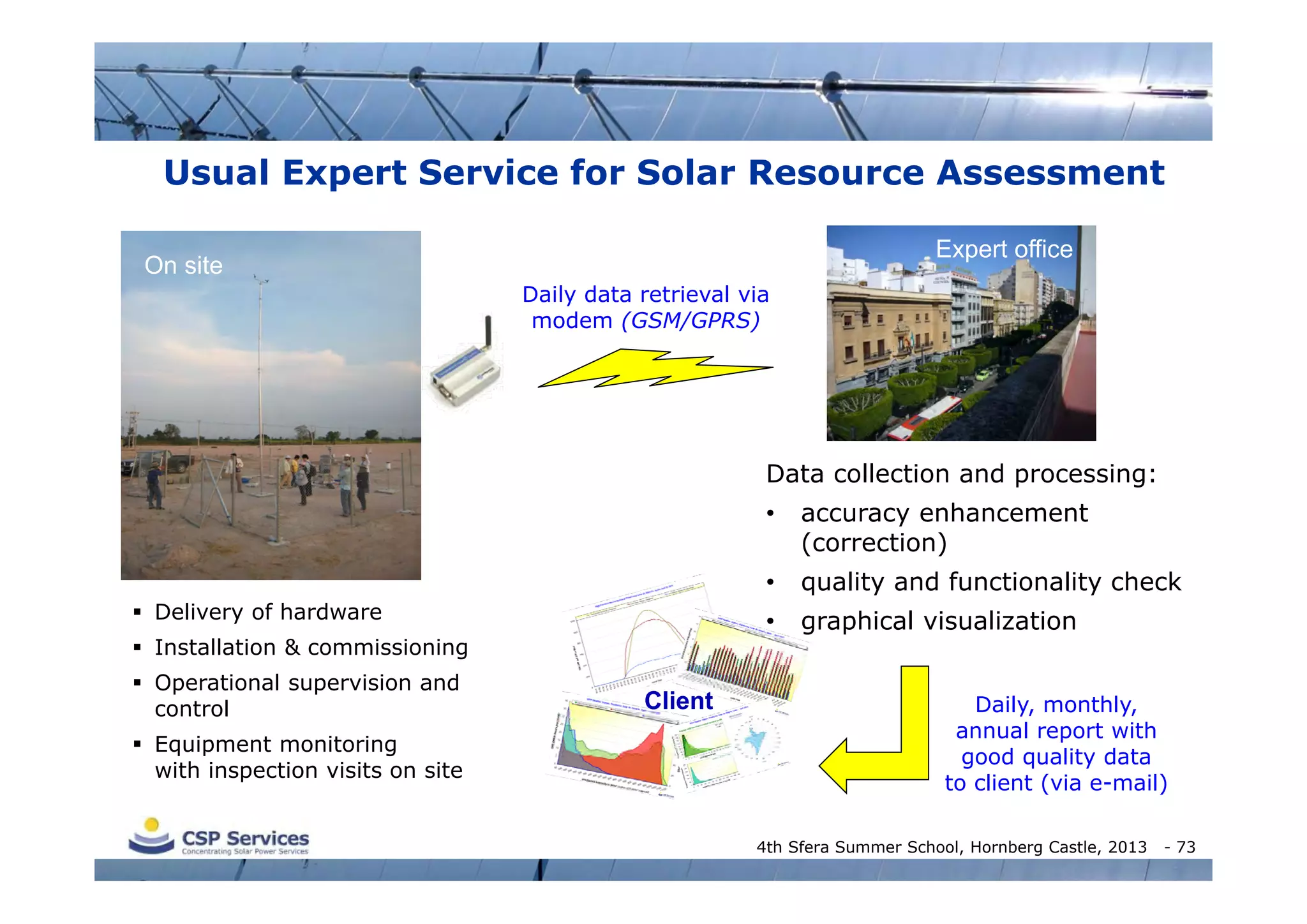
Usual Expert Service for Solar Resource Assessment
Expert office

On site
Daily data retrieval via
modem (GSM/GPRS)

Data collection and processing:
•
•
 Installation & commissioning
 Operational supervision and
control
 Equipment monitoring
with inspection visits on site

Client

quality and functionality check

•

 Delivery of hardware

accuracy enhancement
(correction)
graphical visualization
Daily, monthly,
annual report with
good quality data
to client (via e-mail)

4th Sfera Summer School, Hornberg Castle, 2013

- 73
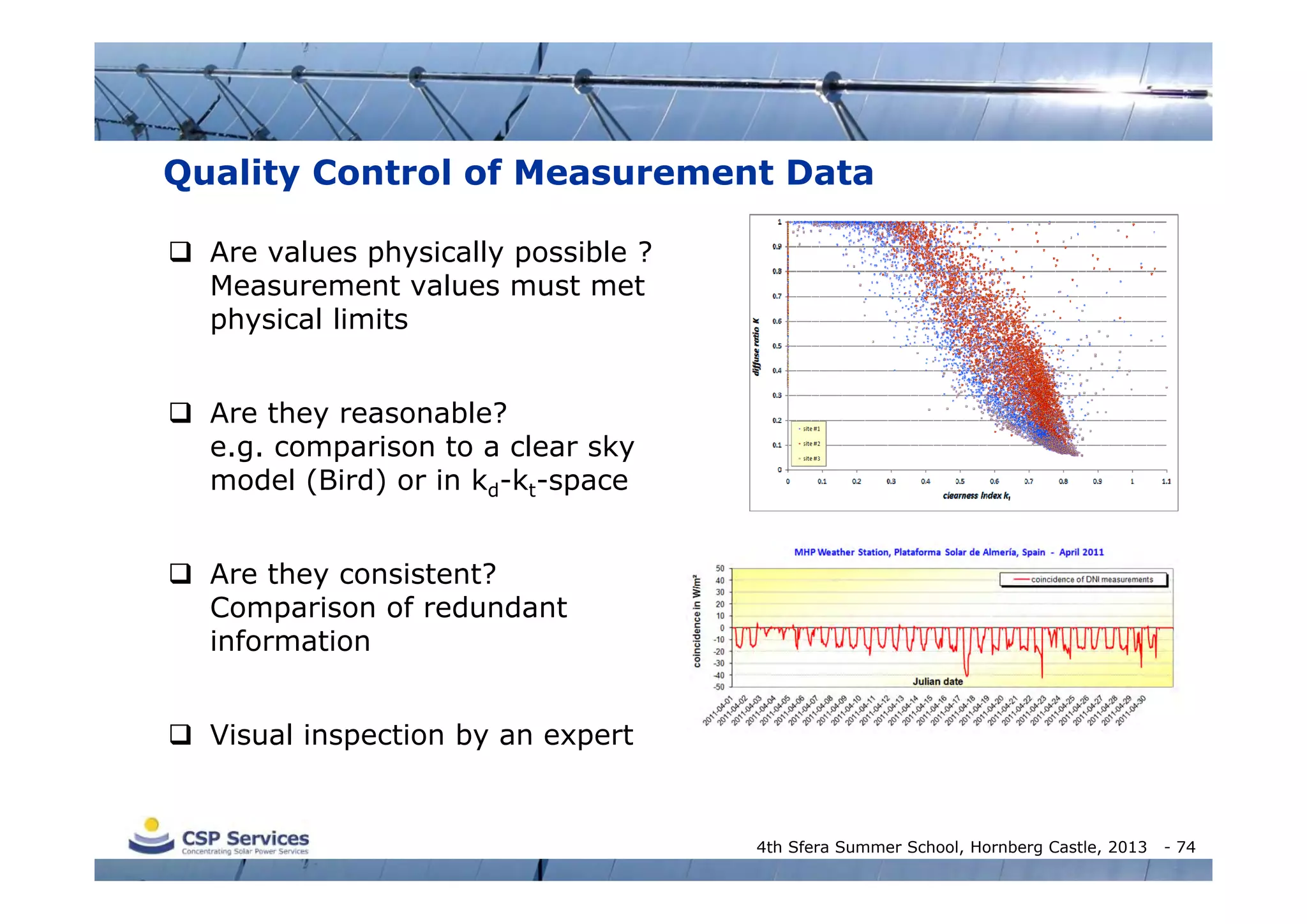
Quality Control of Measurement Data
 Are values physically possible ?
Measurement values must met
physical limits
 Are they reasonable?
e.g. comparison to a clear sky
model (Bird) or in kd-kt-space
 Are they consistent?
Comparison of redundant
information
 Visual inspection by an expert

4th Sfera Summer School, Hornberg Castle, 2013

- 74
Summary
• Knowledge of accurate irradiation data is indispensable for CSP
projects
(→ proper plant design, financial calculation, efficient plant operation)
•

site selection, pre‐feasibility with satellite data

•

colocation of a measurement station, taking care on thorough operation

•

match long‐term satellite data with good quality measurement data from ground

•

monitor the operating plant efficiency thoroughly with high‐precision data

4th Sfera Summer School, Hornberg Castle, 2013

- 75
Thank you
very much
for your
attention!

4th Sfera Summer School, Hornberg Castle, 2013

- 76

Solar resource measurements and sattelite data

  • 1.
    Solar Resource Measurements andSatellite Data 4th Sfera Summer School 2013 Hornberg Castle, Germany Dr. Norbert Geuder CSP Services – Almería – Cologne
  • 2.
    Outline 1) Introduction 2) Fundamentalson Solar Irradiation 3) Variability of Irradiation 4) Irradiation Sensors 5) Sensor calibration and measurement accuracy enhancement 6) Satellite Based Assessment 7) Outlook / Summary 4th Sfera Summer School, Hornberg Castle, 2013 -2
  • 3.
    General Procedure atSolar Resource Assessment Irradiation map: spatial distribution Geographical data: land use, etc. + GIS analysis Selection of promising sites Meteorological Station: Accurate irradiation data Long-term time series (>10 years) Plant design, inter-annual variability, uncertainty analysis, financing, … 4th Sfera Summer School, Hornberg Castle, 2013 -3
  • 4.
    Solar Resource Assessmentfor CSP Plants • Direct Beam Irradiation data required for CSP Applications not global irradiation – this is quite a difference! • Usually not available in suitable sunny regions in the world • Accessible via measurements or derived from satellite data Restrictions: – Measurements: expensive, long duration, not for the past – Satellite data: high uncertainty (≈ 10 % or more) • High accuracy required for DNI with long-term performance 4th Sfera Summer School, Hornberg Castle, 2013 -4
  • 5.
    Impact of SolarResource Uncertainty on CSP Plant rentability DNI uncertainty expected long-term value (100%) (e.g. ±10 %) Annual DNI Electricity production Earnings Losses Annual expenses (redemption, O&M, …) Irradiation uncertainty decides over project realization ! With thoroughly performed measurements an accuracy of approximately 2 % is achievable. 4th Sfera Summer School, Hornberg Castle, 2013 -5
  • 6.
    Fundamentals on SolarIrradiation 4th Sfera Summer School, Hornberg Castle, 2013 -6
  • 7.
    Solar Constant 1367 W/m² Calculation: L W 1367 2 4r 2 m Luminosity of the sun: L = 3.86 x 1026 W Astronomical unit: r = 149.60×10⁹ m Annual Variation of Solar Constant 1420 Irradiance Outside Atmosphere (W/m²) Mean solar irradiance (flux density in W/m²) at normal incidence outside the atmosphere at the mean sun-earth distance r. 1410 1400 1390 1380 1370 1360 1350 1340 1330 1320 0 90 180 270 360 Day of Year 4th Sfera Summer School, Hornberg Castle, 2013 -7
  • 8.
    Path of SolarRadiation through the atmosphere Radiation at the top of atmosphere Ozone.……….….... Absorption (ca. 1%) Air molecules..…… Rayleigh scattering and absorption (ca. 15%) Aerosol…….………..…...…… Scatter and Absorption ( ca. 15%, max. 100%) Clouds………….……….. Reflection, Scatter, Absorption (max. 100%) Water Vapor…….……...……… Direct normal irradiance at ground Absorption (ca. 15%) Source: DLR 4th Sfera Summer School, Hornberg Castle, 2013 -8
  • 9.
    Radiative Transfer inthe Atmosphere 1400 Extraterrestrial O2 and CO2 1000 Ozone 800 Rayleigh 600 Water Vapor 400 Aerosol 200 Clouds Hour of Day 00:00 22:00 20:00 18:00 16:00 14:00 12:00 10:00 08:00 06:00 04:00 02:00 0 00:00 Direct Normal Irradiation (W/m²) 1200 Source: DLR 4th Sfera Summer School, Hornberg Castle, 2013 -9
  • 10.
    Air Mass AM =0 (outside of atmosphere) Source: DLR 4th Sfera Summer School, Hornberg Castle, 2013 - 10
  • 11.
    Solar Spectrum andAtmospheric Influence 1 Planck curve T=5780 K at mean sunearth distance 2 extraterrestrial solar spectrum 3 absorption by 03 4 scattering by 02 und N2 5 scattering by aerosols 6 absorption by H2O vapor 7 absorption by aerosols UV radiation: 0.01 - 0.39 µm, ~ 7 % Visible Spectrum: 0.39 – 0.75 µm, ~ 46 % Near infrared: 0.75 – 2.5 µm, ~ 47 % www.volker-quaschning.de/articles/fundamentals1/index.php 4th Sfera Summer School, Hornberg Castle, 2013 - 11
  • 12.
    Characteristics of solarirradiation data • Component: – DNI (Direct-Normal Irradiation) – DHI (Diffus-Horizontal Irradiation) – GHI (Global-Horizontal Irradiation) • Source: – ground measurements: • precise thermal sensors (thermopiles) • Rotating Shadowband Irradiometers (RSI) – satellite data • Properties of irradiation: – spatial variability – inter-annual variability – long-term drifts 4th Sfera Summer School, Hornberg Castle, 2013 - 12
  • 13.
    Direct, Diffuse andGlobal Irradiance When measuring solar irradiance, the following components are of particular interest: Zenith angle θ, solar elevation   Direct normal irradiance (DNI) (also: beam irradiance)  Diffuse horizontal irradiance (DHI) (also: diffuse sky radiation)  Global horizontal irradiance (GHI) (also: total solar irradiance)  GHI = DHI + DNI * sin () 4th Sfera Summer School, Hornberg Castle, 2013 - 13
  • 14.
    Direct Normal Irradiation(DNI) DNI = BHI / sin  with: BHI = Beam Horizontal Irradiation direct Example: BHI = 600W/m²  = 50°  DNI = 848W/m² DNI > BHI  Direct-Normal- Irradiation (DNI) 4th Sfera Summer School, Hornberg Castle, 2013 - 14
  • 15.
    Global Horizontal Irradiation(GHI) GHI = BHI + DIF Example: direct diffuse BHI = 600W/m² DIF = 150W/m²  GHI = 750W/m² diffuse Global-Horizontal-Irradiation (GHI) 4th Sfera Summer School, Hornberg Castle, 2013 - 15
  • 16.
  • 17.
    Long-term variability ofsolar irradiance GHI from Potsdam, Germany 4th Sfera Summer School, Hornberg Castle, 2013 - 17
  • 18.
    Long-term variability ofsolar irradiance Source: DLR 7 to 10 years of measurement to get long-term mean within 5% 4th Sfera Summer School, Hornberg Castle, 2013 - 18
  • 19.
    Inter-annual variability 1999 deviation to mean 2000 kWh/m²a Averageof the direct normal irradiance from 1999 to 2003 Strong inter-annual and regional variations 2001 2002 Source: DLR 2003 4th Sfera Summer School, Hornberg Castle, 2013 - 19
  • 20.
    Irradiation sensors 4th SferaSummer School, Hornberg Castle, 2013 - 20
  • 21.
    Absolute Cavity Radiometer Principleof Measurements: - - Possibility to measure absolute irradiance values. All other irradiance measurement devices need to be calibrated using an absolute cavity radiometer Its principle of operation is based on the substitution of radiative power by electrical (heating) power - Measurement in intervals with minimal length of 45 s. Constant irradiation required for measurement campain - Tracking device required - No continuous measurement (!) ftp.pmodwrc.ch/pub/pmo6-cc/user_guide_11.pdf Valid for calibration purposes 4th Sfera Summer School, Hornberg Castle, 2013 - 21
  • 22.
    Suitable equipment forirradiance measurements for Concentrating Solar Power (CSP) Thermal sensors Semiconductor sensor Rotating Shadowband Irradiometer, RSI (photodiode) Pyranometer, pyrheliometer (thermopiles) 4th Sfera Summer School, Hornberg Castle, 2013 - 22
  • 23.
    Thermopile Sensors Shading assemblywith shading ball CMP21 Pyranometer (GHI, DHI shaded) with ventilation unit CVF3 CHP1 Pyrheliometer (DNI) Sun sensor Solys 2 sun tracker 4th Sfera Summer School, Hornberg Castle, 2013 - 23
  • 24.
    Thermopile Sensors –Pyrheliometer Principle of Measurement: - Pyrheliometer = radiometer suitable to measure direct normal irradiance - Highly transparent window 97 – 98 % transmission of solar radiation - Housing geomerty with 200 mm absorber tube restricting acceptance angle to 5° - Sensing element with black coating and built-in termopile device - www.kippzonen.com/?product/18172/CHP+1.aspx Pt-100 temperature sensor for temperature corrections 4th Sfera Summer School, Hornberg Castle, 2013 - 24
  • 25.
    Pyrheliometer Specifications Kipp&Zonen CHP1 Specifications: Spectral range: 200 to 4000 nm Sensitivity: 7 to 14 µV/W/m² (mV/kW/m²) Response time: < 5 s Expected daily uncertainty: ± 1 % Full opening view angle: 5° ± 0.2° Required tracking accuracy: ± 0.5° from ideal www.kippzonen.com/?product/18172/CHP+1.aspx 4th Sfera Summer School, Hornberg Castle, 2013 - 25
  • 26.
    Thermopile Sensors –Pyranometer Principle of Measurements: - Pyrheliometer = radiometer suitable to measure short-wave (0.2 - 4 µm) global or diffuse radiation - Highly transparent glass dome 97 – 98 % transmission of solar radiation - Full view on 2π hemisphere (horizontal levelling required) - Sensing element with black coating and built-in termopile - www.kippzonen.com/?product/18172/CHP+1.aspx Pt-100 temperature sensor for temperature corrections 4th Sfera Summer School, Hornberg Castle, 2013 - 26
  • 27.
    Thermopile Sensors –Pyranometer Kipp&Zonen CMP21 Specifications: Spectral range: 285 to 2800 nm Sensitivity: 7 to 14 µV/W/m² (mV/kW/m²) Response time: 5 s www.kippzonen.com/?product/1491/CMP+21.aspx 4th Sfera Summer School, Hornberg Castle, 2013 - 27
  • 28.
    Rotating Shadowband Pyranometer(RSP) Licor silicon photodiode Rotating shadowband Housing of mechanics 4th Sfera Summer School, Hornberg Castle, 2013 - 28
  • 29.
    RSI – Principleof Measurement Simplified sensor signal during shadow band rotation: once per minute, rotation lasts about 1.5 seconds Source: Solar Millennium AG 4th Sfera Summer School, Hornberg Castle, 2013 - 29
  • 30.
    Licor Li-200 PyranometerSensor Specifications: Sensitivity: Typically 90 µA per 1000 W/m² Response time: 10 µs. Spectral range: 0.4 – 1.1 µm Calibration: Calibrated against an Eppley Precision Spectral Pyranometer under natural daylight conditions. Typical error under these conditions is ±3% up to ±5%. www.licor.com/env/Products/Sensors/200/li200_description.jsp 4th Sfera Summer School, Hornberg Castle, 2013 - 30
  • 31.
    Precise thermal sensors: Pyrheliometerand Pyranometer on sun tracker Advantages: + high accuracy (1 to 2%) -GHI -DNI -DHI + separate sensors for GHI, DNI and DHI (cross-check through redundancy) Disadvantages: - high acquisition costs - high maintenance costs - high susceptibility for soiling - high power demand (grid connection required) 4th Sfera Summer School, Hornberg Castle, 2013 - 31
  • 32.
    Sensor with photodiode: Rotating Shadowband Irradiometer, RSI Advantages: + fair acquisition costs + low maintenance + low susceptibility for soiling + low power demand (PV-Panel) Disadvantage: - reduced accuracy due to systematic deviations of the photodiode sensor response: primordial DNI: ≈ 6 to 10 % (or even higher) 4th Sfera Summer School, Hornberg Castle, 2013 - 32
  • 33.
    Measurement uncertainty Precise instruments(HP) versus RSI Error source: Pyrheliometer: RSI:  Calibration < ±1.1% ±3% (... ±5%)  Temperature < ±0.5% 0% ... ±5%  Linearity < ±0.2% ±1%  Stability < ±0.5%/a < ±2%/a  Spectral dependence <±0.1%  Sensor soiling -0.7% per day 0% ... ±8% -0.07% per day systematic errors can be corrected!! 4th Sfera Summer School, Hornberg Castle, 2013 - 33
  • 34.
    Choice of MeasurementEquipment Which equipment is suitable for measurements in Solar Resource Assessment? ? High Precision sensors (thermopiles) Rotating Shadowband Irradiometer: RSI 4th Sfera Summer School, Hornberg Castle, 2013 - 34
  • 35.
    Objectives for IrradianceMeasurements Solar Resource Assessment Power Plant Monitoring • at remote site • no qualified staff • always qualified staff on site • no electric grid • electric power available • often dusty and arid areas 4th Sfera Summer School, Hornberg Castle, 2013 - 35
  • 36.
    Pyrheliometer soiling insouthern Spain Plataforma Solar de Almería 4th Sfera Summer School, Hornberg Castle, 2013 - 36
  • 37.
    Comparison of sensorsoiling University of Almería 4th Sfera Summer School, Hornberg Castle, 2013 - 37
  • 38.
    Soiling characteristics ofpyrheliometers and RSI‘s Solar Irradiation direct  sunlight glass plate tube with  200 mm  length diffusor disk  over  photodiode absorber Pyrheliometer RSI  sensor head 4th Sfera Summer School, Hornberg Castle, 2013 - 38
  • 39.
    Choice of theadequate equipment For Solar Resource Assessment • at remote sites and • daily maintenance not feasible an RSI is the premium choice for DNI measurements. However: • Proper calibration • Corrections of systematic signal response • regular maintenance inspections (2 to 4 weeks) are indispensable for reliable measurements. 4th Sfera Summer School, Hornberg Castle, 2013 - 39
  • 40.
    Sensor calibration and measurementaccuracy enhancement 4th Sfera Summer School, Hornberg Castle, 2013 - 40
  • 41.
    Sensor Calibration –Fundamentals I - The World Standard Group (WSG) is an assembly of highly precise absolute cavity radiometers. www.pmodwrc.ch/pmod.php?topic=wrc - The measured mean value (World Radiometric Reference) is the measurement standard representing the SI unit of irradiance with an estimated accuracy of 0.3 %. - All other short wave irradiation measurement systems are calibrated against this single value. Precision measurement at the WorldRadiation Center (WRC) 4th Sfera Summer School, Hornberg Castle, 2013 - 41
  • 42.
    RSI sensor calibrationby DLR on PSA 2-monthly calibration of each RSI against high-precision instruments at Plataforma Solar de Almería (PSA) (recommended every 2 years) 4th Sfera Summer School, Hornberg Castle, 2013 - 42
  • 43.
    RSI sensor calibrationduration Variations of the Calibration Constant with calibration duration DNI 4th Sfera Summer School, Hornberg Castle, 2013 - 43
  • 44.
    Variability of theCorrection Factors (CF) Variability of correction factors (CF): radiation components need to be corrected with separate CFs. 4th Sfera Summer School, Hornberg Castle, 2013 - 44
  • 45.
    Recalibration of RSIs Driftof Calibration Factor within 2 to 4 years 4th Sfera Summer School, Hornberg Castle, 2013 - 45
  • 46.
    Correction of rawRSI measurement values Origin of systematic errors of RSI response • Temperature dependence of semiconductor sensor • Spectrally varying irradiation – different for irradiation components (direct beam / diffuse) – depending on Air Mass • Angle of incidence • Pre-calibration of the sensor head (from the manufacturer) 4th Sfera Summer School, Hornberg Castle, 2013 - 46
  • 47.
    Spectral correction ofdiffuse irradiation raw values variation with air mass + altitude corrected Π spec  DNI  GHI DHI 2 4th Sfera Summer School, Hornberg Castle, 2013 - 47
  • 48.
    Dependence of responseon solar elevation BHIref / BHIRSI so called „cat-ear effect“ solar elevation angle in degree Correction applied only on direct beam portion of the global response 4th Sfera Summer School, Hornberg Castle, 2013 - 48
  • 49.
    BHIref / BHIRSI Dependence ofresponse on solar elevation corrected solar elevation angle in degree 4th Sfera Summer School, Hornberg Castle, 2013 - 49
  • 50.
    Reachable accuracy forDNI with RSIs Accuracy of RSI measurements as derived from a comparison of the data from 23 RSIs RMSD = 13 W/m² with precise thermopile measurements within the course of a whole year GHI DHI DNI raw cor raw cor raw cor reference (CHP 1) average MB -10.3 ± 4.0 0.3 ± 1.3 -17.3 ± 1.6 -0.4 ± 0.7 24.6 ± 10.5 1.0 ± 0.5 1.0 ± 3.9 W/m² RMSD 14.2 7.6 18.9 4.5 33.3 13.0 5.3 W/m² Annual sum up to -2.5 < ±1 up to -15 < ±3.5 up to +7 < ±1 up to 1.3 % RSP unit 10 min time resolution 4th Sfera Summer School, Hornberg Castle, 2013 - 50
  • 51.
    Transferability of theresults? The reachable accuracy of the measured beam irradiance data for the client at his prospected sites depends on 2 crucial points: • Stability of the sensor sensitivity • Transferability of the results to other sites • Regular inspections and data controlling 4th Sfera Summer School, Hornberg Castle, 2013 - 51
  • 52.
    Transferability to othersites and climates Parallel measurement campaigns in UAE: • Comparision of 6 RSIs to high-precision thermal sensors • Measurement periods >3 weeks • in summer and winter 4th Sfera Summer School, Hornberg Castle, 2013 - 52
  • 53.
    Relative deviation ofDNI sum within measurement campaign only summer: DNI < 730 W/m² summer + winter: DNI until 1000 W/m² 4th Sfera Summer School, Hornberg Castle, 2013 - 53
  • 54.
    Satellite Based Assessment 4thSfera Summer School, Hornberg Castle, 2013 - 54
  • 55.
    Satellite Derived Data www.solemi.de/method.html Principleof Measurements: Analyze satellite data in two steps: 1. Atmosphere: Gather satellite information of atmospheric composition (ozone, water vapor and aerosols) and apply the ‘clear sky model’ to calculate the fractions of direct and diffuse irradiance 1400 O2 and CO2 1000 Ozone 800 Rayleigh 600 Water Vapor 400 Aerosol 200 Clouds 00:00 22:00 20:00 18:00 16:00 14:00 12:00 10:00 08:00 06:00 04:00 02:00 0 00:00 Direct Normal Irradiation (W/m²) 2. Clouds: Calculate the cloud index as the difference between actual reflectivity of the earth as it is seen by the satellite and a reference image which only includes reflectance of the ground Extraterrestrial 1200 Hour of Day 4th Sfera Summer School, Hornberg Castle, 2013 - 55
  • 56.
    How to deriveirradiance data from satellites  The Meteosat satellite is located in a geostationary orbit  The satellite scans the earth line by line every half hour Scan Source: DLR 4th Sfera Summer School, Hornberg Castle, 2013 - 56
  • 57.
    How to deriveirradiance data from satellites Scan in visible spectrum Derivation of a cloud index from the two channels Scan in infra-red spectrum Source: DLR 4th Sfera Summer School, Hornberg Castle, 2013 - 57
  • 58.
    Different Cloud Transmissionfor GHI and DNI  Global Irradiation  Direct Irradiation Sun-satellite angle 60-80 1.2 1.2 -26 °C -16 °C -6 °C 4 °C 14 °C -30°C - -20°C -20°C - -10°C -10 °C - 0°C 0°C - 10 °C >10°C 1 cloud transmission 1 0.8 0.8 0.6 0.6 0.4 0.4 0.2 0.2 0 Different exponential functions for varying viewing angles and brightness temperatures 0 -0.2 -0.2 0 0.2 0.4 0.6 cloud index 0.8 1 1.2 -0.2 -0.2 0 0.2 0.4 0.6 0.8 1 1.2 Source: DLR 4th Sfera Summer School, Hornberg Castle, 2013 - 58
  • 59.
    Clear sky Modelinput data  Aerosol optical thickness  GACP Resolution 4°x5°, monthly data  MATCH Resolution 1.9°x1.9°, daily data  Water Vapor: NCAR/NCEP Reanalysis Resolution 1.125°x1.125°, daily values  Ozone: TOMS sensor Resolution 1.25°x1.25°, monthly values Source: DLR 4th Sfera Summer School, Hornberg Castle, 2013 - 59
  • 60.
    Uncertainty in Aerosols GADS Toms GOCART NASAGISS v1 / GACP All graphs are for July Scales are the same! (0 – 1.5) Large differences in Aerosol values and distribution NASA GISS v2 1990 AeroCom Linke Turbidity Source: DLR 4th Sfera Summer School, Hornberg Castle, 2013 - 60
  • 61.
    Comparing ground andsatellite data: “sensor size” solar thermal power plant (200MW  2x2 km² satellite pixel ( 3x4 km²) ground measurement instrument (2x2 cm²) Source: DLR 4th Sfera Summer School, Hornberg Castle, 2013 - 61
  • 62.
    Comparing ground andsatellite data: accuracy general difficulties: • point versus area • time integrated versus area integrated 1200 ground 1000 satellite W/m² 800 600 400 200 0 0 6 12 hour of day 18 24 Source: DLR 4th Sfera Summer School, Hornberg Castle, 2013 - 62
  • 63.
    Comparing ground andsatellite data: time scales 12:45 13:00 13:15 Hourly average 13:30 13:45 Meteosat image 14:00 14:15 Measurement  Ground measurements are typically pin point measurements which are temporally integrated Hi-res satellite pixel in Europe  Satellite measurements are instantaneous spatial averages  Hourly values are calculated from temporal and spatial averaging (cloud movement) Source: DLR 4th Sfera Summer School, Hornberg Castle, 2013 - 63
  • 64.
    Results of thesatellite-based solar assessment Digital maps: e.g. annual sum of direct normal irradiation in 2002 in the Mediterranean Region The original digital maps can be navigated and zoomed with Geographical Informations Systems like ArcView or Idrisi. data produced by (DLR, 2004) for MED-CSP Temporal resolution of input data: 1 hour Spatial resolution of digital map: 1 km x 1 km per Pixel Long term analysis: up to 20 years of data Source: DLR 4th Sfera Summer School, Hornberg Castle, 2013 - 64
  • 65.
    Results of thesatellite-based solar assessment Time series: for single sites, e.g. hourly, monthly or annual Hourly DNI [Wh/m²] for one site in Spain Annual sums of DNI [kWh/m²] for one site in Spain Monthly sums of DNI [kWh/m²] for one site in Spain Hourly monthly mean of DNI in Wh/m², Solar Village 2000 hour Source: DLR 4th Sfera Summer School, Hornberg Castle, 2013 - 65
  • 66.
    Satellite data andnearest neighbour stations Satellite derived data fit better to a selected site than ground measurements from a site farther than 25 km away. Source: DLR 4th Sfera Summer School, Hornberg Castle, 2013 - 66
  • 67.
    Ground measurements vs.satellite derived data Ground measurements Satellite data Advantages Advantages + high accuracy (depending on sensors) + high time resolution + spatial resolution + long-term data (more than 20 years) + effectively no failures + no soiling + no ground site necessary + low costs Disadvantages - high costs for installation and O&M Disadvantages - soiling of the sensors - lower time resolution - possible sensor failures - low accuracy at high time resolution - no possibility to gain data of the past 4th Sfera Summer School, Hornberg Castle, 2013 - 67
  • 68.
    Combining Ground andSatellite Assessments • Satellite data – Long-term average – Year to year variability – Regional assessment • Ground data – High Precision (if measurements taken thoroughly) – High temporal resolution possible (up to 1 min to model transient effects) – Good distribution function – Site specific 4th Sfera Summer School, Hornberg Castle, 2013 - 68
  • 69.
    Procedure for MatchingGround and Satellite Data Ground measurements Recalculation Separation of clear sky and cloud conditions clear sky correction Comparison with alternative cloud transmission tables Recalculation Selection with alternative atmospheric input Selection of best atmospheric input of best cloud transmission table cloud correction Satellite assessment Transfer MSG to MFG Recalculation of long term time series Best fit satellite data 4th Sfera Summer School, Hornberg Castle, 2013 - 69
  • 70.
    What you shouldcare for in good Solar Resource Assessment 4th Sfera Summer School, Hornberg Castle, 2013 - 70
  • 71.
    Procedure to Followfor Proper Solar Resource Assessment • Find a good location: close to site, safe, suitable for collocation of Weather Station • Clarify the ground property conditions • Check/define the budget for: instrumentation, maintenance and measurement related services • Select the appropriate measurement equipment and provider (based on budget considerations, local conditions on site and maintenance possibilities) • Find local maintenance personnel • Prepare the measurement site according to the supplier’s specifications (foundations, fencing, etc.) • Installation and commissioning of the measurement equipment • Steady monitoring of the measurement data, duration minimum 1 year 4th Sfera Summer School, Hornberg Castle, 2013 - 71
  • 72.
    Procedure to Followfor Proper Solar Resource Assessment • Documenting the selection of instruments • Choosing a renowned company or institution to conduct or assist the measurement campaign • Documenting sensor calibration with proper calibration certificates • Meticolously documenting the instrument installation and alignment • Performing and documenting regular sensor cleaning, maintenance and verification of alignment • Cautiously and continuously checking data for errors and outliers • Flagging suspect data, and applying corrections if possible, during and after the measurement campaign • Stating and justifying the uncertainty estimate in a detailed report after the measurement campaign. 4th Sfera Summer School, Hornberg Castle, 2013 - 72
  • 73.
    Usual Expert Servicefor Solar Resource Assessment Expert office On site Daily data retrieval via modem (GSM/GPRS) Data collection and processing: • •  Installation & commissioning  Operational supervision and control  Equipment monitoring with inspection visits on site Client quality and functionality check •  Delivery of hardware accuracy enhancement (correction) graphical visualization Daily, monthly, annual report with good quality data to client (via e-mail) 4th Sfera Summer School, Hornberg Castle, 2013 - 73
  • 74.
    Quality Control ofMeasurement Data  Are values physically possible ? Measurement values must met physical limits  Are they reasonable? e.g. comparison to a clear sky model (Bird) or in kd-kt-space  Are they consistent? Comparison of redundant information  Visual inspection by an expert 4th Sfera Summer School, Hornberg Castle, 2013 - 74
  • 75.
    Summary • Knowledge ofaccurate irradiation data is indispensable for CSP projects (→ proper plant design, financial calculation, efficient plant operation) • site selection, pre‐feasibility with satellite data • colocation of a measurement station, taking care on thorough operation • match long‐term satellite data with good quality measurement data from ground • monitor the operating plant efficiency thoroughly with high‐precision data 4th Sfera Summer School, Hornberg Castle, 2013 - 75
  • 76.
    Thank you very much foryour attention! 4th Sfera Summer School, Hornberg Castle, 2013 - 76