PUTRI PURNAMA
SARI
K2.09
12238
CALL
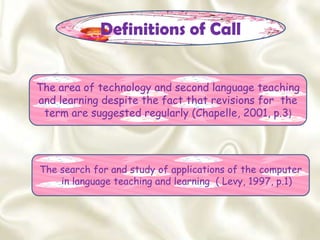
The area of technology and second language teaching
and learning despite the fact that revisions for the
term are suggested regularly (Chapelle, 2001, p.3)
The search for and study of applications of the computer
in language teaching and learning ( Levy, 1997, p.1)
Definitions of Call
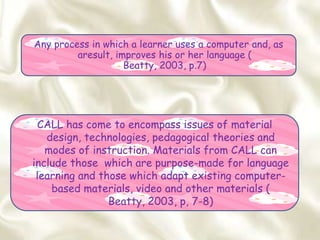
CALL has come to encompass issues of material
design, technologies, pedagogical theories and
modes of instruction. Materials from CALL can
include those which are purpose-made for language
learning and those which adapt existing computer-
based materials, video and other materials (
Beatty, 2003, p, 7-8)
Any process in which a learner uses a computer and, as
aresult, improves his or her language (
Beatty, 2003, p.7)
 CALL dates back to the 1960s, when it was first
introduced on university mainframe computers
 The PLATO project, initiated at the University of
Illinois in 1960, is an important landmark in the
early development of CALL
 The advent of the microcomputer in the late 1970s
brought computing within the range of a wider
audience, resulting in a boom in the development of
CALL programs
 The first publications of books on CALL in the
early 1980s.
History of Call
Three historical phases of CALL according to
Warschauer (1996)[21] and Warschauer &
Healey (1998
• Behavioristic CALL: conceived in the 1950s and
implemented in the 1960s and 1970s.
• Communicative CALL: 1970s to 1980s.
• Integrative CALL: embracing Multimedia and
the Internet: 1990s.
Development of Call
1. CALL-specific software: applications designed to
develop and facilitate language learning, such as
CD-ROMs, web-based interactive language
learning exercises/quizzes (see CD-ROM examples
for language learning)
2. Generic software: applications designed for
general purposes, such as word-processors
(Word), presentation software (PowerPoint, see
an e-book made by students "Many Moons"), and
spreadsheet (Excel), that can be used to support
language learning (see examples of using Excel for
language learning & teaching) *Also see Microsoft
Office Online Templates)
Types of CALL programs
3. Web-based learning programs: online
dictionaries, online
encyclopedias, online
concordancers, news/magazine sites, e-
texts, web-quests, web
publishing, blog, wiki, etc.
4. Computer-mediated communication
(CMC) programs: synchronous - online
chat; asynchronous - email, discussion
forum, message board
• multiple-choice &
true/false quizzes
• gap-filling
exercise/cloze
• matching
• re-
ordering/sequencing
• crossword puzzles
• games
• simulations
• writing & word-
processing
• concordancing
• web
quests/searching
• web publishing
• online
communication(synch
ronous and
asynchronous)
Types of CALL activities
• The term CALI (Computer-assisted
language instruction) was in use before
CALL in 1960s-1970s
• CALL began to replace CALI in the early
1980s
• An alternative term, Technology-enhanced
language learning (TELL), also emerged
around the early 1990s
Term of CALL
Jd def

Jd def

  • 1.
  • 2.
    The area oftechnology and second language teaching and learning despite the fact that revisions for the term are suggested regularly (Chapelle, 2001, p.3) The search for and study of applications of the computer in language teaching and learning ( Levy, 1997, p.1) Definitions of Call
  • 3.
    CALL has cometo encompass issues of material design, technologies, pedagogical theories and modes of instruction. Materials from CALL can include those which are purpose-made for language learning and those which adapt existing computer- based materials, video and other materials ( Beatty, 2003, p, 7-8) Any process in which a learner uses a computer and, as aresult, improves his or her language ( Beatty, 2003, p.7)
  • 4.
     CALL datesback to the 1960s, when it was first introduced on university mainframe computers  The PLATO project, initiated at the University of Illinois in 1960, is an important landmark in the early development of CALL  The advent of the microcomputer in the late 1970s brought computing within the range of a wider audience, resulting in a boom in the development of CALL programs  The first publications of books on CALL in the early 1980s. History of Call
  • 5.
    Three historical phasesof CALL according to Warschauer (1996)[21] and Warschauer & Healey (1998 • Behavioristic CALL: conceived in the 1950s and implemented in the 1960s and 1970s. • Communicative CALL: 1970s to 1980s. • Integrative CALL: embracing Multimedia and the Internet: 1990s. Development of Call
  • 6.
    1. CALL-specific software:applications designed to develop and facilitate language learning, such as CD-ROMs, web-based interactive language learning exercises/quizzes (see CD-ROM examples for language learning) 2. Generic software: applications designed for general purposes, such as word-processors (Word), presentation software (PowerPoint, see an e-book made by students "Many Moons"), and spreadsheet (Excel), that can be used to support language learning (see examples of using Excel for language learning & teaching) *Also see Microsoft Office Online Templates) Types of CALL programs
  • 7.
    3. Web-based learningprograms: online dictionaries, online encyclopedias, online concordancers, news/magazine sites, e- texts, web-quests, web publishing, blog, wiki, etc. 4. Computer-mediated communication (CMC) programs: synchronous - online chat; asynchronous - email, discussion forum, message board
  • 8.
    • multiple-choice & true/falsequizzes • gap-filling exercise/cloze • matching • re- ordering/sequencing • crossword puzzles • games • simulations • writing & word- processing • concordancing • web quests/searching • web publishing • online communication(synch ronous and asynchronous) Types of CALL activities
  • 9.
    • The termCALI (Computer-assisted language instruction) was in use before CALL in 1960s-1970s • CALL began to replace CALI in the early 1980s • An alternative term, Technology-enhanced language learning (TELL), also emerged around the early 1990s Term of CALL