“Actividad 9-10”
Carmen Karina Contreras Valenzuela
June 18th 2015
CALL (COMPUTER
ASSISTED LANGUAGE
LEARNING)
By: Graham Davies
DEFINITION
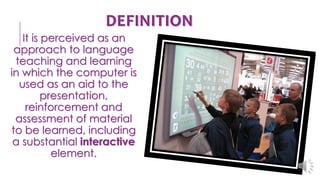
It is perceived as an
approach to language
teaching and learning
in which the computer is
used as an aid to the
presentation,
reinforcement and
assessment of material
to be learned, including
a substantial interactive
element.
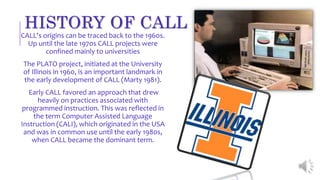
CALL's origins can be traced back to the 1960s.
Up until the late 1970s CALL projects were
confined mainly to universities
The PLATO project, initiated at the University
of Illinois in 1960, is an important landmark in
the early development of CALL (Marty 1981).
Early CALL favored an approach that drew
heavily on practices associated with
programmed instruction. This was reflected in
the term Computer Assisted Language
Instruction (CALI), which originated in the USA
and was in common use until the early 1980s,
when CALL became the dominant term.
HISTORY OF CALL
Traditional CALL programs presented a
stimulus to which the learner had to
provide a response.
The stimulus was in the form of text
presented on screen, and the only way in
which the learner could respond was by
entering an answer at the keyboard.
Discrete error analysis and feedback were
a common feature of traditional CALL, and
the more sophisticated programs would
attempt to analyze the learner's response.
A typical example of this approach is the
CLEF package for learners of French, which
was developed in the late 1970s and early
1980s by a consortium of Canadian
universities
TRADITIONAL CALL
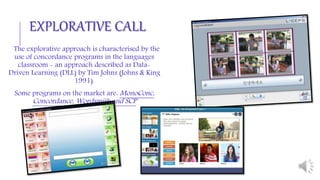
The explorative approach is characterised by the
use of concordance programs in the languages
classroom - an approach described as Data-
Driven Learning (DLL) by Tim Johns (Johns & King
1991).
Some programs on the market are: MonoConc,
Concordance, Wordsmith and SCP
EXPLORATIVE CALL
EXTRA INFORMATION
Web-based CALL
CALL authoring programs
Professional associations for CALL
Suppliers of CALL materials
SOME BIBLIOGRAPHY…
Bickerton, D. (1999). Authoring and the Academic Linguist: the Challenge of MMCALL. In
K. Cameron (ed.) CALL: Media, Design and Applications, 59-79. Lisse: Swets & Zeitlinger.
Bickerton, D., Stenton, T. & Temmermann, M. (2001). Criteria for the Evaluation of
Authoring Tools in Language Education. In A. Chambers & G. Davies (eds), ICT and
Language Learning: a European Perspective, 53-66. Lisse: Swets & Zeitlinger.
Davies, G.D. (1991). Expodisc - an Interactive Videodisc Package for Learners of Spanish.
In H. Savolainen & J. Telenius (eds), EUROCALL 91: Proceedings, 133-39. Helsinki:
Helsinki School of Economics. Available at:
http://www.camsoftpartners.co.uk/expodisc.htm
Felix, U. (2001). Beyond Babel: Language Learning Online. Melbourne: Language
Australia. Reviewed at http://www.camsoftpartners.co.uk/FelixReview.htm
Fuerstenberg, G. (1993). A la rencontre de Philippe: Videodisc, Software, Teacher's
Manual and Student Activities Workbook. Yale University Press. See also
http://web.mit.edu/fll/www/projects/Philippe.html

Act9 10 ckcv

  • 1.
    “Actividad 9-10” Carmen KarinaContreras Valenzuela June 18th 2015
  • 2.
  • 3.
    DEFINITION It is perceivedas an approach to language teaching and learning in which the computer is used as an aid to the presentation, reinforcement and assessment of material to be learned, including a substantial interactive element.
  • 4.
    CALL's origins canbe traced back to the 1960s. Up until the late 1970s CALL projects were confined mainly to universities The PLATO project, initiated at the University of Illinois in 1960, is an important landmark in the early development of CALL (Marty 1981). Early CALL favored an approach that drew heavily on practices associated with programmed instruction. This was reflected in the term Computer Assisted Language Instruction (CALI), which originated in the USA and was in common use until the early 1980s, when CALL became the dominant term. HISTORY OF CALL
  • 5.
    Traditional CALL programspresented a stimulus to which the learner had to provide a response. The stimulus was in the form of text presented on screen, and the only way in which the learner could respond was by entering an answer at the keyboard. Discrete error analysis and feedback were a common feature of traditional CALL, and the more sophisticated programs would attempt to analyze the learner's response. A typical example of this approach is the CLEF package for learners of French, which was developed in the late 1970s and early 1980s by a consortium of Canadian universities TRADITIONAL CALL
  • 6.
    The explorative approachis characterised by the use of concordance programs in the languages classroom - an approach described as Data- Driven Learning (DLL) by Tim Johns (Johns & King 1991). Some programs on the market are: MonoConc, Concordance, Wordsmith and SCP EXPLORATIVE CALL
  • 7.
    EXTRA INFORMATION Web-based CALL CALLauthoring programs Professional associations for CALL Suppliers of CALL materials
  • 8.
    SOME BIBLIOGRAPHY… Bickerton, D.(1999). Authoring and the Academic Linguist: the Challenge of MMCALL. In K. Cameron (ed.) CALL: Media, Design and Applications, 59-79. Lisse: Swets & Zeitlinger. Bickerton, D., Stenton, T. & Temmermann, M. (2001). Criteria for the Evaluation of Authoring Tools in Language Education. In A. Chambers & G. Davies (eds), ICT and Language Learning: a European Perspective, 53-66. Lisse: Swets & Zeitlinger. Davies, G.D. (1991). Expodisc - an Interactive Videodisc Package for Learners of Spanish. In H. Savolainen & J. Telenius (eds), EUROCALL 91: Proceedings, 133-39. Helsinki: Helsinki School of Economics. Available at: http://www.camsoftpartners.co.uk/expodisc.htm Felix, U. (2001). Beyond Babel: Language Learning Online. Melbourne: Language Australia. Reviewed at http://www.camsoftpartners.co.uk/FelixReview.htm Fuerstenberg, G. (1993). A la rencontre de Philippe: Videodisc, Software, Teacher's Manual and Student Activities Workbook. Yale University Press. See also http://web.mit.edu/fll/www/projects/Philippe.html