


1
Garment Printing Solutions
A brief on types of printing methods and their cost
2
Methods of Printing
3
 There are major three methods presently used to impress coloured patterns on cloth:
• Block printing –
‐ Hand Block printing
‐ Perrotine printing
• Screen printing –
‐ Flat-bed Screen / Chest printing
‐ Rotary Screen printing
• Digital textile printing –
‐ Sublimation / Heat transfer printing
‐ DTG – Direct to garment printing
Methods of Printing
4
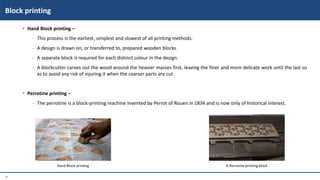
• Hand Block printing –
‐ This process is the earliest, simplest and slowest of all printing methods.
‐ A design is drawn on, or transferred to, prepared wooden blocks.
‐ A separate block is required for each distinct colour in the design.
‐ A blockcutter carves out the wood around the heavier masses first, leaving the finer and more delicate work until the last so
as to avoid any risk of injuring it when the coarser parts are cut.
• Perrotine printing –
‐ The perrotine is a block-printing machine invented by Perrot of Rouen in 1834 and is now only of historical interest.
Block printing
Hand Block printing A Perrotine printing block
5
 Screen printing is sprinting technique that uses a woven mesh to support an ink-
blocking stencil.
 The attached stencil forms open areas a of mesh that transfer ink or other printable
materials which can be pressed through the mesh as a sharp-edged image onto a
substrate.
 The mesh count is the number of threads per inch (tpi) used to weave the mesh.
Typical mesh counts for screen printing range from 85 tpi to 355 tpi.
 The high mesh counts, have a very small thread diameter and less open area. Prints
require more fineness should be use finer mesh count.
 A roller or squeegee is moved across the screen stencil, forcing or pumping ink past the
threads of the woven mesh in the open areas
 Flat screen printing is much more suitable for high pile fabrics, because only one
squeegee pass is available with rotary screen.
 Due to the semi-continuous process, low productivity, and non-continuous patterns of
flat-bed screen printing, inventive machine makers developed rotary screen printing.
Screen printing
6
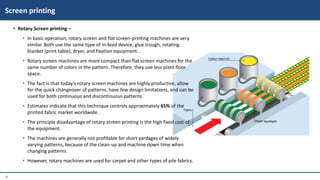
 Rotary Screen printing –
• In basic operation, rotary screen and flat screen-printing machines are very
similar. Both use the same type of in-feed device, glue trough, rotating
blanket (print table), dryer, and fixation equipment.
• Rotary screen machines are more compact than flat screen machines for the
same number of colors in the pattern. Therefore, they use less plant floor
space.
• The fact is that today’s rotary screen machines are highly productive, allow
for the quick changeover of patterns, have few design limitations, and can be
used for both continuous and discontinuous patterns.
• Estimates indicate that this technique controls approximately 65% of the
printed fabric market worldwide.
• The principle disadvantage of rotary screen printing is the high fixed cost of
the equipment.
• The machines are generally not profitable for short yardages of widely
varying patterns, because of the clean-up and machine down time when
changing patterns.
• However, rotary machines are used for carpet and other types of pile fabrics.
Screen printing
7
Screen printing
Flat-bed screen printing m/c Rotary screen printing m/c
Chest screen printing m/c
8
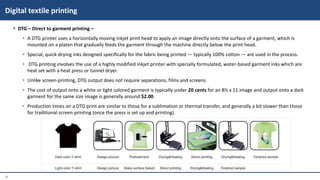
 DTG – Direct to garment printing –
• A DTG printer uses a horizontally moving inkjet print head to apply an image directly onto the surface of a garment, which is
mounted on a platen that gradually feeds the garment through the machine directly below the print head.
• Special, quick-drying inks designed specifically for the fabric being printed — typically 100% cotton — are used in the process.
• DTG printing involves the use of a highly modified inkjet printer with specially formulated, water-based garment inks which are
heat set with a heat press or tunnel dryer.
• Unlike screen-printing, DTG output does not require separations, films and screens.
• The cost of output onto a white or light colored garment is typically under 20 cents for an 8½ x 11 image and output onto a dark
garment for the same size image is generally around $2.00.
• Production times on a DTG print are similar to those for a sublimation or thermal transfer, and generally a bit slower than those
for traditional screen-printing (once the press is set up and printing).
Digital textile printing
9
 Sublimation / Heat transfer printing –
• The sublimation process uses an inkjet printer equipped with sublimation dyes to print an image onto sublimation transfer paper.
• The printed transfer paper is then applied to the blank substrate using a heat press.
• The cost to make a single transfer can range from $0.50 to $2.50 depending on what ink and paper is used by your printer.
Digital textile printing
10
Digital textile printing
DTG- Direct to garment printing Sublimation / Heat transfer printing
11
Types of Prints
12
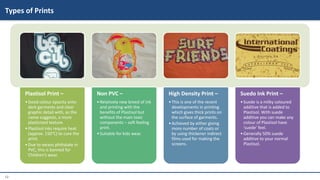
Plastisol Print –
•Good colour opacity onto
dark garments and clear
graphic detail with, as the
name suggests, a more
plasticized texture.
•Plastisol inks require heat
(approx. 150°C) to cure the
print.
•Due to excess phthalate in
PVC, this is banned for
Children’s wear.
Non PVC –
•Relatively new breed of ink
and printing with the
benefits of Plastisol but
without the main toxic
components – soft feeling
print.
•Suitable for kids wear.
High Density Print –
•This is one of the recent
developments in printing
which gives thick prints on
the surface of garments.
•Achieved by either giving
more number of coats or
by using thickener indirect
films used for making the
screens.
Suedo Ink Print –
•Suede is a milky coloured
additive that is added to
Plastisol. With suede
additive you can make any
colour of Plastisol have
‘suede’ feel.
•Generally 50% suede
additive to your normal
Plastisol.
Types of Prints
13
Discharge Print –
•Used to print lighter
colours onto dark
background fabrics, they
work by removing the
dye already present in
the garment.
•This gives a much softer
texture
Sticker Print –
•This is ready to transfer
print.
•The plastisol print is
already printed on paper
and will be transfered on
to garment in the fusing
process.
•The main advantage of
this method is less
expensive.
Pigment Print –
•These penetrate the
fabric more than the
Plastisole inks and create
a much softer feel.
•Also useful for larger
area prints where
texture is important.
Glitter Print –
•Metallic flakes are
suspended in the ink
base to create this
sparkle effect.
•Usually available in gold
or silver but can be
mixed to make most
colours.
Types of Prints
14
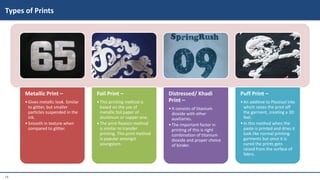
Metallic Print –
•Gives metallic look. Similar
to glitter, but smaller
particles suspended in the
ink.
•Smooth in texture when
compared to glitter.
Foil Print –
•This printing method is
based on the use of
metallic foil paper of
aluminum or copper one.
•The print fixation method
is similar to transfer
printing. This print method
is popular amongst
youngsters.
Distressed/ Khadi
Print –
•It consists of titanium
dioxide with other
auxiliaries.
•The important factor in
printing of this is right
combination of titanium
dioxide and proper choice
of binder.
Puff Print –
•An additive to Plastisol inks
which raises the print off
the garment, creating a 3D
feel.
•In this method when the
paste is printed and dries it
look like normal printing
garments but once it is
cured the prints gets
raised from the surface of
fabric.
Types of Prints
15
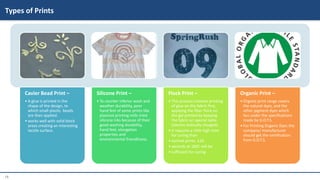
Cavier Bead Print –
• A glue is printed in the
shape of the design, to
which small plastic beads
are then applied.
• works well with solid block
areas creating an interesting
tactile surface.
Silicone Print –
• To counter inferior wash and
weather durability, poor
hand feel of some prints like
plastisol printing mills tried
silicone inks because of their
good washing durability,
hand feel, elongation
properties and
environmental friendliness.
Flock Print –
• This process involves printing
of glue on the fabric first,
applying the fiber flock on
the gel printed by keeping
the fabric on special table
(electro statically charged).
• It requires a little high time
for curing than
• normal prints. 120
• seconds at 160C will be
• sufficient for curing.
Organic Print –
• Organic print range covers
the natural dyes, and the
other pigment dyes which
lies under the specifications
made by G.O.T.S.
• For Printing Organic Dyes the
company/ manufacturer
should get the certification
from G.O.T.S.
Types of Prints
16
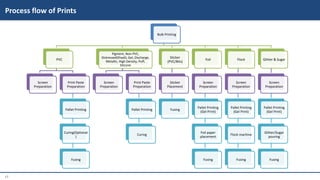
Process flow of Prints
17
Process flow of Prints
Bulk Printing
PVC
Screen
Preparation
Print Paste
Preparation
Pallet Printing
Curing(Optional
)
Fusing
Pigment, Non-PVC,
Distressed(Khadi), Gel, Discharge,
Metallic, High Density, Puff,
Silicone
Screen
Preparation
Print Paste
Preparation
Pallet Printing
Curing
Sticker
(PVC/Bits)
Sticker
Placement
Fusing
Foil
Screen
Preparation
Pallet Printing
(Gel Print)
Foil paper
placement
Fusing
Flock
Screen
Preparation
Pallet Printing
(Gel Print)
Flock machine
Fusing
Glitter & Sugar
Screen
Preparation
Pallet Printing
(Gel Print)
Glitter/Sugar
pouring
Fusing
18
Cost of Various types of Prints
19
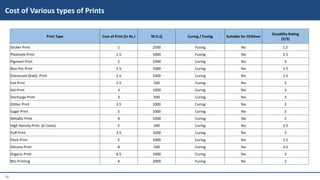
Cost of Various types of Prints
Print Type Cost of Print (in Rs.) M.O.Q Curing / Fusing Suitable for Children
Durablity Rating
(5/5)
Sticker Print 1 2500 Fusing No 1.5
Plastisole Print 1.5 1000 Fusing No 2.5
Pigment Print 2 1000 Curing Yes 3
Non-Pvc Print 2.5 1000 Curing Yes 2.5
Distressed (Kadi) Print 2.5 1000 Curing Yes 2.5
Foil Print 3.5 500 Fusing Yes 2
Gel Print 3 1000 Curing Yes 3
Discharge Print 3 500 Curing Yes 3
Glitter Print 3.5 1000 Curing Yes 2
Sugar Print 5 1000 Curing No 2
Metallic Print 4 1000 Curing No 2
High Density Print (6 Coats) 5 500 Curing Yes 3.5
Puff Print 3.5 1000 Curing Yes 3
Flock Print 5 1000 Curing Yes 2.5
Silicone Print 8 500 Curing Yes 4.5
Organic Print 6.5 1000 Curing Yes 3
Bits Printing 4 2000 Fusing No 2
20
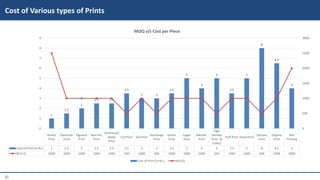
Cost of Various types of Prints
Sticker
Print
Plastisole
Print
Pigment
Print
Non-Pvc
Print
Distressed
(Kadi)
Print
Foil Print Gel Print
Discharge
Print
Glitter
Print
Sugar
Print
Metallic
Print
High
Density
Print (6
Coats)
Puff Print Flock Print
Silicone
Print
Organic
Print
Bits
Printing
Cost of Print (in Rs.) 1 1.5 2 2.5 2.5 3.5 3 3 3.5 5 4 5 3.5 5 8 6.5 4
M.O.Q 2500 1000 1000 1000 1000 500 1000 500 1000 1000 1000 500 1000 1000 500 1000 2000
1
1.5
2
2.5 2.5
3.5
3 3
3.5
5
4
5
3.5
5
8
6.5
4
0
500
1000
1500
2000
2500
3000
0
1
2
3
4
5
6
7
8
9
MOQ v/s Cost per Piece
Cost of Print (in Rs.) M.O.Q
21
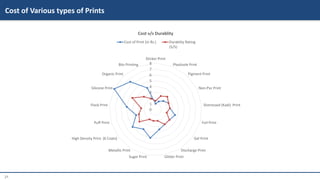
Cost of Various types of Prints
0
1
2
3
4
5
6
7
8
Sticker Print
Plastisole Print
Pigment Print
Non-Pvc Print
Distressed (Kadi) Print
Foil Print
Gel Print
Discharge Print
Glitter PrintSugar Print
Metallic Print
High Density Print (6 Coats)
Puff Print
Flock Print
Silicone Print
Organic Print
Bits Printing
Cost v/s Durablity
Cost of Print (in Rs.) Durablity Rating
(5/5)
22
References
23
 Links of referred websites and sources –
• https://en.wikipedia.org/wiki/Textile_printing#Engraved_copperplate_printing
• https://coldesi.com/2013/07/learn-about-garment-printing-and-garment-printers/
• http://textilelearner.blogspot.com/2012/01/rotary-screen-printing-machine-working.html
• https://dtgprintermachine.com/
• https://www.impressionsmagazine.com/digital-decorating/sublimation/dtg-vs-dye-sublimation/
• https://www.youtube.com/watch?v=R04Dbm3ZRAE
• https://www.youtube.com/watch?v=Dhc9lV5I04U
• https://www.youtube.com/watch?v=CdlYIilVZyU
• https://www.youtube.com/watch?v=ltqgLsWHR0s
• https://www.youtube.com/watch?v=F-0RkqO-AwE
• https://www.youtube.com/watch?v=sdC5Nztuk6I
• https://www.youtube.com/watch?v=7ak27yP5Vdk
References

Garment Printing Solutions

  • 1.
    1 Garment Printing Solutions Abrief on types of printing methods and their cost
  • 2.
  • 3.
    3  There aremajor three methods presently used to impress coloured patterns on cloth: • Block printing – ‐ Hand Block printing ‐ Perrotine printing • Screen printing – ‐ Flat-bed Screen / Chest printing ‐ Rotary Screen printing • Digital textile printing – ‐ Sublimation / Heat transfer printing ‐ DTG – Direct to garment printing Methods of Printing
  • 4.
    4 • Hand Blockprinting – ‐ This process is the earliest, simplest and slowest of all printing methods. ‐ A design is drawn on, or transferred to, prepared wooden blocks. ‐ A separate block is required for each distinct colour in the design. ‐ A blockcutter carves out the wood around the heavier masses first, leaving the finer and more delicate work until the last so as to avoid any risk of injuring it when the coarser parts are cut. • Perrotine printing – ‐ The perrotine is a block-printing machine invented by Perrot of Rouen in 1834 and is now only of historical interest. Block printing Hand Block printing A Perrotine printing block
  • 5.
    5  Screen printingis sprinting technique that uses a woven mesh to support an ink- blocking stencil.  The attached stencil forms open areas a of mesh that transfer ink or other printable materials which can be pressed through the mesh as a sharp-edged image onto a substrate.  The mesh count is the number of threads per inch (tpi) used to weave the mesh. Typical mesh counts for screen printing range from 85 tpi to 355 tpi.  The high mesh counts, have a very small thread diameter and less open area. Prints require more fineness should be use finer mesh count.  A roller or squeegee is moved across the screen stencil, forcing or pumping ink past the threads of the woven mesh in the open areas  Flat screen printing is much more suitable for high pile fabrics, because only one squeegee pass is available with rotary screen.  Due to the semi-continuous process, low productivity, and non-continuous patterns of flat-bed screen printing, inventive machine makers developed rotary screen printing. Screen printing
  • 6.
    6  Rotary Screenprinting – • In basic operation, rotary screen and flat screen-printing machines are very similar. Both use the same type of in-feed device, glue trough, rotating blanket (print table), dryer, and fixation equipment. • Rotary screen machines are more compact than flat screen machines for the same number of colors in the pattern. Therefore, they use less plant floor space. • The fact is that today’s rotary screen machines are highly productive, allow for the quick changeover of patterns, have few design limitations, and can be used for both continuous and discontinuous patterns. • Estimates indicate that this technique controls approximately 65% of the printed fabric market worldwide. • The principle disadvantage of rotary screen printing is the high fixed cost of the equipment. • The machines are generally not profitable for short yardages of widely varying patterns, because of the clean-up and machine down time when changing patterns. • However, rotary machines are used for carpet and other types of pile fabrics. Screen printing
  • 7.
    7 Screen printing Flat-bed screenprinting m/c Rotary screen printing m/c Chest screen printing m/c
  • 8.
    8  DTG –Direct to garment printing – • A DTG printer uses a horizontally moving inkjet print head to apply an image directly onto the surface of a garment, which is mounted on a platen that gradually feeds the garment through the machine directly below the print head. • Special, quick-drying inks designed specifically for the fabric being printed — typically 100% cotton — are used in the process. • DTG printing involves the use of a highly modified inkjet printer with specially formulated, water-based garment inks which are heat set with a heat press or tunnel dryer. • Unlike screen-printing, DTG output does not require separations, films and screens. • The cost of output onto a white or light colored garment is typically under 20 cents for an 8½ x 11 image and output onto a dark garment for the same size image is generally around $2.00. • Production times on a DTG print are similar to those for a sublimation or thermal transfer, and generally a bit slower than those for traditional screen-printing (once the press is set up and printing). Digital textile printing
  • 9.
    9  Sublimation /Heat transfer printing – • The sublimation process uses an inkjet printer equipped with sublimation dyes to print an image onto sublimation transfer paper. • The printed transfer paper is then applied to the blank substrate using a heat press. • The cost to make a single transfer can range from $0.50 to $2.50 depending on what ink and paper is used by your printer. Digital textile printing
  • 10.
    10 Digital textile printing DTG-Direct to garment printing Sublimation / Heat transfer printing
  • 11.
  • 12.
    12 Plastisol Print – •Goodcolour opacity onto dark garments and clear graphic detail with, as the name suggests, a more plasticized texture. •Plastisol inks require heat (approx. 150°C) to cure the print. •Due to excess phthalate in PVC, this is banned for Children’s wear. Non PVC – •Relatively new breed of ink and printing with the benefits of Plastisol but without the main toxic components – soft feeling print. •Suitable for kids wear. High Density Print – •This is one of the recent developments in printing which gives thick prints on the surface of garments. •Achieved by either giving more number of coats or by using thickener indirect films used for making the screens. Suedo Ink Print – •Suede is a milky coloured additive that is added to Plastisol. With suede additive you can make any colour of Plastisol have ‘suede’ feel. •Generally 50% suede additive to your normal Plastisol. Types of Prints
  • 13.
    13 Discharge Print – •Usedto print lighter colours onto dark background fabrics, they work by removing the dye already present in the garment. •This gives a much softer texture Sticker Print – •This is ready to transfer print. •The plastisol print is already printed on paper and will be transfered on to garment in the fusing process. •The main advantage of this method is less expensive. Pigment Print – •These penetrate the fabric more than the Plastisole inks and create a much softer feel. •Also useful for larger area prints where texture is important. Glitter Print – •Metallic flakes are suspended in the ink base to create this sparkle effect. •Usually available in gold or silver but can be mixed to make most colours. Types of Prints
  • 14.
    14 Metallic Print – •Givesmetallic look. Similar to glitter, but smaller particles suspended in the ink. •Smooth in texture when compared to glitter. Foil Print – •This printing method is based on the use of metallic foil paper of aluminum or copper one. •The print fixation method is similar to transfer printing. This print method is popular amongst youngsters. Distressed/ Khadi Print – •It consists of titanium dioxide with other auxiliaries. •The important factor in printing of this is right combination of titanium dioxide and proper choice of binder. Puff Print – •An additive to Plastisol inks which raises the print off the garment, creating a 3D feel. •In this method when the paste is printed and dries it look like normal printing garments but once it is cured the prints gets raised from the surface of fabric. Types of Prints
  • 15.
    15 Cavier Bead Print– • A glue is printed in the shape of the design, to which small plastic beads are then applied. • works well with solid block areas creating an interesting tactile surface. Silicone Print – • To counter inferior wash and weather durability, poor hand feel of some prints like plastisol printing mills tried silicone inks because of their good washing durability, hand feel, elongation properties and environmental friendliness. Flock Print – • This process involves printing of glue on the fabric first, applying the fiber flock on the gel printed by keeping the fabric on special table (electro statically charged). • It requires a little high time for curing than • normal prints. 120 • seconds at 160C will be • sufficient for curing. Organic Print – • Organic print range covers the natural dyes, and the other pigment dyes which lies under the specifications made by G.O.T.S. • For Printing Organic Dyes the company/ manufacturer should get the certification from G.O.T.S. Types of Prints
  • 16.
  • 17.
    17 Process flow ofPrints Bulk Printing PVC Screen Preparation Print Paste Preparation Pallet Printing Curing(Optional ) Fusing Pigment, Non-PVC, Distressed(Khadi), Gel, Discharge, Metallic, High Density, Puff, Silicone Screen Preparation Print Paste Preparation Pallet Printing Curing Sticker (PVC/Bits) Sticker Placement Fusing Foil Screen Preparation Pallet Printing (Gel Print) Foil paper placement Fusing Flock Screen Preparation Pallet Printing (Gel Print) Flock machine Fusing Glitter & Sugar Screen Preparation Pallet Printing (Gel Print) Glitter/Sugar pouring Fusing
  • 18.
    18 Cost of Varioustypes of Prints
  • 19.
    19 Cost of Varioustypes of Prints Print Type Cost of Print (in Rs.) M.O.Q Curing / Fusing Suitable for Children Durablity Rating (5/5) Sticker Print 1 2500 Fusing No 1.5 Plastisole Print 1.5 1000 Fusing No 2.5 Pigment Print 2 1000 Curing Yes 3 Non-Pvc Print 2.5 1000 Curing Yes 2.5 Distressed (Kadi) Print 2.5 1000 Curing Yes 2.5 Foil Print 3.5 500 Fusing Yes 2 Gel Print 3 1000 Curing Yes 3 Discharge Print 3 500 Curing Yes 3 Glitter Print 3.5 1000 Curing Yes 2 Sugar Print 5 1000 Curing No 2 Metallic Print 4 1000 Curing No 2 High Density Print (6 Coats) 5 500 Curing Yes 3.5 Puff Print 3.5 1000 Curing Yes 3 Flock Print 5 1000 Curing Yes 2.5 Silicone Print 8 500 Curing Yes 4.5 Organic Print 6.5 1000 Curing Yes 3 Bits Printing 4 2000 Fusing No 2
  • 20.
    20 Cost of Varioustypes of Prints Sticker Print Plastisole Print Pigment Print Non-Pvc Print Distressed (Kadi) Print Foil Print Gel Print Discharge Print Glitter Print Sugar Print Metallic Print High Density Print (6 Coats) Puff Print Flock Print Silicone Print Organic Print Bits Printing Cost of Print (in Rs.) 1 1.5 2 2.5 2.5 3.5 3 3 3.5 5 4 5 3.5 5 8 6.5 4 M.O.Q 2500 1000 1000 1000 1000 500 1000 500 1000 1000 1000 500 1000 1000 500 1000 2000 1 1.5 2 2.5 2.5 3.5 3 3 3.5 5 4 5 3.5 5 8 6.5 4 0 500 1000 1500 2000 2500 3000 0 1 2 3 4 5 6 7 8 9 MOQ v/s Cost per Piece Cost of Print (in Rs.) M.O.Q
  • 21.
    21 Cost of Varioustypes of Prints 0 1 2 3 4 5 6 7 8 Sticker Print Plastisole Print Pigment Print Non-Pvc Print Distressed (Kadi) Print Foil Print Gel Print Discharge Print Glitter PrintSugar Print Metallic Print High Density Print (6 Coats) Puff Print Flock Print Silicone Print Organic Print Bits Printing Cost v/s Durablity Cost of Print (in Rs.) Durablity Rating (5/5)
  • 22.
  • 23.
    23  Links ofreferred websites and sources – • https://en.wikipedia.org/wiki/Textile_printing#Engraved_copperplate_printing • https://coldesi.com/2013/07/learn-about-garment-printing-and-garment-printers/ • http://textilelearner.blogspot.com/2012/01/rotary-screen-printing-machine-working.html • https://dtgprintermachine.com/ • https://www.impressionsmagazine.com/digital-decorating/sublimation/dtg-vs-dye-sublimation/ • https://www.youtube.com/watch?v=R04Dbm3ZRAE • https://www.youtube.com/watch?v=Dhc9lV5I04U • https://www.youtube.com/watch?v=CdlYIilVZyU • https://www.youtube.com/watch?v=ltqgLsWHR0s • https://www.youtube.com/watch?v=F-0RkqO-AwE • https://www.youtube.com/watch?v=sdC5Nztuk6I • https://www.youtube.com/watch?v=7ak27yP5Vdk References