






truth(Will they have an app for that?)joycekasmanvalenza
the history of . . .
TRUTH
TRUTH
truth
some of my old slides
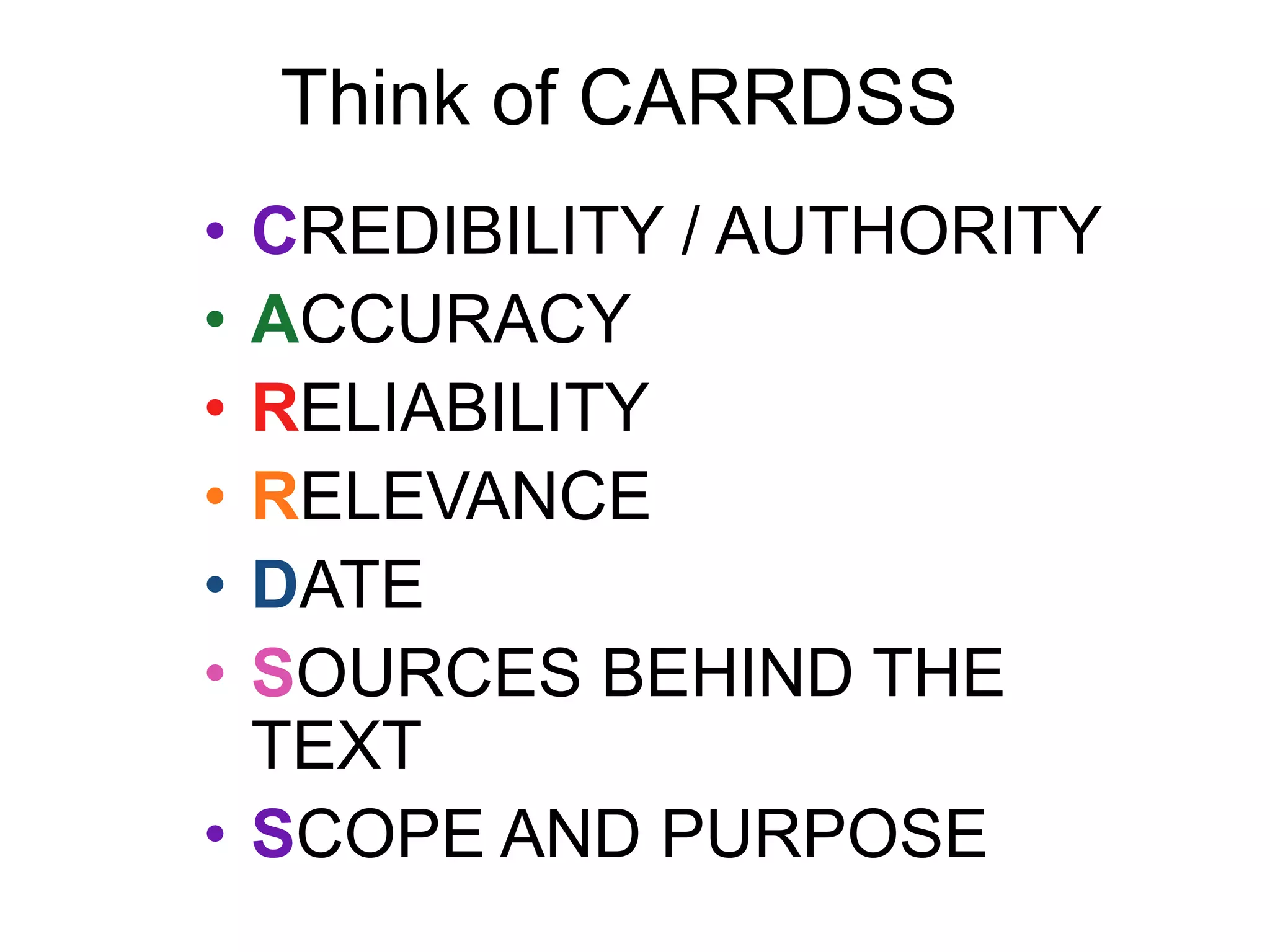
Think of CARRDSSCREDIBILITY / AUTHORITYACCURACYRELIABILITYRELEVANCEDATESOURCES BEHIND THE TEXTSCOPE AND PURPOSE
CREDIBILITY / AUTHORITY :Who is the author? What are his or her credentials? Education? Experience? Affiliation?Does the author’s experience really qualify him or her as an expert?Does he or she offer first-hand credibility? (For instance, a Vietnam veteran or a witness to Woodstock?)Who actually published this page?Is this a personal page or is it part of the site belonging to a major institution? (Clues pointing to a personal page: ~ tilde, %, users, members)Is the page hosted by a free server like AOL, Tripod,
But what if I can’t find any author information?
Look for credibility clues!Words and phrases to look for:About us, Who Am I, FAQs, For More, Company Information, Profiles, Our Staff, HomeE-mail the authorIf you have no information other than an e-mail link, write a polite e-mail asking for more information.
More credibility clues(What do others think?)Do a link checkIn Google or AltaVista typelink:siteaddressYour results will show which other sites have chosen to link to this page.  If respectable institutions have linked to a site, that provides  a clue about the site’s credibility.Does the site appear in major subject directories like Librarian’s Index to the Internet (lii.org)?
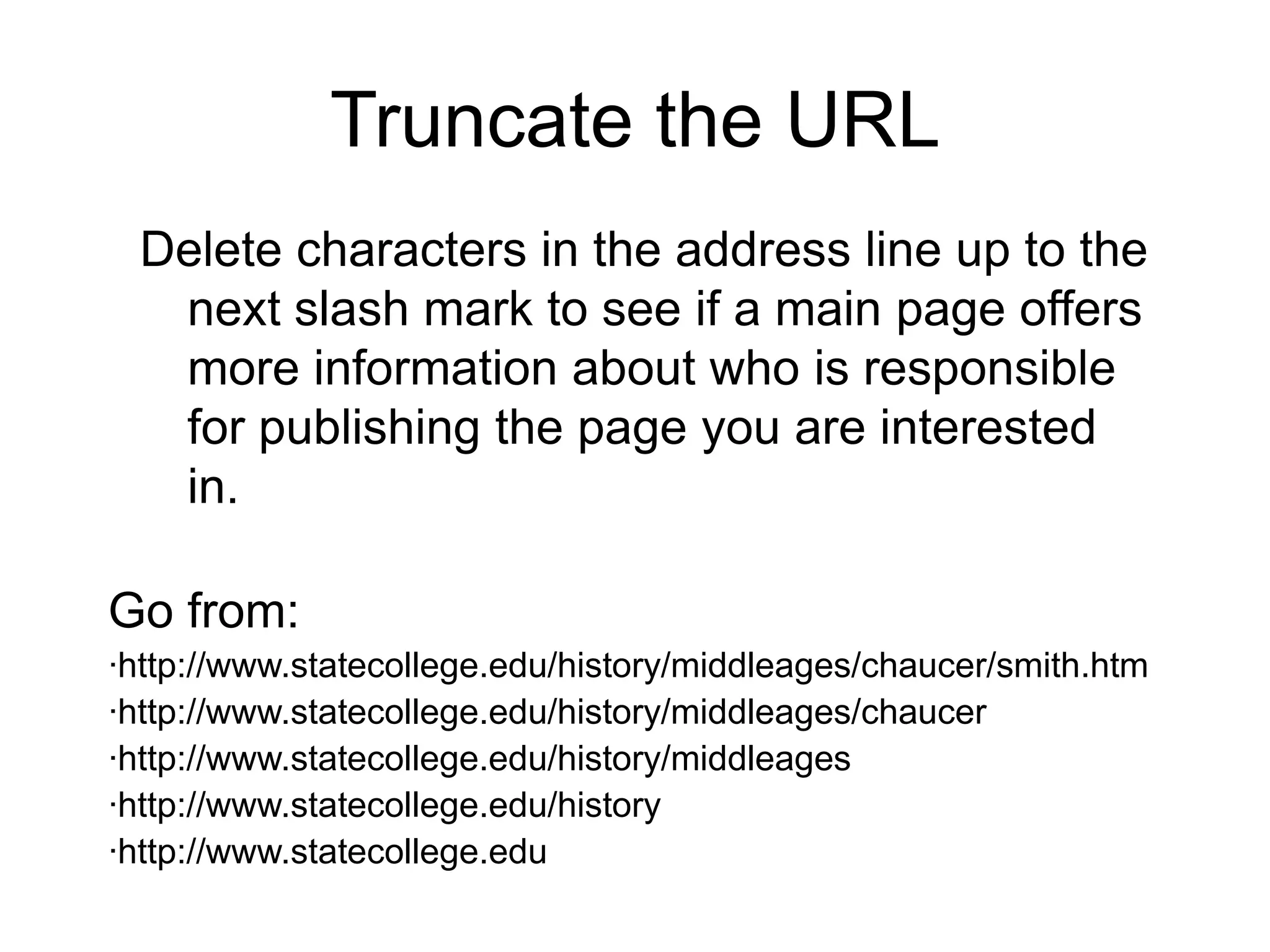
Truncate the URLDelete characters in the address line up to the next slash mark to see if a main page offers more information about who is responsible for publishing the page you are interested in.Go from:http://www.statecollege.edu/history/middleages/chaucer/smith.htm
http://www.statecollege.edu/history/middleages/chaucer
http://www.statecollege.edu/history/middleages
http://www.statecollege.edu/history
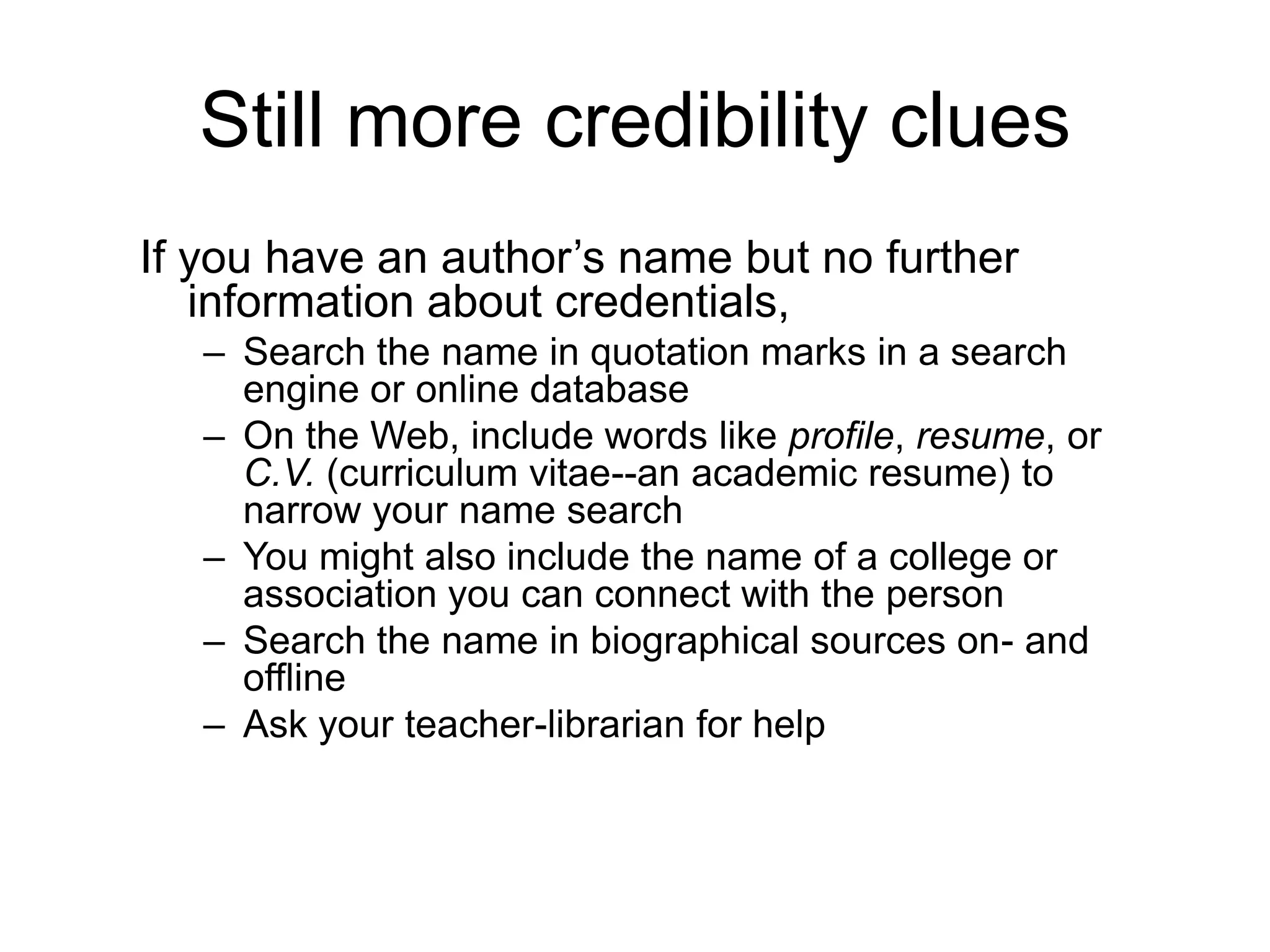
http://www.statecollege.eduStill more credibility cluesIf you have an author’s name but no further information about credentials,Search the name in quotation marks in a search engine or online databaseOn the Web, include words like profile, resume, or C.V. (curriculum vitae--an academic resume) to narrow your name searchYou might also include the name of a college or association you can connect with the personSearch the name in biographical sources on- and offlineAsk your teacher-librarian for help
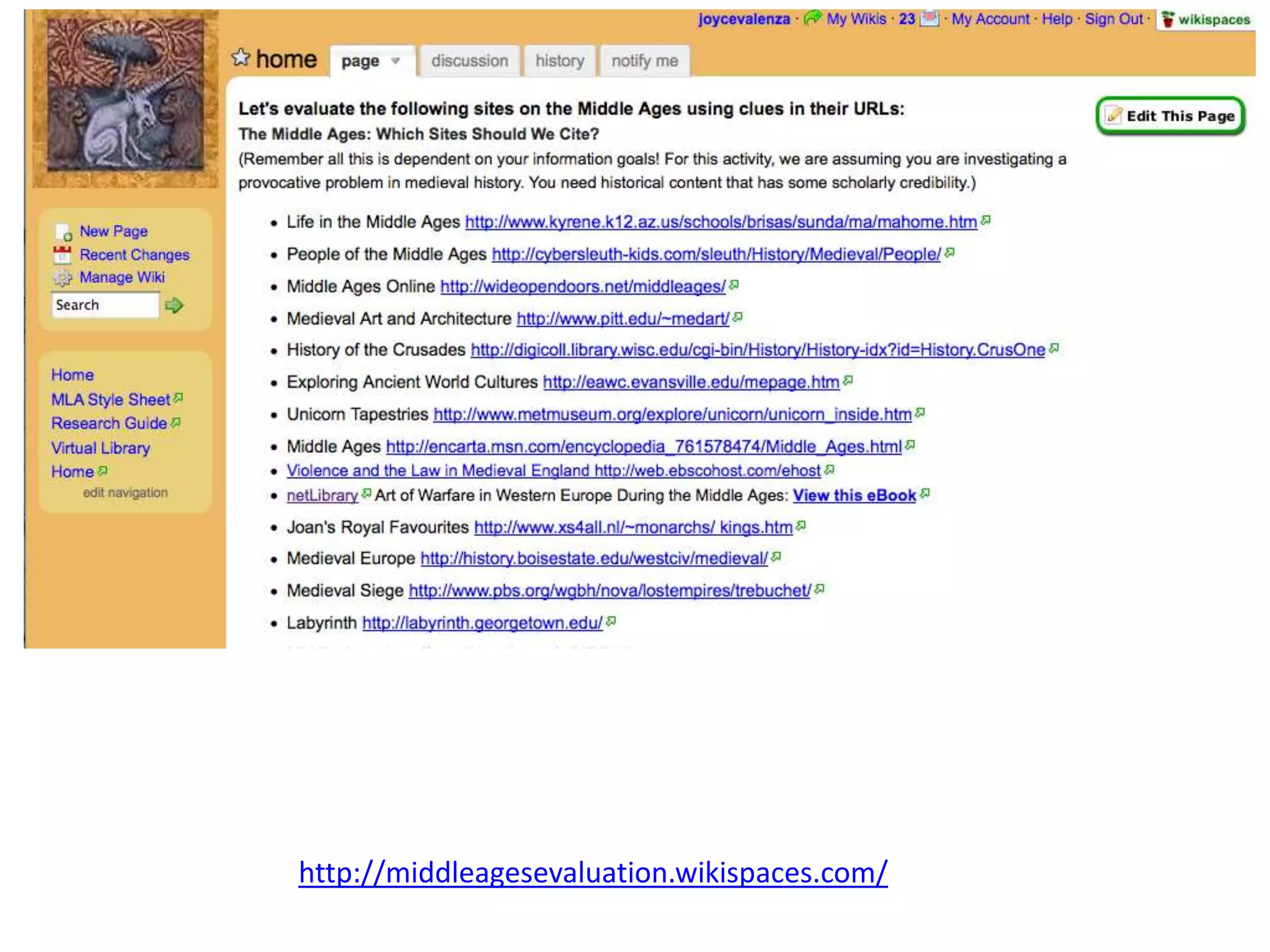
http://middleagesevaluation.wikispaces.com/
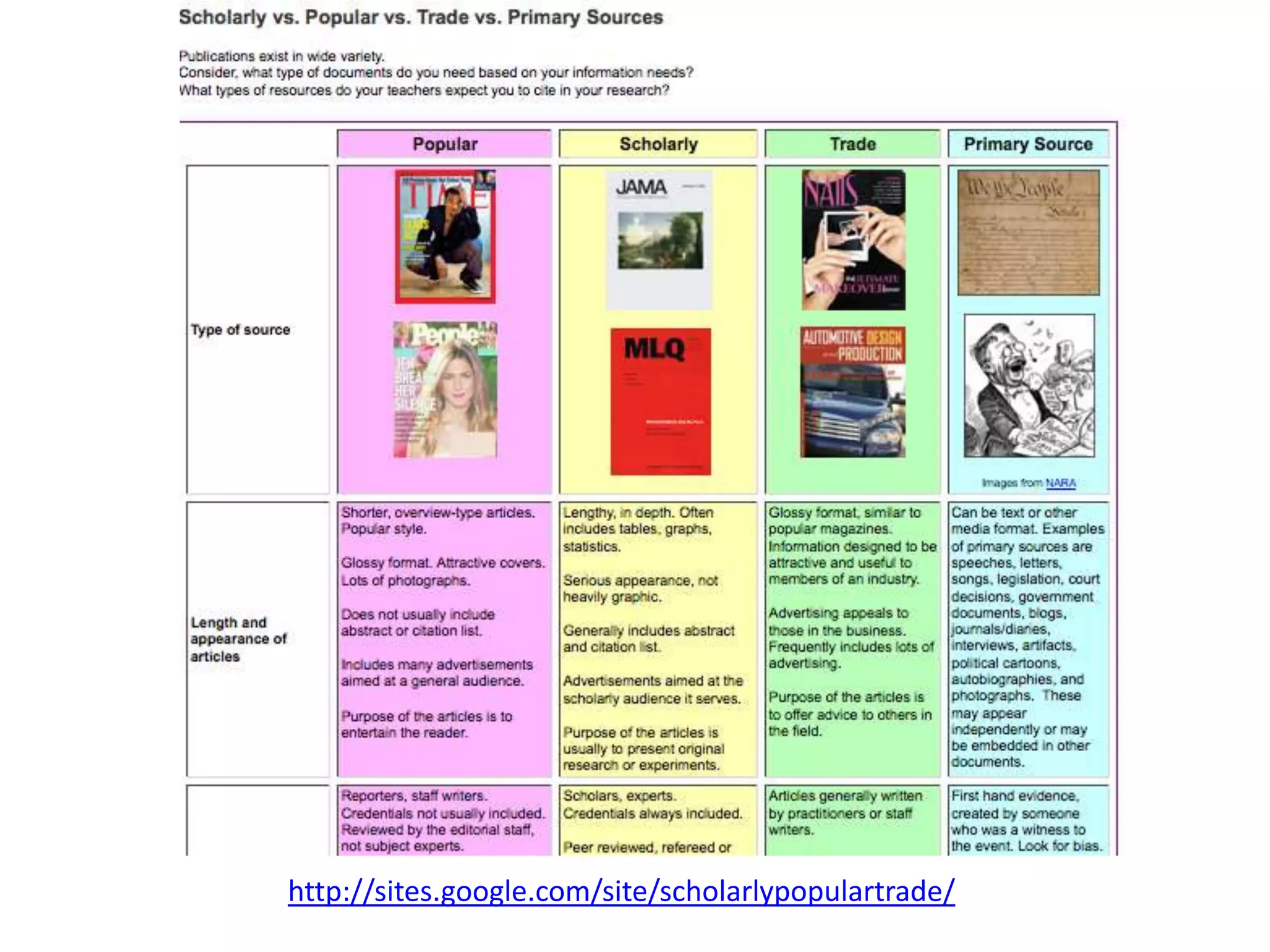
http://sites.google.com/site/scholarlypopulartrade/
http://www.easywhois.com/
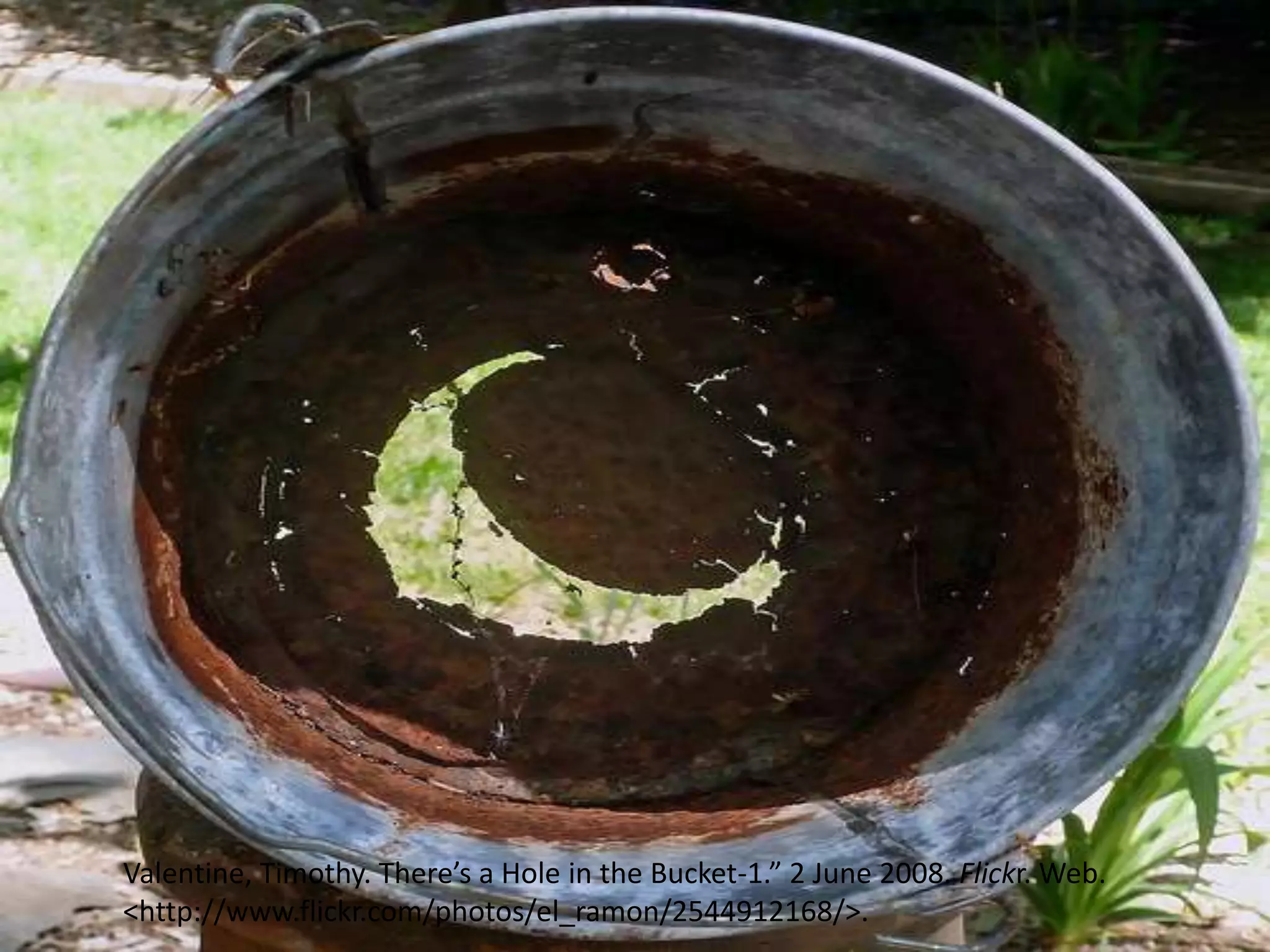
Valentine, Timothy. There’s a Hole in the Bucket-1.” 2 June 2008. Flickr. Web. <http://www.flickr.com/photos/el_ramon/2544912168/>.
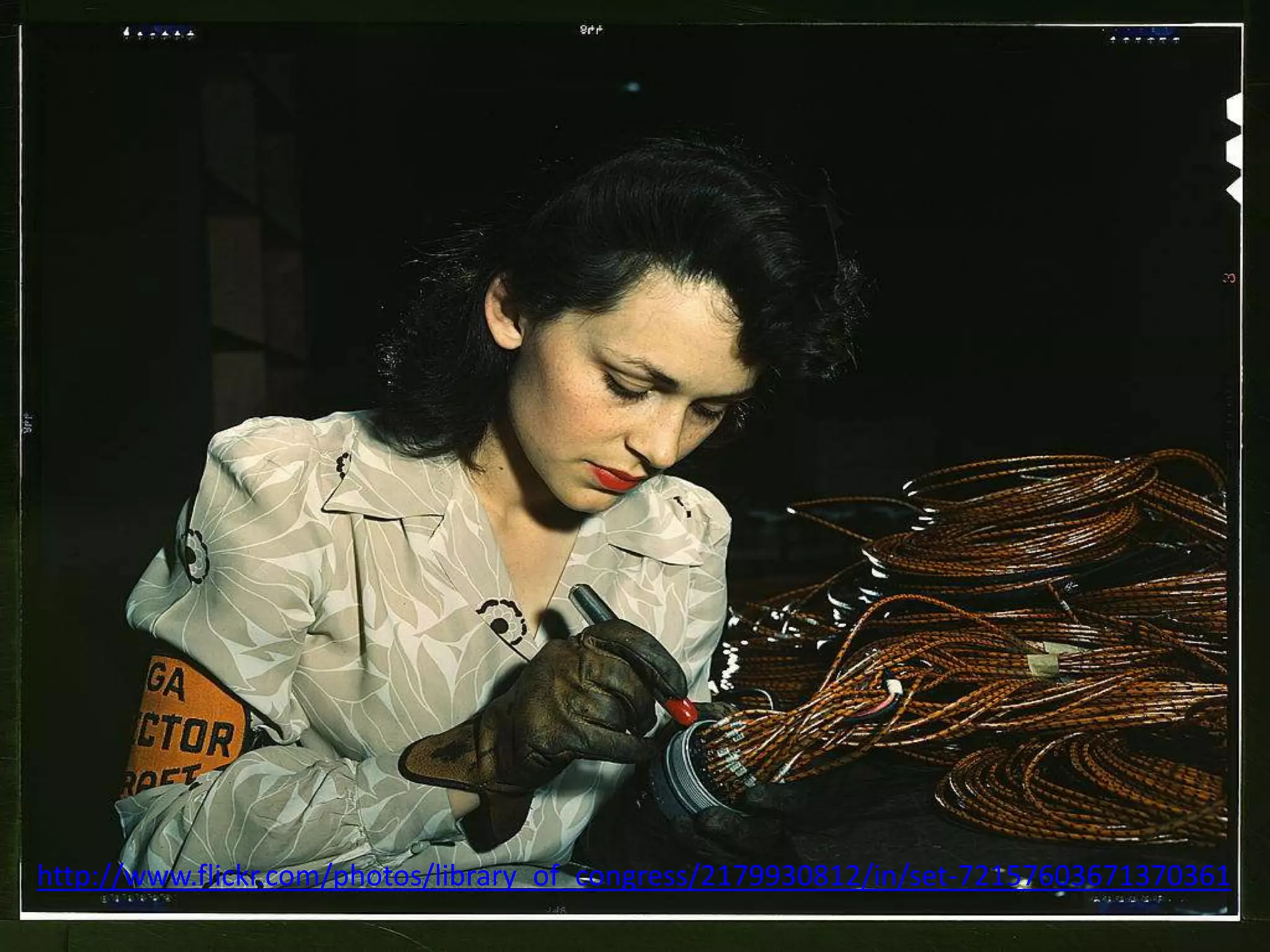
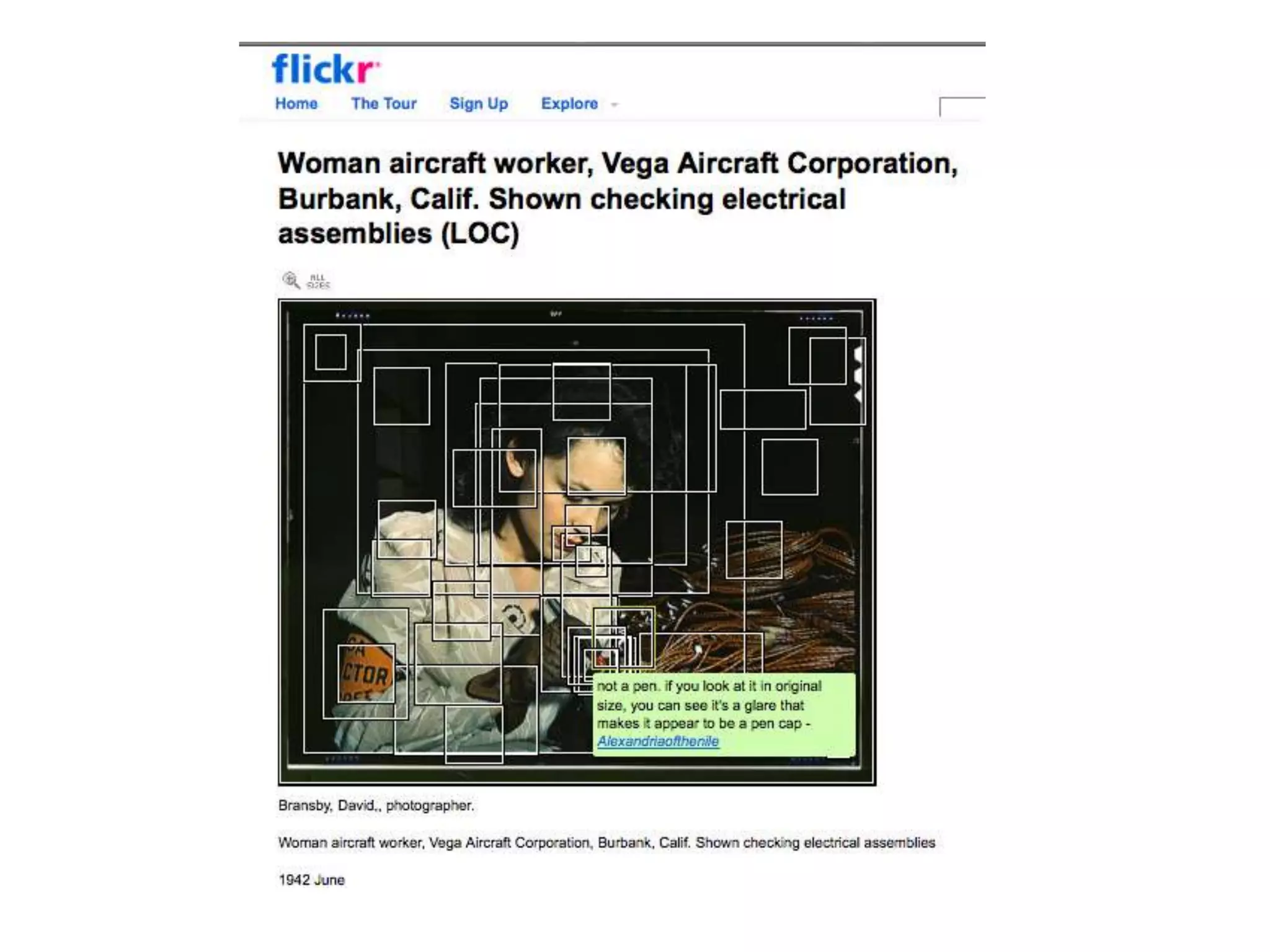
More about The CommonsLaunched on January 16, 2008 in partnership with Library of Congress. Objectives:   1. To increase access to publicly-held photography collections, and   2. To provide a way for the general public to contribute information and knowledge. (Then watch what happens when they do!)
http://www.backlinkwatch.com/index.php
http://www.flickr.com/photos/library_of_congress/2179930812/in/set-72157603671370361
The smartest person in the room is not the person at the front of the room. The smartest person in the room, is the room!  		                                                               David Weinberger, BLC, July 2009
"Nobody is as smart as everybody.”Founding executive editor of Wired, Kevin Kelly
There may not be a single right answer.
All of our texts are flawed.
What’s missing?
From whose lens?
Is there such a thing as neutral text?
What is a primary source?
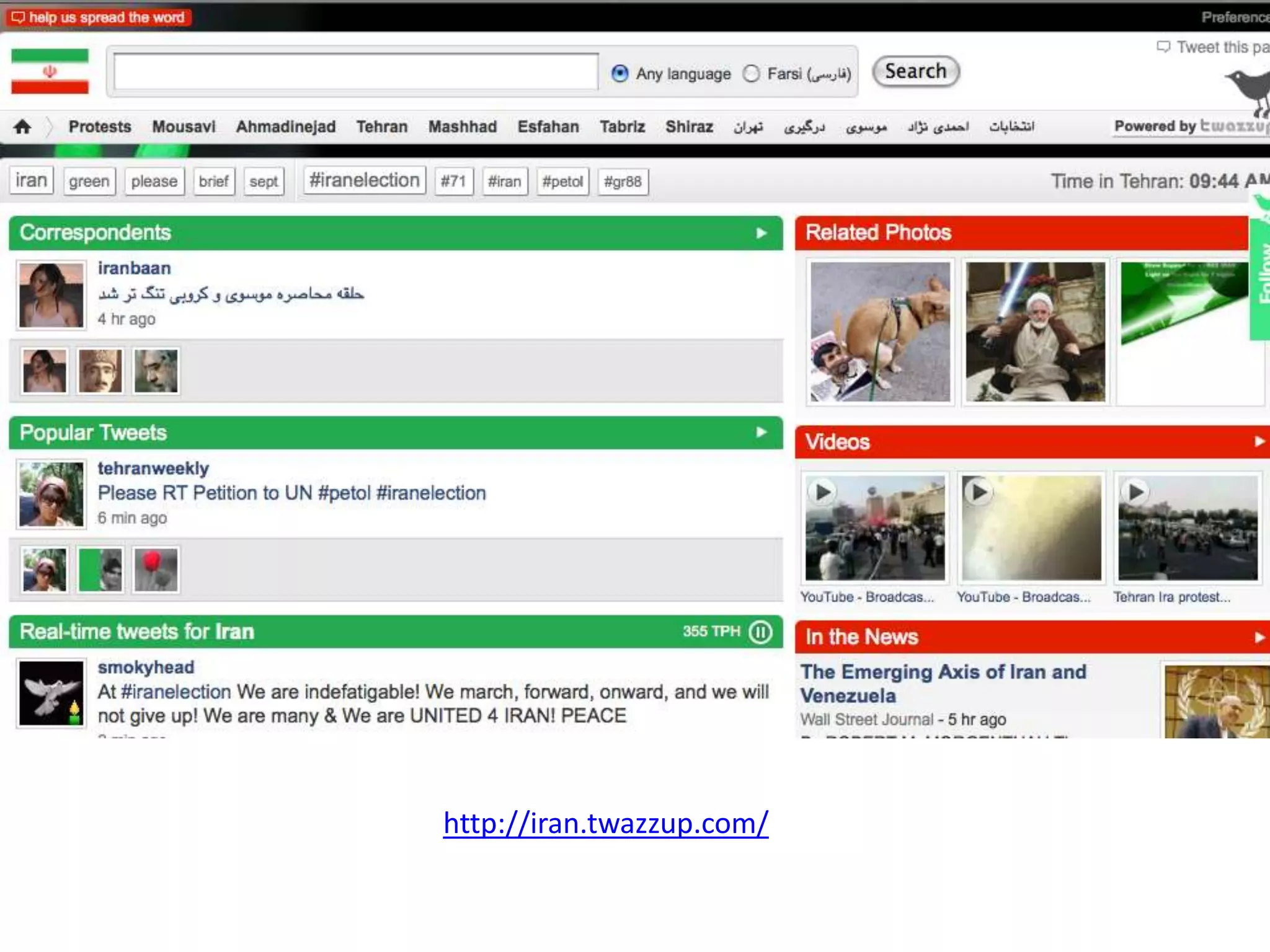
http://iran.twazzup.com/
Using, leveraging, deploying information in new ways to organize for change.
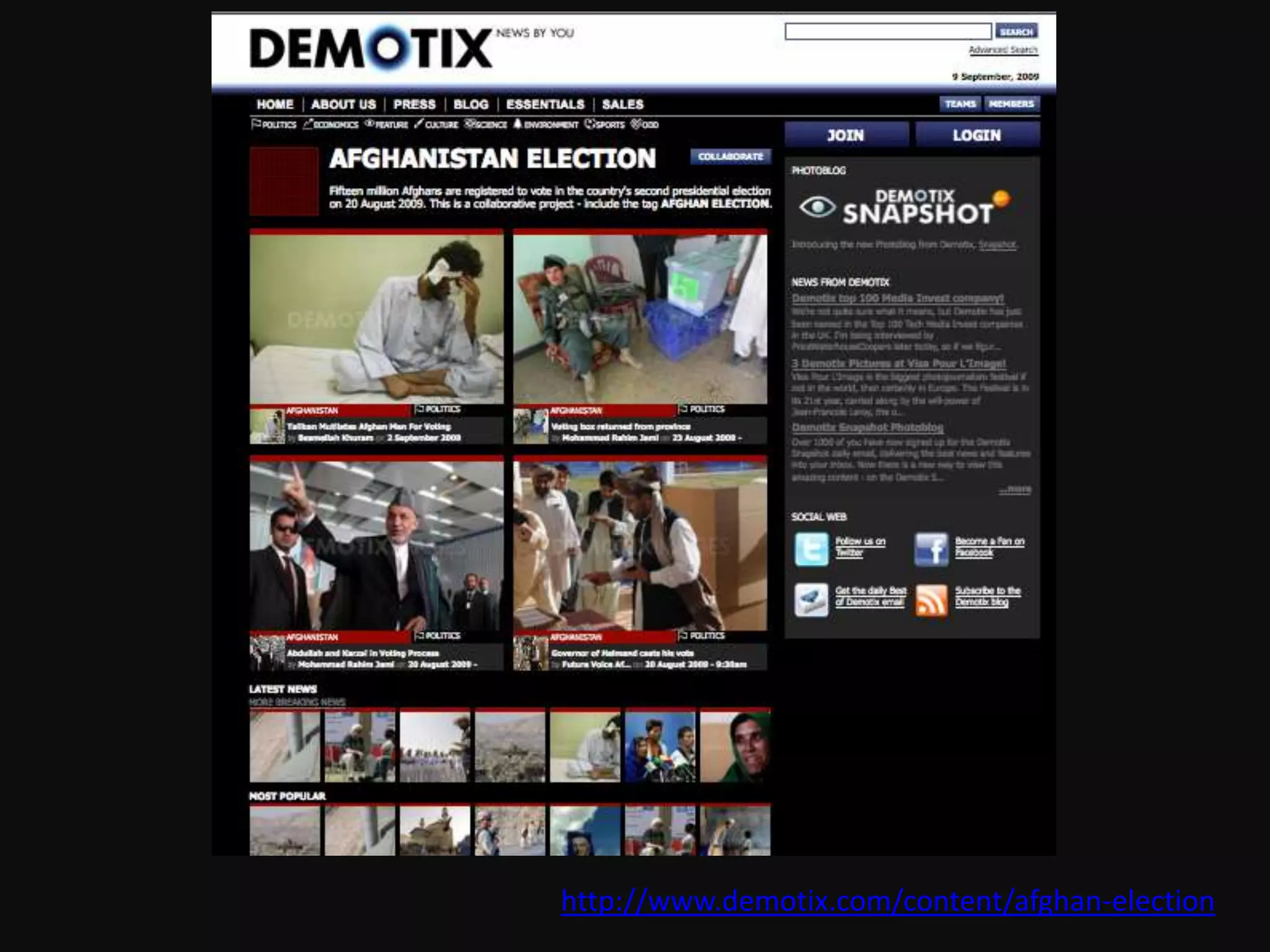
http://www.demotix.com/content/afghan-election
Who is an expert?
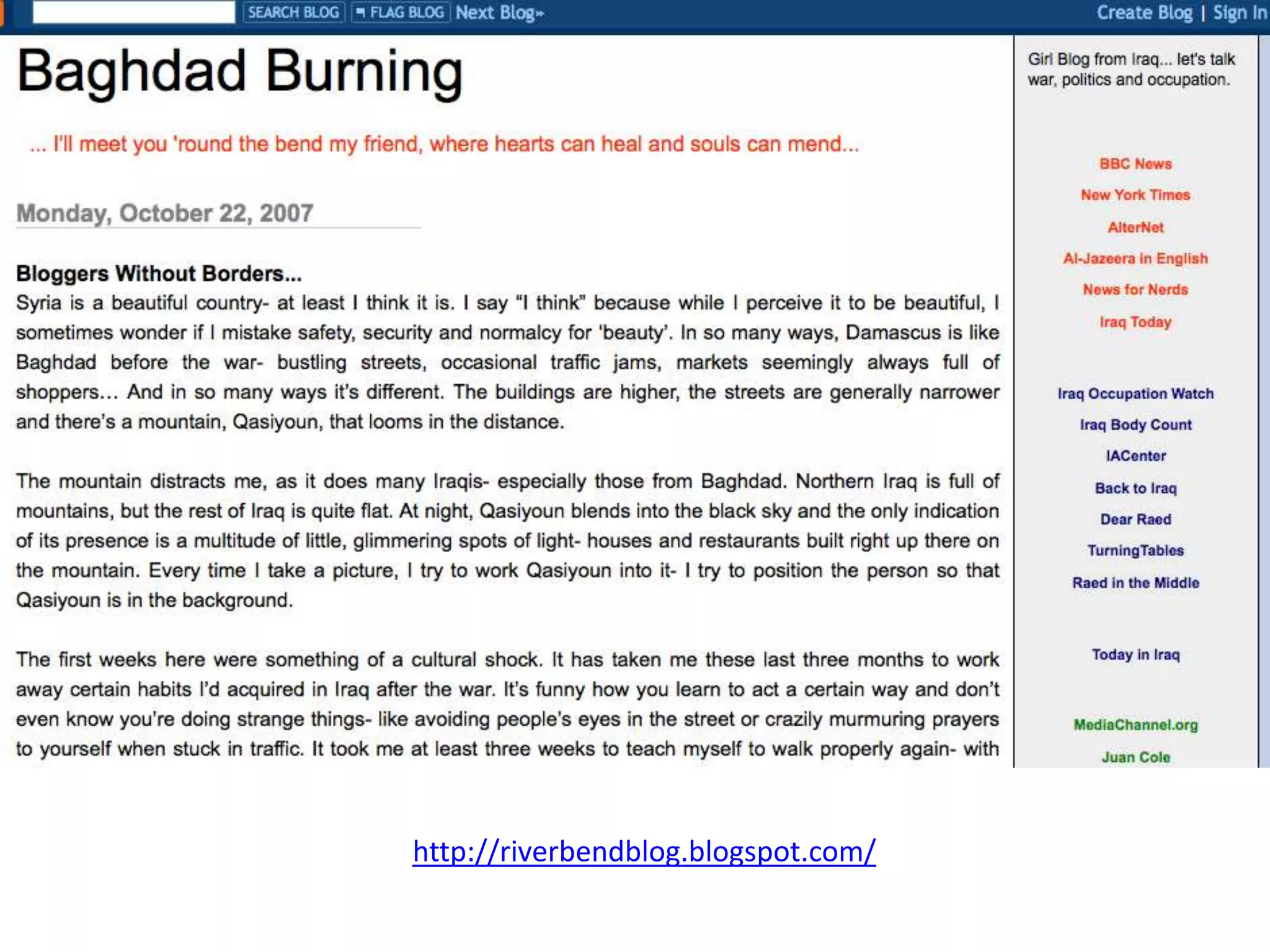
http://riverbendblog.blogspot.com/
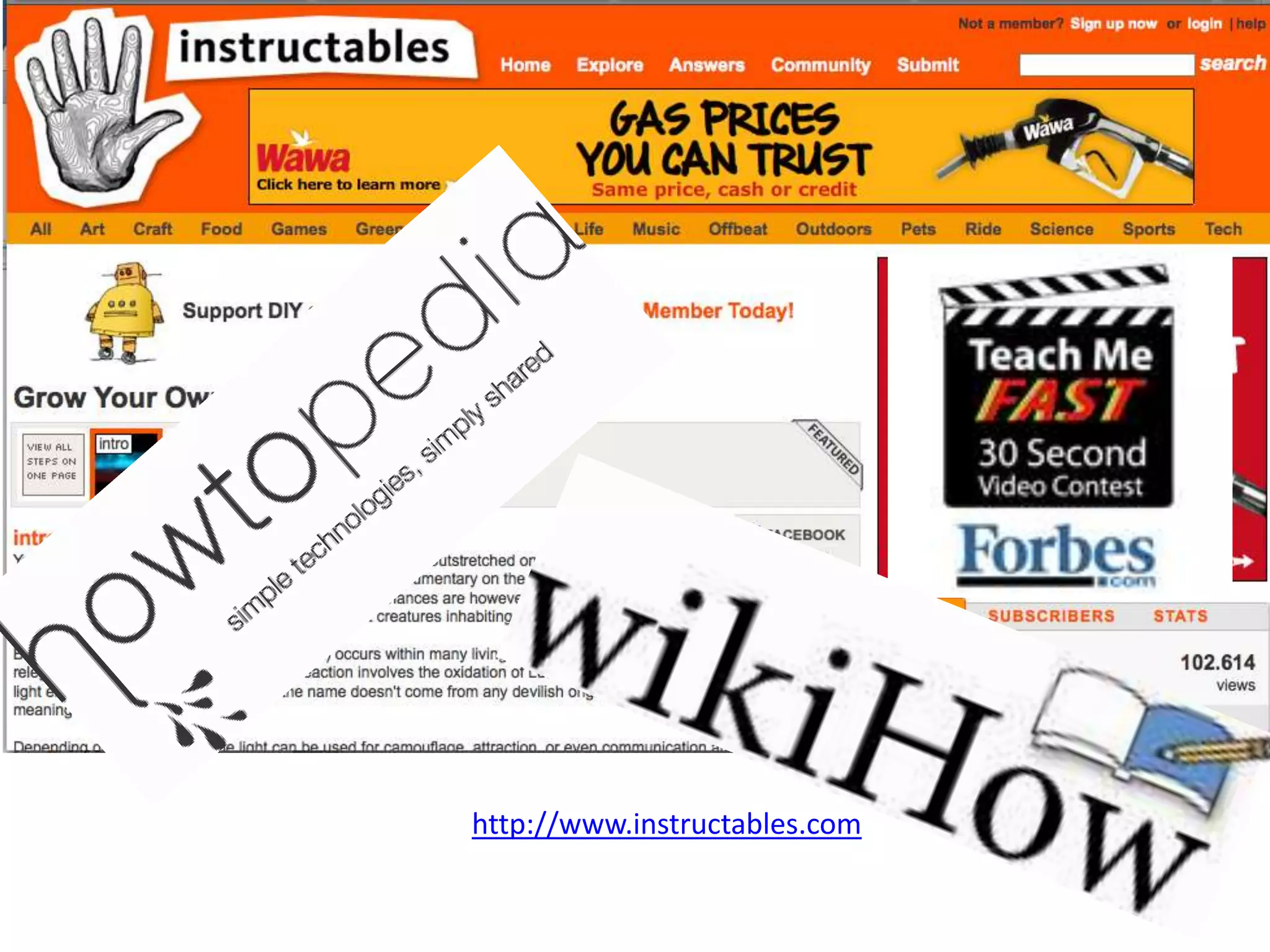
http://www.instructables.com
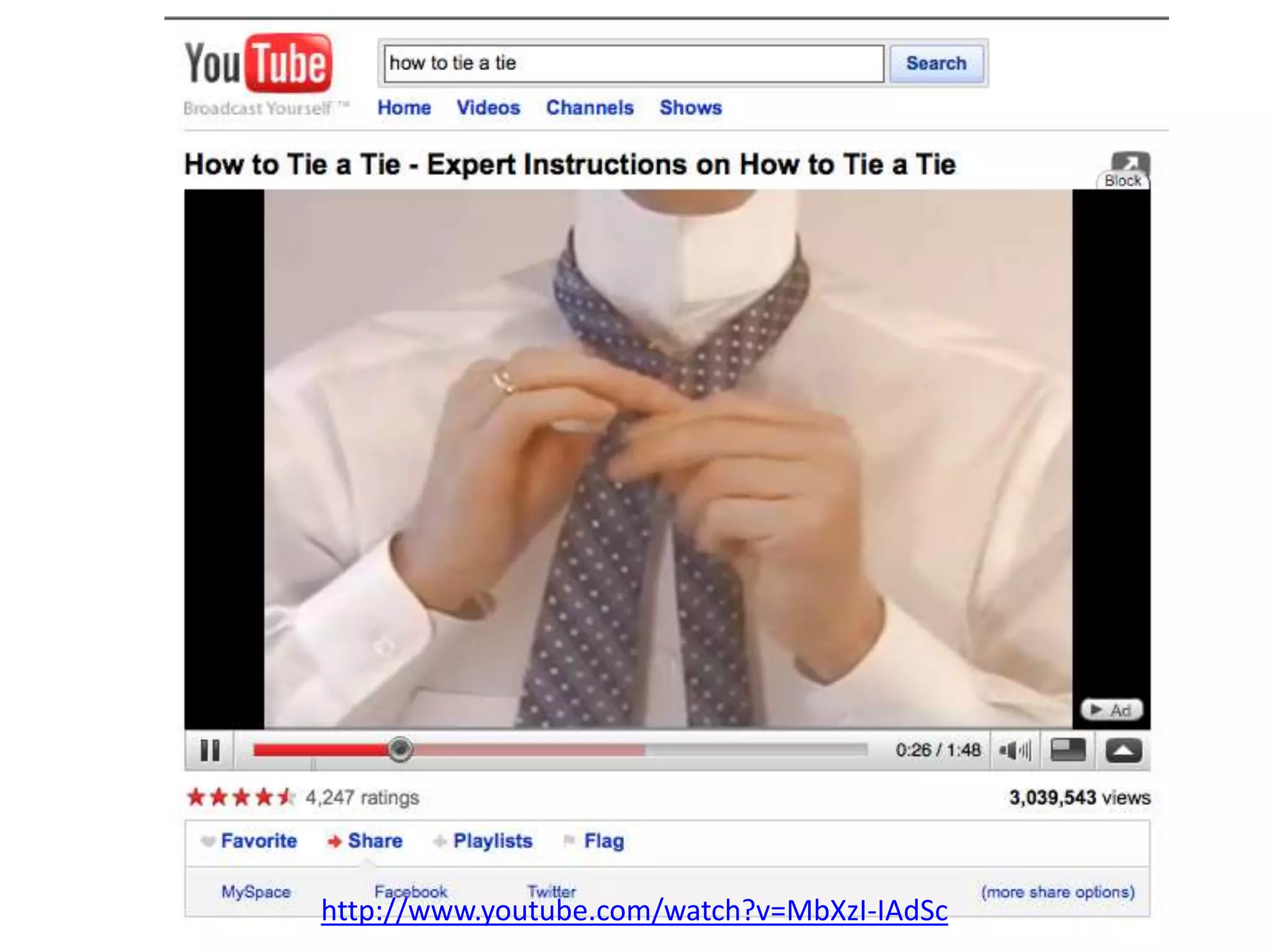
http://www.youtube.com/watch?v=MbXzI-IAdSc
http://yebol.com
Are there new questions?
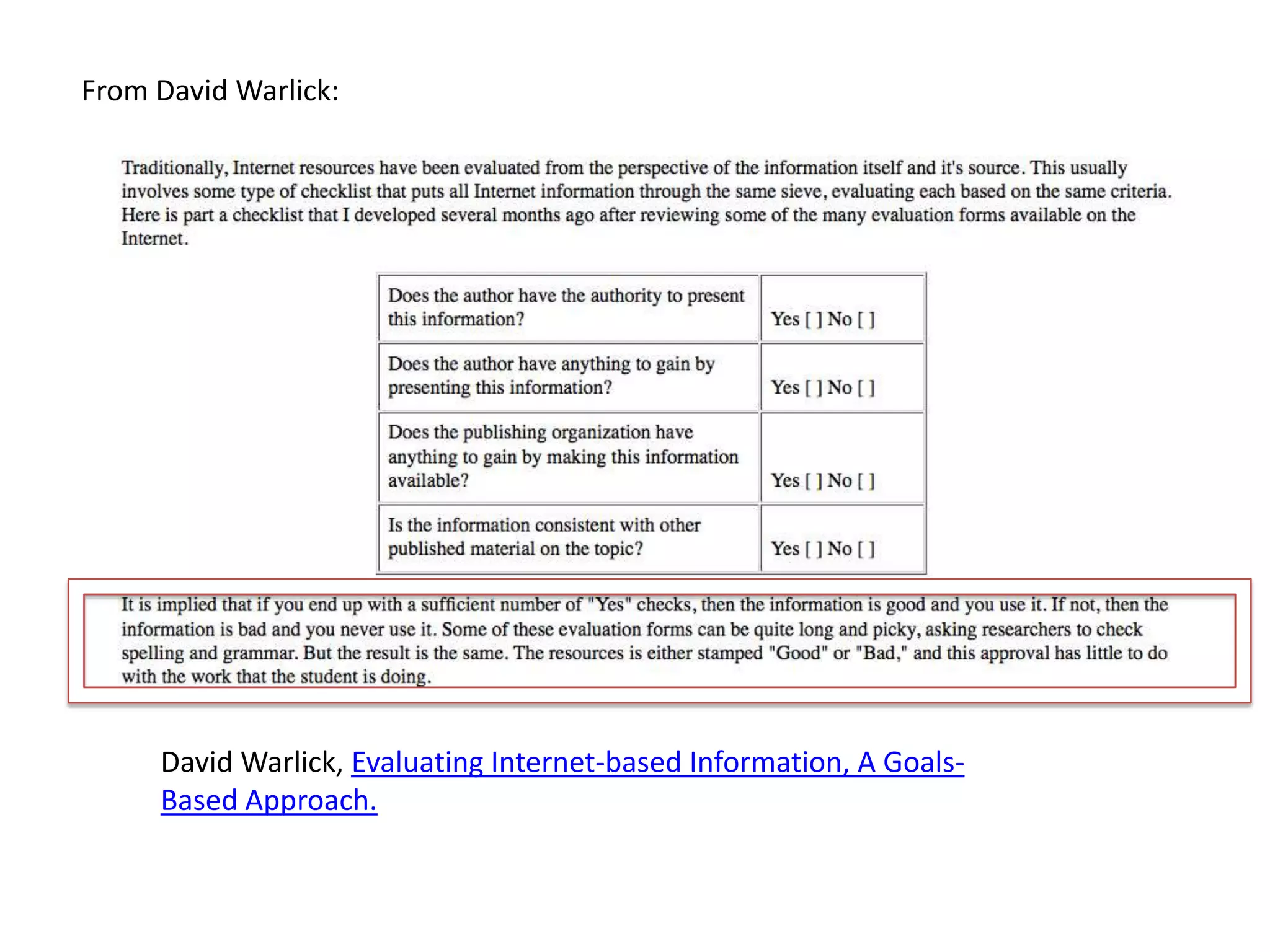
From David Warlick:David Warlick, Evaluating Internet-based Information, A Goals-Based Approach.
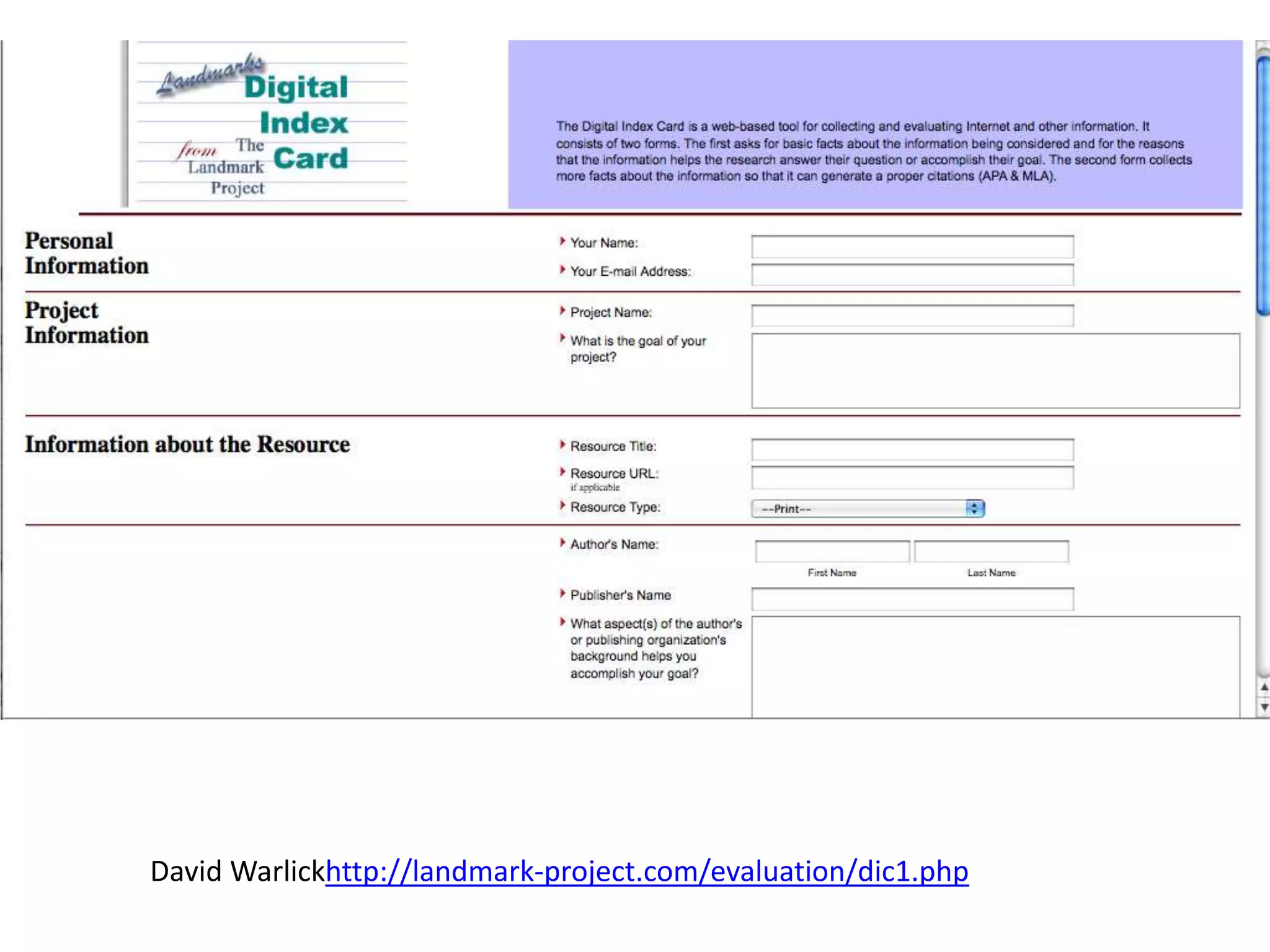
David Warlickhttp://landmark-project.com/evaluation/dic1.php
Thinking about blogs as research sources . . .Who is the blogger? (This may be challenge with so many blogs offering spotty or nonexistent about pages. That may be a clue in itself. )
What sorts of materials is the blogger reading or citing?
Does this blogger have influence? Who and how many people link to the blog? Who is commenting? Does this blog appear to be part of a community? The best blogs are likely to be hubs for folks who share interests with the blogger.
Is this content covered in any depth, with any authority? How sophisticated is the language, the spelling?
Is this blog alive? It there a substantial archive? How current are the posts?
At what point in a story’s lifetime did the post appear? Examining a story’s date may offer clues as to the reliability of a blog entry.
Is the site upfront about its bias? Does it recognize/discuss other points of view? (For certain information tasks, an essay or debate or student blog, bias may be very useful. You need to recognize it. )
If the blogger is not a traditional expert, is this a first-hand view that would be valuable to your research? Is it a unique perspective?
Is the blog rated in any way?  Has it won any awards?  Gotten reviews? Tools like Technorati and Blogpulse can help you assess the influence of a blog.
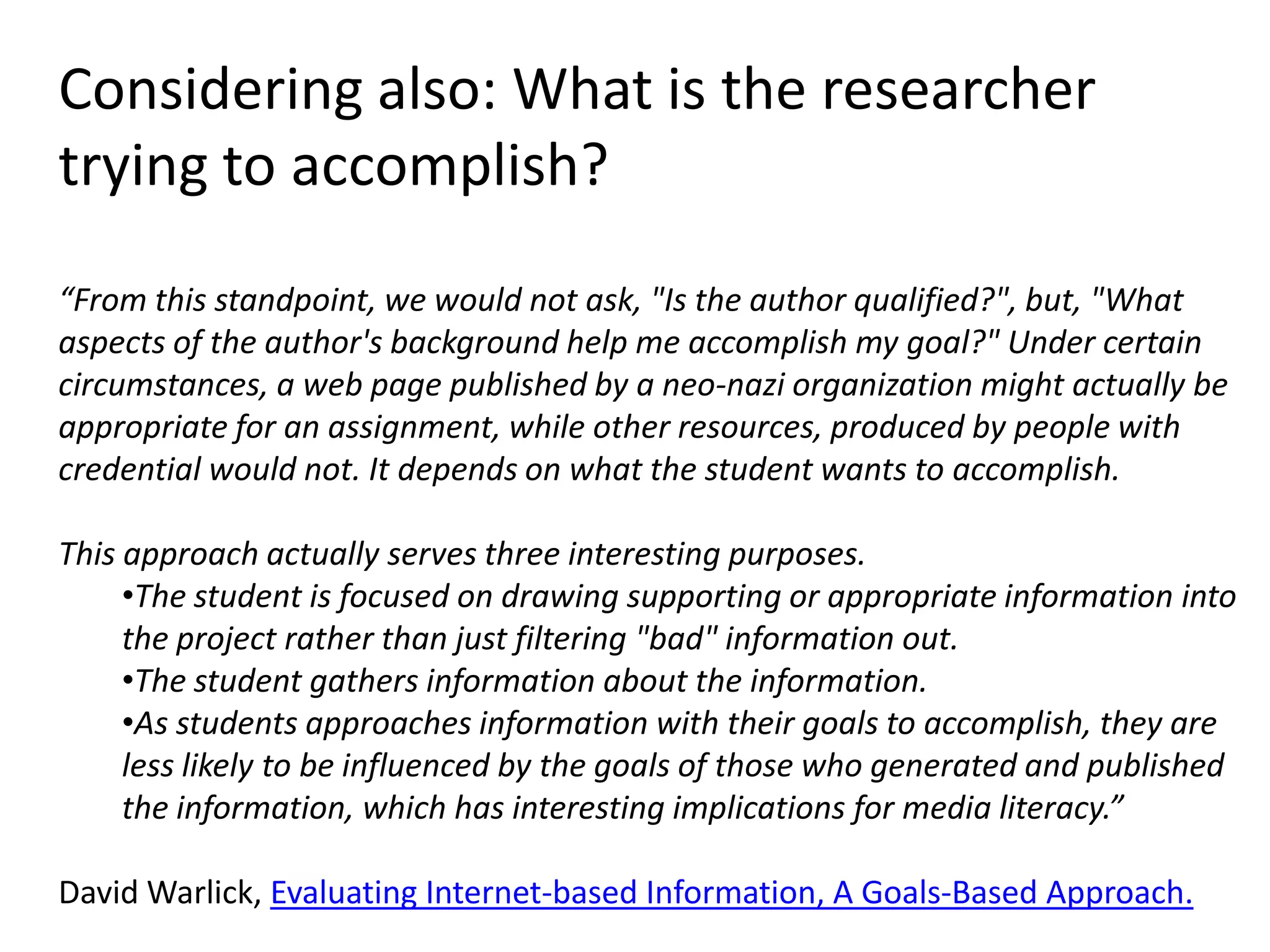
How useful is it to your research?Considering also: What is the researcher trying to accomplish?“From this standpoint, we would not ask, "Is the author qualified?", but, "What aspects of the author's background help me accomplish my goal?" Under certain circumstances, a web page published by a neo-nazi organization might actually be appropriate for an assignment, while other resources, produced by people with credential would not. It depends on what the student wants to accomplish. This approach actually serves three interesting purposes. The student is focused on drawing supporting or appropriate information into the project rather than just filtering "bad" information out.
The student gathers information about the information.
As students approaches information with their goals to accomplish, they are less likely to be influenced by the goals of those who generated and published the information, which has interesting implications for media literacy.”David Warlick, Evaluating Internet-based Information, A Goals-Based Approach.
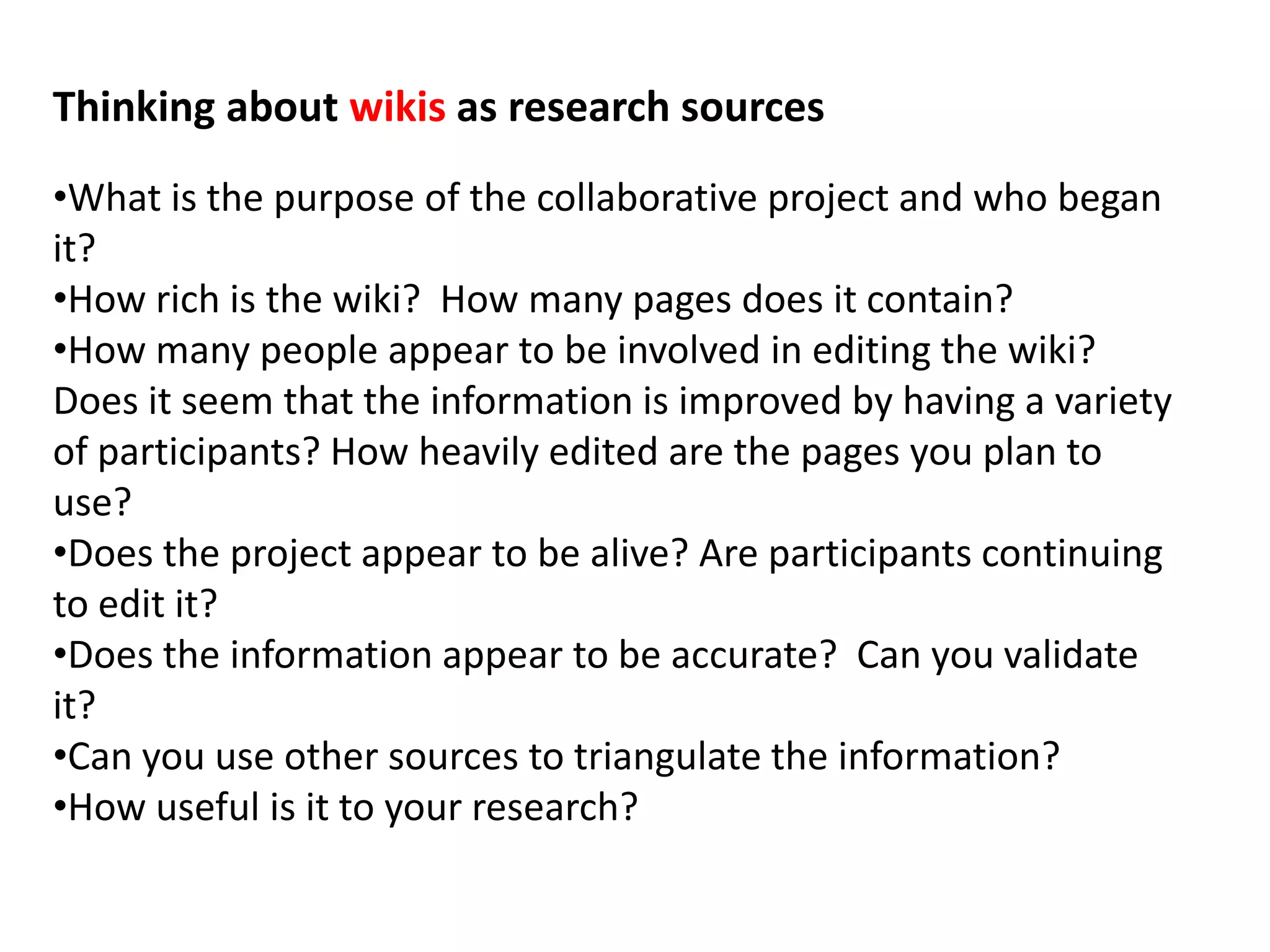
Thinking about wikis as research sourcesWhat is the purpose of the collaborative project and who began it?
How rich is the wiki?  How many pages does it contain?
How many people appear to be involved in editing the wiki?  Does it seem that the information is improved by having a variety of participants? How heavily edited are the pages you plan to use?
Does the project appear to be alive? Are participants continuing to edit it?
Does the information appear to be accurate?  Can you validate it?
Can you use other sources to triangulate the information?
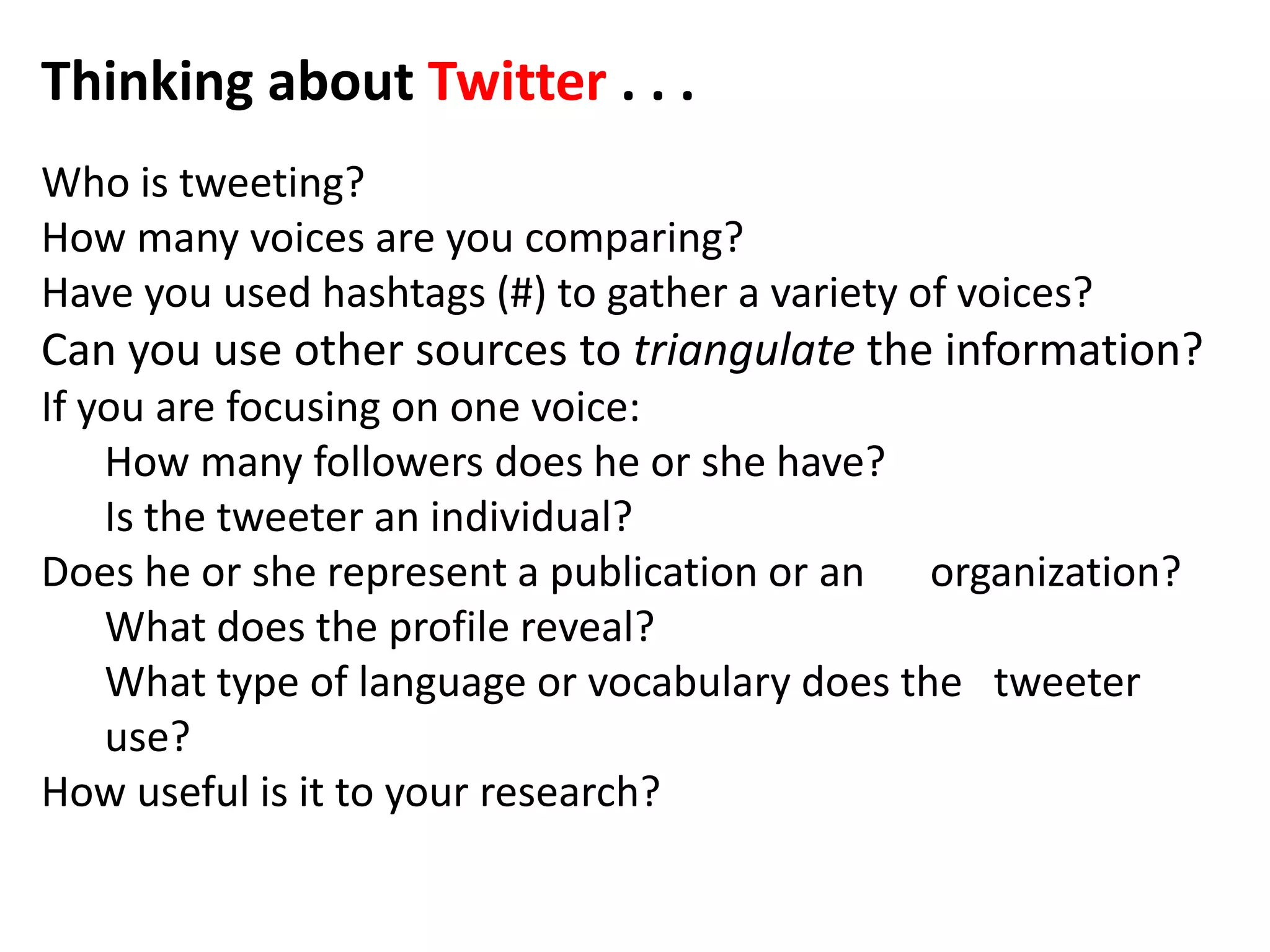
How useful is it to your research?Thinking about Twitter . . .Who is tweeting?How many voices are you comparing?Have you used hashtags (#) to gather a variety of voices?Can you use other sources to triangulate the information?If you are focusing on one voice:	How many followers does he or she have?	Is the tweeter an individual?  Does he or she represent a publication or an     	organization?	What does the profile reveal?	What type of language or vocabulary does the  	tweeter 	use?How useful is it to your research?
The PLN:as information filter.You build it based on your own information criteria

Truth: will they have an app for that?

  • 1.
    truth(Will they havean app for that?)joycekasmanvalenza
  • 2.
  • 3.
  • 4.
  • 5.
  • 6.
    some of myold slides
  • 7.
    Think of CARRDSSCREDIBILITY/ AUTHORITYACCURACYRELIABILITYRELEVANCEDATESOURCES BEHIND THE TEXTSCOPE AND PURPOSE
  • 8.
    CREDIBILITY / AUTHORITY:Who is the author? What are his or her credentials? Education? Experience? Affiliation?Does the author’s experience really qualify him or her as an expert?Does he or she offer first-hand credibility? (For instance, a Vietnam veteran or a witness to Woodstock?)Who actually published this page?Is this a personal page or is it part of the site belonging to a major institution? (Clues pointing to a personal page: ~ tilde, %, users, members)Is the page hosted by a free server like AOL, Tripod,
  • 9.
    But what ifI can’t find any author information?
  • 10.
    Look for credibilityclues!Words and phrases to look for:About us, Who Am I, FAQs, For More, Company Information, Profiles, Our Staff, HomeE-mail the authorIf you have no information other than an e-mail link, write a polite e-mail asking for more information.
  • 11.
    More credibility clues(Whatdo others think?)Do a link checkIn Google or AltaVista typelink:siteaddressYour results will show which other sites have chosen to link to this page. If respectable institutions have linked to a site, that provides a clue about the site’s credibility.Does the site appear in major subject directories like Librarian’s Index to the Internet (lii.org)?
  • 12.
    Truncate the URLDeletecharacters in the address line up to the next slash mark to see if a main page offers more information about who is responsible for publishing the page you are interested in.Go from:http://www.statecollege.edu/history/middleages/chaucer/smith.htm
  • 13.
  • 14.
  • 15.
  • 16.
    http://www.statecollege.eduStill more credibilitycluesIf you have an author’s name but no further information about credentials,Search the name in quotation marks in a search engine or online databaseOn the Web, include words like profile, resume, or C.V. (curriculum vitae--an academic resume) to narrow your name searchYou might also include the name of a college or association you can connect with the personSearch the name in biographical sources on- and offlineAsk your teacher-librarian for help
  • 17.
  • 18.
  • 20.
  • 21.
    Valentine, Timothy. There’sa Hole in the Bucket-1.” 2 June 2008. Flickr. Web. <http://www.flickr.com/photos/el_ramon/2544912168/>.
  • 22.
    More about TheCommonsLaunched on January 16, 2008 in partnership with Library of Congress. Objectives: 1. To increase access to publicly-held photography collections, and 2. To provide a way for the general public to contribute information and knowledge. (Then watch what happens when they do!)
  • 23.
  • 24.
  • 27.
    The smartest personin the room is not the person at the front of the room. The smartest person in the room, is the room! David Weinberger, BLC, July 2009
  • 28.
    "Nobody is assmart as everybody.”Founding executive editor of Wired, Kevin Kelly
  • 29.
    There may notbe a single right answer.
  • 30.
    All of ourtexts are flawed.
  • 31.
  • 32.
  • 33.
    Is there sucha thing as neutral text?
  • 34.
    What is aprimary source?
  • 36.
  • 37.
    Using, leveraging, deployinginformation in new ways to organize for change.
  • 38.
  • 39.
    Who is anexpert?
  • 40.
  • 41.
  • 42.
  • 44.
  • 45.
    Are there newquestions?
  • 46.
    From David Warlick:DavidWarlick, Evaluating Internet-based Information, A Goals-Based Approach.
  • 47.
  • 48.
    Thinking about blogsas research sources . . .Who is the blogger? (This may be challenge with so many blogs offering spotty or nonexistent about pages. That may be a clue in itself. )
  • 49.
    What sorts ofmaterials is the blogger reading or citing?
  • 50.
    Does this bloggerhave influence? Who and how many people link to the blog? Who is commenting? Does this blog appear to be part of a community? The best blogs are likely to be hubs for folks who share interests with the blogger.
  • 51.
    Is this contentcovered in any depth, with any authority? How sophisticated is the language, the spelling?
  • 52.
    Is this blogalive? It there a substantial archive? How current are the posts?
  • 53.
    At what pointin a story’s lifetime did the post appear? Examining a story’s date may offer clues as to the reliability of a blog entry.
  • 54.
    Is the siteupfront about its bias? Does it recognize/discuss other points of view? (For certain information tasks, an essay or debate or student blog, bias may be very useful. You need to recognize it. )
  • 55.
    If the bloggeris not a traditional expert, is this a first-hand view that would be valuable to your research? Is it a unique perspective?
  • 56.
    Is the blograted in any way? Has it won any awards? Gotten reviews? Tools like Technorati and Blogpulse can help you assess the influence of a blog.
  • 57.
    How useful isit to your research?Considering also: What is the researcher trying to accomplish?“From this standpoint, we would not ask, "Is the author qualified?", but, "What aspects of the author's background help me accomplish my goal?" Under certain circumstances, a web page published by a neo-nazi organization might actually be appropriate for an assignment, while other resources, produced by people with credential would not. It depends on what the student wants to accomplish. This approach actually serves three interesting purposes. The student is focused on drawing supporting or appropriate information into the project rather than just filtering "bad" information out.
  • 58.
    The student gathersinformation about the information.
  • 59.
    As students approachesinformation with their goals to accomplish, they are less likely to be influenced by the goals of those who generated and published the information, which has interesting implications for media literacy.”David Warlick, Evaluating Internet-based Information, A Goals-Based Approach.
  • 60.
    Thinking about wikisas research sourcesWhat is the purpose of the collaborative project and who began it?
  • 61.
    How rich isthe wiki? How many pages does it contain?
  • 62.
    How many peopleappear to be involved in editing the wiki? Does it seem that the information is improved by having a variety of participants? How heavily edited are the pages you plan to use?
  • 63.
    Does the projectappear to be alive? Are participants continuing to edit it?
  • 64.
    Does the informationappear to be accurate? Can you validate it?
  • 65.
    Can you useother sources to triangulate the information?
  • 66.
    How useful isit to your research?Thinking about Twitter . . .Who is tweeting?How many voices are you comparing?Have you used hashtags (#) to gather a variety of voices?Can you use other sources to triangulate the information?If you are focusing on one voice: How many followers does he or she have? Is the tweeter an individual? Does he or she represent a publication or an organization? What does the profile reveal? What type of language or vocabulary does the tweeter use?How useful is it to your research?
  • 67.
    The PLN:as informationfilter.You build it based on your own information criteria
  • 68.
  • 69.
    What is theinformation task?
  • 70.
  • 71.
  • 72.
  • 74.
  • 75.
    or developing afilter for crap
  • 76.
  • 77.
  • 78.
  • 81.
    Librarians have arole in truth detection.
  • 82.
    and truth creation.But that’s another story.
  • 83.
    You can foolsome of the people all of the time, and all of the people some of the time,but you can not fool all of the people all of the time.Abraham Lincoln (attributed)
  • 84.
    “Whoever undertakes toset himself up as a judge of Truth and Knowledge is shipwrecked by the laughter of the gods.”Albert Einstein
  • 85.
    Believe nothing justbecause a so-called wise person said it. Believe nothing just because a belief is generally held. Believe nothing just because it is said in ancient books. Believe nothing just because it is said to be of divine origin. Believe nothing just because someone else believes it. Believe only what you yourself test and judge to be true. [paraphrased]Buddha

Editor's Notes

  • #4 It started as golden, absolute.
  • #5 We saw truth, and taught about it, as black and white. Etched in marble.
  • #6 Truth has always been fuzzy. It’s true and it may be either more true or more obvious when information is democratized.
  • #7 It used to work to talk about these things . . .
  • #19 There are lots of holes in lots of buckets.
  • #20 An organization devoted to archiving truth takes a big step in the risk department by opening its collection to the wisdom of the crowd.
  • #24 It’s time to stop demonizing.
  • #35 We are seeing something new and big. Information collaborations.
  • #50 Rheingold--triage