Week 15
     News Literacy
in the Information Age
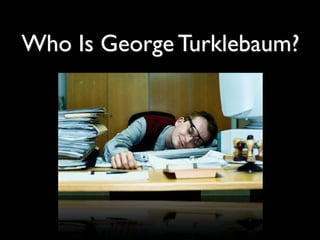
Who Is George Turklebaum?
Three Questions Today:
 1. What are the advantages and
    disadvantages of finding information
    on the Web?
 2. How do you identify reliable
    information on the Web?
 3. How can you minimize the
    disadvantages and maximize the
    advantages?
Context: The Growth of Online Usage
        1968 First Internet-type file-sharing
1989 Tim Berners-Lee, working in Geneva (Switzerland)
             invents World Wide Web

         1995: 9% of Americans are online
        2000: 57% of Americans are online

      2010: 79% of Americans use the Internet
         The Average American Adult Now Spends
            13 Hours A Week on the Internet
                                      Source: Harris Polls
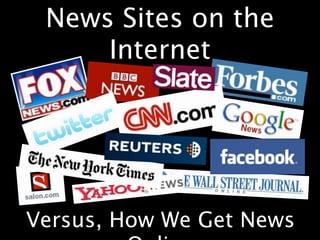
News Sites on the
     Internet


Versus, How We Get News
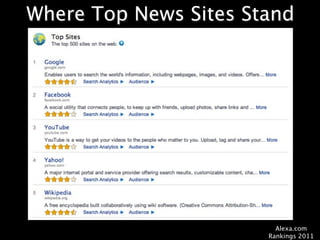
Where Top News Sites Stand
         Overall


                         Alexa.com
                       Rankings 2011
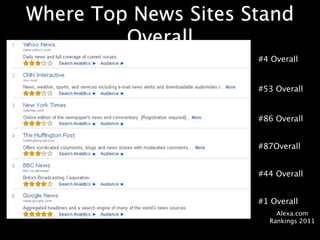
Where Top News Sites Stand
         Overall
                      #4 Overall


                      #53 Overall


                      #86 Overall


                      #87Overall


                      #44 Overall


                      #1 Overall
                          Alexa.com
                        Rankings 2011
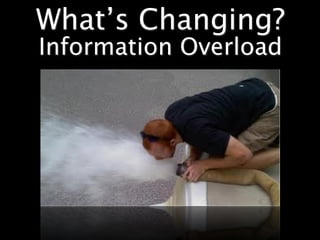
What’s Changing?
Information Overload
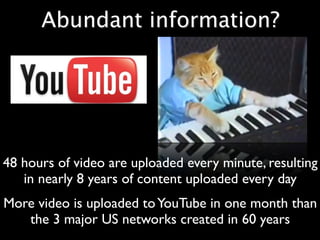
Abundant information?


48 hours of video are uploaded every minute, resulting
   in nearly 8 years of content uploaded every day
More video is uploaded to YouTube in one month than
   the 3 major US networks created in 60 years
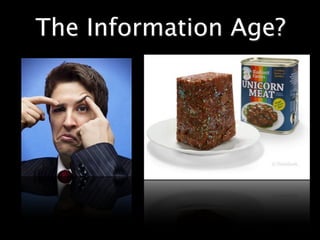
The Information Age?
News on the Web -
       Disadvantages
    Emphasis on Speed Over
            Accuracy
Blurring of Lines Between News,
   Opinion, and Advertising
News on the Web -
   Disadvantages
   Abundance Doesn’t
 Guarantee You’ll Choose
           Quality
“Disinhibition Effect” Makes
Comment Sites Troll Habitat

Underfunding of Newsrooms
Erodes Quality of Journalism
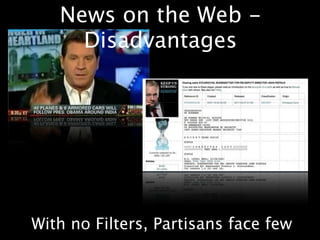
 With No “Filters” There Are
Also No Barriers to Partisans
News on the Web -
  Disadvantages


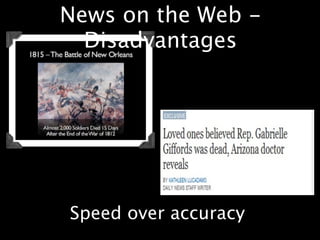
Speed over accuracy
News on the Web -
   Disadvantages


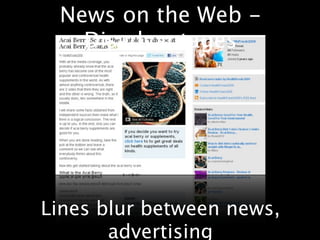
Lines blur between news,
       advertising
News on the Web -
      Disadvantages


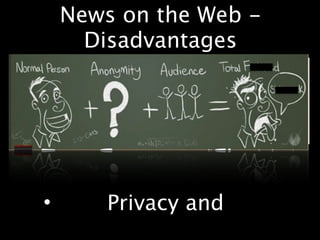
•       Privacy and
News on the Web -
     Disadvantages


With no Filters, Partisans face few
Did the characteristics of reliable
information change when news moved
                online?
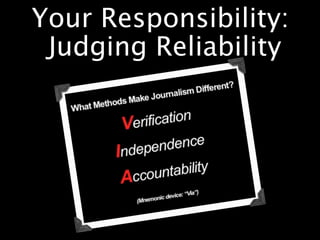
         Verification
       Independence
       Accountability
          (Mnemonic device: “Via”)
News on the Web -
            Advantages
•   Fast          • Customizabl
•   Convenient e
•   Democratic • Archival
•   Participatory • Multimedia
Speed Kills…Errors


http://www.regrettheerror.com/
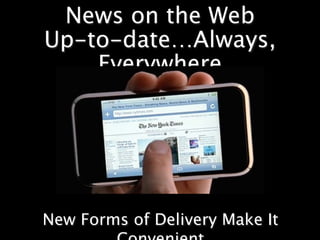
News on the Web
Up-to-date…Always,
    Everywhere


New Forms of Delivery Make It
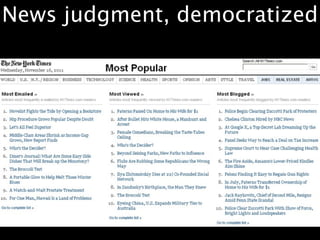
News judgment, democratized
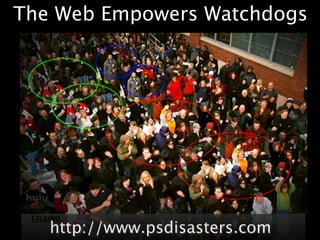
The Web Empowers Watchdogs


   http://www.psdisasters.com
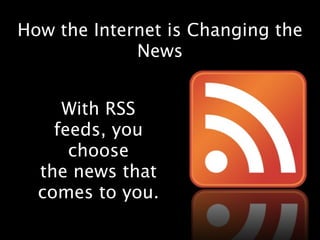
How the Internet is Changing the
             News


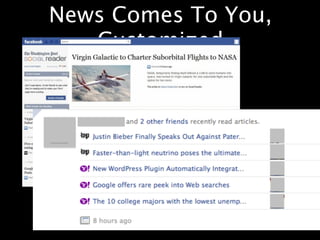
     With RSS
    feeds, you
      choose
  the news that
  comes to you.
News Comes To You,
   Customized
27
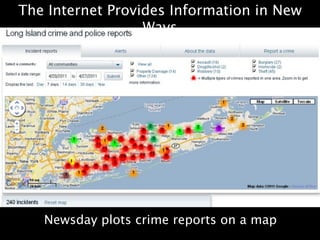
The Internet Provides Information in New
                  Ways


   Newsday plots crime reports on a map
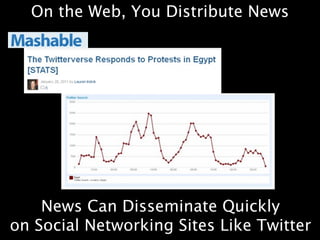
On the Web, You Distribute News


    News Can Disseminate Quickly
on Social Networking Sites Like Twitter
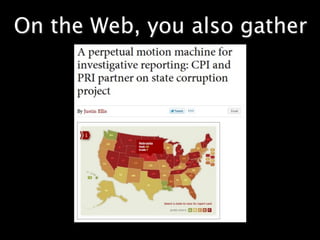
On the Web, you also gather
          news
The Consequence of Increased User
           Power is…


       You
  Have More
 Responsibility
“With great power comes
great responsibility,”
                 -Uncle Ben
Your Responsibility:
 Judging Reliability
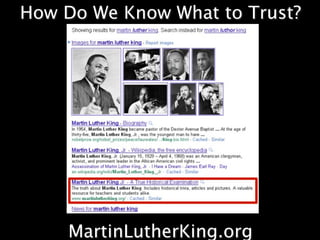
How Do We Know What to Trust?


    MartinLutherKing.org
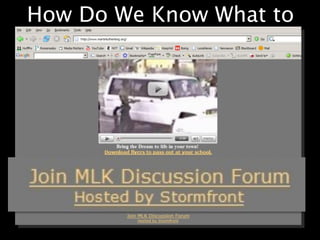
How Do We Know What to
        Trust?


   MartinLutherKing.org
How Do We Know What to
        Trust?
How Do We Know What to
        Trust?


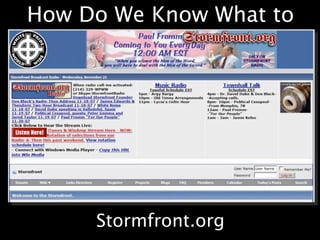
     Stormfront.org
Key Lesson


Rank ≠ Reliability
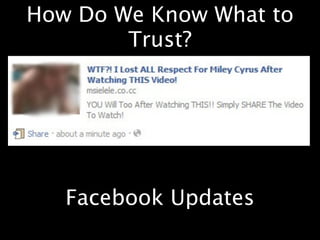
How Do We Know What to
        Trust?


   Facebook Updates
Key Lesson:


Popularity ≠
 Reliability
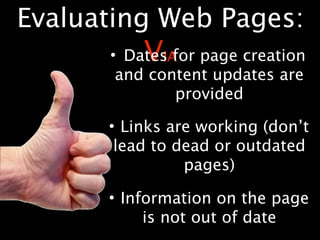
Evaluating Web Pages:
          V
      • Dates for page creation
             IA
       and content updates are
               provided

      • Links are working (don’t
       lead to dead or outdated
                pages)

      • Information on the page
           is not out of date
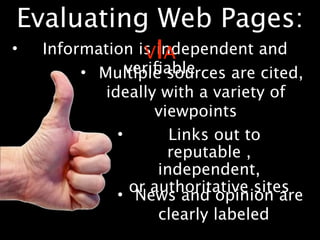
Evaluating Web Pages:
•  Information is IA
                V independent and
              verifiable
       • Multiple sources are cited,
          ideally with a variety of
                  viewpoints
            •        Links out to
                    reputable ,
                   independent,
               or authoritative sites
            • News and opinion are
                   clearly labeled
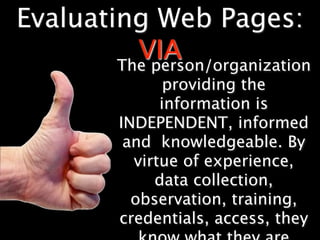
Evaluating Web Pages:
          VIA
        The person/organization
                 providing the
                information is
          INDEPENDENT, informed
           and knowledgeable. By
            virtue of experience,
               data collection,
            observation, training,
          credentials, access, they
Evaluating Web Pages:
          VIA

       • “About Us” easily found,
             and with robust
            information about
           funding, ownership,
           contact numbers for
             corrections, etc.
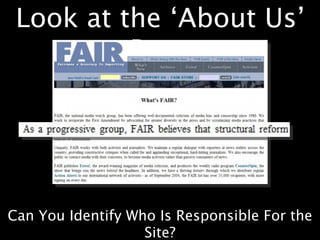
Look at the ‘About Us’
          Page


Can You Identify Who Is Responsible For the
                   Site?
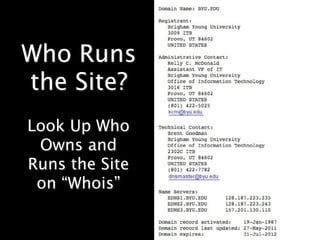
Who Runs
the Site?
Look Up Who
 Owns and
Runs the Site
 on “Whois”
.COM
.COM can be purchased by any
person or company from any country

 It is suggested that .COM be
reserved for commercial interests
(businesses). There are no
restrictions for use.
.ORG
.ORG can be purchased by any
person or company from any country

.ORG is often used to denote
Organizations, specifically Non-Profit
Organizations, BUT, there are no
restrictions for use.
.NET
.NET can be purchased by any
person or company from any country

 It is suggested that .NET be
reserved for internet providers and
the like, BUT there are no
restrictions.
.EDU
.EDU IS RESTRICTED!

 It can only be used by regionally
accredited, degree granting
institutions. Each institution may
only hold a single .EDU domain.
Mostly used for US schools.
.GOV
.GOV IS RESTRICTED!

 It can only be used by United
States governmental organizations.

Registration is done through the
US government directly.
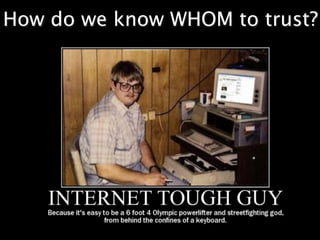
How do we know WHOM to trust?
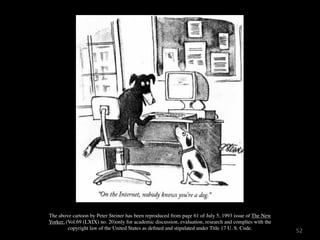
The above cartoon by Peter Steiner has been reproduced from page 61 of July 5, 1993 issue of The New
Yorker, (Vol.69 (LXIX) no. 20)only for academic discussion, evaluation, research and complies with the
         copyright law of the United States as defined and stipulated under Title 17 U. S. Code.
                                                                                                         52
Information on the Web:
    Advantages and
     Disadvantages
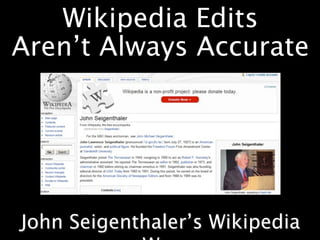
Wikipedia Edits
Aren’t Always Accurate


John Seigenthaler’s Wikipedia
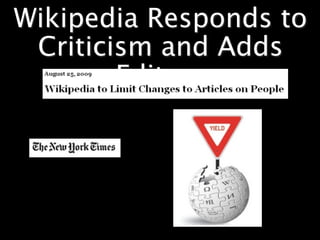
Wikipedia Responds to
 Criticism and Adds
        Editors
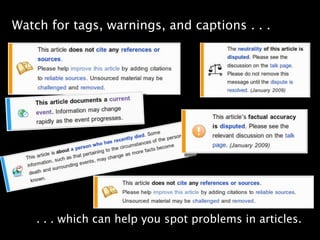
Watch for tags, warnings, and captions . . .


    . . . which can help you spot problems in articles.
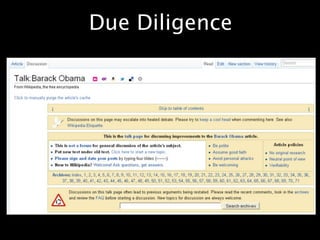
Due Diligence
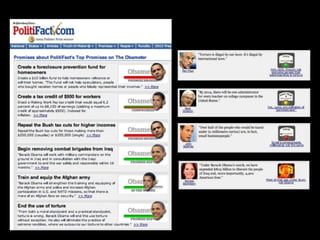
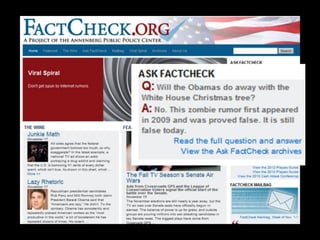
Shortcuts: Is It a Hoax?


      Check Snopes
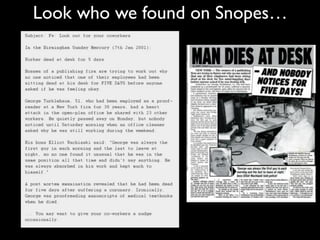
Look who we found on Snopes…
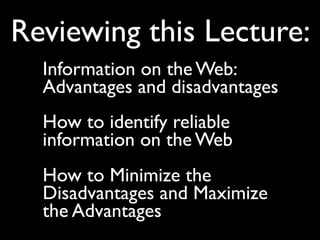
Reviewing this Lecture:
  Information on the Web:
  Advantages and disadvantages
  How to identify reliable
  information on the Web
  How to Minimize the
  Disadvantages and Maximize
  the Advantages
The Big Lessons
          You have the power
 to slow down the rush of information
  Don’t Let The Speed of Information
Drive the Pace of Your Critical Thinking
Rank and popularity do not guarantee
            reliability
            Remember VIA!
Due today


      •   Final Essay
      •   TV deconstruction
          assignment (NewsU)
Extra credit
• Student rating of this class (release
  your name)
Final Exam

•   Emailed to you tonight
•   Four questions, 25 points
    each
•   Last half of the course
Farewell....

Dec 7 lecture

  • 1.
    Week 15 News Literacy in the Information Age
  • 3.
    Who Is GeorgeTurklebaum?
  • 5.
    Three Questions Today: 1. What are the advantages and disadvantages of finding information on the Web? 2. How do you identify reliable information on the Web? 3. How can you minimize the disadvantages and maximize the advantages?
  • 6.
    Context: The Growthof Online Usage 1968 First Internet-type file-sharing 1989 Tim Berners-Lee, working in Geneva (Switzerland) invents World Wide Web 1995: 9% of Americans are online 2000: 57% of Americans are online 2010: 79% of Americans use the Internet The Average American Adult Now Spends 13 Hours A Week on the Internet Source: Harris Polls
  • 7.
    News Sites onthe Internet Versus, How We Get News
  • 8.
    Where Top NewsSites Stand Overall Alexa.com Rankings 2011
  • 9.
    Where Top NewsSites Stand Overall #4 Overall #53 Overall #86 Overall #87Overall #44 Overall #1 Overall Alexa.com Rankings 2011
  • 10.
  • 11.
    Abundant information? 48 hoursof video are uploaded every minute, resulting in nearly 8 years of content uploaded every day More video is uploaded to YouTube in one month than the 3 major US networks created in 60 years
  • 12.
  • 13.
    News on theWeb - Disadvantages Emphasis on Speed Over Accuracy Blurring of Lines Between News, Opinion, and Advertising
  • 14.
    News on theWeb - Disadvantages Abundance Doesn’t Guarantee You’ll Choose Quality “Disinhibition Effect” Makes Comment Sites Troll Habitat Underfunding of Newsrooms Erodes Quality of Journalism With No “Filters” There Are Also No Barriers to Partisans
  • 15.
    News on theWeb - Disadvantages Speed over accuracy
  • 16.
    News on theWeb - Disadvantages Lines blur between news, advertising
  • 17.
    News on theWeb - Disadvantages • Privacy and
  • 18.
    News on theWeb - Disadvantages With no Filters, Partisans face few
  • 19.
    Did the characteristicsof reliable information change when news moved online? Verification Independence Accountability (Mnemonic device: “Via”)
  • 20.
    News on theWeb - Advantages • Fast • Customizabl • Convenient e • Democratic • Archival • Participatory • Multimedia
  • 21.
  • 22.
    News on theWeb Up-to-date…Always, Everywhere New Forms of Delivery Make It
  • 23.
  • 24.
    The Web EmpowersWatchdogs http://www.psdisasters.com
  • 25.
    How the Internetis Changing the News With RSS feeds, you choose the news that comes to you.
  • 26.
    News Comes ToYou, Customized
  • 27.
  • 28.
    The Internet ProvidesInformation in New Ways Newsday plots crime reports on a map
  • 29.
    On the Web,You Distribute News News Can Disseminate Quickly on Social Networking Sites Like Twitter
  • 30.
    On the Web,you also gather news
  • 31.
    The Consequence ofIncreased User Power is… You Have More Responsibility “With great power comes great responsibility,” -Uncle Ben
  • 32.
  • 33.
    How Do WeKnow What to Trust? MartinLutherKing.org
  • 34.
    How Do WeKnow What to Trust? MartinLutherKing.org
  • 35.
    How Do WeKnow What to Trust?
  • 36.
    How Do WeKnow What to Trust? Stormfront.org
  • 37.
  • 38.
    How Do WeKnow What to Trust? Facebook Updates
  • 39.
  • 40.
    Evaluating Web Pages: V • Dates for page creation IA and content updates are provided • Links are working (don’t lead to dead or outdated pages) • Information on the page is not out of date
  • 41.
    Evaluating Web Pages: • Information is IA V independent and verifiable • Multiple sources are cited, ideally with a variety of viewpoints • Links out to reputable , independent, or authoritative sites • News and opinion are clearly labeled
  • 42.
    Evaluating Web Pages: VIA The person/organization providing the information is INDEPENDENT, informed and knowledgeable. By virtue of experience, data collection, observation, training, credentials, access, they
  • 43.
    Evaluating Web Pages: VIA • “About Us” easily found, and with robust information about funding, ownership, contact numbers for corrections, etc.
  • 44.
    Look at the‘About Us’ Page Can You Identify Who Is Responsible For the Site?
  • 45.
    Who Runs the Site? LookUp Who Owns and Runs the Site on “Whois”
  • 46.
    .COM .COM can bepurchased by any person or company from any country  It is suggested that .COM be reserved for commercial interests (businesses). There are no restrictions for use.
  • 47.
    .ORG .ORG can bepurchased by any person or company from any country .ORG is often used to denote Organizations, specifically Non-Profit Organizations, BUT, there are no restrictions for use.
  • 48.
    .NET .NET can bepurchased by any person or company from any country  It is suggested that .NET be reserved for internet providers and the like, BUT there are no restrictions.
  • 49.
    .EDU .EDU IS RESTRICTED! It can only be used by regionally accredited, degree granting institutions. Each institution may only hold a single .EDU domain. Mostly used for US schools.
  • 50.
    .GOV .GOV IS RESTRICTED! It can only be used by United States governmental organizations. Registration is done through the US government directly.
  • 51.
    How do weknow WHOM to trust?
  • 52.
    The above cartoonby Peter Steiner has been reproduced from page 61 of July 5, 1993 issue of The New Yorker, (Vol.69 (LXIX) no. 20)only for academic discussion, evaluation, research and complies with the copyright law of the United States as defined and stipulated under Title 17 U. S. Code. 52
  • 53.
    Information on theWeb: Advantages and Disadvantages
  • 54.
    Wikipedia Edits Aren’t AlwaysAccurate John Seigenthaler’s Wikipedia
  • 55.
    Wikipedia Responds to Criticism and Adds Editors
  • 56.
    Watch for tags,warnings, and captions . . . . . . which can help you spot problems in articles.
  • 57.
  • 58.
    Shortcuts: Is Ita Hoax? Check Snopes
  • 59.
    Look who wefound on Snopes…
  • 62.
    Reviewing this Lecture: Information on the Web: Advantages and disadvantages How to identify reliable information on the Web How to Minimize the Disadvantages and Maximize the Advantages
  • 63.
    The Big Lessons You have the power to slow down the rush of information Don’t Let The Speed of Information Drive the Pace of Your Critical Thinking Rank and popularity do not guarantee reliability Remember VIA!
  • 64.
    Due today • Final Essay • TV deconstruction assignment (NewsU)
  • 65.
    Extra credit • Studentrating of this class (release your name)
  • 66.
    Final Exam • Emailed to you tonight • Four questions, 25 points each • Last half of the course
  • 67.

Editor's Notes