E V A L UA T I O N O F WE B S I T E S
WEBSITE CRITERIA
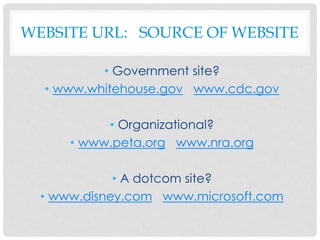
WEBSITE URL: SOURCE OF WEBSITE
• Government site?
• www.whitehouse.gov www.cdc.gov
• Organizational?
• www.peta.org www.nra.org
• A dotcom site?
• www.disney.com www.microsoft.com
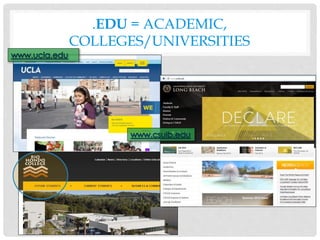
.EDU = ACADEMIC,
COLLEGES/UNIVERSITIES
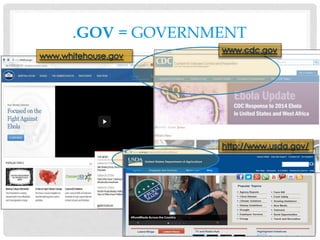
.GOV = GOVERNMENT
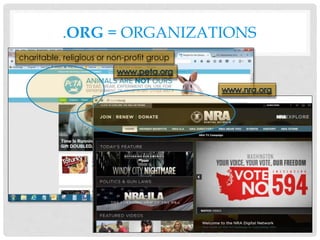
.ORG = ORGANIZATIONS
charitable, religious or non-profit group
.COM = BUSINESS
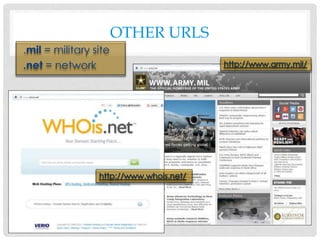
OTHER URLS
.mil = military site
.net = network
CRITERIA
• Purpose: The reason or reasons the item was written. To inform
you about the issue? To persuade you to buy something? To
entertain?
• Authority: The qualifications of the writer. What makes him/her an
expert on the topic? This can apply to both a person and an
organization.
• Currency: The time when the item was written. Is the information
still true? Does your topic need only the most up-to-date
information or would something a few years old be acceptable?
• Accuracy: The absence of errors and use of reliable information.
Is the information correct? Does the source make claims you can
prove? Are there any spelling or grammatical errors?
• Content: The information provided by the item. Does the source
answer the questions you have? Does it contribute new or
different information to your research paper?
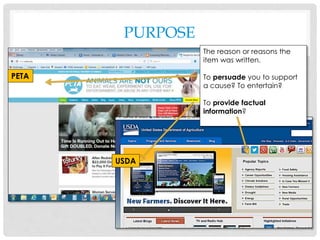
PURPOSE
USDA
PETA
USDA
The reason or reasons the
item was written.
To persuade you to support
a cause? To entertain?
To provide factual
information?
USDA
AUTHORITY [AUTHORSHIP]
Who writes material, entries
or articles for the site?
Who is featured on the site
[experts in the field,
journalists?]
PETA
USDA
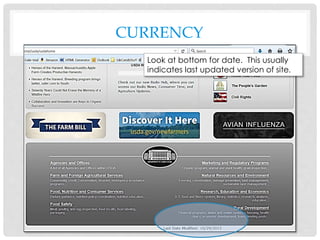
CURRENCY
Look at bottom for date. This usually
indicates last updated version of site.
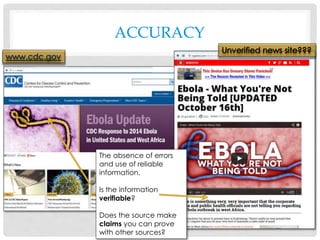
ACCURACY.
The absence of errors
and use of reliable
information.
Is the information
verifiable?
Does the source make
claims you can prove
with other sources?
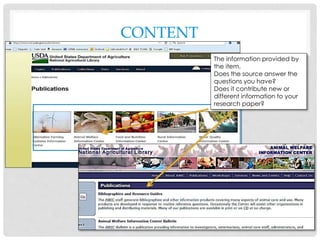
CONTENT
The information provided by
the item.
Does the source answer the
questions you have?
Does it contribute new or
different information to your
research paper?
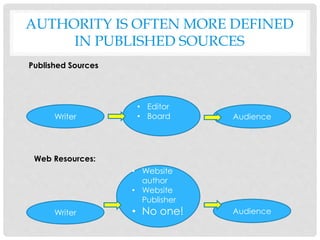
AUTHORITY IS OFTEN MORE DEFINED
IN PUBLISHED SOURCES
Writer
• Editor
• Board Audience
Writer Audience
Published Sources
Web Resources:
• Website
author
• Website
Publisher
• No one!
ORGANIZATIONS = OBJECTIVITY?
Animal Rights
• Organizations
present specific
perspectives on
issues they
represent
• Language Use
[emotional
versus factual]
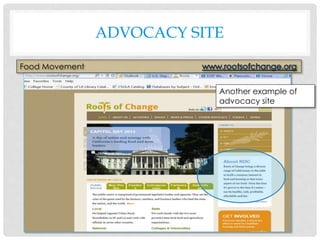
ADVOCACY SITE
Food Movement
Another example of
advocacy site
NEUTRAL VS. ADVOCACY?
• Cigarette smoking: although an issue before
websites, 30 years ago official government sources
supported smoking as a non harmful, or neutral
activity [supported by cigarette manufacturers]
• Food safety/GMOs: although government
websites maintain the safety of GMOs, independent
websites may question this stance
CorporationsGovernment
Public
Where advocacy meets
conflicting motives
VALUE OF ORGANIZATIONAL
WEBSITES
• Sometimes questions existing
information [even factual]
• Presents alternative perspectives on
topics
• Examines conflicting/opposing
viewpoints on topics
WHICH SITE WOULD YOU USE?
Try distinguishing between these two sites for the topic:
Animal Cruelty.
A. Humane Society of America
http://www.humanesociety.org/?credit=web_id235
304807
B. PETA: People for Ethical Treatment of Animals
• http://www.peta.org/
What are some differences between the
sites/organizations?
How do you think each organization approaches the
cause of animal cruelty?
WHICH SITE WOULD YOU USE?
You are writing a research paper exploring the pros and cons of using
“marriage promotion” as a means to decrease poverty and improve
families’ well-being. Which source below would be a more reliable
source of statistics? Be prepared to explain your reasoning.
A. The Heritage Foundation
www.heritage.org/Research/Family/cda0306.cfm
B. The Fragile Families and Child Wellbeing Study
www.fragilefamilies.princeton.edu/
C. Both choices are equally good.
D. Neither choice appears reliable.
WHICH SITE WOULD YOU USE?
You are writing an essay about the health aspects of choosing a
vegetarian diet. Which of the following sources would be a
better place to get objective scientific information?
A. Meat vs. Vegetarian Diet
http://technorati.com/lifestyle/article/meat-vs-
vegetarian-diet-your-best/
B. Vegetarianism in a Nutshell: Health
www.peta.org/living/vegetarian-living/vegetarianism-in-
a-nutshell-health.aspx
C. Both choices are equally good.
D. Neither choice appears reliable.

Webcriteria

  • 1.
    E V AL UA T I O N O F WE B S I T E S WEBSITE CRITERIA
  • 2.
    WEBSITE URL: SOURCEOF WEBSITE • Government site? • www.whitehouse.gov www.cdc.gov • Organizational? • www.peta.org www.nra.org • A dotcom site? • www.disney.com www.microsoft.com
  • 3.
  • 4.
  • 5.
    .ORG = ORGANIZATIONS charitable,religious or non-profit group
  • 6.
  • 7.
    OTHER URLS .mil =military site .net = network
  • 8.
    CRITERIA • Purpose: Thereason or reasons the item was written. To inform you about the issue? To persuade you to buy something? To entertain? • Authority: The qualifications of the writer. What makes him/her an expert on the topic? This can apply to both a person and an organization. • Currency: The time when the item was written. Is the information still true? Does your topic need only the most up-to-date information or would something a few years old be acceptable? • Accuracy: The absence of errors and use of reliable information. Is the information correct? Does the source make claims you can prove? Are there any spelling or grammatical errors? • Content: The information provided by the item. Does the source answer the questions you have? Does it contribute new or different information to your research paper?
  • 9.
    PURPOSE USDA PETA USDA The reason orreasons the item was written. To persuade you to support a cause? To entertain? To provide factual information? USDA
  • 10.
    AUTHORITY [AUTHORSHIP] Who writesmaterial, entries or articles for the site? Who is featured on the site [experts in the field, journalists?] PETA USDA
  • 11.
    CURRENCY Look at bottomfor date. This usually indicates last updated version of site.
  • 12.
    ACCURACY. The absence oferrors and use of reliable information. Is the information verifiable? Does the source make claims you can prove with other sources?
  • 13.
    CONTENT The information providedby the item. Does the source answer the questions you have? Does it contribute new or different information to your research paper?
  • 14.
    AUTHORITY IS OFTENMORE DEFINED IN PUBLISHED SOURCES Writer • Editor • Board Audience Writer Audience Published Sources Web Resources: • Website author • Website Publisher • No one!
  • 15.
    ORGANIZATIONS = OBJECTIVITY? AnimalRights • Organizations present specific perspectives on issues they represent • Language Use [emotional versus factual]
  • 16.
    ADVOCACY SITE Food Movement Anotherexample of advocacy site
  • 17.
    NEUTRAL VS. ADVOCACY? •Cigarette smoking: although an issue before websites, 30 years ago official government sources supported smoking as a non harmful, or neutral activity [supported by cigarette manufacturers] • Food safety/GMOs: although government websites maintain the safety of GMOs, independent websites may question this stance CorporationsGovernment Public Where advocacy meets conflicting motives
  • 18.
    VALUE OF ORGANIZATIONAL WEBSITES •Sometimes questions existing information [even factual] • Presents alternative perspectives on topics • Examines conflicting/opposing viewpoints on topics
  • 19.
    WHICH SITE WOULDYOU USE? Try distinguishing between these two sites for the topic: Animal Cruelty. A. Humane Society of America http://www.humanesociety.org/?credit=web_id235 304807 B. PETA: People for Ethical Treatment of Animals • http://www.peta.org/ What are some differences between the sites/organizations? How do you think each organization approaches the cause of animal cruelty?
  • 20.
    WHICH SITE WOULDYOU USE? You are writing a research paper exploring the pros and cons of using “marriage promotion” as a means to decrease poverty and improve families’ well-being. Which source below would be a more reliable source of statistics? Be prepared to explain your reasoning. A. The Heritage Foundation www.heritage.org/Research/Family/cda0306.cfm B. The Fragile Families and Child Wellbeing Study www.fragilefamilies.princeton.edu/ C. Both choices are equally good. D. Neither choice appears reliable.
  • 21.
    WHICH SITE WOULDYOU USE? You are writing an essay about the health aspects of choosing a vegetarian diet. Which of the following sources would be a better place to get objective scientific information? A. Meat vs. Vegetarian Diet http://technorati.com/lifestyle/article/meat-vs- vegetarian-diet-your-best/ B. Vegetarianism in a Nutshell: Health www.peta.org/living/vegetarian-living/vegetarianism-in- a-nutshell-health.aspx C. Both choices are equally good. D. Neither choice appears reliable.