The Next Step…
Deeper yet into the
Research Pyramid…
Giving credit….
This slide show is based on the original
created by Joyce Valenza
http://www.sdst.org/shs/library/jvweb.html
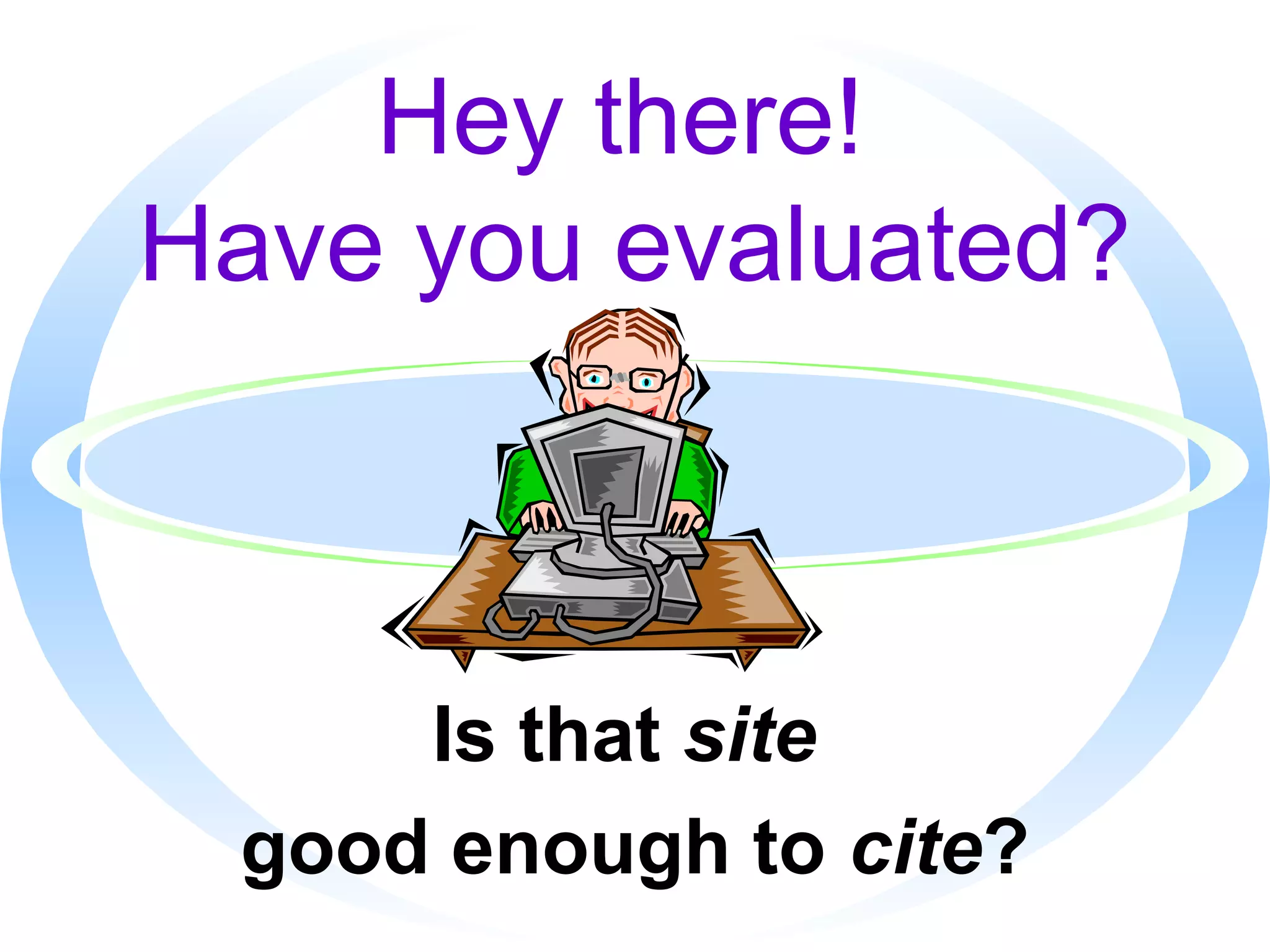
Hey there!
Have you evaluated?
Is that site
good enough to cite?
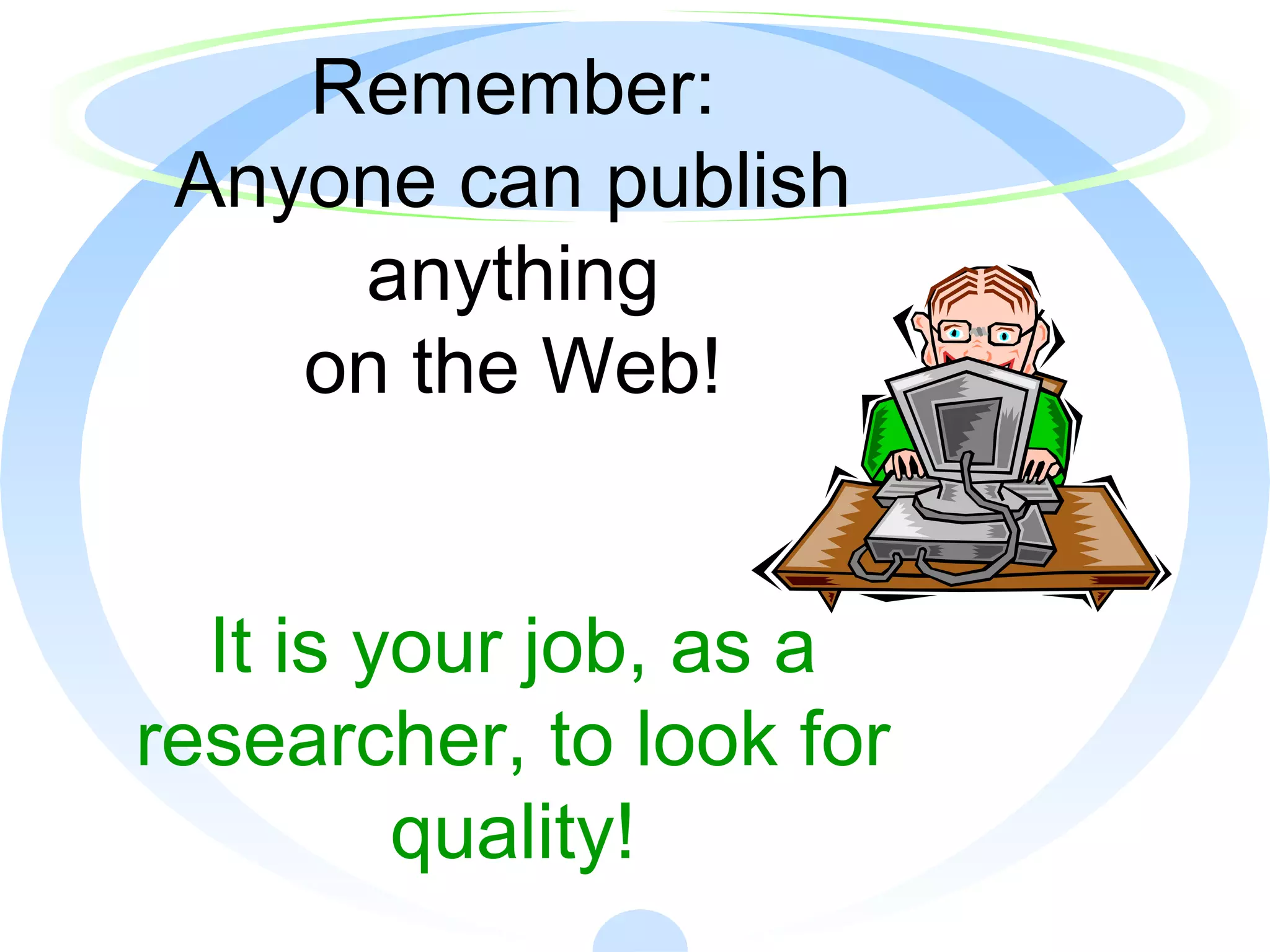
Remember:
Anyone can publish
anything
on the Web!
It is your job, as a
researcher, to look for
quality!
Hmmm.
This one looks good.
How can I tell
for sure?
Question Authority!!
CREDIBILITY / AUTHORITY
Who is the author?
Why is he or she an expert? (experience?
Education?)
Is this a personal page? (Clues: ~ tilde,
%, users, members)
Is it part of a major institution?
Is the page hosted by a free server like
AOL Members, Tripod, Geocities?
Look for credibility clues!
Words and phrases to look for:
• About us, Who Am I, FAQs, For
More, Company Information,
Profiles, Our Staff, Home
• Search for the author in a search
engine or online database
• Ask your teacher-librarian for help
Truncate the URL
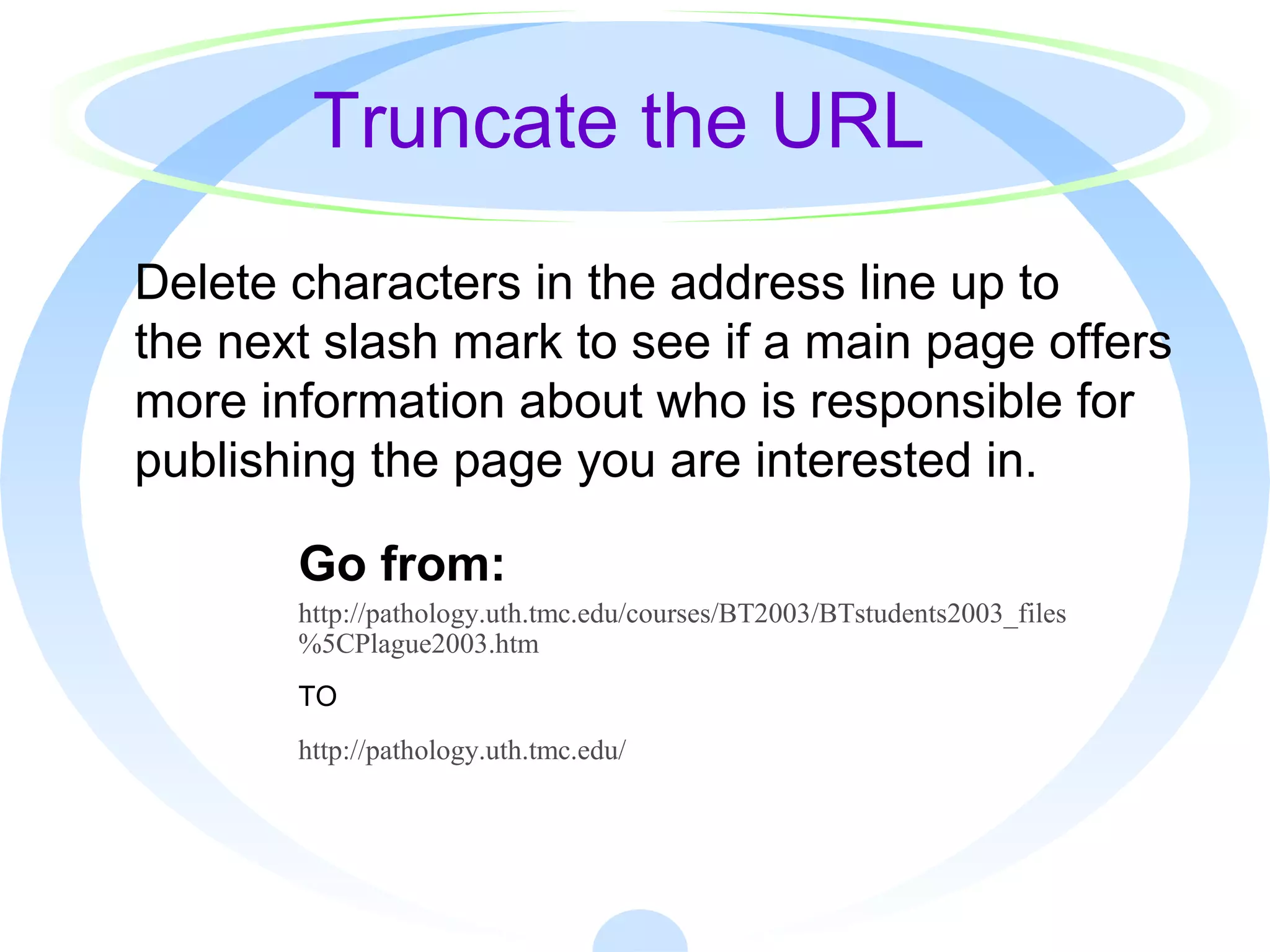
Delete characters in the address line up to
the next slash mark to see if a main page offers
more information about who is responsible for
publishing the page you are interested in.
Go from:
http://pathology.uth.tmc.edu/courses/BT2003/BTstudents2003_files
%5CPlague2003.htm
TO
http://pathology.uth.tmc.edu/
What can you
learn from a URL?
• You can use the end, or suffix of a
domain name to help you judge the
validity of the information and the
potential bias of a website.
• This strategy is not always
accurate.
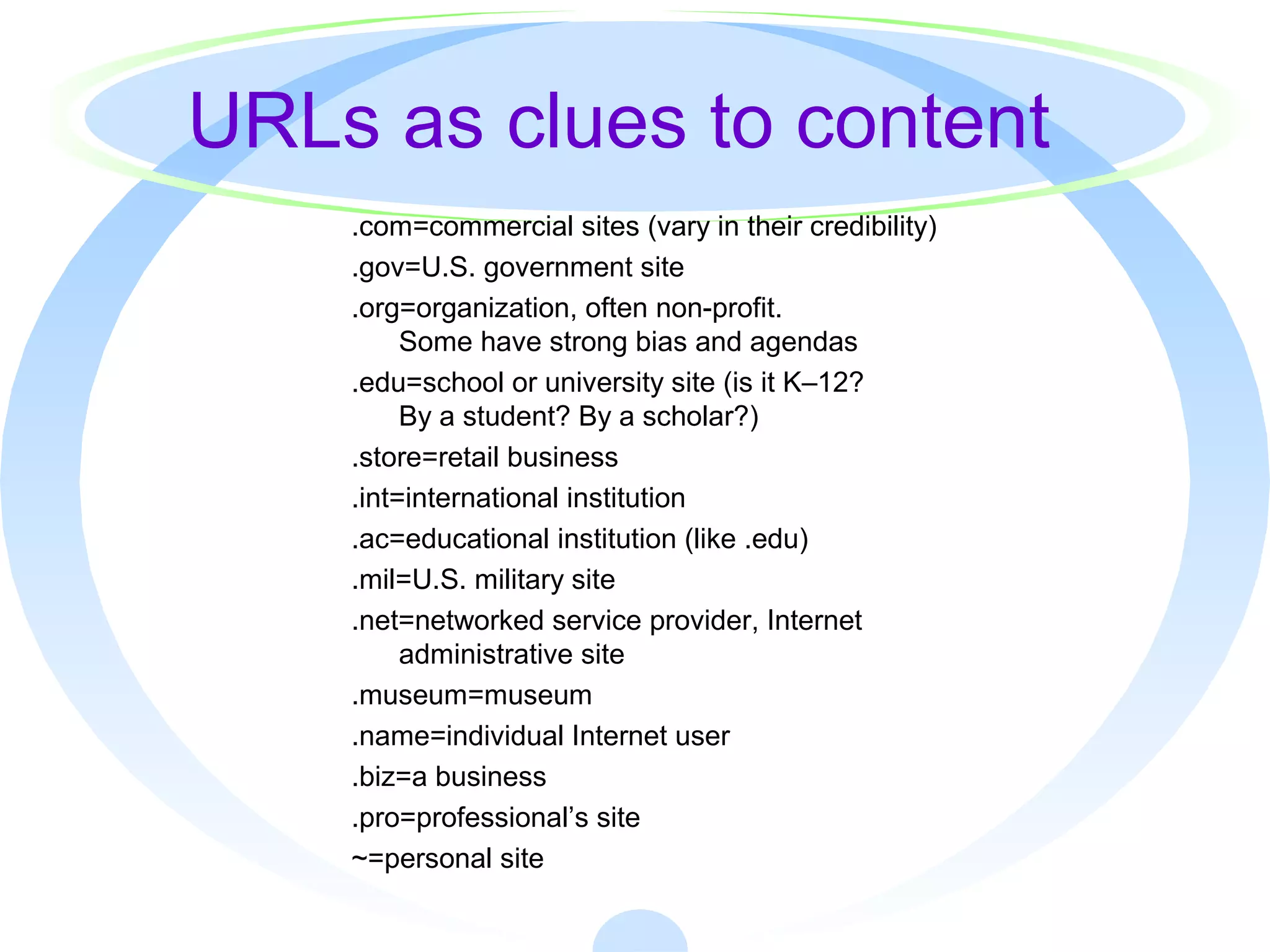
URLs as clues to content
.com=commercial sites (vary in their credibility)
.gov=U.S. government site
.org=organization, often non-profit.
Some have strong bias and agendas
.edu=school or university site (is it K–12?
By a student? By a scholar?)
.store=retail business
.int=international institution
.ac=educational institution (like .edu)
.mil=U.S. military site
.net=networked service provider, Internet
administrative site
.museum=museum
.name=individual Internet user
.biz=a business
.pro=professional’s site
~=personal site
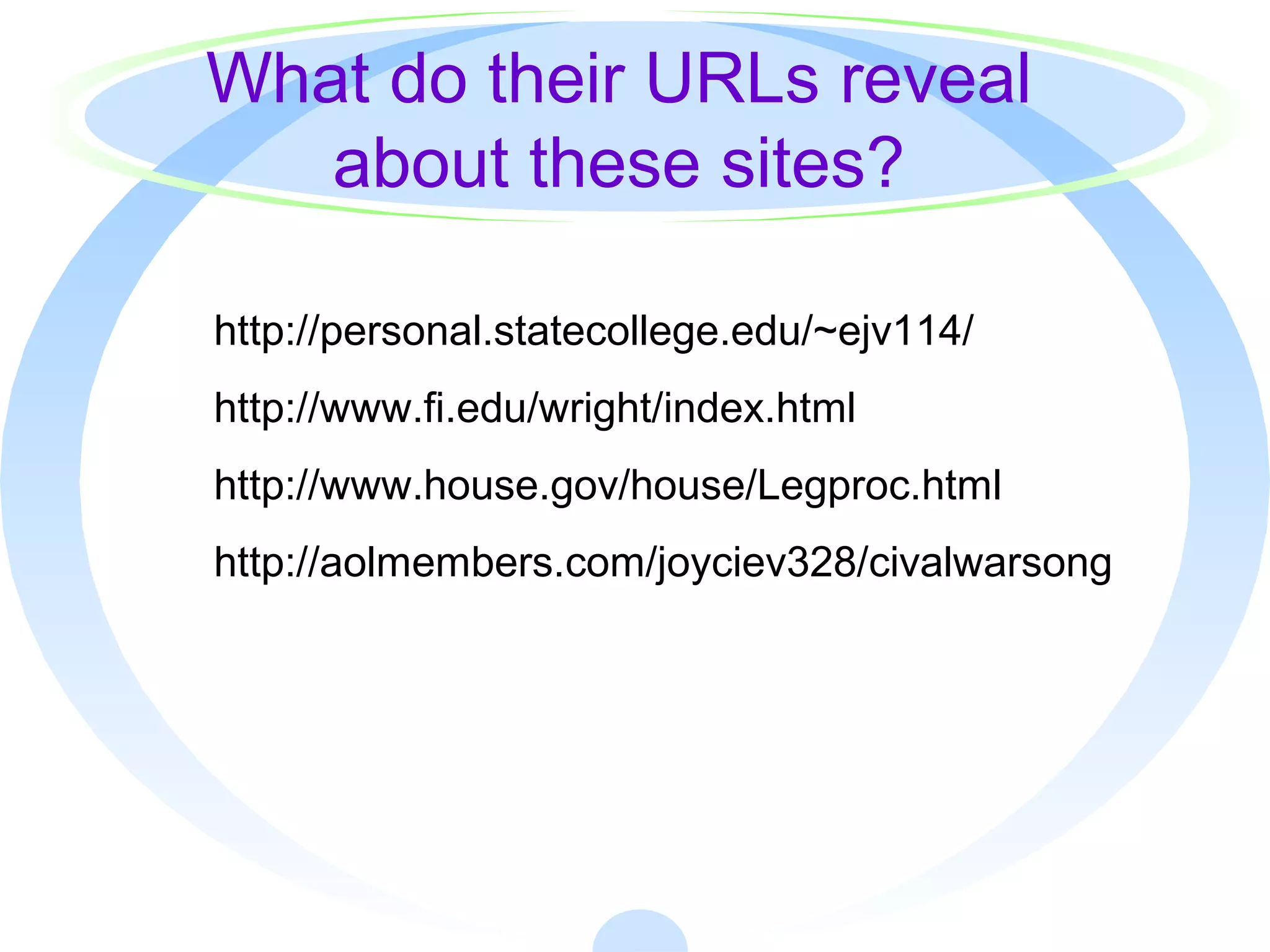
What do their URLs reveal
about these sites?
http://personal.statecollege.edu/~ejv114/
http://www.fi.edu/wright/index.html
http://www.house.gov/house/Legproc.html
http://aolmembers.com/joyciev328/civalwarsong
RELIABILITY
Does the source present a particular view or bias?
Sometimes a bias is useful for persuasive essays or
debates.
Recognizing bias
is important.
RELEVANCE
• Does this information directly support
my hypothesis/thesis or help to answer
my question?
• Does the source give you enough
information?
DATE
• When was this information
created?
• Revised?
• (Be suspicious of undated
material.)
So, why should we care
about all of this?
There are bigger questions in life!
You will be using information to
make important decisions!
• Which car should I buy?
• Which doctor should I choose?
• Should my child have this surgery?
• Should I take this medication?
You want to be able to ensure the
information you choose is reliable, credible,
current, balanced, relevant, and accurate!
Evaluation is
important!
Learn to be fussy!
ASSIGNMENT - Day #4
By the end of Day 4:
• Find at least 1 quality WEB PAGE.
GRADE ALERT!! To get credit for today:
1. Give the librarian a completed PINK
citation sheet
2. Make sure you complete BOTH sides.
ASSIGNMENT - Day #5
By the end of Day 5:
GRADE ALERT!! To get credit for today:
1. Check with the librarian to find out if all
your assignments have been handed in.
2. Make suggested corrections on the
citation sheets that have been graded.
3. Read your sources and take notes.
Let’s try it out!
→
Author & Sponsoring Organization
Are the Most Important Criteria
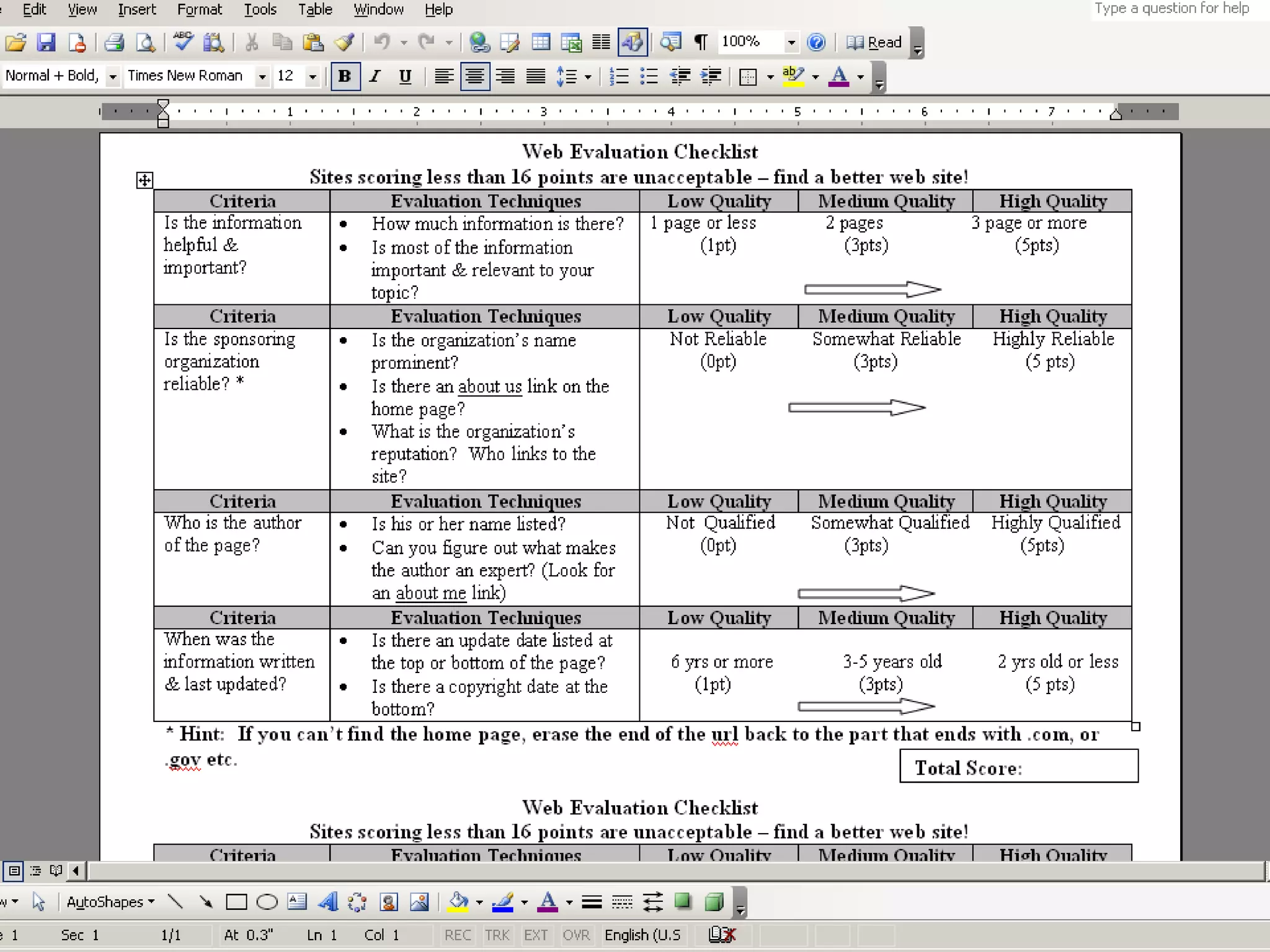
Take a look at this site:
(Be sure to use the evaluation checklist on the back of
your pink web citation slip)
After 9/11
Have You Been Googlized?
There ARE other search engines.
Don’t Forget…..
· Use Boolean Search Operators
AND
OR
NOT
“Phrase in quotes”
* (Truncation)
Web Evaluation Student Guide

Web Evaluation Student Guide

  • 1.
    The Next Step… Deeperyet into the Research Pyramid…
  • 2.
    Giving credit…. This slideshow is based on the original created by Joyce Valenza http://www.sdst.org/shs/library/jvweb.html
  • 3.
    Hey there! Have youevaluated? Is that site good enough to cite?
  • 4.
    Remember: Anyone can publish anything onthe Web! It is your job, as a researcher, to look for quality!
  • 5.
    Hmmm. This one looksgood. How can I tell for sure?
  • 6.
  • 7.
    CREDIBILITY / AUTHORITY Whois the author? Why is he or she an expert? (experience? Education?) Is this a personal page? (Clues: ~ tilde, %, users, members) Is it part of a major institution? Is the page hosted by a free server like AOL Members, Tripod, Geocities?
  • 8.
    Look for credibilityclues! Words and phrases to look for: • About us, Who Am I, FAQs, For More, Company Information, Profiles, Our Staff, Home • Search for the author in a search engine or online database • Ask your teacher-librarian for help
  • 9.
    Truncate the URL Deletecharacters in the address line up to the next slash mark to see if a main page offers more information about who is responsible for publishing the page you are interested in. Go from: http://pathology.uth.tmc.edu/courses/BT2003/BTstudents2003_files %5CPlague2003.htm TO http://pathology.uth.tmc.edu/
  • 10.
    What can you learnfrom a URL? • You can use the end, or suffix of a domain name to help you judge the validity of the information and the potential bias of a website. • This strategy is not always accurate.
  • 11.
    URLs as cluesto content .com=commercial sites (vary in their credibility) .gov=U.S. government site .org=organization, often non-profit. Some have strong bias and agendas .edu=school or university site (is it K–12? By a student? By a scholar?) .store=retail business .int=international institution .ac=educational institution (like .edu) .mil=U.S. military site .net=networked service provider, Internet administrative site .museum=museum .name=individual Internet user .biz=a business .pro=professional’s site ~=personal site
  • 12.
    What do theirURLs reveal about these sites? http://personal.statecollege.edu/~ejv114/ http://www.fi.edu/wright/index.html http://www.house.gov/house/Legproc.html http://aolmembers.com/joyciev328/civalwarsong
  • 13.
    RELIABILITY Does the sourcepresent a particular view or bias? Sometimes a bias is useful for persuasive essays or debates. Recognizing bias is important.
  • 14.
    RELEVANCE • Does thisinformation directly support my hypothesis/thesis or help to answer my question? • Does the source give you enough information?
  • 15.
    DATE • When wasthis information created? • Revised? • (Be suspicious of undated material.)
  • 16.
    So, why shouldwe care about all of this?
  • 17.
    There are biggerquestions in life! You will be using information to make important decisions! • Which car should I buy? • Which doctor should I choose? • Should my child have this surgery? • Should I take this medication? You want to be able to ensure the information you choose is reliable, credible, current, balanced, relevant, and accurate!
  • 18.
  • 19.
    ASSIGNMENT - Day#4 By the end of Day 4: • Find at least 1 quality WEB PAGE. GRADE ALERT!! To get credit for today: 1. Give the librarian a completed PINK citation sheet 2. Make sure you complete BOTH sides.
  • 20.
    ASSIGNMENT - Day#5 By the end of Day 5: GRADE ALERT!! To get credit for today: 1. Check with the librarian to find out if all your assignments have been handed in. 2. Make suggested corrections on the citation sheets that have been graded. 3. Read your sources and take notes.
  • 21.
  • 22.
    Author & SponsoringOrganization Are the Most Important Criteria Take a look at this site: (Be sure to use the evaluation checklist on the back of your pink web citation slip) After 9/11
  • 24.
    Have You BeenGooglized? There ARE other search engines.
  • 25.
    Don’t Forget….. · UseBoolean Search Operators AND OR NOT “Phrase in quotes” * (Truncation)

Editor's Notes

  • #8 You discover an author has a Ph.D. Do you need to investigate any further? What if her degree is in physics and the website she wrote is on Shakespeare? Is everything on Geocities bad? Would your teacher question you citing a source that resided on a free server? Who might have a site with a ~ at a university?
  • #9 Clues often appear on the top or bottom of a page, or in menu bars and frames. These sections often contain authorship clues!
  • #13 These are not working URLS! Use them as examples for analysis only.
  • #15 Research is not a contest. It doesn’t matter how many sources you collect. What does matter is their quality and their relevance! Your teacher will be more impressed with five high-quality, highly relevant sites, than thirty irrelevant ones.
  • #16 Can you give examples of when it would be more or less important to have your site be current? Is it important that an author keep a site maintained?
  • #25 Check out the library home page and click on search engines to locate other search engines. No one search engine covers all of the web. As a matter of fact – there is NO search engine that covers even half the content of the web.
  • #26 Use “Power Searching Tips” handout