
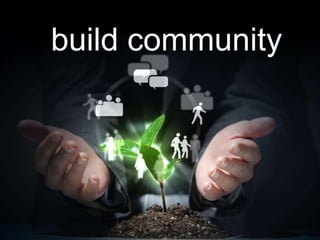

















build community
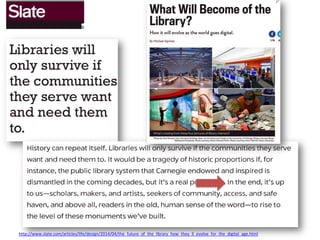
http://www.slate.com/articles/life/design/2014/04/the_future_of_the_library_how_they_ll_evolve_for_the_digital_age.html
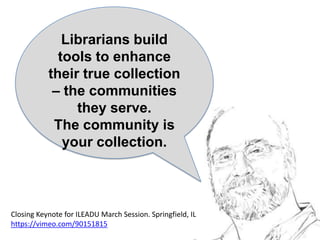
Librarians build
tools to enhance
their true collection
– the communities
they serve.
The community is
your collection.
Closing Keynote for ILEADU March Session. Springfield, IL
https://vimeo.com/90151815
The community is the collection.
If you want to be a brilliant librarian. If you want to make
a difference in people’s lives . . . You must be active.
You must see your community as your collection and you
must be into collection development every day. Not
sitting behind a desk . . .not waiting for someone to come
to you and ask for help, but being out there and saying,
“I’m here. You’re important. . .
You are not in the library business. You are not in the
book business. You are not in the building business. You
are not in the website business. You are in the
community business.
Dave Lankes, Closing Keynote for ILEADU March
Session. Springfield, IL
https://vimeo.com/90151815
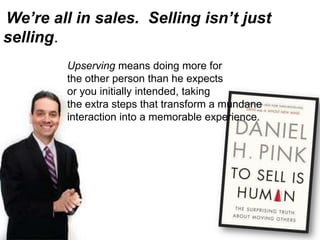
We’re all in sales. Selling isn’t just
selling.
Upserving means doing more for
the other person than he expects
or you initially intended, taking
the extra steps that transform a mundane
interaction into a memorable experience.
Sipyeykina, Dar'ya “Speechless.” 25 Jan. 2009. Flickr. http://www.flickr.com/photos/10522622@N00/3228273137
It won’t help to be a social media introver
What is social capital?
Resources and support
accumulated by an individual,
institution or group through
relationships and the possession
of a durable network.
Tappable goodwill available
Social capital is what allows any organization or
individual to make requests of its followers successfully.
Think of social capital as funds in a sort of intangible
bank account that you add to by listening to, engaging
with, and doing favors for others. Each time you make a
request, you are drawing on that account. If no social
capital has been established from which to draw, actions
requested of others are likely to be ignored.
Having social capital is, in many ways, equivalent to
having credibility in a selected online community. Social
capital can be earned only over time, by participating
appropriately in the community.
Laura Solomon, on Save Ohio Libraries 2009, missing lack of followers & lack of social capital
http://www.americanlibrariesmagazine.org/article/understanding-social-capital
It’s not just who you know, but . .
.
who/what you have access to
because of/via who you know
social capital increases when
you use it.
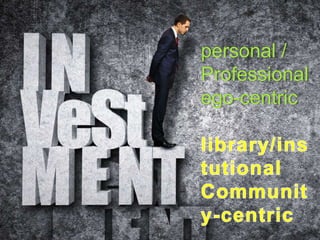
personal /
Professional
ego-centric
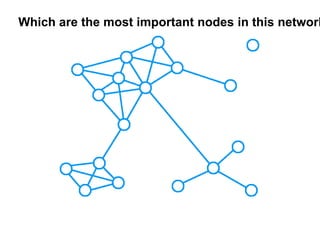
Which are the most important nodes in this network
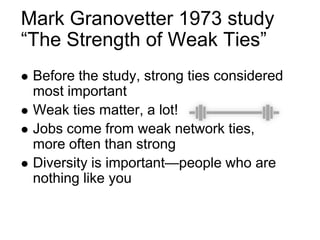
Mark Granovetter 1973 study
“The Strength of Weak Ties”
 Before the study, strong ties considered
most important
 Weak ties matter, a lot!
 Jobs come from weak network ties,
more often than strong
 Diversity is important—people who are
nothing like you
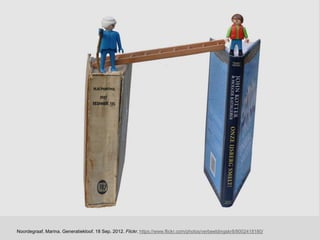
Noordegraaf, Marina. Generatiekloof. 18 Sep. 2012. Flickr. https://www.flickr.com/photos/verbeeldingskr8/8002418180/
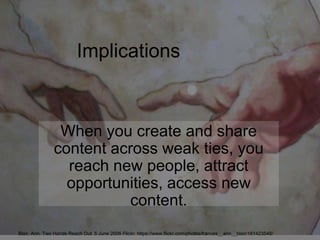
Implications
When you create and share
content across weak ties, you
reach new people, attract
opportunities, access new
content.
Blair, Ann. Two Hands Reach Out. 5 June 2006 Flickr. https://www.flickr.com/photos/frances__ann__blair/161423548/
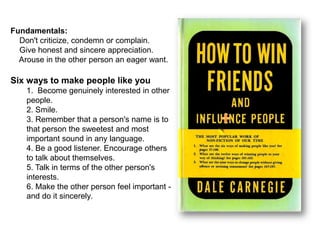
Fundamentals:
Don't criticize, condemn or complain.
Give honest and sincere appreciation.
Arouse in the other person an eager want.
Six ways to make people like you
1. Become genuinely interested in other
people.
2. Smile.
3. Remember that a person's name is to
that person the sweetest and most
important sound in any language.
4. Be a good listener. Encourage others
to talk about themselves.
5. Talk in terms of the other person's
interests.
6. Make the other person feel important -
and do it sincerely.
What would Don Draper do today?
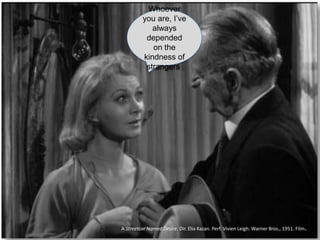
Whoever
you are, I’ve
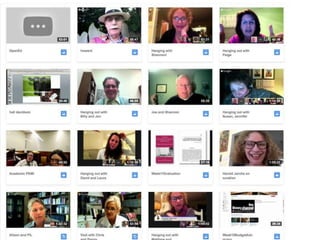
always
depended
on the
kindness of
strangers.
A Streetcar Named Desire. Dir. Elia Kazan. Perf. Vivien Leigh. Warner Bros., 1951. Film.
INADEQU
new rules
In a networked world
You are your content & connections
You are somebody’s critical weak tie
Someone else is your critical weak tie
You can scan, curate, interpret, create
meaningful content for others
You can bridge connections for others
You can find/get what you need if you plan
Create/contribute/share
http://flipgrid.com/#35423ff0
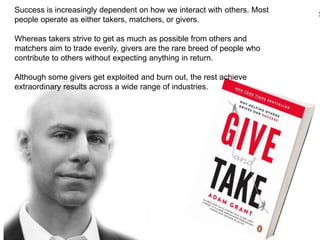
Success is increasingly dependent on how we interact with others. Most
people operate as either takers, matchers, or givers.
Whereas takers strive to get as much as possible from others and
matchers aim to trade evenly, givers are the rare breed of people who
contribute to others without expecting anything in return.
Although some givers get exploited and burn out, the rest achieve
extraordinary results across a wide range of industries.
‹
http://flipgrid.com/#4f31d787
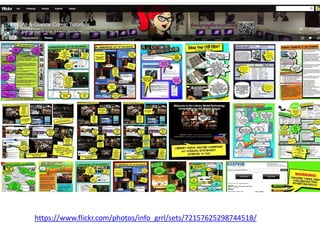
https://www.flickr.com/photos/info_grrl/sets/72157625298744518/
http://www.slideshare.net/
http://www.authorstream.com
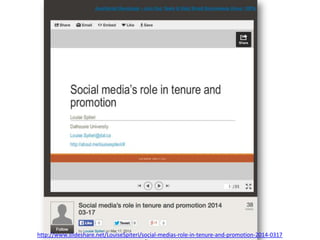
http://www.slideshare.net/LouiseSpiteri/social-medias-role-in-tenure-and-promotion-2014-0317
reciprocate
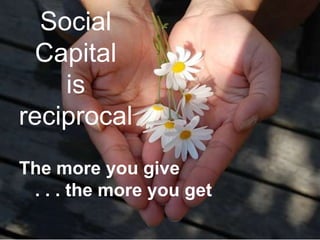
Social
Capital
is
reciprocal
The more you give
. . . the more you get
reciprocity
social norm of in-kind responses
to the behavior of others; in
cultural anthropology, defined as
people's informal exchange of
goods and labour.
Social Media Issues Lexicon
Gaining social capital really
means becoming a strong,
consistent member of the online
community. People expect
reciprocity. Building a social
media reputation means giving
back.
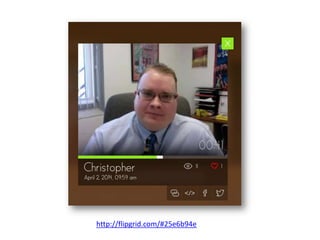
http://flipgrid.com/#25e6b94e
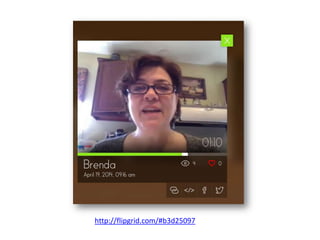
http://flipgrid.com/#b3d25097
ask
Ask for readers’ favorite Oprah Book Club
pick or their favorite program at the library.
Try asking for opinions on the worst book
ever written. The more controversial the
question, the more feedback it will likely
get. Although generating controversy for its
own sake may not be your library’s goal,
facilitating conversation between the library
and others is something you want.
http://flipgrid.com/#db4d46c9
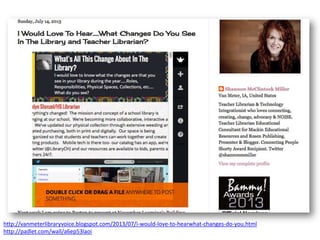
http://vanmeterlibraryvoice.blogspot.com/2013/07/i-would-love-to-hearwhat-changes-do-you.html
http://padlet.com/wall/a6ep53laoi
understand/empathize/respond
We are not in the book business,
we are in the St. Paul business.
http://youtu.be/tWbgQLjXPIk?t=45s
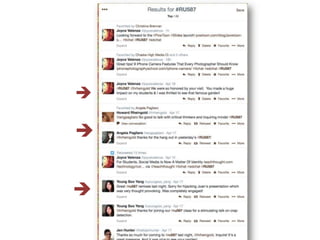
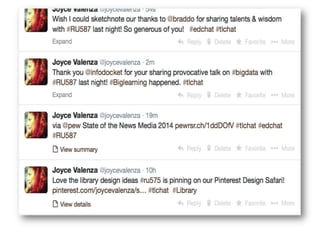
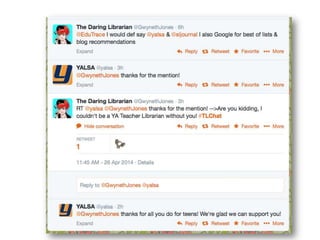
praise/credit/thank
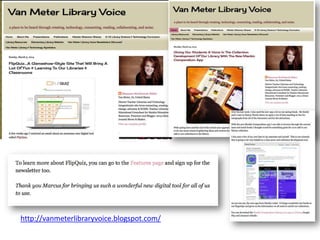
http://vanmeterlibraryvoice.blogspot.com/



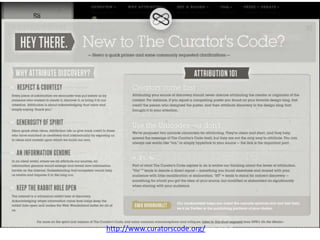
http://www.curatorscode.org/
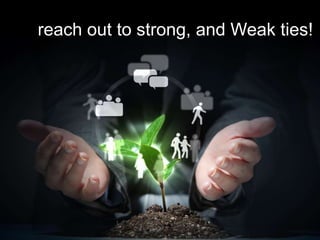
reach out to strong, and Weak ties!
http://flipgrid.com/#d89375c1
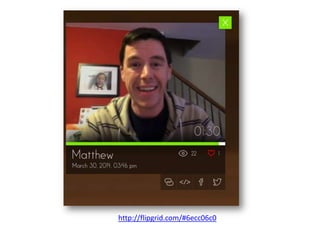
http://flipgrid.com/#6ecc06c0
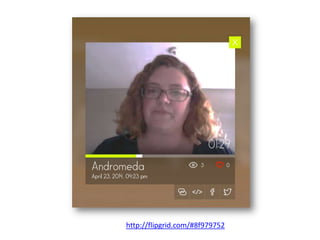
http://flipgrid.com/#8f979752
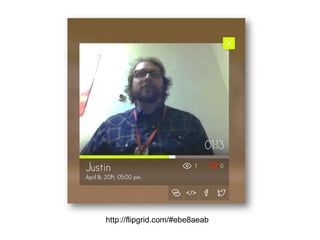
http://flipgrid.com/#ebe8aeab
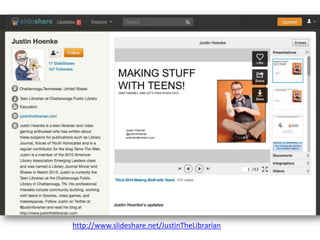
http://www.slideshare.net/JustinTheLibrarian
mentor/support/learn
http://flipgrid.com/#a9cee7e6
http://flipgrid.com/#60ba2ff7
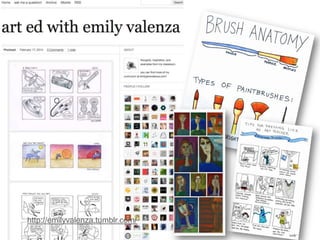
http://emilyvalenza.tumblr.com/
amplify signal
(conference share)
http://flipgrid.com/#c3434348
add value/interpret
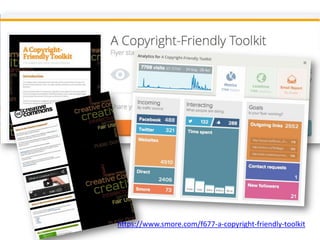
https://www.smore.com/f677-a-copyright-friendly-toolkit
curate
#
books
journal articles
mobile apps
infographics
google docsmuseum collections
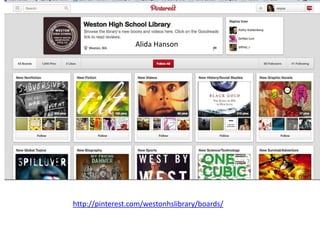
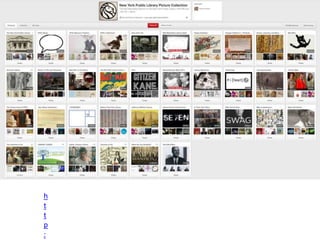
http://pinterest.com/westonhslibrary/boards/
Alida Hanson
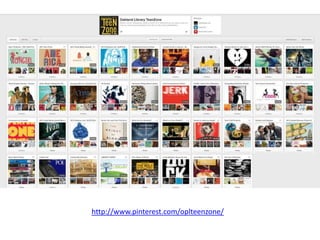
http://www.pinterest.com/oplteenzone/
h
t
t
p
:
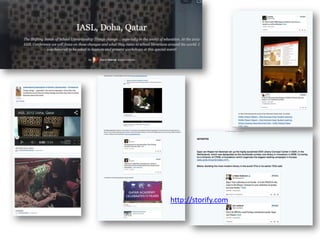
http://storify.com
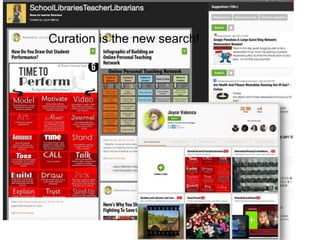
Curation is the new search!
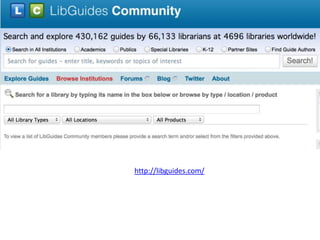
http://libguides.com/
Connect/engage/participate
Fisch, Martin. „eMOTION.” 24 Aug. 2012 Flickr. http://www.flickr.com/photos/45409431@N00/8150285487
PARTICIPATORY
CULTURE
(Jenkins 2006)
We have new opportunities to:
work collaboratively
engage in informal mentorships
disseminate news and ideas
connect
engage civically
create
contribute (your contributions
matter!)
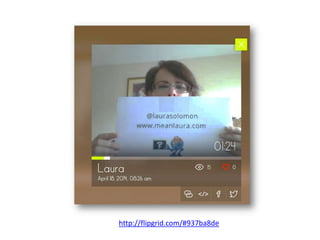
http://flipgrid.com/#937ba8de
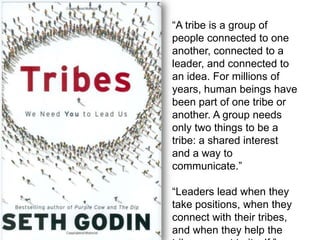
“A tribe is a group of
people connected to one
another, connected to a
leader, and connected to
an idea. For millions of
years, human beings have
been part of one tribe or
another. A group needs
only two things to be a
tribe: a shared interest
and a way to
communicate.”
“Leaders lead when they
take positions, when they
connect with their tribes,
and when they help the
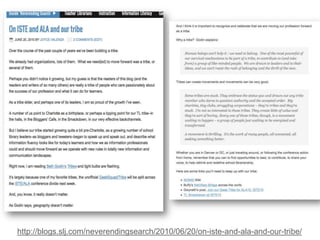
http://blogs.slj.com/neverendingsearch/2010/06/20/on-iste-and-ala-and-our-tribe/
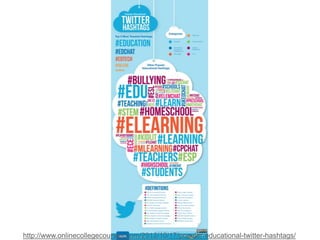
http://www.onlinecollegecourses.com/2012/10/17/popular-educational-twitter-hashtags/
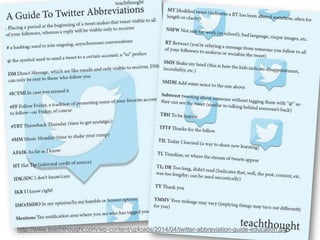
http://www.teachthought.com/wp-content/uploads/2014/04/twitter-abbreviation-guide-education.jpg
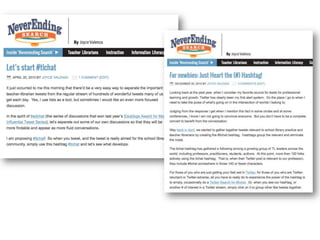
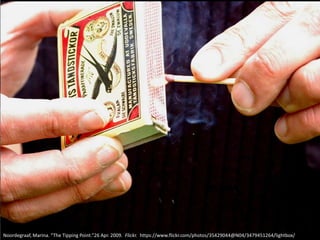
Hit the start button
Noordegraaf, Marina. “The Tipping Point.”26 Apr. 2009. Flickr. https://www.flickr.com/photos/35429044@N04/3479451264/lightbox/
http://flipgrid.com/#3f6fc041
http://flipgrid.com/#7702b3ef
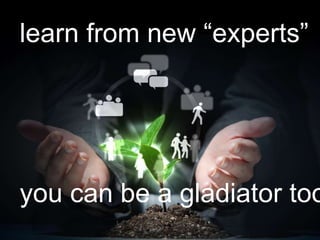
learn from new “experts”
you can be a gladiator too
monitor your “brand”/reputation
What does
the
conversation
about you,
your library,
look like?
Your email SIG
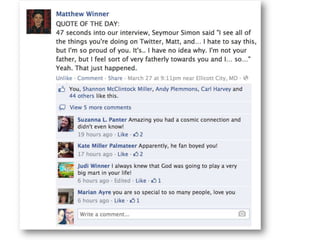
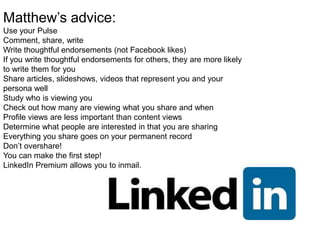
Matthew’s advice:
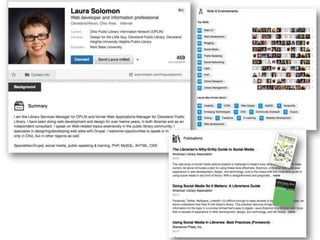
Use your Pulse
Comment, share, write
Write thoughtful endorsements (not Facebook likes)
If you write thoughtful endorsements for others, they are more likely
to write them for you
Share articles, slideshows, videos that represent you and your
persona well
Study who is viewing you
Check out how many are viewing what you share and when
Profile views are less important than content views
Determine what people are interested in that you are sharing
Everything you share goes on your permanent record
Don’t overshare!
You can make the first step!
LinkedIn Premium allows you to inmail.
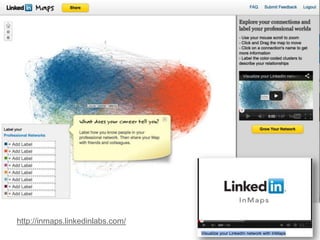
http://inmaps.linkedinlabs.com/
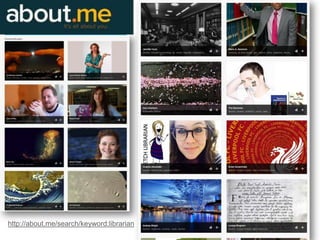
http://about.me/search/keyword:librarian
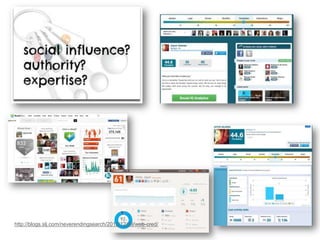
http://blogs.slj.com/neverendingsearch/2012/12/09/web-cred/
https://hootsuite.com/dashboard
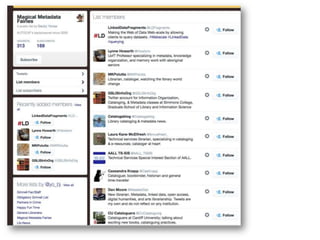
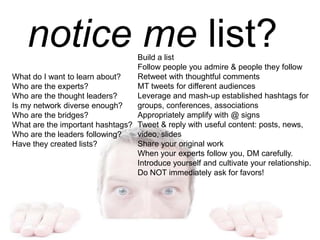
notice me list?
What do I want to learn about?
Who are the experts?
Who are the thought leaders?
Is my network diverse enough?
Who are the bridges?
What are the important hashtags?
Who are the leaders following?
Have they created lists?
Build a list
Follow people you admire & people they follow
Retweet with thoughtful comments
MT tweets for different audiences
Leverage and mash-up established hashtags for
groups, conferences, associations
Appropriately amplify with @ signs
Tweet & reply with useful content: posts, news,
video, slides
Share your original work
When your experts follow you, DM carefully.
Introduce yourself and cultivate your relationship.
Do NOT immediately ask for favors!
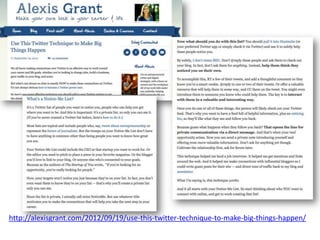
http://alexisgrant.com/2012/09/19/use-this-twitter-technique-to-make-big-things-happen/
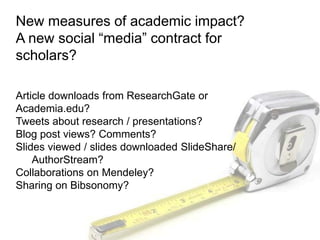
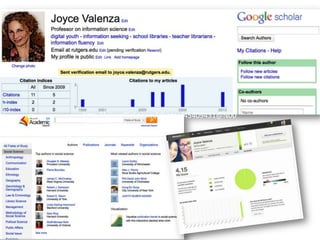
New measures of academic impact?
A new social “media” contract for
scholars?
Article downloads from ResearchGate or
Academia.edu?
Tweets about research / presentations?
Blog post views? Comments?
Slides viewed / slides downloaded SlideShare/
AuthorStream?
Collaborations on Mendeley?
Sharing on Bibsonomy?
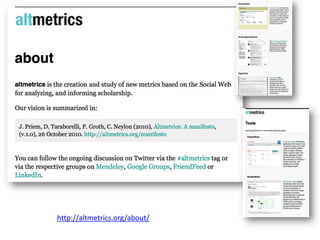
http://altmetrics.org/about/
New playgrounds for scholar
http://www.flickr.com/photos/45409431@N00
/8150285487
http://www.flickr.com/photos/45409431@N00
/8150285487
crowdsource
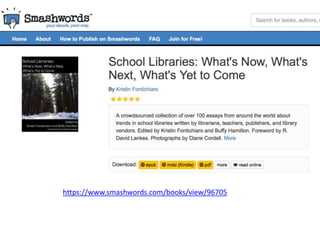
https://www.smashwords.com/books/view/96705
http://flipgrid.com/#74fcdef5
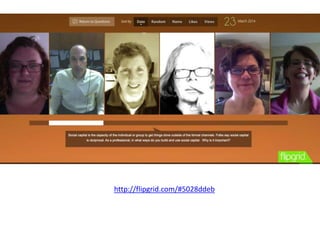
http://flipgrid.com/#5028ddeb
this presentation is about
social capital in more htan
one way
social capital Is earned
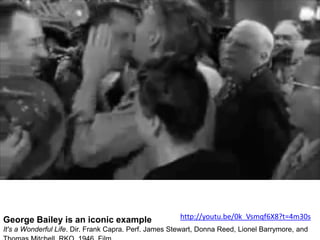
http://youtu.be/0k_Vsmqf6X8?t=4m30sGeorge Bailey is an iconic example
It's a Wonderful Life. Dir. Frank Capra. Perf. James Stewart, Donna Reed, Lionel Barrymore, and
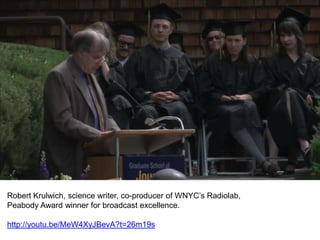
Robert Krulwich, science writer, co-producer of WNYC’s Radiolab,
Peabody Award winner for broadcast excellence.
http://youtu.be/MeW4XyJBevA?t=26m19s
new rules
thank/credit/praise
curate
mentor
reciprocate
contribute /share
add value
new questions:
How can I use the tools at hand to:
Build community?
Contribute/make a difference?
Continue to learn and grow?
hit “go”
My site:
http://about.me/jvalenza
My blog:
http://blog.schoollibraryjournal.com/Ne
verendingsearch/
My tweets:
@joycevalenza
References
Appel, L., Dadlani, P., Dwyer, M., Hampton, K., Kitzie, V., Matni, Z. A., ... & Teodoro, R. (2014). Testing the
validity of social capital measures in the study of information and communication technologies. Information,
Communication & Society, (ahead-of-print), 1-19.
Coleman, J. S. (1988). Social capital in the creation of human capital. American Journal of Sociology,
94(Supplement), S95–S120.
Ferguson, S. (2012). Are Public Libraries Developers of Social Capital? A Review of Their Contribution and
Attempts to Demonstrate It. Australian Library Journal, 61(1), 22-33.
Granovetter, M. S. (1973). The strength of weak ties. American Journal of Sociology, 78(6), 1360–1380.
Granovetter, M. S. (1982). The strength of weak ties: A network theory revisited. In P. V.Mardsen & N.Lin
(Eds.), Social Structure and Network Analysis (pp. 105–130). Thousand Oaks, CA: Sage Publications.
Johnson, C. (2012). How do public libraries create social capital? An analysis of interactions between library
staff and patrons. Library & Information Science Research (07408188), 34(1), 52-62.
Putnam, R. D.(1995). Bowling Alone: America's Declining Social Capital. Journal of Democracy 6(1), 65-78.
The Johns Hopkins University Press. Retrieved April 15, 2014, from Project MUSE database.
Putnam, R. (2000). Bowling Alone. New York, NY: Simon & Schuster.

Librarians and Social Capital

Editor's Notes

  • #15 Being a social media introvert is not a good idea. In a crisis we have to sell our message.
  • #17 During the Save Ohio Libraries movement in 2009, some libraries in Ohio jumped into Twitter. Undoubtedly, they saw it as another avenue for getting the word out about the imminent and catastrophic budget cuts being proposed by Ohio’s governor. However, two major factors prevented them from really using Twitter as an effective rallying tool.The first was simply a lack of followers. Numbers are not the only criterion for social media success (and certainly not the most important one), but some followers are needed to spread a message. When an organization jumps into a social media tool during a crisis before having developed followers over time, there is a distinct lack of audience to hear any pleas for help.The second was a lack of social capital. Laura Solomon, on Save Ohio Libraries 2009, missing lack of followers & lack of social capitalhttp://www.americanlibrariesmagazine.org/article/understanding-social-capital
  • #22 Playwright John GuareBrett C. Tjaden computer game on the U. VA using IMDB to document connections between actors. Time Magazine called his site, The Oracle of Bacon one of the "Ten Best Web Sites of 1996."
  • #24 Friends know all the same people. Your good friends don't offer additional social information beyond what you already know. Bridges are usually weak ties. Weak ties facilitate information flow from disparate clusters of people.Weak ties help spread new information by bridging the gap between clusters of strong tie contacts.  The strength of weak ties informs much of the popular understanding of information spread in social networks.
  • #31 Weak ties are bridges
  • #38 Don has NO social capital
  • #48 “The ambivert advantage stems from the tendency to be assertive and enthusiastic enough to persuade and close, but at the same time, listening carefully to customers and avoiding the appearance of being overly confident or excited,”A new study published in  Psychological Science suggests that not only are these stereotypes wrong, but there’s an entirely different personality type that stands well above the others in sales prowess.Study:Grant predicted that extroverts, contrary to popular lore, would not bury other personality types when it came to closing sales — but rather, ambiverts, people who are more or less equal parts extroverted and introverted would perform best.Forbes http://www.forbes.com/sites/daviddisalvo/2013/04/10/move-over-extroverts-here-come-the-ambiverts/
  • #70 Not an orientation. Beginning a relationship. About community needs. Not a bait and switch and talk about databases and books. Freshman assigned concierge,. Meet during first week face-to-face, look at schedule, texts, what do we have as ebook, where are your classes, what is a bursar. Teaching how to hack the info and other systems of the university. Professors grateful, come in.
  • #72 Always give credit. Laura Solomon: This applies to all content, not just retweets. Do you want to promote a new program that was a patron’s idea? Name the patron and link directly to that person if you can. People want to be involved when they know their name is going to be promoted. This is another reason why photos of patrons at programs are a popular way to get people to visit a website. The library is an organization that cannot exist without its community, so be sure to acknowledge that community whenever and as often as possible.
  • #85 Building stuff, building community, building relationship
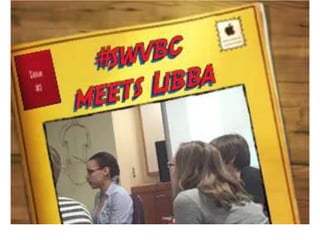
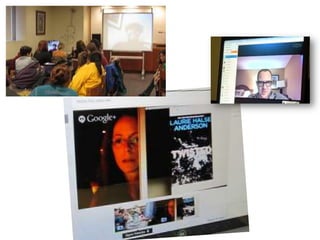
  • #87 Students react to Libba Bray’s reading.
  • #103 What we are curating!
  • #105 Tools for curation.
  • #117 Participation2006, Jenkins and co-authors white paper entitled Confronting the Challenges of Participatory Culture: Media Education for the 21st Century.
  • #125 This infographic lists the most tweeted educational hashtags. Share with your faculty!
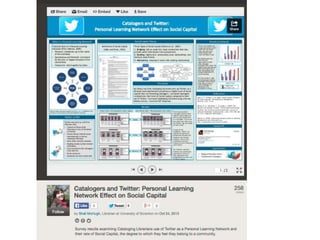
  • #127 Survey results examining Cataloging Librarians use of Twitter as a Personal Learning Network and their rate of Social Capital, the degree to which they feel they belong to a community.
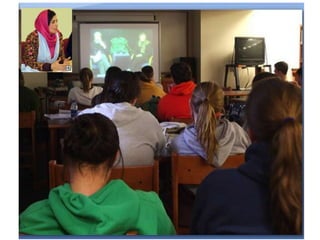
  • #172 Krulwick worked with Charles Kuralt and Kuralt worked with Edward R. Murrow. Kulwich talked about a new generation of professionals. After they wrote, they tweeted and facebooked and blogged their blogs, and because they were good, and worked hard, within a year or two, magazines asked them to affiliate (on financial terms that were insulting), but they did that, and their blogs got an audience, and then they got magazine assignments, then agents, then book deals, and now, three, four years after they began, these folks, five or six of them, are beginning to break through. They are becoming not just science writers with jobs, they are becoming THE science writers, the ones people read, and look to… they’re going places. And they’re doing it on their own terms! In their own voice, they’re free to be themselves AND they’re paid for it! . . .I notice that they get courage from each other. They’ve got a kind of community. At first it was virtual; they wrote each other. Then they met each other. Now they support each other. Watch out for each other. One day, I imagine, they will get and give each other jobs. And they share a sensibility, a generational sense, that this is how “we” do it.
  • #175 Get in the habit of starting