A gentle introduction to BNP
Part I
Antonio Canale
Universit`a di Torino &
Collegio Carlo Alberto
StaTalk on BNP, 19/02/16
Introduction The Dirichlet process Nonparametric mixture models
Outline of the talk(s)
1 Why BNP? (A)
2 The Dirichlet process (A)
3 Nonparametric mixture models (A)
4 Beyond the DP (J)
5 Species sampling processes (J)
6 Completely random measures (J)
Introduction The Dirichlet process Nonparametric mixture models
Why Bayesian nonparametrics (BNP)?
Why nonparametric?
• We don’t want to strictly impose any model but let the data speak;
• The idea of a true model governed by relatively few parameters is
unrealistic;
Why Bayesian?
• If we have a reasonable guess for what is the true model we want
to use this prior knowledge.
• Large support and consistency are interesting concepts related to
priors on infinite dimensional spaces (Pierpaolo’s talk in the
afternoon)
BNP is to fit a single model that can adapt its complexity to the
data.
Introduction The Dirichlet process Nonparametric mixture models
Why Bayesian nonparametrics (BNP)?
Why nonparametric?
• We don’t want to strictly impose any model but let the data speak;
• The idea of a true model governed by relatively few parameters is
unrealistic;
Why Bayesian?
• If we have a reasonable guess for what is the true model we want
to use this prior knowledge.
• Large support and consistency are interesting concepts related to
priors on infinite dimensional spaces (Pierpaolo’s talk in the
afternoon)
BNP is to fit a single model that can adapt its complexity to the
data.
Introduction The Dirichlet process Nonparametric mixture models
Why Bayesian nonparametrics (BNP)?
Why nonparametric?
• We don’t want to strictly impose any model but let the data speak;
• The idea of a true model governed by relatively few parameters is
unrealistic;
Why Bayesian?
• If we have a reasonable guess for what is the true model we want
to use this prior knowledge.
• Large support and consistency are interesting concepts related to
priors on infinite dimensional spaces (Pierpaolo’s talk in the
afternoon)
BNP is to fit a single model that can adapt its complexity to the
data.
Introduction The Dirichlet process Nonparametric mixture models
Why Bayesian nonparametrics (BNP)?
Why nonparametric?
• We don’t want to strictly impose any model but let the data speak;
• The idea of a true model governed by relatively few parameters is
unrealistic;
Why Bayesian?
• If we have a reasonable guess for what is the true model we want
to use this prior knowledge.
• Large support and consistency are interesting concepts related to
priors on infinite dimensional spaces (Pierpaolo’s talk in the
afternoon)
BNP is to fit a single model that can adapt its complexity to the
data.
Introduction The Dirichlet process Nonparametric mixture models
Why Bayesian nonparametrics (BNP)?
Why nonparametric?
• We don’t want to strictly impose any model but let the data speak;
• The idea of a true model governed by relatively few parameters is
unrealistic;
Why Bayesian?
• If we have a reasonable guess for what is the true model we want
to use this prior knowledge.
• Large support and consistency are interesting concepts related to
priors on infinite dimensional spaces (Pierpaolo’s talk in the
afternoon)
BNP is to fit a single model that can adapt its complexity to the
data.
Introduction The Dirichlet process Nonparametric mixture models
Why Bayesian nonparametrics (BNP)?
Why nonparametric?
• We don’t want to strictly impose any model but let the data speak;
• The idea of a true model governed by relatively few parameters is
unrealistic;
Why Bayesian?
• If we have a reasonable guess for what is the true model we want
to use this prior knowledge.
• Large support and consistency are interesting concepts related to
priors on infinite dimensional spaces (Pierpaolo’s talk in the
afternoon)
BNP is to fit a single model that can adapt its complexity to the
data.
Introduction The Dirichlet process Nonparametric mixture models
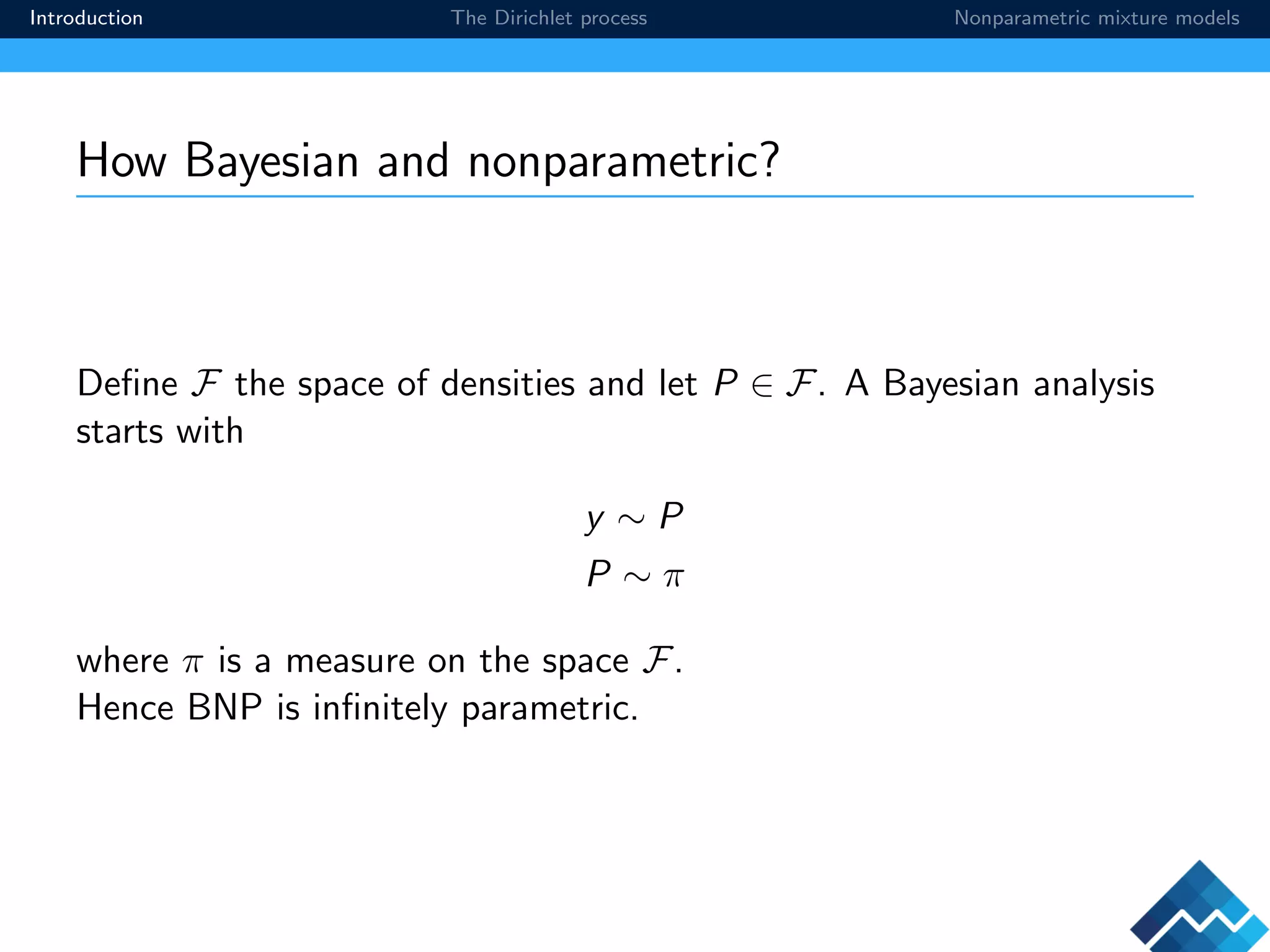
How Bayesian and nonparametric?
Define F the space of densities and let P ∈ F. A Bayesian analysis
starts with
y ∼ P
P ∼ π
where π is a measure on the space F.
Hence BNP is infinitely parametric.
Introduction The Dirichlet process Nonparametric mixture models
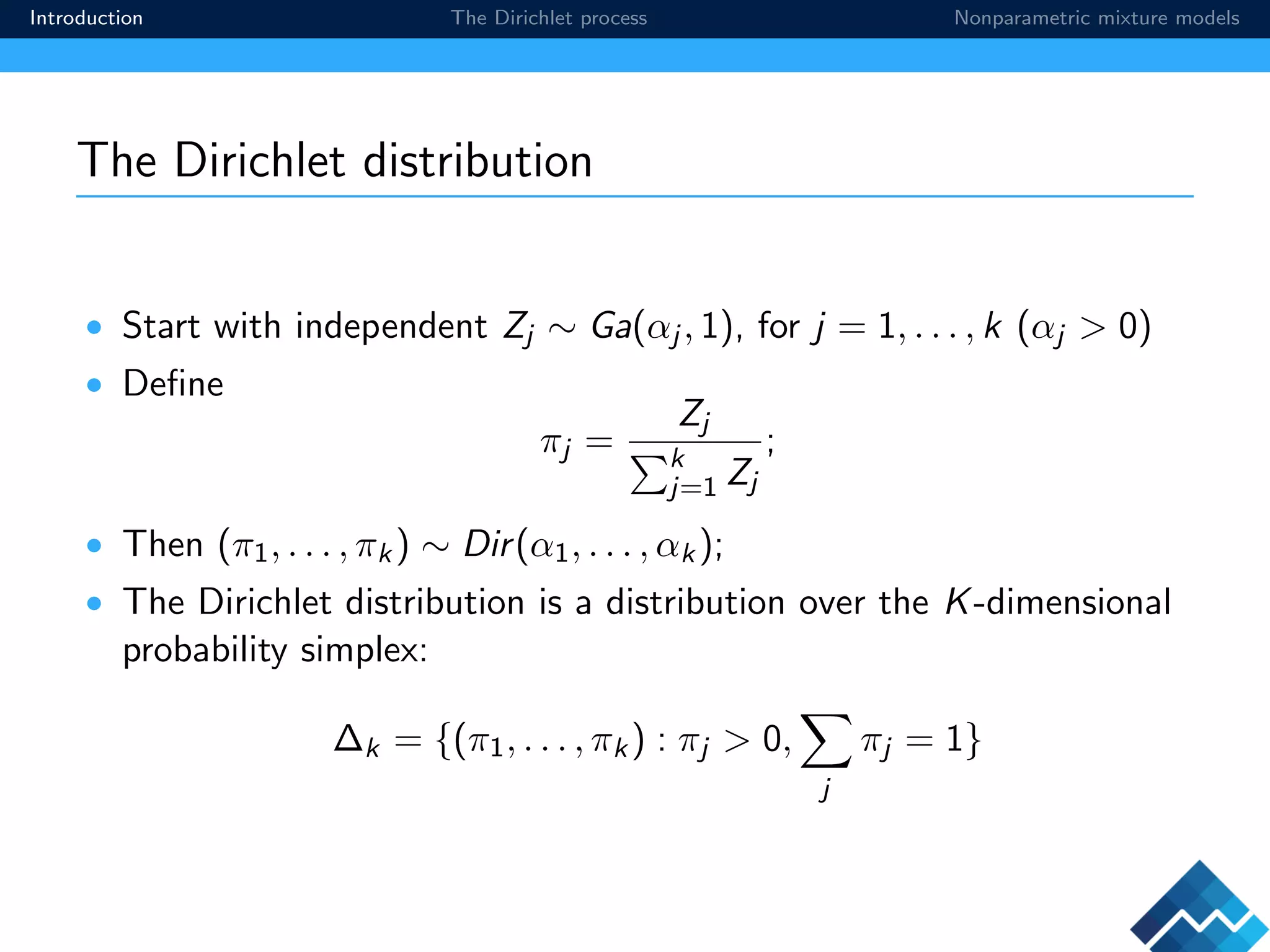
The Dirichlet distribution
• Start with independent Zj ∼ Ga(αj , 1), for j = 1, . . . , k (αj > 0)
• Define
πj =
Zj
k
j=1 Zj
;
• Then (π1, . . . , πk) ∼ Dir(α1, . . . , αk);
• The Dirichlet distribution is a distribution over the K-dimensional
probability simplex:
∆k = {(π1, . . . , πk) : πj > 0,
j
πj = 1}
Introduction The Dirichlet process Nonparametric mixture models
The Dirichlet distribution
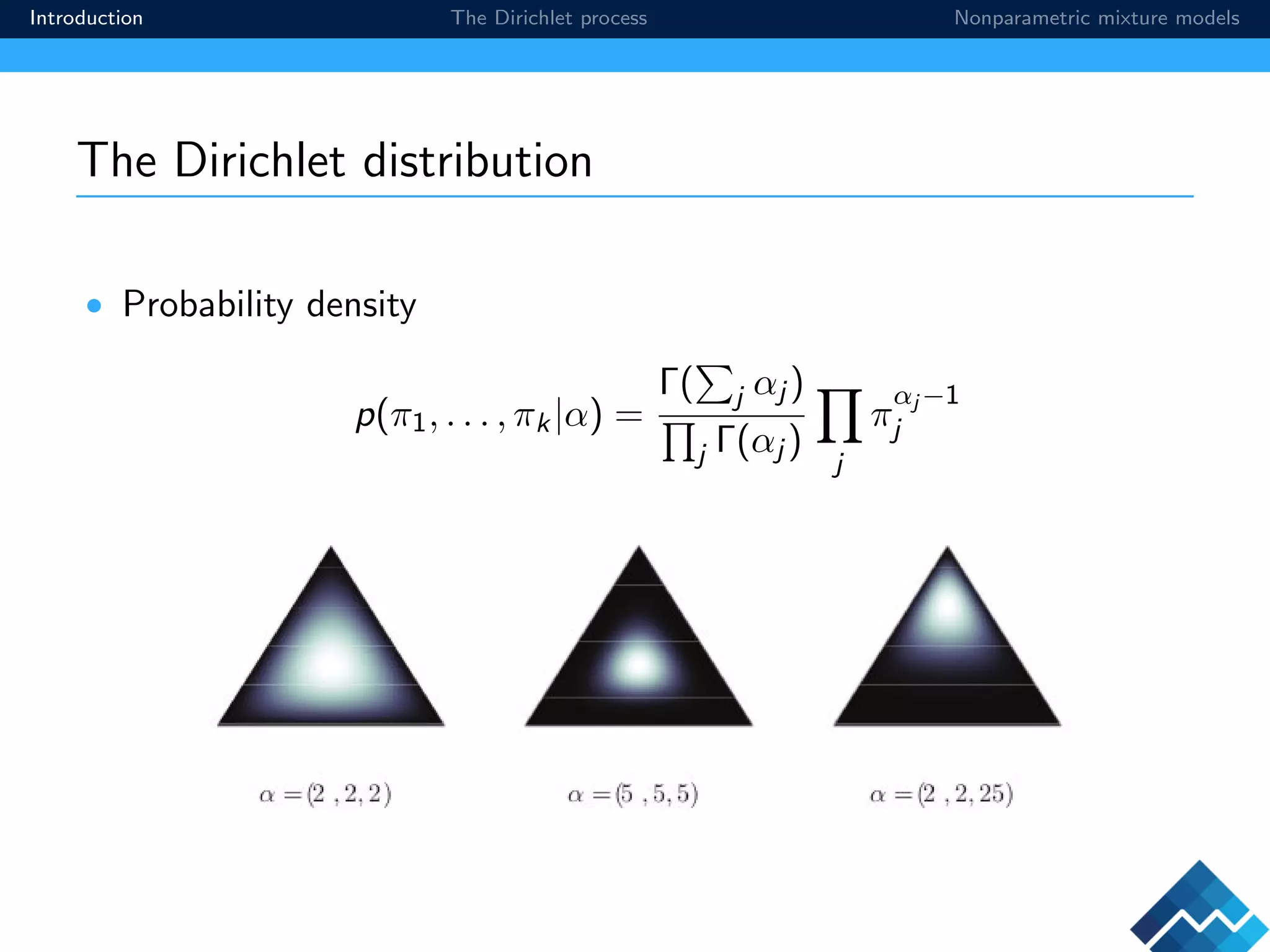
• Probability density
p(π1, . . . , πk|α) =
Γ( j αj )
j Γ(αj )
j
π
αj −1
j
Introduction The Dirichlet process Nonparametric mixture models
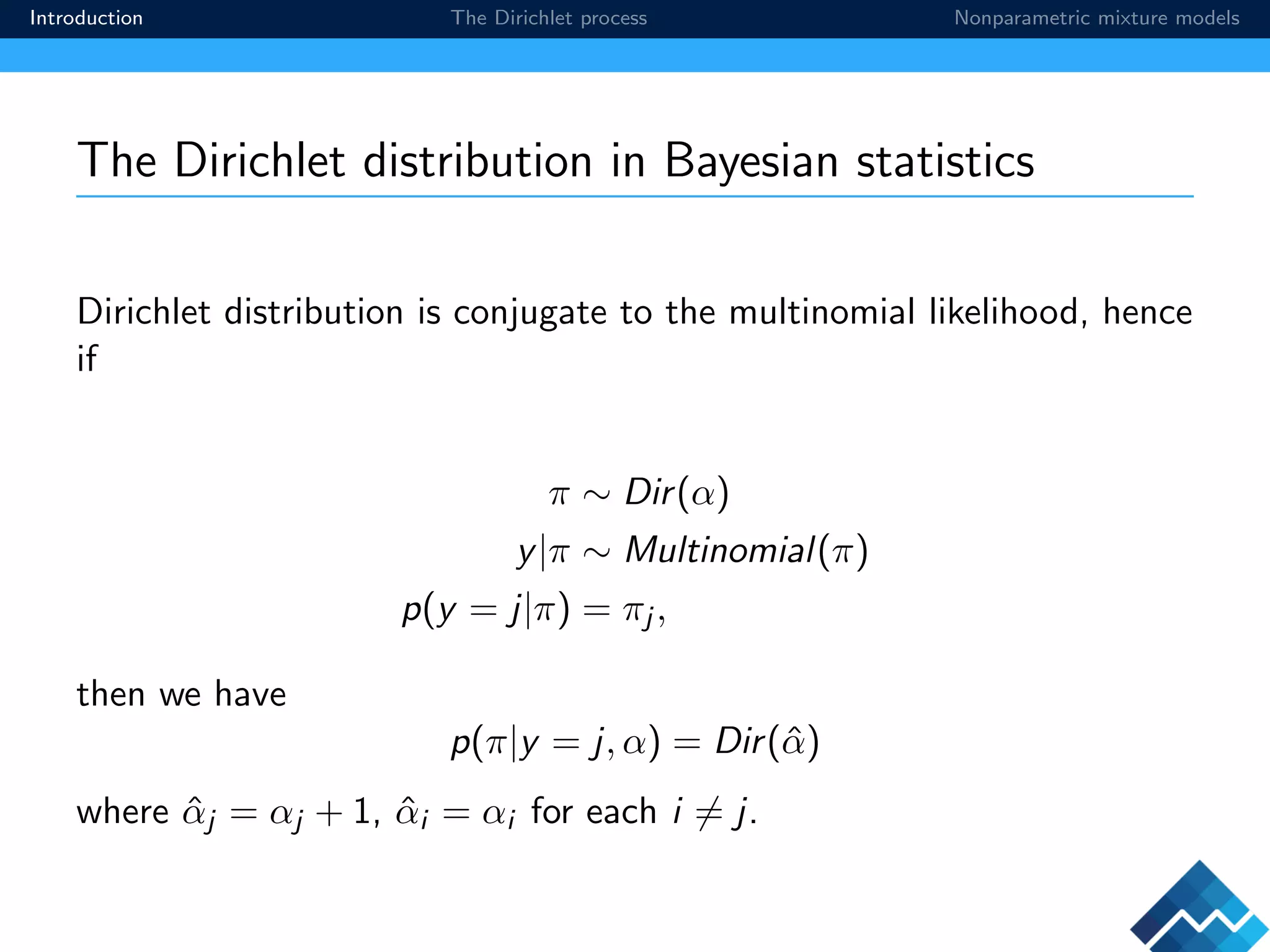
The Dirichlet distribution in Bayesian statistics
Dirichlet distribution is conjugate to the multinomial likelihood, hence
if
π ∼ Dir(α)
y|π ∼ Multinomial(π)
p(y = j|π) = πj ,
then we have
p(π|y = j, α) = Dir(ˆα)
where ˆαj = αj + 1, ˆαi = αi for each i = j.
Introduction The Dirichlet process Nonparametric mixture models
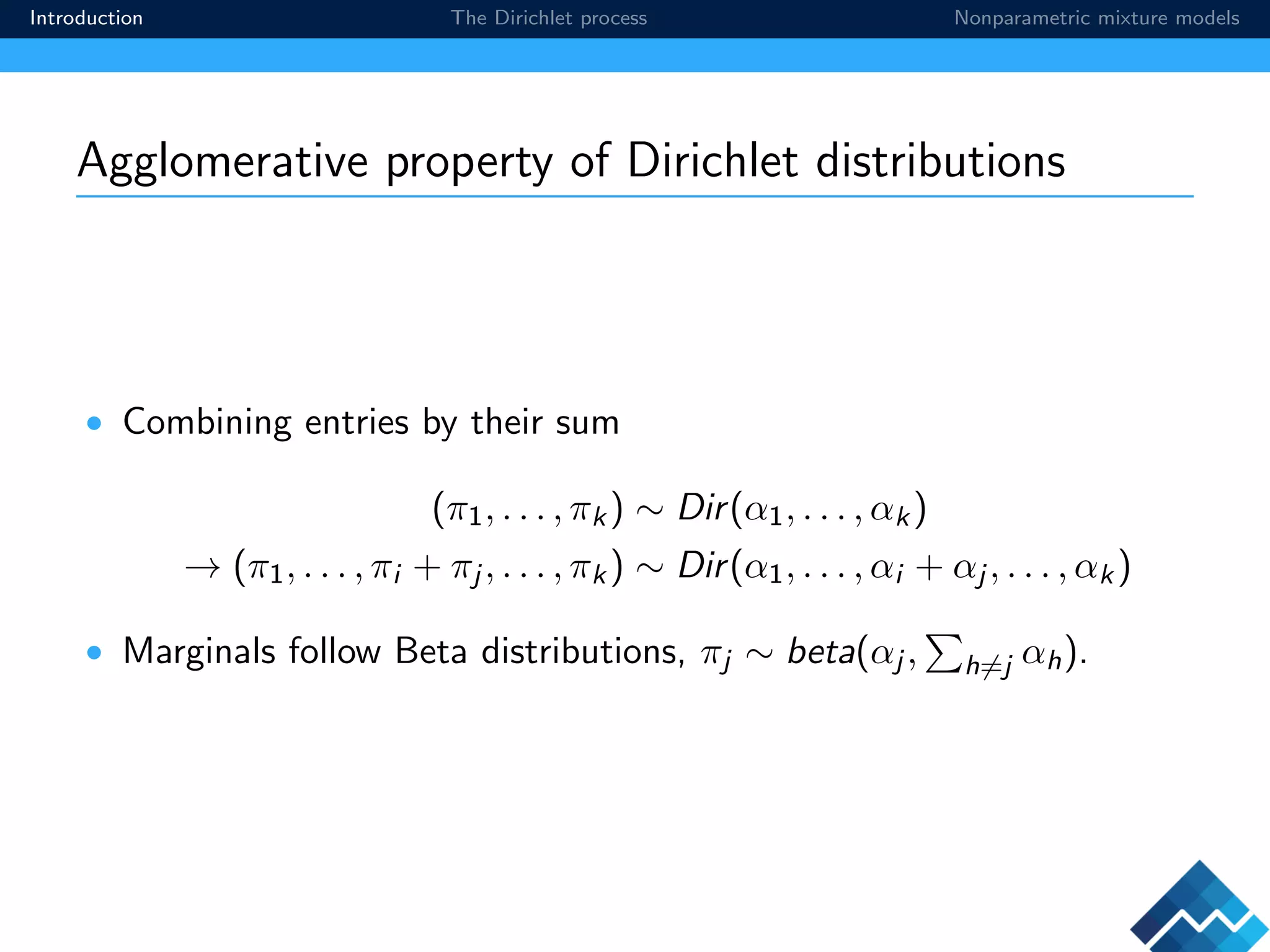
Agglomerative property of Dirichlet distributions
• Combining entries by their sum
(π1, . . . , πk) ∼ Dir(α1, . . . , αk)
→ (π1, . . . , πi + πj , . . . , πk) ∼ Dir(α1, . . . , αi + αj , . . . , αk)
• Marginals follow Beta distributions, πj ∼ beta(αj , h=j αh).
Introduction The Dirichlet process Nonparametric mixture models
1 Introduction
2 The Dirichlet process
3 Nonparametric mixture models
Introduction The Dirichlet process Nonparametric mixture models
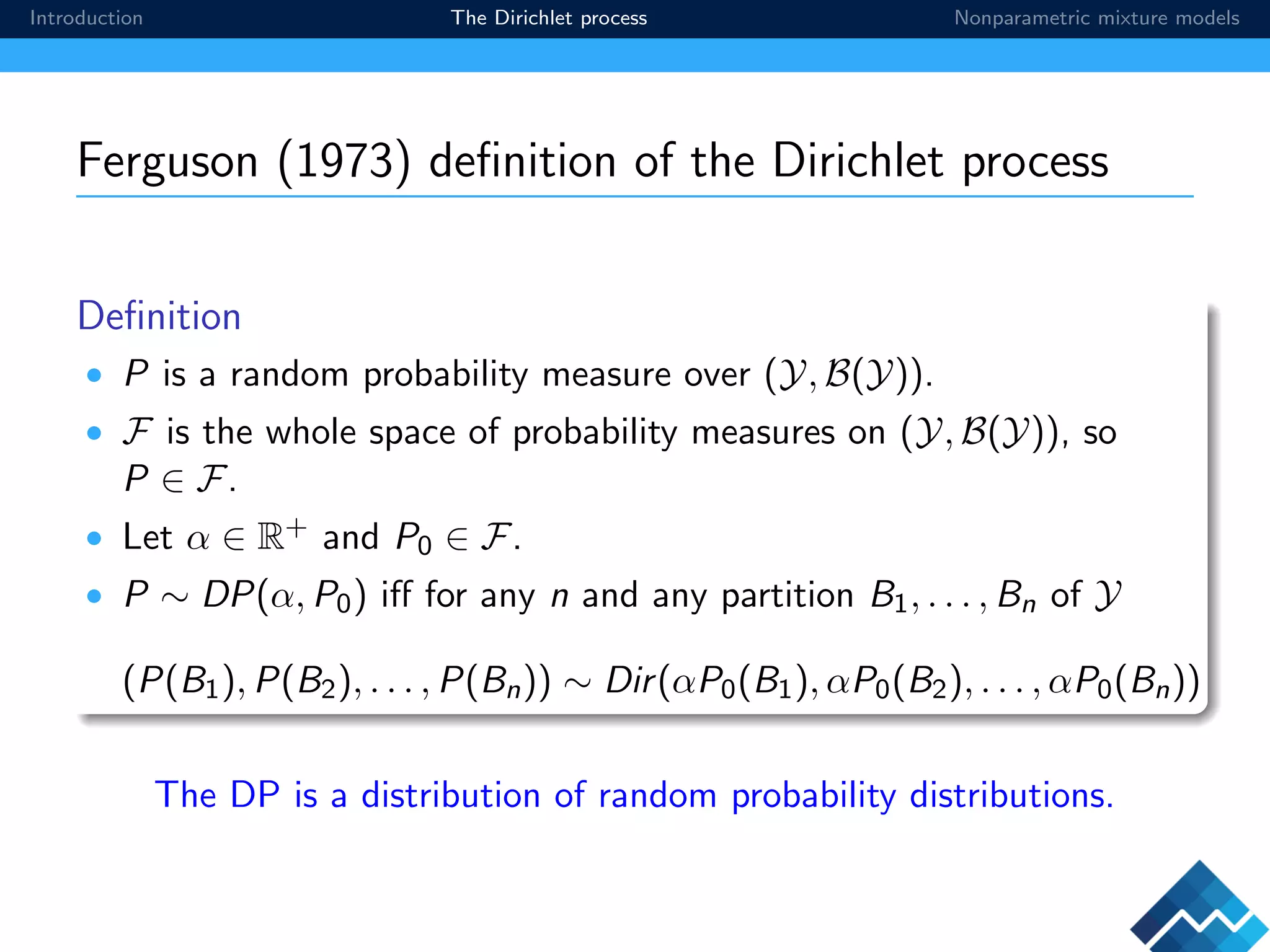
Ferguson (1973) definition of the Dirichlet process
Definition
• P is a random probability measure over (Y, B(Y)).
• F is the whole space of probability measures on (Y, B(Y)), so
P ∈ F.
• Let α ∈ R+ and P0 ∈ F.
• P ∼ DP(α, P0) iff for any n and any partition B1, . . . , Bn of Y
(P(B1), P(B2), . . . , P(Bn)) ∼ Dir(αP0(B1), αP0(B2), . . . , αP0(Bn))
The DP is a distribution of random probability distributions.
Introduction The Dirichlet process Nonparametric mixture models
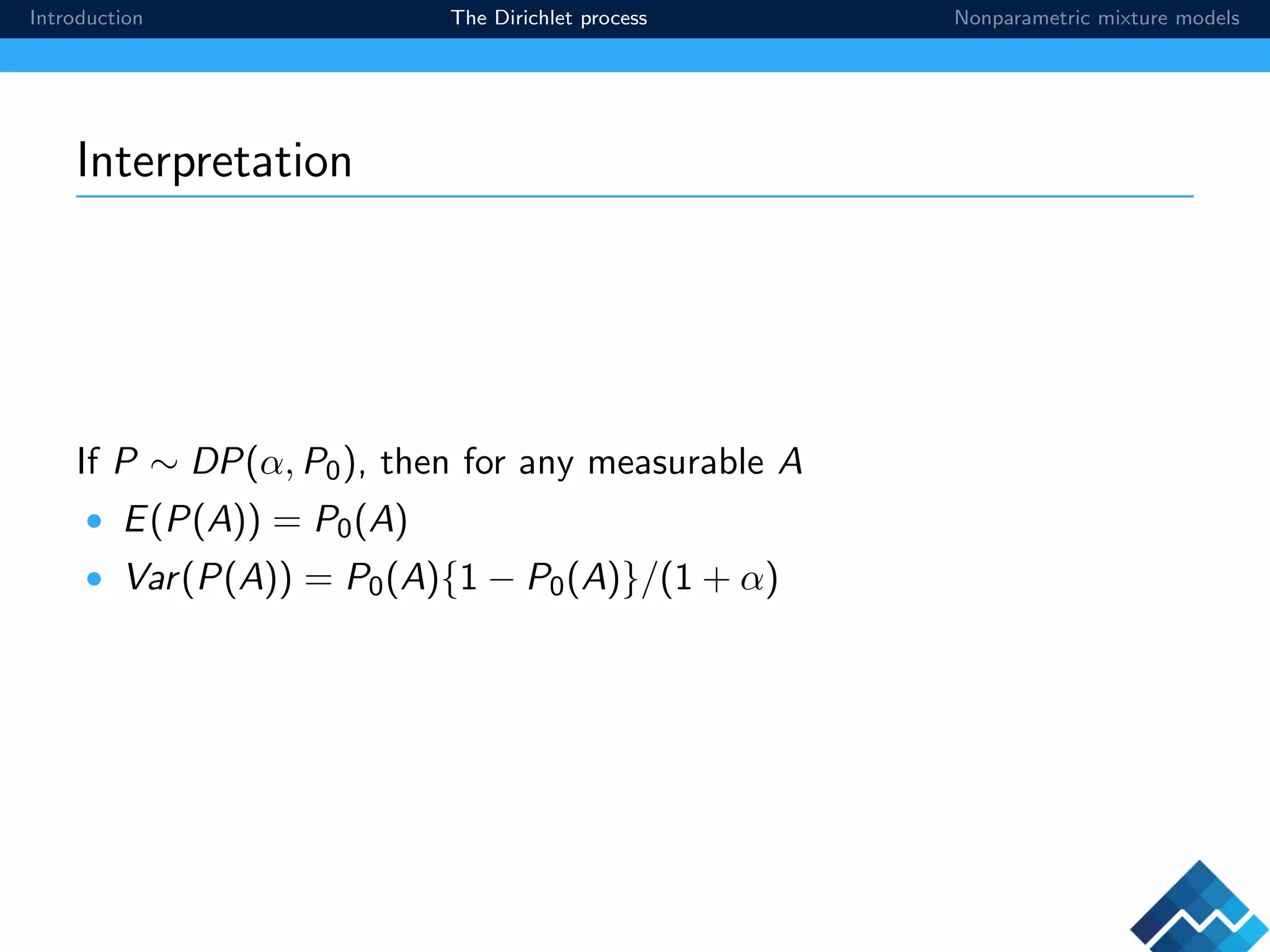
Interpretation
If P ∼ DP(α, P0), then for any measurable A
• E(P(A)) = P0(A)
• Var(P(A)) = P0(A){1 − P0(A)}/(1 + α)
Introduction The Dirichlet process Nonparametric mixture models
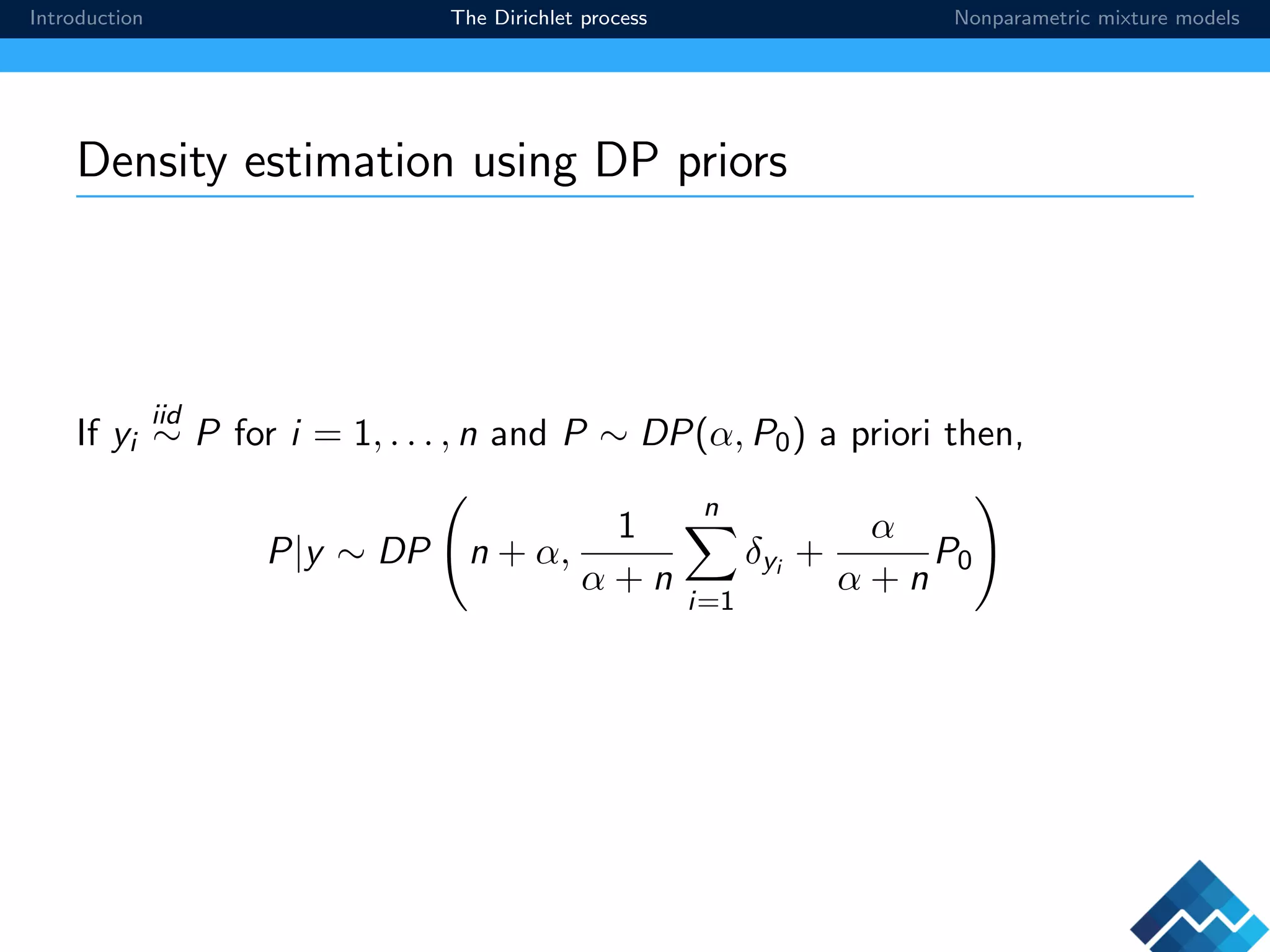
Density estimation using DP priors
If yi
iid
∼ P for i = 1, . . . , n and P ∼ DP(α, P0) a priori then,
P|y ∼ DP n + α,
1
α + n
n
i=1
δyi +
α
α + n
P0
Introduction The Dirichlet process Nonparametric mixture models
Density estimation using DP priors
−6 −4 −2 0 2 4 6
0.00.20.40.60.81.0
x
−6 −4 −2 0 2 4 6
0.00.20.40.60.81.0
x
Figure: Black true density (N(1, 2)), blue base measure (N(0,1)), green
dashed ECDF, blue dashed posterior DP. First plot n = 10, second n = 50.
Introduction The Dirichlet process Nonparametric mixture models
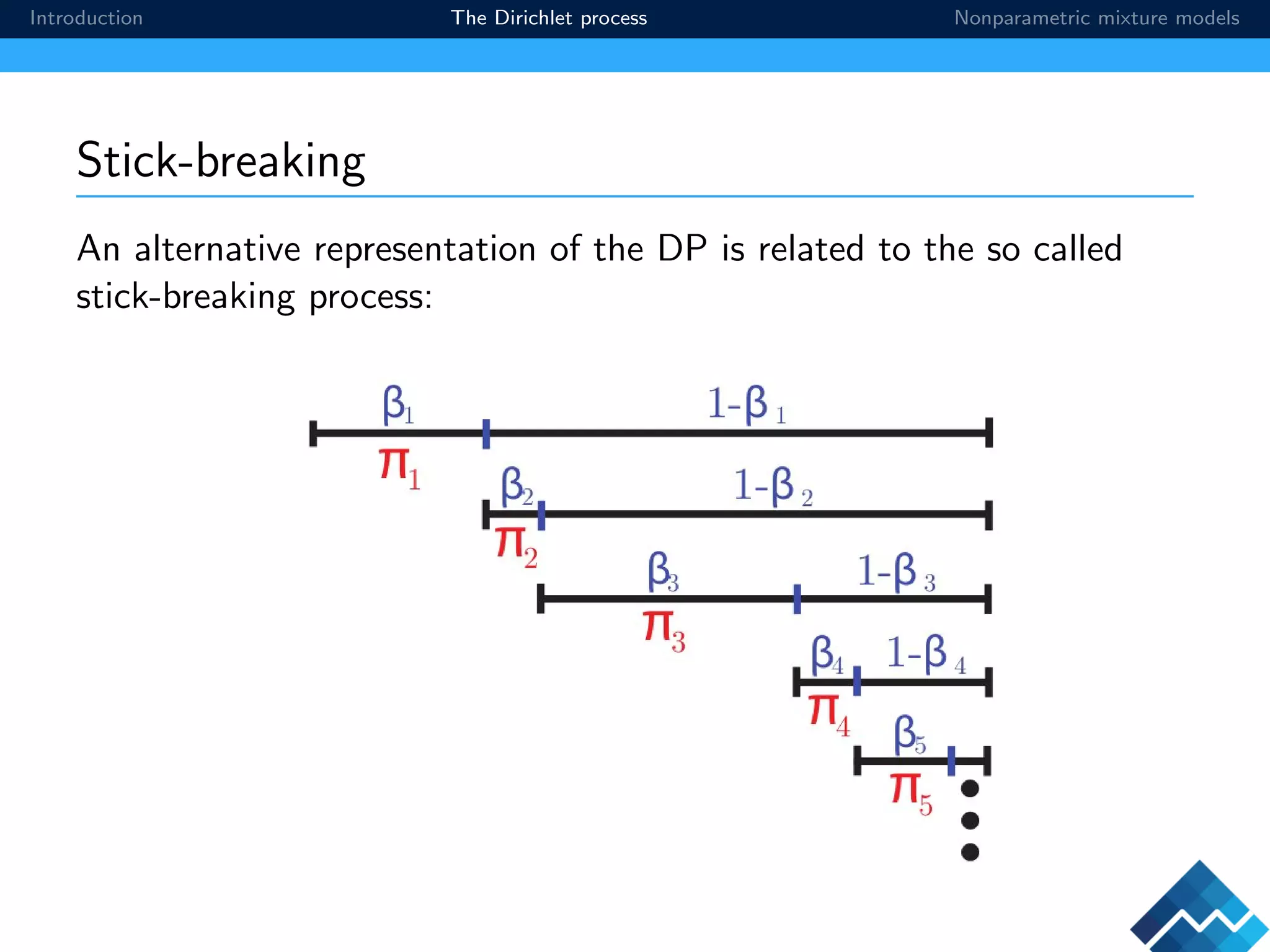
Stick-breaking
An alternative representation of the DP is related to the so called
stick-breaking process:
Introduction The Dirichlet process Nonparametric mixture models
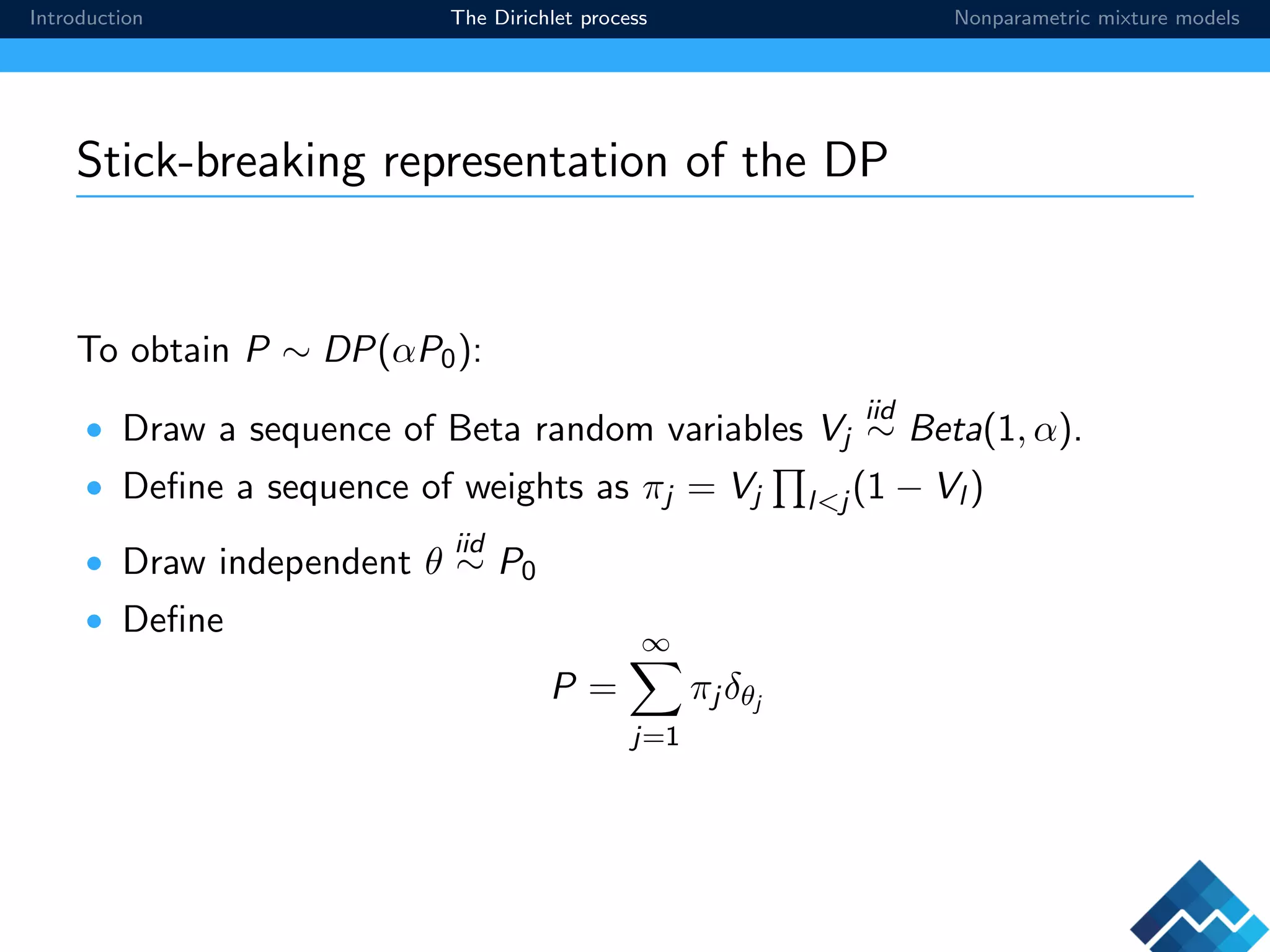
Stick-breaking representation of the DP
To obtain P ∼ DP(αP0):
• Draw a sequence of Beta random variables Vj
iid
∼ Beta(1, α).
• Define a sequence of weights as πj = Vj l<j (1 − Vl )
• Draw independent θ
iid
∼ P0
• Define
P =
∞
j=1
πj δθj
Introduction The Dirichlet process Nonparametric mixture models
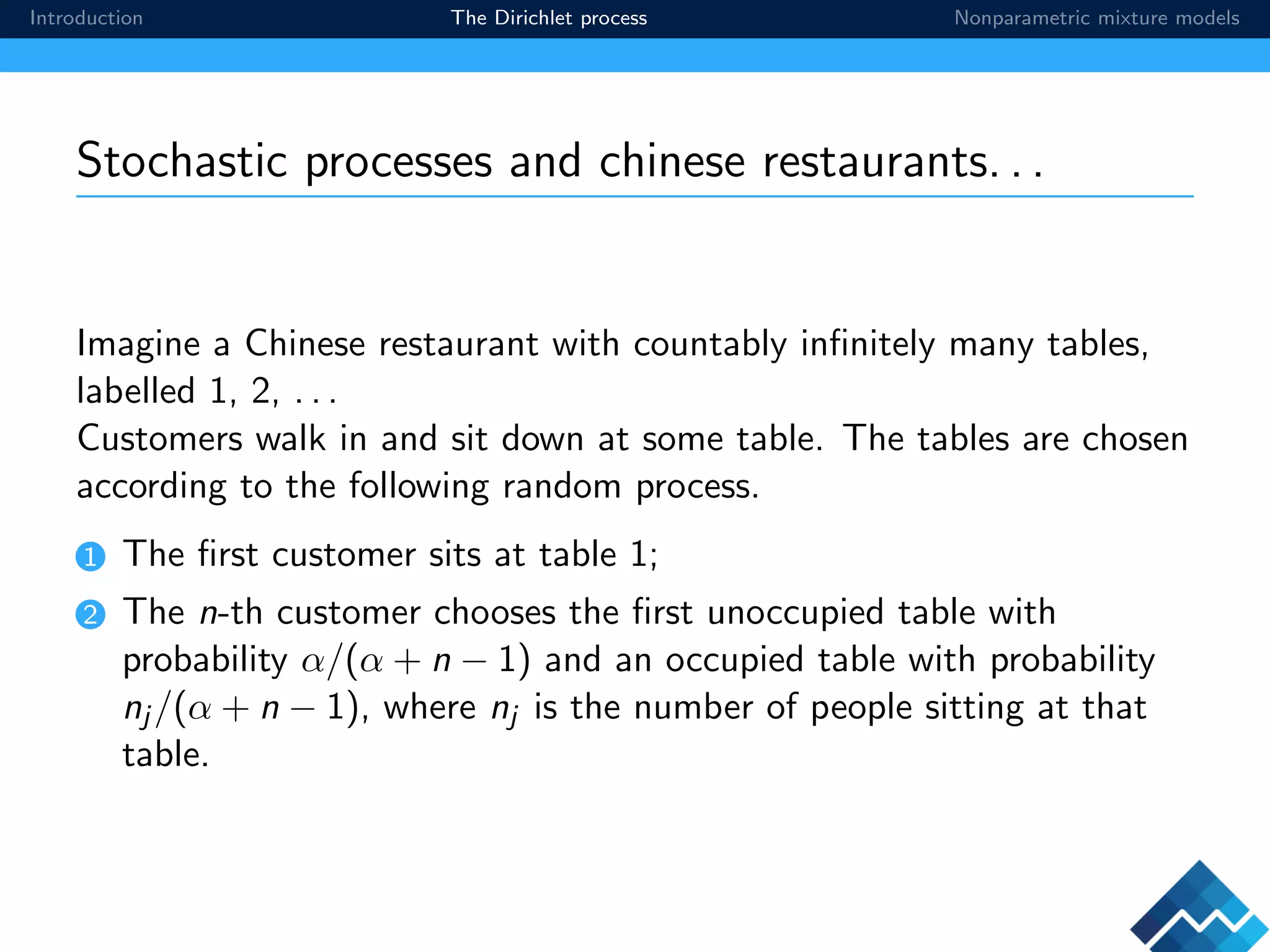
Stochastic processes and chinese restaurants. . .
Imagine a Chinese restaurant with countably infinitely many tables,
labelled 1, 2, . . .
Customers walk in and sit down at some table. The tables are chosen
according to the following random process.
1 The first customer sits at table 1;
2 The n-th customer chooses the first unoccupied table with
probability α/(α + n − 1) and an occupied table with probability
nj /(α + n − 1), where nj is the number of people sitting at that
table.
Introduction The Dirichlet process Nonparametric mixture models
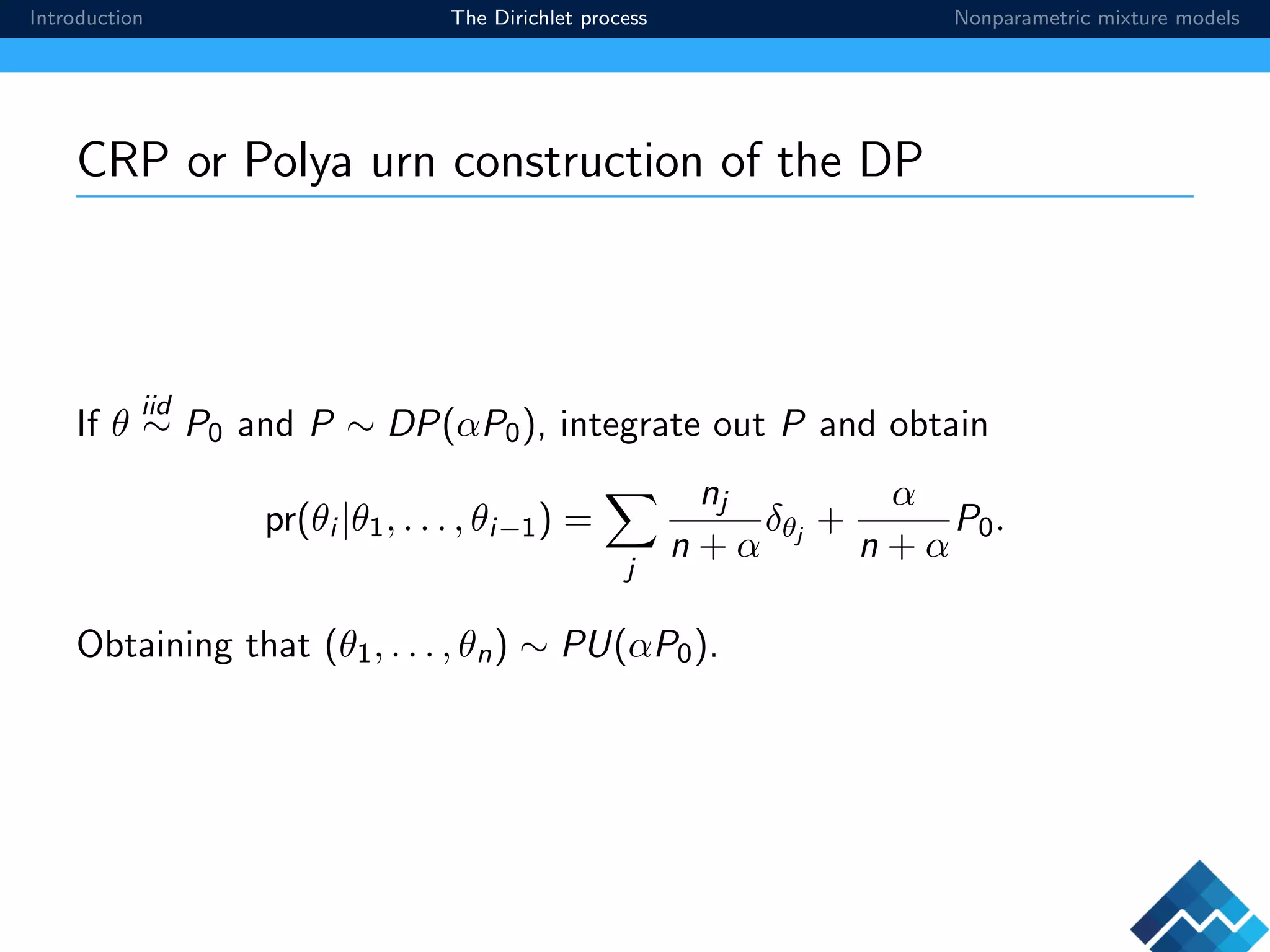
CRP or Polya urn construction of the DP
If θ
iid
∼ P0 and P ∼ DP(αP0), integrate out P and obtain
pr(θi |θ1, . . . , θi−1) =
j
nj
n + α
δθj
+
α
n + α
P0.
Obtaining that (θ1, . . . , θn) ∼ PU(αP0).
Introduction The Dirichlet process Nonparametric mixture models
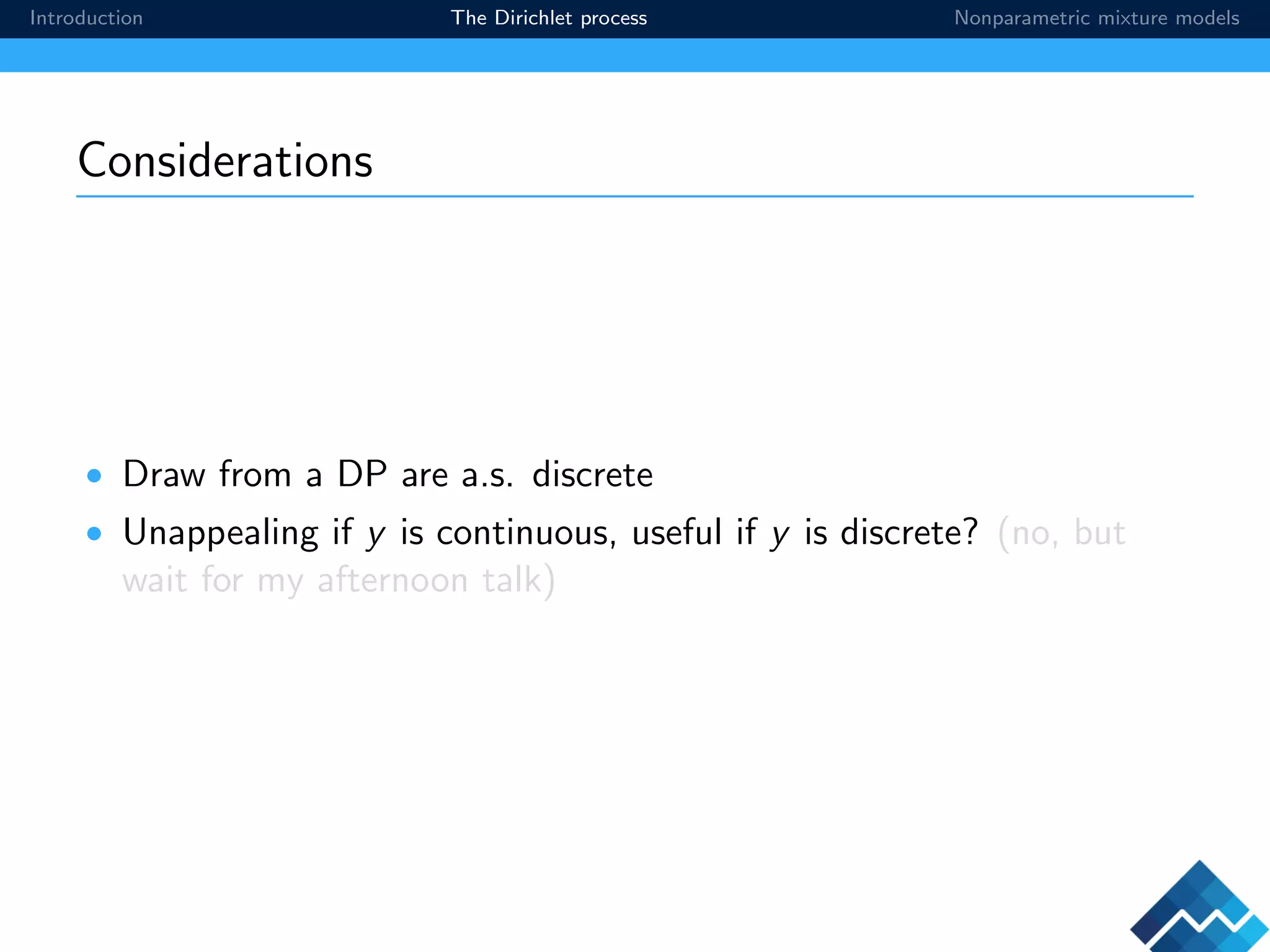
Considerations
• Draw from a DP are a.s. discrete
• Unappealing if y is continuous, useful if y is discrete? (no, but
wait for my afternoon talk)
Introduction The Dirichlet process Nonparametric mixture models
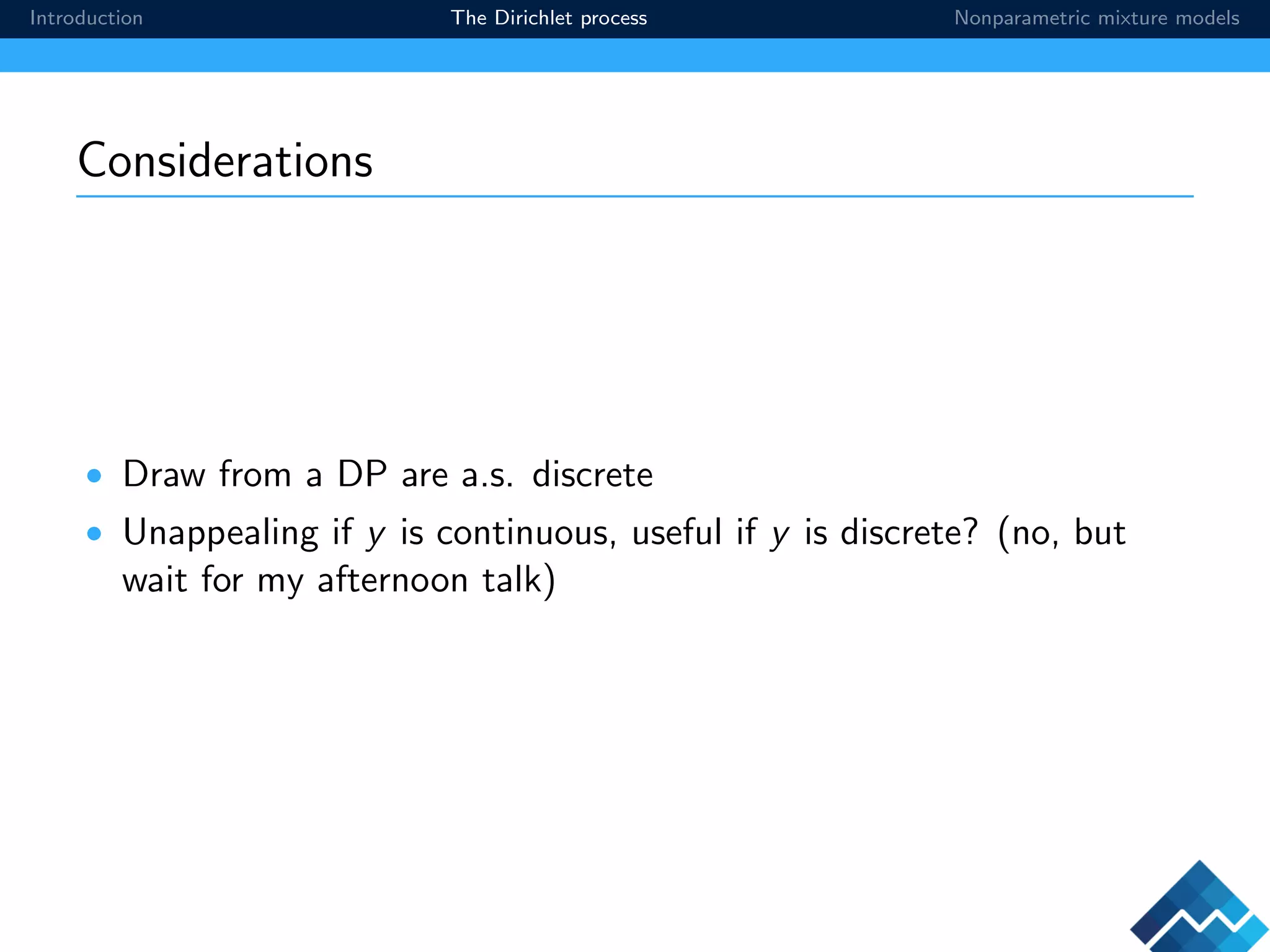
Considerations
• Draw from a DP are a.s. discrete
• Unappealing if y is continuous, useful if y is discrete? (no, but
wait for my afternoon talk)
Introduction The Dirichlet process Nonparametric mixture models
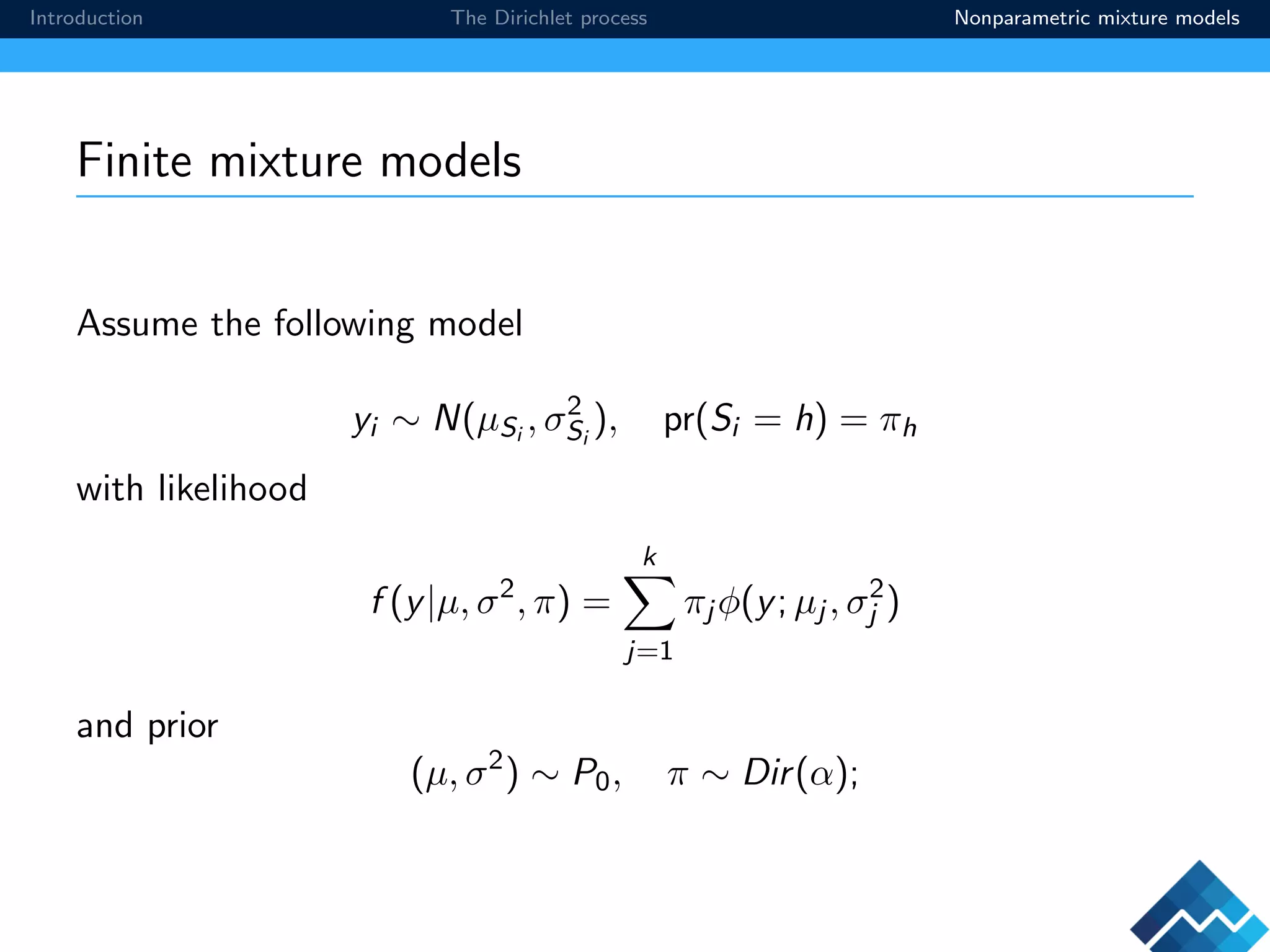
Finite mixture models
Assume the following model
yi ∼ N(µSi
, σ2
Si
), pr(Si = h) = πh
with likelihood
f (y|µ, σ2
, π) =
k
j=1
πj φ(y; µj , σ2
j )
and prior
(µ, σ2
) ∼ P0, π ∼ Dir(α);
Introduction The Dirichlet process Nonparametric mixture models
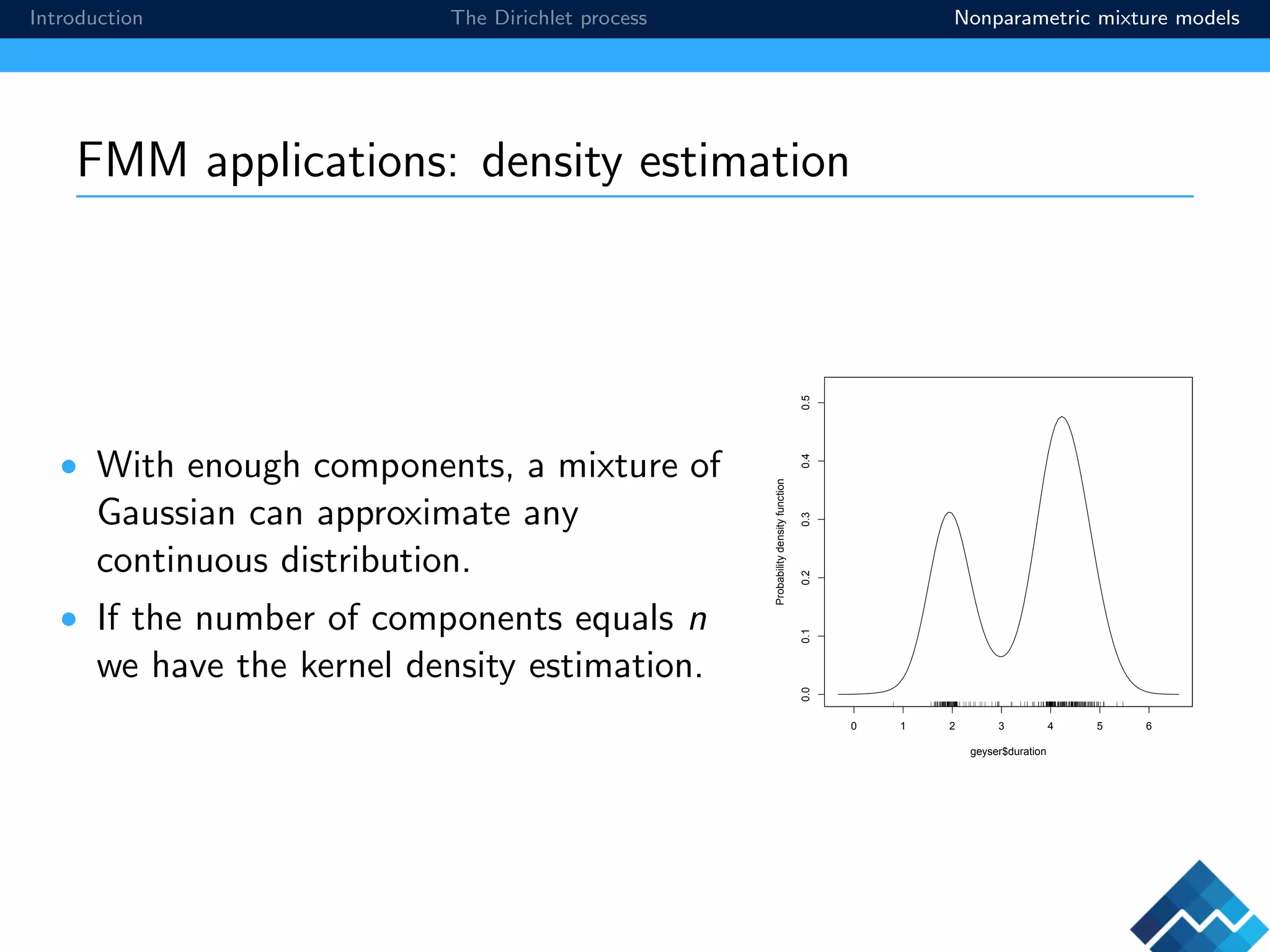
FMM applications: density estimation
• With enough components, a mixture of
Gaussian can approximate any
continuous distribution.
• If the number of components equals n
we have the kernel density estimation.
0 1 2 3 4 5 6
0.00.10.20.30.40.5
geyser$duration
Probabilitydensityfunction
Introduction The Dirichlet process Nonparametric mixture models
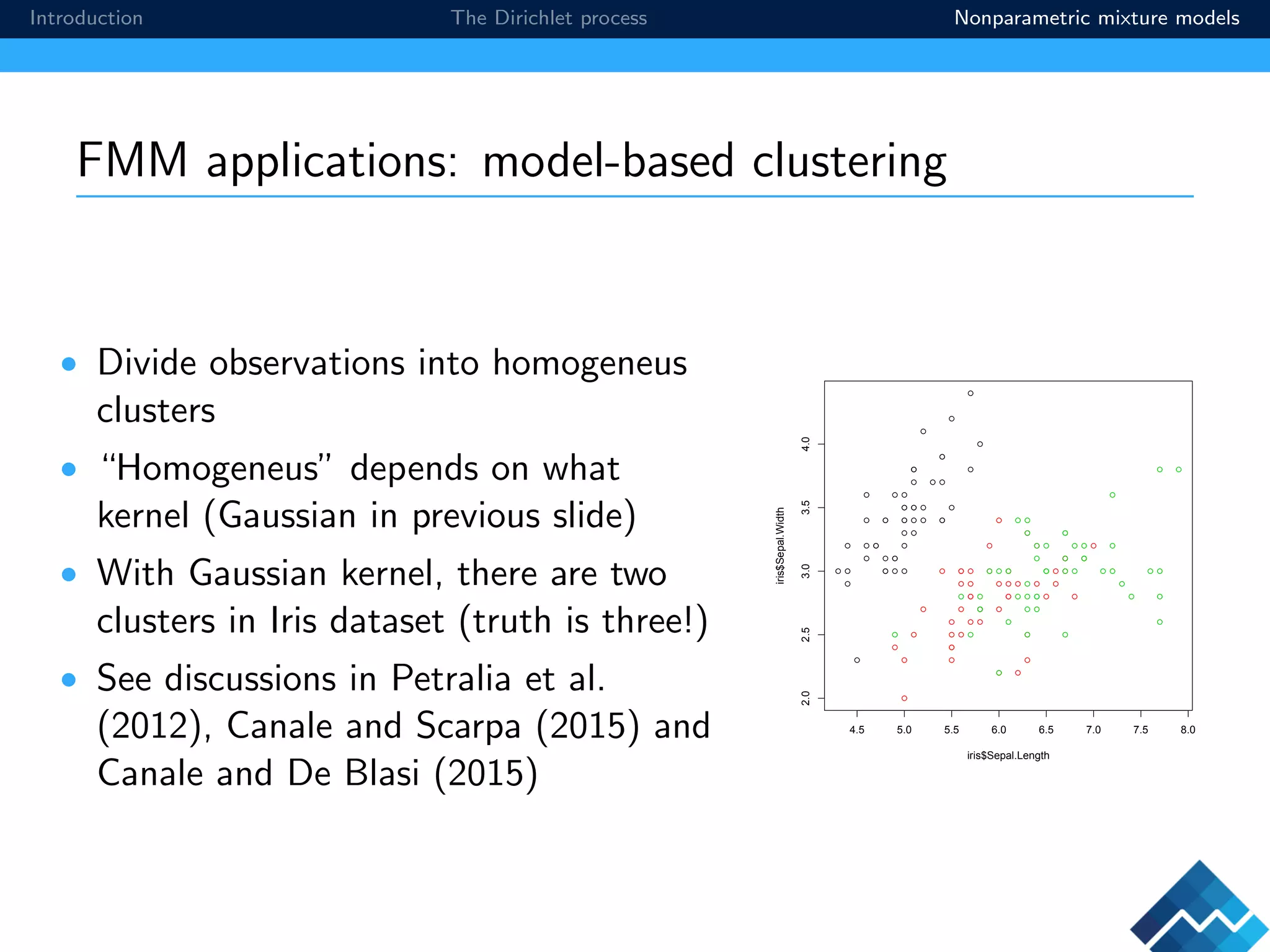
FMM applications: model-based clustering
• Divide observations into homogeneus
clusters
• “Homogeneus” depends on what
kernel (Gaussian in previous slide)
• With Gaussian kernel, there are two
clusters in Iris dataset (truth is three!)
• See discussions in Petralia et al.
(2012), Canale and Scarpa (2015) and
Canale and De Blasi (2015)
q
q
q
q
q
q
q q
q
q
q
q
qq
q
q
q
q
qq
q
q
q
q
q
q
q
q
q
q
q
q
q
q
q
q
q
q
q
q
q
q
q
q
q
q
q
q
q
q
qq
q
q
qq
q
q
q
q
q
q
q
qq
q
q
q
q
q
q
q
q
q
q
q
q
q
q
q
qq
q q
q
q
q
q
q
q
q
q
q
q
q
q
q q
q
q
q
q
q
q
q q
q
q
q
q
q
q
q
q
q
q
q
q
q
q
q
q q
q
q
q
q
q
q
q
q
q
qq
q
q
q
q
q
qq q
q
q
q
q
q
q
q
q
4.5 5.0 5.5 6.0 6.5 7.0 7.5 8.0
2.02.53.03.54.0
iris$Sepal.Length
iris$Sepal.Width
Introduction The Dirichlet process Nonparametric mixture models
Infinite mixture models
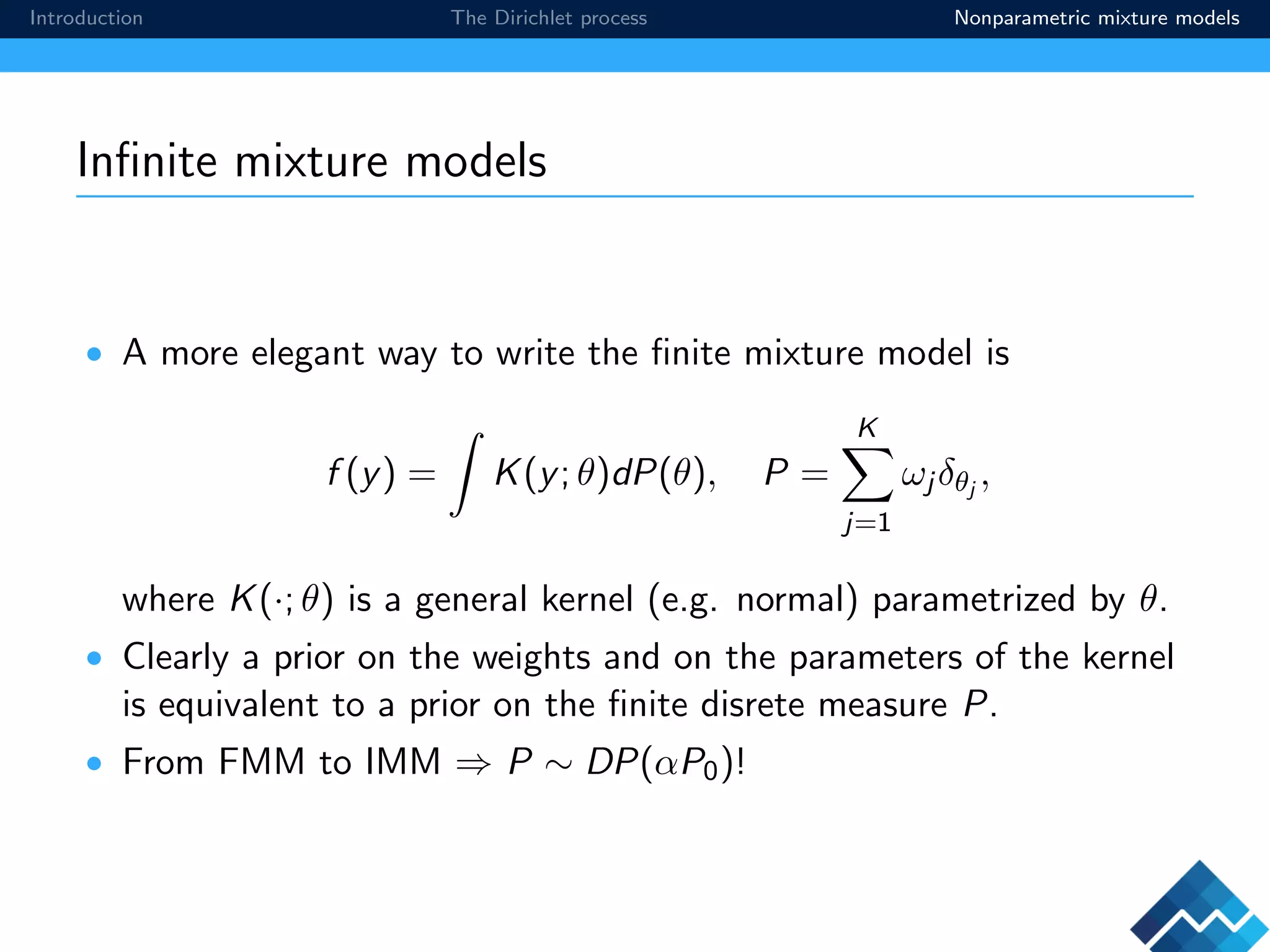
• A more elegant way to write the finite mixture model is
f (y) = K(y; θ)dP(θ), P =
K
j=1
ωj δθj
,
where K(·; θ) is a general kernel (e.g. normal) parametrized by θ.
• Clearly a prior on the weights and on the parameters of the kernel
is equivalent to a prior on the finite disrete measure P.
• From FMM to IMM ⇒ P ∼ DP(αP0)!
Introduction The Dirichlet process Nonparametric mixture models
DP mixture models
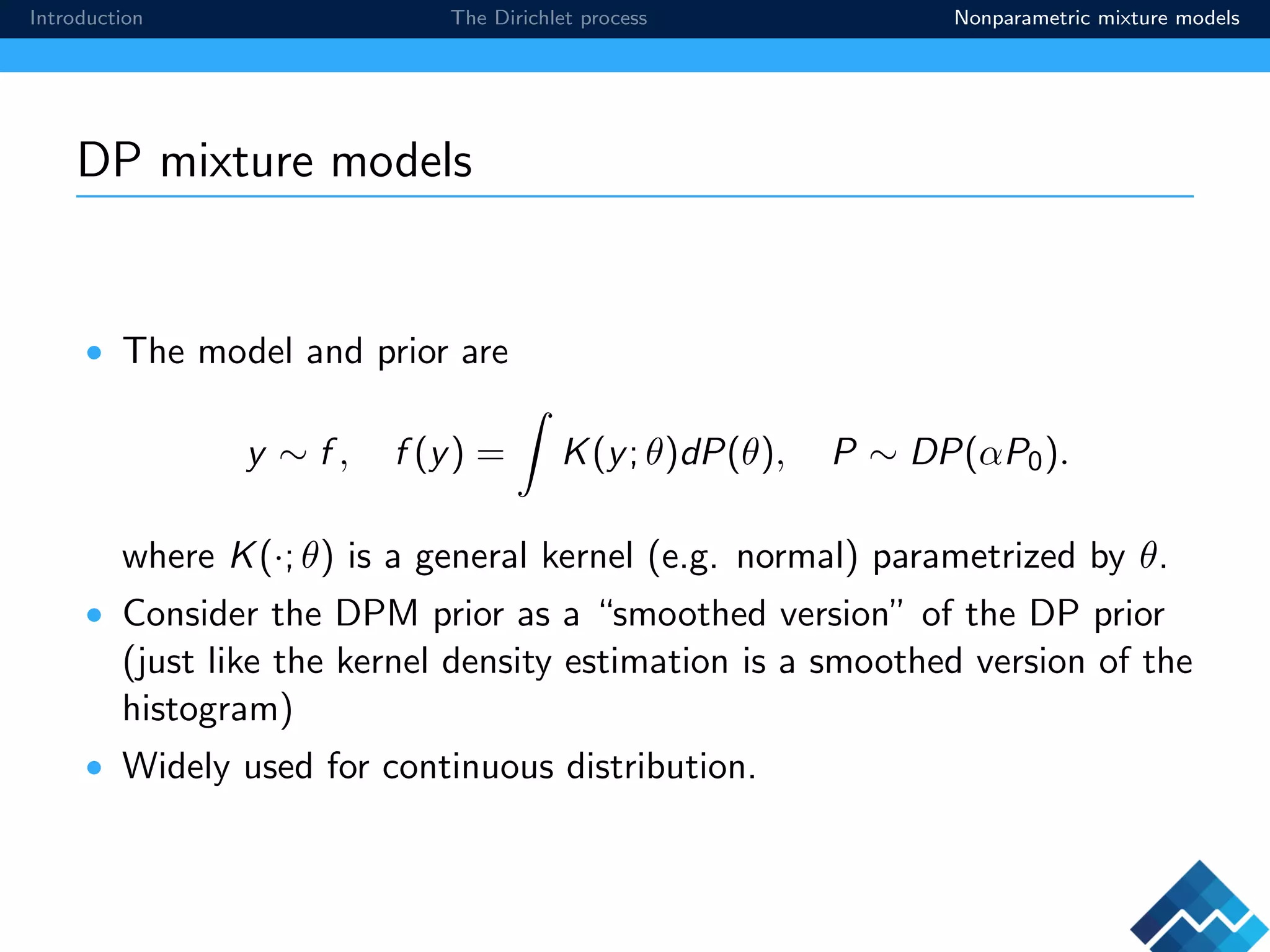
• The model and prior are
y ∼ f , f (y) = K(y; θ)dP(θ), P ∼ DP(αP0).
where K(·; θ) is a general kernel (e.g. normal) parametrized by θ.
• Consider the DPM prior as a “smoothed version” of the DP prior
(just like the kernel density estimation is a smoothed version of the
histogram)
• Widely used for continuous distribution.
Introduction The Dirichlet process Nonparametric mixture models
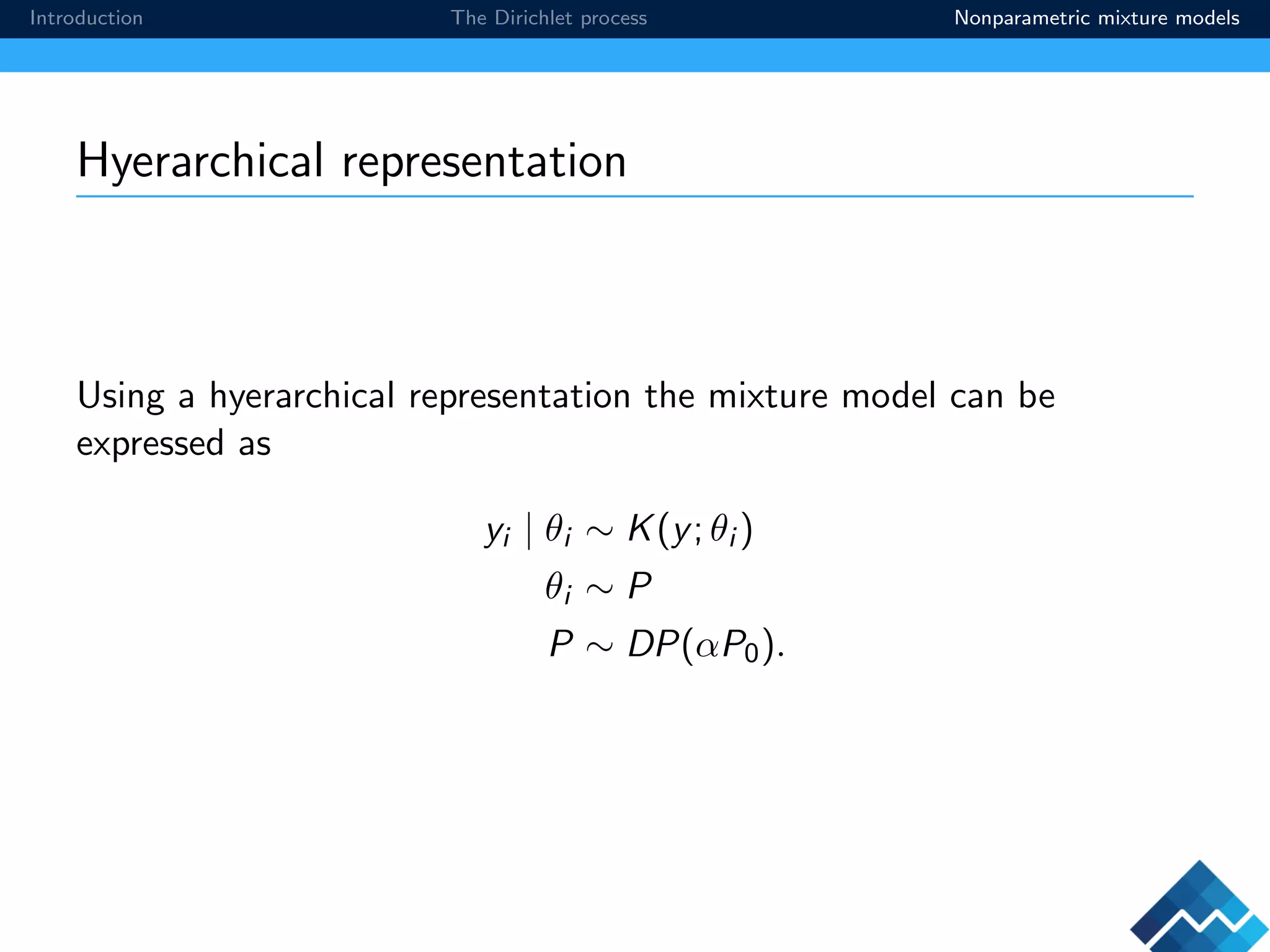
Hyerarchical representation
Using a hyerarchical representation the mixture model can be
expressed as
yi | θi ∼ K(y; θi )
θi ∼ P
P ∼ DP(αP0).
Introduction The Dirichlet process Nonparametric mixture models
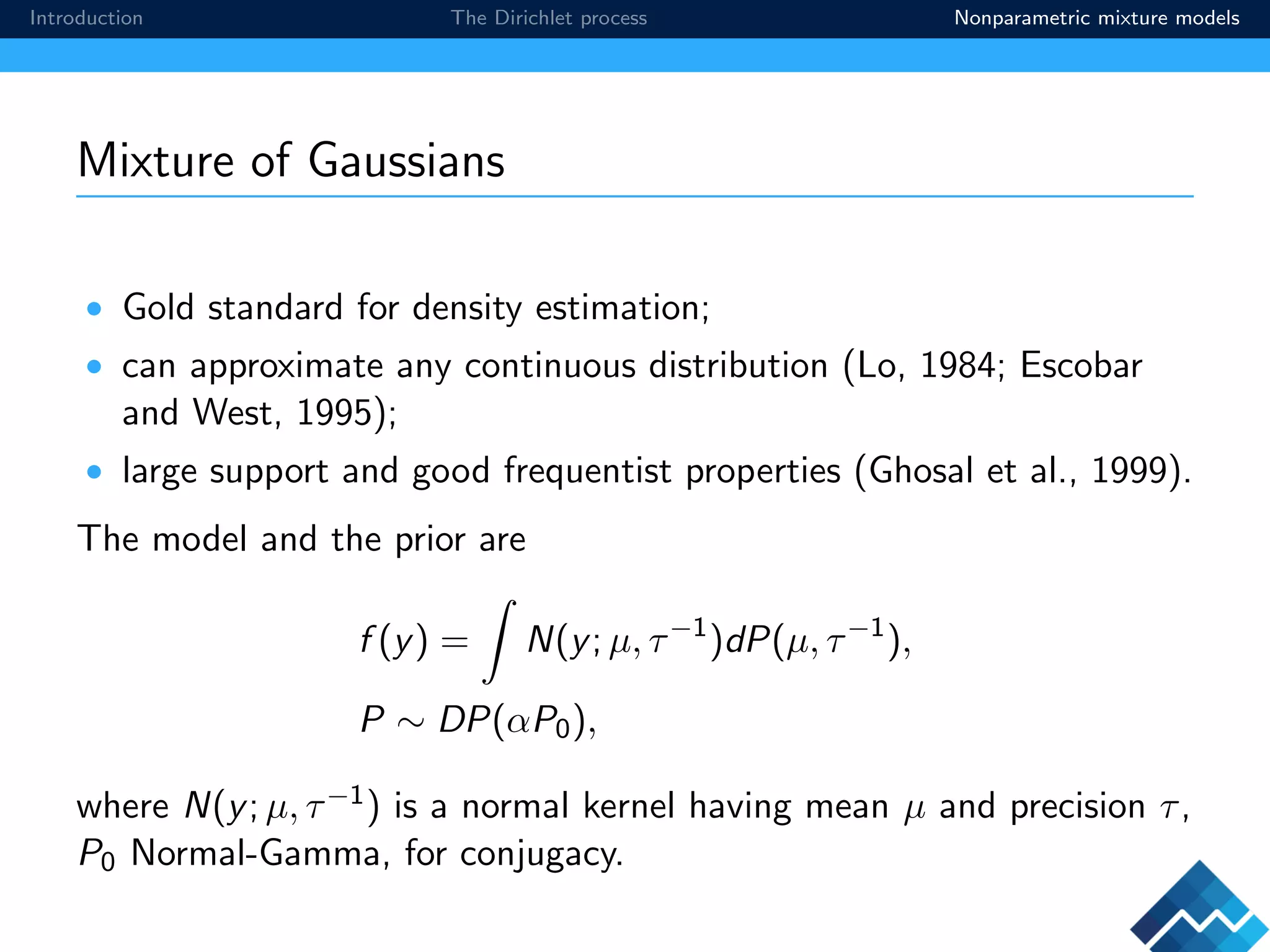
Mixture of Gaussians
• Gold standard for density estimation;
• can approximate any continuous distribution (Lo, 1984; Escobar
and West, 1995);
• large support and good frequentist properties (Ghosal et al., 1999).
The model and the prior are
f (y) = N(y; µ, τ−1
)dP(µ, τ−1
),
P ∼ DP(αP0),
where N(y; µ, τ−1) is a normal kernel having mean µ and precision τ,
P0 Normal-Gamma, for conjugacy.
Introduction The Dirichlet process Nonparametric mixture models
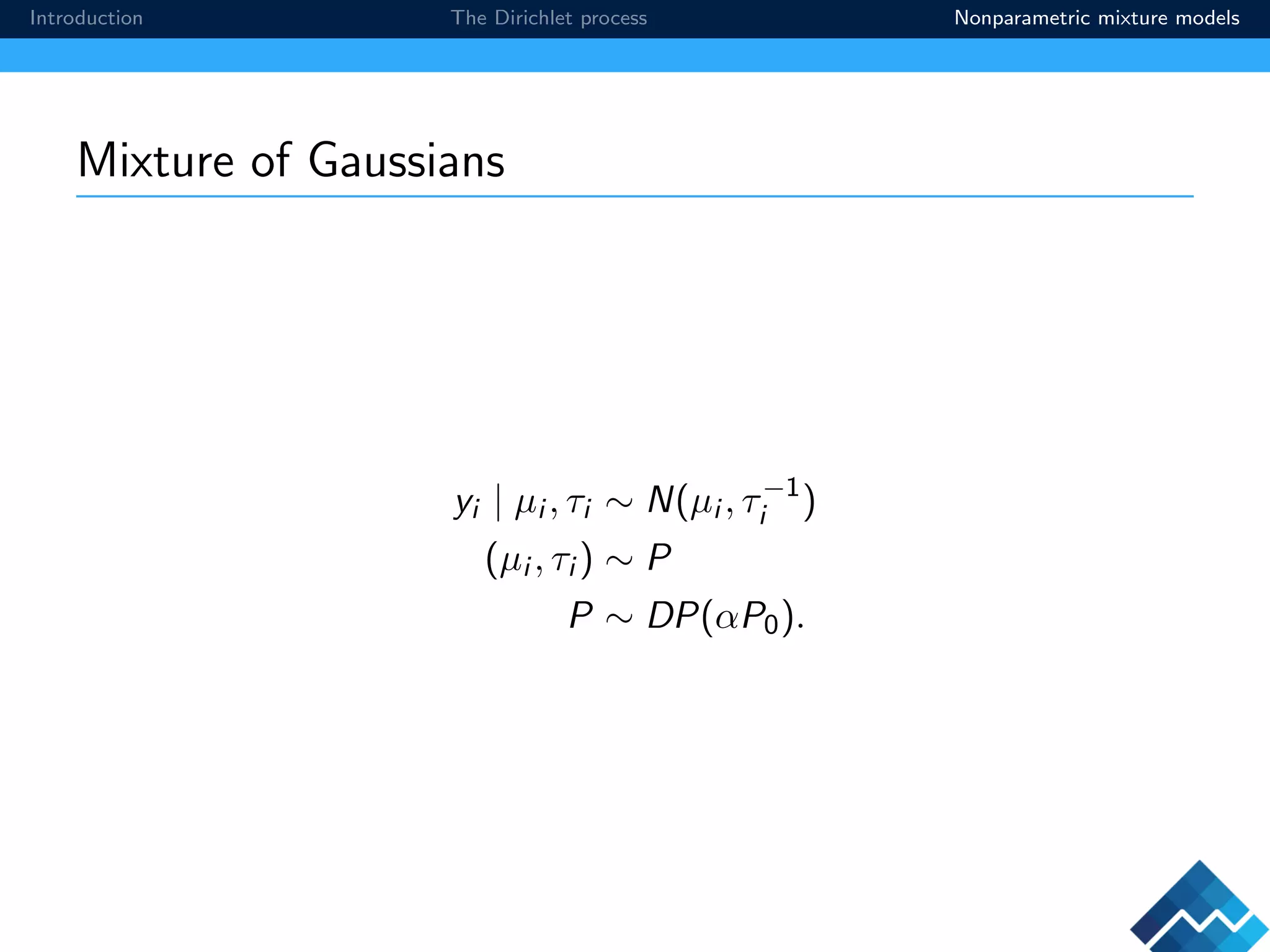
Mixture of Gaussians
yi | µi , τi ∼ N(µi , τ−1
i )
(µi , τi ) ∼ P
P ∼ DP(αP0).
Introduction The Dirichlet process Nonparametric mixture models
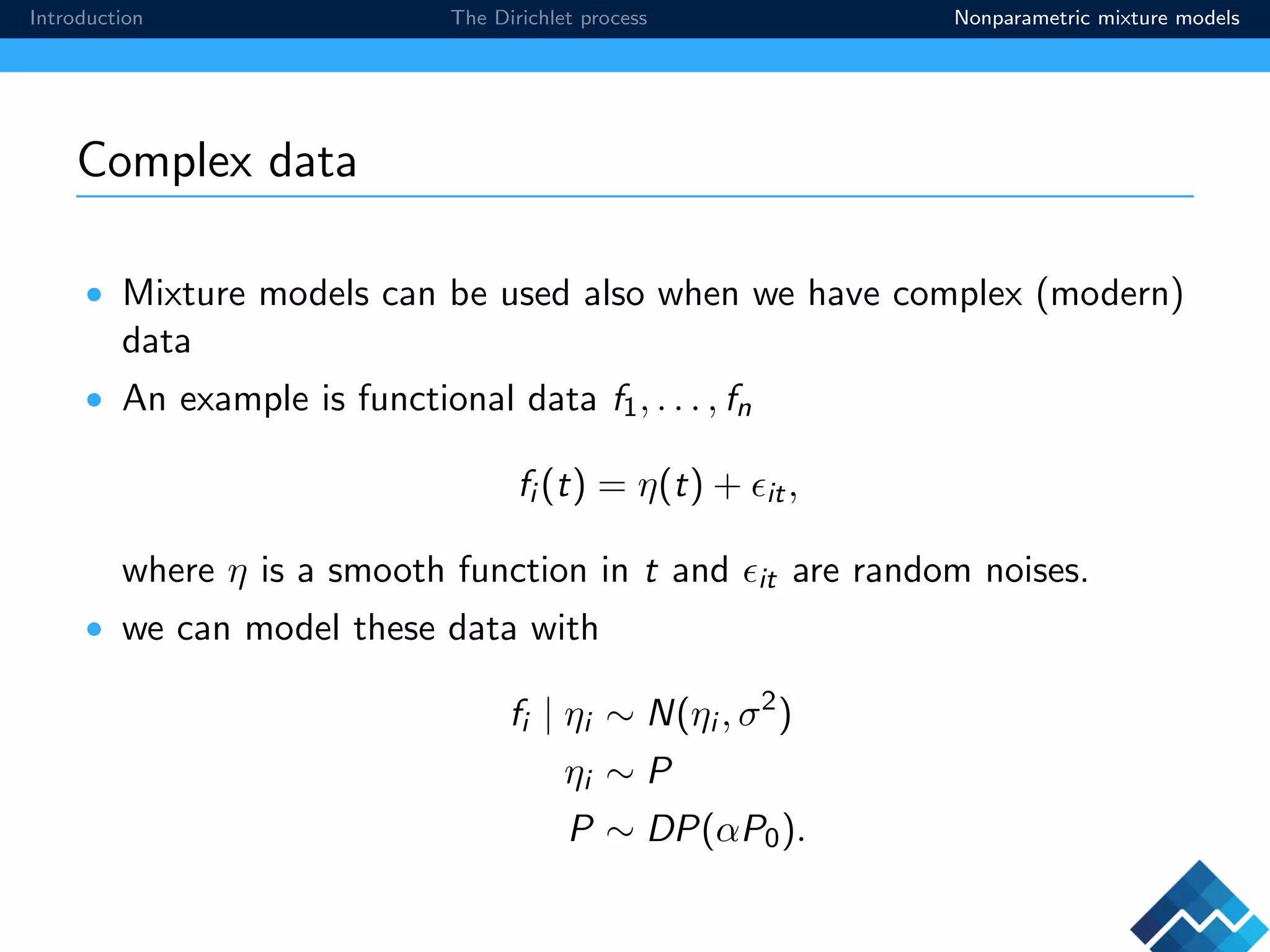
Complex data
• Mixture models can be used also when we have complex (modern)
data
• An example is functional data f1, . . . , fn
fi (t) = η(t) + it,
where η is a smooth function in t and it are random noises.
• we can model these data with
fi | ηi ∼ N(ηi , σ2
)
ηi ∼ P
P ∼ DP(αP0).

A Gentle Introduction to Bayesian Nonparametrics

  • 1.
    A gentle introductionto BNP Part I Antonio Canale Universit`a di Torino & Collegio Carlo Alberto StaTalk on BNP, 19/02/16
  • 2.
    Introduction The Dirichletprocess Nonparametric mixture models Outline of the talk(s) 1 Why BNP? (A) 2 The Dirichlet process (A) 3 Nonparametric mixture models (A) 4 Beyond the DP (J) 5 Species sampling processes (J) 6 Completely random measures (J)
  • 3.
    Introduction The Dirichletprocess Nonparametric mixture models Why Bayesian nonparametrics (BNP)? Why nonparametric? • We don’t want to strictly impose any model but let the data speak; • The idea of a true model governed by relatively few parameters is unrealistic; Why Bayesian? • If we have a reasonable guess for what is the true model we want to use this prior knowledge. • Large support and consistency are interesting concepts related to priors on infinite dimensional spaces (Pierpaolo’s talk in the afternoon) BNP is to fit a single model that can adapt its complexity to the data.
  • 4.
    Introduction The Dirichletprocess Nonparametric mixture models Why Bayesian nonparametrics (BNP)? Why nonparametric? • We don’t want to strictly impose any model but let the data speak; • The idea of a true model governed by relatively few parameters is unrealistic; Why Bayesian? • If we have a reasonable guess for what is the true model we want to use this prior knowledge. • Large support and consistency are interesting concepts related to priors on infinite dimensional spaces (Pierpaolo’s talk in the afternoon) BNP is to fit a single model that can adapt its complexity to the data.
  • 5.
    Introduction The Dirichletprocess Nonparametric mixture models Why Bayesian nonparametrics (BNP)? Why nonparametric? • We don’t want to strictly impose any model but let the data speak; • The idea of a true model governed by relatively few parameters is unrealistic; Why Bayesian? • If we have a reasonable guess for what is the true model we want to use this prior knowledge. • Large support and consistency are interesting concepts related to priors on infinite dimensional spaces (Pierpaolo’s talk in the afternoon) BNP is to fit a single model that can adapt its complexity to the data.
  • 6.
    Introduction The Dirichletprocess Nonparametric mixture models Why Bayesian nonparametrics (BNP)? Why nonparametric? • We don’t want to strictly impose any model but let the data speak; • The idea of a true model governed by relatively few parameters is unrealistic; Why Bayesian? • If we have a reasonable guess for what is the true model we want to use this prior knowledge. • Large support and consistency are interesting concepts related to priors on infinite dimensional spaces (Pierpaolo’s talk in the afternoon) BNP is to fit a single model that can adapt its complexity to the data.
  • 7.
    Introduction The Dirichletprocess Nonparametric mixture models Why Bayesian nonparametrics (BNP)? Why nonparametric? • We don’t want to strictly impose any model but let the data speak; • The idea of a true model governed by relatively few parameters is unrealistic; Why Bayesian? • If we have a reasonable guess for what is the true model we want to use this prior knowledge. • Large support and consistency are interesting concepts related to priors on infinite dimensional spaces (Pierpaolo’s talk in the afternoon) BNP is to fit a single model that can adapt its complexity to the data.
  • 8.
    Introduction The Dirichletprocess Nonparametric mixture models Why Bayesian nonparametrics (BNP)? Why nonparametric? • We don’t want to strictly impose any model but let the data speak; • The idea of a true model governed by relatively few parameters is unrealistic; Why Bayesian? • If we have a reasonable guess for what is the true model we want to use this prior knowledge. • Large support and consistency are interesting concepts related to priors on infinite dimensional spaces (Pierpaolo’s talk in the afternoon) BNP is to fit a single model that can adapt its complexity to the data.
  • 9.
    Introduction The Dirichletprocess Nonparametric mixture models How Bayesian and nonparametric? Define F the space of densities and let P ∈ F. A Bayesian analysis starts with y ∼ P P ∼ π where π is a measure on the space F. Hence BNP is infinitely parametric.
  • 10.
    Introduction The Dirichletprocess Nonparametric mixture models The Dirichlet distribution • Start with independent Zj ∼ Ga(αj , 1), for j = 1, . . . , k (αj > 0) • Define πj = Zj k j=1 Zj ; • Then (π1, . . . , πk) ∼ Dir(α1, . . . , αk); • The Dirichlet distribution is a distribution over the K-dimensional probability simplex: ∆k = {(π1, . . . , πk) : πj > 0, j πj = 1}
  • 11.
    Introduction The Dirichletprocess Nonparametric mixture models The Dirichlet distribution • Probability density p(π1, . . . , πk|α) = Γ( j αj ) j Γ(αj ) j π αj −1 j
  • 12.
    Introduction The Dirichletprocess Nonparametric mixture models The Dirichlet distribution in Bayesian statistics Dirichlet distribution is conjugate to the multinomial likelihood, hence if π ∼ Dir(α) y|π ∼ Multinomial(π) p(y = j|π) = πj , then we have p(π|y = j, α) = Dir(ˆα) where ˆαj = αj + 1, ˆαi = αi for each i = j.
  • 13.
    Introduction The Dirichletprocess Nonparametric mixture models Agglomerative property of Dirichlet distributions • Combining entries by their sum (π1, . . . , πk) ∼ Dir(α1, . . . , αk) → (π1, . . . , πi + πj , . . . , πk) ∼ Dir(α1, . . . , αi + αj , . . . , αk) • Marginals follow Beta distributions, πj ∼ beta(αj , h=j αh).
  • 14.
    Introduction The Dirichletprocess Nonparametric mixture models 1 Introduction 2 The Dirichlet process 3 Nonparametric mixture models
  • 15.
    Introduction The Dirichletprocess Nonparametric mixture models Ferguson (1973) definition of the Dirichlet process Definition • P is a random probability measure over (Y, B(Y)). • F is the whole space of probability measures on (Y, B(Y)), so P ∈ F. • Let α ∈ R+ and P0 ∈ F. • P ∼ DP(α, P0) iff for any n and any partition B1, . . . , Bn of Y (P(B1), P(B2), . . . , P(Bn)) ∼ Dir(αP0(B1), αP0(B2), . . . , αP0(Bn)) The DP is a distribution of random probability distributions.
  • 16.
    Introduction The Dirichletprocess Nonparametric mixture models Interpretation If P ∼ DP(α, P0), then for any measurable A • E(P(A)) = P0(A) • Var(P(A)) = P0(A){1 − P0(A)}/(1 + α)
  • 17.
    Introduction The Dirichletprocess Nonparametric mixture models Density estimation using DP priors If yi iid ∼ P for i = 1, . . . , n and P ∼ DP(α, P0) a priori then, P|y ∼ DP n + α, 1 α + n n i=1 δyi + α α + n P0
  • 18.
    Introduction The Dirichletprocess Nonparametric mixture models Density estimation using DP priors −6 −4 −2 0 2 4 6 0.00.20.40.60.81.0 x −6 −4 −2 0 2 4 6 0.00.20.40.60.81.0 x Figure: Black true density (N(1, 2)), blue base measure (N(0,1)), green dashed ECDF, blue dashed posterior DP. First plot n = 10, second n = 50.
  • 19.
    Introduction The Dirichletprocess Nonparametric mixture models Stick-breaking An alternative representation of the DP is related to the so called stick-breaking process:
  • 20.
    Introduction The Dirichletprocess Nonparametric mixture models Stick-breaking representation of the DP To obtain P ∼ DP(αP0): • Draw a sequence of Beta random variables Vj iid ∼ Beta(1, α). • Define a sequence of weights as πj = Vj l<j (1 − Vl ) • Draw independent θ iid ∼ P0 • Define P = ∞ j=1 πj δθj
  • 21.
    Introduction The Dirichletprocess Nonparametric mixture models Stochastic processes and chinese restaurants. . . Imagine a Chinese restaurant with countably infinitely many tables, labelled 1, 2, . . . Customers walk in and sit down at some table. The tables are chosen according to the following random process. 1 The first customer sits at table 1; 2 The n-th customer chooses the first unoccupied table with probability α/(α + n − 1) and an occupied table with probability nj /(α + n − 1), where nj is the number of people sitting at that table.
  • 22.
    Introduction The Dirichletprocess Nonparametric mixture models CRP or Polya urn construction of the DP If θ iid ∼ P0 and P ∼ DP(αP0), integrate out P and obtain pr(θi |θ1, . . . , θi−1) = j nj n + α δθj + α n + α P0. Obtaining that (θ1, . . . , θn) ∼ PU(αP0).
  • 23.
    Introduction The Dirichletprocess Nonparametric mixture models Considerations • Draw from a DP are a.s. discrete • Unappealing if y is continuous, useful if y is discrete? (no, but wait for my afternoon talk)
  • 24.
    Introduction The Dirichletprocess Nonparametric mixture models Considerations • Draw from a DP are a.s. discrete • Unappealing if y is continuous, useful if y is discrete? (no, but wait for my afternoon talk)
  • 25.
    Introduction The Dirichletprocess Nonparametric mixture models Finite mixture models Assume the following model yi ∼ N(µSi , σ2 Si ), pr(Si = h) = πh with likelihood f (y|µ, σ2 , π) = k j=1 πj φ(y; µj , σ2 j ) and prior (µ, σ2 ) ∼ P0, π ∼ Dir(α);
  • 26.
    Introduction The Dirichletprocess Nonparametric mixture models FMM applications: density estimation • With enough components, a mixture of Gaussian can approximate any continuous distribution. • If the number of components equals n we have the kernel density estimation. 0 1 2 3 4 5 6 0.00.10.20.30.40.5 geyser$duration Probabilitydensityfunction
  • 27.
    Introduction The Dirichletprocess Nonparametric mixture models FMM applications: model-based clustering • Divide observations into homogeneus clusters • “Homogeneus” depends on what kernel (Gaussian in previous slide) • With Gaussian kernel, there are two clusters in Iris dataset (truth is three!) • See discussions in Petralia et al. (2012), Canale and Scarpa (2015) and Canale and De Blasi (2015) q q q q q q q q q q q q qq q q q q qq q q q q q q q q q q q q q q q q q q q q q q q q q q q q q q qq q q qq q q q q q q q qq q q q q q q q q q q q q q q q qq q q q q q q q q q q q q q q q q q q q q q q q q q q q q q q q q q q q q q q q q q q q q q q q q q q qq q q q q q qq q q q q q q q q q 4.5 5.0 5.5 6.0 6.5 7.0 7.5 8.0 2.02.53.03.54.0 iris$Sepal.Length iris$Sepal.Width
  • 28.
    Introduction The Dirichletprocess Nonparametric mixture models Infinite mixture models • A more elegant way to write the finite mixture model is f (y) = K(y; θ)dP(θ), P = K j=1 ωj δθj , where K(·; θ) is a general kernel (e.g. normal) parametrized by θ. • Clearly a prior on the weights and on the parameters of the kernel is equivalent to a prior on the finite disrete measure P. • From FMM to IMM ⇒ P ∼ DP(αP0)!
  • 29.
    Introduction The Dirichletprocess Nonparametric mixture models DP mixture models • The model and prior are y ∼ f , f (y) = K(y; θ)dP(θ), P ∼ DP(αP0). where K(·; θ) is a general kernel (e.g. normal) parametrized by θ. • Consider the DPM prior as a “smoothed version” of the DP prior (just like the kernel density estimation is a smoothed version of the histogram) • Widely used for continuous distribution.
  • 30.
    Introduction The Dirichletprocess Nonparametric mixture models Hyerarchical representation Using a hyerarchical representation the mixture model can be expressed as yi | θi ∼ K(y; θi ) θi ∼ P P ∼ DP(αP0).
  • 31.
    Introduction The Dirichletprocess Nonparametric mixture models Mixture of Gaussians • Gold standard for density estimation; • can approximate any continuous distribution (Lo, 1984; Escobar and West, 1995); • large support and good frequentist properties (Ghosal et al., 1999). The model and the prior are f (y) = N(y; µ, τ−1 )dP(µ, τ−1 ), P ∼ DP(αP0), where N(y; µ, τ−1) is a normal kernel having mean µ and precision τ, P0 Normal-Gamma, for conjugacy.
  • 32.
    Introduction The Dirichletprocess Nonparametric mixture models Mixture of Gaussians yi | µi , τi ∼ N(µi , τ−1 i ) (µi , τi ) ∼ P P ∼ DP(αP0).
  • 33.
    Introduction The Dirichletprocess Nonparametric mixture models Complex data • Mixture models can be used also when we have complex (modern) data • An example is functional data f1, . . . , fn fi (t) = η(t) + it, where η is a smooth function in t and it are random noises. • we can model these data with fi | ηi ∼ N(ηi , σ2 ) ηi ∼ P P ∼ DP(αP0).